
Matthew 5:7

Greek (Tischendorf 8th ed.) Matthew 5:7 appears in the Greek New Testament. The text above is from the Tischendorf 8th edition. Each word links to its Strong’s number and a concise gloss. Click any word for its full Thayer’s Greek Lexicon entry.
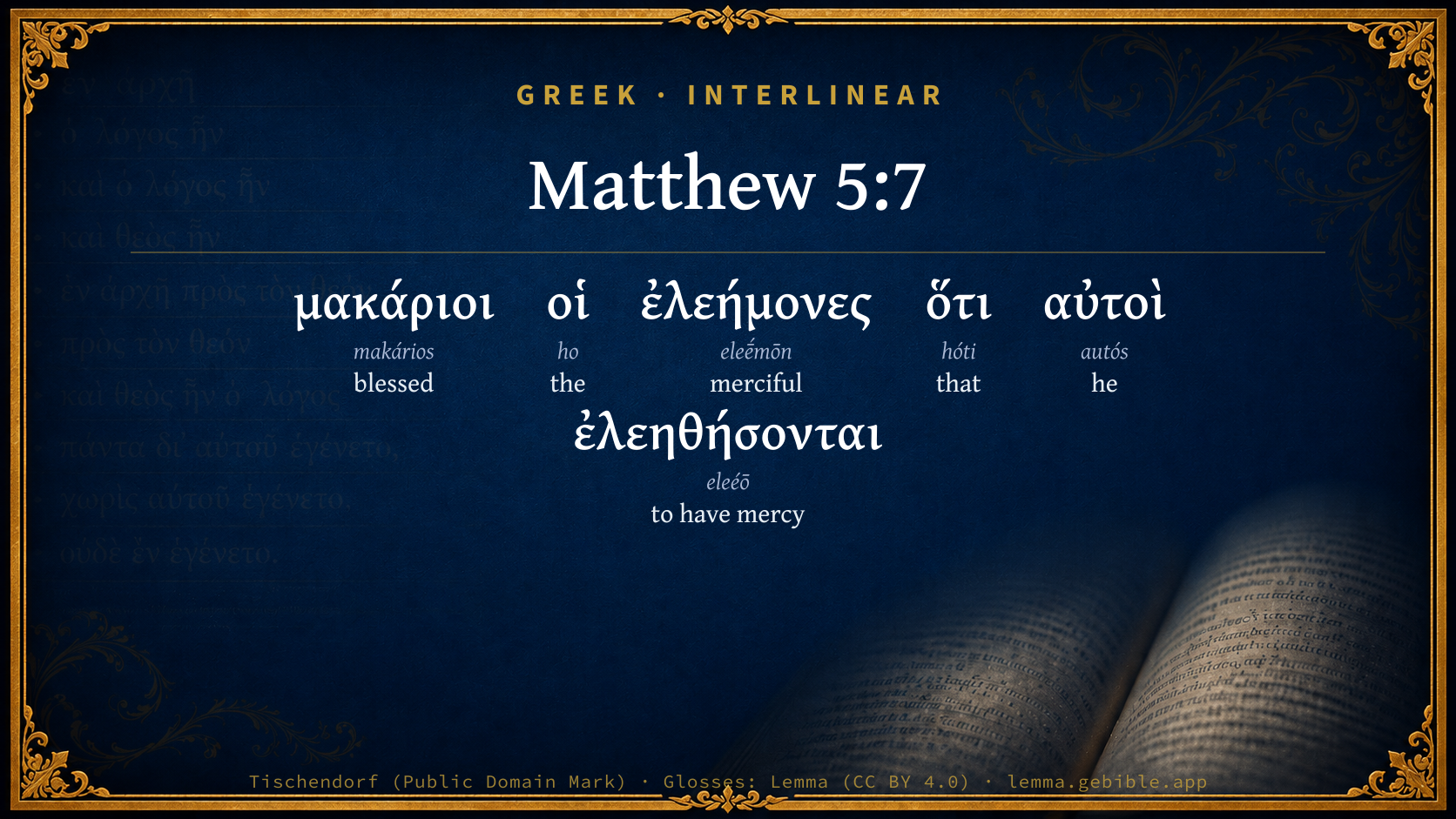
Download image
Cite this verse

Matthew 5:7 (World English Bible). Public Domain. Lemma interlinear Bible study tool, https://lemma.gebible.app/v/matthew/5/7.

Show BibTeX & RIS
BibTeX
RIS
English Translation
Blessed are the merciful, For they shall obtain mercy.
World English Bible · Public Domain
Highlights
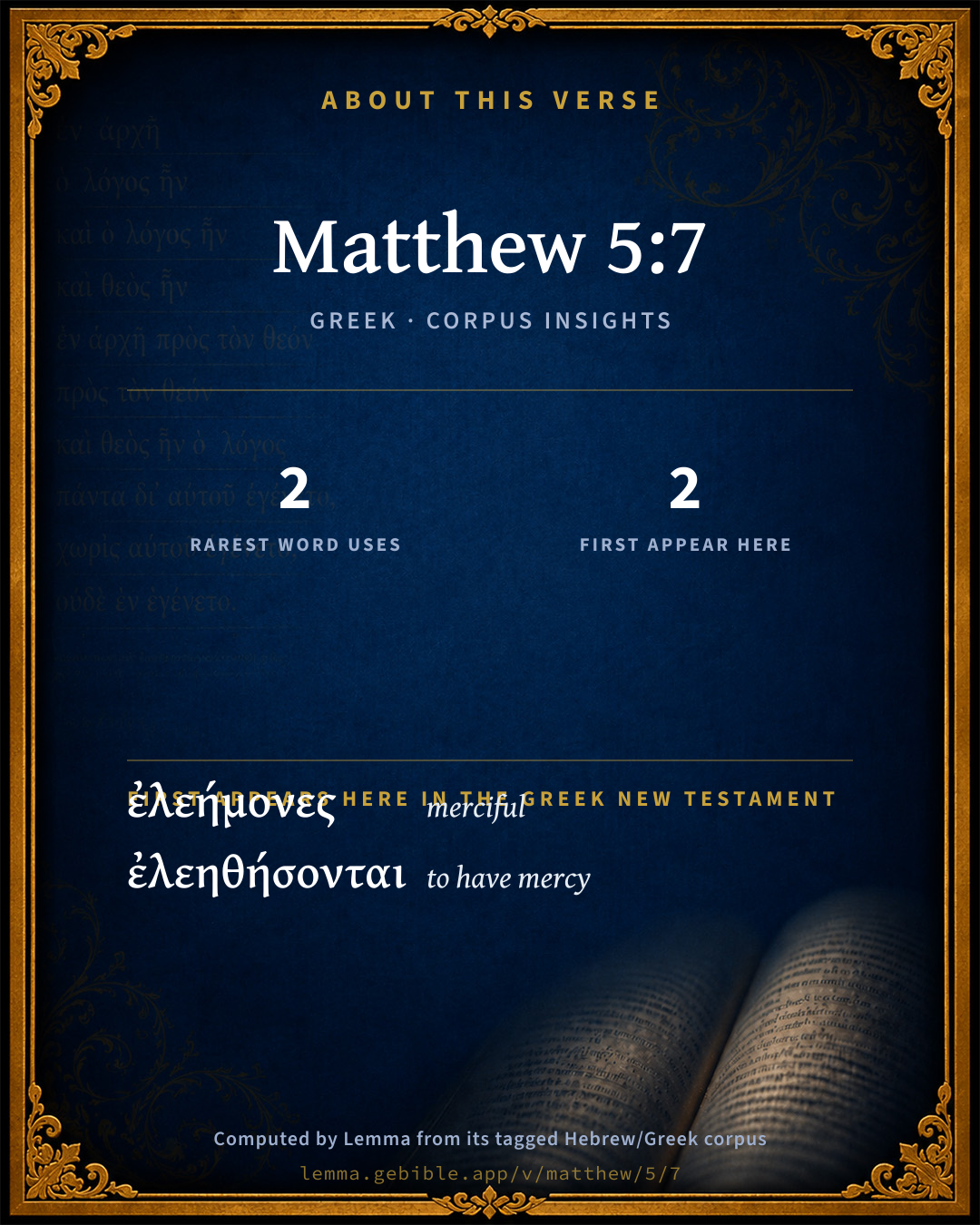
  • 2 first appearances in the Greek New Testament
Full analysis ↓
Download a study sheet

One document with this verse’s original text, its word-by-word gloss line, the meaning frame, cross-references with their text, attributed commentary, and full source and license credits — printable, and it pastes into notes with its structure intact.

This verse Autodidact and up

Study sheet (.html) Plain text (.txt)

A passage Seminary Student

Up to 50 verses in one chapter. A passage sheet keeps up to 6 commentary sources and 12 cross-references per verse, in the order this page ranks them, and says so on the sheet whenever that leaves anything out. Ask for a single verse and you get the Autodidact verse sheet above.

Everything on this page stays free to read, with no account — the sheet is a download of what is already on screen, not access to it.

Want to remove ads? Support Godless Engineer
Compare translations 3

The same verse in 3 English versions, stacked beneath the original-language interlinear above. Click any original word for its lexicon entry.

Each is an independent rendering of the whole verse — the interlinear is not word-aligned to these translations.

Highlighted words mark where these versions differ — a whole-verse word diff, not a word-by-word alignment.

  • World English Bible Public Domain
    Blessed are the merciful, For they shall obtain mercy.
  • King James Version Public Domain
    Blessed are the merciful: for they shall obtain mercy.
  • unfoldingWord Literal Text CC BY-SA 4.0
    Blessed the merciful, for they will obtain mercy.

unfoldingWord Literal Text — © unfoldingWord, licensed CC BY-SA 4.0. Word-aligned USFM3 via Door43 (git.door43.org/unfoldingWord/en_ult).

Versions to compare (up to 4)

3 of 4 selected

Show all 19 translations

Every available English version of this verse, each an independent rendering of the whole verse.

  • World English Bible Public Domain
    Blessed are the merciful, For they shall obtain mercy.
  • Berean Standard Bible Public Domain
    Blessed are the merciful, for they will be shown mercy.
  • Majority Standard Bible Public Domain
    Blessed are the merciful, for they will be shown mercy.
  • King James Version Public Domain
    Blessed are the merciful: for they shall obtain mercy.
  • American Standard Version (1901) Public Domain
    Blessed are the merciful: for they shall obtain mercy.
  • Revised Version (1885) Public Domain
    Blessed are the merciful: for they shall obtain mercy.
  • Geneva Bible (1599) Public Domain
    Blessed are the mercifull: for they shall obteine mercie.
  • Douay-Rheims (1899) Public Domain
    Blessed are the merciful: for they shall obtain mercy.
  • Young's Literal Translation Public Domain
    `Happy the kind -- because they shall find kindness.
  • Literal Standard Version CC BY-SA 4.0
    Blessed the kind—because they will find kindness.
  • Unlocked Literal Bible CC BY-SA 4.0
    Blessed are the merciful, for they will obtain mercy.
  • unfoldingWord Literal Text CC BY-SA 4.0
    Blessed the merciful, for they will obtain mercy.
  • Darby Bible Public Domain
    Blessed the merciful, for *they* shall find mercy.
  • World Messianic Bible Public Domain
    Blessed are the merciful, for they shall obtain mercy.
  • Webster's Bible Public Domain
    Blessed are the merciful: for they shall obtain mercy.
  • Free Bible Version CC BY-SA 4.0
    Blessed are those who are merciful, for they will be shown mercy.
  • Bible in Basic English Public Domain
    Happy are those who have mercy: for they will be given mercy.
  • Text-Critical English NT CC BY 4.0
    Blessed are the merciful, for they will receive mercy.
  • Tyndale New Testament (1534) Public Domain
    Blessed are the mercifull: for they shall obteyne mercy.

Literal Standard Version (2020), Covenant Press — licensed CC BY-SA 4.0. Text via the HelloAO Bible API (eBible.org). Unlocked Literal Bible (unfoldingWord) — licensed CC BY-SA 4.0. Text via the HelloAO Bible API (eBible.org). unfoldingWord Literal Text — © unfoldingWord, licensed CC BY-SA 4.0. Word-aligned USFM3 via Door43 (git.door43.org/unfoldingWord/en_ult). Free Bible Version, Dr. Jonathan Gallagher — licensed CC BY-SA 4.0. Text via the HelloAO Bible API (eBible.org).

Word by word

More ways to search: Search by grammar → Find every occurrence → Compare this word →

Practice this passage: Drill this verse → Learn its vocabulary →

About this verse

These counts appear in no published source. They are computed here, from the morphology-tagged text and Lemma’s own curated glosses. What Lemma adds →

6
words
6
distinct lemmas
Gospels
section

Notable vocabulary

The rarest word here is ἐλεήμονες merciful G1655 — appearing just 2 times in the whole Greek New Testament.

First appearance in Scripture

These words make their first canonical appearance in the Greek New Testament here:

  • ἐλεήμονες merciful G1655
  • ἐλεηθήσονται to have mercy G1653

Shared distinctive vocabulary

ἐλεήμονες merciful G1655 occurs in 2 verses of the Greek New Testament. Also found in:
Cross-references

34

Topical passages linked to Matthew 5:7 in the Treasury of Scripture Knowledge — connected by theme and wording, ordered by reader-vote popularity; previews shown in the World English Bible.

  • Ephesians 4:32–5:1 And be kind to one another, tenderhearted, forgiving each other, just as God also in Christ forgave you.
  • Matthew 6:14–15 "For if you forgive men their trespasses, your heavenly Father will also forgive you.
  • 2 Samuel 22:26 With the merciful you will show yourself merciful; With the perfect man you will show yourself perfect;
  • Matthew 18:33–35 Shouldn't you also have had mercy on your fellow servant, even as I had mercy on you?'
  • Psalms 18:25 With the merciful you will show yourself merciful. With the perfect man, you will show yourself perfect.
  • James 2:13 For judgment is without mercy to him who has shown no mercy. Mercy triumphs over judgment.
  • James 3:17 But the wisdom that is from above is first pure, then peaceful, gentle, reasonable, full of mercy and good fruits, without partiality, and without hypocrisy.
  • Colossians 3:12 Put on therefore, as God's chosen ones, holy and beloved, a heart of compassion, kindness, lowliness, humility, and perseverance;
  • Micah 6:8 He has shown you, O man, what is good. What does Yahweh require of you, but to act justly, To love mercy, and to walk humbly with your God?
  • Luke 6:35 But love your enemies, and do good, and lend, expecting nothing back; and your reward will be great, and you will be children of the Most High; for he is kind toward the unthankful and evil.
  • Proverbs 19:17 He who has pity on the poor lends to Yahweh; He will reward him.
  • Daniel 4:27 Therefore, O king, let my counsel be acceptable to you, and break off your sins by righteousness, and your iniquities by showing mercy to the poor; if there may be a lengthening of your tranquillity.
  • Hebrews 6:10 For God is not unrighteous, so as to forget your work and the labor of love which you showed toward his name, in that you served the saints, and still do serve them.
  • Psalms 41:1–4 Blessed is he who considers the poor: Yahweh will deliver him in the day of evil.
  • Proverbs 11:17 The merciful man does good to his own soul, But he who is cruel troubles his own flesh.
  • Hebrews 4:16 Let us therefore draw near with boldness to the throne of grace, that we may receive mercy, and may find grace for help in time of need.
  • Proverbs 14:21 He who despises his neighbor sins, But blessed is he who has pity on the poor.
  • Mark 11:25 Whenever you stand praying, forgive, if you have anything against anyone; so that your Father, who is in heaven, may also forgive you your transgressions.
  • 1 Peter 2:10 who in time past were no people, but now are God's people, who had not obtained mercy, but now have obtained mercy.
  • Hosea 2:1 "Say to your brothers, 'My people!' And to your sisters, 'My loved one!'
  • Psalms 37:26 All day long he deals graciously, and lends. His seed is blessed.
  • Psalms 112:4 Light dawns in the darkness for the upright, Gracious, merciful, and righteous.
  • Isaiah 58:6–12 Isn't this the fast that I have chosen: to loose the bonds of wickedness, to undo the bands of the yoke, and to let the oppressed go free, and that you break every yoke?
  • Psalms 112:9 He has dispersed, he has given to the poor. His righteousness endures forever. His horn will be exalted with honor.
  • 1 Timothy 1:13 although I was before a blasphemer, a persecutor, and insolent. However, I obtained mercy, because I did it ignorantly in unbelief.
  • 2 Timothy 1:16–18 May the Lord grant mercy to the house of Onesiphorus, for he often refreshed me, and was not ashamed of my chain,
  • Job 31:16–22 "If I have withheld the poor from their desire, Or have caused the eyes of the widow to fail,
  • 1 Corinthians 7:25 Now concerning virgins, I have no commandment from the Lord, but I give my judgment as one who has obtained mercy from the Lord to be trustworthy.
  • 1 Timothy 1:16 However, for this cause I obtained mercy, that in me first, Jesus Christ might display all his patience, for an example of those who were going to believe in him for eternal life.
  • Hosea 1:6 She conceived again, and bore a daughter. Then he said to him, "Call her name Lo-Ruhamah; for I will no longer have mercy on the house of Israel, that I should in any way pardon them.
  • Hosea 2:23 I will sow her to me in the earth; And I will have mercy on her who had not obtained mercy; And I will tell those who were not my people, 'You are my people;' And they will say, 'My God!'"
  • Isaiah 57:1 The righteous perishes, and no man lays it to heart; and merciful men are taken away, none considering that the righteous is taken away from the evil [to come].
  • Romans 11:30 For as you in time past were disobedient to God, but now have obtained mercy by their disobedience,
  • 2 Corinthians 4:1 Therefore seeing we have this ministry, even as we obtained mercy, we don't faint.

Cross-references courtesy of OpenBible.info (CC BY 4.0).

Commentary

Notes on Matthew 5:7 from classic Christian and Jewish commentators (each source and its license shown beneath its notes). The classic Christian expositions comment on the surrounding passage and are grouped to its opening verse, so a note may address several verses; the Jewish commentaries on the Tanakh (Rashi and others) are per-verse, so they appear only where the commentator wrote on this verse.

Lemma curates 59 commentaries, every one of them public domain or Creative Commons licensed, each selected and text-cleaned for this edition rather than reprinted as found. About our sources →

The Biblical Illustrator

Joseph S. Exell

Mat_5:7

The merciful.

Christian mercy

I. What is Christian mercy?

1. Its nature.

2. Its objects.

3. Its author.

4. Its design.

II. How is it exemplified?

1. In the forgiveness of enemies.

2. In various acts of kindness.

3. In deep concern and effort for the spread of the gospel.

III. What is the blessing which Christian mercy insures?

1. He will have mercy shown him from the subjects of his bounty.

2. A merciful Providence will attend the merciful Christian.

3. Mercy shall be shown him at the last day.

IV. A few observations to excite you to cherish a merciful disposition.

1. The more you abound in mercy, the more you are conformed to the precepts of the Scriptures.

2. The more you abound in mercy, the more will you resemble God.

3. The more we abound in mercy, the more eminently we appear to possess the spirit of Christ. (J. Jordan.)

The blessing of mercifulness

I. What is the character of this mercifulness? It is a quality exercised between man and man independent of written law, and which is not so much certain acts of forgiveness as a temper of the soul. It is a temper which makes him who has it not so much sorry that he has been injured, but sorry that the injurer should have the heart to do the wrong. All memory of wrong fades from him.

II. The reward. Christ did not mean a man to be merciful for the sake of obtaining mercy, but as a necessary result he would obtain it. Mercy is the reward of mercy. (S. A. Brooke.)

The sin of cruelty to animals

1. It is inconsistent with any just idea of the place assigned to man upon earth, and of the power granted to him over the other creatures, who occupy the same scene with himself.

2. It is out of harmony with the feelings and graces of character which ought to belong to all who profess the Christian faith.

3. It has a manifest tendency to pervert the entire moral nature of him who indulges it.

4. It is seen to be odious when we consider that the creatures against whom it is directed are those to whom man is most indebted for valuable service. (A. Goldie.)

I. What is implied in being merciful, and to whom does this character properly belong?

II. What is the blessedness promised?

III. The obligation we are under to be merciful. (Joseph Benson.)

The very first grace that grows, like a beautiful spring flower, on the ground of righteousness, is the grace of mercy, or compassion.

I. What is mercy, or compassion? It is sorrow at the suffering of a fellow-creature, rational or irrational, and, along with that sorrow, an earnest desire, if possible, to relieve it. It does not ask the question, Is the sufferer of my nation, sect, party, or Church; does the man deserve relief? It simply asks the question, Does he suffer? We are to go farther and to pity the sufferer as a sinner, and to show mercy to him simply because he is a sinner. This mercy is frequently enjoined in Holy Scripture, and always represented as the characteristic of the loftiest nature. This grace is obligatory upon all. In eider to exercise it, let us think of the mercy we have received.

II. The benediction pronounced upon it. Conscious joy. Special benedictions (Isa_58:6). Blessed because they are Godlike. They shall obtain mercy-from others in this world, and from God, even in this world, and at that day. (Dr. J. Cumming.)

Let me exhort you to deeds of mercy, let your fingers drop with the myrrh of liberality, sow your golden seed, and ye shall reap an abundant harvest.

I. In Christ: labour that your persons may be in Christ.

1. The best works not springing from faith are lost.

2. That fruit is most sweet and genuine which is brought forth in the Vine (Joh_15:14).

3. Out of Christ all our alms-deeds are but the fruit of the wild olive; they are not good works, but dead works.

II. For Christ: for His sake, that you may testify your love to Him. Love mellows and ripens our alms-deeds, it makes them a precious perfume to God.

III. All works of mercy are to be done in humility. As the silkworm, while she weaves her curious works hides herself within the silk, and is not seen, so we should hide ourselves from pride and vainglory. (Thomas Watson.)

I. Are we wanting in this grace of mercy? Let us compare ourselves with God. Gods mercy is changeless, ours is fitful. Gods mercy is provident and thoughtful, ours capricious and thoughtless.

II. How may we hope to have this mercy supplied to us? In the redemption of the fallen world by the Son of God. This thoughtful, universal, and provident mercy is unblurred by single line.

III. Are we merciful in judgment of others? In our speech? Do we not take pleasure in sharp criticism? Are we merciful in consideration for others? Are we merciful employers? (Dr. Chalmers Smith.)

The exercise of mercy chiefly consists of two things.

I. To prevent any evil or mischief which we apprehend our neighbour to be in.

(1) By abstaining from all acts of cruelty or unmercifulness towards anybody or creature;

(2) By using our dominion or authority over others with tenderness and moderation;

(3) By considering our neighbours case as our own.

II. To endeavour to deliver others from difficulties, or at least to ease others of their burdens.

(1) By warning our neighbour;

(2) By friendly admonition. Thus preventing our neighbour falling into evil or mischief;

(3) To comfort others in sickness, sorrow, reproach, or disgrace;

(4) To disperse slanders and aspersions;

(5) To help the needy, feed the hungry, clothe the naked, and take care of the poor. (Bishop Ofspring Blackall, D. D.)

Mercifulness a quality of the entire

man.

Mercifulness, then, is a quality of the whole nature; a certain soft, sweet, tender, gentle, gracious atmosphere in which the whole man lives and breathes; in which he continually acts toward injury and wrong; and under its warm and sunny rays injury and wrong melt away day by day, like icebergs that come floating down into the tropical stream. And those are blest who have it. They live in soft sunshine of their own making, and in it all the simple charities of life, which are like the common flowers that adorn and make sweet the woods and fields, flourish until the whole world rejoices in the life of those who live by mercy. And their speech is delightful as the songs of birds, and their daily acts like the soft murmur of such streams as gently flow through meadows. In all this inward beauty of soul they are blest indeed, for mercy blesses him who gives it. (S. A. Brooke.)

The Biblical Illustrator, edited by Joseph S. Exell (c. 1880s–1900s) — public domain. Text from a community e-Sword module.

Joseph Benson's Commentary

Mat 5:7. Blessed [or happy] are the merciful — The tender-hearted, compassionate, kind, and beneficent, who, being inwardly affected with the infirmities, necessities, and miseries of their fellow-creatures, and feeling them as their own, with tender sympathy endeavour, as they have ability, to relieve them; and who, not confining their efforts to the communicating of temporal relief to the needy and wretched, labour also to do spiritual good; to enlighten the darkness of men’s minds, heal the disorders of their souls, and reclaim them from vice and misery, from every unholy and unhappy temper, from every sinful word and work; always manifesting a readiness to forgive the faults of others, as they themselves need and expect forgiveness from God. The merciful, says Erasmus, are those “who, through brotherly love, account another person’s misery their own; who weep over the calamities of others; who, out of their own property, feed the hungry and clothe the naked; who admonish those that are in error, inform the ignorant, pardon the offending; and who, in short, use their utmost endeavours to relieve and comfort others.” They shall obtain mercy — When they most need it. As they deal with their fellow-creatures, God will deal with them. He will incline men to show them mercy and deal kindly with them in this world, and he himself will grant them mercy and loving kindness in the day of final accounts. And since the best and happiest of mankind may need even the former, and inasmuch as all will want the latter, this is surely a strong and powerful argument to persuade us to show mercy to men, in any and every way in our power, that both God and men may show mercy to us. Add to this, that, were there no other inducement, the comfort and satisfaction arising from a disposition that renders us so like our heavenly Father, might, one would suppose, be sufficient to prevail with us to endeavour, especially in this instance, to imitate Him who, being touched with the feeling of our infirmities, was daily employed in relieving them, and even took them upon himself, continually going about doing good, and at last giving up his life to ransom ours.

Joseph Benson's Commentary on the Old and New Testaments (1811–1818) — public domain. Text from a community e-Sword module.

Tyndale Open Study Notes

Tyndale Open Resources

5:7 Jesus made a cardinal virtue of being merciful, that is, showing kindness to those in distress (see 6:12, 14-15; 9:13; 12:7; 18:23-35; 23:23; 25:31-46). Those who are merciful now will find God’s mercy in the final judgment.

Tyndale Open Study Notes — © Tyndale Open Resources, licensed CC BY-SA 4.0. Text via the HelloAO Bible API.

Bengel's Gnomon

Johann Albrecht Bengel

Mat 5:7. Ἐλεήμονες, the merciful) The Greek word ἔλεος, ruth, from which ἐλεήμονες is derived, corresponds to the Hebrew חסך,[177] and does not refer merely to miserable objects.

[177] חֶסֶד … (1) in a good sense, zeal towards any one, love, kindness, specially (a) of men amongst themselves, benignity, benevolence, as shown in mutual benefits; mercy, pity, when referring to those in misfortune: Gen 21:23; 2Sa 10:2. LXX. often ἔλεος.—GESENIUS.—(I. B.)

Bengel's Gnomon of the New Testament — English translation (T&T Clark, Edinburgh, 1860) — public domain. Text from a community e-Sword module.

Meyer's Critical & Exegetical Commentary

Heinrich August Wilhelm Meyer

Mat_5:7. Οἱ ἐλεήμονες] the compassionate (Heb_2:17; Hom. Od. v. 191) in general, not, as de Wette arbitrarily limits it, in opposition to the desire for revenge and cruelty against the heathen, which were contained in the ordinary Messianic hopes.

ἐλεηθήσονται] that is, in this way, that they get assigned to them the salvation of the Messiahs kingdom, which will be the highest act of the divine compassion, Luk_1:72; Rom_9:16; Rom_5:17. The divine maxim, which lies at the foundation of the statement, Mat_7:2; Mat_25:35. Kienlen is wrong when he says the ἐλεηθ. refers to the forgiveness of the sins which still cleave even to the regenerate; it points to this, that the entire bestowal of Messianic salvation is the work of divine grace, which follows in its procedure its own moral rules (faith working by love).

Meyer — Critical and Exegetical Commentary on the New Testament — English translation by Peter Christie, edited by Frederick Crombie (T&T Clark, 1880) — public domain. Text from a community e-Sword module.

Expositor's Greek Testament

ed. W. Robertson Nicoll

Mat 5:7 . This Beatitude states a self-acting law of the moral world. The exercise of mercy ( ἔλεος , active pity) tends to elicit mercy from others God and men. The chief reference may be to the mercy of God in the final awards of the kingdom, but the application need not be restricted to this. The doctrine of Christ abounds in great ethical principles of universal validity: “he that humbleth himself shall be exalted,” “to him that hath shall be given,” etc. This Beatitude suitably follows the preceding. Mercy is an element in true righteousness (Mic 6:8 ). It was lacking in Pharisaic righteousness (Mat 23:23 ). It needed much to be inculcated in Christ’s time, when sympathy was killed by the theory that all suffering was penalty of special sin, a theory which fostered a pitiless type of righteousness (Schanz). Mercy may be practised by many means; “not by money alone,” says Euthy. Zig., “but by word, and if you have nothing, by tears” ( διὰ δακρύων ).

The Expositor's Greek Testament, edited by W. Robertson Nicoll (1897–1910) — public domain. Text from a community e-Sword module.

Jamieson, Fausset & Brown

Robert Jamieson, A. R. Fausset & David Brown

Blessed are the merciful: for they shall obtain mercy--Beautiful is the connection between this and the preceding beatitude. The one has a natural tendency to beget the other. As for the words, they seem directly fetched from Psa 18:25, "With the merciful Thou wilt show Thyself merciful." Not that our mercifulness comes absolutely first. On the contrary, our Lord Himself expressly teaches us that God's method is to awaken in us compassion towards our fellow men by His own exercise of it, in so stupendous a way and measure, towards ourselves. In the parable of the unmerciful debtor, the servant to whom his lord forgave ten thousand talents was naturally expected to exercise the small measure of the same compassion required for forgiving his fellow servant's debt of a hundred pence; and it is only when, instead of this, he relentlessly imprisoned him till he should pay it up, that his lord's indignation was roused, and he who was designed for a vessel of mercy is treated as a vessel of wrath (Mat 18:23-35; and see Mat 5:23-24; Mat 6:15; Jam 2:13). "According to the view given in Scripture," says TRENCH most justly, "the Christian stands in a middle point, between a mercy received and a mercy yet needed." Sometimes the first is urged upon him as an argument for showing mercy--"forgiving one another, as Christ forgave you" (Col 3:13; Eph 4:32): sometimes the last--"Blessed are the merciful: for they shall obtain mercy"; "Forgive, and ye shall be forgiven" (Luk 6:37; Jam 5:9). And thus, while he is ever to look back on the mercy received as the source and motive of the mercy which he shows, he also looks forward to the mercy which he yet needs, and which he is assured that the merciful--according to what BENGEL beautifully calls the benigna talio ("the gracious requital") of the kingdom of God--shall receive, as a new provocation to its abundant exercise. The foretastes and beginnings of this judicial recompense are richly experienced here below: its perfection is reserved for that day when, from His great white throne, the King shall say, "Come, ye blessed of My Father, inherit the kingdom prepared for you from the foundation of the world; for I was an hungered, and thirsty, and a stranger, and naked, and sick, and in prison, and ye ministered unto Me." Yes, thus He acted towards us while on earth, even laying down His life for us; and He will not, He cannot disown, in the merciful, the image of Himself.

Jamieson, Fausset & Brown — Commentary Critical and Explanatory on the Whole Bible (1871) — public domain (CC PDM 1.0). Text via the HelloAO Bible API.

Adam Clarke's Commentary

Verse 7. The merciful] The word mercy, among the Jews, signified two things: the pardon of injuries, and almsgiving. Our Lord undoubtedly takes it in its fullest latitude here. To know the nature of mercy, we have only to consult the grammatical meaning of the Latin word misericordia, from which ours is derived. It is composed of two words: miserans, pitying, and cor, the heart; or miseria cordis, pain of heart. Mercy supposes two things:

1. A distressed object: and,

2. A disposition of the heart, through which it is affected at the sight of such an object.

This virtue, therefore, is no other than a lively emotion of the heart, which is excited by the discovery of any creature's misery; and such an emotion as manifests itself outwardly, by effects suited to its nature. The merciful man is here termed by our Lord ελεημων, from ελεος, which is generally derived from the Hebrew חיל chil, to be in pain, as a woman in travail: or from ילל galal, to cry, or lament grievously; because a merciful man enters into the miseries of his neighbour, feels for and mourns with him.

They shall obtain mercy.] Mercy is not purchased but at the price of mercy itself; and even this price is a gift of the mercy of God. What mercy can those vindictive persons expect, who forgive nothing, and are always ready to improve every advantage they have of avenging themselves? Whatever mercy a man shows to another, God will take care to show the same to him. The following elegant and nervous saying of one of our best poets is worthy of the reader's most serious attention: -

"The quality of mercy is not strained;

It droppeth as the gentle rain from heaven

Upon the place beneath. It is twice blessed;

It blesseth him who gives, and him who takes:

'Tis mightiest in the mightiest: it becomes

The throned monarch better than his crown.

It is an attribute of God himself;

And earthly power doth then show likest God's,

When mercy seasons justice.--------

Though justice be thy plea, consider this,

That, in the course of justice, none of us

Should see salvation. We do pray for mercy;

And that same prayer doth teach us all to render

The deeds of mercy.--------

Why, all the souls that are, were forfeit once:

And he who might the 'vantage best have took

Found out the remedy. How would you be,

If He who is the top of judgment should

But judge you as you are? O! think on that;

And mercy then will breathe within your lips,

Like man, new made.

How shalt thou hope for mercy, rend'ring none?"

In the tract Shabbath, fol. 151, there is a saying very like this of our Lord.

"He who shows mercy to men, God will show mercy to him: but to him who shows no mercy to man, God will show no mercy.

Adam Clarke's Commentary on the Bible (1810–1826) — public domain. Text from a community e-Sword/MySword module.

Ellicott's Commentary for English Readers

(7) The merciful.—The thought is the same as that afterwards embodied in the Lord’s Prayer. They who are pitiful towards men their brethren are ipso facto the objects of the divine pity. The negative aspect of the same truth is presented in Jas_2:13. In this case, the promised blessing tends to perpetuate and strengthen the grace which is thus rewarded. No motive to mercy is so constraining as the feeling that we ourselves needed it and have found it.

A Bible Commentary for English Readers, edited by Charles John Ellicott (1878–1897) — public domain. Text from a community e-Sword module.

The Cambridge Bible for Schools and Colleges

gen. ed. J. J. S. Perowne

7. they shall obtain mercy] This principle in the divine Government that men shall be dealt with as they deal with their fellow-men is taught in the parable of the Unmerciful Servant, ch. 18, and underlies the fifth petition in the Lord’s Prayer, ch. Mat_6:12.

The Cambridge Bible for Schools and Colleges (gen. ed. J. J. S. Perowne; Cambridge University Press, 1878–1918) — public domain. Text from a community e-Sword module.

John Gill's Exposition

Blessed are the merciful,.... Who show mercy to the bodies of men, to those that are poor, indigent, and miserable, in their outward circumstances; by both sympathizing with them, and distributing unto them; not only making use of expressions of pity and concern; but communicating with readiness and cheerfulness, with affection and tenderness, and with a view to the glory of God: who also show mercy to the souls of men, by instructing such as are ignorant, giving them good counsel and advice: reproving them for sin, praying for them, forgiving injuries done by them, and by comforting those that are cast down. To show mercy is very delightful to, and desirable by God; it is what he requires, and is one of the weightier matters of the law; it is very ornamental to a child of God, and what makes him more like to his heavenly Father. The happiness of such persons is this, that

they shall obtain mercy; from man, whenever they are attended with any uncomfortable circumstances of life; , "whoever is merciful", men show mercy to him (d): and from God, through Christ; which is free, sovereign, abundant, and eternal. Men are said to obtain this, when they are regenerated, and called by grace; and when they have a discovery, and an application, of the forgiveness of their sins: but here, it seems to design those supplies of grace and mercy, which merciful persons may expect to find and obtain, at the throne of grace, to help them in time of need; and who shall not only obtain mercy of God in this life, but in the world to come, in the great day of the Lord; for which the Apostle prayed for Onesiphorus, Ti2 1:18.

(d) Maimon. Hilch. Mattanot Anayim. c. 10. sect. 2.

John Gill's Exposition of the Whole Bible (1746–1763) — public domain (CC PDM 1.0). Text via the HelloAO Bible API.

Trapp's Complete Commentary

John Trapp

7 Blessed are the merciful: for they shall obtain mercy.

Ver. 7. Blessed are the merciful, ελεημονες] They that from a compassionate heart (melting with sense of God’s everlasting mercy to itself, and yearning over the miseries of others) extend and exercise spiritual and corporal mercy. The former, which teacheth a man to warn the unruly, comfort the feeble minded, support the weak, be patient toward all men, &c., 1Th 5:14. The schoolmen thus, Consule, castiga, solare, remitte, fer, ora, usually excel and exceed the latter, which stirs a man up to feed the hungry, clothe the naked, visit the sick, &c., Mat 25:35-36.

" Visito, poto, cibo, redimo, tego, colligo, condo."

1. In the nature of the gift, which is more noble. 2. In the object (the soul), which is more illustrious. 3. In the manner, which is transcendent, as being spiritual. 4. In the kind, which is more heavenly, as that which aims at our brothers’ endless salvation. And this way the poorest may be plentiful, and enrich the richest with spiritual alms. As also the other way, something must be done by all the candidates of true blessedness. They that labour with their hands must have something to give to him that needeth, Eph 4:28; be it but two mites, nay, a cup of cold water, it shall be graciously accepted from a sincere heart, and certainly rewarded. And here the poor Macedonians may shame (and many times do) the rich Corinthians, that have a price in their hands but not a heart to use it; for it is the love, and not the lack, of money that makes men churls and misers. (Money hoarders have no quicksilver, no current coin. Ward.) And hence it is that the richer men are many times the harder, as Dives: being herein like children, who when they have their mouths full, and both hands full. yet will rather spoil all than give any away. But do men give to God’s poor or, do they not rather lend it to the Lord, who turns pay master to such? Do they not lay it out for him, or rather lay it up for themselves? The safest chest is the poor man’s box. Make you friends with the mammon of unrighteousness (God hath purposely branded riches with that infamous adjunct, that we might not overlove them), "that when ye fail, they may receive you into everlasting habitations," Luk 16:9, that is, either the angels, or the poor, or thy well employed wealth, shall let thee into heaven. Only thou must draw forth not thy sheaf alone, but thy soul also to the hungry, Isa 38:10: show bowels of mercy, as our Saviour did, σπλαγχνιζομαι, Mat 15:32, to bleed in other men’s wounds, and be deeply and tenderly affected in other men’s miseries. This is better than alms; for when one gives an alms, he gives something without himself; but by compassion we relieve another by somewhat within and from ourselves. And this is properly the mercy to which mercy is here promised, and blessedness to boot.

For they shall obtain mercy] Misericordiam, non mercedem, Mercy, not wages: it being a mercy (and not a duty) in God, to render unto every man according to his works, Psa 62:12. How much more according to his own works in us! But mercy he shall be sure of, that showeth mercy to those in misery. His soul shall be like a watered garden. "The liberal soul shall be made fat," saith Solomon; "and he that watereth shall be watered also himself," Pro 11:25; or (as Kimchi expounds it), He shall be a sweet and seasonable shower to himself and others. ( Etiam ipse pluvia erit, iuxta Kimchi. Insignis hyperbole. Merc.) His body also shall be fat and fair-liking. Thy health shall spring forth speedily, and thy bones shall be made fat, Isa 58:10-11. Or if he be sick, the Lord will strengthen him upon the bed of languishing, Psa 41:3; he will make all his bed in his sickness; as he did for that faithful and painful preacher of God’s word (while he lived) Master William Whately, Pastor of Banbury (whom for honour’s sake I here name), the most bountiful minister to the poor, I think (saith a learned gentleman that knew him thoroughly), in England, of his means. He abounded in works of mercy (saith another grave divine, that wrote his life), he set apart, and expended, for the space of many years, for good uses, the tenth part of his yearly comings in, both out of his temporal and ecclesiastical means of maintenance. (Edw. Leigh, Hen. Scudder.) A rare example: and God was not behind-hand with him; for in his sickness he could comfort himself with that precious promise, Psa 41:1; Psa 41:3 "Blessed is he that considereth the poor" ( Qui praeoccupat vocem petituri, saith Austin, in Psa 103:1-22); that prevents the poor man’s cry; as he did, for he devised liberal things, seeking out to find objects of his mercy, and not staying many times till they were offered. Therefore by liberal things he stood, as God had promised; his estate (as himself often testified) prospered the better after he took that course above mentioned. For, in the next place, not getting, but giving is the way to wealth, as the Sareptan found it, whose barrel had no bottom; and as Solomon assureth it, Ecc 11:1. The mercy of God crowneth our beneficence with the blessing of store. Thine horn shall be exalted with honour, and thou shalt not want, Psa 112:9; Pro 28:27. Say not then how shall our own do hereafter? Is not mercy as sure a gain as vanity? Is God like to break? Is not your Creator your creditor? Hath not he undertaken for you and yours? How sped Mephibosheth and Chimham for the kindness their fathers showed to distressed David? Were they not plentifully provided for? And did not the Kenites, that were born many ages after Jethro’s death, receive life from his dust, and favour from his hospitality? 1Sa 15:6.

John Trapp, A Commentary or Exposition upon All the Books of the Old and New Testament (1647–1656) — public domain. Text from a community e-Sword module.

Albert Barnes' Notes on the Bible

Blessed are the merciful - That is, those who are so affected by the sufferings of others as to be disposed to alleviate them. This is given as an evidence of piety, and it is said that they who show mercy to others shall obtain it. The same sentiment is found in Mat 10:42; “Whosoever shall give to drink unto one of these little ones a cup of cold water only, in the name of a disciple, verily I say unto you he shall in no wise lose his reward.” See also Mat 25:34-40. This should be done with a wish to glorify God; that is, in obedience to his commandments, and with a desire that he should be honored, and with a feeling that we are benefiting one of his creatures. Then he will regard it as done to him, and will reward us. See the sentiment of this verse, that the merciful shall obtain mercy, more fully expressed in 2Sa 22:26-27; and in Psa 18:25-26.

Nowhere do we imitate God more than in showing mercy. In nothing does God delight more than in the exercise of mercy, Exo 34:6; Eze 33:11; 1Ti 2:4; 2Pe 3:9. To us, guilty sinners; to us, wretched, dying, and exposed to eternal woe, he has shown his mercy by giving his Son to die for us; by expressing his willingness to pardon and save us; and by sending his Spirit to renew and sanctify our hearts. Each day of our life, each hour, and each moment, we partake of his undeserved mercy. All the blessings we enjoy are proofs of his mercy. If we, then, show mercy to the poor, the wretched, the guilty, it shows that we are like God. We have his spirit, and shall not lose our reward. And we have abundant opportunity to do it. Our world is full of guilt and woe, which we may help to relieve; and every day of our lives we have opportunity, by helping the poor and wretched, and by forgiving those who injure us, to show that we are like God. See the notes at Mat 6:14-15.

Albert Barnes' Notes on the Bible (1834–1885) — public domain. Text from a community e-Sword/MySword module.

Haydock's Catholic Bible Commentary

Not only the giving of alms, but the practice of all works of mercy, both corporal and spiritual, are recommended here, and the reward will be given on that day when God will repay every one according to his works, and will do by us, as we have done by our brethren. (Haydock)

George Leo Haydock (1774–1849), Haydock's Catholic Family Bible and Commentary, 1859 edition — public domain. Excludes Psalms (Douay-Rheims chapter numbering differs from Protestant) and Deuterocanonical books (Catholic canon only).

Matthew Poole's English Annotations

The men of the world bless themselves if they can take care of themselves, let others do what they will, and as well as they can: but I tell you, that those alone are the blessed men, who are touched with a true sense and feeling of the wants and miseries of others, and that not out of a mere goodness and tenderness of nature, but out of a true obedience to the will of God, and a sense of his love to them, and faith in his promises; and, moved from these principles, do not only pity and compassionate them, and wish them well, but extend their helping hand to them, suitably to their miseries: for these men shall obtain mercy, and that not only from men, if they come into straits and distress, but from the hand of God, Psa 37:26; 112:5,6; he doth not say they shall merit mercy at God’s hand, but they shall be mercified, they shall obtain mercy.

Matthew Poole's English Annotations on the Holy Bible (1683–1685) — public domain. Text from a community e-Sword/MySword module.

Whedon's Commentary on the Bible

Daniel D. Whedon

7. Blessed are the merciful — Mercy is the exercise of benevolence toward the unfortunate or guilty. It may and does exist as a natural quality in the human heart. It is an approvable trait which has survived the fall.

We must here distinguish between a virtue and a piety. A virtue may exist in unregenerate nature. It is an excellence. Nor is it, like some excellences, as beauty of person, elegance of manners, strength of intellect, taste for literature, a mere neutral excellence; for as a moral excellence it is in itself superior to any of these. Moral virtues stand as good by themselves, as approved by man, and even, in a sense, approved by God; inasmuch as even to God himself they are better than their absence, or their opposite instead.

But all mere virtue is defective unless the sanctifying grace of God brightens and heightens it to piety. For (1.) it is in itself defective, not being as perfect as it should be. (2.) Being defective, it cannot receive the unqualified favour of God. (3.) Virtues not heightened to piety may be used to wicked ends, as Absalom used his own justice, amiableness, and beauty to win Israel to rebellion. (4.) Mere unregenerate virtues cannot atone for our sins of countless multiplicity. They cannot stand in the place of the Redeemer; nay, they may ruin us by inducing us to make these a substitute for him.

Daniel D. Whedon (gen. ed.), Commentary on the Old and New Testaments (1874–1909) — public domain. Text from a community e-Sword module.

The Pulpit Commentary

Our Lord here turns more directly to the character of his followers in relation to men; and in the next three Beatitudes mentions particulars which might be suggested by the sixth, seventh, and ninth commandments. The merciful (oi elehmonev). The mercy referred to here is not so much the almost negative quality which the word usually suggests to us (not dealing harshly, not inflicting punishment when due, sparing an animal or a fellow-man some unnecessary labour), as active kindness to the destitute and to any who are in trouble. (cf. Mat_9:27 Mat_15:22 Mat_17:15 Mar_5:19) As compared with oiktirmonev , (Luk_6:36) it seems to lay more stress on the feeling of pity showing itself in action and not only existing in thought. To this statement of our Lord"s, that they who show mercy to those in need shall themselves be the objects of mercy (i.e. from God) in their time of need, many parallels have been adduced, e.g. , by Wetstein. Rabbi Gamaliel (?the second, circa A.D. 100), as reported by Rabbi Judah (circa A.D. 180), says (Talm. Bab., "Sabb.," 151 b), on Deu_13:18, "Every one that showeth mercy to others, they show mercy to him from heaven, and every one that showeth not mercy to others, they show him not mercy from heaven;" cf. also "Test. XII Patr.:" Zab., "In proportion as a man has compassion (splagcnizetai) on his neighbour, so has the Lord upon him;" and, probably with reference to this passage, Clem. Rom., eleate ina elehyhte . (For the converse, cf. Jam_2:13) Calvin remarks, "Hoc etiam paradoxon cum humano judicio pugnat. Mundus reputat beatos, qui malorum alienorum securi quieti suae consulunt: Christus autem hic beatos dicit, qui non modo ferendis propriis malis parati sunt, sed aliena etiam in se suscipiunt, ut miseris succurrant.

The Beatitude of mercy.

"Blessed are the merciful: for they shall obtain mercy." The line of cleavage that obtains so clearly in the tables of the ten commandments, between those of our duties that look direct to God and those which in their first action regard fellow-men, has not an exact parallel in the ever-welcome table of the Beatitudes. The distinction is probably in the nature of things not so apparent. Ten commandments readily admit a distinctness of classification which the expansive force of living and ever-growing qualities of soul do in part resolutely refuse. These act more freely and on their own account, and intermingle where they will and where they can. If such qualities and virtues at first seem to turn the face more Godward, in that very act none can fail to see how it is all the more laid upon them to be operative, and powerfully so, towards man; and vice versa. The distinction, nevertheless, does exist, and in some of the Beatitudes utters itself forth clearly. It is so with the one, fifth in order, now before us. Our mercifulness has no operation towards God, though it must be that he observes with an ever-open eye whether we observe it, and how liberally or otherwise we observe it to others! He taught the petition and its very wording, "Forgive us our trespasses, as we forgive them that trespass against us." Consider

I THE OBJECTS OF THIS BEATITUDE. They are the "merciful," i.e. those who have mercy of heart; and if they have this, it must be that they will show and practise it. A man may have money in his pocket and not show it. He may have some skill, some knowledge, some talent, in his composition, and may not show them. But mercy is that which, to have it, is to show it and "do" it. So a man cannot be credited with the "forgiving" disposition unless he habitually practise forgiveness. Mercy in itself is (with Remigius, presbyter, and monk of Auxerre, A.D. 880) "to count another"s misery or want one"s own, and to be sad at all another"s grief as at one"s own." The spring of it lies perhaps far away, concealed certainly from general sight and from feeble sight, high up in the hills. Sympathy is its twin rill, and its ever-fresh, crystal, flowing tributary. Its stream now has somehow become deep and full, and circles the world around; for it has become a vital necessity for human-kind. Its compass extends from the freshest, youngest possibilities of the works of the sweetest charity, to the anguished, shamed, smarting sense of pity awakened by and for the worst of sinners. Point special attention to:

1. The grand Exemplar of this quality, the mercy of God in Jesus Christ.

2. The crying, awful, supreme need of it, as poured on a world by him; and as multiplying itself then by the myriad (however weak and small yet) genuine reproductions of its own spirit,

3. The wide, universal use of it every-where, in everything, in the home, the city, the Church, the nation, for the body and for the soul where is there the variety or where the grouping of society which does not hang precarious on mercy and its works?

4. The deep degradation signified by the absence of it, and illustrated so patently, so lamentably, wherever in the world, on smaller or larger scale, the level of it is now lowest. Contrast the world of Christian mercy with all its imperfection, and every blot that lies upon it, and all its wayward inconsistency, i.e. at its worst, with the unchristian world, to which mercy is a stranger all but absolute. Mercy is indeed "mightiest in the mightiest;" but of the mightiest earth has not a pattern to show, unless mercy be there to give the solid strength and enduring framework. Only mercy has in it to find what can meet and bear the strain.

II THE PROMISE ON WHICH THEIR BLESSEDNESS IS BASED. "They shall obtain mercy." This assurance is the justification and the original of that claim on behalf of mercy that it is "twice blessed," blessing him that gives as well as him that takes. Point forcible attention to the fact that here it is signified:

1. That "to obtain mercy" is indeed blessedness. Is it not the necessary deep foundation of all individual and all real blessedness? Quote and compare the beautiful and encouraging exhortation," Let us therefore come boldly to the throne of grace, that we may obtain mercy," as if to say that it is the first and last great effect of the throne of grace.

2. That as "God is not unrighteous to forget the work and labour of love" which is "showed toward his Name" when any "minister to the saints," so certainly he specially appraises this ministry, whether showed to the saints, or possibly yet more, when not shown to saints at all, viz. the ministry of mercifulness.

3. That the reward apparently set forth here, as the return of mercy for mercy, is no mere equivalent. Far otherwise; for, as Chrysostom says, "human mercy and Divine mercy cannot be put on an equality." The latter is "much more nay, is it not infinitely "much more"? The two are compared by the warrant of this very passage. But is it not only in one sense, important and significant indeed, but yet limited, that they are compared, viz. for the motive of them? Intrinsically are they not incomparable? The mercifulness of a human heart taught of God, touched by Jesus, is indeed the evidence of its parentage, and a most grateful one. But what mercy of human action can for a moment compare with that here in view when it is said, "for they shall obtain mercy"?

CONCLUSION. Let all lay to heart what, in the estimate of Jesus Christ, must be the place in the world, and in human life and all the compass of its social relations, for this grace of mercifulness, that it should be enshrined in this elegant, chaste temple of the Beatitude, and fill one niche out of so sacred a nine! B.

The Pulpit Commentary (1880–1919), ed. H.D.M. Spence-Jones & Joseph S. Exell — public domain. Text from a community e-Sword module.

John Wesley's Explanatory Notes

The merciful - The tender-hearted: they who love all men as themselves: They shall obtain mercy - Whatever mercy therefore we desire from God, the same let us show to our brethren. He will repay us a thousand fold, the love we bear to any for his sake.

John Wesley, Explanatory Notes Upon the Whole Bible (1754–1765) — public domain. Text via the GEBible commentary corpus.

Kretzmann's Popular Commentary

Paul E. Kretzmann

One of the chief proofs of the Christian’s piety is mercy:

v. 7. Blessed are the merciful, for they shall obtain mercy.

A heart filled with deep sympathy and sincere compassion for the temporal and spiritual need of the neighbor, that is deeply concerned for, and earnestly endeavors to do good to, all men, especially such as are of the household of faith, is well-pleasing to the Lord. And all the efforts thus made, insignificant as they may seem even in the Christian’s own estimation, will receive, as a reward of mercy, the compassion of God Himself.

Paul E. Kretzmann, Popular Commentary of the Bible (1921–1924) — public domain. Text from a community e-Sword module.

Burkitt's Expository Notes on the New Testament

William Burkitt

Here our blessed Redeemer recommends to us a compassionate regard towards the miseries of others, and that both in soul and body, name and estate; to be forward to pity and pardon, to relieve and help, to give and forgive.

And as an encouragement, he adds, that as we deal with others, God will deal with us; our charity towards men shall be crowned with mercy from God, and that in abundance too; for our rivulet of charity we shall partake of an ocean of mercy: Blessed are the merciful, for they shall obtain mercy.

Learn, That the merciful man is a blessed man, and therefore blessed because he shall obtain mercy, when he most wants it, and most desires it. Mercy, not wages.

William Burkitt's Expository Notes on the New Testament (1700–1703) — public domain. Text from a community e-Sword module.

The People's New Testament

B. W. Johnson

7. Blessed are the merciful. The merciful, those who, instead of resenting injury, are ready to forgive, shall obtain the divine mercy. The fifth petition of the Lord's prayer implies that we must forgive if we expect to be forgiven.

B. W. Johnson's The People's New Testament with Notes (1889–1891) — public domain. Electronic text from the Christian Classics Ethereal Library (CCEL) ThML edition.

Cambridge Greek Testament for Schools and Colleges

7. ἐλεήμονες. With the Stoics ἔλεος was reckoned among the defects or vices, it was a disturbing element that broke in upon the philosophic calm, cp. the following passage which gives the Stoic view of most of the moral ideas of the Beatitudes: ὁ ἀπειθῶν τῇ θείᾳ διοικήσει ἔστω ταπεινός, ἔστω δοῦλος, λυπείσθω, φθονείτω, ἐλεείτω· τὸ κεφάλαιον πάντων δυστυχείτω, θρηνείτω. Epict. Diss. III. 24. 43.

ἐλεηθήσονται. This principle in the divine government that men shall be dealt with as they deal with their fellow-men is taught in the parable of the Unmerciful Servant, ch. 18, and underlies the fifth petition in the Lord’s Prayer, ch. Mat 6:12.

Cambridge Greek Testament for Schools and Colleges (Cambridge University Press, 1896; 21 vols, various authors incl. Carr, Maclear, Plummer, Farrar, Lumby, Moule, M. R. James, Simcox) — public domain. Text from a community e-Sword module.

Alford’s Greek Testament

Henry Alford

7. ἐλεήμονες] οὐχὶ διὰ χρημάτων μόνον ἐστὶν ἐλεεῖν, ἀλλὰ καὶ λόγου· κἂν μηδὲν ἔχῃς, διὰ δακρύων. ποικίλος γὰρ ὁ τῆς ἐλεημοσύνης τρόπος, καὶ πλατεῖα αὕτη ἡ ἐντολή. ἐλεηθήσονται δέ, ἐνταῦθα μὲν παρὰ ἀνθρώπων· ἐκεῖ δὲ παρὰ τοῦ θεοῦ. Euthymius, expanding Chrysostom. This beatitude comprises every degree of sympathy and mutual love and help; from that fulness of it which is shed abroad in those who have been forgiven much, and therefore love much,—down to those first beginnings of the new birth, even among those who know not the Lord, which are brought out in ch. 25:37-40, where see notes.

Henry Alford, The Greek Testament (1849–1861) — public domain. Text from a community e-Sword module.

International Critical Commentary

(L) 7. Blessed are the merciful: because they shall obtain mercy.] i.e. in the day of judgement.

International Critical Commentary — older volumes (1896–1929), various authors — public domain. Text from a community e-Sword module.

Vincent's Word Studies in the New Testament

Marvin R. Vincent

The merciful. See on Luk 1:50.

Marvin R. Vincent, Word Studies in the New Testament (1887–1900) — public domain. Text from a community e-Sword/MySword module.

Lesson kit

Teaching starters — assembled from the data on this page, not authored interpretation. Every prompt links to the verse data it draws on. Edit before teaching.

Matthew, in the Gospels, opens this verse with 6 words (6 distinct Greek lemmas). Its most distinctive word is eleḗmōn (“merciful”). A historical commentator’s framing appears above. Read the whole chapter for the surrounding context.

Discussion questions

  1. The word eleḗmōn carries the sense “merciful.” How does it shape the verse?
  2. 2 words here appear for the first time in Scripture. What is being introduced at this debut?
  3. Hebrews 2:17 shares the word «merciful» with this verse. How do the two illuminate each other?
  4. These translations render this verse differently. What is at stake in choosing one wording over another?
  5. Reading how The Biblical Illustrator and Joseph Benson's Commentary read this verse, where do the two commentators agree and where do they part?

Things to notice

  • 2 words make their first canonical appearance in Scripture here.
  • These translations choose different wording for 2 words in this verse.
  • 6 distinct Greek lemmas span 6 words in this verse.

Reading settings

Reading text

Shown beneath each verse's original-language words.

Old Testament
Old Testament edition

Read the OT as the Masoretic Hebrew (MT) or the Greek Septuagint (LXX).

English shown for the Greek Septuagint (in the Hebrew ↔ Greek comparison).

Comparing translations? Open the Compare panel on any verse page to stack up to four side by side.