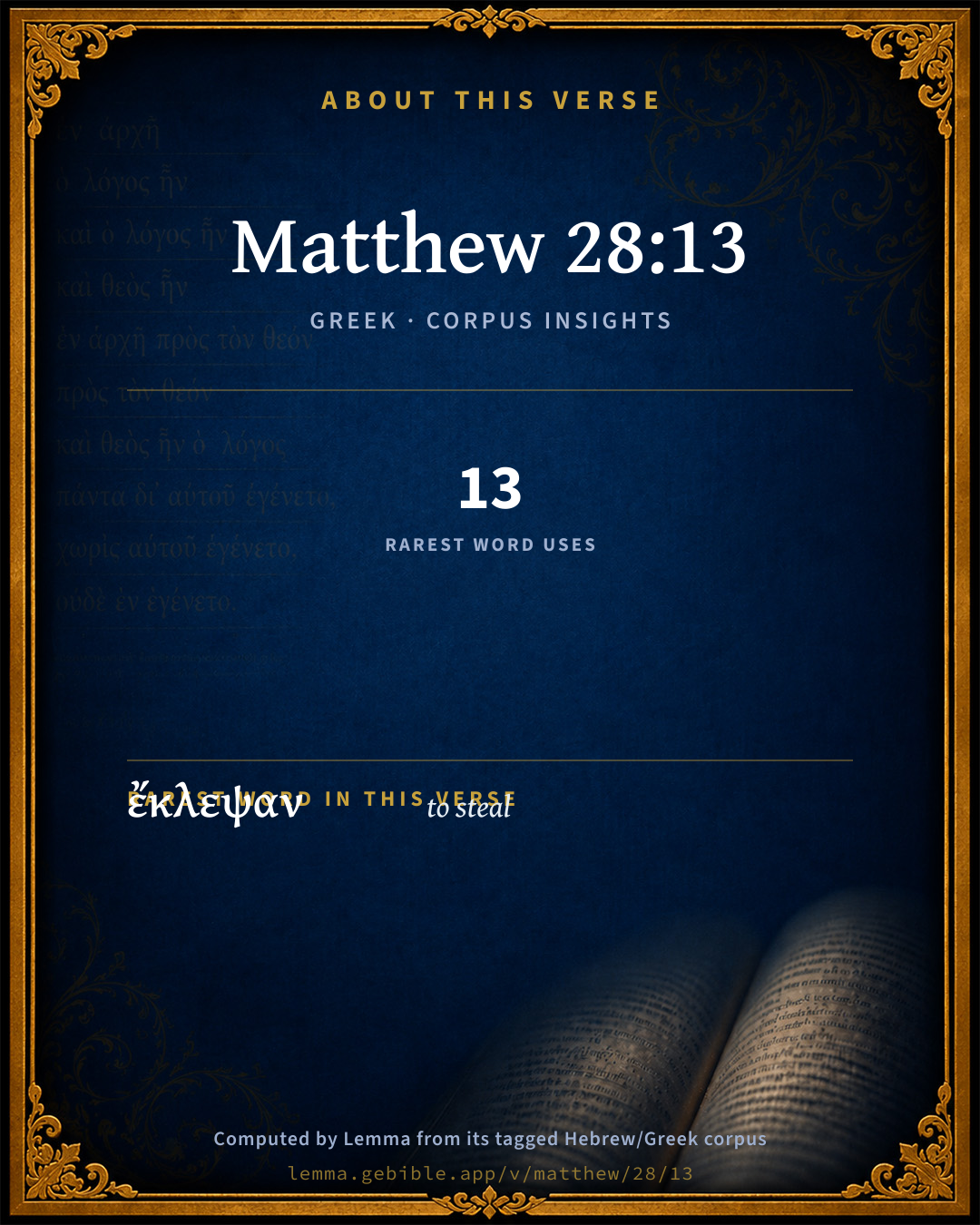
Matthew 28:13

Greek (Tischendorf 8th ed.) Matthew 28:13 appears in the Greek New Testament. The text above is from the Tischendorf 8th edition. Each word links to its Strong’s number and a concise gloss. Click any word for its full Thayer’s Greek Lexicon entry.
Download image
Cite this verse

Matthew 28:13 (World English Bible). Public Domain. Lemma interlinear Bible study tool, https://lemma.gebible.app/v/matthew/28/13.

Show BibTeX & RIS
BibTeX
RIS
English Translation
saying, "Say that his disciples came by night, and stole him away while we slept.
World English Bible · Public Domain
Download a study sheet

One document with this verse’s original text, its word-by-word gloss line, the meaning frame, cross-references with their text, attributed commentary, and full source and license credits — printable, and it pastes into notes with its structure intact.

This verse Autodidact and up

Study sheet (.html) Plain text (.txt)

A passage Seminary Student

Up to 50 verses in one chapter. A passage sheet keeps up to 6 commentary sources and 12 cross-references per verse, in the order this page ranks them, and says so on the sheet whenever that leaves anything out. Ask for a single verse and you get the Autodidact verse sheet above.

Everything on this page stays free to read, with no account — the sheet is a download of what is already on screen, not access to it.

Want to remove ads? Support Godless Engineer
Compare translations 3

The same verse in 3 English versions, stacked beneath the original-language interlinear above. Click any original word for its lexicon entry.

Each is an independent rendering of the whole verse — the interlinear is not word-aligned to these translations.

Highlighted words mark where these versions differ — a whole-verse word diff, not a word-by-word alignment.

  • World English Bible Public Domain
    saying, "Say that his disciples came by night, and stole him away while we slept.
  • King James Version Public Domain
    Saying, Say ye, His disciples came by night, and stole him away while we slept.
  • unfoldingWord Literal Text CC BY-SA 4.0
    saying, “Say, ‘His disciples, having come at night, stole him, we sleeping.’

unfoldingWord Literal Text — © unfoldingWord, licensed CC BY-SA 4.0. Word-aligned USFM3 via Door43 (git.door43.org/unfoldingWord/en_ult).

Versions to compare (up to 4)

3 of 4 selected

Show all 19 translations

Every available English version of this verse, each an independent rendering of the whole verse.

  • World English Bible Public Domain
    saying, "Say that his disciples came by night, and stole him away while we slept.
  • Berean Standard Bible Public Domain
    and instructed them: “You are to say, ‘His disciples came by night and stole Him away while we were asleep.’
  • Majority Standard Bible Public Domain
    and instructed them: “You are to say, ‘His disciples came by night and stole Him away while we were asleep.’
  • King James Version Public Domain
    Saying, Say ye, His disciples came by night, and stole him away while we slept.
  • American Standard Version (1901) Public Domain
    saying, Say ye, His disciples came by night, and stole him away while we slept.
  • Revised Version (1885) Public Domain
    saying, Say ye, His disciples came by night, and stole him away while we slept.
  • Geneva Bible (1599) Public Domain
    Saying, Say, His disciples came by night, and stole him away while we slept.
  • Douay-Rheims (1899) Public Domain
    Saying: Say you, His disciples came by night, and stole him away when we were asleep.
  • Young's Literal Translation Public Domain
    saying, `Say ye, that his disciples having come by night, stole him -- we being asleep;
  • Literal Standard Version CC BY-SA 4.0
    saying, “Say that His disciples having come by night, stole Him—we being asleep;
  • Unlocked Literal Bible CC BY-SA 4.0
    and told them, “Say to others, 'Jesus' disciples came by night and stole his body while we were sleeping.'
  • unfoldingWord Literal Text CC BY-SA 4.0
    saying, “Say, ‘His disciples, having come at night, stole him, we sleeping.’
  • Darby Bible Public Domain
    saying, Say that his disciples coming by night stole him [while] we [were] sleeping.
  • World Messianic Bible Public Domain
    saying, “Say that his disciples came by night and stole him away while we slept.
  • Webster's Bible Public Domain
    Saying, Say ye, His disciples came by night, and stole him away while we slept.
  • Free Bible Version CC BY-SA 4.0
    “Say that his disciples came during the night and stole him while we were sleeping,” they told the soldiers.
  • Bible in Basic English Public Domain
    Say, His disciples came by night and took him away secretly while we were sleeping.
  • Text-Critical English NT CC BY 4.0
    and said, “Tell people, ‘His disciples came by night and stole him away while we were sleeping.’
  • Tyndale New Testament (1534) Public Domain
    sayinge: Saye that his disciples came by nyght and stole him awaye whill ye slept.

Literal Standard Version (2020), Covenant Press — licensed CC BY-SA 4.0. Text via the HelloAO Bible API (eBible.org). Unlocked Literal Bible (unfoldingWord) — licensed CC BY-SA 4.0. Text via the HelloAO Bible API (eBible.org). unfoldingWord Literal Text — © unfoldingWord, licensed CC BY-SA 4.0. Word-aligned USFM3 via Door43 (git.door43.org/unfoldingWord/en_ult). Free Bible Version, Dr. Jonathan Gallagher — licensed CC BY-SA 4.0. Text via the HelloAO Bible API (eBible.org).

Word by word

More ways to search: Search by grammar → Find every occurrence → Compare this word →

Practice this passage: Drill this verse → Learn its vocabulary →

ἔκλεψαν
kléptō
G2813
“to steal”
Verb, Aorist, Active, Indicative, 3rd person, Plural
Part of Speech
Verb
Tense
Aorist
Voice
Active
Mood
Indicative
Person
3rd person
Number
Plural
Full Thayer's Definition

Origin: a primary verb

TDNT: 15:34,4

1. to steal a. to commit a theft b. take away by theft i.e take away by stealth
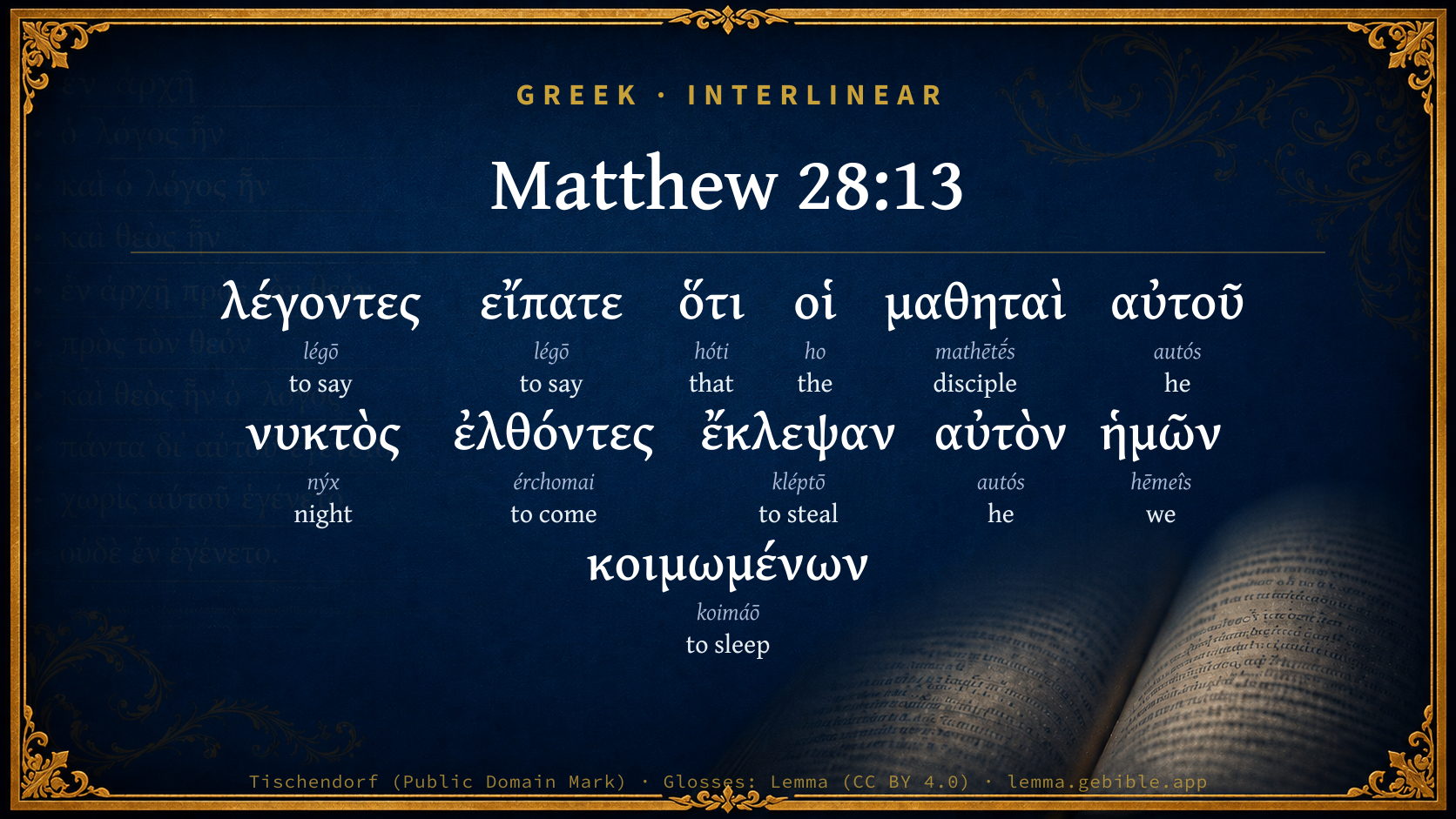
  1. λέγοντες légō G3004 “to say” Verb, Present, Active, Participle, Nominative, Plural, Masculine
  2. εἴπατε légō G3004 “to say” Verb, Aorist, Active, Imperative, 2nd person, Plural
  3. ὅτι hóti G3754 “that” Conjunction
  4. οἱ ho G3588 “the” Article, Nominative, Plural, Masculine
  5. μαθηταὶ mathētḗs G3101 “disciple” Noun, Nominative, Plural, Masculine
  6. αὐτοῦ autós G846 “he” Personal pronoun, Genitive, Singular, Masculine
  7. νυκτὸς nýx G3571 “night” Noun, Genitive, Singular, Feminine
  8. ἐλθόντες érchomai G2064 “to come” Verb, Aorist, Active, Participle, Nominative, Plural, Masculine
  9. αὐτὸν autós G846 “he” Personal pronoun, Accusative, Singular, Masculine
  10. ἡμῶν hēmeîs G2249 “we” Personal pronoun, 1st person, Genitive, Plural
  11. κοιμωμένων koimáō G2837 “to sleep” Verb, Present, Passive, Participle, Genitive, Plural, Masculine

About this verse

These counts appear in no published source. They are computed here, from the morphology-tagged text and Lemma’s own curated glosses. What Lemma adds →

12
words
10
distinct lemmas
Gospels
section

Notable vocabulary

The rarest word here is ἔκλεψαν to steal G2813 — appearing just 13 times in the whole Greek New Testament.

Shared distinctive vocabulary

ἔκλεψαν to steal G2813 occurs in 11 verses of the Greek New Testament. Also found in:

Repetition

Words recur within this verse:

  • λέγοντες to say G3004 ×2
  • αὐτοῦ he G846 ×2

Cross-references

1

Topical passages linked to Matthew 28:13 in the Treasury of Scripture Knowledge — connected by theme and wording, ordered by reader-vote popularity; previews shown in the World English Bible.

  • Matthew 26:64 Jesus said to him, "You have said it. Nevertheless, I tell you, henceforth you will see the Son of Man sitting at the right hand of Power, and coming on the clouds of the sky."

Cross-references courtesy of OpenBible.info (CC BY 4.0).

Commentary

Notes on Matthew 28:13 from classic Christian and Jewish commentators (each source and its license shown beneath its notes). The classic Christian expositions comment on the surrounding passage and are grouped to its opening verse, so a note may address several verses; the Jewish commentaries on the Tanakh (Rashi and others) are per-verse, so they appear only where the commentator wrote on this verse.

Lemma curates 59 commentaries, every one of them public domain or Creative Commons licensed, each selected and text-cleaned for this edition rather than reprinted as found. About our sources →

Tyndale Open Study Notes

Tyndale Open Resources

28:13 stole his body: Tomb robbery was a common problem in the ancient world, so such an accusation would have been entirely believable.

Tyndale Open Study Notes — © Tyndale Open Resources, licensed CC BY-SA 4.0. Text via the HelloAO Bible API.

Bengel's Gnomon

Johann Albrecht Bengel

Mat 28:13. Εἴπατε, κ.τ.λ., say, etc.) The priests were a great stumbling-block to the soldiers, and sinned most heinously against God.—ὅτι, κ.τ.λ., that, etc.) A specimen of Jewish perfidy and calumny.—νυκτὸς, by night) They instruct them how to lie speciously.

Bengel's Gnomon of the New Testament — English translation (T&T Clark, Edinburgh, 1860) — public domain. Text from a community e-Sword module.

Expositor's Greek Testament

ed. W. Robertson Nicoll

Mat 28:13 . εἴπατε , introducing the lie they put into the mouths of the soldiers. The report to be set abroad assumes that there is a fact to be explained, the disappearance of the body. And it is implied that the statement to be given out as to that was known by the soldiers to be false: i.e. , they were perfectly aware that they had not fallen asleep at their post and that no theft had taken place. The lie for which the priests paid so much money is suicidal; one half destroys the other. Sleeping sentinels could not know what happened.

The Expositor's Greek Testament, edited by W. Robertson Nicoll (1897–1910) — public domain. Text from a community e-Sword module.

Jamieson, Fausset & Brown

Robert Jamieson, A. R. Fausset & David Brown

Saying, Say ye, His disciples came by night, and stole him away while we slept--which, as we have observed, was a capital offense for soldiers on guard.

Jamieson, Fausset & Brown — Commentary Critical and Explanatory on the Whole Bible (1871) — public domain (CC PDM 1.0). Text via the HelloAO Bible API.

Adam Clarke's Commentary

Verse 13. His disciples came by night] This was as absurd as it was false. On one hand, the terror of the disciples, the smallness of their number (only eleven;) and their almost total want of faith; on the other, the great danger of such a bold enterprise, the number of armed men who guarded the tomb, the authority of Pilate and of the Sanhedrin, must render such an imposture as this utterly devoid of credit.

Stole him away while we slept.] Here is a whole heap of absurdities.

1st. Is it likely that so many men would all fall asleep, in the open air, at once?

2dly. Is it at all probable that a Roman guard should be found off their watch, much less asleep, when it was instant death, according to the Roman military laws, to be found in this state?

3dly. Could they be so sound asleep as not to awake with all the noise which must be necessarily made by removing the great stone, and taking away the body?

4thly. Is it at all likely that these disciples could have had time sufficient to do all this, and to come and return, without being perceived by any person? And

5thly. If they were asleep, how could they possibly know that it was the disciples that stole him, or indeed that any person or persons stole him? - for, being asleep, they could see no person. From their own testimony, therefore, the resurrection may be as fully proved as the theft.

Adam Clarke's Commentary on the Bible (1810–1826) — public domain. Text from a community e-Sword/MySword module.

Ellicott's Commentary for English Readers

(13) His disciples came by night.—The story was on the face of it self-contradictory. How could they tell, if they had been asleep, who had stolen the body? All that they could know was that they had fallen asleep, and that when they awoke the sepulchre was open and empty.

A Bible Commentary for English Readers, edited by Charles John Ellicott (1878–1897) — public domain. Text from a community e-Sword module.

The Cambridge Bible for Schools and Colleges

gen. ed. J. J. S. Perowne

13. while we slept] The penalty for which would be death.

The Cambridge Bible for Schools and Colleges (gen. ed. J. J. S. Perowne; Cambridge University Press, 1878–1918) — public domain. Text from a community e-Sword module.

John Gill's Exposition

Saying, say ye his disciples came by night,.... They charged them to tell every one that should ask them about this affair; and even publish it every where, that the disciples of Christ came in the dead of the night,

and stole him away while we slept: which was a very unlikely thing, and a foolish scheme this, for such a body of men to form. There is no show of probability in it, that the disciples, who were intimidated by the taking and putting Christ to death, and were now shut up in a house, for fear of the Jews, that these should venture out in the night, to take away the body of Christ, which was decently and honourably interred in a garden of one of his disciples: and when they knew it was guarded by a company of Roman soldiers; and who besides had no notion of his resurrection from the dead, nor never thought of it till he was risen, and therefore would never attempt any thing of this kind, in order to give out such a report. Moreover, had they took it away by stealth, it is not reasonable to think that they would afterwards have reported such a lie every where, that he was risen from the dead, when they were sure to obtain nothing by it, but reproach, afflictions, persecutions, and death: add to this, that this was never objected to them by their worst enemies, when they most strongly asserted his resurrection: nor was it a feasible account, or well put together, with respect to the watch. It can hardly be thought that they should be all of them asleep at once; and if they were, it is much they were not awaked by the coming up of the disciples, and the rolling away of the stone, and the bustle there must be in taking up the body, and carrying it away; and besides, if they were asleep, and continued so, what is their evidence good for? for how could they know that his disciples came and took him away? if they awaked, though too late, and saw them at a distance, why did not they pursue them, who might easily have been overtaken with such a burden? at least, why did not they search their houses for the body? and take up both the women and the disciples, and prosecute them for it? and yet nothing of this was done. Besides, how came the linen clothes to be left behind? why did they take the napkin from his head, and give themselves all that trouble to unwrap the body, and carry it away naked? It is clear the chief priests themselves were convinced in their own minds, that he was truly risen, or they would have punished the soldiers severely for their sleep and negligence, and would never have given them money to spread such a story.

John Gill's Exposition of the Whole Bible (1746–1763) — public domain (CC PDM 1.0). Text via the HelloAO Bible API.

Trapp's Complete Commentary

John Trapp

13 Saying, Say ye, His disciples came by night, and stole him away while we slept.

Ver. 13. Stole him away while we slept] If it were Son 1:1-17. Ye keep a good watch the while; and wanted some Epaminondas to slay you for sleeping. 2. If all asleep, who told you his disciples stole him? Did you sleep waking, as lions do? or did they make so little noise that you never heard them about it? as Sir Francis Drake, at Trurapasa in the West Indies, found a Spaniard sleeping securely upon the shore, and by him 13 wedges of silver, which he commanded to be carried away, not so much as once waking the man. Surely here it was neither so, nor so; but the devil, who began at first his kingdom by lying, and by lying still upholds it, set these fellows to work, to say, as they were taught, anything for money, though never so absurd and false. But money got on this manner will prove aurum Tolosanum, burn in thy purse, and bring God’s curse upon all thy substance.

John Trapp, A Commentary or Exposition upon All the Books of the Old and New Testament (1647–1656) — public domain. Text from a community e-Sword module.

Haydock's Catholic Bible Commentary

It hence appears, that the chief priests themselves were fully convinced of the fact; for otherwise, they would not have bribed the soldiers to dissemble, but would have accused the soldiers before the president of a neglect of duty. (Tirinus) --- How was it possible for the timid and weak disciples, who dared not shew themselves in public, to come in defiance of an armed multitude to steal away the body! If these men dared not even to come forward in defence of their Master when alive, is it probable that these same men after his death would steal away his body? And could they, even allowing the possibility of conceiving the design, have removed the stone, before the guards were stationed? For it was on Saturday the priests petitioned for a guard. Why did they not also take the clothes, which St. Peter saw lying in the sepulchre? Would not a delay in taking off the clothes, and the napkin that bound his head, have appeared dangerous? Would it not have exposed their lives, particularly as the body had been anointed, and some time would be requisite to remove the linen, which would adhere to the body? The means they take to make the miracle uncertain, render it utterly undeniable. For in protesting that the disciples stole it away, they confessed that the body was no longer in the sepulchre. The fear and doubts of the disciples, joined to the idle story of the soldiers, is an evident demonstration, that the account of the body being stolen away, is a gross calumny. (St. John Chrysostom, hom. xc.) --- But let us again see how beautifully Sedulius paints the same in verse. ---------- Fare improbe Custos,

Responde scelerata cohors, si Christus, ut audes

Dicere, concluso furtim prductus ab antro

Sopitos latuit, cujus jacet intus amictus?

Cujus ad exuvias sedet angelus? Anne beati

Corporis ablator velocius esse putavit

Solvere contectum, quam devectare ligatum?

Cum mora sit furtis contraria. Cautius ergo

Cum Domino potuere magis sua lintea tolli.

George Leo Haydock (1774–1849), Haydock's Catholic Family Bible and Commentary, 1859 edition — public domain. Excludes Psalms (Douay-Rheims chapter numbering differs from Protestant) and Deuterocanonical books (Catholic canon only).

Whedon's Commentary on the Bible

Daniel D. Whedon

13. Disciples… stole him away — It has been strangely doubted, even by Olshausen, whether this narrative of the setting the watch and their bribery by the Jews is truly authentic, because he could not conceive that the Jewish Sanhedrim could be so lost to honour as thus plainly to propose a shameful falsehood. But it is not so clear that they deemed it to be a falsehood. It was a rationalistic solution of the strange phenomenon. Whether the soldiers admitted it or not, the Sanhedrim might claim to believe this as truth, and only bribe the men to assent to this version of the story. While we slept — The testimony of sleeping men to the fact of the disciples’ participation in the matter was of course not very valid evidence. They earned their money in fathering so poor and so self-criminating a falsehood.

Daniel D. Whedon (gen. ed.), Commentary on the Old and New Testaments (1874–1909) — public domain. Text from a community e-Sword module.

The Pulpit Commentary

Say ye, etc. They put the lie into the soldiers" mouth, directing them to answer inquiries in this way. The last resource of an infatuated obstinacy! If they were asleep, how could they know that the disciples stole the body? St. Chrysostom comments well on the infamous transaction, "How did they steal him? O most foolish of all men! For because of the clearness and conspicuousness of the truth, they are not even able to make up a falsehood. For indeed, what they said was highly incredible, and the falsehood had not even speciousness. For how, I ask, did the disciples steal him, men poor and unlearned, and not venturing so much as to show themselves? What? was not a seal put upon it? What? were there not many watchmen and soldiers and Jews stationed round it? What? did not those men suspect this very thing, and take thought, and break their rest, and are in anxiety about it? And wherefore, moreover, did they steal it? That they might feign the doctrine of the resurrection? And how should it enter their minds to feign such a thing men who were well content to be hidden and to live? And how could they remove the stone that was made sure? How could they have escaped the observation of so many? Nay, though they had despised death, they would not have attempted without purpose and fruitlessly to venture in defiance of so many who were on the watch. And that moreover they were timorous, what they had done before showed clearly: at least, when they saw him seized, all rushed away from him. If, then, at that time they did not dare so much as to stand their ground when they saw him alive, how when he was dead could they but have feared such a number of soldiers?" ("Hem.," 90.).

The helplessness of a foolish excuse.

If ever there was a foolish excuse offered, this was it. If they were Roman soldiers who composed the watch, everybody must have known it was untrue, for sleeping on duty was punished by death. If they were part of the temple guard, everybody would know that they had been set up to tell this tale by the enemies of Jesus. If inquiry be made concerning the source of St. Matthew"s information, it may suffice to remind that two at least of our Lord"s friends, Joseph and Nicodemus, were members of the Sanhedrin, and would be fully cognizant of the Sanhedrin secrets. The invention of an excuse, and bribing men to make it, show how bewildered the priest party was by the facts and incidents reported. They never attempted to deny the facts; they invented an excuse which they knew had no atom of foundation in fact. Those watchmen could not declare that one single disciple had been seen near the place. It is ever true that they are in grave danger of accusing themselves who attempt to excuse themselves.

I THIS EXCUSE DECEIVED NOBODY.

1. It did not deceive the watchmen; they must have laughed as they looked into the anxious faces of these officials, and pocketed their hush money.

2. It did not deceive the priest party. They knew perfectly well that it was all their own invention, and never a disciple had touched the body.

3. It did not deceive Pilate, to whom the report was sure to come. He enjoyed the confusion of the men who had mastered him and compelled him to do a wrong.

4. It did not deceive the disciples. For they bad absolutely silent consciences, and the idea of stealing the body had never come to them.

5. It does not deceive us; for we can see that making such a lying excuse is just what the priest party was capable of; but stealing the body is just what the disciples were incapable of.

II THIS EXCUSE DID NOT HELP THOSE WHO MADE IT. It did not touch the fact that the body was gone. It did not prevent the circulation of the report that Jesus was risen from the dead. These men spent their money for nothing, and only made themselves laughing stocks.

III THIS EXCUSE DID HELP THOSE AGAINST WHOM IT WAS MADE. It drew attention to the disciples; it set men upon inquiring what had really happened; it made the fact of miraculous resurrection stand out all the more clearly. R.T.

The Pulpit Commentary (1880–1919), ed. H.D.M. Spence-Jones & Joseph S. Exell — public domain. Text from a community e-Sword module.

John Wesley's Explanatory Notes

Say, his disciples came by night, and stole him while we slept - Is it possible, that any man of sense should digest this poor, shallow inconsistency? If ye were awake, why did you let the disciples steal him? If asleep, how do you know they did?

John Wesley, Explanatory Notes Upon the Whole Bible (1754–1765) — public domain. Text via the GEBible commentary corpus.

The People's New Testament

B. W. Johnson

13. His disciples came by night, etc. The improbability of this story is easily seen: 1. The soldiers would not dare to go to sleep on guard. It was death. 2. If they had gone to sleep they could testify nothing of what was done while asleep. Their testimony of what occurred then would be worthless. 3. The disciples did not expect a resurrection and would hardly believe it when it occurred. 4. They had shown themselves cowards and would not have dared to take his body away. 5. Had they dared, had the Roman soldiers slept, they could not have removed the stone and carried off the body without detection. It was a night lighted with the full moon and all the environs of Jerusalem were crowded with people attending the passover.

B. W. Johnson's The People's New Testament with Notes (1889–1891) — public domain. Electronic text from the Christian Classics Ethereal Library (CCEL) ThML edition.

Cambridge Greek Testament for Schools and Colleges

13. ἡμῶν κοιμωμένων. The penalty for which would be death.

Cambridge Greek Testament for Schools and Colleges (Cambridge University Press, 1896; 21 vols, various authors incl. Carr, Maclear, Plummer, Farrar, Lumby, Moule, M. R. James, Simcox) — public domain. Text from a community e-Sword module.

International Critical Commentary

13. They gave much money to the soldiers, saying, Say that His disciples came by night and stole Him while we were sleeping.]—ἱκανά] only here in this sense in Mt.; cf. Mar 10:46. It is common in the Acts. For the tradition as to the theft of the body, cf. Tert. de Spec. 30: “This is He whom His disciples secretly stole away, or the gardener took away that his lettuces might not be injured by the crowds of visitors.” Still earlier, Just. Mart. (Dial. c. Trypho, 108) speaks of the statements put forward by the Jews that the disciples had stolen the body of Christ.

(P)

International Critical Commentary — older volumes (1896–1929), various authors — public domain. Text from a community e-Sword module.

Lesson kit

Teaching starters — assembled from the data on this page, not authored interpretation. Every prompt links to the verse data it draws on. Edit before teaching.

Matthew, in the Gospels, opens this verse with 12 words (10 distinct Greek lemmas). Its most distinctive word is kléptō (“to steal”). A historical commentator’s framing appears above. Read the whole chapter for the surrounding context.

Discussion questions

  1. What does “to steal” (kléptō) contribute to the verse as a whole?
  2. Matthew 6:19 shares the word «to steal» with this verse. How do the two illuminate each other?
  3. “to say” occurs 2× in this one verse. What is the effect of the repetition?
  4. The translations on this page render this verse differently — a whole-verse word diff, not a word-by-word alignment. What might account for the different wordings?
  5. Reading how Tyndale Open Study Notes and Bengel's Gnomon read this verse, where do the two commentators agree and where do they part?

Things to notice

  • These translations choose different wording for 7 words in this verse.
  • “to say” occurs 2× in this single verse.
  • 10 distinct Greek lemmas span 12 words in this verse.

Reading settings

Reading text

Shown beneath each verse's original-language words.

Old Testament
Old Testament edition

Read the OT as the Masoretic Hebrew (MT) or the Greek Septuagint (LXX).

English shown for the Greek Septuagint (in the Hebrew ↔ Greek comparison).

Comparing translations? Open the Compare panel on any verse page to stack up to four side by side.