
Matthew 5:9

Greek (Tischendorf 8th ed.) Matthew 5:9 appears in the Greek New Testament. The text above is from the Tischendorf 8th edition. Each word links to its Strong’s number and a concise gloss. Click any word for its full Thayer’s Greek Lexicon entry.
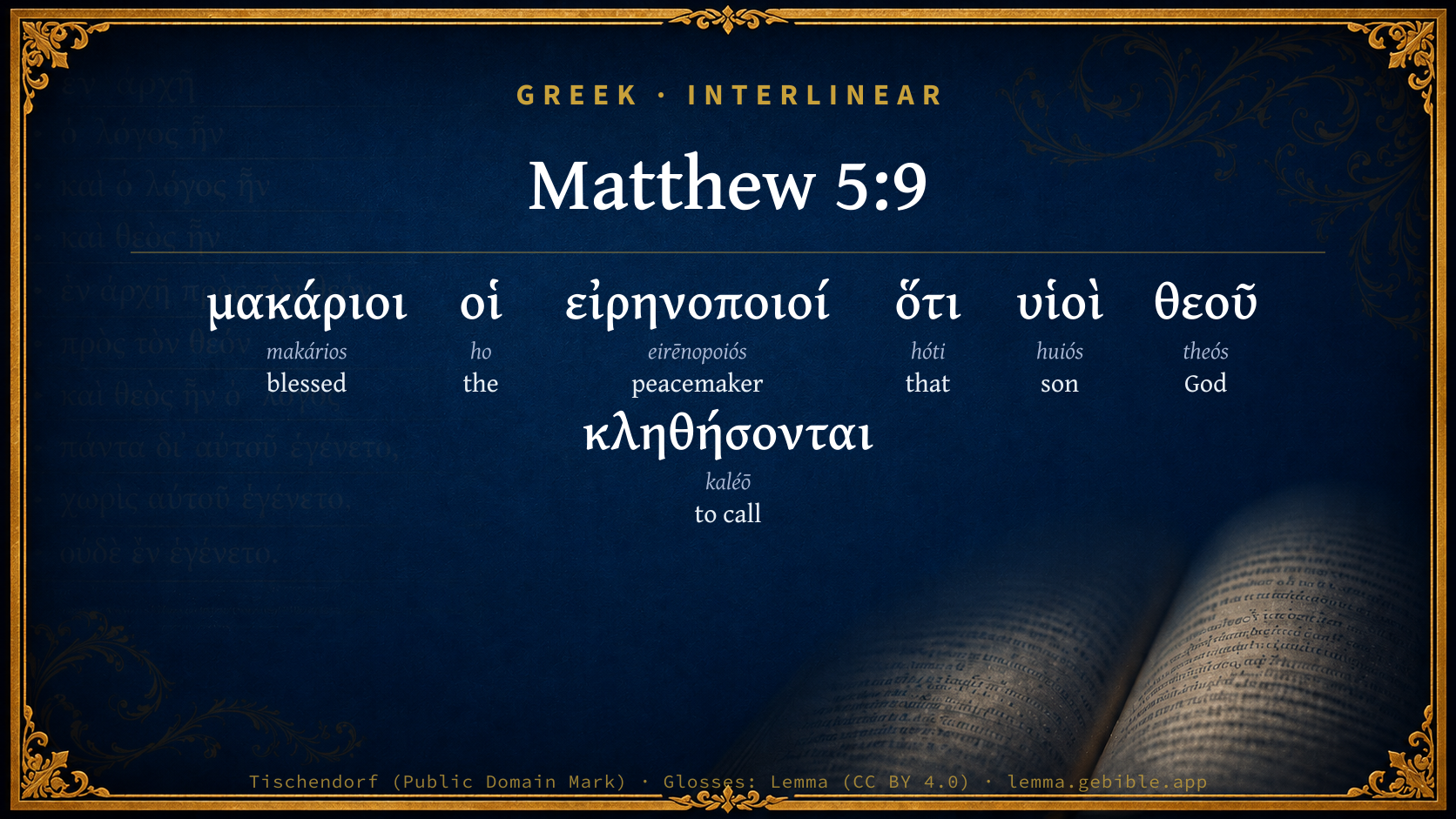
Download image
Cite this verse

Matthew 5:9 (World English Bible). Public Domain. Lemma interlinear Bible study tool, https://lemma.gebible.app/v/matthew/5/9.

Show BibTeX & RIS
BibTeX
RIS
English Translation
Blessed are the peacemakers, For they shall be called children of God.
World English Bible · Public Domain
Highlights
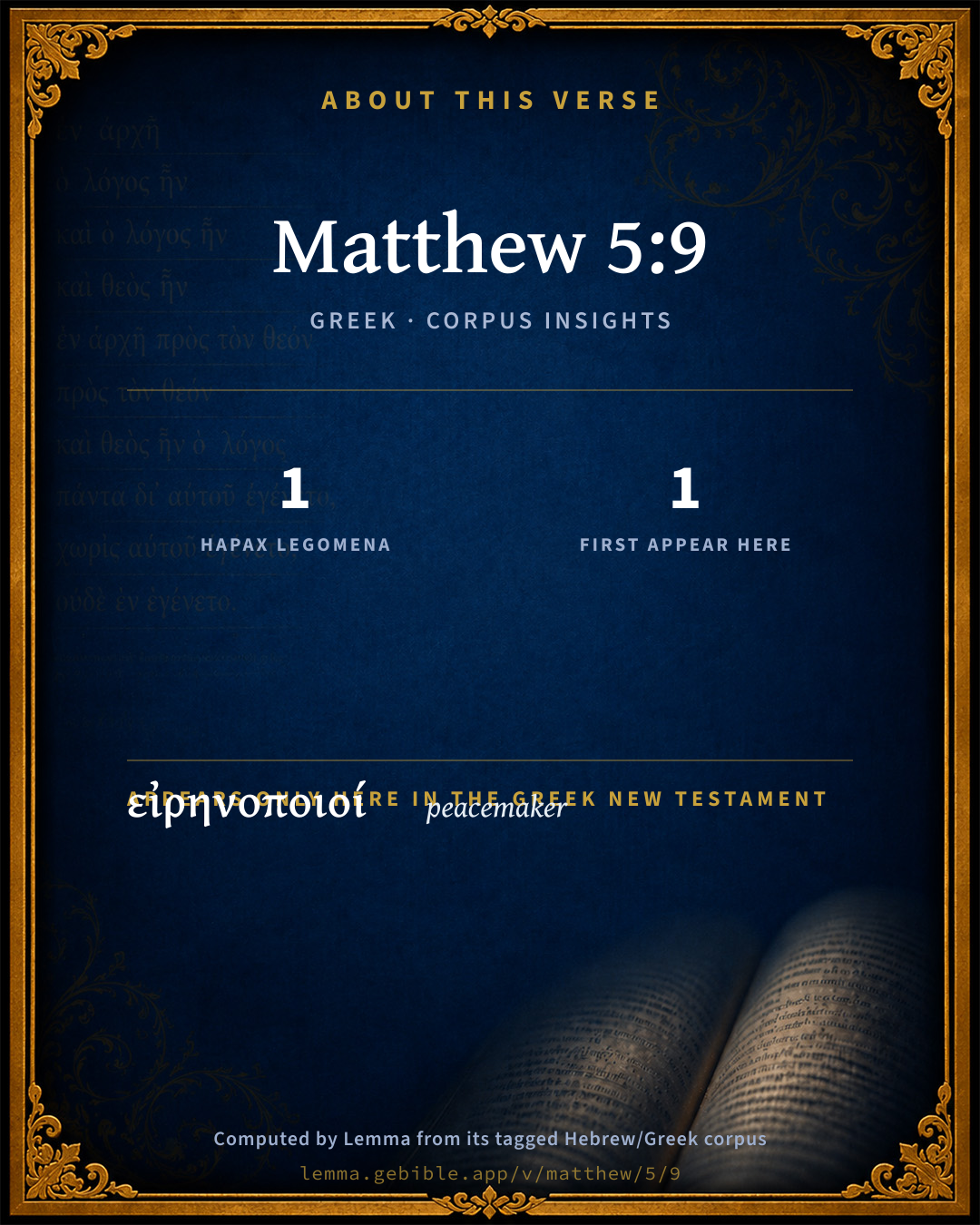
  • 1 hapax legomenon — only here in the Greek New Testament
  • 1 first appearance in the Greek New Testament
Full analysis ↓
Download a study sheet

One document with this verse’s original text, its word-by-word gloss line, the meaning frame, cross-references with their text, attributed commentary, and full source and license credits — printable, and it pastes into notes with its structure intact.

This verse Autodidact and up

Study sheet (.html) Plain text (.txt)

A passage Seminary Student

Up to 50 verses in one chapter. A passage sheet keeps up to 6 commentary sources and 12 cross-references per verse, in the order this page ranks them, and says so on the sheet whenever that leaves anything out. Ask for a single verse and you get the Autodidact verse sheet above.

Everything on this page stays free to read, with no account — the sheet is a download of what is already on screen, not access to it.

Want to remove ads? Support Godless Engineer
Compare translations 3

The same verse in 3 English versions, stacked beneath the original-language interlinear above. Click any original word for its lexicon entry.

Each is an independent rendering of the whole verse — the interlinear is not word-aligned to these translations.

Highlighted words mark where these versions differ — a whole-verse word diff, not a word-by-word alignment.

  • World English Bible Public Domain
    Blessed are the peacemakers, For they shall be called children of God.
  • King James Version Public Domain
    Blessed are the peacemakers: for they shall be called the children of God.
  • unfoldingWord Literal Text CC BY-SA 4.0
    Blessed the peacemakers, for they will be called sons of God.

unfoldingWord Literal Text — © unfoldingWord, licensed CC BY-SA 4.0. Word-aligned USFM3 via Door43 (git.door43.org/unfoldingWord/en_ult).

Versions to compare (up to 4)

3 of 4 selected

Show all 19 translations

Every available English version of this verse, each an independent rendering of the whole verse.

  • World English Bible Public Domain
    Blessed are the peacemakers, For they shall be called children of God.
  • Berean Standard Bible Public Domain
    Blessed are the peacemakers, for they will be called sons of God.
  • Majority Standard Bible Public Domain
    Blessed are the peacemakers, for they will be called sons of God.
  • King James Version Public Domain
    Blessed are the peacemakers: for they shall be called the children of God.
  • American Standard Version (1901) Public Domain
    Blessed are the peacemakers: for they shall be called sons of God.
  • Revised Version (1885) Public Domain
    Blessed are the peacemakers: for they shall be called sons of God.
  • Geneva Bible (1599) Public Domain
    Blessed are the peace makers: for they shall be called the children of God.
  • Douay-Rheims (1899) Public Domain
    Blesses are the peacemakers: for they shall be called children of God.
  • Young's Literal Translation Public Domain
    `Happy the peacemakers -- because they shall be called Sons of God.
  • Literal Standard Version CC BY-SA 4.0
    Blessed the peacemakers—because they will be called sons of God.
  • Unlocked Literal Bible CC BY-SA 4.0
    Blessed are the peacemakers, for they will be called sons of God.
  • unfoldingWord Literal Text CC BY-SA 4.0
    Blessed the peacemakers, for they will be called sons of God.
  • Darby Bible Public Domain
    Blessed the peace-makers, for *they* shall be called sons of God.
  • World Messianic Bible Public Domain
    Blessed are the peacemakers, for they shall be called children of God.
  • Webster's Bible Public Domain
    Blessed are the peace-makers: for they shall be called children of God.
  • Free Bible Version CC BY-SA 4.0
    Blessed are those who work to bring peace, for they will be called children of God.
  • Bible in Basic English Public Domain
    Happy are the peacemakers: for they will be named sons of God.
  • Text-Critical English NT CC BY 4.0
    Blessed are the peacemakers, for they will be called sons of God.
  • Tyndale New Testament (1534) Public Domain
    Blessed are the peacemakers: for they shalbe called the chyldren of God.

Literal Standard Version (2020), Covenant Press — licensed CC BY-SA 4.0. Text via the HelloAO Bible API (eBible.org). Unlocked Literal Bible (unfoldingWord) — licensed CC BY-SA 4.0. Text via the HelloAO Bible API (eBible.org). unfoldingWord Literal Text — © unfoldingWord, licensed CC BY-SA 4.0. Word-aligned USFM3 via Door43 (git.door43.org/unfoldingWord/en_ult). Free Bible Version, Dr. Jonathan Gallagher — licensed CC BY-SA 4.0. Text via the HelloAO Bible API (eBible.org).

Word by word

More ways to search: Search by grammar → Find every occurrence → Compare this word →

Practice this passage: Drill this verse → Learn its vocabulary →

About this verse

These counts appear in no published source. They are computed here, from the morphology-tagged text and Lemma’s own curated glosses. What Lemma adds →

7
words
7
distinct lemmas
Gospels
section

Notable vocabulary

1 hapax legomenon — a word that appears only here in the entire Greek New Testament:

  • εἰρηνοποιοί peacemaker G1518

First appearance in Scripture

This word makes its first canonical appearance in the Greek New Testament here:

  • εἰρηνοποιοί peacemaker G1518

Shared distinctive vocabulary

μακάριοι blessed G3107 occurs in 49 verses of the Greek New Testament. Also found in:
Cross-references

29

Topical passages linked to Matthew 5:9 in the Treasury of Scripture Knowledge — connected by theme and wording, ordered by reader-vote popularity; previews shown in the World English Bible.

  • Hebrews 12:14 Follow after peace with all men, and the sanctification without which no man will see the Lord,
  • James 3:16–18 For where jealousy and selfish ambition are, there is confusion and every evil deed.
  • Romans 12:18 If it is possible, as much as it is up to you, be at peace with all men.
  • Galatians 5:22 But the fruit of the Spirit is love, joy, peace, patience, kindness, goodness, faithfulness,
  • Psalms 120:6 My soul has had her dwelling too long With him who hates peace.
  • Romans 8:14 For as many as are led by the Spirit of God, these are children of God.
  • Luke 6:35 But love your enemies, and do good, and lend, expecting nothing back; and your reward will be great, and you will be children of the Most High; for he is kind toward the unthankful and evil.
  • Romans 14:17–19 for the Kingdom of God is not eating and drinking, but righteousness, peace, and joy in the Holy Spirit.
  • Ephesians 5:1–2 Be therefore imitators of God, as beloved children.
  • 2 Corinthians 13:11 Finally, brothers, rejoice. Be perfected, be comforted, be of the same mind, live in peace, and the God of love and peace will be with you.
  • Psalms 122:6–8 Pray for the peace of Jerusalem. Those who love you will prosper.
  • James 1:19–20 So, then, my beloved brothers, let every man be swift to hear, slow to speak, and slow to anger;
  • Colossians 3:13 bearing with one another, and forgiving each other, if any man has a complaint against any; even as Christ forgave you, so you also do.
  • 2 Timothy 2:22–24 Flee from youthful lusts; but pursue righteousness, faith, love, and peace with those who call on the Lord out of a pure heart.
  • Psalms 82:6–7 I said, "You are gods, All of you are sons of the Most High.
  • Psalms 34:12 Who is someone who desires life, And loves many days, that he may see good?
  • Romans 14:1–7 Now receive one who is weak in faith, but not for disputes over opinions.
  • 1 Peter 1:14–16 as children of obedience, not conforming yourselves according to your former lusts as in your ignorance,
  • Matthew 5:48 Therefore you shall be perfect, just as your Father in heaven is perfect.
  • Philippians 2:1–3 If there is therefore any exhortation in Christ, if any consolation of love, if any fellowship of the Spirit, if any tender mercies and compassion,
  • Philippians 2:15–16 that you may become blameless and harmless, children of God without blemish in the midst of a crooked and perverse generation, among whom you are seen as lights in the world,
  • Acts 7:26 "The day following, he appeared to them as they fought, and urged them to be at peace again, saying, 'Sirs, you are brothers. Why do you wrong one another?'
  • 2 Corinthians 5:20 We are therefore ambassadors on behalf of Christ, as though God were entreating by us. We beg you on behalf of Christ, be reconciled to God.
  • Matthew 5:45 that you may be children of your Father who is in heaven. For he makes his sun to rise on the evil and the good, and sends rain on the just and the unjust.
  • 1 Chronicles 12:17 David went out to meet them, and answered them, If you be come peaceably to me to help me, my heart shall be knit to you; but if [you be come] to betray me to my adversaries, seeing there is no wrong in my hands, the God of our fathers look thereon, and rebuke it.
  • Philippians 4:2 I exhort Euodia, and I exhort Syntyche, to think the same way in the Lord.
  • 1 Corinthians 6:6 But brother goes to law with brother, and that before unbelievers!
  • Ephesians 4:1 I therefore, the prisoner in the Lord, beg you to walk worthily of the calling with which you were called,
  • Luke 20:36 For they can't die any more, for they are like the angels, and are children of God, being children of the resurrection.

Cross-references courtesy of OpenBible.info (CC BY 4.0).

Commentary

Notes on Matthew 5:9 from classic Christian and Jewish commentators (each source and its license shown beneath its notes). The classic Christian expositions comment on the surrounding passage and are grouped to its opening verse, so a note may address several verses; the Jewish commentaries on the Tanakh (Rashi and others) are per-verse, so they appear only where the commentator wrote on this verse.

Lemma curates 59 commentaries, every one of them public domain or Creative Commons licensed, each selected and text-cleaned for this edition rather than reprinted as found. About our sources →

The Biblical Illustrator

Joseph S. Exell

Mat_5:9

The peacemakers.

Peacemakers

I. How great a blessing is peace.

1. It is the preserver of life.

2. It is the preserver of prosperity.

3. It is the preserver of happiness.

4. They are not easily offended.

5. If offended they are not irreconcilable.

6. They exert themselves to reconcile contending parties.

7. Their great effort is to reconcile sinners to God.

`II. The reward which awaits them.

1. They are the children of God by regeneration.

2. By adoption.

3. By their relationship to our Lord Jesus Christ.

4. They shall be acknowledged as the children of God. (J. Jordan.)

Peacemakers

I. The principles of the peacemakers. They are heavenly: this seen from the Great Peacemakers-the God of Peace; the prince of Peace; the Spirit of Peace. All the Divine Persons are active for peace. Many things operate to disturb this peace.

II. The way in which they are shown.

1. To compose differences which may exist between ourselves and others.

2. By striving to bring others to a knowledge of Jesus, that they may know the true peace.

3. In the endeavour to make peace between others. (W. Reeve.)

The peacemaker

I. He must understand what things have the capacity of agreement.

II. He must understand the true cause of disagreement.

III. He must take a deep interest in the contending parties.

IV. He must obey the Divine call for inter:position.

V. He must believe that God has made provision for pacifying world. (Caleb Morris.)

Peacemakers

I. View God as a peacemaker.

1. He is a Lover of peace.

2. He is a Maker of peace.

II. Delineate Christians as peacemakers.

1. They love peace.

2. They make peace.

3. They promote peace.

III. Their blessedness.

1. They are pronounced Gods children.

2. They have the inward happiness of self-approval.

3. They look forward to being rewarded by God. (J. G. Horton.)

I. Before they can become true peacemakers and be entitled to this beatitude, they must seek and obtain inward peace for themselves (Eph_2:13-17).

II. It then becomes their duty to promote peace and restore it where lacking-between man and God, and man and man-in the Church, in the community, in the world at large.

III. The means to be employed. To obtain peace for ourselves and lead others to its possession, we must use the means of grace. To reconcile man to man, we must set an example of peace (Rom_12:18).

IV. Then we shall be blessed.

1. In the enjoyment of peace (Joh_14:27; Jam_3:18).

2. In being known as the children of God, etc. (L. O. Thompson.)

The world is full of peace-breakers. Peacemakers

I. In the family.

II. In society.

III. In the church.

IV. In the state. (J. Mackay, B. D.)

This is the seventh step of the golden ladder which leads to blessedness. The name of peace is sweet, and the work of peace a blessed work.

I. The peace a godly man seeks is not to have a league of amity with sinners, though we are to be

(1) at peace with their persons, yet we are to have war with their

(2) sins

(3) Grace teacheth good nature; we are to be civil to the worst, but not twist into a cord of friendship; that were to be brethren in iniquity.

II. We must not so far have peace with others as to endanger ourselves.

1. If a man hath the plague, we will be helpful to him and send him our best receipts, but we are careful not to suck his infectious breath.

2. So we may be peaceable towards all-nay, helpful.

3. Pray for, counsel, and relieve them, but let us take heed of too much familiarity, lest we suck their infection.

4. We must so make peace with men that we do not break our peace with conscience.

III. We must not so seek peace with others as to wrong truth.

1. Peace must not be bought with the sale of truth.

2. We must so seek the flower of peace as not to lose the pearl of truth.

3. Truth is the most orient gem of the Churchs crown.

IV. We must not let any of Gods truth fall to the ground.

1. We must not so be in love with the golden crown of peace as to pluck off the jewels of truth.

2. Rather let peace go than truth, (Thomas Watson.)

Blessed are the peacemakers

I. 1. They that are desirous to preserve peace among their neighbours.

2. They that avoid and endeavour as much as they can to discourage and prevent in others those practices which are the usual means of raising quarrels and contentions among men.

3. They who avoid backbiting, tale-bearing, slander, detraction, and the like.

II. 1. The peaceful man, if there be any dissension already begun among them, will endeavour to incline parties to coolness and moderation.

2. If his neighbours will not be subdued by his good words and entreaties, he can at least in a great measure allay the dissension.

III. By promoting peace we

(1) do a work pleasing to God,

(2) and for which we shall receive abundant reward. (Bishop Ofspring Blackall, D. D.)

Children of God

Peacemakers are the children of the Most High.

I. By eternal generation: so Christ is the natural Son of His Father (Psa_2:7).

II. By creation: so the angels are sons of God (Job_1:6; Job_38:7). When the morning stars sang together, and all the sons of God shouted for joy.

III. By participation of dignity: so kings and rulers are said to be children of the High God (Psa_8:2; Psa_8:6).

IV. By visible profession: so God hath many children. Hypocrites forge a title of sonship (Gen_6:2).

V. By real sanctification: so the faithful are particularly and eminently the children of God. (Thomas Watson.)

Let us carry ourselves as becomes the children of God.

I. In obedience.

(1) Obey God out of love;

(2) readily;

(3) every command of His.

II. In humility. Look in the glass of God s Word, and see therein our sinful spots.

III. In speech.

1. Grace must be the salt that seasons our words.

2. Sobriety must govern our actions. Error is a spiritual intoxication.

IV. In fidelity. Faithful in all things.

V. In sedulity. We must labour in a calling: God will bless our diligence, not our laziness.

VI. In magnanimity.

1. Must do nothing sordidly.

2. Must not fear the faces of men, but be brave-spirited as Nehemiah.

VII. In sanctity. Holiness is a diadem of beauty. In this let us endeavour to imitate our heavenly Father.

VIII. In cheerfulness. Why do the children of God walk so pensively? Are they not heirs of heaven?

IX. Let us carry ourselves as the children of God in holy longings and expectations. Children are still longing to be at home. There is bread enough in our Fathers house. Oh, how we should ever be longing for home! (Thomas Watson.)

There is a fulness of meaning in the term as it stands in the Scripture, which includes both the effort; to make peace, and the disposition of the mind towards it.

I. A man may be officially or otherwise employed in composing a difference that exists between two families or two individuals, without possessing the spirit and disposition of peace which the word includes.

(1) No one can be the peacemaker of the text without; he

(2) possesses a peaceable and conciliatory disposition.

II. The duty combines the attempt to reconcile men to God, through the peace-speaking blood of the cross, with the effort to heal the breach of friendship which has been made among individuals.

(1) This of all labours the most noble and Divine.

(2) We overlook the most essential part of making peace if we confine our endeavours to the composing of differences among men, while we

(3) pass by multitudes around us who are contending with their Maker. (J. E. Good.)

The peacemaker

I. Describe the peacemaker.

1. He is a citizen.

2. He is a neighbour.

3. He is a Christian.

II. Declare his blessedness.

1. He is blessed of God.

2. He is one of the children of God.

3. They shall be called the children of God.

III. Set the peacemaker to work. (C. H. Spurgeon.)

How the Rev. John Owen restored peace between the Rev. Robert Hall and the Rev. Charles Simeon

A pleasing instance of a successful effort to restore peace is related in the life of the Rev. John Owen. The Rev. Charles Simeon and the Rev. Robert Hall were offended with each other, and in their anger declined intercourse. After several friends had tried to restore peace, and failed, Mr. Owen wrote the under-mentioned lines on two cards, and then left one at the house of each person-

How rare that task a prosperous issue finds,

Which seeks to reconcile discordant minds!

How many scruples rise to passions touch!

This yields too little, and that asks too much.

Each wishes each with others eyes to see:

And many sinners cant make two agree:

What mediation, then, the Saviour showed,

Who singly reconciled us all to God.

The first man who read the lines was so strongly impressed by them that he hastened from his house to call immediately upon his offended friend; the friend had also read the lines, and, being affected by them, had done the same, and the offended persons met each other in the street. A reconciliation instantly took place-a reconciliation which, it is believed, was never interrupted or regretted by either of those useful and highly esteemed men.

The Biblical Illustrator, edited by Joseph S. Exell (c. 1880s–1900s) — public domain. Text from a community e-Sword module.

Joseph Benson's Commentary

Mat 5:9. The peace-makers — Those who are themselves of a peaceable temper, and endeavour to promote peace in others: who study to be quiet, and, as much as in them lieth, to live peaceably with all men: who are so far from sowing the seeds of discord between any of their fellow-creatures, that they both studiously avoid contention themselves, and labour to extinguish it wherever it prevails, laying themselves out to heal the differences of brethren and neighbours, to reconcile contending parties, and to restore peace wherever it is broken, as well as to preserve it where it is. They shall be called the children of God — That is, they are and shall be owned by God as his genuine children, by reason of their great likeness to him: for he is the God of peace and love, and is in Christ reconciling the world to himself not imputing their trespasses to them. And, being his children, they are his heirs, heirs of God and joint heirs with Christ; and, as they suffer with him, so shall they be glorified together. They shall, in due time, be children of the resurrection, shall receive the adoption, the public declaration and manifestation of their adoption, and the glorious fruit of it, viz., the redemption of their bodies from death and corruption.

Joseph Benson's Commentary on the Old and New Testaments (1811–1818) — public domain. Text from a community e-Sword module.

Tyndale Open Study Notes

Tyndale Open Resources

5:9 This beatitude probably targeted zealots—Jewish revolutionaries who advocated the overthrow of Roman domination through violent resistance. The Messiah’s Kingdom would be established by other means. • those who work for peace: Jesus is not calling for pacifism per se, but rather a different kind of activism. • Peace is the absence of enmity and the presence of God’s salvation (Lev 26:6; 1 Sam 16:4-5; Isa 9:5-6; Zech 8:16; Eph 2:14; Col 1:20). Jesus’ disciples are to work for justice, righteousness, reconciliation, and mercy as the effects of God’s salvation through Christ (Matt 5:43-47; Luke 10:5-6).

Tyndale Open Study Notes — © Tyndale Open Resources, licensed CC BY-SA 4.0. Text via the HelloAO Bible API.

Bengel's Gnomon

Johann Albrecht Bengel

Mat 5:9. Εἰρηνοποιοὶ, peacemakers) They who make all lawful peace between those who are at variance, at discord, or at war.—υἱοὶ, sons) How great is this dignity!—Θεοῦ, of God) who is the God of peace.—κληθήσονται, shall be called) i.e., shall be in name and in reality.

Bengel's Gnomon of the New Testament — English translation (T&T Clark, Edinburgh, 1860) — public domain. Text from a community e-Sword module.

Meyer's Critical & Exegetical Commentary

Heinrich August Wilhelm Meyer

Mat_5:9. Οἱ εἰρηνοποιοί] not the peaceful (εἰρηνικοί, Jam_3:17, 2Ma_5:25; or εἰρηνεύοντες, Sir_6:7), a meaning which does not appear even in Pollux, i. 41, 152 (Augustine thinks of the moral inner harmony; de Wette, on the contrary, of the inclination of the contemporaries of Jesus to war and tumult; Bleek reminds us of Jewish party hatred), but: the founders of peace (Xen. Hist. Gr. vi. 3. 4; Plut. Mor. p. 279 B; comp. Col_1:20; Pro_10:10), who as such minister to Gods good pleasure, who is the God of peace (Rom_16:20; 2Co_13:11), as Christ Himself was the highest Founder of peace (Luk_2:14; Joh_16:33; Eph_2:14 ff.).

υἱοὶ θεοῦ κληθής.] again a characteristic designation of community in the future kingdom of the Messiah, so far, namely, as the participators in it have obtained the υἱοθεσία, a relation which begins with their reception into the kingdom; comp. on Luk_6:35. If we import the conception of being loved by God (Kuinoel), or of resemblance to God (Paulus, de Wette), and the like, then we are not in harmony with the expression, and, contrary to the context, we identify it with the conception of the temporal Sonship of God, as it appears in John as a being begotten by God; in Paul, as adoption; see Joh_1:12; Joh_1:14. Certainly this temporal Sonship is the moral premiss of that future one; but it is only the latter which can here be meant; comp. Rom_8:19; Rom_8:23.

κληθήσονται] What they are is designated as expressly recognised by the (honourable) name in question, by which they are called. That καλεῖσθαι does not stand for εἶναι, see Fritzsche on i. 16; Winer, p. 571 f. [E. T. 769]. Comp. Eur. Hec. 625: ὁ δʼ ἐν πολίταις τίμιος κεκλημένος; and Pflugk on the passage; Hom. Il. ii. 260; and Nägelsbach in loc.

REMARK.

In the beatitudes, Mat_5:3-9, the various characteristic designations of the Messianic happiness ingeniously correspond to the various designations of the subject, so that in the first declaration, Mat_5:3, the subject of the promise, the kingdom of the Messiah, is named expressly, and as a whole, and in the following it is always those individual sides of the happiness of this kingdom that are brought forward which correspond to the subjects designated. Thus, to those who mourn corresponds the state of being comforted; to the patient sufferers, who now allow themselves to be oppressed, the future condition of possession and mastership; to the hungry, that of being filled; to the merciful, the receiving of mercy; to the pure in heart, the seeing of God, of which no impure person is capable; to the founders of peace, the sonship of God, who Himself in His own Son has reconciled men to Himself, and to one another. Merely different beams of light from the same glory. At the close, after the seven independent beatitudes, in Mat_5:10, which is the foundation and transition to the following direct address, the Messiahs kingdom is once more expressly named, and as a whole, as in the beginning, Mat_5:3. In this way Mat_5:3-10 form an ingenious and profound harmonious whole. To this unity and completeness belongs also the series of the subjects, which, taken together, set forth the whole position (Mat_5:3-5) and the whole endeavours and life (Mat_5:6-9) of the future member of the kingdom. For as to his position, he is full of lowly feeling (Mat_5:3), a bearer of suffering (Mat_5:4), in quiet patience (Mat_5:5). But as to his endeavours and life: full of fervour after moral perfection (Mat_5:6), he cherishes towards others the feeling of compassionate love (Mat_5:7), and by the purity of heart which he attains (Mat_5:8), his outward actions tend towards peace (Mat_5:9), whether he also suffer persecution (this by way of transition to Mat_5:11) for righteousness sakeall springing from the one root, faith in his Lord.

Meyer — Critical and Exegetical Commentary on the New Testament — English translation by Peter Christie, edited by Frederick Crombie (T&T Clark, 1880) — public domain. Text from a community e-Sword module.

Expositor's Greek Testament

ed. W. Robertson Nicoll

Mat 5:9 . οἱ εἰρηνοποιοί : not merely those who have peace in their own souls through purity (Augustine), or the peace-loving (Grotius, Wetstein), but the active heroic promoters of peace in a world full of alienation, party passion, and strife. Their efforts largely consist in keeping aloof from sectional strifes and the passions which beget them, and living tranquilly for and in the whole. Such men have few friends. Christ, the ideal peace-maker, was alone in a time given up to sectarian division. But they have their compensation υἱοὶ θεοῦ κληθήσονται . God owns the disowned and distrusted as His sons. They shall be called because they are . They shall be called at the great consummation; nay, even before that, in after generations, when party strifes and passions have ceased, and men have come to see who were the true friends of the Divine interest in an evil time.

The Expositor's Greek Testament, edited by W. Robertson Nicoll (1897–1910) — public domain. Text from a community e-Sword module.

Jamieson, Fausset & Brown

Robert Jamieson, A. R. Fausset & David Brown

Blessed are the peacemakers--who not only study peace, but diffuse it.

for they shall be called the children of God--shall be called sons of God. Of all these beatitudes this is the only one which could hardly be expected to find its definite ground in the Old Testament; for that most glorious character of God, the likeness of which appears in the peacemakers, had yet to be revealed. His glorious name, indeed--as "The Lord, the Lord God, merciful and gracious, long-suffering, and abundant in goodness and truth, forgiving iniquity and transgression and sin"--had been proclaimed in a very imposing manner (Exo 34:6), and manifested in action with affecting frequency and variety in the long course of the ancient economy. And we have undeniable evidence that the saints of that economy felt its transforming and ennobling influence on their own character. But it was not till Christ "made peace by the blood of the cross" that God could manifest Himself as "the God of peace, that brought again from the dead our Lord Jesus, that great Shepherd of the sheep, through the blood of the everlasting covenant" (Heb 13:20) --could reveal Himself as "in Christ reconciling the world unto Himself, not imputing their trespasses unto them," and hold Himself forth in the astonishing attitude of beseeching men to be "reconciled to Himself" (Co2 5:19-20). When this reconciliation actually takes place, and one has "peace with God through our Lord Jesus Christ"--even "the peace of God which passeth all understanding"--the peace-receivers become transformed into peace-diffusers. God is thus seen reflected in them; and by the family likeness these peacemakers are recognized as the children of God. In now coming to the eighth, or supplementary beatitude, it will be seen that all that the saints are in themselves has been already described, in seven features of character; that number indicating completeness of delineation. The last feature, accordingly, is a passive one, representing the treatment that the characters already described may expect from the world. He who shall one day fix the destiny of all men here pronounces certain characters "blessed"; but He ends by forewarning them that the world's estimation and treatment of them will be the reserve of His.

Jamieson, Fausset & Brown — Commentary Critical and Explanatory on the Whole Bible (1871) — public domain (CC PDM 1.0). Text via the HelloAO Bible API.

Adam Clarke's Commentary

Verse 9. The peace-makers] ειρηνη, peace, is compounded of ειρειν (εις) εν, connecting into one: for as WAR distracts and divides nations, families, and individuals, from each other, inducing them to pursue different objects and different interests, so PEACE restores them to a state of unity, giving them one object, and one interest. A peace-maker is a man who, being endowed with a generous public spirit, labours for the public good, and feels his own interest promoted in promoting that of others: therefore, instead of fanning the fire of strife, he uses his influence and wisdom to reconcile the contending parties, adjust their differences, and restore them to a state of unity. As all men are represented to be in a state of hostility to God and each other, the Gospel is called the Gospel of peace, because it tends to reconcile men to God and to each other. Hence our Lord here terms peace-makers the children of God: for as he is the Father of peace, those who promote it are reputed his children. But whose children are they who foment divisions in the Church, the state, or among families? Surely they are not of that GOD, who is the Father of peace, and lover of concord; of that CHRIST, who is the sacrifice and mediator of it; of that SPIRIT, who is the nourisher and bond of peace; nor of that CHURCH of the Most High, which is the kingdom and family of peace.

St. Clement, Strom. lib. iv. s. 6, in fin. says, that "Some who transpose the Gospels add this verse: Happy they who are persecuted by justice, for they shall be perfect: happy they who are persecuted on my account, for they shall have a place where they shall not be persecuted."

Adam Clarke's Commentary on the Bible (1810–1826) — public domain. Text from a community e-Sword/MySword module.

Ellicott's Commentary for English Readers

(9) The peacemakers.—Our version rightly distinguishes between the temper which is simply “peaceable” in itself (Jas_3:17), and this, the higher form of the same grace, acting energetically upon others. To be able to say with power to those who are bitter foes, “Sirs, ye are brethren”.(Act_7:26), is nobler even than to strive,” as much as lieth in us, to live peaceably with all men” (Rom_12:18). Rightly does this beatitude follow on that of the “pure in heart,” for it is the absence of all baseness and impurity that gives the power to make peace.

The children of God.—Better, sons of God. The English version slightly obscures the connection between the promise and the character of Him who had been declared to be the Son of God in the truest and highest sense. Not in the ways which the Tempter had suggested, but in the work of “making peace” between God and man, between Jew and Gentile, even at the price of shedding His own blood (Col_1:20), was the witness of sonship to be found, and those who were sharers in that work should, according to their capacity, “be called”—i.e., be, and be recognised as, sharers in that sonship.

A Bible Commentary for English Readers, edited by Charles John Ellicott (1878–1897) — public domain. Text from a community e-Sword module.

The Cambridge Bible for Schools and Colleges

gen. ed. J. J. S. Perowne

9. peacemakers] not only in the sense of those who heal dissension. Peace is used in a deeper sense, “the peace of God,” Php_4:7; “the peace of Christ,” Col_3:15.

children of God] These are most akin to the divine nature, perfect as their Father which is in heaven is perfect, Mat_5:48, cp. 1Jn_3:1, “Behold what manner of love the Father hath bestowed upon us that we should be called the Sons of God.”

The Cambridge Bible for Schools and Colleges (gen. ed. J. J. S. Perowne; Cambridge University Press, 1878–1918) — public domain. Text from a community e-Sword module.

John Gill's Exposition

Blessed are the peace makers,.... Not between God and man, for no man can make his own peace with God; nor can any mere creature, angels, or men, make it for him; Christ, in this sense, is the only peace maker: but between men and men; and such are they, who are of peaceable dispositions themselves; live peaceably with all men, and with one another, as their relation obliges to, and their mutual comfort requires; and with the men of the world; and who are ready, willing, and very serviceable, in composing differences, and making peace between their fellow creatures and fellow Christians. The Jews speak very highly, and much, in the commendation of peace making; they reckon this among the things which shall be of use to a man, both in this, and the other world.

"These are the things, (say they (e),) the fruit of which a man enjoys in this world, and his lot or portion remains for him in the world to come; honouring father and mother, liberality, , "and making peace between a man and his neighhour."''

This, they say (f), Aaron was much disposed to.

"Moses used to say, let justice break through the mountain; but Aaron loved peace, and pursued it, and made peace between a man and his neighhour, as is said, Mal 2:6''

Hence that saying of Hillell (g),

"be thou one of the disciples of Aaron, who loved peace, and followed after it; he loved men, and brought them to the law.''

Now of such persons it is said, that

they shall be called the children of God; that is, they are the children of God by adopting grace, which is made manifest in their regeneration; and that is evidenced by the fruits of it, of which this is one; they not only shall be, and more manifestly appear to be, the sons of God hereafter; but they are, and are known to be so now, by their peaceable disposition, which is wrought in them by the Spirit of God; whereby they become like to the God of peace, and to Christ, the great and only peacemaker, and so are truly sons of peace.

(e) Misn. Peah. c. 1. sect. 1. T. Bab. Sabbat. fol. 127. 1. & Kiddushin. fol. 40. 1. (f) T. Bab. Sanhedrim, fol. 6. 2. Vid. Abot. R. Nathan, c. 12. fol. 4. 2. (g) Pirke Abot. c. 1. sect. 12.

John Gill's Exposition of the Whole Bible (1746–1763) — public domain (CC PDM 1.0). Text via the HelloAO Bible API.

Trapp's Complete Commentary

John Trapp

9 Blessed are the peacemakers: for they shall be called the children of God.

Ver. 9. Blessed are the peacemakers] There are those who, like salamanders, live always in the fire, and, like trouts, love to swim against the stream; that, with Phocion, think it a goodly thing to dissent from others; and, like Samson’s foxes, or Solomon’s fool, carry about and cast abroad firebrands, as if the world were made of nothing but discords, as Democritus imagined. But as St. John speaks in another case, these are "not of the Father, but of the world," 1Jn 2:16. He maketh great reckoning of a meek and quiet mind, 1Pe 3:4, because it is like to his own mind, which is never stirred nor moved, but remaineth still the same to all eternity. He loves those that keep the staff of binders unbroken, Zec 11:7; Zec 11:14; that hold the "unity of the Spirit," and advance the bond of peace among others as much as may be, Eph 4:3. The wicked are apt (as dogs) to intertear and worry one another: and although there be not a disagreement in hell (being but the place of retribution, and not of action), yet on earth there is no peace among the workers of iniquity, that are trotting apace towards hell by their contentions, Rom 2:8. But what pity is it that Abraham and Lot should fall out! that two Israelites should be at strife amid the Egyptians! that John’s disciples should join with Pharisees against Jesus! Mat 9:14; that Corinthians (for their contentions) should "be as carnal, and walk as men!" 1Co 3:3; that Lutherans and Calvinists should be at such deadly feud! Still Satan is thus busy, and Christians are thus malicious, that, as if they wanted enemies, they fly in one another’s faces. There was no noise heard in setting up the temple: in Lebanon there was, but not in Zion. Whatever tumults there are abroad, it is fit there should be all quietness and concord in the Church. Now therefore, although it be, for the most part, a thankless office (with men) to interpose, and seek to take up strife, to piece those again that are gone aside and asunder, and to sound an irenicum; yet do it for God’s sake, and that ye may (as ye shall be after awhile) be called and counted, not meddlers and busybodies, but the sons of God. Tell them that jar and jangle (upon mistakes for most part, or matters of no great moment) that it is the glory of a man to pass by an infirmity, and that in these ignoble quarrels every man should be a law to himself, as the Thracians were (αντονομοι), and not brother to go to law with brother because he treads upon his grass, or some such poor business, ubi et vincere inglorium est, el atteri sordidum. (Tacit.) Now "therefore there is utterly a fault (ηττημα) among you, because ye go to law one with another," saith the apostle, 1Co 6:7. Not but that the course is lawful, where the occasion is weighty and the mind not vindictive. But the apostle disgraceth (in that text) revenge of injuries, by a word that signifieth disgrace or loss of victory. And a little before, "I speak to your shame," saith he; "is it so, that there is not a wise man among you?" no, not one that shall be able to judge between his brethren and compromise the quarrel? Servius Sulpitius (that heathen lawyer) shall rise up in judgment against us, Quippe qui ad facilitatem, aequitatemque omnia contulit, neque constituere litium actiones, quam controversias tollere maluit, as Cicero testifieth. (Cicer. Philippic. 9.) Concedamus de iure, saith one, ut careamus lite: and, ut habeas quietum tempus, perde aliquid. Lose something for a quiet life, was a common proverb, as now among us so of old among the Carthaginians, as St Austin showeth. It were happy surely, if now, as of old, the multitude of believers were η καρδια, και η ψυχη μια, of one heart and of one soul, Act 4:32. And, as in one very ancient Greek copy it is added, that there was not one controversy or contention found among them, και ουκ ην εν αυτοις διακρισος ουδεμια. (Beza ex Beds.)

For they shall be called the children of God] They shall both be, and be said to be, both counted and called, have both the name and the note, the comfort and the credit of the children of God. And if any atheist shall object: What so great honour is that? "Behold," saith St John, "what manner of love the Father hath bestowed upon us, that we should be called the sons of God," 1Jn 3:1. It was something to be called the son of Pharaoh’s daughter, Heb 11:24, to be son-in-law to the king, with David, to be heir to the crown, with Solomon: but far more, that God should say of him, "I will be his Father, and he shall be my son; and I will establish his kingdom," 2Sa 7:14. This is the happy effect of faith; for to them that believe on his name, gave he power and privilege to become the sons of God (εξουσιαν), Joh 1:12. Now, faith ever works by love, and love covereth a multitude of sins, 1Pe 4:8, not by any merit or expiation with God, but by seeking and settling peace among men. And this is as sure and as sweet a sign of a son of the God of peace, as the party coloured coats were anciently of the king’s children, 2Sa 13:18.

John Trapp, A Commentary or Exposition upon All the Books of the Old and New Testament (1647–1656) — public domain. Text from a community e-Sword module.

Albert Barnes' Notes on the Bible

Blessed are the peacemakers - Those who strive to prevent contention, strife, and war; who use their influence to reconcile opposing parties, and to prevent lawsuits and hostilities in families and neighborhoods. Every man may do something of this; and no man is more like God than he who does it. There ought not to be unlawful and officious interference in that which is none of our business; but without any danger of acquiring this character, every man has many opportunities of reconciling opposing parties. Friends, neighbors, people of influence, lawyers, physicians, ministers of the gospel, may do much to promote peace. And it should be taken in hand in the beginning. “The beginning of strife,” says Solomon, “is like the letting out of water.” “An ounce of prevention,” says the English proverb, “is worth a pound of cure.” Long and most deadly quarrels might often be prevented by a little kind interference in the beginning.

Children of God - See the notes at Mat 1:1. Those who resemble God, or who manifest a spirit like his. He is the Author of peace 1Co 14:33; and all those who endeavor to promote peace are like him, and are worthy to be called his children.

Albert Barnes' Notes on the Bible (1834–1885) — public domain. Text from a community e-Sword/MySword module.

Haydock's Catholic Bible Commentary

To be peaceful ourselves and with others, and to bring such as are at variance together, will entitle us to be children of God. Thus we shall be raised to a participation in the honour of the only begotten Son of God, who descended from heaven to bring peace to man, and to reconcile him with his offended Creator. (St. John Chrysostom, hom. xv.)

George Leo Haydock (1774–1849), Haydock's Catholic Family Bible and Commentary, 1859 edition — public domain. Excludes Psalms (Douay-Rheims chapter numbering differs from Protestant) and Deuterocanonical books (Catholic canon only).

Matthew Poole's English Annotations

The world blesseth the boisterous, unquiet party of it, that can never be still, but are continually thinking of more worlds to conquer, and blowing up the coals of war, division, and sedition: but they are blessed indeed, who study to be quiet, seeking peace, and pursuing it; and are so far from sowing the seeds of discord, or blowing those coals, that their great study is to make peace between God and man, and between a man and his neighbour, doing this in obedience to God, and out of a principle of love to God and men; for those that do so shall approve themselves like unto God, to be his children, and so they shall be called.

To be called and to be is much the same: so what Moses said, Gen 21:12, is interpreted by Paul; Rom 9:7,8; so what is said by Matthew, Mat 21:13, is interpreted by Luke, Luk 19:46; what was said by St. John, Joh 1:12, is interpreted 1Jo 3:1; for God is the God of peace, 1Co 14:33.

Matthew Poole's English Annotations on the Holy Bible (1683–1685) — public domain. Text from a community e-Sword/MySword module.

Whedon's Commentary on the Bible

Daniel D. Whedon

9. Peacemakers — A triad of benedictions will now be pronounced on Christian doings. Let us be excused for the quaintness of saying, that of these nine benedictions four are pronounced upon Christian receptivities; two upon Christian positivities, and three upon Christian activities. The three activities on which he will now pronounce benedictions are peace-making, the endurance of persecution the endurance of false reproach.

Peacemakers, in the simple and natural sense, are those who seek to remove quarrels and hates, and to produce kindly affections between men. They are good. Though unregenerate men, these men are herein blessed. How much better than mere indifference; how immensely better than the truly devilish opposite. Even if, for other sins and for the defectiveness of this virtue, the peacemaker be not saved from hell, from what depths of hell may he not be saved!

But the true peacemaker is Christ himself, who first reconciles God and man. And then, by shedding the Spirit of the God of peace into men’s hearts, he brings them to peace. And this is the real basis of all true peace. And he is the true peacemaker who endeavours to lay this basis. He is the true Christian peacemaker who endeavours, like Christ, to plant the divine spirit of peace in men’s hearts. And the promise here accordingly is, that as they are herein like Christ the Son of God, so they shall be called the children of God. So we have a family consisting of the God of Peace, the Prince of Peace, and the sons of peace.

All who truly seek to spread the Gospel, who endeavour to establish the reign of right and truth, who seek to reduce the contentiousness of even the Church, and to bring the imperfect Christianity of the age to a more loving tone, are peacemakers. On the other hand, the mere zealots for party and sect, the partisan politician, the warlike statesman, the glory-loving hero, the duellist, the oppressor, are reverse characters, for whom a counter woe is implied.

Yet the true peacemaker does not seek peace by a compromise with sin. That is a false peace which is made with the devil and sin, and is a true discord and war against good and God. Christ, the true peacemaker, was a terrible denouncer of iniquity.

Daniel D. Whedon (gen. ed.), Commentary on the Old and New Testaments (1874–1909) — public domain. Text from a community e-Sword module.

The Pulpit Commentary

The peacemakers (oi eirhnopoioi). More than "peaceable". (eirhnikov , Jam_3:17; eirhneuontev , Rom_12:18 Mar_9:50) This is the peaceable character consciously exerted outside itself. The same compound in the New Testament in Col_1:20 only: Eirhnopoihsav dia tou aimatov tou staurou autou . (cf. Eph_2:14, Eph_2:15) Christians, in their measure, share in Christ"s work, and, we may add, can attain it generally as he did, only by personal suffering. Observe that this Beatitude must have been specially distasteful to the warlike Galilaeans. Mishna, "Ab.," 1:13 (Taylor), "Hillel said, Be of the disciples of Aharon, loving peace and pursuing peace," hardly refers to peace making, but in Mishna, "Peah," 1:1, "These are the things whose fruit a man eats in this world, but which have their capital reward in the world to come: honouring one"s father and mother, showing kindness, and bringing about peace between a man and his neighbour, but study of the Law is equivalent to them all." For they; autoi , omitted by a, C, D, 13, 124, Latt., Peshito.

Possibly it is an addition inserted from a desire to make this Beatitude harmonize with the others. But more probably it is genuine, and was omitted by accident, either by homoiot, of uioi (Meyer), or (better) because the scribe forgot the abbot in the emphatic uioi Yeou , the form of the second clause being peculiar to this Beatitude. Shall be called; by God and angels and men. The children of God; Revised Version, sons of God; to show that the word used here is uioi , not tekna Christ"s reference is, that is to say, not so much to the nature as to the privileges involved in sonship. The earthly privileges which peacemakers give up rather than disturb their peaceful relations with others, and in order that they may bring about peace between others, shall be much more than made up to them, and that with the approving verdict of all. They shall, with general approval, enter on the full privileges of their relation to God, who is "the God of peace". (Rom_15:33) Dr. Taylor ("Ab.," 1:19) has an increasing note on "Peace" as a Talmudic name of God. For language similar to our Lord"s, cf. Hos_1:10 LXX, equivalent to Rom_9:26. Here, as often in this Gospel, there may be a tacit contradiction to the assumption that natural birth as Israelites involves the full blessings of sons of God; cf. "Ab.," 3:22 (Taylor).

The Beatitude of the peacemakers.

"Blessed are the peacemakers: for they shall be called the children of God." This is the seventh in order of the Beatitudes. It is the first, however, which shows blessedness pronounced as alighting upon a person, not in the first instance for some personal quality, grace, or virtue, but for his works" sake in the interest of others, whether of the family, the world, or the Church. The distinction is manifest, but the difference is not very real. For any man to lay himself out to make peace between others, whether on larger or lesser scale; for any one to have the least likely success in doing so; for any one to have but the honest real desire to do so, postulates already his own disposition. For certain work, the gift, and even the honest fervent desire, argues the foundation-grace. And certainly not least so in exactly an instance like the present. As there are some graces and virtues (like patience, for instance) that come little, indeed, naturally or of preference or predilection to any one, so also there are some works, the first to be needed, very likely, but the last to be chosen of any one. And this is one of them. Thus are some men blessed for their works" sake in double sense. It may, then, be safely assumed that the man who volunteers for the peacemaker"s work

(1) loves peace himself from the heart;

(2) has diligently sought to follow peace with all men; and

(3) has, by God"s grace, subdued the warring elements of his own heart, as far as might be, first.

These are his best and true credentials for his work. The name of special honour and special love put by Jesus himself on the peacemaker pronounces at the same time the high eulogium of his life upon that man"s work. The peacemakers" added title is to be understood to be "the children of God." Notice, then

I HOW DEAR TO GOD PEACE ITSELF MUST BE. This is because there is a meaning in it, and a beauty and a joy in it, which no doubt we at present fail to comprehend. This is in keeping with some grand expressions in other portions of Scripture applied to peace, and positions of special honour in which it is placed; e.g. "the peace of God, which passeth all understanding;" "the God of love and peace;" "grace, mercy, and peace from God;" "the very God of peace;" "peace in heaven;" "peace be unto you;" "my peace I give unto you.

II HOW NEAR THE CORRESPONDENCE BETWEEN THE MAKING OF PEACE AND THE REMAKING OF THE FAMILY OF GOD ON EARTH. Note the names employed by Scripture to describe the people of God on earth, and how to each belongs by special right the claim of concord, harmony, peace; e.g. "the brotherhood," "the family," "the whole family in heaven and earth," "one fold," "my father"s house," etc.; and again note, conversely, how all "enmity," "strife," "divisions," "fightings," and both works and words of "wrath," "unkindness," "malice," "falsehood," and those various ways that must wreck the very thought of peace, are particularly characterized as the works of the devil.

III HOW PEACE IS IN THE STRICT SENSE A CONSEQUENCE, A RESULT; AND NOT MERELY A CONSEQUENCE IN THE LESS REAL SENSE OF A PRIZE, REWARD, OR FREE GIFT. Accordingly, the person who makes peace makes a great deal else. He has done a great deal underneath, preparatory and out of sight. All this is what is now really the work transpiring in the world the work of Christ the great Peacemaker and of all his disciples, and those especially whose gift and grace are to promote the reign of peace! The underneath work is long; its fortunes appear very various now ebbing, again on the flow; the elements concerned in the struggle are very numerous, very complex, very dark, very malignant. Of the actual present period, almost the world around, the things plain to sight are wounds, and the merciless laying open of them; difference, dissension, with opposition as the watchword, euphemistically described not seldom as "inquiry," and "examination into first principles," and "putting the things that are to the test." The peacemakers" work is not the slight healing over of a wound. It includes in it, comprehends under its sweet title, a task which, for the amount of the work it comprises, and for the character of it, makes it coincident with the task of a world"s redemption Christ"s own task.

IV HOW THE GRACIOUS, HOMELY, NATURAL FORM OF THE WORDING OF THIS BEATITUDE MARKS THE CONDESCENDING ACCEPTANCE ON THE PART OF THAT SAME MIGHTY SUFFERER, MIGHTY WORKER IN HIS MIGHTY TASK, OF EACH HUMBLEST CONTRIBUTION AND OFFERING TOWARDS ITS ACCOMPLISHMENT, WHICH MAY BE BROUGHT TO HIM BY THE WAY. The little miniature productions and pictures and homes and social scenes of "peace," in the places where yesterday all the reverse were found-the two lifelong enemies at one the sadder strife of two fellow-disciples, who had fought under one banner, quenched like lovers" quarrels, these are but trifles by the way, drops in the bucket, bloodless kirmishes in comparison of the conflict raging on the world"s wider battlefield. But they are significant of the greater. The" peace" means an earnest of the larger victory; the love, and prayer, and pains, and pleading, perhaps, which have been blessed to bring it, have all been copied from the biography of the great Exemplar; and over these peacemakers, for their hearts desire, for their endeavour of faith, for the loving copy, which with some success, not despised because it is the day of small things only, they have achieved, the word of blessedness is breathed, and to them is given the name of "the children of God. B.

Peacemaking.

The order in which the text follows the blessing upon the pure suggests the doctrine of James concerning the "wisdom that is from above," which is first pure, then peaceable". (Jam_3:17) Christ is himself that Wisdom. Those in vital union with him are pure towards God, peaceable towards men.

I THE CHRISTIAN SURVEYS A WORLD IN STRIFE.

1. Every man"s nature is convulsed.

(1) Irregular imaginations disorder the passions. For good or evil, the passions are moved by the fancy. It should be especially guarded.

(2) Insurgent passion dethrones reason. The passions are then in anarchy.

(3) The anarchy of the soul is propagated into the life. Under passion, as in drunkenness, men will commit crimes, which, when Reason recovers her seat, fill them with horror and shame.

(4) What a scene of turbulence is presented in the aggregate mind of unregenerate humanity!

2. Society writhes in contentions.

(1) A community of convulsed natures. Selfishness and waywardness will be prolific in jealousies and envies, in knaveries and vituperations, in resentments and violences.

(2) Hence a political economy which cannot regenerate must be based upon the counterbalancing of vices. The peace so produced is artificial and imperfect. The effort to produce it often begets new strifes.

(3) The selfishness and ambition of nations provoke fierce wars. The arts of civilization are pressed into this barbaric service.

(4) What voices arise from the battle-fields of the world!

3. Heaven and earth are in antagonism.

(1) Men are in rebellion against God. Some openly the infidel, the libertine. Some covertly the hypocrite, the ungodly. Passive resistance.

(2) God is angry against men. Hence the anger of the elements. His retributions come in blights, pestilences, famines, wars, and in deaths in various frightful forms.

(3) This contest does not cease in death. The rebel carries his nature with him into the spiritual world. There he meets the God of judgment. There he encounters the "wrath to come.

II HE ENDEAVOURS TO COMPOSE THE STRIFE.

1. By an example of peaceableness.

(1) The disposition of the Christian is peace-loving. He is considerate. He is longsuffering. He is forgiving.

(2) His conversation is peaceable. He is conciliatory and yielding. He will sacrifice himself anything but truth and righteousness.

(3) Peace. doing is included in the idea of peacemaking. A doer of peace is one whose actions are good and useful. The Hebrew greeting, "Peace be unto thee," expressed the desire to promote welfare in general

2. By mediatory exertions.

(1) While others, as incendiaries, blow up the tires of discord and contention, the peacemaker finds the greatest pleasure in allaying animosities, quenching the flames of malignity, and promoting unity and concord among men.

(2) The work of the peacemaker requires courage. For he has to take blows from both sides.

3. By seeking the salvation of souls. In this the root of the mischief is reached.

(1) Thereby the strife with Heaven is ended. It is the reconciliation of the sinner to God.

(2) Thereby the civil war in the soul is ended. It is the reconciliation of the conscience and the will. It is the reconciliation of the reason and the passions.

(3) Thereby the conflict between man and his fellow is ended. It is the reconciliation of human interests.

III HE REAPS A BLESSED REWARD.

1. He is recognized as the child of God.

(1) For he partakes of the nature of his Father. The God of the Bible is "the God of peace." Contrast with Mars. All the greater forces of nature are peaceful. There is rattle in the thunderstorm; but the force of that storm is not comparable to the silent power of the light, which covers the earth with verdure. How noiselessly do the worlds perform their stupendous revolutions! The earth rotates on its axis without friction at the rate of a thousand miles an hour. Her wings make no noise by which she is carried through space at the rate of a thousand miles a minute.

(2) He partakes of the nature of the Son. The Prince of Peace. How silently, without observation, does the kingdom of Christ come to the soul! In his millennial kingdom "his rest shall be glorious.

(3) He partakes of the nature of the Spirit. "The Spirit of peace. " Bringing peace, he is the Comforter.

2. He inherits his Fathers love.

(1) This idea is included in the blessedness of the peacemaker. The Father will love the child that bears his image. The Son of his love is the express Image of his substance.

(2) Love implies solicitude. What resources are behind that solicitude! For guidance. For support. For defence. J.A.M.

The Pulpit Commentary (1880–1919), ed. H.D.M. Spence-Jones & Joseph S. Exell — public domain. Text from a community e-Sword module.

John Wesley's Explanatory Notes

The peace makers - They that out of love to God and man do all possible good to all men. Peace in the Scripture sense implies all blessings temporal and eternal. They shall be called the children of God - Shall be acknowledged such by God and man. One would imagine a person of this amiable temper and behaviour would be the darling of mankind. But our Lord well knew it would not be so, as long as Satan was the prince of this world. He therefore warns them before of the treatment all were to expect, who were determined thus to tread in his steps, by immediately subjoining, Happy are they who are persecuted for righteousness' sake. Through this whole discourse we cannot but observe the most exact method which can possibly be conceived. Every paragraph, every sentence, is closely connected both with that which precedes, and that which follows it. And is not this the pattern for every Christian preacher? If any then are able to follow it without any premeditation, well: if not, let them not dare to preach without it. No rhapsody, no incoherency, whether the things spoken be true or false, comes of the Spirit of Christ.

John Wesley, Explanatory Notes Upon the Whole Bible (1754–1765) — public domain. Text via the GEBible commentary corpus.

Kretzmann's Popular Commentary

Paul E. Kretzmann

A third positive Christian virtue, reflecting the perfection of Christ Himself:

v. 9. Blessed are the peacemakers; for they shall be called the children of God.

The disciples of Jesus are children of peace: they not merely have peace in their own souls through purity, they are not merely peace-loving, but they are active, strenuous promoters of peace in the midst of a world torn asunder by hatred, party interest, and every form of alienation, Rom 12:18; Psa 34:15; Mar 9:50; 2Ti 2:22; Heb 12:14, In using their best offices in the interest of assuaging passions, of settling sectional strife, they prove themselves true children of God, who has only thoughts of peace toward all men. This is their reward of grace: God is their Father, Christ is their Brother, heaven is their heritage, their home, 1Pe 3:10-11; Isa 57:2.

Paul E. Kretzmann, Popular Commentary of the Bible (1921–1924) — public domain. Text from a community e-Sword module.

Burkitt's Expository Notes on the New Testament

William Burkitt

Observe, 1. The connection between peace and puity; purity of heart and peaceableness of life accompany one another. There is no inward purity where there is not an endeavour after outward peace.

2. The duty exhorted to, namely, to love peace, and to labour after peace; to love it ourselves, and to promote it amongst others; to be not only peaceable, but peace-makers.

Note, 3. The title of honour that is here put upon such as are of this peaceable and peace-making temper; they shall be dignified and honoured with the privileges of God’s children, namely, grace here, and glory hereafter.

William Burkitt's Expository Notes on the New Testament (1700–1703) — public domain. Text from a community e-Sword module.

The People's New Testament

B. W. Johnson

9. Blessed are the peacemakers. Not the soldiers of a warrior king, such as the Jews expected but the men who, in the name of the Prince of Peace, go forth to proclaim peace and good will among men. Christ is the great Peacemaker.

B. W. Johnson's The People's New Testament with Notes (1889–1891) — public domain. Electronic text from the Christian Classics Ethereal Library (CCEL) ThML edition.

unfoldingWord translationNotes

Door43 World Missions Community

the peacemakers

These are the people who help others to have peace with one another.

for they will be called sons of God

This can be stated in active form. AT: "for God will call them his children" or "they will be children of God" (See: Active or Passive)

sons of God

It is best to translate "sons" with the same word your language would naturally use to refer to a human son or child.

those who have been persecuted

This can be stated in active form. AT: "those people whom others treat unfairly" (See: Active or Passive)

for righteousness' sake

"because they do what God wants them to do"

theirs is the kingdom of heaven

Here "kingdom of heaven" refers to God's rule as king. This phrase is only in the book of Matthew. If possible, keep "heaven" in your translation. See how you translated this in Matthew 5:3. AT: "for God in heaven will be their king" (See: Metonymy)

translationWords

bless

peace

sons of God

persecute

righteous

kingdom of God

unfoldingWord translationNotes — © Distant Shores Media and the Door43 World Missions Community, licensed CC BY-SA 4.0. Source: git.door43.org/Door43/en_tn.

Cambridge Greek Testament for Schools and Colleges

9. εἰρηνοποιοί, this is the highest energy of the perfected soul that has seen God, has had the deepest insight into the divine nature and is thereby moved to do a divine work. εἰρήνη in its lower sense is the absence of dissension or difference between men, in a higher sense it is reconciliation of man with God—the peace made by Christ.

εἰρηνοποιὸς does not occur elsewhere in N.T., but εἰρηνοποιεῖν is used Col 1:20 in the latter sense, cp. also Eph 2:15, αὐτὸς γάρ ἐστιν ἡ εἰρήνη ἡμῶν ὁ ποιήσας τὰ ἀμφότερα ἓν … τὴν ἒχθραν … καταργήσας ἵνα τοὺς δύο κτίσῃ ἐν ἑαυτῷ εἰς ἕνα καινὸν ἄνθρωπον.

υἱοὶ θεοῦ. These are most akin to the divine nature, perfect as their Father which is in heaven is perfect, Mat 5:48, cp. 1Jn 3:1, ἴδετε ποταπὴν ἀγάπην δέδωκεν ἡμῖν ὁ πατὴρ ἵνα τέκνα θεοῦ κληθῶμεν, καὶ ἐσμέν.

κληθήσονται. καλεῖσθαι is not merely equivalent to the substantive verb, but implies (1) prestige, as ὁ πᾶσι κλεινὸς Οἰδίπους καλούμενος, Soph. Œd. R. 8. (2) permanence in a class, τάδε γὰρ ἄλυτα κεκλήσεται, Soph. El. 230. See Jebb on the last passage and Ellendt’s Lex. sub. voc. (3) recognition by others, cp. Luk 1:76. Rom 9:26. Jas 2:23.

Cambridge Greek Testament for Schools and Colleges (Cambridge University Press, 1896; 21 vols, various authors incl. Carr, Maclear, Plummer, Farrar, Lumby, Moule, M. R. James, Simcox) — public domain. Text from a community e-Sword module.

Alford’s Greek Testament

Henry Alford

9. εἰρηνοποιοί] More than ‘the peaceful’ (‘pacifici,’ Vulg.). It is doubtful whether the word ever has this meaning. Thus Euthymius, mostly after Chrysostom: οἱ μὴ μόνον αὐτοὶ μὴ στασιάζοντες, ἀλλὰ καὶ ἑτέρους στασιάζοντας συνάγοντες εἰς εἰρήνην· υἱοὶ δὲ θεοῦ κληθήσονται, ὡς μιμησάμενοι τὸν μονογενῆ υἱὸν αὐτοῦ· ᾧ γέγονεν ἔργον συναγαγεῖν τὰ διεστῶτα καὶ καταλλάξαι τὰ ἐκπεπολεμωμένα. But even thus we do not seem to reach the full meaning, which probably is, “they that work peace;” not confining the reference to the reconciliation of persons at variance: see note on Jas 3:18: and, for the more special meaning, Xen. in reff.

κληθήσονται] implies the reality, as in ver. 19; shall (not only be, but also) be called, i.e. recognized, in the highest sense, both generally, and by the Highest Himself, as such. Cf. Maldonatus: ‘plus etiam quiddam mihi videtur vocari quam esse significare: nempe ita aliquid esse, ut appareat, ut omnium ore celebretur.’ Let it ever be remembered, according to the order of these beatitudes, and the assertion of Jas 3:17, that the wisdom from above is πρῶτον ἁγνή, ἔπειτα εἰρηνική, implying no compromise with evil. And it is in the working out of this ἁγνότης that Luk 12:51 is especially true.

Henry Alford, The Greek Testament (1849–1861) — public domain. Text from a community e-Sword module.

International Critical Commentary

(L) 9. Blessed are the peacemakers: for they shall be called sons of God.] Cf. Secrets of Enoch 52:11 “Blessed is he who establishes peace and love”; Aboth 1:12 “Hillel said, Be ye of the disciples of Aaron, loving peace and pursuing peace”; Ps.-Sol. 17:30 γνώσεται γὰρ αὐτοὺς ὅτι πάντες υἱοὶ θεοῦ αὐτῶν εἰσι; Aboth 3:18 “The Israelites are beloved, for they are called children of God.” Cf. Deu 14:1.

International Critical Commentary — older volumes (1896–1929), various authors — public domain. Text from a community e-Sword module.

Vincent's Word Studies in the New Testament

Marvin R. Vincent

The peacemakers [οι ειρηνοποιοι] . Should be held to its literal meaning, peace - makers; not as Wyc., peaceable men. The founders and promoters or peace are meant; who not only keep the peace, but seek to bring men into harmony with each other. Tynd. renders, the maintainers of peace.

Marvin R. Vincent, Word Studies in the New Testament (1887–1900) — public domain. Text from a community e-Sword/MySword module.

Lesson kit

Teaching starters — assembled from the data on this page, not authored interpretation. Every prompt links to the verse data it draws on. Edit before teaching.

Matthew, in the Gospels, opens this verse with 7 words (7 distinct Greek lemmas). Its most distinctive word is eirēnopoiós (“peacemaker”). A historical commentator’s framing appears above. Read the whole chapter for the surrounding context.

Discussion questions

  1. What does “peacemaker” (eirēnopoiós) contribute to the verse as a whole?
  2. This verse holds 1 word here found nowhere else in the Greek New Testament. What might the rare word draw attention to?
  3. The word “peacemaker” first appears here in Scripture. What is being introduced at this debut?
  4. Matthew 5:3 shares the word «blessed» with this verse. How do the two illuminate each other?
  5. These translations render this verse differently. What is at stake in choosing one wording over another?
  6. Reading how The Biblical Illustrator and Joseph Benson's Commentary read this verse, where do the two commentators agree and where do they part?

Things to notice

  • 1 word in this verse appears nowhere else in the Greek New Testament.
  • 1 word makes its first canonical appearance in Scripture here.
  • These translations choose different wording for 4 words in this verse.
  • 7 distinct Greek lemmas span 7 words in this verse.

Reading settings

Reading text

Shown beneath each verse's original-language words.

Old Testament
Old Testament edition

Read the OT as the Masoretic Hebrew (MT) or the Greek Septuagint (LXX).

English shown for the Greek Septuagint (in the Hebrew ↔ Greek comparison).

Comparing translations? Open the Compare panel on any verse page to stack up to four side by side.