
Matthew 27:18

Greek (Tischendorf 8th ed.) Matthew 27:18 appears in the Greek New Testament. The text above is from the Tischendorf 8th edition. Each word links to its Strong’s number and a concise gloss. Click any word for its full Thayer’s Greek Lexicon entry.

Download image
Cite this verse

Matthew 27:18 (World English Bible). Public Domain. Lemma interlinear Bible study tool, https://lemma.gebible.app/v/matthew/27/18.

Show BibTeX & RIS
BibTeX
RIS
English Translation
For he knew that because of envy they had delivered him up.
World English Bible · Public Domain
Highlights
  • 1 first appearance in the Greek New Testament
Full analysis ↓
Download a study sheet

One document with this verse’s original text, its word-by-word gloss line, the meaning frame, cross-references with their text, attributed commentary, and full source and license credits — printable, and it pastes into notes with its structure intact.

This verse Autodidact and up

Study sheet (.html) Plain text (.txt)

A passage Seminary Student

Up to 50 verses in one chapter. A passage sheet keeps up to 6 commentary sources and 12 cross-references per verse, in the order this page ranks them, and says so on the sheet whenever that leaves anything out. Ask for a single verse and you get the Autodidact verse sheet above.

Everything on this page stays free to read, with no account — the sheet is a download of what is already on screen, not access to it.

Want to remove ads? Support Godless Engineer
Compare translations 3

The same verse in 3 English versions, stacked beneath the original-language interlinear above. Click any original word for its lexicon entry.

Each is an independent rendering of the whole verse — the interlinear is not word-aligned to these translations.

Highlighted words mark where these versions differ — a whole-verse word diff, not a word-by-word alignment.

  • World English Bible Public Domain
    For he knew that because of envy they had delivered him up.
  • King James Version Public Domain
    For he knew that for envy they had delivered him.
  • unfoldingWord Literal Text CC BY-SA 4.0
    For he knew that they handed him over because of envy.

unfoldingWord Literal Text — © unfoldingWord, licensed CC BY-SA 4.0. Word-aligned USFM3 via Door43 (git.door43.org/unfoldingWord/en_ult).

Versions to compare (up to 4)

3 of 4 selected

Show all 19 translations

Every available English version of this verse, each an independent rendering of the whole verse.

  • World English Bible Public Domain
    For he knew that because of envy they had delivered him up.
  • Berean Standard Bible Public Domain
    For he knew it was out of envy that they had handed Jesus over to him.
  • Majority Standard Bible Public Domain
    For he knew it was out of envy that they had handed Jesus over to him.
  • King James Version Public Domain
    For he knew that for envy they had delivered him.
  • American Standard Version (1901) Public Domain
    For he knew that for envy they had delivered him up.
  • Revised Version (1885) Public Domain
    For he knew that for envy they had delivered him up.
  • Geneva Bible (1599) Public Domain
    (For he knewe well, that for enuie they had deliuered him.
  • Douay-Rheims (1899) Public Domain
    For he knew that for envy they had delivered him.
  • Young's Literal Translation Public Domain
    for he had known that because of envy they had delivered him up.
  • Literal Standard Version CC BY-SA 4.0
    For he had known that they had delivered Him up because of envy.
  • Unlocked Literal Bible CC BY-SA 4.0
    He knew that they had handed Jesus over to him because of envy.
  • unfoldingWord Literal Text CC BY-SA 4.0
    For he knew that they handed him over because of envy.
  • Darby Bible Public Domain
    For he knew that they had delivered him up through envy.
  • World Messianic Bible Public Domain
    For he knew that because of envy they had delivered him up.
  • Webster's Bible Public Domain
    (For he knew that for envy they had delivered him.)
  • Free Bible Version CC BY-SA 4.0
    (He had realized it was because of jealousy that they had handed Jesus over to him to be tried.)
  • Bible in Basic English Public Domain
    For he saw that for envy they had given him up.
  • Text-Critical English NT CC BY 4.0
    (For he knew they had handed Jesus over out of envy.)
  • Tyndale New Testament (1534) Public Domain
    For he knewe well that for envie they had delivred him.

Literal Standard Version (2020), Covenant Press — licensed CC BY-SA 4.0. Text via the HelloAO Bible API (eBible.org). Unlocked Literal Bible (unfoldingWord) — licensed CC BY-SA 4.0. Text via the HelloAO Bible API (eBible.org). unfoldingWord Literal Text — © unfoldingWord, licensed CC BY-SA 4.0. Word-aligned USFM3 via Door43 (git.door43.org/unfoldingWord/en_ult). Free Bible Version, Dr. Jonathan Gallagher — licensed CC BY-SA 4.0. Text via the HelloAO Bible API (eBible.org).

Word by word

More ways to search: Search by grammar → Find every occurrence → Compare this word →

Practice this passage: Drill this verse → Learn its vocabulary →

About this verse

These counts appear in no published source. They are computed here, from the morphology-tagged text and Lemma’s own curated glosses. What Lemma adds →

7
words
7
distinct lemmas
Gospels
section

Notable vocabulary

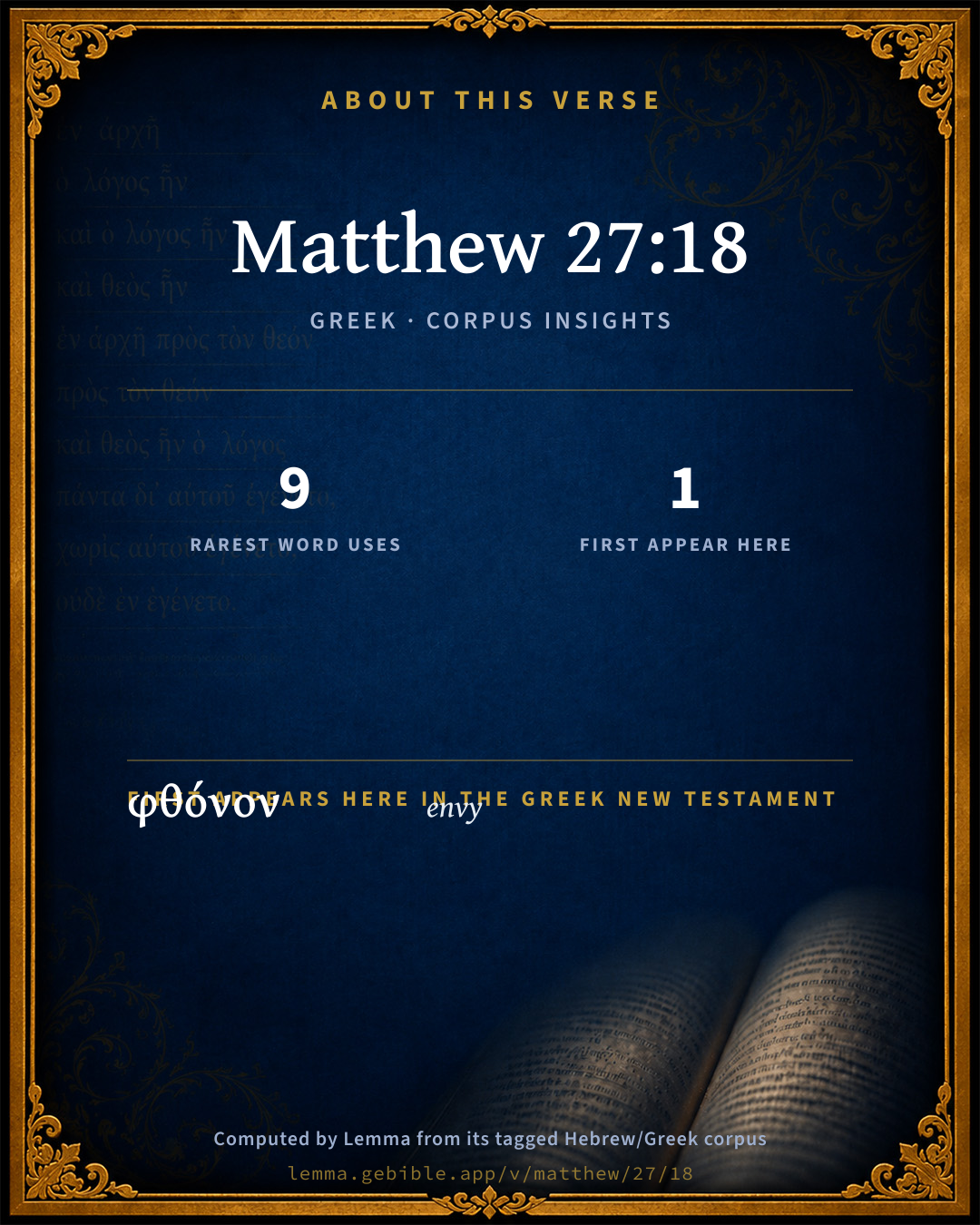
The rarest word here is φθόνον envy G5355 — appearing just 9 times in the whole Greek New Testament.

First appearance in Scripture

This word makes its first canonical appearance in the Greek New Testament here:

  • φθόνον envy G5355

Shared distinctive vocabulary

φθόνον envy G5355 occurs in 9 verses of the Greek New Testament. Also found in:
Cross-references

11

Topical passages linked to Matthew 27:18 in the Treasury of Scripture Knowledge — connected by theme and wording, ordered by reader-vote popularity; previews shown in the World English Bible.

  • Proverbs 27:4 Wrath is cruel, And anger is overwhelming; But who is able to stand before jealousy?
  • Mark 15:10 For he perceived that for envy the chief priests had delivered him up.
  • Acts 5:17 But the high priest rose up, and all those who were with him (which is the sect of the Sadducees), and they were filled with jealousy,
  • Genesis 37:11 His brothers envied him; but his father kept this saying in mind.
  • Acts 7:9 "The patriarchs, moved with jealousy against Joseph, sold him into Egypt. God was with him,
  • Acts 13:45 But when the Jews saw the multitudes, they were filled with jealousy, and contradicted the things which were spoken by Paul, and blasphemed.
  • James 4:5 Or do you think that the Scripture says in vain, "The Spirit who lives in us yearns jealously"?
  • Psalms 106:16 They envied Moses also in the camp, And Aaron, Yahweh's saint.
  • Ecclesiastes 4:4 Then I saw all the labor and achievement that is the envy of a man's neighbor. This also is vanity and a striving after wind.
  • Isaiah 26:11 Yahweh, your hand is lifted up, yet they don't see: but they shall see [your] zeal for the people, and be disappointed; yes, fire shall devour your adversaries.
  • 1 Samuel 18:7–11 The women sang one to another as they played, and said, Saul has slain his thousands, David his ten thousands.

Cross-references courtesy of OpenBible.info (CC BY 4.0).

Commentary

Notes on Matthew 27:18 from classic Christian and Jewish commentators (each source and its license shown beneath its notes). The classic Christian expositions comment on the surrounding passage and are grouped to its opening verse, so a note may address several verses; the Jewish commentaries on the Tanakh (Rashi and others) are per-verse, so they appear only where the commentator wrote on this verse.

Lemma curates 59 commentaries, every one of them public domain or Creative Commons licensed, each selected and text-cleaned for this edition rather than reprinted as found. About our sources →

Bengel's Gnomon

Johann Albrecht Bengel

Mat 27:18. Διὰ φθόνον, for envy) They envied Jesus because the people had adhered to Him.

Bengel's Gnomon of the New Testament — English translation (T&T Clark, Edinburgh, 1860) — public domain. Text from a community e-Sword module.

Meyer's Critical & Exegetical Commentary

Heinrich August Wilhelm Meyer

Mat_27:18 Γάρ] Had he not been aware, etc., he would not have thus attempted to effect the release of Jesus.

παρέδωκαν] The subject of the verb is, of course, the members of the Sanhedrim (Mat_27:2), whose dominant selfishness was too conspicuous in itself, as well as from the animus that characterized their behaviour, to escape his notice. They were jealous of the importance and influence of Jesus; διά denotes the motive which animated them: because of envy; see Winer, p. 372 [E. T. 497]. This was the causa remotior.

Meyer — Critical and Exegetical Commentary on the New Testament — English translation by Peter Christie, edited by Frederick Crombie (T&T Clark, 1880) — public domain. Text from a community e-Sword module.

Expositor's Greek Testament

ed. W. Robertson Nicoll

Mat 27:18 . ᾔδει , he knew, perhaps too strong a word, the fact being that he shrewdly suspected knew his men, and instinctively divined that if Jesus was a popular favourite the Pharisees would be jealous. This explains his sang froid in reference to the title “King of the Jews,” also his offering the name of Jesus to the people.

The Expositor's Greek Testament, edited by W. Robertson Nicoll (1897–1910) — public domain. Text from a community e-Sword module.

Adam Clarke's Commentary

Verse 18. For envy] δια φθονον, through malice. Then it was his business, as an upright judge, to have dispersed this mob, and immediately released Jesus.

Seeing malice is capable of putting even Christ himself to death, how careful should we be not to let the least spark of it harbour in our breast. Let it be remembered that malice as often originates from envy as it does from anger.

Adam Clarke's Commentary on the Bible (1810–1826) — public domain. Text from a community e-Sword/MySword module.

Ellicott's Commentary for English Readers

(18) He knew that for envy.—Pilate knew enough of the accusers to see through the hollowness of their pretended zeal for their own religion, or for the authority of the emperor. He found their real motive in “envy”—fear of the loss of influence and power, if the work of the new Teacher was to continue.

A Bible Commentary for English Readers, edited by Charles John Ellicott (1878–1897) — public domain. Text from a community e-Sword module.

John Gill's Exposition

For he knew that for envy they had delivered him. He saw in their countenances, and by their charges against him, and by the whole of their conduct, that it was not out of any regard to Caesar, or to the peace and tranquillity of the civil government, or to strict justice; but from envy, at his popularity, at his fame and credit, the honour, glory, and applause he had among the people, on account of his doctrine, and miracles, that they had delivered him up into his hands; and therefore Pilate might the rather hope to succeed in this scheme of his to release him, by proposing him with so notorious a person to the populace, when the one, as he might reasonably judge, was abhorred by them, and the other had got great credit and esteem among a large number of them. The Persic version here adds the people's answer; "they answered, release Barabbas, but deliver Jesus to us".

For he knew that for envy they had delivered him. He saw in their countenances, and by their charges against him, and by the whole of their conduct, that it was not out of any regard to Caesar, or to the peace and tranquillity of the civil government, or to strict justice; but from envy, at his popularity, at his fame and credit, the honour, glory, and applause he had among the people, on account of his doctrine, and miracles, that they had delivered him up into his hands; and therefore Pilate might the rather hope to succeed in this scheme of his to release him, by proposing him with so notorious a person to the populace, when the one, as he might reasonably judge, was abhorred by them, and the other had got great credit and esteem among a large number of them. The Persic version here adds the people's answer; "they answered, release Barabbas, but deliver Jesus to us".

Matthew 27:19

mat 27:19

mat 27:19

mat 27:19When he was set down on the judgment seat,.... That is, when Pilate the governor, as the Syriac and Persic versions read, was set down upon the bench, and while he was sitting there, and trying of Jesus:

his wife sent unto him: her name, according to the Ethiopians, was Abrokla (n); who might be a Jewess, as the wife of Felix was, Act 24:24, and a favourer of Jesus, or, at least, a religious person; and if, only a mere Heathen, yet had some notion of justice being to be done; and however, pressed by her dream, sent a messenger to her husband, as he was trying this cause:

saying, have thou nothing to do with that just man; meaning Jesus, whom she either knew to be so, or concluded from her dream that he was one: and her sense is, that her husband would have no hand in his condemnation and death, but rather do all he could to release and save him. She might know that he had gone some lengths already against him; that he had the night before granted a band of soldiers to the chief priests to apprehend him; and knew he rose early that morning, at the request of the same, to try him; and he was now before him, and she might be apprehensive that he was forward to condemn him to death, and therefore sends this cautionary message; alleging this for a reason,

for I have suffered many things this day, in a dream, because of him. The Arabic and Persic versions read, "this night". Pilate might rise that morning before she was awake, and had an opportunity of telling her dream; or she might dream it after he was gone; in which she was sadly distressed about Jesus, and might have some hints given her of the miserable consequences of his death, not only to the Jewish nation, but to her husband and family; which gave her great uneasiness and disquietude. Some have thought, that this dream was from the devil, willing to hinder the death of Christ, and so man's redemption and salvation by it; but had he had any such intention, the most effectual method would have been to have persuaded the chief priests and elders off of it, and in attempting it; whereas, on the contrary, they were instigated by him to it: and whatever natural causes there might be of this dream, as the chief priests coming over night to desire a band of soldiers to take Jesus, and the discourse they might have with Pilate about him; which things might run in her mind in her sleep; yet, doubtless, this was of God, and with a design that a testimony should be bore to the innocency of Christ every way; as by Judas that betrayed him, by Pilate his judge, and by his wife.

(n) Ludolph. Lex. Ethiop. p. 541.

John Gill's Exposition of the Whole Bible (1746–1763) — public domain (CC PDM 1.0). Text via the HelloAO Bible API.

Trapp's Complete Commentary

John Trapp

18 For he knew that for envy they had delivered him.

Ver. 18. For he knew that for envy] His sin was the greater for his knowledge, Jas 4:17. Omne peccatum contra conscientiam aedificat ad gehennam, saith Gerson. When men imprison their light (that prophet from God), Rom 1:18, and after conviction run away with the bit in their mouths, as it were, they run, without God’s greater mercy, upon their utter ruin and destruction. Tostatus truly observeth, that Solomon’s idolatry was a sin far more sinful than that of his wives, because against knowledge.

John Trapp, A Commentary or Exposition upon All the Books of the Old and New Testament (1647–1656) — public domain. Text from a community e-Sword module.

Whedon's Commentary on the Bible

Daniel D. Whedon

18. Knew that for envy — Pilate was perfectly satisfied that the charge brought by the Jews against Jesus, as seeking to be the rival king against Cesar, was a fiction. He knew the innocence of the accused. When he surrendered him he was guilty of innocent blood. No washing of his own hands could cleanse his soul or clear his character in history.

From the other evangelists we learn to supply several facts omitted by Matthew. Pilate, on learning that Jesus was of Galilee, sent him to Herod, the Tetrarch of Galilee, who was then in Jerusalem, hoping that he would dispose of his case. But Herod, after putting Jesus to mockery, remands him back to Pilate. Pilate endeavours to induce the Jews to allow Jesus to be dismissed with a few stripes, and they refuse with clamour. After he had endeavoured to have him released by amnesty, and they prefer the release of Barabbas, he washes his hands, in token of protesting his innocence of the death of Jesus. They respond loudly by taking the responsibility of his blood upon their own heads and their children’s. Pilate then surrenders Jesus apart, to mockery and scourges and then brings him out as a piteous spectacle, and presents him, with the words, Behold the man.” So far from being melted at the sight, they cry out the more to “crucify him!” On his demanding for what possible reason Jesus is to be crucified, they reply, “Because he called himself the Son of God.” Struck with this new charge, and with the strange assumption of this divine title by his prisoner, Pilate returns to Jesus to examine him, and is so impressed with his noble bearing as to make one more effort to save him. But at last the cry, “If you let this man go you are not Cesar’s friend,” settled the matter. Pilate did not bear to have his faithfulness to the emperor questioned, and to save his own position he sacrificed Jesus. He thus became sharer in their guilt. Taking his seat upon the tribunal of the pavement, so called, in front of his palace, he received the last rejection of Jesus by the Jews, and gave him up to death at about nine o’clock on Friday the day of the crucifixion.

Daniel D. Whedon (gen. ed.), Commentary on the Old and New Testaments (1874–1909) — public domain. Text from a community e-Sword module.

The Pulpit Commentary

For he knew. He had recourse to this expedient because he was well acquainted with the motives which led the Sanhedrists to desire his death. They had shown their envy of Christ"s influence with the people; they were jealous of his reputation and success; grudged him his marvellous powers; were embittered by his attacks on rabbinism, and the undermining of their popularity. Pilate saw much of this; he penetrated behind their flimsy pretence of averting some possible danger from the Roman dominion, and he laboured in this indirect way to save the victim of this vindictive plot. Of course, Pilate could not fully appreciate Christ"s character, nor enter into the question of his supernatural claims; he saw only that he was brought before him from the basest motives, that no real offence was proved against him, and that no fear could be entertained of his heading a popular tumult.

Pilate"s character reading.

"He knew that for envy they had delivered him." Pilate was never under any sort of delusion concerning Christ. Experience as a magistrate made the criminal"s face, and attitude, and speech, and ways, quite familiar things to him. He watched Jesus, and was perfectly certain that he was no criminal, and no dangerous revolutionist. And Pilate had not had contention after contention with that priest party without knowing the party well; and his estimate of it we can well imagine. It did not flatter them, and it was just. Of course, he saw everything from the Roman"s point of view, and he made some mistakes, as every one must who fails to put himself in the place of him whom he appraises; he was, however, right in this case. But what he read seriously increases the guilt and shame of his act. He has no excuse of even self-deception.

I PILATE"S READING OF THE CHARACTER AND MOTIVES OF THE PRIEST PARTY. Pilate "was a typical Roman, not of the antique, simple stamp, but of the imperial period; a man not without some remains of the ancient Roman justice in his soul, yet pleasure loving, imperious, and corrupt. He hated the Jews whom he ruled, and, in times of irritation, freely shed their blood. They returned his hatred with cordiality, and accused him of every crime maladministration, cruelty, and robbery." "Pilate understood their pretended zeal for the Roman authority." He may not have known the precise occasion for their strong feeling against Jesus; but he saw plainly that it was a case of malice and revenge, and they were prepared to humiliate themselves utterly in carrying out their evil purpose. But, if Pilate knew them so well, we must judge his guilt in yielding to them by the light of his knowledge.

II PILATE"S READING OF THE CHARACTER AND MOTIVES OF JESUS. He seems to have known something of Jesus. The story of the triumphal entry had been duly reported to him; and he formed his opinion when he found that Jesus took no material advantage of that time of excitement. He settled it Jesus was a harmless enthusiast, of no account politically. "He questioned Jesus in regard to the accusations brought against him, asking especially if he pretended to be a King." He may have laughed cynically at our Lord"s answer, but he knew well that nothing of the demagogue lurked behind that calm and peaceful face. Again and again he declared him innocent he found no fault in him. Pilate read him aright, but condemned himself in the reading. Our guilt is always measured by our knowledge. R.T.

The Pulpit Commentary (1880–1919), ed. H.D.M. Spence-Jones & Joseph S. Exell — public domain. Text from a community e-Sword module.

John Wesley's Explanatory Notes

He knew that for envy they had delivered him - As well as from malice and revenge; they envied him, because the people magnified him.

John Wesley, Explanatory Notes Upon the Whole Bible (1754–1765) — public domain. Text via the GEBible commentary corpus.

Alford’s Greek Testament

Henry Alford

18.] The whole narrative presupposes what this verse and the next distinctly assert, that Pilate was before acquainted with the acts and character of Jesus.

Henry Alford, The Greek Testament (1849–1861) — public domain. Text from a community e-Sword module.

International Critical Commentary

(M) 18. For he knew that they had delivered Him up through envy.] Mk. has: “For he knew that the chief priests had delivered Him up through envy.”—ᾔδει] Mt. avoids Mk.’s imperf. ἐγίνωσκεν.—παρέδωκαν] Mt. avoids Mk.’s pluperfect; cf. 26:48.

International Critical Commentary — older volumes (1896–1929), various authors — public domain. Text from a community e-Sword module.

Lesson kit

Teaching starters — assembled from the data on this page, not authored interpretation. Every prompt links to the verse data it draws on. Edit before teaching.

Matthew, in the Gospels, opens this verse with 7 words (7 distinct Greek lemmas). Its most distinctive word is phthónos (“envy”). A historical commentator’s framing appears above. Read the whole chapter for the surrounding context.

Discussion questions

  1. The word phthónos carries the sense “envy.” How does it shape the verse?
  2. The word “envy” first appears here in Scripture. What is being introduced at this debut?
  3. Mark 15:10 shares the word «envy» with this verse. How do the two illuminate each other?
  4. These translations render this verse differently. What is at stake in choosing one wording over another?
  5. Reading how Bengel's Gnomon and Meyer's Critical & Exegetical Commentary read this verse, where do the two commentators agree and where do they part?

Things to notice

  • 1 word makes its first canonical appearance in Scripture here.
  • These translations choose different wording for 6 words in this verse.
  • 7 distinct Greek lemmas span 7 words in this verse.

Reading settings

Reading text

Shown beneath each verse's original-language words.

Old Testament
Old Testament edition

Read the OT as the Masoretic Hebrew (MT) or the Greek Septuagint (LXX).

English shown for the Greek Septuagint (in the Hebrew ↔ Greek comparison).

Comparing translations? Open the Compare panel on any verse page to stack up to four side by side.