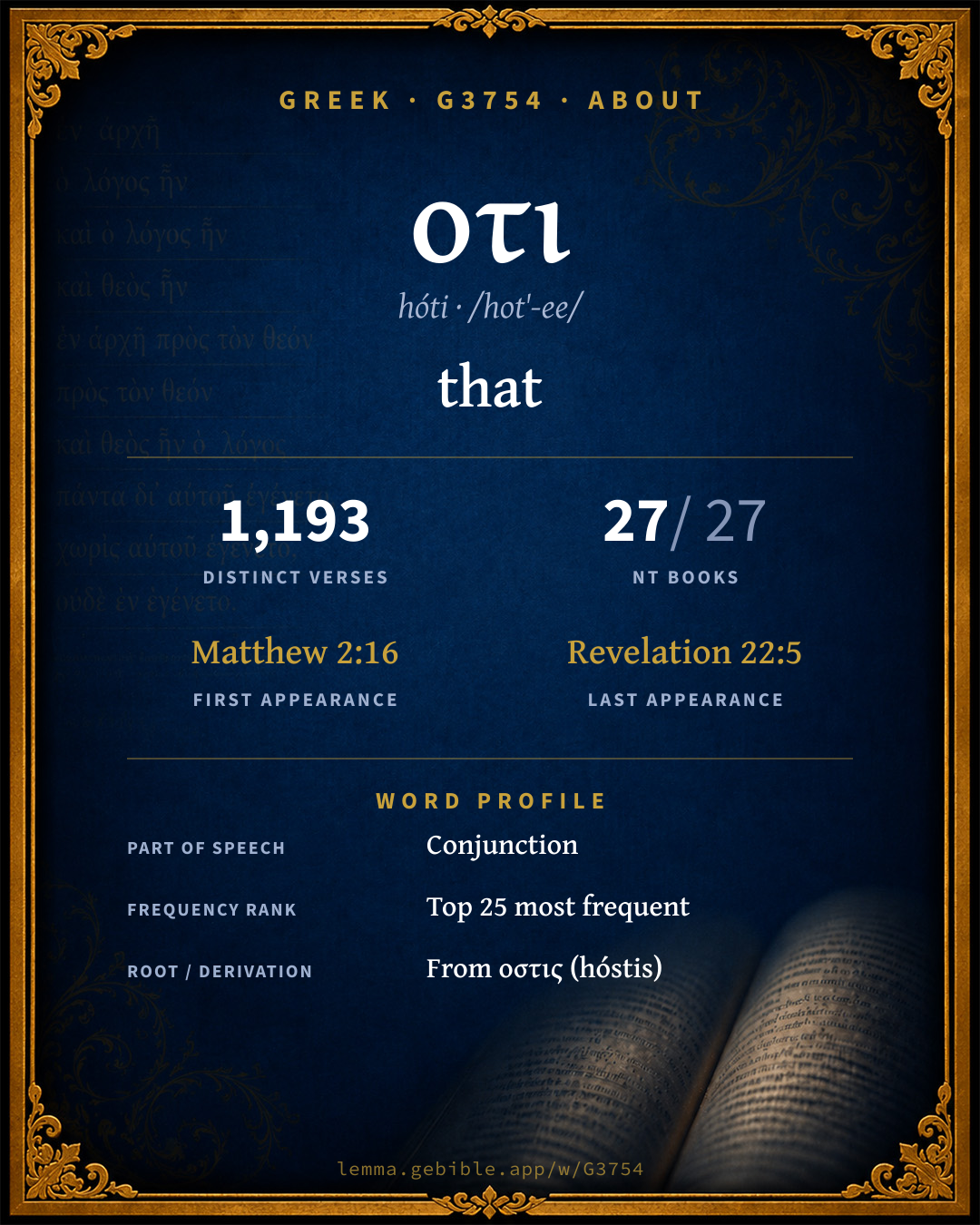
ὅτι
that
Full lexicon entry — Thayer's Greek Lexicon
From Thayer's Greek Lexicon
Where this word appears
Grammar key — what these labels mean
Part of speech
- Conjunction
- A joining word linking words or clauses.
Every verse where G3754 appears in the Book of Acts — 115 distinct verses. Click any verse to open its interlinear word-by-word view. Verse text shown in the World English Bible for context — . Each verse’s Greek form is shown with its reference; the English is not keyword-highlighted, since the data carries no word-level English alignment. Use “Compare translations” on any verse to read it across multiple English versions. This concordance covers the Greek New Testament; Septuagint (Greek Old Testament) occurrences of this word are not indexed here.
Acts
- Acts 1:5 ὅτι conj For John indeed baptized in water, but you will be baptized in the Holy Spirit not many days from now."
- Acts 1:17 ὅτι conj For he was numbered with us, and received his portion in this ministry.
- Acts 2:6 ὅτι conj When this sound was heard, the multitude came together, and were bewildered, because everyone heard them speaking in his own language.
- Acts 2:13 ὅτι conj Others, mocking, said, "They are filled with new wine."
- Acts 2:25 ὅτι conj For David says concerning him, 'I saw the Lord always before my face, For he is on my right hand, that I should not be moved.
- Acts 2:27 ὅτι conj Because you will not leave my soul in Hades, Neither will you allow your Holy One to see decay.
- Acts 2:29 ὅτι conj "Brothers, I may tell you freely of the patriarch David, that he both died and was buried, and his tomb is with us to this day.
- Acts 2:30 ὅτι conj Therefore, being a prophet, and knowing that God had sworn with an oath to him that of the fruit of his body, according to the flesh, he would raise up the Christ to sit on his throne,
- Acts 2:31 ὅτι conj he foreseeing this spoke about the resurrection of the Christ, that neither was his soul left in Hades, nor did his flesh see decay.
- Acts 2:36 ὅτι conj "Let all the house of Israel therefore know assuredly that God has made him both Lord and Christ, this Jesus whom you crucified."
- Acts 3:10 ὅτι conj They recognized him, that it was he who used to sit begging for gifts for the needy at the Beautiful Gate of the temple. They were filled with wonder and amazement at what had happened to him.
- Acts 3:17 ὅτι conj "Now, brothers, I know that you did this in ignorance, as did also your rulers.
- Acts 3:22 ὅτι conj For Moses indeed said to the fathers, 'The Lord God will raise up a prophet for you from among your brothers, like me. You shall listen to him in all things whatever he says to you.
- Acts 4:10 ὅτι conj be it known to you all, and to all the people of Israel, that in the name of Jesus Christ of Nazareth, whom you crucified, whom God raised from the dead, in him does this man stand here before you whole.
- Acts 4:13 ὅτι ὅτι conj conj Now when they saw the boldness of Peter and John, and had perceived that they were unlearned and ignorant men, they marveled. They recognized that they had been with Jesus.
- Acts 4:16 ὅτι conj saying, "What shall we do to these men? Because indeed a notable miracle has been done through them, as can be plainly seen by all who dwell in Jerusalem, and we can't deny it.
- Acts 4:21 ὅτι conj When they had further threatened them, they let them go, finding no way to punish them, because of the people; for everyone glorified God for that which was done.
- Acts 5:4 ὅτι conj While you kept it, didn't it remain your own? After it was sold, wasn't it in your power? How is it that you have conceived this thing in your heart? You haven't lied to men, but to God."
- Acts 5:9 ὅτι conj But Peter asked her, "How is it that you have agreed together to tempt the Spirit of the Lord? Behold, the feet of those who have buried your husband are at the door, and they will carry you out."
- Acts 5:23 ὅτι conj "We found the prison shut and locked, and the guards standing before the doors, but when we opened them, we found no one inside!"
- Acts 5:25 ὅτι conj One came and told them, "Behold, the men whom you put in prison are in the temple, standing and teaching the people."
- Acts 5:38 ὅτι conj Now I tell you, withdraw from these men, and leave them alone. For if this counsel or this work is of men, it will be overthrown.
- Acts 5:41 ὅτι conj They therefore departed from the presence of the council, rejoicing that they were counted worthy to suffer dishonor for Jesus' name.
- Acts 6:1 ὅτι conj Now in those days, when the number of the disciples was multiplying, a complaint arose from the Grecian Jews against the Hebrews because their widows were neglected in the daily service.
- Acts 6:11 ὅτι conj Then they secretly induced men to say, "We have heard him speak blasphemous words against Moses and God."
- Acts 6:14 ὅτι conj For we have heard him say that this Jesus of Nazareth will destroy this place, and will change the customs which Moses delivered to us."
- Acts 7:6 ὅτι conj God spoke in this way: that his seed would live as aliens in a strange land, and that they would be enslaved and mistreated for four hundred years.
- Acts 7:25 ὅτι conj He supposed that his brothers understood that God, by his hand, was giving them deliverance; but they didn't understand.
- Acts 8:14 ὅτι conj Now when the apostles who were at Jerusalem heard that Samaria had received the word of God, they sent Peter and John to them,
- Acts 8:18 ὅτι conj Now when Simon saw that the Holy Spirit was given through the laying on of the apostles' hands, he offered them money,
- Acts 8:20 ὅτι conj But Peter said to him, "May your silver perish with you, because you thought you could obtain the gift of God with money!
- Acts 8:33 ὅτι conj In his humiliation, his judgment was taken away. Who will declare His generation? For his life is taken from the earth."
- Acts 9:15 ὅτι conj But the Lord said to him, "Go your way, for he is my chosen vessel to bear my name before the nations and kings, and the children of Israel.
- Acts 9:20 ὅτι conj Immediately in the synagogues he proclaimed the Christ, that he is the Son of God.
- Acts 9:22 ὅτι conj But Saul increased more in strength, and confounded the Jews who lived at Damascus, proving that this is the Christ.
- Acts 9:26 ὅτι conj When Saul had come to Jerusalem, he tried to join himself to the disciples; but they were all afraid of him, not believing that he was a disciple.
- Acts 9:27 ὅτι conj But Barnabas took him, and brought him to the apostles, and declared to them how he had seen the Lord in the way, and that he had spoken to him, and how at Damascus he had preached boldly in the name of Jesus.
- Acts 9:38 ὅτι conj As Lydda was near Joppa, the disciples, hearing that Peter was there, sent two men to him, imploring him not to delay in coming to them.
- Acts 10:14 ὅτι conj But Peter said, "Not so, Lord; for I have never eaten anything that is common or unclean."
- Acts 10:20 ὅτι conj But arise, get down, and go with them, doubting nothing; for I have sent them."
- Acts 10:34 ὅτι conj Peter opened his mouth and said, "Truly I perceive that God doesn't show favoritism;
- Acts 10:38 ὅτι conj even Jesus of Nazareth, how God anointed him with the Holy Spirit and with power, who went about doing good and healing all who were oppressed by the devil, for God was with him.
- Acts 10:42 ὅτι conj He charged us to preach to the people and to testify that this is he who is appointed by God as the Judge of the living and the dead.
- Acts 10:45 ὅτι conj They of the circumcision who believed were amazed, as many as came with Peter, because the gift of the Holy Spirit was also poured out on the Gentiles.
- Acts 11:1 ὅτι conj Now the apostles and the brothers who were in Judea heard that the Gentiles had also received the word of God.
- Acts 11:3 ὅτι conj saying, "You went in to uncircumcised men, and ate with them!"
- Acts 11:8 ὅτι conj But I said, 'Not so, Lord, for nothing unholy or unclean has ever entered into my mouth.'
- Acts 11:24 ὅτι conj For he was a good man, and full of the Holy Spirit and of faith, and many people were added to the Lord.
- Acts 12:3 ὅτι conj When he saw that it pleased the Jews, he proceeded to seize Peter also. This was during the days of unleavened bread.
- Acts 12:9 ὅτι conj And he went out and followed him. He didn't know that what was being done by the angel was real, but thought he saw a vision.
- Acts 12:11 ὅτι conj When Peter had come to himself, he said, "Now I truly know that the Lord has sent out his angel and delivered me out of the hand of Herod, and from everything the Jewish people were expecting."
- Acts 13:32 ὅτι conj We bring you good news of the promise made to the fathers,
- Acts 13:34 ὅτι ὅτι conj conj "Concerning that he raised him up from the dead, now no more to return to corruption, he has spoken thus: 'I will give you the holy and sure blessings of David.'
- Acts 13:38 ὅτι conj Be it known to you therefore, brothers, that through this man is proclaimed to you remission of sins,
- Acts 13:41 ὅτι conj 'Behold, you scoffers, and wonder, and perish; For I work a work in your days, A work which you will in no way believe, if one declares it to you.'"
- Acts 14:9 ὅτι conj He was listening to Paul speaking, who, fastening eyes on him, and seeing that he had faith to be made whole,
- Acts 14:22 ὅτι conj confirming the souls of the disciples, exhorting them to continue in the faith, and that through many afflictions we must enter into the Kingdom of God.
- Acts 14:27 ὅτι conj When they had arrived, and had gathered the assembly together, they reported all the things that God had done with them, and that he had opened a door of faith to the Gentiles.
- Acts 15:1 ὅτι conj Some men came down from Judea and taught the brothers, "Unless you are circumcised after the custom of Moses, you can't be saved."
- Acts 15:5 ὅτι conj But some of the sect of the Pharisees who believed rose up, saying, "It is necessary to circumcise them, and to charge them to keep the law of Moses."
- Acts 15:7 ὅτι conj When there had been much discussion, Peter rose up and said to them, "Brothers, you know that a good while ago God made choice among you, that by my mouth the Gentiles should hear the word of the Gospel, and believe.
- Acts 15:24 ὅτι conj Because we have heard that some who went out from us have troubled you with words, unsettling your souls, saying, 'You must be circumcised and keep the law,' to whom we gave no commandment;
- Acts 16:3 ὅτι conj Paul wanted to have him go out with him, and he took and circumcised him because of the Jews who were in those parts; for they all knew that his father was a Greek.
- Acts 16:10 ὅτι conj When he had seen the vision, immediately we sought to go out to Macedonia, concluding that the Lord had called us to preach the Gospel to them.
- Acts 16:19 ὅτι conj But when her masters saw that the hope of their gain was gone, they seized Paul and Silas, and dragged them into the marketplace before the rulers.
- Acts 16:36 ὅτι conj The jailer reported these words to Paul, saying, "The magistrates have sent to let you go; now therefore come out, and go in peace."
- Acts 16:38 ὅτι conj The sergeants reported these words to the magistrates, and they were afraid when they heard that they were Romans,
- Acts 17:3 ὅτι ὅτι conj conj explaining and demonstrating that the Christ had to suffer and rise again from the dead, and saying, "This Jesus, whom I proclaim to you, is the Christ."
- Acts 17:6 ὅτι conj When they didn't find them, they dragged Jason and certain brothers before the rulers of the city, crying, "These who have turned the world upside down have come here also,
- Acts 17:13 ὅτι conj But when the Jews of Thessalonica had knowledge that the word of God was proclaimed by Paul at Beroea also, they came there likewise, agitating the multitudes.
- Acts 17:18 ὅτι conj Some of the Epicurean and Stoic philosophers also were conversing with him. Some said, "What does this babbler want to say?" Others said, "He seems to be advocating foreign deities," because he preached Jesus and the resurrection.
- Acts 18:13 ὅτι conj saying, "This man persuades men to worship God contrary to the law."
- Acts 19:21 ὅτι conj Now after these things had ended, Paul determined in the spirit, when he had passed through Macedonia and Achaia, to go to Jerusalem, saying, "After I have been there, I must also see Rome."
- Acts 19:25 ὅτι conj whom he gathered together, with the workmen of like occupation, and said, "Sirs, you know that by this business we have our wealth.
- Acts 19:26 ὅτι ὅτι conj conj You see and hear, that not at Ephesus alone, but almost throughout all Asia, this Paul has persuaded and turned away many people, saying that they are no gods, that are made with hands.
- Acts 19:34 ὅτι conj But when they perceived that he was a Jew, all with one voice for a time of about two hours cried out, "Great is Artemis of the Ephesians!"
- Acts 20:23 ὅτι ὅτι conj conj except that the Holy Spirit testifies in every city, saying that bonds and afflictions wait for me.
- Acts 20:25 ὅτι conj Now, behold, I know that you all, among whom I went about preaching the Kingdom of God, will see my face no more.
- Acts 20:26 ὅτι conj Therefore I testify to you this day that I am clean from the blood of all men,
- Acts 20:29 ὅτι conj For I know that after my departure, vicious wolves will enter in among you, not sparing the flock.
- Acts 20:31 ὅτι conj Therefore watch, remembering that for a period of three years I didn't cease to admonish everyone night and day with tears.
- Acts 20:34 ὅτι conj You yourselves know that these hands ministered to my necessities, and to those who were with me.
- Acts 20:35 ὅτι ὅτι conj conj In all things I gave you an example, that so laboring you ought to help the weak, and to remember the words of the Lord Jesus, that he himself said, 'It is more blessed to give than to receive.'"
- Acts 20:38 ὅτι conj sorrowing most of all because of the word which he had spoken, that they should see his face no more. And they accompanied him to the ship.
- Acts 21:21 ὅτι conj They have been informed about you, that you teach all the Jews who are among the Gentiles to forsake Moses, telling them not to circumcise their children neither to walk after the customs.
- Acts 21:22 ὅτι conj What then? The assembly must certainly meet, for they will hear that you have come.
- Acts 21:24 ὅτι conj Take them, and purify yourself with them, and pay their expenses for them, that they may shave their heads. Then all will know that there is no truth in the things that they have been informed about you, but that you yourself also walk keeping the law.
- Acts 21:29 ὅτι conj For they had seen Trophimus, the Ephesian, with him in the city, and they supposed that Paul had brought him into the temple.
- Acts 21:31 ὅτι conj As they were trying to kill him, news came up to the commanding officer of the regiment that all Jerusalem was in an uproar.
- Acts 22:2 ὅτι conj When they heard that he spoke to them in the Hebrew language, they were even more quiet. He said,
- Acts 22:15 ὅτι conj For you will be a witness for him to all men of what you have seen and heard.
- Acts 22:19 ὅτι conj I said, 'Lord, they themselves know that I imprisoned and beat in every synagogue those who believed in you.
- Acts 22:21 ὅτι conj "He said to me, 'Depart, for I will send you out far from here to the Gentiles.'"
- Acts 22:29 ὅτι ὅτι conj conj Immediately those who were about to examine him departed from him, and the commanding officer also was afraid when he realized that he was a Roman, because he had bound him.
- Acts 23:5 ὅτι ὅτι conj conj Paul said, "I didn't know, brothers, that he was high priest. For it is written, 'You shall not speak evil of a ruler of your people.'"
- Acts 23:6 ὅτι conj But when Paul perceived that the one part were Sadducees and the other Pharisees, he cried out in the council, "Men and brothers, I am a Pharisee, a son of Pharisees. Concerning the hope and resurrection of the dead I am being judged!"
- Acts 23:20 ὅτι conj He said, "The Jews have agreed to ask you to bring Paul down to the council tomorrow, as though intending to inquire somewhat more accurately concerning him.
- Acts 23:22 ὅτι conj So the commanding officer let the young man go, charging him, "Tell no one that you have revealed these things to me."
- Acts 23:27 ὅτι conj "This man was seized by the Jews, and was about to be killed by them, when I came with the soldiers and rescued him, having learned that he was a Roman.
- Acts 23:34 ὅτι conj When the governor had read it, he asked what province he was from. When he understood that he was from Cilicia, he said,
- Acts 24:11 ὅτι conj seeing that you can recognize that it is not more than twelve days since I went up to worship at Jerusalem.
- Acts 24:14 ὅτι conj But this I confess to you, that after the Way, which they call a sect, so I serve the God of our fathers, believing all things which are according to the law, and which are written in the prophets;
- Acts 24:21 ὅτι conj unless it is for this one thing that I cried standing among them, 'Concerning the resurrection of the dead I am being judged before you today!'"
- Acts 24:26 ὅτι conj Meanwhile, he also hoped that money would be given to him by Paul, that he might release him. Therefore also he sent for him more often, and talked with him.
- Acts 25:8 ὅτι conj while he said in his defense, "Neither against the law of the Jews, nor against the temple, nor against Caesar, have I sinned at all."
- Acts 25:16 ὅτι conj To whom I answered that it is not the custom of the Romans to give up any man to destruction, before the accused has met the accusers face to face, and has had opportunity to make his defense concerning the matter laid against him.
- Acts 26:5 ὅτι conj having known me from the first, if they are willing to testify, that after the strictest sect of our religion I lived a Pharisee.
- Acts 26:27 ὅτι conj King Agrippa, do you believe the prophets? I know that you believe."
- Acts 26:31 ὅτι conj When they had withdrawn, they spoke one to another, saying, "This man does nothing worthy of death or of bonds."
- Acts 27:10 ὅτι conj and said to them, "Sirs, I perceive that the voyage will be with injury and much loss, not only of the cargo and the ship, but also of our lives."
- Acts 27:25 ὅτι conj Therefore, sirs, cheer up! For I believe God, that it will be just as it has been spoken to me.
- Acts 28:1 ὅτι conj When we had escaped, then they learned that the island was called Malta.
- Acts 28:22 ὅτι conj But we desire to hear from you what you think. For, as concerning this sect, it is known to us that everywhere it is spoken against."
- Acts 28:25 ὅτι conj When they didn't agree among themselves, they departed after Paul had spoken one word, "The Holy Spirit spoke rightly through Isaiah, the prophet, to our fathers,
- Acts 28:28 ὅτι conj "Be it known therefore to you, that the salvation of God is sent to the Gentiles. They will also listen."
About this entry
At a glance — auto-summarized from this page’s data, not written by a person. Every figure links to its source below. This summary describes the numbers; it doesn’t interpret them.
At its core, οτι (hóti) means “that.” Scripture first uses it in Matthew 2:16. Spanning 1,193 verses in 27 books, it ranks among the most common words of the Greek New Testament. From the same root come οστις and οτου. Each statement above links to its evidence; the full detail follows below.
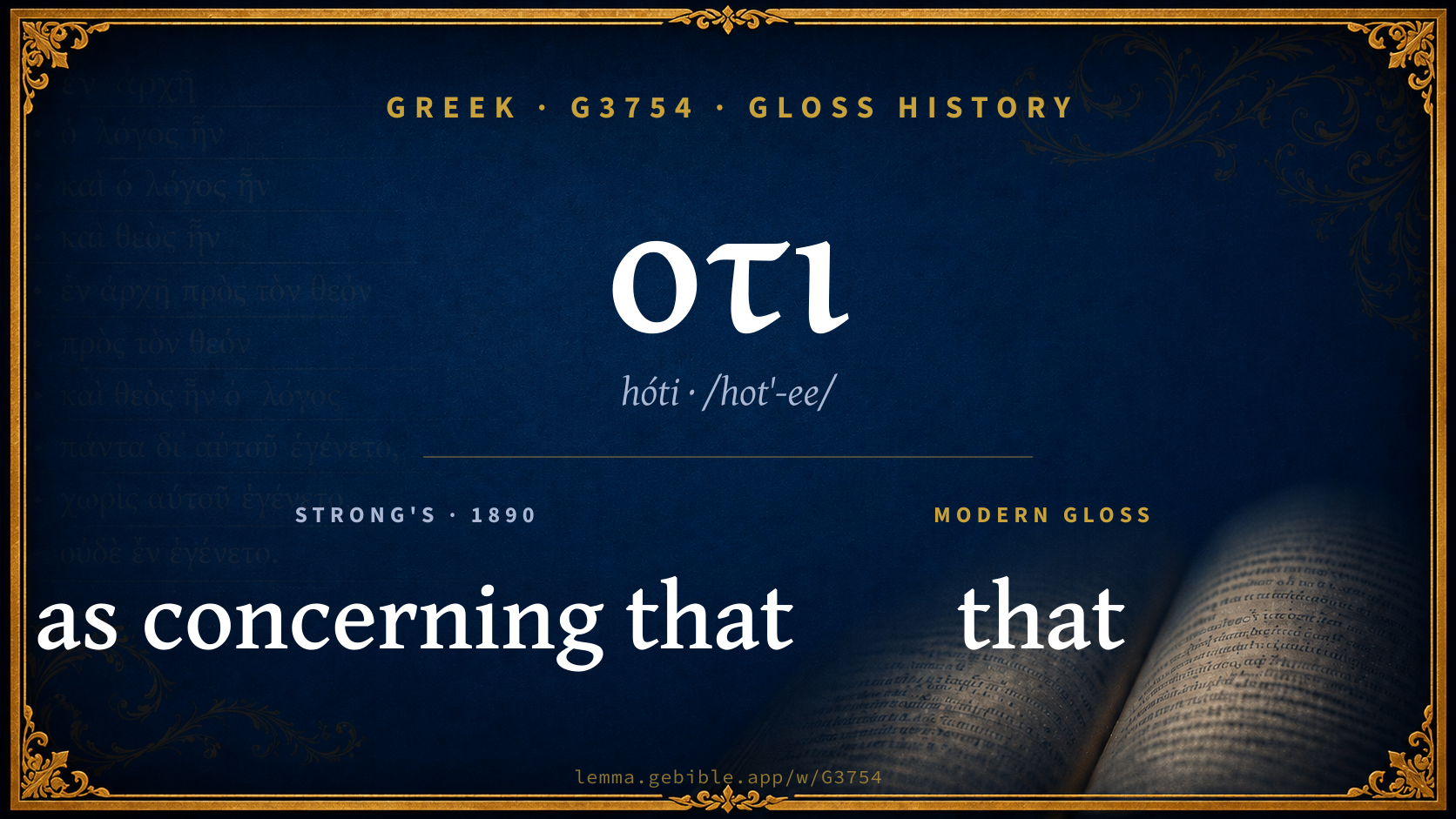
Gloss history
Strong's 1890 vs modern scholarship
About this word
Strong's G3754 catalogs a Greek word from the Greek New Testament.
These counts are not copied from any lexicon or concordance. They are computed here, from the morphology-tagged Greek New Testament. What Lemma adds →
- 1,193
- distinct verses
- The word appears in 1,193 distinct verses.
- 27 / 27
- NT books
- The word appears in 27 of 27 New Testament books.
- #15
- by frequency
- Top 25 most frequent Greek words (rank 15 of 5,347 Greek words by occurrence).
View all 1,193 occurrences in the concordance →
By section of the New Testament
By traditional corpus
Conventional, traditional groupings — biblical authorship is debated, so this is a traditional corpus grouping, not an authorship claim. Some books belong to more than one corpus (Luke is in both the Gospels and the Lukan corpus, and so on), so these shares overlap and need not total 100%. Each figure is a share of the word’s 1,193 distinct verses.
- Gospels 636 verses · 53%
- Johannine 357 verses · 30%
- Lukan (Luke–Acts) 280 verses · 23%
- Pauline corpus 269 verses · 23%
- General (Catholic) Epistles 102 verses · 9%
- Revelation 54 verses · 5%
- Hebrews 17 verses · 1%
How translations render this word
Counts come from each version’s own published word-to-Strong’s tagging or interlinear alignment — an approximate guide to how each version renders this word, not a word-level alignment the data otherwise carries. Because each total is that version’s own tagged count, the per-version totals vary from one another and need not match the appearance or distinct-verse counts above. These counts may also differ from a printed concordance because Lemma counts each distinctly tagged rendering and does not collapse phrase taggings into a single head-word total. This is a fixed set of word-tagged versions (KJV, ASV, BSB, ULT) and does not change with the reading translation you choose elsewhere. Each version’s license is shown beside its name below (and on Sources).
- King James Version: That 607×, For 258×, Because 178×
- American Standard Version: That 605×, For 237×, Because 161×
- Berean Standard Bible: That 520×, Because 207×, For 162×
- unfoldingWord Literal Text: That 681×, Because 221×, For 202×
King James Version Public Domain
Renders G3754 across 1,142 tagged occurrences — most commonly:
Plus other, less common renderings. Plus 35 renderings that appear only once — usually multi-word phrases or single function words the recovered tagging swept in, not distinct renderings. Not rendered by a distinct English word in 151 further occurrences.
American Standard Version Public Domain
Renders G3754 across 1,242 tagged occurrences — most commonly:
Plus other, less common renderings. Plus 98 renderings that appear only once — usually multi-word phrases or single function words the recovered tagging swept in, not distinct renderings. Not rendered by a distinct English word in 20 further occurrences.
Berean Standard Bible Public Domain
Renders G3754 across 935 tagged occurrences — most commonly:
Plus 24 renderings that appear only once — usually multi-word phrases or single function words the recovered tagging swept in, not distinct renderings. Not rendered by a distinct English word in 368 further occurrences.
unfoldingWord Literal Text CC BY-SA 4.0
Renders G3754 across 1,123 tagged occurrences — most commonly:
Plus 2 renderings that appear only once — usually multi-word phrases or single function words the recovered tagging swept in, not distinct renderings.
Senses in Thayer's
The 1 sense Thayer's distinguishes for this word, in lexicon order (not ranked by frequency or importance). The full entry — with sub-senses — is in the Lexicon Entry tab.
- that, because, since
Word origin
Derived from οστις (hóstis) (G3748) — whoever.
Neuter of G3748 as conjugation; demonstrative that (sometimes redundant); causatively because : - as concerning that as though because (that) for (that) how (that) (in) that though why.
— Strong’s Exhaustive Concordance (1890), public domain.
Same root — word family
Other Thayer's entries built from the same root as G3754, grouped by Strong’s listed origin. These share a root / origin per the lexicon — not necessarily a shared meaning. Each links to that word’s own entry.
Derives from
Shares the same root
Compare all same-root words → They share a root, not necessarily a meaning.
Septuagint usage
The same Greek word οτι appears 3,218 times in the Greek Old Testament (Septuagint), across 2,854 verses in 36 books.
- 3,218
- LXX occurrences
- Tagged occurrences of this Greek word in the Septuagint.
- 2,854
- verses
- Distinct Septuagint verses containing this word.
- 36 / 39
- OT books
- The word appears in 36 of the 39 Old Testament books.
Sample Septuagint occurrences
- Genesis 1:4 ὅτι
- Exodus 1:18 ὅτι
- Leviticus 5:11 ὅτι
- Numbers 6:7 ὅτι
- Deuteronomy 1:17 ὅτι
- Joshua 1:9 ὅτι
- Judges 1:15 ὅτι
- Ruth 1:6 ὅτι
- 1 Samuel 1:5 ὅτι
- 2 Samuel 1:4 ὅτι
- 1 Kings 1:11 ὅτι
- 2 Kings 1:4 ὅτι
Septuagint occurrences (same lexeme)
Every verse where the same Strong’s number (G3754) appears in the Greek Septuagint — showing the first 50 of 2,854. Verse text shown in the World English Bible for context; the Greek form is the matched word — the English is not keyword-highlighted.
- Genesis 1:4 ὅτι God saw the light, and saw that it was good. God divided the light from the darkness.
- Genesis 1:8 ὅτι God called the expanse sky. There was evening and there was morning, a second day.
- Genesis 1:10 ὅτι God called the dry land Earth, and the gathering together of the waters he called Seas. God saw that it was good.
- Genesis 1:12 ὅτι The earth brought forth grass, herbs yielding seed after their kind, and trees bearing fruit, with its seed in it, after their kind: and God saw that it was good.
- Genesis 1:18 ὅτι and to rule over the day and over the night, and to divide the light from the darkness. God saw that it was good.
- Genesis 1:21 ὅτι God created the large sea creatures, and every living creature that moves, with which the waters swarmed, after their kind, and every winged bird after its kind. God saw that it was good.
- Genesis 1:25 ὅτι God made the animals of the earth after their kind, and the cattle after their kind, and everything that creeps on the ground after its kind. God saw that it was good.
- Genesis 2:3 ὅτι God blessed the seventh day, and made it holy, because he rested in it from all his work which he had created and made.
- Genesis 2:23 ὅτι The man said, "This is now bone of my bones, and flesh of my flesh. She will be called Woman, because she was taken out of Man."
- Genesis 3:1 ὅτι Now the serpent was more subtle than any animal of the field which Yahweh God had made. He said to the woman, "Yes, has God said, 'You shall not eat of any tree of the garden?'"
- Genesis 3:5 ὅτι for God knows that in the day you eat it, your eyes will be opened, and you will be like God, knowing good and evil."
- Genesis 3:6 ὅτι When the woman saw that the tree was good for food, and that it was a delight to the eyes, and that the tree was to be desired to make one wise, she took of the fruit of it, and ate; and she gave some to her husband with her, and he ate.
- Genesis 3:7 ὅτι Both of their eyes were opened, and they knew that they were naked. They sewed fig leaves together, and made themselves aprons.
- Genesis 3:10 ὅτι The man said, "I heard your voice in the garden, and I was afraid, because I was naked; and I hid myself."
- Genesis 3:11 ὅτι God said, "Who told you that you were naked? Have you eaten from the tree that I commanded you not to eat from?"
- Genesis 3:14 ὅτι Yahweh God said to the serpent, "Because you have done this, cursed are you above all cattle, and above every animal of the field. On your belly shall you go, and you shall eat dust all the days of your life.
- Genesis 3:17 ὅτι To Adam he said, "Because you have listened to your wife's voice, and have eaten of the tree, of which I commanded you, saying, 'You shall not eat of it,' cursed is the ground for your sake. In toil you will eat of it all the days of your life.
- Genesis 3:19 ὅτι By the sweat of your face will you eat bread until you return to the ground, for out of it you were taken. For you are dust, and to dust you shall return."
- Genesis 3:20 ὅτι The man called his wife Eve, because she was the mother of all living.
- Genesis 4:12 ὅτι From now on, when you till the ground, it won't yield its strength to you. You shall be a fugitive and a wanderer in the earth."
- Genesis 4:23 ὅτι Lamech said to his wives, "Adah and Zillah, Hear my voice, You wives of Lamech, listen to my speech, For I have slain a man for wounding me, A young man for bruising me.
- Genesis 4:24 ὅτι If Cain will be avenged seven times, Truly Lamech seventy-seven times."
- Genesis 5:24 ὅτι Enoch walked with God, and he was not, for God took him.
- Genesis 6:2 ὅτι that God's sons saw that men's daughters were beautiful, and they took for themselves wives of all that they chose.
- Genesis 6:5 ὅτι Yahweh saw that the wickedness of man was great in the earth, and that every imagination of the thoughts of his heart was only evil continually.
- Genesis 6:6 ὅτι Yahweh was sorry that he had made man on the earth, and it grieved him in his heart.
- Genesis 6:7 ὅτι Yahweh said, "I will destroy man whom I have created from the surface of the ground; man, along with animals, creeping things, and birds of the sky; for I am sorry that I have made them."
- Genesis 6:12 ὅτι God saw the earth, and saw that it was corrupt, for all flesh had corrupted their way on the earth.
- Genesis 6:13 ὅτι God said to Noah, "The end of all flesh has come before me, for the earth is filled with violence through them. Behold, I will destroy them with the earth.
- Genesis 7:1 ὅτι Yahweh said to Noah, "Come with all of your household into the ark, for I have seen your righteousness before me in this generation.
- Genesis 8:9 ὅτι but the dove found no place to rest her foot, and she returned to him into the ark; for the waters were on the surface of the whole earth. He put forth his hand, and took her, and brought her to him into the ark.
- Genesis 8:11 ὅτι The dove came back to him at evening, and, behold, in her mouth was an olive leaf plucked off. So Noah knew that the waters were abated from off the earth.
- Genesis 8:13 ὅτι It happened in the six hundred first year, in the first month, the first day of the month, the waters were dried up from off the earth. Noah removed the covering of the ark, and looked. He saw that the surface of the ground was dried.
- Genesis 8:21 ὅτι Yahweh smelled the sweet savor. Yahweh said in his heart, "I will not again curse the ground any more for man's sake, because the imagination of man's heart is evil from his youth; neither will I ever again strike everything living, as I have done.
- Genesis 9:6 ὅτι Whoever sheds man's blood, by man will his blood be shed, for in the image of God made he man.
- Genesis 10:25 ὅτι To Eber were born two sons. The name of the one was Peleg, for in his days was the earth divided. His brother's name was Joktan.
- Genesis 11:9 ὅτι Therefore the name of it was called Babel, because Yahweh confused the language of all the earth, there. From there, Yahweh scattered them abroad on the surface of all the earth.
- Genesis 12:10 ὅτι There was a famine in the land. Abram went down into Egypt to live as a foreigner there, for the famine was sore in the land.
- Genesis 12:11 ὅτι It happened, when he was come near to enter into Egypt, that he said to Sarai his wife, "See now, I know that you are a beautiful woman to look on.
- Genesis 12:12 ὅτι It will happen, when the Egyptians will see you, that they will say, 'This is his wife.' They will kill me, but they will save you alive.
- Genesis 12:13 ὅτι Please say that you are my sister, that it may be well with me for your sake, and that my soul may live because of you."
- Genesis 12:14 ὅτι It happened that when Abram had come into Egypt, the Egyptians saw that the woman was very beautiful.
- Genesis 12:18 ὅτι Pharaoh called Abram, and said, "What is this that you have done to me? Why didn't you tell me that she was your wife?
- Genesis 12:19 ὅτι Why did you say, 'She is my sister,' so that I took her to be my wife? Now therefore, see your wife, take her, and go your way."
- Genesis 13:6 ὅτι The land was not able to bear them, that they might live together: for their substance was great, so that they could not live together.
- Genesis 13:8 ὅτι Abram said to Lot, "Please, let there be no strife between me and you, and between my herdsmen and your herdsmen; for we are relatives.
- Genesis 13:10 ὅτι Lot lifted up his eyes, and saw all the plain of the Jordan, that it was well watered every where, before Yahweh destroyed Sodom and Gomorrah, like the garden of Yahweh, like the land of Egypt, as you go to Zoar.
- Genesis 13:15 ὅτι for all the land which you see, I will give to you, and to your offspring forever.
- Genesis 13:17 ὅτι Arise, walk through the land in the length of it and in the breadth of it; for I will give it to you."
- Genesis 14:14 ὅτι When Abram heard that his relative was taken captive, he led forth his trained men, born in his house, three hundred and eighteen, and pursued as far as Dan.
These are occurrences of the same Greek lexeme (G3754) in the Septuagint — not a translation of any one Hebrew word. The store carries no word-level Hebrew↔Greek alignment, so no Hebrew original is asserted here. Counts come from the recovered LXX Strong's tagging — high-frequency vocabulary is well covered, while rare or late forms may be untagged — so they reflect tagged occurrences and may slightly undercount.