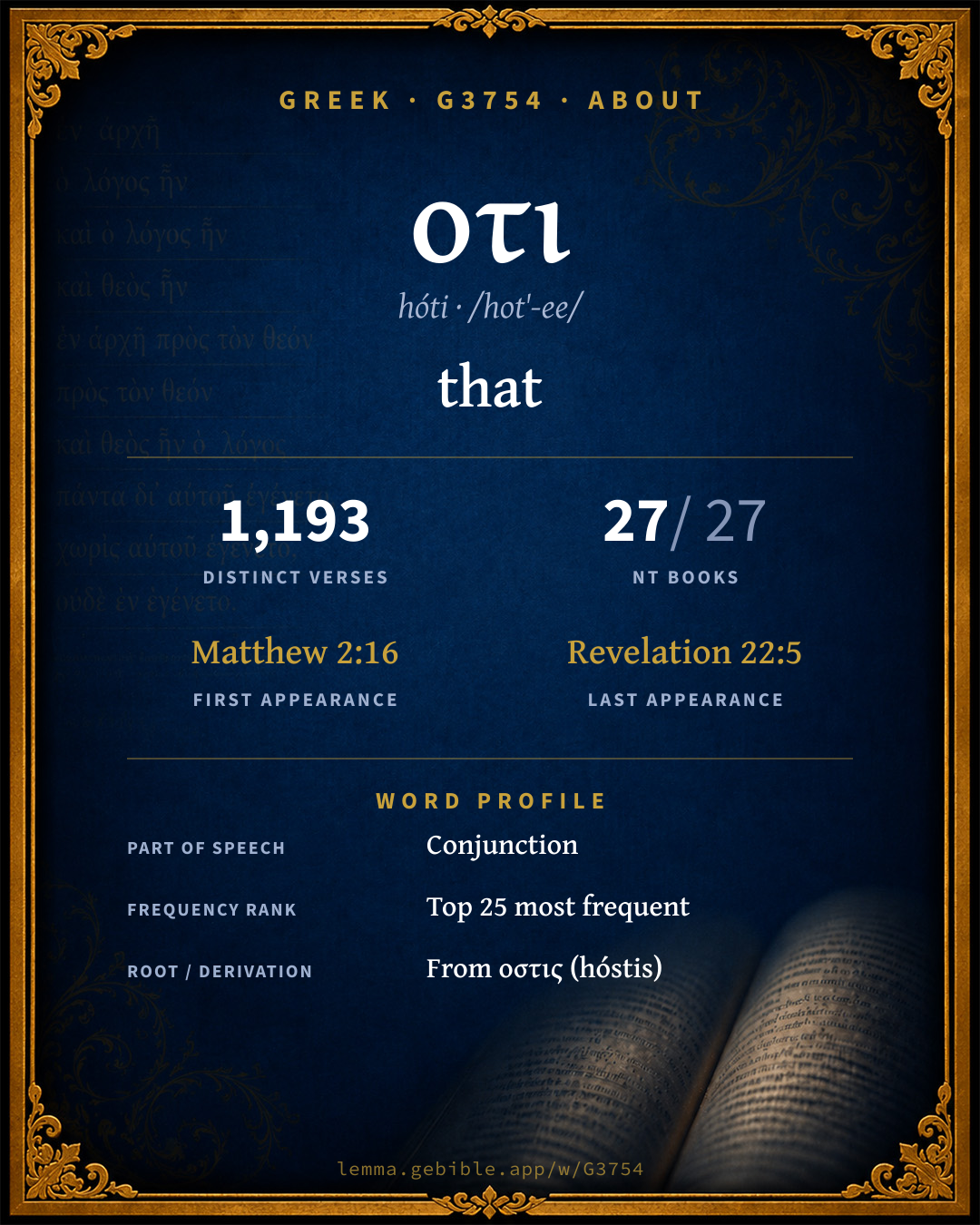
ὅτι
that
Full lexicon entry — Thayer's Greek Lexicon
From Thayer's Greek Lexicon
Where this word appears
Grammar key — what these labels mean
Part of speech
- Conjunction
- A joining word linking words or clauses.
Every verse where G3754 appears in the Book of Mark — 94 distinct verses. Click any verse to open its interlinear word-by-word view. Verse text shown in the World English Bible for context — . Each verse’s Greek form is shown with its reference; the English is not keyword-highlighted, since the data carries no word-level English alignment. Use “Compare translations” on any verse to read it across multiple English versions. This concordance covers the Greek New Testament; Septuagint (Greek Old Testament) occurrences of this word are not indexed here.
Mark
- Mark 1:15 ὅτι conj and saying, "The time is fulfilled, and the Kingdom of God is at hand! Repent, and believe in the Gospel."
- Mark 1:34 ὅτι conj He healed many who were sick with various diseases, and cast out many demons. He didn't allow the demons to speak, because they knew him.
- Mark 1:37 ὅτι conj and they found him, and told him, "Everyone is looking for you."
- Mark 1:40 ὅτι conj There came to him a leper, begging him, kneeling down to him, and saying to him, "If you want to, you can make me clean."
- Mark 2:1 ὅτι conj When he entered again into Capernaum after some days, it was heard that he was in the house.
- Mark 2:8 ὅτι conj Immediately Jesus, perceiving in his spirit that they so reasoned within themselves, said to them, "Why do you reason these things in your hearts?
- Mark 2:10 ὅτι conj But that you may know that the Son of Man has authority on earth to forgive sins"--he said to the paralytic--
- Mark 2:12 ὅτι conj He arose, and immediately took up the mat, and went out in front of them all; so that they were all amazed, and glorified God, saying, "We never saw anything like this!"
- Mark 2:16 ὅτι ὅτι conj conj The scribes and the Pharisees, when they saw that he was eating with the sinners and tax collectors, said to his disciples, "Why is it that he eats and drinks with tax collectors and sinners?"
- Mark 3:11 ὅτι conj The unclean spirits, whenever they saw him, fell down before him, and cried, "You are the Son of God!"
- Mark 3:21 ὅτι conj When his friends heard it, they went out to seize him: for they said, "He is insane."
- Mark 3:22 ὅτι ὅτι conj conj The scribes who came down from Jerusalem said, "He has Beelzebul," and, "By the prince of the demons he casts out the demons."
- Mark 3:28 ὅτι conj Most assuredly I tell you, all of the children of men's sins will be forgiven them, including their blasphemies with which they may blaspheme;
- Mark 3:30 ὅτι conj -- because they said, "He has an unclean spirit."
- Mark 4:21 ὅτι conj He said to them, "Is the lamp brought to be put under a basket or under a bed? Isn't it put on a lampstand?
- Mark 4:29 ὅτι conj But when the fruit is ripe, immediately he puts forth the sickle, because the harvest has come."
- Mark 4:38 ὅτι conj He himself was in the stern, asleep on the cushion, and they woke him up, and told him, "Teacher, don't you care that we are dying?"
- Mark 4:41 ὅτι conj They were greatly afraid, and said to one another, "Who then is this, that even the wind and the sea obey him?"
- Mark 5:9 ὅτι conj He asked him, "What is your name?" He said to him, "My name is Legion, for we are many."
- Mark 5:23 ὅτι conj and begged him much, saying, "My little daughter is at the point of death. Please come and lay your hands on her, that she may be made healthy, and live."
- Mark 5:28 ὅτι conj For she said, "If I just touch his clothes, I will be made well."
- Mark 5:29 ὅτι conj Immediately the flow of her blood was dried up, and she felt in her body that she was healed of her affliction.
- Mark 5:35 ὅτι conj While he was still speaking, they came from the synagogue ruler's house saying, "Your daughter is dead. Why bother the Teacher any more?"
- Mark 6:4 ὅτι conj Jesus said to them, "A prophet is not without honor, except in his own country, and among his own relatives, and in his own house."
- Mark 6:14 ὅτι conj King Herod heard this, for his name had become known, and he said, "John the Baptizer has risen from the dead, and therefore these powers are at work in him."
- Mark 6:15 ὅτι ὅτι conj conj But others said, "It is Elijah." Others said, "It is the Prophet, or like one of the prophets."
- Mark 6:17 ὅτι conj For Herod himself had sent out and arrested John, and bound him in prison for the sake of Herodias, his brother Philip's wife, for he had married her.
- Mark 6:18 ὅτι conj For John said to Herod, "It is not lawful for you to have your brother's wife."
- Mark 6:23 ὅτι conj He swore to her, "Whatever you shall ask of me, I will give you, up to half of my kingdom."
- Mark 6:34 ὅτι conj Jesus came out, saw a great multitude, and he had compassion on them, because they were like sheep without a shepherd, and he began to teach them many things.
- Mark 6:35 ὅτι conj When it was late in the day, his disciples came to him, and said, "This place is deserted, and it is late in the day.
- Mark 6:49 ὅτι conj but they, when they saw him walking on the sea, supposed that it was a ghost, and cried out;
- Mark 6:55 ὅτι conj and ran around that whole region, and began to bring those who were sick, on their mats, to where they heard he was.
- Mark 7:2 ὅτι conj Now when they saw some of his disciples eating bread with defiled, that is, unwashed, hands, they found fault.
- Mark 7:6 ὅτι conj He answered them, "Well did Isaiah prophesy of you hypocrites, as it is written, 'This people honors me with their lips, But their heart is far from me.
- Mark 7:18 ὅτι conj He said to them, "Are you thus without understanding also? Don't you perceive that whatever goes into the man from outside can't defile him,
- Mark 7:19 ὅτι conj because it doesn't go into his heart, but into his stomach, then into the latrine, thus making all foods clean?"
- Mark 7:20 ὅτι conj He said, "That which proceeds out of the man, that defiles the man.
- Mark 8:2 ὅτι conj "I have compassion on the multitude, because they have stayed with me now three days, and have nothing to eat.
- Mark 8:4 ὅτι conj His disciples answered him, "From where could one satisfy these people with bread here in a deserted place?"
- Mark 8:16 ὅτι conj They reasoned with one another, saying, "It's because we have no bread."
- Mark 8:17 ὅτι conj Jesus, perceiving it, said to them, "Why do you reason that it's because you have no bread? Don't you perceive yet, neither understand? Is your heart still hardened?
- Mark 8:24 ὅτι conj He looked up, and said, "I see men; for I see them like trees walking."
- Mark 8:28 ὅτι ὅτι conj conj They told him, "John the Baptizer, and others say Elijah, but others: one of the prophets."
- Mark 8:31 ὅτι conj He began to teach them that the Son of Man must suffer many things, and be rejected by the elders, the chief priests, and the scribes, and be killed, and after three days rise again.
- Mark 8:33 ὅτι conj But he, turning around, and seeing his disciples, rebuked Peter, and said, "Get behind me, Satan! For you have in mind not the things of God, but the things of men."
- Mark 9:1 ὅτι conj He said to them, "Most assuredly I tell you, there are some standing here who will in no way taste death until they see the Kingdom of God come with power."
- Mark 9:11 ὅτι ὅτι conj conj They asked him, saying, "Why do the scribes say that Elijah must come first?"
- Mark 9:13 ὅτι conj But I tell you that Elijah has come, and they have also done to him whatever they wanted to, even as it is written about him."
- Mark 9:25 ὅτι conj When Jesus saw that a multitude came running together, he rebuked the unclean spirit, saying to him, "You mute and deaf spirit, I command you, come out of him, and never enter him again!"
- Mark 9:26 ὅτι conj Having cried out, and convulsed greatly, it came out of him. The boy became like one dead; so much that most of them said, "He is dead."
- Mark 9:28 ὅτι conj When he had come into the house, his disciples asked him privately, "Why couldn't we cast it out?"
- Mark 9:31 ὅτι conj For he was teaching his disciples, and said to them, "The Son of Man is being handed over to the hands of men, and they will kill him; and when he is killed, on the third day he will rise again."
- Mark 9:38 ὅτι conj John said to him, "Teacher, we saw someone who doesn't follow us casting out demons in your name; and we forbade him, because he doesn't follow us."
- Mark 9:41 ὅτι ὅτι conj conj For whoever will give you a cup of water to drink in my name, because you are Christ's, most assuredly I tell you, he will in no way lose his reward.
- Mark 10:33 ὅτι conj "Behold, we are going up to Jerusalem. The Son of Man will be delivered to the chief priests and the scribes. They will condemn him to death, and will deliver him to the Gentiles.
- Mark 10:42 ὅτι conj Jesus summoned them, and said to them, "You know that they who are recognized as rulers over the Gentiles lord it over them, and their great ones exercise authority over them.
- Mark 10:47 ὅτι conj When he heard that it was Jesus the Nazarene, he began to cry out, and say, "Jesus, you son of David, have mercy on me!"
- Mark 11:17 ὅτι conj He taught, saying to them, "Isn't it written, 'My house will be called a house of prayer for all the nations?' But you have made it a den of robbers!"
- Mark 11:23 ὅτι ὅτι conj conj For most assuredly I tell you, whoever may tell this mountain, 'Be taken up and cast into the sea,' and doesn't doubt in his heart, but believes that what he says is happening; he shall have whatever he says.
- Mark 11:24 ὅτι conj Therefore I tell you, all things whatever you pray and ask for, believe that you receive them, and you shall have them.
- Mark 11:32 ὅτι conj If we should say, 'From men'"--they feared the people, for all held John to really be a prophet.
- Mark 12:6 ὅτι conj Therefore still having one, his beloved son, he sent him last to them, saying, 'They will respect my son.'
- Mark 12:7 ὅτι conj But those farmers said among themselves, 'This is the heir. Come, let's kill him, and the inheritance will be ours.'
- Mark 12:12 ὅτι conj They tried to seize him, but they feared the multitude; for they perceived that he spoke the parable against them. They left him, and went away.
- Mark 12:14 ὅτι conj When they had come, they asked him, "Teacher, we know that you are honest, and don't defer to anyone; for you aren't partial to anyone, but truly teach the way of God. Is it lawful to pay taxes to Caesar, or not?
- Mark 12:19 ὅτι conj "Teacher, Moses wrote to us, 'If a man's brother dies, and leaves a wife behind him, and leaves no children, that his brother should take his wife, and raise up offspring for his brother.'
- Mark 12:26 ὅτι conj But about the dead, that they are raised; haven't you read in the book of Moses, about the Bush, how God spoke to him, saying, 'I am the God of Abraham, the God of Isaac, and the God of Jacob?'
- Mark 12:28 ὅτι conj One of the scribes came, and heard them questioning together. Knowing that he had answered them well, asked him, "Which commandment is the greatest of all?"
- Mark 12:29 ὅτι conj Jesus answered, "The greatest is, 'Hear, Israel, the Lord our God, the Lord is one:
- Mark 12:32 ὅτι conj The scribe said to him, "Truly, teacher, you have said well that he is one, and there is none other but he,
- Mark 12:34 ὅτι conj When Jesus saw that he answered wisely, he said to him, "You are not far from the Kingdom of God." No one dared ask him any question after that.
- Mark 12:35 ὅτι conj Jesus responded, as he taught in the temple, "How is it that the scribes say that the Christ is the son of David?
- Mark 12:43 ὅτι conj He called his disciples to himself, and said to them, "Most assuredly I tell you, this poor widow gave more than all those who are giving into the treasury,
- Mark 13:6 ὅτι conj For many will come in my name, saying, 'I am he!' and will lead many astray.
- Mark 13:28 ὅτι conj "Now from the fig tree, learn this parable. When the branch has now become tender, and puts forth its leaves, you know that the summer is near;
- Mark 13:29 ὅτι conj even so you also, when you see these things coming to pass, know that it is near, at the doors.
- Mark 13:30 ὅτι conj Most assuredly I say to you, this generation will not pass away until all these things happen.
- Mark 14:14 ὅτι conj and wherever he enters in, tell the master of the house, 'The Teacher says, "Where is the guest room, where I may eat the Passover with my disciples?"'
- Mark 14:18 ὅτι conj As they sat and were eating, Jesus said, "Most assuredly I tell you, one of you will betray me -- he who eats with me."
- Mark 14:21 ὅτι conj For the Son of Man goes, even as it is written about him, but woe to that man by whom the Son of Man is betrayed! It would be better for that man if he had not been born."
- Mark 14:25 ὅτι conj Most assuredly I tell you, I will no more drink of the fruit of the vine, until that day when I drink it anew in the Kingdom of God."
- Mark 14:27 ὅτι ὅτι conj conj Jesus said to them, "All of you will be made to stumble because of me tonight, for it is written, 'I will strike the shepherd, and the sheep will be scattered.'
- Mark 14:30 ὅτι conj Jesus said to him, "Most assuredly I tell you, that you today, even this night, before the rooster crows twice, you will deny me three times."
- Mark 14:58 ὅτι ὅτι conj conj "We heard him say, 'I will destroy this temple that is made with hands, and in three days I will build another made without hands.'"
- Mark 14:69 ὅτι conj The maid saw him, and began again to tell those who stood by, "This is one of them."
- Mark 14:71 ὅτι conj But he began to curse, and to swear, "I don't know this man of whom you speak!"
- Mark 14:72 ὅτι conj The rooster crowed the second time. Peter remembered the word, how that Jesus said to him, "Before the rooster crows twice, you will deny me three times." When he thought about that, he wept.
- Mark 15:10 ὅτι conj For he perceived that for envy the chief priests had delivered him up.
- Mark 15:39 ὅτι conj When the centurion, who stood by opposite him, saw that he cried out like this and breathed his last, he said, "Truly this man was the Son of God!"
- Mark 16:4 ὅτι conj for it was very big. Looking up, they saw that the stone was rolled back.
- Mark 16:7 ὅτι conj But go, tell his disciples and Peter, 'He goes before you into Galilee. There you will see him, as he said to you.'"
- Mark 16:11 ὅτι conj When they heard that he was alive, and had been seen by her, they disbelieved.
- Mark 16:14 ὅτι conj Afterward he was revealed to the eleven themselves as they sat at the table, and he rebuked them for their unbelief and hardness of heart, because they didn't believe those who had seen him after he had risen.
About this entry
At a glance — auto-summarized from this page’s data, not written by a person. Every figure links to its source below. This summary describes the numbers; it doesn’t interpret them.
At its core, οτι (hóti) means “that.” Scripture first uses it in Matthew 2:16. Spanning 1,193 verses in 27 books, it ranks among the most common words of the Greek New Testament. From the same root come οστις and οτου. Each statement above links to its evidence; the full detail follows below.
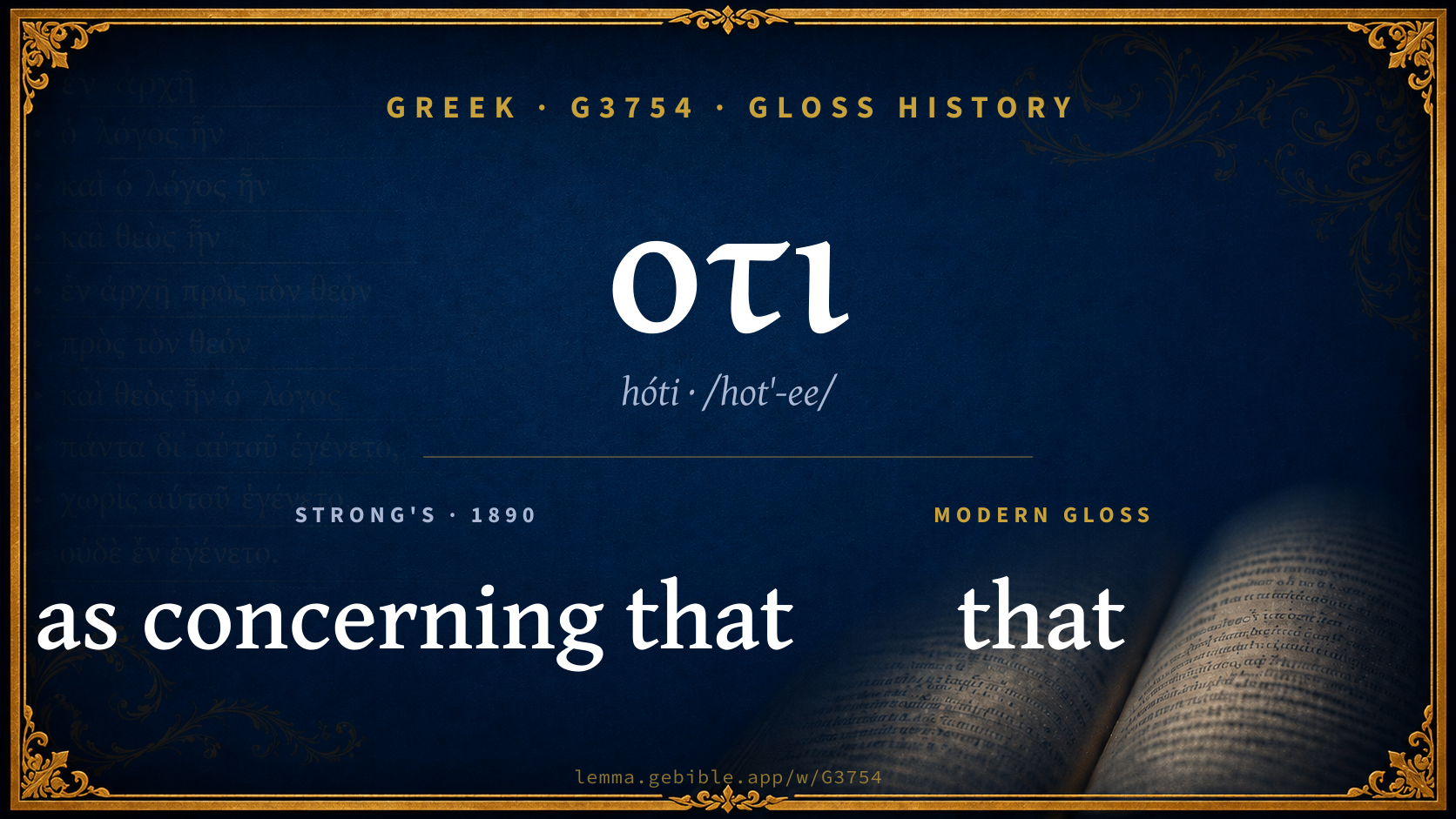
Gloss history
Strong's 1890 vs modern scholarship
About this word
Strong's G3754 catalogs a Greek word from the Greek New Testament.
These counts are not copied from any lexicon or concordance. They are computed here, from the morphology-tagged Greek New Testament. What Lemma adds →
- 1,193
- distinct verses
- The word appears in 1,193 distinct verses.
- 27 / 27
- NT books
- The word appears in 27 of 27 New Testament books.
- #15
- by frequency
- Top 25 most frequent Greek words (rank 15 of 5,347 Greek words by occurrence).
View all 1,193 occurrences in the concordance →
By section of the New Testament
By traditional corpus
Conventional, traditional groupings — biblical authorship is debated, so this is a traditional corpus grouping, not an authorship claim. Some books belong to more than one corpus (Luke is in both the Gospels and the Lukan corpus, and so on), so these shares overlap and need not total 100%. Each figure is a share of the word’s 1,193 distinct verses.
- Gospels 636 verses · 53%
- Johannine 357 verses · 30%
- Lukan (Luke–Acts) 280 verses · 23%
- Pauline corpus 269 verses · 23%
- General (Catholic) Epistles 102 verses · 9%
- Revelation 54 verses · 5%
- Hebrews 17 verses · 1%
How translations render this word
Counts come from each version’s own published word-to-Strong’s tagging or interlinear alignment — an approximate guide to how each version renders this word, not a word-level alignment the data otherwise carries. Because each total is that version’s own tagged count, the per-version totals vary from one another and need not match the appearance or distinct-verse counts above. These counts may also differ from a printed concordance because Lemma counts each distinctly tagged rendering and does not collapse phrase taggings into a single head-word total. This is a fixed set of word-tagged versions (KJV, ASV, BSB, ULT) and does not change with the reading translation you choose elsewhere. Each version’s license is shown beside its name below (and on Sources).
- King James Version: That 607×, For 258×, Because 178×
- American Standard Version: That 605×, For 237×, Because 161×
- Berean Standard Bible: That 520×, Because 207×, For 162×
- unfoldingWord Literal Text: That 681×, Because 221×, For 202×
King James Version Public Domain
Renders G3754 across 1,142 tagged occurrences — most commonly:
Plus other, less common renderings. Plus 35 renderings that appear only once — usually multi-word phrases or single function words the recovered tagging swept in, not distinct renderings. Not rendered by a distinct English word in 151 further occurrences.
American Standard Version Public Domain
Renders G3754 across 1,242 tagged occurrences — most commonly:
Plus other, less common renderings. Plus 98 renderings that appear only once — usually multi-word phrases or single function words the recovered tagging swept in, not distinct renderings. Not rendered by a distinct English word in 20 further occurrences.
Berean Standard Bible Public Domain
Renders G3754 across 935 tagged occurrences — most commonly:
Plus 24 renderings that appear only once — usually multi-word phrases or single function words the recovered tagging swept in, not distinct renderings. Not rendered by a distinct English word in 368 further occurrences.
unfoldingWord Literal Text CC BY-SA 4.0
Renders G3754 across 1,123 tagged occurrences — most commonly:
Plus 2 renderings that appear only once — usually multi-word phrases or single function words the recovered tagging swept in, not distinct renderings.
Senses in Thayer's
The 1 sense Thayer's distinguishes for this word, in lexicon order (not ranked by frequency or importance). The full entry — with sub-senses — is in the Lexicon Entry tab.
- that, because, since
Word origin
Derived from οστις (hóstis) (G3748) — whoever.
Neuter of G3748 as conjugation; demonstrative that (sometimes redundant); causatively because : - as concerning that as though because (that) for (that) how (that) (in) that though why.
— Strong’s Exhaustive Concordance (1890), public domain.
Same root — word family
Other Thayer's entries built from the same root as G3754, grouped by Strong’s listed origin. These share a root / origin per the lexicon — not necessarily a shared meaning. Each links to that word’s own entry.
Derives from
Shares the same root
Compare all same-root words → They share a root, not necessarily a meaning.
Septuagint usage
The same Greek word οτι appears 3,218 times in the Greek Old Testament (Septuagint), across 2,854 verses in 36 books.
- 3,218
- LXX occurrences
- Tagged occurrences of this Greek word in the Septuagint.
- 2,854
- verses
- Distinct Septuagint verses containing this word.
- 36 / 39
- OT books
- The word appears in 36 of the 39 Old Testament books.
Sample Septuagint occurrences
- Genesis 1:4 ὅτι
- Exodus 1:18 ὅτι
- Leviticus 5:11 ὅτι
- Numbers 6:7 ὅτι
- Deuteronomy 1:17 ὅτι
- Joshua 1:9 ὅτι
- Judges 1:15 ὅτι
- Ruth 1:6 ὅτι
- 1 Samuel 1:5 ὅτι
- 2 Samuel 1:4 ὅτι
- 1 Kings 1:11 ὅτι
- 2 Kings 1:4 ὅτι
Septuagint occurrences (same lexeme)
Every verse where the same Strong’s number (G3754) appears in the Greek Septuagint — showing the first 50 of 2,854. Verse text shown in the World English Bible for context; the Greek form is the matched word — the English is not keyword-highlighted.
- Genesis 1:4 ὅτι God saw the light, and saw that it was good. God divided the light from the darkness.
- Genesis 1:8 ὅτι God called the expanse sky. There was evening and there was morning, a second day.
- Genesis 1:10 ὅτι God called the dry land Earth, and the gathering together of the waters he called Seas. God saw that it was good.
- Genesis 1:12 ὅτι The earth brought forth grass, herbs yielding seed after their kind, and trees bearing fruit, with its seed in it, after their kind: and God saw that it was good.
- Genesis 1:18 ὅτι and to rule over the day and over the night, and to divide the light from the darkness. God saw that it was good.
- Genesis 1:21 ὅτι God created the large sea creatures, and every living creature that moves, with which the waters swarmed, after their kind, and every winged bird after its kind. God saw that it was good.
- Genesis 1:25 ὅτι God made the animals of the earth after their kind, and the cattle after their kind, and everything that creeps on the ground after its kind. God saw that it was good.
- Genesis 2:3 ὅτι God blessed the seventh day, and made it holy, because he rested in it from all his work which he had created and made.
- Genesis 2:23 ὅτι The man said, "This is now bone of my bones, and flesh of my flesh. She will be called Woman, because she was taken out of Man."
- Genesis 3:1 ὅτι Now the serpent was more subtle than any animal of the field which Yahweh God had made. He said to the woman, "Yes, has God said, 'You shall not eat of any tree of the garden?'"
- Genesis 3:5 ὅτι for God knows that in the day you eat it, your eyes will be opened, and you will be like God, knowing good and evil."
- Genesis 3:6 ὅτι When the woman saw that the tree was good for food, and that it was a delight to the eyes, and that the tree was to be desired to make one wise, she took of the fruit of it, and ate; and she gave some to her husband with her, and he ate.
- Genesis 3:7 ὅτι Both of their eyes were opened, and they knew that they were naked. They sewed fig leaves together, and made themselves aprons.
- Genesis 3:10 ὅτι The man said, "I heard your voice in the garden, and I was afraid, because I was naked; and I hid myself."
- Genesis 3:11 ὅτι God said, "Who told you that you were naked? Have you eaten from the tree that I commanded you not to eat from?"
- Genesis 3:14 ὅτι Yahweh God said to the serpent, "Because you have done this, cursed are you above all cattle, and above every animal of the field. On your belly shall you go, and you shall eat dust all the days of your life.
- Genesis 3:17 ὅτι To Adam he said, "Because you have listened to your wife's voice, and have eaten of the tree, of which I commanded you, saying, 'You shall not eat of it,' cursed is the ground for your sake. In toil you will eat of it all the days of your life.
- Genesis 3:19 ὅτι By the sweat of your face will you eat bread until you return to the ground, for out of it you were taken. For you are dust, and to dust you shall return."
- Genesis 3:20 ὅτι The man called his wife Eve, because she was the mother of all living.
- Genesis 4:12 ὅτι From now on, when you till the ground, it won't yield its strength to you. You shall be a fugitive and a wanderer in the earth."
- Genesis 4:23 ὅτι Lamech said to his wives, "Adah and Zillah, Hear my voice, You wives of Lamech, listen to my speech, For I have slain a man for wounding me, A young man for bruising me.
- Genesis 4:24 ὅτι If Cain will be avenged seven times, Truly Lamech seventy-seven times."
- Genesis 5:24 ὅτι Enoch walked with God, and he was not, for God took him.
- Genesis 6:2 ὅτι that God's sons saw that men's daughters were beautiful, and they took for themselves wives of all that they chose.
- Genesis 6:5 ὅτι Yahweh saw that the wickedness of man was great in the earth, and that every imagination of the thoughts of his heart was only evil continually.
- Genesis 6:6 ὅτι Yahweh was sorry that he had made man on the earth, and it grieved him in his heart.
- Genesis 6:7 ὅτι Yahweh said, "I will destroy man whom I have created from the surface of the ground; man, along with animals, creeping things, and birds of the sky; for I am sorry that I have made them."
- Genesis 6:12 ὅτι God saw the earth, and saw that it was corrupt, for all flesh had corrupted their way on the earth.
- Genesis 6:13 ὅτι God said to Noah, "The end of all flesh has come before me, for the earth is filled with violence through them. Behold, I will destroy them with the earth.
- Genesis 7:1 ὅτι Yahweh said to Noah, "Come with all of your household into the ark, for I have seen your righteousness before me in this generation.
- Genesis 8:9 ὅτι but the dove found no place to rest her foot, and she returned to him into the ark; for the waters were on the surface of the whole earth. He put forth his hand, and took her, and brought her to him into the ark.
- Genesis 8:11 ὅτι The dove came back to him at evening, and, behold, in her mouth was an olive leaf plucked off. So Noah knew that the waters were abated from off the earth.
- Genesis 8:13 ὅτι It happened in the six hundred first year, in the first month, the first day of the month, the waters were dried up from off the earth. Noah removed the covering of the ark, and looked. He saw that the surface of the ground was dried.
- Genesis 8:21 ὅτι Yahweh smelled the sweet savor. Yahweh said in his heart, "I will not again curse the ground any more for man's sake, because the imagination of man's heart is evil from his youth; neither will I ever again strike everything living, as I have done.
- Genesis 9:6 ὅτι Whoever sheds man's blood, by man will his blood be shed, for in the image of God made he man.
- Genesis 10:25 ὅτι To Eber were born two sons. The name of the one was Peleg, for in his days was the earth divided. His brother's name was Joktan.
- Genesis 11:9 ὅτι Therefore the name of it was called Babel, because Yahweh confused the language of all the earth, there. From there, Yahweh scattered them abroad on the surface of all the earth.
- Genesis 12:10 ὅτι There was a famine in the land. Abram went down into Egypt to live as a foreigner there, for the famine was sore in the land.
- Genesis 12:11 ὅτι It happened, when he was come near to enter into Egypt, that he said to Sarai his wife, "See now, I know that you are a beautiful woman to look on.
- Genesis 12:12 ὅτι It will happen, when the Egyptians will see you, that they will say, 'This is his wife.' They will kill me, but they will save you alive.
- Genesis 12:13 ὅτι Please say that you are my sister, that it may be well with me for your sake, and that my soul may live because of you."
- Genesis 12:14 ὅτι It happened that when Abram had come into Egypt, the Egyptians saw that the woman was very beautiful.
- Genesis 12:18 ὅτι Pharaoh called Abram, and said, "What is this that you have done to me? Why didn't you tell me that she was your wife?
- Genesis 12:19 ὅτι Why did you say, 'She is my sister,' so that I took her to be my wife? Now therefore, see your wife, take her, and go your way."
- Genesis 13:6 ὅτι The land was not able to bear them, that they might live together: for their substance was great, so that they could not live together.
- Genesis 13:8 ὅτι Abram said to Lot, "Please, let there be no strife between me and you, and between my herdsmen and your herdsmen; for we are relatives.
- Genesis 13:10 ὅτι Lot lifted up his eyes, and saw all the plain of the Jordan, that it was well watered every where, before Yahweh destroyed Sodom and Gomorrah, like the garden of Yahweh, like the land of Egypt, as you go to Zoar.
- Genesis 13:15 ὅτι for all the land which you see, I will give to you, and to your offspring forever.
- Genesis 13:17 ὅτι Arise, walk through the land in the length of it and in the breadth of it; for I will give it to you."
- Genesis 14:14 ὅτι When Abram heard that his relative was taken captive, he led forth his trained men, born in his house, three hundred and eighteen, and pursued as far as Dan.
These are occurrences of the same Greek lexeme (G3754) in the Septuagint — not a translation of any one Hebrew word. The store carries no word-level Hebrew↔Greek alignment, so no Hebrew original is asserted here. Counts come from the recovered LXX Strong's tagging — high-frequency vocabulary is well covered, while rare or late forms may be untagged — so they reflect tagged occurrences and may slightly undercount.