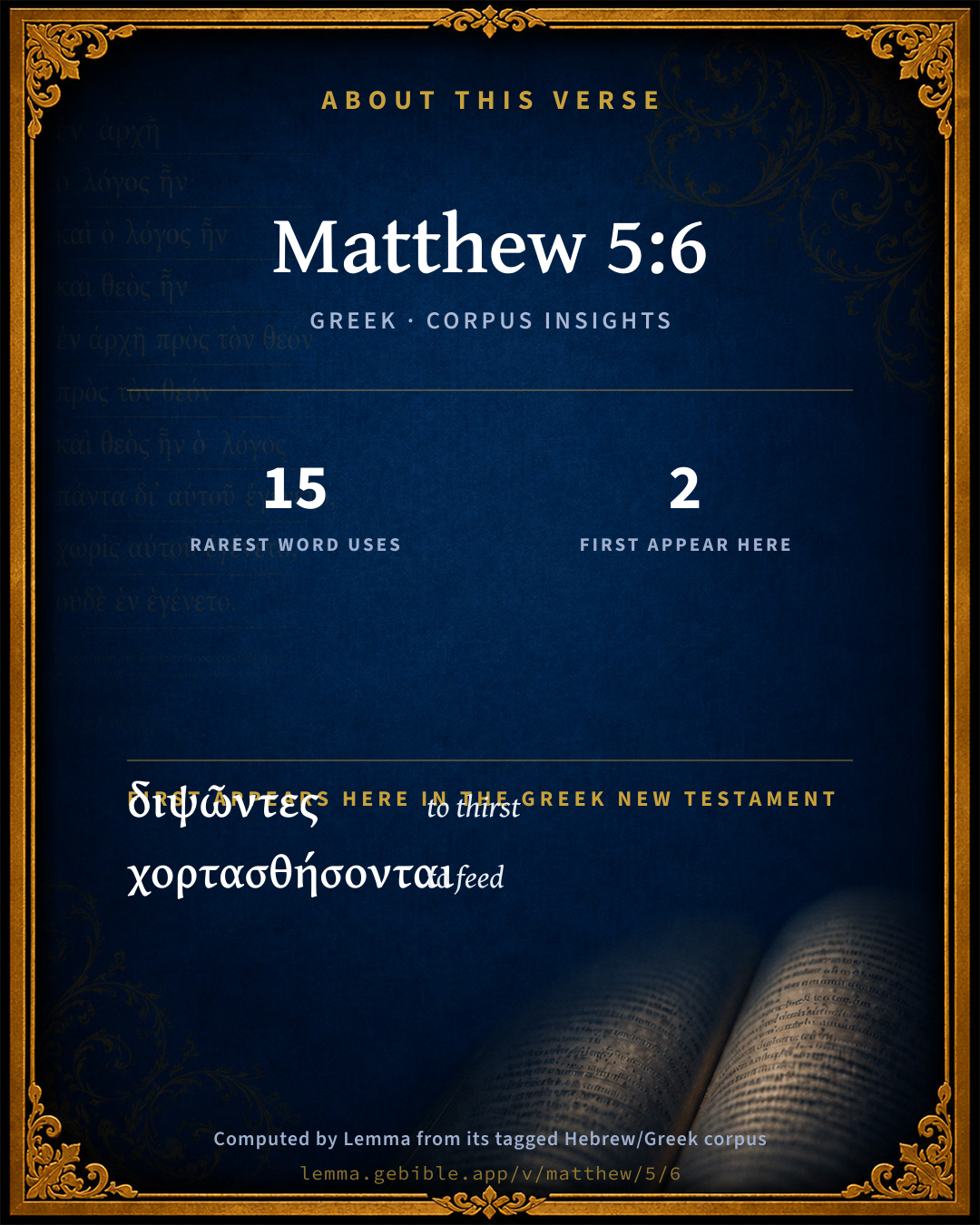
Matthew 5:6

Greek (Tischendorf 8th ed.) Matthew 5:6 appears in the Greek New Testament. The text above is from the Tischendorf 8th edition. Each word links to its Strong’s number and a concise gloss. Click any word for its full Thayer’s Greek Lexicon entry.

Download image
Cite this verse

Matthew 5:6 (World English Bible). Public Domain. Lemma interlinear Bible study tool, https://lemma.gebible.app/v/matthew/5/6.

Show BibTeX & RIS
BibTeX
RIS
English Translation
Blessed are those who hunger and thirst after righteousness, For they shall be filled.
World English Bible · Public Domain
Highlights
  • 2 first appearances in the Greek New Testament
Full analysis ↓
Download a study sheet

One document with this verse’s original text, its word-by-word gloss line, the meaning frame, cross-references with their text, attributed commentary, and full source and license credits — printable, and it pastes into notes with its structure intact.

This verse Autodidact and up

Study sheet (.html) Plain text (.txt)

A passage Seminary Student

Up to 50 verses in one chapter. A passage sheet keeps up to 6 commentary sources and 12 cross-references per verse, in the order this page ranks them, and says so on the sheet whenever that leaves anything out. Ask for a single verse and you get the Autodidact verse sheet above.

Everything on this page stays free to read, with no account — the sheet is a download of what is already on screen, not access to it.

Want to remove ads? Support Godless Engineer
Compare translations 3

The same verse in 3 English versions, stacked beneath the original-language interlinear above. Click any original word for its lexicon entry.

Each is an independent rendering of the whole verse — the interlinear is not word-aligned to these translations.

Highlighted words mark where these versions differ — a whole-verse word diff, not a word-by-word alignment.

  • World English Bible Public Domain
    Blessed are those who hunger and thirst after righteousness, For they shall be filled.
  • King James Version Public Domain
    Blessed are they which do hunger and thirst after righteousness: for they shall be filled.
  • unfoldingWord Literal Text CC BY-SA 4.0
    Blessed the ones hungering and thirsting for righteousness, for they will be fed.

unfoldingWord Literal Text — © unfoldingWord, licensed CC BY-SA 4.0. Word-aligned USFM3 via Door43 (git.door43.org/unfoldingWord/en_ult).

Versions to compare (up to 4)

3 of 4 selected

Show all 19 translations

Every available English version of this verse, each an independent rendering of the whole verse.

  • World English Bible Public Domain
    Blessed are those who hunger and thirst after righteousness, For they shall be filled.
  • Berean Standard Bible Public Domain
    Blessed are those who hunger and thirst for righteousness, for they will be filled.
  • Majority Standard Bible Public Domain
    Blessed are those who hunger and thirst for righteousness, for they will be filled.
  • King James Version Public Domain
    Blessed are they which do hunger and thirst after righteousness: for they shall be filled.
  • American Standard Version (1901) Public Domain
    Blessed are they that hunger and thirst after righteousness: for they shall be filled.
  • Revised Version (1885) Public Domain
    Blessed are they that hunger and thirst after righteousness: for they shall be filled.
  • Geneva Bible (1599) Public Domain
    Blessed are they which hunger and thirst for righteousnes: for they shalbe filled.
  • Douay-Rheims (1899) Public Domain
    Blessed are they that hunger and thirst after justice: for they shall have their fill.
  • Young's Literal Translation Public Domain
    `Happy those hungering and thirsting for righteousness -- because they shall be filled.
  • Literal Standard Version CC BY-SA 4.0
    Blessed those hungering and thirsting for righteousness—because they will be filled.
  • Unlocked Literal Bible CC BY-SA 4.0
    Blessed are those who hunger and thirst for righteousness, for they will be filled.
  • unfoldingWord Literal Text CC BY-SA 4.0
    Blessed the ones hungering and thirsting for righteousness, for they will be fed.
  • Darby Bible Public Domain
    Blessed they who hunger and thirst after righteousness, for *they* shall be filled.
  • World Messianic Bible Public Domain
    Blessed are those who hunger and thirst for righteousness, for they shall be filled.
  • Webster's Bible Public Domain
    Blessed are they who hunger and thirst for righteousness: for they shall be filled.
  • Free Bible Version CC BY-SA 4.0
    Blessed are those whose greatest desire is to do what is right, for they will be satisfied.
  • Bible in Basic English Public Domain
    Happy are those whose heart's desire is for righteousness: for they will have their desire.
  • Text-Critical English NT CC BY 4.0
    Blessed are those who hunger and thirst for righteousness, for they will be filled.
  • Tyndale New Testament (1534) Public Domain
    Blessed are they which honger and thurst for rightewesnes: for they shalbe filled.

Literal Standard Version (2020), Covenant Press — licensed CC BY-SA 4.0. Text via the HelloAO Bible API (eBible.org). Unlocked Literal Bible (unfoldingWord) — licensed CC BY-SA 4.0. Text via the HelloAO Bible API (eBible.org). unfoldingWord Literal Text — © unfoldingWord, licensed CC BY-SA 4.0. Word-aligned USFM3 via Door43 (git.door43.org/unfoldingWord/en_ult). Free Bible Version, Dr. Jonathan Gallagher — licensed CC BY-SA 4.0. Text via the HelloAO Bible API (eBible.org).

Word by word

More ways to search: Search by grammar → Find every occurrence → Compare this word →

Practice this passage: Drill this verse → Learn its vocabulary →

About this verse

These counts appear in no published source. They are computed here, from the morphology-tagged text and Lemma’s own curated glosses. What Lemma adds →

10
words
9
distinct lemmas
Gospels
section

Notable vocabulary

The rarest word here is χορτασθήσονται to feed G5526 — appearing just 15 times in the whole Greek New Testament.

First appearance in Scripture

These words make their first canonical appearance in the Greek New Testament here:

  • διψῶντες to thirst G1372
  • χορτασθήσονται to feed G5526

Shared distinctive vocabulary

χορτασθήσονται to feed G5526 occurs in 15 verses of the Greek New Testament. Also found in:

Repetition

A word recurs within this verse:

Cross-references

26

Topical passages linked to Matthew 5:6 in the Treasury of Scripture Knowledge — connected by theme and wording, ordered by reader-vote popularity; previews shown in the World English Bible.

  • Psalms 107:9 For he satisfies the longing soul. He fills the hungry soul with good.
  • John 4:14 but whoever drinks of the water that I will give him will never thirst again; but the water that I will give him will become in him a well of water springing up to eternal life."
  • John 6:27 Don't work for the food which perishes, but for the food which remains to eternal life, which the Son of Man will give to you. For God the Father has sealed him."
  • John 6:48–58 I am the bread of life.
  • Psalms 145:19 He will fulfill the desire of those who fear him. He also will hear their cry, and will save them.
  • Isaiah 55:1–3 Ho, everyone who thirsts, come you to the waters, and he who has no money; come you, buy, and eat; yes, come, buy wine and milk without money and without price.
  • John 7:37 Now on the last and greatest day of the feast, Jesus stood and cried out, "If anyone is thirsty, let him come to me and drink!
  • Luke 6:21 Blessed are you who hunger now, For you will be filled. Blessed are you who weep now, For you will laugh.
  • Revelation 7:16 They will never be hungry, neither thirsty any more; neither will the sun beat on them, nor any heat;
  • Psalms 42:1–2 As the deer pants for the water brooks, So my soul pants after you, God.
  • Isaiah 44:3 For I will pour water on him who is thirsty, and streams on the dry ground; I will pour my Spirit on your seed, and my blessing on your offspring:
  • Psalms 63:1–2 God, you are my God. I will earnestly seek you. My soul thirsts for you, My flesh longs for you, In a dry and weary land, where there is no water.
  • Amos 8:11–13 Behold, the days come," says the Lord Yahweh, "That I will send a famine in the land, Not a famine of bread, Nor a thirst for water, But of hearing the words of Yahweh.
  • Luke 1:53 He has filled the hungry with good things. He has sent the rich away empty.
  • Isaiah 65:13 Therefore thus says the Lord Yahweh, Behold, my servants shall eat, but you shall be hungry; behold, my servants shall drink, but you shall be thirsty; behold, my servants shall rejoice, but you shall be disappointed;
  • Psalms 4:6–7 Many say, "Who will show us any good?" Yahweh, let the light of your face shine on us.
  • Psalms 65:4 Blessed is one whom you choose, and cause to come near, That he may live in your courts. We will be filled with the goodness of your house, Your holy temple.
  • Psalms 17:15 As for me, I shall see your face in righteousness; I shall be satisfied, when I awake, with seeing your form.
  • Psalms 84:2 My soul longs, and even faints for the courts of Yahweh. My heart and my flesh cry out for the living God.
  • Isaiah 49:9–10 saying to those who are bound, Go forth; to those who are in darkness, Show yourselves. They shall feed in the ways, and on all bare heights shall be their pasture.
  • Isaiah 41:17 The poor and needy seek water, and there is none, and their tongue fails for thirst; I, Yahweh, will answer them, I, the God of Israel, will not forsake them.
  • Isaiah 25:6 In this mountain will Yahweh of Hosts make to all peoples a feast of fat things, a feast of wines on the lees, of fat things full of marrow, of wines on the lees well refined.
  • Luke 6:25 Woe to you, you who are full now! For you will be hungry. Woe to you who laugh now! For you will mourn and weep.
  • Psalms 63:5 My soul shall be satisfied as with the richest food. My mouth shall praise you with joyful lips,
  • Song of Solomon 5:1 I have come into my garden, my sister, my bride. I have gathered my myrrh with my spice; I have eaten my honeycomb with my honey; I have drunk my wine with my milk. Friends Eat, friends! Drink, yes, drink abundantly, beloved. Beloved
  • Isaiah 66:11 that you may suck and be satisfied with the breasts of her consolations; that you may milk out, and be delighted with the abundance of her glory.

Cross-references courtesy of OpenBible.info (CC BY 4.0).

Commentary

Notes on Matthew 5:6 from classic Christian and Jewish commentators (each source and its license shown beneath its notes). The classic Christian expositions comment on the surrounding passage and are grouped to its opening verse, so a note may address several verses; the Jewish commentaries on the Tanakh (Rashi and others) are per-verse, so they appear only where the commentator wrote on this verse.

Lemma curates 59 commentaries, every one of them public domain or Creative Commons licensed, each selected and text-cleaned for this edition rather than reprinted as found. About our sources →

The Biblical Illustrator

Joseph S. Exell

Mat_5:6

They which do hunger and thirst.

Righteousness desired

I. A few features of the disposition here commended. The term righteousness is variously used.

1. Sometimes it signifies rectitude.

2. Sometimes imputed righteousness.

3. Sometimes personal righteousness. But here it means-

(1) A death unto sin;

(2) A renunciation of the world;

(3) A deliberate choice of God.

II. Trace this disposition to its legitimate source.

III. Attend to the gracious statement made respecting the possession of this disposition.

1. It implies that their desires shall be satisfied.

2. It implies a plenitude of satisfaction.

3. The text implies the stability of the promise, that this satisfaction is sure.

To conclude-

1. Is the disposition possessed by us?

2. Have you an ardent desire for righteousness. (J. Jordan.)

A test of heavenly citizenship

I. An object of Christian desire-righteousness. This is conformity to Gods will. God is righteous.

1. Personal purity.

2. It also takes the form of doing right.

II. This object is a matter of desire.

1. The desire for righteousness is present more or less in most men.

2. The attention is not drawn to its possession, but to the desire for it.

III. The attainment of this object. They shall have righteousness.

1. The desire for righteousness is met by the actual presence of sin. Jesus died that sin might be removed.

2. The desire for righteousness is met and apparently hindered by the moral feebleness of our moral nature. The Holy Ghost is given to him.

IV. The possession of this object is happiness. (W. Butcher.)

I. The vastness and intensty of the religious life. Hunger and thirst are primitive appetites; they cover life.

II. The glory Of the religious life. We assimilate the strength of what we feed on.

III. The progressiveness of the religious life.

IV. The satisfaction of the religious life. (T. T. Sherlock, B. A.)

Heart-cravings

1. Man may be measured by his desires.

2. Righteousness a supreme object of desire.

3. The desire is the measure of the supply.

4. A real desire culminates in action, hunger drives to work. (G. Elliot.)

The want of spiritual appetite

1. Desire is a condition and prophecy of religious attainments.

2. This law of desire explains our spiritual poverty.

3. This want of appetite for righteousness is the curse of mankind. (Am. Hem. Monthly.)

Longing for righteousness

I. He who would have the blessing promised in the text, must want righteousness-as a hungry man wants food. This tests the value of our superficial professions. In order to this longing he must perceive the intrinsic worth of the thing desired.

II. What is here meant by righteousness.

1. It is not the single virtue of justice or rectitude. It implies the essence of the thing, a state of mind and heart; a soil out of which all single virtues grow.

2. It is not merely a desire to see righteous-mess prevailing in the world at large.

3. It is a desire not merely for doing righteously, but for being righteous.

III. The result. I fear some are not hungering for righteousness, but for the rewards of righteousness. Worldly good cannot fill man. Intellectual attainment cannot. Goodness will satisfy. There is no condition where we cannot be satisfied in the enjoyment of righteousness. Goodness does not forsake a man. (E. H. Chaplin.)

I. The state or condition described.

1. What righteousness is it? Gods justifying righteousness. The necessity for it is deeply felt. This hungering is a special condition of mind, an indication of healthy, spiritual life.

II. The blessedness of this state of mind. Satisfied because it quenches the desire of sin. A mark of the Divine favour. Security and permanency of the blessing. Identical with that of the glorified in heaven. (W. Barker.)

I. What is this righteousness?

II. What is it that leads persons thus to hunger and thirst? A sense of insufficiency and dissatisfaction in all created things; a sense of guilt; a perception of the utter inefficacy of all human prescriptions to remove sin or supply righteousness; a discovery of that righteousness which is unto all and upon all that believe.

III. Those who thus hunger and thirst are pronounced blessed. Because it is the evidence of a new nature-acceptance with God. They are drawn off from the disappointing and perplexing pursuits of the things of this world; they are filled-satisfied-with righteousness, happiness, and finally with the likeness of God, etc. We learn that real religion is a matter of personal experience. (Dr. J. Cramming.)

See here at what a low price God sets heavenly things; it is but hungering and thirsting.

I. Do but hunger and you shall have righteousness.

(1) Hunger less after the world and

(2) more after righteousness.

(3) Say concerning spiritual things: Lord, evermore give me this bread.

(4) Hunger after that righteousness which delivereth from death.

II. If we do not thirst here, we shall thirst when it is too late.

(1) If we do not thirst as David did (Psa_42:2),

(2) we shall thirst as Dives did, for a drop of water.

(3) Oh, is it not better to thirst for righteousness while it is to be had, than to thirst for mercy when there is none to be had? (Thomas Watson.)

What an encouragement is this to hunger after righteousness! Such shall be filled. God chargeth us to fill the hungry (Isa_58:10). He blames those who do not fill the hungry (Isa_32:6). And do we think He will be slack in that which He blames us for not doing? God is a fountain. If we bring the vessels of our desires to this fountain, He is able to fill them. The fulness in God is:-

I. An infinite fulness.

(1) Though He fill us, yet He hath never the less Himself.

(2) As it hath its resplendency, so

(3) its redundancy. It is inexhaustible and fathomless,

II. It is a constant fulness.

1. The fulness of the creature is mutable. It ebbs and changeth.

2. Gods fulness is overflowing and everflowing.

3. It is a never-failing goodness.

III. God fills the hungry soul with-

1. Grace. Grace is filling because suitable to the soul.

2. Peace. Israel had honey out of the rock; this honey of peace comes out of the rock Christ.

3. Bliss. Glory is a filling thing. When a Christian awakes out of the sleep of death, then he shall be satisfied. Then shall the soul be filled brimful. (Thomas Watson.)

I. What is here meant by righteousness.

1. Actual and inherent righteousness; living a life in sincere and perfect obedience to all the laws of God.

2. Imputed righteousness.

II. What is it to hunger and thirst after righteousness?

1. TO contend fiercely and fight manfully against our spiritual adversaries.

2. To desire ardently and intensely for spiritual sustenance.

3. To discharge our duty in every point to the best of our skill and power.

4. To willingly suffer hunger, thirst, cold, nakedness, and the want of anything necessary for the support and comfort of life, rather than knowingly transgress any point of duty. (Bishop Ofspring Blackall, D. D.)

Soul starvation a sad and guilty thing

The utter starving of the soul, if we could see it as we see other things, would strike us as one of the saddest of things. When the shepherd, over in New York, had a house for the reception of orphan children, and on inspection it was found that the soup was very thin, that there was but little of it, that the food was most stingily dealt out, and that these children were gradually coming to be skin and bones by starvation charity, the whole city flamed with indignation. They threw open the door of the cell, and seized him by the throat, and pitched him in ignominiously. But look into your own soul and see how the things that are nearest to God are shut up in you. While your awakened appetites and passions are fully clothed, and are walking up and down the palace of your soul, having their own way, I hear a faint cry in some remote chamber thereof. It is conscience moaning and pleading for food; and. I hear the thundering rap of passions on the door as they say, Hush! Be still! Are you never going to sleep? Will you never die? In another quarter I hear the soul crying for food. What ails you? is the response; and a bone is thrown in for it to gnaw on. (Beecher.)

Righteousness many-sided

It is not merely the single virtue of justice or rectitude-in fact, no virtue is absolutely single, if we look at it closely. A man cannot really have one virtue, and but one, genuine and complete. He cannot have one without having all virtues and all graces, for no one virtue or grace is complete without the intermingling of the life and reciprocal action of all the rest. We make a great mistake if we suppose otherwise. There have been men who could play delightful music on one string of the violin, but there never was a man who could produce the harmonies of heaven in his soul by one-stringed virtue. Can a man be thoroughly and strictly honest, and at the same time be a selfish man? Can he be temperate. Suppose a man, for instance, pursuing a course of virtue, a course of temperance, or of rectitude, has the promise that he shall be wealthy, and that he shall have long life-shall make a fortune, and shall be respected. This is all very good; but what is the essence of all this? It is in being righteous; that is the great blessing. So that if you have a long life, it is a righteous life; and if you have wealth, it is righteous wealth, as you make a righteous use and disposition of it. With this, any condition is blessed; without it, no condition is blessed. So the essence of all promises is in the possession of this intrinsic righteousness. (E. H. Chaplin.)

Moral hunger a developing energy

Now, the same law prevails in the mind. That is to say, outward activity grows from some sort of inward uneasiness or impulse. Hunger existing in the body works outwardly, first, into that industry which supplies it, and then enlarges gradually, and inspires a more complex industry. And so almost; all of life in its upper sphere proceeds from a kind of hunger which exists in the soul. Some yearning, or longing, or action, or some faculty developing itself and working to produce its appropriate gratification-this is the analogue; and the character, as formed by the faculties, answers to the industrial creations produced by sensations of hunger and thirst in the body. (Beecher.)

The Biblical Illustrator, edited by Joseph S. Exell (c. 1880s–1900s) — public domain. Text from a community e-Sword module.

Joseph Benson's Commentary

Mat 5:6. Blessed are they which hunger and thirst after righteousness — That, instead of desiring the possessions of others, and endeavouring to obtain them by violence or deceit; and instead of coveting this world’s goods, sincerely, earnestly, and perseveringly desire universal holiness of heart and life, or deliverance from all sinful dispositions and practices, and a complete restoration of their souls to the image of God in which they were created: a just and beautiful description this of that fervent, constant, increasing, restless, and active desire; of that holy ardour and vehemence of soul in pursuit of the most eminent degrees of universal goodness which will end in complete satisfaction: For they shall be filled — Shall obtain the righteousness which they hunger and thirst for, and be abundantly satisfied therewith.

Joseph Benson's Commentary on the Old and New Testaments (1811–1818) — public domain. Text from a community e-Sword module.

Godbey's Commentary on the New Testament

William B. Godbey

JOHN’S INFLUENCE

Mat 5:6, & Mar 1:5. “Then there went out unto him Jerusalem, and all Judea, and all the regions round about Jordan, and were baptized of him in Jordan, confessing their sins.” Six millions of people are included in these countries. O the wonderful power and magnetism of John’s preaching! He actually emptied the cities and populated the desert with thronging millions. From dewy morn till dusky eve, the rich on camels, the middle classes on donkeys, and the poor trudging on foot, literally crowd the way, off into the desert wild and drear, carrying their food and bedding, that they may spend a fortnight in the grandest camp-meeting that the world has seen in four thousand years. Water is very scarce in the “wilderness [desert] of Judea.” Traveling through it four times, I saw none but the Brook Cherith. I have heard of it, however, in other localities of that desert. Doubtless the scarcity of water to supply the multitudes and the animals they rode, as well as for baptismal demands, induced John to go away to the Jordan, only a dozen miles from this desert. The Jordan rises in great Mt. Hermon, ten thousand feet high, capped with a world of snows, all through the long summer incessantly melting, and keeping the river abundantly supplied with plenty of water for all purposes. Behold John, standing on the beautiful, spreading plain of the Jordan, surrounded by an audience of fifty thousand people, listening spellbound to his thunder peals, while the lightning of conviction is flashing from the skies, electrifying all hearts, with the gushing tears of a soul-crushing repentance. Moses was a great baptist, baptizing all the people at the tabernacle door upon the ratification of the Sinaitic Covenant. (Heb 9:10-12.) Judaism, with its vast and operose ritual, the Messianic hemisphere, offering millions of slain victims, typifying the atonement of Christ, while the spiritual was equally operose, emblematizing the work of the Holy Ghost by the innumerable watery ablutions for the purification from all sorts of ceremonial uncleanness. Hence the Johannic dispensation must be characterized by ceremonial purifications. At the present time, the Oriental religions gather by thousands upon the very spot where John baptized the Savior, the priest dipping the cross three times in the name of the Three Persons of the Trinity, they all simultaneously plunge themselves under the rolling wave of the holy Jordan three times; not doing this for baptism as the initiatory rite into the Church-this they have already received — but as a holy ablution to sanctify them, as they all believe the baptism of the Savior sanctified the Jordan. As John had neither the time nor the physical ability to handle his converts, they either plunged themselves under the rolling tide, or John, after the manner of the Jewish priest (and he was one), dipping the hyssop in the water, sprinkled the multitudes, somewhat as a Catholic priest nowadays sprinkles his audiences. The Jordan has plenty of water, and there is plenty in all parts of the earth. Be sure you satisfy your conscience as to this duty.

William B. Godbey, Commentary on the New Testament (1896–1900) — public domain. Text from a community e-Sword module.

Tyndale Open Study Notes

Tyndale Open Resources

5:6 those who hunger and thirst for justice (or for righteousness): This refers either to the follower of Jesus whose driving purpose in life is to obey the Lord (cp. 3:15; 5:10, 20) or to the disciple’s desire to see justice for all people (Pss 11:7; 85:10-12; Isa 11:1-4; Jer 23:5-6; 33:16). One with such a longing often prays, “May your will be done on earth” (Matt 6:10). • Christ has brought justice and righteousness (Rom 3:21-22; 5:1); the disciples will be satisfied with it (cp. Pss 42:1-2; 63:1-2).

Tyndale Open Study Notes — © Tyndale Open Resources, licensed CC BY-SA 4.0. Text via the HelloAO Bible API.

Bengel's Gnomon

Johann Albrecht Bengel

Mat 5:6. Οἱ πεινῶντες καὶ διψῶντες, κ.τ.λ, who hunger and thirst, etc.) who feel that of themselves they have no righteousness by which they may approve themselves either to God or man, and eagerly long for it. Faith is here described, suitably to the beginning of the New Testament.—τὴν δικαιοσύνην, righteousness) Our Lord plainly declares Himself here to be the author of righteousness. That which is signified here is not the right (jus) of the human, but of the Divine tribunal. This verse is the centre of this passage, and the theme of the whole sermon. Our Lord does not say, Blessed are the righteous, as he presently says, Blessed are the merciful, etc.; but, Blessed are they that hunger and thirst after righteousness. Pure righteousness will become their portion in due time. (See 2Pe 3:13; Isa 60:21.)—χορτασθήσονται, they shall be filled) with righteousness; see Rom 14:17. This was the meat of Jesus himself: see Joh 4:34; cf. Mat 3:15. This satisfying fulness He proposes to His followers in the whole of this sermon, and promises and offers them in this very verse.

Bengel's Gnomon of the New Testament — English translation (T&T Clark, Edinburgh, 1860) — public domain. Text from a community e-Sword module.

Meyer's Critical & Exegetical Commentary

Heinrich August Wilhelm Meyer

Mat_5:6. Concerning πεινῆν and διψῆν, which regularly govern the genitive with the accusative, where the object is conceived as that which endures the action, see examples of this rare use in Kypke, Obss. I. p. 17; Loesner, Obss. p. 11; and especially Winer, p. 192 [E. T. 256]. The metaphorical meaning (Isa_55:1; Psa_42:3; Sir_51:24) of the verbs is that of longing desire. See Pricaeus and Wetstein in loc.; as regards διψ., also Jacobs, ad Anthol. VI. p. 26, VIII. p. 233. The δικαιοσύνη, however, is the righteousness, the establishment of which was the aim of Christs work, and the condition of participation in the Messiahs kingdom. They are designated as such whose great earnestness, desire, and fervour (Luther) are directed towards a moral constitution free from guilt. Luther, besides, strikingly draws attention to this, that before all these portions of the beatitudes, faith must first be there as the tree and headpiece or sum of righteousness.

χορτασθήσονται] not generally regni Messiani felicitate (Fritzsche), but, as the context requires, δικαιοσύνης: they will obtain righteousness in full measure, namely, in being declared to be righteous (Rom_5:19; Gal_5:5, and remarks thereon) at the judgment of the Messiah (Mat_25:34), and then live for ever in perfect righteousness, so that God will be all in all (1Co_15:28). Comp. 2Pe_3:13. On the figurative χορτάζ., Psa_17:15; Psa_107:9.

Meyer — Critical and Exegetical Commentary on the New Testament — English translation by Peter Christie, edited by Frederick Crombie (T&T Clark, 1880) — public domain. Text from a community e-Sword module.

Expositor's Greek Testament

ed. W. Robertson Nicoll

Mat 5:6 . If the object of the hunger and thirst had not been mentioned this fourth Beatitude would have been parallel in form to the second: Blessed the hungry, for they shall be filled. We should then have another absolute affirmation requiring qualification, and raising the question: What sort of hunger is it which is sure to be satisfied? That might be the original form of the aphorism as given in Luke. The answer to the question it suggests is similar to that given under Beatitude 1. The hunger whose satisfaction is sure is that which contains its own satisfaction. It is the hunger for moral good. The passion for righteousness is righteousness in the deepest sense of the word. πεινῶντες καὶ διψῶντες . These verbs, like all verbs of desire, ordinarily take the genitive of the object. Here and in other places in N. T. they take the accusative, the object being of a spiritual nature, which one not merely desires to participate in, but to possess in whole. Winer, § xxx. 10, thus distinguishes the two constructions: διψᾶν φιλοσοφίας = to thirst after philosophy; διψ . φιλοσοφίαν = to thirst for possession of philosophy as a whole. Some have thought that διὰ is to be understood before δικ ., and that the meaning is: “Blessed they who suffer natural hunger and thirst on account of righteousness”. Grotius understands by δικ . the way or doctrine of righteousness.

The Expositor's Greek Testament, edited by W. Robertson Nicoll (1897–1910) — public domain. Text from a community e-Sword module.

Jamieson, Fausset & Brown

Robert Jamieson, A. R. Fausset & David Brown

Blessed are they which do hunger and thirst after righteousness: for they shall be filled--"shall be saturated." "From this verse," says THOLUCK, "the reference to the Old Testament background ceases." Surprising! On the contrary, none of these beatitudes is more manifestly dug out of the rich mine of the Old Testament. Indeed, how could any one who found in the Old Testament "the poor in spirit," and "the mourners in Zion," doubt that he would also find those same characters also craving that righteousness which they feel and mourn their want of? But what is the precise meaning of "righteousness" here? Lutheran expositors, and some of our own, seem to have a hankering after that more restricted sense of the term in which it is used with reference to the sinner's justification before God. (See Jer 23:6; Isa 45:24; Rom 4:6; Co2 5:21). But, in so comprehensive a saying as this, it is clearly to be taken--as in Mat 5:10 also--in a much wider sense, as denoting that spiritual and entire conformity to the law of God, under the want of which the saints groan, and the possession of which constitutes the only true saintship. The Old Testament dwells much on this righteousness, as that which alone God regards with approbation (Psa 11:7; Psa 23:3; Psa 106:3; Pro 12:28; Pro 16:31; Isa 64:5, &c.). As hunger and thirst are the keenest of our appetites, our Lord, by employing this figure here, plainly means "those whose deepest cravings are after spiritual blessings." And in the Old Testament we find this craving variously expressed: "Hearken unto Me, ye that follow after righteousness, ye that seek the Lord" (Isa 51:1); "I have waited for Thy salvation, O Lord," exclaimed dying Jacob (Gen 49:18); "My soul," says the sweet Psalmist, "breaketh for the longing that it hath unto Thy judgments at all times" (Psa 119:20): and in similar breathings does he give vent to his deepest longings in that and other Psalms. Well, our Lord just takes up here--this blessed frame of mind, representing it as--the surest pledge of the coveted supplies, as it is the best preparative, and indeed itself the beginning of them. "They shall be saturated," He says; they shall not only have what they so highly value and long to possess, but they shall have their fill of it. Not here, however. Even in the Old Testament this was well understood. "Deliver me," says the Psalmist, in language which, beyond all doubt, stretches beyond the present scene, "from men of the world, which have their portion in this life: as for me, I shall behold Thy face in righteousness: I shall be satisfied, when I awake, with Thy likeness" (Psa 17:13-15). The foregoing beatitudes--the first four--represent the saints rather as conscious of their need of salvation, and acting suitably to that character, than as possessed of it. The next three are of a different kind--representing the saints as having now found salvation, and conducting themselves accordingly.

Jamieson, Fausset & Brown — Commentary Critical and Explanatory on the Whole Bible (1871) — public domain (CC PDM 1.0). Text via the HelloAO Bible API.

Adam Clarke's Commentary

Verse 6. They which do hunger and thirst] As the body has its natural appetites of hunger and thirst for the food and drink suited to its nourishment, so has the soul. No being is indestructible or unfailing in its nature but GOD; no being is independent but him: as the body depends for its nourishment, health, and strength upon the earth, so does the soul upon heaven. Heavenly things cannot support the body; they are not suited to its nature: earthly things cannot support the soul, for the same reason. When the uneasy sensation termed hunger takes place in the stomach, we know we must get food or perish. When the soul is awakened to a tense of its wants, and begins to hunger and thirst after righteousness or holiness, which is its proper food, we know that it must be purified by the Holy Spirit, and be made a partaker of that living bread, Joh 8:48, or perish everlastingly. Now, as God never inspires a prayer but with a design to answer it, he who hungers and thirsts after the full salvation of God, may depend on being speedily and effectually blessed or satisfied, well-fed, as the word χορτασθησονται implies. Strong and intense desire after any object has been, both by poets and orators, represented metaphorically by hunger and thirst. See the well-known words of Virgil, AEneid iii. 55.

---------Quid non mortalia pectora cogis,

Auri sacra FAMES! "O cursed hunger after gold! what canst thou not influence the hearts of men to perpetrate?"

How frequently do we find, inexplebilis honorum FAMES-SITIENS virtutis-famae SITUS, the insatiable hunger after honour, a thirst for virtue, thirst after fame, and such like! Righteousness here is taken for all the blessings of the new covenant - all the graces of the Messiah's kingdom - a full restoration to the image of God!

Adam Clarke's Commentary on the Bible (1810–1826) — public domain. Text from a community e-Sword/MySword module.

Ellicott's Commentary for English Readers

(6) Which do hunger and thirst.—We seem in this to hear the lesson which our Lord had learnt from the recent experience of the wilderness. The craving of bodily hunger has become a parable of that higher yearning after righteousness, that thirsting after God, even as the hart desireth the water-brooks, which is certain, in the end, to gain its full fruition. Desires after earthly goods are frustrated, or end in satiety and weariness. To this only belongs the promise that they who thus “hunger and thirst” shall assuredly be filled. The same thoughts meet us again in the Gospel which in many respects is so unlike that of St. Matthew. (Comp. Joh_4:14; Joh_4:32).

A Bible Commentary for English Readers, edited by Charles John Ellicott (1878–1897) — public domain. Text from a community e-Sword module.

The Cambridge Bible for Schools and Colleges

gen. ed. J. J. S. Perowne

6. This longing for righteousness is God’s gift to the meek.

The Cambridge Bible for Schools and Colleges (gen. ed. J. J. S. Perowne; Cambridge University Press, 1878–1918) — public domain. Text from a community e-Sword module.

John Gill's Exposition

Blessed are they which do hunger and thirst,.... Not after the riches, honours, and pleasures of this world, but

after righteousness; by which is meant, not justice and equity, as persons oppressed and injured; nor a moral, legal righteousness, which the generality of the Jewish nation were eagerly pursuing; but the justifying righteousness of Christ, which is imputed by God the Father, and received by faith. To "hunger and thirst" after this, supposes a want of righteousness, which is the case of all men; a sense of want of it, which is only perceived by persons spiritually enlightened; a discovery of the righteousness of Christ to them, which is made in the Gospel, and by the Spirit of God; a value for it, and a preference of it to all other righteousness; and an earnest desire after it, to be possessed of it, and found in it; and that nothing can be more grateful than that, because of its perfection, purity, suitableness, and use: happy souls are these,

for they shall be filled: with that righteousness, and with all other good things, in consequence of it; and particularly with joy and peace, which are the certain effects of it: or, "they shall be satisfied", that they have an interest in it; and so satisfied with it, that they shall never seek for any other righteousness, as a justifying one, in the sight of God; this being full, perfect, sufficient, and entirely complete.

John Gill's Exposition of the Whole Bible (1746–1763) — public domain (CC PDM 1.0). Text via the HelloAO Bible API.

Trapp's Complete Commentary

John Trapp

6 Blessed are they which do hunger and thirst after righteousness: for they shall be filled.

Ver. 6. Blessed are those that hunger and thirst after righteousness] The righteousness of Christ both imputed and imparted ( iustitia imputata, impertita). This is in Christ for us, being wrought by his value and merit, and is called the righteousness of justification. This is in us from Christ, being wrought by his virtue and spirit, and is called the righteousness of sanctification. Both these the blessed must hunger and thirst after, that is, earnestly, and afflictim desire, as Rachel did for children, she must prevail or perish; as David did after the water of the well of Bethlehem, to the jeopardy of the lives of his three mightiest, 1Ch 11:18; as the hunted hart (or, as the Septuagint readeth it, η ελαφος, hind) brayeth after the water brooks. The philosophers observe of the hart or hind, that being a beast thirsty by nature, when she is pursued by dogs, by reason of heat and loss of breath, her thirst is increased. (Aristot., Lucret., Oppian., Psa 42:1) And in females the passions are stronger than in males; so that she breathes and brays after the brooks with utmost desire: so panteth the good soul after Christ, it panteth and fainteth, it breatheth and breaketh for the longing that it hath unto his righteousness at all times, Psa 119:20. She fainteth with Jonathan, swooneth and is sick with the Spouse, yea, almost dead with that poor affamished Amalekite, 1Sa 30:12. And this spiritual appetite add affection ariseth from a deep and due sense and feeling of our want of Christ, whole Christ, and that there is an absolute necessity of every drop of his blood. There must be a sad and serious consideration of man’s misery and God’s mercy. Whence will arise (as in hunger and thirst), 1. A sense of pain in the stomach. 2. A want and emptiness. 3. An eager desire of supply from Christ, who is the true bread of life, and heavenly manna; the rock flowing with honey, and fountain of living water, that reviveth the fainting spirits of every true Jonathan and Samson, and makes them never to thirst again after the world’s tasteless fooleries: like as his mouth will not water after homely provision that hath lately tasted of delicate sustenance.

They shall be satisfied] Because true desires are the breathings of a broken heart, which God will not despise, Psa 51:17. He poureth not the oil of his grace but into broken vessels. For indeed, whole vessels are full vessels, and so this precious liquor would run over and be spilt on the ground. There may be some faint desires (as of wishers and woulders) even in hell’s mouth; as Balaam desired to die the death of the righteous, but liked not to live their life; Pilate desired to know what is truth, but stayed not to know it; that faint merchant in the Gospel, that cheapened heaven of our Saviour, but was loth to go to the price of it. "The desire of the slothful killeth him," Pro 21:25; Mat 19:22. These were but fits and flashes, and they came to nothing. Carnal men care not to seek, whom yet they desire to find, saith Bernard ( Carnales non curant quaerere, quem tamen desiderant invenire; cupientes consequi, sed non et sequi); fain they would have Christ, but care not to make after him: as Herod had of a long time desired to see our Saviour, but never stirred out of doors to come where he was, Luk 23:8. But now, the desire of the righteous, that shall be satisfied, as Solomon hath it, that shall be well filled, as beasts are after a good bait (as our Saviour’s word here signifieth). χορτασθησονται hoc proprie dicitur de armentis. Nam χορτον est gramen aut pabulum. Desires, as they must be ardent and violent, such as will take no nay, or be set down with silence or sad answers (whence it is that desire and zeal go together, 2Co 7:11), so if they be right, they are ever seconded with endeavour after the thing desired. Hence the apostle contents not himself to say, "that if there be first a willing mind," God accepts, &c., 2Co 8:12, but presently adds, "Now perform the doing of it; that as there was a readiness to will, so there may be a performance also;" that is, a sincere endeavour to perform: as a thirsty man will not long for drink only, but labour after it; or a covetous man wish for wealth, but strive to compass it. And thus to run is to attain; thus to will is to work; thus to desire is to do the will of our heavenly Father, who accepts pence for pounds, mites for millions, and accounts us as good as we wish to be. He hath also promised to fill the hungry with good things, to rain down righteousness on the dry and parched ground, to fulfil the desires of them that fear him. So that it is but our asking and his giving; our opening the mouth and he will fill it; our hungering and his feeding; our thirsting and his watering; our open hand and his open heart. The oil failed not till the vessels failed: neither are we straitened in God till in our own bowels, 2Co 6:12; "Dear wife" (saith Lawrence Saunders the martyr), "riches have I none to leave behind, wherewith to endow you after the worldly manner; but that treasure of tasting how sweet Christ is to hungry consciences (whereof, I thank my Christ, I do feel part, and would feel more), that I bequeath unto you, and to the rest of my beloved in Christ, to retain the same in sense of heart always. Pray, pray: I am merry, and I trust I shall be, maugre the teeth of all the devils in hell. I utterly refuse myself, and resign me to my Christ, in whom I know I shall be strong, as he seeth needful." (Acts and Mon.)

John Trapp, A Commentary or Exposition upon All the Books of the Old and New Testament (1647–1656) — public domain. Text from a community e-Sword module.

Albert Barnes' Notes on the Bible

Blessed are they which do hunger ... - Hunger and thirst, here, are expressive of strong desire. Nothing would better express the strong desire which we ought to feel to obtain righteousness than hunger and thirst. No needs are so keen, none so imperiously demand supply, as these. They occur daily, and when long continued, as in case of those shipwrecked, and doomed to wander months or years over burning sands, with scarcely any drink or food, nothing is more distressing. An ardent desire for anything is often represented in the Scriptures by hunger and thirst, Psa 42:1-2; Psa 63:1-2. A desire for the blessings of pardon and peace; a deep sense of sin, and want, and wretchedness, is also represented by thirsting, Isa 55:1-2.

They shall be filled - They shall be satisfied as a hungry man is when supplied with food, or a thirsty man when supplied with drink. Those who are perishing for want of righteousness; those who feel that they are lost sinners and strongly desire to be holy, shall be thus satisfied. Never was there a desire to be holy which God was not willing to gratify, and the gospel of Christ has made provision to satisfy all who truly desire to be holy. See Isa 55:1-3; Isa 65:13; Joh 4:14; Joh 6:35; Joh 7:37-38; Psa 17:15.

Albert Barnes' Notes on the Bible (1834–1885) — public domain. Text from a community e-Sword/MySword module.

Haydock's Catholic Bible Commentary

Hunger and thirst; i.e. spiritually, with an earnest desire of being just and holy. But others again understand such as endure with patience the hardships of hunger and thirst. (Witham) --- Rupertus understands those to whom justice is denied, such as poor widows and orphans. Maldonatus those who from poverty really suffer hunger and thirst, because justice is not done them. (Menochius) --- They shall be filled with every kind of good in their heavenly country. I shall be filled when thy glory shall appear. (Psalm xvi.)

George Leo Haydock (1774–1849), Haydock's Catholic Family Bible and Commentary, 1859 edition — public domain. Excludes Psalms (Douay-Rheims chapter numbering differs from Protestant) and Deuterocanonical books (Catholic canon only).

Matthew Poole's English Annotations

You see many men and women hungering and thirsting after sensual satisfactions, or after sensible enjoyments; these are unhappy, miserable men, they often hunger and thirst, and are not satisfied: but I will show you a more excellent way, a more excellent object of your hunger and thirst, that is, righteousness; both a righteousness wherein you may stand before God, which is in me, Jer 23:6, and is revealed from faith to faith, Rom 1:17, and the righteousness of a holy life. Those are blessed men, who first seek the kingdom of heaven, and the righteousness thereof, God will fill these men with what they desire, Isa 55:1,2; Lu 1:53. There are some who understand this text of a hungering after the clearing of their innocency towards men, which is natural to just and innocent persons falsely accused and traduced, and they have a promise of being filled, Psa 37:6; but I see no reason to conclude this the sense of this text.

Matthew Poole's English Annotations on the Holy Bible (1683–1685) — public domain. Text from a community e-Sword/MySword module.

Whedon's Commentary on the Bible

Daniel D. Whedon

6. Hunger and thirst. — Here is something more than mere vacuity, or penitence, or tranquil readiness. It is an ardent longing — a holy appetite for all that is right and good. Filled — The Gospel can fill the largest desire for the true good.

Thus far has Jesus, in the act of propounding his Gospel, pronounced preparatory blessings on those who are variously ready to receive it. Four benedictions are thus conferred on a proper receptiveness of heart.

He next pronounces two benedictions on positive traits of character; the one being a natural virtue sanctified by grace, the other a gracious state wrought by piety.

Daniel D. Whedon (gen. ed.), Commentary on the Old and New Testaments (1874–1909) — public domain. Text from a community e-Sword module.

The Pulpit Commentary

They which do hunger and thirst. The application of the figure of eating and drinking to spiritual things (cf. Luk_22:30) is not infrequent in the Old Testament; e.G. Isa_55:1. Yet the thought here is not the actual participation, but the craving. The Benediction marks a distinct stage in our Lord"s argument. He spoke first of the consciously poor in their spirit; next of those who mourned over their poverty; then of those who were ready to receive whatever teaching or chastisement might be given them; here of those who had an earnest longing for that right relation to God in which they were so lacking. This is the positive stage. Intense longing, such as can only be compared to that of a starving man for food, is sure of satisfaction. After righteousness (thnhn). Observe:

(1) The accusative. In Greek writers peinaw and diqaw are regularly followed by the genitive. Here by the accusative; for the desire is after the whole object, and not after a part of it. (cf. Weiss; also Bishop Westcott, on Heb_6:4, Heb_6:5)

(2) The article. It idealizes. There is but one righteousness worthy of the name, and for this and all that it includes, both in standing before God and in relation to men, the soul longs. How it is to be obtained Christ does not here say. For they. Emphatic, as always (ver. 3, note). Shall be filled (cortasyhsontai); vide Bishop Lightfoot on Php_4:12. Properly of animals being fed with fodder (cortov); cf. Rev_19:21, "All the birds were filled (ecortasyhsan) with their flesh." At first only used of men depreciatingly (Plato," Rep.," 9:9, p. 586 a), afterwards readily. Rare in the sense of moral and spiritual satisfaction. (cf. Psa_17:15) When shall they be filled? As in the case of vers. 3, 4, now in part, fully hereafter. "St. Austin, wondering at the overflowing measure of God"s Spirit in the Apostles" hearts, observes that the reason why they were so full of God was because they were so empty of his creatures. "They were very full," he says, "because they were very empty (Anon., in Ford). That on earth, but in heaven with all the saints"Ever filled and ever seeking, what they have they still desire, Hunger there shall fret them never, nor satiety shall tire, Still enjoying whilst aspiring, in their joy they still aspire. ("Chronicles of the Schonberg-Cotta Family," ch. 9., from the Latin Hymn of Peter Damiani,

Vers. 6-12. Five gates to happiness.

We have already looked at three gates to happiness. Let us now proceed to examine the five that still remain to us.

I HUNGER AND THIRST AFTER RIGHTEOUSNESS.

1. This is a desire for righteousness on its own account, and not for its rewards. It is very different from the merely selfish wish to escape from the penalty of sin. Righteousness is regarded as an end in itself.

2. This is a deep appetite, like hunger and thirst. The most primitive, the most universal, the most imperious appetites are the types of this desire. In our better moments does it not wake up in us with an inexpressible longing? If we could but be like Christ the sinless!

3. It is rewarded by its own satisfaction. These hungry and thirsty ones are to be filled. Nothing but the object of the appetite will appease its craving.

4. Righteousness is attainable in Christ. The Epistle to the Romans shows how this Beatitude is realized in experience.

II MERCIFULNESS. The previous Beatitude referred to the interior life and the personal desires of individual souls. This Beatitude concerns an attitude towards other people. Perfect happiness is not possible without a right regard to the social relations of life.

1. It is a peculiarly Christian view of those relations to see them in the light of mercy. We are to think especially of kindness

a. to the helpless,

b. to the undeserving,

c. to those who have wronged us. This is just the Christ-spirit.

2. The reward of it is to be treated in a similar manner:

a. even by men whose gratitude is worn;

b. especially by God, who cannot pardon the unforgiving, and who makes our forgiveness of others the standard of his forgiveness of us. (Mat_6:12)

III PURITY OF HEART. We have reached the holy of holies, the inner sanctuary of the Christian life. God regards the state of the heart as of supreme importance. He does not consider that we can have clean hands if we do not possess a pure heart. While foul imaginations are welcomed and gross desires cherished, the whole life is degraded in the sight of God. But the purity of heart has a wonderful reward reserved for it alone the vision of God. Pure Sir Galahad can see the holy grail which great Sir Launcelot was doomed by his sin to miss. Here, as elsewhere, there is an essential connection between the grace and the reward. Sin blinds the soul; purity is clear-eyed in the spiritual world. Moreover, it is only to the pure in heart that the vision of God can be a reward. The impure would but be scorched by it, and would cry on the rocks and hills to cover them from its awful presence.

IV PEACEMAKING. We now come to an active grace. The Christian is not to shut himself up in monastic seclusion, indifferent to the evils of the world around him. He is to interfere for its betterment. Peace is the greatest interest of nations, brotherhood the greatest requisite of society. Happy are they who can bring about such things. The process is dangerous and likely to be misunderstood, for the peacemaker is often regarded as an enemy by both sides of the quarrel. His reward, however, is great to be accounted one of God"s sons; like the only begotten Son, who is the Prince of peacemakers. The fitness of the reward springs from the fact that the work is most God-like.

V PERSECUTION. How far-reaching is the prophetic gaze of Christ to foresee persecution when in the flush of early popularity! How honest is he to foretell it! How serene is his contemplation of it! He knows that there is a great beyond. Already the heavenly treasures are stored up for those who may lose all for Christ"s sake. Fidelity till death is rewarded with a crown of life after death. W.F.A. (Rev_2:10)

The blessedness of those who hunger and thirst after righteousness.

"Blessed are they which do hunger... for they shall be filled." This Beatitude is, among all the others around it, as the spread banquet of religious meditation. It may have the just effect of surprising us, with a very unaccustomed hopefulness as to human nature. It challenges us to believe that there is left surviving still in us a germ and force of spiritual nature that can rise to appreciate that which is the highest of things that are holiest. It postulates the possibility, though it were only a possibility, of our attaining the disposition to feel in genuine, unfeigned sympathy with it, that principle of so lofty height; and so much so as to long with the longing of hunger and thirst to live, actually live, in practical harmony with it, and habitual exemplification of it. Such encouragement is not the illusion of vanity, or of self-sufficient exaltings of what man is or may be; it is the outcome of the knowledge, the gracious condescending love and power of that true Teacher, and the Lifter-up of our souls, who spoke the Beatitude spoke it in that strange gathering and at that strange time of day. In what he said we may certainly repose the confidence of hope and of firmest faith. Let us ask

I WHAT IS THE THING HERE CALLED RIGHTEOUSNESS? The word may well be a study. It may well and most wisely be intended for a study. How much a compressed volume in a word must there be condensed in the quality, the disposition, the power, the great reality, be it what it may, which Christ here calls righteousness! It is the thing man failed of at the first, and spoiled fresh-born human nature. It is God"s own undeviating rightness; the unfaltering love of that which he unfalteringly loves, and unfailing practice of that which he unfailingly practises. It is, indeed, the supreme ideal, but the most undoubted reality. It soars to highest thought, and to lowliest practice it stoops. It is "exceeding broad," but fine and penetrating as a "two-edged sword." God"s Law, God"s will, God"s love, the moral projection of the heavenly kingdom on earth, how great, how wise, how generous, how omnipresent, filling all spaces whatsoever like the flowing tide to all the world, it must surely be! The type of moral perfection is that which constitutes the righteousness here spoken of, in which a perfect moral nature rests in satisfied blissful repose, and for which our imperfect moral condition should make us hunger and thirst. Whether the knowledge of that type is reached by us direct from the pattern in the heavens, and in the Divine Being himself; or whether we attain it with Divine help through a perpetual exalting of each and every germ and tendency and quality of goodness that our human nature has ever shown, is comparatively immaterial to inquire. We are persuaded of its existence, and we have some knowledge of its proportions, according to the greater advance or the backwardness of our own moral discernments. And though the image be all too broken, the reflection too uncertain and scattered, like that upon the sin face of troubled waters, yet there is this strange fact to be noted, that while entirely lost in none, all perhaps have a completer notion and scheme of it than they, for the most part, care to own to. Such is its reality, its vitality, and its deep-cut graving on the heart I

II WHAT ARE THE THINGS WHICH LIE INCLUDED IN THE DESCRIPTION OF "HUNGERING AND THIRSTING" AFTER IT?

1. The unfeigned belief in that perfect thing called righteousness, and the acknowledgment of the principle that the righteousness of a perfect life should be still and always the object of endeavour, kept before the gaze of even fallen man. Even for him it is still the genuine ideal. Though we should never actually attain it here, the sight of it and the attempt to reach it will not be fruitless. These will be preservatives against dissipation. They will guard against despair. They will exert a constant practical elevating influence. They are the protest against a false creed, and the very pernicious creed, that we are not in any sense required to live to the same standard to which we were once created; and that as to attain it perfectly may be impossible, so it is nugatory to try, and matters less than nothing how little we try. Merely in this view of it, this Beatitude was a startling announcement and novelty for those, in their very degraded national state, whose ears first received it from those most gracious lips that first spoke it. Is it not for unnumbered millions still the same, and for us all far too much the same?

2. The genuine craving, continual craving, intense craving, of the soul after it. The unresting deep want, the unquenched aspiration so well known to the heart, must have exchanged other objects for this supreme one object. It is the gift of God. As such it justifies the asking of it, that it show the depth, determination, and lastingness of divinely implanted qualities. The desire of all the nature after righteousness must be at least strong and real as nature, for so it is called "hunger and thirst," the figurative language serving its purpose to the furthest extent possible, but none the less, as we well know, in fact inadequate, as figure should always be to fact. The spiritual appetite here shadowed forth must be, and. when in its perfection has shown itself so many times, a far more powerful, commanding, consuming force than all mere natural appetite. It has borne the greatest strain, faced the greatest perils, dared all enemies, and "overcome the world," within and without. Yet nevertheless, in the quieter times of the world"s course and our own individual history, it is pre-eminently entitled to ask time to grow, to find food, to gain strength and robustness, to learn its own high quality, and feel its own intrinsic force. For often the desire that feared itself and distrusted itself, that did not know whether it would live and could stand certain chili winds, has been rooting itself the more firmly, and has become the dominant holy passion of the soul. That which did not look quite like it at first has become the genuine, constant, and intense craving of the soul.

III WHAT IS THE GROUND ON WHICH CHRIST PRONOUNCES THOSE BLESSED WHO HUNGER AND THIRST AFTER RIGHTEOUSNESS? The ground which our Saviour assigns for the blessedness of such is that their desire shall not be mocked; shall not find itself empty, hollow, and such as must come to nothing; shall not find itself unsatisfied. They shall have, have enough, "be filled," but be filled without being sated! How many desires, how many hopes, how many objects of pursuit, how many worthy and even noble enterprises and high-pitched ambitions, fail of fruition; or, not entirely failing of fruition, yet fail of such satisfying and such being satisfied as will bring them up to the meaning of Christ when he says, "for they shall be filled"! It is an infinite loss that we court, that we incur, when we leave unsought, uncared for, the abiding, the satisfying, the unstinted abundance, for that which wastes, perishes in the using, and does not fill the infinite capacity of a human heart. B.

Vers. 6, 7. Righteousness and mercy.

The cry of humanity is after happiness. Men seek it in all manner of avenues. They are commonly mortified and disappointed. In the text we may learn

I THAT IN RIGHTEOUSNESS ALONE IS SATISFACTION.

1. The sphere of intellect is filled with God.

(1) He is the Origin of all things. They came out of nothing by his power.

(2) He is the End of all things. They were made for his pleasure. In his pleasure they consist.

(3) Science is miserably deficient when it ignores God. The Godward side is the nobler side of all things.

(4) The pure knowledge of God is the crowning science. God is self-revealed. Herein is satisfaction; for there is nothing above or beyond.

2. The sphere of affection is filled with God.

(1) Illicit affections are demoralizing. In demoralization there can be no satisfaction. Reason is insulted. Conscience is outraged. God is provoked.

(2) Inordinate affections are demoralizing. A man comes to resemble that he loves. If he love supremely that which is inferior to himself, he is degraded. He may love his neighbour as himself. He may not low the World as his neighbour.

(3) God alone may be supremely loved. The supreme love of God is what the Bible calls "perfect love." There is nothing above, nothing beyond. Herein our happiness is full.

3. Righteousness secures the highest favour.

(1) No approval is comparable to that of God. It is founded in justice and truth.

(2) The sense of that favour is the earnest of a magnificent reward. What resources are behind the favour of God!

(3) In the sense of righteousness is the soul of contentment. It sends joy into affliction. It is the crown of martyrdom. Witness the face of Stephen, and the triumphing of his "noble army.

II THAT RIGHTEOUSNESS MUST BE SOUGHT IN THE SPIRIT OF EARNESTNESS,

1. God is in earnest.

(1) This is evinced in his "unspeakable Gift." Had he given a world for us, there would have been millions of worlds left. He, the Maker of all worlds, gave himself for us.

(2) It is evinced in the glories of heaven. He must love perfect righteousness with all the strength of his being. He is himself that righteousness. He must love his saints correspondingly in proportion to the measure of their righteousness. This viewed in Christ is great. Heaven is the expression of that love.

(3) It is evinced in the horrors of perdition. Hell is no scarecrow. It is the antithesis of heaven.

(4) By all these arguments we should hunger and thirst after righteousness.

2. Satan is in earnest.

(1) This is evinced in the number of his agents. They are numerous as swarms of flies. He is called Beelzebub, "lord of flies.

(2) In the order in which he marshals them. "Legion". (cf. Rev_16:13, Rev_16:14)

(3) In the variety of his "devices." His subtlety and ingenuity are surprising.

(4) In his indomitable perseverance. If thwarted, he changes his front. He pursues us to the very gate of heaven.

3. True repentance is earnest.

(1) Its earnestness is here likened to the strongest instincts of our physical nature.

(2) What is the world to a man who is in the arms of death? To save his life, the mariner will throw overboard bales of richest treasure. So will the true penitent give up everything for the salvation of his soul.

(3) His hunger and thirst are stimulated by his convictions. He is convinced that God is righteousness itself. Sin is seen to be hideous and odious.

III THAT RIGHTEOUSNESS MUST BE SOUGHT IN THE SPIRIT OF MERCY.

1. The righteousness of God cannot be compromised to his mercy.

(1) Time was when man had no need of mercy. He was created in innocency. But he transgressed the Law, and became obnoxious to judgment. Mercy can have no place until righteousness be vindicated.

(2) Righteousness is vindicated in the vicarious sufferings of Christ. These sufferings therefore opened an avenue for mercy.

(3) Righteousness must still be vindicated in the conditions of mercy. Repentance is therefore indispensable. In it the sinner confesses the righteousness of God. So is faith. In this the sinner renounces false righteousness.

2. Hence the spirit of mercy is required in the suppliant.

(1) If we would be forgiven we must also forgive. This is insisted upon in the Lord"s Prayer and in the comment which he added. (see Mat_6:14, Mat_6:15) This is the moral of the parable of the debtors.

(2) Beneficence is another form of mercy which is required by the beneficent God. The sinner must repent of his covetousness. The sinfulness of covetousness is not duly estimated. No sin is, in Scripture, more severely denounced. (cf. Psa_10:3 1Co_5:11 1Co_6:10 Eph_5:3, Eph_5:5)

(3) Have you sought without success the righteousness of justification before God? Have you sought it in the spirit of earnestness? Have you sought it in the spirit of mercy? "He will have judgment without mercy that hath shown no mercy. J.A.M.

The Divine reward of the spiritually minded.

St. Paul uses this word, "To be carnally minded is death, but to be spiritually minded is life and peace." But there is a polemical, controversial, doctrinal force in his use, which we are not just now needing. Dr. Bushnell has a very striking sermon on "The Efficiency of the Passive Virtues" ("New Life," p. 280); but that is not precisely our Lord"s point here, though they are "passive virtues" which he commends. They who "hunger and thirst after righteousness" are they who have a strong sense of God, who estimate themselves in his light, and so discover that their one supreme need is righteousness; and it must be righteousness according to God"s idea.

I MAN HAS A SPIRITUAL NATURE, AND SPIRITUAL NEEDS. "The Lord God formed man of the dust of the ground, and breathed into his nostrils the breath of life, and man became a living soul." "Man was made for God, and can find no rest till he finds rest in him." Two things tend to crush down the spiritual nature, and silence the cry of the spiritual needs.

1. Excessive concern for the body.

2. Excessive demands of religious routine.

The first is always doing its mischievous work; the second has its evil influence at times. It was doing an almost fatal work in the times of Christ.

II HIS MANHOOD DEPENDS ON DUE ATTENTION TO THEM. "Man doth not live by bread alone." His soul-hunger is of far greater importance than his body-hunger. Illustrate, that man is not a true, full man who, by reason of the absorption of his powers in business, has no response to the worlds of thought or of art. So the man is not a true, full man who makes no attempt to satisfy the hunger of his soul for righteousness.

III FOSTER THE SOUL"S LONGINGS FOR RIGHTEOUSNESS, AND THEY WILL GROW INTO SANCTIFYING PASSIONS. They will become the supreme purpose of life. They will put character judged according to the Divine standard in its proper place, and that is the first place. The man who "seeks first the kingdom of God, and his righteousness," is not made unworldly, but he does learn how to sanctify all worldly relations.

IV THERE IS ALWAYS THE CERTAINTY OF THEIR SUPPLY. "They shall be filled." God the Spirit responds to the cry of spirits. God the eternal Righteousness is gracious in dealing with all who would be "righteous as he is righteous. R.T.

The Pulpit Commentary (1880–1919), ed. H.D.M. Spence-Jones & Joseph S. Exell — public domain. Text from a community e-Sword module.

John Wesley's Explanatory Notes

They that hunger and thirst after righteousness - After the holiness here described. They shall be satisfied with it.

John Wesley, Explanatory Notes Upon the Whole Bible (1754–1765) — public domain. Text via the GEBible commentary corpus.

Kretzmann's Popular Commentary

Paul E. Kretzmann

Having named a few negative virtues, the Lord next mentions some positive qualifications which should characterize His disciples:

v. 6. Blessed are they which do hunger and thirst after righteousness; for they shall be filled.

This righteousness is not that of Christ, imputed by faith, in which case this one sentence of Gospel would be out of place in the admonitions concerning the life and behavior of His followers. It is the external righteousness before the world, the piety of life which He here urges. "Therefore understand here the external righteousness before the world, as we comport ourselves one toward another. That this, briefly and simply, is the meaning of these words: That is a truly blessed person that always continues and with all his might strives after this, that all things everywhere be in proper order and every person do right, and helps to hold and further such a condition with words and deeds, with counsel and action. " The disciples of Christ should hunger and thirst, be extremely eager for the possession of such piety, in order to receive the blessing of a full and complete satisfaction. This is God’s reward of mercy for virtue, not only the happy, conviction of things well done, but, according to His will, also temporal recompense. Psa 37:25; Isa 3:10; Pro 11:18-19; Pro 14:34, and finally an acknowledgment of the virtue in heaven, Psa 36:9; Rev 7:16; Psa 17:15.

Paul E. Kretzmann, Popular Commentary of the Bible (1921–1924) — public domain. Text from a community e-Sword module.

Burkitt's Expository Notes on the New Testament

William Burkitt

Observe, 1. The character of the persons whom Christ pronounces blessed; such as hunger and thirst after righteousness.

2. Wherein their blessedness doth consist: They shall be filled.

By righteousness we are to understand, 1. A righteousness of justification; the righteousness of the Mediator imputed to us, by which we stand righteous in God’s sight, being freed from condemnation.

2. A righteousness of sanctification, wrought in us by the Holy Spirit, enabling us to act righteously.

By the former, there is a relative change in our condition; by the latter, a real change in our constitution.

1. Learn, That all and only such as do spiritually hunger and thirst after Christ and his righteousness, are in a happy and blessed condition.

2. That to hunger and thirst after holiness is to apprehend the worth of it, to be sensible of the want of it, to be desirous of it, and restless in endeavours after it, as men usually do that are pinched with hunger. Dr. Hammond’s Prac. Catech.

William Burkitt's Expository Notes on the New Testament (1700–1703) — public domain. Text from a community e-Sword module.

The People's New Testament

B. W. Johnson

6. Blessed are they that hunger, etc. This implies the same sense of spiritual needs as verses 3 and 4. Hunger is a felt want, in this case a want of righteousness before God, the righteousness that comes from the forgiveness of sins. See Luke 15:17.

B. W. Johnson's The People's New Testament with Notes (1889–1891) — public domain. Electronic text from the Christian Classics Ethereal Library (CCEL) ThML edition.

Cambridge Greek Testament for Schools and Colleges

6. αὐτοί, they in their turn.

χορτασθήσονται. χορτάζειν is one of those words strong and even coarse in their origin which came to be used by the Jews at Alexandria with a softened and more refined meaning. It is properly used of cattle ‘to feed,’ βοσκημάτων δίκην … βόσκονται χορταζόμενοι, Plato, Rep. 586, then in mid. voice in comedy of men ‘to eat’; cp. German fressen and see Thuc. VII. 48 and Arnold’s note there on βόσκοντας. In late Greek as here χορτάζειν = ‘to satisfy’ for the classical κορεννύναι. It is curious to note how completely the distinction between χορτάζεσθαι and ἐσθίειν has vanished. In Mar 7:27-28 both verbs are used, but their proper application is reversed, ἐσθίειν being used of the κυνάρια, and χορτάζεσθαι of the τέκνα.

Cambridge Greek Testament for Schools and Colleges (Cambridge University Press, 1896; 21 vols, various authors incl. Carr, Maclear, Plummer, Farrar, Lumby, Moule, M. R. James, Simcox) — public domain. Text from a community e-Sword module.

Alford’s Greek Testament

Henry Alford

6.] See Psa 107:9; Psa 65:4; Psa 22:26: Isa 41:17. This hunger and thirst is the true sign of that new life on which those born of the Spirit (Joh 3:3, Joh 3:5) have entered; and it is after δικαιος., i.e. perfect conformity to the holy will of God. This was His meat, Joh 4:34. ‘lllo cibo saturabuntur de quo ipse Dominus dicit, Meus cibus est ut faciam voluntatem Patris mei, quod est, justitia: et illa aqua, de qua quisquis biberit, ut Idem dicit, fiet in eo fons aquæ salientis in vitam æternam.’ Aug. in loc. (vol. iii. pt. 2, Migne). But he elsewhere says (in Ev. Joh. Tract. 26. 1 (vol. iii. pt. 2)), after quoting this verse, ‘Justitiam vero nobis esse Christum, Paulus Apostolus dicit. Ac per hoc qui esurit Hunc Panem, esuriat Justitiam: sed justitiam quæ de cœlo descendit, justitiam quam dat Deus, non quam sibi facit homo.’ (Chrysostom confines himself to the moral explanation, as also Euthymius.) They shall be satisfied—in the new heaven and new earth, ἐν οἷς δικαιοσύνη κατοικεῖ, 2Pe 3:13. Cf. the remarkable parallel, Ps. 16:15 (LXX), ἐγὼ δὲ ἐν δικαιοσύνῃ ὀφθήσομαι τῷ προσώπῳ σου, χορτασθήσομαι ἐν τῷ ὀφθῆναι τὴν δόξαν σου. This hunger and thirst after righteousness is admirably set forth in the three first petitions of the Lord’s prayer,—‘Hallowed be Thy name—Thy kingdom come—Thy will be done on earth, as it is in heaven.’

Henry Alford, The Greek Testament (1849–1861) — public domain. Text from a community e-Sword module.

International Critical Commentary

(L) 6. Blessed are those who hunger and thirst after righteousness: because they shall be filled.] Lk has: “Blessed are ye who mourn now: for ye shall be filled.” Cf. Jer 38:25 (LXX.) ὅτι ἐμέθυσα πᾶσαν ψυχὴν διψῶσαν καὶ πᾶσαν ψυχὴν πεινῶσαν ἐνέπλησα; Isa 55:1, Psa 106:9 (LXX.) ὅτι ἐχόρτασεν ψυχὴν κενὴν καὶ ψυχὴν πεινῶσαν ἐνέπλησεν ἀγαθῶν.

The thought is of those who spend their lives in endeavours to fulfil the requirements of the law, and to obtain the “righteousness” which God demands. Such whole-hearted search will not fail.

χορτασθήσονται] A coarse word softened down in Comedy and in colloquial use. Common in the LXX. and N.T. in the sense to feed. See Kennedy, Sources, 82.

International Critical Commentary — older volumes (1896–1929), various authors — public domain. Text from a community e-Sword module.

Vincent's Word Studies in the New Testament

Marvin R. Vincent

Shall be filled [χορτασθησονται] . A very strong and graphic word, originally applied to the feeding and fattening of animals in a stall. In Rev 19:21, it is used of the filling of the birds with the flesh of God 's enemies. Also of the multitudes fed with the loaves and fishes (Mt 14:20; Mr 8:8; Luk 9:17). It is manifestly appropriate here as expressing the complete satisfaction of spiritual hunger and thirst. Hence Wycliffe's rendering, fulfilled, is strictly true to the original.

Marvin R. Vincent, Word Studies in the New Testament (1887–1900) — public domain. Text from a community e-Sword/MySword module.

Lesson kit

Teaching starters — assembled from the data on this page, not authored interpretation. Every prompt links to the verse data it draws on. Edit before teaching.

Matthew, in the Gospels, opens this verse with 10 words (9 distinct Greek lemmas). Its most distinctive word is chortázō (“to feed”). A historical commentator’s framing appears above. Read the whole chapter for the surrounding context.

Discussion questions

  1. How does “to feed” (chortázō) shape what this verse is saying?
  2. 2 words make their first appearance in Scripture here. What does this debut establish?
  3. How does Matthew 14:20, which shares the word «to feed», read alongside this verse?
  4. What does the repetition of “the” (2× in this one verse) do in this verse?
  5. These translations render this verse differently; the difference is in the English rendering, not the original. What questions does that raise?
  6. Compare how The Biblical Illustrator and Joseph Benson's Commentary read this verse. Where do they agree or differ?

Things to notice

  • 2 words make their first canonical appearance in Scripture here.
  • These translations choose different wording for 13 words in this verse.
  • “the” occurs 2× in this single verse.
  • 9 distinct Greek lemmas span 10 words in this verse.

Reading settings

Reading text

Shown beneath each verse's original-language words.

Old Testament
Old Testament edition

Read the OT as the Masoretic Hebrew (MT) or the Greek Septuagint (LXX).

English shown for the Greek Septuagint (in the Hebrew ↔ Greek comparison).

Comparing translations? Open the Compare panel on any verse page to stack up to four side by side.