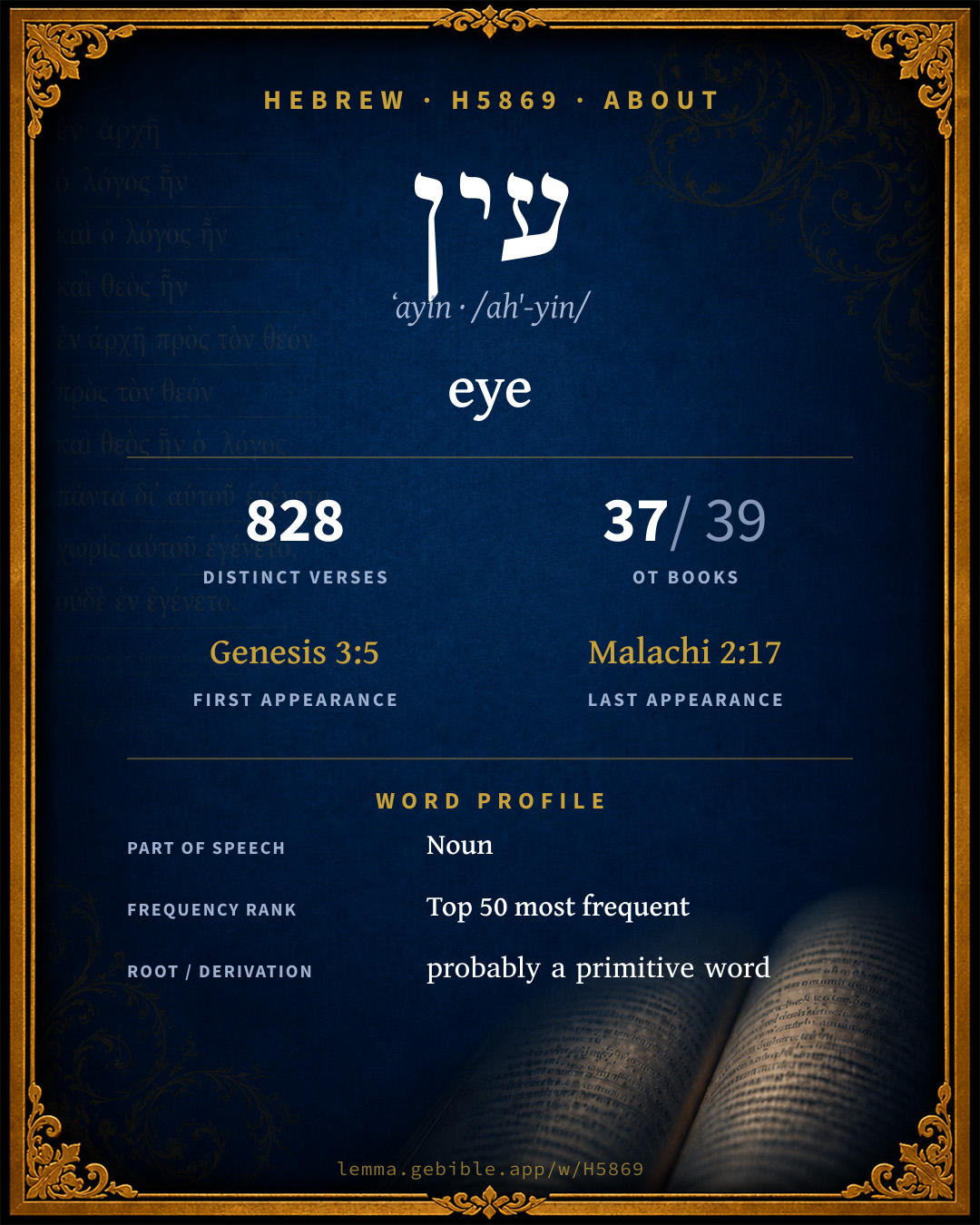
עַ֫יִן
eye
‘eye’ is one of 2 main senses fuller range ↓
Full lexicon entry — Brown-Driver-Briggs (BDB)
From Brown-Driver-Briggs (BDB)
Where this word appears
See every Construct-state word in the Hebrew Bible →
Grammar key — what these labels mean
Part of speech
- Noun
- A naming word — a person, place, thing, or idea.
Noun type
- Common
- A common noun — a general class of person, place, or thing (“king,” “city,” “water”), not a specific name.
- Proper
- A name of a specific person, place, or people (e.g. Abraham, Zion, Israel).
State
- Construct
- A noun bound to a following noun in a possessive / “of” relationship (the construct chain).
- Absolute
- The independent form of a noun, not bound to a following word.
Gender
- Both
- Attested as both masculine and feminine.
- Masculine
- Grammatically masculine.
- Feminine
- Grammatically feminine.
Number
- Dual
- Exactly two — for natural pairs and some measures of time.
- Singular
- One.
- Plural
- More than one (in Hebrew, generally three or more).
66 verses where H5869 appears in the Construct state in the Book of Genesis. Filtered view — show all forms. Click any verse to open its interlinear word-by-word view. Verse text shown in the World English Bible for context — . Each verse’s Hebrew form is shown with its reference; the English is not keyword-highlighted, since the data carries no word-level English alignment. Use “Compare translations” on any verse to read it across multiple English versions. This concordance covers the Hebrew Bible; Septuagint (Greek Old Testament) occurrences are not indexed here.
Genesis
- Genesis 3:5 עֵֽינֵי/כֶ֑ם n c bd cs + sfx pers 2mp for God knows that in the day you eat it, your eyes will be opened, and you will be like God, knowing good and evil."
- Genesis 3:7 עֵינֵ֣י n c bd cs Both of their eyes were opened, and they knew that they were naked. They sewed fig leaves together, and made themselves aprons.
- Genesis 6:8 בְּ/עֵינֵ֥י prep + n c bd cs But Noah found favor in Yahweh's eyes.
- Genesis 13:10 עֵינָ֗י/ו n c bd cs + sfx pers 3ms Lot lifted up his eyes, and saw all the plain of the Jordan, that it was well watered every where, before Yahweh destroyed Sodom and Gomorrah, like the garden of Yahweh, like the land of Egypt, as you go to Zoar.
- Genesis 13:14 עֵינֶ֨י/ךָ֙ n c bd cs + sfx pers 2ms Yahweh said to Abram, after Lot was separated from him, "Now, lift up your eyes, and look from the place where you are, northward and southward and eastward and westward,
- Genesis 16:4 בְּ/עֵינֶֽי/הָ prep + n c bd cs + sfx pers 3fs He went in to Hagar, and she conceived. When she saw that she had conceived, her mistress was despised in her eyes.
- Genesis 16:5 בְּ/עֵינֶ֑י/הָ prep + n c bd cs + sfx pers 3fs Sarai said to Abram, "This wrong is your fault. I gave my handmaid into your bosom, and when she saw that she had conceived, I was despised in her eyes. Yahweh judge between me and you."
- Genesis 16:6 בְּ/עֵינָ֑יִ/ךְ prep + n c bd cs + sfx pers 2fs But Abram said to Sarai, "Behold, your maid is in your hand. Do to her whatever is good in your eyes." Sarai dealt harshly with her, and she fled from her face.
- Genesis 16:7 עֵ֥ין הָ/עַ֖יִן n c bs cs ptcl def.art + n c bs The angel of Yahweh found her by a fountain of water in the wilderness, by the fountain in the way to Shur.
- Genesis 18:2 עֵינָי/ו֙ n c bd cs + sfx pers 3ms He lifted up his eyes and looked, and saw that three men stood opposite him. When he saw them, he ran to meet them from the tent door, and bowed himself to the earth,
- Genesis 18:3 בְּ/עֵינֶ֔י/ךָ prep + n c bd cs + sfx pers 2ms and said, "My lord, if now I have found favor in your sight, please don't go away from your servant.
- Genesis 19:8 בְּ/עֵינֵי/כֶ֑ם prep + n c bd cs + sfx pers 2mp See now, I have two virgin daughters. Please let me bring them out to you, and do you to them as is good in your eyes. Only don't do anything to these men, because they have come under the shadow of my roof."
- Genesis 19:14 בְּ/עֵינֵ֥י prep + n c bd cs Lot went out, and spoke to his sons-in-law, who were pledged to marry his daughters, and said, "Get up! Get out of this place, for Yahweh will destroy the city." But he seemed to his sons-in-law to be joking.
- Genesis 19:19 בְּ/עֵינֶי/ךָ֒ prep + n c bd cs + sfx pers 2ms See now, your servant has found favor in your sight, and you have magnified your loving kindness, which you have shown to me in saving my life. I can't escape to the mountain, lest evil overtake me, and I die.
- Genesis 20:15 בְּ/עֵינֶ֖י/ךָ prep + n c bd cs + sfx pers 2ms Abimelech said, "Behold, my land is before you. Dwell where it pleases you."
- Genesis 21:11 בְּ/עֵינֵ֣י prep + n c bd cs The thing was very grievous in Abraham's sight on account of his son.
- Genesis 21:12 בְּ/עֵינֶ֨י/ךָ֙ prep + n c bd cs + sfx pers 2ms God said to Abraham, "Don't let it be grievous in your sight because of the boy, and because of your handmaid. In all that Sarah says to you, listen to her voice. For from Isaac will your seed be called.
- Genesis 21:19 עֵינֶ֔י/הָ n c bd cs + sfx pers 3fs God opened her eyes, and she saw a well of water. She went, filled the bottle with water, and gave the boy drink.
- Genesis 22:4 עֵינָ֛י/ו n c bd cs + sfx pers 3ms On the third day Abraham lifted up his eyes, and saw the place far off.
- Genesis 22:13 עֵינָ֗י/ו n c bd cs + sfx pers 3ms Abraham lifted up his eyes, and looked, and saw that behind him was a ram caught in the thicket by his horns. Abraham went and took the ram, and offered him up for a burnt offering instead of his son.
- Genesis 23:11 לְ/עֵינֵ֧י prep + n c bd cs "No, my lord, hear me. I give you the field, and I give you the cave that is in it. In the presence of the children of my people I give it to you. Bury your dead."
- Genesis 23:18 לְ/עֵינֵ֣י prep + n c bd cs to Abraham for a possession in the presence of the children of Heth, before all who went in at the gate of his city.
- Genesis 24:13 עֵ֣ין n c bs cs Behold, I am standing by the spring of water. The daughters of the men of the city are coming out to draw water.
- Genesis 24:43 עֵ֣ין n c bs cs Behold, I am standing by the spring of water. Let it happen, that the maiden who comes forth to draw, to whom I will say, Give me, I pray you, a little water from your pitcher to drink.
- Genesis 24:63 עֵינָי/ו֙ n c bd cs + sfx pers 3ms Isaac went out to meditate in the field at the evening. He lifted up his eyes, and saw, and, behold, there were camels coming.
- Genesis 24:64 עֵינֶ֔י/הָ n c bd cs + sfx pers 3fs Rebekah lifted up her eyes, and when she saw Isaac, she dismounted from the camel.
- Genesis 27:1 עֵינָ֖י/ו n c bd cs + sfx pers 3ms It happened, that when Isaac was old, and his eyes were dim, so that he could not see, he called Esau his elder son, and said to him, "My son?" He said to him, "Here I am."
- Genesis 27:12 בְ/עֵינָ֖י/ו prep + n c bd cs + sfx pers 3ms What if my father touches me? I will seem to him as a deceiver, and I would bring a curse on myself, and not a blessing."
- Genesis 28:8 בְּ/עֵינֵ֖י prep + n c bd cs Esau saw that the daughters of Canaan didn't please Isaac, his father.
- Genesis 29:17 וְ/עֵינֵ֥י conj + n c bd cs Leah's eyes were weak, but Rachel was beautiful and well favored.
- Genesis 29:20 בְ/עֵינָי/ו֙ prep + n c bd cs + sfx pers 3ms Jacob served seven years for Rachel. They seemed to him but a few days, for the love he had for her.
- Genesis 30:27 בְּ/עֵינֶ֑י/ךָ prep + n c bd cs + sfx pers 2ms Laban said to him, "If now I have found favor in your eyes, stay here, for I have divined that Yahweh has blessed me for your sake."
- Genesis 30:41 לְ/עֵינֵ֥י prep + n c bd cs It happened, whenever the stronger of the flock conceived, that Jacob laid the rods before the eyes of the flock in the gutters, that they might conceive among the rods;
- Genesis 31:10 עֵינַ֛/י n c bd cs + sfx pers 1cs It happened at the time that the flock conceive, that I lifted up my eyes, and saw in a dream, and behold, the male goats which leaped on the flock were streaked, speckled, and grizzled.
- Genesis 31:12 עֵינֶ֤י/ךָ n c bd cs + sfx pers 2ms He said, 'Now lift up your eyes, and behold, all the male goats which leap on the flock are streaked, speckled, and grizzled, for I have seen all that Laban does to you.
- Genesis 31:35 בְּ/עֵינֵ֣י prep + n c bd cs She said to her father, "Don't let my lord be angry that I can't rise up before you; for the manner of women is on me." He searched, but didn't find the teraphim.
- Genesis 31:40 מֵֽ/עֵינָֽ/י prep + n c bd cs + sfx pers 1cs Thus I was; in the day the drought consumed me, and the frost by night; and my sleep fled from my eyes.
- Genesis 32:5 בְּ/עֵינֶֽי/ךָ prep + n c bd cs + sfx pers 2ms I have oxen, donkeys, flocks, men-servants, and maid-servants. I have sent to tell my lord, that I may find favor in your sight.'"
- Genesis 33:1 עֵינָ֗י/ו n c bd cs + sfx pers 3ms Jacob lifted up his eyes, and looked, and, behold, Esau was coming, and with him four hundred men. He divided the children between Leah, Rachel, and to the two handmaids.
- Genesis 33:5 עֵינָ֗י/ו n c bd cs + sfx pers 3ms He lifted up his eyes, and saw the women and the children; and said, "Who are these with you?" He said, "The children whom God has graciously given your servant."
- Genesis 33:8 בְּ/עֵינֵ֥י prep + n c bd cs Esau said, "What do you mean by all this company which I met?" Jacob said, "To find favor in the sight of my lord."
- Genesis 33:10 בְּ/עֵינֶ֔י/ךָ prep + n c bd cs + sfx pers 2ms Jacob said, "Please, no, if I have now found favor in your sight, then receive my present at my hand, because I have seen your face, as one sees the face of God, and you were pleased with me.
- Genesis 33:15 בְּ/עֵינֵ֥י prep + n c bd cs Esau said, "Let me now leave with you some of the folk who are with me." He said, "Why? Let me find favor in the sight of my lord."
- Genesis 34:11 בְּ/עֵינֵי/כֶ֑ם prep + n c bd cs + sfx pers 2mp Shechem said to her father and to her brothers, "Let me find favor in your eyes, and whatever you will tell me I will give.
- Genesis 34:18 בְּ/עֵינֵ֣י וּ/בְ/עֵינֵ֖י prep + n c bd cs conj + prep + n c bd cs Their words pleased Hamor, and Shechem, Hamor's son.
- Genesis 37:25 עֵֽינֵי/הֶם֙ n c bd cs + sfx pers 3mp They sat down to eat bread, and they lifted up their eyes and looked, and saw a caravan of Ishmaelites was coming from Gilead, with their camels bearing spices and balm and myrrh, going to carry it down to Egypt.
- Genesis 38:7 בְּ/עֵינֵ֣י prep + n c bd cs Er, Judah's firstborn, was wicked in the sight of Yahweh. Yahweh killed him.
- Genesis 38:10 בְּ/עֵינֵ֥י prep + n c bd cs The thing which he did was evil in the sight of Yahweh, and he killed him also.
- Genesis 39:4 בְּ/עֵינָ֖י/ו prep + n c bd cs + sfx pers 3ms Joseph found favor in his sight. He ministered to him, and he made him overseer over his house, and all that he had he put into his hand.
- Genesis 39:7 עֵינֶ֖י/הָ n c bd cs + sfx pers 3fs It happened after these things, that his master's wife cast her eyes on Joseph; and she said, "Lie with me."
- Genesis 39:21 בְּ/עֵינֵ֖י prep + n c bd cs But Yahweh was with Joseph, and showed kindness to him, and gave him favor in the sight of the keeper of the prison.
- Genesis 41:37 בְּ/עֵינֵ֣י וּ/בְ/עֵינֵ֖י prep + n c bd cs conj + prep + n c bd cs The thing was good in the eyes of Pharaoh, and in the eyes of all his servants.
- Genesis 42:24 לְ/עֵינֵי/הֶֽם prep + n c bd cs + sfx pers 3mp He turned himself about from them, and wept, and he returned to them, and spoke to them, and took Simeon from among them, and bound him before their eyes.
- Genesis 43:29 עֵינָ֗י/ו n c bd cs + sfx pers 3ms He lifted up his eyes, and saw Benjamin, his brother, his mother's son, and said, "Is this your youngest brother, of whom you spoke to me?" He said, "God be gracious to you, my son."
- Genesis 44:21 עֵינִ֖/י n c bs cs + sfx pers 1cs You said to your servants, 'Bring him down to me, that I may set my eyes on him.'
- Genesis 45:5 בְּ/עֵ֣ינֵי/כֶ֔ם prep + n c bd cs + sfx pers 2mp Now don't be grieved, nor angry with yourselves, that you sold me here, for God sent me before you to preserve life.
- Genesis 45:12 עֵֽינֵי/כֶם֙ וְ/עֵינֵ֖י n c bd cs + sfx pers 2mp conj + n c bd cs Behold, your eyes see, and the eyes of my brother Benjamin, that it is my mouth that speaks to you.
- Genesis 45:16 בְּ/עֵינֵ֣י וּ/בְ/עֵינֵ֖י prep + n c bd cs conj + prep + n c bd cs The report of it was heard in Pharaoh's house, saying, "Joseph's brothers have come." It pleased Pharaoh well, and his servants.
- Genesis 45:20 וְ/עֵ֣ינְ/כֶ֔ם conj + n c bs cs + sfx pers 2mp Also, don't concern yourselves about your belongings, for the good of all of the land of Egypt is yours."
- Genesis 46:4 עֵינֶֽי/ךָ n c bd cs + sfx pers 2ms I will go down with you into Egypt. I will also surely bring you up again. Joseph will close your eyes."
- Genesis 47:19 לְ/עֵינֶ֗י/ךָ prep + n c bd cs + sfx pers 2ms Why should we die before your eyes, both we and our land? Buy us and our land for bread, and we and our land will be servants to Pharaoh. Give us seed, that we may live, and not die, and that the land won't be desolate."
- Genesis 47:25 בְּ/עֵינֵ֣י prep + n c bd cs They said, "You have saved our lives! Let us find favor in the sight of my lord, and we will be Pharaoh's servants."
- Genesis 47:29 בְּ/עֵינֶ֔י/ךָ prep + n c bd cs + sfx pers 2ms The time drew near that Israel must die, and he called his son Joseph, and said to him, "If now I have found favor in your sight, please put your hand under my thigh, and deal kindly and truly with me. Please don't bury me in Egypt,
- Genesis 48:10 וְ/עֵינֵ֤י conj + n c bd cs Now the eyes of Israel were dim for age, so that he couldn't see. He brought them near to him; and he kissed them, and embraced them.
- Genesis 48:17 בְּ/עֵינָ֑י/ו prep + n c bd cs + sfx pers 3ms When Joseph saw that his father laid his right hand on the head of Ephraim, it displeased him. He held up his father's hand, to remove it from Ephraim's head to Manasseh's head.
- Genesis 50:4 בְּ/עֵ֣ינֵי/כֶ֔ם prep + n c bd cs + sfx pers 2mp When the days of weeping for him were past, Joseph spoke to the house of Pharaoh, saying, "If now I have found favor in your eyes, please speak in the ears of Pharaoh, saying,
About this entry
At a glance — auto-summarized from this page’s data, not written by a person. Every figure links to its source below. This summary describes the numbers; it doesn’t interpret them.
The Hebrew noun עין centers on the idea of “eye.” First canonically at Genesis 3:5, it enters the text early. The Hebrew Bible uses it across 828 verses — among the most common. Not a single-sense word: explore its full sense range. It clusters with מעין, עון and עין under a shared root. For the data behind this summary, explore the sense tree and the renderings breakdown below.
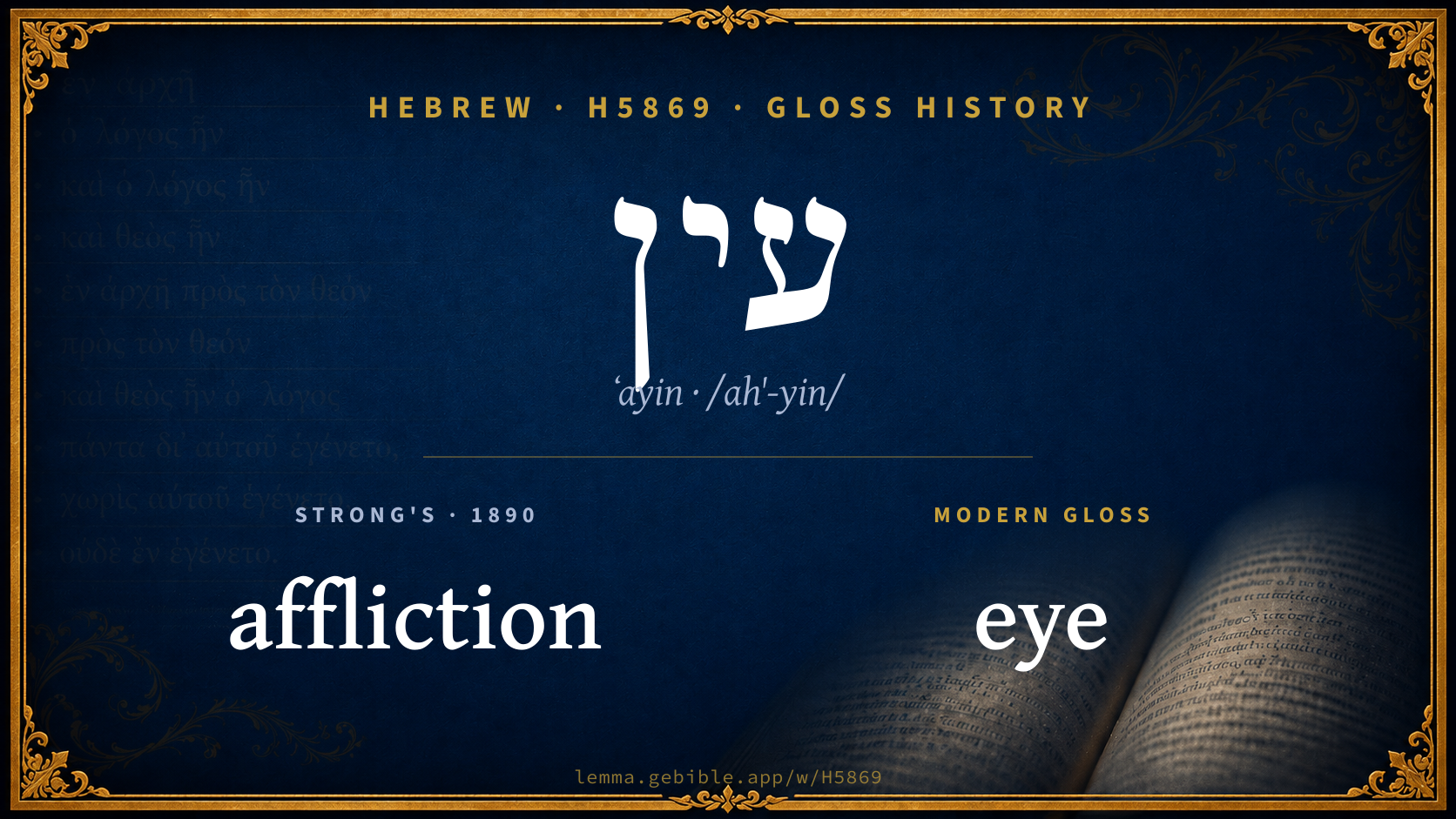
Gloss history
Strong's 1890 vs modern scholarship
About this word
Strong's H5869 catalogs a Hebrew word from the Hebrew Old Testament.
These counts are not copied from any lexicon or concordance. They are computed here, from the morphology-tagged Hebrew Old Testament. What Lemma adds →
- 828
- distinct verses
- The word appears in 828 distinct verses.
- 37 / 39
- OT books
- The word appears in 37 of 39 Old Testament books.
- #46
- by frequency
- Top 50 most frequent Hebrew words (rank 46 of 8,640 Hebrew words by occurrence).
View all 828 occurrences in the concordance →
By section of the Old Testament
By traditional corpus
Conventional, traditional groupings — biblical authorship is debated, so this is a traditional corpus grouping, not an authorship claim. Each share is this word’s portion of its verses in that division of the Hebrew canon. Each figure is a share of the word’s 828 distinct verses.
- Prophets (Nevi'im) 365 verses · 44%
- Writings (Ketuvim) 253 verses · 31%
- Torah (Pentateuch) 210 verses · 25%
How translations render this word
Counts come from each version’s own published word-to-Strong’s tagging or interlinear alignment — an approximate guide to how each version renders this word, not a word-level alignment the data otherwise carries. Because each total is that version’s own tagged count, the per-version totals vary from one another and need not match the appearance or distinct-verse counts above. These counts may also differ from a printed concordance because Lemma counts each distinctly tagged rendering and does not collapse phrase taggings into a single head-word total. This is a fixed set of word-tagged versions (KJV, ASV, BSB, ULT) and does not change with the reading translation you choose elsewhere. Each version’s license is shown beside its name below (and on Sources).
BDB lists this Strong’s number as 4 distinct words (homographs). Each count above pools all of them and is not split by sense — see the Senses section below. A low-frequency rendering may belong to a different one of those words, not the primary meaning.
- King James Version†: Eyes 322×, Sight 202×, Eye 61×
- American Standard Version†: Eyes 308×, Sight 177×, Eye 59×
- Berean Standard Bible†: Eyes 305×, Sight 183×, Eye 36×
- unfoldingWord Literal Text†: Eyes 468×, Eyes of 201×, Eye 76×
King James Version Public Domain
Renders H5869 across 839† tagged occurrences — most commonly:
Plus other, less common renderings. Plus 101 renderings that appear only once — usually multi-word phrases or single function words the recovered tagging swept in, not distinct renderings. Not rendered by a distinct English word in 49 further occurrences.
American Standard Version Public Domain
Renders H5869 across 834† tagged occurrences — most commonly:
Plus other, less common renderings. Plus 128 renderings that appear only once — usually multi-word phrases or single function words the recovered tagging swept in, not distinct renderings.
Berean Standard Bible Public Domain
Renders H5869 across 765† tagged occurrences — most commonly:
Plus other, less common renderings. Plus 72 renderings that appear only once — usually multi-word phrases or single function words the recovered tagging swept in, not distinct renderings. Not rendered by a distinct English word in 120 further occurrences.
unfoldingWord Literal Text CC BY-SA 4.0
Renders H5869 across 881† tagged occurrences — most commonly:
Plus other, less common renderings. Plus 33 renderings that appear only once — usually multi-word phrases or single function words the recovered tagging swept in, not distinct renderings.
39 senses and sub-senses in the full BDB
What do BDB’s symbols mean?
BDB uses these scholarly abbreviations:
| Symbol | Meaning |
|---|---|
| 𝔊 | the Septuagint (the ancient Greek translation, LXX) |
| 𝔙 | the Vulgate (the Latin translation) |
| 𝔖 | the Syriac version (the Peshitta) |
| 𝔗 | the Targum (the Aramaic translation) |
| ψ | the Psalms |
| √ | root (the underlying root or stem) |
| ‖ | parallel passage (a synonymous or contrasted parallel) |
| † | the dagger: every passage where the word occurs is cited |
The 39 senses and sub-senses the full Brown-Driver-Briggs lexicon distinguishes for this word, in lexicon order (not ranked by frequency), with BDB’s own verbatim wording and sub-sense lettering. Shown in Hebrew script with BDB’s own scholarly abbreviations. The condensed entry is in the Lexicon Entry tab. See also the Forms in the corpus table below.
עין I
- 1. lit. as physical organ,
- a. of man Ex 21:6(×3) (E), Gn 3:6 (J) +, Lv 21:20; 24:20(×2); 26:16 (H; very rarely P, e.g. Dt 34:4, 7), 2 K 4:34(×2) +; once שְׁתֵּי עֵינַי Ju 16:28. e.g. Exodus 21:6
- b. anthropomorph. of י׳ ψ 33:18; 34:16 (אֶל) +. e.g. Psalms 33:18
- c. of idols ψ 115:5; 135:16. e.g. Psalms 115:5
- d. of beasts Gn 30:41 (J), Jb 40:24 (hippop., si vera l., but prob. crpt. Di Siegf Bu Du where see conj.), 41:10 (crocod.); bird Jb 28:7; 39:29; Pr 1:17. e.g. Genesis 30:41
- e. in wheels Ez 1:18 cf. 10:12; on stone Zc 3:9 (all in visions). e.g. Ezekiel 1:18
- f. subj. of ראה see Gn 45:12(×2) (E), + (often Dt), c. חזה ψ 11:4; men see בְּע׳ Dt 3:27; 2 K 7:12 +; especially נָשָׂא ע׳ + ראה Gn 13:10, 14 (J) +; cf. לְכָל־מַרְאֵה עֵינֵי הַכֹּהֵן Lv 13:12 = as far as the priest can see, מַרְאֵה ע׳ Dt 28:34 what is seen by the eyes = v 67 Ec 6:9. e.g. Genesis 45:12
- g. as affected by sleep, v. שֵׁנָה sub [יָשֵׁן].
- h. as weeping, ע׳ מְקוֹר דִּמְעָה Je 8:23, ע׳ נִגְּרָה La 3:49, דָּֽלְפָה ע׳ Jb 16:20; v. also Je 31:16 ψ 116:8, and ירד Qal 3 c. e.g. Jeremiah 8:23
- i. as growing dim, v. I. כָּהָה, חָשַׁךְ 3; c. כָּבֵד Gn 48:10 (E), קוּם 1 S 4:15 1 K 14:4, שָׁעַע Is 32:3; 6:10 (Hiph.); c. כָּלָה pine, languish, v. כ׳ Qal 2 b, Pi. 2 b, c. דָּאַב ψ 88:10, עָשַׁשׁ 6:8; 31:10, דָּלַל Is 38:14. e.g. Genesis 48:10
- j. c. פָּקַח open, after sleep Jb 27:19, sleep of death 2 K 4:35; = keep awake Pr 20:13 (opp. שֵׁנָה); of new power of vision Gn 3:5, 7 (J), given by God 21:19 (E), 2 K 6:17(×2); so (c. וַיְגַל) Nu 22:31 (JE); = give sight to blind 2 K 6:20(×2); Is 35:5; 42:7 ψ 146:8; of God (י׳) opening his eyes, פָּקַח ע׳ 2 K 19:16 = Is 37:17, Dn 9:18, + עַל־ Je 32:19; Zc 12:4; Jb 14:3 שִׂים ע׳ עַל Gn 44:21 (J) Je 39:12; 40:4, + לטובה 24:6, + לרעה Am 9:4; c. פָּתַח, + אֶל־ 1 K 8:29 = 2 Ch 6:20; 1 K 8:52; Ne 1:6, + ל 2 Ch 6:40; 7:15; + inf. Ne 1:6. e.g. Job 27:19
- k. אוֹר ע׳ etc., = revive, v. אור vb. Qal, Hiph.; noun, 10.
- l. קָרַץ ע׳ = wink ψ 35:19; Pr 10:10, ק׳ בְּע׳ 6:13. e.g. Psalms 35:19
- m. יִרְזְמוּן ע׳ Jb 15:12 i.e. roll (in anger). e.g. Job 15:12
- n. לָטַשׁ ע׳ ל׳ Jb 16:9 whet eyes against = ‘look daggers at.’ e.g. Job 16:9
- o. put out eye, v. עִוֵּר, נקר.
- p. as feature of beauty, יְפֵה ע׳ Dt 16:12; cf. Ct 4:9; 7:5, ע׳ יוֹנִים 1:15; 4:1 and 5:12 (כְּיוֹנִים); on other hand, ע׳ לֵאָה רַכּוֹת Gn 29:17 (E); וַתָּשֶׂם בַּפּוּךְ ע׳ †2 K 9:30 (v. פּוּךְ), cf. Je 4:30, כָּחַל ע׳ Ez 23:40 paint the eyes †. e.g. Deuteronomy 16:12
- q. apple of the eye, v. אִישׁוֹן, [בָּבָה], בַּת 6.
- r. גַּבֹּת ע׳ Lv 14:9 eyebrows. e.g. Leviticus 14:9
- s. חַכְלִילִי ע׳ מִיָּ֑יִן Gn 49:12, חַכְלִילוּת ע ׳ Pr 23:29 (v. ח׳); מְאוֹר ע׳ Pr 15:30, v. Toy.—v. שׁתם for Nu 24:3, 15. e.g. Genesis 49:12
- 2.
- a. eyes as shewing mental qualities: arrogance ע׳ גַבְהוּת Is 2:11, ע׳ גְבֹהִים 5:15, גְּבַהּ־ע׳ ψ 101:5, תִּפְאֶרֶת רוּם ע׳ Is 10:12; c. רוּם also ψ 18:28 (so read also ‖ 2 S 22:28 Hup HPS), 131:1 Pr 6:17; 21:4; humility, שַׁח ע׳ Jb 22:29; mockery, ע׳ תִּלְעַג לְ Pr 30:17; cf. רָעָה ע׳ בְּ Dt 15:9 (grudging), 28:54, 56 (id.); especially (עַל) ע׳ אַל־תָּחֹס not have pity on Dt 7:16 + 4 times Dt, Ez 5:11 + 8 times Ez, Is 13:18, also Gn 45:20 (E; = not regret); cf. נֹחַם יִסָּתֵר מֵע׳ Ho 13:14. e.g. Isaiah 2:11
- b. מַחְמַד ע׳ Ez 24:16 desire of the eyes, so v 21, 25; שִׁקּוּצֵי ע׳ 20:7 abominations of the eyes, so v 3.—ψ 73:7 v. חֵלֶב. e.g. Ezekiel 24:16
- 3. Fig. of mental and spiritual faculties, acts and states:
- a. תִּפָּקַחְנָה ע׳ Gn 3:5, 7 (J) Is 42:7, גִּלוּי ע׳ Nu 24:4, 16 (JE); also טַח מֵרְאוֹת ע׳ Is 44:18; ע׳ אֶל־י׳ ψ 123:2 (see v 2(×2) for origin of fig.), +; of י׳, 33:18 (i.e. his favour) 34:16 (id.) +. e.g. Genesis 3:5
- b. ע׳ הַזֹּנוֹת Ez 6:9; תִּשְׂבַּע ע׳ Ec 1:8; 4:8; שָֽׁאֲלוּ ע׳ 2:10; ע׳ לְנֹכַח יַבִּיטוּ Pr 4:25; טוֹב־ע׳ 22:9 = bountiful, רַע עָ֑יִן 23:6 = niggardly one, so 28:22; eye as avenue of temptation Jb 31:1, 7; שִׁית ע׳ ψ 17:11 = design. e.g. Ezekiel 6:9
- c. especially בְּעֵינֵי, c. adj. and intrans. verbs, in the view, opinion, of Gn 16:4, 5 (J), 21:11, 12 (E), 34:18 (P), + often; c. act. vb. 2 S 10:3 = 1 Ch 19:3; Est 1:17; 3:6; הַטּוֹב בְּע׳ Gn 16:6; 19:14 (J), +, i.e. what one pleases, Nu 36:6 (P) whom they please; הַיָּשָׁר בְּע׳ Dt 12:8, 25 +, הַטּוֹב וְהַיָּשָׁר בְּע׳ v 28 Jos 9:25 (D), הָרַע בְּע׳ Ju 2:11; 3:7; Dt 4:25 + especially D and K (RD); so לְנֶגֶד עיניו 2 S 22:25 = ψ 18:25; אַחֲרֵי עֵינֵיכֶם Nu 15:39 = according to your wish, fancy (+ לְבַבְכֶם). e.g. Genesis 16:4
- d. נֶעְלָם מֵע׳ Lv 4:13 i.e. hid from knowledge of, so Nu 5:13 (both P), Jb 28:21; מֵע׳ Nu 15:24 (P) without the knowledge of; אַעְלִים ע׳ מִן Is 1:15 = disregard, pay no attention; cf. Lv 20:4 (H) Ez 22:26; without מִן, abs., Pr 28:27; נִסְתְּרוּ מֵע׳ Is 65:16, וַיַּסְתֵּר עָמָל מֵע׳ Jb 3:10; אַעְלִים ע׳ בּוֹ (i.e. בַּכֹּפֶר) 1 S 12:3 (נעלים sandals + ענו בי 𝔊 Th We Kit, cf. Ecclusxlvi. 19; Bu HPS ins. ענו בי); הַשֹּׁחַד יְעַוֵּר ע׳ Dt 16:19, cf. כְּסוּת ע׳ Gn 20:16 (E). e.g. Leviticus 4:13
- 4. Transferred meanings:
- a. visible surface of earth Ex 10:5, 15 (J) Nu 22:5, 11 (JE). e.g. Exodus 10:5
- b. appearance Lv 13:5 (P; reading בְּעֵינוֹ Di Kau Dr-Wh), v 37 (P; reading id.), v 55 (P) Nu 11:7(×2) (JE); so appar. dual 1 S 16:7. e.g. Leviticus 13:5
- c. gleam, sparkle (of metal, jewels, etc.) Ez 1:4, 7, 16, 22, 27; 8:2; 10:9 Dn 10:6; of wine Pr 23:31. e.g. Ezekiel 1:4
- 5. Other phrases are: ע׳ תַּחַת ע׳ Ex 21:24 (E) = Lv 24:20 (H), = ע׳ בְּע׳ Dt 19:21, all = an eye for an eye; ע׳ בְּע׳ = eye to eye, Nu 14:14 (P) Is 52:8 (fig.), cf. וְע׳ אֶת־ע׳ תִּרְאֶינָה Je 32:4; 34:3; especially לְעֵינֵי in the presence of, in full view of Gn 42:24 (E) 47:19 (J) Ex 4:30 (J) Nu 19:5 (P), + often of business transaction Je 32:12(×2); Gn 23:11, 18 (P); so נֶגֶד ע׳ Jo 1:16, לְנֶגֶד ע׳ Jb 4:16, בְּע׳ Jos 3:7; 4:14 1 S 21:14 Ezr 3:12; נִגְרַזְתִּי מִנֶּגֶד ע׳ ψ 31:23; בֵּין ע׳ = on the forehead Ex 13:9, 16 (JE) Dt 6:8; 11:18; 14:1; Dn 8:5, 21. e.g. Exodus 21:24
עין II spring (of water) (connexion with i. ע׳ dub.
- a. ע׳ חֲרֹד Ju 7:1 (on loc. cf. GFM). e.g. Judges 7:1
- b. ע׳ הַקּוֹרֵא (partridge-spring) Ju 15:19 (cf. id.). e.g. Judges 15:19
- c. ע׳ רֹגֵל near Jerus. (early sanctuary RSSem i. 157, 2nd ed. 172) 2 S 17:17 cf. 1 K 1:9, on border of Judah Jos 15:7, and Benj. 18:16. e.g. 2 Samuel 17:17
- d. ע׳ הַתַּנִּין (dragonspring) Ne 2:13 (= c.? so RSl.c.).—On שַׁעַר הָעַיִן Ne 2:14; 3:15; 12:37 v. שַׁעַר. e.g. Nehemiah 2:13
עין III loc.
- 1. לָעָ֑יִן, on NE. border of Can. Nu 34:11, 𝔊 ἐπὶ πηγάς. e.g. Numbers 34:11
- 2.
- a. in Negeb of Judah Jos 15:32 (+ וְרִמּוֹן), Levit. city 21:16 (but 𝔊B Ασα read עָשָׁן, as 1 Ch 6:44), appar. = e.g. Joshua 15:32
- b. 19:7 (+ ר׳; assigned to Simeon), וָע׳ ר׳ 1 Ch 4:32 (read prob. וְעֵין ר׳); prob. mod. Umm er-Ramāmīn, c. 18 mils SW. from Hebron, BuhlGeogr.183.—Vid. עֵין רִמּוֹן. e.g. 1 Chronicles 19:7
עין IV Qr, [עֵינָה] Kt n.f. only sf. Ho 10
Senses from the full Brown-Driver-Briggs lexicon (Brown, Driver, Briggs; Oxford 1906 — public domain), digitized via Sefaria, supplemented by the OpenScriptures HebrewLexicon (CC BY 4.0). Full attribution on Sources.
Word origin
I. n.f. Gn 3:7 and (Zc 3:9; 4:10 AlbrZAW xvi (1896), 75) m. eye (ancient Sem. word; √ and relation to ii. ע׳ unknown; NH id.; Ph. ען; 𝔗 עֵינָא, עַיְינָא; Palm. עינא, Zinj. sf. עיני, עינך; Syriac ܥܰܝܢܳܐ; Assyrian ênu, enu, TelAm. sf. inaya and (appar. Can. gloss) ḫinaya; Arabic عَيْنٌ; Ethiopic ዐይን );—abs. ע׳ Ex 21:4 +, cstr. עֵין v 26 +; sf. עֵינִי Gn 44:21 + (2 S 16:12 read עָנְיִי Vrss Comm.), עֵינֵךָ Dt 7:16 +, עֵינֵנוּ ψ 35:21 (2 S 20:6 v. נצל Hiph.); sf. 3 mpl. עֵינָם Is 13:18 (Zc 5:6 read עֲוֹנָם 𝔊 We Gr Now), עֵינֵמוֹ ψ 73:7 (but read עֲוֹנָמוֹ v. Comm.); usually du. עֵינַיִם Gn 20:16 +, עֵינָ֑יִם Is 3:16 +, especially cstr. עֵינֵי Gn 3:7 +, עֵנֵי Is 3:8; sf. עֵינַי Gn 31:10 +, עֵינֶיךָ Ju 6:17 +, etc. (Ho 10:10 read עֲוֹנֹתָם) cf. 𝔊 𝔙 Che We Gr Now);—eye:
II. n.f. spring (of water) (connexion with i. ע׳ dub.; NH id., Ph. ען; Assyrian ênu, înu; Arabic عَيْنٌ; Ethiopic ዐይን; Palm. עינא, 𝔗 עֵינָא, עַיְינָא; Syriac ܥܰܝܢܳܐ );—abs. ע׳ 1 S 29:1 +, עָ֑יִן Gn 49:22 +, הָעַ֫יְנָה 24:16, 45; cstr. עֵין v 13 +; pl. עֲיָנֹת Dt 8:7, -וֹת 2 Ch 32:3; cstr. עֵינוֹת Ex 15:27 = Nu 33:9, עִינוֹת Pr 8:28 (Ges§93 v);—spring Gn 16:7; 24:16, 29, 30, 42, 45 (all J) 49:22 (poem in J), 1 S 29:1; עֵין הַמַּיִם Gn 16:7; 24:13, 43 (J), cf. Ex 15:27 (J) Nu 33:9 (P); נַחֲלֵי מַיִם ע׳ וּתְהֹמֹת Dt 8:7; מֵימֵי הָעֲיָנוֹת 2 Ch 32:3; ע׳ תְּהוֹם Pr 8:28 (i.e. of the sea); fig. עֵין יַעֲקֹב Dt 33:28 (poem), i.e. Jacob’s descendants. Particular springs are:
I. Qr, [עֵינָה] Kt n.f. only sf. Ho 10:10: Qr pl. עוֹנֹתָם Baer, sg. עוֹנָתָם Ginsb; > עֵינֹתָם Kt; but read עֲוֹנֹתָם, v. עָוֹן 1 a. p. 730.
— Brown-Driver-Briggs (Oxford 1906, public domain), digitized via Sefaria, supplemented by the OpenScriptures HebrewLexicon (CC BY 4.0). See Sources.
Origin: probably a primitive word
Jastrow Dictionary
A second Hebrew/Aramaic lexicon for comparison, covering Aramaic and post-biblical (Talmudic, Targumic, Midrashic) usage that the biblical-Hebrew BDB does not. Matched by lemma rather than by Strong’s number, so a lemma may carry more than one Jastrow headword (shown separately below), and the entries cover usage well beyond the Bible.
עַיִן
- 1. eye, sight, look. Kidd. 24ᵃ בשן וע׳, v. יָצָא. Ib. 24ᵇ הכהו על עֵינוֹ וכ׳ if the master struck him on his eye and made it blind. B. Kam. 83ᵇ (ref. to Ex. XXI, 24) אימא ע׳ ממש may not the text mean that he who injures a person’s eye must really suffer the same injury? Sabb. 108ᵇ bot. יד לע׳ וכ׳ an unwashed hand (in the morning) touching the eye deserves to be cut off. Taan. 8ᵇ סמוי מן הע׳, v. סָמָא. Ib. דבר שאין הע׳ שולטת בו something which the eye cannot look at (being stored away), v. infra; a. v. fr.—[Y. Ned. IX, end, 41ᶜ עשה לה ע׳ של זהב, a corrupt dittography of עשה לה שן של זהב.]—ע׳ טובה (also יפה) a benevolent eye, good will, liberality, opp. ע׳ רעה or עֵין הרע (abbr. עה"ר), also ע׳ צרה ill-will, selfishness, envy. Ab. II, 9. Sabb. 74ᵃ משום ע׳ יפה וכ׳ he intended to show his good will. Tosef. Ḥall. I, 7 שעינו יפה בעיסתו he is liberal with his dough (is glad to give the priest’s portion), opp. עינו צרה. Esth. R. to I, 4 היתה עינו צרה בממונו he was jealous of his wealth (unwilling to leave it to his heirs to be enjoyed by them). Ab. V, 13 עינו רצה בשל אחרים he is illiberal with regard to other people’s money (begrudges them the privilege of giving charity), ע׳ רעה בשלו he is illiberal with his own money (is too greedy to afford himself the pleasure of giving charity). Ib. II, 11, v. יֵצֶר; a. fr.—צַר ע׳ (= רַע ע׳) selfish, opp. טוב ע׳ liberal, selfless. Sabb. 108ᵇ שדורי … צר ע׳ אנא I send you (the salve), lest you say that I am selfish. Sot. 38ᵇ אפי׳ העופות מכירין בצָרֵי ע׳ even birds recognize selfish men. Ib. כל הנהנה מצרי ע׳ וכ׳ he who accepts benefits from self-seeking men, transgresses a law (ref. to Prov. XXIII, 6). Ib. אין … לטוב ע׳ the cup of benediction must be handed to none but an unselfish person (with ref. to Prov. XXII, 9); a. e.—Esp. ע׳ רעה, עֵין הרע (abbrev. עה"ר), or only עַיִן, the evil eye, an envious glance that brings harm to the person looked at, bewitchment. B. Mets. 107ᵇ (ref. to Deut. VII, 15) זו ע׳ that means the effect of an evil eye. Ib. תשעים … בע׳ רעה וכ׳ ninety-nine persons die of an evil eye against one in the natural course. Gen. R. s. 91 שלא תשלוט בכם עה"ר that the evil eye may have no power over you. Ib. לא הייתם … מפני הע׳ were you not afraid of the evil eye? Ber. 20a ע׳ שלא … אין עה"ר שולטת בי no evil eye can affect him whose eye refused to feed on what was not his (to look at the charms of a married woman); a. fr.—שקל ע׳ בע׳ to balance the scales exactly, to allow no overweight (v. עוּן, a. כָּרַע). B. Bath. V, 11; a. fr.—בע׳ visible to the eye, discernible; in natural form. Y. Ber. VI, 10ᵃ אע"פ ששחוקין בעֵינָן הן although they are ground, they are still discernible. Ib. אם בעַיְינָן הן if they are in their natural form (not mashed); a. fr.—כְּעֵין like the appearance of, similar to, a sort of (cmp. גַּוָּון). Ib.ᵇ כל שהוא כע׳ סולת וכ׳ whatever resembles a pudding or dumpling. Ber. 58ᵃ (in Chald. dict.) מלכותא דארעא כע׳ וכ׳ the government on earth is like the government in heaven (inspires reverence); a. fr.—מֵעֵין a reflection of, of the nature of; an abstract of. Snh. 105ᵇ (ref. to the preposition מ in I Kings I, 47) מע׳ קאמר ליה he means, ‘as a reflection’ (of thy name, thy throne). Ib. (ref. to Jud. V, 24) מע׳ קאמר it means ‘similar to’ (the blessings of Sarah &c.). Ber. IV, 3 מע׳ י"ח an abstract of the eighteen benedictions. Y. ib. 8ᵃ bot. שבע מע׳ י"ח seven benedictions embodying the eighteen. Ib. VI, 10ᵇ ברכה אחת מע׳ שלש one benediction embodying the three. Gen. R. s. 11, a. e., v. דּוּגְמַטְרִין.—Du. עֵינַיִים, עֵינַיִם. Bekh. VII, 4 עֵינָיו גדולות וכ׳ if his (the priest’s) eyes are as large as those of a calf. Ib. 3. Ber. 58ᵃ, a. e. נתן עיניו בו וכ׳ he put his eyes on him, and he was turned into a heap of bones. Y. Hor. III, end, 48ᶜ נתנו עֵינֵיהֶן בשמואל וכ׳ they directed their attention to Samuel &c.; a. fr.—אחז את הע׳, v. אָחַז. e.g. Exodus 21:24
- 2. anything resembling the eye, hole, ring &c. Kel. VIII, 7 ע׳ של תנור the ‘eye’ of an oven (the fire-place under the oven, Maim.; the opening for the escape of the smoke, which may be closed to retain the heat, R. S.). Ib. IX, 8 תנור שניקב מעינו an oven in the eye of which is a defect. Ib. XXI, 2 ע׳ the ring-shaped pad around an animal’s neck (a halter of soft material). Ib. ע׳ של מתכת a metal hame (cmp. עוֹנָתָא). Tosef. Kel. B. Bath. I, 7 העיין שבמצעד the ring attached to an adze; a. fr.
- 3. spring, well. Keth. I, 10; a. fr.—[Frequ. עֵין in pr. n. pl., as ע׳ סוכר, ע׳ טב; v. respective determinants].
עַיִן ²
- 1. eye, sight &c. Targ. Lev. XXIV, 20. Targ. O. Ex. XXII, 2. Ib. X, 5; a. fr.—Ḥull. 96ᵃ, a. fr. טביעות ע׳, v. טְבִיעוּתָא.—בע׳ (v. preced.) discernible, in natural form. Pes. 75ᵃ top בְּעֵינֵיה, v. קִיּוּהָא.—כְּעֵין, מֵעֵין, v. preced. Targ. Deut. XXXIII, 28. Targ. Josh. XXIV, 27; a. e.—ע׳ בישא (or only ע׳) evil eye. Targ. Y. Gen. XLII, 5.—Ber. 20ᵃ. Pes. 50ᵇ שלטא בהו ע׳ the eye controls them (they cannot be hidden from sight; v. Taan. 8ᵇ, quot. in preced.). B. Mets. 30ᵃ משום ע׳ (Ms. M. ע׳ בישא) because it attracts the (evil) eye; a. v. fr.—Ned. 50ᵃ the ram (figure-head, v. אֵילָא) דכל ספינתא עבדין ליה מן ע׳ which all ships have attached (as a protection) from the evil eye (and which the losers paid a high price for redeeming; cmp. Sm. Ant. s. v. Insigne) [comment. explain differently].—Pl. עֵינִין, עַיְינִין. Targ. Gen. III, 6; a. fr.
- 2. ring, collar; hole. M. Kat. 10ᵃ בת עינא (he cuts out) the hole for the hopper, v. כָּבַשׁ.—Pl. as ab. Targ. Hos. X, 10, v. עוֹנָתָא
- 3. [guide,] guide-post on cross-roads (only in pl.). Targ. O. Gen. XXXVIII, 14 פרשות ע׳; ib. 21 ע׳ (ed. Berl. עֵינַיִם, as pr. n. pl.; Y. סכות ע׳).
- 4. spring, well. Targ. Gen. XVI, 7; a. fr.—Targ. Y. I Ex. XV, 27 ענווא (some ed. עניא, read: עֵינָא or עַיְינָא).—Pl. עַיְינִין, עֵינָוָון, עֵינָוָן, עֵינְוָתָא; עֵינָתָא. Targ. Y. I, II ib. Targ. II Chr. XXXII, 3. Ib. 4 עַיְינָוָתָא. Targ. Y. I Num. XXXIV, 9, sq. (טירת) עֵינְוָותָא pr. n. pl. Ṭirath ‘Envatha (h. text חצר עינן); Targ. Y. II ib. (דירת) עַיְינוּתָא, v. עַיְנוּתָא.—Bekh. 55ᵃ sq. והאיכא עינתא מידליין but are there not springs higher than the Euphrates?
A Dictionary of the Targumim, the Talmud Babli and Yerushalmi, and the Midrashic Literature (Marcus Jastrow; London, Luzac, 1903) — Public Domain. Digitized via Sefaria. Digitized via Sefaria. Full attribution on Sources.
Forms in the corpus
The 330 distinct written forms H5869 takes in the Hebrew Bible, most frequent first — each parse links to that state’s occurrences in the concordance. Hebrew forms include their vowel points and cantillation, so a single lemma takes many written forms.
The 60 most common forms are shown; 270 rarer forms follow in the full concordance.
Same root — word family
Other BDB entries built from the same root as H5869, grouped by Strong’s listed origin. These share a root / origin per the lexicon — not necessarily a shared meaning. Each links to that word’s own entry.
Derived from this word
Proper names from this root
People and places named from this root — a name, not an additional meaning of the word.
- עין ʻAyin H5871 Ain
- עין גדי ʻÊyn Gedîy H5872 En-gedi
- עין גנים ʻÊyn Gannîym H5873 En-gannim
- עיןדאר ʻÊyn-Dôʼr H5874 En-dor
- עין הקורא ʻÊyn haq-Qôwrêʼ H5875 En-hakkore
- עין חדה ʻÊyn Chaddâh H5876 En-haddah
- עין חצור ʻÊyn Châtsôwr H5877 En-hazor
- עין חרד ʻÊyn Chărôd H5878 En-harod
- עינים ʻÊynayim H5879 Enam
- עין משפט ʻÊyn Mishpâṭ H5880 En-mishpat
- עינן ʻÊynân H5881 Enan
- עין עגלים ʻÊyn ʻEglayim H5882 En-eglaim
- עין רגל ʻÊyn Rôgêl H5883 En-rogel
- עין רמון ʻÊyn Rimmôwn H5884 En-rimmon
- עין שמש ʻÊyn Shemesh H5885 En-shemesh
- עין תנים ʻÊyn Tannîym H5886 dragon well
- עין תפוח ʻÊyn Tappûwach H5887 En-tappuah
- ענים ʻÂnîym H6044 Anim
- ענם ʻÂnêm H6046 Anem
Compare all same-root words → Showing 4 of 23 — not the complete family. 19 of the same-root words are proper names (people or places). They share a root, not necessarily a meaning.
Septuagint verse parallels
This word appears in 788 verses that also exist in the Greek Old Testament (Septuagint), out of the 828 Hebrew verses it occurs in. You can read those verses in Greek by switching the Old Testament edition to the Septuagint.
Read these verses in the Septuagint
- Genesis 3:5
- Exodus 3:21
- Leviticus 4:13
- Numbers 5:13
- Deuteronomy 1:23
- Joshua 3:7
- Judges 2:11
- Ruth 2:2
- 1 Samuel 1:18
- 2 Samuel 3:19
- 1 Kings 1:20
- 2 Kings 1:13
This is a verse-level parallel only — the same verses exist in both the Hebrew and Greek Old Testaments. No word-level Hebrew↔Greek correspondence is claimed: the data carries no such alignment, so no Greek word is shown as this Hebrew word’s translation. Coverage is not total — the Septuagint omits the deuterocanon and renumbers the Psalms, so some Hebrew verses have no direct Greek parallel.