
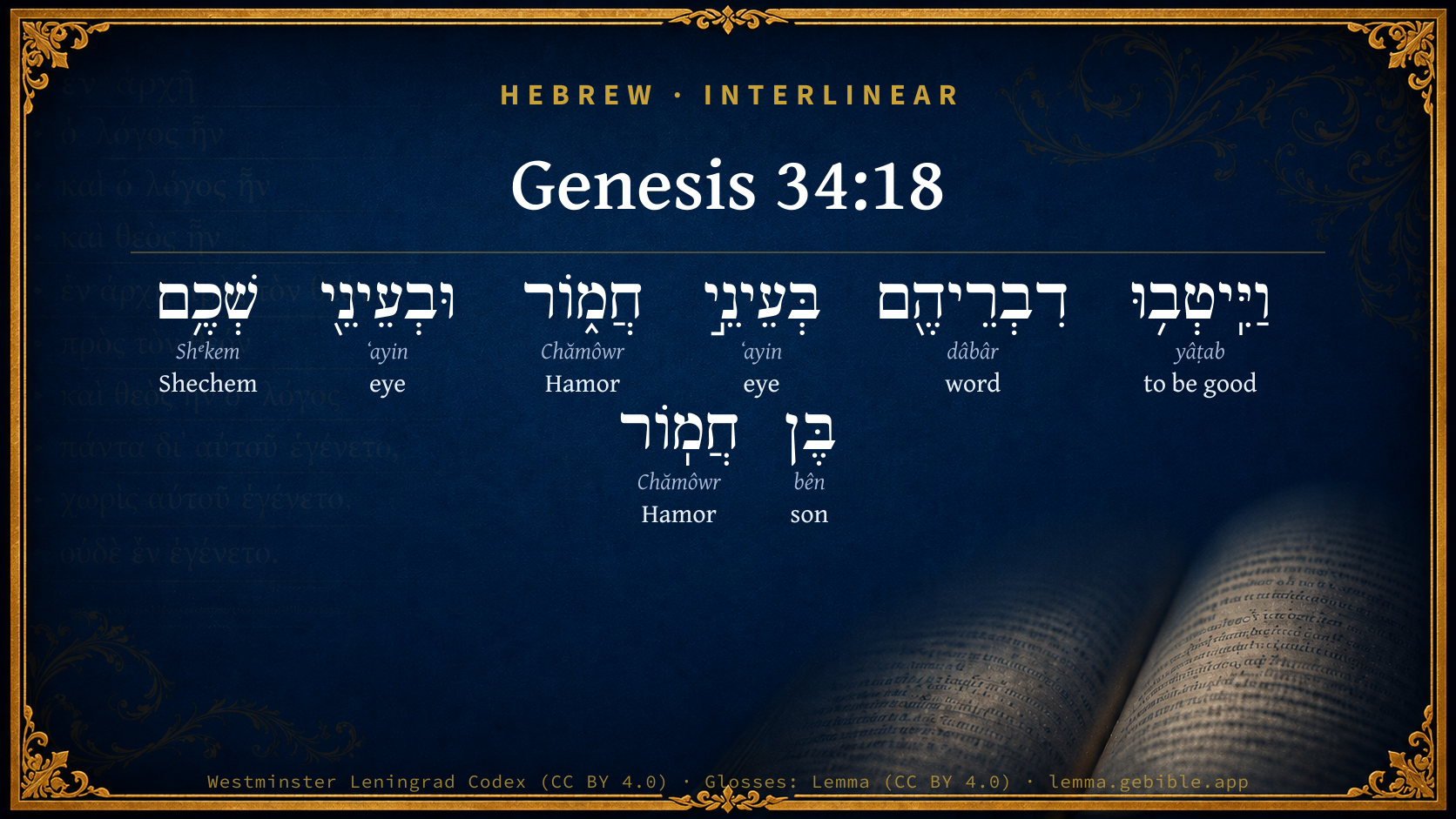
Genesis 34:18

Hebrew (Westminster Leningrad Codex) Genesis 34:18 appears in the Hebrew Old Testament. The text above is from the Westminster Leningrad Codex. Each word links to its Strong’s number, a concise gloss, and parsing drawn from the Open Scriptures Hebrew Bible morphology. Click any word for its full Brown-Driver-Briggs (BDB) entry.
Download image
Cite this verse

Genesis 34:18 (World English Bible). Public Domain. Lemma interlinear Bible study tool, https://lemma.gebible.app/v/genesis/34/18.

Show BibTeX & RIS
BibTeX
RIS
English Translation
Their words pleased Hamor, and Shechem, Hamor's son.
World English Bible · Public Domain
Download a study sheet

One document with this verse’s original text, its word-by-word gloss line, the meaning frame, cross-references with their text, attributed commentary, and full source and license credits — printable, and it pastes into notes with its structure intact.

This verse Autodidact and up

Study sheet (.html) Plain text (.txt)

A passage Seminary Student

Up to 50 verses in one chapter. A passage sheet keeps up to 6 commentary sources and 12 cross-references per verse, in the order this page ranks them, and says so on the sheet whenever that leaves anything out. Ask for a single verse and you get the Autodidact verse sheet above.

Everything on this page stays free to read, with no account — the sheet is a download of what is already on screen, not access to it.

Want to remove ads? Support Godless Engineer
Compare translations 3

The same verse in 3 English versions, stacked beneath the original-language interlinear above. Click any original word for its lexicon entry.

Each is an independent rendering of the whole verse — the interlinear is not word-aligned to these translations.

Highlighted words mark where these versions differ — a whole-verse word diff, not a word-by-word alignment.

  • World English Bible Public Domain
    Their words pleased Hamor, and Shechem, Hamor's son.
  • King James Version Public Domain
    And their words pleased Hamor, and Shechem Hamor's son.
  • unfoldingWord Literal Text CC BY-SA 4.0
    And their words were good in the eyes of Hamor and in the eyes of Shechem, Hamor’s son.

unfoldingWord Literal Text — © unfoldingWord, licensed CC BY-SA 4.0. Word-aligned USFM3 via Door43 (git.door43.org/unfoldingWord/en_ult).

Versions to compare (up to 4)

3 of 4 selected

Show all 18 translations

Every available English version of this verse, each an independent rendering of the whole verse.

  • World English Bible Public Domain
    Their words pleased Hamor, and Shechem, Hamor's son.
  • Berean Standard Bible Public Domain
    Their offer seemed good to Hamor and his son Shechem.
  • Majority Standard Bible Public Domain
    Their offer seemed good to Hamor and his son Shechem.
  • King James Version Public Domain
    And their words pleased Hamor, and Shechem Hamor's son.
  • American Standard Version (1901) Public Domain
    And their words pleased Hamor, and Shechem Hamor's son.
  • Revised Version (1885) Public Domain
    And their words pleased Hamor, and Shechem Hamor’s son.
  • Geneva Bible (1599) Public Domain
    Nowe their wordes pleased Hamor, and Shechem Hamors sonne.
  • Douay-Rheims (1899) Public Domain
    Their offer pleased Hemor, and Sichem his son:
  • Young's Literal Translation Public Domain
    And their words are good in the eyes of Hamor, and in the eyes of Shechem, Hamor's son;
  • Literal Standard Version CC BY-SA 4.0
    And their words are good in the eyes of Hamor, and in the eyes of Shechem, Hamor’s son;
  • Unlocked Literal Bible CC BY-SA 4.0
    Their words pleased Hamor and his son Shechem.
  • unfoldingWord Literal Text CC BY-SA 4.0
    And their words were good in the eyes of Hamor and in the eyes of Shechem, Hamor’s son.
  • Darby Bible Public Domain
    And their words were good in the eyes of Hamor and Shechem, Hamor's son.
  • World Messianic Bible Public Domain
    Their words pleased Hamor and Shechem, Hamor’s son.
  • Webster's Bible Public Domain
    And their words pleased Hamor, and Shechem Hamor's son.
  • Free Bible Version CC BY-SA 4.0
    Hamor and his son Shechem agreed to what was proposed.
  • Bible in Basic English Public Domain
    And their words were pleasing to Hamor and his son Shechem.
  • JPS Tanakh (1917) Public Domain
    And their words pleased Hamor, and Shechem Hamor's son.

Literal Standard Version (2020), Covenant Press — licensed CC BY-SA 4.0. Text via the HelloAO Bible API (eBible.org). Unlocked Literal Bible (unfoldingWord) — licensed CC BY-SA 4.0. Text via the HelloAO Bible API (eBible.org). unfoldingWord Literal Text — © unfoldingWord, licensed CC BY-SA 4.0. Word-aligned USFM3 via Door43 (git.door43.org/unfoldingWord/en_ult). Free Bible Version, Dr. Jonathan Gallagher — licensed CC BY-SA 4.0. Text via the HelloAO Bible API (eBible.org).

Word by word

More ways to search: Search by grammar → Find every occurrence → Compare this word →

Practice this passage: Drill this verse → Learn its vocabulary →

About this verse

These counts appear in no published source. They are computed here, from the morphology-tagged text and Lemma’s own curated glosses. What Lemma adds →

8
words
6
distinct lemmas
Pentateuch
section

Notable vocabulary

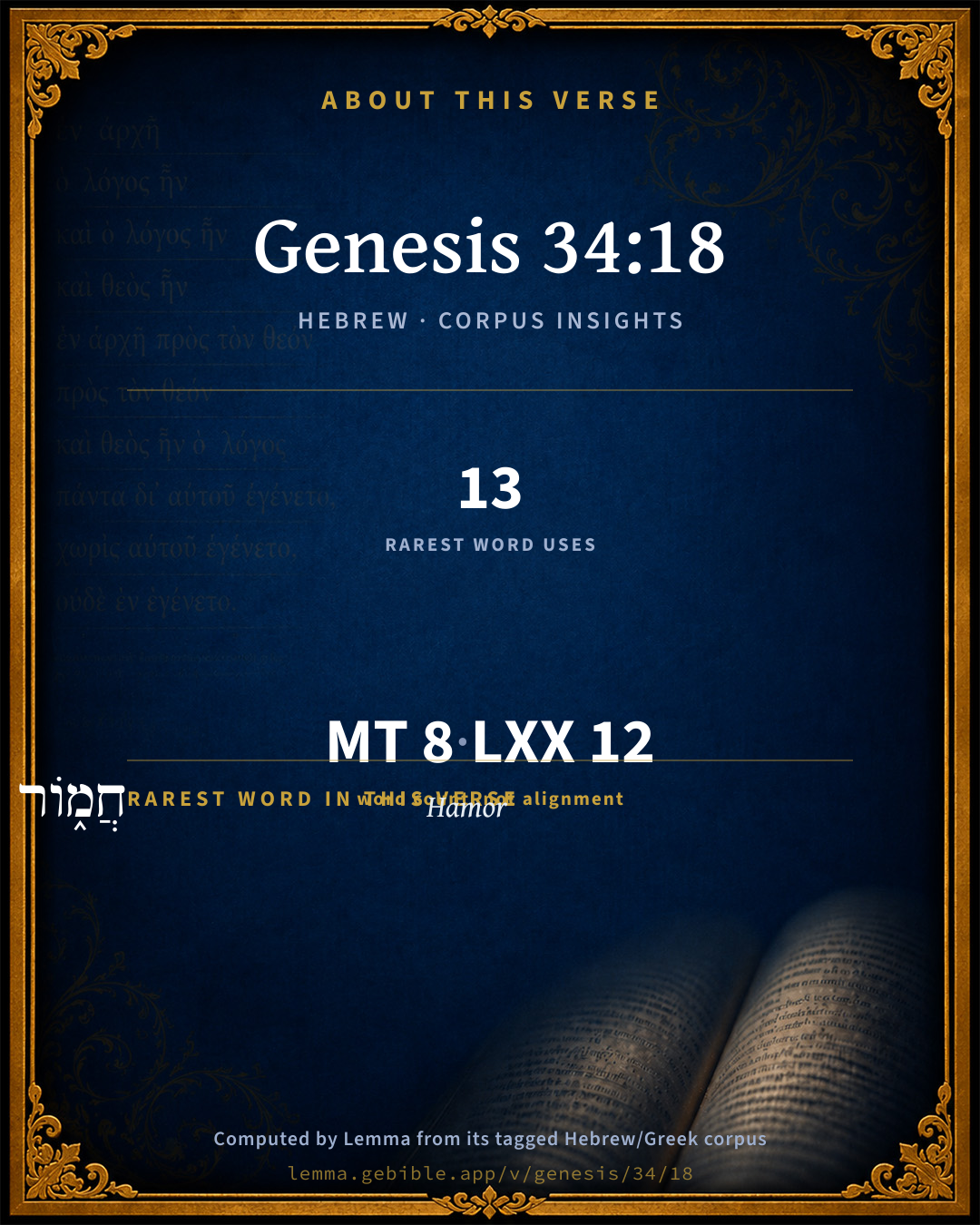
The rarest word here is חֲמ֑וֹר Hamor H2544 — appearing just 13 times in the whole Hebrew Bible.

Shared distinctive vocabulary

חֲמ֑וֹר Hamor H2544 occurs in 12 verses of the Hebrew Bible. Also found in:

Grammatical profile

  • 1 verb
  • 7 nouns

Verb forms

  • וַיִּֽיטְב֥וּ Qal · Sequential Imperfect

Repetition

Words recur within this verse — often emphatic in Hebrew:

  • בְּעֵינֵ֣י eye H5869 ×2
  • חֲמ֑וֹר Hamor H2544 ×2

Hebrew & Septuagint length

In English translation the verse runs 8 words from the Hebrew and 11 from the Septuagint (LXX English) — closely comparable.

A rough comparison of the two English renderings, which tokenize alike — not a word-level alignment.

Word counts can differ between the Hebrew and the Greek without any difference in meaning — e.g. the Hebrew direct-object marker אֵת has no separate Greek word, and Greek often adds the article ὁ.

In the original languages it is 8 Hebrew tokens and 12 Greek tokens — but the two are counted differently (Hebrew bundles its prefixes and suffixes into one token; the Greek is in lemma form), so that isn’t a like-for-like length.

Hebrew and Greek witnesses Masoretic Hebrew ↔ Greek Septuagint

The same verse in the two great witnesses to the Old Testament, shown verse-for-verse.

These are two independent witnesses, not word-aligned to each other, and the Septuagint is shown in lemma (dictionary) form.

Hebrew Genesis 34:18 Masoretic · Westminster Leningrad Codex

וַיִּֽיטְב֥וּ דִבְרֵיהֶ֖ם בְּעֵינֵ֣י חֲמ֑וֹר וּבְעֵינֵ֖י שְׁכֶ֥ם בֶּן חֲמֽוֹר

Their words pleased Hamor, and Shechem, Hamor's son.

World English Bible · Public Domain

Greek LXX Genesis 34:18 Septuagint · lemma form

καί ἀρέσκω ὁ λόγος ἐναντίον εμμωρ καί ἐναντίον συχεμ ὁ υἱός εμμωρ

And the words pleased Emmor, and Sychem the son of Emmor.

LXX2012 (modern English Septuagint) · Public Domain

Hebrew: Westminster Leningrad Codex (CC BY 4.0). Greek: Septuagint (public domain); English from LXX2012 (modern English Septuagint) (Public Domain). How the Septuagint differs from the Hebrew →

Targum (Aramaic paraphrase)

2

The Targum is the ancient Jewish Aramaic paraphrase of the Hebrew Scriptures — an interpretive translation, not the Hebrew text itself. Onkelos (literal) and Pseudo-Jonathan (expansive) render the Torah, and Jonathan the Prophets. Coverage is partial: where no permissively-licensed English translation exists for a verse, only the Aramaic is shown. This is verse-level text, not a word-by-word alignment to the Hebrew.

  1. Targum Onkelos Torah (Genesis–Deuteronomy)
    וּשְׁפָרוּ פִּתְגָּמֵיהוֹן בְּעֵינֵי חֲמוֹר וּבְעֵינֵי שְׁכֶם בַּר חֲמוֹר

    (no public-domain English translation for this verse)

    Targum Onkelos — Aramaic: “Onkelos Genesis” (public domain); “Onkelos Exodus” (public domain); “Onkelos Leviticus” (public domain); “Onkelos Numbers” (public domain); “Onkelos Deuteronomy” (public domain). English: “Sefaria Community Translation” (CC0 1.0 (public-domain dedication)); “J.W. Etheridge. The Targums of Onkelos and Jonathan Ben Uzziel on the Pentateuch. London: Longmans, Green, 1862” (public domain). Text via Sefaria.

  2. Targum Pseudo-Jonathan Torah (Genesis–Deuteronomy)
    וּשְׁפָרוּ פִּתְגָמֵיהוֹן בְּעֵינֵי חֲמוֹר וּבְעֵינֵי שְׁכֶם בַּר חֲמוֹר

    And their words were pleasing in the eyes of Hamor, and in the eyes of Shekem, the son of Hamor.

    Targum Pseudo-Jonathan — Aramaic: “Targum Jonathan on Genesis” (public domain); “Targum Jonathan on Exodus” (public domain); “Targum Jonathan on Leviticus” (public domain); “Targum Jonathan on Numbers” (public domain); “Targum Jonathan on Deuteronomy” (public domain). English: “The Targum of Jonathan ben Uzziel, trans. J. W. Etheridge, London, 1862” (public domain). Text via Sefaria.

Commentary

Notes on Genesis 34:18 from classic Christian and Jewish commentators (each source and its license shown beneath its notes). The classic Christian expositions comment on the surrounding passage and are grouped to its opening verse, so a note may address several verses; the Jewish commentaries on the Tanakh (Rashi and others) are per-verse, so they appear only where the commentator wrote on this verse.

Lemma curates 59 commentaries, every one of them public domain or Creative Commons licensed, each selected and text-cleaned for this edition rather than reprinted as found. About our sources →

Matthew Henry's Commentary

Here, 1. Hamor and Shechem gave consent themselves to be circumcised, Gen 34:18, Gen 34:19. To this perhaps they were moved, not only by the strong desire they had to bring about this match, but by what they might have heard of the sacred and honourable intentions of this sign, in the family of Abraham, which, it is probable, they had some confused notions of, and of the promises confirmed by it, which made them the more desirous to incorporate with the family of Jacob, Zac 8:23. Note, Many who know little of religion, yet know so much of it as makes them willing to join themselves with those that are religious. Again, If a man would take upon him a form of religion to gain a good wife, much more should we embrace the power of it to gain the favour of a good God, even circumcise our hearts to love him, and, as Shechem here, not defer to do the thing. 2. They gained the consent of the men of their city, Jacob's sons requiring that they also should be circumcised. (1.) They themselves had great influences upon them by their command and example. Note, Religion would greatly prevail if those in authority, who, like Shechem, are more honourable than their neighbours, would appear forward and zealous for it. (2.) They urged an argument which was very cogent (Gen 34:23), Shall not their cattle and their substance be ours? They observed that Jacob's sons were industrious thriving people, and promised themselves and their neighbours advantage by an alliance with them; it would improve ground and trade, and bring money into their country. Now, [1.] It was bad enough to marry upon this principle: yet we see covetousness the greatest matchmaker in the world, and nothing designed so much, with many, as the laying of house to house, and field to field, without regard had to any other consideration. [2.] It was worse to be circumcised upon this principle. The Shechemites will embrace the religion of Jacob's family only in hopes of interesting themselves thereby in the riches of that family. Thus there are many with whom gain is godliness, and who are more governed and influenced by their secular interest than by any principle of their religion.

Matthew Henry's Commentary on the Whole Bible (1708–1710) — public domain (CC PDM 1.0). Text via the HelloAO Bible API.

Trapp's Complete Commentary

John Trapp

Gen 34:18 And their words pleased Hamor, and Shechem Hamor’s son.

Ver. 18. And their words.] See the force of love, and hope of profit!

John Trapp, A Commentary or Exposition upon All the Books of the Old and New Testament (1647–1656) — public domain. Text from a community e-Sword module.

Joseph Benson's Commentary

Gen 34:18-19. Hamor and Shechem gave consent themselves to be circumcised. To this perhaps they were moved, not only by the strong desire they had to bring about this match, but by what they might have heard of the sacred and honourable intentions of this sign, in the family of Abraham, which it is probable they had some confused notions of, and of the promises confirmed by it; which made them the more desirous to incorporate with the family of Jacob. He (Shechem) was more honourable than all the house of his father — More highly esteemed by the people, which was the reason he prevailed so much with them in so strange a request.

Joseph Benson's Commentary on the Old and New Testaments (1811–1818) — public domain. Text from a community e-Sword module.

Tyndale Open Study Notes

Tyndale Open Resources

34:18-24 The Canaanites accepted the stipulation and every male in the town was circumcised. This was not just to allow Shechem to marry Dinah, but to give them the opportunity to acquire everything that Jacob possessed (34:23).

Tyndale Open Study Notes — © Tyndale Open Resources, licensed CC BY-SA 4.0. Text via the HelloAO Bible API.

John Calvin's Commentaries

18. And their words pleased Hamor. Moses prosecutes the history until he comes to the slaughter of the Shechemites. Hamor had, no doubt, been induced by the entreaties of his son, to show himself thus tractable. Whence appears the excessive indulgence of the kind old man. He ought, in the beginning, severely to have corrected the fault of his son; but he not only covers it as much as possible, but yields to all his wishes. This moderation and equity would have been commendable, if what his son had required was just; but that the old man, for the sake of his son, should adopt a new religion, and suffer a wound to be inflicted on his own flesh, cannot be deemed free from folly. The youth is said not to have delayed, because he vehemently loved the maid, and excelled in dignity among his own citizens; and on account of the honor of his rank he easily obtained what he wished: for the fervor of his love would have availed nothing, unless he had possessed the power of accomplishing his object.

John Calvin's Commentaries (1540-1563) — public domain. Text from the Calvin Translation Society English edition (1840s-50s) via the Christian Classics Ethereal Library (ccel.org). Calvin's coverage is partial (roughly two-thirds of the Bible); uncommented books and verses are honest gaps, never fabricated. The 19th-century editor's footnotes and remarks are omitted so the notes are faithfully Calvin's own voice.

Ellicott's Commentary for English Readers

(18) Their words pleased Hamor.—We gather from this that circumcision was a rite not only well known, but regarded as something honourable; for otherwise they would not so readily have submitted to a thing so painful.

A Bible Commentary for English Readers, edited by Charles John Ellicott (1878–1897) — public domain. Text from a community e-Sword module.

John Gill's Exposition

And their words pleased Hamor, and Shechem Hamor's son. The condition proposed was acceptable to them both, and they agreed to comply with it; Hamor, because of the great love he had for his son; Shechem, because of the great love he had for Dinah.

And their words pleased Hamor, and Shechem Hamor's son. The condition proposed was acceptable to them both, and they agreed to comply with it; Hamor, because of the great love he had for his son; Shechem, because of the great love he had for Dinah.

Genesis 34:19

gen 34:19

gen 34:19

gen 34:19And the young man deferred not to do the thing,.... To be circumcised himself, and to get all the males of the city circumcised; he delayed not a moment, but made all the haste he could to get it accomplished:

because he had delight in Jacob's daughter; he really loved her, and delighted in her person and company: it was not the effect of a brutish lust, but a true affection he bore to her, that he desired her in marriage:

and he was more honourable than all the house of his father; for though he had done a base thing in defiling Jacob's daughter, yet in this he was honourable, that he sought to marry her, and to do any thing that was in his power to recompence the injury; and he was honourable in keeping covenant and compact with men; and was honest, upright, and sincere, to fulfil the condition imposed on him, and he had agreed to, as well as he was in greater esteem among the citizens than any of his father's house, which made it the more easy to him to get their consent to be circumcised; they having a very high and honourable opinion of him, and ready to oblige him in anything they could.

John Gill's Exposition of the Whole Bible (1746–1763) — public domain (CC PDM 1.0). Text via the HelloAO Bible API.

The Pulpit Commentary

Vers. 18, 19. And their words pleased (literally, were flood in the eyes of) Hamor, and (literally, in the eyes of) Shechem, Hamor"s son. And the young man deferred not (i.e. delayed not) to do the thing (literally, the word, i.e. to submit to circumcision. This is stated here by anticipation), because he had delight in Jacob"s daughter: and he was more honorable literally, more honored, doubtless because more worthy of regard (cf. 1Ch_4:9) than all the house of his father.

The Pulpit Commentary (1880–1919), ed. H.D.M. Spence-Jones & Joseph S. Exell — public domain. Text from a community e-Sword module.

John Wesley's Explanatory Notes

Hamor and Shechem gave consent themselves to be circumcised. To this perhaps they were moved not only by the strong desire they had to bring about, this match, but by what they might have heard of the sacred and honourable intentions of this sign, in the family of Abraham, which it is probable they had some confused notions of, and of the promises confirmed by it; which made them the more desirous to incorporate with the family of Jacob.

John Wesley, Explanatory Notes Upon the Whole Bible (1754–1765) — public domain. Text via the GEBible commentary corpus.

Keil & Delitzsch

C. F. Keil & F. Delitzsch

The condition seemed reasonable to the two suitors, and by way of setting a good example, "the young man did not delay to do this word," i.e., to submit to circumcision, "as he was honoured before all his father's house." This is stated by anticipation in Gen 34:19; but before submitting to the operation, he went with his father to the gate, the place of public assembly, to lay the matter before the citizens of the town. They knew so well how to make the condition palatable, by a graphic description of the wealth of Jacob and his family, and by expatiating upon the advantages of being united with them, that the Shechemites consented to the proposal. שׁלמים: integri, people whose bearing is unexceptionable. "And the land, behold broad on both sides it is before them," i.e., it offers space enough in every direction for them to wander about with their flocks. And then the gain: "Their cattle, and their possessions, and their beasts of burden...shall they not be ours?" מקנה is used here for flocks and herds, בּהמה for beasts of burden, viz., camels and asses (cf. Num 32:26). But notwithstanding the advantages here pointed out, the readiness of all the citizens of Shechem (vid., Gen 23:10) to consent to be circumcised, could only be satisfactorily explained from the fact that this religious rite was already customary in different nations (according to Herod. 2, 104, among the Egyptians and Colchians), as an act of religious or priestly consecration.

Keil & Delitzsch — Biblical Commentary on the Old Testament (1861–1891) — public domain (CC PDM 1.0). Text via the HelloAO Bible API. (Old Testament only.)

unfoldingWord translationNotes

Door43 World Missions Community

Their words pleased Hamor and his son Shechem

"Hamor and his son Shechem agreed with what Jacob's sons said"

to do what they said

"to become circumcised"

Jacob's daughter

"Jacob's daughter Dinah"

because he was the most honored person in all his father's household

This can be translated as a new sentence. It can be made explicit that Shechem knew the other men would agree to be circumcised because they greatly respected him. AT: "Shechem knew all the men in his father's household would agree with him because he was the most honored among them" (See: Assumed Knowledge and Implicit Information)

translationWords

word

Hamor

Shechem

Jacob

honor

household

unfoldingWord translationNotes — © Distant Shores Media and the Door43 World Missions Community, licensed CC BY-SA 4.0. Source: git.door43.org/Door43/en_tn.

Lesson kit

Teaching starters — assembled from the data on this page, not authored interpretation. Every prompt links to the verse data it draws on. Edit before teaching.

Genesis, in the Pentateuch, opens this verse with 8 words (6 distinct Hebrew lemmas). Its most distinctive word is Chămôwr (“Hamor”). A historical commentator’s framing appears above. Read the whole chapter for the surrounding context.

Discussion questions

  1. How does “Hamor” (Chămôwr) shape what this verse is saying?
  2. Genesis 33:19 shares the word «Hamor» with this verse. How do the two illuminate each other?
  3. “eye” occurs 2× in this one verse. What is the effect of the repetition?
  4. These translations render this verse differently. What is at stake in choosing one wording over another?
  5. The verb «וַיִּֽיטְב֥וּ» is Qal Sequential Imperfect. How does its form color the action?
  6. Reading how Matthew Henry's Commentary and Trapp's Complete Commentary read this verse, where do the two commentators agree and where do they part?

Things to notice

Reading settings

Reading text

Shown beneath each verse's original-language words.

Old Testament
Old Testament edition

Read the OT as the Masoretic Hebrew (MT) or the Greek Septuagint (LXX).

English shown for the Greek Septuagint (in the Hebrew ↔ Greek comparison).

Comparing translations? Open the Compare panel on any verse page to stack up to four side by side.