
Exodus 21:24

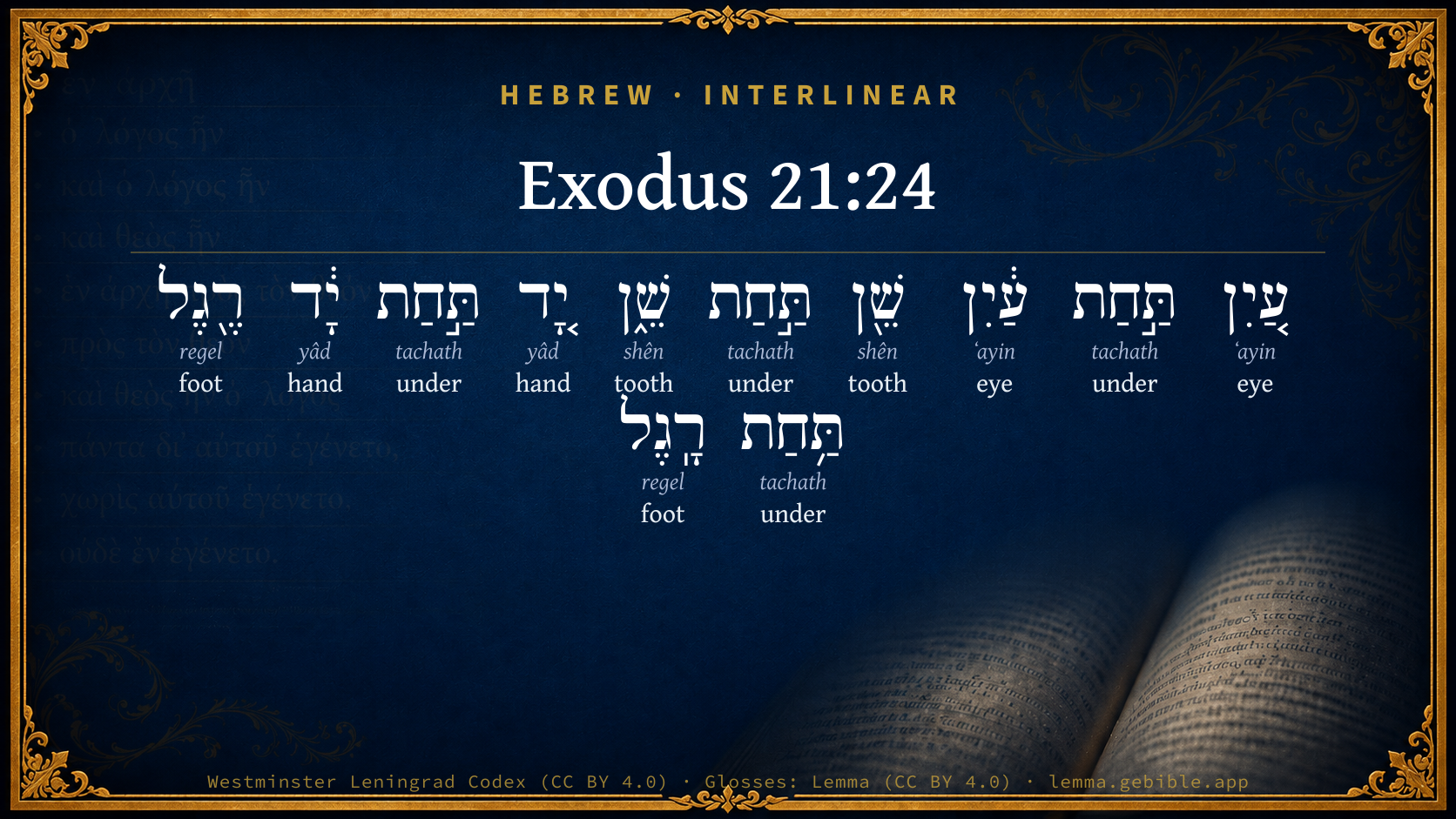
Hebrew (Westminster Leningrad Codex) Exodus 21:24 appears in the Hebrew Old Testament. The text above is from the Westminster Leningrad Codex. Each word links to its Strong’s number, a concise gloss, and parsing drawn from the Open Scriptures Hebrew Bible morphology. Click any word for its full Brown-Driver-Briggs (BDB) entry.
Download image
Cite this verse

Exodus 21:24 (World English Bible). Public Domain. Lemma interlinear Bible study tool, https://lemma.gebible.app/v/exodus/21/24.

Show BibTeX & RIS
BibTeX
RIS
English Translation
eye for eye, tooth for tooth, hand for hand, foot for foot,
World English Bible · Public Domain
Download a study sheet

One document with this verse’s original text, its word-by-word gloss line, the meaning frame, cross-references with their text, attributed commentary, and full source and license credits — printable, and it pastes into notes with its structure intact.

This verse Autodidact and up

Study sheet (.html) Plain text (.txt)

A passage Seminary Student

Up to 50 verses in one chapter. A passage sheet keeps up to 6 commentary sources and 12 cross-references per verse, in the order this page ranks them, and says so on the sheet whenever that leaves anything out. Ask for a single verse and you get the Autodidact verse sheet above.

Everything on this page stays free to read, with no account — the sheet is a download of what is already on screen, not access to it.

Want to remove ads? Support Godless Engineer
Compare translations 3

The same verse in 3 English versions, stacked beneath the original-language interlinear above. Click any original word for its lexicon entry.

Each is an independent rendering of the whole verse — the interlinear is not word-aligned to these translations.

Highlighted words mark where these versions differ — a whole-verse word diff, not a word-by-word alignment.

  • World English Bible Public Domain
    eye for eye, tooth for tooth, hand for hand, foot for foot,
  • King James Version Public Domain
    Eye for eye, tooth for tooth, hand for hand, foot for foot,
  • unfoldingWord Literal Text CC BY-SA 4.0
    an eye for an eye, a tooth for a tooth, a hand for a hand, a foot for a foot,

unfoldingWord Literal Text — © unfoldingWord, licensed CC BY-SA 4.0. Word-aligned USFM3 via Door43 (git.door43.org/unfoldingWord/en_ult).

Versions to compare (up to 4)

3 of 4 selected

Show all 18 translations

Every available English version of this verse, each an independent rendering of the whole verse.

  • World English Bible Public Domain
    eye for eye, tooth for tooth, hand for hand, foot for foot,
  • Berean Standard Bible Public Domain
    eye for eye, tooth for tooth, hand for hand, foot for foot,
  • Majority Standard Bible Public Domain
    eye for eye, tooth for tooth, hand for hand, foot for foot,
  • King James Version Public Domain
    Eye for eye, tooth for tooth, hand for hand, foot for foot,
  • American Standard Version (1901) Public Domain
    eye for eye, tooth for tooth, hand for hand, foot for foot,
  • Revised Version (1885) Public Domain
    eye for eye, tooth for tooth, hand for hand, foot for foot,
  • Geneva Bible (1599) Public Domain
    Eye for eye, tooth for tooth, hande for hand, foote for foote,
  • Douay-Rheims (1899) Public Domain
    Eye for eye, tooth for tooth, hand for hand, foot for foot,
  • Young's Literal Translation Public Domain
    eye for eye, tooth for tooth, hand for hand, foot for foot,
  • Literal Standard Version CC BY-SA 4.0
    eye for eye, tooth for tooth, hand for hand, foot for foot,
  • Unlocked Literal Bible CC BY-SA 4.0
    an eye for an eye, a tooth for a tooth, a hand for a hand, a foot for a foot,
  • unfoldingWord Literal Text CC BY-SA 4.0
    an eye for an eye, a tooth for a tooth, a hand for a hand, a foot for a foot,
  • Darby Bible Public Domain
    eye for eye, tooth for tooth, hand for hand, foot for foot,
  • World Messianic Bible Public Domain
    eye for eye, tooth for tooth, hand for hand, foot for foot,
  • Webster's Bible Public Domain
    Eye for eye, tooth for tooth, hand for hand, foot for foot,
  • Free Bible Version CC BY-SA 4.0
    an eye for an eye, a tooth for a tooth, a hand for a hand, a foot for a foot,
  • Bible in Basic English Public Domain
    Eye for eye, tooth for tooth, hand for hand, foot for foot,
  • JPS Tanakh (1917) Public Domain
    eye for eye, tooth for tooth, hand for hand, foot for foot,

Literal Standard Version (2020), Covenant Press — licensed CC BY-SA 4.0. Text via the HelloAO Bible API (eBible.org). Unlocked Literal Bible (unfoldingWord) — licensed CC BY-SA 4.0. Text via the HelloAO Bible API (eBible.org). unfoldingWord Literal Text — © unfoldingWord, licensed CC BY-SA 4.0. Word-aligned USFM3 via Door43 (git.door43.org/unfoldingWord/en_ult). Free Bible Version, Dr. Jonathan Gallagher — licensed CC BY-SA 4.0. Text via the HelloAO Bible API (eBible.org).

Word by word

More ways to search: Search by grammar → Find every occurrence → Compare this word →

Practice this passage: Drill this verse → Learn its vocabulary →

About this verse

These counts appear in no published source. They are computed here, from the morphology-tagged text and Lemma’s own curated glosses. What Lemma adds →

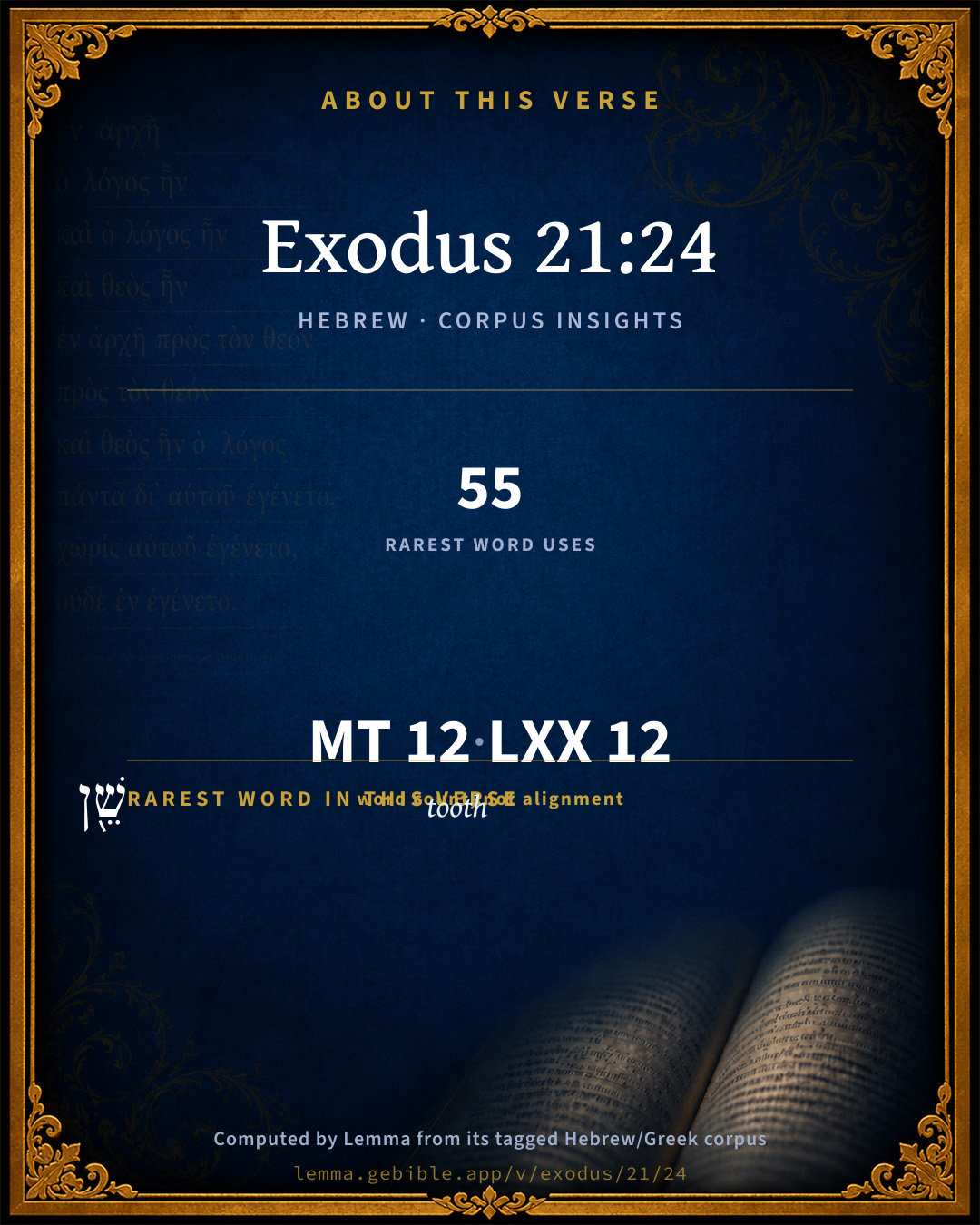
12
words
5
distinct lemmas
Pentateuch
section

Shared distinctive vocabulary

שֵׁ֖ן tooth H8127 occurs in 48 verses of the Hebrew Bible. Also found in:

Grammatical profile

  • 8 nouns
  • 4 prepositions

Repetition

Words recur within this verse — often emphatic in Hebrew:

  • תַּ֣חַת under H8478 ×4
  • עַ֚יִן eye H5869 ×2
  • שֵׁ֖ן tooth H8127 ×2
  • יָ֚ד hand H3027 ×2
  • רֶ֖גֶל foot H7272 ×2

Hebrew & Septuagint length

In English translation the verse runs 12 words from the Hebrew and 12 from the Septuagint (LXX English) — the same length.

A rough comparison of the two English renderings, which tokenize alike — not a word-level alignment.

Word counts can differ between the Hebrew and the Greek without any difference in meaning — e.g. the Hebrew direct-object marker אֵת has no separate Greek word, and Greek often adds the article ὁ.

In the original languages it is 12 Hebrew tokens and 12 Greek tokens — but the two are counted differently (Hebrew bundles its prefixes and suffixes into one token; the Greek is in lemma form), so that isn’t a like-for-like length.

Cross-references

9

Topical passages linked to Exodus 21:24 in the Treasury of Scripture Knowledge — connected by theme and wording, ordered by reader-vote popularity; previews shown in the World English Bible.

  • Deuteronomy 19:21 Your eyes shall not pity; life [shall go] for life, eye for eye, tooth for tooth, hand for hand, foot for foot.
  • Matthew 7:2 For with whatever judgment you judge, you will be judged; and with whatever measure you measure, it will be measured to you.
  • Matthew 5:38–40 "You have heard that it was said, 'An eye for an eye, and a tooth for a tooth.'
  • Leviticus 24:19–20 If anyone injures his neighbor; as he has done, so shall it be done to him:
  • Judges 1:6–7 But Adoni-bezek fled; and they pursued after him, and caught him, and cut off his thumbs and his great toes.
  • Luke 6:38 "Give, and it will be given to you: good measure, pressed down, shaken together, and running over, will be given to you. For with the same measure you measure it will be measured back to you."
  • Revelation 16:6 For they poured out the blood of the saints and the prophets, and you have given them blood to drink. They deserve this."
  • Exodus 21:26–27 "If a man strikes his servant's eye, or his maid's eye, and destroys it, he shall let him go free for his eye's sake.
  • 1 Samuel 15:33 Samuel said, As your sword has made women childless, so shall your mother be childless among women. Samuel hewed Agag in pieces before Yahweh in Gilgal.

Cross-references courtesy of OpenBible.info (CC BY 4.0).

Hebrew and Greek witnesses Masoretic Hebrew ↔ Greek Septuagint

The same verse in the two great witnesses to the Old Testament, shown verse-for-verse.

These are two independent witnesses, not word-aligned to each other, and the Septuagint is shown in lemma (dictionary) form.

Hebrew Exodus 21:24 Masoretic · Westminster Leningrad Codex

עַ֚יִן תַּ֣חַת עַ֔יִן שֵׁ֖ן תַּ֣חַת שֵׁ֑ן יָ֚ד תַּ֣חַת יָ֔ד רֶ֖גֶל תַּ֥חַת רָֽגֶל

eye for eye, tooth for tooth, hand for hand, foot for foot,

World English Bible · Public Domain

Greek LXX Exodus 21:24 Septuagint · lemma form

ὀφθαλμός ἀντί ὀφθαλμός ὀδούς ἀντί ὀδούς χείρ ἀντί χείρ πούς ἀντί πούς

eye for eye, tooth for tooth, hand for hand, foot for foot,

LXX2012 (modern English Septuagint) · Public Domain

Hebrew: Westminster Leningrad Codex (CC BY 4.0). Greek: Septuagint (public domain); English from LXX2012 (modern English Septuagint) (Public Domain). How the Septuagint differs from the Hebrew →

Targum (Aramaic paraphrase)

2

The Targum is the ancient Jewish Aramaic paraphrase of the Hebrew Scriptures — an interpretive translation, not the Hebrew text itself. Onkelos (literal) and Pseudo-Jonathan (expansive) render the Torah, and Jonathan the Prophets. Coverage is partial: where no permissively-licensed English translation exists for a verse, only the Aramaic is shown. This is verse-level text, not a word-by-word alignment to the Hebrew.

  1. Targum Onkelos Torah (Genesis–Deuteronomy)
    עֵינָא חֳלָף עֵינָא שִׁנָא חֳלָף שִׁנָא יְדָא חֳלָף יְדָא רַגְלָא חֳלָף רַגְלָא:

    (no public-domain English translation for this verse)

    Targum Onkelos — Aramaic: “Onkelos Genesis” (public domain); “Onkelos Exodus” (public domain); “Onkelos Leviticus” (public domain); “Onkelos Numbers” (public domain); “Onkelos Deuteronomy” (public domain). English: “Sefaria Community Translation” (CC0 1.0 (public-domain dedication)); “J.W. Etheridge. The Targums of Onkelos and Jonathan Ben Uzziel on the Pentateuch. London: Longmans, Green, 1862” (public domain). Text via Sefaria.

  2. Targum Pseudo-Jonathan Torah (Genesis–Deuteronomy)
    דְּמֵי עֵינָא חוֹלַף עֵינָא דְּמֵי שִׁינָא חוֹלַף שִׁינָא דְּמֵי יְדָא חוֹלַף יְדָא דְּמֵי רִיגְלָא חוֹלַף רִיגְלָא

    The value of an eye for an eye, the value of a tooth for a tooth, the value of a hand for a hand, the value of a foot for a foot,

    Targum Pseudo-Jonathan — Aramaic: “Targum Jonathan on Genesis” (public domain); “Targum Jonathan on Exodus” (public domain); “Targum Jonathan on Leviticus” (public domain); “Targum Jonathan on Numbers” (public domain); “Targum Jonathan on Deuteronomy” (public domain). English: “The Targum of Jonathan ben Uzziel, trans. J. W. Etheridge, London, 1862” (public domain). Text via Sefaria.

Commentary

Notes on Exodus 21:24 from classic Christian and Jewish commentators (each source and its license shown beneath its notes). The classic Christian expositions comment on the surrounding passage and are grouped to its opening verse, so a note may address several verses; the Jewish commentaries on the Tanakh (Rashi and others) are per-verse, so they appear only where the commentator wrote on this verse.

Lemma curates 59 commentaries, every one of them public domain or Creative Commons licensed, each selected and text-cleaned for this edition rather than reprinted as found. About our sources →

Trapp's Complete Commentary

John Trapp

Exo 21:24 Eye for eye, tooth for tooth, hand for hand, foot for foot,

Ver. 24. Eye for eye.] How the Pharisees had wrested that text. {See Trapp on "Mat 5:39"} This kind of law, in use among heathens also, Aristotle calls το αντιπεπονθος and was given against private revenge.

John Trapp, A Commentary or Exposition upon All the Books of the Old and New Testament (1647–1656) — public domain. Text from a community e-Sword module.

Joseph Benson's Commentary

Exo 21:24-25. Eye for eye, &c. — This is termed the law of retaliation; and from hence heathen lawgivers took it, and put it among their other laws. It seems probable, that it was not necessary always to take it strictly and literally, but that it might in some cases be satisfied with pecuniary mulcts, or with such satisfaction as the injuring party would give, and the injured accept. Indeed, the injustice of the literal execution of it, in many cases, is apparent; as, when a man that had but one eye or hand, would be thereby condemned to lose it, which to him would be a far greater calamity than he had brought upon his neighbour, by depriving him of one of his eyes or hands. It is especially to be observed, that the execution of these laws was not put into the hands of private persons, and that they were not allowances for private revenge, but rules to regulate the magistrate’s decision, who might go thus far, if he judged the heinousness of the offence required it, but no further; and, no doubt, might abate of this rigour when alleviating circumstances appeared to render it proper so to do.

Joseph Benson's Commentary on the Old and New Testaments (1811–1818) — public domain. Text from a community e-Sword module.

Geneva Bible (1599)

Geneva Bible translators

The execution of this law only belonged to the magistrate, Matt. 5:38.

Geneva Bible (1599) marginal notes — public domain. Text via Bolls.life.

Adam Clarke's Commentary

Verse 24. Eye for eye] This is the earliest account we have of the lex talionis, or law of like for like, which afterwards prevailed among the Greeks and Romans. Among the latter, it constituted a part of the twelve tables, so famous in antiquity; but the punishment was afterwards changed to a pecuniary fine, to be levied at the discretion of the praetor. It prevails less or more in most civilized countries, and is fully acted upon in the canon law, in reference to all calumniators: Calumniator, si in accusatione defecerit, talionem recipiat. "If the calumniator fall in the proof of his accusation, let him suffer the same punishment which he wished to have inflicted upon the man whom he falsely accused." Nothing, however, of this kind was left to private revenge; the magistrate awarded the punishment when the fact was proved, otherwise the lex talionis would have utterly destroyed the peace of society, and have sown the seeds of hatred, revenge, and all uncharitableness.

Adam Clarke's Commentary on the Bible (1810–1826) — public domain. Text from a community e-Sword/MySword module.

John Gill's Exposition

Eye for eye, tooth for tooth, hand for hand, foot for foot. This is "lex talionis", the law of retaliation, and from whence the Heathens had theirs; but whether this is to be taken strictly and literally, or only for pecuniary mulcts, is a question; Josephus (d) understands it in the former sense, the Jewish writers generally in the latter; and so the Targum of Jonathan paraphrases it;"the price of an eye for an eye, &c.''Jarchi on the place observes, that,"he that puts out his neighbour's eye must pay him the price of his eye, according to the price of a servant sold in the market, and so of all the rest; for not taking away of members strictly is meant, as our doctors here interpret it;''in a place he refers to, and to which Aben Ezra agrees; and of the difference and dispute between the Jews concerning this matter; see Gill on Mat 5:38 and indeed, though these laws of retaliation should, according to the letter of them, be attended to as far as they can; yet, in some cases, it seems necessary that they should not be strictly attended to, but some recompence made in another way, and nothing seems more agreeable than a pecuniary one: thus, for instance, this law cannot be literally executed, when one that has never an eye puts out the eye of another, as it is possible that a blind man may; or one that has no teeth may strike out the tooth of another; in such cases eye cannot be given for eye, nor tooth for tooth; and, as Saadiah Gaon (e) observes, if a man should smite the eye of his neighbour, and the third part of the sight of his eye should depart, how will he order it to strike such a stroke as that, without adding or lessening? and if a man that has but one eye, or one hand, or one foot, should damage another man in those parts, and must lose his other eye, or hand, or foot, he would be in a worse case and condition than the man he injured; since he would still have one eye, or hand, or foot; wherefore a like law of Charondas among the Thurians is complained of, since it might be the case, that a man with one eye might have that struck out, and so be utterly deprived of sight; whereas the man that struck it out, though he loses one for it, yet has another, and so not deprived of sight utterly, and therefore thought not to be sufficiently punished; and that it was most correct that he should have both his eyes put out for it: and hence Diodorus Siculus (f) reports of a one-eyed man who lost his eye, that he complained of this law to the people, and advised to have it altered: this "lex talionis" was among the Roman laws of the "twelve tables" (g).

(d) Antiqu. l. 4. c. 33. 35. (e) Apud Aben Ezram in loc. (f) Bibliothec. l. 12. par. 2. p. 82, 83. (g) A. Gell. Noct. Attic. l. 20. c. 1.

John Gill's Exposition of the Whole Bible (1746–1763) — public domain (CC PDM 1.0). Text via the HelloAO Bible API.

Haydock's Catholic Bible Commentary

Eye. "This law tended to restrain, not to encourage, fury and revenge." (St. Augustine, contra Faust. xix. 25.) Some explain it, as if a sum of money could only be required, equivalent to the ransom of an eye, in case a person should be under a necessity of losing or of redeeming it. (Muis; Jonathan) --- Retaliation was not left to the injured party’s discretion. The judge was to decide. Christ enjoins what is more perfect, ordering us to turn the left cheek, when we have received a blow on the right. The canon law inflicts the punishment of retaliation upon the calumniator. (Calmet)

George Leo Haydock (1774–1849), Haydock's Catholic Family Bible and Commentary, 1859 edition — public domain. Excludes Psalms (Douay-Rheims chapter numbering differs from Protestant) and Deuterocanonical books (Catholic canon only).

Matthew Poole's English Annotations

This is called the law of retaliation, and from hence the heathen lawgivers took it and put it into their laws. But though this might sometimes be practised in the letter, yet it was not necessarily to be understood and executed so; as may appear,

1. By the impossibility of the just execution of it in many cases, as when a man that had but one eye or hand was to lose the other, which to him was a far greater mischief than what he did to his neighbour, whom he deprived but of one of his eyes or hands. And this is a sure and righteous rule, Punishments may be less, but never should be greater than the fault. And how could a wound be made neither bigger nor less than that which he inflicted?

2. By comparing this with other laws, wherein a compensation is allowed in like cases, as Exo 21:18,30. And when it is enjoined that no satisfaction shall be taken for the life of a wilful murderer, Num 35:31, it seems therein implied that satisfaction may be taken for lesser injuries. And indeed the payment of such a price as the loss of an eye, or hand, or foot required, though it might not so much satisfy the revenge of the party so injured, yet it was really more to his benefit. This law therefore was only minatory, but so as it was literally to be inflicted, except the injuring party would give such satisfaction as the injured person accepted, or the judges determined.

Matthew Poole's English Annotations on the Holy Bible (1683–1685) — public domain. Text from a community e-Sword/MySword module.

John Wesley's Explanatory Notes

Eye for eye - The execution of this law is not put into the hands of private persons, as if every man might avenge himself, which would introduce universal confusion. The tradition of the elders seems to have put this corrupt gloss upon it. But magistrates had an eye to this rule in punishing offenders, and doing right to those that are injured.

John Wesley, Explanatory Notes Upon the Whole Bible (1754–1765) — public domain. Text via the GEBible commentary corpus.

Scofield Reference Notes

C. I. Scofield

Eye for eye

Lev 24:20; Deu 19:21; Mat 5:38-44; 1Pe 2:19-21. The provision in Exodus is law, and righteous; the N.T. passages, grace, and merciful.

The Scofield Reference Bible (1917 edition), notes by C. I. Scofield — public domain. Text from a community e-Sword module.

Rashi

Rabbi Shlomo Yitzchaki (Rashi)

עין תחת עין EYE FOR EYE — If one blinded the eye of his fellow-man he has to pay him the value of his eye, i. e. he pays him how much his value would be diminished if he were to be sold as a slave in the market. In the same way all other cases are to be dealt with, but it does not mean the actual cutting off of the offender’s limb — just as our Rabbis have explained in the chapter beginning with the word החובל (Bava Kamma 84a).

Rashi on the Tanakh — English translations: “The Judaica Press complete Tanach with Rashi, translated by A. J. Rosenberg” (CC BY 4.0); “Pentateuch with Rashi's commentary by M. Rosenbaum and A.M. Silbermann, 1929-1934” (public domain); “The Metsudah Tanach series, Lakewood, N.J” (CC BY 4.0); and “The Book of Joshua, Metsudah Publications, 1997” (CC BY 4.0). Text via Sefaria.

Ramban (Nachmanides)

Rabbi Moshe ben Nachman (Ramban / Nachmanides)

EYE ‘TACHATH’ (FOR) EYE. It is known in the tradition of our Rabbis that this means monetary compensation. Such usage [of the term tachath to indicate] monetary compensation is found in the verse: And he that smiteth a beast mortally shall pay for it; life ‘tachath’ life, [in which case tachath surely indicates monetary compensation]. Rabbi Abraham ibn Ezra commented that Scripture uses such a term to indicate that he really is deserving of such a punishment, [that his eye be taken from him], if he does not give his ransom. For Scripture has forbidden us to take ransom for the life of a murderer, that is guilty of death, but we may take ransom from a wicked person who cut off any of the limbs of another person. Therefore we are never to cut off that limb from him, but rather he is to pay monetary compensation, and if he has no money to pay, it lies as a debt on him until he acquires the means to pay, and then he is redeemed.Proof for what the Sages have said [that eye ‘tachath’ eye means he pays him the value of his eye], is in what He has said above [with reference to one who injures another person], only he shall pay for the loss of his time, and shall cause him to be thoroughly healed. But if we were to do to the assailant exactly as he has done to the injured man, why does he have to pay after that? He himself is in need of amends for the loss of his own time and costs of his own healing! And it would not be valid to argue that the assailant is to give the injured man [the difference in cost between a slow recovery and] a fast recovery, really means that the eye of the assailant be removed, and Verse 19 that deals with his obligation to pay for the loss of time and cost of healing of the injured, applies to that difference as explained above. — This argument is actually mentioned in the Talmud (Baba Kamma 84a.). But, argues Ramban, it is not the plain meaning of Scripture, for the simple meaning of Verse 19 is that it speaks of the assailant having to pay for the whole loss of time and costs of healing. Therefore it constitutes a proof that eye ‘tachath’ eye means monetary compensation, as explained above. since this is not the plain meaning of Scripture. Rather, Scripture speaks of all people, and even if his recovery [i.e., the assailant’s] were to be fast, we would have long taken our punishment of him, in doing to him exactly as he did! cannot be meant literally, but means the monetary value of the eye.If we explain the verses according to the literal interpretation of Scripture, there is no escape from this question, and in the other it speaks of the assailant’s duty to pay for the loss of his time and costs of healing, and the question appears why he should pay this additional payment when we have already punished him. There is no escape from this question except by saying that etc. [see text]. Ramban will finally allude to why he mentions all this: it is to show what sophistry we have to display if we seek to follow only the plain meaning of Scripture! We thus have no recourse but to Tradition. unless they ). See Vol. I, p. 154. will say that if someone maims his neighbor so that he deprives him permanently of some bodily member, such as an eye, hand, or foot, or causes a burn which leaves a permanent mark, then we are to do likewise to the assailant’s body, this being the case of the verse which says, As he hath caused a blemish in a man, so shall it be done to him, and in that case there is no monetary compensation paid for loss of time and cost of healing. But if he hits him with a stone or with his fist on his clothes, and he is laid up in bed but then is completely healed without any crippling effect remaining upon his body, in that case He said, only he shall pay for the loss of his time, and shall cause him to be thoroughly healed. All the injuries specified in the verse, burning for burning, wound for wound, stripe for stripe, are included, according to the plain meaning of Scripture, in this preceding general principle, for a wound and stripe may be completely healed. And as for that which Scripture states there, And if a man cause a blemish in his neighbor, as he hath done so shall it be done to him, it too was meant to include all injuries, but He did not mention there at length the cases of wounding, striping, and burning [as He did here]. He used the term mum (blemish), for every wound causes at least a temporary blemish. Thus even if it is of the kind which heals, it is still called “a blemish,” just as we say: “a passing blemish,” and the Torah calls scabbed, or scurvy, or hath his stones crushed “a blemish” although they are temporary and can be healed, and it is further written, youths in whom there was no blemish. The general principle everywhere is that the Tradition is always true.

Ramban (Nachmanides) on the Tanakh — English translation: “Commentary on the Torah by Ramban (Nachmanides). Translated and annotated by Charles B. Chavel. New York, Shilo Pub. House, 1971-1976” (CC BY 4.0). Text via Sefaria.

Lesson kit

Teaching starters — assembled from the data on this page, not authored interpretation. Every prompt links to the verse data it draws on. Edit before teaching.

Exodus, in the Pentateuch, opens this verse with 12 words (5 distinct Hebrew lemmas). Its most distinctive word is shên (“tooth”). A historical commentator’s framing appears above. Read the whole chapter for the surrounding context.

Discussion questions

  1. What does “tooth” (shên) contribute to the verse as a whole?
  2. How does Genesis 49:12, which shares the word «tooth», read alongside this verse?
  3. What does the repetition of “under” (4× in this one verse) do in this verse?
  4. Compare how Trapp's Complete Commentary and Joseph Benson's Commentary read this verse. Where do they agree or differ?

Things to notice

Reading settings

Reading text

Shown beneath each verse's original-language words.

Old Testament
Old Testament edition

Read the OT as the Masoretic Hebrew (MT) or the Greek Septuagint (LXX).

English shown for the Greek Septuagint (in the Hebrew ↔ Greek comparison).

Comparing translations? Open the Compare panel on any verse page to stack up to four side by side.