Exodus 4:30

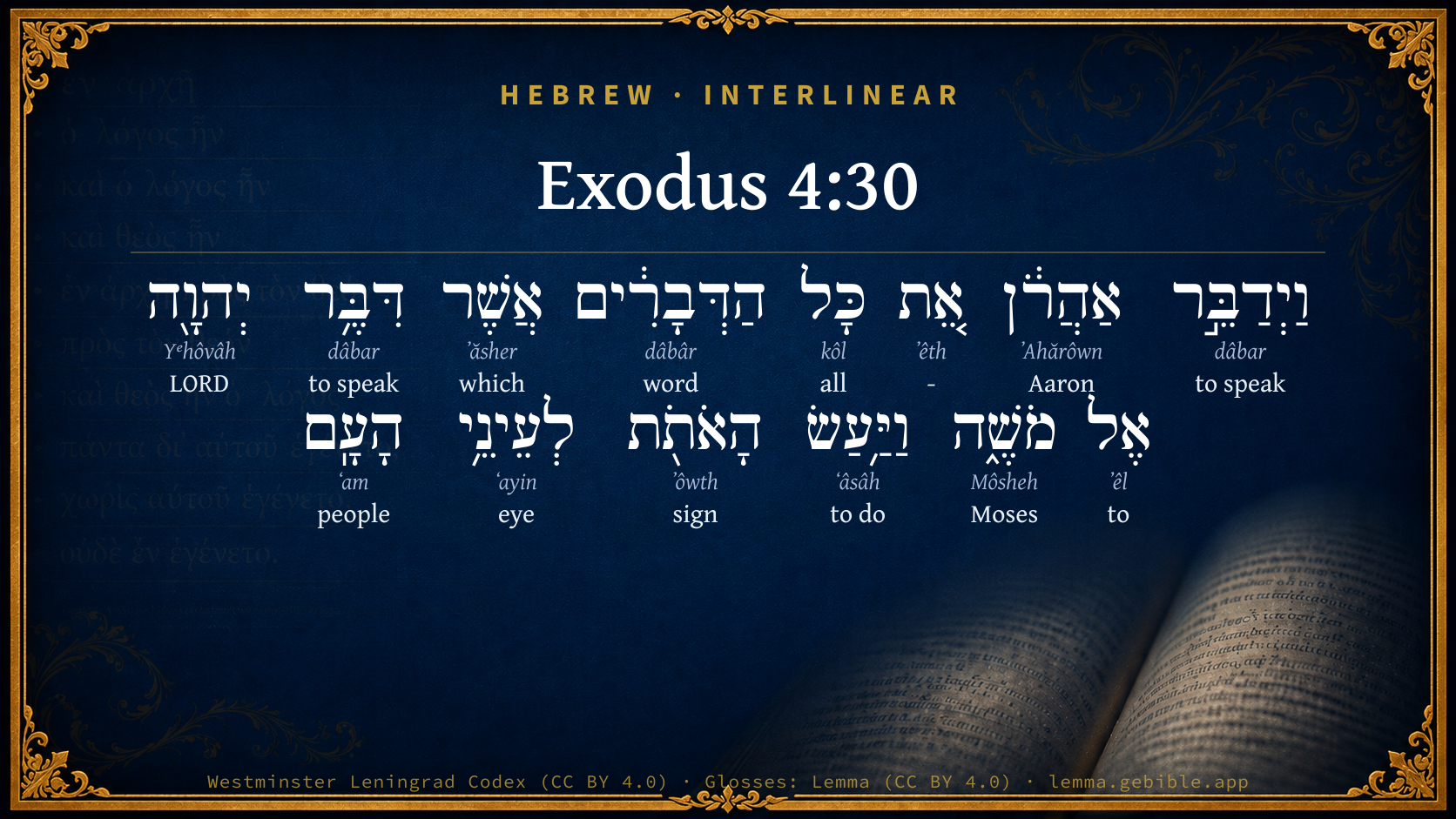
Hebrew (Westminster Leningrad Codex) Exodus 4:30 appears in the Hebrew Old Testament. The text above is from the Westminster Leningrad Codex. Each word links to its Strong’s number, a concise gloss, and parsing drawn from the Open Scriptures Hebrew Bible morphology. Click any word for its full Brown-Driver-Briggs (BDB) entry.
Download image
Cite this verse

Exodus 4:30 (World English Bible). Public Domain. Lemma interlinear Bible study tool, https://lemma.gebible.app/v/exodus/4/30.

Show BibTeX & RIS
BibTeX
RIS
English Translation
Aaron spoke all the words which Yahweh had spoken to Moses, and did the signs in the sight of the people.
World English Bible · Public Domain
Download a study sheet

One document with this verse’s original text, its word-by-word gloss line, the meaning frame, cross-references with their text, attributed commentary, and full source and license credits — printable, and it pastes into notes with its structure intact.

This verse Autodidact and up

Study sheet (.html) Plain text (.txt)

A passage Seminary Student

Up to 50 verses in one chapter. A passage sheet keeps up to 6 commentary sources and 12 cross-references per verse, in the order this page ranks them, and says so on the sheet whenever that leaves anything out. Ask for a single verse and you get the Autodidact verse sheet above.

Everything on this page stays free to read, with no account — the sheet is a download of what is already on screen, not access to it.

Want to remove ads? Support Godless Engineer
Compare translations 3

The same verse in 3 English versions, stacked beneath the original-language interlinear above. Click any original word for its lexicon entry.

Each is an independent rendering of the whole verse — the interlinear is not word-aligned to these translations.

Highlighted words mark where these versions differ — a whole-verse word diff, not a word-by-word alignment.

  • World English Bible Public Domain
    Aaron spoke all the words which Yahweh had spoken to Moses, and did the signs in the sight of the people.
  • King James Version Public Domain
    And Aaron spake all the words which the LORD had spoken unto Moses, and did the signs in the sight of the people.
  • unfoldingWord Literal Text CC BY-SA 4.0
    And Aaron spoke all of the words that Yahweh had spoken to Moses. And he did the signs before the eyes of the people,

unfoldingWord Literal Text — © unfoldingWord, licensed CC BY-SA 4.0. Word-aligned USFM3 via Door43 (git.door43.org/unfoldingWord/en_ult).

Versions to compare (up to 4)

3 of 4 selected

Show all 18 translations

Every available English version of this verse, each an independent rendering of the whole verse.

  • World English Bible Public Domain
    Aaron spoke all the words which Yahweh had spoken to Moses, and did the signs in the sight of the people.
  • Berean Standard Bible Public Domain
    and Aaron relayed everything the LORD had said to Moses. And Moses performed the signs before the people,
  • Majority Standard Bible Public Domain
    and Aaron relayed everything the LORD had said to Moses. And Moses performed the signs before the people,
  • King James Version Public Domain
    And Aaron spake all the words which the LORD had spoken unto Moses, and did the signs in the sight of the people.
  • American Standard Version (1901) Public Domain
    and Aaron spake all the words which Jehovah had spoken unto Moses, and did the signs in the sight of the people.
  • Revised Version (1885) Public Domain
    and Aaron spake all the words which the LORD had spoken unto Moses, and did the signs in the sight of the people.
  • Geneva Bible (1599) Public Domain
    And Aaron told all the wordes, which the Lord had spoken vnto Moses, and he did the miracles in the sight of the people,
  • Douay-Rheims (1899) Public Domain
    And Aaron spoke all the words which the Lord had said to Moses: and he wrought the signs before the people,
  • Young's Literal Translation Public Domain
    and Aaron speaketh all the words which Jehovah hath spoken unto Moses, and doth the signs before the eyes of the people;
  • Literal Standard Version CC BY-SA 4.0
    and Aaron speaks all the words which YHWH has spoken to Moses, and does the signs before the eyes of the people;
  • Unlocked Literal Bible CC BY-SA 4.0
    Aaron spoke all the words that Yahweh had spoken to Moses. He also displayed the signs of Yahweh's power in the sight of the people.
  • unfoldingWord Literal Text CC BY-SA 4.0
    And Aaron spoke all of the words that Yahweh had spoken to Moses. And he did the signs before the eyes of the people,
  • Darby Bible Public Domain
    and Aaron spoke all the words that Jehovah had spoken to Moses, and did the signs before the eyes of the people.
  • World Messianic Bible Public Domain
    Aaron spoke all the words which the LORD had spoken to Moses, and did the signs in the sight of the people.
  • Webster's Bible Public Domain
    And Aaron spoke all the words which the LORD had spoken to Moses, and performed the signs in the sight of the people.
  • Free Bible Version CC BY-SA 4.0
    Aaron shared with them everything the Lord had told Moses, and Moses carried out the miracles so they could see them.
  • Bible in Basic English Public Domain
    And Aaron said to them all the words the Lord had said to Moses, and did the signs before all the people.
  • JPS Tanakh (1917) Public Domain
    And Aaron spoke all the words which the LORD had spoken unto Moses, and did the signs in the sight of the people.

Literal Standard Version (2020), Covenant Press — licensed CC BY-SA 4.0. Text via the HelloAO Bible API (eBible.org). Unlocked Literal Bible (unfoldingWord) — licensed CC BY-SA 4.0. Text via the HelloAO Bible API (eBible.org). unfoldingWord Literal Text — © unfoldingWord, licensed CC BY-SA 4.0. Word-aligned USFM3 via Door43 (git.door43.org/unfoldingWord/en_ult). Free Bible Version, Dr. Jonathan Gallagher — licensed CC BY-SA 4.0. Text via the HelloAO Bible API (eBible.org).

Word by word

More ways to search: Search by grammar → Find every occurrence → Compare this word →

Practice this passage: Drill this verse → Learn its vocabulary →

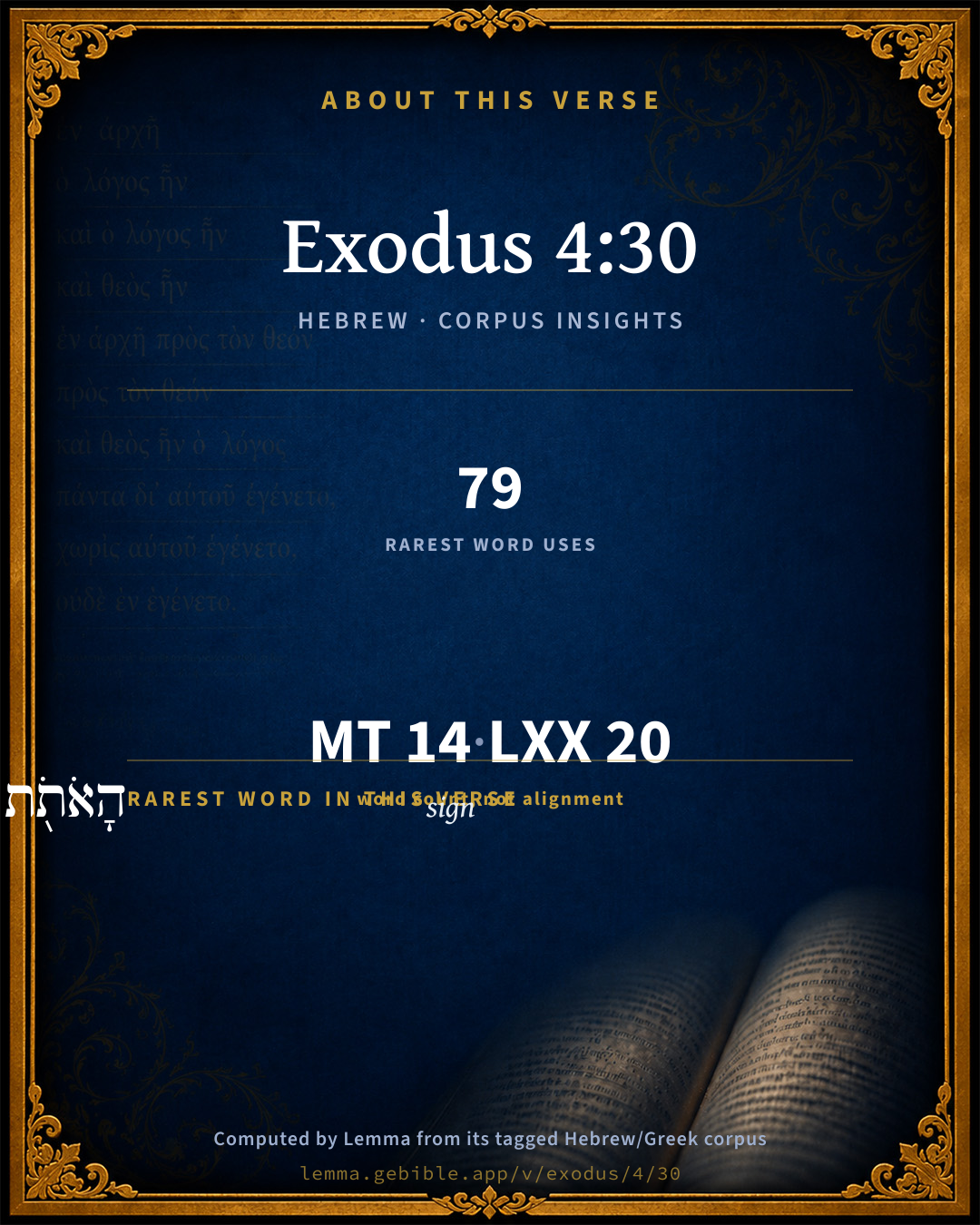
הָאֹתֹ֖ת
ʼôwth
H226
“the · signs”
Particle, Definite Article + Noun, Common, Both, Plural, Absolute
Part of Speech
Particle + Noun
Type
Common
Gender
Both
Number
Plural
State
Absolute
Full BDB Definition

Origin: probably from H225 (in the sense of appearing)

TWOT: 41a

sign, signal - a distinguishing mark - banner - remembrance - miraculous sign - omen - warning - token, ensign, standard, miracle, proof
  1. וַיְדַבֵּ֣ר dâbar H1696 “and · to speak” Conjunction + Verb, Piel, Sequential Imperfect, 3rd Person, Masculine, Singular
  2. אַהֲרֹ֔ן ʼAhărôwn H175 “Aaron” Noun, Proper
  3. אֵ֚ת ʼêth H853 “-” Particle, Direct Object
  4. כָּל kôl H3605 “all of” Noun, Common, Masculine, Singular, Construct
  5. הַדְּבָרִ֔ים dâbâr H1697 “the · words” Particle, Definite Article + Noun, Common, Masculine, Plural, Absolute
  6. אֲשֶׁר ʼăsher H834 “which” Particle, Relative
  7. דִּבֶּ֥ר dâbar H1696 “to speak” Verb, Piel, Perfect, 3rd Person, Masculine, Singular
  8. יְהוָ֖ה Yᵉhôvâh H3068 “LORD” Noun, Proper
  9. אֶל ʼêl H413 “to” Preposition
  10. מֹשֶׁ֑ה Môsheh H4872 “Moses” Noun, Proper
  11. וַיַּ֥עַשׂ ʻâsâh H6213 “and · to do” Conjunction + Verb, Qal, Sequential Imperfect, 3rd Person, Masculine, Singular
  12. לְעֵינֵ֥י ʻayin H5869 “to/for · eyes of” Preposition + Noun, Common, Both, Dual, Construct
  13. הָעָֽם ʻam H5971 “the · people” Particle, Definite Article + Noun, Common, Masculine, Singular, Absolute

About this verse

These counts appear in no published source. They are computed here, from the morphology-tagged text and Lemma’s own curated glosses. What Lemma adds →

14
words
13
distinct lemmas
Pentateuch
section

Grammatical profile

  • 3 verbs
  • 8 nouns
  • 1 preposition
  • 2 particles

Verb forms

  • וַיְדַבֵּ֣ר Piel · Sequential Imperfect
  • דִּבֶּ֥ר Piel · Perfect
  • וַיַּ֥עַשׂ Qal · Sequential Imperfect

Repetition

A word recurs within this verse — often emphatic in Hebrew:

  • וַיְדַבֵּ֣ר to speak H1696 ×2

Hebrew & Septuagint length

In English translation the verse runs 21 words from the Hebrew and 18 from the Septuagint (LXX English) — closely comparable.

A rough comparison of the two English renderings, which tokenize alike — not a word-level alignment.

Word counts can differ between the Hebrew and the Greek without any difference in meaning — e.g. the Hebrew direct-object marker אֵת has no separate Greek word, and Greek often adds the article ὁ.

In the original languages it is 14 Hebrew tokens and 20 Greek tokens — but the two are counted differently (Hebrew bundles its prefixes and suffixes into one token; the Greek is in lemma form), so that isn’t a like-for-like length.

Cross-references

1

Topical passages linked to Exodus 4:30 in the Treasury of Scripture Knowledge — connected by theme and wording, ordered by reader-vote popularity; previews shown in the World English Bible.

  • Exodus 4:16 He will be your spokesman to the people; and it will happen, that he will be to you a mouth, and you will be to him as God.

Cross-references courtesy of OpenBible.info (CC BY 4.0).

Hebrew and Greek witnesses Masoretic Hebrew ↔ Greek Septuagint

The same verse in the two great witnesses to the Old Testament, shown verse-for-verse.

These are two independent witnesses, not word-aligned to each other, and the Septuagint is shown in lemma (dictionary) form.

Hebrew Exodus 4:30 Masoretic · Westminster Leningrad Codex

וַיְדַבֵּ֣ר אַהֲרֹ֔ן אֵ֚ת כָּל הַדְּבָרִ֔ים אֲשֶׁר דִּבֶּ֥ר יְהוָ֖ה אֶל מֹשֶׁ֑ה וַיַּ֥עַשׂ הָאֹתֹ֖ת לְעֵינֵ֥י הָעָֽם

Aaron spoke all the words which Yahweh had spoken to Moses, and did the signs in the sight of the people.

World English Bible · Public Domain

Greek LXX Exodus 4:30 Septuagint · lemma form

καί λαλέω ααρων πᾶς ὁ ῥῆμα οὗτος ὅς λαλέω ὁ θεός πρός μωυσῆς καί ποιέω ὁ σημεῖον ἐναντίον ὁ λαός

And Aaron spoke all these words, which God spoke to Moses, and wrought the miracles before the people.

LXX2012 (modern English Septuagint) · Public Domain

Hebrew: Westminster Leningrad Codex (CC BY 4.0). Greek: Septuagint (public domain); English from LXX2012 (modern English Septuagint) (Public Domain). How the Septuagint differs from the Hebrew →

Targum (Aramaic paraphrase)

2

The Targum is the ancient Jewish Aramaic paraphrase of the Hebrew Scriptures — an interpretive translation, not the Hebrew text itself. Onkelos (literal) and Pseudo-Jonathan (expansive) render the Torah, and Jonathan the Prophets. Coverage is partial: where no permissively-licensed English translation exists for a verse, only the Aramaic is shown. This is verse-level text, not a word-by-word alignment to the Hebrew.

  1. Targum Onkelos Torah (Genesis–Deuteronomy)
    וּמַלִיל אַהֲרֹן יָת כָּל פִּתְגָמַיָא דִי מַלִיל יְיָ עִם משֶׁה וַעֲבַד אָתַיָא לְעֵינֵי עַמָא:

    (no public-domain English translation for this verse)

    Targum Onkelos — Aramaic: “Onkelos Genesis” (public domain); “Onkelos Exodus” (public domain); “Onkelos Leviticus” (public domain); “Onkelos Numbers” (public domain); “Onkelos Deuteronomy” (public domain). English: “Sefaria Community Translation” (CC0 1.0 (public-domain dedication)); “J.W. Etheridge. The Targums of Onkelos and Jonathan Ben Uzziel on the Pentateuch. London: Longmans, Green, 1862” (public domain). Text via Sefaria.

  2. Targum Pseudo-Jonathan Torah (Genesis–Deuteronomy)
    וּמַלֵיל אַהֲרן יַת פִּתְגָמַיָא דְמַלֵיל יְיָ עִם משֶׁה וְעָבַד אָתַיָא לְעֵינֵי עַמָא

    And Aharon spake all the words which the Lord had spoken with Mosheh, and did the signs in the eyes of the people.

    Targum Pseudo-Jonathan — Aramaic: “Targum Jonathan on Genesis” (public domain); “Targum Jonathan on Exodus” (public domain); “Targum Jonathan on Leviticus” (public domain); “Targum Jonathan on Numbers” (public domain); “Targum Jonathan on Deuteronomy” (public domain). English: “The Targum of Jonathan ben Uzziel, trans. J. W. Etheridge, London, 1862” (public domain). Text via Sefaria.

Commentary

Notes on Exodus 4:30 from classic Christian and Jewish commentators (each source and its license shown beneath its notes). The classic Christian expositions comment on the surrounding passage and are grouped to its opening verse, so a note may address several verses; the Jewish commentaries on the Tanakh (Rashi and others) are per-verse, so they appear only where the commentator wrote on this verse.

Lemma curates 59 commentaries, every one of them public domain or Creative Commons licensed, each selected and text-cleaned for this edition rather than reprinted as found. About our sources →

Trapp's Complete Commentary

John Trapp

Exo 4:30 And Aaron spake all the words which the LORD had spoken unto Moses, and did the signs in the sight of the people.

Ver. 30. And did the signs.] Moses did; or Aaron, by his command and appointment.

John Trapp, A Commentary or Exposition upon All the Books of the Old and New Testament (1647–1656) — public domain. Text from a community e-Sword module.

Joseph Benson's Commentary

Exo 4:30. Aaron did the signs — By the direction of Moses. Hereby full proof was given to the people of the divine mission of Moses, and their concurrence was gained before he applied to Pharaoh in their behalf.

Joseph Benson's Commentary on the Old and New Testaments (1811–1818) — public domain. Text from a community e-Sword module.

Adam Clarke's Commentary

Verse 30. Aaron spake all the words] It is likely that Aaron was better acquainted with the Hebrew tongue than his brother, and on this account he became the spokesman. See Clarke on Ex 4:14.

Did the signs] Turned the rod into a serpent, made the hand leprous, and changed the water into blood. See Clarke on Ex 4:6; and "Ex 4:8".

Adam Clarke's Commentary on the Bible (1810–1826) — public domain. Text from a community e-Sword/MySword module.

Ellicott's Commentary for English Readers

(30) Aaron spake.—According to the Divine command (Exo_4:16).

And did the signs.—So, generally, afterwards (Exo_7:10; Exo_7:19; Exo_8:6; Exo_8:17, &c.), not, however, universally (see Exo_9:10; Exo_9:23; Exo_10:13; Exo_14:21; &c).

The people believed.—The narrative is very much compressed. The elders heard the words, and saw the signs first. Then they must have summoned an assembly of the people, after working hours, and the people must have been addressed and shown the signs. The effect was to convince them also, and to induce them to accept Moses and Aaron for the national leaders.

Worshipped.—Some think that Moses was the object of the worship; but it is better to regard it as offered to “the Lord,” who had “visited” them.

A Bible Commentary for English Readers, edited by Charles John Ellicott (1878–1897) — public domain. Text from a community e-Sword module.

The Cambridge Bible for Schools and Colleges

gen. ed. J. J. S. Perowne

30a. Here Aaron appears as Moses’ spokesman, in accordance with vv. 15, 16 (J).

30b. and did] i.e. Aaron. But the Heb. is and he did, allowing reference to Moses, which is undoubtedly right (Di.). The ‘signs’ and those given to Moses in vv. 1–9.

The Cambridge Bible for Schools and Colleges (gen. ed. J. J. S. Perowne; Cambridge University Press, 1878–1918) — public domain. Text from a community e-Sword module.

John Gill's Exposition

And the people believed,.... That Moses was sent of God, and would be the deliverer of them:

and when they heard that the Lord had visited the children of Israel; in a way of grace and mercy, by raising such a redeemer and deliverer in the midst of them:

and that he had looked upon their affliction; with an eye of pity and compassion:

then they bowed their heads, and worshipped; adoring the goodness of God, and expressing their thankfulness for the notice he took of them, and signifying their readiness to obey all instructions and directions that should be given them.

Next: Exodus Chapter 5

John Gill's Exposition of the Whole Bible (1746–1763) — public domain (CC PDM 1.0). Text via the HelloAO Bible API.

Haydock's Catholic Bible Commentary

The three signs, prescribed above, in proof of their mission. (Calmet)

George Leo Haydock (1774–1849), Haydock's Catholic Family Bible and Commentary, 1859 edition — public domain. Excludes Psalms (Douay-Rheims chapter numbering differs from Protestant) and Deuterocanonical books (Catholic canon only).

Matthew Poole's English Annotations

Thus beginning to execute the office which God had put upon him, which was to be Moses’s mouth, or spokesman. i.e. Aaron did the signs as Moses’s minister, or by the command and direction of Moses.

Matthew Poole's English Annotations on the Holy Bible (1683–1685) — public domain. Text from a community e-Sword/MySword module.

The Pulpit Commentary

Aaron spake. Aaron at once entered on his office of "spokesman" (ver. 16), declaring to the elders all God"s dealings with his brother. Aaron also, and not Moses, us we should have expected (ver. 17), did the signs, God, by allowing him to do them, sanctioning this delegation of power. On later occasions, we find Aaron more than once required by God to work the miracles. (See below, Exo_7:19 Exo_8:5, Exo_8:16) In the sight of the people. It is not probable that the people were present at the first meeting of the elders; but the sacred historian, anxious to compress his narrative, and bent simply on conveying to us the fact of Aaron"s success with both elders and people, omits stages in the history which he supposes that any reader can supply, e.g. the doing of the signs in the sight of the elders, their belief in them, and their subsequent assembling of the people.

The Pulpit Commentary (1880–1919), ed. H.D.M. Spence-Jones & Joseph S. Exell — public domain. Text from a community e-Sword module.

John Wesley's Explanatory Notes

Aaron did the signs - By the direction of Moses.

John Wesley, Explanatory Notes Upon the Whole Bible (1754–1765) — public domain. Text via the GEBible commentary corpus.

Lesson kit

Teaching starters — assembled from the data on this page, not authored interpretation. Every prompt links to the verse data it draws on. Edit before teaching.

Exodus, in the Pentateuch, opens this verse with 14 words (13 distinct Hebrew lemmas). Its most distinctive word is ʼôwth (“sign”). A historical commentator’s framing appears above. Read the whole chapter for the surrounding context.

Discussion questions

  1. How does “sign” (ʼôwth) shape what this verse is saying?
  2. How does Exodus 4:16, which shares this passage’s theme, read alongside this verse?
  3. What does the repetition of “to speak” (2× in this one verse) do in this verse?
  4. The translations on this page render this verse differently — a whole-verse word diff, not a word-by-word alignment. What might account for the different wordings?
  5. «וַיְדַבֵּ֣ר» is a Piel Sequential Imperfect verb. How does that grammatical form shape the action described?
  6. Compare how Trapp's Complete Commentary and Joseph Benson's Commentary read this verse. Where do they agree or differ?

Things to notice

Reading settings

Reading text

Shown beneath each verse's original-language words.

Old Testament
Old Testament edition

Read the OT as the Masoretic Hebrew (MT) or the Greek Septuagint (LXX).

English shown for the Greek Septuagint (in the Hebrew ↔ Greek comparison).

Comparing translations? Open the Compare panel on any verse page to stack up to four side by side.