
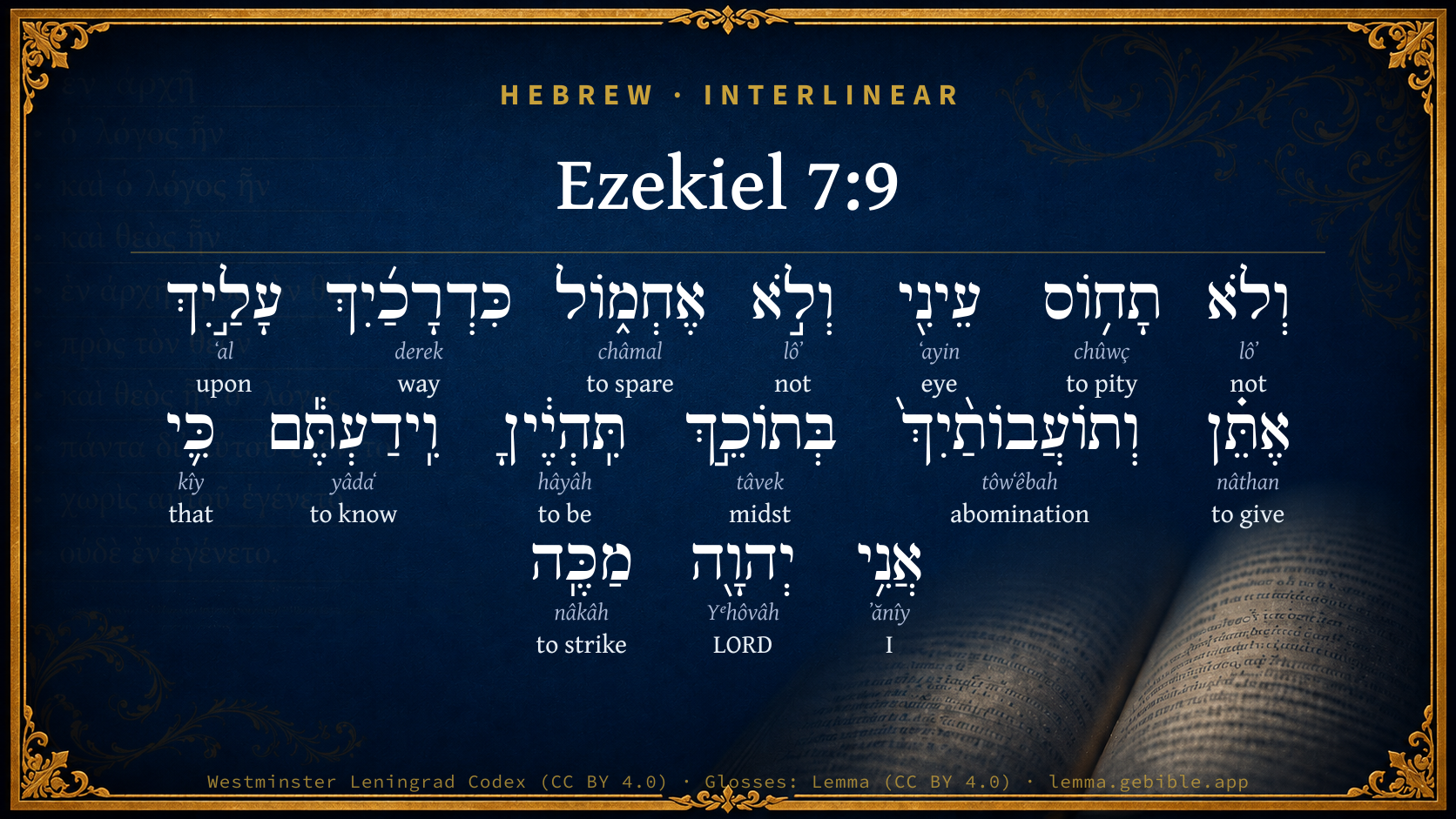
Ezekiel 7:9

Hebrew (Westminster Leningrad Codex) Ezekiel 7:9 appears in the Hebrew Old Testament. The text above is from the Westminster Leningrad Codex. Each word links to its Strong’s number, a concise gloss, and parsing drawn from the Open Scriptures Hebrew Bible morphology. Click any word for its full Brown-Driver-Briggs (BDB) entry.
Download image
Cite this verse

Ezekiel 7:9 (World English Bible). Public Domain. Lemma interlinear Bible study tool, https://lemma.gebible.app/v/ezekiel/7/9.

Show BibTeX & RIS
BibTeX
RIS
English Translation
My eye shall not spare, neither will I have pity: I will bring on you according to your ways; and your abominations shall be in the midst of you; and you shall know that I, Yahweh, do strike.
World English Bible · Public Domain
Download a study sheet

One document with this verse’s original text, its word-by-word gloss line, the meaning frame, cross-references with their text, attributed commentary, and full source and license credits — printable, and it pastes into notes with its structure intact.

This verse Autodidact and up

Study sheet (.html) Plain text (.txt)

A passage Seminary Student

Up to 50 verses in one chapter. A passage sheet keeps up to 6 commentary sources and 12 cross-references per verse, in the order this page ranks them, and says so on the sheet whenever that leaves anything out. Ask for a single verse and you get the Autodidact verse sheet above.

Everything on this page stays free to read, with no account — the sheet is a download of what is already on screen, not access to it.

Want to remove ads? Support Godless Engineer
Compare translations 3

The same verse in 3 English versions, stacked beneath the original-language interlinear above. Click any original word for its lexicon entry.

Each is an independent rendering of the whole verse — the interlinear is not word-aligned to these translations.

Highlighted words mark where these versions differ — a whole-verse word diff, not a word-by-word alignment.

  • World English Bible Public Domain
    My eye shall not spare, neither will I have pity: I will bring on you according to your ways; and your abominations shall be in the midst of you; and you shall know that I, Yahweh, do strike.
  • King James Version Public Domain
    And mine eye shall not spare, neither will I have pity: I will recompense thee according to thy ways and thine abominations that are in the midst of thee; and ye shall know that I am the LORD that smiteth.
  • unfoldingWord Literal Text CC BY-SA 4.0
    For my eye will not look compassionately, and I will not spare you. As you have done, I will do to you; and your abominations will be in your midst so you will know that I am Yahweh, the one punishing you.

unfoldingWord Literal Text — © unfoldingWord, licensed CC BY-SA 4.0. Word-aligned USFM3 via Door43 (git.door43.org/unfoldingWord/en_ult).

Versions to compare (up to 4)

3 of 4 selected

Show all 18 translations

Every available English version of this verse, each an independent rendering of the whole verse.

  • World English Bible Public Domain
    My eye shall not spare, neither will I have pity: I will bring on you according to your ways; and your abominations shall be in the midst of you; and you shall know that I, Yahweh, do strike.
  • Berean Standard Bible Public Domain
    I will not look on you with pity, nor will I spare you, but I will punish you for your ways and for the abominations among you. Then you will know that it is I, the LORD, who strikes the blow.
  • Majority Standard Bible Public Domain
    I will not look on you with pity, nor will I spare you, but I will punish you for your ways and for the abominations among you. Then you will know that it is I, the LORD, who strikes the blow.
  • King James Version Public Domain
    And mine eye shall not spare, neither will I have pity: I will recompense thee according to thy ways and thine abominations that are in the midst of thee; and ye shall know that I am the LORD that smiteth.
  • American Standard Version (1901) Public Domain
    And mine eye shall not spare, neither will I have pity: I will bring upon thee according to thy ways; and thine abominations shall be in the midst of thee; and ye shall know that I, Jehovah, do smite.
  • Revised Version (1885) Public Domain
    And mine eye shall not spare, neither will I have pity: I will bring upon thee according to thy ways, and thine abominations shall be in the midst of thee; and ye shall know that I the LORD do smite.
  • Geneva Bible (1599) Public Domain
    Neither shall mine eie spare thee, neither will I haue pitie, but I will laye vpon thee according to thy wayes, and thine abominations shalbe in the middes of thee, and ye shall knowe that I am the Lord that smiteth.
  • Douay-Rheims (1899) Public Domain
    And my eye shall not spare, neither will I shew mercy: but I will lay thy ways upon thee, and thy abominations shall be in the midst of thee: and you shall know that I am the Lord that strike.
  • Young's Literal Translation Public Domain
    And not pity doth Mine eye, nor do I spare, According to thy ways unto thee I give, And thine abominations are in thy midst, And ye have known that I `am' Jehovah the smiter.
  • Literal Standard Version CC BY-SA 4.0
    And My eye does not pity, nor do I spare, || I give to you according to your ways, || And your abominations are in your midst, || And you have known that [it is] I, YHWH, striking.
  • Unlocked Literal Bible CC BY-SA 4.0
    For my eye will not look compassionately, and I will not spare you. As you have done, I will do to you; and your abominations will be in your midst so you will know that I am Yahweh, the one punishing you.
  • unfoldingWord Literal Text CC BY-SA 4.0
    For my eye will not look compassionately, and I will not spare you. As you have done, I will do to you; and your abominations will be in your midst so you will know that I am Yahweh, the one punishing you.
  • Darby Bible Public Domain
    And mine eye shall not spare, neither will I have pity: I will render unto thee according to thy ways, and thine abominations shall be in the midst of thee; and ye shall know that it is I, Jehovah, that smite.
  • World Messianic Bible Public Domain
    My eye won’t spare, neither will I have pity. I will punish you according to your ways. Your abominations will be among you. Then you will know that I, the LORD, strike.
  • Webster's Bible Public Domain
    And my eye shall not spare, neither will I have pity: I will recompense thee according to thy ways and thy abominations that are in the midst of thee; and ye shall know that I am the LORD that smiteth.
  • Free Bible Version CC BY-SA 4.0
    I won't have any pity for you or show you any mercy. I'm going to punish you for what you've done, for your disgusting sins. Then you will know that it is I, the Lord, who is attacking you.
  • Bible in Basic English Public Domain
    My eye will not have mercy, and I will have no pity: I will send on you the punishment of your ways, and your disgusting works will be among you; and you will see that I am the Lord who gives punishment.
  • JPS Tanakh (1917) Public Domain
    And Mine eye shall not spare, neither will I have pity; I will bring upon thee according to thy ways, and thine abominations shall be in the midst of thee; and ye shall know that I the LORD do smite.

Literal Standard Version (2020), Covenant Press — licensed CC BY-SA 4.0. Text via the HelloAO Bible API (eBible.org). Unlocked Literal Bible (unfoldingWord) — licensed CC BY-SA 4.0. Text via the HelloAO Bible API (eBible.org). unfoldingWord Literal Text — © unfoldingWord, licensed CC BY-SA 4.0. Word-aligned USFM3 via Door43 (git.door43.org/unfoldingWord/en_ult). Free Bible Version, Dr. Jonathan Gallagher — licensed CC BY-SA 4.0. Text via the HelloAO Bible API (eBible.org).

Word by word

More ways to search: Search by grammar → Find every occurrence → Compare this word →

Practice this passage: Drill this verse → Learn its vocabulary →

תָח֥וֹס
chûwç
H2347
“to pity”
Verb, Qal, Imperfect, 3rd Person, Feminine, Singular
Part of Speech
Verb
Stem
Qal
Form
Imperfect
Person
3rd Person
Gender
Feminine
Number
Singular
Full BDB Definition

Origin: a primitive root

TWOT: 626

(Qal) to pity, have compassion, spare, look upon with compassion
  1. וְלֹא lôʼ H3808 “and · not” Conjunction + Particle, Negative
  2. עֵינִ֖י ʻayin H5869 “eye · my” Noun, Common, Both, Singular, Construct + Suffix, Personal, 1st Person, Common, Singular
  3. וְלֹ֣א lôʼ H3808 “and · not” Conjunction + Particle, Negative
  4. אֶחְמ֑וֹל châmal H2550 “to spare” Verb, Qal, Imperfect, 1st Person, Common, Singular
  5. כִּדְרָכַ֜יִךְ derek H1870 “like/as · ways · your” Preposition + Noun, Common, Both, Plural, Construct + Suffix, Personal, 2nd Person, Feminine, Singular
  6. עָלַ֣יִךְ ʻal H5921 “upon · you” Preposition + Suffix, Personal, 2nd Person, Feminine, Singular
  7. אֶתֵּ֗ן nâthan H5414 “to give” Verb, Qal, Imperfect, 1st Person, Common, Singular
  8. וְתוֹעֲבוֹתַ֨יִךְ֙ tôwʻêbah H8441 “and · abominations · your” Conjunction + Noun, Common, Feminine, Plural, Construct + Suffix, Personal, 2nd Person, Feminine, Singular
  9. בְּתוֹכֵ֣ךְ tâvek H8432 “in/at · midst · your” Preposition + Noun, Common, Masculine, Singular, Construct + Suffix, Personal, 2nd Person, Feminine, Singular
  10. תִּֽהְיֶ֔יןָ hâyâh H1961 “to be” Verb, Qal, Imperfect, 3rd Person, Feminine, Plural
  11. וִֽידַעְתֶּ֕ם yâdaʻ H3045 “and · to know” Conjunction + Verb, Qal, Sequential Perfect, 2nd Person, Masculine, Plural
  12. כִּ֛י kîy H3588 “that” Conjunction
  13. אֲנִ֥י ʼănîy H589 “I” Pronoun, Personal, 1st Person, Common, Singular
  14. יְהוָ֖ה Yᵉhôvâh H3068 “LORD” Noun, Proper
  15. מַכֶּֽה nâkâh H5221 “striking” Verb, Hiphil, Participle Active, Masculine, Singular, Absolute

About this verse

These counts appear in no published source. They are computed here, from the morphology-tagged text and Lemma’s own curated glosses. What Lemma adds →

16
words
15
distinct lemmas
Prophets
section

Notable vocabulary

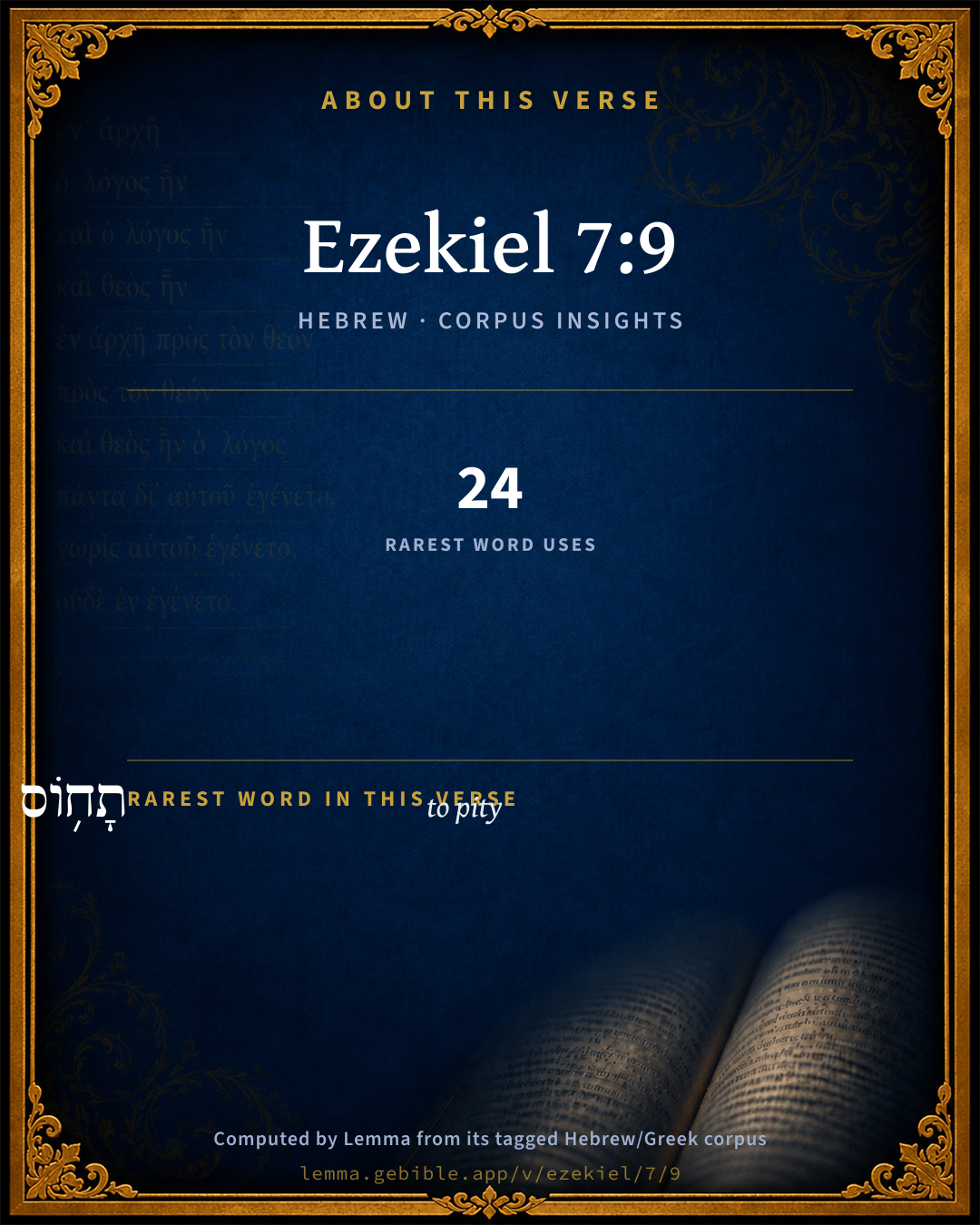
The rarest word here is תָח֥וֹס to pity H2347 — appearing just 24 times in the whole Hebrew Bible.

Shared distinctive vocabulary

תָח֥וֹס to pity H2347 occurs in 24 verses of the Hebrew Bible. Also found in:

Grammatical profile

  • 6 verbs
  • 5 nouns
  • 1 pronoun
  • 1 preposition
  • 1 conjunction
  • 2 particles

Verb forms

  • תָח֥וֹס Qal · Imperfect
  • אֶחְמ֑וֹל Qal · Imperfect
  • אֶתֵּ֗ן Qal · Imperfect
  • תִּֽהְיֶ֔יןָ Qal · Imperfect
  • וִֽידַעְתֶּ֕ם Qal · Sequential Perfect
  • מַכֶּֽה Hiphil · Participle Active

Repetition

A word recurs within this verse — often emphatic in Hebrew:

  • וְלֹא not H3808 ×2

Hebrew & Septuagint length

In English translation the verse runs 38 words from the Hebrew and 10 from the Septuagint (LXX English) — the Septuagint runs noticeably shorter here. See the side-by-side →

A rough comparison of the two English renderings, which tokenize alike — not a word-level alignment.

Word counts can differ between the Hebrew and the Greek without any difference in meaning — e.g. the Hebrew direct-object marker אֵת has no separate Greek word, and Greek often adds the article ὁ.

Cross-references

4

Topical passages linked to Ezekiel 7:9 in the Treasury of Scripture Knowledge — connected by theme and wording, ordered by reader-vote popularity; previews shown in the World English Bible.

  • Revelation 20:13 The sea gave up the dead who were in it. Death and Hades gave up the dead who were in them. They were judged, each one according to his works.
  • Isaiah 9:13 Yet the people have not turned to him who struck them, neither have they sought Yahweh of Hosts.
  • Micah 6:9 Yahweh's voice calls to the city, And wisdom sees your name: "Listen to the rod, And he who appointed it.
  • Galatians 6:7 Don't be deceived. God is not mocked, for whatever a man sows, that will he also reap.

Cross-references courtesy of OpenBible.info (CC BY 4.0).

Hebrew and Greek witnesses Masoretic Hebrew ↔ Greek Septuagint

The same verse in the two great witnesses to the Old Testament, shown verse-for-verse.

Here the Septuagint runs noticeably shorter than the Hebrew — LXX2012 (modern English Septuagint) 10 words vs World English Bible 38. A rough length comparison of the two English translations, not a word-level alignment — read both below.

These are two independent witnesses, not word-aligned to each other, and the Septuagint is shown in lemma (dictionary) form.

Hebrew Ezekiel 7:9 Masoretic · Westminster Leningrad Codex

וְלֹא תָח֥וֹס עֵינִ֖י וְלֹ֣א אֶחְמ֑וֹל כִּדְרָכַ֜יִךְ עָלַ֣יִךְ אֶתֵּ֗ן וְתוֹעֲבוֹתַ֨יִךְ֙ בְּתוֹכֵ֣ךְ תִּֽהְיֶ֔יןָ וִֽידַעְתֶּ֕ם כִּ֛י אֲנִ֥י יְהוָ֖ה מַכֶּֽה

My eye shall not spare, neither will I have pity: I will bring on you according to your ways; and your abominations shall be in the midst of you; and you shall know that I, Yahweh, do strike.

World English Bible · Public Domain

Greek LXX Ezekiel 7:9 Septuagint · lemma form

διότι ὅδε λέγω κύριος

For thus says the Lord; Behold, the end is come.

LXX2012 (modern English Septuagint) · Public Domain

Hebrew: Westminster Leningrad Codex (CC BY 4.0). Greek: Septuagint (public domain); English from LXX2012 (modern English Septuagint) (Public Domain). How the Septuagint differs from the Hebrew →

Targum (Aramaic paraphrase)

1

The Targum is the ancient Jewish Aramaic paraphrase of the Hebrew Scriptures — an interpretive translation, not the Hebrew text itself. Onkelos (literal) and Pseudo-Jonathan (expansive) render the Torah, and Jonathan the Prophets. Coverage is partial: where no permissively-licensed English translation exists for a verse, only the Aramaic is shown. This is verse-level text, not a word-by-word alignment to the Hebrew.

  1. Targum Jonathan Prophets (Joshua–Malachi)
    וְלָא תְחוֹס מֵימְרִי וְלָא אֶרְחִים כְּחוֹבֵי אוֹרְחָתַיִךְ עֲלָךְ אֶתֵּן וּפוּרְעֲנוּת תּוֹעֲבָתַיִךְ בְּגַוִיךְ יֶהֱוְיָן וְתִדְעוּן אֲרֵי אֲנָא יְיָ אַיְתֵיתִי עֲלֵיכוֹן מְחָא:

    (no public-domain English translation for this verse)

    Targum Jonathan — Aramaic: “Mikraot Gedolot” (public domain). English: “Sefaria Community Translation” (CC0 1.0 (public-domain dedication)); “London "Chaldee Paraphrase," 1871” (public domain). Text via Sefaria.

Commentary

Notes on Ezekiel 7:9 from classic Christian and Jewish commentators (each source and its license shown beneath its notes). The classic Christian expositions comment on the surrounding passage and are grouped to its opening verse, so a note may address several verses; the Jewish commentaries on the Tanakh (Rashi and others) are per-verse, so they appear only where the commentator wrote on this verse.

Lemma curates 59 commentaries, every one of them public domain or Creative Commons licensed, each selected and text-cleaned for this edition rather than reprinted as found. About our sources →

Trapp's Complete Commentary

John Trapp

Eze 7:9 And mine eye shall not spare, neither will I have pity: I will recompense thee according to thy ways and thine abominations [that] are in the midst of thee; and ye shall know that I [am] the LORD that smiteth.

Ver. 9. I will recompense.] The same as before. Nunquam satis dicitur, quod nunquam satis discitur.

That I am the Lord that smiteth.] Think not that I am made all of mercy, or that I will ever serve you for a sinning stock. Ye shall know that I have verbera flogging as well as ubera, plenty and can so set it on as no creature can take it off.

John Trapp, A Commentary or Exposition upon All the Books of the Old and New Testament (1647–1656) — public domain. Text from a community e-Sword module.

John Calvin's Commentaries

This verse contains nothing besides a repetition, unless that at last the Prophet more clearly points out what that knowledge was which he formerly mentioned, namely, that they should unwillingly feel God’s power, because they had withdrawn their confidence from the Prophet’s teaching. For he had said two or three times, ye shall know that I am Jehovah: now he adds the participle, and that it is I who smite you This then is the knowledge by which God makes himself known to the reprobate, while they are compelled, whether they will or not, to feel that there is a judge of the world. The faithful indeed profit under God’s chastisements, and they are at times humbled under his hand, because they do not willingly obey his word: but we said that the Prophet here triumphs over the people’s pride who dared to deride all threats as if God were sleeping in heaven. He says therefore at length, that when God strikes them they should feel what they did not believe. It follows —

John Calvin's Commentaries (1540-1563) — public domain. Text from the Calvin Translation Society English edition (1840s-50s) via the Christian Classics Ethereal Library (ccel.org). Calvin's coverage is partial (roughly two-thirds of the Bible); uncommented books and verses are honest gaps, never fabricated. The 19th-century editor's footnotes and remarks are omitted so the notes are faithfully Calvin's own voice.

Ellicott's Commentary for English Readers

(9) The Lord that smiteth.—In Eze_7:4 it is only said, “Ye shall know that I am the LORD,” without saying in what respect; here this is specified—they shall know that God is a God of judgment, and that these calamities are from Him.

A Bible Commentary for English Readers, edited by Charles John Ellicott (1878–1897) — public domain. Text from a community e-Sword module.

John Gill's Exposition

Behold the day, behold, it is come,.... That is, the day of trouble and distress, said to be near, Eze 7:3;

the morning is gone forth; See Gill on Eze 7:7;

the rod hath blossomed, pride hath budded; both these phrases may be understood of Nebuchadnezzar; he was the rod, with which the Lord smote his people, as the Assyrian monarch is called the rod of his anger, Isa 10:5, and was a very proud prince, and had budded and blossomed, and had brought forth much bad fruit of that kind; see Dan 3:15; or these may be separately considered; the rod may be interpreted of Nebuchadnezzar, which had been growing up, and preparing for the chastisement of the people of the Jews, and now was just ready to be made use of; and "pride" may respect the sin of that people, which was the cause of their being smitten with this rod, as the following words seem to indicate. The Targum is,

"a ruler hath budded, a wicked one hath appeared.''

John Gill's Exposition of the Whole Bible (1746–1763) — public domain (CC PDM 1.0). Text via the HelloAO Bible API.

Matthew Poole's English Annotations

See Eze 5:11.

According to thy ways, worse than the ways of heathens, and thy punishments shall be worse.

That are in the midst of thee; still thou retainest the old, and addest new abominations; these to this day are in thee, not hidden, but openly.

I am the Lord that smiteth; you look only to the hand and sword of the Chaldeans, but I will not cease till you feel and acknowledge my hand smiting, that you may accept punishment, repent, and return to me.

Matthew Poole's English Annotations on the Holy Bible (1683–1685) — public domain. Text from a community e-Sword/MySword module.

Lesson kit

Teaching starters — assembled from the data on this page, not authored interpretation. Every prompt links to the verse data it draws on. Edit before teaching.

Ezekiel, in the Prophets, opens this verse with 16 words (15 distinct Hebrew lemmas). Its most distinctive word is chûwç (“to pity”). The Greek Septuagint runs shorter here. A historical commentator’s framing appears above. Read the whole chapter for the surrounding context.

Discussion questions

  1. What does “to pity” (chûwç) contribute to the verse as a whole?
  2. How does Genesis 45:20, which shares the word «to pity», read alongside this verse?
  3. What does the repetition of “not” (2× in this one verse) do in this verse?
  4. The Septuagint runs shorter here than the Hebrew. What might account for the difference?
  5. The translations on this page render this verse differently — a whole-verse word diff, not a word-by-word alignment. What might account for the different wordings?
  6. «תָח֥וֹס» is a Qal Imperfect verb. How does that grammatical form shape the action described?
  7. Compare how Trapp's Complete Commentary and John Calvin's Commentaries read this verse. Where do they agree or differ?

Things to notice

Reading settings

Reading text

Shown beneath each verse's original-language words.

Old Testament
Old Testament edition

Read the OT as the Masoretic Hebrew (MT) or the Greek Septuagint (LXX).

English shown for the Greek Septuagint (in the Hebrew ↔ Greek comparison).

Comparing translations? Open the Compare panel on any verse page to stack up to four side by side.