Ezekiel 4:12

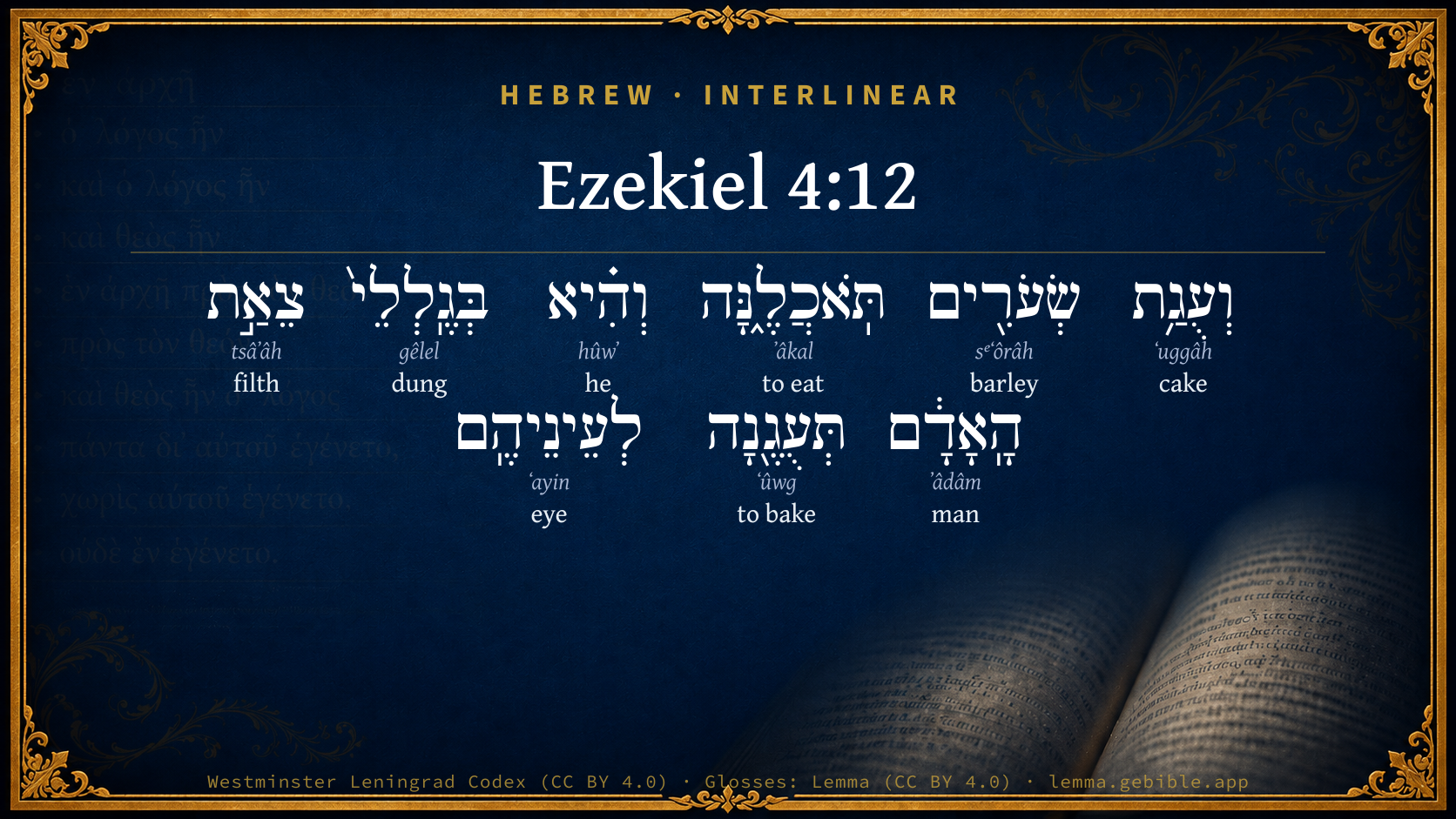
Hebrew (Westminster Leningrad Codex) Ezekiel 4:12 appears in the Hebrew Old Testament. The text above is from the Westminster Leningrad Codex. Each word links to its Strong’s number, a concise gloss, and parsing drawn from the Open Scriptures Hebrew Bible morphology. Click any word for its full Brown-Driver-Briggs (BDB) entry.
Download image
Cite this verse

Ezekiel 4:12 (World English Bible). Public Domain. Lemma interlinear Bible study tool, https://lemma.gebible.app/v/ezekiel/4/12.

Show BibTeX & RIS
BibTeX
RIS
English Translation
You shall eat it as barley cakes, and you shall bake it in their sight with dung that comes out of man.
World English Bible · Public Domain
Highlights
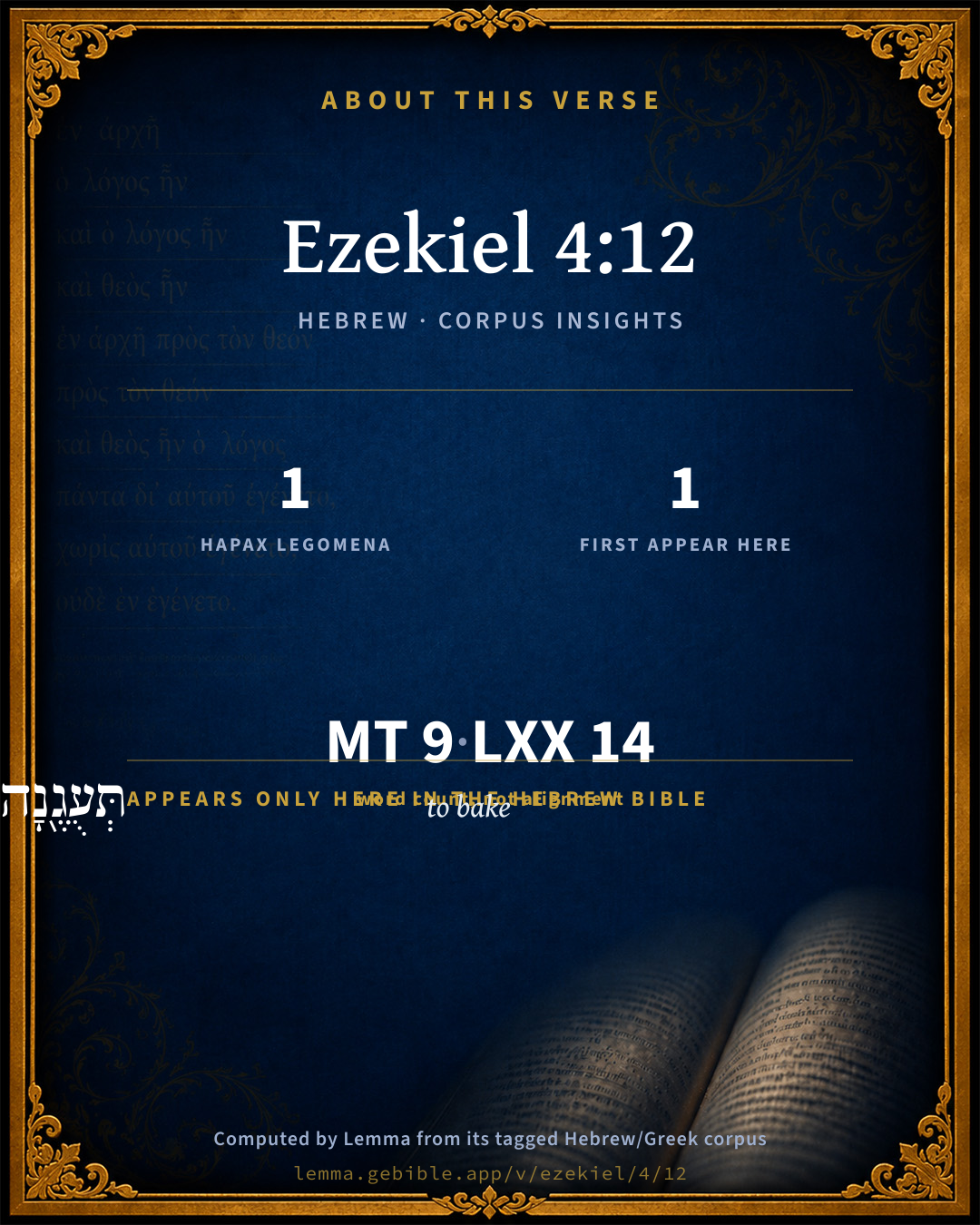
  • 1 hapax legomenon — only here in the Hebrew Bible
  • 1 first appearance in the Hebrew Bible
Full analysis ↓
Download a study sheet

One document with this verse’s original text, its word-by-word gloss line, the meaning frame, cross-references with their text, attributed commentary, and full source and license credits — printable, and it pastes into notes with its structure intact.

This verse Autodidact and up

Study sheet (.html) Plain text (.txt)

A passage Seminary Student

Up to 50 verses in one chapter. A passage sheet keeps up to 6 commentary sources and 12 cross-references per verse, in the order this page ranks them, and says so on the sheet whenever that leaves anything out. Ask for a single verse and you get the Autodidact verse sheet above.

Everything on this page stays free to read, with no account — the sheet is a download of what is already on screen, not access to it.

Want to remove ads? Support Godless Engineer
Compare translations 3

The same verse in 3 English versions, stacked beneath the original-language interlinear above. Click any original word for its lexicon entry.

Each is an independent rendering of the whole verse — the interlinear is not word-aligned to these translations.

Highlighted words mark where these versions differ — a whole-verse word diff, not a word-by-word alignment.

  • World English Bible Public Domain
    You shall eat it as barley cakes, and you shall bake it in their sight with dung that comes out of man.
  • King James Version Public Domain
    And thou shalt eat it as barley cakes, and thou shalt bake it with dung that cometh out of man, in their sight.
  • unfoldingWord Literal Text CC BY-SA 4.0
    You will eat it as barley cakes, but you will bake it on excrement of human dung within their sight!”

unfoldingWord Literal Text — © unfoldingWord, licensed CC BY-SA 4.0. Word-aligned USFM3 via Door43 (git.door43.org/unfoldingWord/en_ult).

Versions to compare (up to 4)

3 of 4 selected

Show all 18 translations

Every available English version of this verse, each an independent rendering of the whole verse.

  • World English Bible Public Domain
    You shall eat it as barley cakes, and you shall bake it in their sight with dung that comes out of man.
  • Berean Standard Bible Public Domain
    And you shall eat the food as you would a barley cake, after you bake it over dried human excrement in the sight of the people.”
  • Majority Standard Bible Public Domain
    And you shall eat the food as you would a barley cake, after you bake it over dried human excrement in the sight of the people.”
  • King James Version Public Domain
    And thou shalt eat it as barley cakes, and thou shalt bake it with dung that cometh out of man, in their sight.
  • American Standard Version (1901) Public Domain
    And thou shalt eat it as barley cakes, and thou shalt bake it in their sight with dung that cometh out of man.
  • Revised Version (1885) Public Domain
    And thou shalt eat it as barley cakes, and thou shalt bake it in their sight with dung that cometh out of man.
  • Geneva Bible (1599) Public Domain
    And thou shalt eate it as barley cakes, and thou shalt bake it in the dongue that commeth out of man, in their sight.
  • Douay-Rheims (1899) Public Domain
    And thou shalt eat it as barley bread baked under the ashes: and thou shalt cover it, in their sight, with the dung that cometh out of a man.
  • Young's Literal Translation Public Domain
    A barley-cake thou dost eat it, and it with dung -- the filth of man -- thou dost bake before their eyes.
  • Literal Standard Version CC BY-SA 4.0
    And you eat it [as] barley-cake, and it with dung—the filth of man—you bake before their eyes.”
  • Unlocked Literal Bible CC BY-SA 4.0
    You will eat it as barley cakes, but you will bake it on excrement of human dung within their sight!”
  • unfoldingWord Literal Text CC BY-SA 4.0
    You will eat it as barley cakes, but you will bake it on excrement of human dung within their sight!”
  • Darby Bible Public Domain
    And thou shalt eat it [as] barley-cake, and thou shalt bake it in their sight with dung that cometh out of man.
  • World Messianic Bible Public Domain
    You shall eat it as barley cakes, and you shall bake it in their sight with dung that comes out of man.”
  • Webster's Bible Public Domain
    And thou shalt eat it as barley cakes, and thou shalt bake it with human excrement in their sight.
  • Free Bible Version CC BY-SA 4.0
    You are to eat the bread as you would a barley loaf. You are to bake it over a fire burning dried human excrement as everyone watches.”
  • Bible in Basic English Public Domain
    And let your food be barley cakes, cooking it before their eyes with the waste which comes out of a man.
  • JPS Tanakh (1917) Public Domain
    And thou shalt eat it as barley cakes, and thou shalt bake it in their sight with dung that cometh out of man.'

Literal Standard Version (2020), Covenant Press — licensed CC BY-SA 4.0. Text via the HelloAO Bible API (eBible.org). Unlocked Literal Bible (unfoldingWord) — licensed CC BY-SA 4.0. Text via the HelloAO Bible API (eBible.org). unfoldingWord Literal Text — © unfoldingWord, licensed CC BY-SA 4.0. Word-aligned USFM3 via Door43 (git.door43.org/unfoldingWord/en_ult). Free Bible Version, Dr. Jonathan Gallagher — licensed CC BY-SA 4.0. Text via the HelloAO Bible API (eBible.org).

Word by word

More ways to search: Search by grammar → Find every occurrence → Compare this word →

Practice this passage: Drill this verse → Learn its vocabulary →

תְּעֻגֶ֖נָה
ʻûwg
H5746
“to bake · her”
Verb, Qal, Imperfect, 2nd Person, Masculine, Singular + Suffix, Personal, 3rd Person, Feminine, Singular
Part of Speech
Verb
Stem
Qal
Form
Imperfect
Person
2nd Person
Gender
Masculine
Number
Singular
Full BDB Definition

Origin: a primitive root

TWOT: 1575

(Qal) to bake, bake a cake
  1. וְעֻגַ֥ת ʻuggâh H5692 “and · cake of” Conjunction + Noun, Common, Feminine, Singular, Construct
  2. שְׂעֹרִ֖ים sᵉʻôrâh H8184 “barley” Noun, Common, Feminine, Plural, Absolute
  3. תֹּֽאכֲלֶ֑נָּה ʼâkal H398 “to eat · her” Verb, Qal, Imperfect, 2nd Person, Masculine, Singular + Suffix, Personal, 3rd Person, Feminine, Singular
  4. וְהִ֗יא hûwʼ H1931 “and · he” Conjunction + Pronoun, Personal, 3rd Person, Feminine, Singular
  5. בְּגֶֽלְלֵי֙ gêlel H1561 “in/at · dung of” Preposition + Noun, Common, Masculine, Plural, Construct
  6. צֵאַ֣ת tsâʼâh H6627 “filth of” Noun, Common, Feminine, Singular, Construct
  7. הָֽאָדָ֔ם ʼâdâm H120 “the · man” Particle, Definite Article + Noun, Common, Masculine, Singular, Absolute
  8. לְעֵינֵיהֶֽם ʻayin H5869 “to/for · eyes · their” Preposition + Noun, Common, Both, Dual, Construct + Suffix, Personal, 3rd Person, Masculine, Plural

About this verse

These counts appear in no published source. They are computed here, from the morphology-tagged text and Lemma’s own curated glosses. What Lemma adds →

9
words
9
distinct lemmas
Prophets
section

Notable vocabulary

1 hapax legomenon — a word that appears only here in the entire Hebrew Bible:

  • תְּעֻגֶ֖נָה to bake H5746

First appearance in Scripture

This word makes its first canonical appearance in the Hebrew Bible here:

  • תְּעֻגֶ֖נָה to bake H5746

Shared distinctive vocabulary

צֵאַ֣ת filth H6627 occurs in 2 verses of the Hebrew Bible. Also found in:

Grammatical profile

  • 2 verbs
  • 6 nouns
  • 1 pronoun

Verb forms

  • תֹּֽאכֲלֶ֑נָּה Qal · Imperfect
  • תְּעֻגֶ֖נָה Qal · Imperfect

Hebrew & Septuagint length

In English translation the verse runs 22 words from the Hebrew and 19 from the Septuagint (LXX English) — closely comparable.

A rough comparison of the two English renderings, which tokenize alike — not a word-level alignment.

Word counts can differ between the Hebrew and the Greek without any difference in meaning — e.g. the Hebrew direct-object marker אֵת has no separate Greek word, and Greek often adds the article ὁ.

In the original languages it is 9 Hebrew tokens and 14 Greek tokens — but the two are counted differently (Hebrew bundles its prefixes and suffixes into one token; the Greek is in lemma form), so that isn’t a like-for-like length.

Cross-references

2

Topical passages linked to Ezekiel 4:12 in the Treasury of Scripture Knowledge — connected by theme and wording, ordered by reader-vote popularity; previews shown in the World English Bible.

  • Isaiah 36:12 But Rabshakeh said, Has my master sent me to your master, and to you, to speak these words? [has he] not [sent me] to the men who sit on the wall, to eat their own dung, and to drink their own water with you?
  • Genesis 18:6 Abraham hurried into the tent to Sarah, and said, "Quickly make ready three measures of fine meal, knead it, and make cakes."

Cross-references courtesy of OpenBible.info (CC BY 4.0).

Hebrew and Greek witnesses Masoretic Hebrew ↔ Greek Septuagint

The same verse in the two great witnesses to the Old Testament, shown verse-for-verse.

These are two independent witnesses, not word-aligned to each other, and the Septuagint is shown in lemma (dictionary) form.

Hebrew Ezekiel 4:12 Masoretic · Westminster Leningrad Codex

וְעֻגַ֥ת שְׂעֹרִ֖ים תֹּֽאכֲלֶ֑נָּה וְהִ֗יא בְּגֶֽלְלֵי֙ צֵאַ֣ת הָֽאָדָ֔ם תְּעֻגֶ֖נָה לְעֵינֵיהֶֽם

You shall eat it as barley cakes, and you shall bake it in their sight with dung that comes out of man.

World English Bible · Public Domain

Greek LXX Ezekiel 4:12 Septuagint · lemma form

καί ἐγκρυφίας κρίθινος ἐσθίω αὐτός ἐν βόλβιτον κόπρος ἀνθρώπινος ἐνκρύπτω αὐτός κατά ὀφθαλμός αὐτός

And you shall eat them as a barley cake: you shall bake them before their eyes in man's dung.

LXX2012 (modern English Septuagint) · Public Domain

On this verse, Haydock's Catholic Bible Commentary discusses the Septuagint’s reading. Read the note in Commentary ↓

Hebrew: Westminster Leningrad Codex (CC BY 4.0). Greek: Septuagint (public domain); English from LXX2012 (modern English Septuagint) (Public Domain). How the Septuagint differs from the Hebrew →

Targum (Aramaic paraphrase)

1

The Targum is the ancient Jewish Aramaic paraphrase of the Hebrew Scriptures — an interpretive translation, not the Hebrew text itself. Onkelos (literal) and Pseudo-Jonathan (expansive) render the Torah, and Jonathan the Prophets. Coverage is partial: where no permissively-licensed English translation exists for a verse, only the Aramaic is shown. This is verse-level text, not a word-by-word alignment to the Hebrew.

  1. Targum Jonathan Prophets (Joshua–Malachi)
    וַחֲרָרָא דִלְחַם שְׂעוֹרִין תֵּיכְלִינָהּ וְהִיא עַל גְלֵי מַפְקַת אֱנָשָׁא תַּחְרְרִינָה לְעֵינֵיהוֹן:

    (no public-domain English translation for this verse)

    Targum Jonathan — Aramaic: “Mikraot Gedolot” (public domain). English: “Sefaria Community Translation” (CC0 1.0 (public-domain dedication)); “London "Chaldee Paraphrase," 1871” (public domain). Text via Sefaria.

Commentary

Notes on Ezekiel 4:12 from classic Christian and Jewish commentators (each source and its license shown beneath its notes). The classic Christian expositions comment on the surrounding passage and are grouped to its opening verse, so a note may address several verses; the Jewish commentaries on the Tanakh (Rashi and others) are per-verse, so they appear only where the commentator wrote on this verse.

Lemma curates 59 commentaries, every one of them public domain or Creative Commons licensed, each selected and text-cleaned for this edition rather than reprinted as found. About our sources →

Trapp's Complete Commentary

John Trapp

Eze 4:12 And thou shalt eat it [as] barley cakes, and thou shalt bake it with dung that cometh out of man, in their sight.

Ver. 12. And thou shalt eat it as barley cakes.] Baked on coals made of homely fuel, man’s dung burnt. {a}

And thou shalt bake it with dung.] For want of wood. {Lam 5:4} To the hungry soul every bitter thing is sweet. {Pro 27:7}

In their sight.] This, then, was more than a vision.

{a} Panem exhibuit Papa non ad purum ignem, sed ad oleta Quaestionariorum, Sorbonistarum, et Canonicorum coctum. - Pol.

John Trapp, A Commentary or Exposition upon All the Books of the Old and New Testament (1647–1656) — public domain. Text from a community e-Sword module.

Tyndale Open Study Notes

Tyndale Open Resources

4:12-13 Cooking over human dung would render the bread ceremonially unclean, thus defiling Ezekiel when he ate it. The Israelites had to eat defiled bread in exile, when it was extremely difficult to observe kosher dietary laws. They would be unclean and cut off from the cleansing presence of the Lord.

Tyndale Open Study Notes — © Tyndale Open Resources, licensed CC BY-SA 4.0. Text via the HelloAO Bible API.

Geneva Bible (1599)

Geneva Bible translators

Signifying hereby the great scarcity of fuel and matter to burn.

Geneva Bible (1599) marginal notes — public domain. Text via Bolls.life.

Jamieson, Fausset & Brown

Robert Jamieson, A. R. Fausset & David Brown

dung--as fuel; so the Arabs use beasts' dung, wood fuel being scarce. But to use human dung so implies the most cruel necessity. It was in violation of the law (Deu 14:3; Deu 23:12-14); it must therefore have been done only in vision.

Jamieson, Fausset & Brown — Commentary Critical and Explanatory on the Whole Bible (1871) — public domain (CC PDM 1.0). Text via the HelloAO Bible API.

Adam Clarke's Commentary

Verse 12. Thou shalt bake it with dung] Dried ox and cow dung is a common fuel in the east; and with this, for want of wood and coals, they are obliged to prepare their food. Indeed, dried excrement of every kind is gathered. Here, the prophet is to prepare his bread with dry human excrement. And when we know that this did not come in contact with the bread, and was only used to warm the plate, (see Eze 4:3,) on which the bread was laid over the fire, it removes all the horror and much of the disgust. This was required to show the extreme degree of wretchedness to which they should be exposed; for, not being able to leave the city to collect the dried excrements of beasts, the inhabitants during the siege would be obliged, literally, to use dried human ordure for fuel. The very circumstances show that this was the plain fact of the case. However, we find that the prophet was relieved from using this kind of fuel, for cow's dung was substituted at his request. See Eze 4:15.

Adam Clarke's Commentary on the Bible (1810–1826) — public domain. Text from a community e-Sword/MySword module.

John Calvin's Commentaries

This vision properly belongs to the ten tribes, and, for this reason, I have said that God’s vengeance is not to be considered as to the siege of the city alone, but to be extended longer. After the Prophet had spoken of the siege of Jerusalem, he adds, that their reward was prepared for the children of Israel, because a just God was the avenger of each people. As, therefore, he punished the remnant who as yet remained at Jerusalem, so he avenged the wickedness of the ten tribes in exile at Babylon. For this reason the Prophet is ordered to cook a cake with dung: that is, he is commanded to take human dung instead of fuel: nor does he simply say dung, but the dung of men. By and bye the application follows. Thus the children of Israel shall eat their polluted bread among the Gentiles Now, therefore, we see that the Jews are at length drawn to judgment, because they had not been so touched with the slaughter of their brethren as to repent, but, in the meantime, the wrath of God was conspicuous against the ten tribes, because among the Gentiles those miserable exiles were compelled to eat their bread polluted. We know that cakes are made of the finest flour, for the purer the flour the more delicate is the bread, but the Prophet is ordered to make cakes of barley, and then to cook them in dung, for that uncleanness was forbidden by the law. (Leviticus 5:3; Leviticus 7:21.) Therefore God signifies, that the Israelites were so rejected that they differed in nothing from polluted nations; for the Lord had separated them as we know from the rest of the world: but from the time of their mingling themselves with the filth of the impious, at length, after long forbearance, they were altogether rejected as it is here said. For under this figure a universal pollution is signified, as if he had said, nothing is any longer holy or sacred in Israel, because they are mixed up with the pollutions of all nations: finally, the impure bread embraces within itself all kinds of impiety. Now when he says among the Gentiles, it means, that they would be such inhabitants of the lands among which they were driven, that they should be not only exiles but banished from the land of Canaan, which was their inheritance. In fine, a disinheriting is here marked, when the Jews are said to be driven about hither and thither, so as not to, dwell in the promised land. It follows —

John Calvin's Commentaries (1540-1563) — public domain. Text from the Calvin Translation Society English edition (1840s-50s) via the Christian Classics Ethereal Library (ccel.org). Calvin's coverage is partial (roughly two-thirds of the Bible); uncommented books and verses are honest gaps, never fabricated. The 19th-century editor's footnotes and remarks are omitted so the notes are faithfully Calvin's own voice.

Ellicott's Commentary for English Readers

(12) As barley cakes.—These were commonly cooked in the hot ashes, hence the especial defilement caused by the fuel required to be used. Against this the prophet pleads, not merely as revolting in itself, but as ceremonially polluting (Eze_4:14; see Lev_5:3; Lev_7:21), and a mitigation of the requirement is granted to him (Eze_4:15).

In their sight—This is still a part of the vision. The words have been thought to determine that the whole transaction was an actual symbolic act and not a vision; but this does not follow. It need only have been a part of the vision that what was done was done publicly.

A Bible Commentary for English Readers, edited by Charles John Ellicott (1878–1897) — public domain. Text from a community e-Sword module.

The Cambridge Bible for Schools and Colleges

gen. ed. J. J. S. Perowne

12. It was customary in the East to use the dung of animals when perfectly dried as fuel. The hot ashes remaining from it are perfectly clean, and retaining their glow for a considerable time were used for firing cakes upon or under. See Wetzstein in Del. Job, p. 261 (Trans. i. p. 377). Whether the Hebrews would have considered such fuel unclean is not certain (cf. Lev_5:3; Lev_7:21; Deu_23:13); the material for firing which the prophet is commanded to use would certainly be unclean (Deu_23:13) as well as loathsome. The command is explained in Eze_4:13.

The Cambridge Bible for Schools and Colleges (gen. ed. J. J. S. Perowne; Cambridge University Press, 1878–1918) — public domain. Text from a community e-Sword module.

John Gill's Exposition

And thou shalt eat it as barley cakes,.... That is, the bread made of wheat, barley, beans, lentiles, millet, and fitches, was to be made in the form of barley cakes, and to be baked as they; not in an oven, but under ashes; and these ashes not of wood, or straw, or turf, but as follows:

and thou shalt bake it with dung that cometh out of men, in their sight: the prophet was to take human dung, and dry it, and then cover the cakes or loaves of his mixed bread with it, and burn it over them, and with it bake it; which must be a very disagreeable task to him, and make the food very nauseous, both to himself and to the Jews, in whose sight it was done; and this shows scarcity of fuel, and the severity of the famine; that they had not fuel to bake with, or could not stay till it was baked in an oven, and therefore took this method; as well as points at what they were to eat when carried captive, as follows:

John Gill's Exposition of the Whole Bible (1746–1763) — public domain (CC PDM 1.0). Text via the HelloAO Bible API.

Albert Barnes' Notes on the Bible

In eastern countries where fuel is scarce the want is supplied by dried cow-dung laid up for the winter. Barley cakes were (and are) baked under hot ashes without an oven. The dung here is to be burned to ashes, and the ashes so employed.

Albert Barnes' Notes on the Bible (1834–1885) — public domain. Text from a community e-Sword/MySword module.

Haydock's Catholic Bible Commentary

Barley, the worst or usual food of the poor. (Haydock) --- Ashes, to denote hurry. (Calmet) --- Cover with hot ashes, (Haydock) formed of dry excrements. (Calmet) --- That of oxen is still used in Egypt, (Val. ep. xi.) and in some parts of England, by the poor people. (Hooke.) --- This was more tolerable, (Calmet) and God agrees to substitute it, ver. 15. Hebrew, "Thou shalt eat it as barley cakes, and shalt bake," (Protestants) or "hide it," &c. (Septuagint) (Haydock) --- "The law itself, which the Jews read and do not understand, is this ember cake covered with human dung." (Philippians iii. 8.) --- "They adore not idols, but do all for the belly and for earthly goods." (St. Jerome)

George Leo Haydock (1774–1849), Haydock's Catholic Family Bible and Commentary, 1859 edition — public domain. Excludes Psalms (Douay-Rheims chapter numbering differs from Protestant) and Deuterocanonical books (Catholic canon only).

Matthew Poole's English Annotations

As barley cakes: these were delicacies with them when they could temper and make them right, but now these pitiful things should be to these half-starved bodies as delicates, Or rather, because they were greedy, and could not stay till they were baked. Or, lest any should take it from them. Or, because they never had enough to make a loaf with, they eat them as barley cakes.

With dung; there would be no wood left for such necessary uses, nor yet dung of other creatures, they would be all consumed by the length of the siege too. What loathsome food was this! yet in this straitness of the siege they are brought to it.

In their sight; openly, that any might see it. From this passage some conclude this was actually done, and not only represented in a vision.

Matthew Poole's English Annotations on the Holy Bible (1683–1685) — public domain. Text from a community e-Sword/MySword module.

Whedon's Commentary on the Bible

Daniel D. Whedon

12. The supply of wood in a besieged city must soon give out. Camels’ and asses’ dung, which is the ordinary fuel for poor people in Egypt and Palestine even to this day, could not be used because the beasts were all dead. Besides, the once “holy people” have lost all sense of shame. This vividly represents the loathesomeness and uncleanness of the people (Eze_4:13; compare Deu_23:13), and was as revolting to Ezekiel as to us (Lev_5:3; Lev_7:21). Henceforth the once holy people, having been driven out of the Lord’s land because of their sins, will eat their bread defiled (Eze_4:13; Hos_9:3).

As barley cakes — He shall eat it as barley cakes — the ordinary food of the poorest classes — are eaten. Does this mean that after being baked in the coals it is to be eaten ravenously?

Daniel D. Whedon (gen. ed.), Commentary on the Old and New Testaments (1874–1909) — public domain. Text from a community e-Sword module.

The Pulpit Commentary

Thou shall bake it with dung, etc. The process of baking in ashes was as old as the time of Abraham, (Gen_18:6) and continues in Arabia and Syria to the present day. The kneaded dough was rolled into thin flat cakes, and they were placed upon, or hung over, the hot wood embers of the hearth or oven. But in a besieged city the supply of wood for fuel soon fails. The first resource is found, as still often happens in the East, in using the dried dung of camels or of cattle. Before Ezekiel"s mind there came the vision of a yet more terrible necessity. That supply also might tail, and then men would be forced to use the dried contents of the "draught houses" or cesspools of Jerusalem. They would be compelled almost literally to fulfil the taunt of Rabshakeh. (Isa_36:12) Thatthought, as bringing with it the ceremonial pollution of Lev_5:3:7:21, was as revolting to Ezekiel as it is to us; but like Dante, in a like revolting symbolism ("Inf.," 18:114), he does not shrink from naming it. It came to him, as with the authority of a Divine command, that he was even to do this, to represent the extreme horrors of the siege. And all this was to be done visibly, before the eyes of his neighbours at Tel-Abib.

The Pulpit Commentary (1880–1919), ed. H.D.M. Spence-Jones & Joseph S. Exell — public domain. Text from a community e-Sword module.

John Wesley's Explanatory Notes

As barley cakes - Because they never had enough to make a loaf with, they eat them as barley cakes. With dung - There was no wood left, nor yet dung of other creatures. This also was represented in a vision.

John Wesley, Explanatory Notes Upon the Whole Bible (1754–1765) — public domain. Text via the GEBible commentary corpus.

unfoldingWord translationNotes

Door43 World Missions Community

General Information:

The Spirit continues speaking to Ezekiel.

You will eat it

The word "it" refers to the bread (Ezekiel 4:9).

barley cakes

flat bread made of barley (Ezekiel 4:9) (See: Translate Unknowns)

you will bake it on excrement of human dung

"you will cook it over a fire made with pieces of human solid waste." Your language may have a way of expressing this politely.

will banish

will send away by force

translationWords

Yahweh

bread

Israel

clean

nation

unfoldingWord translationNotes — © Distant Shores Media and the Door43 World Missions Community, licensed CC BY-SA 4.0. Source: git.door43.org/Door43/en_tn.

Rashi

Rabbi Shlomo Yitzchaki (Rashi)

And as barley cakes you shall eat it Rolled out in a repulsive manner like the rolling of barley, not nicely like the rolling out of a wheat cake.

and they shall bake it with human excrement They shall bake it with their coals that dry it out and burn it.

Rashi on the Tanakh — English translations: “The Judaica Press complete Tanach with Rashi, translated by A. J. Rosenberg” (CC BY 4.0); “Pentateuch with Rashi's commentary by M. Rosenbaum and A.M. Silbermann, 1929-1934” (public domain); “The Metsudah Tanach series, Lakewood, N.J” (CC BY 4.0); and “The Book of Joshua, Metsudah Publications, 1997” (CC BY 4.0). Text via Sefaria.

Lesson kit

Teaching starters — assembled from the data on this page, not authored interpretation. Every prompt links to the verse data it draws on. Edit before teaching.

Ezekiel, in the Prophets, opens this verse with 9 words (9 distinct Hebrew lemmas). Its most distinctive word is ʻûwg (“to bake”). A historical commentator’s framing appears above. Read the whole chapter for the surrounding context.

Discussion questions

  1. How does “to bake” (ʻûwg) shape what this verse is saying?
  2. This verse holds 1 word here found nowhere else in the Hebrew Bible. What might the rare word draw attention to?
  3. The word “to bake” first appears here in Scripture. What is being introduced at this debut?
  4. Deuteronomy 23:13 shares the word «filth» with this verse. How do the two illuminate each other?
  5. These translations render this verse differently. What is at stake in choosing one wording over another?
  6. The verb «תֹּֽאכֲלֶ֑נָּה» is Qal Imperfect. How does its form color the action?
  7. Reading how Trapp's Complete Commentary and Tyndale Open Study Notes read this verse, where do the two commentators agree and where do they part?

Things to notice

Reading settings

Reading text

Shown beneath each verse's original-language words.

Old Testament
Old Testament edition

Read the OT as the Masoretic Hebrew (MT) or the Greek Septuagint (LXX).

English shown for the Greek Septuagint (in the Hebrew ↔ Greek comparison).

Comparing translations? Open the Compare panel on any verse page to stack up to four side by side.