Deuteronomy 16:12

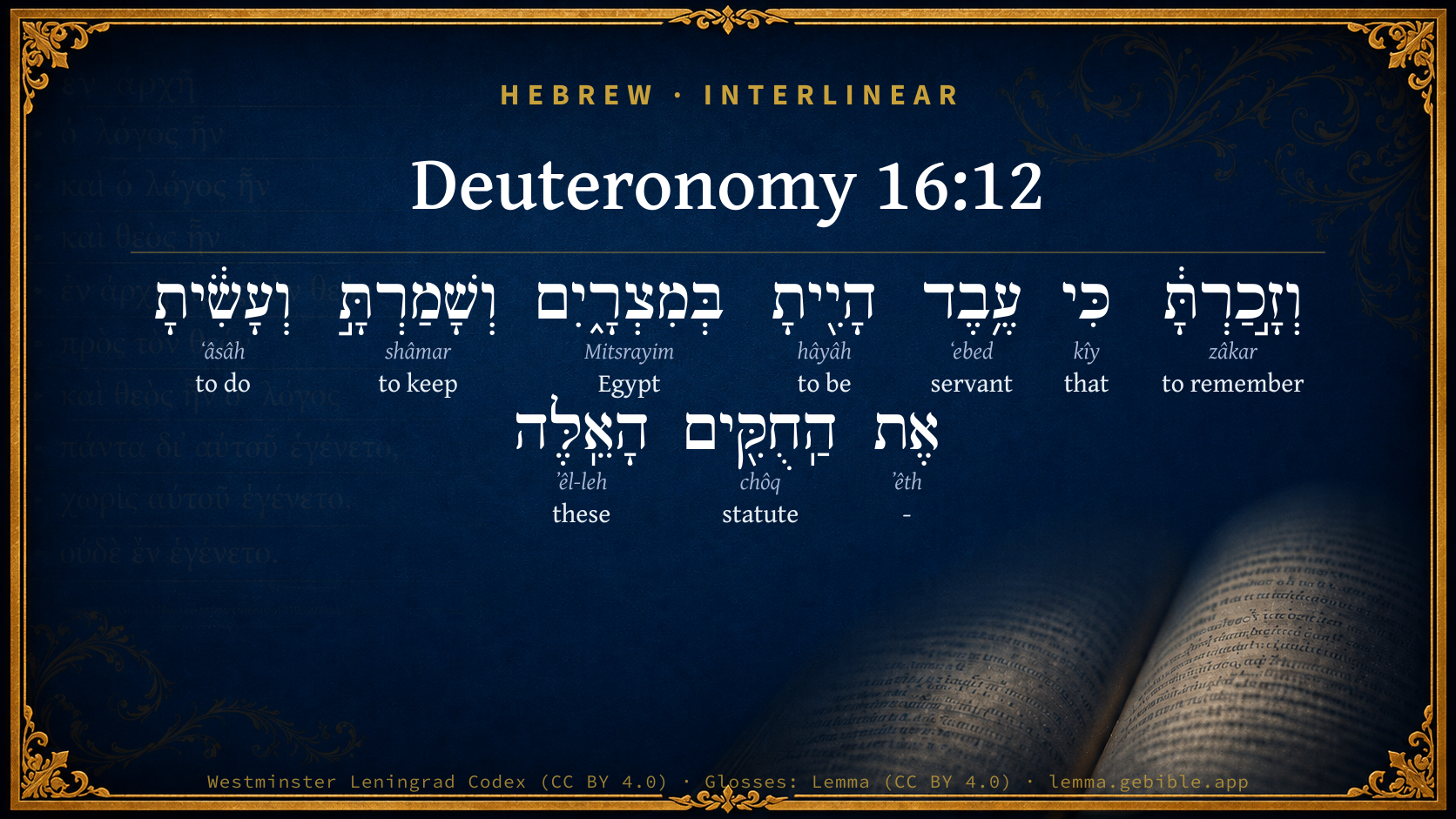
Hebrew (Westminster Leningrad Codex) Deuteronomy 16:12 appears in the Hebrew Old Testament. The text above is from the Westminster Leningrad Codex. Each word links to its Strong’s number, a concise gloss, and parsing drawn from the Open Scriptures Hebrew Bible morphology. Click any word for its full Brown-Driver-Briggs (BDB) entry.
Download image
Cite this verse

Deuteronomy 16:12 (World English Bible). Public Domain. Lemma interlinear Bible study tool, https://lemma.gebible.app/v/deuteronomy/16/12.

Show BibTeX & RIS
BibTeX
RIS
English Translation
You shall remember that you were a bondservant in Egypt: and you shall observe and do these statutes.
World English Bible · Public Domain
Download a study sheet

One document with this verse’s original text, its word-by-word gloss line, the meaning frame, cross-references with their text, attributed commentary, and full source and license credits — printable, and it pastes into notes with its structure intact.

This verse Autodidact and up

Study sheet (.html) Plain text (.txt)

A passage Seminary Student

Up to 50 verses in one chapter. A passage sheet keeps up to 6 commentary sources and 12 cross-references per verse, in the order this page ranks them, and says so on the sheet whenever that leaves anything out. Ask for a single verse and you get the Autodidact verse sheet above.

Everything on this page stays free to read, with no account — the sheet is a download of what is already on screen, not access to it.

Want to remove ads? Support Godless Engineer
Compare translations 3

The same verse in 3 English versions, stacked beneath the original-language interlinear above. Click any original word for its lexicon entry.

Each is an independent rendering of the whole verse — the interlinear is not word-aligned to these translations.

Highlighted words mark where these versions differ — a whole-verse word diff, not a word-by-word alignment.

  • World English Bible Public Domain
    You shall remember that you were a bondservant in Egypt: and you shall observe and do these statutes.
  • King James Version Public Domain
    And thou shalt remember that thou wast a bondman in Egypt: and thou shalt observe and do these statutes.
  • unfoldingWord Literal Text CC BY-SA 4.0
    And you shall remember that you were a slave in Egypt, and you shall keep and do these statutes.

unfoldingWord Literal Text — © unfoldingWord, licensed CC BY-SA 4.0. Word-aligned USFM3 via Door43 (git.door43.org/unfoldingWord/en_ult).

Versions to compare (up to 4)

3 of 4 selected

Show all 18 translations

Every available English version of this verse, each an independent rendering of the whole verse.

  • World English Bible Public Domain
    You shall remember that you were a bondservant in Egypt: and you shall observe and do these statutes.
  • Berean Standard Bible Public Domain
    Remember that you were slaves in Egypt, and carefully follow these statutes.
  • Majority Standard Bible Public Domain
    Remember that you were slaves in Egypt, and carefully follow these statutes.
  • King James Version Public Domain
    And thou shalt remember that thou wast a bondman in Egypt: and thou shalt observe and do these statutes.
  • American Standard Version (1901) Public Domain
    And thou shalt remember that thou wast a bondman in Egypt: and thou shalt observe and do these statutes.
  • Revised Version (1885) Public Domain
    And thou shalt remember that thou wast a bondman in Egypt: and thou shalt observe and do these statutes.
  • Geneva Bible (1599) Public Domain
    And thou shalt remember that thou wast a seruant in Egypt: therefore thou shalt obserue and doe these ordinances.
  • Douay-Rheims (1899) Public Domain
    And thou shalt remember that thou wast a servant in Egypt: and thou shalt keep and do the things that are commanded.
  • Young's Literal Translation Public Domain
    and thou hast remembered that a servant thou hast been in Egypt, and hast observed and done these statutes.
  • Literal Standard Version CC BY-SA 4.0
    and you have remembered that you have been a servant in Egypt, and have observed and done these statutes.
  • Unlocked Literal Bible CC BY-SA 4.0
    You will call to mind that you were a slave in Egypt; you must observe and do these statutes.
  • unfoldingWord Literal Text CC BY-SA 4.0
    And you shall remember that you were a slave in Egypt, and you shall keep and do these statutes.
  • Darby Bible Public Domain
    And thou shalt remember that thou wast a bondman in Egypt, and thou shalt keep and do these statutes.
  • World Messianic Bible Public Domain
    You shall remember that you were a slave in Egypt. You shall observe and do these statutes.
  • Webster's Bible Public Domain
    And thou shalt remember that thou wast a bond-man in Egypt: and thou shalt observe and do these statutes.
  • Free Bible Version CC BY-SA 4.0
    Don't forget that you were once slaves in Egypt, and be careful to follow these regulations.
  • Bible in Basic English Public Domain
    And you will keep in mind that you were a servant in the land of Egypt: and you will take care to keep all these laws.
  • JPS Tanakh (1917) Public Domain
    And thou shalt remember that thou wast a bondman in Egypt; and thou shalt observe and do these statutes.

Literal Standard Version (2020), Covenant Press — licensed CC BY-SA 4.0. Text via the HelloAO Bible API (eBible.org). Unlocked Literal Bible (unfoldingWord) — licensed CC BY-SA 4.0. Text via the HelloAO Bible API (eBible.org). unfoldingWord Literal Text — © unfoldingWord, licensed CC BY-SA 4.0. Word-aligned USFM3 via Door43 (git.door43.org/unfoldingWord/en_ult). Free Bible Version, Dr. Jonathan Gallagher — licensed CC BY-SA 4.0. Text via the HelloAO Bible API (eBible.org).

Word by word

More ways to search: Search by grammar → Find every occurrence → Compare this word →

Practice this passage: Drill this verse → Learn its vocabulary →

הַֽחֻקִּ֖ים
chôq
H2706
“the · statutes”
Particle, Definite Article + Noun, Common, Masculine, Plural, Absolute
Part of Speech
Particle + Noun
Type
Common
Gender
Masculine
Number
Plural
State
Absolute
Full BDB Definition

Origin: from H2710

TWOT: 728a

statute, ordinance, limit, something prescribed, due - prescribed task - prescribed portion - action prescribed (for oneself), resolve - prescribed due - prescribed limit, boundary - enactment, decree, ordinance - specific decree - law in general - enactments, statutes - conditions - enactments - decrees - civil enactments prescribed by God
  1. וְזָ֣כַרְתָּ֔ zâkar H2142 “and · to remember” Conjunction + Verb, Qal, Sequential Perfect, 2nd Person, Masculine, Singular
  2. כִּי kîy H3588 “that” Conjunction
  3. עֶ֥בֶד ʻebed H5650 “servant” Noun, Common, Masculine, Singular, Absolute
  4. הָיִ֖יתָ hâyâh H1961 “to be” Verb, Qal, Perfect, 2nd Person, Masculine, Singular
  5. בְּמִצְרָ֑יִם Mitsrayim H4714 “in/at · Egypt” Preposition + Noun, Proper
  6. וְשָׁמַרְתָּ֣ shâmar H8104 “and · to keep” Conjunction + Verb, Qal, Sequential Perfect, 2nd Person, Masculine, Singular
  7. וְעָשִׂ֔יתָ ʻâsâh H6213 “and · to do” Conjunction + Verb, Qal, Sequential Perfect, 2nd Person, Masculine, Singular
  8. אֶת ʼêth H853 “-” Particle, Direct Object
  9. הָאֵֽלֶּה ʼêl-leh H428 “the · these” Particle, Definite Article + Pronoun, Demonstrative, Common, Plural

About this verse

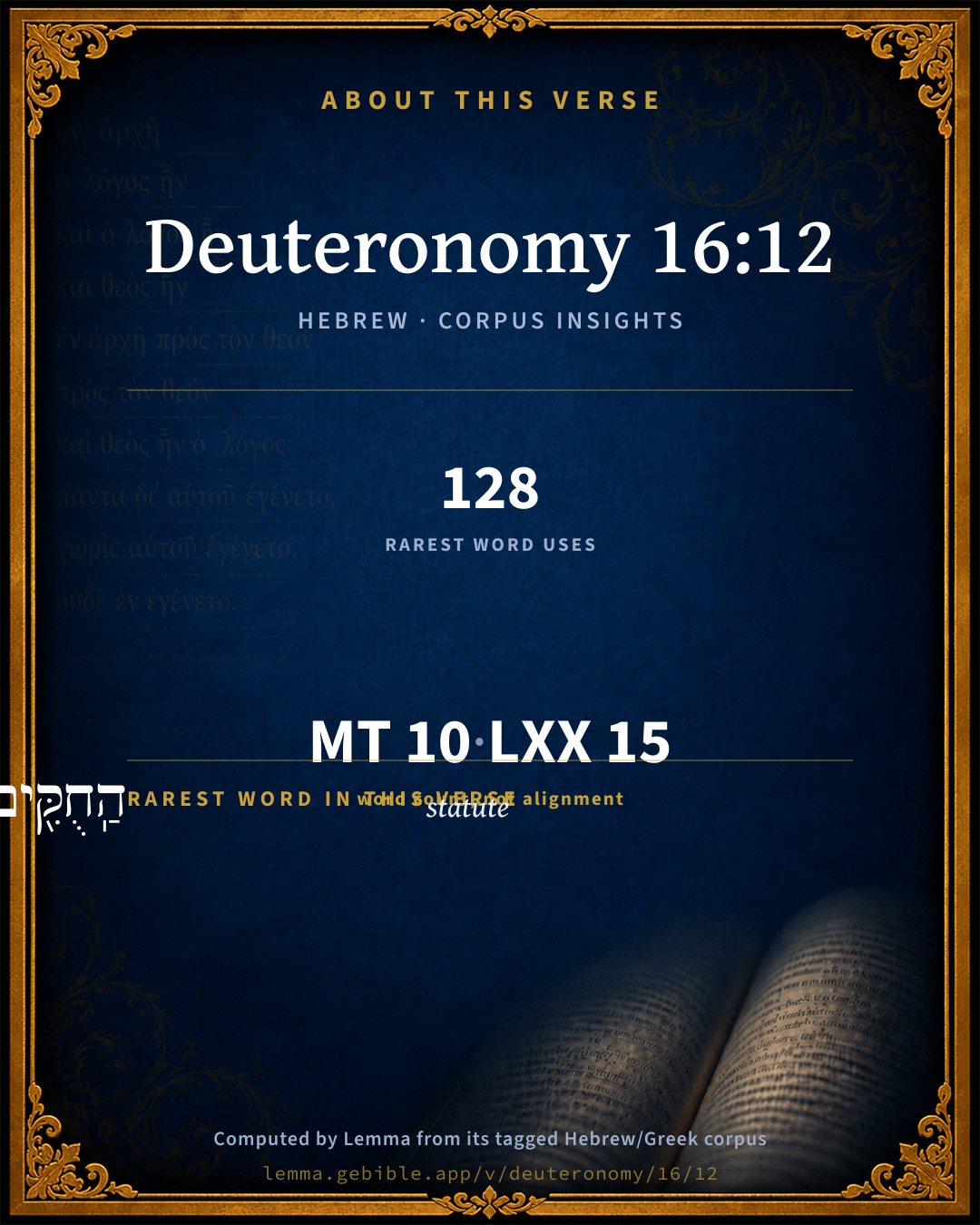
These counts appear in no published source. They are computed here, from the morphology-tagged text and Lemma’s own curated glosses. What Lemma adds →

10
words
10
distinct lemmas
Pentateuch
section

Grammatical profile

  • 4 verbs
  • 3 nouns
  • 1 pronoun
  • 1 conjunction
  • 1 particle

Verb forms

  • וְזָ֣כַרְתָּ֔ Qal · Sequential Perfect
  • הָיִ֖יתָ Qal · Perfect
  • וְשָׁמַרְתָּ֣ Qal · Sequential Perfect
  • וְעָשִׂ֔יתָ Qal · Sequential Perfect

Hebrew & Septuagint length

In English translation the verse runs 18 words from the Hebrew and 22 from the Septuagint (LXX English) — closely comparable.

A rough comparison of the two English renderings, which tokenize alike — not a word-level alignment.

Word counts can differ between the Hebrew and the Greek without any difference in meaning — e.g. the Hebrew direct-object marker אֵת has no separate Greek word, and Greek often adds the article ὁ.

In the original languages it is 10 Hebrew tokens and 15 Greek tokens — but the two are counted differently (Hebrew bundles its prefixes and suffixes into one token; the Greek is in lemma form), so that isn’t a like-for-like length.

Cross-references

6

Topical passages linked to Deuteronomy 16:12 in the Treasury of Scripture Knowledge — connected by theme and wording, ordered by reader-vote popularity; previews shown in the World English Bible.

  • Deuteronomy 15:15 You shall remember that you were a bondservant in the land of Egypt, and Yahweh your God redeemed you: therefore I command you this thing today.
  • Deuteronomy 16:15 Seven days shall you keep a feast to Yahweh your God in the place which Yahweh shall choose; because Yahweh your God will bless you in all your increase, and in all the work of your hands, and you shall be altogether joyful.
  • Lamentations 3:19–20 Remember my affliction and my misery, the wormwood and the gall.
  • Romans 6:17–18 But thanks be to God, that, whereas you were bondservants of sin, you became obedient from the heart to that form of teaching whereunto you were delivered.
  • Ephesians 2:1–3 You were made alive when you were dead in transgressions and sins,
  • Ephesians 2:11 Therefore remember that once you, the Gentiles in the flesh, who are called "uncircumcision" by that which is called "circumcision," (in the flesh, made by hands);

Cross-references courtesy of OpenBible.info (CC BY 4.0).

Hebrew and Greek witnesses Masoretic Hebrew ↔ Greek Septuagint

The same verse in the two great witnesses to the Old Testament, shown verse-for-verse.

These are two independent witnesses, not word-aligned to each other, and the Septuagint is shown in lemma (dictionary) form.

Hebrew Deuteronomy 16:12 Masoretic · Westminster Leningrad Codex

וְזָ֣כַרְתָּ֔ כִּי עֶ֥בֶד הָיִ֖יתָ בְּמִצְרָ֑יִם וְשָׁמַרְתָּ֣ וְעָשִׂ֔יתָ אֶת הַֽחֻקִּ֖ים הָאֵֽלֶּה

You shall remember that you were a bondservant in Egypt: and you shall observe and do these statutes.

World English Bible · Public Domain

Greek LXX Deuteronomy 16:12 Septuagint · lemma form

καί μιμνήσκω ὅτι οἰκέτης εἰμί ἐν γῆ αἴγυπτος καί φυλάσσω καί ποιέω ὁ ἐντολή οὗτος

And you shall remember that you were a servant in the land of Egypt, and you shall observe and do these commands.

LXX2012 (modern English Septuagint) · Public Domain

Hebrew: Westminster Leningrad Codex (CC BY 4.0). Greek: Septuagint (public domain); English from LXX2012 (modern English Septuagint) (Public Domain). How the Septuagint differs from the Hebrew →

Targum (Aramaic paraphrase)

2

The Targum is the ancient Jewish Aramaic paraphrase of the Hebrew Scriptures — an interpretive translation, not the Hebrew text itself. Onkelos (literal) and Pseudo-Jonathan (expansive) render the Torah, and Jonathan the Prophets. Coverage is partial: where no permissively-licensed English translation exists for a verse, only the Aramaic is shown. This is verse-level text, not a word-by-word alignment to the Hebrew.

  1. Targum Onkelos Torah (Genesis–Deuteronomy)
    וְתִדְכַּר אֲרֵי עַבְדָא הֲוֵיתָא בְּמִצְרָיִם וְתִטַר וְתַעְבֵּד יָת קְיָמַיָא הָאִלֵין

    (no public-domain English translation for this verse)

    Targum Onkelos — Aramaic: “Onkelos Genesis” (public domain); “Onkelos Exodus” (public domain); “Onkelos Leviticus” (public domain); “Onkelos Numbers” (public domain); “Onkelos Deuteronomy” (public domain). English: “Sefaria Community Translation” (CC0 1.0 (public-domain dedication)); “J.W. Etheridge. The Targums of Onkelos and Jonathan Ben Uzziel on the Pentateuch. London: Longmans, Green, 1862” (public domain). Text via Sefaria.

  2. Targum Pseudo-Jonathan Torah (Genesis–Deuteronomy)
    וְתֶהֱווֹן דְּכִירִין אֲרוּם מְשַׁעְבְּדִין הֲוֵיתוּן בְּמִצְרַיִם וְתִיטְרוּן וְתַעַבְדוּן יַת קְיָימַיָא הָאִלֵין

    Remember that you were servants in Mizraim; so shall you observe and perform these statutes.

    Targum Pseudo-Jonathan — Aramaic: “Targum Jonathan on Genesis” (public domain); “Targum Jonathan on Exodus” (public domain); “Targum Jonathan on Leviticus” (public domain); “Targum Jonathan on Numbers” (public domain); “Targum Jonathan on Deuteronomy” (public domain). English: “The Targum of Jonathan ben Uzziel, trans. J. W. Etheridge, London, 1862” (public domain). Text via Sefaria.

Commentary

Notes on Deuteronomy 16:12 from classic Christian and Jewish commentators (each source and its license shown beneath its notes). The classic Christian expositions comment on the surrounding passage and are grouped to its opening verse, so a note may address several verses; the Jewish commentaries on the Tanakh (Rashi and others) are per-verse, so they appear only where the commentator wrote on this verse.

Lemma curates 59 commentaries, every one of them public domain or Creative Commons licensed, each selected and text-cleaned for this edition rather than reprinted as found. About our sources →

Trapp's Complete Commentary

John Trapp

Deu 16:12 And thou shalt remember that thou wast a bondman in Egypt: and thou shalt observe and do these statutes.

Ver. 12. And thou shalt remember.] It is very good to look back and recognise our former worse condition. Agathocles, king of Sicily, being a potter’s son, would be served only in earthen vessels. Willigis, archbishop of Ments, a wheelwright’s son, hung wheels, and the tools wherewith they were made, around his bedchamber, and had these words written upon the walls in very fair characters, Willigis, Willigis, recole uncle veneris, Remember whence thou camest.

John Trapp, A Commentary or Exposition upon All the Books of the Old and New Testament (1647–1656) — public domain. Text from a community e-Sword module.

Joseph Benson's Commentary

Deu 16:12. And thou shalt remember that thou wast a bond-man — This is added to show, 1st, That to remind them of this was one principal end of this feast. 2d, As a motive to engage them to a cheerful obedience to all the other commands of God. 3d, To induce them to regard their poor servants and strangers in this feast.

Joseph Benson's Commentary on the Old and New Testaments (1811–1818) — public domain. Text from a community e-Sword module.

The Cambridge Bible for Schools and Colleges

gen. ed. J. J. S. Perowne

12. And thou shalt remember, etc.] See on Deu_15:15. This clause is not relevant to the whole law, but only to the inclusion under it of the bondservant, Deu_16:11. It can hardly be original, and as the rest of the v. is purely formal, the whole is probably secondary.

The Cambridge Bible for Schools and Colleges (gen. ed. J. J. S. Perowne; Cambridge University Press, 1878–1918) — public domain. Text from a community e-Sword module.

John Gill's Exposition

And thou shalt remember that thou wast a bondman in Egypt,.... And now delivered from that bondage; the consideration of which should make them liberal in their freewill offering, and generous in the feast they provided, and compassionate to the stranger, widow, and fatherless:

and thou shalt observe and do these statutes; concerning the passover, the feast of unleavened bread, and of Pentecost, and the peace offerings and the freewill offerings belonging to them: and nothing could more strongly oblige them to observe them than their redemption from their bondage in Egypt; as nothing more engages to the performance of good works than the consideration of our spiritual and eternal redemption by Christ, Co1 6:19.

John Gill's Exposition of the Whole Bible (1746–1763) — public domain (CC PDM 1.0). Text via the HelloAO Bible API.

Haydock's Catholic Bible Commentary

Commanded, in gratitude for past favours.

George Leo Haydock (1774–1849), Haydock's Catholic Family Bible and Commentary, 1859 edition — public domain. Excludes Psalms (Douay-Rheims chapter numbering differs from Protestant) and Deuterocanonical books (Catholic canon only).

Rashi

Rabbi Shlomo Yitzchaki (Rashi)

וזכרת כי עבד היית וגו׳ AND THOU SHALT REMEMBER THAT THOU WAST A SERVANT [IN EGYPT] — Only on this condition did I deliver you from Egypt: that you keep and do these statutes.

Rashi on the Tanakh — English translations: “The Judaica Press complete Tanach with Rashi, translated by A. J. Rosenberg” (CC BY 4.0); “Pentateuch with Rashi's commentary by M. Rosenbaum and A.M. Silbermann, 1929-1934” (public domain); “The Metsudah Tanach series, Lakewood, N.J” (CC BY 4.0); and “The Book of Joshua, Metsudah Publications, 1997” (CC BY 4.0). Text via Sefaria.

Ramban (Nachmanides)

Rabbi Moshe ben Nachman (Ramban / Nachmanides)

AND THOU SHALT REMEMBER THAT THOU WAST A BONDMAN IN EGYPT. Rabbi Abraham [ibn Ezra] said that this phrase is connected with the expression and thy manservant, and thy maidservant [mentioned in the first part of the preceding verse]. The correct interpretation is according to the plain meaning thereof, that you are to observe these statutes which the Lord Who redeemed thee out of the house of bondage commanded you. We also proclaim in the Kiddush of that [festival] day, “It is a memorial of the exodus from Egypt.” He stated these statutes with reference to the Festival of Weeks [an expression not used with reference to the other festivals] because the reason for the counting of seven weeks, and the observing of only the fiftieth day as the only solemn assembly is not mentioned in the Torah [and hence they are accounted as chukim — “statutes,” commandments for which we do not know the reasons, and therefore he warned us to observe and do these statutes]. I have already mentioned their secret. Shoftim

Ramban (Nachmanides) on the Tanakh — English translation: “Commentary on the Torah by Ramban (Nachmanides). Translated and annotated by Charles B. Chavel. New York, Shilo Pub. House, 1971-1976” (CC BY 4.0). Text via Sefaria.

Lesson kit

Teaching starters — assembled from the data on this page, not authored interpretation. Every prompt links to the verse data it draws on. Edit before teaching.

Deuteronomy, in the Pentateuch, opens this verse with 10 words (10 distinct Hebrew lemmas). Its most distinctive word is chôq (“statute”). A historical commentator’s framing appears above. Read the whole chapter for the surrounding context.

Discussion questions

  1. How does “statute” (chôq) shape what this verse is saying?
  2. How does Deuteronomy 15:15, which shares this passage’s theme, read alongside this verse?
  3. The translations on this page render this verse differently — a whole-verse word diff, not a word-by-word alignment. What might account for the different wordings?
  4. «וְזָ֣כַרְתָּ֔» is a Qal Sequential Perfect verb. How does that grammatical form shape the action described?
  5. Compare how Trapp's Complete Commentary and Joseph Benson's Commentary read this verse. Where do they agree or differ?

Things to notice

Reading settings

Reading text

Shown beneath each verse's original-language words.

Old Testament
Old Testament edition

Read the OT as the Masoretic Hebrew (MT) or the Greek Septuagint (LXX).

English shown for the Greek Septuagint (in the Hebrew ↔ Greek comparison).

Comparing translations? Open the Compare panel on any verse page to stack up to four side by side.