Deuteronomy 12:8

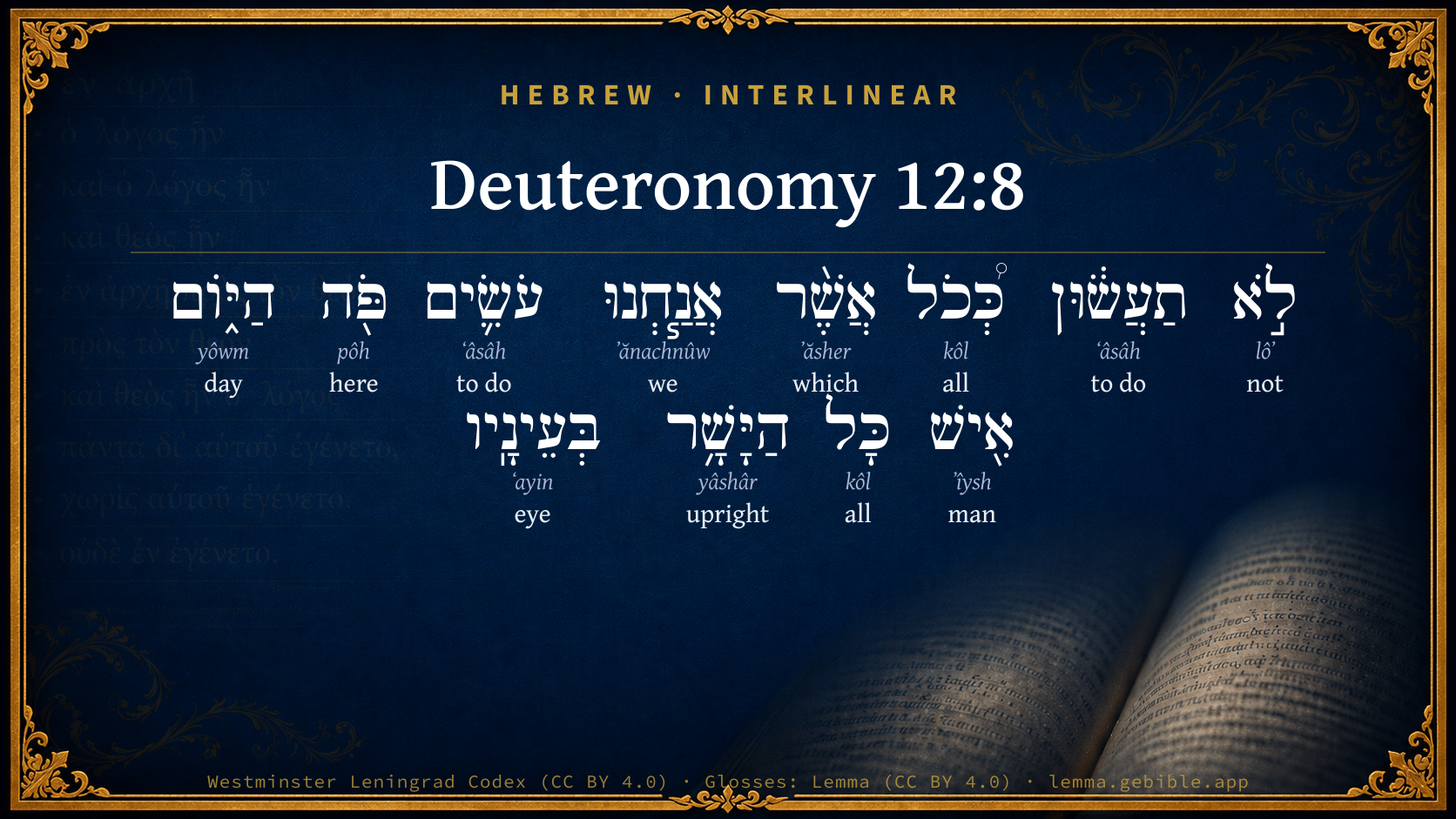
Hebrew (Westminster Leningrad Codex) Deuteronomy 12:8 appears in the Hebrew Old Testament. The text above is from the Westminster Leningrad Codex. Each word links to its Strong’s number, a concise gloss, and parsing drawn from the Open Scriptures Hebrew Bible morphology. Click any word for its full Brown-Driver-Briggs (BDB) entry.
Download image
Cite this verse

Deuteronomy 12:8 (World English Bible). Public Domain. Lemma interlinear Bible study tool, https://lemma.gebible.app/v/deuteronomy/12/8.

Show BibTeX & RIS
BibTeX
RIS
English Translation
You shall not do after all the things that we do here this day, every man whatever is right in his own eyes;
World English Bible · Public Domain
Download a study sheet

One document with this verse’s original text, its word-by-word gloss line, the meaning frame, cross-references with their text, attributed commentary, and full source and license credits — printable, and it pastes into notes with its structure intact.

This verse Autodidact and up

Study sheet (.html) Plain text (.txt)

A passage Seminary Student

Up to 50 verses in one chapter. A passage sheet keeps up to 6 commentary sources and 12 cross-references per verse, in the order this page ranks them, and says so on the sheet whenever that leaves anything out. Ask for a single verse and you get the Autodidact verse sheet above.

Everything on this page stays free to read, with no account — the sheet is a download of what is already on screen, not access to it.

Want to remove ads? Support Godless Engineer
Compare translations 3

The same verse in 3 English versions, stacked beneath the original-language interlinear above. Click any original word for its lexicon entry.

Each is an independent rendering of the whole verse — the interlinear is not word-aligned to these translations.

Highlighted words mark where these versions differ — a whole-verse word diff, not a word-by-word alignment.

  • World English Bible Public Domain
    You shall not do after all the things that we do here this day, every man whatever is right in his own eyes;
  • King James Version Public Domain
    Ye shall not do after all the things that we do here this day, every man whatsoever is right in his own eyes.
  • unfoldingWord Literal Text CC BY-SA 4.0
    You shall not do as everything that we are doing here today, man whatever right in his eyes;

unfoldingWord Literal Text — © unfoldingWord, licensed CC BY-SA 4.0. Word-aligned USFM3 via Door43 (git.door43.org/unfoldingWord/en_ult).

Versions to compare (up to 4)

3 of 4 selected

Show all 18 translations

Every available English version of this verse, each an independent rendering of the whole verse.

  • World English Bible Public Domain
    You shall not do after all the things that we do here this day, every man whatever is right in his own eyes;
  • Berean Standard Bible Public Domain
    You are not to do as we are doing here today, where everyone does what seems right in his own eyes.
  • Majority Standard Bible Public Domain
    You are not to do as we are doing here today, where everyone does what seems right in his own eyes.
  • King James Version Public Domain
    Ye shall not do after all the things that we do here this day, every man whatsoever is right in his own eyes.
  • American Standard Version (1901) Public Domain
    Ye shall not do after all the things that we do here this day, every man whatsoever is right in his own eyes;
  • Revised Version (1885) Public Domain
    Ye shall not do after all the things that we do here this day, every man whatsoever is right in his own eyes:
  • Geneva Bible (1599) Public Domain
    Ye shall not doe after all these things that we doe here this day: that is, euery man whatsoeuer seemeth him good in his owne eyes.
  • Douay-Rheims (1899) Public Domain
    You shall not do there the things we do here this day, every man that which seemeth good to himself.
  • Young's Literal Translation Public Domain
    `Ye do not do according to all that we are doing here to-day, each anything that is right in his own eyes,
  • Literal Standard Version CC BY-SA 4.0
    You do not do according to all that we are doing here today—each [doing] anything that is right in his own eyes—
  • Unlocked Literal Bible CC BY-SA 4.0
    You will not do all the things that we are doing here today; now everyone is doing whatever is right in his own eyes;
  • unfoldingWord Literal Text CC BY-SA 4.0
    You shall not do as everything that we are doing here today, man whatever right in his eyes;
  • Darby Bible Public Domain
    Ye shall not do after all that we do here this day, each one whatever is right in his own eyes.
  • World Messianic Bible Public Domain
    You shall not do all the things that we do here today, every man whatever is right in his own eyes;
  • Webster's Bible Public Domain
    Ye shall not do after all the things that we do here this day, every man whatever is right in his own eyes.
  • Free Bible Version CC BY-SA 4.0
    You're not to do like we're doing here today. At the moment everyone does what they think is right,
  • Bible in Basic English Public Domain
    You are not to do things then in the way in which we now do them here, every man as it seems right to him:
  • JPS Tanakh (1917) Public Domain
    Ye shall not do after all that we do here this day, every man whatsoever is right in his own eyes;

Literal Standard Version (2020), Covenant Press — licensed CC BY-SA 4.0. Text via the HelloAO Bible API (eBible.org). Unlocked Literal Bible (unfoldingWord) — licensed CC BY-SA 4.0. Text via the HelloAO Bible API (eBible.org). unfoldingWord Literal Text — © unfoldingWord, licensed CC BY-SA 4.0. Word-aligned USFM3 via Door43 (git.door43.org/unfoldingWord/en_ult). Free Bible Version, Dr. Jonathan Gallagher — licensed CC BY-SA 4.0. Text via the HelloAO Bible API (eBible.org).

Word by word

More ways to search: Search by grammar → Find every occurrence → Compare this word →

Practice this passage: Drill this verse → Learn its vocabulary →

פֹּ֖ה
pôh
H6311
“here”
Adverb
Part of Speech
Adverb
Full BDB Definition

Origin: probably from a primitive inseparable particle "p" (of demonstrative force) and H1931

TWOT: 1739

here, from here, hither - here - hither
  1. לֹ֣א lôʼ H3808 “not” Particle, Negative
  2. תַעֲשׂ֔וּן ʻâsâh H6213 “to do” Verb, Qal, Imperfect, 2nd Person, Masculine, Plural + Suffix, n
  3. כְּ֠כֹל kôl H3605 “like/as · all” Preposition + Noun, Common, Masculine, Singular, Absolute
  4. אֲשֶׁ֨ר ʼăsher H834 “which” Particle, Relative
  5. אֲנַ֧חְנוּ ʼănachnûw H587 “we” Pronoun, Personal, 1st Person, Common, Plural
  6. עֹשִׂ֛ים ʻâsâh H6213 “doing” Verb, Qal, Participle Active, Masculine, Plural, Absolute
  7. הַיּ֑וֹם yôwm H3117 “the · day” Particle, Definite Article + Noun, Common, Masculine, Singular, Absolute
  8. אִ֖ישׁ ʼîysh H376 “man” Noun, Common, Masculine, Singular, Absolute
  9. כָּל kôl H3605 “all of” Noun, Common, Masculine, Singular, Construct
  10. הַיָּשָׁ֥ר yâshâr H3477 “the · upright” Particle, Definite Article + Adjective, Adjective, Masculine, Singular, Absolute
  11. בְּעֵינָֽיו ʻayin H5869 “in/at · eyes · his” Preposition + Noun, Common, Both, Dual, Construct + Suffix, Personal, 3rd Person, Masculine, Singular

About this verse

These counts appear in no published source. They are computed here, from the morphology-tagged text and Lemma’s own curated glosses. What Lemma adds →

12
words
10
distinct lemmas
Pentateuch
section

Grammatical profile

  • 2 verbs
  • 5 nouns
  • 1 adjective
  • 1 pronoun
  • 1 adverb
  • 2 particles

Verb forms

  • תַעֲשׂ֔וּן Qal · Imperfect
  • עֹשִׂ֛ים Qal · Participle Active

Repetition

Words recur within this verse — often emphatic in Hebrew:

  • תַעֲשׂ֔וּן to do H6213 ×2
  • כְּ֠כֹל all H3605 ×2

Hebrew & Septuagint length

In English translation the verse runs 23 words from the Hebrew and 20 from the Septuagint (LXX English) — closely comparable.

A rough comparison of the two English renderings, which tokenize alike — not a word-level alignment.

Word counts can differ between the Hebrew and the Greek without any difference in meaning — e.g. the Hebrew direct-object marker אֵת has no separate Greek word, and Greek often adds the article ὁ.

In the original languages it is 12 Hebrew tokens and 13 Greek tokens — but the two are counted differently (Hebrew bundles its prefixes and suffixes into one token; the Greek is in lemma form), so that isn’t a like-for-like length.

Cross-references

6

Topical passages linked to Deuteronomy 12:8 in the Treasury of Scripture Knowledge — connected by theme and wording, ordered by reader-vote popularity; previews shown in the World English Bible.

  • Judges 21:25 In those days there was no king in Israel: every man did that which was right in his own eyes.
  • Judges 17:6 In those days there was no king in Israel: every man did that which was right in his own eyes.
  • Proverbs 21:2 Every way of a man is right in his own eyes, But Yahweh weighs the hearts.
  • Numbers 15:39 and it shall be to you for a fringe, that you may look on it, and remember all the commandments of Yahweh, and do them; and that you not follow after your own heart and your own eyes, after which you use to play the prostitute;
  • Acts 7:42 But God turned, and gave them up to serve the host of the sky, as it is written in the book of the prophets, 'Did you offer to me slain animals and sacrifices Forty years in the wilderness, O house of Israel?
  • Amos 5:25 "Did you bring to me sacrifices and offerings in the wilderness forty years, house of Israel?

Cross-references courtesy of OpenBible.info (CC BY 4.0).

Hebrew and Greek witnesses Masoretic Hebrew ↔ Greek Septuagint

The same verse in the two great witnesses to the Old Testament, shown verse-for-verse.

These are two independent witnesses, not word-aligned to each other, and the Septuagint is shown in lemma (dictionary) form.

Hebrew Deuteronomy 12:8 Masoretic · Westminster Leningrad Codex

לֹ֣א תַעֲשׂ֔וּן כְּ֠כֹל אֲשֶׁ֨ר אֲנַ֧חְנוּ עֹשִׂ֛ים פֹּ֖ה הַיּ֑וֹם אִ֖ישׁ כָּל הַיָּשָׁ֥ר בְּעֵינָֽיו

You shall not do after all the things that we do here this day, every man whatever is right in his own eyes;

World English Bible · Public Domain

Greek LXX Deuteronomy 12:8 Septuagint · lemma form

οὐ ποιέω πᾶς ὅς ἐγώ ποιέω ὧδε σήμερον ἕκαστος ὁ ἀρεστός ἐνώπιον αὐτός

You⌃ shall not do altogether as we do here today, every man that which is pleasing in his own sight.

LXX2012 (modern English Septuagint) · Public Domain

On this verse, The Cambridge Bible for Schools and Colleges discusses the Septuagint’s reading. Read the note in Commentary ↓

Hebrew: Westminster Leningrad Codex (CC BY 4.0). Greek: Septuagint (public domain); English from LXX2012 (modern English Septuagint) (Public Domain). How the Septuagint differs from the Hebrew →

Targum (Aramaic paraphrase)

2

The Targum is the ancient Jewish Aramaic paraphrase of the Hebrew Scriptures — an interpretive translation, not the Hebrew text itself. Onkelos (literal) and Pseudo-Jonathan (expansive) render the Torah, and Jonathan the Prophets. Coverage is partial: where no permissively-licensed English translation exists for a verse, only the Aramaic is shown. This is verse-level text, not a word-by-word alignment to the Hebrew.

  1. Targum Onkelos Torah (Genesis–Deuteronomy)
    לָא תַעְבְּדוּן כְּכֹל דִי אֲנַחְנָא עָבְדִין הָכָא יוֹמָא דֵין גְבַר כָּל מָן דְכָשַׁר קֳדָמוֹהִי

    (no public-domain English translation for this verse)

    Targum Onkelos — Aramaic: “Onkelos Genesis” (public domain); “Onkelos Exodus” (public domain); “Onkelos Leviticus” (public domain); “Onkelos Numbers” (public domain); “Onkelos Deuteronomy” (public domain). English: “Sefaria Community Translation” (CC0 1.0 (public-domain dedication)); “J.W. Etheridge. The Targums of Onkelos and Jonathan Ben Uzziel on the Pentateuch. London: Longmans, Green, 1862” (public domain). Text via Sefaria.

  2. Targum Pseudo-Jonathan Torah (Genesis–Deuteronomy)
    לֵיתֵיכוֹן רַשָּׁאִין לְמֶעֱבַד הֵיכְמָא דַאֲנָן עָבְדִין הָכָא יוֹמָא דֵין גְּבַר כָּל דְּכָשַׁר בְּעֵינוֹי

    It will not be lawful for you to do (there) as we do here today, whatever any one thinks fit for himself;

    Targum Pseudo-Jonathan — Aramaic: “Targum Jonathan on Genesis” (public domain); “Targum Jonathan on Exodus” (public domain); “Targum Jonathan on Leviticus” (public domain); “Targum Jonathan on Numbers” (public domain); “Targum Jonathan on Deuteronomy” (public domain). English: “The Targum of Jonathan ben Uzziel, trans. J. W. Etheridge, London, 1862” (public domain). Text via Sefaria.

Commentary

Notes on Deuteronomy 12:8 from classic Christian and Jewish commentators (each source and its license shown beneath its notes). The classic Christian expositions comment on the surrounding passage and are grouped to its opening verse, so a note may address several verses; the Jewish commentaries on the Tanakh (Rashi and others) are per-verse, so they appear only where the commentator wrote on this verse.

Lemma curates 59 commentaries, every one of them public domain or Creative Commons licensed, each selected and text-cleaned for this edition rather than reprinted as found. About our sources →

The Cambridge Bible for Schools and Colleges

gen. ed. J. J. S. Perowne

8–12. Second Statement of the Law of the Single Sanctuary

With a different preface from the first, contrasting Israel’s duty after settlement to concentrate on the one altar, not with the practice of the Canaanites, but with that of Israel itself in the time of the wanderings: for the rest substantially the same as the first statement, and like it in the Pl. address, with one doubtful transition to Sg.: see on Deu_12:9.

Deu_12:8. Ye shall not do after all the things that we do here this day] That is in the time of Moses the speaker, and in Moab; but with reference (as the following vv. indicate) to the ritual practice of Israel during the whole forty years preceding their settlement. There may, however, be also here a reflection of the religious practice of the writer’s own time (Oettli).

every man whatsoever is right in his own eyes] So with regard to the multiplication of local shrines after the settlement in Canaan, Jdg_17:6, cp. Jdg_21:25.

But if Israel and even Moses—we!—worshipped, where every man thought good, what are we to make of P’s account of the institution of the Tabernacle at Sinai, and of its use during the rest of the forty years and of P’s rigorous and exact laws (e.g. Leviticus 17) concerning the ritual? Obviously P either did not exist when D’s law of the one altar was written, or was unknown to its author. Amos agrees with D. His challenge to Israel (Deu_5:25), did ye bring unto Me sacrifices and offerings in the wilderness forty years? expects a negative answer in support of his polemic against all sacrifice. Jeremiah’s report of a word of God (Deu_7:22): I spake not unto your fathers in the day that I brought them out of the land of Egypt concerning burnt offerings or sacrifices is also indicative of the non-existence of P in the 7th century; and though it continues to give expression to the essential contents of the deuteronomic covenant in deuteronomic language it is difficult to reconcile it with such a law as is now before us.

Deu_12:9. for ye are not as yet come to the rest, etc.] The present irregular form of Israel’s worship is excused by their unsettled, wandering condition. It was then inevitable, but if so what becomes of P’s central sanctuary in the wilderness and his rigorous laws for the ritual? To the rest, 1Ki_8:56 (deuteronomic); there the erection of the Temple marks the close of Israel’s struggles for possession of the land: cp. Deu_5:10 b.

the inheritance which the Lord your God is about to give you] See on Deu_4:21. Heb. thy and thee. But probably your and you should be read with Sam. and some LXX codd. (most read our God giveth you). At the same time inheritance is elsewhere used with passages in the Sg. address: if the Sg. be retained here the clause must be a later insertion.

Deu_12:10. when ye go over Jordan] The usual phrase with the Pl., see on Deu_3:18, Deu_4:21; but Deu_9:1 is Sg.

causeth you to inherit] See on Deu_1:38.

giveth you rest, etc.] See on Deu_12:9.

Deu_12:11. See on Deu_12:5 f. where the expressions are the same or similar; only cause his name to dwell there for put his name there (Deu_12:5,); all I am about to command you (cp. Deu_12:14); firstlings and freewill offerings are omitted; and for vows there is choice vows, Heb. all the choice of your vows—ambiguous, and either only the choicest of the things you have vowed (cp. Exo_14:7; Exo_15:4) in which case the form of the law is a modification of the other, or the choice things, your vows. More probable is the former. Of the contrary opinion is Bertholet.

Deu_12:12. See on Deu_12:7 : eat found there is here omitted; and your households is defined as sons, daughters, bondmen and bondmaids, and the Levite within your gates. So Deu_12:18, Deu_16:11; Deu_16:14 (+ stranger, fatherless, widow, cp. Deu_14:29), Deu_5:14 (stranger instead of Levite), Deu_14:26 f. (household and Levite), Deu_26:11 (thou, Levite and stranger). Wives are not mentioned, for they are included in those to whom the law is addressed; a significant fact. The Levite within your gates (the only instance of the phrase with the Pl. address, see on Deu_12:17) is the family or local minister of the ritual, who is deprived of the means of subsistence by the disestablishment of the rural shrines, and hath no portion nor inheritance with you, no land of his own: see on Deu_10:9 and further under Deu_18:1-8.

The Cambridge Bible for Schools and Colleges (gen. ed. J. J. S. Perowne; Cambridge University Press, 1878–1918) — public domain. Text from a community e-Sword module.

The Biblical Illustrator

Joseph S. Exell

Deu_12:8

Ye shall not do after all the things that we do here this day.

Restraint the Christians blessing

The blessing, of which it is now proposed to speak more particularly, is that of being more under control--of having our lives and ways more exactly ordered--than as if we were not Christians. We are now come to the rest and to the inheritance which the Lord our God was so long preparing for us, and therefore we are no longer to think of doing every man what is right in his own eyes. And therefore the gate, into which we must strive to enter, is called strait, and the way which leadeth unto life, narrow. And our Saviour, inviting us to the blessings of the Gospel, describes them as a yoke and a burthen; easy indeed, and light, yet still a yoke and a burthen. And this very circumstance He mentions as a blessing; as the very reason why, coming to Him, the weary and heavy laden might find rest (Mat_11:28). So that it appears that both the law and the Gospel, both Moses and Jesus Christ, consider it a great blessing, a great increase of comfort and happiness, to be kept under strict rules. The Gospel was more strict than the law; and on that very account its subjects were happier. Canaan was a place where men could not do what pleased themselves so much as they could in the wilderness: and it was the more entirely and truly a place of rest. But now this way of thinking is by no means the way of the world. People in general like nothing so much as having their own choice in all things. They account it a burthen, and not a privilege, to be under the government of others. And there is not, one may venture to say, one man in a thousand who would not rather be rich than poor, for this very reason--that a rich man is much more his own master, has much more of his own way in choosing how to spend his time, what company to keep, what employments to follow, than a poor man generally can have. Again, everyone has observed, I might say has experienced, the hurry which children are usually in to get out of the state of childhood and to be left to judge and act for themselves. But the worst, and, unfortunately, the most common instance of this ungovernable temper in mankind is, our unwillingness to let God choose for us, and our impatience under the burthens He lays upon us. How very commonly does it happen that the very condition people chose beforehand, the very place they wished to live in, and the persons they wished to live among, being obtained, becomes the ground of continual complaint and vexation. If they could but change at will, they say, they should like their situation well enough, but now they are tied down to it they cannot, that is, they will not, help being fretful and impatient. Yet this very circumstance of being tied down to rules and not having the power to change at will, is, as we have seen, reckoned a great blessing, both in the Old and New Testament, both by Moses and Jesus Christ. And the contrary (the having to choose for ourselves, and to do what is right in our own eyes), is spoken of as a great disadvantage. So different is the judgment of God from the judgment of men. To have this thought steadily fixed within us, will prove, indeed, the greatest of all blessings, both as to our rest in this world, and as to our inheritance in that which is to come. In whatever counsel and pursuit we are sure we are guided by God, that, we are equally sure, must turn out well in the end; and soberly speaking, what can we wish for more? Once make up your mind to this most certain truth, that what is right in Gods eyes is far better for you than what is right in your own eyes, and you will have but one care in the whole world, i.e. how to please God in making the best use of the present time, a care in which, by His gracious assistance, you are sure not to fail. But it was further said, that this temper of not choosing for ourselves leads directly to our everlasting inheritance in the other world, as well as making sure of our rest and refreshment in this. For it helps us greatly in the performance of our duty, because, in truth, it leaves us nothing else to do. It prepares and trains us for everlasting happiness in heaven. For the very secret of our enjoyment there will be that Gods will shall be ours. We shall behold His works and ways, especially the glory which He has given to His beloved Son our Saviour, and shall rejoice in them as in so much good done to ourselves, more and more thankfully forever. What a beautiful and comfortable thought is this, of the high and noble uses to which, if we will, we may turn all our worst disappointments--the bitterest thoughts of shame and remorse which ever come upon us. We may consider them as part of our heavenly Fathers way of breaking us in, as it were, and training us to the desire and enjoyment of His own blessed presence in heaven. And if even the bitter thought of our past sins may be accompanied with so much of what is comfortable and hopeful, surely we may well leave it to Almighty God to do what He will with us in every other respect. (Plain Sermons by Contributors to Tracts for the Times. )

Life a transitional state of being

Ye are not as yet come to your rest. The present is a temporary and provisional state of things. Such is the reason (Deu_12:9) assigned by the great lawgiver of the Jews for the nonobservance of many, and the imperfect observance of nearly all the statutes and ordinances which he was delivering to them. We are all, he says, to blame. Your leader is no more exempt from human infirmities than yourselves. He is as fond of having his own way, of doing what is right in his own eyes, as any of you. We have all done amiss, and we must all try to do better; and so prepare ourselves for that entirely altered state of circumstances which awaits us as soon as we have crossed the narrow dividing stream; you of Jordan, I of death. In applying these words to the objects of Christian instruction, observe--

I. The uniformity of human character. What describes the natural man in one age or country will suit him equally well at all times and in all countries. What were the Israelites doing in the wilderness? Every man whatsoever was right in his own eyes. This is human nature. We like to have our own way. Restraint is irksome to us. We seek to be independent in our circumstances, in order that we may be so in our actions, and have no ones wishes or feelings to consult but our own. But if human wilfulness shows itself in one direction more than another, it is in our relations to God. Here we meet with no such checks as hem us in on every other side. Here the freedom of our will is not interfered with by the claims of family or the obligations of society. The world looks on, but never thinks of interfering. A mans religion, it holds, is something entirely between God and his conscience. In the concerns of the soul it is commonly said that every man ought to do whatever is right in his own eyes, without any regard to the opinions or feelings of others. What is most agreeable to our feelings, we easily persuade ourselves, is most profitable to our souls; and where we are most profited, where we get most good, as it is called, there we feel sure it is Gods will that we should go. So we wrap it up (Mic_7:3). We settle the matter nominally between God and our consciences, but really between ourselves and our own wayward and corrupt wills.

II. The impropriety of this principle of doing every man whatsoever is right in his own eyes. No day passes without some matters arising which involve the question of not what is right in our own eyes, but what is right in itself, and what is right in the sight of God and man. We are reasonable and accountable creatures. There is a sense of right and wrong implanted in us by nature. We cannot act contrary to it without violating our conscience, and causing a sensible disturbance to our peace of mind. Besides moral, there is also such a thing as positive right, arising out of the declared will of God; and this is just as binding upon our consciences as the other. When it pleased God to promulgate the Fourth Commandment, by that very act He made it a right thing to keep holy the seventh day, and a wrong thing to do our ordinary work thereon, in the eyes of every man who believes in the existence and attributes of the Creator of the world. Unhappily, moral disorder is not attended with the same inconveniences as civil. Men may be lovers of their own selves, covetous, boasters, proud, blasphemers, disobedient to parents, and many other things equally offensive to piety and virtue, without any particular shock to the peaceful and prosperous course of this world. Still, these things ought not so to be. Wrong can never be right. There is one Lawgiver, and one holy and righteous and perfect law. To do as we like is to violate the fundamental law of our being. For none of us liveth to himself, etc. To do that which is right in our own eyes is too often to do that which is abominable in the sight of God.

III. The necessary imperfection of our present state of being. Perfect order and perfect happiness are not to be found on earth, but are reserved for that eternal existence to which this world is but a passage.

1. This thought will reconcile us, in a great degree, to the troubles of life.

2. It will encourage us under our moral failings and imperfections. It may be a poor consolation, but a consolation it certainly is, when we have done amiss, to know that all have sinned, and come short of the glory of God; and that so long as man is man he will do whatsoever is right in his own eyes. Hereafter it will be otherwise. In another world we shall not do after all the things that we do here this day.

3. It will make us tolerant and indulgent to the failings of others. We must take the world as we find it. We must deal with things as they are, not as they ought to be. To bear and to forbear is no small part of our trial. And we cannot be required to show greater forbearance towards others than God is continually exercising towards us.

IV. There is no sentiment so just as not to be liable to perversion and abuse. The necessary imperfection of our present state might be urged as an excuse for those evils and disorders which need not exist, and therefore are inexcusable. But this must not be allowed. Sin must always be protested against. Our nature is corrupt; but that is a reason for striving against it, not for giving way to it. We live in a wicked world; but that should put us on our guard against an unreserved association with the world, or an undue compliance with its ways. Is this all that is required of us--to contend against the evil of our own hearts, and to keep ourselves unspotted from the world? Not so. A Christian has a higher vocation: to make the world better; to season it with the salt of a pure and uncorrupt conversation; to set an example of that self-denying, self-sacrificing spirit which leads to conduct the very opposite of that described in the text. The Christian must be continually reminding both himself and others that what we are all doing here this day may be excused by considerations arising out of the frailty of human nature, but can never be justified. Let us take every opportunity of mortifying those deeds of the body, those sinful desires and depraved inclinations which, if they do not actually deprive us of the rest and the inheritance which the Lord our God giveth us, cannot but make us less fit for it. Let us learn the pleasure of giving up our wills, instead of indulging them; of looking not every man on his own things, but every man also on the things of others; of doing, not every man whatsoever is right in his own eyes, but every man whatsoever is right for him to do--what religion teaches, what conscience justifies, and what God approves.

V. Let us learn from this subject to understand more perfectly, and to appreciate more justly, the Gospel method of salvation. Moses, we are told, was faithful in all his house; as the mediator of that former covenant, he performed his part on the whole faithfully and well; but that was all. He was no redeemer; he could not save his people from their sins. He was a sinner like themselves: the things which, by reason of their frailty, they did there that day, he also did. Christ alone could say, Ye shall not do after all the things which ye do here this day; ye, not we,--excluding Himself from the number of those who do every man whatsoever is right in his own eyes. Of Himself He says, I seek not Mine own will, but the will of the Father which sent Me. I do always those things that please Him. On this principle of seeking Gods glory, not His own--He acted through life, and also became obedient unto death. Without this act we should never have come to that rest, never have attained to that inheritance at all. We should have continued all our lives, as many do to this day, doing every man whatsoever is right in his own eyes; because we should have had no motive or inducement to do otherwise. If we have learnt better things, it is only because we have learnt Christ; learnt Him as the way, the truth, and the life; heard Him, and been taught by Him, as the truth is in Jesus. It remains that we should turn our lessons into practice, by putting off the old man, etc. So shall we leave off by degrees to do after all the things which we do here this day; and under the renewing and sanctifying influence of the Holy Spirit we shall become daily more and more meet for the inheritance of the saints in light, and ripe for that rest which remaineth for the people of God. (Frederick Field, LL. D.)

The Biblical Illustrator, edited by Joseph S. Exell (c. 1880s–1900s) — public domain. Text from a community e-Sword module.

Joseph Benson's Commentary

Deu 12:8. That we do here — Where the inconvenience of the place, and the uncertainty of their abode, would not permit exact order in sacrifices, and feasts, and ceremonies, which therefore God was then pleased to dispense with; but, saith he, he will not do so there. Right in his own eyes — Not that universal liberty was given to all persons to worship how they listed: but in many things their unsettled condition gave opportunity to do so.

Joseph Benson's Commentary on the Old and New Testaments (1811–1818) — public domain. Text from a community e-Sword module.

Tyndale Open Study Notes

Tyndale Open Resources

12:8 doing as you please: Until the Exodus, the Israelites probably worshiped at multiple shrines in Egypt. With the construction of the Tabernacle, worship was centralized and remained so with the later building of the Temple. In the future, the community would be required to assemble on stated occasions to worship the Lord collectively at the central sanctuary, although local worship by individuals, families, and even villages would continue (see Exod 20:24-26; 1 Sam 9:11-14).

Tyndale Open Study Notes — © Tyndale Open Resources, licensed CC BY-SA 4.0. Text via the HelloAO Bible API.

Geneva Bible (1599)

Geneva Bible translators

Not that they sacrificed after their fantasies, but that God would be served more purely in the land of Canaan.

Geneva Bible (1599) marginal notes — public domain. Text via Bolls.life.

Ellicott's Commentary for English Readers

(8) Ye shall not do after all the things that we do here this day.—Another precept strongly marked with the condition of Israel in the wilderness. It has been too much overlooked by recent commentators that the law of Moses has a prophetic side. It was given to him and to Israel at a time when they were not in a position to keep it. It was the law of the land which God would give them. In many ways its observance depended on the completion of the conquest of the land, and upon the quietness of the times in which they lived. This prophetic aspect was certainly not unrecognised by the Jews, or they would not (for example) have neglected to dwell in booths at the Feast of Tabernacles from the time of Joshua to Nehemiah. (See Neh_8:17.)[2]

[2] And compare the curious position of the Jaw in Leviticus which required them to dwell in booths. It occurs as an appendix outside the regular laws of that festival (Lev_23:37-43).

A Bible Commentary for English Readers, edited by Charles John Ellicott (1878–1897) — public domain. Text from a community e-Sword module.

John Gill's Exposition

Ye shall not do after all the things that we do here,.... In the wilderness, where they had no abiding, but were continually removing from place to place, and could not always observe punctually and precisely the exact order and time of their sacrifices and other things, nor offer them at any certain place, and many were doubtless neglected by them; see Amo 5:25.

every man whatsoever is right in his own eyes; that did he, brought the above things when and where he pleased; not that there was no regard had to the laws and rules given, as if there was no priest in Israel; but they were not so exactly in all circumstances conformed to as they would be obliged to when they came into the land of Canaan, and had a certain place to bring their offerings to; so some in Aben Ezra observe, that one would give the firstling, another not, because it depended on the land, or was what they were obliged to only when they came into the land of Canaan; see Exo 13:11 but he thinks the sense is, that they did not all fear God, and so did not do their duty.

John Gill's Exposition of the Whole Bible (1746–1763) — public domain (CC PDM 1.0). Text via the HelloAO Bible API.

Albert Barnes' Notes on the Bible

Moses points out that heretofore they had not observed the prescribed order in their worship, because during their migratory life in the wilderness it had been impossible to do so. During their wanderings there were doubtless times when the tabernacle was not set up for days together, and when the daily sacrifice Num 28:3, together with many other ordinances, were necessarily omitted (compare Jos 5:5). This consideration must be carefully borne in mind throughout Deuteronomy. It illustrates the necessity for a repetition of very much of the Sinaitic legislation, and suggests the reason why some parts are so urgently reiterated and impressed, while others are left unnoticed. Moses now warns the people that as they were about to quit their unsettled mode of life, God’s purpose of choosing for Himself a place to set His Name there would be executed, and the whole of the sacred ritual would consequently become obligatory. The “rest and safety” of Canaan is significantly laid down Deu 12:10-11 as the indispensable condition and basis for an entire fulfillment of the Law: the perfection of righteousness coinciding thus with the cessation of wanderings, dangers, and toils.

Albert Barnes' Notes on the Bible (1834–1885) — public domain. Text from a community e-Sword/MySword module.

Haydock's Catholic Bible Commentary

Himself. Some confine this to the sacrifices, which each person might offer, where he thought proper, till the ark was fixed at Silo. But many other parts of the ceremonial law, seem not to have been in force till the Hebrews crossed the Jordan, Amos v. 25. Circumcision was omitted, as well as most of the festivals. Several laws were, however, designed for the people during their sojournment, such as those which regard the order of judgment, the cleanness of the camp, the purification of women, and of those who had touched a dead body, &c., Exodus xviii. 25., Numbers v. 2., and Leviticus xv. 31. It was not left to their option to observe or to neglect the sabbath, (Numbers xv. 32,) the loaves of proposition, or the perpetual fire, &c., Numbers iv. 7, 13. (Calmet)

George Leo Haydock (1774–1849), Haydock's Catholic Family Bible and Commentary, 1859 edition — public domain. Excludes Psalms (Douay-Rheims chapter numbering differs from Protestant) and Deuterocanonical books (Catholic canon only).

Matthew Poole's English Annotations

Here; where the inconveniency of the place, and the uncertainty of our abode in and removal from several places, would not permit exact order in sacrifices, and feasts, and ceremonies, which therefore God was pleased then to dispense with; but, saith he, he will not do so there.

Every man whatsoever is right in his own eyes; not that universal liberty was given to all persons to worship whom and how they listed, but that in many things their unsettled condition gave every one opportunity to do so if he thought good.

Matthew Poole's English Annotations on the Holy Bible (1683–1685) — public domain. Text from a community e-Sword/MySword module.

Whedon's Commentary on the Bible

Daniel D. Whedon

8. Ye shall not do… the things that we do — During the sojourn in the desert there had not been a rigid adherence to the requirements of the law. Even in the matter of the important rite of circumcision there had been a non-observance for years. See Jos_5:5. But hereafter they are not to do every man whatsoever is right in his own eyes.

Daniel D. Whedon (gen. ed.), Commentary on the Old and New Testaments (1874–1909) — public domain. Text from a community e-Sword module.

The Pulpit Commentary

Vers. 8-10. In the wilderness, while leading a nomadic life, no certain place could be appointed to them for the observance of sacred rites; each man did in that matter as suited his own convenience. But after they were settled in Canaan it should no longer be so; a certain order and fixed locality should be determined for their worship and service; when they had passed over Jordan the Lord would give them rest from all their enemies, and then all irregularity and arbitrariness in the matter of worship must cease, and all their gifts arid offerings must be brought to the place which Jehovah their God should choose. Ye dwell in safety; rather, dwell securely, not only safe from assault, but without fear or anxiety (cf. Jud_1:8:11 18:7)

The Pulpit Commentary (1880–1919), ed. H.D.M. Spence-Jones & Joseph S. Exell — public domain. Text from a community e-Sword module.

John Wesley's Explanatory Notes

Here - Where the inconveniency of the place, and the uncertainty of our abode, would not permit exact order in sacrifices and feasts and ceremonies, which therefore God was then pleased to dispense with; but, saith he, he will not do so there. Right in his own eyes - Not that universal liberty was given to all persons to worship how they listed; but in many things their unsettled condition gave opportunity to do so.

John Wesley, Explanatory Notes Upon the Whole Bible (1754–1765) — public domain. Text via the GEBible commentary corpus.

unfoldingWord translationNotes

Door43 World Missions Community

You will not do all the things that we are doing here today

"You will not do as we are doing here today." This means that they would worship in the promised land differently than the way they were worshiping at that moment.

now everyone is doing whatever is right in his own eyes

The eyes represent seeing, and seeing represents thoughts or judgment. AT: "everyone is doing what he considers to be right" or "now everyone is doing what he judges to be right" (See: Metaphor)

to the rest

The abstract noun "the rest" can be stated as a verb. AT: "to the land where you will rest" (See: Abstract Nouns)

to the inheritance that Yahweh your God is giving you

The land that God is giving to the people of Israel is spoken of as if it were a possession that a father leaves as an inheritance for his children. AT: "to the land that Yahweh your God is giving to you as a permanent possession" (See: Metaphor)

translationWords

rest

inherit

Yahweh

God

unfoldingWord translationNotes — © Distant Shores Media and the Door43 World Missions Community, licensed CC BY-SA 4.0. Source: git.door43.org/Door43/en_tn.

Rashi

Rabbi Shlomo Yitzchaki (Rashi)

לא תעשון ככל אשר אנחנו עשים וגו׳ YE SHALL NOT DO AFTER ALL [THE THINGS] THAT WE DO [HERE THIS DAY] — This refers back to what is stated above (Deuteronomy 11:31) “for ye shall pass over the Jordan etc.”, the meaning being: when ye have crossed the Jordan, you are at once permitted to offer on Bamahs, during all the fourteen years of subjugating and dividing the land amongst the tribes: but on these Bamahs you must not sacrifice all that you sacrifice “here this day”, in the Tabernacle that is with you and that has been anointed and is thus fit to offer sin and guilt offerings and vows and free-will offerings on it, whilst on a Bamah only that may be sacrificed which has been made the subject of a vow or a free-will offering. And that is the meaning of איש כל הישר בעיניו, “every man whatsoever is right in his eyes” — vows and free-will offerings which you dedicate because it is pleasing in your eyes to bring them, and not because of an obligation imposed upon you, such may you offer on Bamahs, but not sacrifices that are to be offered in consequence of an obligation (sin and guilt offerings) (Sifrei Devarim 65:4; Zevachim 117b).

Rashi on the Tanakh — English translations: “The Judaica Press complete Tanach with Rashi, translated by A. J. Rosenberg” (CC BY 4.0); “Pentateuch with Rashi's commentary by M. Rosenbaum and A.M. Silbermann, 1929-1934” (public domain); “The Metsudah Tanach series, Lakewood, N.J” (CC BY 4.0); and “The Book of Joshua, Metsudah Publications, 1997” (CC BY 4.0). Text via Sefaria.

Ramban (Nachmanides)

Rabbi Moshe ben Nachman (Ramban / Nachmanides)

YE SHALL NOT DO AFTER ALL THAT WE DO HERE THIS DAY, EVERY MAN WHATSOEVER IS RIGHT IN HIS OWN EYES. Rabbi Abraham ibn Ezra wrote by way of the plain meaning of Scripture, “they have explained it [as follows]: Because they were journeying from stage to stage, [they brought no offerings from the time they left Mount Sinai until after the death of Aaron in the fortieth year after the exodus. Even after his death] a person could bring an offering at any stage as he wished; there were some who gave the firstling of their flock [to the priest] and others who did not give, since the commandment [to give the firstborn] is dependent on the Land. [Hence the verse before us says that after arriving in the Land we are no longer to do whatever is right in the eyes of each individual.] But this is not my own opinion [continues Ibn Ezra]. Rather, the meaning of the verse is that they were not all G-d-fearing [and they sacrificed to the host of heaven; hence Moses warned them against continuing to do so in the Land of Israel]. And the reason Moses used the word ‘we’ [Ye shall not do after all that ‘we’ do — implying that he, too, participated in such transgressions] is because many commandments relating to the offerings apply only within the Land” [and not in the wilderness; hence, Moses himself had never fulfilled those commandments. He, therefore, included himself among the people]. This is Ibn Ezra’s language. But it is not correct, since it is out of context for the section to speak in terms of reproof [that they were sacrificing to the host of heaven] and to say to them now that they were not observing the commandments of G-d, every man doing what was right in his own eyes. [On the contrary, Verses 4-15 contain a positive discussion of the chosen place that awaited them in the Land of Israel.] And how could Moses our teacher say “We are committing sins!” Forbid it! Instead he should have said “You shall not do after all that ‘you’ have done to this day, every man whatsoever is right in his own eyes.” And what sense was there to include among the sins the commandments that depend on the Land?Rather, the meaning of the verse is as follows: “When the Israelites were in the wilderness they were commanded to slaughter all their cattle and sheep as peace-offerings before the Tabernacle, but they would perform [the Service of the offerings] in whatever place the Tabernacle was [that is, wherever it halted rather than in a fixed location]. And if someone did not care to eat the meat of bullocks or sheep he was not at all obligated to bring an offering. He was also not obligated to bring firstlings, nor the tithe of cattle and the Second Tithe. Thus a person was not bound, ever to bring an offering to the Tabernacle as an obligation, and even on the festivals they were not obligated to come there.. Since that condition was not fulfilled in the desert, they were not yet obligated to observe this commandment. For more on this matter see my Hebrew commentary, p. 399. So also in the wilderness, after the sprinkling of the blood and the burning of the sacrificial fat of the peace-offering [on the altar], the owner might eat it wherever he wished because Scripture did not stipulate a location for it, and therefore they could eat [the peace-offerings both] within the camp and without. Thus there was nothing obligatory upon them in the matter of the offerings; instead every man did that which was right in his own eyes. Therefore he commanded here that after [they would come to] the rest and [to] the inheritance they should not do so. Instead, they are obliged to come to a certain specific place chosen by G-d and bring there the offerings, the tithes, and the firstlings, and eat them there within the precinct before the Eternal. What our Rabbis have said [based on the verse before us] concerning offerings that are not vowed or freely offered [for example, the obligatory Passover-offering], that they may not be offered on a bamah [a private altar set up by an individual, a practice that was permitted during certain periods prior to the erection of the Holy Temple], is an interpretation based on the redundancy of the verse, as explained in the last chapter of Tractate Zebachim, [but the plain meaning of the verse is as we have explained above].

Ramban (Nachmanides) on the Tanakh — English translation: “Commentary on the Torah by Ramban (Nachmanides). Translated and annotated by Charles B. Chavel. New York, Shilo Pub. House, 1971-1976” (CC BY 4.0). Text via Sefaria.

Lesson kit

Teaching starters — assembled from the data on this page, not authored interpretation. Every prompt links to the verse data it draws on. Edit before teaching.

Deuteronomy, in the Pentateuch, opens this verse with 12 words (10 distinct Hebrew lemmas). Its most distinctive word is pôh (“here”). A historical commentator’s framing appears above. Read the whole chapter for the surrounding context.

Discussion questions

  1. How does “here” (pôh) shape what this verse is saying?
  2. Judges 21:25 shares this passage’s theme. How do the two illuminate each other?
  3. “to do” occurs 2× in this one verse. What is the effect of the repetition?
  4. These translations render this verse differently. What is at stake in choosing one wording over another?
  5. The verb «תַעֲשׂ֔וּן» is Qal Imperfect. How does its form color the action?
  6. Reading how The Cambridge Bible for Schools and Colleges and The Biblical Illustrator read this verse, where do the two commentators agree and where do they part?

Things to notice

Reading settings

Reading text

Shown beneath each verse's original-language words.

Old Testament
Old Testament edition

Read the OT as the Masoretic Hebrew (MT) or the Greek Septuagint (LXX).

English shown for the Greek Septuagint (in the Hebrew ↔ Greek comparison).

Comparing translations? Open the Compare panel on any verse page to stack up to four side by side.