Esther 3:11

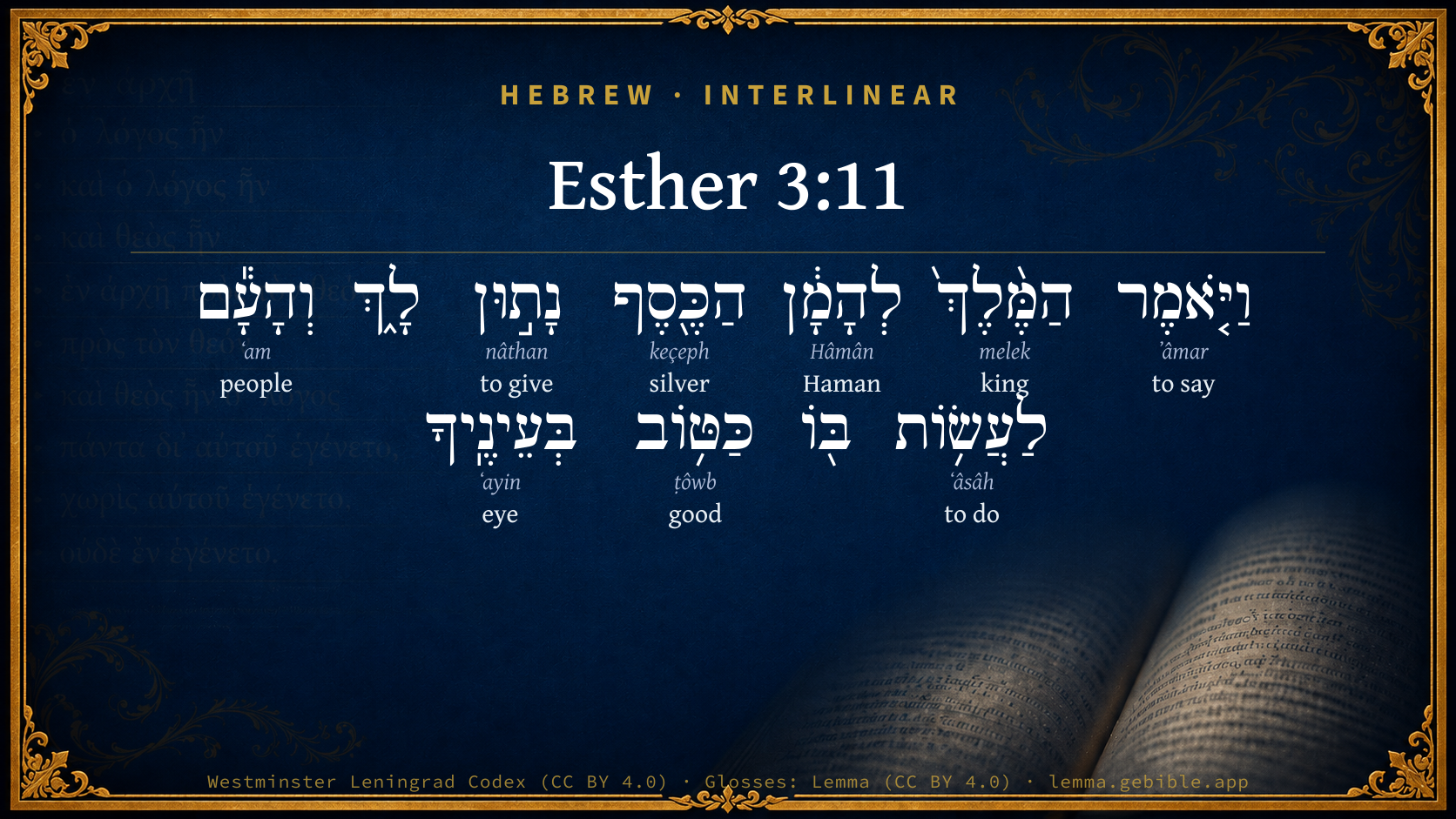
Hebrew (Westminster Leningrad Codex) Esther 3:11 appears in the Hebrew Old Testament. The text above is from the Westminster Leningrad Codex. Each word links to its Strong’s number, a concise gloss, and parsing drawn from the Open Scriptures Hebrew Bible morphology. Click any word for its full Brown-Driver-Briggs (BDB) entry.
Download image
Cite this verse

Esther 3:11 (World English Bible). Public Domain. Lemma interlinear Bible study tool, https://lemma.gebible.app/v/esther/3/11.

Show BibTeX & RIS
BibTeX
RIS
English Translation
The king said to Haman, The silver is given to you, the people also, to do with them as it seems good to you.
World English Bible · Public Domain
Download a study sheet

One document with this verse’s original text, its word-by-word gloss line, the meaning frame, cross-references with their text, attributed commentary, and full source and license credits — printable, and it pastes into notes with its structure intact.

This verse Autodidact and up

Study sheet (.html) Plain text (.txt)

A passage Seminary Student

Up to 50 verses in one chapter. A passage sheet keeps up to 6 commentary sources and 12 cross-references per verse, in the order this page ranks them, and says so on the sheet whenever that leaves anything out. Ask for a single verse and you get the Autodidact verse sheet above.

Everything on this page stays free to read, with no account — the sheet is a download of what is already on screen, not access to it.

Want to remove ads? Support Godless Engineer
Compare translations 3

The same verse in 3 English versions, stacked beneath the original-language interlinear above. Click any original word for its lexicon entry.

Each is an independent rendering of the whole verse — the interlinear is not word-aligned to these translations.

Highlighted words mark where these versions differ — a whole-verse word diff, not a word-by-word alignment.

  • World English Bible Public Domain
    The king said to Haman, The silver is given to you, the people also, to do with them as it seems good to you.
  • King James Version Public Domain
    And the king said unto Haman, The silver is given to thee, the people also, to do with them as it seemeth good to thee.
  • unfoldingWord Literal Text CC BY-SA 4.0
    And the king said to Haman, “The silver is given to you, and the people, to do with them as is good in your eyes.”

unfoldingWord Literal Text — © unfoldingWord, licensed CC BY-SA 4.0. Word-aligned USFM3 via Door43 (git.door43.org/unfoldingWord/en_ult).

Versions to compare (up to 4)

3 of 4 selected

Show all 18 translations

Every available English version of this verse, each an independent rendering of the whole verse.

  • World English Bible Public Domain
    The king said to Haman, The silver is given to you, the people also, to do with them as it seems good to you.
  • Berean Standard Bible Public Domain
    “Keep your money,” said the king to Haman. “These people are given to you to do with them as you please.”
  • Majority Standard Bible Public Domain
    “Keep your money,” said the king to Haman. “These people are given to you to do with them as you please.”
  • King James Version Public Domain
    And the king said unto Haman, The silver is given to thee, the people also, to do with them as it seemeth good to thee.
  • American Standard Version (1901) Public Domain
    And the king said unto Haman, The silver is given to thee, the people also, to do with them as it seemeth good to thee.
  • Revised Version (1885) Public Domain
    And the king said unto Haman, The silver is given to thee, the people also, to do with them as it seemeth good to thee.
  • Geneva Bible (1599) Public Domain
    And the King sayde vnto Haman, Let the siluer be thine, and the people to doe with them as it pleaseth thee.
  • Douay-Rheims (1899) Public Domain
    And he said to him: As to the money which thou promisest, keep it for thyself: and as to the people, do with them as seemeth good to thee.
  • Young's Literal Translation Public Domain
    and the king saith to Haman, `The silver is given to thee, and the people, to do with it as `it is' good in thine eyes.'
  • Literal Standard Version CC BY-SA 4.0
    and the king says to Haman, “The silver is given to you, and the people, to do with it as [it is] good in your eyes.”
  • Unlocked Literal Bible CC BY-SA 4.0
    The king said to Haman, “I will see that the money is given back to you and your people. You will do with it whatever you wish.”
  • unfoldingWord Literal Text CC BY-SA 4.0
    And the king said to Haman, “The silver is given to you, and the people, to do with them as is good in your eyes.”
  • Darby Bible Public Domain
    And the king said to Haman, The silver is given to thee, the people also, to do with them as seems good to thee.
  • World Messianic Bible Public Domain
    The king said to Haman, “The silver is given to you, the people also, to do with them as it seems good to you.”
  • Webster's Bible Public Domain
    And the king said to Haman, The silver is given to thee, the people also, to do with them as it seemeth good to thee.
  • Free Bible Version CC BY-SA 4.0
    The king told Haman, “You can have the money, and do to the people whatever you want.”
  • Bible in Basic English Public Domain
    And the king said to Haman, The money is yours, and the people, to do with them whatever seems right to you.
  • JPS Tanakh (1917) Public Domain
    And the king said unto Haman: 'The silver is given to thee, the people also, to do with them as it seemeth good to thee.'

Literal Standard Version (2020), Covenant Press — licensed CC BY-SA 4.0. Text via the HelloAO Bible API (eBible.org). Unlocked Literal Bible (unfoldingWord) — licensed CC BY-SA 4.0. Text via the HelloAO Bible API (eBible.org). unfoldingWord Literal Text — © unfoldingWord, licensed CC BY-SA 4.0. Word-aligned USFM3 via Door43 (git.door43.org/unfoldingWord/en_ult). Free Bible Version, Dr. Jonathan Gallagher — licensed CC BY-SA 4.0. Text via the HelloAO Bible API (eBible.org).

Word by word

More ways to search: Search by grammar → Find every occurrence → Compare this word →

Practice this passage: Drill this verse → Learn its vocabulary →

לְהָמָ֔ן
Hâmân
H2001
“to/for · Haman”
Preposition + Noun, Proper
Part of Speech
Preposition + Noun
Type
Proper
Full BDB Definition

Origin: of foreign derivation

TWOT: None

Haman = "magnificent" - chief minister of Ahasuerus, enemy of Mordecai and the Jews, who plotted to kill the Jews but, being foiled by Esther, was hanged, with his family, on the gallows he had made for Mordecai
  1. וַיֹּ֤אמֶר ʼâmar H559 “and · to say” Conjunction + Verb, Qal, Sequential Imperfect, 3rd Person, Masculine, Singular
  2. הַמֶּ֨לֶךְ֙ melek H4428 “the · king” Particle, Definite Article + Noun, Common, Masculine, Singular, Absolute
  3. הַכֶּ֖סֶף keçeph H3701 “the · silver” Particle, Definite Article + Noun, Common, Masculine, Singular, Absolute
  4. נָת֣וּן nâthan H5414 “given” Verb, Qal, Participle Passive, Masculine, Singular, Absolute
  5. וְהָעָ֕ם ʻam H5971 “and · the · people” Conjunction + Particle, Definite Article + Noun, Common, Masculine, Singular, Absolute
  6. לַעֲשׂ֥וֹת ʻâsâh H6213 “to do” Preposition + Verb, Qal, Infinitive Construct
  7. כַּטּ֥וֹב ṭôwb H2896 “like/as the · good” Preposition, Determined + Adjective, Adjective, Masculine, Singular, Absolute
  8. בְּעֵינֶֽיךָ ʻayin H5869 “in/at · eyes · your” Preposition + Noun, Common, Both, Dual, Construct + Suffix, Personal, 2nd Person, Masculine, Singular

About this verse

These counts appear in no published source. They are computed here, from the morphology-tagged text and Lemma’s own curated glosses. What Lemma adds →

11
words
9
distinct lemmas
Historical
section

Shared distinctive vocabulary

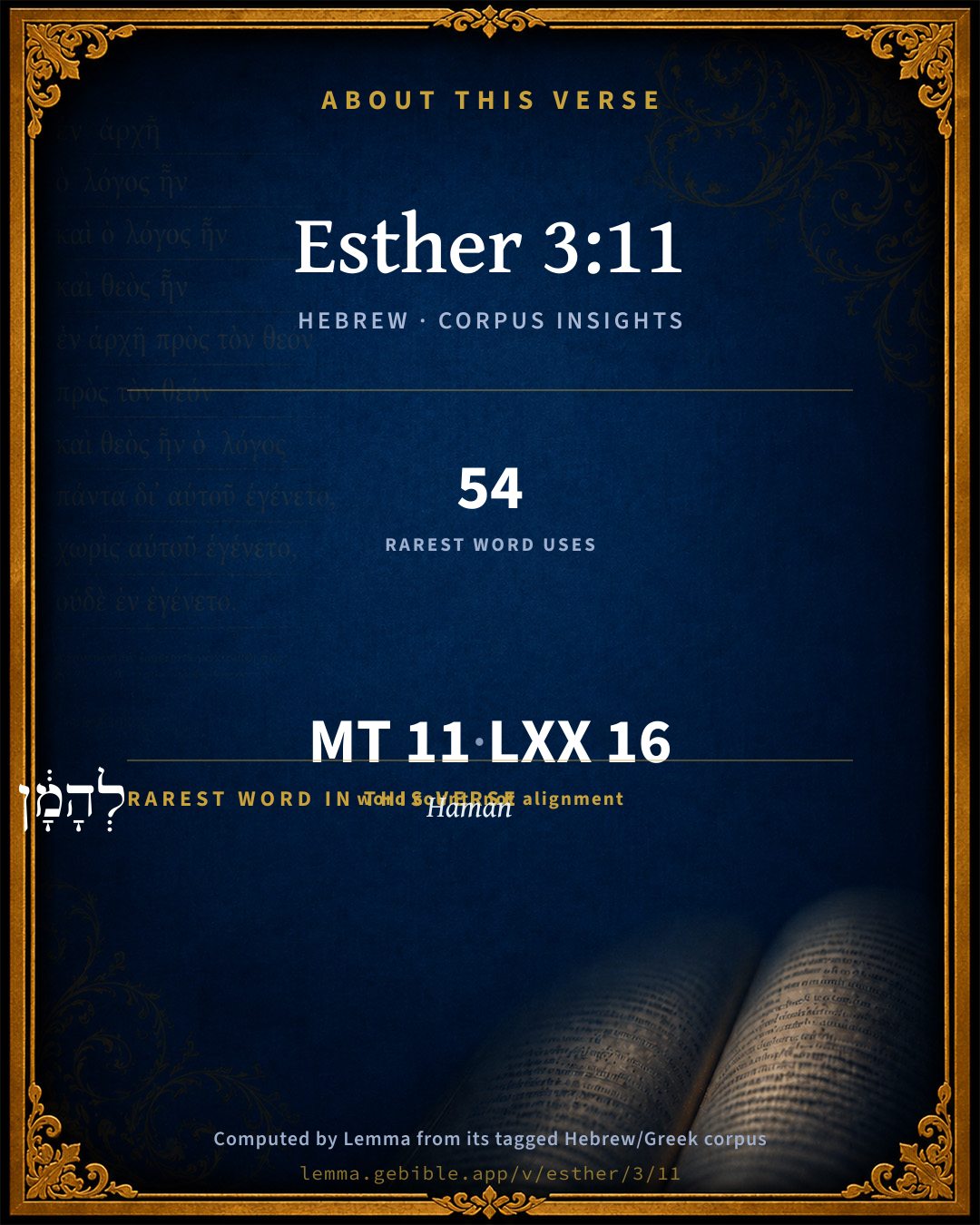
לְהָמָ֔ן Haman H2001 occurs in 45 verses of the Hebrew Bible. Also found in:

Grammatical profile

  • 3 verbs
  • 5 nouns
  • 1 adjective
  • 2 prepositions

Verb forms

  • וַיֹּ֤אמֶר Qal · Sequential Imperfect
  • נָת֣וּן Qal · Participle Passive
  • לַעֲשׂ֥וֹת Qal · Infinitive Construct

Hebrew & Septuagint length

In English translation the verse runs 24 words from the Hebrew and 16 from the Septuagint (LXX English) — the Septuagint runs noticeably shorter here. See the side-by-side →

A rough comparison of the two English renderings, which tokenize alike — not a word-level alignment.

Word counts can differ between the Hebrew and the Greek without any difference in meaning — e.g. the Hebrew direct-object marker אֵת has no separate Greek word, and Greek often adds the article ὁ.

In the original languages it is 11 Hebrew tokens and 16 Greek tokens — but the two are counted differently (Hebrew bundles its prefixes and suffixes into one token; the Greek is in lemma form), so that isn’t a like-for-like length.

Cross-references

4

Topical passages linked to Esther 3:11 in the Treasury of Scripture Knowledge — connected by theme and wording, ordered by reader-vote popularity; previews shown in the World English Bible.

  • Jeremiah 26:14 But as for me, behold, I am in your hand: do with me as is good and right in your eyes.
  • Jeremiah 40:4 Now, behold, I loose you this day from the chains which are on your hand. If it seem good to you to come with me into Babylon, come, and I will look well to you; but if it seem ill to you to come with me into Babylon, forbear: behold, all the land is before you; where it seems good and right to you to go, there go.
  • Luke 23:25 He released him who had been thrown into prison for insurrection and murder, for whom they asked, but he delivered Jesus up to their will.
  • Psalms 73:7 Their eyes bulge with fat. Their minds pass the limits of conceit.

Cross-references courtesy of OpenBible.info (CC BY 4.0).

Hebrew and Greek witnesses Masoretic Hebrew ↔ Greek Septuagint

The same verse in the two great witnesses to the Old Testament, shown verse-for-verse.

Here the Septuagint runs noticeably shorter than the Hebrew — LXX2012 (modern English Septuagint) 16 words vs World English Bible 24. A rough length comparison of the two English translations, not a word-level alignment — read both below.

These are two independent witnesses, not word-aligned to each other, and the Septuagint is shown in lemma (dictionary) form.

Hebrew Esther 3:11 Masoretic · Westminster Leningrad Codex

וַיֹּ֤אמֶר הַמֶּ֨לֶךְ֙ לְהָמָ֔ן הַכֶּ֖סֶף נָת֣וּן לָ֑ךְ וְהָעָ֕ם לַעֲשׂ֥וֹת בּ֖וֹ כַּטּ֥וֹב בְּעֵינֶֽיךָ

The king said to Haman, The silver is given to you, the people also, to do with them as it seems good to you.

World English Bible · Public Domain

Greek LXX Esther 3:11 Septuagint · lemma form

καί εἶπον ὁ βασιλεύς ὁ αμαν ὁ μέν ἀργύριον ἔχω ὁ δέ ἔθνος χράω ὡς βούλομαι

And the king said to Aman, Keep the silver, and treat the nation as you will.

LXX2012 (modern English Septuagint) · Public Domain

Hebrew: Westminster Leningrad Codex (CC BY 4.0). Greek: Septuagint (public domain); English from LXX2012 (modern English Septuagint) (Public Domain). How the Septuagint differs from the Hebrew →

Commentary

Notes on Esther 3:11 from classic Christian and Jewish commentators (each source and its license shown beneath its notes). The classic Christian expositions comment on the surrounding passage and are grouped to its opening verse, so a note may address several verses; the Jewish commentaries on the Tanakh (Rashi and others) are per-verse, so they appear only where the commentator wrote on this verse.

Lemma curates 59 commentaries, every one of them public domain or Creative Commons licensed, each selected and text-cleaned for this edition rather than reprinted as found. About our sources →

Trapp's Complete Commentary

John Trapp

Est 3:11 And the king said unto Haman, The silver [is] given to thee, the people also, to do with them as it seemeth good to thee.

Ver. 11. And the king said unto Haman] Whom he looked upon as an honest, prudent, public spirited man, and therefore so easily empowered him to do what he would.

O vanas hominum mentes! O pectora caeca!

The silver is given unto thee] i.e. The ten thousand talents that thou hast proffered, and which Haman likely purposed to raise out of the spoil of the Jews; all this is remitted, and returned to Haman as a gift again. Sic ex alieno corie gigantes isti latissimas corrigias secant, saith an interpreter here, Such large thongs cut these giants out of other men’s hides. But what meant they thus to sell the hide before they had taken the beast? He that sat in heaven (and had otherwise determined it) laughed at them, the Lord had them in derision, Psa 2:4. "With him" (alone) "is strength and wisdom: the deceived and the deceiver are his. He leadeth counsellors away spoiled, and maketh the judges fools. He leadeth princes away spoiled, and overthroweth the mighty," Job 12:16-17; Job 12:19.

The people also, to do with them] Here Haman was made, here he had more than heart could wish, as Psa 73:7, and holdeth himself, therefore, no doubt, the happiest man under heaven. But nihil sane infelicius est felicitate peccantium, saith Jerome, There cannot befall a man a greater misery than to prosper in sin: for such a one is ripening for ruin, as fatting cattle are fitting for the butcher. They prosper and live at ease, saith God, yet I am extremely displeased with them, Zec 1:15. As they say of the metal they make glass of, it is nearest melting when it shineth brightest; so are the wicked nearest destruction when at greatest lustre. Meanwhile see here what, many times, is the condition of God’s dearest children, viz. to fall into the power and paws of lions, leopards, boars, bears, tigers; of men more savage than any of these, whose tender mercies are mere cruelties. Poor blind men they are that offer violence to the saints, as Samson laid bands upon the pillars, to pluck the house upon their own heads.

To do with them as it seemeth good to thee] Oh bloody sentence! Such words as these Leniter volant, sed non leniter violant. So Dioclesian gave leave to people to kill up Christians, without more ado, wherever they met them; the like was done by authority in the French Massacre; but though tyrants restrain not their agents, yet God will, Psa 76:10. And though they bandy together and bend all their forces to root out true religion; yet are they bounded by him, and shall not do what themselves please, but what he hath appointed. My times are in thine hand, saith David; and Pilate had no more power to crucify Christ than what was given him from above, Joh 19:11.

John Trapp, A Commentary or Exposition upon All the Books of the Old and New Testament (1647–1656) — public domain. Text from a community e-Sword module.

The Biblical Illustrator

Joseph S. Exell

Est_3:11

To do with them as it seemeth good to thee.

The danger of an easy temper

Ahasuerus appears to have been a man of an easy temper, and ready to confer the greatest obligations, without deliberation, on those whom he loved. But there is no true wisdom without judgment and steadiness. A thoughtless man, of an easy temper, is more likely to turn out a vicious than a virtuous character, because in a world where so many more bad than good men are to be met with, he is likely to give up himself to the guidance of those who will lead him out of the way of understanding; or if he should be led in the right path by some of his friends, there are others that will lead him out of it. Ahasuerus would have heaped favours upon the Jews, if Mordecai had been to him at this time what Haman was.

I. Many have not duly distinguished between an easy and a good temper. An easy temper is a very dangerous one, when it is not under the powerful restraints of wisdom. It is vain to boast of a ready compliance with every good motion suggested to us if we are equally ready to comply with bad motions. If we surrender our selves to the direction of our friends, we may soon find that we have given up ourselves to our enemies. He is not our friend who desires to be oar lord.

II. Please men for their good to edification. Be always ready to grant reasonable requests, and to follow good counsels. But you must judge for your selves, by the light which God has given you, what requests are lawful to be granted, and what counsels are worthy to be followed. (G. Lawson.)

The terrors of despotism

I. This history is an illustration of the danger of a one-man power--of an absolute despotism. The liberty that rests on the selfishness, or the inclination of one man, or of a hundred men, is suspended despotism, and if we must choose between the rule of one man, or of thirty, without a written constitution and laws, we should greatly prefer the one. In either case, our property and personal liberty are at the will of human caprice or passion.

II. We see how greatly we are blest, in having a government, not of men, but of just, mild, enlightened and equitable written and published laws, guaranteeing to us liberty in the worship of God, and in the pursuits of life and the enjoyment of our institutions. The King of Persia, in some instances, seems to have been surrounded by the restraints of precedents, yet, in other cases, he could do what he pleased with the lives and property of his subjects. There was no written constitution.

III. We are never to despair of the ark, even when it fall into the hands of the philistines. God will never forsake His people. It is no new thing for the godly to have to suffer persecution. The Jews were misrepresented. Even what Haman said of them that was true was so said as to give a fresh colouring to the whole picture. There is no proof that the Jews were factious under the Persian rule. On the contrary, from the lives of Daniel, Ezra, and Nehemiah we should infer just the opposite. It is an old aspersion of Gods people, to charge them with singularity. Would to God there was more cause for the imputation than there is t The very thing, therefore, that constituted their glory was made their offence. But it is better always to fall into the hands of God than of men. This was Davids choice, and observation approves of it. The very reasons Haman gave for destroying the Hebrews are among the very reasons why God will not let them perish out of the earth. That which whets the sword of men moves the pity of the Almighty. God sometimes leaves His people to come into the greatest peril, that His power may be the more easily seen in their deliverance. Pharaoh was raised up to show His power, and so was Haman. God taketh the wise in their own craftiness, and ensnares the wicked in the works of their own hands. In the darkest hour it is our duty and our highest happiness still to trust in God. (W. A. Scott, D. D.)

The Biblical Illustrator, edited by Joseph S. Exell (c. 1880s–1900s) — public domain. Text from a community e-Sword module.

Joseph Benson's Commentary

Est 3:11. The silver is given to thee — Keep it for thy own use, I do not desire it. I accept thy offer for the deed. So that he gave him power to draw up what decree he pleased, and seal it with the king’s ring; but as for the money, he assured him he would have none of it. What inhumanity was this! to give so many people unheard to death to please a favourite!

Joseph Benson's Commentary on the Old and New Testaments (1811–1818) — public domain. Text from a community e-Sword module.

Ellicott's Commentary for English Readers

(11) And the king said . . .—With indifference which seems incredible, but which is quite in accordance with what we otherwise know of Xerxes, the king simply hands over to his minister the whole nation and their possessions to do with as he will. The king perhaps was glad to throw the cares of government on his minister, and, too indolent to form an opinion for himself, was content to believe that the Jews were a worthless, disloyal people.

A Bible Commentary for English Readers, edited by Charles John Ellicott (1878–1897) — public domain. Text from a community e-Sword module.

The Cambridge Bible for Schools and Colleges

gen. ed. J. J. S. Perowne

11. In the East, confiscation of goods is the invariable accompaniment of capital punishment, and they are forfeited to the crown. At first sight the words seem to mean that the king declines Haman’s offer, and gives him free leave to massacre the Jews, and plunder them for his own benefit. But probably it is implied that the promised payment to the king was to be made out of the spoils. It is clear that the information which Mordecai obtained assured him that the king’s treasuries were to receive the booty (Est_4:7).

The Cambridge Bible for Schools and Colleges (gen. ed. J. J. S. Perowne; Cambridge University Press, 1878–1918) — public domain. Text from a community e-Sword module.

John Gill's Exposition

And the king said unto Haman, the silver is given unto thee,.... The 10,000 talents of silver Haman proposed to pay into the treasury were returned to him, or the king out of his great munificence refused to take them:

the people also, to do with them as seemeth good unto thee; that is, the people of the Jews; he gave him full power to do with them as he thought fit, and who breathing revenge upon them, would not spare them.

John Gill's Exposition of the Whole Bible (1746–1763) — public domain (CC PDM 1.0). Text via the HelloAO Bible API.

Albert Barnes' Notes on the Bible

The silver is given to thee - Some understand this to mean that Xerxes refused the silver which Haman had offered to him; but the passage is better explained as a grant to him of all the property of such Jews as should be executed Est 3:13.

Albert Barnes' Notes on the Bible (1834–1885) — public domain. Text from a community e-Sword/MySword module.

Matthew Poole's English Annotations

The silver is given to thee; keep it to thy own use, I do not desire it, I accept thy offer for the deed.

Matthew Poole's English Annotations on the Holy Bible (1683–1685) — public domain. Text from a community e-Sword/MySword module.

Whedon's Commentary on the Bible

Daniel D. Whedon

11. The silver is given to thee — Instead of bringing the spoil of silver into the royal treasury, Haman is permitted to keep it for himself. Xerxes was the only Persian despot whose favouritism, vanity, and prodigality would readily allow such a loss from his own treasury.

Daniel D. Whedon (gen. ed.), Commentary on the Old and New Testaments (1874–1909) — public domain. Text from a community e-Sword module.

The Pulpit Commentary

The silver is given thee, the people also. Not "the silver which thou hast given me is given back to thee," for the 10, 000 talents had not been given, but only offered. Rather, "the silver of the people is given thee, together with the people themselves, to do with both as it pleases thee." Confiscation always accompanies execution in the East, and the goods of those who are put to death naturally escheat to the crown, which either seizes them or makes a grant of them. Compare ch. 8:11, where the property of those of the Jews" enemies who should suffer death is granted to those who should slay them.

A greedy grand vizier.

silver is given to thee, the people also, to do with them as it seemeth good to thee." One man alone was instrumental in placing the Jews in danger of complete extermination. This happened during the period of their subjection. To supply the record of their wondrous deliverance the Book of Esther, primarily, was written. The man who wrought this danger was Haman, the grand vizier to the king of Persia. He was second only to the king. Through flattering he had attained the coveted position. He was an astute politician, and apparently as unscrupulous as he was cunning. The king heaped riches upon his favourite. He would have Haman"s means adequate to his position. Many houses and much land confiscated, often on the slightest excuse, would be handed over to him. The post of grand vizier would afford ample opportunities of self-enrichment. We read of the conspiracy of Bigthan and Teresh against the king, and of its discovery. To whom would fall the large possessions of these hitherto influential men? What more probable than that the next favourite should receive a great share of their forfeited property?

I IT IS TO THE MATERIAL REWARDS OF OFFICE THAT SUCH MEN AS HAMAN TURN AN EAGER EYE. He well understood the ways of court, so as to secure the tangible results of favouritism. Conceptions of higher honour expand in proportion to elevation. A thought enters his mind to which if he gave utterance his immediate deposition and death would ensue. This thought will leak out by and by. It only needs a fitting opportunity. Nay, it will seize and make an opportunity out of the flimsiest pretext. Meanwhile he is as contented as an ambitious man ever can be. Under an outward calm he is hiding a flame of impatient expectancy. See him going forth from Shushan the palace. The gates are scarcely high enough for the proud-hearted man. Mark that smile on his countenance. Haman is "exceedingly glad of heart." Some further honour has been put upon him, and he goes to his home to reveal it to his friends. Why, may not a man of his calibre be proud? Can his honour ever be eclipsed? Can his glory ever be overshadowed? Can his name, handed down by his many children, ever die? Who can supplant him in the king"s favour, seeing that he knows so well the arts of courtiers, and exercises his office apparently only with respect to the pleasure of the king? Do not all the rest of the courtiers and place-seekers look to him for advancement? Is not his favour, in turn, the sun that "gilds the noble troops waiting upon his smile"? "If ever man may flatter himself in the greatness and security of his glory," thinks Haman, "surely I may do so." Ah, Haman! thy pride is dangerous; it is like a high-heeled shoe, fitting thee only for a fall. Take care, the least stone may cause thee to stumble. Be not over-sure of thy position. Pitfalls are around. Ambition and pride are like heavy, widely-spread canvas on a ship, and need much ballast. Great is thy risk. Thou art like one standing on the narrow apex of a mountain. One false step will set thee rolling to the very abyss.

II WORLDLY POSSESSIONS OR POSITIONS CAN NEVER GIVE FULL SATISFACTION. If they could, the result would have been injurious to man"s moral nature. No thought of higher things entering man"s mind, he would soon be degraded to the level of the brute creation. True pleasure arises from the attainment of some possession or object, but not full satisfaction. It is pleasant to have wealth wherewith to gratify desire, to be able to confer benefits on others; but if we make these things the one aim in life we are sure to reap but little joy. The drawbacks and counter-balancings are great. Much wealth, much furniture, many servants, a large house, and great popularity are only extra anxieties. The pleasure soon passes, the possession soon palls. Still, a man without any passion or aim is simply like "a speaking stone." Yet as a horse, too restive and fiery, puts his rider in danger, so do our passions. Ambition in moderation is an advantage, and few men become very useful who have none; but if give we the reins to our ambition we may be sure that such a fiery charger will dash-away over rocks or into floods to our great hazard. A man when at sea, cares neither for calm nor for a hurricane, but he enjoys a stiff breeze which helps the vessel along and braces his nerves. We suggest, therefore, not the banishment of all ambition, but its moderation; not the despising of all possessions, but that we should not be disappointed if we do not receive so much joy therefrom as we expected. Nay, we may thank God that we cannot live on stones, nor satisfy our hunger with husks; that in us has been cultivated the longing for those things which really afford satisfaction, viz., righteousness, peace, faith, and love. H.

The Pulpit Commentary (1880–1919), ed. H.D.M. Spence-Jones & Joseph S. Exell — public domain. Text from a community e-Sword module.

John Wesley's Explanatory Notes

The silver - Keep it to thy own use; I accept the offer for the deed.

John Wesley, Explanatory Notes Upon the Whole Bible (1754–1765) — public domain. Text via the GEBible commentary corpus.

Lesson kit

Teaching starters — assembled from the data on this page, not authored interpretation. Every prompt links to the verse data it draws on. Edit before teaching.

Esther, in the Historical, opens this verse with 11 words (9 distinct Hebrew lemmas). Its most distinctive word is Hâmân (“Haman”). The Greek Septuagint runs shorter here. A historical commentator’s framing appears above. Read the whole chapter for the surrounding context.

Discussion questions

  1. The word Hâmân carries the sense “Haman.” How does it shape the verse?
  2. Esther 3:1 shares the word «Haman» with this verse. How do the two illuminate each other?
  3. Compared with the Hebrew, the Septuagint runs shorter here. What questions does that raise?
  4. These translations render this verse differently; the difference is in the English rendering, not the original. What questions does that raise?
  5. The verb «וַיֹּ֤אמֶר» is Qal Sequential Imperfect. How does its form color the action?
  6. Reading how Trapp's Complete Commentary and The Biblical Illustrator read this verse, where do the two commentators agree and where do they part?

Things to notice

Reading settings

Reading text

Shown beneath each verse's original-language words.

Old Testament
Old Testament edition

Read the OT as the Masoretic Hebrew (MT) or the Greek Septuagint (LXX).

English shown for the Greek Septuagint (in the Hebrew ↔ Greek comparison).

Comparing translations? Open the Compare panel on any verse page to stack up to four side by side.