
Leviticus 4:13

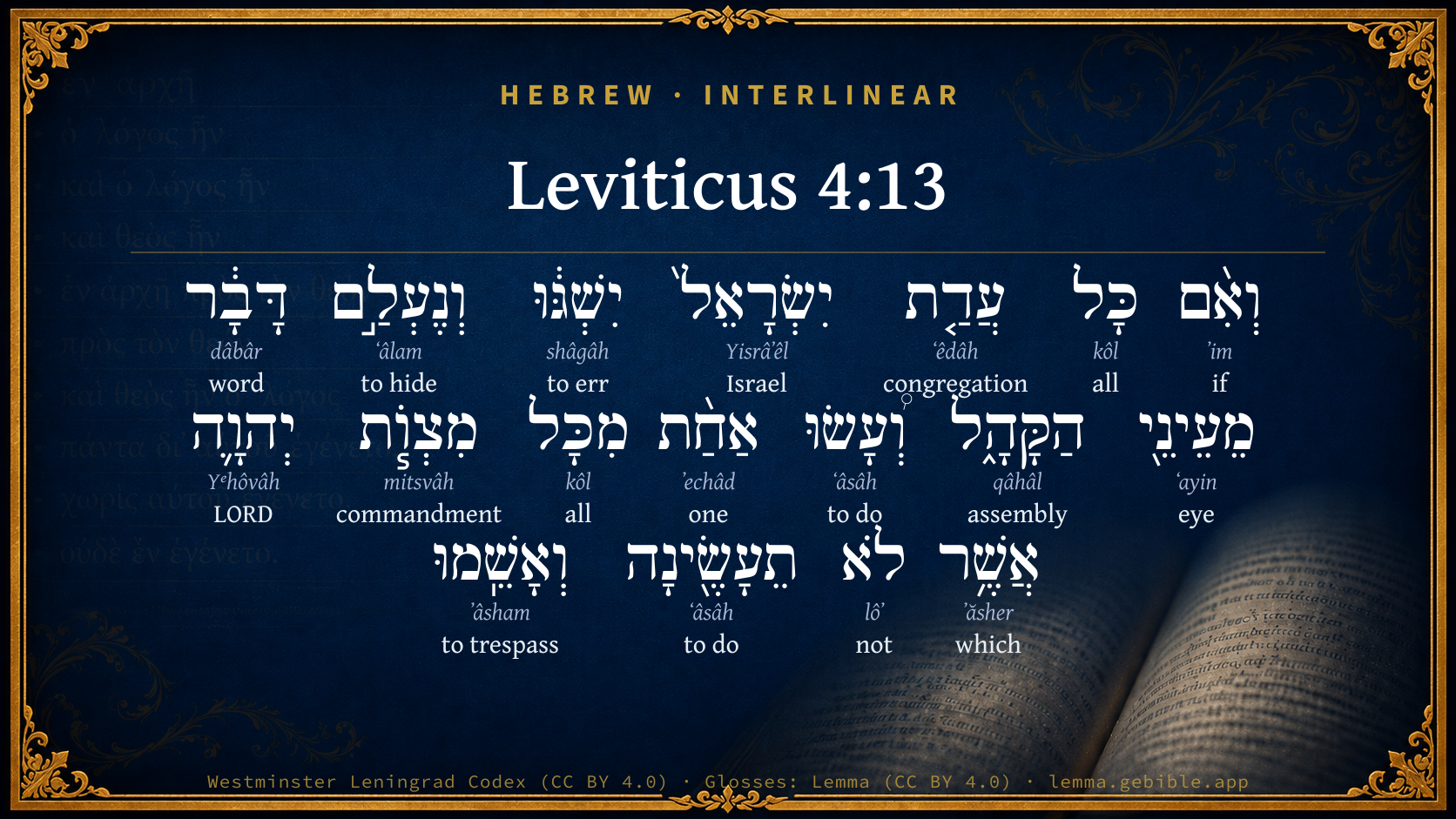
Hebrew (Westminster Leningrad Codex) Leviticus 4:13 appears in the Hebrew Old Testament. The text above is from the Westminster Leningrad Codex. Each word links to its Strong’s number, a concise gloss, and parsing drawn from the Open Scriptures Hebrew Bible morphology. Click any word for its full Brown-Driver-Briggs (BDB) entry.
Download image
Cite this verse

Leviticus 4:13 (World English Bible). Public Domain. Lemma interlinear Bible study tool, https://lemma.gebible.app/v/leviticus/4/13.

Show BibTeX & RIS
BibTeX
RIS
English Translation
"'If the whole congregation of Israel sins, and the thing is hidden from the eyes of the assembly, and they have done any of the things which Yahweh has commanded not to be done, and are guilty;
World English Bible · Public Domain
Highlights
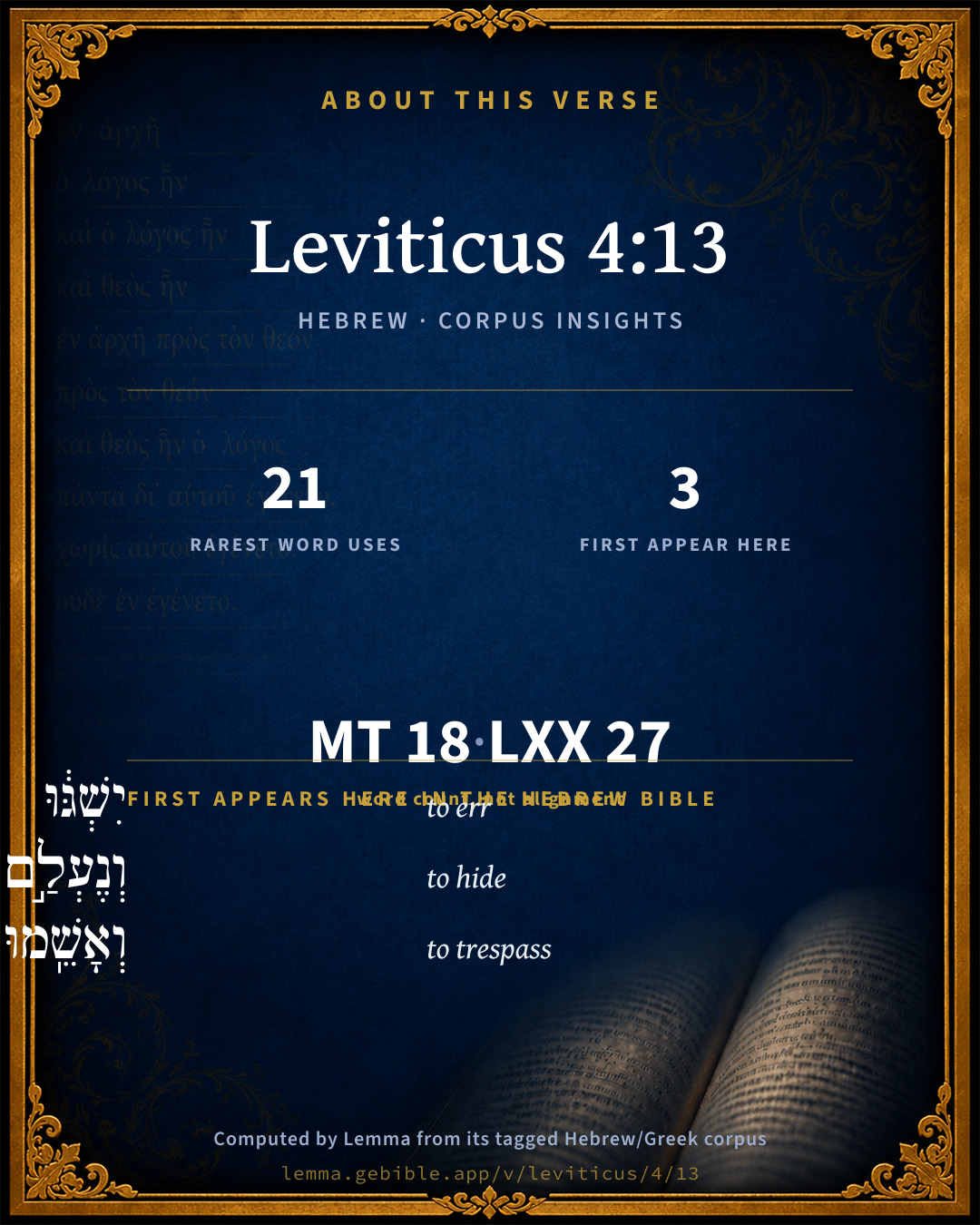
  • 3 first appearances in the Hebrew Bible
Full analysis ↓
Download a study sheet

One document with this verse’s original text, its word-by-word gloss line, the meaning frame, cross-references with their text, attributed commentary, and full source and license credits — printable, and it pastes into notes with its structure intact.

This verse Autodidact and up

Study sheet (.html) Plain text (.txt)

A passage Seminary Student

Up to 50 verses in one chapter. A passage sheet keeps up to 6 commentary sources and 12 cross-references per verse, in the order this page ranks them, and says so on the sheet whenever that leaves anything out. Ask for a single verse and you get the Autodidact verse sheet above.

Everything on this page stays free to read, with no account — the sheet is a download of what is already on screen, not access to it.

Want to remove ads? Support Godless Engineer
Compare translations 3

The same verse in 3 English versions, stacked beneath the original-language interlinear above. Click any original word for its lexicon entry.

Each is an independent rendering of the whole verse — the interlinear is not word-aligned to these translations.

Highlighted words mark where these versions differ — a whole-verse word diff, not a word-by-word alignment.

  • World English Bible Public Domain
    "'If the whole congregation of Israel sins, and the thing is hidden from the eyes of the assembly, and they have done any of the things which Yahweh has commanded not to be done, and are guilty;
  • King James Version Public Domain
    And if the whole congregation of Israel sin through ignorance, and the thing be hid from the eyes of the assembly, and they have done somewhat against any of the commandments of the LORD concerning things which should not be done, and are guilty;
  • unfoldingWord Literal Text CC BY-SA 4.0
    And if the whole congregation of Israel mistakenly errs, and the matter is hidden from the eyes of the assembly, and they do one from all the commands of Yahweh which shall not be done, and they become guilty,

unfoldingWord Literal Text — © unfoldingWord, licensed CC BY-SA 4.0. Word-aligned USFM3 via Door43 (git.door43.org/unfoldingWord/en_ult).

Versions to compare (up to 4)

3 of 4 selected

Show all 18 translations

Every available English version of this verse, each an independent rendering of the whole verse.

  • World English Bible Public Domain
    "'If the whole congregation of Israel sins, and the thing is hidden from the eyes of the assembly, and they have done any of the things which Yahweh has commanded not to be done, and are guilty;
  • Berean Standard Bible Public Domain
    Now if the whole congregation of Israel strays unintentionally and the matter escapes the notice of the assembly so that they violate any of the LORD’s commandments and incur guilt by doing what is forbidden,
  • Majority Standard Bible Public Domain
    Now if the whole congregation of Israel strays unintentionally and the matter escapes the notice of the assembly so that they violate any of the LORD’s commandments and incur guilt by doing what is forbidden,
  • King James Version Public Domain
    And if the whole congregation of Israel sin through ignorance, and the thing be hid from the eyes of the assembly, and they have done somewhat against any of the commandments of the LORD concerning things which should not be done, and are guilty;
  • American Standard Version (1901) Public Domain
    And if the whole congregation of Israel err, and the thing be hid from the eyes of the assembly, and they have done any of the things which Jehovah hath commanded not to be done, and are guilty;
  • Revised Version (1885) Public Domain
    And if the whole congregation of Israel shall err, and the thing be hid from the eyes of the assembly, and they have done any of the things which the LORD hath commanded not to be done, and are guilty;
  • Geneva Bible (1599) Public Domain
    And if the whole Congregation of Israel shall sinne through ignorance, and the thing be hid from the eyes of the multitude, and haue done against any of the commandements of the Lord which should not be done, and haue offended:
  • Douay-Rheims (1899) Public Domain
    And if all the multitude of Israel shall be ignorant, and through ignorance shall do that which is against the commandment of the Lord,
  • Young's Literal Translation Public Domain
    `And if the whole company of Israel err ignorantly, and the thing hath been hidden from the eyes of the assembly, and they have done `something against' one of all the commands of Jehovah `concerning things' which are not to be done, and have been guilty;
  • Literal Standard Version CC BY-SA 4.0
    And if all the congregation of Israel errs ignorantly, and the thing has been hidden from the eyes of the assembly, and they have done [something against] one of all the commands of YHWH [regarding things] which are not to be done, and have been guilty;
  • Unlocked Literal Bible CC BY-SA 4.0
    If the whole assembly of Israel sins without wanting to sin, and the assembly is unaware that they have sinned and done any of the things which Yahweh has commanded not to be done, and if they are guilty,
  • unfoldingWord Literal Text CC BY-SA 4.0
    And if the whole congregation of Israel mistakenly errs, and the matter is hidden from the eyes of the assembly, and they do one from all the commands of Yahweh which shall not be done, and they become guilty,
  • Darby Bible Public Domain
    And if the whole assembly of Israel sin inadvertently, and the thing be hid from the eyes of the congregation, and they do [somewhat against] any of all the commandments of Jehovah [in things] which should not be done, and are guilty;
  • World Messianic Bible Public Domain
    “‘If the whole congregation of Israel sins, and the thing is hidden from the eyes of the assembly, and they have done any of the things which the LORD has commanded not to be done, and are guilty;
  • Webster's Bible Public Domain
    And if the whole congregation of Israel shall sin through ignorance, and the thing be hid from the eyes of the assembly, and they have done somewhat against any of the commandments of the LORD concerning things which should not be done, and are guilty;
  • Free Bible Version CC BY-SA 4.0
    If the whole Israelite community goes astray unintentionally, and even though they are unaware of doing what is not permitted by any of the Lord's commandments, they are all still guilty.
  • Bible in Basic English Public Domain
    And if all the people of Israel do wrong, without anyone's knowledge; if they have done any of the things which by the Lord's order are not to be done, causing sin to come on them;
  • JPS Tanakh (1917) Public Domain
    And if the whole congregation of Israel shall err, the thing being hid from the eyes of the assembly, and do any of the things which the LORD hath commanded not to be done, and are guilty:

Literal Standard Version (2020), Covenant Press — licensed CC BY-SA 4.0. Text via the HelloAO Bible API (eBible.org). Unlocked Literal Bible (unfoldingWord) — licensed CC BY-SA 4.0. Text via the HelloAO Bible API (eBible.org). unfoldingWord Literal Text — © unfoldingWord, licensed CC BY-SA 4.0. Word-aligned USFM3 via Door43 (git.door43.org/unfoldingWord/en_ult). Free Bible Version, Dr. Jonathan Gallagher — licensed CC BY-SA 4.0. Text via the HelloAO Bible API (eBible.org).

Word by word

More ways to search: Search by grammar → Find every occurrence → Compare this word →

Practice this passage: Drill this verse → Learn its vocabulary →

יִשְׁגּ֔וּ
shâgâh
H7686
“to err”
Verb, Qal, Imperfect, 3rd Person, Masculine, Plural
Part of Speech
Verb
Stem
Qal
Form
Imperfect
Person
3rd Person
Gender
Masculine
Number
Plural
Full BDB Definition

Origin: a primitive root

TWOT: 2325

to go astray, stray, err - (Qal) - to err, stray - to swerve, meander, reel, roll, be intoxicated, err (in drunkenness) - to go astray (morally) - to commit sin of ignorance or inadvertence, err (ignorantly) - (Hiphil) - to lead astray - to lead astray, mislead (mentally) - to lead astray (morally)
  1. וְאִ֨ם ʼim H518 “and · if” Conjunction + Conjunction
  2. כָּל kôl H3605 “all of” Noun, Common, Masculine, Singular, Construct
  3. עֲדַ֤ת ʻêdâh H5712 “congregation of” Noun, Common, Feminine, Singular, Construct
  4. יִשְׂרָאֵל֙ Yisrâʼêl H3478 “Israel” Noun, Proper
  5. וְנֶעְלַ֣ם ʻâlam H5956 “and · to hide” Conjunction + Verb, Niphal, Sequential Perfect, 3rd Person, Masculine, Singular
  6. דָּבָ֔ר dâbâr H1697 “word” Noun, Common, Masculine, Singular, Absolute
  7. מֵעֵינֵ֖י ʻayin H5869 “from · eyes of” Preposition + Noun, Common, Both, Dual, Construct
  8. הַקָּהָ֑ל qâhâl H6951 “the · assembly” Particle, Definite Article + Noun, Common, Masculine, Singular, Absolute
  9. וְ֠עָשׂוּ ʻâsâh H6213 “and · to do” Conjunction + Verb, Qal, Sequential Perfect, 3rd Person, Common, Plural
  10. אַחַ֨ת ʼechâd H259 “one” Adjective, Cardinal number, Feminine, Singular, Absolute
  11. מִכָּל kôl H3605 “from · all of” Preposition + Noun, Common, Masculine, Singular, Construct
  12. מִצְוֺ֧ת mitsvâh H4687 “commandments of” Noun, Common, Feminine, Plural, Construct
  13. יְהוָ֛ה Yᵉhôvâh H3068 “LORD” Noun, Proper
  14. אֲשֶׁ֥ר ʼăsher H834 “which” Particle, Relative
  15. לֹא lôʼ H3808 “not” Particle, Negative
  16. תֵעָשֶׂ֖ינָה ʻâsâh H6213 “to do” Verb, Niphal, Imperfect, 3rd Person, Feminine, Plural
  17. וְאָשֵֽׁמוּ ʼâsham H816 “and · to trespass” Conjunction + Verb, Qal, Sequential Perfect, 3rd Person, Common, Plural

About this verse

These counts appear in no published source. They are computed here, from the morphology-tagged text and Lemma’s own curated glosses. What Lemma adds →

18
words
16
distinct lemmas
Pentateuch
section

Notable vocabulary

The rarest word here is יִשְׁגּ֔וּ to err H7686 — appearing just 21 times in the whole Hebrew Bible.

First appearance in Scripture

These words make their first canonical appearance in the Hebrew Bible here:

  • יִשְׁגּ֔וּ to err H7686
  • וְנֶעְלַ֣ם to hide H5956
  • וְאָשֵֽׁמוּ to trespass H816

Shared distinctive vocabulary

יִשְׁגּ֔וּ to err H7686 occurs in 19 verses of the Hebrew Bible. Also found in:

Grammatical profile

  • 5 verbs
  • 9 nouns
  • 1 adjective
  • 1 conjunction
  • 2 particles

Verb forms

  • יִשְׁגּ֔וּ Qal · Imperfect
  • וְנֶעְלַ֣ם Niphal · Sequential Perfect
  • וְ֠עָשׂוּ Qal · Sequential Perfect
  • תֵעָשֶׂ֖ינָה Niphal · Imperfect
  • וְאָשֵֽׁמוּ Qal · Sequential Perfect

Repetition

Words recur within this verse — often emphatic in Hebrew:

  • כָּל all H3605 ×2
  • וְ֠עָשׂוּ to do H6213 ×2

Hebrew & Septuagint length

In English translation the verse runs 37 words from the Hebrew and 43 from the Septuagint (LXX English) — closely comparable.

A rough comparison of the two English renderings, which tokenize alike — not a word-level alignment.

Word counts can differ between the Hebrew and the Greek without any difference in meaning — e.g. the Hebrew direct-object marker אֵת has no separate Greek word, and Greek often adds the article ὁ.

In the original languages it is 18 Hebrew tokens and 27 Greek tokens — but the two are counted differently (Hebrew bundles its prefixes and suffixes into one token; the Greek is in lemma form), so that isn’t a like-for-like length.

Cross-references

12

Topical passages linked to Leviticus 4:13 in the Treasury of Scripture Knowledge — connected by theme and wording, ordered by reader-vote popularity; previews shown in the World English Bible.

  • Leviticus 5:17 "If anyone sins, and does any of the things which Yahweh has commanded not to be done; though he didn't know it, yet he is guilty, and shall bear his iniquity.
  • Leviticus 5:2–5 "'Or if anyone touches any unclean thing, whether it is the carcass of an unclean animal, or the carcass of unclean cattle, or the carcass of unclean creeping things, and it is hidden from him, and he is unclean, then he shall be guilty.
  • Leviticus 4:1–2 Yahweh spoke to Moses, saying,
  • Leviticus 6:4 then it shall be, if he has sinned, and is guilty, he shall restore that which he took by robbery, or the thing which he has gotten by oppression, or the deposit which was committed to him, or the lost thing which he found,
  • Numbers 15:24–29 then it shall be, if it be done unwittingly, without the knowledge of the congregation, that all the congregation shall offer one young bull for a burnt offering, for a sweet savor to Yahweh, with the meal-offering of it, and the drink-offering of it, according to the ordinance, and one male goat for a sin-offering.
  • Joshua 7:11 Israel has sinned; yes, they have even transgressed my covenant which I commanded them: yes, they have even taken of the devoted thing, and have also stolen, and dissembled also; and they have even put it among their own stuff.
  • Joshua 7:24–26 Joshua, and all Israel with him, took Achan the son of Zerah, and the silver, and the mantle, and the wedge of gold, and his sons, and his daughters, and his oxen, and his donkeys, and his sheep, and his tent, and all that he had: and they brought them up to the valley of Achor.
  • Ezra 10:19 They gave their hand that they would put away their wives; and being guilty, [they offered] a ram of the flock for their guilt.
  • Hosea 5:15 I will go and return to my place, until they acknowledge their offense, And seek my face. In their affliction they will seek me earnestly."
  • 1 Corinthians 11:27 Therefore whoever eats this bread or drinks the Lord's cup in a manner unworthy of the Lord will be guilty of the body and the blood of the Lord.
  • 1 Timothy 1:13 although I was before a blasphemer, a persecutor, and insolent. However, I obtained mercy, because I did it ignorantly in unbelief.
  • Hebrews 10:26–29 For if we sin willfully after we have received the knowledge of the truth, there remains no more a sacrifice for sins,

Cross-references courtesy of OpenBible.info (CC BY 4.0).

Hebrew and Greek witnesses Masoretic Hebrew ↔ Greek Septuagint

The same verse in the two great witnesses to the Old Testament, shown verse-for-verse.

These are two independent witnesses, not word-aligned to each other, and the Septuagint is shown in lemma (dictionary) form.

Hebrew Leviticus 4:13 Masoretic · Westminster Leningrad Codex

וְאִ֨ם כָּל עֲדַ֤ת יִשְׂרָאֵל֙ יִשְׁגּ֔וּ וְנֶעְלַ֣ם דָּבָ֔ר מֵעֵינֵ֖י הַקָּהָ֑ל וְ֠עָשׂוּ אַחַ֨ת מִכָּל מִצְוֺ֧ת יְהוָ֛ה אֲשֶׁ֥ר לֹא תֵעָשֶׂ֖ינָה וְאָשֵֽׁמוּ

"'If the whole congregation of Israel sins, and the thing is hidden from the eyes of the assembly, and they have done any of the things which Yahweh has commanded not to be done, and are guilty;

World English Bible · Public Domain

Greek LXX Leviticus 4:13 Septuagint · lemma form

ἐάν δέ πᾶς συναγωγή ἰσραήλ ἀγνοέω ἀκουσίως καί λανθάνω ῥῆμα ἐκ ὀφθαλμός ὁ συναγωγή καί ποιέω εἷς ἀπό πᾶς ὁ ἐντολή κύριος ὅς οὐ ποιέω καί πλημμελέω

And if the whole congregation of Israel trespass ignorantly, and a thing should escape the notice of the congregation, and they should do one thing forbidden of any of the commands of the Lord, which ought not to be done, and should transgress:

LXX2012 (modern English Septuagint) · Public Domain

On this verse, Haydock's Catholic Bible Commentary discusses the Septuagint’s reading. Read the note in Commentary ↓

Hebrew: Westminster Leningrad Codex (CC BY 4.0). Greek: Septuagint (public domain); English from LXX2012 (modern English Septuagint) (Public Domain). How the Septuagint differs from the Hebrew →

Targum (Aramaic paraphrase)

2

The Targum is the ancient Jewish Aramaic paraphrase of the Hebrew Scriptures — an interpretive translation, not the Hebrew text itself. Onkelos (literal) and Pseudo-Jonathan (expansive) render the Torah, and Jonathan the Prophets. Coverage is partial: where no permissively-licensed English translation exists for a verse, only the Aramaic is shown. This is verse-level text, not a word-by-word alignment to the Hebrew.

  1. Targum Onkelos Torah (Genesis–Deuteronomy)
    וְאִם כָּל כְּנִשְׁתָּא דְיִשְׂרָאֵל יִשְׁתְּלוּן וִיהֵי מְכַסָא פִּתְגָמָא מֵעֵינֵי קְהָלָא וְיַעְבְדוּן חָד מִכָּל פִּקוּדַיָא דַיְיָ דִי לָא כָשְׁרִין לְאִתְעֲבָדָא וִיחוֹבוּן

    (no public-domain English translation for this verse)

    Targum Onkelos — Aramaic: “Onkelos Genesis” (public domain); “Onkelos Exodus” (public domain); “Onkelos Leviticus” (public domain); “Onkelos Numbers” (public domain); “Onkelos Deuteronomy” (public domain). English: “Sefaria Community Translation” (CC0 1.0 (public-domain dedication)); “J.W. Etheridge. The Targums of Onkelos and Jonathan Ben Uzziel on the Pentateuch. London: Longmans, Green, 1862” (public domain). Text via Sefaria.

  2. Targum Pseudo-Jonathan Torah (Genesis–Deuteronomy)
    וְאִין כָּל כְּנִישְׁתָּא דְיִשְרָאֵל יִשְׁתְּלוּן וְיִתְכַּסֵי פִּתְגַם מִן מֵחְמֵי קְהָלָא וְיַעֲבְדוּן בְּשָׁלוּ מִן חַד מִן כָּל פִּקוּדַיָא דַיְיָ דְלָא כַשְׁרִין לְאִתְעֲבָדָא וְיִתְחַיְיבוּן

    And if the whole congregation of Israel have erred, and the thing hath been hidden from the sight of the congregation in doing inadvertently against one of the commandments of the Lord what was not right to be done, and (thus) have sinned;

    Targum Pseudo-Jonathan — Aramaic: “Targum Jonathan on Genesis” (public domain); “Targum Jonathan on Exodus” (public domain); “Targum Jonathan on Leviticus” (public domain); “Targum Jonathan on Numbers” (public domain); “Targum Jonathan on Deuteronomy” (public domain). English: “The Targum of Jonathan ben Uzziel, trans. J. W. Etheridge, London, 1862” (public domain). Text via Sefaria.

Commentary

Notes on Leviticus 4:13 from classic Christian and Jewish commentators (each source and its license shown beneath its notes). The classic Christian expositions comment on the surrounding passage and are grouped to its opening verse, so a note may address several verses; the Jewish commentaries on the Tanakh (Rashi and others) are per-verse, so they appear only where the commentator wrote on this verse.

Lemma curates 59 commentaries, every one of them public domain or Creative Commons licensed, each selected and text-cleaned for this edition rather than reprinted as found. About our sources →

Ellicott's Commentary for English Readers

(13) And if the whole congregation.—As the whole Church, in its corporate body, is no more exempt from human frailty than its highest spiritual chief, the law now prescribes the sin offering for the congregation (Lev_4:13-21). The case here assumed is that of the whole congregation having ignorantly committed some act which at the time of its committal they believed to be lawful, but which they afterwards discovered to be sinful. The two terms respectively rendered in the Authorised Version by congregation and assembly denote the same body of people, and are used interchangeably, so that the same congregation or assembly which inadvertently committed the sin afterwards recognised it. (Comp. Num_15:24-26.) An instance of such a national and congregational sin is recorded in 1Sa_14:32, where we are told that the Israelites, after smiting the Philistines, “flew upon the spoil, and took sheep, and oxen, and calves, and slew them on the ground, and the people did eat them with the blood.” According to the ancient interpretation, however, which obtained at the time of Christ, “the whole congregation of Israel” and “the assembly” here spoken of denote the great Sanhedrin, the representatives of the people, who, through error, might proclaim a decree calculated to mislead the nation, thus accounting for the apparent discrepancy between this passage and Num_15:22-26.

A Bible Commentary for English Readers, edited by Charles John Ellicott (1878–1897) — public domain. Text from a community e-Sword module.

Trapp's Complete Commentary

John Trapp

Lev 4:13 And if the whole congregation of Israel sin through ignorance, and the thing be hid from the eyes of the assembly, and they have done [somewhat against] any of the commandments of the LORD [concerning things] which should not be done, and are guilty;

Ver. 13. And if the whole congregation.] Particular congregations, then, may err for a season; though not finally, fundamentally, if they be "the congregation of saints," {Psa 89:5} and not "the congregation of hypocrites," {Job 15:34} the Church malignant.

And they have done somewhat.] Either by transgression or disobedience, {Heb 2:2} omission or commission.

John Trapp, A Commentary or Exposition upon All the Books of the Old and New Testament (1647–1656) — public domain. Text from a community e-Sword module.

The Biblical Illustrator

Joseph S. Exell

Lev_4:13-21

If the whole congregation.

., sin.

Responsibility of communities and nations

Israel was taught by this law, as we are, that responsibility attaches not only to each individual person, but also to associations of individuals in their corporate character, as nations, communities, and--we may add--all societies and corporations, whether secular or religious. Never has a generation needed this reminder more than our own. The political and social principles which, since the French Revolution in the end of last century, have been, year by year, more and more generally accepted among the nations of Christendom, are everywhere tending to the avowed or practical denial of this most important truth. It is a maxim ever more and more extensively accepted as almost axiomatic in our modern democratic communities, that religion is wholly a concern of the individual; and that a nation or community, as such, should make no distinction between various religions as false or true, but maintain an absolute neutrality, even between Christianity and idolatry, or theism and atheism. It should take little thought to see that this modern maxim stands in direct opposition to the principle assumed in this law of the sin-offering; namely, that a community or nation is as truly and directly responsible to God as the individual in the nation. But this corporate responsibility the spirit of the age squarely denies. Not that all indeed, in our modern so-called Christian nations have come to this. But no one will deny that this is the mind of the vanguard of nineteenth-century liberalism in religion and politics. Many of our political leaders in all lands make no secret of their views on the subject. A purely secular state is everywhere held up, and that with great plausibility and persuasiveness, as the ideal of political government; the goal to the attainment of which all good citizens should unite their efforts. It is not strange, indeed, to see atheists, agnostics, and others who deny the Christian faith, maintaining this position; but when we hear men who call themselves Christians--in many cases, even Christian ministers--advocating, in one form or another, governmental neutrality in religion, as the only right basis of government, one may well be amazed. Will any one venture to say that this teaching of the law of the sin-offering was only intended, like the offering itself, for the old Hebrews? Is it not rather the constant and most emphatic teaching of the whole Scriptures, that God dealt with all the ancient Gentile nations on the same principle? The history which records the overthrow of those old nations and empires does so, even professedly, for the express purpose of calling the attention of men in all ages to this principle, that God deals with all nations as under obligation to recognise Himself as King of nations, and submit in all things to His authority. So it was in the case of Moab, of Ammon, of Nineveh, and Babylon; in regard to each of which we are told, in so many words, that it was because they refused to recognise this principle of national responsibility to the one true God, which was brought before Israel in this part of the law of the sin-offering, that the Divine judgment came upon them in their utter national overthrow. How awfully plain, again, is the language of the second Psalm on this subject, where it is precisely this national repudiation of the supreme authority of God and of His Christ, so increasingly common in our day, which is named as the ground of the derisive judgment of God, and is made the occasion of exhorting all nations, not merely to belief in God, but also to the obedient recognition of His only-begotten Son, the Messiah, as the only possible means of escaping the future kindling of His wrath. (S. H. Kellogg, D. D.)

Multitude no excuse for offence

Note how a multitude of offenders excuseth no, offence: but if even the whole congregation should sin through ignorance, yet a sin-offering must be offered by them all, and their number yieldeth no excuse. Great was the number of sinners when God sent the flood, but their number defended them not. So in Sodom and Gomorrah the offenders were many. Ten tribes of twelve fell away from God and became idolaters. Broad is the way that leadeth to hell, and many find it, going to hell, though they be many, &c. Secondly, observe with yourself the praise (hid from your eyes) and see the state of many a man and woman do evil. The matter is hid from their eyes in Gods anger, and albeit they lie at the pits brink of destruction, yet they see it not, feel it not, are not troubled with it. Because, indeed, they never sit and take an account of themselves and their works, laying them to the rule of the word: which if they did, conscience would quickly bite and spy, and speak of a misdoing. The godly do this at last, and therefore you see it here in your chapter, a time of knowing to them, as there was a time of hiding. Pray we ever for this grace, that we sleep not in death: I mean in sin, that leadeth to death, but that we may awake and stand up from the dead, and Jesus Christ vouchsafe us light, to amendment of life, and eternal comfort and safety. (Bp. Babington.)

Some difference between the sacrifice of the priest and that of the people

1. It is said when the sin which they have committed is known this was not rehearsed before in the sacrifice of the priest to show that the priests for the most part do sin wittingly, but the people through ignorance.

2. In the other sacrifice the priest alone was to put his hand upon the head of the sacrifice; but here the elders are to lay on their hands both in their own name and of all the people.

3. Here is added Lev_4:20, and the priest shall make atonement for them, which was not expressed before, because the priest before offered sacrifice for his own sin, and so could not be a mediator for himself. Herein the priest interceding for the people was a type of Christ who is the only effectual Intercessor both for sin of priest and people.

4. This congregation here offending may represent the synagogue of the Jews who put Christ to death, crying, Crucify Him; but they did it of ignorance as St. Peter saith: and now I know, brethren, that through ignorance ye did it, and as here a sacrifice is appointed after the people came to the knowledge of their sin, so there St. Peter exhorteth the people to acknowledge and confess their sin, repent and turn, that your sins may be put away; and as here the elders put their hands upon the sacrifice, so the elders, rulers, and governors, had their hand in Christs death. (A. Willet, D. D.)

The Biblical Illustrator, edited by Joseph S. Exell (c. 1880s–1900s) — public domain. Text from a community e-Sword module.

Joseph Benson's Commentary

Lev 4:13-14. The whole congregation — The body of the people, or the greater part of them, their rulers concurring with them. A bullock — But if the sin of the congregation was only the omission of some ceremonial duty, a kid of the goats was to be offered, Num 15:24.

Joseph Benson's Commentary on the Old and New Testaments (1811–1818) — public domain. Text from a community e-Sword module.

Whedon's Commentary on the Bible

Daniel D. Whedon

SIN OF THE CONGREGATION, Lev_4:13-21.

13. Whole congregation… sin — It is not to be supposed that so great a multitude should each be guilty of the same inadvertent sin, except it be some defect in worship or some deviation from the letter of the law arising out of their peculiar circumstances, as in 1Sa_14:32-35. It is this presumptive sin of the whole congregation of Christian worshippers which renders it eminently appropriate for the Lord’s Prayer, with its petition for forgiveness of debts, to be repeated in every assembly. The sin of the whole congregation was to be expiated in the same way with the sin of the priest, except that the elders, as their representatives, laid their hands upon the victim.

Daniel D. Whedon (gen. ed.), Commentary on the Old and New Testaments (1874–1909) — public domain. Text from a community e-Sword module.

Geneva Bible (1599)

Geneva Bible translators

The multitude excuseth not the sin, but if all have sinned, they must all be punished.

Geneva Bible (1599) marginal notes — public domain. Text via Bolls.life.

Matthew Henry's Commentary

This is the law for expiating the guilt of a national sin, by a sin offering. If the leaders of the people, through mistake concerning the law, caused them to err, when the mistake was discovered an offering must be brought, that wrath might not come upon the whole congregation. Observe, 1. It is possible that the church may err, and that her guides may mislead her. It is here supposed that the whole congregation may sin, and sin through ignorance. God will always have a church on earth; but he never said it should be infallible, or perfectly pure from corruption on this side heaven. 2. When a sacrifice was to be offered for the whole congregation, the elders were to lay their hands upon the head of it (three of them at least), as representatives of the people and agents for them. The sin we suppose to have been some common custom, taken up and used by the generality of the people, upon presumption of its being lawful, which afterwards, upon search, appeared to be otherwise. In this case the commonness of the usage received perhaps by tradition from their fathers, and the vulgar opinion of its being lawful, would not so far excuse them from sin but that they must bring a sacrifice to make atonement for it. There are many bad customs and forms of speech which are thought to have no harm in them, and yet may bring guilt and wrath upon a land, which therefore it concerns the elders both to reform and to intercede with God for the pardon of, Joe 2:16. 3. The blood of this sin-offering, as of the former, was to be sprinkled seven times before the Lord, Lev 4:17. It was not to be poured out there, but sprinkled only; for the cleansing virtue of the blood of Christ was then and still is sufficiently signified and represented by sprinkling, Isa 52:15. It was to be sprinkled seven times. Seven is a number of perfection, because when God had made the world in six days he rested the seventh; so this signified the perfect satisfaction Christ made, and the complete cleansing of the souls of the faithful by it; see Heb 10:14. The blood was likewise to be put upon the horns of the incense-altar, to which there seems to be an allusion in Jer 17:1, where the sin of Judah is said to be graven upon the horns of their altars. If they did not forsake their sins, the putting of the blood of their sin-offerings upon the horns of their altars, instead of taking away their guilt, did but bind it on the faster, perpetuated the remembrance of it, and remained a witness against them. It is likewise alluded to in Rev 9:13, where a voice is heard from the four horns of the golden altar; that is, an answer of peace is given to the prayers of the saints, which are acceptable and prevalent only by virtue of the blood of the sin-offering put upon the horns of that altar; compare Rev 8:3. 4. When the offering is completed, it is said, atonement is made, and the sin shall be forgiven, Lev 4:20. The promise of remission is founded upon the atonement. It is spoken here of the forgiveness of the sin of the whole congregation, that is, the turning away of those national judgments which the sin deserved. Note, The saving of churches and kingdoms from ruin is owing to the satisfaction and mediation of Christ.

Matthew Henry's Commentary on the Whole Bible (1708–1710) — public domain (CC PDM 1.0). Text via the HelloAO Bible API.

Jamieson, Fausset & Brown

Robert Jamieson, A. R. Fausset & David Brown

if the whole congregation of Israel sin through ignorance--In consequence of some culpable neglect or misapprehension of the law, the people might contract national guilt, and then national expiation was necessary. The same sacrifice was to be offered as in the former case, but with this difference in the ceremonial, that the elders or heads of the tribes, as representing the people and being the principal aggressors in misleading the congregation, laid their hands on the head of the victim. The priest then took the blood into the holy place, where, after dipping his finger in it seven times, he sprinkled the drops seven times before the veil. This done, he returned to the court of the priests, and ascending the altar, put some portion upon its horns; then he poured it out at the foot of the altar. The fat was the only part of the animal which was offered on the altar; for the carcass, with its appurtenances and offals, was carried without the camp, into the place where the ashes were deposited, and there consumed with fire.

Jamieson, Fausset & Brown — Commentary Critical and Explanatory on the Whole Bible (1871) — public domain (CC PDM 1.0). Text via the HelloAO Bible API.

Adam Clarke's Commentary

Verse 13. If the whole congregation of Israel sin] This probably refers to some oversight in acts of religious worship, or to some transgression of the letter of the law, which arose out of the peculiar circumstances in which they were then found, such as the case mentioned 1Sa 14:32, c., where the people, through their long and excessive fatigue in their combat with the Philistines, being faint, flew on the spoil, and took sheep, oxen, and calves, and slew them on the ground, and did eat with the blood and this was partly occasioned by the rash adjuration of Saul, mentioned 1Sa 14:24: Cursed be the man that eateth any food until evening.

The sacrifices and rites in this case were the same as those prescribed in the preceding, only here the elders of the congregation, i. e., three of the sanhedrim, according to Maimonides, laid their hands on the head of the victim in the name of all the congregation.

Adam Clarke's Commentary on the Bible (1810–1826) — public domain. Text from a community e-Sword/MySword module.

The Cambridge Bible for Schools and Colleges

gen. ed. J. J. S. Perowne

13–21. The Sin-Offering for the congregation, a bullock

The Cambridge Bible for Schools and Colleges (gen. ed. J. J. S. Perowne; Cambridge University Press, 1878–1918) — public domain. Text from a community e-Sword module.

John Gill's Exposition

When the sin which they have sinned against it,.... Any of the commandments of the Lord forbidding such a thing to be done:

is known; is made known to them by the priest, or any other, so that they are convinced that what has been done is wrong, though done through ignorance:

then the congregation shall offer a young bullock for the sin, and bring him before the tabernacle of the congregation; the same offering with that of the anointed priest, he being, as Aben Ezra on the place observes, equal to all Israel.

John Gill's Exposition of the Whole Bible (1746–1763) — public domain (CC PDM 1.0). Text via the HelloAO Bible API.

Albert Barnes' Notes on the Bible

Congregation ... assembly - Each of the Hebrew words signifies the people in a collected body. It does not appear that there is any difference between them in the connection in which they are here used.

Albert Barnes' Notes on the Bible (1834–1885) — public domain. Text from a community e-Sword/MySword module.

Haydock's Catholic Bible Commentary

Multitude assembled. Septuagint add, "be involuntarily ignorant, and no one of the congregation perceive the truth, (or word,) and shall transgress, by commission or omission, one of all the precepts of the Lord." Such was the offence of Saul and the people, 1 Kings xiv. 33. On these occasions, the elders were to put their hands on the victim, to acknowledge the general offence, if it were not of too heinous a nature to be expiated by sacrifice. See Deuteronomy xiii. 12.

George Leo Haydock (1774–1849), Haydock's Catholic Family Bible and Commentary, 1859 edition — public domain. Excludes Psalms (Douay-Rheims chapter numbering differs from Protestant) and Deuterocanonical books (Catholic canon only).

Matthew Poole's English Annotations

The whole congregation; the body of the people, or the greater part of them, their rulers concurring with them.

Matthew Poole's English Annotations on the Holy Bible (1683–1685) — public domain. Text from a community e-Sword/MySword module.

The Pulpit Commentary

Vers. 13-21. The case of the whole congregation. A nation may become guilty of national sin in different ways, according to its political constitution: most directly, by the action of a popular Legislature passing a decree such as that of the Athenian assembly, condemning the whole of the Mitylenean people to death (Thucyd., 3:36), or by approving an act of sacrilege; (Mal_3:9) indirectly, by any complicity in or condoning of a sin done in its name by its rulers. The ritual of the sin offering is the same as in the case of the high priest. The elders of the congregation (according to the Targum of Jonathan, twelve in number), acting for the nation, lay their hands on the victim"s head, and the high priest, as before, presents the blood, by sprinkling it seven times before the Lord, even before the vail; and putting some of the blood upon the horns of the altar which is before the Lord, that is in the tabernacle of the congregation. It is added that he shall thus make an atonement, or covering of sin, for them, and it shall be forgiven them.

Vers. 13-21. Sin offering for the congregation.

The congregation of Israel sustained a twofold character, viz. a political and an ecclesiastical; for it was at once a Nation and a Church. Here we have

I THE SIN OF A NATION. Verse 13.

1. The commandments of the Lord concern nations.

(1) Nations are constituted under the control of his providence. We see this in the account of their origin at Babel. (Gen_11:6-8) In the teaching of prophecy. (Gen_9:25-27 Gen_17:4, Gen_17:6, Gen_17:16) In the inspired review of their history. (Act_17:26)

(2) God has ever held nations responsible to him. (Job_12:18 Jer_27:6 Dan_2:21 Dan_4:32)

(3) The Hebrew nation more especially so. He raised them up in pursuance of his promise to their fathers. He preserved them in Egypt. He brought them forth with an outstretched arm. He gave them a code of laws at Sinai. He gave them possession of the land of Canaan. In visible symbol he guided their government. (Psa_147:19, 20 Rom_9:4, Rom_9:5)

2. Therefore nations may sin against him.

(1) Where a law is there may be transgression. (1Jn_3:4) God has not left himself without witness. (Act_14:17)

(2) The Gentile nations sinned in throwing off their allegiance to the true God and joining themselves to idols. They have in consequence sunk into the most abominable immoralities. (Rom_1:21-32)

(3) The Hebrews followed the bad example of their neighbours.

(a) In asking a king to be like them. (1Sa_8:7, 1Sa_8:8)

(b) In their idolatries. (1Ki_12:26-30 2Ki_21:11)

They became demoralized by licentiousness and violence. (Isa_1:4)

II THE SIN OF A CHURCH.

1. The commandments of the Lord concern Churches.

(1) The Church of God in the noblest sense is a grand unity existing throughout the universe and throughout the ages. This is the corporation against which the gates of hell cannot prevail. (Mat_16:18)

(2) This invisible Church has visible representatives on this earth. The congregation of Israel was such a representative. (Act_7:38; collate Psa_22:22 with Heb_2:12) Now under the gospel these representatives are many. There is a Church where two or three are met together in the name of Jesus.

2. These Churches are responsible to God.

(1) They have to maintain the purity of faith. (Tit_3:10 2Jn_1:10 Jud_1:3 Rev_2:13)

(2) They have to maintain purity of discipline, viz. by persuasion, by admonition, and by expulsion of incorrigible offenders. Excision in the Jewish Church was accompanied by the infliction of death; for the laws of the nation and those of the Church were one. (Exo_31:14 Num_15:34, Num_15:35) Now it means withdrawment from the companionship of the offender. (Mat_18:17 Rom_16:17 1Co 5 2Th_3:6, 14 2Ti_3:5)

III THE OFFERING FOR SIN.

1. Communities are punished in this world.

(1) This is evident from the nature of the case. There is no future resurrection of communities. Disintegration to a community is its utter extinction.

(2) Nations meet their punishment in adversities which are ordered by Providence. These are the sword; (1Sa_12:9-15) the pestilence; (Deu_28:21) the consequence is famine, and wasting, possibly, unto extinction. God stirs up one nation against another to punish its pride. (Isa_41:2, 25 45:1-4 46:10)

(3) Churches have their punishment in this world. It may come in the form of spiritual leanness. In abandonment to apostasy. (Isa_66:3, 4 2Th_2:11) The candlestick may be taken out of its place. (Mat_21:41-43 Rev_2:5)

2. Punishment may be averted by sacrifice.

(1) Sacrifices of the Law were concerned with communities. The text furnishes an example. The community may be civil. It may be ecclesiastical. When sacrifice is accepted, no punishment is inflicted. This is the import of the assurance, "It shall be forgiven them.

(2) The sacrifice of Calvary is no less concerned with communities. Churches feel it as well as individuals. Nations feel it as well as Churches. Churches and nations also should plead it far more than they do.

3. There is no mercy for willful sin.

(1) To avail ourselves of the benefits of atonement, there must be repentance. This was expressed when the elders of the congregation, on behalf of their constituents, laid their hands upon the bullock (see verse 15). The gospel of this is obvious.

(2) There must also be faith. The faith expressed in the laying on of hands was carried further in the sprinkling of blood (see verses 16, 18). The vail was a type of Christ, who is our "Way" to God, the "Door" to us into the temple of the Divine Presence. (Heb_10:19, Heb_10:20) The blood sprinkled upon the vail set forth the laying of our sin upon him who thereby consecrates for us the way. He also is our altar of incense upon whom the blood of our guilt is laid, and by whose intercession we are rendered acceptable to God. (1Pe_2:5)

(3) Judgment is reserved for the obstinate. When a Church becomes apostate and will not repent, it must be destroyed. Such was the case with Judaism, which was removed amidst the slaughter of the destruction of Jerusalem. Such will be the doom of the Babylonish harlot. (Rev_18:4-8) And what hope is there for nations when they become infidel? If sins of ignorance cannot be forgiven without a sin offering, what must be the fate of communities guilty of presumptuous sins! J.A.M.

Vers. 13, 14. Collective guilt unconsciously incurred.

We learn from the special provision made for the "sin in ignorance" of "the whole congregation of Israel

I THAT, THOUGH GOD DEALS PRIMARILY WITH INDIVIDUAL SOULS, HE HAS DIRECT RELATIONS WITH COMMUNITIES. Ordinarily, constantly, God comes to the individual soul, and says, "Thou shalt" or "Thou shalt not;" "My Son," do this and live, etc. But he has his Divine dealings with societies, with secular and sacred communities also; with

(1) nations,

(2) Churches,

(3) families.

II THAT COMMUNITIES, AS SUCH, MAY INCUR HIS CONDEMNATION. A "whole congregation," an entire people, may sin (verse 13).

1. The nation: witness the Jewish people, again and again denounced and punished.

2. The Church: witness the Churches of Galatia (Epistle to Galatians), the Churches of Asia Minor. (Rev_2:3)

3. The family.

III THAT THIS GUILT MAY BE CONTRACTED UNCONSCIOUSLY. "The thing be hid from the eyes of the assembly" (verse 13).

1. The Jewish nation, "through ignorance, killed the Prince of Life". (Act_3:15, Act_3:17) Under some of the better and worthier emperors as well as under the viler, Rome martyred the Christians, thinking them injurious to that human race which they were regenerating.

2. The Church of Christ has unconsciously fallen, at different times and places into

a. error,

b. laxity of conduct,

c. un-spirituality in worship and life,

d. inactivity.

3. Families fall into

a. undevoutness of habit;

b. unneighbourliness and inconsiderateness;

c. ungraciousness of tone, and unkindness of behaviour in the home circle.

IV THAT RECOGNITION OF WRONG MUST BE IMMEDIATELY FOLLOWED BY PENITENCE AND FAITH. When "the sin was known," the congregation was to "offer a young bullock," etc. (verse 14). Let every nation, Church, society, family:

1. Remember that it is fallible, and may fall unconsciously into sin.

2. Readily, and with open mind, receive expostulation and warning for mothers.

3. Upon conviction of wrong, resort in penitence and faith to the all-sufficient Sacrifice of which the sin offering was the type. C.

Vers. 13-21. The whole congregation sinners through ignorance.

The sacrifice is very similar to the high priest"s. The ruling thought in both cases is that of sin attaching to those who represent the covenant of God. The people, whether as a nation or assembly, or as a house of God, a worshipping congregation, whether in its ciders or rulers, or in its high priest, were in a covenant relation to Jehovah; therefore might offend against that relation, and required atonement to be made. Take up the subject of national sins.

I A NATION MAY BE GUILTY.

1. Negatively, violating the commandments of God. Political unwisdom, producing national disorder, ignorance, division of classes from one another; decay of commerce, and distress. International confusion and war.

2. Positively irreligious. Growth of vices till they become national. Combinations of great masses of people to uphold wrong and protect interests which impede the advance of morality. Sins of rulers in dishonest legislation. State interference with religious liberty. Spread of superstition, for which the nation as a whole is accountable. Indifference of the more privileged classes to the moral and religious condition of the multitudes. Guilty leaders followed.

II NATIONAL SINS SHOULD BE NATIONALLY CONFESSED AND PUT AWAY. While there are prominent members of the nation who should set an example of penitence and sacrifice, the whole people should be summoned to a united acknowledgment of their position before God. The national fast, if rightly conducted, and emanating from a widespread sense of sin, and not from a mere royal command, must be pleasing to God. At such times the chief stress should be laid not upon the performance of external rites, but upon the facts of the moral state of the people and the gospel call to repentance and faith.

III THERE IS A FORGIVENESS OF NATIONS AS WELL AS OF INDIVIDUALS. "And the priest shall make art atonement for them, and it shall be forgiven them." We cannot doubt that God, as a Moral Governor, punishes nations. History proves that there is not a mere natural rise and fall of great powers by the working of ordinary physical, social, and economical laws; but there is an ordering of events, so as to visit national sins upon nations. Great illustrations: in France; in United States for slavery; in our own history, Spanish Armada Deus, et dissipantur." Many instances of change for the better in affairs of nations: France, Italy, America, England at the Commonwealth. Preservation from impending evils. Special help in internal troubles and international relations. We must watch the will of Providence over long periods, and adapt facts and principles to one another. Testimony in the Old. Testament, and especially in the Psalms, to the government of God in nations. R.

The Pulpit Commentary (1880–1919), ed. H.D.M. Spence-Jones & Joseph S. Exell — public domain. Text from a community e-Sword module.

John Wesley's Explanatory Notes

The whole congregation - The body of the people, or the greater part of them, their rulers concurring with them.

John Wesley, Explanatory Notes Upon the Whole Bible (1754–1765) — public domain. Text via the GEBible commentary corpus.

Keil & Delitzsch

C. F. Keil & F. Delitzsch

Sin of the whole congregation. - This is still further defined, as consisting in the fact that the thing was hid (נעלּם)

(Note: In the correct editions נעלּם has dagesh both here and in Lev 5:2, Lev 5:4, as Delitzsch informs me, according to an old rule in pointing, which required that every consonant which followed a syllable terminating with a guttural should be pointed with dagesh, if the guttural was to be read with a quiescent sheva and not with chateph. This is the case in ויּאסּר in Gen 46:29; Exo 14:6, תּעלּים in Psa 10:1, and other words in the critical edition of the Psalter which has been carefully revised by Bהr according to the Masora, and published with an introduction by Delitzsch. In other passages, such as בּכל־לּבּי Psa 9:2, על־לּשׁנו Psa 15:3, etc., the dagesh is introduced to prevent the second letter from being lost in the preceding one through the rapidity of reading. - Ewald's conjectures and remarks about this "dagesh, which is found in certain MSS," is a proof that he was not acquainted with this rule which the Masora recognises.)

from the eyes of the congregation, i.e., that it was a sin which was not known to be such, an act which really violated a commandment of God, though it was not looked upon as sin. Every transgression of a divine command, whether it took place consciously or unconsciously, brought guilt, and demanded a sin-offering for its expiation; and this was to be presented as soon as the sin was known. The sin-offering, which the elders had to offer in the name of the congregation, was to consist of a young ox, and was to be treated like that of the high priest (Lev 4:14-23 compared with Lev 4:3-12), inasmuch as "the whole congregation" included the priesthood, or at any rate was on an equality with the priesthood by virtue of its calling in relation to the Lord. חטא with על signifies to incur guilt upon (on the foundation of) sin (Lev 5:5, etc.); it is usually construed with an accusative (Lev 4:3, Lev 4:28; Lev 5:6, Lev 5:10, etc.), or with בּ, to sin with a sin (Lev 4:23; Gen 42:22). The subject of ושׁחט (Lev 4:15) is one of the elders. "The bullock for a sin-offering:" sc., the one which the anointed priest offered for his sin, or as it is briefly and clearly designated in Lev 4:21, "the former bullock" (Lev 4:12).

Keil & Delitzsch — Biblical Commentary on the Old Testament (1861–1891) — public domain (CC PDM 1.0). Text via the HelloAO Bible API. (Old Testament only.)

Kretzmann's Popular Commentary

Paul E. Kretzmann

For the Whole Congregation

v. 13. And if the whole congregation of Israel sin through ignorance, that is, through inadvertence due either to unconsciousness of the act’s sinfulness or to lack of information on certain points of the Law, and the thing be hid from the eyes of the assembly, and they have done somewhat (something)against any of the commandments of the Lord concerning things which should not be done, and are guilty, although, for the time being, still in ignorance of that fact;

v. 14. when the sin, which they have sinned against it, is known, then the congregation, as a body,shall offer a young bullock For the sin, and bring him before the Tabernacle of the Congregation.

v. 15. And the elders of the congregation, as the representatives of the entire people, shall lay their hands up on the head of the bullock before the Lord, both in confessing the sin and expressing the transfer of the sin to the sacrificial animal; and the bullock shall be killed before the Lord.

v. 16. And the priest that is anointed, the high priest, shall bring of the bullock’s blood, which was caught up as usual,to the Tabernacle of the Congregation, to the Holy Place;

v. 17. and the priest shall dip his finger in some of the blood, and sprinkle it seven times before the Lord, even before the veil, behind which was the throne of the Lord, the mercy-seat of the ark.

v. 18. And he shall put some of the blood up on the horns of the altar which is before the Lord, that is in the Tabernacle of the Congregation, the golden altar of incense,and shall pour out all the blood at the bottom of the altar of the burnt offering, which is at the door of the Tabernacle of the Congregation.

v. 19. And he shall take all his fat from him, and burn it up on the altar.

v. 20. And he shall do with the bullock as he did with the bullock for a sin-offering, that offered by the high priest, so shall he do with this; and the priest shall make an atonement For them, and it shall be forgiven them.

v. 21. And he shall carry forth the bullock without the camp and burn him as he burned the first bullock, it is a sin-offering for the congregation, The high priest here acted as the mediator of the people, and the meaning of the entire ceremony was this, that the sin was covered, put out of sight, not, of course, as if the wrong could be undone, but that God had so hidden it as to have the sinner stand in His presence without fault. The sin-offering, in this case especially, was a symbol of the perfect sacrifice of Jesus Christ, as He gave Himself for the sins of the whole world, and of the atonement which He gained by it. At the same time we Christians must riot lose sight of the fact that, if we sin willfully after we have received the knowledge of the truth, there remaineth no more sacrifice for sins, Heb 10:26.

Paul E. Kretzmann, Popular Commentary of the Bible (1921–1924) — public domain. Text from a community e-Sword module.

unfoldingWord translationNotes

Door43 World Missions Community

is unaware

"does not know"

commanded not to be done

This can be stated in active form. AT: "commanded them not to do" (See: Active or Passive)

if they are guilty

"they are guilty" or "they deserve for God to punish them"

when the sin they have committed becomes known

This can be stated in active form. AT: "when they realize that they have sinned" (See: Active or Passive)

will lay their hands on the head

This is a symbolic action that identifies the people with the animal they are offering. In this way the people are offering themselves to Yahweh through the animal. See how you translated a similar phrase in Leviticus 1:4. (See: Symbolic Action)

the bull will be killed

This can be stated in active form. AT: "and they will kill the bull" (See: Active or Passive)

translationWords

assembly

Israel

sin

Yahweh

command

guilt

cow

sin offering

tent of meeting

elder

unfoldingWord translationNotes — © Distant Shores Media and the Door43 World Missions Community, licensed CC BY-SA 4.0. Source: git.door43.org/Door43/en_tn.

Rashi

Rabbi Shlomo Yitzchaki (Rashi)

עדת ישראל [AND IF THE WHOLE] CONGREGATION OF ISRAEL [ERR] — This is the Great Sanhedrin (Sifra, Vayikra Dibbura d'Chovah, Section 4 2; cf. Horayot 4b).

ונעלם דבר AND A THING (a matter of law) WAS HID [FROM THE EYES OF THE ASSEMBLY] — i. e. they (the Synhedrion) erred, deciding in respect to one of all those acts for which excision is, according to tradition), implicitly mentioned in the Torah that it is permissible (Horayot 8a).

הקהל ועשו — [AND THE THING BE HID FROM THE EYES OF] THE ASSEMBLY AND THEY HAVE DONE — It means that the assembly did according to their (the Sanhedrin’s) decision (cf. Horayot 2a).

Rashi on the Tanakh — English translations: “The Judaica Press complete Tanach with Rashi, translated by A. J. Rosenberg” (CC BY 4.0); “Pentateuch with Rashi's commentary by M. Rosenbaum and A.M. Silbermann, 1929-1934” (public domain); “The Metsudah Tanach series, Lakewood, N.J” (CC BY 4.0); and “The Book of Joshua, Metsudah Publications, 1997” (CC BY 4.0). Text via Sefaria.

Lesson kit

Teaching starters — assembled from the data on this page, not authored interpretation. Every prompt links to the verse data it draws on. Edit before teaching.

Leviticus, in the Pentateuch, opens this verse with 18 words (16 distinct Hebrew lemmas). Its most distinctive word is shâgâh (“to err”). A historical commentator’s framing appears above. Read the whole chapter for the surrounding context.

Discussion questions

  1. What does “to err” (shâgâh) contribute to the verse as a whole?
  2. 3 words here appear for the first time in Scripture. What is being introduced at this debut?
  3. Numbers 15:22 shares the word «to err» with this verse. How do the two illuminate each other?
  4. “all” occurs 2× in this one verse. What is the effect of the repetition?
  5. These translations render this verse differently; the difference is in the English rendering, not the original. What questions does that raise?
  6. The verb «יִשְׁגּ֔וּ» is Qal Imperfect. How does its form color the action?
  7. Reading how Ellicott's Commentary for English Readers and Trapp's Complete Commentary read this verse, where do the two commentators agree and where do they part?

Things to notice

Reading settings

Reading text

Shown beneath each verse's original-language words.

Old Testament
Old Testament edition

Read the OT as the Masoretic Hebrew (MT) or the Greek Septuagint (LXX).

English shown for the Greek Septuagint (in the Hebrew ↔ Greek comparison).

Comparing translations? Open the Compare panel on any verse page to stack up to four side by side.