Haggai 2:3

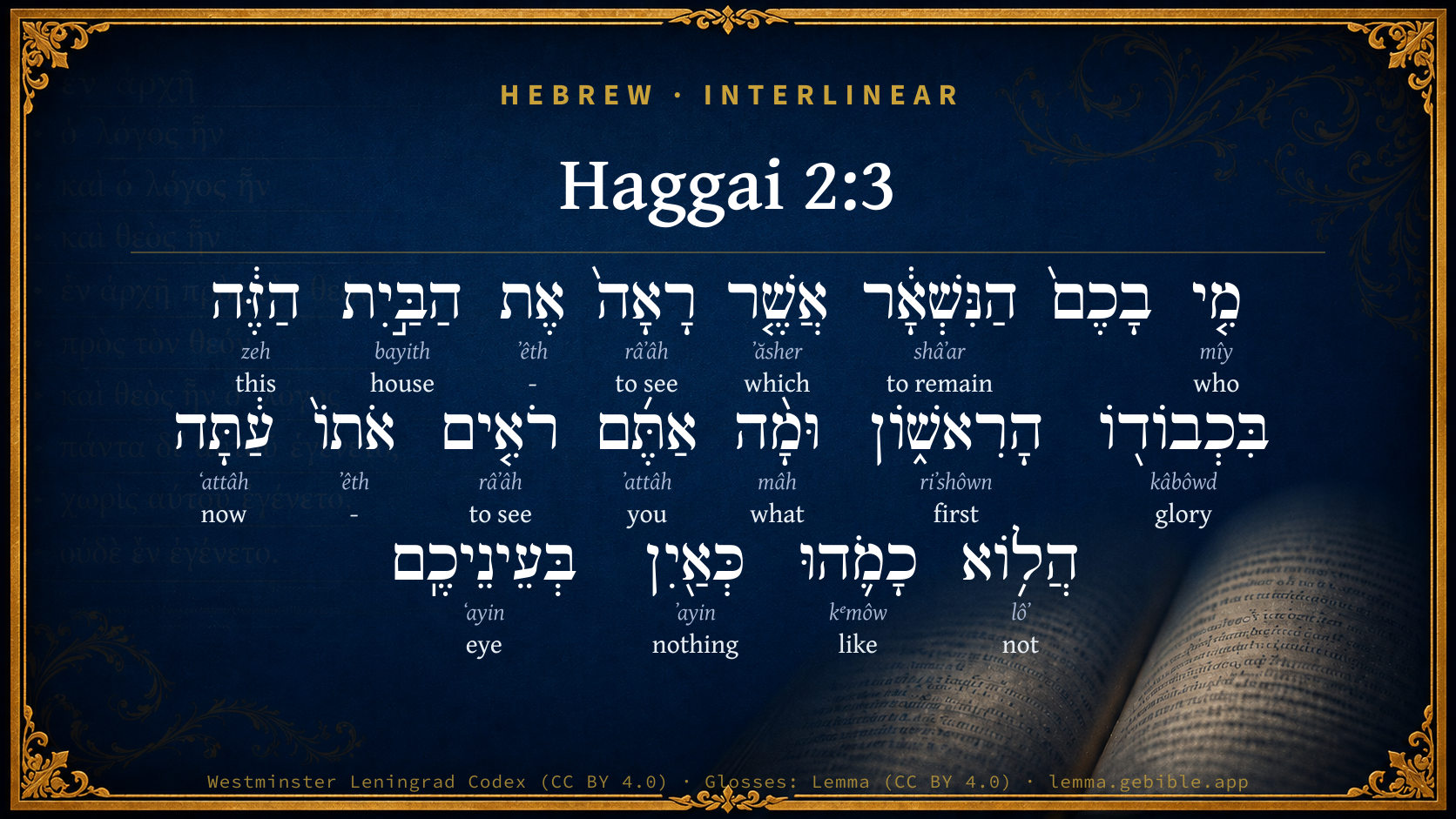
Hebrew (Westminster Leningrad Codex) Haggai 2:3 appears in the Hebrew Old Testament. The text above is from the Westminster Leningrad Codex. Each word links to its Strong’s number, a concise gloss, and parsing drawn from the Open Scriptures Hebrew Bible morphology. Click any word for its full Brown-Driver-Briggs (BDB) entry.
Download image
Cite this verse

Haggai 2:3 (World English Bible). Public Domain. Lemma interlinear Bible study tool, https://lemma.gebible.app/v/haggai/2/3.

Show BibTeX & RIS
BibTeX
RIS
English Translation
'Who is left among you who saw this house in its former glory? How do you see it now? Isn't it in your eyes as nothing?
World English Bible · Public Domain
Download a study sheet

One document with this verse’s original text, its word-by-word gloss line, the meaning frame, cross-references with their text, attributed commentary, and full source and license credits — printable, and it pastes into notes with its structure intact.

This verse Autodidact and up

Study sheet (.html) Plain text (.txt)

A passage Seminary Student

Up to 50 verses in one chapter. A passage sheet keeps up to 6 commentary sources and 12 cross-references per verse, in the order this page ranks them, and says so on the sheet whenever that leaves anything out. Ask for a single verse and you get the Autodidact verse sheet above.

Everything on this page stays free to read, with no account — the sheet is a download of what is already on screen, not access to it.

Want to remove ads? Support Godless Engineer
Compare translations 3

The same verse in 3 English versions, stacked beneath the original-language interlinear above. Click any original word for its lexicon entry.

Each is an independent rendering of the whole verse — the interlinear is not word-aligned to these translations.

Highlighted words mark where these versions differ — a whole-verse word diff, not a word-by-word alignment.

  • World English Bible Public Domain
    'Who is left among you who saw this house in its former glory? How do you see it now? Isn't it in your eyes as nothing?
  • King James Version Public Domain
    Who is left among you that saw this house in her first glory? and how do ye see it now? is it not in your eyes in comparison of it as nothing?
  • unfoldingWord Literal Text CC BY-SA 4.0
    ‘Who is the one left among you who saw this house in its former glory? How are you seeing it now? Compared with that, not like nothing in your eyes?

unfoldingWord Literal Text — © unfoldingWord, licensed CC BY-SA 4.0. Word-aligned USFM3 via Door43 (git.door43.org/unfoldingWord/en_ult).

Versions to compare (up to 4)

3 of 4 selected

Show all 18 translations

Every available English version of this verse, each an independent rendering of the whole verse.

  • World English Bible Public Domain
    'Who is left among you who saw this house in its former glory? How do you see it now? Isn't it in your eyes as nothing?
  • Berean Standard Bible Public Domain
    ‘Who is left among you who saw this house in its former glory? How does it look to you now? Does it not appear to you like nothing in comparison?’
  • Majority Standard Bible Public Domain
    ‘Who is left among you who saw this house in its former glory? How does it look to you now? Does it not appear to you like nothing in comparison?’
  • King James Version Public Domain
    Who is left among you that saw this house in her first glory? and how do ye see it now? is it not in your eyes in comparison of it as nothing?
  • American Standard Version (1901) Public Domain
    Who is left among you that saw this house in its former glory? and how do ye see it now? is it not in your eyes as nothing?
  • Revised Version (1885) Public Domain
    Who is left among you that saw this house in its former glory? and how do ye see it now? is it not in your eyes as nothing?
  • Geneva Bible (1599) Public Domain
    Speake nowe to Zerubbabel the sonne of Shealtiel prince of Iudah, and to Iehoshua the sonne of Iehozadak the hie Priest, and to the residue of the people, saying,
  • Douay-Rheims (1899) Public Domain
    Speak to Zorobabel the son of Salathiel the governor of Juda, and to Jesus the son of Josedec the high priest, and to the rest of the people, saying:
  • Young's Literal Translation Public Domain
    Who among you hath been left that saw this house in its former honour? And what are ye seeing it now? Is it not, compared with it, as nothing in your eyes?
  • Literal Standard Version CC BY-SA 4.0
    Who among you has been left that saw this house in its former glory? And what are you seeing it now? Is it not, compared with it, as nothing in your eyes?
  • Unlocked Literal Bible CC BY-SA 4.0
    'Who is left among you who saw this house in its former glory? How do you see it now? Is it not like nothing in your eyes?
  • unfoldingWord Literal Text CC BY-SA 4.0
    ‘Who is the one left among you who saw this house in its former glory? How are you seeing it now? Compared with that, not like nothing in your eyes?
  • Darby Bible Public Domain
    Who is left among you that saw this house in its former glory? and how do ye see it now? Is it not as nothing in your eyes?
  • World Messianic Bible Public Domain
    ‘Who is left among you who saw this house in its former glory? How do you see it now? Isn’t it in your eyes as nothing?
  • Webster's Bible Public Domain
    Who is left among you that saw this house in her first glory? and how do ye see it now? is it not in your eyes in comparison of it as nothing?
  • Free Bible Version CC BY-SA 4.0
    Is there anyone left among you who saw this house in its former glory? How does it look to you now? Does it seem like nothing to you?
  • Bible in Basic English Public Domain
    Who is there still among you who saw this house in its first glory? and how do you see it now? is it not in your eyes as nothing?
  • JPS Tanakh (1917) Public Domain
    Who is left among you that saw this house in its former glory? and how do ye see it now? is not such a one as nothing in your eyes?

Literal Standard Version (2020), Covenant Press — licensed CC BY-SA 4.0. Text via the HelloAO Bible API (eBible.org). Unlocked Literal Bible (unfoldingWord) — licensed CC BY-SA 4.0. Text via the HelloAO Bible API (eBible.org). unfoldingWord Literal Text — © unfoldingWord, licensed CC BY-SA 4.0. Word-aligned USFM3 via Door43 (git.door43.org/unfoldingWord/en_ult). Free Bible Version, Dr. Jonathan Gallagher — licensed CC BY-SA 4.0. Text via the HelloAO Bible API (eBible.org).

Word by word

More ways to search: Search by grammar → Find every occurrence → Compare this word →

Practice this passage: Drill this verse → Learn its vocabulary →

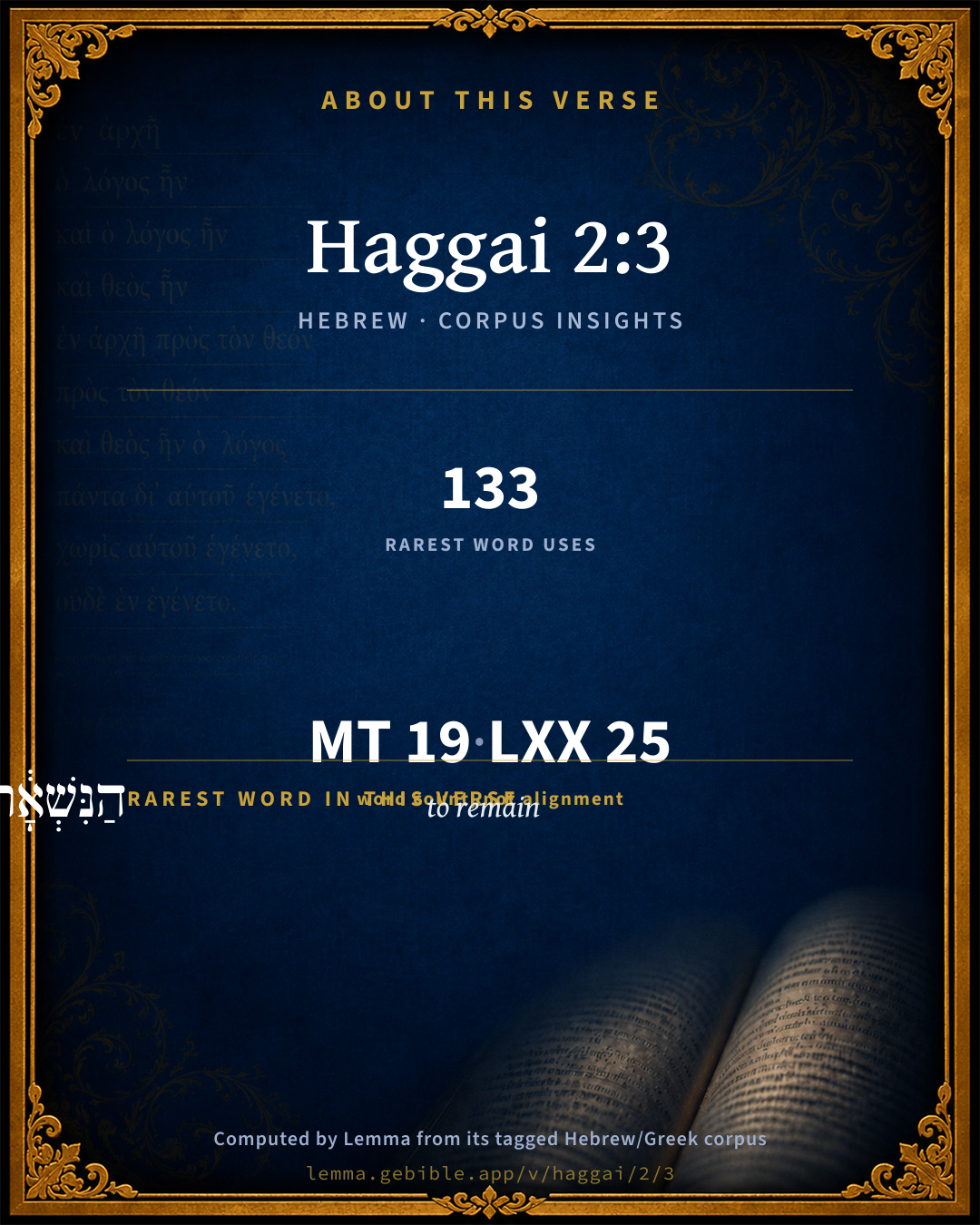
הַנִּשְׁאָ֔ר
shâʼar
H7604
“the · remaining”
Particle, Definite Article + Verb, Niphal, Participle Active, Masculine, Singular, Absolute
Part of Speech
Particle + Verb
Stem
Niphal
Form
Participle Active
Gender
Masculine
Number
Singular
State
Absolute
Full BDB Definition

Origin: a primitive root

TWOT: 2307 , 2308

to remain, be left over, be left behind - (Qal) to remain - (Niphal) - to be left over, be left alive, survive - remainder, remnant (participle) - to be left behind - (Hiphil) - to leave over, spare - to leave or keep over - to have left - to leave (as a gift)
  1. מִ֤י mîy H4310 “who” Particle, Interrogative
  2. אֲשֶׁ֤ר ʼăsher H834 “which” Particle, Relative
  3. רָאָה֙ râʼâh H7200 “to see” Verb, Qal, Perfect, 3rd Person, Masculine, Singular
  4. אֶת ʼêth H853 “-” Particle, Direct Object
  5. הַבַּ֣יִת bayith H1004 “the · house” Particle, Definite Article + Noun, Common, Masculine, Singular, Absolute
  6. הַזֶּ֔ה zeh H2088 “the · this” Particle, Definite Article + Pronoun, Demonstrative, Masculine, Singular
  7. בִּכְבוֹד֖וֹ kâbôwd H3519 “in/at · glory · his” Preposition + Noun, Common, Both, Singular, Construct + Suffix, Personal, 3rd Person, Masculine, Singular
  8. הָרִאשׁ֑וֹן riʼshôwn H7223 “the · first” Particle, Definite Article + Adjective, Ordinal number, Masculine, Singular, Absolute
  9. וּמָ֨ה mâh H4100 “and · what” Conjunction + Particle, Interrogative
  10. אַתֶּ֜ם ʼattâh H859 “you” Pronoun, Personal, 2nd Person, Masculine, Plural
  11. רֹאִ֤ים râʼâh H7200 “seeing” Verb, Qal, Participle Active, Masculine, Plural, Absolute
  12. אֹתוֹ֙ ʼêth H853 “- · him” Particle, Direct Object + Suffix, Personal, 3rd Person, Masculine, Singular
  13. עַ֔תָּה ʻattâh H6258 “now” Adverb
  14. הֲל֥וֹא lôʼ H3808 “not” Particle, Interrogative + Particle, Negative
  15. כָמֹ֛הוּ kᵉmôw H3644 “like · him” Preposition + Suffix, Personal, 3rd Person, Masculine, Singular
  16. כְּאַ֖יִן ʼayin H369 “like/as · nothing” Preposition + Particle, Negative
  17. בְּעֵינֵיכֶֽם ʻayin H5869 “in/at · eyes · your” Preposition + Noun, Common, Both, Dual, Construct + Suffix, Personal, 2nd Person, Masculine, Plural

About this verse

These counts appear in no published source. They are computed here, from the morphology-tagged text and Lemma’s own curated glosses. What Lemma adds →

19
words
16
distinct lemmas
Prophets
section

Grammatical profile

  • 3 verbs
  • 3 nouns
  • 1 adjective
  • 2 pronouns
  • 2 prepositions
  • 1 adverb
  • 7 particles

Verb forms

  • הַנִּשְׁאָ֔ר Niphal · Participle Active
  • רָאָה֙ Qal · Perfect
  • רֹאִ֤ים Qal · Participle Active

Repetition

A word recurs within this verse — often emphatic in Hebrew:

  • רָאָה֙ to see H7200 ×2

Hebrew & Septuagint length

In English translation the verse runs 26 words from the Hebrew and 32 from the Septuagint (LXX English) — closely comparable.

A rough comparison of the two English renderings, which tokenize alike — not a word-level alignment.

Word counts can differ between the Hebrew and the Greek without any difference in meaning — e.g. the Hebrew direct-object marker אֵת has no separate Greek word, and Greek often adds the article ὁ.

In the original languages it is 19 Hebrew tokens and 25 Greek tokens — but the two are counted differently (Hebrew bundles its prefixes and suffixes into one token; the Greek is in lemma form), so that isn’t a like-for-like length.

Cross-references

5

Topical passages linked to Haggai 2:3 in the Treasury of Scripture Knowledge — connected by theme and wording, ordered by reader-vote popularity; previews shown in the World English Bible.

  • Ezra 3:12 But many of the priests and Levites and heads of fathers' [houses], the old men who had seen the first house, when the foundation of this house was laid before their eyes, wept with a loud voice; and many shouted aloud for joy:
  • Luke 21:5–6 As some were talking about the temple and how it was decorated with beautiful stones and gifts, he said,
  • Ezekiel 7:20 As for the beauty of his ornament, he set it in majesty; but they made the images of their abominations [and] their detestable things therein: therefore have I made it to them as an unclean thing.
  • Haggai 2:9 'The latter glory of this house will be greater than the former,' says Yahweh of Hosts; 'and in this place will I give peace,' says Yahweh of Hosts."
  • Zechariah 4:9–10 "The hands of Zerubbabel have laid the foundation of this house. His hands shall also finish it; and you will know that Yahweh of Hosts has sent me to you.

Cross-references courtesy of OpenBible.info (CC BY 4.0).

Hebrew and Greek witnesses Masoretic Hebrew ↔ Greek Septuagint

The same verse in the two great witnesses to the Old Testament, shown verse-for-verse.

These are two independent witnesses, not word-aligned to each other, and the Septuagint is shown in lemma (dictionary) form.

Hebrew Haggai 2:3 Masoretic · Westminster Leningrad Codex

מִ֤י בָכֶם֙ הַנִּשְׁאָ֔ר אֲשֶׁ֤ר רָאָה֙ אֶת הַבַּ֣יִת הַזֶּ֔ה בִּכְבוֹד֖וֹ הָרִאשׁ֑וֹן וּמָ֨ה אַתֶּ֜ם רֹאִ֤ים אֹתוֹ֙ עַ֔תָּה הֲל֥וֹא כָמֹ֛הוּ כְּאַ֖יִן בְּעֵינֵיכֶֽם

'Who is left among you who saw this house in its former glory? How do you see it now? Isn't it in your eyes as nothing?

World English Bible · Public Domain

Greek LXX Haggai 2:3 Septuagint · lemma form

τίς ἐκ σύ ὅς ὁράω ὁ οἶκος οὗτος ἐν ὁ δόξα αὐτός ὁ ἔμπροσθεν καί πῶς σύ βλέπω αὐτός νῦν καθώς οὐ ὑποἄρχω ἐνώπιον σύ

Speak now to Zorobabel the son of Salathiel, of the tribe of Juda, and to Jesus the son of Josedec, the high priest, and to all the remnant of the people, saying,

LXX2012 (modern English Septuagint) · Public Domain

Hebrew: Westminster Leningrad Codex (CC BY 4.0). Greek: Septuagint (public domain); English from LXX2012 (modern English Septuagint) (Public Domain). How the Septuagint differs from the Hebrew →

Targum (Aramaic paraphrase)

1

The Targum is the ancient Jewish Aramaic paraphrase of the Hebrew Scriptures — an interpretive translation, not the Hebrew text itself. Onkelos (literal) and Pseudo-Jonathan (expansive) render the Torah, and Jonathan the Prophets. Coverage is partial: where no permissively-licensed English translation exists for a verse, only the Aramaic is shown. This is verse-level text, not a word-by-word alignment to the Hebrew.

  1. Targum Jonathan Prophets (Joshua–Malachi)
    מַן בְּכוֹן דְיִשְׁתָּאַר דַחֲזָא יַת בַּיְתָא הָדֵין בִּיקָרֵיהּ קַדְמָאָה וּמַה אַתּוּן חָזָן יָתֵיהּ כְּעַן הֲלָא כִדְלֵיתוֹהִי כֵּן הוּא בְּעֵינֵיכוֹן:

    (no public-domain English translation for this verse)

    Targum Jonathan — Aramaic: “Mikraot Gedolot” (public domain). English: “Sefaria Community Translation” (CC0 1.0 (public-domain dedication)); “London "Chaldee Paraphrase," 1871” (public domain). Text via Sefaria.

Commentary

Notes on Haggai 2:3 from classic Christian and Jewish commentators (each source and its license shown beneath its notes). The classic Christian expositions comment on the surrounding passage and are grouped to its opening verse, so a note may address several verses; the Jewish commentaries on the Tanakh (Rashi and others) are per-verse, so they appear only where the commentator wrote on this verse.

Lemma curates 59 commentaries, every one of them public domain or Creative Commons licensed, each selected and text-cleaned for this edition rather than reprinted as found. About our sources →

Trapp's Complete Commentary

John Trapp

Hag 2:3 Who [is] left among you that saw this house in her first glory? and how do ye see it now? [is it] not in your eyes in comparison of it as nothing?

Ver. 3. Who is left among you that saw this house in her first glory?] Some such there were among them (as is here implied), and these must needs be very old, one hundred and twenty, at least, some say more. Zerubbabel might well be one of these; for he was a chieftain in the first year of Cyrus, Ezr 2:2. And Jehoshua, the high priest, might be another; for he came out of Babylon with Zerubbabel at the same time, Ezr 3:2. We see by experience that men’s lives are daily shortened. Natural reasons whereof may be these. 1. Untimely marriages. 2. Filling our bodies with variety of foods, and so digging our own graves with our own teeth. 3. Much ease and delicacy. The supernatural reason may be that so the world may sooner come to an end. God maketh haste to have the number of his elect fulfilled, and therefore dispatcheth away the generations, shorteneth life for his elect’s sake, fetcheth home his pilgrims, makes their days few, though evil, {Gen 47:9} takes them away from the evil to come, &c., death being to them aerumnarum requies rest from all toils, (as Chaucer’s motto was), yea, ianua vitae, porta coeli, the door of life, the gate to heaven, the daybreak of eternal brightness.

And how do ye see it now?] It is a part of old men’s prudence rightly to compare things long since past with things present, and so to conjecture at things to come. Thus the prudent person, by discourse of reason, foreseeth an evil and hideth himself, when the young fool passeth on and is punished.

Is it not in your eyes] That is, in your thoughts; for God taketh notice of the inward workings of the heart, 1Sa 16:7 Psa 139:2 1Ki 8:39. For he made the heart, and must therefore know all that is in it; as a watchmaker knows all the wheels and motions of the watch. He also will bring every secret thing into judgment, Ecc 12:14. Therefore thought is not free (as foolish folk dote), either from the notice of his eye (he had soon found out these Jews, when they did but despise the day of small things in their hearts, Zec 4:10), or from the censure of his mouth, Heb 4:12-13 Rom 7:14 (the law is spiritual and meets with involuntary motions to sin, Hag 2:7), or, lastly, from the stroke of his hand, which is a mighty hand, 1Pe 5:6, and falls very heavy, Deu 29:19, even for a root of bitterness, as it is there, for vain thoughts, Jer 4:14; how much more for mischievous, murderous, covetous, vain-glorious, and adulterous thoughts, &c. It were good, therefore, to write upon walls and windows (yea, would it were written upon the tables of our hearts) that short motto, which as short as it is, yet our memories are shorter, Cave, Deus videt, Take heed, God looks on; for he is omnipresent and omniscient.

Is it not in your eyes in comparison of it as nothing?] A mere non-entity or nullity? not fit to be named in the same day with the former temple? For, first, Cyrus appointed the full proportion of this second house, the height thereof threescore cubits, and the breadth thereof threescore cubits, Ezr 6:3, which was but one-half so large as Solomon’s temple. Herod indeed, to curry favour with the Jews (which yet would never be), built upon Solomen’s foundation, and bestowed a great deal of cost, if we may believe Josephus. But so could not these Jews do, that returned from Babylon; for they were (secondly) but few, and those also poor, and, though helped both by Cyrus and Darius, yet they were glad to build the temple of common stone, and unpolished, nothing like those precious carved stones wherewith Solomon built, 1Ki 6:36. Thirdly, God hereby would draw their minds from the legal ceremonies and services; the Sun of Righteousness being now ready to arise upon them, the Dayspring from on high to visit them. Howbeit, because they could not have so glorious a temple as the former, they slighted it in their thoughts, and would have neglected it. Learn hence, That men naturally account as nothing of God’s service, if not accompanied with outward pomp and splendour. The Israelites in the wilderness would needs have a calf (as the Egyptians had) made of their jewels and ear-rings. Jeroboam would have two, and those of gold. Nebuchadnezzar dedicated a golden image with all manner of music, Dan 3:1-7 The people wept when the foundation of this temple was laid, Ezr 3:12, because nothing so magnificent as the former. And the Papists explode our religion in comparison of theirs, because nothing so pompous and plausible to the rude people, whom they deceive with apish toys and trinkets, shows and pageants. In their petition to King James they pleaded for their religion, that it was more pleasing than ours, and more agreeable to nature. John Hunt, a Roman Catholic, in his humble appeal to King James, thus blasphemeth: The God of the Protestants is worse than Pan, god of the clowns, which can endure no ceremonies nor good manners at all. Many, like children, like that book best that hath most babies in it; neither will they eat their milk but in a golden dish. This proceeds from a blind understanding and carnal affection. The Church in its infancy was enticed with shows and shadows; but now God requires a reasonable service, he calls for spirit and truth.

John Trapp, A Commentary or Exposition upon All the Books of the Old and New Testament (1647–1656) — public domain. Text from a community e-Sword module.

The Biblical Illustrator

Joseph S. Exell

Hag_2:3

Who is left among you that saw this house in her first glory?

The contrast between the two houses

A despondency, such as the Israelites must needs have felt, is very apt to come over those who have begun to engage in a good work, after the first flash of their zeal has faded away. When we are labouring for ourselves, indeed, our carnal heart urges us forward; but when we are doing anything for the good of our brethren, or in the service of God, our carnal heart lies like a heavy drag upon the will. This is especially the case at first. It is long before we grow humble enough to labour diligently, although the fruits of our labour are not to be seen even by our own eyes. For example, when our hearts have been moved to undertake any work for the strengthening or spreading of Christs Church on earth, and when we have been thus led to look round and consider what she is, must not our hearts faint within us as we think how she is nothing in comparison with her first glory, in the time of the Holy Apostles? How do we see the Church of Christ now? Is she not almost as nothing in comparison of her primitive glory? The same question may be asked with regard to man in his natural state. At first made in the image of God, and unsullied by sin, how do we see him now? When we compare these two pictures together in thought, fallen man, in his best and most flourishing estate, may seem to us as nothing by the side of his first glory. Let us cast our eyes on our own selves. They who watch the growth of the young must often have seen a time in their history which was like the teeming and blossoming of spring. And they will also have seen how the blossoms have fallen off, without leaving any fruit, even if they have not been wholly blighted. The prophet says, And now be strong. How were they to find strength? Not in the thought which had just been so forcibly put before them, that their work was as nothing in comparison with the first temple. Such a thought will never strengthen a man, will never make him work. Nor will it strengthen us, and make us work, to call to mind how far the Church of Christ has fallen back from the zeal and holiness of the primitive ages, or how far human nature has fallen from what it was in the Garden of Eden. Where are we to look for strength? Not to ourselves. Not to friends. The prophet gives this assurance from God, For I am with you. This same assurance is granted to all who earnestly desire to build up the house of the Lord, either in the world around them or in their own hearts If they will work, they shall be strong; for the Lord of hosts is with them. We have Gods covenanted word that He will be with us. God does not give His Spirit like a gleam of sunshine bursting for a moment through the clouds. His Spirit remaineth with those to whom it is given. He has remained with the Church from the day when the Father and the Son sent Him down from heaven; and He will remain with it unto the end of the world. The first lessen we are to draw from this assurance is, that we are to be strong and work. Many foolishly think that if the Spirit is with them, irresistible impulse will stir them to work without and against their will. It is through the power of the Spirit they who work continually in His strength do truly become strong. The second lesson is drawn from the words, Fear ye not. They who work and are strong in the strength of Gods Spirit abiding with them may boldly say, The Lord is my Helper: I will not fear what man can do unto me. They may even say, I will not fear myself, what I can do to myself, having this Helper against myself. Even the fear of God, if we felt that His Spirit remains with us, would by degrees lose all that is painful and oppressive and repelling in fear, and would be transfigured, by a constant living communion with Him, into reverent, dutiful love. (Julius C. Hare, M. A.)

Glory of the new temple

Just as in the second year of the return from Babylon, when the foundation for the temple, which was about to be rebuilt, was laid in the reign of Cyrus, many old men, who had seen the temple of Solomon, burst out into loud weeping when they saw the new foundation; a similar feeling of mourning and despair appears to have taken possession of the people and their rulers immediately after the work had been resumed under Darius, and doubts arose whether the new building was really well-pleasing to the Lord, and ought to be carried on. The occasion for this despondency is not to be sought in the fact that objections were made to the continuance of the building, and that the opinion prevailed in consequence that the works ought to be stopped till the arrival of the kings authority. This view not only has no support whatever in our prophecy, but is also at variance with the account in the Book of Ezra, according to which the governor and his companions, who had made inquiries concerning the command to build, did not stop the building while they sent word of the affair to the king (Ezr_5:5). Moreover, the conjecture that the people had been seized with a feeling of sadness, when the work had so far advanced that they were able to institute a comparison between the new temple and the earlier one, does not suffice to explain the rapid alteration which took place in the feelings of the people. The building could not have been so far advanced in three weeks and a half as that the contrast between the new temple and the former one could be clearly seen, if it had not been noticed from the very first; a fact, however, to which Ezr_3:12 distinctly refers. But although it had been seen from the very beginning that the new building would not come up to the glory of the former temple, the people could not from the very outset give up the hope of erecting a building which, if not quite equal to the former one in glory, would at all events come somewhat near to it. Under these circumstances their confidence in the work might begin to vanish as soon as the first enthusiasm flagged, and a time arrived which was more favourable for the quiet contemplation of the general condition of affairs. This explanation is suggested by the time at which the second word of God was delivered to the congregation through the prophet. It was the feast of tabernacles, the great festival of rejoicing. The return of this festal celebration, especially after a harvest which had turned out very miserably and showed no sign of the blessing of God, could not fail to call up vividly before the mind the difference between the former times, when Israel was able to assemble in the courts of the Lords house, and so to rejoice in the blessings of His grace in the midst of abundant sacrificial meals, and the present time, when the altar of burnt sacrifice might indeed be restored again and the building of the temple resumed, but in which there was no prospect of erecting a building that would in any degree answer to the glory of the former temple; and when the prophecies of an Isaiah or an Ezekiel were remembered, according to which the new temple was to surpass the former one in glory, it would be almost sure to produce gloomy thoughts, and supply food for doubt whether the time had really come for rebuilding the temple, when after all it would be only a miserable hut. In this gloomy state of mind consolation was very necessary, if the hardly awakened zeal for the building of the house of God was not to cool down and vanish entirely away. To bring this consolation to those who were in despair was the object of the second word of God, which Haggai was to publish to the congregation. (C. F. Keil, D. D.)

The Sorrow of the old men

How was it that the people became negligent after they had begun their work? Even because it grieved the old men to see the glory of the second so far inferior to the first temple. For though the people animated themselves by the sound of trumpets, yet the old among them drowned the sound by their lamentations. As this temple was in no way equal to the ancient one, they thought that God was not as yet reconciled to them. Had they said, that so great an expense was not necessary, that God did not require much money to be laid out, their impiety should have been openly manifested; but when they especially wished that the splendour of the temple would be such as might surely prove that the restoration of the Church was come, such as had been promised by all the prophets, we doubtless perceive their pious feeling. We are thus reminded that we ought always to beware of the intrigues of Satan, when they appear under the cover of truth. When our minds are disposed to piety, Satan is ever to be feared, lest he should stealthily suggest to us what may turn us aside from our duty; for we see that some leave the Church because they require in it the highest perfection. They are indignant at vices which they deem in tolerable when they cannot be corrected; and thus, under the pretext of zeal, they separate themselves, and seek to form for themselves a new world, in which there is to be a perfect Church; and they lay hold on those passages in which the Holy Spirit recommends purity to the Church, as when Paul says, that it was purchased by Christ, that it might be without spot or wrinkle. In all this there is some appearance of piety. How so? Because they would have God to be reverenced so that they would have the whole world to be filled with the fear of His majesty; or they would have much wealth to be gathered, so that sumptuous offerings might be made. But Satan cunningly insinuates himself; and hence we ought to fear his intrigues, lest, under plausible pretences, he should dazzle our eyes. The best way of caution is to regard what God commands, and so to rely on His promises as to proceed steadily in our course, though the accomplishment of the promises does not immediately correspond with our desires; for God designedly keeps us in suspense in order to try our faith. Though then He may not as yet fulfil what He has promised, let it yet be our course to attempt nothing rashly, while we are obeying His command. It will then be our chief wisdom, by which we may escape all the crafts of Satan, simply to obey Gods word, and to exercise our hope so as patiently to wait the seasonable times when He will fulfil what He now promises. (John Calvin.)

Thoughts of the past

The glorious past is never disdained. There ought not to be any past in the sense of exhaustion or annihilation. The past should be the most vivid and graphic influence in the present. Because we have seen greatness we shall see glory, should be the tone of every man who undertakes to teach the mysteries of the Divine Kingdom, and lead the charprises of the elect and consecrated Church. The house, indeed, had gone down; in that sense it was nothing in comparison with the house in its first glory. There is a past that humbles the present, that makes the present insignificant and worthless; but the Lord never regards that past as the end of His own opportunity; it is rather the occasion of the beginning of new revelations of His omnipotence. The Lord never stops His kingdom in its darkest hour and says, thin is all. The Lord never interrupts a prayer at the point of confession; He listens until the prayer glows with thankfulness, until it becomes violent in sacred ambition, until it would seize the treasures of the kingdom, and appropriate them all with a grateful heart. It is thus that God leads us and educates us. He takes us at our best point, not at our worst. The Lord promised that the house should assume a glory to which the first glory was as nothing. Here is a principle in the Divine economy; it is a principle of development, of progress, of gradual and assured consummation. (Joseph Parker, D. D.)

The Biblical Illustrator, edited by Joseph S. Exell (c. 1880s–1900s) — public domain. Text from a community e-Sword module.

Keil & Delitzsch

C. F. Keil & F. Delitzsch

"Who is left among you, that saw this house in its former glory? and how do ye see it now? Is it not as nothing in your eyes? Hag 2:4. And now be comforted, Zerubbabel, is the saying of Jehovah; and be comforted, Joshua son of Jozadak, thou high priest; and be comforted all the people of the land, is the saying of Jehovah, and work: for I am with you, is the saying of Jehovah of hosts. Hag 2:5. The word that I concluded with you at your coming out of Egypt, and my Spirit, stand in the midst of you; fear ye not." The prophet, admitting the poverty of the new building in comparison with the former one, exhorts them to continue the work in comfort, and promises them that the Lord will be with them, and fulfil His covenant promises. The question in Hag 2:3 is addressed to the old men, who had seen Solomon's temple in all its glory. There might be many such men still living, as it was only sixty-seven or sixty-eight years since the destruction of the first temple. הנּשׁאר is the predicate to the subject מי, and has the article because it is defined by the reflex action of the relative clause which follows (compare Ewald, 277, a). The second question, וּמה אתּם וגו, et qualem videtis, In what condition do ye see it now? is appended to the last clause of the first question: the house which ye saw in its former glory. There then follows with הלוא, in the form of a lively assurance, the statement of the difference between the two buildings. כּמהוּ כּאין, which has been interpreted in very different ways, may be explained from the double use of the כ in comparisons, which is common in Hebrew, and which answers to our as - so: here, however, it is used in the same way as in Gen 18:25 and Gen 44:18; that is to say, the object to be compared is mentioned first, and the object with which the comparison is instituted is mentioned afterwards, in this sense, "so is it, as having no existence," in which case we should either leave out the first particle of comparison, or if it were expressed, should have to reverse the order of the words: "as not existing (nothing), so is it in your eyes." Koehler gives this correct explanation; whereas if כּמהוּ be explained according to Joe 2:2, its equal, or such an one, we get the unsuitable thought, that it is not the temple itself, but something like the temple, that is compared to nothing. Even in Gen 44:18, to which Ewald very properly refers as containing a perfectly equivalent phrase, it is not a man equal to Joseph, but Joseph himself, who is compared to Pharaoh, and described as being equal to him. Nevertheless they are not to let their courage fail, but to be comforted and to work. Châzaq, to be inwardly strong, i.e., to be comforted, 'Ash, to work or procure, as in Rut 2:19 and Pro 31:13, in actual fact, to continue the work of building bravely, without there being any necessity to supply מלאכה from Hag 1:14. For Jehovah will be with them (cf. Hag 1:13).

In confirmation of this promise the Lord adds, that the word which He concluded with them on their coming out of Egypt, and His Spirit, will continue among them. "The word" ('eth-haddâbhâr) cannot be either the accusative of the object to the preceding verb ‛ăsū (Hag 2:4), or to any verb we may choose to supply, or the preposition 'ēth, with, or the accusative of norm or measure (Luther, Calvin, and others). To connect it with ‛ăsū yields no suitable meaning. It is not the word, which they vowed to the Lord, at the conclusion of the covenant, that they are to do now, but the work which they had begun, viz., the building of the temple, they are now to continue. It is perfectly arbitrary to supply the verb zikhrū, remember (Ewald and Hengstenberg), and to understand the prophet as reminding them of the word "fear not" (Exo 20:17-20). That word, "fear not," with which Moses, not God, infused courage into the people, who were alarmed at the terrible phenomenon with which Jehovah came down upon Sinai, has no such central significance as that Haggai could point to it without further introduction, and say that Jehovah had concluded it with them on their coming out of Egypt. The word which the Lord concluded with Israel when He led it out of Egypt, can only be the promise which established the covenant, to the fulfilment of which God bound Himself in relation to the people, when He led them out of Egypt, namely, the word that He would make Israel into His own property out of all nations (Exo 19:5-6; Deu 7:6; cf. Jer 7:22-23, and Jer 11:4). It would quite agree with this to take 'ēth as the accusative of the norm, and also to connect it as a preposition, if this could only be shown to be in accordance with the rules of the language. But although the accusative in Hebrew is often used, in the relation of free subordination, "to express more precisely the relation of measure and size, space and time, mode and kind" (cf. Ewald, 204-206), it is impossible to find any example of such an accusative of norm as is here assumed, especially with 'ēth preceding it. But if 'ēth were a preposition instead of אתּכם, we should have עמּכם, inasmuch as the use of את־הדּבר, as a parallel to אתּכם, makes the words clumsy and awkward. The thought which Haggai evidently wishes to express requires that haddâbhâr should stand upon the same line with rūchı̄, so that 'eth-haddâbhâr is actually the subject to ‛ōmedeth, and 'ēth is simply used to connect the new declaration with the preceding one, and to place it in subjection to the one which follows, in the sense of "as regards," quoad (Ewald, 277, d, pp. 683-4), in which case the choice of the accusative in the present instance may either be explained from a kind of attraction (as in the Latin, urbem quam statuo vestra est), as Hitzig supposes, or from the blending together of two constructions, as Koehler maintains; that is to say, Haggai intended to write את־הדּבר ורוּחי העמדתּי, but was induced to alter the proposed construction by the relative clause אשׁר כּרתּי וגו attaching itself to הדּבר. Consequently ‛ōmedeth, as predicate, not only belongs to rūchı̄, but also to haddâbhâr, in the sense of to have continuance and validity; and according to a later usage of the language, עמד is used for קוּם, to stand fast (compare Isa 40:8 with Dan 11:14). The word, that Israel is the property of Jehovah, and Jehovah the God of Israel, still stands in undiminished force; and not only so, but His Spirit also still works in the midst of Israel. Rūăch, in parallelism with the word containing the foundation of the covenant, is neither the spirit of prophecy (Chald., J. D. Mich.), nor the spirit which once filled Bezaleel and his companions (Exo 31:1., Exo 36:1.), enabling them to erect the tabernacle in a proper manner, and one well-pleasing to God (Luc., Osiander, and Koehler). Both views are too narrow; rūăch is the divine power which accompanies the word of promise and realizes it in a creative manner, i.e., not merely "the virtue with which God will establish their souls, that they may not be overcome by temptations" (Calvin), but also the power of the Spirit working in the world, which is able to remove all the external obstacles that present themselves to the realization of the divine plan of salvation. This Spirit is still working in Israel ("in the midst of you"); therefore they are not to fear, even if the existing state of things does not correspond to human expectations. The omnipotence of God can and will carry out His word, and glorify His temple. This leads to the further promise in Hag 2:6-9, which gives the reason for the exhortation, "Fear ye not."

Keil & Delitzsch — Biblical Commentary on the Old Testament (1861–1891) — public domain (CC PDM 1.0). Text via the HelloAO Bible API. (Old Testament only.)

Tyndale Open Study Notes

Tyndale Open Resources

2:3 The former splendor belonged to Solomon’s Temple (1 Kgs 6:38), which some of the older people of Judah had seen in their youth before going into exile in Babylon. They wept when they saw the new foundation laid (Ezra 3:12-13), because it seemed like nothing at all by comparison.

Tyndale Open Study Notes — © Tyndale Open Resources, licensed CC BY-SA 4.0. Text via the HelloAO Bible API.

Jamieson, Fausset & Brown

Robert Jamieson, A. R. Fausset & David Brown

Who is left . . . that saw . . . first glory--Many elders present at the laying of the foundation of the second temple who had seen the first temple (Ezr 3:12-13) in all its glory, wept at the contrast presented by the rough and unpromising appearance of the former in its beginnings. From the destruction of the first temple to the second year of Darius Hystaspes, the date of Haggai's prophecy, was a space of seventy years (Zac 1:12); and to the first year of Cyrus, or the end of the captivity, fifty-two years; so that the elders might easily remember the first temple. The Jews note five points of inferiority: The absence from the second temple of (1) the sacred fire; (2) the Shekinah; (3) the ark and cherubim; (4) the Urim and Thummim; (5) the spirit of prophecy. The connection of it with Messiah more than counterbalanced all these; for He is the antitype to all the five (Hag 2:9).

how do ye see it now?--God's estimate of things is very different from man's (Zac 8:6; compare Sa1 16:7). However low their estimate of the present temple ("it") from its outward inferiority, God holds it superior (Zac 4:10; Co1 1:27-28).

Jamieson, Fausset & Brown — Commentary Critical and Explanatory on the Whole Bible (1871) — public domain (CC PDM 1.0). Text via the HelloAO Bible API.

Adam Clarke's Commentary

Verse 3. Who is left among you that saw this house in her first glory?] Who of you has seen the temple built by Solomon? The foundation of the present house had been laid about fifty-three years after the destruction of the temple built by Solomon and though this prophecy was uttered fifteen years after the foundation of this second temple, yet there might still survive some of those who had seen the temple of Solomon.

Is it not in your eyes] Most certainly the Jews at this time had neither men nor means to make any such splendid building as that erected by Solomon. The present was as nothing when compared with the former.

Adam Clarke's Commentary on the Bible (1810–1826) — public domain. Text from a community e-Sword/MySword module.

Ellicott's Commentary for English Readers

(3) Is it not . . .—Better, is not such a (Temple) as this like nothing in your eyes?

A Bible Commentary for English Readers, edited by Charles John Ellicott (1878–1897) — public domain. Text from a community e-Sword module.

The Cambridge Bible for Schools and Colleges

gen. ed. J. J. S. Perowne

3. Who is left among you? &c.] When the foundations of this Temple were laid in the second year of Cyrus there were many such. Now after sixteen more years, when seventy years had elapsed since the destruction of Solomon’s Temple, the number must have been greatly diminished. Old men of fourscore years or thereabouts they must now have been.

how do ye see it?] Lit., what (i.e. of what kind) do ye see it. Comp. 1Ki_9:13, where Hiram in displeasure at the cities given him by Solomon exclaims, “what cities are these (pr. quid urbium hoc, Gesen.) which thou hast given me, my brother?”

in comparison of it] These words should be omitted as in R.V. They were inserted in A.V. through a misunderstanding of the Hebrew idiom.

“Besides the richness of the sculptures in the former Temple, everything which admitted of it was overlaid with gold; Solomon overlaid the whole house with gold, until he had finished all the house, the whole altar by the oracle, the two cherubims, the floor of the house, the doors of the Holy of Holies and the ornaments of it, the cherubims thereon, and the palm trees he covered with gold fitted upon the carved work; the altar of gold and the table of gold, whereupon the shewbread was, the ten candlesticks of pure gold, with the flowers and the lamps and the tongs of gold, the bowls, the snuffers and the basons and the spoons and the censers of pure gold, and hinges of pure gold for all the doors of the Temple. The porch that was in the front of the house, twenty cubits broad and 120 cubits high, was overlaid within with pure gold; the house glistened with precious stones; and the gold (it is added) was gold of Parvaim, a land distant of course and unknown to us. Six hundred talents of gold (about £4,320,000) were employed in overlaying the Holy of Holies. The upper chambers were also of gold; the weight of the nails was fifty shekels of gold.” Pusey.

The Cambridge Bible for Schools and Colleges (gen. ed. J. J. S. Perowne; Cambridge University Press, 1878–1918) — public domain. Text from a community e-Sword module.

John Gill's Exposition

Who is left among you that saw this house in her first glory?.... Not taken away by death, yet alive, and dwelling among them; and who lived before the destruction of the first temple, built by Solomon; and has seen it in all its magnificence; its grand and noble structure; its stately pillars; its carved work, and decorations of gold. This shows that it was not in the times of Darius Nothus, but of Darius Hystaspis, that Haggai prophesied: those who go the former way make these men to have lived near two hundred years at least, which was greatly beyond the common time of man's life in that age; or consider these words as a mere supposition, that, if there were or had been such persons then living, this building, in comparison of the former, must have appeared mean and contemptible unto them: but the words manifestly imply that there were persons among them then living, who had seen Solomon's temple in all its glory; and who are particularly and personally addressed in the following clauses; and of whom there might be several at this time, going the latter way; for the seventy years' captivity are to be reckoned from the fourth year of Jehoiakim, in which the captivity began, and which was the first year of Nebuchadnezzar, Jer 25:1 but it was not until the nineteenth year of his reign that the temple, was burnt by him, Jer 52:12 and the time of Haggai's prophesying being about seventeen or eighteen years after the proclamation of Cyrus, when the seventy years' captivity ended; this shows that it was scarcely seventy years from the time the temple was destroyed; and therefore it may be reasonably supposed there were several ancient persons living that could remember to have seen it; and it is certain that there were a great number of such living that returned from Babylon, who wept when they saw the foundation of the second temple laid, which was but fifteen years before this, Ezr 3:12 some of whom, in all probability, were now alive, yea, it is certain there were, to whom the following questions were put:

and how do ye see it now? is not this that is building very different from that? does it promise anything like it? what ideas have you of it? can you conceive in your minds that it will ever rise up to such grandeur and stateliness as the former? what is your judgment, and what your sentiments concerning it? can you think of it with equal delight and pleasure as of the former?

is it not in your eyes in comparison of it as nothing? do not you think that it is not to be mentioned, or once named, in comparison of the former temple? or that a man had as good say nothing at all, as to attempt a comparison of them? or that this building and nothing are alike? and that the one is a nonentity, as well as the other, comparatively speaking, when set in competition with the first temple? and are not you of opinion that the people had as good do nothing, and that in effect they are doing nothing, and all their labour lost, who are working in this house? no answer is returned, nor any waited for: but it is as if the Lord had said, I, who am the omniscient God, the discerner of the thoughts of men, know that these are your sentiments, and these the reasonings of your minds; and but now lest discovering these thoughts of theirs, and speaking out their minds freely as they might, which would tend to discourage the governors and the people in carrying on the work they had engaged in; the Lord by the prophet says to them, as follows:

John Gill's Exposition of the Whole Bible (1746–1763) — public domain (CC PDM 1.0). Text via the HelloAO Bible API.

Albert Barnes' Notes on the Bible

Who is left among you? - The question implies that there were those among them, who had seen the first house in its glory, yet but few. When the foundations of the first temple were laid, there were many Ezr 3:12. “Many of the priests and Levites and chief of the fathers, ancient men, that had seen the first house, when the foundations of this house were laid before their eyes, wept with a loud voice.” Fifty-nine years had elapsed from the destruction of the temple in the eleventh year of Zedekiah to the first of Cyrus; so that old men of seventy years had seen the first temple, when themselves eleven years old. In this second of Darius seventy years had passed, so that those of 78 or 80 years might still well remember it. Ezra’s father, Seraiah, was slain in the eleventh year of Zedekiah; so he must have been born at latest a few months later; yet he lived to the second of Artaxerxes.

Is not such as it is as nothing? - o Beside the richness of the sculptures in the former temple, everything, which admitted of it, was overlaid with gold 1Ki 6:22, 1Ki 6:28, 1Ki 6:30, 1Ki 6:32, 1Ki 6:35, “Solomon overlaid the whole house with gold, until he had finished all the house, the whole altar by the oracle, the two cherubim, the floor of the house, the doors of the holy of holies” and the ornaments of it, “the cherubims thereon” and “the palm trees he covered with gold fitted upon the carved work 1Ki 7:48-50, the altar of gold and the table of gold, whereupon the showbread was, the ten candlesticks of pure gold, with the flowers and the lamps and the tongs of gold, the bowls, the snuffers and the basons and the spoons and the censers of pure gold, and hinges of pure gold for all the doors of the temple 2Ch 3:4-9. The porch that was in the front of the house, twenty cubits broad and 120 cubits high, was overlaid within with pure gold;” the house glistened with precious stones; and the gold (it is added) was “gold of Parvaim,” a land distant of course and unknown to us. “Six hundred talents of gold” (about 4,320,000 British pounds were employed in overlaying the holy of holies. “The upper chambers were also of gold; the weight of the nails was fifty shekels of gold.”

Albert Barnes' Notes on the Bible (1834–1885) — public domain. Text from a community e-Sword/MySword module.

Matthew Poole's English Annotations

Who is left among you? there are surely some that are of that age as to have seen the temple which our father’s sins, God’s just displeasure, and the Chaldean malice burnt; who are they? and where may they be found? This question implieth there were such, and by Ezr 3:12,13 it appears there were many, for the cries and sobs of them equalled the shouts of the younger, who rejoiced to see the foundations of the second house laid.

That saw; took notice of it then, and remember it now, that were of such age and knowledge as to remember what was standing in its glory one hundred and fifty years ago, if some conjecture aright, but, what is nearer to truth, who remember some fourscore years past, who are about one hundred years of age.

This house; the house of God, the temple built by Solomon.

In her first glory; in the stately structure of it, in the rich adornings of it, in the unparalleled skill and curiosity of its workmanship, when it was the glory of the world.

How do ye see it now? do you see the same glorious structure going forward? have you expectation of one equal to the former temple? You cannot but recall the former to mind, and make your judgment of this by that.

Is it not in your eyes in comparison of it as nothing? do you not judge this second nothing comparable with the first? you are ready to say, (in proverbial speech,) It is nothing to it.

Matthew Poole's English Annotations on the Holy Bible (1683–1685) — public domain. Text from a community e-Sword/MySword module.

Whedon's Commentary on the Bible

Daniel D. Whedon

3. The prophet does not deny that there is a marked contrast between the former temple and the one on which they are now laboring.

This house — The temple of Jehovah. The Jews did not think of the first, second, and third temples as separate buildings; they were all one and the same temple of Jehovah, only in different forms. Here the prophet has in mind Solomon’s temple.

Who is left… that saw — Probably only very few, for about sixty-six years had elapsed since the destruction of Solomon’s temple in 586.

First glory — R.V., “former glory” (compare 1Ki_5:7).

How do ye see it now? — In what condition? Certainly it was not yet completed, but they knew the resources at their command, and were fully aware that in style of building and magnificence of equipment they could not possibly equal the former splendor (compare Zec_4:10).

Is it not… as nothing? — For the grammatical construction of the Hebrew see G.-K., 161c. R.V. reproduces it in smoother English: “is it not in your eyes as nothing?”

Daniel D. Whedon (gen. ed.), Commentary on the Old and New Testaments (1874–1909) — public domain. Text from a community e-Sword module.

The Pulpit Commentary

Who is left among you! etc. It is quite possible that there should be some old people present who had seen Solomon"s temple. Many have thought that Haggai himself was of the number. It was sixty-eight years ago that the temple was destroyed, and we can well believe that its remarkable features were deeply impressed on the minds of those who as boys or youths had loved and admired it. Ezra tells us (Ezr_3:12) that "many of the priests and Levites" when the foundation first was laid and chief of the fathers, who were ancient men, that had seen the first house, wept with a loud voice." This house. The prophet identifies the present with Solomon"s temple, as being adapted for the same purposes, to fill the same place in the national life, built on the same hallowed spot, and partly with the same materials. In the Jews" eyes there was one only temple, whatever might be the date of its erection or the comparative worth of its decorations and materials. First; former, as ver. 9. How do ye see it now? (Num_13:18) In what condition do ye see this house now? Is it not in your eyes in comparison of it as nothing? The words, "in comparison of it," ought to be omitted, as not required by the Hebrew idiom. Does it not seem in your eyes as if it had no existence? If the injunction of Cyrus (Ezr_1:3, etc.) had been carried out, the dimensions of. the new temple would have exceeded those of the old; but Zerubbabel seems to have been unable, with the small resources at his disposal, to execute the original design, though even so the proportions were not greatly inferior to those of the earlier temple. But the chief inferiority lay in the absence of the splendour and enrichment with which Solomon adorned his edifice. The gold which he had lavished on the house was no longer available; the precious stones could not be had. Besides. these defects, the Talmudists reckon five things wanting in this second temple, viz. the ark of the covenant, with the cherubim and mercy seat; the holy fire; the Shechinah; the spirit of prophecy; the Urim and Thnmmim. It was, according to Josephus, only half the height of Solomon"s-sixty cubits ("Ant.," 15:11, 1), and it appears to have been in many respects inferior to the first building ("Ant.," 4:2). Hecabaeus of Abdera gives the dimensions of the courts as five hundred feet in length and a hundred cubits in breadth (double the width of the court of the tabernacle), and the size of the altar as twenty cubits square and ten cubits high (see Josephus, "Cont. Ap.," 1:22; Conder, "Handbook to the Bible," p. 370).

Vers. 3-5Past and present.

I A SUGGESTIONOf the continuity of human history. Haggai"s question assumes that the structure then erecting was not a new edifice (which it really was), but the old building set up again, though in faded splendour, which also it was, inasmuch as it was based on the foundations of the earlier pile. "This house in its former glory" meant that the prophet looked on the two houses as one, and the two eras represented by these houses, not as two distinct and separate periods, but as one continuous period. As it were the national life, for seventy years interrupted by the exile, again flowed on, restoring the temple, reinstituting the religion of Jehovah, and pervading the whole fabric of society. The present was not so much a fresh commencement as a prolongation of the past. And this is true of human history and life in general. No age or individual is entirely disconnected from and independent of the ages and individuals that have gone before. A perfectly new beginning in human history or in individual life has never yet taken place. Even in the Incarnation, the second Adam was connected with the first through his human nature. The civilization of the nineteenth century is built upon the foundations laid by preceding centuries. The maturity of manhood in wisdom or virtue is developed from the gains in knowledge and goodness made in youth.

II AN ILLUSTRATIONOf the tendency to glorify the past at the expense of the present. "Who is left among you that saw this house in its former glory? and how do you see it now? asks the prophet; is it not in your eyes as nothing?" In certain respects this depreciation of the post-exilic temple, in comparison with the Solomonic, was justifiable the material splendour of the second building was vastly inferior to that of the first; but in other respects the glory of the latter house would ultimately far eclipse that of the former (ver. 9) it would be the centre and scene, the instrument and support of a purer worship than had been maintained in the former, and would be honoured by the visit of a greater potentate than Solomon himself, even by the Messenger of the covenant and the Lord of the temple, after whom were going out the desires, not of Israel alone, but of all nations (ver. 7). And upon the foundation of the old structure of cedar wood and gold, and to glorify the old which seventy years before had perished in the going down of their nation before the might of Babylon, so does it seem to be a tendency in human nature to exalt the past and to depress the present, to extol the men and institutions, the characteristics and occurrences of other days at the expense of the present, even when there is as little ground for doing so as there was for the depreciatory remarks of the builders. It is not difficult to account for either this laudation of the past or this disparagement of the present. On the one hand, lapse of years allows the memory of past discomforts, irritations, deficiencies, imperfections, blemishes, to fade away, while present evils obtrude themselves upon the notice and press upon the hearts of the passing generation; on the other hand, the present is too near for its peculiar excellences to be rightly gauged, while the glories of the past, like distant mountains, shine out with augmented splendour. Yet the verdict which prefers the past to the present is incorrect. (Ecc_7:10) Unless the world is a hopelessly bad world, which it is not, (Rom_8:20) and the grace of God that bringeth salvation is effete, which is not the mind of Scripture; (Tit_2:11) unless the predictions of the Word of God are to be falsified (Isa_11:9; Hab_2:14; Rev_11:15) which cannot be (Isa_4:1; Mat_24:35) and the aspirations of good men"s hearts are to be disappointed, which would be clean contrary to what God has led them to expect; there (Psa_145:19) can be little doubt that the world is and must be surely but slowly becoming better.

For I doubt not through the ages one increasing purpose runs; And the thoughts of men are widened by the process of the suns. (Tennyson)

To the widening of the thoughts add the purifying of the hearts and the elevation of the lives of men.

III AN EXHORTATIONto earnest diligence in discharge of present duty. "Yet now be strong, O Zerubbabel, saith the Lord," etc. The duty of the builders was to prosecute the work in which they were engaged, the erection of the temple, even though the temple should be inferior to its predecessor, and the circumstances for its erection less favourable than had been those for the construction of the former perhaps all the more their duly on that account. So were the present age inferior to the ages which had gone before, the same duty would be incumbent on all ranks and classes the duty, viz. of working with earnest diligence at one"s daily calling, "the trivial round, the common task," if assigned by God, and more especially at the upbuilding of God"s spiritual temple in the individual soul and in the world at large. Without this the present age cannot grow better than the past, and is certain to grow worse.

IV A CONSOLATIONin the guaranteed fellowship of God. Jehovah would be with them always, of course, conditionally if they continued with him. (2Ch_15:2)

1. Not merely externally, as through his immanent presence he is with all, but internally, by his Spirit abiding amongst them as a community, and in their hearts as individuals, as he still does in the midst of his Church and in the souls of believers, when these remain true to him, no matter how degenerate the age may be in which their lot is cast.

2. Not now for the first time, but as he had ever been since the day when they came forth from Egypt; without which, indeed, they had never become a nation having access to Jehovah through their priests and sacrifices, and receiving from him revelations and spiritual quickenings through the medium of their prophets; (Heb_1:1) and without which they could not now be prospered in their undertaking. God"s Spirit is the secret source and ultimate cause of all good in either Church or nation.

3. Not of constraint, but willingly, according to his own covenant engagement, which are never imposed on him by any of his creatures, but always freely proposed and executed by himself whence they are rightly styled covenants of grace. It is the existence of such a covenant that guarantees the indestructibility and perpetuity of the Christian Church.

4. Not as an unseen presence only, but as an actively cooperating power, imparting to them strength for their work as well as boldness in it, (see homily on Hag_1:13, Hag_1:14) both of which would be theirs in proportion u they realized the cheering truth that they were fellow labourers with God. In like manner also, and for similar ends and purposes, is Christ, by his Spirit, present with his Church. (Mat_28:20; Joh_14:6)

LESSONS.

1. The inheritance of the past a cause of thankfulness.

2. The imperfections of the present a stimulus to duty.

3. The glorious times of the future a reason for cheerfulness and hope.

The Pulpit Commentary (1880–1919), ed. H.D.M. Spence-Jones & Joseph S. Exell — public domain. Text from a community e-Sword module.

John Wesley's Explanatory Notes

That saw - Near fourscore years ago. This house - The temple built by Solomon.

John Wesley, Explanatory Notes Upon the Whole Bible (1754–1765) — public domain. Text via the GEBible commentary corpus.

Scofield Reference Notes

C. I. Scofield

house in her first glory

The prophet calls upon the old men who remembered Solomon’s temple to witness to the new generation how greatly that structure exceeded the present in magnificence; and then utters a prophecy (Hag 1:7-9) which can only refer to the future kingdom temple described by Ezekiel. It is certain that the restoration temple and all subsequent structures, including Herod’s, were far inferior in costliness and splendour to Solomon’s. The present period is described in Hos 3:4; Hos 3:5. Hab 2:6 is quoted in Heb 12:26; Heb 12:27. Hab 2:7: "I will shake all nations," refers to the great tribulation and is followed by the coming of Christ in glory, as in Mat 24:29; Mat 24:30. "The desire of all nations" is Christ. (See Scofield "Mal 3:1").

The Scofield Reference Bible (1917 edition), notes by C. I. Scofield — public domain. Text from a community e-Sword module.

unfoldingWord translationNotes

Door43 World Missions Community

General Information:

Yahweh speaks to the people about the new temple they are building. They are building it on the same place their ancestors built the former temple, which Nebuchadnezzar completely destroyed. This new temple is much smaller than the former temple.

Who is left among you who saw this house in its former glory?

Yahweh speaks of the new temple as if it were the same building as the old temple. He is telling those who had seen the former temple to pay attention. This rhetorical question can be translated as a statement. AT: "I want those among you who saw this house in its former glory to pay attention." (See: Rhetorical Question and Assumed Knowledge and Implicit Information)

How do you see it now?

Yahweh is telling them that he knows what they are thinking about the new temple. He speaks of the new temple as if it were the same building as the old temple. This rhetorical question can be translated as a statement. AT: "I know what you think of this new temple." (See: Rhetorical Question and Assumed Knowledge and Implicit Information)

Is it not like nothing in your eyes?

Yahweh is telling the people that he understands that they are disappointed because the new temple is so small. This rhetorical question can be translated as a statement. AT: "I know that you think it is not important at all." (See: Rhetorical Question and Double Negatives)

Now, be strong

"From now on, be strong"

this is Yahweh's declaration

Yahweh speaks of himself by name to express the certainty of what he is declaring. AT: "this is what Yahweh has declared" or "this is what I, Yahweh, have declared" (See: First, Second, or Third Person)

this is the declaration of Yahweh of hosts

Yahweh speaks of himself by name to express the certainty of what he is declaring. See how you translated this in Haggai 1:9. AT: "this is what Yahweh of hosts has declared" or "this is what I, Yahweh of hosts, have declared" (See: First, Second, or Third Person)

translationWords

house

glory

covenant

Egypt

Holy Spirit

fear

unfoldingWord translationNotes — © Distant Shores Media and the Door43 World Missions Community, licensed CC BY-SA 4.0. Source: git.door43.org/Door43/en_tn.

Rashi

Rabbi Shlomo Yitzchaki (Rashi)

Who among you is left who was of the exiles and is still alive?

who saw, etc. Who saw the first one this [one] is of no esteem in his eyes.

is it not as nothing I know that to one who saw the first one, this one is but nothing in his eyes.

is it... as nothing It and nothing are equal, as in (Hos. 4:9) “And it shall be like people like priest” Here, too, כָמֹהוּ כְּאַיִן; it [the Second Temple] and nothing are equal.

Rashi on the Tanakh — English translations: “The Judaica Press complete Tanach with Rashi, translated by A. J. Rosenberg” (CC BY 4.0); “Pentateuch with Rashi's commentary by M. Rosenbaum and A.M. Silbermann, 1929-1934” (public domain); “The Metsudah Tanach series, Lakewood, N.J” (CC BY 4.0); and “The Book of Joshua, Metsudah Publications, 1997” (CC BY 4.0). Text via Sefaria.

Lesson kit

Teaching starters — assembled from the data on this page, not authored interpretation. Every prompt links to the verse data it draws on. Edit before teaching.

Haggai, in the Prophets, opens this verse with 19 words (16 distinct Hebrew lemmas). Its most distinctive word is shâʼar (“to remain”). A historical commentator’s framing appears above. Read the whole chapter for the surrounding context.

Discussion questions

  1. The word shâʼar carries the sense “to remain.” How does it shape the verse?
  2. Ezra 3:12 shares this passage’s theme. How do the two illuminate each other?
  3. “to see” occurs 2× in this one verse. What is the effect of the repetition?
  4. These translations render this verse differently; the difference is in the English rendering, not the original. What questions does that raise?
  5. The verb «הַנִּשְׁאָ֔ר» is Niphal Participle Active. How does its form color the action?
  6. Reading how Trapp's Complete Commentary and The Biblical Illustrator read this verse, where do the two commentators agree and where do they part?

Things to notice

Reading settings

Reading text

Shown beneath each verse's original-language words.

Old Testament
Old Testament edition

Read the OT as the Masoretic Hebrew (MT) or the Greek Septuagint (LXX).

English shown for the Greek Septuagint (in the Hebrew ↔ Greek comparison).

Comparing translations? Open the Compare panel on any verse page to stack up to four side by side.