
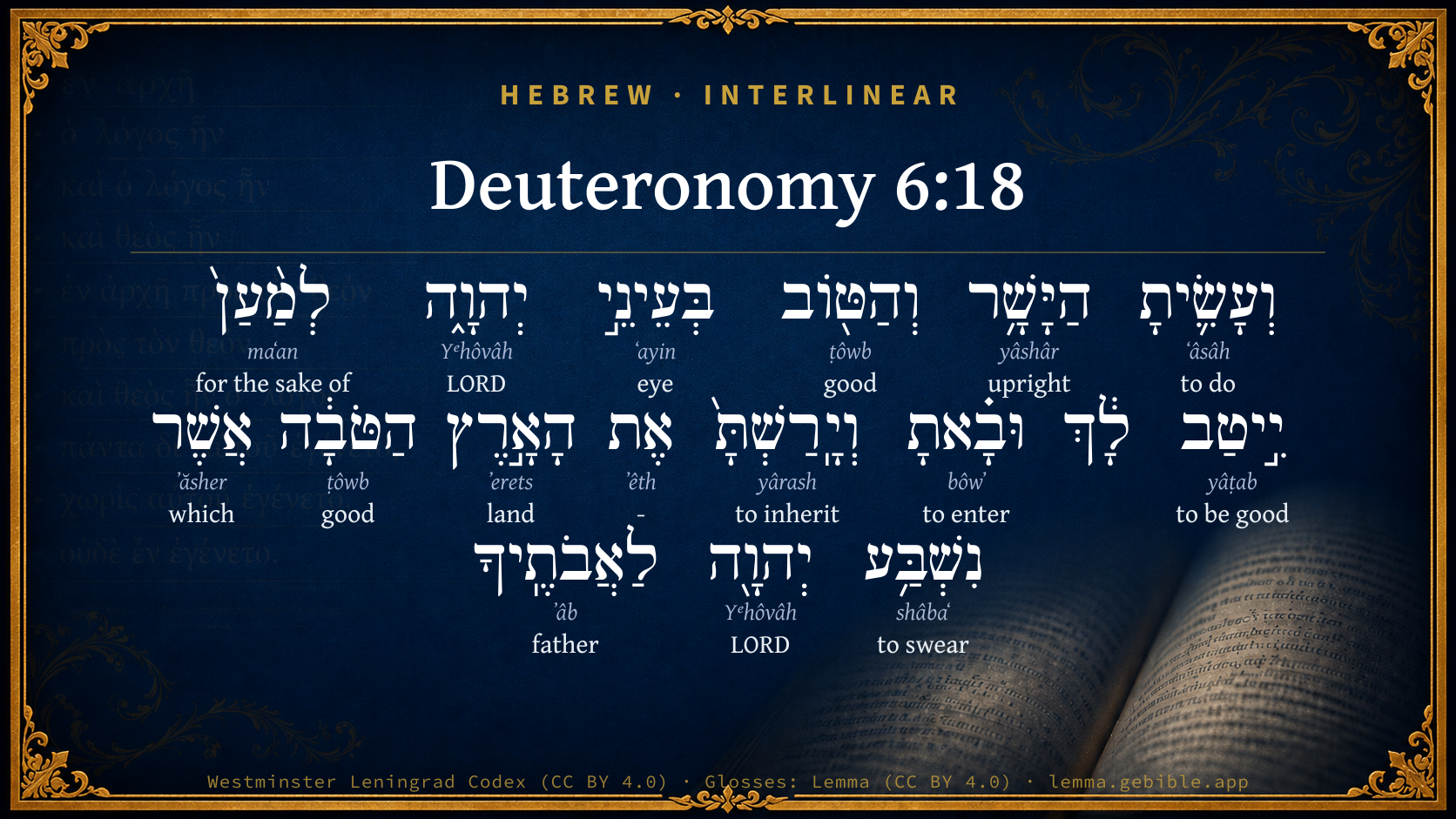
Deuteronomy 6:18

Hebrew (Westminster Leningrad Codex) Deuteronomy 6:18 appears in the Hebrew Old Testament. The text above is from the Westminster Leningrad Codex. Each word links to its Strong’s number, a concise gloss, and parsing drawn from the Open Scriptures Hebrew Bible morphology. Click any word for its full Brown-Driver-Briggs (BDB) entry.
Download image
Cite this verse

Deuteronomy 6:18 (World English Bible). Public Domain. Lemma interlinear Bible study tool, https://lemma.gebible.app/v/deuteronomy/6/18.

Show BibTeX & RIS
BibTeX
RIS
English Translation
You shall do that which is right and good in the sight of Yahweh; that it may be well with you, and that you may go in and possess the good land which Yahweh swore to your fathers,
World English Bible · Public Domain
Download a study sheet

One document with this verse’s original text, its word-by-word gloss line, the meaning frame, cross-references with their text, attributed commentary, and full source and license credits — printable, and it pastes into notes with its structure intact.

This verse Autodidact and up

Study sheet (.html) Plain text (.txt)

A passage Seminary Student

Up to 50 verses in one chapter. A passage sheet keeps up to 6 commentary sources and 12 cross-references per verse, in the order this page ranks them, and says so on the sheet whenever that leaves anything out. Ask for a single verse and you get the Autodidact verse sheet above.

Everything on this page stays free to read, with no account — the sheet is a download of what is already on screen, not access to it.

Want to remove ads? Support Godless Engineer
Compare translations 3

The same verse in 3 English versions, stacked beneath the original-language interlinear above. Click any original word for its lexicon entry.

Each is an independent rendering of the whole verse — the interlinear is not word-aligned to these translations.

Highlighted words mark where these versions differ — a whole-verse word diff, not a word-by-word alignment.

  • World English Bible Public Domain
    You shall do that which is right and good in the sight of Yahweh; that it may be well with you, and that you may go in and possess the good land which Yahweh swore to your fathers,
  • King James Version Public Domain
    And thou shalt do that which is right and good in the sight of the LORD: that it may be well with thee, and that thou mayest go in and possess the good land which the LORD sware unto thy fathers.
  • unfoldingWord Literal Text CC BY-SA 4.0
    And you shall do the right and the good in the eyes of Yahweh, so that it may be well for you, and you may go in and possess the good land that Yahweh swore to your fathers,

unfoldingWord Literal Text — © unfoldingWord, licensed CC BY-SA 4.0. Word-aligned USFM3 via Door43 (git.door43.org/unfoldingWord/en_ult).

Versions to compare (up to 4)

3 of 4 selected

Show all 18 translations

Every available English version of this verse, each an independent rendering of the whole verse.

  • World English Bible Public Domain
    You shall do that which is right and good in the sight of Yahweh; that it may be well with you, and that you may go in and possess the good land which Yahweh swore to your fathers,
  • Berean Standard Bible Public Domain
    Do what is right and good in the sight of the LORD, so that it may be well with you and that you may enter and possess the good land that the LORD your God swore to give your fathers,
  • Majority Standard Bible Public Domain
    Do what is right and good in the sight of the LORD, so that it may be well with you and that you may enter and possess the good land that the LORD your God swore to give your fathers,
  • King James Version Public Domain
    And thou shalt do that which is right and good in the sight of the LORD: that it may be well with thee, and that thou mayest go in and possess the good land which the LORD sware unto thy fathers.
  • American Standard Version (1901) Public Domain
    And thou shalt do that which is right and good in the sight of Jehovah; that it may be well with thee, and that thou mayest go in and possess the good land which Jehovah sware unto thy fathers,
  • Revised Version (1885) Public Domain
    And thou shalt do that which is right and good in the sight of the LORD: that it may be well with thee, and that thou mayest go in and possess the good land which the LORD sware unto thy fathers,
  • Geneva Bible (1599) Public Domain
    And thou shalt doe that which is right and good in the sight of the Lord: that thou mayest prosper, and that thou mayest go in, and possesse that good land which the Lord sware vnto thy fathers,
  • Douay-Rheims (1899) Public Domain
    And do that which is pleasing and good in the sight of the Lord, that it may be well with thee: and going in thou mayst possess the goodly land, concerning which the Lord swore to thy fathers,
  • Young's Literal Translation Public Domain
    and thou hast done that which is right and good in the eyes of Jehovah, so that it is well with thee, and thou hast gone in and possessed the good land which Jehovah hath sworn to thy fathers,
  • Literal Standard Version CC BY-SA 4.0
    and you have done that which is right and good in the eyes of YHWH, so that it is well with you, and you have gone in and possessed the good land which YHWH has sworn to your fathers,
  • Unlocked Literal Bible CC BY-SA 4.0
    You will do what is right and good in the sight of Yahweh, that it may go well with you, and that you may go in and possess the good land that Yahweh swore to your fathers,
  • unfoldingWord Literal Text CC BY-SA 4.0
    And you shall do the right and the good in the eyes of Yahweh, so that it may be well for you, and you may go in and possess the good land that Yahweh swore to your fathers,
  • Darby Bible Public Domain
    And thou shalt do what is right and good in the sight of Jehovah, that it may be well with thee, and that thou mayest enter in and possess the good land which Jehovah swore unto thy fathers,
  • World Messianic Bible Public Domain
    You shall do that which is right and good in the LORD’s sight, that it may be well with you and that you may go in and possess the good land which the LORD swore to your fathers,
  • Webster's Bible Public Domain
    And thou shalt do that which is right and good in the sight of the LORD: that it may be well with thee, and that thou mayest go in and possess the good land which the LORD swore to thy fathers,
  • Free Bible Version CC BY-SA 4.0
    Do what's good and right in the Lord's sight so that it will go well for you and that you may enter and take over the good land that the Lord your God promised to give your forefathers.
  • Bible in Basic English Public Domain
    And do what is upright and good in the eyes of the Lord your God, so that it may be well for you and you may go in and take for your heritage that good land from which the Lord undertook by an oath to your fathers,
  • JPS Tanakh (1917) Public Domain
    And thou shalt do that which is right and good in the sight of the LORD; that it may be well with thee, and that thou mayest go in and possess the good land which the LORD swore unto thy fathers,

Literal Standard Version (2020), Covenant Press — licensed CC BY-SA 4.0. Text via the HelloAO Bible API (eBible.org). Unlocked Literal Bible (unfoldingWord) — licensed CC BY-SA 4.0. Text via the HelloAO Bible API (eBible.org). unfoldingWord Literal Text — © unfoldingWord, licensed CC BY-SA 4.0. Word-aligned USFM3 via Door43 (git.door43.org/unfoldingWord/en_ult). Free Bible Version, Dr. Jonathan Gallagher — licensed CC BY-SA 4.0. Text via the HelloAO Bible API (eBible.org).

Word by word

More ways to search: Search by grammar → Find every occurrence → Compare this word →

Practice this passage: Drill this verse → Learn its vocabulary →

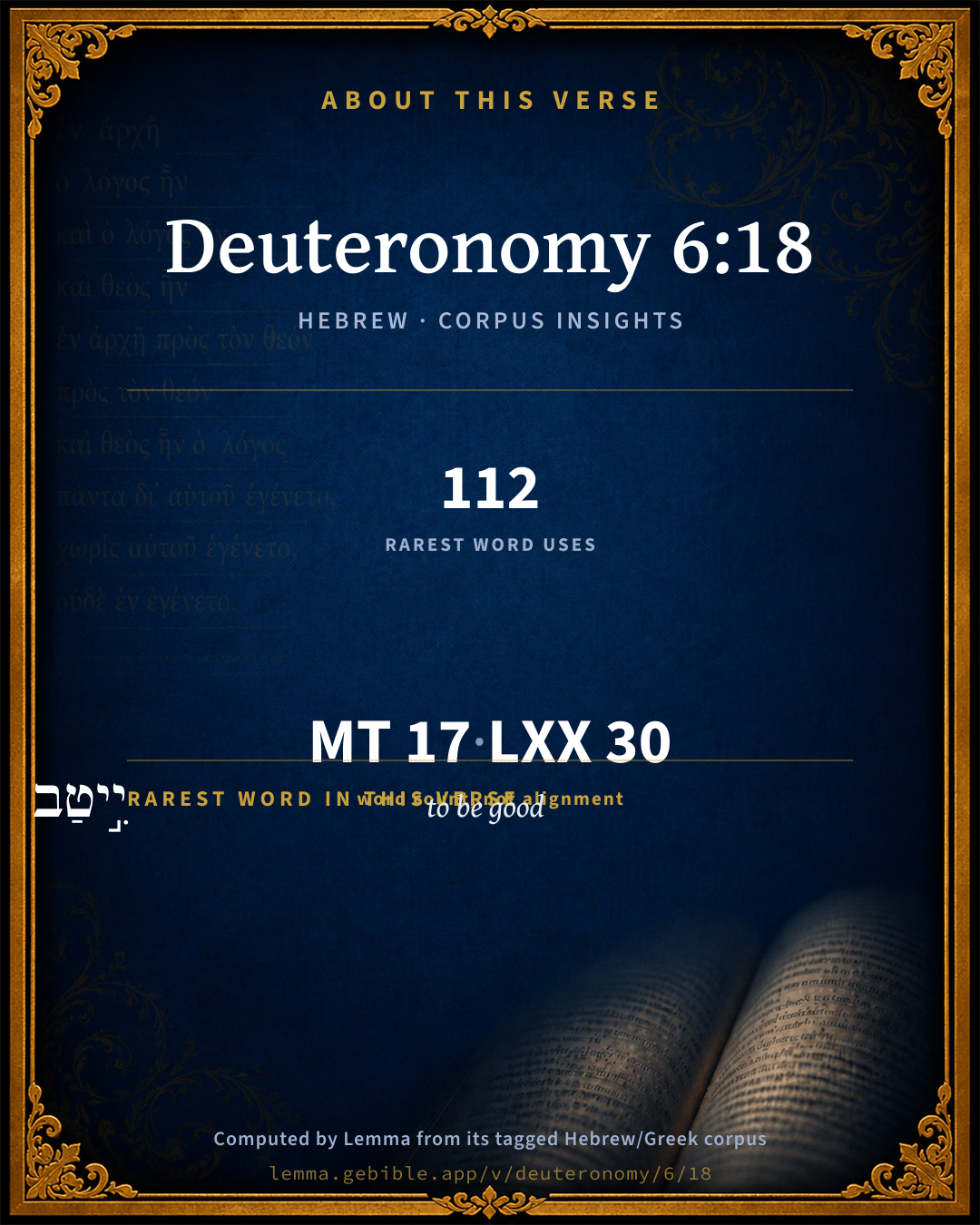
יִ֣יטַב
yâṭab
H3190
“to be good”
Verb, Qal, Imperfect, 3rd Person, Masculine, Singular
Part of Speech
Verb
Stem
Qal
Form
Imperfect
Person
3rd Person
Gender
Masculine
Number
Singular
Full BDB Definition

Origin: a primitive root

TWOT: 863

to be good, be pleasing, be well, be glad - (Qal) - to be glad, be joyful - to be well placed - to be well for, be well with, go well with - to be pleasing, be pleasing to - (Hiphil) - to make glad, rejoice - to do good to, deal well with - to do well, do thoroughly - to make a thing good or right or beautiful - to do well, do right
  1. וְעָשִׂ֛יתָ ʻâsâh H6213 “and · to do” Conjunction + Verb, Qal, Sequential Perfect, 2nd Person, Masculine, Singular
  2. הַיָּשָׁ֥ר yâshâr H3477 “the · upright” Particle, Definite Article + Adjective, Adjective, Masculine, Singular, Absolute
  3. וְהַטּ֖וֹב ṭôwb H2896 “and · the · good” Conjunction + Particle, Definite Article + Adjective, Adjective, Masculine, Singular, Absolute
  4. בְּעֵינֵ֣י ʻayin H5869 “in/at · eyes of” Preposition + Noun, Common, Both, Dual, Construct
  5. יְהוָ֑ה Yᵉhôvâh H3068 “LORD” Noun, Proper
  6. לְמַ֨עַן֙ maʻan H4616 “for the sake of” Preposition
  7. וּבָ֗אתָ bôwʼ H935 “and · to enter” Conjunction + Verb, Qal, Sequential Perfect, 2nd Person, Masculine, Singular
  8. וְיָֽרַשְׁתָּ֙ yârash H3423 “and · to inherit” Conjunction + Verb, Qal, Sequential Perfect, 2nd Person, Masculine, Singular
  9. אֶת ʼêth H853 “-” Particle, Direct Object
  10. הָאָ֣רֶץ ʼerets H776 “the · land” Particle, Definite Article + Noun, Common, Both, Singular, Absolute
  11. הַטֹּבָ֔ה ṭôwb H2896 “the · good” Particle, Definite Article + Adjective, Adjective, Feminine, Singular, Absolute
  12. אֲשֶׁר ʼăsher H834 “which” Particle, Relative
  13. נִשְׁבַּ֥ע shâbaʻ H7650 “to swear” Verb, Niphal, Perfect, 3rd Person, Masculine, Singular
  14. יְהוָ֖ה Yᵉhôvâh H3068 “LORD” Noun, Proper
  15. לַאֲבֹתֶֽיךָ ʼâb H1 “to/for · fathers · your” Preposition + Noun, Common, Masculine, Plural, Construct + Suffix, Personal, 2nd Person, Masculine, Singular

About this verse

These counts appear in no published source. They are computed here, from the morphology-tagged text and Lemma’s own curated glosses. What Lemma adds →

17
words
14
distinct lemmas
Pentateuch
section

Grammatical profile

  • 5 verbs
  • 5 nouns
  • 3 adjectives
  • 2 prepositions
  • 2 particles

Verb forms

  • וְעָשִׂ֛יתָ Qal · Sequential Perfect
  • יִ֣יטַב Qal · Imperfect
  • וּבָ֗אתָ Qal · Sequential Perfect
  • וְיָֽרַשְׁתָּ֙ Qal · Sequential Perfect
  • נִשְׁבַּ֥ע Niphal · Perfect

Repetition

Words recur within this verse — often emphatic in Hebrew:

  • וְהַטּ֖וֹב good H2896 ×2
  • יְהוָ֑ה LORD H3068 ×2

Hebrew & Septuagint length

In English translation the verse runs 38 words from the Hebrew and 40 from the Septuagint (LXX English) — closely comparable.

A rough comparison of the two English renderings, which tokenize alike — not a word-level alignment.

Word counts can differ between the Hebrew and the Greek without any difference in meaning — e.g. the Hebrew direct-object marker אֵת has no separate Greek word, and Greek often adds the article ὁ.

In the original languages it is 17 Hebrew tokens and 30 Greek tokens — but the two are counted differently (Hebrew bundles its prefixes and suffixes into one token; the Greek is in lemma form), so that isn’t a like-for-like length.

Cross-references

20

Topical passages linked to Deuteronomy 6:18 in the Treasury of Scripture Knowledge — connected by theme and wording, ordered by reader-vote popularity; previews shown in the World English Bible.

  • Deuteronomy 4:40 You shall keep his statutes, and his commandments, which I command you this day, that it may go well with you, and with your children after you, and that you may prolong your days in the land, which Yahweh your God gives you, forever.
  • Deuteronomy 12:25 You shall not eat it; that it may go well with you, and with your children after you, when you shall do that which is right in the eyes of Yahweh.
  • Deuteronomy 5:29 Oh that there were such a heart in them, that they would fear me, and keep all my commandments always, that it might be well with them, and with their children forever!
  • Romans 12:2 Don't be conformed to this world, but be transformed by the renewing of your mind, so that you may prove what is the good, well-pleasing, and perfect will of God.
  • Ezekiel 18:5 But if a man is just, and does that which is lawful and right,
  • John 8:29 He who sent me is with me. The Father hasn't left me alone, for I always do the things that are pleasing to him."
  • Exodus 15:26 and he said, "If you will diligently listen to the voice of Yahweh your God, and will do that which is right in his eyes, and will pay attention to his commandments, and keep all his statutes, I will put none of the diseases on you, which I have put on the Egyptians; for I am Yahweh who heals you."
  • Deuteronomy 8:11 Beware lest you forget Yahweh your God, in not keeping his commandments, and his ordinances, and his statutes, which I command you this day:
  • Deuteronomy 12:28 Observe and hear all these words which I command you, that it may go well with you, and with your children after you forever, when you do that which is good and right in the eyes of Yahweh your God.
  • Deuteronomy 13:18 when you shall listen to the voice of Yahweh your God, to keep all his commandments which I command you this day, to do that which is right in the eyes of Yahweh your God.
  • Psalms 19:11 Moreover by them is your servant warned. In keeping them there is great reward.
  • Isaiah 3:10 Tell the righteous "Good!" For they shall eat the fruit of their deeds.
  • Ezekiel 18:19 Yet say you, Why does not the son bear the iniquity of the father? when the son has done that which is lawful and right, and has kept all my statutes, and has done them, he shall surely live.
  • Ezekiel 18:21 But if the wicked turn from all his sins that he has committed, and keep all my statutes, and do that which is lawful and right, he shall surely live, he shall not die.
  • Ezekiel 18:27 Again, when the wicked man turns away from his wickedness that he has committed, and does that which is lawful and right, he shall save his soul alive.
  • Ezekiel 33:14 Again, when I say to the wicked, You shall surely die; if he turn from his sin, and do that which is lawful and right;
  • Ezekiel 33:16 None of his sins that he has committed shall be remembered against him: he has done that which is lawful and right; he shall surely live.
  • Ezekiel 33:19 When the wicked turns from his wickedness, and does that which is lawful and right, he shall live thereby.
  • Hosea 14:9 Who is wise, that he may understand these things? Who is prudent, that he may know them? For the ways of Yahweh are right, And the righteous walk in them; But the rebellious stumble in them.
  • Deuteronomy 5:33 You shall walk in all the way which Yahweh your God has commanded you, that you may live, and that it may be well with you, and that you may prolong your days in the land which you shall possess.

Cross-references courtesy of OpenBible.info (CC BY 4.0).

Hebrew and Greek witnesses Masoretic Hebrew ↔ Greek Septuagint

The same verse in the two great witnesses to the Old Testament, shown verse-for-verse.

These are two independent witnesses, not word-aligned to each other, and the Septuagint is shown in lemma (dictionary) form.

Hebrew Deuteronomy 6:18 Masoretic · Westminster Leningrad Codex

וְעָשִׂ֛יתָ הַיָּשָׁ֥ר וְהַטּ֖וֹב בְּעֵינֵ֣י יְהוָ֑ה לְמַ֨עַן֙ יִ֣יטַב לָ֔ךְ וּבָ֗אתָ וְיָֽרַשְׁתָּ֙ אֶת הָאָ֣רֶץ הַטֹּבָ֔ה אֲשֶׁר נִשְׁבַּ֥ע יְהוָ֖ה לַאֲבֹתֶֽיךָ

You shall do that which is right and good in the sight of Yahweh; that it may be well with you, and that you may go in and possess the good land which Yahweh swore to your fathers,

World English Bible · Public Domain

Greek LXX Deuteronomy 6:18 Septuagint · lemma form

καί ποιέω ὁ ἀρεστός καί ὁ καλός ἐναντίον κύριος ὁ θεός σύ ἵνα εὖ σύ γίγνομαι καί εἰςἔρχομαι καί κληρονομέω ὁ γῆ ὁ ἀγαθός ὅς ὄμνυμι κύριος ὁ πατήρ σύ

And you shall do that which is pleasing and good before the Lord your God, that it may be well with you, and that you may go in and inherit the good land, which the Lord swore to your fathers,

LXX2012 (modern English Septuagint) · Public Domain

Hebrew: Westminster Leningrad Codex (CC BY 4.0). Greek: Septuagint (public domain); English from LXX2012 (modern English Septuagint) (Public Domain). How the Septuagint differs from the Hebrew →

Targum (Aramaic paraphrase)

2

The Targum is the ancient Jewish Aramaic paraphrase of the Hebrew Scriptures — an interpretive translation, not the Hebrew text itself. Onkelos (literal) and Pseudo-Jonathan (expansive) render the Torah, and Jonathan the Prophets. Coverage is partial: where no permissively-licensed English translation exists for a verse, only the Aramaic is shown. This is verse-level text, not a word-by-word alignment to the Hebrew.

  1. Targum Onkelos Torah (Genesis–Deuteronomy)
    וְתַעְבֵּד דְכָשַׁר וּדְתַקֵן קֳדָם יְיָ בְּדִיל דְיֵיטַב לָךְ וְתֵעוּל וְתֵירַת יָת אַרְעָא טַבְתָא דִי קַיִים יְיָ לַאֲבָהָתָךְ

    (no public-domain English translation for this verse)

    Targum Onkelos — Aramaic: “Onkelos Genesis” (public domain); “Onkelos Exodus” (public domain); “Onkelos Leviticus” (public domain); “Onkelos Numbers” (public domain); “Onkelos Deuteronomy” (public domain). English: “Sefaria Community Translation” (CC0 1.0 (public-domain dedication)); “J.W. Etheridge. The Targums of Onkelos and Jonathan Ben Uzziel on the Pentateuch. London: Longmans, Green, 1862” (public domain). Text via Sefaria.

  2. Targum Pseudo-Jonathan Torah (Genesis–Deuteronomy)
    וְתַעֲבֵיד דְּתַקִּין וּדְכָשַׁר קֳדָם יְיָ מִן בִּגְלַל דְּיוֹטִיב לְכוֹן וְתֵיעֲלוּן וְתֵירְתוּן יַת אַרְעָא טַבְתָּא דְקַיִים יְיָ לַאֲבָהַתְכוֹן

    and do what is good and right before the Lord, that it may be well with you, and ye may go in, and possess by inheritance the good land which the Lord covenanted to your fathers;

    Targum Pseudo-Jonathan — Aramaic: “Targum Jonathan on Genesis” (public domain); “Targum Jonathan on Exodus” (public domain); “Targum Jonathan on Leviticus” (public domain); “Targum Jonathan on Numbers” (public domain); “Targum Jonathan on Deuteronomy” (public domain). English: “The Targum of Jonathan ben Uzziel, trans. J. W. Etheridge, London, 1862” (public domain). Text via Sefaria.

Commentary

Notes on Deuteronomy 6:18 from classic Christian and Jewish commentators (each source and its license shown beneath its notes). The classic Christian expositions comment on the surrounding passage and are grouped to its opening verse, so a note may address several verses; the Jewish commentaries on the Tanakh (Rashi and others) are per-verse, so they appear only where the commentator wrote on this verse.

Lemma curates 59 commentaries, every one of them public domain or Creative Commons licensed, each selected and text-cleaned for this edition rather than reprinted as found. About our sources →

The Biblical Illustrator

Joseph S. Exell

Deu_6:18

Fear the Lord thy God, and serve Him.

Moses serious and affectionate charge to Israel

I. A solemn charge given.

1. Hear the Word of the Lord. This message is neglected or abused--

(1) By those who seldom or never attend a place of public worship: let such consider how they will be able to account for their negligence (Heb_2:1-3).

(2) By those who visit places of worship, but who sleep when they should hear (Rev_3:14-19).

(3) By those who are usually engaged in worldly contemplations while under the sound of the Word (Amo_8:5). Hence the charge is--

2. Observe the Word of the Lord. Observe--

(1) The doctrinal truths taught--respecting Gods claim on us; and God has claims on us as our Creator, Preserver, Benefactor, etc.

respecting our obligation to obedience, from gratitude, fear, hope, etc.

(2) The preceptive part of what is taught--concerning both outward and reward obedience, and the discrepancy between our conduct and spirit and the extensive requirements of the holy law (Mar_12:30-31).

(3). The promissory and encouraging part of what is taught--respecting the freeness and plenitude of Divine grace, to pity and pardon our transgressions (Isa_1:18); to purify our hearts (Eze_36:25-27); and to help our infirmities (Isa_41:10; Heb_4:14-16). The observance required is, however, principally in reference to practice.

3. Obey the Word of the Lord. Observe to do it. This refers to what in Deu_6:1, Moses called the commandments, the statutes, and the judgments which the Lord your God commanded.

II. Important benefits proposed. As a stimulus to the Israelites to devote themselves to the service of Jehovah, Moses proposes--

1. Their safety; their well-being--that it may be well with thee. By way of contrast, look at Deu_4:23-26; Deu_27:26; Deu_28:16-20. Disobedience always exposes to danger, to destruction. But say ye to the righteous - the obedient believer - it shall be well with him. He shall be well instructed (Psa_25:9; 1Jn_2:20); well defended (Deu_32:9-11); well provided (Psa_34:10; Php_4:19). It shall be well with such, not only through life, but also at death (Psa_116:15); at judgment (Mat_25:34; 2Th_1:10); and forever (Psa_16:11). But we must return to observe that Moses proposes--

2. Their prosperity--that ye may increase mightily. This may have respect--

(1) To an increase of wealth--houses full of all good things, etc. (Deu_28:11). Or--

(2) To an increase of numbers (Deu_7:13). In the former case they would have an increase of their means of enjoyment; in the latter they would more mightily resist and overcome their enemies (Deu_7:24); and in both they might with less difficulty and greater cheerfulness attend on the services of the Most High. We, as Christians, may expect prosperity of a higher order.

1. Individually, we may be blessed with a sense of pardoning love, and fellowship with God through His Son (1Jn_1:3); may be enriched with the fruits of the Divine Spirit, love, joy, peace, etc. (Gal_5:22-23); strengthened with might in the inner man (Eph_3:16); and continue to grow in grace, etc. (2Pe_3:18). Hence we shall be enabled to bear temptation more easily; and in our conflict with Satan and his servants, our having prospered mightily will appear in our effectual resistance and our final triumph. And hence--

2. While the members of churches adorn their profession, we may hope that the churches collectively will receive an accession of members who, won by our Christian deportment, shall glorify God on our behalf. (Sketches of Four Hundred Sermons.)

Serve God

I. What is it to serve God?

1. To dedicate ourselves wholly to Him.

(1) Our souls, understandings, wills, affections.

(2) Our bodies.

(3) Our estates.

(4) Our gifts.

(5) Our authority.

(6) Our time.

2. To make His laws the rule of our lives.

3. To endeavour to please Him in all things.

II. Why serve God? He is our Maker, Preserver, Redeemer, etc,

III. Exhortation. Serve God--

1. Spiritually.

2. Obediently.

3. Willingly.

4. Cheerfully.

5. Faithfully.

6. Humbly.

7. Thankfully. (W. Stevens.)

The Biblical Illustrator, edited by Joseph S. Exell (c. 1880s–1900s) — public domain. Text from a community e-Sword module.

Geneva Bible (1599)

Geneva Bible translators

Here he condemneth all man’s good intentions.

Geneva Bible (1599) marginal notes — public domain. Text via Bolls.life.

Ellicott's Commentary for English Readers

(18) And that thou mayest go in and possess.—This should be taken with what follows, “Possess,” so as “to cast out all thine enemies from before thee” (Deu_6:19). There was no question now whether Israel should pass the Jordan; but how far the conquest of Canaan would be completed, or within what period of time, depended upon their faithfulness to His decrees. That it was delayed by their disobedience is clear from Jdg_2:20-23.

A Bible Commentary for English Readers, edited by Charles John Ellicott (1878–1897) — public domain. Text from a community e-Sword module.

The Cambridge Bible for Schools and Colleges

gen. ed. J. J. S. Perowne

18. do that which is right, etc.] Cp. Deu_12:25.

mayest go in and possess] See above on Deu_6:1.

18, 19. Resumption of the Sg. address; in spite of this the originality of these verses also has been doubted. It is at least curious that we have in them the divine name alone without the addition thy God, characteristic of D.

The Cambridge Bible for Schools and Colleges (gen. ed. J. J. S. Perowne; Cambridge University Press, 1878–1918) — public domain. Text from a community e-Sword module.

John Gill's Exposition

And thou shalt do that which is right and good in the sight of the Lord,.... And what is such appears from the declaration of his mind and will in the commandments he has given, and obeying which is therefore doing what is right and good; for his commandment is holy, just, and good, being agreeable both to his nature and will, Rom 7:12 that it may be well with thee; as it is with those that fear God, and keep his commandments:

and that thou mayest go in and possess the good land which the Lord sware unto thy fathers; to give to them and to their posterity, even the land of Canaan; but if they did not what was right and good in the sight of God, they might expect to be kept out of it, as their immediate parents were, whose carcasses fell in the wilderness.

John Gill's Exposition of the Whole Bible (1746–1763) — public domain (CC PDM 1.0). Text via the HelloAO Bible API.

Matthew Poole's English Annotations

Not that which is right in thine own eyes, as many superstitious and sinful practices seem right and good to evil-minded men. Let God’s will and word, and not thine own fancy or invention, be thy rule in God’s service. Good actions are oft said to be right in God’s sight, as Jer 34:15; Act 4:19; and evil actions are oft said to be right in our own eyes, as Deu 12:8; Jdg 17:6.

Matthew Poole's English Annotations on the Holy Bible (1683–1685) — public domain. Text from a community e-Sword/MySword module.

unfoldingWord translationNotes

Door43 World Missions Community

General Information:

Moses continues to tell the people of Israel Yahweh's words as if the Israelites are one person. (See: Forms of You)

You will do what is right and good in the sight of Yahweh

This idiom is a command and a blessing. If the Israelites obey Yahweh, they will receive blessings from Yahweh. AT: "Do what Yahweh says is right and good" (See: Idiom)

translationWords

good

Yahweh

possess

oath

ancestor

cast out

adversary

unfoldingWord translationNotes — © Distant Shores Media and the Door43 World Missions Community, licensed CC BY-SA 4.0. Source: git.door43.org/Door43/en_tn.

Rashi

Rabbi Shlomo Yitzchaki (Rashi)

הישר והטוב [AND THOU SHALT DO] THAT WHICH IS RIGHT AND GOOD [IN THE EYES OF THE LORD] — This refers to a compromise, acting beyond the strict demands of the law (cf. Rashi on Bava Metzia 108a).

Rashi on the Tanakh — English translations: “The Judaica Press complete Tanach with Rashi, translated by A. J. Rosenberg” (CC BY 4.0); “Pentateuch with Rashi's commentary by M. Rosenbaum and A.M. Silbermann, 1929-1934” (public domain); “The Metsudah Tanach series, Lakewood, N.J” (CC BY 4.0); and “The Book of Joshua, Metsudah Publications, 1997” (CC BY 4.0). Text via Sefaria.

Ramban (Nachmanides)

Rabbi Moshe ben Nachman (Ramban / Nachmanides)

AND THOU SHALT DO THAT WHICH IS RIGHT AND GOOD IN THE SIGHT OF THE ETERNAL. In line with the plain meaning of Scripture the verse says, “Keep the commandments of G-d, His testimonies, and His statutes, and, in observing them, intend to do what is right and good in His sight only.” And [the expression in the verse before us] that it may be well with thee is a promise, stating that, when you will do that which is good in His eyes, it will be well with you, for G-d does good unto the good, and to them that are upright in their hearts. Our Rabbis have a beautiful Midrash on this verse. They have said: “[That which is right and good] refers to a compromise and going beyond the requirement of the letter of the law.” The intent of this is as follows: At first he [Moses] stated that you are to keep His statutes and His testimonies which He commanded you, and now he is stating that even where He has not commanded you, give thought, as well, to do what is good and right in His eyes, for He loves the good and the right. Now this is a great principle, for it is impossible to mention in the Torah all aspects of man’s conduct with his neighbors and friends, and all his various transactions, and the ordinances of all societies and countries. But since He mentioned many of them — such as, Thou shalt not go up and down as a talebearer; Thou shalt not take vengeance, nor bear any grudge;, Verse 18. neither shalt thou stand idly by the blood of thy neighbor; Thou shalt not curse the deaf;, Verse 15. Thou shalt rise up before the hoary head, Verse 32. and the like — he reverted to state in a general way that, in all matters, one should do what is good and right, including even compromise and, going beyond the requirements of the law. Other examples are the Rabbis’ ordinances concerning the prerogative of a neighbor, and even what they said [concerning the desirability] that one’s youthful reputation be unblemished, and that one’s conversation with people be pleasant. Thus [a person must seek to refine his behavior] in every form of activity, until he is worthy of being called “good and upright.”

Ramban (Nachmanides) on the Tanakh — English translation: “Commentary on the Torah by Ramban (Nachmanides). Translated and annotated by Charles B. Chavel. New York, Shilo Pub. House, 1971-1976” (CC BY 4.0). Text via Sefaria.

Lesson kit

Teaching starters — assembled from the data on this page, not authored interpretation. Every prompt links to the verse data it draws on. Edit before teaching.

Deuteronomy, in the Pentateuch, opens this verse with 17 words (14 distinct Hebrew lemmas). Its most distinctive word is yâṭab (“to be good”). A historical commentator’s framing appears above. Read the whole chapter for the surrounding context.

Discussion questions

  1. How does “to be good” (yâṭab) shape what this verse is saying?
  2. Deuteronomy 4:40 shares this passage’s theme. How do the two illuminate each other?
  3. “good” occurs 2× in this one verse. What is the effect of the repetition?
  4. These translations render this verse differently; the difference is in the English rendering, not the original. What questions does that raise?
  5. The verb «וְעָשִׂ֛יתָ» is Qal Sequential Perfect. How does its form color the action?
  6. Reading how The Biblical Illustrator and Geneva Bible (1599) read this verse, where do the two commentators agree and where do they part?

Things to notice

Reading settings

Reading text

Shown beneath each verse's original-language words.

Old Testament
Old Testament edition

Read the OT as the Masoretic Hebrew (MT) or the Greek Septuagint (LXX).

English shown for the Greek Septuagint (in the Hebrew ↔ Greek comparison).

Comparing translations? Open the Compare panel on any verse page to stack up to four side by side.