
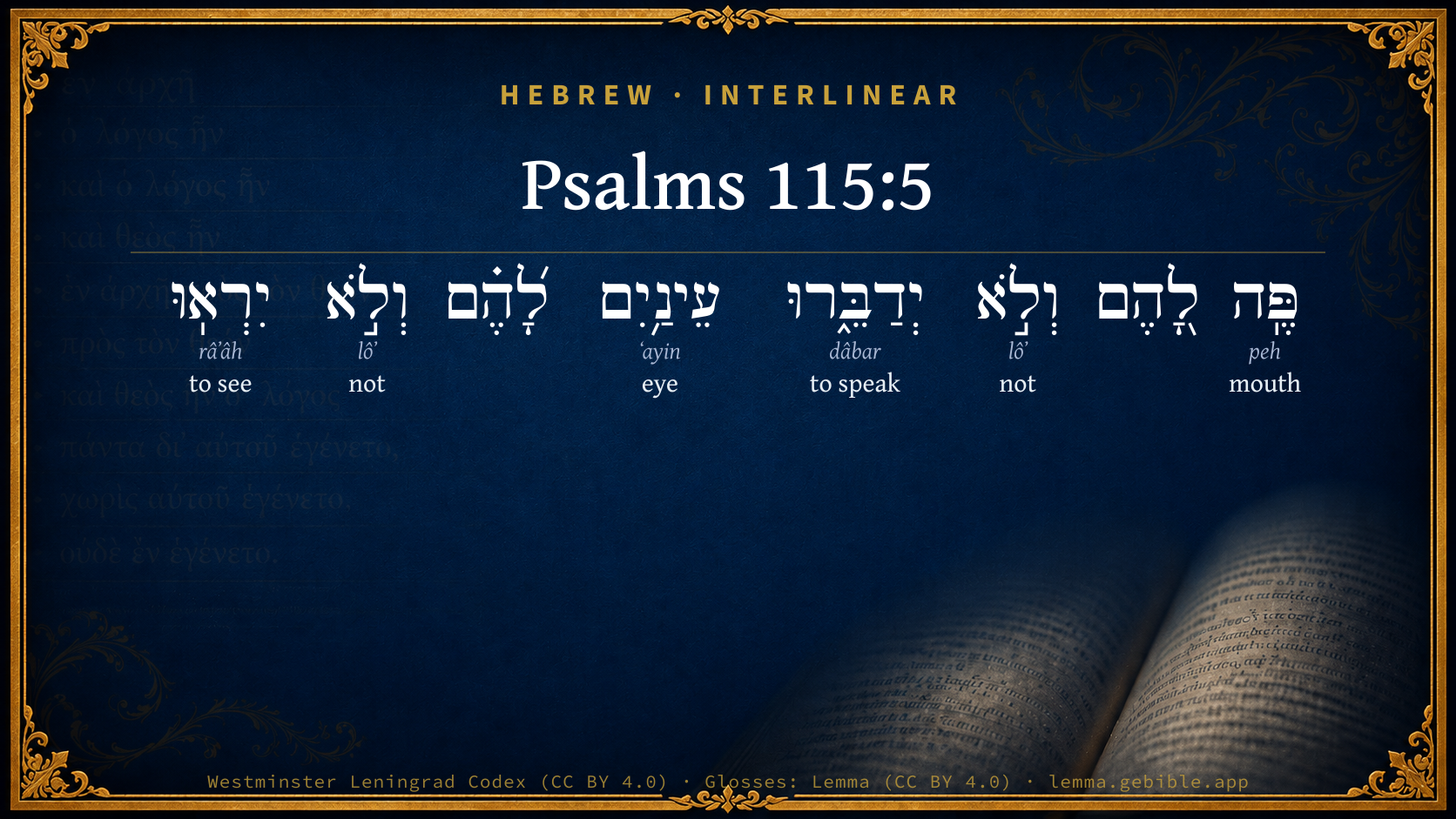
Psalms 115:5

Hebrew (Westminster Leningrad Codex) Psalms 115:5 appears in the Hebrew Old Testament. The text above is from the Westminster Leningrad Codex. Each word links to its Strong’s number, a concise gloss, and parsing drawn from the Open Scriptures Hebrew Bible morphology. Click any word for its full Brown-Driver-Briggs (BDB) entry.
Download image
Cite this verse

Psalms 115:5 (World English Bible). Public Domain. Lemma interlinear Bible study tool, https://lemma.gebible.app/v/psalms/115/5.

Show BibTeX & RIS
BibTeX
RIS
English Translation
They have mouths, but they don't speak; They have eyes, but they don't see;
World English Bible · Public Domain
Download a study sheet

One document with this verse’s original text, its word-by-word gloss line, the meaning frame, cross-references with their text, attributed commentary, and full source and license credits — printable, and it pastes into notes with its structure intact.

This verse Autodidact and up

Study sheet (.html) Plain text (.txt)

A passage Seminary Student

Up to 50 verses in one chapter. A passage sheet keeps up to 6 commentary sources and 12 cross-references per verse, in the order this page ranks them, and says so on the sheet whenever that leaves anything out. Ask for a single verse and you get the Autodidact verse sheet above.

Everything on this page stays free to read, with no account — the sheet is a download of what is already on screen, not access to it.

Want to remove ads? Support Godless Engineer
Compare translations 3

The same verse in 3 English versions, stacked beneath the original-language interlinear above. Click any original word for its lexicon entry.

Each is an independent rendering of the whole verse — the interlinear is not word-aligned to these translations.

Highlighted words mark where these versions differ — a whole-verse word diff, not a word-by-word alignment.

  • World English Bible Public Domain
    They have mouths, but they don't speak; They have eyes, but they don't see;
  • King James Version Public Domain
    They have mouths, but they speak not: eyes have they, but they see not:
  • unfoldingWord Literal Text CC BY-SA 4.0
    A mouth to them, but they do not speak; eyes to them, but they do not see;

unfoldingWord Literal Text — © unfoldingWord, licensed CC BY-SA 4.0. Word-aligned USFM3 via Door43 (git.door43.org/unfoldingWord/en_ult).

Versions to compare (up to 4)

3 of 4 selected

Show all 18 translations

Every available English version of this verse, each an independent rendering of the whole verse.

  • World English Bible Public Domain
    They have mouths, but they don't speak; They have eyes, but they don't see;
  • Berean Standard Bible Public Domain
    They have mouths, but cannot speak; they have eyes, but cannot see;
  • Majority Standard Bible Public Domain
    They have mouths, but cannot speak; they have eyes, but cannot see;
  • King James Version Public Domain
    They have mouths, but they speak not: eyes have they, but they see not:
  • American Standard Version (1901) Public Domain
    They have mouths, but they speak not; Eyes have they, but they see not;
  • Revised Version (1885) Public Domain
    They have mouths, but they speak not; eyes have they, but they see not;
  • Geneva Bible (1599) Public Domain
    They haue a mouth and speake not: they haue eyes and see not.
  • Douay-Rheims (1899) Public Domain
    The Lord is merciful and just, and our God sheweth mercy.
  • Young's Literal Translation Public Domain
    A mouth they have, and they speak not, Eyes they have, and they see not,
  • Literal Standard Version CC BY-SA 4.0
    They have a mouth, and they do not speak, || They have eyes, and they do not see,
  • Unlocked Literal Bible CC BY-SA 4.0
    Those idols have mouths, but they do not speak; they have eyes, but they do not see;
  • unfoldingWord Literal Text CC BY-SA 4.0
    A mouth to them, but they do not speak; eyes to them, but they do not see;
  • Darby Bible Public Domain
    They have a mouth, and they speak not; eyes have they, and they see not;
  • World Messianic Bible Public Domain
    They have mouths, but they don’t speak. They have eyes, but they don’t see.
  • Webster's Bible Public Domain
    They have mouths, but they speak not: eyes have they, but they see not:
  • Free Bible Version CC BY-SA 4.0
    They have mouths, but can't speak. They have eyes, but can't see.
  • Bible in Basic English Public Domain
    They have mouths, but no voice; they have eyes, but they see not;
  • JPS Tanakh (1917) Public Domain
    They have mouths, but they speak not; eyes have they, but they see not;

Literal Standard Version (2020), Covenant Press — licensed CC BY-SA 4.0. Text via the HelloAO Bible API (eBible.org). Unlocked Literal Bible (unfoldingWord) — licensed CC BY-SA 4.0. Text via the HelloAO Bible API (eBible.org). unfoldingWord Literal Text — © unfoldingWord, licensed CC BY-SA 4.0. Word-aligned USFM3 via Door43 (git.door43.org/unfoldingWord/en_ult). Free Bible Version, Dr. Jonathan Gallagher — licensed CC BY-SA 4.0. Text via the HelloAO Bible API (eBible.org).

Word by word

More ways to search: Search by grammar → Find every occurrence → Compare this word →

Practice this passage: Drill this verse → Learn its vocabulary →

פֶּֽה
peh
H6310
“mouth”
Noun, Common, Masculine, Singular, Absolute
Part of Speech
Noun
Type
Common
Gender
Masculine
Number
Singular
State
Absolute
Full BDB Definition

Origin: from H6284

TWOT: 1738

mouth - mouth (of man) - mouth (as organ of speech) - mouth (of animals) - mouth, opening, orifice (of a well, river, etc) - extremity, end - a weight equal to one third of a shekel, occurs only in 1Sa 13:21
  1. וְלֹ֣א lôʼ H3808 “and · not” Conjunction + Particle, Negative
  2. יְדַבֵּ֑רוּ dâbar H1696 “to speak” Verb, Piel, Imperfect, 3rd Person, Masculine, Plural
  3. עֵינַ֥יִם ʻayin H5869 “eyes” Noun, Common, Both, Dual, Absolute
  4. וְלֹ֣א lôʼ H3808 “and · not” Conjunction + Particle, Negative
  5. יִרְאֽוּ râʼâh H7200 “to see” Verb, Qal, Imperfect, 3rd Person, Masculine, Plural

About this verse

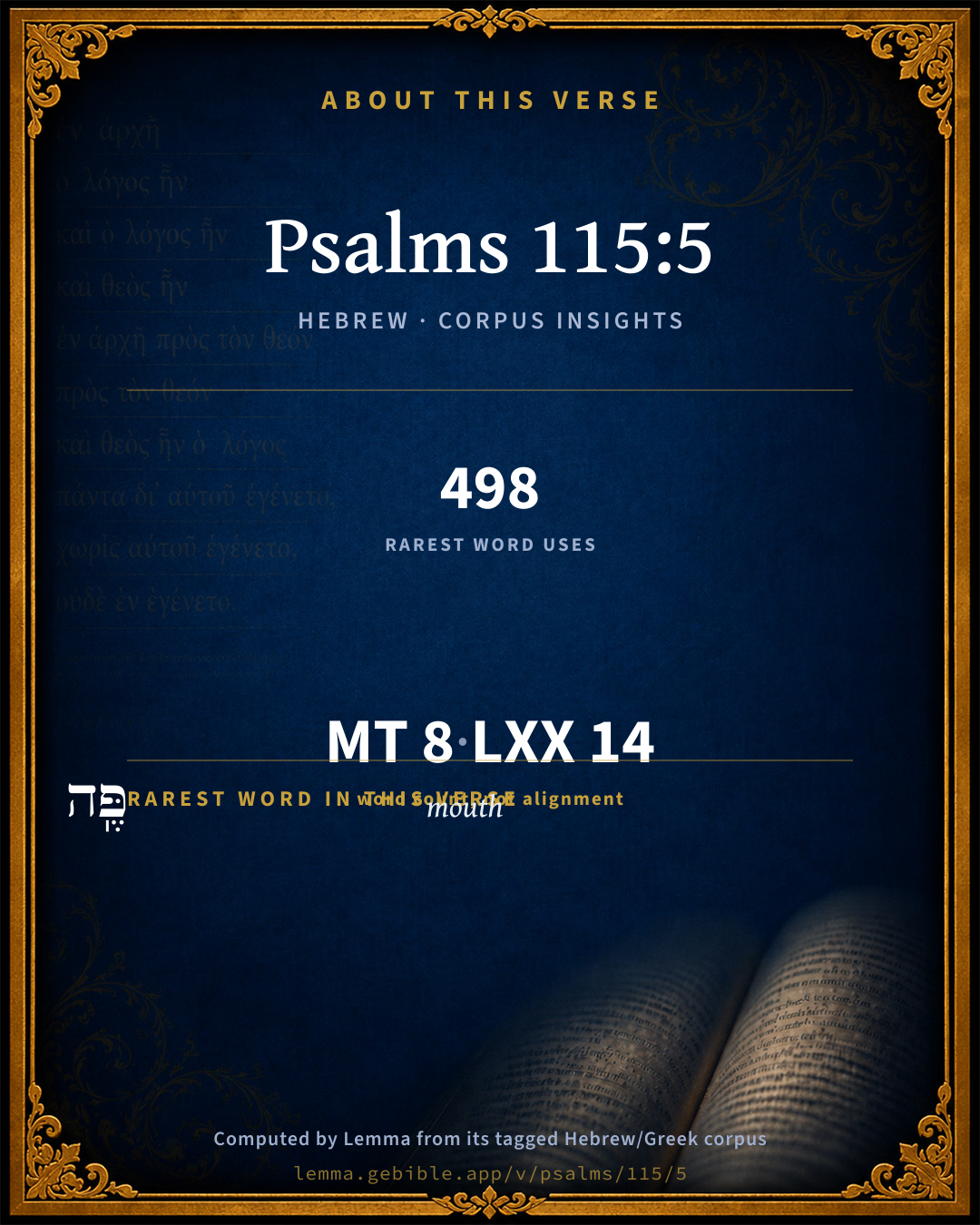
These counts appear in no published source. They are computed here, from the morphology-tagged text and Lemma’s own curated glosses. What Lemma adds →

8
words
5
distinct lemmas
Wisdom
section

Grammatical profile

  • 2 verbs
  • 2 nouns
  • 2 prepositions
  • 2 particles

Verb forms

  • יְדַבֵּ֑רוּ Piel · Imperfect
  • יִרְאֽוּ Qal · Imperfect

Repetition

A word recurs within this verse — often emphatic in Hebrew:

  • וְלֹ֣א not H3808 ×2

Hebrew & Septuagint length

In English translation the verse runs 14 words from the Hebrew and 16 from the Septuagint (LXX English) — closely comparable.

A rough comparison of the two English renderings, which tokenize alike — not a word-level alignment.

Word counts can differ between the Hebrew and the Greek without any difference in meaning — e.g. the Hebrew direct-object marker אֵת has no separate Greek word, and Greek often adds the article ὁ.

In the original languages it is 8 Hebrew tokens and 14 Greek tokens — but the two are counted differently (Hebrew bundles its prefixes and suffixes into one token; the Greek is in lemma form), so that isn’t a like-for-like length.

Cross-references

1

Topical passages linked to Psalms 115:5 in the Treasury of Scripture Knowledge — connected by theme and wording, ordered by reader-vote popularity; previews shown in the World English Bible.

  • Jeremiah 10:5 They are like a palm tree, of turned work, and don't speak: they must be carried, because they can't go. Don't be afraid of them; for they can't do evil, neither is it in them to do good."

Cross-references courtesy of OpenBible.info (CC BY 4.0).

Hebrew and Greek witnesses Masoretic Hebrew ↔ Greek Septuagint

The same verse in the two great witnesses to the Old Testament, shown verse-for-verse.

You’re reading Greek Psalm 113 (Hebrew Psalm 115). The Septuagint counts the superscription, so verse numbers can differ from the Hebrew — chapter-level alignment, not verse-by-verse. Numbering follows Rahlfs.

These are two independent witnesses, not word-aligned to each other, and the Septuagint is shown in lemma (dictionary) form.

Hebrew Psalms 115:5 Masoretic · Westminster Leningrad Codex

פֶּֽה לָ֭הֶם וְלֹ֣א יְדַבֵּ֑רוּ עֵינַ֥יִם לָ֝הֶ֗ם וְלֹ֣א יִרְאֽוּ

They have mouths, but they don't speak; They have eyes, but they don't see;

World English Bible · Public Domain

Greek LXX Greek Psalm 113:5 Septuagint · lemma form

τίς σύ εἰμί θάλασσα ὅτι φεύγω καί σύ ιορδάνης ὅτι ἀναχωρέω εἰς ὁ ὀπίσω

What ailed you, O sea, that you fled? and you Jordan, that you were turned back?

LXX2012 (modern English Septuagint) · Public Domain

Hebrew: Westminster Leningrad Codex (CC BY 4.0). Greek: Septuagint (public domain); English from LXX2012 (modern English Septuagint) (Public Domain). How the Septuagint differs from the Hebrew →

Commentary

Notes on Psalms 115:5 from classic Christian and Jewish commentators (each source and its license shown beneath its notes). The classic Christian expositions comment on the surrounding passage and are grouped to its opening verse, so a note may address several verses; the Jewish commentaries on the Tanakh (Rashi and others) are per-verse, so they appear only where the commentator wrote on this verse.

Lemma curates 59 commentaries, every one of them public domain or Creative Commons licensed, each selected and text-cleaned for this edition rather than reprinted as found. About our sources →

Trapp's Complete Commentary

John Trapp

Psa 115:5 They have mouths, but they speak not: eyes have they, but they see not:

Ver. 5. They have mouths, but speak not] Unless the devil haply speak in them, and by them, as at Delphos; or the false priests, as here, in times of Popery.

Eyes have they, but they see not] And yet with wires and other devices they were made here once to goggle their eyes, to move their chaps apace, as well apaid when something of worth was presented them; as if otherwise, to look at eyes’ end, and to hang a lip.

John Trapp, A Commentary or Exposition upon All the Books of the Old and New Testament (1647–1656) — public domain. Text from a community e-Sword module.

J. A. Alexander on Psalms

Joseph Addison Alexander

5. (Psa 115:5) They have a mouth and speak not; they have eyes and see not. As the verb to have is wanting in the Hebrew and its cognate languages (see above, on Psa 114:5), it is not a literal translation of the original expression, (there is) a mouth to them, (there are) eyes to them. The future includes not only a simple affirmation, they speak not, they see not, but the future and potential sense, they never will or can speak or see.

Joseph Addison Alexander, The Psalms Translated and Explained (1850) — public domain. Text from a community e-Sword module.

The Cambridge Bible for Schools and Colleges

gen. ed. J. J. S. Perowne

5, 6. They cannot teach their worshippers (Hab_2:19) or see their needs; they cannot hear prayers offered to them or smell the sweet savour of sacrifices. Jehovah, though He has no bodily form, can truly be said to speak (Isa_1:20) and see (Psa_113:6) and hear (Psa_6:8) and smell (Gen_8:21).

The Cambridge Bible for Schools and Colleges (gen. ed. J. J. S. Perowne; Cambridge University Press, 1878–1918) — public domain. Text from a community e-Sword module.

John Gill's Exposition

They have mouths, but they speak not,.... These idols are carved with mouths, but they make no use of them; if any cry to them for they cannot answer them, nor save them from their troubles. Baal's priests cried to their idol, but was no voice heard, nor answer returned; they are rightly called dumb idols, Hab 2:18, Kg1 18:26, but our God in the heavens, when his people cry to him, he answers them, and sends them relief; and tells them his grace is sufficient for them, and so they find it to be.

Eyes have they, but they see not; they are made with eyes in their heads, but cannot see with them; they cannot see their worshippers, nor what they bring to them; neither their persons nor their wants, Dan 5:23, but our God and Father in heaven, he sees in secret the persons and hearts of his people; their desires are before him, and their groanings are not hid from him; his eyes are on the righteous, and are never withdrawn from them.

John Gill's Exposition of the Whole Bible (1746–1763) — public domain (CC PDM 1.0). Text via the HelloAO Bible API.

Albert Barnes' Notes on the Bible

They have mouths ... - They are shaped like people, but have none of the attributes of intelligent beings.

Albert Barnes' Notes on the Bible (1834–1885) — public domain. Text from a community e-Sword/MySword module.

Matthew Poole's English Annotations

For although the blind heathen are by their idolatrous priests made to believe otherwise concerning their idols, in regard of the spirits which they pretend to dwell in them, yet this is the truth of the matter, and confirmed by long and constant experience, that they are but vain and senseless things; they can neither

speak in answer to your prayers of inquiries, nor see what you do or what you want, nor hear your petitions, nor smell your incenses and sacrifices, nor handle or use their hands, either to take any thing from you, or to give any filing to you: nor so much as mutter, or give the least signification of their apprehension of your condition and concerns.

Matthew Poole's English Annotations on the Holy Bible (1683–1685) — public domain. Text from a community e-Sword/MySword module.

The Treasury of David

Charles H. Spurgeon

Ver. 5. They have mouths, but they speak not. The idols cannot utter even the faintest sound, they cannot communicate with their worshippers, they can neither promise nor threaten, command nor console, explain the past nor prophesy the future. If they had no mouths they might not be expected to speak, but having mouths and speaking not, they are mere dumb idols, and not worthy to be compared with the Lord God who thundered at Sinai, who in old time spake by his servants the prophets, and whose voice even now breaketh the cedars of Lebanon.

Eyes have they, but they see not. They cannot tell who their worshippers may be or what they offer. Certain idols have had jewels in their eyes more precious than a king's ransom, but they were as blind as the rest of the fraternity. A god who has eyes, and cannot see, is a blind deity; and blindness is a calamity, and not an attribute of godhead. He must be very blind who worships a blind god: we pity a blind man, it is strange to worship a blind image.

Ver. 5. Mouths, but they speak not. The noblest function of the mouth is to speak. Eyes, ears, and nose are the organs of certain senses. The mouth contains the organ of taste, and the hands and feet belong to the organ of touch, but speech is the glory of the mouth. James G. Murphy.

Psalms 115:6*

Charles H. Spurgeon's The Treasury of David (1869–1885) — public domain. Psalms only. Text from a community e-Sword/MySword module.

The Pulpit Commentary

Vers. 5-7. They have mouths, but they speak not: eyes have they, but they see not: they have ears, but they hear not: noses have they, but they smell not: they have hands, but they handle not: feet have they, but they walk net: neither speak they through their throat.

Possessing a semblance of every organ of human sense, they are wholly unable to perform any of the functions. That men should worship them, or believe in their power to help, is an utter absurdity.

Like god, like people.

"They that make them shall be like unto them." This suggests a topic in the line of the previous homily. It is a law which works in a twofold way. As is the god who is worshipped, so are the people who worship. As is the people who worship, so are the gods whom they create for worship. It is, indeed, the very essence of the idea of a God worthy to be worshipped, that he shall be revealed to man, not created by him; that he shall be in the sphere of man"s thoughts, and so apprehensible; but beyond the reach of man"s thoughts, and so a perpetual inspiration to him. The reproach which Jehovah makes to his people is that they have not kept him beyond them, but have reduced him to their level. "Thou thoughtest that I was altogether such a one as thyself." We have seen that what men attempt to embody when they make their own gods is themselves; the gods are like the people. The characteristics of any nation can be known by a study of its gods; and the characteristics of any particular age of a nation can be known by its relation to, and treatment of, the national gods. Therefore the history of the nations is so largely the history of the national religions.

I Let men make their own gods like themselves, and THEY WILL NEVER MAKE THE GODS LIKE THEMSELVES AT THEIR REST. Whatever may be thought about the formulated doctrine of original sin, the fact of universal moral deterioration is bound to be generally accepted. And the sign of it is that man is not interested in his best; perhaps not even able to set before himself the image of himself at his best possible. So there never yet was an idol-god made that even represented its maker at his noblest.

II Let men make their own gods like themselves, and THEY WILL BE SURE TO MAKE THE GODS LIKE THEMSELVES AT THEIR WORST. This can be effectually illustrated by the Kali, Sarasvati, Juggernaut, of India; the Baal and Ashtaroth of Phoenicians; the Moloch of Amorites; and even the refined and artistic creations of Grecian genius; for these represent man sensual, which really is man at his lowest. And this fact, that if man makes his own gods he makes them like himself at his worst, may be shown to be equally true of those immaterial, mental, figures of God which men now make as the idols of an intellectual age. They are no more worthy of God than the hideous figures of India, and this is the serious feature of the case. Let man make his god after the pattern of himself at his worst, and the god he makes and worships will inevitably debase him lower and lower. R.T.

The Pulpit Commentary (1880–1919), ed. H.D.M. Spence-Jones & Joseph S. Exell — public domain. Text from a community e-Sword module.

unfoldingWord translationNotes

Door43 World Missions Community

Those idols have mouths

The idols do not have real mouths, eyes, ears, or noses. Rather, people made them with the likeness of mouths, eyes, ears, and noses. The writer is emphasizing that these idols are not really alive. You can make clear the implied information. AT: "People have given mouths to those idols" (See: Assumed Knowledge and Implicit Information)

translationWords

false god

unfoldingWord translationNotes — © Distant Shores Media and the Door43 World Missions Community, licensed CC BY-SA 4.0. Source: git.door43.org/Door43/en_tn.

Lesson kit

Teaching starters — assembled from the data on this page, not authored interpretation. Every prompt links to the verse data it draws on. Edit before teaching.

Psalms, in the Wisdom, opens this verse with 8 words (5 distinct Hebrew lemmas). Its most distinctive word is peh (“mouth”). A historical commentator’s framing appears above. Read the whole chapter for the surrounding context.

Discussion questions

  1. What does “mouth” (peh) contribute to the verse as a whole?
  2. Jeremiah 10:5 shares this passage’s theme. How do the two illuminate each other?
  3. “not” occurs 2× in this one verse. What is the effect of the repetition?
  4. These translations render this verse differently; the difference is in the English rendering, not the original. What questions does that raise?
  5. The verb «יְדַבֵּ֑רוּ» is Piel Imperfect. How does its form color the action?
  6. Reading how Trapp's Complete Commentary and J. A. Alexander on Psalms read this verse, where do the two commentators agree and where do they part?

Things to notice

Reading settings

Reading text

Shown beneath each verse's original-language words.

Old Testament
Old Testament edition

Read the OT as the Masoretic Hebrew (MT) or the Greek Septuagint (LXX).

English shown for the Greek Septuagint (in the Hebrew ↔ Greek comparison).

Comparing translations? Open the Compare panel on any verse page to stack up to four side by side.