
Ecclesiastes 2:10

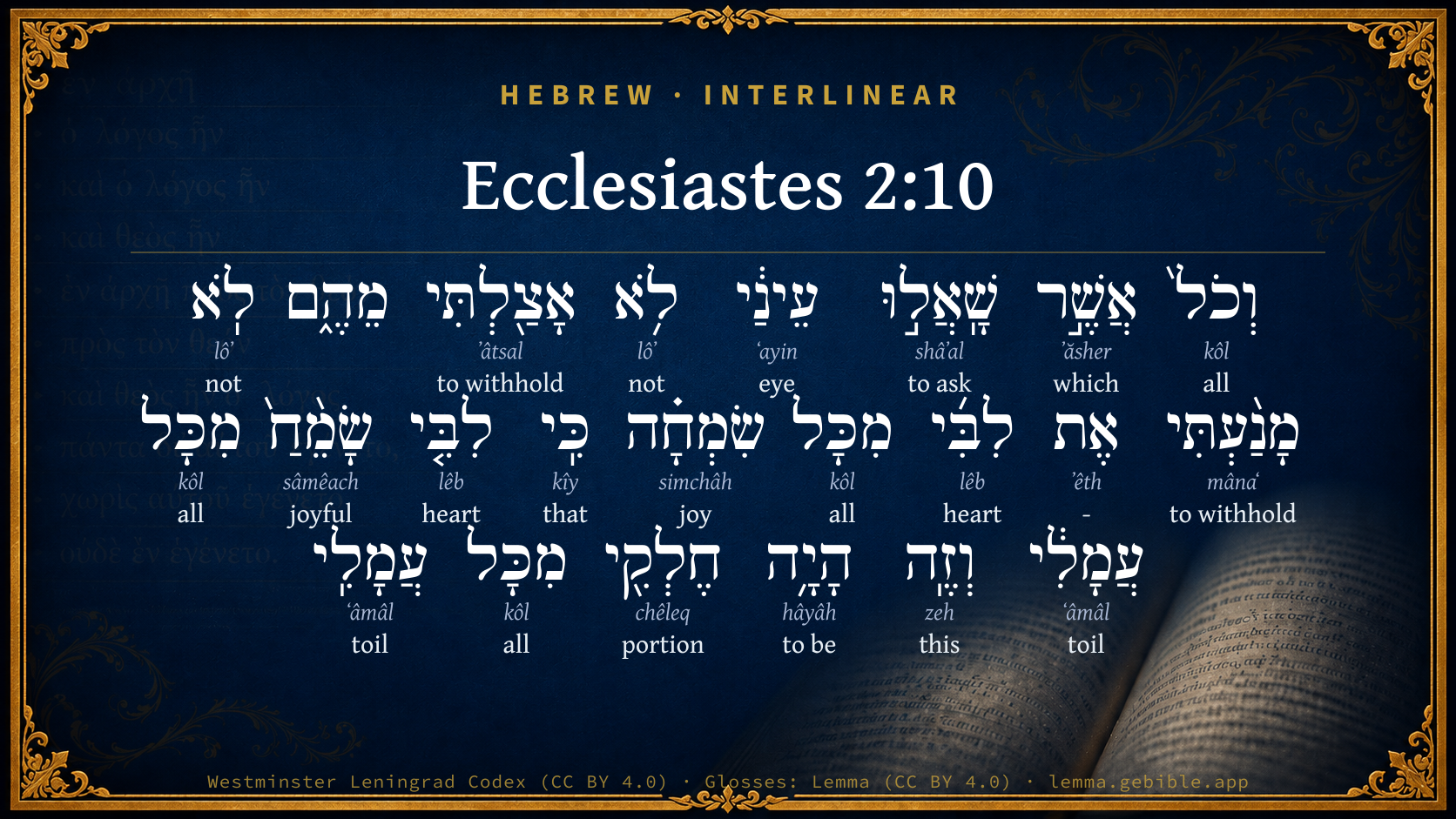
Hebrew (Westminster Leningrad Codex) Ecclesiastes 2:10 appears in the Hebrew Old Testament. The text above is from the Westminster Leningrad Codex. Each word links to its Strong’s number, a concise gloss, and parsing drawn from the Open Scriptures Hebrew Bible morphology. Click any word for its full Brown-Driver-Briggs (BDB) entry.
Download image
Cite this verse

Ecclesiastes 2:10 (World English Bible). Public Domain. Lemma interlinear Bible study tool, https://lemma.gebible.app/v/ecclesiastes/2/10.

Show BibTeX & RIS
BibTeX
RIS
English Translation
Whatever my eyes desired, I didn't keep from them. I didn't withhold my heart from any joy, for my heart rejoiced because of all my labor, and this was my portion from all my labor.
World English Bible · Public Domain
Download a study sheet

One document with this verse’s original text, its word-by-word gloss line, the meaning frame, cross-references with their text, attributed commentary, and full source and license credits — printable, and it pastes into notes with its structure intact.

This verse Autodidact and up

Study sheet (.html) Plain text (.txt)

A passage Seminary Student

Up to 50 verses in one chapter. A passage sheet keeps up to 6 commentary sources and 12 cross-references per verse, in the order this page ranks them, and says so on the sheet whenever that leaves anything out. Ask for a single verse and you get the Autodidact verse sheet above.

Everything on this page stays free to read, with no account — the sheet is a download of what is already on screen, not access to it.

Want to remove ads? Support Godless Engineer
Compare translations 3

The same verse in 3 English versions, stacked beneath the original-language interlinear above. Click any original word for its lexicon entry.

Each is an independent rendering of the whole verse — the interlinear is not word-aligned to these translations.

Highlighted words mark where these versions differ — a whole-verse word diff, not a word-by-word alignment.

  • World English Bible Public Domain
    Whatever my eyes desired, I didn't keep from them. I didn't withhold my heart from any joy, for my heart rejoiced because of all my labor, and this was my portion from all my labor.
  • King James Version Public Domain
    And whatsoever mine eyes desired I kept not from them, I withheld not my heart from any joy; for my heart rejoiced in all my labour: and this was my portion of all my labour.
  • unfoldingWord Literal Text CC BY-SA 4.0
    And all that my eyes asked, I did not refuse from them. I did not restrain my heart from any joy, because my heart joyful from all my toil and this was my portion from all my toil.

unfoldingWord Literal Text — © unfoldingWord, licensed CC BY-SA 4.0. Word-aligned USFM3 via Door43 (git.door43.org/unfoldingWord/en_ult).

Versions to compare (up to 4)

3 of 4 selected

Show all 18 translations

Every available English version of this verse, each an independent rendering of the whole verse.

  • World English Bible Public Domain
    Whatever my eyes desired, I didn't keep from them. I didn't withhold my heart from any joy, for my heart rejoiced because of all my labor, and this was my portion from all my labor.
  • Berean Standard Bible Public Domain
    Anything my eyes desired, I did not deny myself. I refused my heart no pleasure. For my heart took delight in all my work, and this was the reward for all my labor.
  • Majority Standard Bible Public Domain
    Anything my eyes desired, I did not deny myself. I refused my heart no pleasure. For my heart took delight in all my work, and this was the reward for all my labor.
  • King James Version Public Domain
    And whatsoever mine eyes desired I kept not from them, I withheld not my heart from any joy; for my heart rejoiced in all my labour: and this was my portion of all my labour.
  • American Standard Version (1901) Public Domain
    And whatsoever mine eyes desired I kept not from them; I withheld not my heart from any joy; for my heart rejoiced because of all my labor; and this was my portion from all my labor.
  • Revised Version (1885) Public Domain
    And whatsoever mine eyes desired I kept not from them: I withheld not my heart from any joy, for my heart rejoiced because of all my labour; and this was my portion from all my labour.
  • Geneva Bible (1599) Public Domain
    And whatsoeuer mine eyes desired, I withheld it not from them: I withdrew not mine heart from any ioy: for mine heart reioyced in al my labour: and this was my portion of all my trauaile.
  • Douay-Rheims (1899) Public Domain
    And whatsoever my eyes desired, I refused them not: and I withheld not my heart from enjoying every pleasure, and delighting itself in the things which I had prepared: and esteemed this my portion, to make use of my own labour.
  • Young's Literal Translation Public Domain
    And all that mine eyes asked I kept not back from them; I withheld not my heart from any joy, for my heart rejoiced because of all my labour, and this hath been my portion, from all my labour,
  • Literal Standard Version CC BY-SA 4.0
    And all that my eyes asked I did not keep back from them; I did not withhold my heart from any joy, for my heart rejoiced because of all my labor, and this has been my portion, from all my labor,
  • Unlocked Literal Bible CC BY-SA 4.0
    Whatever my eyes desired, I did not withhold from them. I did not withhold my heart from any pleasure, because my heart rejoiced in all my labor and pleasure was my reward for all my work.
  • unfoldingWord Literal Text CC BY-SA 4.0
    And all that my eyes asked, I did not refuse from them. I did not restrain my heart from any joy, because my heart joyful from all my toil and this was my portion from all my toil.
  • Darby Bible Public Domain
    And whatsoever mine eyes desired I kept not from them: I withheld not my heart from any joy; for my heart rejoiced in all my labour, and this was my portion from all my labour.
  • World Messianic Bible Public Domain
    Whatever my eyes desired, I didn’t keep from them. I didn’t withhold my heart from any joy, for my heart rejoiced because of all my labor, and this was my portion from all my labor.
  • Webster's Bible Public Domain
    And whatever my eyes desired I kept not from them, I withheld not my heart from any joy; for my heart rejoiced in all my labor: and this was my portion of all my labor.
  • Free Bible Version CC BY-SA 4.0
    I didn't stop myself trying anything I wanted. Whatever I felt like enjoying, I did. I even enjoyed everything I had accomplished, a reward for all my work.
  • Bible in Basic English Public Domain
    And nothing which was desired by my eyes did I keep from them; I did not keep any joy from my heart, because my heart took pleasure in all my work, and this was my reward.
  • JPS Tanakh (1917) Public Domain
    And whatsoever mine eyes desired I kept not from them; I withheld not my heart from any joy, for my heart had joy of all my labour; and this was my portion from all my labour.

Literal Standard Version (2020), Covenant Press — licensed CC BY-SA 4.0. Text via the HelloAO Bible API (eBible.org). Unlocked Literal Bible (unfoldingWord) — licensed CC BY-SA 4.0. Text via the HelloAO Bible API (eBible.org). unfoldingWord Literal Text — © unfoldingWord, licensed CC BY-SA 4.0. Word-aligned USFM3 via Door43 (git.door43.org/unfoldingWord/en_ult). Free Bible Version, Dr. Jonathan Gallagher — licensed CC BY-SA 4.0. Text via the HelloAO Bible API (eBible.org).

Word by word

More ways to search: Search by grammar → Find every occurrence → Compare this word →

Practice this passage: Drill this verse → Learn its vocabulary →

אָצַ֖לְתִּי
ʼâtsal
H680
“to withhold”
Verb, Qal, Perfect, 1st Person, Common, Singular
Part of Speech
Verb
Stem
Qal
Form
Perfect
Person
1st Person
Gender
Common
Number
Singular
Full BDB Definition

Origin: a primitive root

TWOT: 153

to lay aside, reserve, withdraw, withhold - (Qal) to reserve, set apart, withhold - (Niphal) to be withdrawn - (Hiphil) to withdraw
  1. וְכֹל֙ kôl H3605 “and · all” Conjunction + Noun, Common, Masculine, Singular, Absolute
  2. אֲשֶׁ֣ר ʼăsher H834 “which” Particle, Relative
  3. שָֽׁאֲל֣וּ shâʼal H7592 “to ask” Verb, Qal, Perfect, 3rd Person, Common, Plural
  4. עֵינַ֔י ʻayin H5869 “eyes · my” Noun, Common, Both, Dual, Construct + Suffix, Personal, 1st Person, Common, Singular
  5. לֹ֥א lôʼ H3808 “not” Particle, Negative
  6. לֹֽא lôʼ H3808 “not” Particle, Negative
  7. מָנַ֨עְתִּי mânaʻ H4513 “to withhold” Verb, Qal, Perfect, 1st Person, Common, Singular
  8. אֶת ʼêth H853 “-” Particle, Direct Object
  9. לִבִּ֜י lêb H3820 “heart · my” Noun, Common, Masculine, Singular, Construct + Suffix, Personal, 1st Person, Common, Singular
  10. מִכָּל kôl H3605 “from · all of” Preposition + Noun, Common, Masculine, Singular, Construct
  11. שִׂמְחָ֗ה simchâh H8057 “joy” Noun, Common, Feminine, Singular, Absolute
  12. כִּֽי kîy H3588 “that” Conjunction
  13. לִבִּ֤י lêb H3820 “heart · my” Noun, Common, Masculine, Singular, Construct + Suffix, Personal, 1st Person, Common, Singular
  14. שָׂמֵ֨חַ֙ sâmêach H8056 “joyful” Adjective, Adjective, Masculine, Singular, Absolute
  15. מִכָּל kôl H3605 “from · all of” Preposition + Noun, Common, Masculine, Singular, Construct
  16. עֲמָלִ֔י ʻâmâl H5999 “toil · my” Noun, Common, Both, Singular, Construct + Suffix, Personal, 1st Person, Common, Singular
  17. וְזֶֽה zeh H2088 “and · this” Conjunction + Pronoun, Demonstrative, Masculine, Singular
  18. הָיָ֥ה hâyâh H1961 “to be” Verb, Qal, Perfect, 3rd Person, Masculine, Singular
  19. חֶלְקִ֖י chêleq H2506 “portion · my” Noun, Common, Masculine, Singular, Construct + Suffix, Personal, 1st Person, Common, Singular
  20. מִכָּל kôl H3605 “from · all of” Preposition + Noun, Common, Masculine, Singular, Construct
  21. עֲמָלִֽי ʻâmâl H5999 “toil · my” Noun, Common, Both, Singular, Construct + Suffix, Personal, 1st Person, Common, Singular

About this verse

These counts appear in no published source. They are computed here, from the morphology-tagged text and Lemma’s own curated glosses. What Lemma adds →

23
words
16
distinct lemmas
Wisdom
section

Notable vocabulary

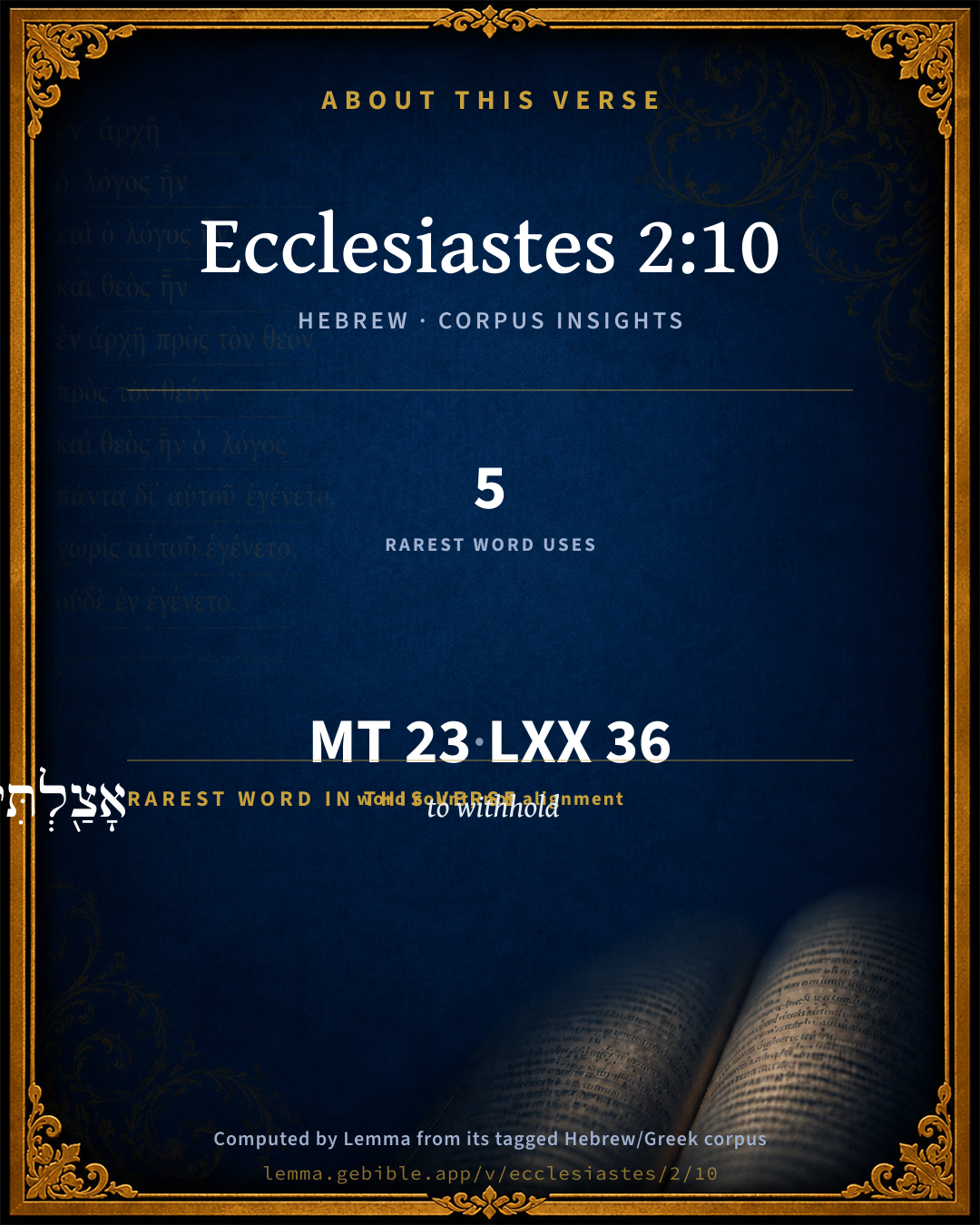
The rarest word here is אָצַ֖לְתִּי to withhold H680 — appearing just 5 times in the whole Hebrew Bible.

Shared distinctive vocabulary

אָצַ֖לְתִּי to withhold H680 occurs in 5 verses of the Hebrew Bible. Also found in:

Grammatical profile

  • 4 verbs
  • 11 nouns
  • 1 adjective
  • 1 pronoun
  • 1 preposition
  • 1 conjunction
  • 4 particles

Verb forms

  • שָֽׁאֲל֣וּ Qal · Perfect
  • אָצַ֖לְתִּי Qal · Perfect
  • מָנַ֨עְתִּי Qal · Perfect
  • הָיָ֥ה Qal · Perfect

Repetition

Words recur within this verse — often emphatic in Hebrew:

  • וְכֹל֙ all H3605 ×4
  • לִבִּ֜י heart H3820 ×2
  • עֲמָלִ֔י toil H5999 ×2
  • לֹ֥א not H3808 ×2

Hebrew & Septuagint length

In English translation the verse runs 35 words from the Hebrew and 36 from the Septuagint (LXX English) — closely comparable.

A rough comparison of the two English renderings, which tokenize alike — not a word-level alignment.

Word counts can differ between the Hebrew and the Greek without any difference in meaning — e.g. the Hebrew direct-object marker אֵת has no separate Greek word, and Greek often adds the article ὁ.

In the original languages it is 23 Hebrew tokens and 36 Greek tokens — but the two are counted differently (Hebrew bundles its prefixes and suffixes into one token; the Greek is in lemma form), so that isn’t a like-for-like length.

Cross-references

14

Topical passages linked to Ecclesiastes 2:10 in the Treasury of Scripture Knowledge — connected by theme and wording, ordered by reader-vote popularity; previews shown in the World English Bible.

  • Ecclesiastes 3:22 Therefore I saw that there is nothing better, than that a man should rejoice in his works; for that is his portion: for who can bring him to see what will be after him?
  • Ecclesiastes 5:18 Behold, that which I have seen to be good and proper is for one to eat and to drink, and to enjoy good in all his labor, in which he labors under the sun, all the days of his life which God has given him; for this is his portion.
  • Ecclesiastes 9:9 Live joyfully with the wife whom you love all the days of your life of vanity, which he has given you under the sun, all your days of vanity: for that is your portion in life, and in your labor in which you labor under the sun.
  • Psalms 119:37 Turn my eyes away from looking at worthless things. Revive me in your ways.
  • Psalms 128:2 For you will eat the labor of your hands. You will be happy, and it will be well with you.
  • Ecclesiastes 2:22 For what has a man of all his labor, and of the striving of his heart, in which he labors under the sun?
  • 1 John 2:16 For all that is in the world, the lust of the flesh, the lust of the eyes, and the pride of life, isn't the Father's, but is the world's.
  • Genesis 3:6 When the woman saw that the tree was good for food, and that it was a delight to the eyes, and that the tree was to be desired to make one wise, she took of the fruit of it, and ate; and she gave some to her husband with her, and he ate.
  • Genesis 6:2 that God's sons saw that men's daughters were beautiful, and they took for themselves wives of all that they chose.
  • Judges 14:2 He came up, and told his father and his mother, and said, I have seen a woman in Timnah of the daughters of the Philistines: now therefore get her for me as wife.
  • Job 31:1 "I made a covenant with my eyes, How then should I look lustfully at a young woman?
  • Proverbs 23:5 Why do you set your eyes on that which is not? For it certainly sprouts wings like an eagle and flies in the sky.
  • Ecclesiastes 6:9 Better is the sight of the eyes than the wandering of the desire. This also is vanity and a chasing after wind.
  • Ecclesiastes 11:9 Rejoice, young man, in your youth, And let your heart cheer you in the days of your youth, And walk in the ways of your heart, And in the sight of your eyes; But know that for all these things God will bring you into judgment.

Cross-references courtesy of OpenBible.info (CC BY 4.0).

Hebrew and Greek witnesses Masoretic Hebrew ↔ Greek Septuagint

The same verse in the two great witnesses to the Old Testament, shown verse-for-verse.

These are two independent witnesses, not word-aligned to each other, and the Septuagint is shown in lemma (dictionary) form.

Hebrew Ecclesiastes 2:10 Masoretic · Westminster Leningrad Codex

וְכֹל֙ אֲשֶׁ֣ר שָֽׁאֲל֣וּ עֵינַ֔י לֹ֥א אָצַ֖לְתִּי מֵהֶ֑ם לֹֽא מָנַ֨עְתִּי אֶת לִבִּ֜י מִכָּל שִׂמְחָ֗ה כִּֽי לִבִּ֤י שָׂמֵ֨חַ֙ מִכָּל עֲמָלִ֔י וְזֶֽה הָיָ֥ה חֶלְקִ֖י מִכָּל עֲמָלִֽי

Whatever my eyes desired, I didn't keep from them. I didn't withhold my heart from any joy, for my heart rejoiced because of all my labor, and this was my portion from all my labor.

World English Bible · Public Domain

Greek LXX Ecclesiastes 2:10 Septuagint · lemma form

καί πᾶς ὅς αἰτέω ὁ ὀφθαλμός ἐγώ οὐ ὑποαἱρέω ἀπό αὐτός οὐ ἀποκωλύω ὁ καρδία ἐγώ ἀπό πᾶς εὐφροσύνη ὅτι καρδία ἐγώ εὐφραίνω ἐν πᾶς μόχθος ἐγώ καί οὗτος γίγνομαι μερίς ἐγώ ἀπό πᾶς μόχθος ἐγώ

And whatever my eyes desired, I withheld not from them, I withheld not my heart from all my mirth: for my heart rejoiced in all my labor; and this was my portion of all my labor.

LXX2012 (modern English Septuagint) · Public Domain

Hebrew: Westminster Leningrad Codex (CC BY 4.0). Greek: Septuagint (public domain); English from LXX2012 (modern English Septuagint) (Public Domain). How the Septuagint differs from the Hebrew →

Commentary

Notes on Ecclesiastes 2:10 from classic Christian and Jewish commentators (each source and its license shown beneath its notes). The classic Christian expositions comment on the surrounding passage and are grouped to its opening verse, so a note may address several verses; the Jewish commentaries on the Tanakh (Rashi and others) are per-verse, so they appear only where the commentator wrote on this verse.

Lemma curates 59 commentaries, every one of them public domain or Creative Commons licensed, each selected and text-cleaned for this edition rather than reprinted as found. About our sources →

Trapp's Complete Commentary

John Trapp

Ecc 2:10 And whatsoever mine eyes desired I kept not from them, I withheld not my heart from any joy; for my heart rejoiced in all my labour: and this was my portion of all my labour.

Ver. 10. And whatsoever mine eyes desired, &c.] I fed them with pleasant pictures, shows, sights, and other objects of delight, which yet have plus deceptionis quam delectationis, {a} able to entice and ready to kill the entangled. How many are there that have died of the wound in the eye; David, knowing the danger, prayeth, "Turn away mine eyes from beholding of vanity." {Psa 119:37} Job steps one degree further, from a prayer to a vow, {Job 31:1} yea, from a vow to an imprecation. {Ecc 2:7} If our first parents fell by following the sight of their eyes and lust of their hearts, what can Solomon or any of us promise of ourselves, qui animas etiam incarnavimus, who have made our very spirit a lump of flesh, prone to entertain vice, yea, to solicit it?

For my heart rejoiced in all my labour.] This is not every worldling’s happiness. For some live not to enjoy what they have raked together, as that rich fool in the gospel; others live indeed, but live beside what they have gotten, as not daring to diminish ought, but defrauding their own genius, and denying themselves necessaries. So did not Solomon, and yet he found not the good he sought for either, as he tells us in the next words. Nor is it want of variety in these pleasures, but inward weakness, an emptiness and insufficiency in the creature. In heaven the objects of our delight and blessedness shall be, though uniform, yet everlastingly pleasing.

{a} Lactant.

John Trapp, A Commentary or Exposition upon All the Books of the Old and New Testament (1647–1656) — public domain. Text from a community e-Sword module.

Tyndale Open Study Notes

Tyndale Open Resources

2:10 I even found great pleasure in hard work: The Teacher introduces a significant, repetitive theme: Joy comes from wise and rigorous work (5:12, 18-20).

Tyndale Open Study Notes — © Tyndale Open Resources, licensed CC BY-SA 4.0. Text via the HelloAO Bible API.

Geneva Bible (1599)

Geneva Bible translators

This was the fruit of all my labor, a certain pleasure mixed with care, which he calleth vanity in the next verse.

Geneva Bible (1599) marginal notes — public domain. Text via Bolls.life.

Jamieson, Fausset & Brown

Robert Jamieson, A. R. Fausset & David Brown

my labour--in procuring pleasures.

this--evanescent "joy" was my only "portion out of all my labor" (Ecc 3:22; Ecc 5:18; Ecc 9:9; Kg1 10:5).

Jamieson, Fausset & Brown — Commentary Critical and Explanatory on the Whole Bible (1871) — public domain (CC PDM 1.0). Text via the HelloAO Bible API.

Adam Clarke's Commentary

Verse 10. I withheld not my heart from any joy] He had every means of gratification; he could desire nothing that was not within his reach; and whatever he wished, he took care to possess.

Adam Clarke's Commentary on the Bible (1810–1826) — public domain. Text from a community e-Sword/MySword module.

The Cambridge Bible for Schools and Colleges

gen. ed. J. J. S. Perowne

10. whatsoever mine eyes desired] From such a life the idea of self-denial, even of self-control, was absolutely excluded. Money and power were but means to the end, and the end proposed was the gratification of the “desire of the eyes,” not identified with the “lust of the flesh,” but closely allied to it (1Jn_2:16), in all its restless cravings. It was not altogether a fruitless effort. Such joy as these things could bring he had in abundant measure. It was for a time his “portion.” Like the rich man in the parable of Luk_16:25 he had his “good things,” and could not complain that the experiment failed as through imperfect apparatus. He also was tasting of the “tree of knowledge of good and evil,” and found that it was “good for food, and pleasant to the eyes, and a tree to be desired to make one wise” (Gen_3:6).

The Cambridge Bible for Schools and Colleges (gen. ed. J. J. S. Perowne; Cambridge University Press, 1878–1918) — public domain. Text from a community e-Sword module.

John Gill's Exposition

And whatsoever mine eyes desired I kept not from them,.... Though this sense is only mentioned, all are designed; he denied himself of nothing that was agreeable to him, that was pleasing to the eye, to the ear, to the taste, or any other sense; he indulged himself in everything, observing a proper decorum, and keeping himself within the due bounds of sobriety and good sense;

I withheld not my heart from any joy: the Targum says, "from all joy of the law"; but it is to be understood of natural pleasure, and of the gratifications of the senses in a wise and moderate manner;

for my heart rejoiced in all my labours; he took all the pleasure that could be taken in the works he wrought for that purpose before enumerated;

and this was my portion of all my labour; pleasure was what he aimed at, and that he enjoyed; this was the fruit and issue of all his laborious works; the part allotted him, the inheritance he possessed, and the thing he sought after.

John Gill's Exposition of the Whole Bible (1746–1763) — public domain (CC PDM 1.0). Text via the HelloAO Bible API.

Albert Barnes' Notes on the Bible

Portion - A word of frequent occurrence. By it Solomon describes the pleasure found in the act of working and also perhaps the pleasure felt in the process of acquiring wisdom; this pleasure is admitted to be good, if received from God (Ecc 2:26; Ecc 5:18; compare 1Ti 4:4); but being transitory it is subject to vanity, and therefore does not afford a sufficient answer to the repeated question, “What profit etc.?” Ecc 1:3.

Albert Barnes' Notes on the Bible (1834–1885) — public domain. Text from a community e-Sword/MySword module.

Haydock's Catholic Bible Commentary

Labour. Hebrew, "and this was my portion of all my labour." I perceived that I could not thus obtain content. (Calmet) --- "Thou (O God) hast made us for thyself, and our hearts are restless till they repose in thee." (St. Augustine, Confessions i. 1.) (Menochius) --- Aurelius makes the same confession as Solomon, respecting the insatiable nature of his own heart, and the emptiness of pleasure, &c.

George Leo Haydock (1774–1849), Haydock's Catholic Family Bible and Commentary, 1859 edition — public domain. Excludes Psalms (Douay-Rheims chapter numbering differs from Protestant) and Deuterocanonical books (Catholic canon only).

Matthew Poole's English Annotations

Whatsoever mine eyes desired; whatsoever was grateful to my senses, or my heart desired. He ascribes desire to the eyes, because the sight of the eyes is the usual and powerful incentive of desires; of which see Jos 7:21; Job 31:1; Mat 5:28.

I kept not from them; I denied myself nothing, at least of lawful delights, but went to the very utmost bounds of them; which was the occasion of his falling afterward into sinful pleasures. I withheld not my heart from any joy; as my heart was vehemently set upon pleasure, so I did not resist or curb it therein, but made all possible provisions to gratify it.

My heart rejoiced in all my labour; I had the comfort of all my labours, and was not hindered from the free and full enjoyment of them by sickness or war, or any other calamities occurrent.

This was my portion of all my labour; this present and temporary enjoyment of them was all the benefit which I could expect or receive from all my labours, so that I made the best of them. I had a heart to use them, which many men through covetousness have not; and I tasted the sweetness of them, which many others cannot do; and therefore if any man could arrive at happiness by this means, I had done it.

Matthew Poole's English Annotations on the Holy Bible (1683–1685) — public domain. Text from a community e-Sword/MySword module.

Whedon's Commentary on the Bible

Daniel D. Whedon

10. Mine eyes desired — This experiment, so broad and full, was not the reckless conduct of a debauchee, but there was method and discretion in it.

My heart rejoiced — Hebrew, (an unusual form.) was in the way to get joy from all my labour.

And this was — Hebrew, and this would be.

Daniel D. Whedon (gen. ed.), Commentary on the Old and New Testaments (1874–1909) — public domain. Text from a community e-Sword module.

The Pulpit Commentary

Whatsoever mine eyes desired. The lust of the eyes, (1Jn_2:16) all that he saw and desired, he took measures to obtain. He denied himself no gratification, however foolish (ver. 3). For my heart rejoiced in all my labor; i.e. found joy in what my labor procured for it. (Pro_5:18) This was the reason why he withheld not his heart from any joy; kept it, as it were, ready to taste any pleasure which his exertions might obtain. This was my portion of all my labor. Such joy was that which he won from his labor, he had his reward, such as it was (Mat_6:2; Luk_16:25) This term "portion" (cheleq) recurs often (e.g. ver. 21; Ecc_3:22 Ecc_5:18, etc.; so RAPC Wis 2:9) in the sense of the result obtained by labor or con-duet. And what a meagre and unsatisfying result it was which he gained! Contrast the apostle"s teaching, "All that is in the world, the lust of the flesh, and the lust of the eyes, and the vain-glory of life, is not of the Father, but is of the world. And the world passeth away, and the lust thereof: but he that doeth the will of God abideth forever". (1Jn_2:16, 1Jn_2:17)

The Pulpit Commentary (1880–1919), ed. H.D.M. Spence-Jones & Joseph S. Exell — public domain. Text from a community e-Sword module.

John Wesley's Explanatory Notes

And - Whatsoever was grateful to my senses. Rejoiced - I had the comfort of all my labours, and was not hindered from the full enjoyment of them by sickness or war, or any other calamity. My portion - This present enjoyment of them, was all the benefit which I could expect from all my labours. So that I made the best of them.

John Wesley, Explanatory Notes Upon the Whole Bible (1754–1765) — public domain. Text via the GEBible commentary corpus.

Rashi

Rabbi Shlomo Yitzchaki (Rashi)

I did not deprive I did not distance them to separate from them, and so (Num. 11:25): “and He held back (וַיָאצֶל) some of the spirit...and placed [it] on...the elders,” like a candelabrum from which many candles are kindled, and its light is not at all diminished.

and this was my portion And after doing all these, I have nothing [left] of all of them but this. Rav and Shmuel [differ]: One says, his staff, and one says, his cup. קִידוֹ is an earthenware cup, from which [people] drink (Gittin 68b). Others in the Midrash Aggadah (Ecc. Zuta 2:8) interpret the entire section as referring to study halls, students, and synagogues [as follows]:

[6] a forest sprouting with trees the ignorant people, for the work of fields and vineyards.

Rashi on the Tanakh — English translations: “The Judaica Press complete Tanach with Rashi, translated by A. J. Rosenberg” (CC BY 4.0); “Pentateuch with Rashi's commentary by M. Rosenbaum and A.M. Silbermann, 1929-1934” (public domain); “The Metsudah Tanach series, Lakewood, N.J” (CC BY 4.0); and “The Book of Joshua, Metsudah Publications, 1997” (CC BY 4.0). Text via Sefaria.

Lesson kit

Teaching starters — assembled from the data on this page, not authored interpretation. Every prompt links to the verse data it draws on. Edit before teaching.

Ecclesiastes, in the Wisdom, opens this verse with 23 words (16 distinct Hebrew lemmas). Its most distinctive word is ʼâtsal (“to withhold”). A historical commentator’s framing appears above. Read the whole chapter for the surrounding context.

Discussion questions

  1. The word ʼâtsal carries the sense “to withhold.” How does it shape the verse?
  2. How does Genesis 27:36, which shares the word «to withhold», read alongside this verse?
  3. What does the repetition of “all” (4× in this one verse) do in this verse?
  4. These translations render this verse differently. What is at stake in choosing one wording over another?
  5. «שָֽׁאֲל֣וּ» is a Qal Perfect verb. How does that grammatical form shape the action described?
  6. Compare how Trapp's Complete Commentary and Tyndale Open Study Notes read this verse. Where do they agree or differ?

Things to notice

Reading settings

Reading text

Shown beneath each verse's original-language words.

Old Testament
Old Testament edition

Read the OT as the Masoretic Hebrew (MT) or the Greek Septuagint (LXX).

English shown for the Greek Septuagint (in the Hebrew ↔ Greek comparison).

Comparing translations? Open the Compare panel on any verse page to stack up to four side by side.