
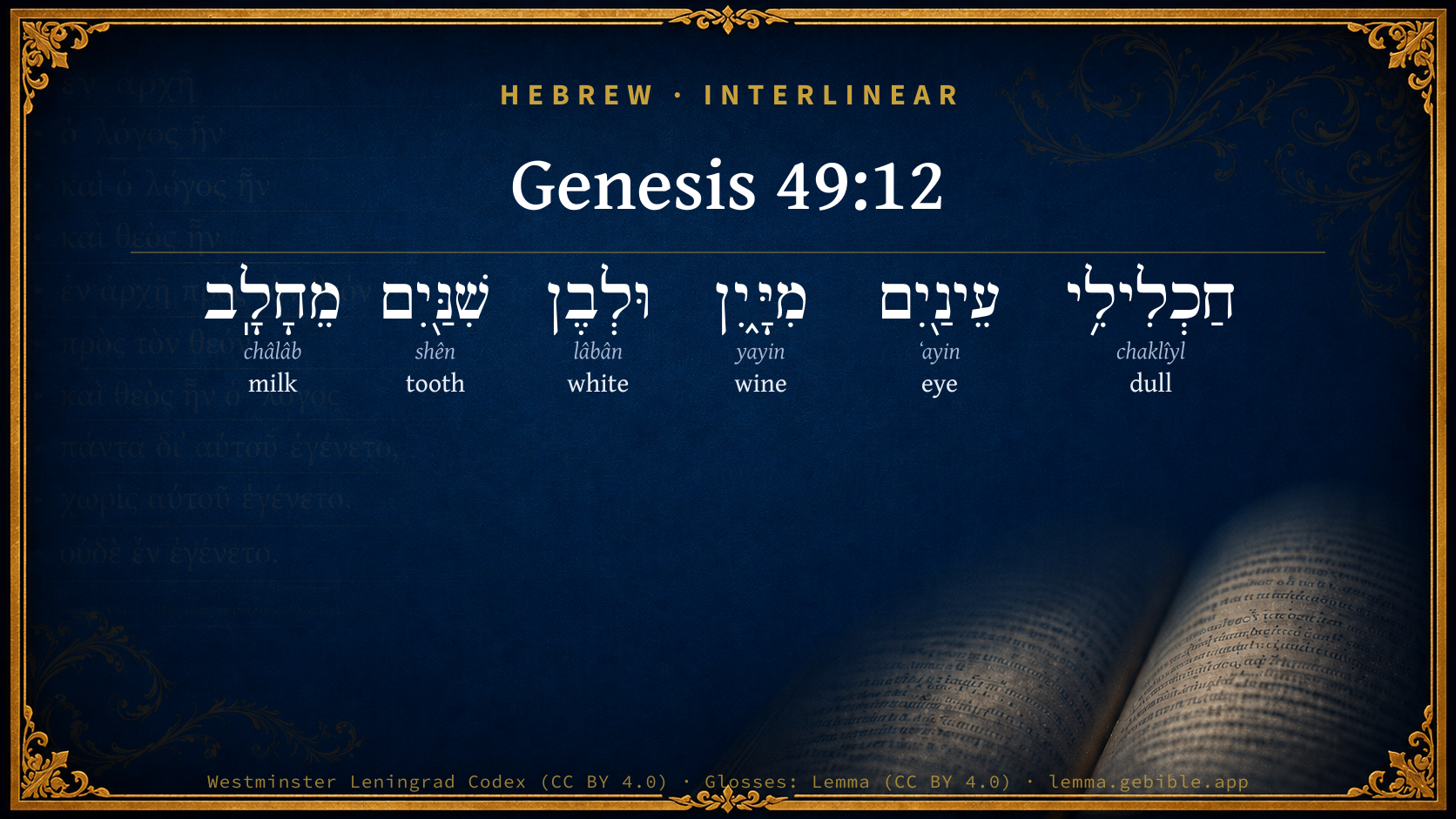
Genesis 49:12

Hebrew (Westminster Leningrad Codex) Genesis 49:12 appears in the Hebrew Old Testament. The text above is from the Westminster Leningrad Codex. Each word links to its Strong’s number, a concise gloss, and parsing drawn from the Open Scriptures Hebrew Bible morphology. Click any word for its full Brown-Driver-Briggs (BDB) entry.
Download image
Cite this verse

Genesis 49:12 (World English Bible). Public Domain. Lemma interlinear Bible study tool, https://lemma.gebible.app/v/genesis/49/12.

Show BibTeX & RIS
BibTeX
RIS
English Translation
His eyes will be red with wine, His teeth white with milk.
World English Bible · Public Domain
Highlights
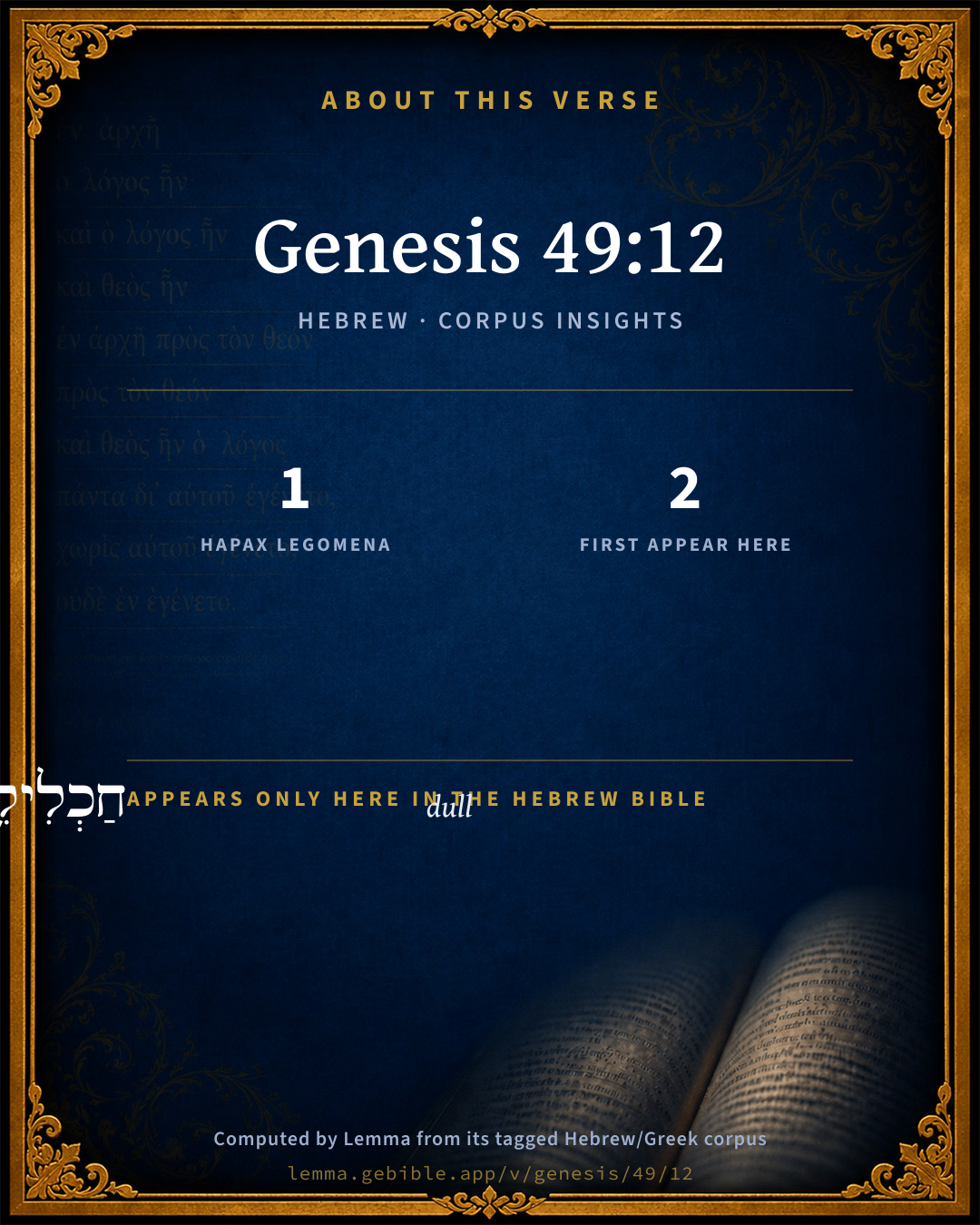
  • 1 hapax legomenon — only here in the Hebrew Bible
  • 2 first appearances in the Hebrew Bible
Full analysis ↓
Download a study sheet

One document with this verse’s original text, its word-by-word gloss line, the meaning frame, cross-references with their text, attributed commentary, and full source and license credits — printable, and it pastes into notes with its structure intact.

This verse Autodidact and up

Study sheet (.html) Plain text (.txt)

A passage Seminary Student

Up to 50 verses in one chapter. A passage sheet keeps up to 6 commentary sources and 12 cross-references per verse, in the order this page ranks them, and says so on the sheet whenever that leaves anything out. Ask for a single verse and you get the Autodidact verse sheet above.

Everything on this page stays free to read, with no account — the sheet is a download of what is already on screen, not access to it.

Want to remove ads? Support Godless Engineer
Compare translations 3

The same verse in 3 English versions, stacked beneath the original-language interlinear above. Click any original word for its lexicon entry.

Each is an independent rendering of the whole verse — the interlinear is not word-aligned to these translations.

Highlighted words mark where these versions differ — a whole-verse word diff, not a word-by-word alignment.

  • World English Bible Public Domain
    His eyes will be red with wine, His teeth white with milk.
  • King James Version Public Domain
    His eyes shall be red with wine, and his teeth white with milk.
  • unfoldingWord Literal Text CC BY-SA 4.0
    eyes brilliant from wine, and teeth white from milk. ts\*

unfoldingWord Literal Text — © unfoldingWord, licensed CC BY-SA 4.0. Word-aligned USFM3 via Door43 (git.door43.org/unfoldingWord/en_ult).

Versions to compare (up to 4)

3 of 4 selected

Show all 18 translations

Every available English version of this verse, each an independent rendering of the whole verse.

  • World English Bible Public Domain
    His eyes will be red with wine, His teeth white with milk.
  • Berean Standard Bible Public Domain
    His eyes are darker than wine, and his teeth are whiter than milk.
  • Majority Standard Bible Public Domain
    His eyes are darker than wine, and his teeth are whiter than milk.
  • King James Version Public Domain
    His eyes shall be red with wine, and his teeth white with milk.
  • American Standard Version (1901) Public Domain
    His eyes shall be red with wine, And his teeth white with milk.
  • Revised Version (1885) Public Domain
    His eyes shall be red with wine, And his teeth white with milk.
  • Geneva Bible (1599) Public Domain
    His eyes shalbe red with wine, and his teeth white with milke.
  • Douay-Rheims (1899) Public Domain
    His eyes are more beautiful than wine, and his teeth whiter than milk.
  • Young's Literal Translation Public Domain
    Red `are' eyes with wine, And white `are' teeth with milk!
  • Literal Standard Version CC BY-SA 4.0
    Red [are] eyes with wine, || And white [are] teeth with milk!
  • Unlocked Literal Bible CC BY-SA 4.0
    His eyes will be as dark as wine, and his teeth as white as milk.
  • unfoldingWord Literal Text CC BY-SA 4.0
    eyes brilliant from wine, and teeth white from milk. ts\*
  • Darby Bible Public Domain
    The eyes are red with wine, And the teeth [are] white with milk.
  • World Messianic Bible Public Domain
    His eyes will be red with wine, his teeth white with milk.
  • Webster's Bible Public Domain
    His eyes shall be red with wine, and his teeth white with milk.
  • Free Bible Version CC BY-SA 4.0
    His eyes sparkle more than wine, and his teeth are whiter than milk.
  • Bible in Basic English Public Domain
    His eyes will be dark with wine, and his teeth white with milk.
  • JPS Tanakh (1917) Public Domain
    His eyes shall be red with wine, and his teeth white with milk.

Literal Standard Version (2020), Covenant Press — licensed CC BY-SA 4.0. Text via the HelloAO Bible API (eBible.org). Unlocked Literal Bible (unfoldingWord) — licensed CC BY-SA 4.0. Text via the HelloAO Bible API (eBible.org). unfoldingWord Literal Text — © unfoldingWord, licensed CC BY-SA 4.0. Word-aligned USFM3 via Door43 (git.door43.org/unfoldingWord/en_ult). Free Bible Version, Dr. Jonathan Gallagher — licensed CC BY-SA 4.0. Text via the HelloAO Bible API (eBible.org).

Word by word

More ways to search: Search by grammar → Find every occurrence → Compare this word →

Practice this passage: Drill this verse → Learn its vocabulary →

About this verse

These counts appear in no published source. They are computed here, from the morphology-tagged text and Lemma’s own curated glosses. What Lemma adds →

6
words
6
distinct lemmas
Pentateuch
section

Notable vocabulary

1 hapax legomenon — a word that appears only here in the entire Hebrew Bible:

  • חַכְלִילִ֥י dull H2447

First appearance in Scripture

These words make their first canonical appearance in the Hebrew Bible here:

  • חַכְלִילִ֥י dull H2447
  • שִׁנַּ֖יִם tooth H8127

Shared distinctive vocabulary

וּלְבֶן white H3836 occurs in 24 verses of the Hebrew Bible. Also found in:

Grammatical profile

  • 4 nouns
  • 2 adjectives

Hebrew & Septuagint length

In English translation the verse runs 12 words from the Hebrew and 14 from the Septuagint (LXX English) — closely comparable.

A rough comparison of the two English renderings, which tokenize alike — not a word-level alignment.

Word counts can differ between the Hebrew and the Greek without any difference in meaning — e.g. the Hebrew direct-object marker אֵת has no separate Greek word, and Greek often adds the article ὁ.

Hebrew and Greek witnesses Masoretic Hebrew ↔ Greek Septuagint

The same verse in the two great witnesses to the Old Testament, shown verse-for-verse.

These are two independent witnesses, not word-aligned to each other, and the Septuagint is shown in lemma (dictionary) form.

Hebrew Genesis 49:12 Masoretic · Westminster Leningrad Codex

חַכְלִילִ֥י עֵינַ֖יִם מִיָּ֑יִן וּלְבֶן שִׁנַּ֖יִם מֵחָלָֽב

His eyes will be red with wine, His teeth white with milk.

World English Bible · Public Domain

Greek LXX Genesis 49:12 Septuagint · lemma form

χαροπός ὁ ὀφθαλμός αὐτός ἀπό οἶνος καί λευκός ὁ ὀδούς αὐτός ἤ γάλα

His eyes shall be more cheering than wine, and his teeth whiter than milk.

LXX2012 (modern English Septuagint) · Public Domain

On this verse, The Cambridge Bible for Schools and Colleges discusses the Septuagint’s reading. Read the note in Commentary ↓

Hebrew: Westminster Leningrad Codex (CC BY 4.0). Greek: Septuagint (public domain); English from LXX2012 (modern English Septuagint) (Public Domain). How the Septuagint differs from the Hebrew →

Targum (Aramaic paraphrase)

2

The Targum is the ancient Jewish Aramaic paraphrase of the Hebrew Scriptures — an interpretive translation, not the Hebrew text itself. Onkelos (literal) and Pseudo-Jonathan (expansive) render the Torah, and Jonathan the Prophets. Coverage is partial: where no permissively-licensed English translation exists for a verse, only the Aramaic is shown. This is verse-level text, not a word-by-word alignment to the Hebrew.

  1. Targum Onkelos Torah (Genesis–Deuteronomy)
    יְסַמְקוּן טּוּרוֹהִי בְּכַרְמוֹהִי יְטוּפוּן נַעֲווֹהִי בַּחֲמָר יְחַוְרָן בִּקְעֲתֵהּ בְּעִיבוּר וּבְעֶדְרֵי עָנָא

    (no public-domain English translation for this verse)

    Targum Onkelos — Aramaic: “Onkelos Genesis” (public domain); “Onkelos Exodus” (public domain); “Onkelos Leviticus” (public domain); “Onkelos Numbers” (public domain); “Onkelos Deuteronomy” (public domain). English: “Sefaria Community Translation” (CC0 1.0 (public-domain dedication)); “J.W. Etheridge. The Targums of Onkelos and Jonathan Ben Uzziel on the Pentateuch. London: Longmans, Green, 1862” (public domain). Text via Sefaria.

  2. Targum Pseudo-Jonathan Torah (Genesis–Deuteronomy)
    מַה יָאִין הִינוּן עֵינוֹי דְמַלְכָּא מְשִׁיחָא כְּחַמְרָא זַכִּיכָא מִן לְמֵיחְמֵי גִילוּי עִירְיַין וְשַׁדְיוּת אֲדַם זַכַּאי וְשִׁינוֹי נַקְיַין מִן חַלְבָּא דְלָא לְמֵיכַל חֲטוֹף וַאֲנוּסָא וּכְדֵין יִסְמְקוּן טַוְורוֹי וּמַעֲצַרְתֵּיהּ מִן חַמְרָא וְגוּלְמָתוֹי יְחַוְורַן מִן עֲלַלְתָּא וּמִן דִירִין דְעָאן

    How beautiful are the eyes of the king Meshiha, as the pure wine! He cannot look upon what is unclean, nor on the shedding of the blood of the innocent; and his teeth, purer than milk, cannot eat that which is stolen or torn; and therefore his mountains are red with wine, and his hills white with corn, and with the cotes of flocks.

    Targum Pseudo-Jonathan — Aramaic: “Targum Jonathan on Genesis” (public domain); “Targum Jonathan on Exodus” (public domain); “Targum Jonathan on Leviticus” (public domain); “Targum Jonathan on Numbers” (public domain); “Targum Jonathan on Deuteronomy” (public domain). English: “The Targum of Jonathan ben Uzziel, trans. J. W. Etheridge, London, 1862” (public domain). Text via Sefaria.

Commentary

Notes on Genesis 49:12 from classic Christian and Jewish commentators (each source and its license shown beneath its notes). The classic Christian expositions comment on the surrounding passage and are grouped to its opening verse, so a note may address several verses; the Jewish commentaries on the Tanakh (Rashi and others) are per-verse, so they appear only where the commentator wrote on this verse.

Lemma curates 59 commentaries, every one of them public domain or Creative Commons licensed, each selected and text-cleaned for this edition rather than reprinted as found. About our sources →

Trapp's Complete Commentary

John Trapp

Gen 49:12 His eyes [shall be] red with wine, and his teeth white with milk.

Ver. 12. His eyes shall be red, &c.] Wine and milk are used to signify plenty of spiritual blessings in heavenly things. {Isa 55:1; Isa 25:6}

John Trapp, A Commentary or Exposition upon All the Books of the Old and New Testament (1647–1656) — public domain. Text from a community e-Sword module.

Ellicott's Commentary for English Readers

(12) His eyes shall be red with wine.—The word rendered red occurs only here, and is rendered in the Versions, bright, sparkling, and in the Vulg., beautiful. They also give the word rendered in our Version with a comparative force, which seems to be right: “His eyes shall be brighter than wine, and his teeth whiter than milk.” The words do not refer to Judah’s person, but describe the prosperity of his descendants, whose temporal welfare will show itself in their bright and healthy countenances.

A Bible Commentary for English Readers, edited by Charles John Ellicott (1878–1897) — public domain. Text from a community e-Sword module.

The Cambridge Bible for Schools and Colleges

gen. ed. J. J. S. Perowne

12. His eyes] It may be doubted whether our rendering “red” gives the right meaning. The passage is usually illustrated from Pro_23:29, “who hath redness of eyes?” But, surely, the poet would hardly eulogize Judah by attributing to his eyes the redness of continuous drinking! It will be better to assume that the writer meant “sparkling.” The versions, LXX and Vulg., give another rendering, which is probably to be preferred, “his eyes are more sparkling than wine, and his teeth whiter than milk.” In this case, the verse will symbolically describe the beauty of his personal appearance, rather than the productiveness of his territory.

The Cambridge Bible for Schools and Colleges (gen. ed. J. J. S. Perowne; Cambridge University Press, 1878–1918) — public domain. Text from a community e-Sword module.

John Gill's Exposition

His eyes shall be red with wine,.... Signifying, not the intemperance of this tribe, and their immoderate use of wine, and the effect of it on them; but the goodness and generosity of their wine, that if drank plentifully of, and especially to excess, would have such an effect, see Pro 23:29 and, as applied to the Messiah, the antitype of Judah, and who was of this tribe, it may denote not so much the beauty of his eyes, as the Targums paraphrase it; as the joy and pleasure that sparkled in his eyes when he shed his blood on the cross, enduring that, and despising the shame of it, for the joy of the salvation of his people; or the clearness of his sight in beholding the actions of his enemies, and especially of the fierceness and fury of his wrath against them, whose eyes are said to be an flames of fire, Rev 1:14.

and his teeth white with milk; denoting the fruitfulness of his land, producing fine pastures, on which flocks and herds fed, and gave abundance of milk; and so Onkelos paraphrases the whole verse,"his mountains shall be red with his vineyards, and his hills shall drop wine, and his valleys shall be white with corn and flocks of sheep;''and much the same are the Targums of Jonathan and Jerusalem: the mystical sense may respect Christ and his people, and be expressive of the purity of his nature, life, and doctrine, and of the holiness of his members, their faith and conversation; or the clauses may be rendered, redder than wine, whiter than milk; but though whiteness recommends teeth, yet not redness the eyes; wherefore some (a) by transposing the first letters of the word for "red", make it to signify black, as it does with the Arabs, and that colour of the eye is reckoned beautiful.

(a) Danzius apud Stockium, p. 334.

John Gill's Exposition of the Whole Bible (1746–1763) — public domain (CC PDM 1.0). Text via the HelloAO Bible API.

Haydock's Catholic Bible Commentary

Beautiful. The eyes and teeth contribute much to the beauty of a face. Our Saviour, rising form the dead, filled the hearts fo the beholders with joy, as wine exhilarates the heart of man. (Menochius) --- The spouse in the Canticle of Canticles, (ver. 12,) compares the eyes of the bridegroom to the shining reddish, or fiery ones of pigeons: chaclili, beautiful, means shining red, &c. Jesus Christ seems to allude to this prophecy of Jacob, (Matthew xxi. 43. and John x. 16,) telling the Jews, that the kingdom of God should be taken from them, and one fold should be established for all. God would then cease to distinguish the Jews by any other marks than those of his wrath. He would no longer be their king and shepherd. His sceptre, or pastoral crook, should be taken off the tribe of Juda, and it should be confounded with the rest, as it is at this day. (Calmet)

George Leo Haydock (1774–1849), Haydock's Catholic Family Bible and Commentary, 1859 edition — public domain. Excludes Psalms (Douay-Rheims chapter numbering differs from Protestant) and Deuterocanonical books (Catholic canon only).

Matthew Poole's English Annotations

Which shows not only the plenty of wine, but also the excellency and strength of it, which, though not drunk in great quantity, or to excess, will make the eyes red. See Pro 23:29.

Matthew Poole's English Annotations on the Holy Bible (1683–1685) — public domain. Text from a community e-Sword/MySword module.

Whedon's Commentary on the Bible

Daniel D. Whedon

12. Lustrous the eyes from wine — The Septuagint, Vulgate, and some expositors construe the preposition מן, from, as denoting a comparison; more lustrous, or more joyful than wine, and whiter than milk. This is allowable; but inasmuch as the previous verse speaks of the great abundance of wine, and fertility of the land of Judah, the more suitable thought in this verse is, that from the superabundance of wine and milk, (as the originating cause,) the eyes and teeth are affected.

Daniel D. Whedon (gen. ed.), Commentary on the Old and New Testaments (1874–1909) — public domain. Text from a community e-Sword module.

The Pulpit Commentary

Vers. 1-33.

The patriarchal blessing, or the last words of Jacob,

I THE SONS OF LEAH.

1. The blessing on Reuben.

(1) A declaration of Reuben s natural precedence, as the first-born in Jacob s family, the beginning of Jacob"s strength, and therefore the legitimate heir of Jacob"s house.

(2) A proclamation of Reuben"s deposition from this honorable position: "Boiling as water, thou shalt not have the precedence," i.e. the birthright is taken from thee, and assigned to another.

(3) A statement of Reuben"s sin, as the reason of this forfeiture of the firstborn"s place: "because thou wentest up to thy father"s bed: then defiledst thou it; he went up to my couch.

2. The blessings on Simeon and Levi. It is only by a species of irony that the words pronounced on the authors of the Shechem massacre can be styled a blessing.

(1) The patriarch expresses his abhorrence of their atrocious wickedness, describing them with a refined sarcasm as brethren, confederates in sin as welt as the offspring of common parents, characterizing their swords, or their compacts, or their rage, or their machinations, according to the translation adopted, as instruments of violence, and shudderingly recoiling from the least association with two such reckless murderers, who in their wrathful fury spared neither man nor beast: "Man they slew, and ox they houghed.

(2) He pronounces a solemn curse upon their sin. Not upon themselves, it is noticeable, but upon their deed, meaning that while God might mercifully pardon transgressors such as they had been, he could not do otherwise than reveal his wrath against appalling wickedness like theirs.

(3) He allots to them a punishment appropriate to their offence: "I will divide them in Jacob, and scatter them in Israel.

3. The blessing upon Judah. Recalling probably the part which his fourth son had played with reference to Benjamin, Jacob fervently declares that Judah should be

(1) The admiration of his brethren: "Judah, thou art he whom thy brethren shall praise;" and "thy father"s children shall bow down unto thee.

(2) The terror of his foes: "thy hand shall be in the neck of thine enemies;" "Judah is a lion"s whelp," &c. ;

(3) The ancestor of the Messiah, whose character he defines by the term Shiloh, whose advent he marks by the time: "The scepter shall not depart from Judah, nor a lawgiver (or ruler s staff) from between his feet, until Shiloh come;" and the result of his appearance: "unto him shall the gathering of the people be.

(4) The possessor of a prosperous domain, whose vine-trees should be abundant, and whose pasture grounds should be fertile.

1. The blessing on Zebulun. With allusion to the import or ms name, Jacob prophesies that Leah s sixth son should be the ancestor of a flourishing community devoted to commercial pursuits, with a territory reaching towards the sea-coast, where ships should come to load and unload their cargoes of merchandise.

2. The blessing on Issachar. The last mentioned son of Leah, though the fifth in the order of birth, the patriarch predicts should develop into a powerful and sagacious tribe, capable of great exertion and warlike achievements, but addicted to pastoral pursuits, and so fond of luxuriant repose, that for the sake of resting among his sheepfolds and in his fat meadows he should be willing to fulfill the mute anticipation of his name, and render tribute to his more heroic brethren.

II THE SONS OF THE CONCUBINES.

1. The blessing on Dan. Dan was the firstborn of Bilhah, the maid of Rachel; and concerning him the patriarch announces though the child of a secondary wife, his descendants should attain to the position of an independent and self-governing tribe shall judge his people, as one of the tribes of Israel

(2) That if not as a tribe, yet as individuals, and if not permanently, yet occasionally, they should manifest the qualities of sudden, unexpected, and even treacherous attack that were so remarkably characteristic of the horned serpent;

(3) That he should enjoy, in all the perils to which he might in future be exposed, the gracious succor of Jehovah a thought which appears to elevate the speaker"s soul to the contemplation of another and higher keeper, who was yet to come to heal the fatal bite of that great serpent the Devil, who had injected his mortal virus into the race.

2. The blessing on Gad. The firstborn of Zilpah, Leah"s handmaid, obtains the next place in the order of the sons, and concerning him it is declared with a threefold play upon his name, which signifies a troop, that

(1) He will be sore pressed on every side by troops of marauding foes; but that

(2) He will in the end prove himself to be victorious over the fiercest and the boldest.

1. The blessing on Aslant. The happy one should he the occupier of a territory exceeding fertile, and capable of yielding rich and dainty fruits for royal tables.

2. The blessing on Naphtali. Naphtali was Bilhah"s child, which Rachel named in honor of her triumphant wrestling or contending with her sister; and for him were reserved the gifts of a graceful exterior, agile movements, and attractive speech both in eloquence and song.

III THE SONS OF RACHEL.

1. The blessing on Joseph. With a fullness and tenderness of paternal emotion like that with which already he had spoken of Judah, the expiring patriarch declares the fortunes of Joseph, setting forth

(1) The general prosperity that awaited him, representing him as the son (or offshoot) of a fruit-tree planted by a well, and rushing up into such luxuriance of growth that its branches (or daughters) overhung the walls that gave it support;

(2) The severe adversity to which in early years he had been exposed, and of which in future his descendants should have experience, comparing him to one whom the archers shot at and hated, and fiercely persecuted;

(3) The heavenly succor which had enabled him to overcome his bitter trials, and which would yet advance his children to safety, viz., the assistance of the mighty God of Jacob, the Shepherd and Stone of Israel, the God of his fathers Abraham and Isaac;

(4) The wealth of Benediction that should descend upon the head of him who had been separated from his brethren, viz., blessings of heaven above, blessings of the deep that lieth under, blessings of the breasts and of the womb, blessings that should surpass those bestowed on any of his progenitors, or, according to the more correct rendering, that should outlast the everlasting hills.

2. The blessing on Benjamin. Though latest born of Jacob"s family, he should not be the least important, but should show himself possessed of a warlike and adventurous disposition, causing him with eagerness and animation to take the field against the foe, and to desist not from battle till he could lead back his legions as rejoicing conquerors, enriched with the spoils of glorious victory.

Learn

1. That God is the great arbiter of human destiny.

2. That each man"s sphere in life, as well as each nation"s place on earth, is adapted to his or its peculiar character.

3. That though fore-appointed and fore-known, the destinies of men and nations are freely wrought out by themselves. And

4. That in Providence as well as Grace, it often happens that the first becomes last, and the last first.

The Pulpit Commentary (1880–1919), ed. H.D.M. Spence-Jones & Joseph S. Exell — public domain. Text from a community e-Sword module.

Rashi

Rabbi Shlomo Yitzchaki (Rashi)

חכלילי [HIS EYES] ARE RED — חכלילי denotes redness, as the Targum renders it: they shall become red. Similar is (Proverbs 23:29) “who hath redness (חכלילות) of eyes?” Redness of eyes is associated with wine because that is what usually happens to those who drink much wine — their eyes become red.

מחלב [AND THE WHITENESS OF HIS TEETH IS] FROM MILK— because of abundance of milk, for there will be in his land good pasture for herds of flock. The verse is therefore to be explained as follows: There will be redness of eyes because of abundance of wine and there will be whiteness of teeth because of abundance of milk (the ם of of מיין and מחלב is not the מ comparativum: “His eyes shall be redder than wine etc.”). According to the Targum עינים means mountains which are called thus because from thence as a point of observation one can see afar off (i.e. it translates by “the mountains are red with wine”). He (Onkelos) further translates the verse in a different way, taking עינים in the sense of fountains and continuous flow of the wine-press. The word נעווהי which Onkelos uses signifies his wine-presses. It is an Aramaic word that occurs in (Avodah Zarah 74b): “as for a tank (נעוא), cleanse it with hot water”. (The translation of the Targum is therefore: “His vats will stream with wine”.) The words יחורון בקעתה his valleys (the places wore mountains are, as it wore, cloven, בקע) are the Targum of [לבן] שנים, taking the second word in the sense of שני הסלעים rocky crags (cf. 1 Samuel 14:4 and Rashi on פי החירות Exodus 14:2 — where פִי = שִׁנַּיִם — and the reference there to the valley between the rocks).

Rashi on the Tanakh — English translations: “The Judaica Press complete Tanach with Rashi, translated by A. J. Rosenberg” (CC BY 4.0); “Pentateuch with Rashi's commentary by M. Rosenbaum and A.M. Silbermann, 1929-1934” (public domain); “The Metsudah Tanach series, Lakewood, N.J” (CC BY 4.0); and “The Book of Joshua, Metsudah Publications, 1997” (CC BY 4.0). Text via Sefaria.

Ramban (Nachmanides)

Rabbi Moshe ben Nachman (Ramban / Nachmanides)

HIS EYES ARE ‘CHACHLILI’ (FROM WINE). The Commentators say that the word chachlili denotes redness, and it means that his eyes will become red from drinking much wine. Of similar meaning is the verse, Who hath ‘chachliluth’ (redness) of the eyes? Now it appears to me that this is a case of a word whose letters are transposed, it should be understood as if it were written: kaf, cheth, lamed, suggesting the act of painting, as will be explained further. it being derived from the expression, Thou didst paint (‘kachalt’) thine eyes. The lamed is doubled — [chachlili] — as is customary in many places, and it denotes the process of painting eyes which is known and frequently mentioned in the words of our Rabbis. In Arabic also its name is “al kachul.” The verse is thus stating that Judah’s eyes are colored with wine for just as others paint them with puch (eye-paint), which is the Arabic “al kachul,” so does he paint them with wine, and just as others whiten their teeth with ointments, so does he whiten them with milk, the comparison indicating the abundance of wine and milk in Judah’s land, just as Onkelos mentioned. Similar in meaning is the verse, Who hath ‘chachliluth’ of eyes, [the letters in the word chachliluth are to be transposed to read] kachliluth (paint), with the verse stating that the drunkard has his eyes painted by wine and he cannot hide his drunken state. It is possible that the verse is stating, “Who has coloring of eyes?” meaning “who needs to paint his eyes always? They that tarry long at the wine, since the wine dims their eyes, causing them to tear, and be consumed away in their sockets, thus making it necessary for him to have his eyes constantly painted.” Scripture, in the book of Proverbs, is thus speaking of the disgrace of wine and the external evils of contentions and wounds which befall he who drinks it in abundance, while in his house there will always be the cry of “Woe” and “Alas.” It then also mentions this specific harm which affects his body, namely, the dimming of his vision, and many other sicknesses. This is a correct interpretation and elucidation of the subject.

Ramban (Nachmanides) on the Tanakh — English translation: “Commentary on the Torah by Ramban (Nachmanides). Translated and annotated by Charles B. Chavel. New York, Shilo Pub. House, 1971-1976” (CC BY 4.0). Text via Sefaria.

Radak

Rabbi David Kimhi (Radak)

Yaakov adds something else which is an exaggeration when he says: חכלילי עינים סותה, not only Yehudah’s clothing would be red but even his face and eyes. The word עינים describes the exterior appearance, as in Proverbs 23,29 למי חכלילות עינים? “Who suffers from redness of his eyes? The word עין, עינים, to describe an exterior appearance is also used to describe the manna in Numbers 11,7.

ולבן שנים מחלב. Due to drinking a lot of milk his teeth are white. Some commentators understand the word שנים in our verse as describing the teeth-like points of the rocks being white from the drippings of excess milk by the sheep and goats. Accordingly, even these so-called teeth have to be explained allegorically, as a reference to the Messiah. [I believe that all the commentators who chose the path of interpreting Yaakov’s words allegorically, simply could not credit that he would waste his last few minutes on earth with describing mundane matters as being the essence of what he had to communicate to his children at that time, even if these words were garbed in poetic language. The sages were convinced that behind this lovely prose there must be hidden far more profound spiritual messages. Ed.]

To continue with the “Messianic” interpretation. אסרי לגפן עירה, the word הגפן is a metaphor for the concept of the Jewish nation, כנסת ישראל, an expression used in the same sense in Psalms 80,9 גפן ממצרים תסיע, “You transplanted a vine (the people of Israel) from Egypt.” Just as the word גפן is used as a metaphor for the Jewish people in Psalms, so the word שרקה is used in a similar sense in Jeremiah 2,21, ואנכי נטעתיך שורק כלו זרע אמת, “whereas I had planted you as a vine, all with the choicest seed.” The prophet, of course, compares the Jewish people to a vine, normally yielding excellent grapes, but somehow having become corrupted. When such vines are at their best, the grapes they produce do not even have kernels, (i.e. seedless grapes)

Yaakov continues with אסרי, this King Messiah, when he arrives, will tie together two vines, i.e. the Kingdom of Yehudah and the Kingdom of Ephrayim who had been bitter competitors until then, as predicted in clear language by Ezekiel 37,19 ועשיתם לעץ אחד”so that they will become a single stick.” The reason Yaakov chose the expression אסרי for this kind of unification can be well understood when we read in Hoseah 10,10 באסרם על שתי עוונותם, an expression used by the prophet when referring to these two kingdoms. The most effective union, one that is least likely to come undone, is the one described in Hebrew by the verb אסר and קשר respectively. עירה and בני אתונו, refer to the King Messiah of whom it has been said in Zecharyah 9,9 that he will appear riding on an ass, on a donkey foaled by a she-ass. Yaakov continues with כבס ביין לבושו, here the word לבושו is an alternate for בגדו a word also used in Psalms 45,9 an expression used in Kohelet as describing one’s words of wisdom and one’s good deeds. In other words, tangible phenomena that we are familiar with are used as substituting for meta-physical, abstract concepts by our sages and patriarchs. Yaakov refers to ביין with the vowel patach under the letter ב, meaning a specific wine as distinct from wine generally. The fragrance of good wine envelops the people who drink it. Compare Hoseah 14,8 זכרו כיין לבנון, “His scent is like the wine of Lebanon.” The wine Yaakov speaks of is well known for its fine bouquet. A similar reference to the fragrance of wine occurs in Song of Songs 7,10 וחכך כיין הטוב, “and the breath of your mouth is like the choicest wines.” We believe that the thrust of these allegorical interpretations is that if ever Yehudah were in difficulties in matters physical, then spiritual mental faculties should compensate for what he could not accomplish in the natural way. This is the definition of the Messiah in Isaiah 11,2 “the spirit of the Lord shall alight upon him; a spirit of wisdom and insight; a spirit of counsel and valor, a spirit of devotion and reverence for the Lord.” The prophet continues.והריחו ביראת ה' ולא למראה עיניו ישפוט ולא למשמע אזניו יוכיח ושפט בצדק דלים והוכיח במישור לענוי ארץ והכה ארץ בשבט פיו, וברוח שפתיו ימית רשע. “He shall sense the truth by his reverence for the Lord. He shall not judge what his eyes behold, nor decide by what his ears perceive; thus shall he judge the poor with equity and decide with justice for the lowly of the land. He shall strike down with the rod of his mouth and slay the wicked with the breath of his lips.” ובדם ענבים סותה, Yaakov mentions the appearance as something comparable to how it appears after it has been laundered, whereas he describes the wine as symbolic of a pleasant fragrance but here he uses it in connection with the external appearance of something. All these hyperboles are just that, a parable.

He continues: חכלילי עינים מיין ולבן שנים מחלב, having already mentioned wine as symbolising fragrance as well as symbolising an impressive appearance, he did so because he views them as the most appropriate description of something that looks pleasant and inspiring. Such a perception of what looks beautiful is also echoed in Lamentations 4,7 ”Her elect were purer than snow and whiter than milk,” and in Song of Songs 5,10 the example for such a lovely appearance is “my beloved is clear-skinned and ruddy.” The appearance of wine is most impressive and it is reddish and sparkling as described in Proverbs 23,31 “do not ogle that red wine as it lends its colour to the cup.” It is described as if giving off sparks. Pure white colour is also extolled in Exodus 24,10 when the elders before the revelation at Mount Sinai feasted their eyes on a Divine appearance described as “like a brick of sapphire, and the essence of the heavens in purity.” The whitest parts of the human body are the teeth They are praised for their whiteness also in Song of Songs 6,6 where their whiteness is compared to that of “a flock of ewes climbing up from the washing pool.” [The author continues in this vein for a few more lines. Ed.] The point he is trying to make is that over and beyond any physical perfection we know of in this world, the perfection of virtues, albeit intangible, is superior to anything perfect but tangible on earth. Hence the superiority of the Messiah with his virtues and supernatural qualities. Yaakov, using his prophetic insights, addresses each of his sons with the degree of prophetic insight he has been granted in describing the future in store for him.

Radak on the Tanakh — English translations: “Sefaria Community Translation” (CC0 1.0 (public-domain dedication)); “Eliyahu Munk, HaChut Hameshulash” (CC BY 4.0); “Rabbi Mike Feuer, Jerusalem Anthology” (CC BY 4.0); and “R. David Kimhi on the first book of Psalms, Translated by R.G. Finch, London, 1919” (public domain). Text via Sefaria.

Lesson kit

Teaching starters — assembled from the data on this page, not authored interpretation. Every prompt links to the verse data it draws on. Edit before teaching.

Genesis, in the Pentateuch, opens this verse with 6 words (6 distinct Hebrew lemmas). Its most distinctive word is chaklîyl (“dull”). A historical commentator’s framing appears above. Read the whole chapter for the surrounding context.

Discussion questions

  1. The word chaklîyl carries the sense “dull.” How does it shape the verse?
  2. This verse holds 1 word here found nowhere else in the Hebrew Bible. What might the rare word draw attention to?
  3. 2 words here appear for the first time in Scripture. What is being introduced at this debut?
  4. Genesis 30:35 shares the word «white» with this verse. How do the two illuminate each other?
  5. These translations render this verse differently. What is at stake in choosing one wording over another?
  6. Reading how Trapp's Complete Commentary and Ellicott's Commentary for English Readers read this verse, where do the two commentators agree and where do they part?

Things to notice

  • 1 word in this verse appears nowhere else in the Hebrew Bible.
  • 2 words make their first canonical appearance in Scripture here.
  • These translations choose different wording for 5 words in this verse.
  • 6 distinct Hebrew lemmas span 6 words in this verse.

Reading settings

Reading text

Shown beneath each verse's original-language words.

Old Testament
Old Testament edition

Read the OT as the Masoretic Hebrew (MT) or the Greek Septuagint (LXX).

English shown for the Greek Septuagint (in the Hebrew ↔ Greek comparison).

Comparing translations? Open the Compare panel on any verse page to stack up to four side by side.