Job 16:9

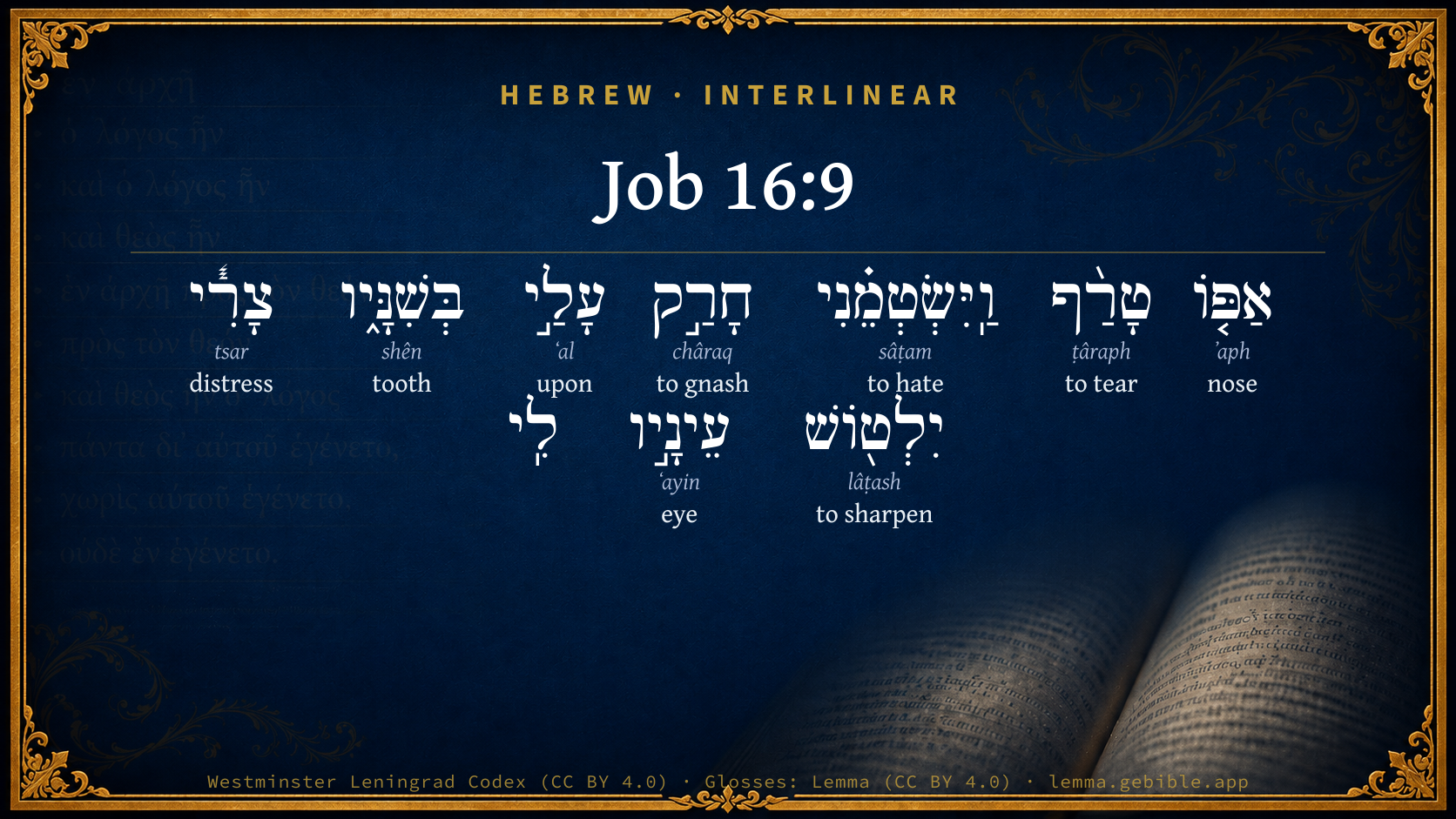
Hebrew (Westminster Leningrad Codex) Job 16:9 appears in the Hebrew Old Testament. The text above is from the Westminster Leningrad Codex. Each word links to its Strong’s number, a concise gloss, and parsing drawn from the Open Scriptures Hebrew Bible morphology. Click any word for its full Brown-Driver-Briggs (BDB) entry.
Download image
Cite this verse

Job 16:9 (World English Bible). Public Domain. Lemma interlinear Bible study tool, https://lemma.gebible.app/v/job/16/9.

Show BibTeX & RIS
BibTeX
RIS
English Translation
He has torn me in his wrath, and persecuted me; He has gnashed on me with his teeth: My adversary sharpens his eyes on me.
World English Bible · Public Domain
Highlights
  • 1 first appearance in the Hebrew Bible
Full analysis ↓
Download a study sheet

One document with this verse’s original text, its word-by-word gloss line, the meaning frame, cross-references with their text, attributed commentary, and full source and license credits — printable, and it pastes into notes with its structure intact.

This verse Autodidact and up

Study sheet (.html) Plain text (.txt)

A passage Seminary Student

Up to 50 verses in one chapter. A passage sheet keeps up to 6 commentary sources and 12 cross-references per verse, in the order this page ranks them, and says so on the sheet whenever that leaves anything out. Ask for a single verse and you get the Autodidact verse sheet above.

Everything on this page stays free to read, with no account — the sheet is a download of what is already on screen, not access to it.

Want to remove ads? Support Godless Engineer
Compare translations 3

The same verse in 3 English versions, stacked beneath the original-language interlinear above. Click any original word for its lexicon entry.

Each is an independent rendering of the whole verse — the interlinear is not word-aligned to these translations.

Highlighted words mark where these versions differ — a whole-verse word diff, not a word-by-word alignment.

  • World English Bible Public Domain
    He has torn me in his wrath, and persecuted me; He has gnashed on me with his teeth: My adversary sharpens his eyes on me.
  • King James Version Public Domain
    He teareth me in his wrath, who hateth me: he gnasheth upon me with his teeth; mine enemy sharpeneth his eyes upon me.
  • unfoldingWord Literal Text CC BY-SA 4.0
    In his nose, he has torn and he has attacked me; he gnashes his teeth against me. My enemy sharpens his eyes against me.

unfoldingWord Literal Text — © unfoldingWord, licensed CC BY-SA 4.0. Word-aligned USFM3 via Door43 (git.door43.org/unfoldingWord/en_ult).

Versions to compare (up to 4)

3 of 4 selected

Show all 18 translations

Every available English version of this verse, each an independent rendering of the whole verse.

  • World English Bible Public Domain
    He has torn me in his wrath, and persecuted me; He has gnashed on me with his teeth: My adversary sharpens his eyes on me.
  • Berean Standard Bible Public Domain
    His anger has torn me and opposed me; He gnashes His teeth at me. My adversary pierces me with His eyes.
  • Majority Standard Bible Public Domain
    His anger has torn me and opposed me; He gnashes His teeth at me. My adversary pierces me with His eyes.
  • King James Version Public Domain
    He teareth me in his wrath, who hateth me: he gnasheth upon me with his teeth; mine enemy sharpeneth his eyes upon me.
  • American Standard Version (1901) Public Domain
    He hath torn me in his wrath, and persecuted me; He hath gnashed upon me with his teeth: Mine adversary sharpeneth his eyes upon me.
  • Revised Version (1885) Public Domain
    He hath torn me in his wrath, and persecuted me; he hath gnashed upon me with his teeth: mine adversary sharpeneth his eyes upon me.
  • Geneva Bible (1599) Public Domain
    His wrath hath torne me, and hee hateth me, and gnasheth vpon mee with his teeth: mine enemie hath sharpened his eyes against me.
  • Douay-Rheims (1899) Public Domain
    My wrinkles bear witness against me, and a false speaker riseth up against my face, contradicting me.
  • Young's Literal Translation Public Domain
    His anger hath torn, and he hateth me, He hath gnashed at me with his teeth, My adversary sharpeneth his eyes for me.
  • Literal Standard Version CC BY-SA 4.0
    His anger has torn, and He hates me, || He has gnashed at me with His teeth, || My adversary sharpens His eyes for me.
  • Unlocked Literal Bible CC BY-SA 4.0
    God has torn me in his wrath and persecuted me; He grinds his teeth in rage; my enemy fastens his eyes on me as he tears me apart.
  • unfoldingWord Literal Text CC BY-SA 4.0
    In his nose, he has torn and he has attacked me; he gnashes his teeth against me. My enemy sharpens his eyes against me.
  • Darby Bible Public Domain
    His anger teareth and pursueth me; he gnasheth with his teeth against me; [as] mine adversary he sharpeneth his eyes at me.
  • World Messianic Bible Public Domain
    He has torn me in his wrath and persecuted me. He has gnashed on me with his teeth. My adversary sharpens his eyes on me.
  • Webster's Bible Public Domain
    He teareth me in his wrath, who hateth me: he gnasheth upon me with his teeth; my enemy sharpeneth his eyes upon me.
  • Free Bible Version CC BY-SA 4.0
    He has torn me apart in his anger; in his hostility he has gnashed his teeth at me; my enemy pierces me with his fierce look.
  • Bible in Basic English Public Domain
    I am broken by his wrath, and his hate has gone after me; he has made his teeth sharp against me: my haters are looking on me with cruel eyes;
  • JPS Tanakh (1917) Public Domain
    He hath torn me in His wrath, and hated me; He hath gnashed upon me with His teeth; mine adversary sharpeneth his eyes upon me.

Literal Standard Version (2020), Covenant Press — licensed CC BY-SA 4.0. Text via the HelloAO Bible API (eBible.org). Unlocked Literal Bible (unfoldingWord) — licensed CC BY-SA 4.0. Text via the HelloAO Bible API (eBible.org). unfoldingWord Literal Text — © unfoldingWord, licensed CC BY-SA 4.0. Word-aligned USFM3 via Door43 (git.door43.org/unfoldingWord/en_ult). Free Bible Version, Dr. Jonathan Gallagher — licensed CC BY-SA 4.0. Text via the HelloAO Bible API (eBible.org).

Word by word

More ways to search: Search by grammar → Find every occurrence → Compare this word →

Practice this passage: Drill this verse → Learn its vocabulary →

חָרַ֣ק
châraq
H2786
“to gnash”
Verb, Qal, Perfect, 3rd Person, Masculine, Singular
Part of Speech
Verb
Stem
Qal
Form
Perfect
Person
3rd Person
Gender
Masculine
Number
Singular
Full BDB Definition

Origin: a primitive root

TWOT: 755

(Qal) to gnash, grind (the teeth)
  1. אַפּ֤וֹ ʼaph H639 “nose · his” Noun, Common, Masculine, Singular, Construct + Suffix, Personal, 3rd Person, Masculine, Singular
  2. טָרַ֨ף ṭâraph H2963 “to tear” Verb, Qal, Perfect, 3rd Person, Masculine, Singular
  3. וַֽיִּשְׂטְמֵ֗נִי sâṭam H7852 “and · to hate · me” Conjunction + Verb, Qal, Sequential Imperfect, 3rd Person, Masculine, Singular + Suffix, Personal, 1st Person, Common, Singular
  4. עָלַ֣י ʻal H5921 “upon · me” Preposition + Suffix, Personal, 1st Person, Common, Singular
  5. בְּשִׁנָּ֑יו shên H8127 “in/at · teeth · his” Preposition + Noun, Common, Both, Dual, Construct + Suffix, Personal, 3rd Person, Masculine, Singular
  6. צָרִ֓י tsar H6862 “distress · my” Noun, Common, Masculine, Singular, Construct + Suffix, Personal, 1st Person, Common, Singular
  7. יִלְט֖וֹשׁ lâṭash H3913 “to sharpen” Verb, Qal, Imperfect, 3rd Person, Masculine, Singular
  8. עֵינָ֣יו ʻayin H5869 “eyes · his” Noun, Common, Both, Dual, Construct + Suffix, Personal, 3rd Person, Masculine, Singular

About this verse

These counts appear in no published source. They are computed here, from the morphology-tagged text and Lemma’s own curated glosses. What Lemma adds →

10
words
9
distinct lemmas
Wisdom
section

Notable vocabulary

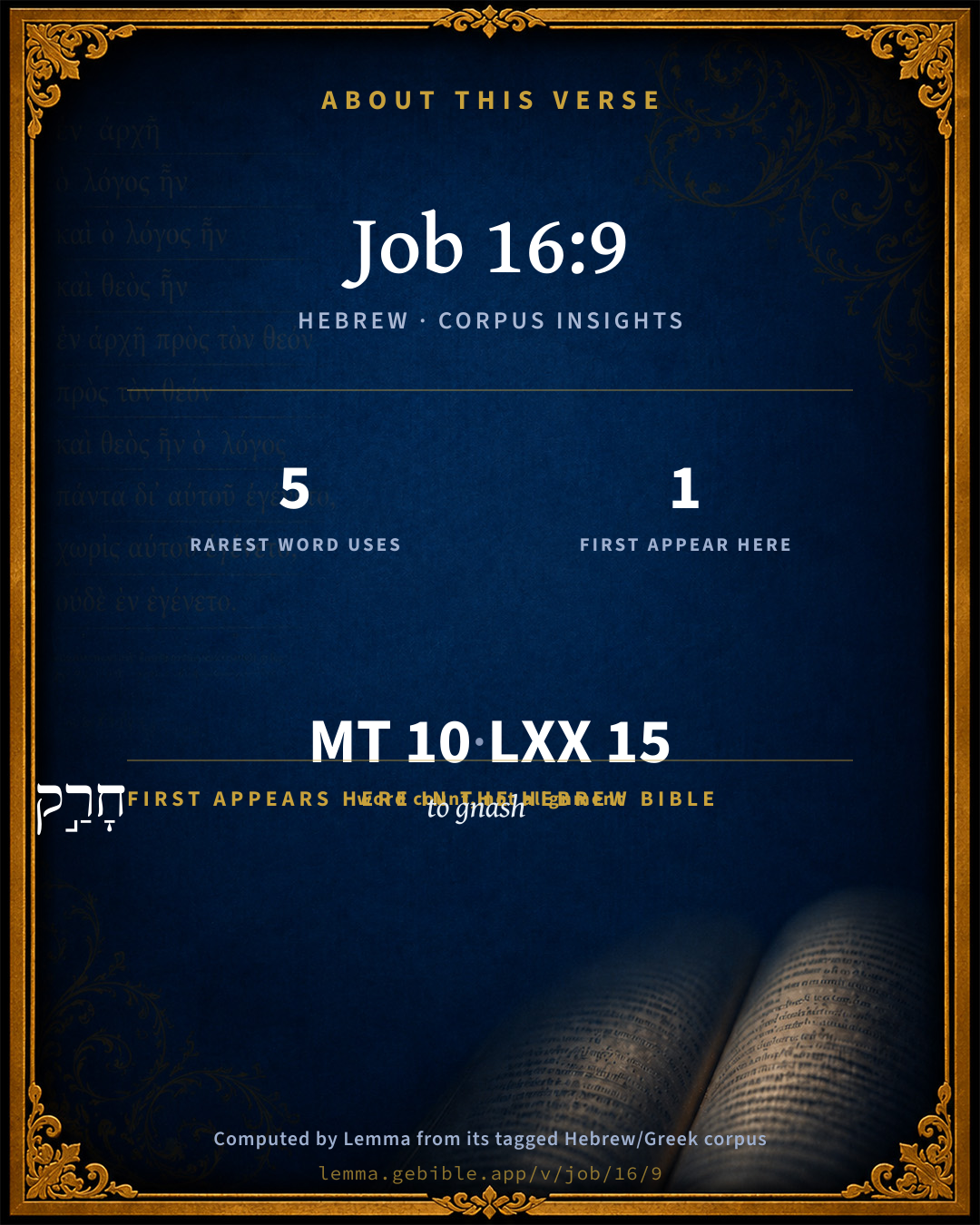
The rarest word here is חָרַ֣ק to gnash H2786 — appearing just 5 times in the whole Hebrew Bible.

First appearance in Scripture

This word makes its first canonical appearance in the Hebrew Bible here:

  • חָרַ֣ק to gnash H2786

Shared distinctive vocabulary

חָרַ֣ק to gnash H2786 occurs in 5 verses of the Hebrew Bible. Also found in:

Grammatical profile

  • 4 verbs
  • 4 nouns
  • 2 prepositions

Verb forms

  • טָרַ֨ף Qal · Perfect
  • וַֽיִּשְׂטְמֵ֗נִי Qal · Sequential Imperfect
  • חָרַ֣ק Qal · Perfect
  • יִלְט֖וֹשׁ Qal · Imperfect

Hebrew & Septuagint length

In English translation the verse runs 25 words from the Hebrew and 19 from the Septuagint (LXX English) — closely comparable.

A rough comparison of the two English renderings, which tokenize alike — not a word-level alignment.

Word counts can differ between the Hebrew and the Greek without any difference in meaning — e.g. the Hebrew direct-object marker אֵת has no separate Greek word, and Greek often adds the article ὁ.

In the original languages it is 10 Hebrew tokens and 15 Greek tokens — but the two are counted differently (Hebrew bundles its prefixes and suffixes into one token; the Greek is in lemma form), so that isn’t a like-for-like length.

Cross-references

14

Topical passages linked to Job 16:9 in the Treasury of Scripture Knowledge — connected by theme and wording, ordered by reader-vote popularity; previews shown in the World English Bible.

  • Job 13:24 Why hide you your face, And hold me for your enemy?
  • Psalms 35:16 Like the profane mockers in feasts, They gnashed their teeth at me.
  • Lamentations 2:16 All your enemies have opened their mouth wide against you; They hiss and gnash the teeth; they say, We have swallowed her up; Certainly this is the day that we looked for; we have found, we have seen it.
  • Job 19:11 He has also kindled his wrath against me. He counts me among his adversaries.
  • Hosea 6:1 "Come, and let us return to Yahweh; For he has torn us to pieces, And he will heal us; He has injured us, And he will bind up our wounds.
  • Job 10:16–17 If my head is held high, you hunt me like a lion. Again you show yourself powerful to me.
  • Job 13:27 You also put my feet in the stocks, And mark all my paths. You set a bound to the soles of my feet:
  • Job 18:4 You who tear yourself in your anger, Shall the earth be forsaken for you? Or shall the rock be removed out of its place?
  • Psalms 37:12 The wicked plots against the just, And gnashes at him with his teeth.
  • Acts 7:54 Now when they heard these things, they were cut to the heart, and they gnashed at him with their teeth.
  • Psalms 50:22 "Now consider this, you who forget God, Lest I tear you into pieces, and there be none to deliver.
  • Lamentations 3:10 He is to me as a bear lying in wait, as a lion in secret places.
  • Hosea 5:14 For I will be to Ephraim like a lion, And like a young lion to the house of Judah. I myself will tear in pieces and go away. I will carry off, and there will be no one to deliver.
  • Micah 7:8 Don't rejoice against me, my enemy. When I fall, I will arise. When I sit in darkness, Yahweh will be a light to me.

Cross-references courtesy of OpenBible.info (CC BY 4.0).

Hebrew and Greek witnesses Masoretic Hebrew ↔ Greek Septuagint

The same verse in the two great witnesses to the Old Testament, shown verse-for-verse.

These are two independent witnesses, not word-aligned to each other, and the Septuagint is shown in lemma (dictionary) form.

Hebrew Job 16:9 Masoretic · Westminster Leningrad Codex

אַפּ֤וֹ טָרַ֨ף וַֽיִּשְׂטְמֵ֗נִי חָרַ֣ק עָלַ֣י בְּשִׁנָּ֑יו צָרִ֓י יִלְט֖וֹשׁ עֵינָ֣יו לִֽי

He has torn me in his wrath, and persecuted me; He has gnashed on me with his teeth: My adversary sharpens his eyes on me.

World English Bible · Public Domain

Greek LXX Job 16:9 Septuagint · lemma form

ὀργή χράω καταβάλλω ἐγώ βρύχω ἐπί ἐγώ ὁ ὀδούς βέλος πειρατής αὐτός ἐπί ἐγώ πίπτω

My falsehood has become a testimony, and has risen up against me: it has confronted me to my face.

LXX2012 (modern English Septuagint) · Public Domain

Hebrew: Westminster Leningrad Codex (CC BY 4.0). Greek: Septuagint (public domain); English from LXX2012 (modern English Septuagint) (Public Domain). How the Septuagint differs from the Hebrew →

Commentary

Notes on Job 16:9 from classic Christian and Jewish commentators (each source and its license shown beneath its notes). The classic Christian expositions comment on the surrounding passage and are grouped to its opening verse, so a note may address several verses; the Jewish commentaries on the Tanakh (Rashi and others) are per-verse, so they appear only where the commentator wrote on this verse.

Lemma curates 59 commentaries, every one of them public domain or Creative Commons licensed, each selected and text-cleaned for this edition rather than reprinted as found. About our sources →

Trapp's Complete Commentary

John Trapp

Job 16:9 He teareth [me] in his wrath, who hateth me: he gnasheth upon me with his teeth; mine enemy sharpeneth his eyes upon me.

Ver. 9. He teareth me in his wrath, &c.] Who did all this to Job? The devil, say some; his disease, say others that was a most uncharitable censure passed by Luther upon Oecolampadius, that he died suddenly, ignitis Satanae telis confossus, slain by Satan’s fiery darts, because he died of a carbuncle (Lib. de Missa. prin., A.D. 1533). But Job surely meaneth it of God, upon whom his heart was still, though he speak here somewhat unhappily of him, out of the sense of the flesh, and greatness of his grief.

Who hateth me] Heb. He Satanically hateth me. What strange language is this from him who elsewhere calleth God his salvation, his redeemer, Job 13:15-16; Job 13:18; Job 19:25, and will eventually call him his witness in heaven, to whom his eye poureth out tears! Job 16:19-20. How shall we reconcile these so contrary passions and passages, otherwise than by saying, that every good man is two men? &c.; neither can it possibly be expressed how deeply sensible the saints are of God’s displeasure when they are more than ordinarily afflicted by him, and especially when he seemeth to fight against them with his own hand. Hereby, saith Ferus, we may easily see in what a perplexed estate wicked reprobates shall be at the last day, when God shall declare himself to be such an enemy to them indeed; for so much as one of his elect, and a most rare man, but, conceiving him to be against him, because he had no present sense of his favour, was thus extremely troubled.

He gnasheth upon me with his teeth] As extremely angry, Act 7:54, and by sharpening his teeth threatening destruction, Psa 37:12.

Mine enemy sharpeneth his eyes upon me] Which cast forth, as it were, sparkles of fire. An elegant hypotyposis, or description of his sad condition to the life, Ut non tam gesta res quam nunc geri videatur, saith Brentius, as if we saw it even acted before our faces.

John Trapp, A Commentary or Exposition upon All the Books of the Old and New Testament (1647–1656) — public domain. Text from a community e-Sword module.

Joseph Benson's Commentary

Job 16:9. He teareth me in his wrath — Hebrew, אפו שׂר, appo tarap, His wrath teareth me in pieces, properly, as a lion or other savage beast tears his prey, of which the word tarap is peculiarly used; who hateth me — וישׂשׂמני, vajistemeni, rather, and hateth me; that is, pursues me with hatred, or as if he hated me. Some render it, adversatus est mihi, is hostile to me; or, acts as mine enemy. He gnasheth upon me with his teeth — A strong figurative expression, denoting extreme anger; mine enemy sharpeneth his eyes upon me — That is, looks upon me with a fierce and sparkling eye, as enraged persons are wont to look on those who have provoked them. It is a great question among commentators what enemy Job meant. Sol. Jarchi writes, Hasatan hu hatzar: Satan, he is the enemy. Certainly Satan was Job’s greatest enemy, and, by the divine permission, had brought all his sufferings upon him, and perhaps now frequently terrified him with apparitions. “It is not improbable,” says Henry, “that this is the enemy he means.” Many think that Eliphaz, who spoke last, and to whose speech Job is now replying, is intended. He had showed himself very much exasperated against Job; and might express himself with such marks of indignation as are here mentioned, rending Job’s good name, as Bishop Patrick expresses himself, and preaching nothing but terror against him. His eyes might be said to be sharpened to spy out matter of reproach against him, and very unkindly, yea, cruelly, both he and his friends had used him. Others, however, think that the expressions, though harsh, and apparently unbecoming to be applied to God, were, nevertheless, intended of him by Job, and are capable of being so interpreted as not to imply any reflection on the divine perfections. “The expressions,” says Chappelow, “are really not stronger than those which we read in other places, particularly in the eleventh and four following verses; as also 19:11, 30, 31.” The reader must observe, that the melancholy state of Job’s mind, and his dreadful sufferings under the chastising hand of God, which his friends never ceased to represent as the effects of divine wrath, had caused him to entertain distressing ideas of God’s terrors, and to view him, if not as an enemy, yet as a severe and inexorable judge, who was extreme to mark all his iniquities and failings.

Joseph Benson's Commentary on the Old and New Testaments (1811–1818) — public domain. Text from a community e-Sword module.

Whedon's Commentary on the Bible

Daniel D. Whedon

9. He teareth — His anger teareth me and warreth against me. If Job ascribe his treatment to God, (Job_16:9-14,) his language transcends all bounds of reason; but if, on the contrary, he speaks of the malice of evil spirits to whose power he has been for a time delivered, it is nothing more than what might be expected from their diabolical nature, which is best imaged in the wildness and cruelty of the brute creation. Raschi, Cocceius, Adam Clarke, Tayler Lewis, and others, think that Job speaks here of Satan with his mocking fiends.

Gnasheth… with his teeth — Such expressions appear often in the classics.

Sharpeneth his eyes — An expression still in use in the East. The eye is here compared to a sword, or, as others suppose, to the fierce, fascinating gaze of the lion as he is about to pounce upon his prey.

Daniel D. Whedon (gen. ed.), Commentary on the Old and New Testaments (1874–1909) — public domain. Text from a community e-Sword module.

Tyndale Open Study Notes

Tyndale Open Resources

16:9-10 jeer and laugh at me: Job was the subject of mockery (cp. Ps 35:21; Isa 57:4; Lam 2:16; 3:46). • To slap the cheek was less an act of violence (Ps 3:7; Mic 5:1) than an insult (1 Kgs 22:24; Isa 50:6; Lam 3:30; Matt 26:67).

Tyndale Open Study Notes — © Tyndale Open Resources, licensed CC BY-SA 4.0. Text via the HelloAO Bible API.

Geneva Bible (1599)

Geneva Bible translators

That is, God by his wrath: and in this diversity of words and high style, he expresseth how grievous the hand of God was upon him.

Geneva Bible (1599) marginal notes — public domain. Text via Bolls.life.

Jamieson, Fausset & Brown

Robert Jamieson, A. R. Fausset & David Brown

Image from a wild beast. So God is represented (Job 10:16).

who hateth me--rather, "and pursues me hard." Job would not ascribe "hatred" to God (Psa 50:22).

mine enemy--rather, "he sharpens, &c., as an enemy" (Psa 7:12). Darts wrathful glances at me, like a foe (Job 13:24).

Jamieson, Fausset & Brown — Commentary Critical and Explanatory on the Whole Bible (1871) — public domain (CC PDM 1.0). Text via the HelloAO Bible API.

Adam Clarke's Commentary

Verse 9. He teareth me in his wrath] Who the person is that is spoken of in this verse, and onward to the end of the fourteenth, has been a question on which commentators have greatly differed. Some think God, others Eliphaz, is intended: I think neither. Probably God permitted Satan to show himself to Job, and the horrible form which he and his demons assumed increased the misery under which Job had already suffered so much. All the expressions, from this to the end of the fourteenth verse, may be easily understood on this principle; e.g., Job 16:9: "He (Satan) gnasheth upon me with his teeth; mine enemy sharpeneth his eyes upon me." Job 16:10: "They (demons) have gaped on me with their mouth;-they have gathered themselves together against me." Job 16:11: "God hath delivered me to the ungodly, (עויל avil, to the EVIL ONE,) and turned me over into the hands of the wicked." He hath abandoned me to be tortured by the tempter and his host.

If we consider all these expressions as referring to Job's three friends, we must, in that case, acknowledge that the figures are all strained to an insufferable height, so as not to be justified by any figure of speech.

Adam Clarke's Commentary on the Bible (1810–1826) — public domain. Text from a community e-Sword/MySword module.

Ellicott's Commentary for English Readers

(9) He teareth me in his wrath.—Terrible as the language is that Job has used against God, he seems here almost to exceed it, for he calls Him his adversary. It is hardly possible not to understand the expression of God, for though he immediately speaks of his friends, yet just afterwards he openly mentions God.

A Bible Commentary for English Readers, edited by Charles John Ellicott (1878–1897) — public domain. Text from a community e-Sword module.

The Cambridge Bible for Schools and Colleges

gen. ed. J. J. S. Perowne

9. Picture of God’s hostility to him. The figure is that of a beast of prey.

who hateth me] lit. and hateth me, or, and is hostile to me, i. e. assaileth me. The picture of the lion-like assailant, his rending fury, and gnashing teeth, and flashing eyes, is graphic.

The Cambridge Bible for Schools and Colleges (gen. ed. J. J. S. Perowne; Cambridge University Press, 1878–1918) — public domain. Text from a community e-Sword module.

John Gill's Exposition

They have gaped upon me with their mouth,.... Here Job speaks of the instruments which God suffered to use him ill; and he has respect to his friends who came with open mouth against him, loading him with calumnies and reproaches, laying charges to him he was not conscious of, and treating him with scorn and contempt, which such a gesture is sometimes a token of, Lam 3:46; and in which manner also Christ was used by men, on whom the reproach of them that reproached God and his people fell, and who exhibited false charges against him of various sorts; and he was the reproach of men and the contempt of the people, who laughed him to scorn, opened their mouths in derision; they shot out the lip and shook the head, and mocked and scoffed at him; yea, "they gaped upon him with their mouth as a ravening and a roaring lion", Psa 22:6; to which the allusion is here, when they cried out themselves and called upon others to join them, saying, "Crucify him, crucify him", Luk 23:21,

they have smitten me on the cheek reproachfully; to be smitten on the cheek is a reproach itself, and is a suffering not very patiently endured. Hence Christ, to teach his followers patience, advised when they were smitten on the one cheek to turn the other, that is, to take the blow patiently; and it is not the smart of the stroke that is so much regarded as the shame of it, the affront given, and the indignity offered; see Co2 11:20; so that the phrase may be taken for reproaching him; and indeed it may be rendered, "they have smitten on the cheek with reproach" (a); they reproached him, which was the same as if they had smitten him on the cheek; they smote him with their tongues, as Jeremiah's enemies smote him, Jer 18:18; they threw the dirt of scandal and calumny at him, and which is the common lot of God's people; and though since they are reproached for Christ's sake, for the Gospel's sake, and for righteousness sake, they should not be disturbed at that; but rather reckon themselves happy, as they are said to be, and bind these reproaches about their necks as chains of gold, and esteem them greater riches than all the treasures of Egypt. This was literally true of Job's antitype, the Messiah, for as it was foretold of him that he should give his cheek to those that plucked off the hair, and they should smite the Judge of Israel with a rod upon his cheek, Isa 50:6, so this was done unto him by the servants of the high priest in his hall, and by others, Mat 26:67;

they have gathered themselves together against me; Job's friends got together in order to visit him and comfort him, but it proved otherwise, and he viewed it in no other light than as a combination against him: the words may be rendered, "they filled themselves against me" (b); their hearts with wrath and anger, as the Targum; their mouths with reproaches and calumnies, and their eyes with pleasure and delight, and satisfaction at his miseries and afflictions; and so the Vulgate Latin version,

"they are satiated with my punishments;''

though rather this may respect the high spirits they were in, the boldness and even impudence, as Job interpreted it, they showed in their conduct towards him, their hearts being swelled with pride and haughtiness and passion (c); see Est 7:5; or else their numbers that came against him; so Mr. Broughton renders the words, "they came by full troops upon me"; Job's three friends, being great personages, very probably brought a large retinue and train of servants with them; who, observing their master's conduct, behaved in an indecent manner towards him themselves, to whom he may have respect, Job 30:1; this was verified in Christ his antitype, whom Judas, with a multitude of men, with swords and staves, even with a band of soldiers, came to apprehend in the garden; and when Herod and Pontius Pilate, with the Gentiles, and people of Israel, were gathered against him to do what God had determined should be done, Mat 26:46.

(a) "cum opprobrio", Beza, Vatablus, Drusius; so Schmidt, Michaelis, Schultens; "with reproaches", Broughton. (b) "impleverunt sese", De Dieu. (c) Vid. De Dieu in loc.

John Gill's Exposition of the Whole Bible (1746–1763) — public domain (CC PDM 1.0). Text via the HelloAO Bible API.

Albert Barnes' Notes on the Bible

He teareth me in his wrath - The language here is all taken from the ferocity of wild beasts; and the idea is, that his enemy had come upon him as a lion seizes upon its prey. Rosenmuller, Reiske, and some others suppose that this refers to God. Cocceius refers it to Satan. Schultens, Dr. Good, and some others, to Eliphaz, as the leading man among his adversaries. I have no doubt that this is the true reference. The connection seems to demand this; and we ought not to suppose that Job would charge this upon God, unless there is the clearest evidence. The whole passage is a description of the manner in which Job supposed his friends had come upon him. He says they had attacked him like wild beasts. Yet it must be admitted that he sometimes attributes these feelings to God, and says that he came upon him like a roaring lion see Job 10:16-17.

Who hateth me - Or rather, “and persecutes me, or is become my adversary,” for so the word used here (שׂטם śâṭam) means; see the notes at Job 30:21.

He gnasheth upon me with his teeth - As an enraged wild animal does when about to seize upon its prey. A similar figure occurs in Otway, in his “Orphan:”

- For my Castalio’s false;

False as the wind, the water, or the weather:

Cruel as tigers o’er their trembling prey:

I feel him in my breast, he tears my heart,

And at each sigh he drinks the gushing blood.

And so Homer, when he describes the wrath of Achilles as he armed himself to avenge the death of Patroclus, mentions among other signs of wrath his gnashing his teeth:

Τοῦ καὶ ὀδόντων μὲν καναχὴ πέλε.

Tou kai odontōn men kanachē pele.

Iliad xix. 364.

So Virgil describes his hero as

furens animis, dentibus infrendens.

Aeneid viii. 228.

Mine enemy sharpeneth his eyes upon me - Looks fiercely; watches me narrowly - as an animal does his victim when about to seize upon it. The image is probably drawn from the intense gaze of the lion when about to pounce upon his prey. “He darts piercing looks at me; or looks at me with a fierce and penetrating eye.”

Albert Barnes' Notes on the Bible (1834–1885) — public domain. Text from a community e-Sword/MySword module.

Haydock's Catholic Bible Commentary

Against me, in your opinion, as if I were guilty of lies. Hebrew, "my leanness bears witness, my falsehood has risen up against me and answered me to my face;" which may be understood in the same sense as the argument of Eliphaz. He is designated by the false speaker; (Calmet) unless we explain it of the wrinkles, which falsely indicated that Job was advanced in years, or of the malady; whence it was gathered that he must be a criminal. (Menochius) --- Protestants, "my leanness riseth up." (Haydock)

George Leo Haydock (1774–1849), Haydock's Catholic Family Bible and Commentary, 1859 edition — public domain. Excludes Psalms (Douay-Rheims chapter numbering differs from Protestant) and Deuterocanonical books (Catholic canon only).

Matthew Poole's English Annotations

He teareth me in his wrath, Heb. his wrath teareth me in pieces, as a lion doth his prey.

Who hateth me, Heb. and he hateth me, i.e. he pursueth me with a deadly hatred and rage. Or, and he is become mine enemy; or, he sets himself against me with all his might; or, he treats me like an implacable enemy. He gnasheth upon me with his teeth; which is a gesture and sign of extreme anger and fury, as Psa 35:16; 37:12; Lam 2:16; as elsewhere of grievous pain, as Luk 13:28.

Mine enemy; either,

1. God, who of a friend is now become my implacable enemy. Or,

2. Eliphaz, who deals with me more like an enemy than a friend.

Sharpeneth his eyes upon me, i.e. looks upon me with a fierce and sparkling eye, as enraged persons uso to do.

Matthew Poole's English Annotations on the Holy Bible (1683–1685) — public domain. Text from a community e-Sword/MySword module.

The Pulpit Commentary

He teareth me in his wrath, who hateth me; literally, his wrath teareth" and he hateth me. God treats Job as severely as if he hated him. That he is actually hated of God Job does not believe; otherwise he would long since have ceased to call upon him, and pour out his heart before him. He gnasheth upon me with his teeth. (comp. Psa_35:16 Psa_37:12) Mine enemy (or rather, adversary) sharpeneth his eyes upon me; i.e. makes me a whetstone on which he sharpens his angry glances.

The Pulpit Commentary (1880–1919), ed. H.D.M. Spence-Jones & Joseph S. Exell — public domain. Text from a community e-Sword module.

John Wesley's Explanatory Notes

Eyes - Looks upon me with a fierce, and sparkling eye, as enraged persons use to do.

John Wesley, Explanatory Notes Upon the Whole Bible (1754–1765) — public domain. Text via the GEBible commentary corpus.

unfoldingWord translationNotes

Door43 World Missions Community

God has torn me in his wrath and persecuted me ... as he tears me apart

This speaks of God causing Job pain as if God were a wild animal and Job were his prey that he was killing. AT: "Because God is very angry with me, it is as though he were a wild animal that tore my body apart with his teeth because he was my enemy" (See: Metaphor)

my enemy

Job refers to God as his "enemy" as he describes how he has caused him great pain.

fastens his eyes on me

This is an idiom. AT: "glares at me" (See: Idiom)

People have gaped with open mouth

To "gape" means to stare in amazement with open mouth.

translationWords

wrath

persecute

people group

reproach

unfoldingWord translationNotes — © Distant Shores Media and the Door43 World Missions Community, licensed CC BY-SA 4.0. Source: git.door43.org/Door43/en_tn.

Rashi

Rabbi Shlomo Yitzchaki (Rashi)

My Adversary Satan is the adversary.

sharpens Heb. ילטוש, sharpens, like (Gen. 4:22), “who sharpened (לטש) every instrument etc.”

Rashi on the Tanakh — English translations: “The Judaica Press complete Tanach with Rashi, translated by A. J. Rosenberg” (CC BY 4.0); “Pentateuch with Rashi's commentary by M. Rosenbaum and A.M. Silbermann, 1929-1934” (public domain); “The Metsudah Tanach series, Lakewood, N.J” (CC BY 4.0); and “The Book of Joshua, Metsudah Publications, 1997” (CC BY 4.0). Text via Sefaria.

Lesson kit

Teaching starters — assembled from the data on this page, not authored interpretation. Every prompt links to the verse data it draws on. Edit before teaching.

Job, in the Wisdom, opens this verse with 10 words (9 distinct Hebrew lemmas). Its most distinctive word is châraq (“to gnash”). A historical commentator’s framing appears above. Read the whole chapter for the surrounding context.

Discussion questions

  1. What does “to gnash” (châraq) contribute to the verse as a whole?
  2. This is the first place “to gnash” appears in Scripture (first appears here). What does its debut here establish?
  3. How does Psalms 35:16, which shares the word «to gnash», read alongside this verse?
  4. The translations on this page render this verse differently — a whole-verse word diff, not a word-by-word alignment. What might account for the different wordings?
  5. «טָרַ֨ף» is a Qal Perfect verb. How does that grammatical form shape the action described?
  6. Compare how Trapp's Complete Commentary and Joseph Benson's Commentary read this verse. Where do they agree or differ?

Things to notice

Reading settings

Reading text

Shown beneath each verse's original-language words.

Old Testament
Old Testament edition

Read the OT as the Masoretic Hebrew (MT) or the Greek Septuagint (LXX).

English shown for the Greek Septuagint (in the Hebrew ↔ Greek comparison).

Comparing translations? Open the Compare panel on any verse page to stack up to four side by side.