Ezekiel 1:18

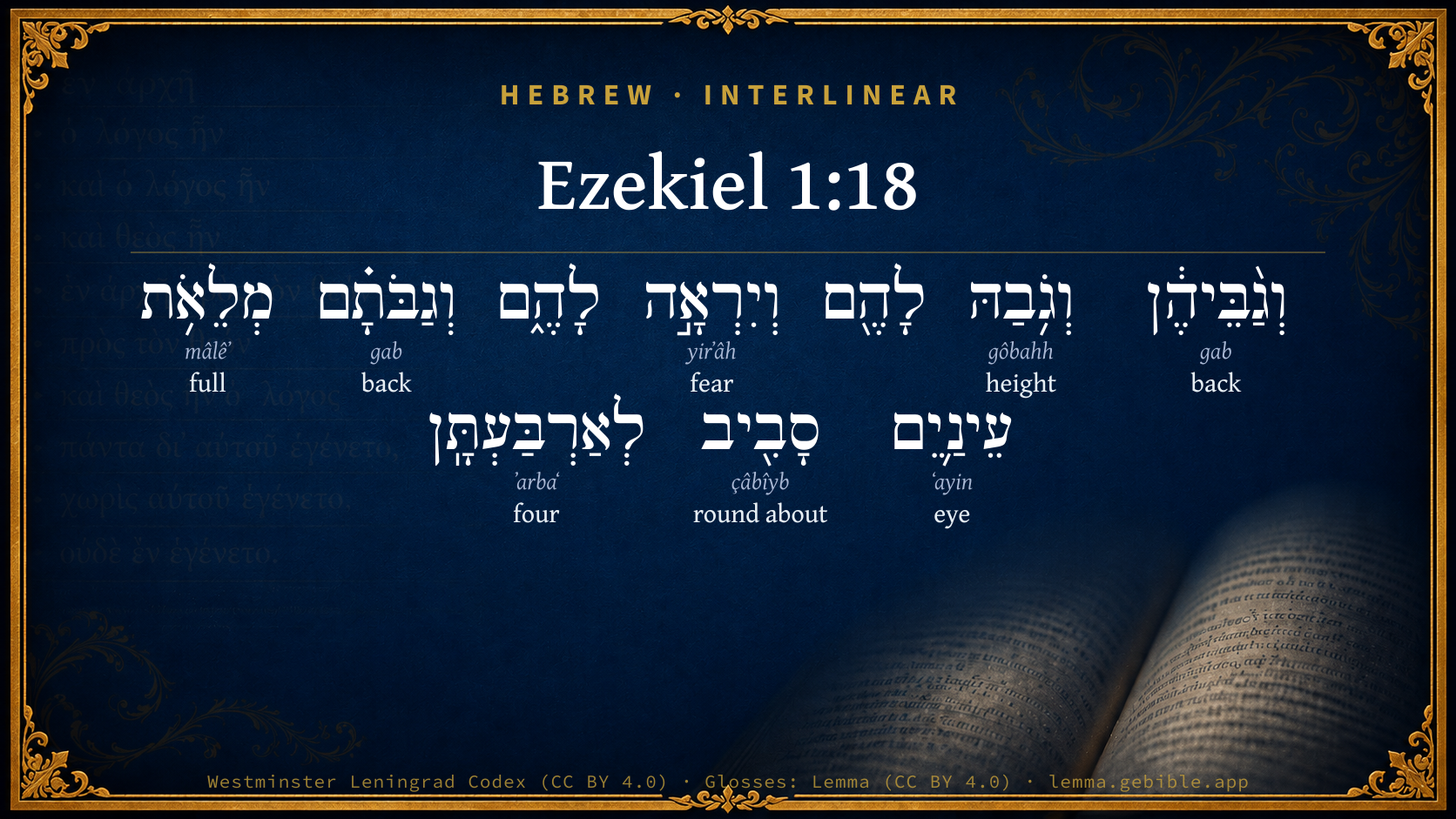
Hebrew (Westminster Leningrad Codex) Ezekiel 1:18 appears in the Hebrew Old Testament. The text above is from the Westminster Leningrad Codex. Each word links to its Strong’s number, a concise gloss, and parsing drawn from the Open Scriptures Hebrew Bible morphology. Click any word for its full Brown-Driver-Briggs (BDB) entry.
Download image
Cite this verse

Ezekiel 1:18 (World English Bible). Public Domain. Lemma interlinear Bible study tool, https://lemma.gebible.app/v/ezekiel/1/18.

Show BibTeX & RIS
BibTeX
RIS
English Translation
As for their rims, they were high and dreadful; and they four had their rims full of eyes round about.
World English Bible · Public Domain
Download a study sheet

One document with this verse’s original text, its word-by-word gloss line, the meaning frame, cross-references with their text, attributed commentary, and full source and license credits — printable, and it pastes into notes with its structure intact.

This verse Autodidact and up

Study sheet (.html) Plain text (.txt)

A passage Seminary Student

Up to 50 verses in one chapter. A passage sheet keeps up to 6 commentary sources and 12 cross-references per verse, in the order this page ranks them, and says so on the sheet whenever that leaves anything out. Ask for a single verse and you get the Autodidact verse sheet above.

Everything on this page stays free to read, with no account — the sheet is a download of what is already on screen, not access to it.

Want to remove ads? Support Godless Engineer
Compare translations 3

The same verse in 3 English versions, stacked beneath the original-language interlinear above. Click any original word for its lexicon entry.

Each is an independent rendering of the whole verse — the interlinear is not word-aligned to these translations.

Highlighted words mark where these versions differ — a whole-verse word diff, not a word-by-word alignment.

  • World English Bible Public Domain
    As for their rims, they were high and dreadful; and they four had their rims full of eyes round about.
  • King James Version Public Domain
    As for their rings, they were so high that they were dreadful; and their rings were full of eyes round about them four.
  • unfoldingWord Literal Text CC BY-SA 4.0
    As for their rims, they were high and fearsome, for the rims were full of eyes round about.

unfoldingWord Literal Text — © unfoldingWord, licensed CC BY-SA 4.0. Word-aligned USFM3 via Door43 (git.door43.org/unfoldingWord/en_ult).

Versions to compare (up to 4)

3 of 4 selected

Show all 18 translations

Every available English version of this verse, each an independent rendering of the whole verse.

  • World English Bible Public Domain
    As for their rims, they were high and dreadful; and they four had their rims full of eyes round about.
  • Berean Standard Bible Public Domain
    Their rims were high and awesome, and all four rims were full of eyes all around.
  • Majority Standard Bible Public Domain
    Their rims were high and awesome, and all four rims were full of eyes all around.
  • King James Version Public Domain
    As for their rings, they were so high that they were dreadful; and their rings were full of eyes round about them four.
  • American Standard Version (1901) Public Domain
    As for their rims, they were high and dreadful; and they four had their rims full of eyes round about.
  • Revised Version (1885) Public Domain
    As for their rings, they were high and dreadful; and they four had their rings full of eyes round about.
  • Geneva Bible (1599) Public Domain
    They had also rings, and height, and were fearefull to beholde, and their rings were full of eyes, round about them foure.
  • Douay-Rheims (1899) Public Domain
    The wheels had also a size, and a height, and a dreadful appearance: and the whole body was full of eyes round about all the four.
  • Young's Literal Translation Public Domain
    As to their rings, they are both high and fearful, and their rings `are' full of eyes round about them four.
  • Literal Standard Version CC BY-SA 4.0
    As for their rings, they are both high and fearful, and their rings, of the four of them, [are] full of eyes around them.
  • Unlocked Literal Bible CC BY-SA 4.0
    As for their rims, they were high and fearsome, for the rims were full of eyes round about.
  • unfoldingWord Literal Text CC BY-SA 4.0
    As for their rims, they were high and fearsome, for the rims were full of eyes round about.
  • Darby Bible Public Domain
    As for their rims, they were high and dreadful; and they four had their rims full of eyes round about.
  • World Messianic Bible Public Domain
    As for their rims, they were high and dreadful; and the four of them had their rims full of eyes all around.
  • Webster's Bible Public Domain
    As for their rings, they were so high that they were dreadful; and their rings were full of eyes around them four.
  • Free Bible Version CC BY-SA 4.0
    The wheel rims were impressively high, and all of the four rims were covered in eyes.
  • Bible in Basic English Public Domain
    And I saw that they had edges, and their edges, even of the four, were full of eyes round about.
  • JPS Tanakh (1917) Public Domain
    As for their rings, they were high and they were dreadful; and they four had their rings full of eyes round about.

Literal Standard Version (2020), Covenant Press — licensed CC BY-SA 4.0. Text via the HelloAO Bible API (eBible.org). Unlocked Literal Bible (unfoldingWord) — licensed CC BY-SA 4.0. Text via the HelloAO Bible API (eBible.org). unfoldingWord Literal Text — © unfoldingWord, licensed CC BY-SA 4.0. Word-aligned USFM3 via Door43 (git.door43.org/unfoldingWord/en_ult). Free Bible Version, Dr. Jonathan Gallagher — licensed CC BY-SA 4.0. Text via the HelloAO Bible API (eBible.org).

Word by word

More ways to search: Search by grammar → Find every occurrence → Compare this word →

Practice this passage: Drill this verse → Learn its vocabulary →

וְגַ֨בֵּיהֶ֔ן
gab
H1354
“and · backs · their”
Conjunction + Noun, Common, Both, Plural, Construct + Suffix, Personal, 3rd Person, Feminine, Plural
Part of Speech
Conjunction + Noun
Type
Common
Gender
Both
Number
Plural
State
Construct
Full BDB Definition

Origin: from an unused root

TWOT: 303a

convex surface, back - back (of man) - mound (for illicit worship) - boss (convex projection of shield) - bulwarks, breastworks (of arguments - figuratively) - brow, eyebrow - rim (of wheel)
  1. וְגֹ֥בַהּ gôbahh H1363 “and · height” Conjunction + Noun, Common, Masculine, Singular, Absolute
  2. וְיִרְאָ֣ה yirʼâh H3374 “and · fear” Conjunction + Noun, Common, Feminine, Singular, Absolute
  3. וְגַבֹּתָ֗ם gab H1354 “and · backs · their” Conjunction + Noun, Common, Both, Plural, Construct + Suffix, Personal, 3rd Person, Masculine, Plural
  4. מְלֵאֹ֥ת mâlêʼ H4392 “full” Adjective, Adjective, Feminine, Plural, Absolute
  5. עֵינַ֛יִם ʻayin H5869 “eyes” Noun, Common, Both, Dual, Absolute
  6. סָבִ֖יב çâbîyb H5439 “round about” Noun, Common, Both, Singular, Absolute
  7. לְאַרְבַּעְתָּֽן ʼarbaʻ H702 “to/for · four · their” Preposition + Adjective, Cardinal number, Masculine, Singular, Construct + Suffix, Personal, 3rd Person, Feminine, Plural

About this verse

These counts appear in no published source. They are computed here, from the morphology-tagged text and Lemma’s own curated glosses. What Lemma adds →

10
words
7
distinct lemmas
Prophets
section

Notable vocabulary

The rarest word here is וְגַ֨בֵּיהֶ֔ן back H1354 — appearing just 13 times in the whole Hebrew Bible.

Shared distinctive vocabulary

וְגַ֨בֵּיהֶ֔ן back H1354 occurs in 11 verses of the Hebrew Bible. Also found in:

Grammatical profile

  • 6 nouns
  • 2 adjectives
  • 2 prepositions

Repetition

A word recurs within this verse — often emphatic in Hebrew:

  • וְגַ֨בֵּיהֶ֔ן back H1354 ×2

Hebrew & Septuagint length

In English translation the verse runs 20 words from the Hebrew and 25 from the Septuagint (LXX English) — closely comparable.

A rough comparison of the two English renderings, which tokenize alike — not a word-level alignment.

Word counts can differ between the Hebrew and the Greek without any difference in meaning — e.g. the Hebrew direct-object marker אֵת has no separate Greek word, and Greek often adds the article ὁ.

Cross-references

9

Topical passages linked to Ezekiel 1:18 in the Treasury of Scripture Knowledge — connected by theme and wording, ordered by reader-vote popularity; previews shown in the World English Bible.

  • Ezekiel 10:12 Their whole body, and their backs, and their hands, and their wings, and the wheels, were full of eyes round about, [even] the wheels that they four had.
  • Revelation 4:6 Before the throne was something like a sea of glass, similar to crystal. In the midst of the throne, and around the throne were four living creatures full of eyes before and behind.
  • Revelation 4:8 The four living creatures, each one of them having six wings, are full of eyes around about and within. They have no rest day and night, saying, "Holy, holy, holy, holy, holy, holy, holy, holy, holy is the Lord God, the Almighty, who was and who is and who is to come!"
  • Job 37:22–24 Out of the north comes golden splendor; With God is awesome majesty.
  • Psalms 77:16–19 The waters saw you, God. The waters saw you, and they writhed. The depths also convulsed.
  • Psalms 97:2–5 Clouds and darkness are around him. Righteousness and justice are the foundation of his throne.
  • Proverbs 15:3 Yahweh's eyes are everywhere, Keeping watch on the evil and the good.
  • Isaiah 55:9 For as the heavens are higher than the earth, so are my ways higher than your ways, and my thoughts than your thoughts.
  • Zechariah 4:10 Indeed, who despises the day of small things? For these seven shall rejoice, and shall see the plumb line in the hand of Zerubbabel. These are the eyes of Yahweh, which run back and forth through the whole earth."

Cross-references courtesy of OpenBible.info (CC BY 4.0).

Hebrew and Greek witnesses Masoretic Hebrew ↔ Greek Septuagint

The same verse in the two great witnesses to the Old Testament, shown verse-for-verse.

These are two independent witnesses, not word-aligned to each other, and the Septuagint is shown in lemma (dictionary) form.

Hebrew Ezekiel 1:18 Masoretic · Westminster Leningrad Codex

וְגַ֨בֵּיהֶ֔ן וְגֹ֥בַהּ לָהֶ֖ם וְיִרְאָ֣ה לָהֶ֑ם וְגַבֹּתָ֗ם מְלֵאֹ֥ת עֵינַ֛יִם סָבִ֖יב לְאַרְבַּעְתָּֽן

As for their rims, they were high and dreadful; and they four had their rims full of eyes round about.

World English Bible · Public Domain

Greek LXX Ezekiel 1:18 Septuagint · lemma form

οὐδέ ὁ νῶτος αὐτός καί ὕψος εἰμί αὐτός καί ὁράω αὐτός καί ὁ νῶτος αὐτός πλήρης ὀφθαλμός κυκλόθεν ὁ τέσσαρες

neither did their backs turn: and they were high: and I saw them, and the backs of them four were full of eyes round about.

LXX2012 (modern English Septuagint) · Public Domain

On this verse, Whedon's Commentary on the Bible discusses the Septuagint’s reading. Read the note in Commentary ↓

Hebrew: Westminster Leningrad Codex (CC BY 4.0). Greek: Septuagint (public domain); English from LXX2012 (modern English Septuagint) (Public Domain). How the Septuagint differs from the Hebrew →

Targum (Aramaic paraphrase)

1

The Targum is the ancient Jewish Aramaic paraphrase of the Hebrew Scriptures — an interpretive translation, not the Hebrew text itself. Onkelos (literal) and Pseudo-Jonathan (expansive) render the Torah, and Jonathan the Prophets. Coverage is partial: where no permissively-licensed English translation exists for a verse, only the Aramaic is shown. This is verse-level text, not a word-by-word alignment to the Hebrew.

  1. Targum Jonathan Prophets (Joshua–Malachi)
    וְגַבֵּיהֶן שָׁוָן לְקִיבְלָא רָקִיעָא וְרוּמָא לְהֶן וּדְחִילִין אִנוּן וְגַבֵּיהֶן מְלָן עַיְנִין סְחוֹר סְחוֹר לְאַרְבַּעְתְּהֶן:

    (no public-domain English translation for this verse)

    Targum Jonathan — Aramaic: “Mikraot Gedolot” (public domain). English: “Sefaria Community Translation” (CC0 1.0 (public-domain dedication)); “London "Chaldee Paraphrase," 1871” (public domain). Text via Sefaria.

Commentary

Notes on Ezekiel 1:18 from classic Christian and Jewish commentators (each source and its license shown beneath its notes). The classic Christian expositions comment on the surrounding passage and are grouped to its opening verse, so a note may address several verses; the Jewish commentaries on the Tanakh (Rashi and others) are per-verse, so they appear only where the commentator wrote on this verse.

Lemma curates 59 commentaries, every one of them public domain or Creative Commons licensed, each selected and text-cleaned for this edition rather than reprinted as found. About our sources →

Trapp's Complete Commentary

John Trapp

Eze 1:18 As for their rings, they were so high that they were dreadful; and their rings [were] full of eyes round about them four.

Ver. 18. As for their rings they were so high.] Apsides earum tam amplae seu altae ut propterea formidabiles. The rings or strokes, Heb., backs, of these wheels were so broad and high that they struck terror into the beholders. It is hard to take the altitude of second causes. Well might one write a book of the vanity of sciences, and another a tractate Quod nihil scitur. I would see the proudest of you all define the nature of a straw, as one preached in Cambridge to all the scholars; so of a flower, of a fly, &c. Well might David say, "Thy judgments, Lord, are a great deep," {Psa 36:6} such as hath neither bank nor bottom. Well might Paul cry out, "Oh the depth! how unsearchable are his ways." {Rom 11:23}

And the rings were full of eyes.] Instead of cart nails. Understand hereby God’s all-seeing providence, which never erreth, but always ordereth the world’s disorders to his own glory.

Round about them four.] The Divine providence is like a well drawn picture, which eyeth all that are in the room. See 2Ch 16:9 Psa 34:15 Zec 4:10 Job 34:21; Job 36:7 Jer 16:17; Jer 32:17.

John Trapp, A Commentary or Exposition upon All the Books of the Old and New Testament (1647–1656) — public domain. Text from a community e-Sword module.

Tyndale Open Study Notes

Tyndale Open Resources

1:18 The wheels were tall and frightening, and they were covered with eyes (cp. 10:12). There was no more hope of hiding from this chariot than of running from it.

Tyndale Open Study Notes — © Tyndale Open Resources, licensed CC BY-SA 4.0. Text via the HelloAO Bible API.

Geneva Bible (1599)

Geneva Bible translators

Or, the trent.

Geneva Bible (1599) marginal notes — public domain. Text via Bolls.life.

Jamieson, Fausset & Brown

Robert Jamieson, A. R. Fausset & David Brown

rings--that is, felloes or circumferences of the wheels.

eyes--The multiplicity of eyes here in the wheels, and Eze 10:12, in the cherubim themselves, symbolizes the plenitude of intelligent life, the eye being the window through which "the spirit of the living creatures" in the wheels (Eze 1:20) looks forth (compare Zac 4:10). As the wheels signify the providence of God, so the eyes imply that He sees all the circumstances of each case, and does nothing by blind impulse.

Jamieson, Fausset & Brown — Commentary Critical and Explanatory on the Whole Bible (1871) — public domain (CC PDM 1.0). Text via the HelloAO Bible API.

Adam Clarke's Commentary

Verse 18. As for their rings] The strakes which form the rim or periphery.

They were dreadful] They were exceedingly great in their diameter, so that it was tremendous to look from the part that touched the ground to that which was opposite above.

Were full of eyes] Does not this refer to the appearance of nails keeping on the spokes, or strakes or bands upon the rim?

Adam Clarke's Commentary on the Bible (1810–1826) — public domain. Text from a community e-Sword/MySword module.

John Calvin's Commentaries

What he says about the circumferences of the wheels may seem superfluous, but he refers to the second clause of the verse, where he says, that these circumferences were full of eyes. Here, then, he now treats about their height and terrible aspect. It signifies that the wheels were large, for being round their length and breadth is equal. When he says they were lofty, he, doubtless, signifies that they inspire terror by their very appearance, as he afterwards expresses it.. The sum of the whole is, that these wheels were not common ones, but. they so exceeded the usual size that their magnitude was formidable. But all these things tend to impress the vision on the attention of the Prophet, because unless the Lord should, as it were, draw us violently to himself, we should become torpid through sloth. The Prophet then required to be so variously affected, that, as soon as he sees that no common vision is before him, he should apply all his faculties to its consideration. What he now says, that the circumferences of the wheels were full of eyes, signifies that all the wheels were not rashly but considerately put in motion. If the eyes had been in other parts, they had not been useful; but since the wheels turned by means of their felloes — that is, their iron hoops — there the Prophet saw the eyes fixed.

Now, therefore, we see in what manner God directs the world in various ways, and yet nothing’ is done without reason and plan. By the eyes, the Prophet understands, that providence which never wanders. He does not say, that every wheel had two eyes, but that the circumferences were full of eyes, which expresses much more than if he had said they possessed eyes: which means that there was not the least motion in the wheels unless arranged and governed with the utmost reason. And hence the error of those who think that years are intended by the entangled wheels is refuted. This idea they obtained, I suppose, front the Egyptians, for in their hieroglyphics the year is represented under the image of a serpent., which, being twisted round, bites his own tail. It is indeed true, that the continual series of time is so woven together that year draws year behind it, as Virgil also says in his second Georgic —

“The year returns into itself by its own footsteps.”

But this is altogether out of place here, where the Prophet; signifies that motions which seem to us confused are yet connected, because God does nothing either rashly or inconsiderately. Now, therefore, we comprehend the sense of this portion. He adds —

John Calvin's Commentaries (1540-1563) — public domain. Text from the Calvin Translation Society English edition (1840s-50s) via the Christian Classics Ethereal Library (ccel.org). Calvin's coverage is partial (roughly two-thirds of the Bible); uncommented books and verses are honest gaps, never fabricated. The 19th-century editor's footnotes and remarks are omitted so the notes are faithfully Calvin's own voice.

Ellicott's Commentary for English Readers

(18) Their rings.—The same word is used twice in this verse, and means what we call the felloes. “They were both high and terrible,” i.e., they had both these characteristics, but not, as seems to be implied in our translation, that one was the cause of the other. The height might be inferred from the fact that the wheel was “upon the earth,” and yet was “by the living creatures” (Eze_1:15) who were seen in the cloud (Eze_1:5). The terribleness was in keeping with all other parts of the vision, and its reason is explained in the circumstances which follow.

Full of eyes.—In Eze_10:12 it is said of the living creatures, “their whole body, and their backs, and their hands, and their wings, and the wheels were full of eyes round about.” It was the same vision in either case (Eze_10:20-22), only in the effort to describe it, which the prophet evidently feels it impossible to do adequately, he mentions now one particular and now another. In the corresponding vision in the Apocalypse the four living creatures are represented as “full of eyes within” (Rev_4:8). In both places alike the symbolism sets forth God’s perfect knowledge of all His works: here as showing the absolute wisdom of all His doings (comp. 2Ch_16:9), there as resulting in perfect and harmonious praise from all His works. The Hebrew seers ever looked through all secondary causes directly to the ultimate force which originates and controls all nature, and which they represent as intelligent and self-conscious. To do this the more effectively, they often use in their visions such concrete imagery as this before us.

A Bible Commentary for English Readers, edited by Charles John Ellicott (1878–1897) — public domain. Text from a community e-Sword module.

The Cambridge Bible for Schools and Colleges

gen. ed. J. J. S. Perowne

18. so high that they were dreadful] lit. as for their rings, there was height to them and there was fear to them; R.V. they were high and dreadful. The word “fear,” however, nowhere means terribleness but always terror. Psa_90:11, “thy fear” is the fear due to thee, or, the fear inspired by thee. The statement also that the rings or felloes were high has little meaning, as in any case the living creatures were higher, and is strangely expressed. The text is possibly in some disorder. The main point of the verse is that the rings or felloes were full of eyes round about.

full of eyes] as R.V. they four had their rings full of eyes round about. The eye is the expression of life and intelligence (ch. Eze_10:12).

The Cambridge Bible for Schools and Colleges (gen. ed. J. J. S. Perowne; Cambridge University Press, 1878–1918) — public domain. Text from a community e-Sword module.

John Gill's Exposition

As for their rings, they were so high, that they were dreadful,.... The circles and circumferences of them were "high": which may denote the visibility and extensiveness of the churches of Christ, especially in the latter day; when they shall be exalted above the mountains and hills, the kingdoms and states of this world; and there shall be such numerous additions to them, that the place will be too strait for the members of them to dwell in, Isa 2:2; and "they were dreadful"; terrible, as the churches of Christ will be to their enemies to look at, when they shall be in their exalted state, Rev 11:12; or the words may be rendered, "and they had fear" (s); there was fear and reverence in them; the fear of God, and a reverential affection for him; they were waiting on him, and attending his worship with great reverence and godly fear:

and their rings were full of eyes round about them four; everyone of the four wheels, and each of their four semicircles, were full of eyes; expressive of the knowledge of the Gospel, and the truths of it, in church members; their continual looking to Christ for fresh supplies of grace and strength; and their constant watchfulness over each other.

(s) "et timor illis erat", Cocceius; "et timor ipis", Starckius; "and they were reverent", so Dr. Lightfoot, Prospect of the Temple, &c. c. 38. p. 2055.

John Gill's Exposition of the Whole Bible (1746–1763) — public domain (CC PDM 1.0). Text via the HelloAO Bible API.

Albert Barnes' Notes on the Bible

Rings - The felloes (circumference) of the wheels: they were both high and terrible. The “eyes” may have been no more than dazzling spots adding to their brilliancy. But it seems more likely that they had a symbolic meaning expressing either the universal fulfillment of God’s will through His creation (2Ch 16:9; compare Eze 10:12), or the constant and unceasing praise which His works are ever rendering to Him Rev 4:8. The power of nature is no blind force. it is employed in the service of God’s Providence, and the stamp of reason is impressed all over it. It is this very thing that makes the power of nature terrible to him who is at enmity with God.

Albert Barnes' Notes on the Bible (1834–1885) — public domain. Text from a community e-Sword/MySword module.

Haydock's Catholic Bible Commentary

Eyes, like Argus, or the tail of a peacock. (Calmet) --- The eye is sometimes put for a colour. (Grotius)

George Leo Haydock (1774–1849), Haydock's Catholic Family Bible and Commentary, 1859 edition — public domain. Excludes Psalms (Douay-Rheims chapter numbering differs from Protestant) and Deuterocanonical books (Catholic canon only).

Matthew Poole's English Annotations

Their rings; the circumference of the wheels, the whole compass of the wheels, or the fellows (as a carter calls the whole roundle of his wheels).

They were so high; the two strakes, the thickness of hob and felloes, give us the height of a wheel from the earth on which it stands;

that they were dreadful; their very height impressed a fear on the beholder, but if we may suppose one near these wheels which so readily changed course, so easily overbearing all that none could turn them aside, (which might possibly be the prophet’s case in this vision,) it would increase the terror.

Their rings, the whole circumference or circle of these wheels,

were full of eyes: this added to the dreadfulness of their appearance: so unusual and supernatural a sight could not but affect the prophet, who in so mighty a wheel might expect multitudes of nails, but instead thereof discovers as great a multitude of eyes. One eye seen, or imagined to be seen, suddenly, and in the dark, hath amazed many a one, how much more so many as would fill up the circumference of these wheels! for they were round about.

Round about them four; every one of the four wheels were thus filled with eyes. Now this is too narrowly confined by some interpreters, who would have the greatness and policy of the Chaldean set out hereby; whereas the wheels, their motion, their height and eyes, signify the height, unsearchableness, wisdom, and vigilance of the Divine providence, in governing the affairs of the world and the church.

Matthew Poole's English Annotations on the Holy Bible (1683–1685) — public domain. Text from a community e-Sword/MySword module.

Whedon's Commentary on the Bible

Daniel D. Whedon

18. “They were high and dreadful” (R.V.). This verse is so difficult in the Hebrew that the Septuagint, Peshito, and Vulgate all differ in their attempt to translate it so as to make sense. The Revised Version gives perhaps the best guess of any. The emphasis of the height of these blazing circles would suggest that they were not underneath the chariot and “firmament” (Eze_1:22), but surrounded the living creatures with flashing cycles of light. The throne of God was guarded by these orbits of light as the gates of Eden by the circular blazing sword. The lower rim of these orbits was near the feet of the living creatures (Eze_10:2), but according to the prophet, the upper rim was “high and dreadful.”

Full of eyes — The eye, with every ancient people, was the symbol of life, knowledge, and intelligence. (Compare Eze_10:12.) It was one of the most common and sacred symbols used in ancient Egypt and Assyria. Modern science has emphasized, in a way undreamed of by Ezekiel, the wakefulness and activity of the atoms which compose the material universe.

Daniel D. Whedon (gen. ed.), Commentary on the Old and New Testaments (1874–1909) — public domain. Text from a community e-Sword module.

The Pulpit Commentary

As for their rings, etc. The "rings" or "felloes" of the wheels impressed the prophet"s mind with a sense of awe, partly from their size, partly from their being "full of eyes." These were obviously, as again in Eze_10:12, and in the analogues of the "stone with seven eyes" in Zec_3:9 Zec_4:10, and the "four beasts i.e. "living creatures" full of eyes," in Rev_4:6, symbols of the omniscience of God working through the forces of nature and of history. These were not, as men have sometimes thought, blind forces, but were guided as by a supreme insight. (2Ch_16:9)

The Pulpit Commentary (1880–1919), ed. H.D.M. Spence-Jones & Joseph S. Exell — public domain. Text from a community e-Sword module.

John Wesley's Explanatory Notes

The rings - The circumference of the wheels. Dreadful - Their very height imprest a fear on the beholder. Them four - Every one of the four wheels. How fitly do the wheels, their motion, their height, and eyes, signify the height, unsearchableness, wisdom, and vigilance of the Divine Providence.

John Wesley, Explanatory Notes Upon the Whole Bible (1754–1765) — public domain. Text via the GEBible commentary corpus.

Rashi

Rabbi Shlomo Yitzchaki (Rashi)

And they had backs Heb. וְגַבֵּיהֶן, lit. and their backs. And they had backs.

and they were very high, and they were dreadful They were frightful to look upon. Others interpret: “they had fear,” meaning they stood in awe.

and their eyebrows Heb. וְגֲבֹּתָם, et leurs sourcils in French.

were full of eyes round about to see in all directions, for they did not turn when they went.

Rashi on the Tanakh — English translations: “The Judaica Press complete Tanach with Rashi, translated by A. J. Rosenberg” (CC BY 4.0); “Pentateuch with Rashi's commentary by M. Rosenbaum and A.M. Silbermann, 1929-1934” (public domain); “The Metsudah Tanach series, Lakewood, N.J” (CC BY 4.0); and “The Book of Joshua, Metsudah Publications, 1997” (CC BY 4.0). Text via Sefaria.

Lesson kit

Teaching starters — assembled from the data on this page, not authored interpretation. Every prompt links to the verse data it draws on. Edit before teaching.

Ezekiel, in the Prophets, opens this verse with 10 words (7 distinct Hebrew lemmas). Its most distinctive word is gab (“back”). A historical commentator’s framing appears above. Read the whole chapter for the surrounding context.

Discussion questions

  1. What does “back” (gab) contribute to the verse as a whole?
  2. How does Leviticus 14:9, which shares the word «back», read alongside this verse?
  3. What does the repetition of “back” (2× in this one verse) do in this verse?
  4. The translations on this page render this verse differently — a whole-verse word diff, not a word-by-word alignment. What might account for the different wordings?
  5. Compare how Trapp's Complete Commentary and Tyndale Open Study Notes read this verse. Where do they agree or differ?

Things to notice

  • These translations choose different wording for 6 words in this verse.
  • “back” occurs 2× in this single verse.
  • 7 distinct Hebrew lemmas span 10 words in this verse.

Reading settings

Reading text

Shown beneath each verse's original-language words.

Old Testament
Old Testament edition

Read the OT as the Masoretic Hebrew (MT) or the Greek Septuagint (LXX).

English shown for the Greek Septuagint (in the Hebrew ↔ Greek comparison).

Comparing translations? Open the Compare panel on any verse page to stack up to four side by side.