
Ezekiel 6:9

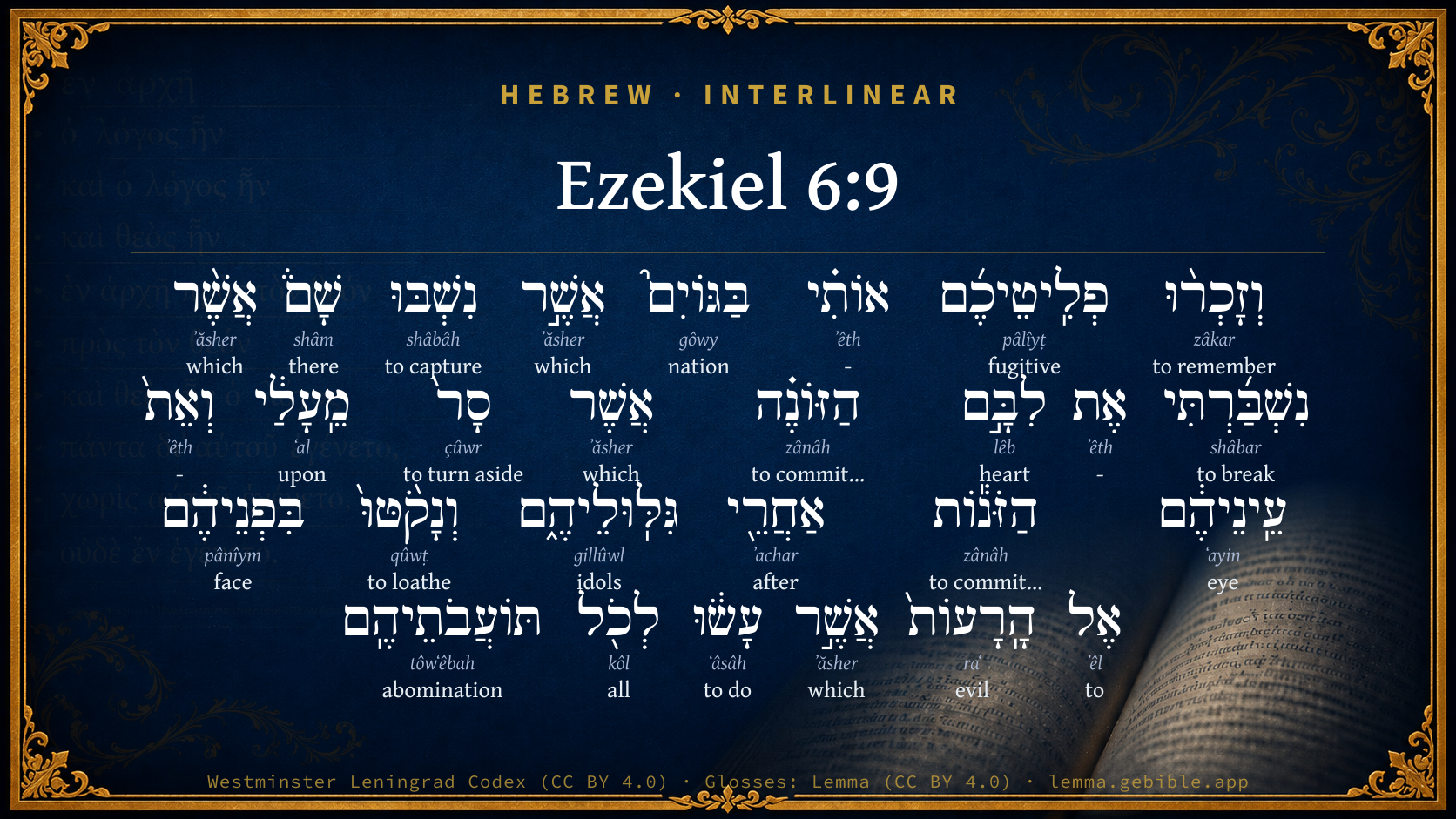
Hebrew (Westminster Leningrad Codex) Ezekiel 6:9 appears in the Hebrew Old Testament. The text above is from the Westminster Leningrad Codex. Each word links to its Strong’s number, a concise gloss, and parsing drawn from the Open Scriptures Hebrew Bible morphology. Click any word for its full Brown-Driver-Briggs (BDB) entry.
Download image
Cite this verse

Ezekiel 6:9 (World English Bible). Public Domain. Lemma interlinear Bible study tool, https://lemma.gebible.app/v/ezekiel/6/9.

Show BibTeX & RIS
BibTeX
RIS
English Translation
Those of you that escape shall remember me among the nations where they shall be carried captive, how that I have been broken with their lewd heart, which has departed from me, and with they eyes, which play the prostitute after their idols: and they shall loathe themselves in their own sight for the evils which they have committed in all their abominations.
World English Bible · Public Domain
Download a study sheet

One document with this verse’s original text, its word-by-word gloss line, the meaning frame, cross-references with their text, attributed commentary, and full source and license credits — printable, and it pastes into notes with its structure intact.

This verse Autodidact and up

Study sheet (.html) Plain text (.txt)

A passage Seminary Student

Up to 50 verses in one chapter. A passage sheet keeps up to 6 commentary sources and 12 cross-references per verse, in the order this page ranks them, and says so on the sheet whenever that leaves anything out. Ask for a single verse and you get the Autodidact verse sheet above.

Everything on this page stays free to read, with no account — the sheet is a download of what is already on screen, not access to it.

Want to remove ads? Support Godless Engineer
Compare translations 3

The same verse in 3 English versions, stacked beneath the original-language interlinear above. Click any original word for its lexicon entry.

Each is an independent rendering of the whole verse — the interlinear is not word-aligned to these translations.

Highlighted words mark where these versions differ — a whole-verse word diff, not a word-by-word alignment.

  • World English Bible Public Domain
    Those of you that escape shall remember me among the nations where they shall be carried captive, how that I have been broken with their lewd heart, which has departed from me, and with they eyes, which play the prostitute after their idols: and they shall loathe themselves in their own sight for the evils which they have committed in all their abominations.
  • King James Version Public Domain
    And they that escape of you shall remember me among the nations whither they shall be carried captives, because I am broken with their whorish heart, which hath departed from me, and with their eyes, which go a whoring after their idols: and they shall lothe themselves for the evils which they have committed in all their abominations.
  • unfoldingWord Literal Text CC BY-SA 4.0
    Then those who escape will think of me among the nations where they will be held captive, that I was grieved by their promiscuous heart that turned away from me, and by their eyes that whored after their idols. Then they will show loathing on their face for the wickedness which they have committed with all their abominations.

unfoldingWord Literal Text — © unfoldingWord, licensed CC BY-SA 4.0. Word-aligned USFM3 via Door43 (git.door43.org/unfoldingWord/en_ult).

Versions to compare (up to 4)

3 of 4 selected

Show all 18 translations

Every available English version of this verse, each an independent rendering of the whole verse.

  • World English Bible Public Domain
    Those of you that escape shall remember me among the nations where they shall be carried captive, how that I have been broken with their lewd heart, which has departed from me, and with they eyes, which play the prostitute after their idols: and they shall loathe themselves in their own sight for the evils which they have committed in all their abominations.
  • Berean Standard Bible Public Domain
    Then in the nations to which they have been carried captive, your survivors will remember Me—how I have been grieved by their adulterous hearts that turned away from Me, and by their eyes that lusted after idols. So they will loathe themselves for the evil they have done and for all their abominations.
  • Majority Standard Bible Public Domain
    Then in the nations to which they have been carried captive, your survivors will remember Me—how I have been grieved by their adulterous hearts that turned away from Me, and by their eyes that lusted after idols. So they will loathe themselves for the evil they have done and for all their abominations.
  • King James Version Public Domain
    And they that escape of you shall remember me among the nations whither they shall be carried captives, because I am broken with their whorish heart, which hath departed from me, and with their eyes, which go a whoring after their idols: and they shall lothe themselves for the evils which they have committed in all their abominations.
  • American Standard Version (1901) Public Domain
    And those of you that escape shall remember me among the nations whither they shall be carried captive, how that I have been broken with their lewd heart, which hath departed from me, and with they eyes, which play the harlot after their idols: and they shall loathe themselves in their own sight for the evils which they have committed in all their abominations.
  • Revised Version (1885) Public Domain
    And they that escape of you shall remember me among the nations whither they shall be carried captives, how that I have been broken with their whorish heart, which hath departed from me, and with their eyes, which go a whoring after their idols: and they shall loathe themselves in their own sight for the evils which they have committed in all their abominations.
  • Geneva Bible (1599) Public Domain
    And they that escape of you, shall remember me among the nations, where they shalbe in captiuitie, because I am grieued for their whorish hearts, which haue departed from mee, and for their eyes, which haue gone a whoring after their idoles, and they shalbe displeased in them selues for the euils, which they haue committed in all their abominations.
  • Douay-Rheims (1899) Public Domain
    And they that are saved of you shall remember me amongst the nations to which they are carried captives: because I have broken their heart that was faithless, and revolted from me: and their eyes that went a fornicating after their idols: and they shall be displeased with themselves because of the evils which they have committed in all their abominations.
  • Young's Literal Translation Public Domain
    And remembered Me have your escaped among nations, Whither they have been taken captive, Because I have been broken with their heart that is going a-whoring, That hath turned aside from off Me, And with their eyes they are going a-whoring after their idols, And they have been loathsome in their own faces, For the evils that they have done -- all their abominations.
  • Literal Standard Version CC BY-SA 4.0
    And your escaped have remembered Me among nations, || To where they have been taken captive, || Because I have been broken with their heart that is going whoring, || That has turned aside from off Me, || And with their eyes they are going whoring after their idols, || And they have been loathsome in their own faces, || For the evils that they have done—all their abominations.
  • Unlocked Literal Bible CC BY-SA 4.0
    Then those who escape will think of me among the nations where they will be held captive, that I was grieved by their promiscuous heart that turned away from me, and by their eyes that whored after their idols. Then they will show loathing on their face for the wickedness which they have committed with all their abominations.
  • unfoldingWord Literal Text CC BY-SA 4.0
    Then those who escape will think of me among the nations where they will be held captive, that I was grieved by their promiscuous heart that turned away from me, and by their eyes that whored after their idols. Then they will show loathing on their face for the wickedness which they have committed with all their abominations.
  • Darby Bible Public Domain
    And they that escape of you shall remember me among the nations whither they have been carried captives, when I shall have broken their whorish heart, which hath departed from me, and their eyes, which go a whoring after their idols; and they shall loathe themselves for the evils which they have committed, in all their abominations.
  • World Messianic Bible Public Domain
    Those of you that escape will remember me among the nations where they are carried captive, how I have been broken with their lewd heart, which has departed from me, and with their eyes, which play the prostitute after their idols. Then they will loathe themselves in their own sight for the evils which they have committed in all their abominations.
  • Webster's Bible Public Domain
    And they that escape of you shall remember me among the nations whither they shall be carried captives, because I am broken with their apostate heart, which hath departed from me, and with their eyes which go astray after their idols: and they shall lothe themselves for the evils which they have committed in all their abominations.
  • Free Bible Version CC BY-SA 4.0
    Once they are there as prisoners in the nations, then the survivors will remember me. They will realize how sad they made me by their spiritual adultery as they deserted me with their eyes full of lust as they worshiped idols. They will hate themselves for the evil things they did, for all their disgusting sins.
  • Bible in Basic English Public Domain
    And those of you who are kept safe will have me in mind among the nations where they have been taken away as prisoners, how I sent punishment on their hearts which were untrue to me, and on their eyes which were turned to their false gods: and they will be full of hate for themselves because of the evil things which they have done in all their disgusting ways.
  • JPS Tanakh (1917) Public Domain
    And they that escape of you shall remember Me among the nations whither they shall be carried captives, how that I have been anguished with their straying heart, which hath departed from Me, and with their eyes, which are gone astray after their idols; and they shall loathe themselves in their own sight for the evils which they have committed in all their abominations.

Literal Standard Version (2020), Covenant Press — licensed CC BY-SA 4.0. Text via the HelloAO Bible API (eBible.org). Unlocked Literal Bible (unfoldingWord) — licensed CC BY-SA 4.0. Text via the HelloAO Bible API (eBible.org). unfoldingWord Literal Text — © unfoldingWord, licensed CC BY-SA 4.0. Word-aligned USFM3 via Door43 (git.door43.org/unfoldingWord/en_ult). Free Bible Version, Dr. Jonathan Gallagher — licensed CC BY-SA 4.0. Text via the HelloAO Bible API (eBible.org).

Word by word

More ways to search: Search by grammar → Find every occurrence → Compare this word →

Practice this passage: Drill this verse → Learn its vocabulary →

וְנָקֹ֨טּוּ֙
qûwṭ
H6962
“and · to loathe”
Conjunction + Verb, Niphal, Sequential Perfect, 3rd Person, Common, Plural
Part of Speech
Conjunction + Verb
Stem
Niphal
Form
Sequential Perfect
Person
3rd Person
Gender
Common
Number
Plural
Full BDB Definition

Origin: a primitive root

TWOT: 1996

to loathe, be grieved, feel a loathing - (Qal) to feel a loathing - (Niphal) - to feel loathing against self - to detest - (Hithpolel) to loathe oneself
  1. וְזָכְר֨וּ zâkar H2142 “and · to remember” Conjunction + Verb, Qal, Sequential Perfect, 3rd Person, Common, Plural
  2. פְלִֽיטֵיכֶ֜ם pâlîyṭ H6412 “fugitives · your” Noun, Common, Masculine, Plural, Construct + Suffix, Personal, 2nd Person, Masculine, Plural
  3. אוֹתִ֗י ʼêth H853 “- · me” Particle, Direct Object + Suffix, Personal, 1st Person, Common, Singular
  4. בַּגּוֹיִם֮ gôwy H1471 “in/at the · nations” Preposition, Determined + Noun, Common, Masculine, Plural, Absolute
  5. אֲשֶׁ֣ר ʼăsher H834 “which” Particle, Relative
  6. נִשְׁבּוּ shâbâh H7617 “to capture” Verb, Niphal, Perfect, 3rd Person, Common, Plural
  7. שָׁם֒ shâm H8033 “there” Adverb
  8. אֲשֶׁ֨ר ʼăsher H834 “which” Particle, Relative
  9. נִשְׁבַּ֜רְתִּי shâbar H7665 “to break” Verb, Niphal, Perfect, 1st Person, Common, Singular
  10. אֶת ʼêth H853 “-” Particle, Direct Object
  11. לִבָּ֣ם lêb H3820 “heart · their” Noun, Common, Masculine, Singular, Construct + Suffix, Personal, 3rd Person, Masculine, Plural
  12. הַזּוֹנֶ֗ה zânâh H2181 “the · committing fornication” Particle, Definite Article + Verb, Qal, Participle Active, Masculine, Singular, Absolute
  13. אֲשֶׁר ʼăsher H834 “which” Particle, Relative
  14. סָר֙ çûwr H5493 “to turn aside” Verb, Qal, Perfect, 3rd Person, Masculine, Singular
  15. מֵֽעָלַ֔י ʻal H5921 “from · upon · me” Preposition + Preposition + Suffix, Personal, 1st Person, Common, Singular
  16. וְאֵת֙ ʼêth H853 “and · -” Conjunction + Particle, Direct Object
  17. עֵֽינֵיהֶ֔ם ʻayin H5869 “eyes · their” Noun, Common, Both, Dual, Construct + Suffix, Personal, 3rd Person, Masculine, Plural
  18. הַזֹּנ֕וֹת zânâh H2181 “the · committing fornication” Particle, Definite Article + Verb, Qal, Participle Active, Feminine, Plural, Absolute
  19. אַחֲרֵ֖י ʼachar H310 “after” Preposition
  20. גִּלּֽוּלֵיהֶ֑ם gillûwl H1544 “idols · their” Noun, Common, Masculine, Plural, Construct + Suffix, Personal, 3rd Person, Masculine, Plural
  21. בִּפְנֵיהֶ֔ם pânîym H6440 “in/at · face(s) · their” Preposition + Noun, Common, Both, Plural, Construct + Suffix, Personal, 3rd Person, Masculine, Plural
  22. אֶל ʼêl H413 “to” Preposition
  23. הָֽרָעוֹת֙ raʻ H7451 “the · evils” Particle, Definite Article + Noun, Common, Feminine, Plural, Absolute
  24. אֲשֶׁ֣ר ʼăsher H834 “which” Particle, Relative
  25. עָשׂ֔וּ ʻâsâh H6213 “to do” Verb, Qal, Perfect, 3rd Person, Common, Plural
  26. לְכֹ֖ל kôl H3605 “to/for · all of” Preposition + Noun, Common, Masculine, Singular, Construct
  27. תּוֹעֲבֹתֵיהֶֽם tôwʻêbah H8441 “abominations · their” Noun, Common, Feminine, Plural, Construct + Suffix, Personal, 3rd Person, Masculine, Plural

About this verse

These counts appear in no published source. They are computed here, from the morphology-tagged text and Lemma’s own curated glosses. What Lemma adds →

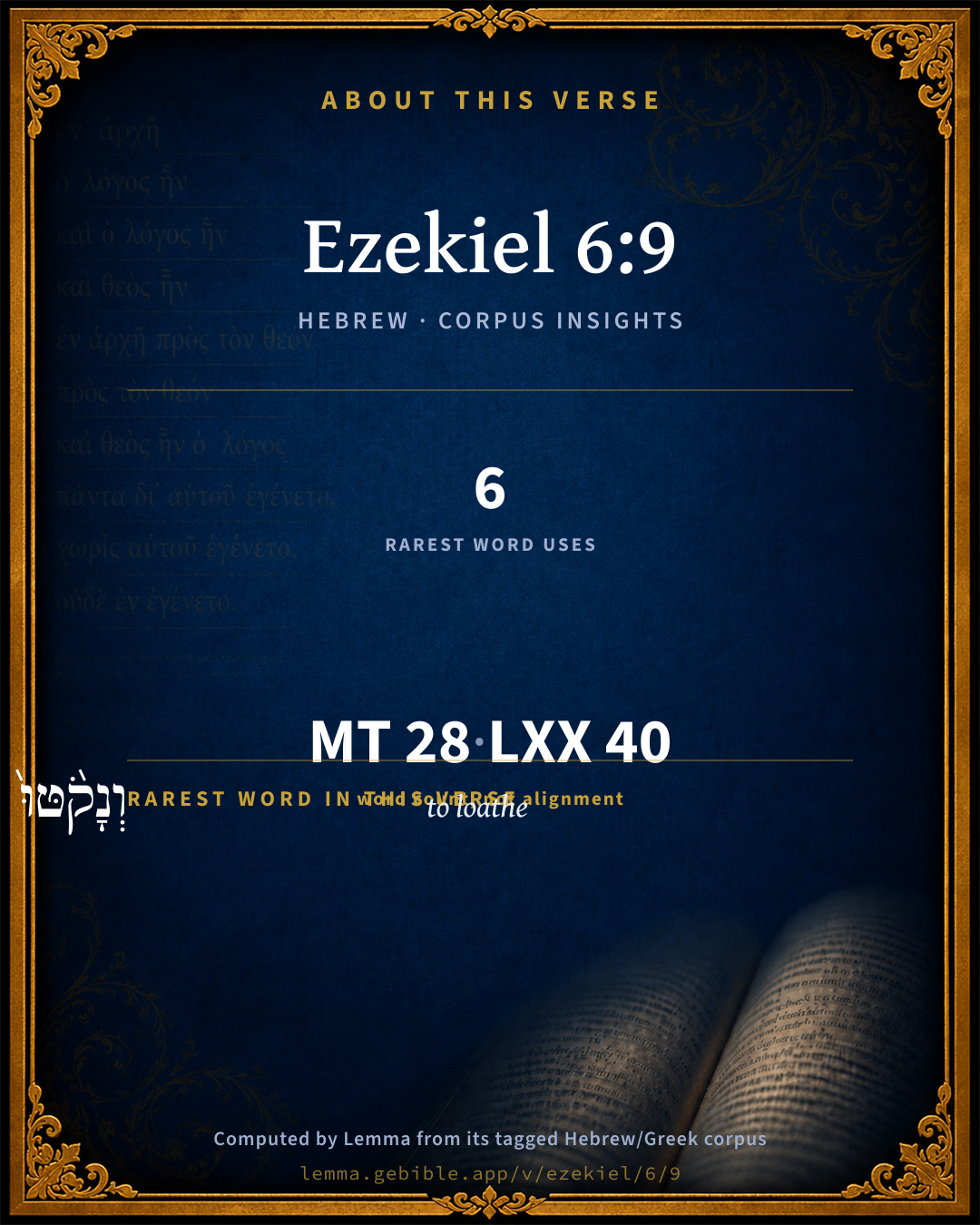
28
words
22
distinct lemmas
Prophets
section

Notable vocabulary

The rarest word here is וְנָקֹ֨טּוּ֙ to loathe H6962 — appearing just 6 times in the whole Hebrew Bible.

Shared distinctive vocabulary

וְנָקֹ֨טּוּ֙ to loathe H6962 occurs in 6 verses of the Hebrew Bible. Also found in:

Grammatical profile

  • 8 verbs
  • 9 nouns
  • 3 prepositions
  • 1 adverb
  • 7 particles

Verb forms

  • וְזָכְר֨וּ Qal · Sequential Perfect
  • נִשְׁבּוּ Niphal · Perfect
  • נִשְׁבַּ֜רְתִּי Niphal · Perfect
  • הַזּוֹנֶ֗ה Qal · Participle Active
  • סָר֙ Qal · Perfect
  • הַזֹּנ֕וֹת Qal · Participle Active
  • וְנָקֹ֨טּוּ֙ Niphal · Sequential Perfect
  • עָשׂ֔וּ Qal · Perfect

Repetition

Words recur within this verse — often emphatic in Hebrew:

  • הַזּוֹנֶ֗ה to commit fornication H2181 ×2
  • אֲשֶׁ֣ר which H834 ×4

Hebrew & Septuagint length

In English translation the verse runs 63 words from the Hebrew and 49 from the Septuagint (LXX English) — closely comparable.

A rough comparison of the two English renderings, which tokenize alike — not a word-level alignment.

Word counts can differ between the Hebrew and the Greek without any difference in meaning — e.g. the Hebrew direct-object marker אֵת has no separate Greek word, and Greek often adds the article ὁ.

In the original languages it is 28 Hebrew tokens and 40 Greek tokens — but the two are counted differently (Hebrew bundles its prefixes and suffixes into one token; the Greek is in lemma form), so that isn’t a like-for-like length.

Cross-references

32

Topical passages linked to Ezekiel 6:9 in the Treasury of Scripture Knowledge — connected by theme and wording, ordered by reader-vote popularity; previews shown in the World English Bible.

  • Ezekiel 20:43 There shall you remember your ways, and all your doings, in which you have polluted yourselves; and you shall loathe yourselves in your own sight for all your evils that you have committed.
  • Isaiah 7:13 He said, "Listen now, house of David: Is it not enough for you to try the patience of men, that you will try the patience of my God also?
  • Job 42:6 Therefore I abhor myself, And repent in dust and ashes."
  • Psalms 78:40 How often they rebelled against him in the wilderness, And grieved him in the desert!
  • Isaiah 43:24 You have bought me no sweet cane with money, neither have you filled me with the fat of your sacrifices; but you have burdened me with your sins, you have wearied me with your iniquities.
  • Deuteronomy 4:29–31 But from there you shall seek Yahweh your God, and you shall find him, when you search after him with all your heart and with all your soul.
  • Ezekiel 20:7 I said to them, Cast you away every man the abominations of his eyes, and don't defile yourselves with the idols of Egypt; I am Yahweh your God.
  • Zechariah 10:9 I will sow them among the peoples; And they will remember me in far countries; And they will live with their children, and will return.
  • Jeremiah 51:50 You who have escaped the sword, go you, don't stand still; remember Yahweh from afar, and let Jerusalem come into your mind.
  • Ezekiel 20:24 because they had not executed my ordinances, but had rejected my statutes, and had profaned my Sabbaths, and their eyes were after their fathers' idols.
  • Ezekiel 36:31–32 Then shall you remember your evil ways, and your doings that were not good; and you shall loathe yourselves in your own sight for your iniquities and for your abominations.
  • Ezekiel 16:43 Because you have not remembered the days of your youth, but have raged against me in all these things; therefore, behold, I also will bring your way on your head, says the Lord Yahweh: and you shall not commit this lewdness with all your abominations.
  • Ezekiel 23:14–16 She increased her prostitution; for she saw men portrayed on the wall, the images of the Chaldeans portrayed with vermilion,
  • 2 Peter 2:14 having eyes full of adultery, and who can't cease from sin; enticing unsettled souls; having a heart trained in greed; children of cursing;
  • Ezekiel 16:63 that you may remember, and be confounded, and never open your mouth any more, because of your shame, when I have forgiven you all that you have done, says the Lord Yahweh.
  • Ezekiel 20:28 For when I had brought them into the land, which I swore to give to them, then they saw every high hill, and every thick tree, and they offered there their sacrifices, and there they presented the provocation of their offering; there also they made their sweet savor, and they poured out there their drink-offerings.
  • Numbers 15:39 and it shall be to you for a fringe, that you may look on it, and remember all the commandments of Yahweh, and do them; and that you not follow after your own heart and your own eyes, after which you use to play the prostitute;
  • Ezekiel 5:13 Thus shall my anger be accomplished, and I will cause my wrath toward them to rest, and I shall be comforted; and they shall know that I, Yahweh, have spoken in my zeal, when I have accomplished my wrath on them.
  • Ezekiel 14:4–7 Therefore speak to them, and tell them, Thus says the Lord Yahweh: Every man of the house of Israel who takes his idols into his heart, and puts the stumbling block of his iniquity before his face, and comes to the prophet; I Yahweh will answer him therein according to the multitude of his idols;
  • Amos 2:13 Behold, I will crush you in your place, As a cart crushes that is full of grain.
  • Leviticus 26:39–41 Those of you who are left will pine away in their iniquity in your enemies' lands; and also in the iniquities of their fathers shall they pine away with them.
  • Deuteronomy 30:1–3 It shall happen, when all these things are come on you, the blessing and the curse, which I have set before you, and you shall call them to mind among all the nations, where Yahweh your God has driven you,
  • 2 Kings 16:10 King Ahaz went to Damascus to meet Tiglath Pileser king of Assyria, and saw the altar that was at Damascus; and king Ahaz sent to Urijah the priest the fashion of the altar, and the pattern of it, according to all the workmanship of it.
  • Psalms 137:1 By the rivers of Babylon, there we sat down. Yes, we wept, when we remembered Zion.
  • Isaiah 63:10 But they rebelled, and grieved his holy Spirit: therefore he was turned to be their enemy, [and] himself fought against them.
  • Isaiah 64:6 For we are all become as one who is unclean, and all our righteousness are as a polluted garment: and we all do fade as a leaf; and our iniquities, like the wind, take us away.
  • Jeremiah 3:6 Moreover Yahweh said to me in the days of Josiah the king, Have you seen that which backsliding Israel has done? she is gone up on every high mountain and under every green tree, and there has played the prostitute.
  • Jeremiah 3:13 Only acknowledge your iniquity, that you have transgressed against Yahweh your God, and have scattered your ways to the strangers under every green tree, and you have not obeyed my voice, says Yahweh.
  • Jeremiah 30:18–19 Thus says Yahweh: Behold, I will turn again the captivity of Jacob's tents, and have compassion on his dwelling-places; and the city shall be built on its own hill, and the palace shall be inhabited after its own manner.
  • Ezekiel 7:16 But those of those who escape shall escape, and shall be on the mountains like doves of the valleys, all of them moaning, every one in his iniquity.
  • Ezekiel 12:16 But I will leave a few men of them from the sword, from the famine, and from the pestilence; that they may declare all their abominations among the nations where they come; and they shall know that I am Yahweh.
  • Daniel 9:2–3 in the first year of his reign I, Daniel, understood by the books the number of the years about which the word of Yahweh came to Jeremiah the prophet, for the accomplishing of the desolations of Jerusalem, even seventy years.

Cross-references courtesy of OpenBible.info (CC BY 4.0).

Hebrew and Greek witnesses Masoretic Hebrew ↔ Greek Septuagint

The same verse in the two great witnesses to the Old Testament, shown verse-for-verse.

These are two independent witnesses, not word-aligned to each other, and the Septuagint is shown in lemma (dictionary) form.

Hebrew Ezekiel 6:9 Masoretic · Westminster Leningrad Codex

וְזָכְר֨וּ פְלִֽיטֵיכֶ֜ם אוֹתִ֗י בַּגּוֹיִם֮ אֲשֶׁ֣ר נִשְׁבּוּ שָׁם֒ אֲשֶׁ֨ר נִשְׁבַּ֜רְתִּי אֶת לִבָּ֣ם הַזּוֹנֶ֗ה אֲשֶׁר סָר֙ מֵֽעָלַ֔י וְאֵת֙ עֵֽינֵיהֶ֔ם הַזֹּנ֕וֹת אַחֲרֵ֖י גִּלּֽוּלֵיהֶ֑ם וְנָקֹ֨טּוּ֙ בִּפְנֵיהֶ֔ם אֶל הָֽרָעוֹת֙ אֲשֶׁ֣ר עָשׂ֔וּ לְכֹ֖ל תּוֹעֲבֹתֵיהֶֽם

Those of you that escape shall remember me among the nations where they shall be carried captive, how that I have been broken with their lewd heart, which has departed from me, and with they eyes, which play the prostitute after their idols: and they shall loathe themselves in their own sight for the evils which they have committed in all their abominations.

World English Bible · Public Domain

Greek LXX Ezekiel 6:9 Septuagint · lemma form

καί μιμνήσκω ἐγώ ὁ ἀνασώζω ἐκ σύ ἐν ὁ ἔθνος ὅς αἰχμαλωτεύω ἐκεῖ ὄμνυμι ὁ καρδία αὐτός ὁ ἐκπορνεύω ἀπό ἐγώ καί ὁ ὀφθαλμός αὐτός ὁ πορνεύω ὀπίσω ὁ ἐπιτήδευμα αὐτός καί κόπτω πρόσωπον αὐτός ἐν πᾶς ὁ βδέλυγμα αὐτός

then they of you that escape among the nations whither they were carried captive shall remember me; (I have sworn an oath against their heart that goes a-whoring from me, and their eyes that go a-whoring after their practices;) and they shall mourn over themselves for all their abominations.

LXX2012 (modern English Septuagint) · Public Domain

Hebrew: Westminster Leningrad Codex (CC BY 4.0). Greek: Septuagint (public domain); English from LXX2012 (modern English Septuagint) (Public Domain). How the Septuagint differs from the Hebrew →

Targum (Aramaic paraphrase)

1

The Targum is the ancient Jewish Aramaic paraphrase of the Hebrew Scriptures — an interpretive translation, not the Hebrew text itself. Onkelos (literal) and Pseudo-Jonathan (expansive) render the Torah, and Jonathan the Prophets. Coverage is partial: where no permissively-licensed English translation exists for a verse, only the Aramaic is shown. This is verse-level text, not a word-by-word alignment to the Hebrew.

  1. Targum Jonathan Prophets (Joshua–Malachi)
    וְיִדְכְּרוּן מְשֵׁיזְבֵיכוֹן דְחַלְתִּי בֵּינֵי עַמְמַיָא דְאִשְׁתְּבִיאוּ לְתַמָן דִתְבַרֵית יַת לִבְּהוֹן טִפְּשָׁא דִסְטָא מִבָּתַר פּוּלְחָנִי וְיַת חֵיזוּ עֵינֵיהוֹן דִטְעָא בָּתַר טַעֲוַתְהוֹן וְיִדַנְקוּן וִיהוֹן חָזַן עַל בִּישְׁתָּא דַעֲבַדוּ לְכָל תּוֹעֲבַתְהוֹן:

    (no public-domain English translation for this verse)

    Targum Jonathan — Aramaic: “Mikraot Gedolot” (public domain). English: “Sefaria Community Translation” (CC0 1.0 (public-domain dedication)); “London "Chaldee Paraphrase," 1871” (public domain). Text via Sefaria.

Commentary

Notes on Ezekiel 6:9 from classic Christian and Jewish commentators (each source and its license shown beneath its notes). The classic Christian expositions comment on the surrounding passage and are grouped to its opening verse, so a note may address several verses; the Jewish commentaries on the Tanakh (Rashi and others) are per-verse, so they appear only where the commentator wrote on this verse.

Lemma curates 59 commentaries, every one of them public domain or Creative Commons licensed, each selected and text-cleaned for this edition rather than reprinted as found. About our sources →

Trapp's Complete Commentary

John Trapp

Eze 6:9 And they that escape of you shall remember me among the nations whither they shall be carried captives, because I am broken with their whorish heart, which hath departed from me, and with their eyes, which go a whoring after their idols: and they shall lothe themselves for the evils which they have committed in all their abominations.

Ver. 9. And they that escape of you shall remember me.] Here beginneth that true repentance never to be repented of. {Psa 22:27; Psa 20:7}

Because I am broken off from their whorish heart,] i.e., I am troubled, saith Piscator. I am tired out, saith Zegedine, and made to break off the course of my kindness. I am broken off from their whorish heart - so Polanus rendereth it; that is, saith he, I leave them, though loath to do it: the breach is merely on their part; for they have an impetus, a spirit of whoredoms in them, that causeth them to err, and go whoring from under their God. {Hos 4:12; Hos 9:1}

And with their eyes.] Those windows of wickedness through which the devil (who is ειδωλοχαρης, as saith Synesius) doth oft wind himself into the soul.

And they shall loathe themselves.] {a} They shall displease themselves, saith the Vulgate; but that is not enough. Pudefient in faciebus suis, say others. They shall bleed inwardly, and blush outwardly, deeply detesting their former abominations, and not waiting till others condemn them, they shall condemn themselves.

{a} κοψονται. - Sept.

John Trapp, A Commentary or Exposition upon All the Books of the Old and New Testament (1647–1656) — public domain. Text from a community e-Sword module.

The Biblical Illustrator

Joseph S. Exell

Eze_6:9

They shall loathe themselves.

Self-loathing after sin

We never realise what sin is till its passion is over, and we have time quietly to remember. Oh, the terror of those hours of remembrance and remorse! Sitting in the captivity of its prison, or serving in the heavy bondage of its fetters, the soul has time to review the bitter path by which it has come to such a pass, and the way it has broken the hearts of those who loved and trusted. But the most terrible element in remorse will be the personal one: Shall remember Me. One of our great writers depicts a heartless, thoughtless husband standing beside the newly covered-in grave of his wife, and saying, Ah, Milly, Milly; dost thou hear me? I was not tender enough to thee; but it is too late to alter it now. The child who has given way to fits of ungovernable passion, which have broken up the home, and brought down grey hairs with sorrow to the grave, will loathe itself. Similarly, as we review our past life, and see how we must have grieved the tender Spirit of God, we fall at the feet of Jesus and cover them with tears and kisses. (F. B. Meyer, B. A.)

.

Eze_6:9

And ye shall know that I am the Lord that smiteth.

Gods hand in judgment

You look at second causes, and think it is Nebuchadnezzar that smites you, but you shall be made to know he is but the staff; it is the hand of the Lord that smiteth you, and who knows the weight of His hand? (M. Henry.)

The Biblical Illustrator, edited by Joseph S. Exell (c. 1880s–1900s) — public domain. Text from a community e-Sword module.

Geneva Bible (1599)

Geneva Bible translators

They shall be ashamed to see that their hope in idols was but vain, and so shall repent.

Geneva Bible (1599) marginal notes — public domain. Text via Bolls.life.

Jamieson, Fausset & Brown

Robert Jamieson, A. R. Fausset & David Brown

they that escape of you shall remember me--The object of God's chastisements shall at last be effected by working in them true contrition. This partially took place in the complete eradication of idolatry from the Jews ever since the Babylonian captivity. But they have yet to repent of their crowning sin, the crucifixion of Messiah; their full repentance is therefore future, after the ordeal of trials for many centuries, ending with that foretold in Zac 10:9; Zac 13:8-9; Zac 14:1-4, Zac 14:11. "They shall remember me in far countries" (Eze 7:16; Deu 30:1-8).

I am broken with their whorish heart--FAIRBAIRN translates, actively, "I will break" their whorish heart; English Version is better. In their exile they shall remember how long I bore with them, but was at last compelled to punish, after I was "broken" (My long-suffering wearied out) by their desperate (Num 15:39) spiritual whorishness [CALVIN], (Psa 78:40; Isa 7:13; Isa 43:24; Isa 63:10).

loathe themselves-- (Lev 26:39-45; Job 42:6). They shall not wait for men to condemn them but shall condemn themselves (Eze 20:43; Eze 36:31; Job 42:6; Co1 11:31).

Jamieson, Fausset & Brown — Commentary Critical and Explanatory on the Whole Bible (1871) — public domain (CC PDM 1.0). Text via the HelloAO Bible API.

Adam Clarke's Commentary

Verse 9. They that escape of you shall remember me] Those that escape the sword, the pestilence, and the famine, and shall be led into captivity, shall plainly see that it is God who has done this, and shall humble themselves on account of their abominations, leave their idolatry, and worship me alone. And this they have done from the Babylonish captivity to the present day.

Adam Clarke's Commentary on the Bible (1810–1826) — public domain. Text from a community e-Sword/MySword module.

John Calvin's Commentaries

I see that I cannot finish, and I think the time is advancing.

John Calvin's Commentaries (1540-1563) — public domain. Text from the Calvin Translation Society English edition (1840s-50s) via the Christian Classics Ethereal Library (ccel.org). Calvin's coverage is partial (roughly two-thirds of the Bible); uncommented books and verses are honest gaps, never fabricated. The 19th-century editor's footnotes and remarks are omitted so the notes are faithfully Calvin's own voice.

Ellicott's Commentary for English Readers

(9) Because I am broken.—The verb in the Hebrew is passive in form, but it is better to take it, with most modern commentators, as a middle, in a transitive sense, “Because I have broken their whorish heart . . . and their eyes,” the eyes being mentioned as the means by which their hearts had been enticed to evil. Here, as constantly in all parts of Scripture, apostacy from God is described under the figure of unfaithfulness in the marriage relation. “They shall loathe themselves” indicates a true repentance; they shall loathe the sin and themselves for having committed it. Thus their sin has drawn down punishment; punishment has destroyed many, but brought a “remnant” to repentance; and repentance leads to a true knowledge of God, and communion with Him. The Divine word and act has not been “in vain.”

A Bible Commentary for English Readers, edited by Charles John Ellicott (1878–1897) — public domain. Text from a community e-Sword module.

The Cambridge Bible for Schools and Colleges

gen. ed. J. J. S. Perowne

9. because I am broken] R.V. how that I have been broken with their whorish heart. Such a sense as “been broken with” is altogether impossible; and the middle sense “break for myself” is equally to be rejected. The natural sense is: they shall remember (think of) me … when I have broken. Their idolatrous heart shall be broken with their calamities, and then shall they return unto the Lord; Hos_2:7, “I will return unto my first husband, for then was it better with me than now.” The present reading has probably arisen from the similar word “carried captive” being in the copyist’s mind.

and with their eyes] Read: when I have broken their whorish heart … and their eyes. The harshness of the zeugma, “and their eyes,” is relieved by the distance from “break” and the metaphorical nature of the expression. Cf. the phrase “lifted up his eyes towards the idols,” ch. Eze_18:6; Eze_18:12; Eze_18:15, Eze_20:24, Eze_33:25.

lothe themselves] Lit. their faces; a use of “face” for self, not uncommon in the later language, ch. Eze_20:43, Eze_36:31; Job_23:17.

The Cambridge Bible for Schools and Colleges (gen. ed. J. J. S. Perowne; Cambridge University Press, 1878–1918) — public domain. Text from a community e-Sword module.

John Gill's Exposition

And they shall know that I am the Lord,.... As in Eze 6:7;

and that I have not said in vain; either within himself, in his own purposes and decrees; so the Targum,

"I have not in vain decreed in my word;''

or by the mouth of the prophets:

that I would do this evil unto them; in carrying them captive, and dispersing them in other lands; for this is not the evil of sin, but the evil of punishment, or of affliction.

John Gill's Exposition of the Whole Bible (1746–1763) — public domain (CC PDM 1.0). Text via the HelloAO Bible API.

Albert Barnes' Notes on the Bible

I am broken ... - Translate: “because” I have broken “their whorish heart, which hath departed from me,” and their eyes etc. Since Ezekiel is addressing the Church of God through Israel, we are to note here that the general principle of the divine administration is laid down. Sin leads to judgment, judgment to repentance, repentance to forgiveness, forgiveness to reconciliation, reconciliation to a knowledge of communion with God.

Albert Barnes' Notes on the Bible (1834–1885) — public domain. Text from a community e-Sword/MySword module.

Haydock's Catholic Bible Commentary

Broken. Adversity has made them repent.

George Leo Haydock (1774–1849), Haydock's Catholic Family Bible and Commentary, 1859 edition — public domain. Excludes Psalms (Douay-Rheims chapter numbering differs from Protestant) and Deuterocanonical books (Catholic canon only).

Matthew Poole's English Annotations

They that escape; some of them, not every one of them, for several of the escaped did not bethink themselves, as appears, Jer 47; 48; 49;.

Shall remember me; my precepts which they violated, my mercies which they abused, my threats which they despised, my promises which they refused, my prophets whom they persecuted, my judgments which have executed; and shall consider and return, and seek me in their affliction.

Among the nations: in their own land they forgot and sinned, in a strange land they shall remember and weep; so the remnant is bettered by afflictions. At liberty they were captives to sin and idols; when in captivity they shall shake off that bondage, and become my servants.

Because I am broken, & c. Here we meet very different reading. The Chaldee paraphrase and Syriac version read it actively, so does the Latin Vulgate, because, or when, I have broken, &c.; and if this vary from the grammatical construction, yet it carrieth very good sense, and agreeable to the foregoing words. Their whorish hearts would still have forgotten God, if he had not broken their hearts with judgments; but they remembered when broken, and this breaking was the occasion or cause of their remembering God. Others read this passively, as our version, and as the Hebrew form most usually beareth, I am broken. It is an allusion to a misused husband whom a treacherous wife hath broken; either,

1. His peace and content.

2. His love and tenderness.

3. His patience and forbearance.

4. His purposes.

5. His offers and promises. So that, as overcome with grief and anger, he doth, contrary to his natural disposition, lay aside his courting her love, and in his jealousy takes revenge, and then she bethinks herself. So here.

Their whorish heart; their heart of whoredom, i.e. idolatrous heart, which was full of that sin, addicted to it, delighted in it, and wedded to it.

Hath departed from me: idolatrous hearts do actually depart from God, as an adulterous wife actually departs from her husband.

With their eyes: as it vexeth a husband to see his wife fixing her eyes with delight on the adulterer, and turning them with scorn from him, as this breaks the husband’s patience; so in this case, Israel’s eyes were to idols, and delighted in them, expected help from them, were ready to serve them; all which broke their Husband’s, i.e. God’s, patience, and provoked his severe revenges.

Loathe themselves; with a mixture of grief towards God offended, of indignation against themselves offending, of abhorrence of the offence, and shame before all for it, shall they show their repentance.

For the evils; wickednesses, or, as Psa 32:5,

iniquities of sin; the deepest and darkest part of sin, the complicated evils that were in each act.

In all their abominations: it is a hypocrite’s repentance which is but for some; this of the reserved remnant shall be sound, it is for all abominations, for all kinds of their abominations.

Matthew Poole's English Annotations on the Holy Bible (1683–1685) — public domain. Text from a community e-Sword/MySword module.

Whedon's Commentary on the Bible

Daniel D. Whedon

9. “And they… shall remember me… when I have broken for myself their whorish heart.” — Havernick and Keil. This seems a better reading than that of the R.V., “I have been broken.” Israel went into Babylonian captivity a nation prone to fall constantly into idolatry. It came out of that fiery furnace a purified people with the whorish heart broken and every polytheistic tendency burned out of it. Up to this point their whole history had been a series of national or tribal apostasies from the true God; from this point onward there is not a single instance of this. From the time of this awful punishment down to the present, the whole nation has heartily sung, in every age: —

Thou art One, the first great cause of all;

Thou art One, and none can penetrate,

Not even the wise in heart, the mystery

Of thy unfathomable unity,

Thou art One, the infinitely great.

— Ibn Gebirol.

Their eyes — “The eyes that hung wantonly on their idols.” — Kautzsch. “Ears and hearts were both involved in the sin (Eze_20:7-8; Eze_20:24; Num_15:39), and both came under the same chastisement that was to lead them to repentance.” — Plumptre.

Loathe themselves — Literally, loathe their own faces. (Compare Eze_20:43; Eze_36:31.)

Daniel D. Whedon (gen. ed.), Commentary on the Old and New Testaments (1874–1909) — public domain. Text from a community e-Sword module.

The Pulpit Commentary

Because I am broken with their whorish heart. The words have been very differently rendered.

(1) The Revised Version mainly follows the Authorized Version, but gives, they shall remember how I have been broken, etc. So taken, the words are boldly anthropomorphic, and ascribe to Jehovah the word which implies the strongest form of human distress. The "whorish heart" of the people has made Jehovah himself "broken-hearted.

(2) Most recent critics, however, follow the rendering of the Vulgate (contrivi), and take the verb, which is passive in form, as being like a Greek verb in the middle voice, transitive in form, with an implied reflex force. So we get, as in the margin of the Revised Version, "I have broken their whorish heart." So taken, thought and words are both connected with Psa_51:17, and the self-loathing that follows has its counterpart in Job_42:6. The thought is eminently characteristic of Ezekiel, (Eze_20:43 Eze_36:31) and, we may add also, of Leviticus. (Lev_26:39-42)

Self-loathing.

This very strong and very remarkable assertion concerning the remnant of Israel that should be spared amid the destruction and desolation about to overtake the nation and its metropolis, is a proof to every thoughtful reader that the mind of the prophet was occupied not so much with the external and political aspects of history as with the moral. In his view supreme importance is attached to the result of experience upon character. So regarded, calamity may be "blessing in disguise." If the chastisement of God awakens repentance and self-loathing, one purpose at all events, and that a most important purpose, has been answered.

I SELF-LOATHING IS IN CONTRAST WITH FORMER SELFSATISFACTION AND SELF-COMPLACENCY. It is not natural to men to loathe themselves, however they may be tempted to loathe their fellow men, where there has been infliction of injury or want of sympathy and congeniality. It is too common for men to look at their own character and their own conduct in the most favourable and flattering light; and to speak, or at all events to think, of themselves with approval and admiration. In most cases a great change must come over a man"s mind in order that he may regard his character and his life with dissatisfaction, in order that he may hate himself.

II SELF-LOATHING IS AN INDICATION OF SELF-KNOWLEDGE. Those who admire and approve themselves are, in many instances, if not in all, the victims of illusion. It is a rude, and yet it may be a wholesome, awakening, which sets a man face to face with his true self. His fancied excellences and virtues are seen to be faults. The blemishes which he has been accustomed to extenuate appear in their real deformity. He wonders how he could have misinterpreted his actions and misunderstood his character. He learns to know himself, not as he has imagined himself to be but as he really is.

III SELF-LOATHING HAS ABUNDANT JUSTIFICATION IN THE ERRORS AND FOLLIES OF THE PAST. When a man sees himself, in some measure, as God sees him to be, then trivial faults as they were once deemed become, in his apprehension serious and culpable. Sin is the abominable thing which God hates; and it is an evidence of true enlightenment when a man loathes his own offences against the laws of God and the dictates of his own conscience. The unspiritual detest deformities of body, defects of manner or of speech; the spiritually minded are more distressed at what is morally evil than at anything of a more external character.

IV SELF-LOATHING MAY LEAD TO TRUE REPENTANCE, AND SO TO FORGIVENESS AND ACCEPTANCE. To remain in a state of mind in which repugnance to evil absorbs the whole nature is to be abandoned to despondency. Sin is to be loathed in order that it may be forsaken; and that it may be forsaken it must be forgiven. The Scriptures abound in denunciations of sin, but they abound also in invitations to repentance and in promises of forgiveness. "Let the wicked forsake his way," etc. Reconciliation and purity are by the gospel assured to every penitent and believing sinner.

V THUS SELF-LOATHING MAY BE A MEANS TOWARDS THE REMOVAL OF WHAT OCCASIONED IT, AND OF THE SUBSTITUTION OF WHAT CAN BE REGARDED WITH THANKFULNESS AND DELIGHT. It may be said thus to work its own cure. Or, more properly, it may induce the repenting sinner to apply to the great Physician, by whose remedial treatment the unsoundness may be removed, and spiritual health, vigour, and happiness may be restored. T.

The Pulpit Commentary (1880–1919), ed. H.D.M. Spence-Jones & Joseph S. Exell — public domain. Text from a community e-Sword module.

John Wesley's Explanatory Notes

Shall remember - So as to turn unto me. Broken - I am much grieved. Whorish heart - Idolatrous hearts depart from God, as an adulterous wife departs from her husband. Loath - With a mixture of grief towards God, of indignation against themselves, and abhorrence of the offense.

John Wesley, Explanatory Notes Upon the Whole Bible (1754–1765) — public domain. Text via the GEBible commentary corpus.

Rashi

Rabbi Shlomo Yitzchaki (Rashi)

And those of you that escape will remember Me My kindnesses and My compassion, that I had compassion on them when they committed iniquities before Me in their land.

that I yielded to their straying heart That I yielded to them. Although their heart went astray and they turned away from Me, I begged of them, through My prophets, to return to Me, and [promised] that I will [then] do good for them, but they were unwilling.

and they will quarrel with themselves Heb. וְנָקֹטוּ. Menachem associated it with (Ps. 119:158): “I saw traitors, and I quarreled (וָאֶתְקוֹטָטָה).” They will quarrel with themselves for not listening to Me. Jonathan renders: וְידַנְקוּן and they will see, and so does he translate (below 9:4): “those who groan (הַנֶאֶנָקִים),” דְּמִדַנְקִין, and (Mal. 2:13): “weeping...and groaning (וַאֲנָקָה),” דְּמִדַנְקָן, demonir in Old French, to groan.

Rashi on the Tanakh — English translations: “The Judaica Press complete Tanach with Rashi, translated by A. J. Rosenberg” (CC BY 4.0); “Pentateuch with Rashi's commentary by M. Rosenbaum and A.M. Silbermann, 1929-1934” (public domain); “The Metsudah Tanach series, Lakewood, N.J” (CC BY 4.0); and “The Book of Joshua, Metsudah Publications, 1997” (CC BY 4.0). Text via Sefaria.

Lesson kit

Teaching starters — assembled from the data on this page, not authored interpretation. Every prompt links to the verse data it draws on. Edit before teaching.

Ezekiel, in the Prophets, opens this verse with 28 words (22 distinct Hebrew lemmas). Its most distinctive word is qûwṭ (“to loathe”). A historical commentator’s framing appears above. Read the whole chapter for the surrounding context.

Discussion questions

  1. How does “to loathe” (qûwṭ) shape what this verse is saying?
  2. Psalms 95:10 shares the word «to loathe» with this verse. How do the two illuminate each other?
  3. “to commit fornication” occurs 2× in this one verse. What is the effect of the repetition?
  4. The translations on this page render this verse differently — a whole-verse word diff, not a word-by-word alignment. What might account for the different wordings?
  5. The verb «וְזָכְר֨וּ» is Qal Sequential Perfect. How does its form color the action?
  6. Reading how Trapp's Complete Commentary and The Biblical Illustrator read this verse, where do the two commentators agree and where do they part?

Things to notice

Reading settings

Reading text

Shown beneath each verse's original-language words.

Old Testament
Old Testament edition

Read the OT as the Masoretic Hebrew (MT) or the Greek Septuagint (LXX).

English shown for the Greek Septuagint (in the Hebrew ↔ Greek comparison).

Comparing translations? Open the Compare panel on any verse page to stack up to four side by side.