
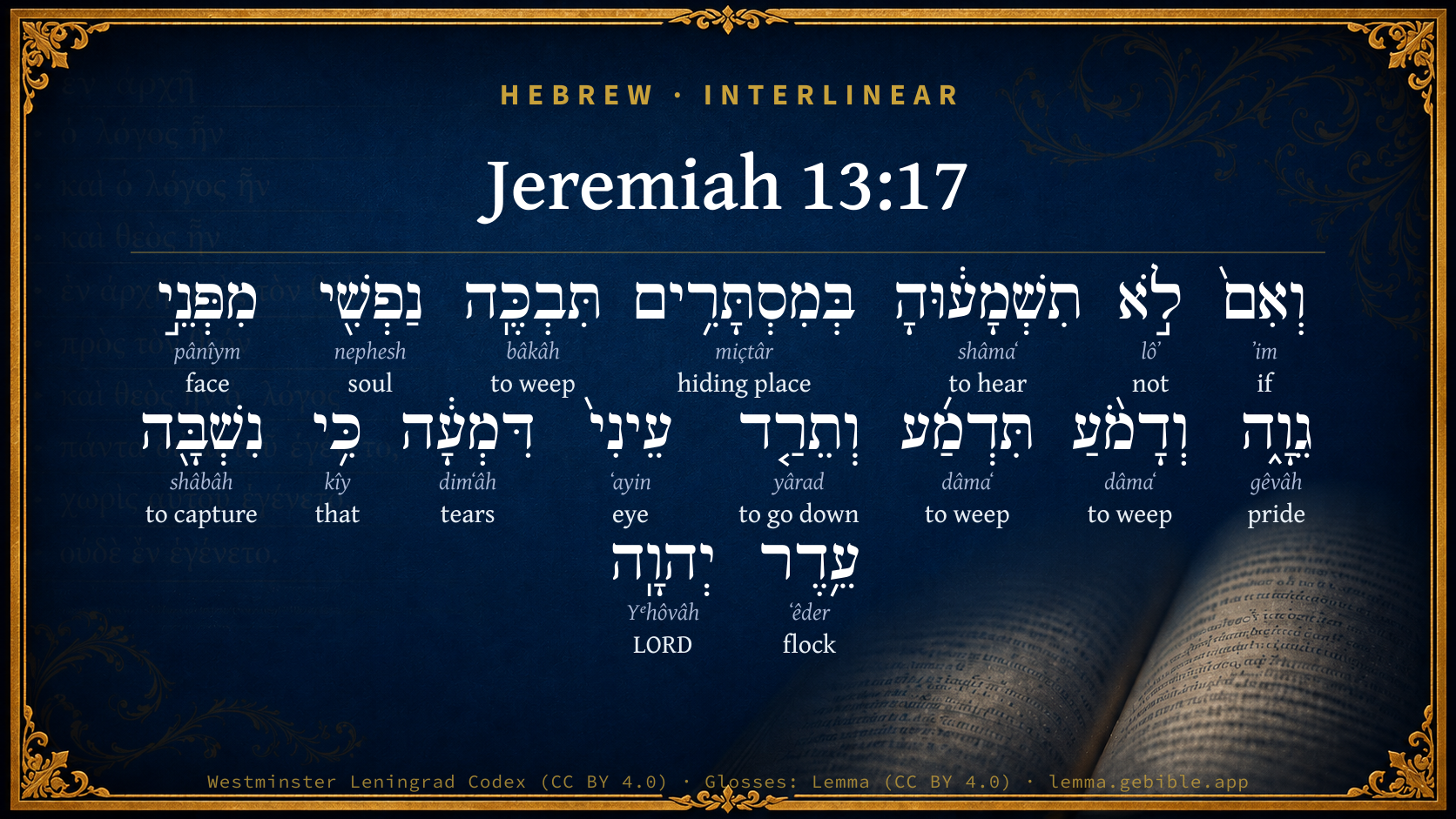
Jeremiah 13:17

Hebrew (Westminster Leningrad Codex) Jeremiah 13:17 appears in the Hebrew Old Testament. The text above is from the Westminster Leningrad Codex. Each word links to its Strong’s number, a concise gloss, and parsing drawn from the Open Scriptures Hebrew Bible morphology. Click any word for its full Brown-Driver-Briggs (BDB) entry.
Download image
Cite this verse

Jeremiah 13:17 (World English Bible). Public Domain. Lemma interlinear Bible study tool, https://lemma.gebible.app/v/jeremiah/13/17.

Show BibTeX & RIS
BibTeX
RIS
English Translation
But if you will not hear it, my soul shall weep in secret for [your] pride; and my eye shall weep sore, and run down with tears, because Yahweh's flock is taken captive.
World English Bible · Public Domain
Highlights
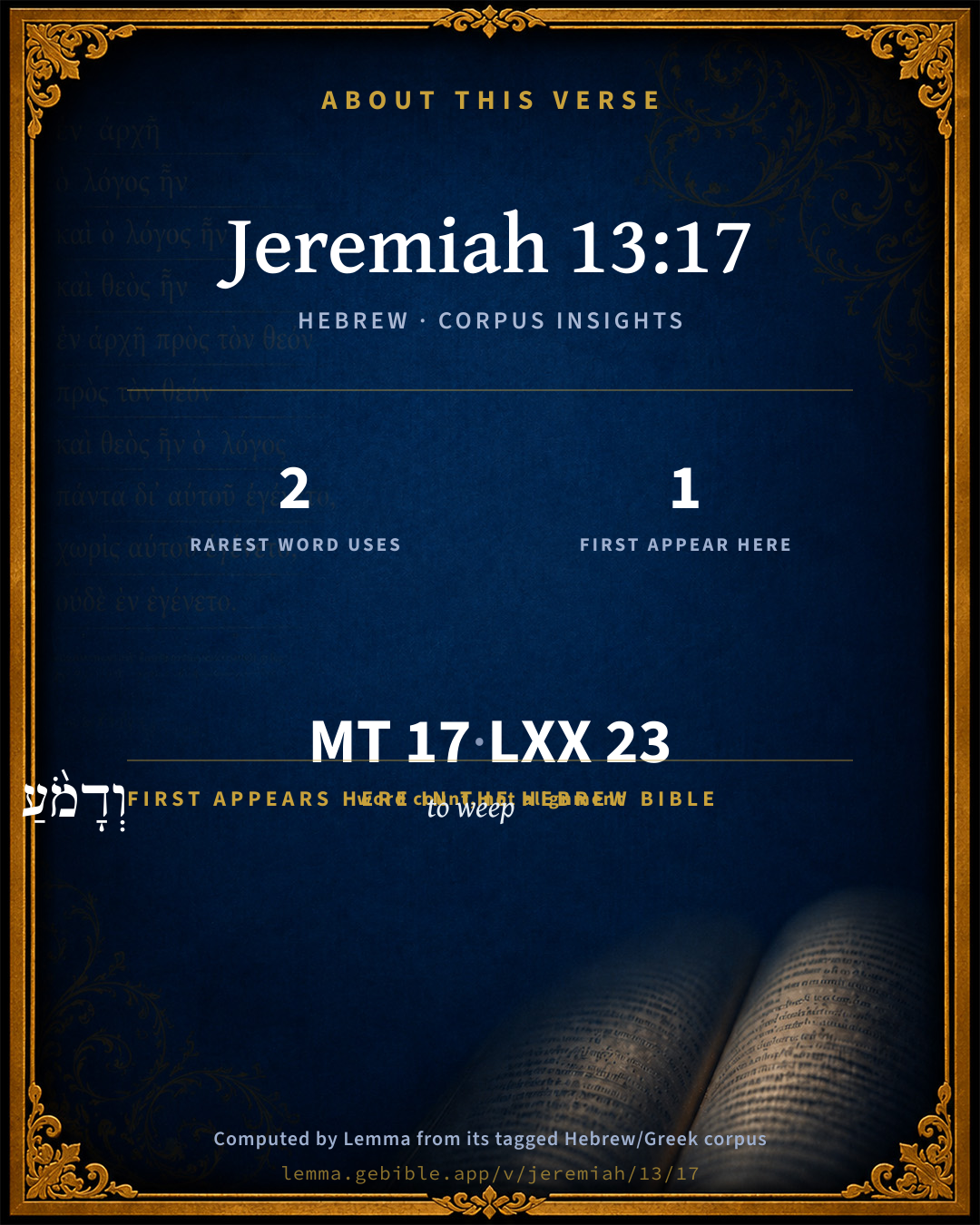
  • 1 first appearance in the Hebrew Bible
Full analysis ↓
Download a study sheet

One document with this verse’s original text, its word-by-word gloss line, the meaning frame, cross-references with their text, attributed commentary, and full source and license credits — printable, and it pastes into notes with its structure intact.

This verse Autodidact and up

Study sheet (.html) Plain text (.txt)

A passage Seminary Student

Up to 50 verses in one chapter. A passage sheet keeps up to 6 commentary sources and 12 cross-references per verse, in the order this page ranks them, and says so on the sheet whenever that leaves anything out. Ask for a single verse and you get the Autodidact verse sheet above.

Everything on this page stays free to read, with no account — the sheet is a download of what is already on screen, not access to it.

Want to remove ads? Support Godless Engineer
Compare translations 3

The same verse in 3 English versions, stacked beneath the original-language interlinear above. Click any original word for its lexicon entry.

Each is an independent rendering of the whole verse — the interlinear is not word-aligned to these translations.

Highlighted words mark where these versions differ — a whole-verse word diff, not a word-by-word alignment.

  • World English Bible Public Domain
    But if you will not hear it, my soul shall weep in secret for [your] pride; and my eye shall weep sore, and run down with tears, because Yahweh's flock is taken captive.
  • King James Version Public Domain
    But if ye will not hear it, my soul shall weep in secret places for your pride; and mine eye shall weep sore, and run down with tears, because the LORD's flock is carried away captive.
  • unfoldingWord Literal Text CC BY-SA 4.0
    But if you will not listen, my soul will weep in secret places because of pride; and weeping she will weep and my eyes will flow with tears, because Yahweh’s flock has been taken captive.

unfoldingWord Literal Text — © unfoldingWord, licensed CC BY-SA 4.0. Word-aligned USFM3 via Door43 (git.door43.org/unfoldingWord/en_ult).

Versions to compare (up to 4)

3 of 4 selected

Show all 18 translations

Every available English version of this verse, each an independent rendering of the whole verse.

  • World English Bible Public Domain
    But if you will not hear it, my soul shall weep in secret for [your] pride; and my eye shall weep sore, and run down with tears, because Yahweh's flock is taken captive.
  • Berean Standard Bible Public Domain
    But if you do not listen, I will weep in secret because of your pride. My eyes will overflow with tears, because the LORD’s flock has been taken captive.
  • Majority Standard Bible Public Domain
    But if you do not listen, I will weep in secret because of your pride. My eyes will overflow with tears, because the LORD’s flock has been taken captive.
  • King James Version Public Domain
    But if ye will not hear it, my soul shall weep in secret places for your pride; and mine eye shall weep sore, and run down with tears, because the LORD's flock is carried away captive.
  • American Standard Version (1901) Public Domain
    But if ye will not hear it, my soul shall weep in secret for `your' pride; and mine eye shall weep sore, and run down with tears, because Jehovah's flock is taken captive.
  • Revised Version (1885) Public Domain
    But if ye will not hear it, my soul shall weep in secret for your pride; and mine eye shall weep sore, and run down with tears, because the LORD’S flock is taken captive.
  • Geneva Bible (1599) Public Domain
    But if ye will not heare this, my soule shall weepe in secrete for your pride, and mine eye shall weepe and drop downe teares, because the Lords flocke is caried away captiue.
  • Douay-Rheims (1899) Public Domain
    But if you will not hear this, my soul shall weep in secret for your pride: weeping it shall weep, and my eyes shall run down the tears, because the flock of the Lord is carried away captive.
  • Young's Literal Translation Public Domain
    And if ye do not hear it, In secret places doth my soul weep, because of pride, Yea, it weepeth sore, And the tear cometh down mine eyes, For the flock of Jehovah hath been taken captive.
  • Literal Standard Version CC BY-SA 4.0
    And if you do not hear it, || My soul weeps in secret places, because of pride, || Indeed, it weeps and wails, || And the tear comes down my eyes, || For the flock of YHWH has been taken captive.
  • Unlocked Literal Bible CC BY-SA 4.0
    So if you will not listen, I will weep alone because of your arrogance. My eyes will certainly weep and flow with tears, for Yahweh's flock has been taken captive.
  • unfoldingWord Literal Text CC BY-SA 4.0
    But if you will not listen, my soul will weep in secret places because of pride; and weeping she will weep and my eyes will flow with tears, because Yahweh’s flock has been taken captive.
  • Darby Bible Public Domain
    And if ye will not hear it, my soul shall weep in secret places for [your] pride; and mine eye shall weep sore, and run down with tears, because Jehovah's flock is gone into captivity.
  • World Messianic Bible Public Domain
    But if you will not hear it, my soul will weep in secret for your pride. My eye will weep bitterly, and run down with tears, because the LORD’s flock has been taken captive.
  • Webster's Bible Public Domain
    But if ye will not hear it, my soul shall weep in secret places for your pride; and my eye shall weep bitterly, and run down with tears, because the LORD'S flock is carried away captive.
  • Free Bible Version CC BY-SA 4.0
    But if you refuse to listen, I will weep secretly inside because of your pride. My tears pour down because the Lord's flock has been captured.
  • Bible in Basic English Public Domain
    But if you do not give ear to it, my soul will be weeping in secret for your pride; my eye will be weeping bitterly, streaming with water, because the Lord's flock has been taken away as prisoners.
  • JPS Tanakh (1917) Public Domain
    But if ye will not hear it, my soul shall weep in secret for your pride; and mine eyes shall weep sore, and run down with tears, because the LORD'S flock is carried away captive.

Literal Standard Version (2020), Covenant Press — licensed CC BY-SA 4.0. Text via the HelloAO Bible API (eBible.org). Unlocked Literal Bible (unfoldingWord) — licensed CC BY-SA 4.0. Text via the HelloAO Bible API (eBible.org). unfoldingWord Literal Text — © unfoldingWord, licensed CC BY-SA 4.0. Word-aligned USFM3 via Door43 (git.door43.org/unfoldingWord/en_ult). Free Bible Version, Dr. Jonathan Gallagher — licensed CC BY-SA 4.0. Text via the HelloAO Bible API (eBible.org).

Word by word

More ways to search: Search by grammar → Find every occurrence → Compare this word →

Practice this passage: Drill this verse → Learn its vocabulary →

וְדָמֹ֨עַ
dâmaʻ
H1830
“and · to weep”
Conjunction + Verb, Qal, Infinitive Absolute
Part of Speech
Conjunction + Verb
Stem
Qal
Form
Infinitive Absolute
Full BDB Definition

Origin: a primitive root

TWOT: 442

(Qal) to weep
  1. וְאִם֙ ʼim H518 “and · if” Conjunction + Conjunction
  2. לֹ֣א lôʼ H3808 “not” Particle, Negative
  3. תִשְׁמָע֔וּהָ shâmaʻ H8085 “to hear · her” Verb, Qal, Imperfect, 2nd Person, Masculine, Plural + Suffix, Personal, 3rd Person, Feminine, Singular
  4. בְּמִסְתָּרִ֥ים miçtâr H4565 “in/at · hiding places” Preposition + Noun, Common, Masculine, Plural, Absolute
  5. תִּבְכֶּֽה bâkâh H1058 “to weep” Verb, Qal, Imperfect, 3rd Person, Feminine, Singular
  6. נַפְשִׁ֖י nephesh H5315 “soul · my” Noun, Common, Both, Singular, Construct + Suffix, Personal, 1st Person, Common, Singular
  7. מִפְּנֵ֣י pânîym H6440 “from · face(s) of” Preposition + Noun, Common, Both, Plural, Construct
  8. גֵוָ֑ה gêvâh H1466 “pride” Noun, Common, Feminine, Singular, Absolute
  9. תִּדְמַ֜ע dâmaʻ H1830 “to weep” Verb, Qal, Imperfect, 3rd Person, Feminine, Singular
  10. וְתֵרַ֤ד yârad H3381 “and · to go down” Conjunction + Verb, Qal, Imperfect, 3rd Person, Feminine, Singular
  11. עֵינִי֙ ʻayin H5869 “eye · my” Noun, Common, Both, Singular, Construct + Suffix, Personal, 1st Person, Common, Singular
  12. דִּמְעָ֔ה dimʻâh H1832 “tears” Noun, Common, Feminine, Singular, Absolute
  13. כִּ֥י kîy H3588 “that” Conjunction
  14. נִשְׁבָּ֖ה shâbâh H7617 “to capture” Verb, Niphal, Perfect, 3rd Person, Masculine, Singular
  15. עֵ֥דֶר ʻêder H5739 “flock of” Noun, Common, Masculine, Singular, Construct
  16. יְהוָֽה Yᵉhôvâh H3068 “LORD” Noun, Proper

About this verse

These counts appear in no published source. They are computed here, from the morphology-tagged text and Lemma’s own curated glosses. What Lemma adds →

17
words
16
distinct lemmas
Prophets
section

Notable vocabulary

The rarest word here is וְדָמֹ֨עַ to weep H1830 — appearing just 2 times in the whole Hebrew Bible.

First appearance in Scripture

This word makes its first canonical appearance in the Hebrew Bible here:

  • וְדָמֹ֨עַ to weep H1830

Grammatical profile

  • 6 verbs
  • 8 nouns
  • 2 conjunctions
  • 1 particle

Verb forms

  • תִשְׁמָע֔וּהָ Qal · Imperfect
  • תִּבְכֶּֽה Qal · Imperfect
  • וְדָמֹ֨עַ Qal · Infinitive Absolute
  • תִּדְמַ֜ע Qal · Imperfect
  • וְתֵרַ֤ד Qal · Imperfect
  • נִשְׁבָּ֖ה Niphal · Perfect

Repetition

A word recurs within this verse — often emphatic in Hebrew:

  • וְדָמֹ֨עַ to weep H1830 ×2

Hebrew & Septuagint length

In the original languages it is 17 Hebrew tokens and 23 Greek tokens — but the two are counted differently (Hebrew bundles its prefixes and suffixes into one token; the Greek is in lemma form), so that isn’t a like-for-like length.

Cross-references

19

Topical passages linked to Jeremiah 13:17 in the Treasury of Scripture Knowledge — connected by theme and wording, ordered by reader-vote popularity; previews shown in the World English Bible.

  • Malachi 2:2 If you will not listen, and if you will not lay it to heart, to give glory to my name," says Yahweh of Hosts, "then will I send the curse on you, and I will curse your blessings. Indeed, I have cursed them already, because you do not lay it to heart.
  • Jeremiah 9:1 Oh that my head were waters, and my eyes a spring of tears, that I might weep day and night for the slain of the daughter of my people!
  • Jeremiah 14:17 You shall say this word to them, Let my eyes run down with tears night and day, and let them not cease; for the virgin daughter of my people is broken with a great breach, with a very grievous wound.
  • Psalms 80:1 Hear us, Shepherd of Israel, You who lead Joseph like a flock, You who sit above the cherubim, shine forth.
  • Luke 19:41–42 When he drew near, he saw the city and wept over it,
  • Romans 9:2–4 that I have great sorrow and unceasing pain in my heart.
  • 1 Samuel 15:35 Samuel came no more to see Saul until the day of his death; for Samuel mourned for Saul: and Yahweh repented that he had made Saul king over Israel.
  • Psalms 119:136 Streams of tears run down my eyes, Because they don't observe your law.
  • Lamentations 1:16 For these things I weep; my eye, my eye runs down with water; Because the comforter who should refresh my soul is far from me: My children are desolate, because the enemy has prevailed.
  • Lamentations 2:18 Their heart cried to the Lord: wall of the daughter of Zion, let tears run down like a river day and night; Give yourself no respite; don't let the apple of your eye cease.
  • Ezekiel 34:31 You my sheep, the sheep of my pasture, are men, and I am your God, says the Lord Yahweh.
  • 1 Samuel 15:11 It repents me that I have set up Saul to be king; for he is turned back from following me, and has not performed my commandments. Samuel was angry; and he cried to Yahweh all night.
  • Isaiah 63:11 Then he remembered the days of old, Moses [and] his people, [saying], Where is he who brought them up out of the sea with the shepherds of his flock? where is he who put his holy Spirit in the midst of them?
  • Jeremiah 13:19–20 The cities of the South are shut up, and there is none to open them: Judah is carried away captive, all of it; it is wholly carried away captive.
  • Jeremiah 17:16 As for me, I have not hurried from being a shepherd after you; neither have I desired the woeful day; you know: that which came out of my lips was before your face.
  • Jeremiah 22:5 But if you will not hear these words, I swear by myself, says Yahweh, that this house shall become a desolation.
  • Jeremiah 23:1 Woe to the shepherds who destroy and scatter the sheep of my pasture! says Yahweh.
  • Lamentations 1:2 She weeps sore in the night, and her tears are on her cheeks; Among all her lovers she has none to comfort her: All her friends have dealt treacherously with her; they are become her enemies.
  • Ezekiel 36:38 As the flock for sacrifice, as the flock of Jerusalem in her appointed feasts, so shall the waste cities be filled with flocks of men; and they shall know that I am Yahweh.

Cross-references courtesy of OpenBible.info (CC BY 4.0).

Hebrew and Greek witnesses Masoretic Hebrew ↔ Greek Septuagint

The same verse in the two great witnesses to the Old Testament, shown verse-for-verse.

These are two independent witnesses, not word-aligned to each other, and the Septuagint is shown in lemma (dictionary) form.

Hebrew Jeremiah 13:17 Masoretic · Westminster Leningrad Codex

וְאִם֙ לֹ֣א תִשְׁמָע֔וּהָ בְּמִסְתָּרִ֥ים תִּבְכֶּֽה נַפְשִׁ֖י מִפְּנֵ֣י גֵוָ֑ה וְדָמֹ֨עַ תִּדְמַ֜ע וְתֵרַ֤ד עֵינִי֙ דִּמְעָ֔ה כִּ֥י נִשְׁבָּ֖ה עֵ֥דֶר יְהוָֽה

But if you will not hear it, my soul shall weep in secret for [your] pride; and my eye shall weep sore, and run down with tears, because Yahweh's flock is taken captive.

World English Bible · Public Domain

Greek LXX Structure differs

In the Septuagint, Jeremiah is about an eighth shorter than the Hebrew and arranges its material differently — the Oracles Against the Nations (Hebrew chapters 46–51) appear in the middle of the Greek book, after 25:13. Because the chapter and verse boundaries do not line up, a verse-for-verse comparison with the Hebrew is not shown.

A verse-for-verse comparison isn’t shown here because the chapters and verses don’t line up. Switch to the LXX edition with the MT / LXX toggle above to read the Greek directly.

On this verse, Haydock's Catholic Bible Commentary discusses the Septuagint’s reading. Read the note in Commentary ↓

Hebrew: Westminster Leningrad Codex (CC BY 4.0). Greek: Septuagint (public domain); English from a public-domain English Septuagint. How the Septuagint differs from the Hebrew →

Targum (Aramaic paraphrase)

1

The Targum is the ancient Jewish Aramaic paraphrase of the Hebrew Scriptures — an interpretive translation, not the Hebrew text itself. Onkelos (literal) and Pseudo-Jonathan (expansive) render the Torah, and Jonathan the Prophets. Coverage is partial: where no permissively-licensed English translation exists for a verse, only the Aramaic is shown. This is verse-level text, not a word-by-word alignment to the Hebrew.

  1. Targum Jonathan Prophets (Joshua–Malachi)
    וְאִם לָא תְקַבְּלוּן אוּלְפַן כַּד בְּסִתְרָא תִבְכֵּי נַפְשִׁי מִן קֳדָם דְיֶדְעֵי מִנְכוֹן יְקַרְכוֹן וּמִדְמַע תִּדְמַע וּתְשַׁגֵר עֵינֵי דִמְעִין אֲרֵי אִשְׁתְּבֵי עַמָא דַיְיָ:

    (no public-domain English translation for this verse)

    Targum Jonathan — Aramaic: “Mikraot Gedolot” (public domain). English: “Sefaria Community Translation” (CC0 1.0 (public-domain dedication)); “London "Chaldee Paraphrase," 1871” (public domain). Text via Sefaria.

Commentary

Notes on Jeremiah 13:17 from classic Christian and Jewish commentators (each source and its license shown beneath its notes). The classic Christian expositions comment on the surrounding passage and are grouped to its opening verse, so a note may address several verses; the Jewish commentaries on the Tanakh (Rashi and others) are per-verse, so they appear only where the commentator wrote on this verse.

Lemma curates 59 commentaries, every one of them public domain or Creative Commons licensed, each selected and text-cleaned for this edition rather than reprinted as found. About our sources →

Trapp's Complete Commentary

John Trapp

Jer 13:17 But if ye will not hear it, my soul shall weep in secret places for [your] pride; and mine eye shall weep sore, and run down with tears, because the LORD’S flock is carried away captive.

Ver. 17. My soul shall weep in secret places.] Good men are apt to weep, Et faciles motus mens generosa capit. Good ministers should be full of compassionate tears, weeping in secret for their people’s unprofitableness, and their danger thereby. The breast and right shoulder of the sacrifice belonged to the priest, to show that he should be a breast to love, and a shoulder to support the people in their troubles and burdens.

John Trapp, A Commentary or Exposition upon All the Books of the Old and New Testament (1647–1656) — public domain. Text from a community e-Sword module.

Tyndale Open Study Notes

Tyndale Open Resources

13:17 Jeremiah had learned that if the people did not acknowledge the Lord, they would be led away into exile. The thought of it filled him with grief.

Tyndale Open Study Notes — © Tyndale Open Resources, licensed CC BY-SA 4.0. Text via the HelloAO Bible API.

Geneva Bible (1599)

Geneva Bible translators

You shall surely be led away captive, and I, according to mine affection towards you, shall weep and lament for your stubbornness.

Geneva Bible (1599) marginal notes — public domain. Text via Bolls.life.

Jamieson, Fausset & Brown

Robert Jamieson, A. R. Fausset & David Brown

hear it--my exhortation.

in secret--as one mourning and humbling himself for their sin, not self-righteously condemning them (Phi 3:18).

pride--(see on Jer 13:15; Job 33:17).

flock-- (Jer 13:20), just as kings and leaders are called pastors.

Jamieson, Fausset & Brown — Commentary Critical and Explanatory on the Whole Bible (1871) — public domain (CC PDM 1.0). Text via the HelloAO Bible API.

Adam Clarke's Commentary

Verse 17. My soul shalt weep in secret places] If you will not hearken to the Lord, there is no remedy: destruction must come; and there is nothing left for me, but to go in secret, and mourn and bewail your wretched lot.

Adam Clarke's Commentary on the Bible (1810–1826) — public domain. Text from a community e-Sword/MySword module.

John Calvin's Commentaries

The Prophet had indirectly threatened them; but yet there was some hope of pardon, provided the Jews anticipated God’s judgment in time and humbled themselves before him. He now declares more clearly that a most certain destruction was nigh at hand, If ye will not hear, he says, weep will my soul in secret But much weight is in what the Prophet intimates, that he would cease to address them, as though he had said, “I have not hitherto left off to exhort you, for God has so commanded me; but there will be no remedy, if ye as usual harden yourselves against what I teach you. There remains then nothing now for me, except to hide myself in some secret place and there to mourn; for my prophetic office among you is at an end, as ye are unworthy of such a favor from God.”

He does not state simply, If ye will not hear, but he adds a pronoun, this, If ye will not hear this, or it: for the Jews might have raised an objection and said, that they were not disobedient to God, and had prophets among them, as it appeared yesterday; for there were those who deceived them by their flatteries. The Prophet then does not speak indistinctly, for that would have had no effect; but he expressly declares that they were to hear what he had said in the last verse: “Except then,” he says, “ye give glory to God, I will leave you or bid you farewell, and will hide myself in some corner, and there bewail your miseries.” When the Prophet said that nothing remained for him but weeping, he intimated that it was all over with them, and that their salvation was hopeless. The sum of the whole is, that they were not to be always favored with that which they were now despising, that is, to be warned by God’s servants; for if they continued to despise all the prophets, God would withdraw such a favor from them.

The Prophet at the same time shows with what feelings he exercised his prophetic office; for though he knew that he was to perform, the part of an herald, and boldly to denounce on the Jews the calamity which we have observed; he yet ever felt so much pity in his soul, that he bewailed that perverseness which would prove their ruin. The Prophet then connected the two feelings together, so that with a bold and intrepid spirit he denounced vengeance on the Jews, and at the same time he felt commiseration and sympathy.

He then mentions the cause, For taken captive is the flock of Jehovah Jeremiah might have had indeed a regard also for his own blood. When, therefore, he saw the nation from which he himself sprung miserably perishing, he could not but mourn for their ruin: but he had an especial regard to the favor of God, as was the case also with Paul, (Romans 9:2, 4, 5) for though he refers to his descent from the Israelites, and assigns this as a reason why he wished to be an anathema from Christ on their account, there were yet other reasons why he spoke highly of them; for he afterwards adds, that the covenant was theirs, that they derived their origin from the fathers, that from them Christ came according to the flesh, who is God, blessed for ever. Paul then so honored and valued the benefits with which the Jews were adorned, that he wished as it were to die for their salvation, and even wished to be an anathema from Christ. There is not the least doubt but Jeremiah for a similar reason adds now, that he would seek retirement or some hidden place where he might bewail the destruction of his people, for it was the flock of Jehovah We hence see that it was God’s covenant that made him to shed tears, for he saw that in a manner it failed through the fault of the people. It follows —

John Calvin's Commentaries (1540-1563) — public domain. Text from the Calvin Translation Society English edition (1840s-50s) via the Christian Classics Ethereal Library (ccel.org). Calvin's coverage is partial (roughly two-thirds of the Bible); uncommented books and verses are honest gaps, never fabricated. The 19th-century editor's footnotes and remarks are omitted so the notes are faithfully Calvin's own voice.

Ellicott's Commentary for English Readers

(17) My soul shall weep in secret places for your pride.—The words present no difficulty that requires explanation, but deserve to be noted in their exquisite tenderness as characteristic of the prophet’s temperament (comp. Lam_1:16), reminding us of the tears shed over Jerusalem (Luk_19:41) and of St. Paul’s “great heaviness and continual sorrow” (Rom_9:2). Nothing remained for one who found his labours fruitless but silent sorrow and intercession. The “secret places” find a parallel in our Lord’s withdrawal for prayer into a “solitary place” (Mar_1:35).

A Bible Commentary for English Readers, edited by Charles John Ellicott (1878–1897) — public domain. Text from a community e-Sword module.

The Cambridge Bible for Schools and Colleges

gen. ed. J. J. S. Perowne

17. the Lord’s flock] As the rulers are called elsewhere (Jer_2:8 mg., Jer_3:15, Jer_6:3) shepherds (pastors), so the ruled are the flock. Cp. Psa_80:1, and so Psa_74:1; Psa_77:20; Psa_78:52; Psa_79:13; also Zec_10:3.

The Cambridge Bible for Schools and Colleges (gen. ed. J. J. S. Perowne; Cambridge University Press, 1878–1918) — public domain. Text from a community e-Sword module.

John Gill's Exposition

Say unto the king, and to the queen,.... Jehoiachin, and his mother Nehushta, as it is generally interpreted by the Jewish commentators, and others; who, with many princes and officers, were carried captive into Babylon, Kg2 24:12 or rather Zedekiah and his wife; since the captivity after threatened is a perfect and complete one, which Jehoiachin's was not:

humble yourselves, sit down; or, "sit down humbled" (d); come down from your thrones, and sit in the dust; humble yourselves before the Lord for your own sins, and the sins of the people; in times of general corruption, and which threatens a nation with ruin, it becomes kings and princes to set an example of repentance, humiliation, and reformation; though it may be this is rather a prediction of what would be, that they should descend from their throne, and lose their grandeur, and be in a low and abject condition, than an exhortation to what was their duty; since it follows:

for your principalities shall come down; their royal state and greatness, and all the ensigns of it; and especially such as they had upon their heads, as the word used denotes, and as the following explanation shows:

even the crown of your glory; or glorious crown, which should fall from their heads, or be taken from them, when they should be no more served in state, or treated as crowned heads.

(d) "degite humiliter", Castalio; "abjectissime considite", Junius & Tremellius; "loco humili considite", Piscator.

John Gill's Exposition of the Whole Bible (1746–1763) — public domain (CC PDM 1.0). Text via the HelloAO Bible API.

Albert Barnes' Notes on the Bible

The Lord’s flock - The people carried away captive with Jeconiah formed the Jewish Church, as we are expressly told, whereas Zedekiah and the people of Jerusalem possessed only the externals of the Church and not its reality. It is for this reason that the seventy years’ exile counts from Jeconiah’s captivity.

Albert Barnes' Notes on the Bible (1834–1885) — public domain. Text from a community e-Sword/MySword module.

Haydock's Catholic Bible Commentary

My soul. Jeremias can do no more. (Calmet) --- Septuagint, "your soul,...your eyes," &c. (Haydock)

George Leo Haydock (1774–1849), Haydock's Catholic Family Bible and Commentary, 1859 edition — public domain. Excludes Psalms (Douay-Rheims chapter numbering differs from Protestant) and Deuterocanonical books (Catholic canon only).

Matthew Poole's English Annotations

That is, if you will not listen to what I say, take heed to what I say, and obey the counsel which I give you, I shall seriously and secretly mourn for your rebellion and obstinacy, which is rooted in your pride, and lifting up yourselves against the Lord’s monitions and counsels; and I shall also mourn for your calamity when it comes upon you, I shall have a personal and family concern with you, but that will not so much trouble me as to consider that you who are the church and people of God should be led into captivity.

Matthew Poole's English Annotations on the Holy Bible (1683–1685) — public domain. Text from a community e-Sword/MySword module.

Whedon's Commentary on the Bible

Daniel D. Whedon

17. My soul shall weep in secret places — Most characteristic language! In it how clearly do we see reflected the heart of this man of God! A true “jeremiad” is not so much the language of gloom and hopelessness as of tenderness and earnest remonstrance. “Secret places” may, perhaps, suggest the present enforced privacy of the prophet.

Daniel D. Whedon (gen. ed.), Commentary on the Old and New Testaments (1874–1909) — public domain. Text from a community e-Sword module.

The Pulpit Commentary

Should all admonitions be in vain, Jeremiah will return (like 1Sa_15:35) and give vent to his sorrowful emotion. The Lord"s flock. Jehovah is likened to a shepherd. (comp. Zec_10:3)

See on Jer_10:19 M.

The Pulpit Commentary (1880–1919), ed. H.D.M. Spence-Jones & Joseph S. Exell — public domain. Text from a community e-Sword module.

Keil & Delitzsch

C. F. Keil & F. Delitzsch

Knowing their obstinacy, the prophet adds: if ye hear it (what I have declared to you) not, my soul shall weep. In the concealment, quo secedere lugentes amant, ut impensius flere possint (Chr. B. Mich.). For the pride, sc. in which ye persist. With tears mine eye shall run down because the flock of Jahveh, i.e., the people of God (cf. Zac 10:3), is carried away into captivity (perfect. proph).

Keil & Delitzsch — Biblical Commentary on the Old Testament (1861–1891) — public domain (CC PDM 1.0). Text via the HelloAO Bible API. (Old Testament only.)

Rashi

Rabbi Shlomo Yitzchaki (Rashi)

because of your pride Because of your greatness which will be curtailed. Another explanation: Because of the pride of the kingdom of Heaven that will be given over to the idols of Babylon.

Rashi on the Tanakh — English translations: “The Judaica Press complete Tanach with Rashi, translated by A. J. Rosenberg” (CC BY 4.0); “Pentateuch with Rashi's commentary by M. Rosenbaum and A.M. Silbermann, 1929-1934” (public domain); “The Metsudah Tanach series, Lakewood, N.J” (CC BY 4.0); and “The Book of Joshua, Metsudah Publications, 1997” (CC BY 4.0). Text via Sefaria.

Lesson kit

Teaching starters — assembled from the data on this page, not authored interpretation. Every prompt links to the verse data it draws on. Edit before teaching.

Jeremiah, in the Prophets, opens this verse with 17 words (16 distinct Hebrew lemmas). Its most distinctive word is dâmaʻ (“to weep”). A historical commentator’s framing appears above. Read the whole chapter for the surrounding context.

Discussion questions

  1. How does “to weep” (dâmaʻ) shape what this verse is saying?
  2. This is the first place “to weep” appears in Scripture (first appears here). What does its debut here establish?
  3. How does Malachi 2:2, which shares this passage’s theme, read alongside this verse?
  4. What does the repetition of “to weep” (2× in this one verse) do in this verse?
  5. The translations on this page render this verse differently — a whole-verse word diff, not a word-by-word alignment. What might account for the different wordings?
  6. «תִשְׁמָע֔וּהָ» is a Qal Imperfect verb. How does that grammatical form shape the action described?
  7. Compare how Trapp's Complete Commentary and Tyndale Open Study Notes read this verse. Where do they agree or differ?

Things to notice

Reading settings

Reading text

Shown beneath each verse's original-language words.

Old Testament
Old Testament edition

Read the OT as the Masoretic Hebrew (MT) or the Greek Septuagint (LXX).

English shown for the Greek Septuagint (in the Hebrew ↔ Greek comparison).

Comparing translations? Open the Compare panel on any verse page to stack up to four side by side.