Isaiah 42:7

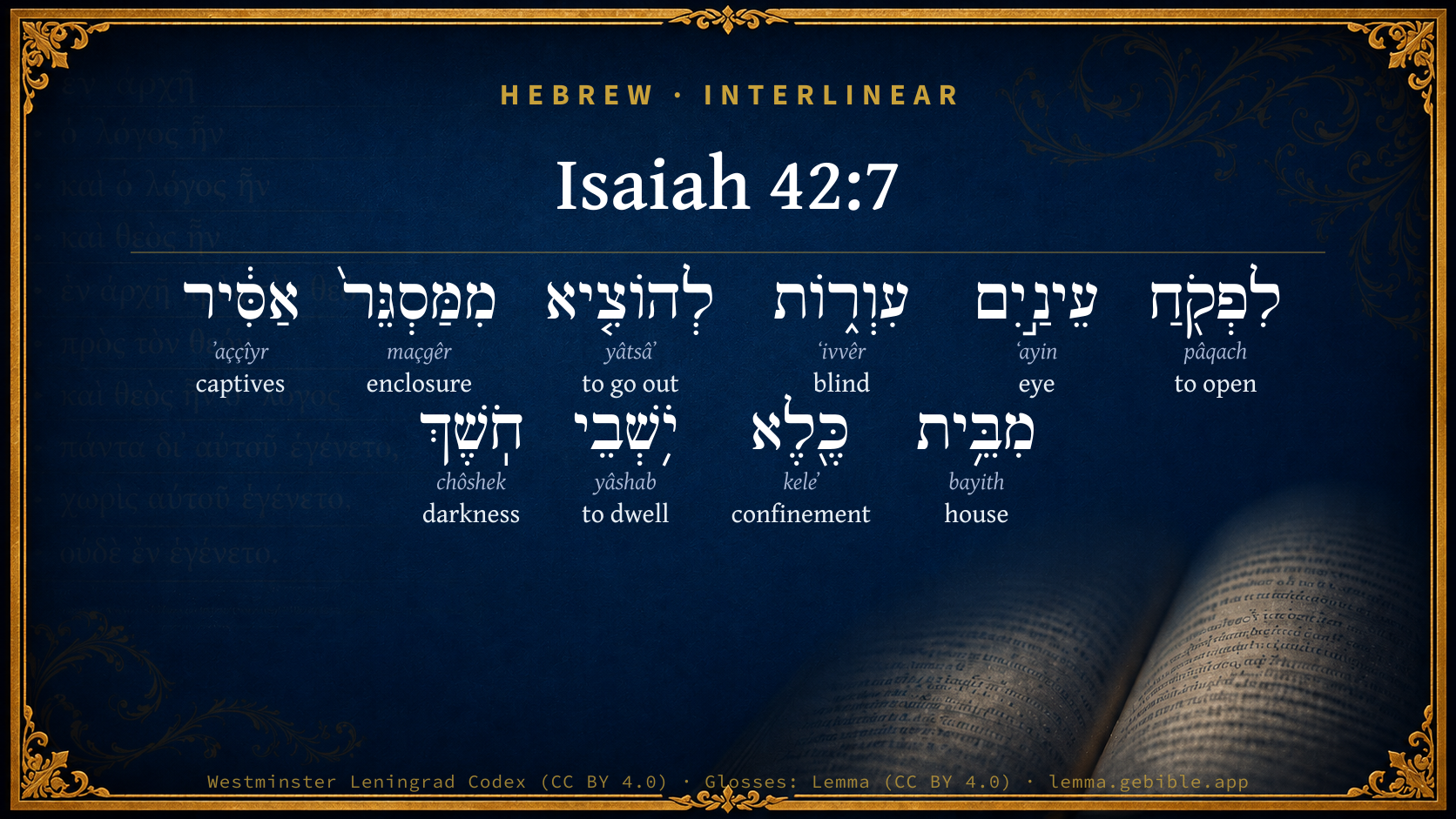
Hebrew (Westminster Leningrad Codex) Isaiah 42:7 appears in the Hebrew Old Testament. The text above is from the Westminster Leningrad Codex. Each word links to its Strong’s number, a concise gloss, and parsing drawn from the Open Scriptures Hebrew Bible morphology. Click any word for its full Brown-Driver-Briggs (BDB) entry.
Download image
Cite this verse

Isaiah 42:7 (World English Bible). Public Domain. Lemma interlinear Bible study tool, https://lemma.gebible.app/v/isaiah/42/7.

Show BibTeX & RIS
BibTeX
RIS
English Translation
to open the blind eyes, to bring out the prisoners from the dungeon, and those who sit in darkness out of the prison-house.
World English Bible · Public Domain
Download a study sheet

One document with this verse’s original text, its word-by-word gloss line, the meaning frame, cross-references with their text, attributed commentary, and full source and license credits — printable, and it pastes into notes with its structure intact.

This verse Autodidact and up

Study sheet (.html) Plain text (.txt)

A passage Seminary Student

Up to 50 verses in one chapter. A passage sheet keeps up to 6 commentary sources and 12 cross-references per verse, in the order this page ranks them, and says so on the sheet whenever that leaves anything out. Ask for a single verse and you get the Autodidact verse sheet above.

Everything on this page stays free to read, with no account — the sheet is a download of what is already on screen, not access to it.

Want to remove ads? Support Godless Engineer
Compare translations 3

The same verse in 3 English versions, stacked beneath the original-language interlinear above. Click any original word for its lexicon entry.

Each is an independent rendering of the whole verse — the interlinear is not word-aligned to these translations.

Highlighted words mark where these versions differ — a whole-verse word diff, not a word-by-word alignment.

  • World English Bible Public Domain
    to open the blind eyes, to bring out the prisoners from the dungeon, and those who sit in darkness out of the prison-house.
  • King James Version Public Domain
    To open the blind eyes, to bring out the prisoners from the prison, and them that sit in darkness out of the prison house.
  • unfoldingWord Literal Text CC BY-SA 4.0
    to open blind eyes, to bring forth the prisoner from the dungeon, from the house of confinement, the dwellers of darkness.

unfoldingWord Literal Text — © unfoldingWord, licensed CC BY-SA 4.0. Word-aligned USFM3 via Door43 (git.door43.org/unfoldingWord/en_ult).

Versions to compare (up to 4)

3 of 4 selected

Show all 18 translations

Every available English version of this verse, each an independent rendering of the whole verse.

  • World English Bible Public Domain
    to open the blind eyes, to bring out the prisoners from the dungeon, and those who sit in darkness out of the prison-house.
  • Berean Standard Bible Public Domain
    to open the eyes of the blind, to bring prisoners out of the dungeon and those sitting in darkness out from the prison house.
  • Majority Standard Bible Public Domain
    to open the eyes of the blind, to bring prisoners out of the dungeon and those sitting in darkness out from the prison house.
  • King James Version Public Domain
    To open the blind eyes, to bring out the prisoners from the prison, and them that sit in darkness out of the prison house.
  • American Standard Version (1901) Public Domain
    to open the blind eyes, to bring out the prisoners from the dungeon, and them that sit in darkness out of the prison-house.
  • Revised Version (1885) Public Domain
    to open the blind eyes, to bring out the prisoners from the dungeon, and them that sit in darkness out of the prison house.
  • Geneva Bible (1599) Public Domain
    That thou maist open the eyes of the blind, and bring out the prisoners from the prison: and them that sitte in darkenesse, out of the prison house.
  • Douay-Rheims (1899) Public Domain
    That thou mightest open the eyes of the blind, and bring forth the prisoner out of prison, and them that sit in darkness out of the prison house.
  • Young's Literal Translation Public Domain
    To open the eyes of the blind, To bring forth from prison the bound one, From the house of restraint those sitting in darkness.
  • Literal Standard Version CC BY-SA 4.0
    To open the eyes of the blind, || To bring forth the bound one from prison, || Those sitting in darkness from the house of restraint.
  • Unlocked Literal Bible CC BY-SA 4.0
    to open the eyes of the blind, to release the prisoners from the dungeon, and from the house of confinement those who sit in darkness.
  • unfoldingWord Literal Text CC BY-SA 4.0
    to open blind eyes, to bring forth the prisoner from the dungeon, from the house of confinement, the dwellers of darkness.
  • Darby Bible Public Domain
    to open the blind eyes, to bring forth the prisoner from the prison, them that sit in darkness out of the house of restraint.
  • World Messianic Bible Public Domain
    to open the blind eyes, to bring the prisoners out of the dungeon, and those who sit in darkness out of the prison.
  • Webster's Bible Public Domain
    To open the blind eyes, to bring out the prisoners from the prison, and them that sit in darkness out of the prison-house.
  • Free Bible Version CC BY-SA 4.0
    You will make the blind see, set free those who are locked up, and lead those who sit in darkness out from prison.
  • Bible in Basic English Public Domain
    To give eyes to the blind, to make free the prisoners from the prison, to let out those who are shut up in the dark.
  • JPS Tanakh (1917) Public Domain
    To open the blind eyes, to bring out the prisoners from the dungeon, and them that sit in darkness out of the prison-house.

Literal Standard Version (2020), Covenant Press — licensed CC BY-SA 4.0. Text via the HelloAO Bible API (eBible.org). Unlocked Literal Bible (unfoldingWord) — licensed CC BY-SA 4.0. Text via the HelloAO Bible API (eBible.org). unfoldingWord Literal Text — © unfoldingWord, licensed CC BY-SA 4.0. Word-aligned USFM3 via Door43 (git.door43.org/unfoldingWord/en_ult). Free Bible Version, Dr. Jonathan Gallagher — licensed CC BY-SA 4.0. Text via the HelloAO Bible API (eBible.org).

Word by word

More ways to search: Search by grammar → Find every occurrence → Compare this word →

Practice this passage: Drill this verse → Learn its vocabulary →

About this verse

These counts appear in no published source. They are computed here, from the morphology-tagged text and Lemma’s own curated glosses. What Lemma adds →

10
words
10
distinct lemmas
Prophets
section

Notable vocabulary

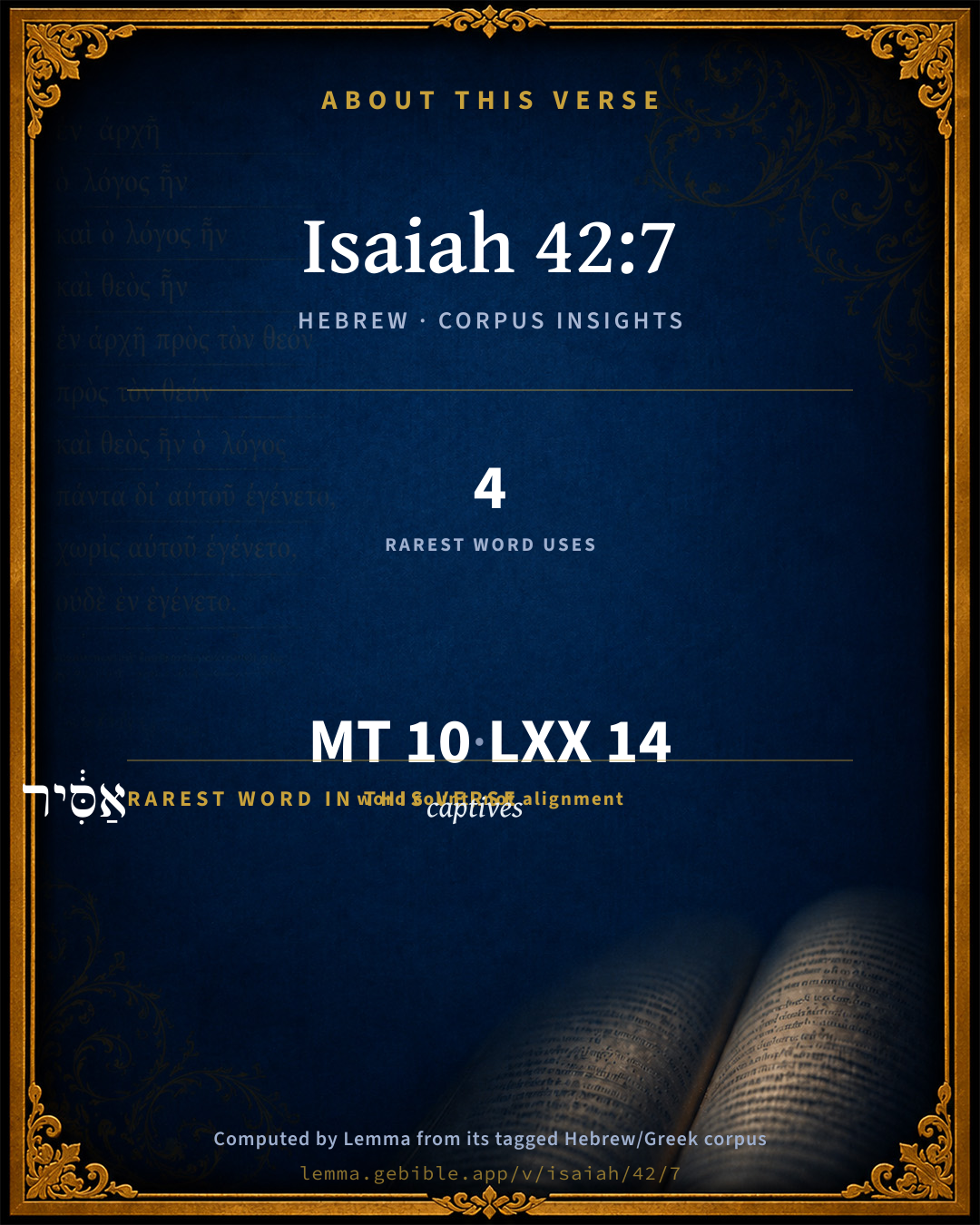
The rarest word here is אַסִּ֔יר captives H616 — appearing just 4 times in the whole Hebrew Bible.

Shared distinctive vocabulary

אַסִּ֔יר captives H616 occurs in 4 verses of the Hebrew Bible. Also found in:

Grammatical profile

  • 3 verbs
  • 6 nouns
  • 1 adjective

Verb forms

  • לִפְקֹ֖חַ Qal · Infinitive Construct
  • לְהוֹצִ֤יא Hiphil · Infinitive Construct
  • יֹ֥שְׁבֵי Qal · Participle Active

Hebrew & Septuagint length

In English translation the verse runs 23 words from the Hebrew and 23 from the Septuagint (LXX English) — the same length.

A rough comparison of the two English renderings, which tokenize alike — not a word-level alignment.

Word counts can differ between the Hebrew and the Greek without any difference in meaning — e.g. the Hebrew direct-object marker אֵת has no separate Greek word, and Greek often adds the article ὁ.

In the original languages it is 10 Hebrew tokens and 14 Greek tokens — but the two are counted differently (Hebrew bundles its prefixes and suffixes into one token; the Greek is in lemma form), so that isn’t a like-for-like length.

Cross-references

21

Topical passages linked to Isaiah 42:7 in the Treasury of Scripture Knowledge — connected by theme and wording, ordered by reader-vote popularity; previews shown in the World English Bible.

  • Isaiah 61:1 The Spirit of the Lord Yahweh is on me; because Yahweh has anointed me to preach good news to the humble; he has sent me to bind up the broken-hearted, to proclaim liberty to the captives, and the opening [of the prison] to those who are bound;
  • Ephesians 1:17–18 that the God of our Lord Jesus Christ, the Father of glory, may give to you a spirit of wisdom and revelation in the knowledge of him;
  • Isaiah 35:5 Then the eyes of the blind shall be opened, and the ears of the deaf shall be unstopped.
  • Isaiah 49:9 saying to those who are bound, Go forth; to those who are in darkness, Show yourselves. They shall feed in the ways, and on all bare heights shall be their pasture.
  • 2 Timothy 2:26 and they may recover themselves out of the devil's snare, having been taken captive by him to his will.
  • Matthew 11:5 the blind receive their sight, the lame walk, the lepers are cleansed, the deaf hear, the dead are raised up, and the poor have good news preached to them.
  • Hebrews 2:14–15 Since then the children have shared in flesh and blood, he also himself in like manner partook of the same, that through death he might bring to nothing him who had the power of death, that is, the devil,
  • Luke 4:18–21 "The Spirit of the Lord is on me, Because he has anointed me to preach good news to the poor. He has sent me to heal the brokenhearted, To proclaim release to the captives, Recovering of sight to the blind, To deliver those who are crushed,
  • Luke 24:45 Then he opened their minds, that they might understand the Scriptures.
  • 1 Peter 2:9 But you are a chosen race, a royal priesthood, a holy nation, a people for God's own possession, that you may show forth the excellencies of him who called you out of darkness into his marvelous light:
  • Isaiah 29:18 In that day shall the deaf hear the words of the book, and the eyes of the blind shall see out of obscurity and out of darkness.
  • John 9:39 Jesus said, "I came into this world for judgment, that those who don't see may see; and that those who see may become blind."
  • Revelation 3:18 I counsel you to buy from me gold refined by fire, that you may become rich; and white garments, that you may clothe yourself, and that the shame of your nakedness may not be revealed; and eye salve to anoint your eyes, that you may see.
  • Psalms 146:7–8 Who executes justice for the oppressed; Who gives food to the hungry. Yahweh frees the prisoners.
  • Zechariah 9:11–12 As for you also, Because of the blood of your covenant, I have set free your prisoners from the pit in which is no water.
  • Acts 26:18 to open their eyes, that they may turn from darkness to light and from the power of Satan to God, that they may receive remission of sins and an inheritance among those who are sanctified by faith in me.'
  • Isaiah 9:2 The people who walked in darkness have seen a great light: those who lived in the land of the shadow of death, on them has the light shined.
  • Psalms 107:10–16 Some sat in darkness and in the shadow of death, Being bound in affliction and iron,
  • Isaiah 42:16 I will bring the blind by a way that they don't know; in paths that they don't know will I lead them; I will make darkness light before them, and crooked places straight. These things will I do, and I will not forsake them.
  • Isaiah 42:22 But this is a people robbed and plundered; they are all of them snared in holes, and they are hid in prison-houses: they are for a prey, and none delivers; for a spoil, and none says, Restore.
  • 2 Corinthians 4:6 seeing it is God who said, "Light will shine out of darkness," who has shone in our hearts, to give the light of the knowledge of the glory of God in the face of Jesus Christ.

Cross-references courtesy of OpenBible.info (CC BY 4.0).

Hebrew and Greek witnesses Masoretic Hebrew ↔ Greek Septuagint

The same verse in the two great witnesses to the Old Testament, shown verse-for-verse.

These are two independent witnesses, not word-aligned to each other, and the Septuagint is shown in lemma (dictionary) form.

Hebrew Isaiah 42:7 Masoretic · Westminster Leningrad Codex

לִפְקֹ֖חַ עֵינַ֣יִם עִוְר֑וֹת לְהוֹצִ֤יא מִמַּסְגֵּר֙ אַסִּ֔יר מִבֵּ֥ית כֶּ֖לֶא יֹ֥שְׁבֵי חֹֽשֶׁךְ

to open the blind eyes, to bring out the prisoners from the dungeon, and those who sit in darkness out of the prison-house.

World English Bible · Public Domain

Greek LXX Isaiah 42:7 Septuagint · lemma form

ἀναοἴγω ὀφθαλμός τυφλός ἐκἄγω ἐκ δεσμός δέω καί ἐκ οἶκος φυλακή καταἧμαι ἐν σκότος

to open the eyes of the blind, to bring the bound and them that sit in darkness out of bonds and the prison-house.

LXX2012 (modern English Septuagint) · Public Domain

On this verse, Adam Clarke's Commentary discusses the Septuagint’s reading. Read the note in Commentary ↓

Hebrew: Westminster Leningrad Codex (CC BY 4.0). Greek: Septuagint (public domain); English from LXX2012 (modern English Septuagint) (Public Domain). How the Septuagint differs from the Hebrew →

Targum (Aramaic paraphrase)

1

The Targum is the ancient Jewish Aramaic paraphrase of the Hebrew Scriptures — an interpretive translation, not the Hebrew text itself. Onkelos (literal) and Pseudo-Jonathan (expansive) render the Torah, and Jonathan the Prophets. Coverage is partial: where no permissively-licensed English translation exists for a verse, only the Aramaic is shown. This is verse-level text, not a word-by-word alignment to the Hebrew.

  1. Targum Jonathan Prophets (Joshua–Malachi)
    לְפַתָּחָא עֵינֵי בֵּית יִשְׂרָאֵל דְאִינוּן כְּסָמָן מִן אוֹרַיְתָא לְאַפָקָא נַלְוַתְהוֹן מִבֵּינֵי עַמְמַיָא דְאִינוּן דָמָן לַאֲסִירִין וּלְמִפְרַקְהוֹן מִשִׁעְבּוּד מַלְכְּוָתָא דְאִינוּן עֲנִינִין כַּאֲסִירֵי קְבָל:

    To open the eyes of the house of Israel, who are blind to the law, to bring back their captivity from among the nations, where they are like prisoners, and to redeem them from the servitude of the kingdoms being shut up as those that are bound in darkness.

    Targum Jonathan — Aramaic: “Mikraot Gedolot” (public domain). English: “Sefaria Community Translation” (CC0 1.0 (public-domain dedication)); “London "Chaldee Paraphrase," 1871” (public domain). Text via Sefaria.

Commentary

Notes on Isaiah 42:7 from classic Christian and Jewish commentators (each source and its license shown beneath its notes). The classic Christian expositions comment on the surrounding passage and are grouped to its opening verse, so a note may address several verses; the Jewish commentaries on the Tanakh (Rashi and others) are per-verse, so they appear only where the commentator wrote on this verse.

Lemma curates 59 commentaries, every one of them public domain or Creative Commons licensed, each selected and text-cleaned for this edition rather than reprinted as found. About our sources →

Trapp's Complete Commentary

John Trapp

Isa 42:7 To open the blind eyes, to bring out the prisoners from the prison, [and] them that sit in darkness out of the prison house.

Ver. 7. To open the blind eyes.] By the preaching of the gospel. {Act 26:18 2Co 4:4-6 Rev 3:18}

To bring out the prisoners from the prison.] To free poor souls from the tyranny of sin and terror of hell. This should make us say to Christ, as one did once to Augustus for a deliverance nothing so great, Effecisti, Ceesar, ut viverem et morerer ingratus, Let me do mine utmost, I must live and die in thy debt.

John Trapp, A Commentary or Exposition upon All the Books of the Old and New Testament (1647–1656) — public domain. Text from a community e-Sword module.

The Biblical Illustrator

Joseph S. Exell

Isa_42:7

To open the blind eyes

Opening blind eyes

What a grievous affliction is blindness! It was no frivolous boon which Christ, in the days of His sojourn on earth, thought proper to confer, when, in the external sense, He opened blind eyes.

In the paragraph of which the text is a part, Jehovah is describing the Messiah in His spiritual character and work; and, great as the marvel of removing natural blindness was, and great as similar miracles were which Christ performed, their principal value consisted in their being symbols and pledges of those spiritual operations which He could accomplish on the souls of men.

I. THE CALAMITY OF SPIRITUAL BLINDNESS WHICH HAS OVERTAKEN OUR RACE. You would very greatly aggravate the evil of natural blindness by dilating on the numerous and diversified beauties of nature, for the poor blind man sees none of these things! But how much greater is the calamity by which the soul is excluded from the sight of the glory of God! There is very high criminality connected with the origin of this spiritual blindness. The Divine displeasure never arises without a cause, or beyond the cause. What, then, must have been the cause which led to such a fatal condition? The incontestable and melancholy fact is, that man has sinned! As there was high criminality connected with the origin of this blindness, so there is high criminality connected with the continuance of it. If men, struck with this blindness, were to humble themselves on account of it, it would be some alleviation of the matter; but, generally, I find men taking advantage of their darkness, and receding further and further from God; and, indeed, many of them seem never to be so completely happy as when they have most effectually succeeded in banishing all thought of God. This spiritual blindness is so complete that it leads a man to pervert the very instruments which God has appointed for its removal. Take an observation of the state of mankind around us, and see whether or not it sustains this description.

II. THE GREAT ORDINANCE OF JEHOVAH FOR THE REMOVAL OF THIS CALAMITY. See what light Christ has thrown on the character of God! Consider the light which He has thrown on the providence around us. The difficulties of the virtuous, and the shouting success of the villainous, almost seemed, to conscientious men, to indicate very bad management on the part of God; and they have had recourse to a great many theories to explain it. Christ has thrown light on the afflictions which happen to the people of God. And on that immortality which is before us. And on the spiritualities which are required within us.

III. THE GRANDEUR OF THAT OPERATION OF THE SPIRIT BY WHICH THE REMOVAL OF THIS SPIRITUAL BLINDNESS IS EFFECTED. (J. E. Beaumont, M. D.)

New sight causes great joy

I do not wonder that, when a man gets this light into his soul, he should be overjoyed. A young woman had lived to the age of eighteen without seeing at all. Dr. Boyle watched the performance of an operation upon her, and he has described, as only a philosopher could describe, what took place. For some time they were afraid she would lose her reason, so overcome was she by the innumerable beauties which so suddenly burst in upon her. (J. E. Beaumont, M. D.)

A social saviour

This is the kind of man needed in all ages. We have critics enough, we have judges in great abundance, we have speculators more than can be overtaken by statistical genius; we want another kind of man, and we seek for him no better description than that which is outlined by the prophet. We want moral helpers, social saviours, personal healers and comforters. Shall we apply these words to the Lord Jesus Christ? They will fit the occasion exactly. In Him they would seem to secure their amplest and completest realisation. (J. Parker, D. D.)

Christianity opens eyes

Christianity opens eyes never closes them. (J. Parker, D. D.)

Victor Emmanuel, emancipator

We gladly survey the effectual operations of Jesus the Saviour, the true Victor Emmanuel, who comes to set men free from the bondage of their sins.

I. CONSIDER WHO IT IS THAT SENDS JESUS CHRIST TO ACCOMPLISH THE LIBERATION OF THE SONS OF MEN, because much will depend upon the Liberators credentials, the authority by which He is warranted, and the power by which He is hacked. We sing for joy of heart as we see that the Infinite God Himself commissioned the Lord Jesus to be the Deliverer of men; and He did this--

1. In His capacity as Creator (Isa_42:5).

2. He also describes Himself as the life-giver (Isa_42:5).

3. The faithful God. I the Lord have called Thee in righteousness (Isa_42:6) that is to say, the God who sends Christ the Saviour is not one who plays with words, and having given a promise to-day, retracts it to-morrow.

4. The everblessed sender of the Lord Jesus is omnipotent. And will hold thine hand, and will keep Thee. By which is meant that God will give to the Mediator all His power. Christ is the power of God.

II. THE SENT ONE HIMSELF.

1. Jesus is a chosen one. Mine elect, in whom My soul delighteth (Isa_42:1).

2. Jesus is anointed to this work. I have put My Spirit upon Him. The Holy Spirit is the greatest of all actors in the world of mind. He it is who can illuminate, persuade, and control the spirits of men.

3. The Redeemer is spoken of as being gentle and lowly of heart, which should commend Him much to every lowly and contrite spirit (Isa_42:3).

4. The Christ who has come to save the sons of men is persevering to the last degree (Isa_42:4).

III. THE WORK ITSELF. The Messiahs work of grace is divided into three parts.

1. To open the blind eyes. Mans understanding is perverted from the knowledge of God, from a true sense of sin, from a realisation of Divine justice, from a right estimate of salvation. The understanding, which is the eye of the soul, is darkened. But when the anointed Saviour comes, He removes the scales of our mental ophthalmia, and in the light of God we see light.

2. To bring out the prisoners from the prison. Habits of sin, like iron nets, surround the sinner, and he cannot escape their meshes. Faith in the Lord Jesus is the end of bondage and the dawn of freedom.

3. Bringing them that sit in darkness out of the prison-house. This we will refer to those who are truly emancipated, and yet by reason of despondency sit down in the dark dungeon.

IV. WHAT IS THE DESIGN OF GOD IN ALL THIS? I am the Lord: that is My name: and My glory will I not give to another (Isa_42:8). (C. H. Spurgeon.)

Stages of liberty

Men are in various stages of liberty. We are not all equally the free men of God. There are men even now who are under the disadvantage of prejudice. Even to-day superstition lives--chilling, fear-exciting, soul-depressing superstition. There are those who still live in the letter of the Word. (J. Parker, D. D.)

The Biblical Illustrator, edited by Joseph S. Exell (c. 1880s–1900s) — public domain. Text from a community e-Sword module.

Tyndale Open Study Notes

Tyndale Open Resources

42:7 The servant will open the eyes of the spiritually blind (see 6:10; 29:18) and free the spiritual captives from the prison of sin, in addition to those who were captive in the Babylonian exile (see 61:1 with Luke 4:18).

Tyndale Open Study Notes — © Tyndale Open Resources, licensed CC BY-SA 4.0. Text via the HelloAO Bible API.

Jamieson, Fausset & Brown

Robert Jamieson, A. R. Fausset & David Brown

blind--spiritually (Isa 42:16, Isa 42:18-19; Isa 35:5; Joh 9:39).

prison-- (Isa 61:1-2).

darkness--opposed to "light" (Isa 42:6; Eph 5:8; Pe1 2:9).

Jamieson, Fausset & Brown — Commentary Critical and Explanatory on the Whole Bible (1871) — public domain (CC PDM 1.0). Text via the HelloAO Bible API.

Adam Clarke's Commentary

Verse 7. To open the blind eyes] In this verse the prophet seems to set forth the spiritual redemption, under images borrowed from the temporal deliverance.

Out of the prison house - "And from the dungeon."] The Septuagint, Syriac, and four MSS., one ancient, add the conjunction ו vau, ומבית umibbeith, and from the house.

Adam Clarke's Commentary on the Bible (1810–1826) — public domain. Text from a community e-Sword/MySword module.

Ellicott's Commentary for English Readers

(7) To open the blind eyes.—The prophet must have felt the contrast between this and his own mission (Isa_6:10). The words all point to spiritual blessings. (Comp. St. Paul’s call in Act_26:18.) The “prison” is that of the selfishness and sin which hinder men from being truly free. In the “prisoners of hope” of Zec_9:11, and the “spirits in prison” of 1Pe_3:18, we have different aspects of the same thought.

A Bible Commentary for English Readers, edited by Charles John Ellicott (1878–1897) — public domain. Text from a community e-Sword module.

The Cambridge Bible for Schools and Colleges

gen. ed. J. J. S. Perowne

7. to open [the] blind eyes] The subject of this and the following verb might be either Jehovah or His Servant, and the point is not quite settled by ch. Isa_49:8. The latter, however, seems more probable from Isa_49:6. The reference is no doubt to the Servant’s work on Israel. The “blindness” spoken of is spiritual (see Isa_42:18-20); imprisonment is a metaphor for the Captivity (Isa_42:22); although a spiritual application may be included here also.

The Cambridge Bible for Schools and Colleges (gen. ed. J. J. S. Perowne; Cambridge University Press, 1878–1918) — public domain. Text from a community e-Sword module.

John Gill's Exposition

To open the blind eyes,.... Of the idolatrous Gentiles, who were spiritually blind, and knew not the wretchedness of their case; the exceeding sinfulness of sin; their need of a Saviour, and who he was; as they did, when their eyes were opened by means of the Gospel sent among them, through the energy of the divine Spirit; for this is a work of almighty power and efficacious grace:

to bring out the prisoners from the prison; who were concluded in sin, shut up in unbelief, and under the law, the captives of Satan, and held fast prisoners by him and their own lusts, under the dominion of which they were:

and them that sit in darkness out of the prison house: of sin, Satan, and the law; being under which, they were in a state of darkness and ignorance as to things divine and spiritual. The allusion is to prisons, which are commonly dark places. Vitringa, by the "prisoners", understands the Jews shut up under the law; and by those in "darkness" the Gentiles, destitute of all divine knowledge.

John Gill's Exposition of the Whole Bible (1746–1763) — public domain (CC PDM 1.0). Text via the HelloAO Bible API.

Albert Barnes' Notes on the Bible

To open the blind eyes - This is equivalent to saying that he would impart instruction to those who were ignorant. It relates to the Jews as well as to the Gentiles. He would acquaint them with God, and with the way of salvation. The condition of the world is often represented as one of darkness and blindness. Men see not their true character; they see not their real condition; they are ignorant of God, and of the truths pertaining to their future existence; and they need, therefore, some one who shall enlighten, and sanctify, and save them.

To bring out the prisoners from the prison - (Compare Isa 61:1-2). This evidently refers to a spiritual deliverance, though the language is derived from deliverance from a prison. It denotes that he would rescue those who were confined in mental darkness by sin; and that their deliverance from the thraldom and darkness of sin would be as wonderful as if a prisoner should be delivered suddenly from a dark cell, and be permitted to go forth and breathe the pure air of freedom. Such is the freedom which the gospel imparts; nor can there be a more striking description of its happy effects on the minds and hearts of darkened and wretched people (compare 1Pe 2:9).

Albert Barnes' Notes on the Bible (1834–1885) — public domain. Text from a community e-Sword/MySword module.

Haydock's Catholic Bible Commentary

House. The Jews out of captivity, prefigured the redemption of mankind. These miracles proved that Jesus was the Messias, Luke vii. 22.

George Leo Haydock (1774–1849), Haydock's Catholic Family Bible and Commentary, 1859 edition — public domain. Excludes Psalms (Douay-Rheims chapter numbering differs from Protestant) and Deuterocanonical books (Catholic canon only).

Matthew Poole's English Annotations

The blind eyes; the eyes of their minds blinded with long ignorance, and deep prejudice, and inveterate error, and by the power and policy of the god of this world, 2Co 4:4, which nothing but the almighty power of God could cure.

The prisoners; sinners, unto are taken captive by the devil at his will, as we read, 2Ti 2:26, and as daily experience showeth, and who are enslaved and chained by their own lusts, and made free-men only by Christ, Joh 8:32,36. Compare this portion of Scripture with Isa 61:1, and both with Luk 4:17-21, where it is said to be fulfilled in and by Christ.

Matthew Poole's English Annotations on the Holy Bible (1683–1685) — public domain. Text from a community e-Sword/MySword module.

Whedon's Commentary on the Bible

Daniel D. Whedon

7. To open the blind eyes — That is, to quicken the intellect to discern moral distinctions — the conscience to feel, and the will to bestir itself, in view of them.

To bring out the prisoners — Deliverance from the prison house of sin was another function. Messianic work is providential work, so-called; ordering, through its moral changes, physical changes. The Gospel and effects are an exemplification of these things everywhere.

Daniel D. Whedon (gen. ed.), Commentary on the Old and New Testaments (1874–1909) — public domain. Text from a community e-Sword module.

The Pulpit Commentary

To open the blind eyes. The Messiah was to cure both physical and. spiritual blindness. (see Isa_29:18 Isa_32:3 Isa_35:5, etc.) Here it is spiritual blindness that is specially intended, as appears both by the symbolic language of the two conjoined clauses, and by the comment of vers. 16-19. To bring out the prisoners from the prison; rather, to bring out prisoners. To deliver from the bondage of sin such as are its slaves, and shut up in its prison-houses. The promise is general, but, like all spiritual promises, conditioned by the willingness of those who are its objects to avail themselves of it. Them that sit in darkness. (comp. Isa_9:2)

The Pulpit Commentary (1880–1919), ed. H.D.M. Spence-Jones & Joseph S. Exell — public domain. Text from a community e-Sword module.

J. A. Alexander on Isaiah

Joseph Addison Alexander

“To open blind eyes, to bring out from prison the bondman, from the house of confinement the dwellers in darkness.” This was the end to be accomplished by the Servant of Jehovah in the character or office just ascribed to Him. The spiritual evils to be remedied are represented under the figures of imprisonment and darkness, the removal of the latter having obvious allusion to the light of the nations in v. 6. That explanation of these words, which refers them to the restoration of the Jews from exile, is encumbered with various and complex difficulties. What is said of bondage must be either strictly understood or metaphorically. If the former be preferred, how is it that the Prophet did not use expressions more exactly descriptive of the state of Israel in Babylon? A whole nation carried captive by its enemies could hardly be described as prisoners in dark dungeons. If it be said that this is a figurative representation of confinement in the dark, the principle of strict interpretation is abandoned, and the imprisonment itself may be a metaphor for other evils. There is then left no specific reason for applying this description to the exile any more than to a hundred other seasons of calamity. Another and more positive objection to this limitation is, that it connects this verse with only part of the previous description, and that the part to which it bears the least resemblance. Even granting what has been disproved, that the covenant of the people has respect to Israel alone, how is it that the other attribute, a light to the Gentiles, must be excluded in interpreting what follows? It was surely not in this capacity that the Servant of Jehovah was to set the Jewish exiles free. The opening of the eyes and the deliverance of those that sit in darkness are correlative expressions to the light of the Gentiles, which on this account, and as the nearest antecedent, must decide the sense of this verse, if that sense depend on either of these attributes exclusively. I will make thee a light to the Gentiles, to open the blind eyes etc. can scarcely mean, I will make thee an instructor of the heathen to restore the Jews from captivity in Babylon. Whether the verse before us therefore be strictly or figuratively understood, it cannot be applied to the captivity without doing violence at once to the text and context. The very same reasoning applies to the analogous expressions used in Isa 49:9, and thus corroborates our previous conclusion, that the context in neither of these places favors, much less requires, the restriction of these words to the Jews. The only natural interpretation of the verse before us is that which makes it figurative like the one preceding it; and the only natural interpretation of its figures is the one which understands them as descriptive of spiritual blindness and spiritual bondage, both which are metaphors of constant application to the natural condition of mankind in the Old as well as the New Testament. The removal of these evils is the work of Christ, as the revealer of the Father, who has brought life and immortality to light; but in subordination to Him, and as His representative, His church may also be correctly represented as a covenant of the people and a light of the nations; since the law, though a divine revelation, was to go forth from Zion and the word of the Lord from Jerusalem.

Joseph Addison Alexander, The Prophecies of Isaiah (1846–1847; New York: Scribner, 1870–1878) — public domain. Text from a community e-Sword module.

unfoldingWord translationNotes

Door43 World Missions Community

General Information:

Yahweh continues describing what his servant will do.

to open the eyes of the blind

Causing blind people to see is spoken of as if it were opening their eyes. Also, Yahweh speaks of his servant delivering those who have been wrongly imprisoned as if his servant were restoring sight to blind people. AT: "to enable the blind to see" (See: Metaphor)

to release the prisoners from the dungeon, and from the house of confinement those who sit in darkness

These two phrases mean basically the same thing. The verb may be supplied in the second phrase. AT: "to release the prisoners from the dungeon, and to release those who sit in darkness from the house in which they are confined" (See: Parallelism and Ellipsis)

translationWords

prison

darkness

unfoldingWord translationNotes — © Distant Shores Media and the Door43 World Missions Community, licensed CC BY-SA 4.0. Source: git.door43.org/Door43/en_tn.

Rashi

Rabbi Shlomo Yitzchaki (Rashi)

To open blind eyes who do not see My might, to take heart to return to Me.

to bring prisoners out of a dungeon And because their eyes will be opened, the prisoners will come out of the dungeon. Another explanation: To inform them of the exile destined to befall them, out of which they will eventually come.

Rashi on the Tanakh — English translations: “The Judaica Press complete Tanach with Rashi, translated by A. J. Rosenberg” (CC BY 4.0); “Pentateuch with Rashi's commentary by M. Rosenbaum and A.M. Silbermann, 1929-1934” (public domain); “The Metsudah Tanach series, Lakewood, N.J” (CC BY 4.0); and “The Book of Joshua, Metsudah Publications, 1997” (CC BY 4.0). Text via Sefaria.

Ibn Ezra

Rabbi Abraham ibn Ezra

To bring out the prisoners, etc. To tell Israel that they shall be delivered out of the Babylonian exile. Comp. 49:9

Ibn Ezra on the Tanakh — English translations: “Sefaria Community Translation” (CC0 1.0 (public-domain dedication)); “Yalkut, Sifsei Chachomim Chumash, Metsudah Publications, 2009” (CC BY 4.0); and “Commentary of Ibn Ezra on Isaiah - trans. by M. Friedlander, 1873” (public domain). Text via Sefaria.

Lesson kit

Teaching starters — assembled from the data on this page, not authored interpretation. Every prompt links to the verse data it draws on. Edit before teaching.

Isaiah, in the Prophets, opens this verse with 10 words (10 distinct Hebrew lemmas). Its most distinctive word is ʼaççîyr (“captives”). A historical commentator’s framing appears above. Read the whole chapter for the surrounding context.

Discussion questions

  1. How does “captives” (ʼaççîyr) shape what this verse is saying?
  2. Psalms 79:11 shares the word «captives» with this verse. How do the two illuminate each other?
  3. These translations render this verse differently; the difference is in the English rendering, not the original. What questions does that raise?
  4. The verb «לִפְקֹ֖חַ» is Qal Infinitive Construct. How does its form color the action?
  5. Reading how Trapp's Complete Commentary and The Biblical Illustrator read this verse, where do the two commentators agree and where do they part?

Things to notice

Reading settings

Reading text

Shown beneath each verse's original-language words.

Old Testament
Old Testament edition

Read the OT as the Masoretic Hebrew (MT) or the Greek Septuagint (LXX).

English shown for the Greek Septuagint (in the Hebrew ↔ Greek comparison).

Comparing translations? Open the Compare panel on any verse page to stack up to four side by side.