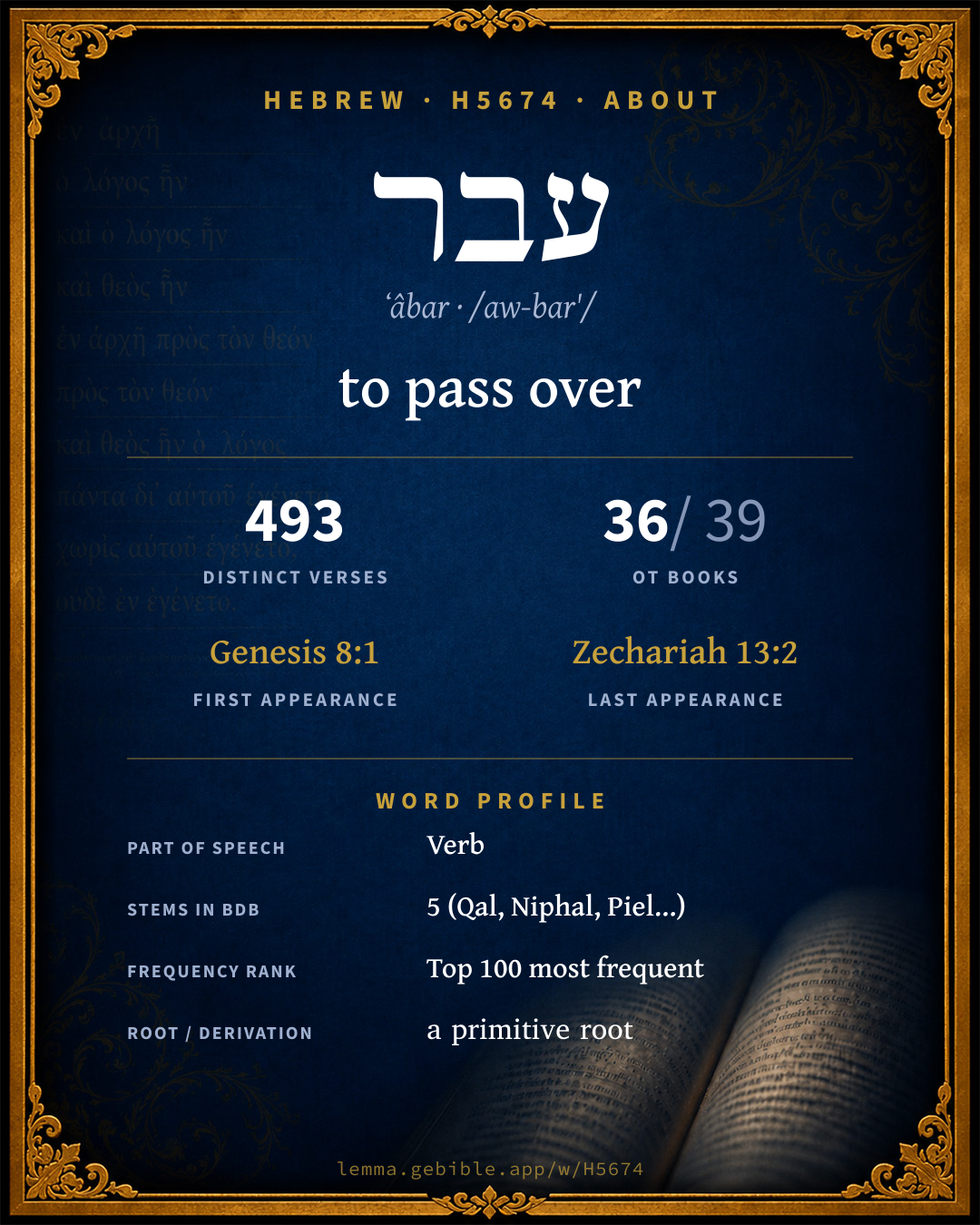
עָבַר
to pass over
‘to pass over’ is one of 4 main senses fuller range ↓
Full lexicon entry — Brown-Driver-Briggs (BDB)
From Brown-Driver-Briggs (BDB)
Where this word appears
See every Qal verb in the Hebrew Bible →
Grammar key — what these labels mean
Part of speech
- Verb
- An action or state-of-being word.
Stem
- Qal
- The basic, simple active stem — the plain form of the verb (“he wrote”). Here: ‘pass over’
- Hiphil
- The causative active stem (“he caused / brought about”). Here: ‘cause to pass over’
- Hithpael
- The reflexive or reciprocal stem (the subject acts on itself). Here: ‘be arrogant’
- Piel
- An intensive or resultative active stem.
- Niphal
- Usually the simple passive or reflexive of the Qal (“he was written”).
Form
- Participle Active
- A verbal adjective expressing ongoing or characteristic action (“writing / one who writes”).
- Sequential Imperfect
- An imperfect with prefixed waw — the standard past-narrative form (waw-consecutive imperfect).
- Imperfect
- An incomplete, ongoing, or future action (“he will / would write”).
- Perfect
- A completed action or state — Hebrew marks aspect (completeness) more than strict tense (“he wrote”).
- Infinitive Construct
- A bound verbal noun, frequently with prepositions (“to write / in writing”).
- Imperative
- A direct command (“write!”).
- Sequential Perfect
- A perfect with prefixed waw continuing a preceding imperfect or command (waw-consecutive perfect).
- Cohortative
- A first-person volitional form expressing wish or resolve (“let me / let us write”).
- Jussive
- A third- or second-person volitional form expressing wish or command (“let him write”).
- Infinitive Absolute
- An unbound verbal noun, often intensifying or standing in for a finite verb.
State
- Absolute
- The independent form of a noun, not bound to a following word.
- Construct
- A noun bound to a following noun in a possessive / “of” relationship (the construct chain).
Person
- 3rd Person
- The one spoken about (“he / she / it / they”).
- 2nd Person
- The one addressed (“you”).
- 1st Person
- The speaker (“I / we”).
Gender
- Masculine
- Grammatically masculine.
- Common
- Either gender — not distinguished for this form.
- Feminine
- Grammatically feminine.
Number
- Singular
- One.
- Plural
- More than one (in Hebrew, generally three or more).
41 verses where H5674 appears in the Qal stem in the Book of Deuteronomy. Filtered view — show all forms. Click any verse to open its interlinear word-by-word view. Verse text shown in the World English Bible for context — . Each verse’s Hebrew form is shown with its reference; the English is not keyword-highlighted, since the data carries no word-level English alignment. Use “Compare translations” on any verse to read it across multiple English versions. This concordance covers the Hebrew Bible; Septuagint (Greek Old Testament) occurrences are not indexed here.
Deuteronomy
- Deuteronomy 2:4 עֹֽבְרִ֗ים Qal ptcp.act mp Command you the people, saying, You are to pass through the border of your brothers the children of Esau, who dwell in Seir; and they will be afraid of you: take good heed to yourselves therefore;
- Deuteronomy 2:8 וַֽ/נַּעֲבֹ֞ר וַֽ/נַּעֲבֹ֔ר conj + Qal wimpf 1cp conj + Qal wimpf 1cp So we passed by from our brothers the children of Esau, who dwell in Seir, from the way of the Arabah from Elath and from Ezion Geber. We turned and passed by the way of the wilderness of Moab.
- Deuteronomy 2:13 וְ/עִבְר֥וּ וַֽ/נַּעֲבֹ֖ר conj + Qal impv 2mp conj + Qal wimpf 1cp Now rise up, and get you over the brook Zered. We went over the brook Zered.
- Deuteronomy 2:14 עָבַ֨רְנוּ֙ Qal pf 1cp The days in which we came from Kadesh-barnea, until we were come over the brook Zered, were thirty-eight years; until all the generation of the men of war were consumed from the midst of the camp, as Yahweh swore to them.
- Deuteronomy 2:18 עֹבֵ֥ר Qal ptcp.act ms You are this day to pass over Ar, the border of Moab:
- Deuteronomy 2:24 וְ/עִבְרוּ֮ conj + Qal impv 2mp Rise up, take your journey, and pass over the valley of the Arnon: behold, I have given into your hand Sihon the Amorite, king of Heshbon, and his land; begin to possess it, and contend with him in battle.
- Deuteronomy 2:27 אֶעְבְּרָ֣ה Qal coh 1cs Let me pass through your land: I will go along by the highway, I will turn neither to the right hand nor to the left.
- Deuteronomy 2:28 אֶעְבְּרָ֥ה Qal coh 1cs You shall sell me food for money, that I may eat; and give me water for money, that I may drink: only let me pass through on my feet,
- Deuteronomy 2:29 אֶֽעֱבֹר֙ Qal impf 1cs as the children of Esau who dwell in Seir, and the Moabites who dwell in Ar, did to me; until I shall pass over the Jordan into the land which Yahweh our God gives us.
- Deuteronomy 3:18 תַּֽעַבְר֗וּ Qal impf 2mp I commanded you at that time, saying, Yahweh your God has given you this land to possess it: you shall pass over armed before your brothers the children of Israel, all the men of valor.
- Deuteronomy 3:21 עֹבֵ֥ר Qal ptcp.act ms I commanded Joshua at that time, saying, Your eyes have seen all that Yahweh your God has done to these two kings: so shall Yahweh do to all the kingdoms where you go over.
- Deuteronomy 3:25 אֶעְבְּרָה Qal coh 1cs Please let me go over and see the good land that is beyond the Jordan, that goodly mountain, and Lebanon.
- Deuteronomy 3:27 תַעֲבֹ֖ר Qal impf 2ms Go up to the top of Pisgah, and lift up your eyes westward, and northward, and southward, and eastward, and see with your eyes: for you shall not go over this Jordan.
- Deuteronomy 3:28 יַעֲבֹ֗ר Qal impf 3ms But charge Joshua, and encourage him, and strengthen him; for he shall go over before this people, and he shall cause them to inherit the land which you shall see.
- Deuteronomy 4:14 עֹבְרִ֥ים Qal ptcp.act mp Yahweh commanded me at that time to teach you statutes and ordinances, that you might do them in the land where you go over to possess it.
- Deuteronomy 4:21 עָבְרִ/י֙ Qal inf.cs + sfx pers 1cs Furthermore Yahweh was angry with me for your sakes, and swore that I should not go over the Jordan, and that I should not go in to that good land, which Yahweh your God gives you for an inheritance:
- Deuteronomy 4:22 עֹבֵ֖ר עֹֽבְרִ֔ים Qal ptcp.act ms Qal ptcp.act mp but I must die in this land, I must not go over the Jordan; but you shall go over, and possess that good land.
- Deuteronomy 4:26 עֹבְרִ֧ים Qal ptcp.act mp I call heaven and earth to witness against you this day, that you shall soon utterly perish from off the land whereunto you go over the Jordan to possess it; you shall not prolong your days on it, but shall utterly be destroyed.
- Deuteronomy 6:1 עֹבְרִ֥ים Qal ptcp.act mp Now this is the commandment, the statutes, and the ordinances, which Yahweh your God commanded to teach you, that you might do them in the land where you go over to possess it;
- Deuteronomy 9:1 עֹבֵ֤ר Qal ptcp.act ms Hear, Israel: you are to pass over the Jordan this day, to go in to dispossess nations greater and mightier than yourself, cities great and fortified up to the sky,
- Deuteronomy 9:3 הָ/עֹבֵ֤ר ptcl def.art + Qal ptcp.act ms Know therefore this day, that Yahweh your God is he who goes over before you as a devouring fire; he will destroy them, and he will bring them down before you: so shall you drive them out, and make them to perish quickly, as Yahweh has spoken to you.
- Deuteronomy 11:8 עֹבְרִ֥ים Qal ptcp.act mp Therefore shall you keep all the commandment which I command you this day, that you may be strong, and go in and possess the land, where you go over to possess it;
- Deuteronomy 11:11 עֹבְרִ֥ים Qal ptcp.act mp but the land, where you go over to possess it, is a land of hills and valleys, [and] drinks water of the rain of the sky,
- Deuteronomy 11:31 עֹבְרִ֣ים Qal ptcp.act mp For you are to pass over the Jordan to go in to possess the land which Yahweh your God gives you, and you shall possess it, and dwell therein.
- Deuteronomy 12:10 וַ/עֲבַרְתֶּם֮ conj + Qal wpf 2mp But when you go over the Jordan, and dwell in the land which Yahweh your God causes you to inherit, and he gives you rest from all your enemies round about, so that you dwell in safety;
- Deuteronomy 17:2 לַ/עֲבֹ֥ר prep + Qal inf.cs If there be found in the midst of you, within any of your gates which Yahweh your God gives you, man or woman, who does that which is evil in the sight of Yahweh your God, in transgressing his covenant,
- Deuteronomy 24:5 יַעֲבֹ֥ר Qal impf 3ms When a man takes a new wife, he shall not go out in the host, neither shall he be charged with any business: he shall be free at home one year, and shall cheer his wife whom he has taken.
- Deuteronomy 26:13 עָבַ֥רְתִּי Qal pf 1cs You shall say before Yahweh your God, I have put away the holy things out of my house, and also have given them to the Levite, and to the foreigner, to the fatherless, and to the widow, according to all your commandment which you have commanded me: I have not transgressed any of your commandments, neither have I forgotten them:
- Deuteronomy 27:2 תַּעַבְר֣וּ Qal impf 2mp It shall be on the day when you shall pass over the Jordan to the land which Yahweh your God gives you, that you shall set yourself up great stones, and plaster them with plaster:
- Deuteronomy 27:3 בְּ/עָבְרֶ֑/ךָ prep + Qal inf.cs + sfx pers 2ms and you shall write on them all the words of this law, when you are passed over; that you may go in to the land which Yahweh your God gives you, a land flowing with milk and honey, as Yahweh, the God of your fathers, has promised you.
- Deuteronomy 27:4 בְּ/עָבְרְ/כֶ֣ם prep + Qal inf.cs + sfx pers 2mp It shall be, when you are passed over the Jordan, that you shall set up these stones, which I command you this day, in Mount Ebal, and you shall plaster them with plaster.
- Deuteronomy 27:12 בְּ/עָבְרְ/כֶ֖ם prep + Qal inf.cs + sfx pers 2mp These shall stand on Mount Gerizim to bless the people, when you are passed over the Jordan: Simeon, and Levi, and Judah, and Issachar, and Joseph, and Benjamin.
- Deuteronomy 29:12 לְ/עָבְרְ/ךָ֗ prep + Qal inf.cs + sfx pers 2ms that you may enter into the covenant of Yahweh your God, and into his oath, which Yahweh your God makes with you this day;
- Deuteronomy 29:16 עָבַ֛רְנוּ עֲבַרְתֶּֽם Qal pf 1cp Qal pf 2mp (for you know how we lived in the land of Egypt, and how we came through the midst of the nations through which you passed;
- Deuteronomy 30:13 יַעֲבָר Qal impf 3ms Neither is it beyond the sea, that you should say, Who shall go over the sea for us, and bring it to us, and make us to hear it, that we may do it?
- Deuteronomy 30:18 עֹבֵר֙ Qal ptcp.act ms I denounce to you this day, that you shall surely perish; you shall not prolong your days in the land, where you pass over the Jordan to go in to possess it.
- Deuteronomy 31:2 תַעֲבֹ֖ר Qal impf 2ms He said to them, I am one hundred twenty years old this day; I can no more go out and come in: and Yahweh has said to me, You shall not go over this Jordan.
- Deuteronomy 31:3 עֹבֵ֣ר עֹבֵ֣ר Qal ptcp.act ms Qal ptcp.act ms Yahweh your God, he will go over before you; he will destroy these nations from before you, and you shall dispossess them: [and] Joshua, he shall go over before you, as Yahweh has spoken.
- Deuteronomy 31:13 עֹבְרִ֧ים Qal ptcp.act mp and that their children, who have not known, may hear, and learn to fear Yahweh your God, as long as you live in the land where you go over the Jordan to possess it.
- Deuteronomy 32:47 עֹבְרִ֧ים Qal ptcp.act mp For it is no vain thing for you; because it is your life, and through this thing you shall prolong your days in the land, where you go over the Jordan to possess it.
- Deuteronomy 34:4 תַעֲבֹֽר Qal impf 2ms Yahweh said to him, This is the land which I swore to Abraham, to Isaac, and to Jacob, saying, I will give it to your seed: I have caused you to see it with your eyes, but you shall not go over there.
About this entry
At a glance — auto-summarized from this page’s data, not written by a person. Every figure links to its source below. This summary describes the numbers; it doesn’t interpret them.
עבר (ʻâbar) is a Hebrew verb most often rendered “to pass over.” Translators differ — “passed over” in the King James Version, then “crossed” (Berean Standard Bible) and “pass through” (unfoldingWord Literal Text), as the renderings breakdown shows. With 493 verses in 36 books, it is a common word in the Hebrew Bible. It first appears in Genesis 8:1. The verb spans 5 stems, from Qal to Niphal. For the data behind this summary, explore the sense tree and the renderings breakdown below.
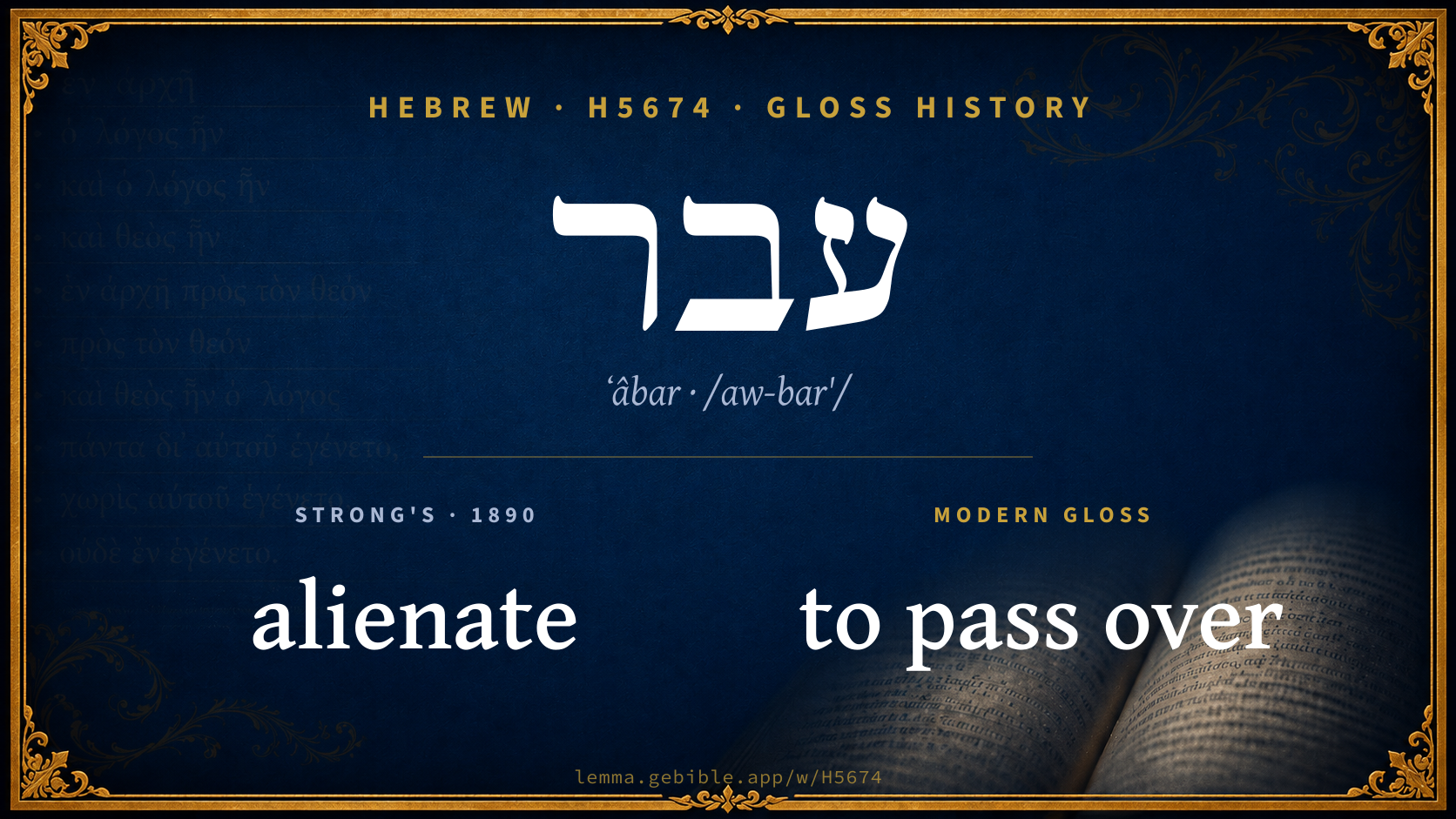
Gloss history
Strong's 1890 vs modern scholarship
About this word
Strong's H5674 catalogs a Hebrew word from the Hebrew Old Testament.
These counts are not copied from any lexicon or concordance. They are computed here, from the morphology-tagged Hebrew Old Testament. What Lemma adds →
- 493
- distinct verses
- The word appears in 493 distinct verses.
- 36 / 39
- OT books
- The word appears in 36 of 39 Old Testament books.
- #90
- by frequency
- Top 100 most frequent Hebrew words (rank 90 of 8,640 Hebrew words by occurrence).
View all 493 occurrences in the concordance →
Most concentrated in
- Joshua 49 verses 10%
- Deuteronomy 44 verses 9%
- 2 Samuel 37 verses 8%
By section of the Old Testament
By traditional corpus
Conventional, traditional groupings — biblical authorship is debated, so this is a traditional corpus grouping, not an authorship claim. Each share is this word’s portion of its verses in that division of the Hebrew canon. Each figure is a share of the word’s 493 distinct verses.
- Prophets (Nevi'im) 272 verses · 55%
- Torah (Pentateuch) 113 verses · 23%
- Writings (Ketuvim) 108 verses · 22%
How translations render this word
Counts come from each version’s own published word-to-Strong’s tagging or interlinear alignment — an approximate guide to how each version renders this word, not a word-level alignment the data otherwise carries. Because each total is that version’s own tagged count, the per-version totals vary from one another and need not match the appearance or distinct-verse counts above. These counts may also differ from a printed concordance because Lemma counts each distinctly tagged rendering and does not collapse phrase taggings into a single head-word total. This is a fixed set of word-tagged versions (KJV, ASV, BSB, ULT) and does not change with the reading translation you choose elsewhere. Each version’s license is shown beside its name below (and on Sources).
BDB lists this Strong’s number as 4 distinct words (homographs). Each count above pools all of them and is not split by sense — see the Senses section below. A low-frequency rendering may belong to a different one of those words, not the primary meaning.
- King James Version†: Passed over 26×, Pass 24×, Passed 22×
- American Standard Version†: Passed over 27×, Passed 23×, Pass 21×
- Berean Standard Bible†: Crossed 25×, Pass 18×, Cross 15×
- unfoldingWord Literal Text†: Pass through 30×, Passed over 30×, And 28×
King James Version Public Domain
Renders H5674 across 562† tagged occurrences — most commonly:
Plus other, less common renderings. Plus 247 renderings that appear only once — usually multi-word phrases or single function words the recovered tagging swept in, not distinct renderings. Not rendered by a distinct English word in 5 further occurrences.
American Standard Version Public Domain
Renders H5674 across 561† tagged occurrences — most commonly:
Plus other, less common renderings. Plus 270 renderings that appear only once — usually multi-word phrases or single function words the recovered tagging swept in, not distinct renderings.
Berean Standard Bible Public Domain
Renders H5674 across 541† tagged occurrences — most commonly:
Plus other, less common renderings. Plus 245 renderings that appear only once — usually multi-word phrases or single function words the recovered tagging swept in, not distinct renderings. Not rendered by a distinct English word in 14 further occurrences.
unfoldingWord Literal Text CC BY-SA 4.0
Renders H5674 across 694† tagged occurrences — most commonly:
Plus other, less common renderings. Plus 201 renderings that appear only once — usually multi-word phrases or single function words the recovered tagging swept in, not distinct renderings.
70 senses and sub-senses in the full BDB
Hebrew verbs can shift meaning by stem (binyan): Qal is the basic action, Niphal is often passive or reflexive, Piel often intensifies or makes it factitive, and Hiphil is typically causative. The senses below are grouped under the stem BDB assigns to each. This entry also uses Hithpael (reflexive or reciprocal).
What do BDB’s symbols mean?
BDB uses these scholarly abbreviations:
| Symbol | Meaning |
|---|---|
| 𝔊 | the Septuagint (the ancient Greek translation, LXX) |
| 𝔙 | the Vulgate (the Latin translation) |
| 𝔖 | the Syriac version (the Peshitta) |
| 𝔗 | the Targum (the Aramaic translation) |
| ψ | the Psalms |
| √ | root (the underlying root or stem) |
| ‖ | parallel passage (a synonymous or contrasted parallel) |
| † | the dagger: every passage where the word occurs is cited |
The 70 senses and sub-senses the full Brown-Driver-Briggs lexicon distinguishes for this word, in lexicon order (not ranked by frequency), with BDB’s own verbatim wording and sub-sense lettering. Shown in Hebrew script with BDB’s own scholarly abbreviations. The condensed entry is in the Lexicon Entry tab. See also the Forms in the corpus table below.
עבר I pass over, through, by, pass on (NH = BH
Qal
- Pf. 3 ms. ע׳ Gn 15:17 +, sf. עֲבָרוֹ Je 23:9; 1 s. עָבַ֫רְתִּי 1 S 15:24 +; 2 mpl. עֲבַרְתֶּם Gn 18:5 +; 1 pl. עָבַ֫רְנוּ Jos 24:17 +, etc.; Impf. 3 ms. יַעֲבֹר Am 8:5 +, יַעֲבָר־ Gn 33:14 +, sf. 3 ms. יַעַבְרֶ֫נּוּ Is 33:21; 35:8, יַעַבְרֶ֫נְהוּ Je 5:22, וַיַּעֲבֹר Gn 12:6 +; 1 s. אֶעֱבֹר Am 5:17 +, cohort. אֶעְבְּרָה Nu 21:22 +, אֶעֱבֹ֑רָה Nu 20:19 Ju 12:5, etc.; Imv. ms. עֲבֹר Ex 17:5 +; fs. עִבְרִי Mi 1:11 + 2 times; עֲבֹ֑רִי Is 23:12; mpl. עִבְרוּ Am 6:2 +; Inf. abs. עָבוֹר 2 S 17:16; cstr. עֲבֹר Am 7:8 +, לַעֲבָר־ 1 K 18:6 + Na 2:1 Qr (Kt לעבור); sf. עָבְרִי Ex 33:22 Dt 4:21, etc.; Pt. עֹבֵר Ju 8:4 +, etc.;— e.g. Genesis 15:17
- 1. pass over:
- a. = cross (stream, wady, sea, etc.), (1) c. acc. Gn 31:21 (E), 32:11 (J), Jos 3:14, 17; 4:1 (all JE), Dt 2:14 (D), Nu 32:29 (P), 2 S 17:20, 22, 24 Is 16:8, + 37 times, + Gn 32:23 (E; acc. מַעֲבַר), וְעָֽבְרָה הָֽעֲבָרָה לַעֲבִיר 2 S 19:19 (read וַיַּעַבְרוּ We Dr Kit Löhr, and they crossed the ford, or וְעָֽבְרוּ frequent., HPS; > 𝔊 Klo Bu וַיַּעַבְדוּ הָעֲבֹדָה and they performed the service); also c. acc. + acc. loc. 1 S 13:7, + ה loc. Dt 4:26; 31:13, 32:47. (2) acc. om. Ju 3:28 2 S 17:16(×2) + 32 times, + עֹבֵר Ju 8:4 (read וַיַּעֲבֹר Vrss, or del. as gloss GFM Bu), 2 S 15:23a (where read עֹמֵד for MT עֹבֵר We Dr Bu Kit Löhr HPS, but del. עֹבְרִים, plausibly, Klo HPS); c. אֶל־ †Nu 32:7 (JE), Dt 27:2 (D), Jos 4:13; 22:19 (both P), c. אֶל־עֵבֶר Dt 30:13, c. הָעֵבֶר 1 S 26:13; c.ה loc. †Dt 3:21; 4:14; 6:1; 11:8, 11; 34:4 Is 23:6; c. acc. loc. †Is 23:12 Je 2:10 Nu 32:32 (P). e.g. Genesis 31:21
- b. cross border, boundary, c. acc. Nu 20:17b; 21:22b (both JE), + אֶל־ 1 S 27:2; of invasion, acc. om., c. אֶל־ Ju 11:32; 12:3 1 S 14:1, 6, 8, c. ה loc. 2 K 8:21, abs. 2 Ch 21:9; cf. Jb 14:5. e.g. Numbers 20:17
- c. cross over (sc. intervening space) against (עַל־) 1 S 14:4, unto 2 S 24:20 (read אֶל־ for עַל־ Bu HPS, cf. 𝔊L), so perhaps also Is 45:14 (עַל; read אֶל?); c. acc. of goal Am 5:5; 6:2. e.g. 1 Samuel 14:4
- d. pass, march over (sc. bodies of captives), Is 51:23(×2). e.g. Isaiah 51:23
- e. = overflow, fig., Is 23:10, abs. of invasion (like a flood) Is 8:8, hence Dn 11:10, 40, Na 1:8 (cf. 4 c); of evil thoughts ψ 73:7; cf. עָֽבְרוּ דִבְרֵי־רָ֑ע Je 5:28 they overflow with evil matters. e.g. Isaiah 23:10
- f. pass, go, over, of waves, over one’s head, usually c. עַל־ Is 54:9 ψ 42:8; 88:17; 124:4, 5 (all fig.), Jon 2:4; c. acc. ψ 38:5, cf. Je 23:9 over whom wine hath gone (= overcome with wine). e.g. Isaiah 54:9
- g. of razor passing over head, c. עַל Nu 6:5; fig. of time passing over one, c. עַל־ 1 Ch 29:30 (cf. Biblical Aramaic חלף על Dn 4:13 +). e.g. Numbers 6:5
- h. pass over upon (עַל־), in weakened sense, nearly = come or light upon; of spirit Nu 5:14(×2), 30; abs. + מֵאֵת 1 K 22:24 = 2 Ch 18:23; c. עַל־ also light upon in chastisement or judgment, Ho 10:11 Jb 13:13, cf. Na 3:19; Dt 24:5 no affair shall pass over upon (עַל־) him, i.e. no duty be laid upon him. e.g. Numbers 5:14
- i. overstep, transgress, c. acc. of covenant, command, etc. (usually divine); Nu 14:41; Jos 7:11, 15 (all JE), Dt 17:2; 26:13; Jos 23:16 (all D), Ju 2:20; 1 S 15:24; Ho 6:7; 8:1; 2 K 18:12; Je 34:18; Is 24:5 ψ 148:6 2 Ch 24:20; Dn 9:11; command of earthly king Est 3:3; abs. ψ 17:3 Jb 14:5. e.g. Numbers 14:41
- j. pass over = overlook, forgive עַל־פֶּשַׁע Mi 7:18 (+ לְ pers.), Pr 19:11; c. לְ pers. only, Am 7:8; 8:2. e.g. Micah 7:18
- 2. Pass beyond, c. acc. 1 S 14:23 (of battle), Je 5:22(×2) (of sea); + אֶל Gn 31:52(×2) (E); pass a little beyond ע׳ מְעַט מֵהָרֹאשׁ 2 S 16:1, כִּמְעַט שֶׁעָבַרְתִּי מֵהֶם Ct 3:4; c. acc. of God’s command (פֶּה), Pr 8:29 (of sea), Nu 22:18 = 24:13 (JE); acc. om. Jb 14:5 ψ 104:9. e.g. 1 Samuel 14:23
- 3. Pass through, traverse, usually
- a. c. בְּ of land, city, etc.: Nu 21:23 (E), 20:21 Jos 18:9 (JE), Ex 12:2 (P), 1 S 9:4(×4) 2 S 20:14 (+ ה loc.), + 31 times; c. בְּתוֹךְ †Ez 9:4 Jb 15:19; c. בְּקֶרֶב of camp, nation(s) †Jos 1:11; 3:2 (D), 24:17 (E), Am 5:17 Dt 29:15; c. acc. †Dt 2:18; 29:15 Ju 11:29(×2) Is 10:29; abs. Ex 12:23 (J) 15:16 (JE), Nu 20:19, 20 (JE), Dt 2:28 Mi 5:7 La 3:44 Ez 14:15; 33:28; †opp. שׁוּב, pass through and return, go to and fro, Ex 32:27 (E; מִשַׁעַר לָשַׁעַר בְּ׳), pt. abs. those going to and fro Ez 35:7 Zc 7:14; 9:8. e.g. Numbers 21:23
- b. c. בְּ of river 2 S 19:19 + 15:23 (but read עֹמֵד We Dr Bu al.), of sea Zc 10:11, cf. Is 43:2 ψ 66:6, c. בְּתוֹךְ Nu 33:8 (P), Ne 9:11; c. בְּ of gates Is 62:10(×2); cf. עֹבְרֵי בְּעֵמֶק ψ 84:7 (Ges§ 130 a). e.g. 2 Samuel 19:19
- c. pt. abs. הָעֹבְרִים the passers-through Ez 39:11a, read prob. הָעֲבָרִים (JDMich Hi Co Berthol), v 11b (Co reads אֶת־הַגַּיְא; Toy del. as gloss), v 14 (del. 𝔊 𝔖 Co Toy Berthol). e.g. Ezekiel 39:11
- d. pass through between (בֵּין) parts of victim, in covenant Gn 15:17 (J), Je 34:18, 19. e.g. Genesis 15:17
- e. traverse c. acc. of expanse of water Is 33:21 (of ship). e.g. Isaiah 33:21
- 4.
- a. pass along by (עַל־), Gn 18:5 (J; not סַרְתֶּם אֶל־ Ball after 𝔊), 1 K 9:8 Je 18:16 + 14 times; c. עַל־פָּנָיו †Ex 34:6 (J); c. acc. †Gn 32:32 Ju 3:26 (on other possibilities v. GFM), 2 K 6:9; abs. pass by Ex 33:22(×2) (J), 2 K 4:8 + 15 times, + (of wind) Jb 37:21 Pr 10:25 and (of waters, = flow past) Hb 3:10 (cf. Jb 6:15), Jb 11:16, hence מוֹר עֹבֵר Ct 5:5, 13 flowing myrrh (liquid, opp. hard = מ׳ דְּרוֹר Ex 30:23); pt. = passer-by Mi 2:8 Ez 5:14; 36:34; 39:15 + 6 times. (Pr 26:10 v. Toy), + עֹבֵר אֹרַח Is 33:8, עֹבְרֵי דֶרֶךְ †La 1:12; 2:15 Jb 21:29 Pr 9:15 ψ 80:13; 89:42; pass by = overtake and pass c. acc. †2 S 18:23. e.g. Genesis 18:5
- b. pass by, בְּ rei, ψ 103:16 (of wind); cf. Dt 2:4. e.g. Psalms 103:16
- c. sweep by, of scourge (fig.) Is 28:15, 18, 19 (cf. מַעֲבָר 3). e.g. Isaiah 28:15
- d. be past, over, of time, etc., Am 8:5 1 K 18:29 Gn 50:4 Ct 2:11 + 7 times e.g. Amos 8:5
- e. pass along (from hand to hand), only pt. שֶׁקֶל כֶּסֶף עֹבֵר לַסֹּחֵר Gn 23:16 i.e. current money of the merchant (v. BuTh Lz 1892(3), 63); כֶּסֶף עֹבֵר 2 K 12:5 (v. עֵרֶךְ). e.g. Genesis 23:16
- 5. Pass on, go on:
- a. abs. Gn 18:5 (J), Nu 22:26 (E), Ju 12:1 + 20 times, + Ju 11:29; 18:13 Jos 10:29 (D; all c. acc. of goal + מִן), Gn 18:3 (J; c. מֵעַל pers.); also c. אֶל־ pers. vel rei, proceed unto 1 K 19:19 2 K 4:8 Ne 2:14, c. עַל־ pers. (read אֶל־?) La 4:21; c. מִן Ru 2:8, out of the city 2 S 15:24; c. ה loc. Ju 12:1 2 S 19:41, c. ה loc. + מִן Jos 10:31, 34 (D); ע׳ מֵעִיר לָעִיר בארץ 2 Ch 30:10; abs. 2 S 19:41 all the people of Judah proceeding with the king (read עֹבְרִים for ויעברו, v. Hiph. ad fin.). e.g. Genesis 18:5
- b. specif. of boundary-line, pass on, c. ה loc. Nu 34:4(×2) Jos 15:3, 4; 16:6 (om. אוֹתוֹ 𝔊 𝔙 cf. BennHpt Steuern); + מִן 19:13 + מִן + אֶל־ 18:13; c. מִן + לְ 15:6; c. אֶל־ 15:7, 10; 16:2; 18:18, 19; c. acc. loc. 15:3, 10, 11 (all P, except Jos 16:2 JE). e.g. Numbers 34:4
- c. c. לִפְנֵי pass on before, go in advance of Gn 32:17 Ex 17:5 (both E), Gn 32:22; 33:3, 14 (all J), Dt 9:3 + 7 times, + Dt 3:18, 28; 31:3(×2) Jos 1:14 (all D) where ref. may be to crossing in advance of; c. עַל־פְּנֵו 2 S 15:18 so v 23b (reading עַל־פָּנָיו 𝔊L We Dr Klo Bu Kit HPS). e.g. Genesis 32:17
- d. pass on as far as (עַד), Ju 19:12, + מִן v 18; c. אַחֲרֵי after 2 S 20:13; תַּעֲבָר־כּוֹם עַל La 4:21 pass on unto (cf. תִּסּוֹב Hb 2:16). e.g. Judges 19:12
- e. pass on into (בְּ), Jos 3:11 (+ לִפְנֵי), 4:7 (both JE), cf. Ju 9:26 Jb 33:28, so also ע׳ בִּבְרִית י׳ Dt 29:11 enter into a covenant with י׳; (Klo reads וַיַּעֲבֹר בַּבּ׳ also 2 K 23:3 for MT ויעמד). e.g. Joshua 3:11
- f. pass on away from (מֵאֵת) Dt 2:8 (+ ה loc.). e.g. Deuteronomy 2:8
- g. pass on in order, for counting 2 S 2:15, עַל־יְדֵי מוֹנֶה Je 33:13, עֹבֵר עַל־הַפְּקֻדִים Ex 30:13, 14; 38:26, also pass on under (תַּחַת) rod Lv 27:32 (for counting; all P; cf. Hiph. 3 d). e.g. 2 Samuel 2:15
- h. pass along, travel c. acc. of way Is 35:8 cf. 51:10; עֹבֵר אָרְחוֹת יַמִּים ψ 8:9; c. בְּ of way Jos 3:4 Pr 4:15; 7:8. e.g. Isaiah 35:8
- i. pass on, advance, abs., ψ 48:5 (Ol We pass away, perish), Mi 2:13a (acc. loc.). e.g. Psalms 48:5
- 6. Pass away:
- a. emigrate, leave one’s territory or city Mi 1:11. e.g. Micah 1:11
- b. vanish, of chaff, Is 29:5 cf. Je 13:24, shadow ψ 144:4, brooks Jb 6:15 (all in sim.), Ct 5:6. e.g. Isaiah 29:5
- c. = cease to exist, perish Na 1:12 Jb 30:15; 33:18 (בְּ instr.), 36:12 (id.), 34:20 ψ 37:36 (but read ואעבר and I passed by, cf. 4 a), cf. Is 31:9 (סלעו subj.), מֵאֱלֹהַי מִשְׁפָּטִי יַעֲבוֹר 40:27 pass away from. e.g. Nahum 1:12
- d. = become invalid, obsolete, of law, decree, Est 1:19; 9:27, also v 28 (+ מִתּוֹךְ הַיְהוּדִים). e.g. Esther 1:19
- e. c. מִן of hands ψ 81:7 (i.e. they were freed from). e.g. Psalms 81:7
- f. = be alienated, pass into other hands Ez 48:14 (reading Kt; > Qr Hiph.).—Je 2:20 read אֶעֱבוֹד Kt (not אֶעֱבוֹר Qr); וָאֶתֵּן לָהֶם יַעַבְרוּם 8:13 and I gave to them that which they transgress 𝔖 𝔙 𝔗 Aq Symm Ew, those that shall pass over them Hi Gf Ke RVm, those that shall consume, devour them RothstKau (reading יְבַעֲרוּם) but all very dub.; 𝔊 Co del.; 11:15 read Hiph. q.v.; מִנֹּגַהּ נֶגְדּוֹ עָבָיו עָֽבְרוּ ψ 18:13 is difficult; perhaps best, as Che KitKau Löhr, out of the brightness before him issued forth hailstones, etc. (del. עָבָיו); > ‖ 2 S 22:13 בָּֽעֲרוּ and so here Bu HPS cf. WoodsHbr 1887, 262, his clouds burned with hailstons, etc.; read rather עברו in 2 S. e.g. Ezekiel 48:14
Niphal
- Impf. 3 ms. נַחַל אֲשֶׁר לֹא יֵעָבֵר Ez 47:5 a stream which cannot be forded. e.g. Ezekiel 47:5
Piel
- 1. Pf. 3 ms. שׁוֹרוֹ עִבַּר Jb 21:10 his bull impregnateth (cf. NH מְעֻבֶּרֶת pregnant, Yeb 4:1, 2; 7:3 Keth 1:9; but note also that in 𝔗J and Talm. (both Aramaic and Heb.) עִבַּר = conceive, עִבּוּר conception, עוֹבֵר embryo.) abs. (proposes causeth to pass over, sc. semen).* e.g. Job 21:10
- 2. Impf. 3 ms. וַיְעַבֵּר בְּ׳ 1 K 6:21 he made to pass across with chains of gold.— e.g. 1 Kings 6:21
Hithpael
- v. [עָבַר] infr.
Hiphil
- Pf. 3 ms. הֶעֱבִיר 2 S 12:13 +; 2 ms. הֵעֲבַ֫רְתָּ Jos 7:7 (Ges§ 63 p), וְהַעֲבַרְתָּ֫ Ez 5:1 +; 1 s. הֶעֱבַ֫רְתִּי Zc 3:4, וְהַעֲבַרְתִּ֫י Ez 20:37 + Je 15:14 (but read והעבדתי 𝔊 𝔖 𝔗 Codd Ew Hi Gf Gie), etc.; Impf. 3 ms. וַיַּעֲבֵר Gn 8:1 +, וַיַּעֲבֶר־ 2 Ch 36:22 = Ezr 1:1, sf. וַיַּעֲבִרֵנִי Ez 46:21 +, etc.; Imv. ms. הַעֲבֵר ψ 119:37 + 2 times, הַעֲבֶר־ 2 S 24:10 = 1 Ch 21:8; mpl. sf. הַעֲבִירוּנִי 2 Ch 35:23; Inf. abs. הַעֲבִיר Jos 7:7 (read prob. הַעֲבֵיר); cstr. הַעֲבִיר 2 S 3:10 +, לַעֲבִיר 2 S 19:19 (Ges§ 53 q), etc.; Pt. מַעֲבִיר Dt 18:10 Dn 11:20, pl. מַעֲבִרִים 1 S 2:24 (v. infr.);— e.g. 2 Samuel 12:13
- 1. cause to pass over, bring over:
- a. cause one to cross river, c. 2 acc., Gn 32:24 (J), Nu 32:5 Jos 7:7 (both JE), 2 S 19:16, 42; acc. of river om. Gn 32:24 (J), Jos 4:3; 7:7 (+ Inf. abs.; both JE), 4:8 (JE; + אֶל־), 2 S 2:8 (+ acc. loc.). e.g. Genesis 32:24
- b. cause something to pass over (עַל־): razor (acc.) Nu 8:7 (P), cf. Ez 5:1 (where Co reads sf. of razor), wind Gn 8:1 (P). e.g. Numbers 8:7
- c. make over to (ל), acc. of inheritance Nu 27:7, 8 (P); of making over, dedicating, something to (לְ) deity Ex 13:12 (JE; = קִדַּשׁ). Especially e.g. Numbers 27:7
- d. devote children to (לְ) heathen god Je 32:35 Ez 23:37 (+ לְאָכְלָה), Lv 18:21 (H), cf. Ez 16:21; + בָּאֵשׁ by fire 2 K 23:10; c. acc. alone devote Ez 20:26; c. acc. + בָּאֵשׁ alone, devote by fire Dt 18:10 2 K 16:3; 17:17; 21:6 = 2 Ch 33:6, Ez 20:31 (on the practice cf. NowArch. ii. 205 f. BenzArch. 433 f. Toy Ez:16:20; 20:26 GFMJBL xvi (1897), 161 ff.). e.g. Jeremiah 32:35
- 2.
- a. cause to pass through, c. acc. + בְּ Ez 14:15; 47:3, 4 + v 4 (where ins. בְּ, cf. Co Berthol Toy), Nu 31:23(×2) (P); c. acc. + בְּתוֹךְ ψ 136:14; c. acc. pers. alone 78:13, + אֶל־ Ez 46:21, + עַד־אֲשֶׁר Ne 2:7; c. acc. of (sound of) שׁוֹפָר Lv 25:9 (H), + בְּ v 9 (P); c. acc. קוֹל = proclamation, + בְּ Ex 36:6 (P), 2 Ch 30:5; 36:22 = Ezr 1:1, Ezr 10:7 (+ לִ pers.), Ne 8:15. e.g. Ezekiel 14:15
- b. let pass through, c. acc. + בְּ pers. Dt 2:30. e.g. Deuteronomy 2:30
- 3.
- a. cause to pass by, c. acc. + עַל־, Ez 37:2 (+ סָבִיב סָבִיב), + עַל־פְּנֵי Ex 33:19 (J), + לִפְנֵי 1 S 16:8, 10 and (לִפְנֵי om.) v 9. e.g. Ezekiel 37:2
- b. let pass by, c. acc. מוֹעֵד Je 46:17 he hath let the set time pass by (in mocking appell. of Pharaoh). e.g. Jeremiah 46:17
- c. cause arrow to pass beyond one 1 S 20:36. e.g. 1 Samuel 20:36
- d. cause to pass under rod, for counting, Ez 20:37 (cf. Qal 5 g). e.g. Ezekiel 20:37
- 4. Cause to pass away, take away, kingdom (acc.) + מִן pers. 2 S 3:10, cf. Est 8:2, put off robe + מֵעַל Jon 3:6; c. acc. of sin 2 S 12:13 (חַטָּאת) 24:10 = 1 Ch 21:8; Jb 7:21 (עָוֹן), + מֵעַל pers. Zc 3:4; Je 11:15 (reading יַעֲבִרוּ מֵעַל Ew Gf Gie); put away evil (acc.) from (מִן), 1 K 15:12 cf. ‖ 2 Ch 15:8; Zc 13:2; Ec 11:10; c. acc. alone ψ 119:39 Est 8:3; also take me away (sf.) 2 Ch 35:23 (c. מִן) v 24; turn away eyes (acc.) + מִן ψ 119:37.—Gn 47:21 read הֶעֱבִיד לַעֲבָדִים Sam 𝔊 𝔙 Ol Kn Di Kau Holz; Je 15:14 read וְהַעֲבַדְתִּיךָ 𝔊 𝔗 Codd Gie; 2 S 12:31 read וְהֶעֱבִיד HoffmZAW ii (1882), 53 f. Gr Klo Bu Kit HPS, cf. Dr Löhr; 2 S 19:41 (for ויעברו Kt, הֶעֱבִרוּ Qr) read עֹבְרִים 𝔊 We Bu Löhr HPS, וַיַּעַבְרוּ Kit (v. Qal 5 a); Ez 48:14 read Qal (so Kt; v. Qal 6 f); מַעֲבִרִים עַם־י׳ 1 S 2:24 not good is the report which I hear the people of י׳ spreading (cf. 2), so Ew Th We Dr Kit Löhr RVm, but order of words difficult; > (ye) make the people of י׳ transgress 𝔙 AV RV; text dub.; מַעֲבִיר נוֹגֵשׂ Dn 11:20 one causing an exactor to pass through Ew al. RV, Bev proposes נוֹגֵשׂ מ׳ an exactor causing to pass away the glory, etc. e.g. 2 Samuel 3:10
עבר II
- 1. region across or beyond anything (usually wady, river, or sea), mostly c. prep.: בְּעֵבֶר אַרְנוֹן Nu 21:13 (JE) Ju 11:18, cf. Je 25:22; אֶל־ע׳ הַיָּם Dt 30:13 b, מֵעֵבֶר לַיָּם v 13 a beyond the sea; מֵע׳ לְנַהֲרֵי־כוּשׁ Is 18:1, cf. עַד־מֵע׳ 1 K 4:12 (מִן on the side of, on, v. מִן 1 c; so usually c. ע׳); but also (rarely) מֵע׳ from the other side of Zp 3:10 Jb 1:19 2 Ch 20:2; abs. הָע׳ 1 S 26:13 to the other side (sc. of a ravine; after וַיַּעֲבֹר); בְּעֵבֶר הָעֵמֶק 1 S 31:7, read perhaps בְּעָרֵי הָע׳, so Klo Bu HPS; בְּעֶבְרֵי פִי־פָ֑חַת Je 48:28 beyond the mouth of a chasm is dub.; Gie proposes בְּחֹרֵי כֵפֵי בַתֹּת in the rock-holes of the precipices; especially (chiefly Hex, 37 times) ע׳הַיַּרְדֵּן (30 times), or (less often, Jos 13:32 + 13 times), לַיַּרְדֵּן, לְיַרְדֵּן יְרֵחוֹ (only c. מֵע׳), of either E. Jordan (36 times) or W. Jordan land (9 times) according to standpoint of speaker or writer: A. E. Jordan (from standpoint of writer) Gn 50:10, 11 (J) Jos 17:5 (JE) Dt 1:1, 5; 4:41, 46, 47, 49; Jos 1:14; 12:1; 13:8 (D), Nu 22:1; 32:19; 34:15 Jos 13:27, 32; 14:3; 20:8 (P), Ju 7:25; 10:8 1 S 31:7 Is 8:23 1 Ch 6:63; 12:37; from standpoint of speaker, Jos 7:7 (JE), 24:8 (E), 1:15; 2:10; 9:10; 18:7; 22:4 (D), Ju 5:17; in Nu 35:14 (Moses speaks) it is land opp. to Can., cf. Nu 32:32; in Dt 3:8 (Moses speaks) writer (D) ascribes his own standpoint to Moses; (often further topogr. note is added, e.g. מִזְרָ֫חָה Dt 4:49 +, מִזְרַח הַששֶּׁמֶשׁ Jos 1:15 +, etc.); אֶל־עֵבֶר בְּנֵי יִשְׂר׳ Jos 22:11 toward the region opposite the sons of Israel appar. also refers to E. side (v. Steuernagel on text). B. W. Jordan (9 times), from standpoint of speaker Dt 3:20, 25 (Moses), also 11:30 (but here + מְבוֹא הַשֶּׁמֶשׁ, and in all foll. some special designation of West), + יָ֫מָּה Jos 5:1 (D; from standpoint of those just crossed), 12:7 (opposite East v 1–6), 22:7 (id.; Kt מעבר, Qr בְּעֵבֶר), cf. 9:1 (as 5:1); + וָהָ֑לְאָה Nu 32:19 a (opposite East v b); in 1 Ch 26:30 מֵע׳ לַיַּר׳ מַעֲרָ֑בָה ע׳ seems = side (v. infr.). Also בְּע׳ הַנָּהָר beyond the river (Euphrates) Jos 24:2, 14, 15 (E; Kt Qr מֵע׳), מֵע׳ 2 S 10:16 = 1 Ch 19:16 beyond, and 1 K 14:5 to the other side of (v. מִן 1 c); מֵע׳ from beyond the river only Jos 24:3 (E), in all these = beyond the Euphr. eastward, from standpoint of those west of Euphr.; so pl. בְּעֶבְרֵי הַנּ׳ Is 7:20; poss. also ע׳ alone (si vera l.) in the difficult passage Nu 24:24; ע׳ הַנָּהָר = region beyond the river (Euphr.) westward (from standpoint of those in Babylonia or Persia) Ne 2:7, 9; 3:7 Ezr 8:36; also 1 K 5:4(×2) (written in Bab.; cf. Biblical Aramaic עֲבַר, and DrIntr (6) 504). cf. late Assyrian ebir nâri SchrKB iv. 304, 1. 7 from below; KAT 3. 188, 437. e.g. Numbers 21:13
- 2. (Opposite) side, side: מֵע׳ הַלָּז 1 S 14:1 on yonder side seems transition to this meaning; מֵהָע׳ מִזֶּה twice, v 4 = on one side, on the other side, so לְע׳ אֶחָד twice v 40; even מִשְּׁנֵי עִבְרֵיהֶם Ex 32:15 (E) on their two sides (i.e. of tablets); אֶל־ע׳ הָאֵפוֹד בָּ֑יְתָה Ex 28:26 (P) toward the inner side of the ephod; in 1 K 7:20, 30 ע׳ appar. = at the side of or opposite, but the archit. details are obscure; מִכָּל־עֲבָרָיו מִסָּבִיב 1 K 5:4 on all sides of him, round about, מִכָּל־עֲבָרָיו Je 49:32 (reads עֶבְרֵיהֶם Vrss Gie) from all sides of them (all directions, = מִכָּל־סְבִיבָ֑יִךְ v 5); אֶל־עֵבֶר פָּנָיו יֵלֵ֑כוּ to the side of their faces (i.e. in front, straight forward) they (always) went Ez 1:9, 12; 10:22, cf. עַל־ע׳ פָּנֶיהָ Ex 25:37 to give light upon the space in front of it; אִישׁ לְעֶבְרוֹ תָּעוּ Is 47:15 they wander away each in his own direction (regardless of thee).—On 1 Ch 26:30 v. supr. e.g. 1 Samuel 14:1
עבר III m. Eber (perhaps eponym of Hebrews, form inferred from עִבְרִי, cf. reff. there)
- 1. ‘son’ of Shelaḥ, and ‘grandson’ of Arpachshad Gn 10:24 (J) = 1 Ch 1:18; Gn 11:14, 15 (P); ‘father’ of Peleg and Joktan 10:25 (J; with especially ref. to Joktan v 26 ff., i.e. to Arabians) = 1 Ch 1:19 (cf. v 20 ff.), of Peleg specif. Gn 11:16, 17 (P; with especially ref. to Abr. v 26 f.) cf. 1 Ch 1:25 (see v 27 f.); in Gn 10:21 (J) Shem is called אֲבִי כָּל־בְּנֵי־עֵבֶר; 𝔊 Εβερ.—ע׳ Nu 24:24 perhaps (si vera l.) belongs not here (= עִבְרִים Hebrews, 𝔊 Ἐβραίους, so Thes), but sub i. עֵבֶר = the (land) beyond (the river), ‖ אַשּׁוּר, so Di Kau. e.g. Genesis 10:24
- 2. a Gadite chief 1 Ch 5:13, 𝔊 Ωβηδ, 𝔊L Εβερ. e.g. 1 Chronicles 5:13
- 3. Benjamite names:
- a. 1 Ch 8:12, 𝔊 Ωβηδ, 𝔊L Αβερ. e.g. 1 Chronicles 8:12
- b. 1 Ch 8:22 (עֵבֶר van d. H. Ginsb; עֶבֶד Baer), 𝔊 Ωβδη, A Ωβηδ, 𝔊L Αβερ. e.g. 1 Chronicles 8:22
- 4. a priest Ne 12:20 𝔊L Αβεδ. e.g. Nehemiah 12:20
עבר IV denom.
Hithpael
- be arrogant, infuriate oneself;—Pf. 3 ms. הִתְעַבָּ֑ר ψ 78:62; 2 ms. הִתְעַבַּ֫רְתָּ 89:39; Impf. 3 ms. וַיִּתְעַבֵּר Dt 3:26, וַיִּתְעַבָּ֑ר ψ 78:21, 59; Pt. מִתְעַבֵּר Pr 14:16; 26:17; sf. מִתְעַבְּרוֹ 20:2;— e.g. Psalms 78:62
- 1. be arrogant, Pr 14:16 (opp. יָרֵא). e.g. Proverbs 14:16
- 2.
- a. put oneself in a fury, become furious. c. בְּ pers. Dt 3:26 ψ 78:62; c. עִם pers. 89:39; abs. 78:21, 59 (all of God); of man, c. עַל rei. Pr 26:17. e.g. Deuteronomy 3:26
- b. incite one to fury for oneself Pr 20:2 (si vera l.; cf. De Ges§ 54 f.). e.g. Proverbs 20:2
Senses from the full Brown-Driver-Briggs lexicon (Brown, Driver, Briggs; Oxford 1906 — public domain), digitized via Sefaria, supplemented by the OpenScriptures HebrewLexicon (CC BY 4.0). Full attribution on Sources.
Word origin
I. vb. pass over, through, by, pass on (NH = BH; Zinj. עבר Haph. Lzb336 Cook88, perhaps also Nab. עבר id.ib.; 𝔗 עֲבַר, Syriac ܥܒܰܪ id.; Assyrian ebêru, id. DlHWB 10, and deriv.; Arabic عَبَرَ id., and deriv.; Sab. עבר = Heb. עִבַּר 1. MordtSab Denkm 49; עברת passage, march through DHMZMG xxix (1875), 614 also bank or neighbourhood of a stream Sab Denkm49);—
I. n.m. 1 S 14:40 region across or beyond, side (on format. cf. BaNB 144; cf. especially Assyrian êbru, êbirtu, id. êbirtan, adv. beyond);—ע׳ abs. 1 S 14:4 +; cstr. Jos 24:4 +; sf. עֶבְרוֹ Is 47:15; pl. cstr. עֶבְרֵי Is 7:20 Je 48:28 (si vera l., v. infr.); sf. עֲבָרָיו 1 K 5:4 Je 49:32 (read probably עֶבְרֵיהֶם, so Vrss), עֶבְרֵיהֶם Ex 32:15;—
II. n.pr.m. Eber (perhaps eponym of Hebrews, form inferred from עִבְרִי, cf. reff. there);—
— Brown-Driver-Briggs (Oxford 1906, public domain), digitized via Sefaria, supplemented by the OpenScriptures HebrewLexicon (CC BY 4.0). See Sources.
Origin: a primitive root
Jastrow Dictionary
A second Hebrew/Aramaic lexicon for comparison, covering Aramaic and post-biblical (Talmudic, Targumic, Midrashic) usage that the biblical-Hebrew BDB does not. Matched by lemma rather than by Strong’s number, so a lemma may carry more than one Jastrow headword (shown separately below), and the entries cover usage well beyond the Bible.
עָבַר
- (b. h.)
- 1. to be thick, swell; to run over. Par. VI, 4 כדי שׁיַעַבְרוּ המים וכ׳ that the water may overflow into a vessel; a. e.—Ex. R. s. 15 שאני עוֹבֵר, v. עֶבְרָה.
- 2. (cmp. סְגֵי I a. II) to pass, to cross. Tosef. Sot. VIII, 1; Sot. 33ᵇ כיצד עָבְרוּ ישראל את וכ׳ in what manner did the Israelites cross the Jordan? Cant. R. to V, 13 עוֹבֵר הוא וחוזר וכ׳ he goes over his studies once and again &c.; a. fr.—ע׳ את הדין to cross the line of justice, to be too severe. Midd. II, 2 כאילו עברו עליו וכ׳ as if they had treated him too severely (arbitrarily). Ex. R. s. 30 כשם שאני יכול לַעֲבוֹר … ואני איני מַעֲבִיר וכ׳ as I (the Lord) have power to treat the nations with rigor, but refrain from doing so, so shall you not go beyond the line of justice. Ib. עִיבְּרָה את הדין (Pi.); a. e.
- 3. (with על) to pass over (a sin); to forgive. Cant. R. to V, 5 (play on מור עובר, ib.) מר עובר ע׳ על מררי the bitterness passes away, he (the Lord) passes over my bitterness (sin). R. Hash. 17ᵃ (ref. to Mic. VII, 18) למי נושא עון למי שעובר על פשע whose iniquity does he pardon? the iniquity of him who forgives (his neighbor’s) transgression; a. e. e.g. Micah 7:18
- 4. to transgress, sin. Yoma 86ᵇ, a. e. כיון שע׳ אדם עבירה ושנה וכ׳ as soon as a man has committed a sin and repeated it, it becomes to him a permitted act. Ib. 86ᵃ, a. e. ע׳ על עשה when one has transgressed a positive law (committed a sin of omission). Ib. ע׳ על כריתות וכ׳ when one has committed sins punishable with extinction or death by a court. Erub. 100ᵃ, a. fr. עובר על בל וכ׳, v. בַּל. Keth. VII, 6 העוֹבֶרֶת על דת וכ׳ if a wife offends against Mosaic or Jewish customs, v. דַּת; Y. ib. VII, 31ᶜ top נשים המְעַבְּרוֹת על הדת (Pi.); a. v. fr.
- 5. to pass, overtake, precede. Pes. 7ᵇ כל המצות מברך עליהן עובר לעשייתן in the performance of all religious ceremonies one must say the benediction over them before doing them; מאי משמע דהאי עובר לישנא דאקדומי היא what evidence is there that this ‘ober has the meaning of precedence? Answ. by ref. to ויעבר (II Sam. XVIII, 23) ‘and he arrived before the Cushite’. e.g. 2 Samuel 18:23
- 6. to pass by, go away, be removed. Pes. III, 1 אלו עוֹבְרִין בפסח the following things must pass away (their use must be suspended) during Passover. Bets. 26ᵃ, a. fr. מום עובר a transitory blemish, opp. קבוע. Ber. 26ᵃ ע׳ יומו בטל קרבנו when its day is passed, the sacrifice of the day is void. Pes. II, 2 חמץ … שע׳ עליו הפסח leavened matter … over which Passover has passed (which had been in the house during Passover). Ber. IX, 3 הצועק לַשֶּׁעָבַר וכ׳ praying for what is passed (decided) is a vain prayer, e.g. if one’s wife is with child, and one prays, may it be the will of God that my wife bear a male child; Y. Taan. II, 65ᶜ bot. נותן הודייה לשעבר וצועק וכ׳ one gives thanks for what is passed, and prays for what is to come. Gitt. VII, 7 כל זמן שאֱעֶבוֹר מכנגד פניך וכ׳ as soon as I shall have been out of thy sight for thirty days; Tosef. ib. VII (V), 10. Keth. 17ᵃ ע׳ מלפני כלה he passed aside to make room for a bridal procession. Yoma 66ᵃ, a. e. חטאת שעָבְרָה שנתה a sin-offering whose year is passed (that is older than one year); Tem. 22ᵃ שעִיבְּרָה שנתה (Pi.) whose year is completed (v. infra). Ib. 21ᵇ בכור שעברה שנתו a first-born animal older than one year; R. Hash. 5ᵇ; Zeb. 29ᵃ bot. שעיברה; Tosef. Snh. III, 6 בכור שעיברה זמנו ed. Zuck. (read with Var.: שעבר). Keth. 87ᵃ על שֶׁעָ׳ as regards the past, v. עָתִיד; a. v. fr.—לַשֶּׁעָ׳ in former days. Gen. R. s. 47, opp. עַכְשָׁיו; a. fr.
- 1. to lead past, stroke gently. Tosef. Sabb. VII (VIII), 23 [read:] מַעֲבִירִין על גבי העין בשבת you are permitted to stroke a sore eye on the Sabbath; Y. ib. XIV, 14ᶜ bot. מעבירין על העין. Ib. הֶעֱבִירוּ עליו כלים they passed garments over it.
- 2. to cause to pass; to remove, displace. Keth. 17ᵃ מַעֲבִירִין את המת מלפני כלה וכ׳ a funeral procession is made to make way for a bridal procession, and both of them for the king, v. supra. Gitt. 57ᵇ שאין אנו מעבירין אותו באל אחר that we shall never displace him for another god; שאין מַעֲבִיר אותנו וכ׳ that he will never displace us for another nation. Ex. R. s. 30 כאילו היא מעביר איקינין וכ׳ as if he removed (defaced) the king’s portrait; a. fr.
- 3. to go beyond. Ib. איני מעביר וכ׳, v. supra. Ib. הבריות מעבירין על הדין וכ׳ men go beyond the line of justice (are treacherous, cruel), and they are punished; a. e.
- 4. to skip over; to forego, postpone.—ה׳ על מדותיו, v. מִדָּה.—Yoma 33ᵃ; 58ᵇ, a. fr. אין מעבירין על המצות you must not forego the occasion for performing a religious act. Erub. 64ᵇ אין מעבירין על האוכלין you must not pass by eatables (and let them lie in the street); B. Mets. 23ᵃ; a. fr.
- 5. to forego, overlook, pardon. R. Hash. 17ᵃ (ref. to Mic. VII, 18) מעביר ראשון ראשין וכך היא המדה (Ms. M. על ראשון וכ׳; v. Rabb. D. S. a. l. note) he pardons one sin after the other (before they are put on the scale), and such is the divine dealing. Ib. מעבירין לו על כל פשעיו all his transgressions are pardoned; a. fr. e.g. Micah 7:18
- 6. to cause to forego or disregard. Erub. 41ᵇ שלשה דברים מעבירין … על וכ׳ three things make a man disregard his own sense (of right) and the sense of his Maker; a. e.
- 1. to be completed, full. Tem. 22ᵃ, a. e., v. supra.
- 2. to transgress repeatedly. Y. Keth. VII, 31ᶜ top, v. supra.
- 3. to go beyond. Ex. R. l. c. עיברה את הדין, v. supra. [Tosef. B. Kam. VI, 22 שעיברה הדליקה עד, read with Y. ib. VII, 5ᶜ. שעברה … את.]
- 4. (v. עוּבָּר) to carry, be with young. Kidd. 31ᵇ כי עִבַּרְתּוֹ אמו וכ׳ while his mother was pregnant with him, his father died. Tosef. B. Kam. X, 1 ועִיבְּרָה אצלו (B. Kam. IX, 1 ונִתְעַבְּרָה) and the cow became pregnant while she was in his possession. Ḥull. 58ᵃ; a. fr.—Part. pass. f. מְעוּבֶּרֶת; pl. מְעוּבָּרוֹת pregnant. Yeb. XVI, 1. Ib. 36ᵇ, a. e. מע׳ חבירו a woman who is with child of another man (divorced or widowed during pregnancy). Gen. R. s. 85 מלכים אני מע׳ גואלים אני מע׳ I am pregnant with kings, with redeemers (kings and redeemers are destined to be of my offspring). Yeb. III, 10; a. fr.—4) (v. עִיבּוּר) to extend the city limits, for the purpose of defining Sabbath distances, in cases of buildings projecting beyond the city lines (outskirts). Erub. V, 1 כיצד מְעַבְּרִין וכ׳ (v. אָבַר), defined ib. 53ᵃ; Y. ib. V, beg. 22ᵇ; Y. Ber. VII, 12ᶜ top כאשה עוברה like a pregnant woman; Tosef. Ber. VI (V), 1; a. e.—6) to complement, add to, esp. to intercalate a month, (second Adar); proclaim a leap year; to complement a month (v. מָלֵא) by assigning to it an additional day (thirty days). Tosef. Snh. II, 1 שנים אומרים צריכה לְעַבֵּר if two judges say, it is necessary to intercalate a month. Ib. 2 על שלשה סימנים מעברין וכ׳ on three indications the intercalation is decided; על שנים מעברין וכ׳ when two of them exist, the intercalation is decreed. Ib. ואם עִיבְּרוּהָ הרי זו מעוברת but if they proclaimed it a leap-year, it remains a leap-year; a. fr.—Part. pass. מְעוּבָּר; f. מְעוּבֶּרֶת. R. Hash. 19ᵇ אלול מע׳ an Elul of thirty days. Snh. 11ᵇ אינה מע׳ the year is not a leap-year (the declared intercalation is invalid); a. fr.
- 1. to swell (with anger), to become wroth. Sifré Num. 135 (expl. ויתעבר, Deut. III, 26) כאדם שאומר נ׳ בי פלוני נתמלא וכ׳ as a man says, that man (became full) got wroth with me, meaning, he was filled with wrath against me; Yalk. Deut. 818; Sifré Deut. 29 כאשה שאינה יכולה לשוח מפני עוברה (swelled,) like a woman that cannot bend down on account of the child she is pregnant with; v. עֶבְרָה. e.g. Deuteronomy 3:26
- 2. to become pregnant. Gen. R. s. 45 מביאה … נִתְעַבְּרָה she conceived on her first intercourse; אין אשה מִתְעַבֶּרֶת וכ׳ no woman conceives on &c.; Yeb. 34ᵃ. Ib. 34ᵇ כדי שלא תִתְעַבֵּר וכ׳ that she may not become with child, and her beauty &c., v. כָּחַשׁ. B. Kam. IX, 1 ונתעברה אצלו, v. supra; a. fr.
- 3. to be extended, to be consolidated into one township. Y. Erub. V, 22ᵇ bot. יכול אני … בית מעון מתעברת וכ׳ I can cause Beth Ma‘on and Tiberias to be considered one township (as regards Sabbath distances).
- 4. to be added to, to be proclaimed a full month (of thirty days), a leap-year (of thirteen months). Y. R. Hash. III, beg. 58ᶜ ניסן לא נ׳ מימיו Nisan was never made a full month (by decree of the court); Y. Shebi. X, beg. 39ᵇ; a. e.—Snh. 12ᵃ ראויה … שתִּתְעַבֵּר that year ought to have been a leap-year. B. Mets. נִתְעַבְּרָה השנה נתע׳ לשוכר if the year was made a leap-year, the tenant (that rented by the year) reaps the benefit of the intercalation. R. Hash. 19ᵇ; a. fr.
- (with עֲבֵרָה) to be committed. Tosef. B. Kam. X, 3 בהמה ונֶעֶבְרָה בה עבירה if one stole a beast, and some sinful act was committed on it (by which it became forbidden for any benefit); (B. Kam. IX, 2, a. fr. נעבדה … עבירה).
עֲבַר
- , to pass, cross, step over, forgive &c. (v. preced.). Impf. יְעִיבַּר; infin. מִיעִיבַּר. Targ. Gen. XXXII, 17. Ib. XII, 6. Targ. O. Deut. XVII, 2 מִיעִיבַּר ed. Berl. (oth. ed. מֶעְבַּר, מֶעֱבַר; Y. מֵעִיבַר). Targ. Ps. CXXIV, 4; a. v. fr.—Sabb. 40ᵃ האי מאן דע׳ אדרבנן he who disregards Rabbinical enactments. Y. ib. VII, 9ᵃ top; Y. Yeb. VIII, 9ᶜ עַבְרַת בידך וכ׳, v. בְּדִי I. Y. Ab. Zar. III, 43ᵇ bot. מהו נִיעֲבוֹר קומוי how about passing it by?; … עבור וסמי עיניה pass it and ignore it, v. סְמֵי; Y. Ber. II, 4ᵇ מהו מִיעֲבוֹר (not מיהו); Y. Shek. II, 47ᵃ top; a. fr.
- as preced. Hif. Targ. O. Lev. XVIII, 21 לאָעַבָרָא ed. Berl. (oth. ed. לאַעְבָּ׳, לאַעֲבָ׳). Targ. Gen. XLVII, 21. Targ. Ex. XXXVI, 6.—Targ. II Sam. XII, 13.—Targ. Mic. VII, 18; a. v. fr.—Esp. (b. h. עִבֵּר) to pass through; to bar. Targ. I Kings VI, 21. Targ. O. Ex. XXXVI, 33.—Part. pass. מַעְבַּר passed through, barring. Ib. XXVI, 28.—Ḥag. 5ᵃ מַעְבִּיר במיליה = h. מַעֲבִיר על מדותיו, v. preced. a. מִדָּה.
- 1. to be with child, to conceive. Targ. Ps. LI, 7 עַבְּרַת (ed. Lag. עברית, Bxt. עֲבָרַת, corr. acc.). Targ. Y. Num. XI, 12 (ed. Vien. עֲבָרִית, corr. acc.); a. fr.—Part. pass. f. מְעַבְּרָא, מְעַבְּרָה, מְעַבַּרְתָּא; pl. מְעַבְּרָתָא. Targ. Y. Gen. XVI, 11. Ib. XXXVIII, 24; a. e.—B. Kam. 47ᵃ פרה מע׳ a pregnant cow. Ḥull. 59ᵇ אַפִּילוּ כל מע׳ all pregnant women miscarried; a. e.
- 2. as preced. Hif., to cause to pass; to remove, displace; to cover up. Ab. Zar. 65ᵇ מְעַבֵּר להו מעברא he passed them over the ford. Yoma 33ᵇ עַבּוּרֵי דרעא וכ׳, v. דְּרָעָא. Erub. 65ᵃ, v. פּוּק. Ḥull. 18ᵃ שמתיה ועַבְּרֵיה he excommunicated him and removed him (from his office). Ib. מְעַבְּרִינָן ליה וכ׳ we remove him and declare his meat ṭ’refah. Ber. 27ᵇ תא ונְעַבְּרֵיה come, let us displace him. Ib. 39ᵃ לעבורי זוהמא to carry off foul matter. Y. Ber. II, 4ᶜ bot. הוה מעבר וכ׳ covered it with a sheet, v. פַּלְיוּם; a. fr.—Yeb. 63ᵇ עבורו, v. infra.
- 3. to declare a full month, a leap year. Targ. I Chr. XII, 32. Targ. Cant. VII, 5; a. e.—Snh. 11ᵇ בתר דעַבְּרוּהָ after they had declared it a leap year. R. Hash. 20ᵃ עַבְּרוּהָ לאלול they have declared Elul a full month; a. e.—Part. pass. מְעַבַּר; f. מְעַבַּרְתָּא. Snh. 12ᵇ שתא מע׳ a leap year; a. e.
- 1. to become pregnant. Targ. Y. Gen. XIX, 36, sq.; a. e.—Yeb. 45ᵃ אִיעַבְּרָא מכותי was with child by a Samaritan.
- 2. to get over it, to be appeased. Yeb. 63ᵇ מתקיף … ועַבּוּרֵי איעברא במילא she is irascible, but is easily appeased with a word.
- 3. to be waded through, be crossed. Targ. Ez. XLVII, 5.
עֵבֶר I
- (b. h.) pr. n. m. Eber, a descendant of Shem, believed to have maintained schools (oracles) in connection with Shem. Gen. R. s. 63 (ref. to Gen. XXV, 22) למדרשו של שם וע׳ to the school of Shem and Eber. Gen. R. s. 37 נביא גדול היה ע׳ וכ׳ E. was a great prophet, for he gave names alluding to coming events. Ib. s. 42 (expl. העברי, Gen. XIV, 13) שהוא מבני בניו של ע׳ because he is a descendant of Eber; a. fr. e.g. Genesis 25:22
עֵבֶר II
- border, bank, side. Gen. R. s. 42 (expl. העברי, v. preced.) כל העולם כולו מֵעֵ׳ אחד וכ׳ the whole world was on one side (idolaters), and he (Abraham) on the other side; שהוא מע׳ הנהר וכ׳ because he came from the banks of the river (Euphrates), and spoke the Hebrew language (v. עִבְרִו).—מע׳ לים beyond the sea. Erub. 55ᵃ (ref. to Deut. XXX, 12) … אם מע׳ לים לעבור אחריה if the Law be beyond the sea, thou must go over to learn it. e.g. Deuteronomy 30:12
עֵבַר
- , v. עֵיבַר II, a. next w.
A Dictionary of the Targumim, the Talmud Babli and Yerushalmi, and the Midrashic Literature (Marcus Jastrow; London, Luzac, 1903) — Public Domain. Digitized via Sefaria. Digitized via Sefaria. Full attribution on Sources.
Forms in the corpus
The 356 distinct written forms H5674 takes in the Hebrew Bible, most frequent first — each parse links to that stem’s occurrences in the concordance. Hebrew forms include their vowel points and cantillation, so a single lemma takes many written forms.
The 60 most common forms are shown; 296 rarer forms follow in the full concordance.
Same root — word family
Other BDB entries built from the same root as H5674, grouped by Strong’s listed origin. These share a root / origin per the lexicon — not necessarily a shared meaning. Each links to that word’s own entry.
Derived from this word
Compare all same-root words → Showing 4 of 5 — not the complete family. They share a root, not necessarily a meaning.
Septuagint verse parallels
This word appears in 471 verses that also exist in the Greek Old Testament (Septuagint), out of the 493 Hebrew verses it occurs in. You can read those verses in Greek by switching the Old Testament edition to the Septuagint.
Read these verses in the Septuagint
- Genesis 8:1
- Exodus 12:12
- Leviticus 18:21
- Numbers 5:14
- Deuteronomy 2:4
- Joshua 1:2
- Judges 2:20
- Ruth 2:8
- 1 Samuel 2:24
- 2 Samuel 2:8
- 1 Kings 2:37
- 2 Kings 2:8
This is a verse-level parallel only — the same verses exist in both the Hebrew and Greek Old Testaments. No word-level Hebrew↔Greek correspondence is claimed: the data carries no such alignment, so no Greek word is shown as this Hebrew word’s translation. Coverage is not total — the Septuagint omits the deuterocanon and renumbers the Psalms, so some Hebrew verses have no direct Greek parallel.