
Deuteronomy 11:31

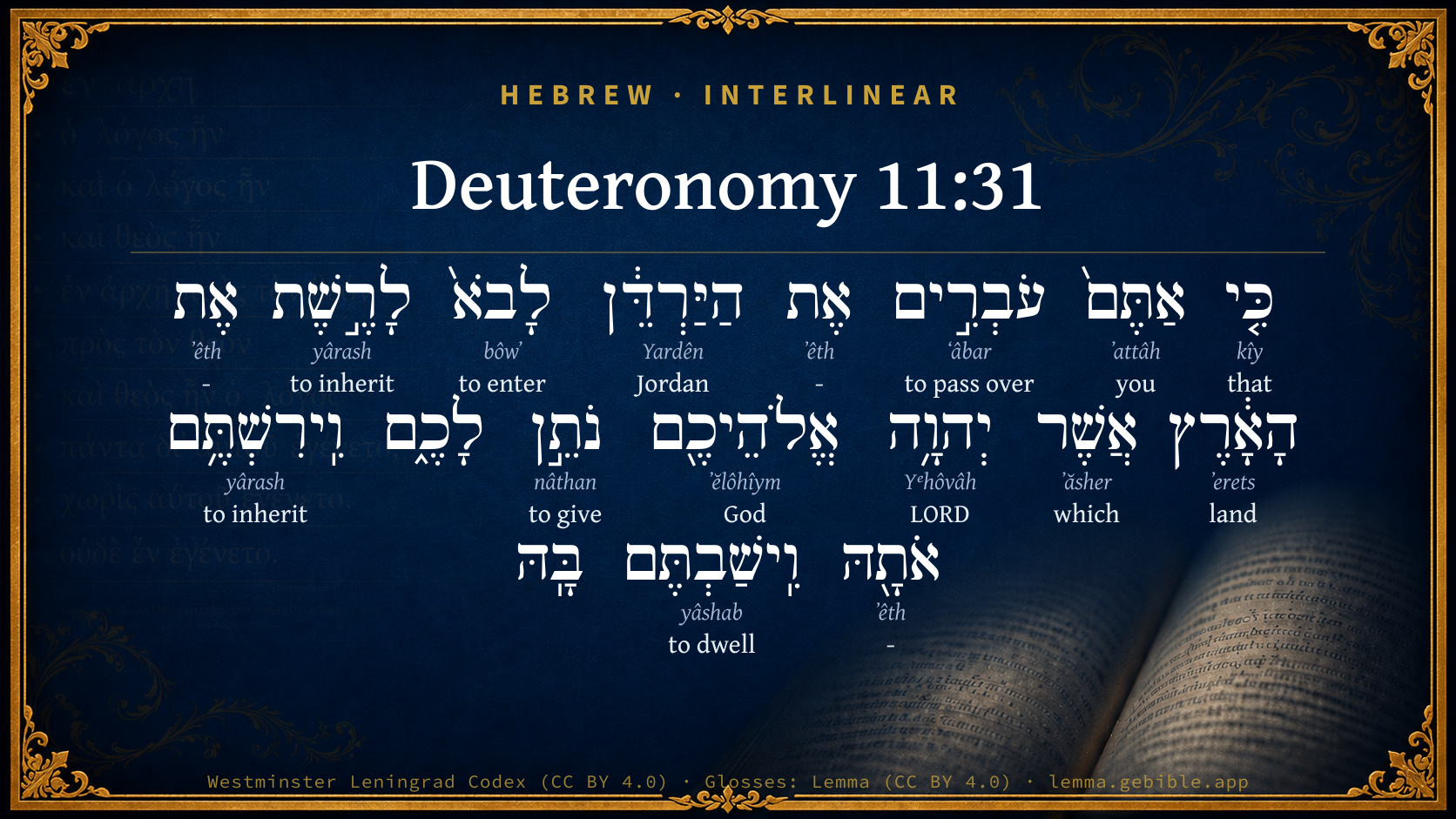
Hebrew (Westminster Leningrad Codex) Deuteronomy 11:31 appears in the Hebrew Old Testament. The text above is from the Westminster Leningrad Codex. Each word links to its Strong’s number, a concise gloss, and parsing drawn from the Open Scriptures Hebrew Bible morphology. Click any word for its full Brown-Driver-Briggs (BDB) entry.
Download image
Cite this verse

Deuteronomy 11:31 (World English Bible). Public Domain. Lemma interlinear Bible study tool, https://lemma.gebible.app/v/deuteronomy/11/31.

Show BibTeX & RIS
BibTeX
RIS
English Translation
For you are to pass over the Jordan to go in to possess the land which Yahweh your God gives you, and you shall possess it, and dwell therein.
World English Bible · Public Domain
Download a study sheet

One document with this verse’s original text, its word-by-word gloss line, the meaning frame, cross-references with their text, attributed commentary, and full source and license credits — printable, and it pastes into notes with its structure intact.

This verse Autodidact and up

Study sheet (.html) Plain text (.txt)

A passage Seminary Student

Up to 50 verses in one chapter. A passage sheet keeps up to 6 commentary sources and 12 cross-references per verse, in the order this page ranks them, and says so on the sheet whenever that leaves anything out. Ask for a single verse and you get the Autodidact verse sheet above.

Everything on this page stays free to read, with no account — the sheet is a download of what is already on screen, not access to it.

Want to remove ads? Support Godless Engineer
Compare translations 3

The same verse in 3 English versions, stacked beneath the original-language interlinear above. Click any original word for its lexicon entry.

Each is an independent rendering of the whole verse — the interlinear is not word-aligned to these translations.

Highlighted words mark where these versions differ — a whole-verse word diff, not a word-by-word alignment.

  • World English Bible Public Domain
    For you are to pass over the Jordan to go in to possess the land which Yahweh your God gives you, and you shall possess it, and dwell therein.
  • King James Version Public Domain
    For ye shall pass over Jordan to go in to possess the land which the LORD your God giveth you, and ye shall possess it, and dwell therein.
  • unfoldingWord Literal Text CC BY-SA 4.0
    For you are crossing over the Jordan to go in to possess the land that Yahweh your God is giving to you, and you will possess it and live in it.

unfoldingWord Literal Text — © unfoldingWord, licensed CC BY-SA 4.0. Word-aligned USFM3 via Door43 (git.door43.org/unfoldingWord/en_ult).

Versions to compare (up to 4)

3 of 4 selected

Show all 18 translations

Every available English version of this verse, each an independent rendering of the whole verse.

  • World English Bible Public Domain
    For you are to pass over the Jordan to go in to possess the land which Yahweh your God gives you, and you shall possess it, and dwell therein.
  • Berean Standard Bible Public Domain
    For you are about to cross the Jordan to enter and possess the land that the LORD your God is giving you. When you take possession of it and settle in it,
  • Majority Standard Bible Public Domain
    For you are about to cross the Jordan to enter and possess the land that the LORD your God is giving you. When you take possession of it and settle in it,
  • King James Version Public Domain
    For ye shall pass over Jordan to go in to possess the land which the LORD your God giveth you, and ye shall possess it, and dwell therein.
  • American Standard Version (1901) Public Domain
    For ye are to pass over the Jordan to go in to possess the land which Jehovah your God giveth you, and ye shall possess it, and dwell therein.
  • Revised Version (1885) Public Domain
    For ye are to pass over Jordan to go in to possess the land which the LORD your God giveth you, and ye shall possess it, and dwell therein.
  • Geneva Bible (1599) Public Domain
    For yee shall passe ouer Iorden, to goe in to possesse the land, which ye Lord your God giueth you, and ye shall possesse it, and dwell therein.
  • Douay-Rheims (1899) Public Domain
    Which are beyond the Jordan, behind the way that goeth to the setting of the sun, in the land of the Chanaanite who dwelleth in the plain country over against Galgala, which is near the valley that reacheth and entereth far.
  • Young's Literal Translation Public Domain
    for ye are passing over the Jordan to go in to possess the land which Jehovah your God is giving to you; and ye have possessed it, and dwelt in it,
  • Literal Standard Version CC BY-SA 4.0
    For you are passing over the Jordan to go in to possess the land which your God YHWH is giving to you; and you have possessed it, and dwelt in it,
  • Unlocked Literal Bible CC BY-SA 4.0
    For you are to cross over the Jordan to go in to possess the land that Yahweh your God is giving you, and you will possess it and live in it.
  • unfoldingWord Literal Text CC BY-SA 4.0
    For you are crossing over the Jordan to go in to possess the land that Yahweh your God is giving to you, and you will possess it and live in it.
  • Darby Bible Public Domain
    For ye pass over the Jordan to enter in to possess the land which Jehovah your God giveth you, and ye shall take possession of it, and dwell therein.
  • World Messianic Bible Public Domain
    For you are to pass over the Jordan to go in to possess the land which the LORD your God gives you, and you shall possess it and dwell in it.
  • Webster's Bible Public Domain
    For ye shall pass over Jordan to go in to possess the land which the LORD your God giveth you, and ye shall possess it, and dwell in it.
  • Free Bible Version CC BY-SA 4.0
    Shortly you're going to cross the Jordan to enter and occupy the country the Lord your God is giving you. When you take it over and settle there,
  • Bible in Basic English Public Domain
    For you are about to go over Jordan to take the heritage which the Lord your God is giving you, and it will be your resting-place.
  • JPS Tanakh (1917) Public Domain
    For ye are to pass over the Jordan to go in to possess the land which the LORD your God giveth you, and ye shall possess it, and dwell therein.

Literal Standard Version (2020), Covenant Press — licensed CC BY-SA 4.0. Text via the HelloAO Bible API (eBible.org). Unlocked Literal Bible (unfoldingWord) — licensed CC BY-SA 4.0. Text via the HelloAO Bible API (eBible.org). unfoldingWord Literal Text — © unfoldingWord, licensed CC BY-SA 4.0. Word-aligned USFM3 via Door43 (git.door43.org/unfoldingWord/en_ult). Free Bible Version, Dr. Jonathan Gallagher — licensed CC BY-SA 4.0. Text via the HelloAO Bible API (eBible.org).

Word by word

More ways to search: Search by grammar → Find every occurrence → Compare this word →

Practice this passage: Drill this verse → Learn its vocabulary →

הַיַּרְדֵּ֔ן
Yardên
H3383
“the · Jordan”
Particle, Definite Article + Noun, Proper
Part of Speech
Particle + Noun
Type
Proper
Full BDB Definition

Origin: from H3381

TWOT: None

Jordan = "descender" - the river of Palestine running from the roots of Anti-Lebanon to the Dead Sea a distance of approx 200 miles (320 kilometers)
  1. כִּ֤י kîy H3588 “that” Conjunction
  2. אַתֶּם֙ ʼattâh H859 “you” Pronoun, Personal, 2nd Person, Masculine, Plural
  3. עֹבְרִ֣ים ʻâbar H5674 “passing over” Verb, Qal, Participle Active, Masculine, Plural, Absolute
  4. אֶת ʼêth H853 “-” Particle, Direct Object
  5. לָבֹא֙ bôwʼ H935 “to enter” Preposition + Verb, Qal, Infinitive Construct
  6. לָרֶ֣שֶׁת yârash H3423 “to inherit” Preposition + Verb, Qal, Infinitive Construct
  7. אֶת ʼêth H853 “-” Particle, Direct Object
  8. הָאָ֔רֶץ ʼerets H776 “the · land” Particle, Definite Article + Noun, Common, Both, Singular, Absolute
  9. אֲשֶׁר ʼăsher H834 “which” Particle, Relative
  10. יְהוָ֥ה Yᵉhôvâh H3068 “LORD” Noun, Proper
  11. אֱלֹהֵיכֶ֖ם ʼĕlôhîym H430 “God(s) · your” Noun, Common, Masculine, Plural, Construct + Suffix, Personal, 2nd Person, Masculine, Plural
  12. נֹתֵ֣ן nâthan H5414 “giving” Verb, Qal, Participle Active, Masculine, Singular, Absolute
  13. וִֽירִשְׁתֶּ֥ם yârash H3423 “and · to inherit” Conjunction + Verb, Qal, Sequential Perfect, 2nd Person, Masculine, Plural
  14. אֹתָ֖הּ ʼêth H853 “- · her” Particle, Direct Object + Suffix, Personal, 3rd Person, Feminine, Singular
  15. וִֽישַׁבְתֶּם yâshab H3427 “and · to dwell” Conjunction + Verb, Qal, Sequential Perfect, 2nd Person, Masculine, Plural

About this verse

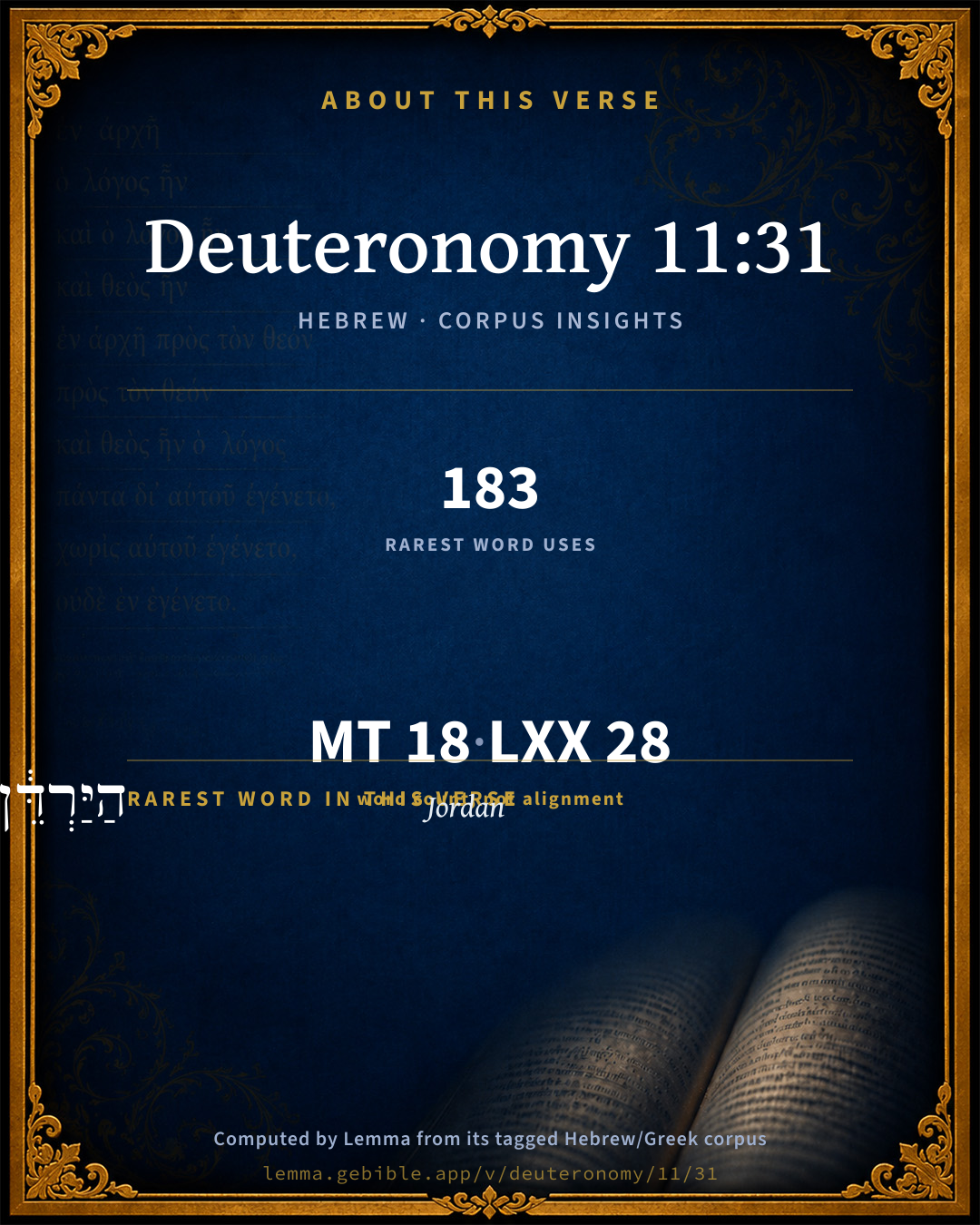
These counts appear in no published source. They are computed here, from the morphology-tagged text and Lemma’s own curated glosses. What Lemma adds →

18
words
13
distinct lemmas
Pentateuch
section

Grammatical profile

  • 6 verbs
  • 4 nouns
  • 1 pronoun
  • 2 prepositions
  • 1 conjunction
  • 4 particles

Verb forms

  • עֹבְרִ֣ים Qal · Participle Active
  • לָבֹא֙ Qal · Infinitive Construct
  • לָרֶ֣שֶׁת Qal · Infinitive Construct
  • נֹתֵ֣ן Qal · Participle Active
  • וִֽירִשְׁתֶּ֥ם Qal · Sequential Perfect
  • וִֽישַׁבְתֶּם Qal · Sequential Perfect

Repetition

A word recurs within this verse — often emphatic in Hebrew:

  • לָרֶ֣שֶׁת to inherit H3423 ×2

Hebrew & Septuagint length

In English translation the verse runs 29 words from the Hebrew and 29 from the Septuagint (LXX English) — the same length.

A rough comparison of the two English renderings, which tokenize alike — not a word-level alignment.

Word counts can differ between the Hebrew and the Greek without any difference in meaning — e.g. the Hebrew direct-object marker אֵת has no separate Greek word, and Greek often adds the article ὁ.

In the original languages it is 18 Hebrew tokens and 28 Greek tokens — but the two are counted differently (Hebrew bundles its prefixes and suffixes into one token; the Greek is in lemma form), so that isn’t a like-for-like length.

Cross-references

3

Topical passages linked to Deuteronomy 11:31 in the Treasury of Scripture Knowledge — connected by theme and wording, ordered by reader-vote popularity; previews shown in the World English Bible.

  • Joshua 1:11 Pass through the midst of the camp, and command the people, saying, Prepare food; for within three days you are to pass over this Jordan, to go in to possess the land, which Yahweh your God gives you to possess it.
  • Deuteronomy 9:1 Hear, Israel: you are to pass over the Jordan this day, to go in to dispossess nations greater and mightier than yourself, cities great and fortified up to the sky,
  • Joshua 3:13–17 It shall come to pass, when the soles of the feet of the priests who bear the ark of Yahweh, the Lord of all the earth, shall rest in the waters of the Jordan, that the waters of the Jordan shall be cut off, even the waters that come down from above; and they shall stand in one heap.

Cross-references courtesy of OpenBible.info (CC BY 4.0).

Hebrew and Greek witnesses Masoretic Hebrew ↔ Greek Septuagint

The same verse in the two great witnesses to the Old Testament, shown verse-for-verse.

These are two independent witnesses, not word-aligned to each other, and the Septuagint is shown in lemma (dictionary) form.

Hebrew Deuteronomy 11:31 Masoretic · Westminster Leningrad Codex

כִּ֤י אַתֶּם֙ עֹבְרִ֣ים אֶת הַיַּרְדֵּ֔ן לָבֹא֙ לָרֶ֣שֶׁת אֶת הָאָ֔רֶץ אֲשֶׁר יְהוָ֥ה אֱלֹהֵיכֶ֖ם נֹתֵ֣ן לָכֶ֑ם וִֽירִשְׁתֶּ֥ם אֹתָ֖הּ וִֽישַׁבְתֶּם בָּֽהּ

For you are to pass over the Jordan to go in to possess the land which Yahweh your God gives you, and you shall possess it, and dwell therein.

World English Bible · Public Domain

Greek LXX Deuteronomy 11:31 Septuagint · lemma form

σύ γάρ διαβαίνω ὁ ἰορδάνης εἰςἔρχομαι κληρονομέω ὁ γῆ ὅς κύριος ὁ θεός σύ δίδωμι σύ ἐν κλῆρος πᾶς ὁ ἡμέρα καί κληρονομέω αὐτός καί κατοικέω ἐν αὐτός

For you⌃ are passing over Jordan, to go in and inherit the land, which the Lord our God gives you to inherit always, and you⌃ shall dwell in it.

LXX2012 (modern English Septuagint) · Public Domain

Hebrew: Westminster Leningrad Codex (CC BY 4.0). Greek: Septuagint (public domain); English from LXX2012 (modern English Septuagint) (Public Domain). How the Septuagint differs from the Hebrew →

Targum (Aramaic paraphrase)

2

The Targum is the ancient Jewish Aramaic paraphrase of the Hebrew Scriptures — an interpretive translation, not the Hebrew text itself. Onkelos (literal) and Pseudo-Jonathan (expansive) render the Torah, and Jonathan the Prophets. Coverage is partial: where no permissively-licensed English translation exists for a verse, only the Aramaic is shown. This is verse-level text, not a word-by-word alignment to the Hebrew.

  1. Targum Onkelos Torah (Genesis–Deuteronomy)
    אֲרֵי אַתּוּן עָבְרִין יָת יַרְדְנָא לְמֵעַל לְמֵירַת יָת אַרְעָא דַיְיָ אֱלָהֲכוֹן יָהֵב לְכוֹן וְתֵירְתוּן יָתַהּ וְתֵיתְבוּן בַּהּ

    (no public-domain English translation for this verse)

    Targum Onkelos — Aramaic: “Onkelos Genesis” (public domain); “Onkelos Exodus” (public domain); “Onkelos Leviticus” (public domain); “Onkelos Numbers” (public domain); “Onkelos Deuteronomy” (public domain). English: “Sefaria Community Translation” (CC0 1.0 (public-domain dedication)); “J.W. Etheridge. The Targums of Onkelos and Jonathan Ben Uzziel on the Pentateuch. London: Longmans, Green, 1862” (public domain). Text via Sefaria.

  2. Targum Pseudo-Jonathan Torah (Genesis–Deuteronomy)
    אֲרוּם אַתּוּן עָבְרִין יַת יוֹרְדְּנָא לְמֵיעַל לְמֵירוֹת יַת אַרְעָא דַיְיָ אֱלָהָכוֹן יָהֵיב לְכוֹן וְתֵירְתוּן יָתָהּ וְתֵיתְבוּן בָּהּ

    For you are to pass over Jordan to enter and possess the land which the Lord your God giveth you, and you will hold and will dwell therein.

    Targum Pseudo-Jonathan — Aramaic: “Targum Jonathan on Genesis” (public domain); “Targum Jonathan on Exodus” (public domain); “Targum Jonathan on Leviticus” (public domain); “Targum Jonathan on Numbers” (public domain); “Targum Jonathan on Deuteronomy” (public domain). English: “The Targum of Jonathan ben Uzziel, trans. J. W. Etheridge, London, 1862” (public domain). Text via Sefaria.

Commentary

Notes on Deuteronomy 11:31 from classic Christian and Jewish commentators (each source and its license shown beneath its notes). The classic Christian expositions comment on the surrounding passage and are grouped to its opening verse, so a note may address several verses; the Jewish commentaries on the Tanakh (Rashi and others) are per-verse, so they appear only where the commentator wrote on this verse.

Lemma curates 59 commentaries, every one of them public domain or Creative Commons licensed, each selected and text-cleaned for this edition rather than reprinted as found. About our sources →

The Biblical Illustrator

Joseph S. Exell

Deu_11:31

Ye shall pass over Jordan.

Jordan and Canaan typical of death and heaven

I. The anticipated inheritance.

1. A land of promise.

2. A land of abundance.

3. A holy land.

4. A land of rest.

5. Permanence of residence.

6. A land freely given.

II. The manner of possession.

1. The streams of Jordan rolled between the desert and the land of Canaan. So does the river of death flow between earth and heaven.

2. Jordan separated the Israelites from the inhabitants of Canaan. Death separates the church militant and the church triumphant. On this side is a parent, on the other side a child.

3. Jordan was subject to the command of God. When He gave the word, the waters rose and stood up (Jos_3:16). Death, too, is under His control. Christ destroyed him who had the power of death (Heb_2:14-15).

4. Through Jordan was a necessary way to the laud of promise. So is death, however painful and affecting. It is necessary that the river of death should be dark and formidable to render us content with the present state of existence.

5. Jordan was the last river they had to pass. Death will be the last conflict--the last enemy with which the saint will have to struggle. Observe that when the children of Israel passed over Jordan the following things were observable.

(1) They were required to sanctify themselves previous to the passage (Jos_3:5). Before death Christ must be made unto the believer sanctification (1Co_1:30).

(2) The priests were to enter the river first. So Jesus entered the river before us--as our Forerunner. The eye of faith in the dying believer beholds His footprints at the bottom.

(3) The priests stood firm in the midst of Jordan until all the people passed over (Jos_3:17). Christ stands by His people in their dying moments, and they feel the bottom of the river, for it is good.

(4) When they had passed over, they erected memorials of praise (Jos_4:5; Jos_4:8; Jos_4:20). So when the Christian reaches heaven he shall utter a song of praise. We went through fire and through water, but Thou broughtest us out into a wealthy place (Psa_66:12). Unto Him that loved us (Rev_1:5-6).

Application:

1. The possession of the heavenly inheritance is certain: Ye shall possess it. Faithful is He who hath promised it, who also will do it.

2. Meditate much on heaven and Christ as an important means of inducing to preparation for the last conflict.

3. All sinners will be overwhelmed in the swellings of Jordan. (Helps for the Pulpit.)

The Biblical Illustrator, edited by Joseph S. Exell (c. 1880s–1900s) — public domain. Text from a community e-Sword module.

Ellicott's Commentary for English Readers

(31) For ye shall pass over Jordan.—In the place of Sichern, by the oak of Moreh, “the Lord appeared to Abram, and said, Unto thy seed will I give this land.” It is the first recorded promise given to the patriarch that his seed should inherit that particular country. He had gone out from his own country, “not knowing whither he went” (Gen_12:6-7).

Here ends the first portion of the exposition of the Decalogue—that which sets forth the relation of the people brought out of Egypt to Jehovah. The following chapters set forth the laws of the land of Israel—first, as the seat of worship of Jehovah; secondly, as the seat of His kingdom; thirdly, as the sphere of operation of certain rules of behaviour, intended to form a distinctive character for His people. For a complete analysis of this portion, see the Introduction to this Book. Some modern writers attribute these chapters to a later hand than that of Moses. It is therefore necessary to consider them carefully, not simply as chapters, but in their primary structure and according to their natural divisions.

The land is considered as the seat of Jehovah’s worship from Deu_12:1 to Deu_16:17 inclusive.

A Bible Commentary for English Readers, edited by Charles John Ellicott (1878–1897) — public domain. Text from a community e-Sword module.

The Cambridge Bible for Schools and Colleges

gen. ed. J. J. S. Perowne

31–32. Resumption of the Pl. form of address; either an editorial addition to mark the transition to the actual laws which begin with Deu_12:1, or the close of an original introduction, in the Pl., to the Code. The former is the more probable as the vv. are compounded of phrases characteristic both of the Sg. and the Pl. forms of address.

31. For ye are about to pass over Jordan] A Pl. phrase; see on Deu_4:14, Deu_6:1.

to go in to possess the land] Mainly a Sg. phrase; see on Deu_6:1.

which the Lord your God is about to give you.

32. and ye shall observe to do] Deu_5:32, etc.

all the statutes and the judgements] See on Deu_5:31.

The Cambridge Bible for Schools and Colleges (gen. ed. J. J. S. Perowne; Cambridge University Press, 1878–1918) — public domain. Text from a community e-Sword module.

Whedon's Commentary on the Bible

Daniel D. Whedon

31, 32. Ye shall pass over Jordan — Moses gives a reason for these specific directions in the confident assurance he has that the people are to cross the Jordan and take possession of the land.

Daniel D. Whedon (gen. ed.), Commentary on the Old and New Testaments (1874–1909) — public domain. Text from a community e-Sword module.

The Pulpit Commentary

Vers. 31, 32. The assurance that they should pass over Jordan and possess the land of Canaan, is assigned as a reason and motive why they should observe to do all that God had commanded them.

The Pulpit Commentary (1880–1919), ed. H.D.M. Spence-Jones & Joseph S. Exell — public domain. Text from a community e-Sword module.

unfoldingWord translationNotes

Door43 World Missions Community

General Information:

Moses continues speaking to the people of Israel.

all the statutes and the decrees

These are the statutes and decrees Moses will give in Deuteronomy 12-26.

I set before you today

This does not mean these are new. Moses is reviewing the same statutes and decrees that he gave 40 years earlier.

I set before you

God's statutes and decrees, which Moses is telling the people, are spoken of as if they were objects that Moses is setting before the people. AT: "I am giving to you" (See: Metaphor)

translationWords

statute

decree

unfoldingWord translationNotes — © Distant Shores Media and the Door43 World Missions Community, licensed CC BY-SA 4.0. Source: git.door43.org/Door43/en_tn.

Rashi

Rabbi Shlomo Yitzchaki (Rashi)

כי אתם עברים את הירדן וגו׳ FOR YE SHALL PASS OVER THE JORDAN etc., — The miracles that will be wrought for you during your crossing of the Jordan shall be an omen for you that you will indeed come into and inherit the land (cf. Sifrei Devarim 57).

Rashi on the Tanakh — English translations: “The Judaica Press complete Tanach with Rashi, translated by A. J. Rosenberg” (CC BY 4.0); “Pentateuch with Rashi's commentary by M. Rosenbaum and A.M. Silbermann, 1929-1934” (public domain); “The Metsudah Tanach series, Lakewood, N.J” (CC BY 4.0); and “The Book of Joshua, Metsudah Publications, 1997” (CC BY 4.0). Text via Sefaria.

Lesson kit

Teaching starters — assembled from the data on this page, not authored interpretation. Every prompt links to the verse data it draws on. Edit before teaching.

Deuteronomy, in the Pentateuch, opens this verse with 18 words (13 distinct Hebrew lemmas). Its most distinctive word is Yardên (“Jordan”). A historical commentator’s framing appears above. Read the whole chapter for the surrounding context.

Discussion questions

  1. What does “Jordan” (Yardên) contribute to the verse as a whole?
  2. How does Joshua 1:11, which shares this passage’s theme, read alongside this verse?
  3. What does the repetition of “to inherit” (2× in this one verse) do in this verse?
  4. These translations render this verse differently; the difference is in the English rendering, not the original. What questions does that raise?
  5. «עֹבְרִ֣ים» is a Qal Participle Active verb. How does that grammatical form shape the action described?
  6. Compare how The Biblical Illustrator and Ellicott's Commentary for English Readers read this verse. Where do they agree or differ?

Things to notice

Reading settings

Reading text

Shown beneath each verse's original-language words.

Old Testament
Old Testament edition

Read the OT as the Masoretic Hebrew (MT) or the Greek Septuagint (LXX).

English shown for the Greek Septuagint (in the Hebrew ↔ Greek comparison).

Comparing translations? Open the Compare panel on any verse page to stack up to four side by side.