Ezekiel 14:15

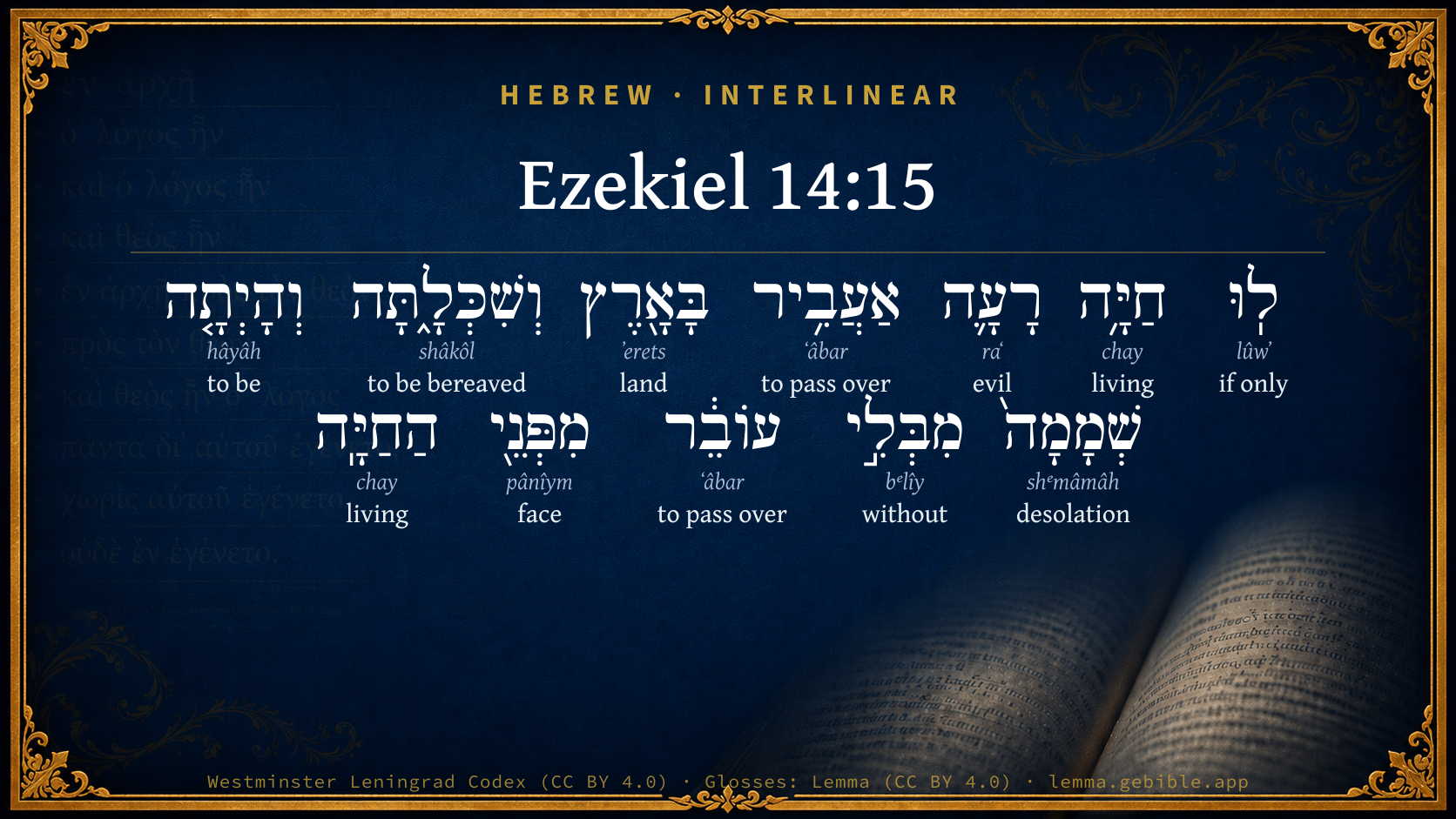
Hebrew (Westminster Leningrad Codex) Ezekiel 14:15 appears in the Hebrew Old Testament. The text above is from the Westminster Leningrad Codex. Each word links to its Strong’s number, a concise gloss, and parsing drawn from the Open Scriptures Hebrew Bible morphology. Click any word for its full Brown-Driver-Briggs (BDB) entry.
Download image
Cite this verse

Ezekiel 14:15 (World English Bible). Public Domain. Lemma interlinear Bible study tool, https://lemma.gebible.app/v/ezekiel/14/15.

Show BibTeX & RIS
BibTeX
RIS
English Translation
If I cause evil animals to pass through the land, and they ravage it, and it be made desolate, so that no man may pass through because of the animals;
World English Bible · Public Domain
Download a study sheet

One document with this verse’s original text, its word-by-word gloss line, the meaning frame, cross-references with their text, attributed commentary, and full source and license credits — printable, and it pastes into notes with its structure intact.

This verse Autodidact and up

Study sheet (.html) Plain text (.txt)

A passage Seminary Student

Up to 50 verses in one chapter. A passage sheet keeps up to 6 commentary sources and 12 cross-references per verse, in the order this page ranks them, and says so on the sheet whenever that leaves anything out. Ask for a single verse and you get the Autodidact verse sheet above.

Everything on this page stays free to read, with no account — the sheet is a download of what is already on screen, not access to it.

Want to remove ads? Support Godless Engineer
Compare translations 3

The same verse in 3 English versions, stacked beneath the original-language interlinear above. Click any original word for its lexicon entry.

Each is an independent rendering of the whole verse — the interlinear is not word-aligned to these translations.

Highlighted words mark where these versions differ — a whole-verse word diff, not a word-by-word alignment.

  • World English Bible Public Domain
    If I cause evil animals to pass through the land, and they ravage it, and it be made desolate, so that no man may pass through because of the animals;
  • King James Version Public Domain
    If I cause noisome beasts to pass through the land, and they spoil it, so that it be desolate, that no man may pass through because of the beasts:
  • unfoldingWord Literal Text CC BY-SA 4.0
    If I send evil beasts through the land and make it barren so that it becomes a wasteland where no man may pass through because of the beasts,

unfoldingWord Literal Text — © unfoldingWord, licensed CC BY-SA 4.0. Word-aligned USFM3 via Door43 (git.door43.org/unfoldingWord/en_ult).

Versions to compare (up to 4)

3 of 4 selected

Show all 18 translations

Every available English version of this verse, each an independent rendering of the whole verse.

  • World English Bible Public Domain
    If I cause evil animals to pass through the land, and they ravage it, and it be made desolate, so that no man may pass through because of the animals;
  • Berean Standard Bible Public Domain
    Or if I send wild beasts through the land to leave it childless and desolate, with no man passing through it for fear of the beasts,
  • Majority Standard Bible Public Domain
    Or if I send wild beasts through the land to leave it childless and desolate, with no man passing through it for fear of the beasts,
  • King James Version Public Domain
    If I cause noisome beasts to pass through the land, and they spoil it, so that it be desolate, that no man may pass through because of the beasts:
  • American Standard Version (1901) Public Domain
    If I cause evil beasts to pass through the land, and they ravage it, and it be made desolate, so that no man may pass through because of the beasts;
  • Revised Version (1885) Public Domain
    If I cause noisome beasts to pass through the land, and they spoil it, so that it be desolate, that no man may pass through because of the beasts;
  • Geneva Bible (1599) Public Domain
    If I bring noysome beastes into the lande and they spoyle it, so that it bee desolate, that no man may passe through, because of beastes,
  • Douay-Rheims (1899) Public Domain
    And if I shall bring mischievous beasts also upon the land to waste it, and it be desolate, so that there is none that can pass because of the beasts:
  • Young's Literal Translation Public Domain
    `If an evil beast I cause to pass through the land, and it hath bereaved, and it hath been a desolation, without any passing through because of the beast --
  • Literal Standard Version CC BY-SA 4.0
    “If I cause an evil beast to pass through the land, and it has bereaved, and it has been a desolation, without any passing through because of the beast—
  • Unlocked Literal Bible CC BY-SA 4.0
    If I send evil beasts through the land and make it barren so that it becomes a wasteland where no man may pass through because of the beasts,
  • unfoldingWord Literal Text CC BY-SA 4.0
    If I send evil beasts through the land and make it barren so that it becomes a wasteland where no man may pass through because of the beasts,
  • Darby Bible Public Domain
    If I cause evil beasts to pass through the land, and they bereave it, and it become a desolation, so that no one passeth through because of the beasts;
  • World Messianic Bible Public Domain
    “If I cause evil animals to pass through the land, and they ravage it and it is made desolate, so that no man may pass through because of the animals—
  • Webster's Bible Public Domain
    If I cause noisome beasts to pass through the land, and they lay it waste, so that it be desolate, that no man may pass through because of the beasts:
  • Free Bible Version CC BY-SA 4.0
    I could send wild animals rampaging through the country, so they would leave it uninhabited and desolate, a place no one would travel through for fear of such animals.
  • Bible in Basic English Public Domain
    Or if I send evil beasts through the land causing destruction and making it waste, so that no man may go through because of the beasts:
  • JPS Tanakh (1917) Public Domain
    If I cause evil beasts to pass through the land, and they bereave it, and it be desolate, so that no man may pass through because of the beasts;

Literal Standard Version (2020), Covenant Press — licensed CC BY-SA 4.0. Text via the HelloAO Bible API (eBible.org). Unlocked Literal Bible (unfoldingWord) — licensed CC BY-SA 4.0. Text via the HelloAO Bible API (eBible.org). unfoldingWord Literal Text — © unfoldingWord, licensed CC BY-SA 4.0. Word-aligned USFM3 via Door43 (git.door43.org/unfoldingWord/en_ult). Free Bible Version, Dr. Jonathan Gallagher — licensed CC BY-SA 4.0. Text via the HelloAO Bible API (eBible.org).

Word by word

More ways to search: Search by grammar → Find every occurrence → Compare this word →

Practice this passage: Drill this verse → Learn its vocabulary →

וְשִׁכְּלָ֑תָּה
shâkôl
H7921
“and · to be bereaved · her”
Conjunction + Verb, Piel, Sequential Perfect, 3rd Person, Feminine, Singular + Suffix, Personal, 3rd Person, Feminine, Singular
Part of Speech
Conjunction + Verb
Stem
Piel
Form
Sequential Perfect
Person
3rd Person
Gender
Feminine
Number
Singular
Full BDB Definition

Origin: a primitive root

TWOT: 2385

to be bereaved, make childless, miscarry - (Qal) to be bereaved - (Piel) - to make childless - to cause barrenness, show barrenness or abortion - to miscarry - (Hiphil) miscarrying (participle)
  1. לֽוּ lûwʼ H3863 “if only” Conjunction
  2. חַיָּ֥ה chay H2416 “living” Noun, Common, Feminine, Singular, Absolute
  3. רָעָ֛ה raʻ H7451 “evil” Adjective, Adjective, Feminine, Singular, Absolute
  4. אַעֲבִ֥יר ʻâbar H5674 “to pass over” Verb, Hiphil, Imperfect, 1st Person, Common, Singular
  5. בָּאָ֖רֶץ ʼerets H776 “in/at the · land” Preposition, Determined + Noun, Common, Both, Singular, Absolute
  6. וְהָיְתָ֤ה hâyâh H1961 “and · to be” Conjunction + Verb, Qal, Sequential Perfect, 3rd Person, Feminine, Singular
  7. שְׁמָמָה֙ shᵉmâmâh H8077 “desolation” Noun, Common, Feminine, Singular, Absolute
  8. מִבְּלִ֣י bᵉlîy H1097 “from · without of” Preposition + Noun, Common, Masculine, Singular, Construct
  9. עוֹבֵ֔ר ʻâbar H5674 “passing over” Verb, Qal, Participle Active, Masculine, Singular, Absolute
  10. מִפְּנֵ֖י pânîym H6440 “from · face(s) of” Preposition + Noun, Common, Both, Plural, Construct
  11. הַחַיָּֽה chay H2416 “the · living” Particle, Definite Article + Noun, Common, Feminine, Singular, Absolute

About this verse

These counts appear in no published source. They are computed here, from the morphology-tagged text and Lemma’s own curated glosses. What Lemma adds →

12
words
10
distinct lemmas
Prophets
section

Notable vocabulary

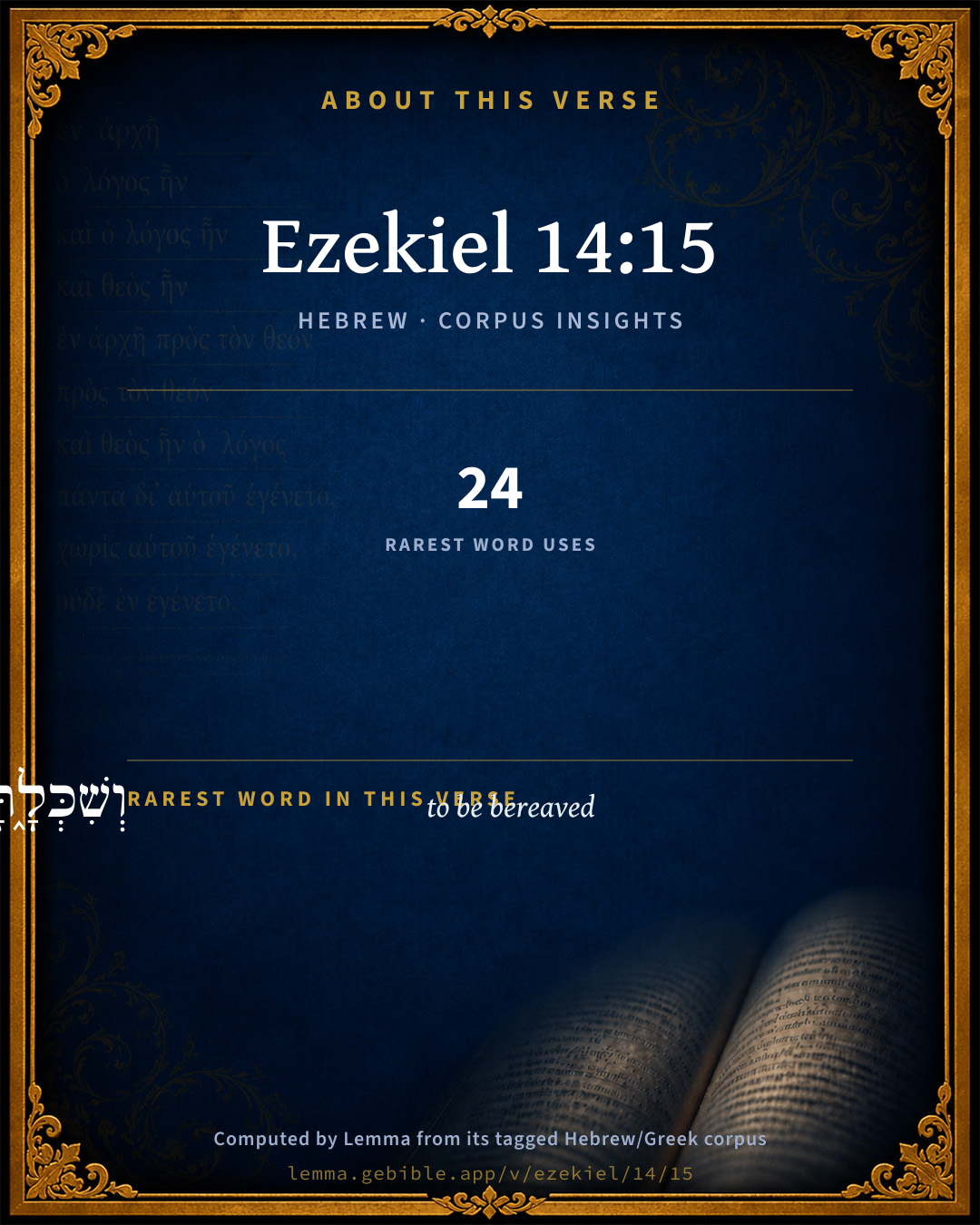
The rarest word here is וְשִׁכְּלָ֑תָּה to be bereaved H7921 — appearing just 24 times in the whole Hebrew Bible.

Shared distinctive vocabulary

וְשִׁכְּלָ֑תָּה to be bereaved H7921 occurs in 22 verses of the Hebrew Bible. Also found in:

Grammatical profile

  • 4 verbs
  • 6 nouns
  • 1 adjective
  • 1 conjunction

Verb forms

  • אַעֲבִ֥יר Hiphil · Imperfect
  • וְשִׁכְּלָ֑תָּה Piel · Sequential Perfect
  • וְהָיְתָ֤ה Qal · Sequential Perfect
  • עוֹבֵ֔ר Qal · Participle Active

Repetition

Words recur within this verse — often emphatic in Hebrew:

  • חַיָּ֥ה living H2416 ×2
  • אַעֲבִ֥יר to pass over H5674 ×2

Hebrew & Septuagint length

In English translation the verse runs 30 words from the Hebrew and 32 from the Septuagint (LXX English) — closely comparable.

A rough comparison of the two English renderings, which tokenize alike — not a word-level alignment.

Word counts can differ between the Hebrew and the Greek without any difference in meaning — e.g. the Hebrew direct-object marker אֵת has no separate Greek word, and Greek often adds the article ὁ.

Cross-references

5

Topical passages linked to Ezekiel 14:15 in the Treasury of Scripture Knowledge — connected by theme and wording, ordered by reader-vote popularity; previews shown in the World English Bible.

  • Leviticus 26:22 I will send the wild animals among you, which will rob you of your children, destroy your cattle, and make you few in number; and your roads will become desolate.
  • Ezekiel 5:17 and I will send on you famine and evil animals, and they shall bereave you; and pestilence and blood shall pass through you; and I will bring the sword on you: I, Yahweh, have spoken it.
  • Jeremiah 15:3 I will appoint over them four kinds, says Yahweh: the sword to kill, and the dogs to tear, and the birds of the sky, and the animals of the earth, to devour and to destroy.
  • 1 Kings 20:36 Then said he to him, Because you have not obeyed the voice of Yahweh, behold, as soon as you are departed from me, a lion shall kill you. As soon as he was departed from him, a lion found him, and killed him.
  • 2 Kings 17:25 So it was, at the beginning of their dwelling there, that they didn't fear Yahweh: therefore Yahweh sent lions among them, which killed some of them.

Cross-references courtesy of OpenBible.info (CC BY 4.0).

Hebrew and Greek witnesses Masoretic Hebrew ↔ Greek Septuagint

The same verse in the two great witnesses to the Old Testament, shown verse-for-verse.

These are two independent witnesses, not word-aligned to each other, and the Septuagint is shown in lemma (dictionary) form.

Hebrew Ezekiel 14:15 Masoretic · Westminster Leningrad Codex

לֽוּ חַיָּ֥ה רָעָ֛ה אַעֲבִ֥יר בָּאָ֖רֶץ וְשִׁכְּלָ֑תָּה וְהָיְתָ֤ה שְׁמָמָה֙ מִבְּלִ֣י עוֹבֵ֔ר מִפְּנֵ֖י הַחַיָּֽה

If I cause evil animals to pass through the land, and they ravage it, and it be made desolate, so that no man may pass through because of the animals;

World English Bible · Public Domain

Greek LXX Ezekiel 14:15 Septuagint · lemma form

ἐάν καί θηρίον πονηρός ἐπιἄγω ἐπί ὁ γῆ καί τιμωρέω αὐτός καί εἰμί εἰς ἀφανισμός καί οὐ εἰμί ὁ διαὁδεύω ἀπό πρόσωπον ὁ θηρίον

If again I bring evil beasts upon the land, and take vengeance upon it, and it be ruined, and there be no one to pass through for fear of the wild beasts:

LXX2012 (modern English Septuagint) · Public Domain

Hebrew: Westminster Leningrad Codex (CC BY 4.0). Greek: Septuagint (public domain); English from LXX2012 (modern English Septuagint) (Public Domain). How the Septuagint differs from the Hebrew →

Targum (Aramaic paraphrase)

1

The Targum is the ancient Jewish Aramaic paraphrase of the Hebrew Scriptures — an interpretive translation, not the Hebrew text itself. Onkelos (literal) and Pseudo-Jonathan (expansive) render the Torah, and Jonathan the Prophets. Coverage is partial: where no permissively-licensed English translation exists for a verse, only the Aramaic is shown. This is verse-level text, not a word-by-word alignment to the Hebrew.

  1. Targum Jonathan Prophets (Joshua–Malachi)
    אִילוּ חַיְתָא בִישְׁתָא אַעְבֵּיד בְּאַרְעָא וְתִתְכְּלִינָהּ וּתְהֵי לְצָדוּ מִבְּלִי עָדֵי מִן קֳדָם חַיְתָא:

    (no public-domain English translation for this verse)

    Targum Jonathan — Aramaic: “Mikraot Gedolot” (public domain). English: “Sefaria Community Translation” (CC0 1.0 (public-domain dedication)); “London "Chaldee Paraphrase," 1871” (public domain). Text via Sefaria.

Commentary

Notes on Ezekiel 14:15 from classic Christian and Jewish commentators (each source and its license shown beneath its notes). The classic Christian expositions comment on the surrounding passage and are grouped to its opening verse, so a note may address several verses; the Jewish commentaries on the Tanakh (Rashi and others) are per-verse, so they appear only where the commentator wrote on this verse.

Lemma curates 59 commentaries, every one of them public domain or Creative Commons licensed, each selected and text-cleaned for this edition rather than reprinted as found. About our sources →

Jamieson, Fausset & Brown

Robert Jamieson, A. R. Fausset & David Brown

The argument is cumulative. He first puts the case of the land sinning so as to fall under the judgment of a famine (Eze 14:13); then (Eze 14:15) "noisome beasts" (Lev 26:22); then "the sword"; then, worst of all, "pestilence." The three most righteous of men should deliver only themselves in these several four cases. In Eze 14:21 he concentrates the whole in one mass of condemnation. If Noah, Daniel, Job, could not deliver the land, when deserving only one judgment, "how much more" when all four judgments combined are justly to visit the land for sin, shall these three righteous men not deliver it.

Jamieson, Fausset & Brown — Commentary Critical and Explanatory on the Whole Bible (1871) — public domain (CC PDM 1.0). Text via the HelloAO Bible API.

Trapp's Complete Commentary

John Trapp

Eze 14:15 If I cause noisome beasts to pass through the land, and they spoil it, so that it be desolate, that no man may pass through because of the beasts:

Ver. 15. If I cause noisome beasts.] As lions, wolves, bears, serpents, &c. Great hurt hath been done not only by such, as Num 21:6 2Ki 2:24; 2Ki 17:25-26 Jos 24:12; but also by tamer creatures when set on by God. Rebellis facta est, quia homo numini, creatura homini. {a} Rats, conies, frogs, wasps, moths, have done much mischief.

{a} Augustine.

John Trapp, A Commentary or Exposition upon All the Books of the Old and New Testament (1647–1656) — public domain. Text from a community e-Sword module.

Joseph Benson's Commentary

Eze 14:15-21. If I cause noisome beasts to pass through the land — We find it was one punishment of the inhabitants of Judea, to be infested by lions and other wild beasts. To this their neighbourhood to the deserts of Arabia exposed them; and God, at certain times, to punish them for their sins, either by causing a scarcity of food in the deserts, or by some other means, influenced these wild beasts to make incursions into Judea, in great numbers, which they otherwise were not wont to do. Or if I bring a sword upon that land, &c. — “If I deliver a land into the hand of a cruel enemy. The conquerors’ sword is often called the sword of the Lord, in the prophets, because they are the executioners of God’s judgments.” So that I cut off man and beast from it — “Men are destroyed by the sword, and the cattle are driven away by the enemy; or else consumed by pestilence, arising from the air’s being corrupted through the stench of dead bodies.” Or I send pestilence, and pour out my fury in blood — With great destruction of men’s lives, Eze 38:22; for every kind of sudden and immature death is called blood in the Hebrew. How much more — Shall there be an utter destruction; when I send my four sore judgments upon Jerusalem — “If it is just, with respect to other countries, that the good alone should escape punishment, how much more with respect to Jerusalem, after such repeated instructions and admonitions?” And if the intercessions of such holy men as those above mentioned could not prevent the execution of one of these four judgments upon those that had filled up the measure of their iniquities, how much less would they be able to keep off all the four, when I commission them all to come at once?

Joseph Benson's Commentary on the Old and New Testaments (1811–1818) — public domain. Text from a community e-Sword module.

John Calvin's Commentaries

Now he mentions the second kind of punishment. For we said that God’s four scourges were here brought before us, which are more familiarly known to men through frequent use. They are hunger and wild beasts, war and pestilence. The Prophet has spoken of famine; he now comes down to wild beasts. This kind of scourge is rarely used in Scripture; for God more frequently mentions the sword, pestilence, and famine; but when he distinctly treats, of his scourges, he adds also savage beasts. Now therefore he says, if he had sent wild beasts to lay waste the land, and Noah, Job, and Daniel, had been in that land, they would be free from the common slaughter, but that their righteousness would not profit others. He expresses a little more clearly what he had spoken briefly and obscurely when he treated of the famine. If, says he, I shall cause an evil beast to pass through and injure the land, so as to lay it waste, that no one may pass through on account of the wild beasts, as I live, says he, if these three men shall free their sons and their daughters. This passage teaches what I lately touched upon about the famine, namely, that the beasts did not break in by chance to attack and rage against men, but that they are sent by God. Thus God follows out his judgments no less by means of lions, and bears, and tigers, than by rain and drought, the sword and the pestilence: and surely this may be understood, if we reflect upon the great savageness of these beasts; first, when hunger arouses them they are carried along by a ravenous impulse; and then, without the compulsion of necessity, they are hostile to the human race, and without doubt they would urge themselves on to tear to pieces all whom they met with, unless restrained by God’s secret instinct. If, therefore, God restrains the wild beasts, thus also he sends them forth as often as it pleases him, to exercise their ferocity against mankind, and in this way to become his scourges. But here an oath is interposed that God may inspire confidence in his sentence, so God swears by his own life. This is the meaning of the phrase as I live; that is, I swear by my life. This is indeed spoken improperly, but elsewhere we have seen that God swears by his life; that is, just as if he swore by himself, because he has no greater by whom he can swear, as the Apostle says (Hebrews 6:13); and as often as we swear by the name of God we attribute the supreme power to him, and thus we profess our life to be in his hand, and he to be our only Judge. When, therefore, he swears by himself, he admonishes us at the same time that his name is profaned if we swear by any others: then he shows how much religion is to be exhibited in oaths. Let us follow, therefore, God’s example, when our speech needs confirmation, by calling in a witness and judge: next, that we should not use his name rashly and falsely, but that our oath should be truly a testimony to our piety. But here in truth a question arises, — How God can say that the land should perish which has been once subjected to wild beasts? For sometimes wild beasts have infected many regions, and God has immediately restrained them, and so their cruelty has passed away like a storm.

Again, we knew that the prayer of the saints are not superfluous when they pray for others; but God seems here to deny what is clearly manifest. But the solution is easy. For since he does not inflict his judgments equably but variably, and at one time hastens punishments and at another suspends them: at one time punishes men’s sins and at another delays doing so, he fixes for himself no sure law by which he is always bound, but he speaks of the land which he has destined to destruction. God therefore will strike one region with famine, another with war, a third with pestilence, a fourth with wild beasts, and yet he can mitigate his own rigor, and when men begin to be terrified, he can withdraw his hand. But if it has been once decreed that any land must perish, all the saints would run together in vain, because no one would be a fit intercessor to abolish that inviolable decree. We now understand the Prophet’s intention, for he does not speak generally of any lands whatever, but he points out the very land which was devoted to final destruction. It follows —

John Calvin's Commentaries (1540-1563) — public domain. Text from the Calvin Translation Society English edition (1840s-50s) via the Christian Classics Ethereal Library (ccel.org). Calvin's coverage is partial (roughly two-thirds of the Bible); uncommented books and verses are honest gaps, never fabricated. The 19th-century editor's footnotes and remarks are omitted so the notes are faithfully Calvin's own voice.

Ellicott's Commentary for English Readers

(15-20) In these verses the same declaration is repeated, for the sake of emphasis, with each one of three other instruments of punishment, with only such variations of phraseology as are required for rhetorical reasons. The phrase “their own souls” is here also simply equivalent to “themselves.” The judgments mentioned are all taken from the warnings in Leviticus 26, the famine from Lev_26:26, the wild beasts from Lev_26:22, the sword and also the pestilence from Lev_26:25.

A Bible Commentary for English Readers, edited by Charles John Ellicott (1878–1897) — public domain. Text from a community e-Sword module.

John Gill's Exposition

Though these three men were in it,.... Above named, Noah, Daniel, and Job; as they were not, two of them not being in the land of the living, and the other in Babylon; but if all three had been in a land so threatened, and used all the interest they had with God, by fervent prayer and supplication, to have called in the wild beasts, and chained them up, and to preserve the people from being destroyed by them, it would have been all in vain; the Lord was determined upon the destruction of them, and by means of these, as one of his sore judgments:

as I live, saith the Lord God; or by my life; for it is an oath with which God swears by himself, who has life in himself, and is the author and giver of life to others, and can take it away when, and in what manner, he pleases; and this oath is used, to show the unalterableness of the judgment threatened, it being decreed and sworn to: God's word or decree, and his oath, are two immutable things, in which he cannot lie, and from which he never departs:

they shall deliver neither sons nor daughters; meaning not adult persons, but little ones, infant sons and daughters; such as had not been guilty of the actual sins and transgressions their parents were charged with; even these they should not deliver by their prayers and supplications from being destroyed by noisome beasts, God punishing the iniquities of the fathers upon the children; and much less should they deliver those that were adult, and had committed the same idolatries and other sins their parents had; no, not even their own sons and daughters; for no exception is made but of themselves, as follows:

they only shall be delivered: as Noah with his family was in the ark, when amidst wild beasts; and Daniel in the lions den; and Job, with whom the beasts of the field were at peace, Job 5:23;

but the land shall be desolate; see Eze 12:20.

John Gill's Exposition of the Whole Bible (1746–1763) — public domain (CC PDM 1.0). Text via the HelloAO Bible API.

Matthew Poole's English Annotations

Noisome beasts are one of the great plagues or armies that God hath always at his command.

To pass through the land; to range over the land, and spoil their cattle, devour their servants and children, and destroy travellers, and make it as a wilderness.

No man may pass through without much danger, and great guards that may repel the wild ravening beasts.

Matthew Poole's English Annotations on the Holy Bible (1683–1685) — public domain. Text from a community e-Sword/MySword module.

Whedon's Commentary on the Bible

Daniel D. Whedon

15. Noisome beasts — Remembering that serpents, according to Scripture language, were included among these “hurtful beasts” (Gen_3:14), it is a suggestive circumstance that over twenty thousand people die in India every year of snake bite, notwithstanding the excessive population and the carefulness of British officials, and notwithstanding the fact that the government kills five hundred thousand of these reptiles every year (Victoria Institute, 26:89, 111). In Syria, where the serpent was reverenced as possessing superhuman powers, its ability to “bereave” the land would be great.

Daniel D. Whedon (gen. ed.), Commentary on the Old and New Testaments (1874–1909) — public domain. Text from a community e-Sword module.

The Pulpit Commentary

Noisome beasts. (see note on Eze_5:17)

The Pulpit Commentary (1880–1919), ed. H.D.M. Spence-Jones & Joseph S. Exell — public domain. Text from a community e-Sword module.

unfoldingWord translationNotes

Door43 World Missions Community

these same three men

Noah, Daniel, and Job

as I live

"as surely as I am alive." Yahweh uses this expression to show that what he says next is certainly true. This is a way of making a solemn promise. See how you translated this in Ezekiel 5:11. AT: "I solemnly swear" (See: Idiom)

only their own lives would be rescued

This can be stated in active form. AT: "they could only rescue their own lives" (See: Active or Passive)

translationWords

evil

barren

waste

life

declare

Lord Yahweh

unfoldingWord translationNotes — © Distant Shores Media and the Door43 World Missions Community, licensed CC BY-SA 4.0. Source: git.door43.org/Door43/en_tn.

Rashi

Rabbi Shlomo Yitzchaki (Rashi)

If...wild beasts Heb. לוּ. If wild beasts.

Rashi on the Tanakh — English translations: “The Judaica Press complete Tanach with Rashi, translated by A. J. Rosenberg” (CC BY 4.0); “Pentateuch with Rashi's commentary by M. Rosenbaum and A.M. Silbermann, 1929-1934” (public domain); “The Metsudah Tanach series, Lakewood, N.J” (CC BY 4.0); and “The Book of Joshua, Metsudah Publications, 1997” (CC BY 4.0). Text via Sefaria.

Lesson kit

Teaching starters — assembled from the data on this page, not authored interpretation. Every prompt links to the verse data it draws on. Edit before teaching.

Ezekiel, in the Prophets, opens this verse with 12 words (10 distinct Hebrew lemmas). Its most distinctive word is shâkôl (“to be bereaved”). A historical commentator’s framing appears above. Read the whole chapter for the surrounding context.

Discussion questions

  1. What does “to be bereaved” (shâkôl) contribute to the verse as a whole?
  2. Genesis 27:45 shares the word «to be bereaved» with this verse. How do the two illuminate each other?
  3. “living” occurs 2× in this one verse. What is the effect of the repetition?
  4. These translations render this verse differently; the difference is in the English rendering, not the original. What questions does that raise?
  5. The verb «אַעֲבִ֥יר» is Hiphil Imperfect. How does its form color the action?
  6. Reading how Jamieson, Fausset & Brown and Trapp's Complete Commentary read this verse, where do the two commentators agree and where do they part?

Things to notice

Reading settings

Reading text

Shown beneath each verse's original-language words.

Old Testament
Old Testament edition

Read the OT as the Masoretic Hebrew (MT) or the Greek Septuagint (LXX).

English shown for the Greek Septuagint (in the Hebrew ↔ Greek comparison).

Comparing translations? Open the Compare panel on any verse page to stack up to four side by side.