
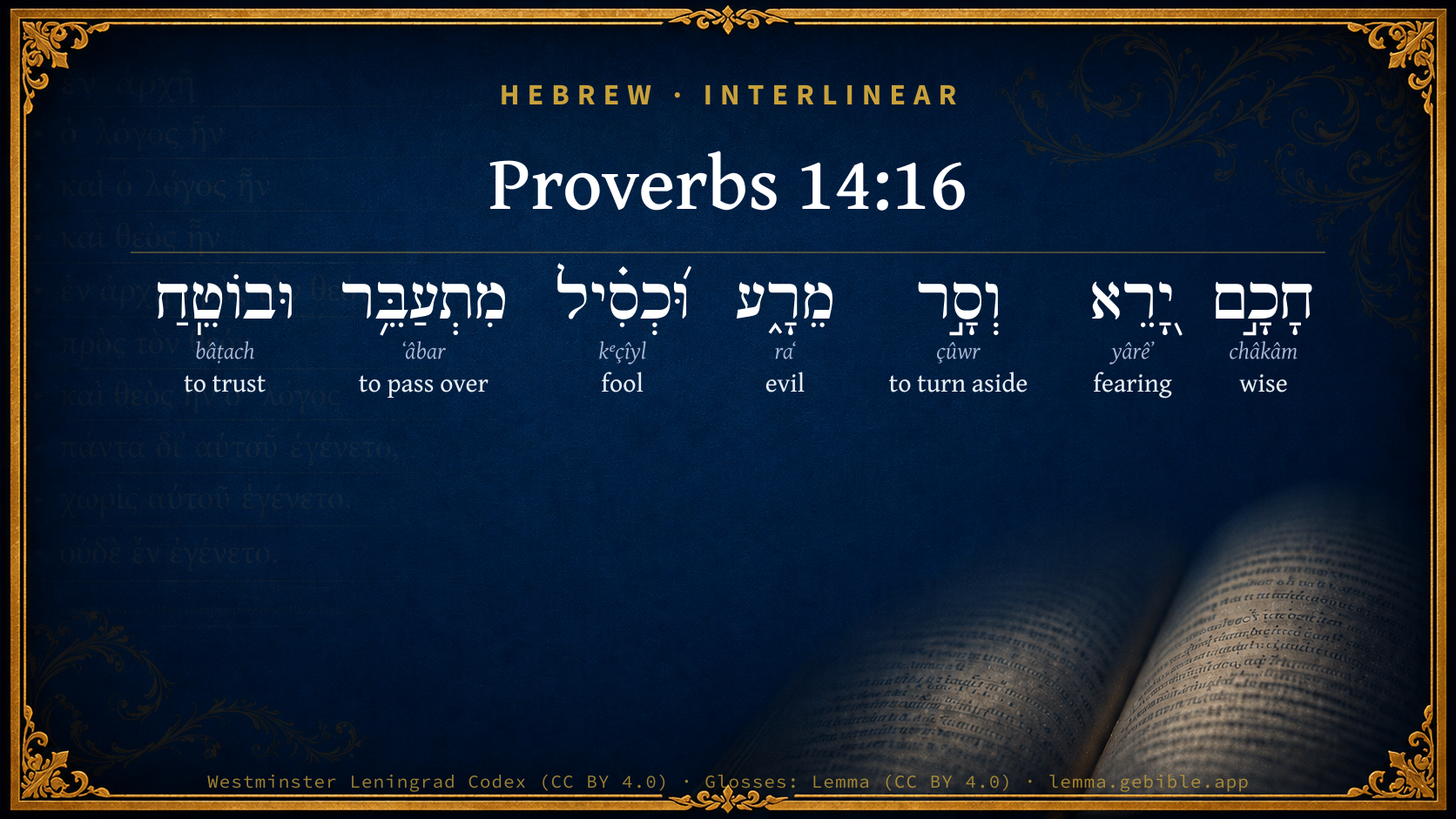
Proverbs 14:16

Hebrew (Westminster Leningrad Codex) Proverbs 14:16 appears in the Hebrew Old Testament. The text above is from the Westminster Leningrad Codex. Each word links to its Strong’s number, a concise gloss, and parsing drawn from the Open Scriptures Hebrew Bible morphology. Click any word for its full Brown-Driver-Briggs (BDB) entry.
Download image
Cite this verse

Proverbs 14:16 (World English Bible). Public Domain. Lemma interlinear Bible study tool, https://lemma.gebible.app/v/proverbs/14/16.

Show BibTeX & RIS
BibTeX
RIS
English Translation
A wise man fears, and shuns evil, But the fool is hotheaded and reckless.
World English Bible · Public Domain
Download a study sheet

One document with this verse’s original text, its word-by-word gloss line, the meaning frame, cross-references with their text, attributed commentary, and full source and license credits — printable, and it pastes into notes with its structure intact.

This verse Autodidact and up

Study sheet (.html) Plain text (.txt)

A passage Seminary Student

Up to 50 verses in one chapter. A passage sheet keeps up to 6 commentary sources and 12 cross-references per verse, in the order this page ranks them, and says so on the sheet whenever that leaves anything out. Ask for a single verse and you get the Autodidact verse sheet above.

Everything on this page stays free to read, with no account — the sheet is a download of what is already on screen, not access to it.

Want to remove ads? Support Godless Engineer
Compare translations 3

The same verse in 3 English versions, stacked beneath the original-language interlinear above. Click any original word for its lexicon entry.

Each is an independent rendering of the whole verse — the interlinear is not word-aligned to these translations.

Highlighted words mark where these versions differ — a whole-verse word diff, not a word-by-word alignment.

  • World English Bible Public Domain
    A wise man fears, and shuns evil, But the fool is hotheaded and reckless.
  • King James Version Public Domain
    A wise man feareth, and departeth from evil: but the fool rageth, and is confident.
  • unfoldingWord Literal Text CC BY-SA 4.0
    A wise fears and turns away from trouble, but a stupid interferes and is confident.

unfoldingWord Literal Text — © unfoldingWord, licensed CC BY-SA 4.0. Word-aligned USFM3 via Door43 (git.door43.org/unfoldingWord/en_ult).

Versions to compare (up to 4)

3 of 4 selected

Show all 18 translations

Every available English version of this verse, each an independent rendering of the whole verse.

  • World English Bible Public Domain
    A wise man fears, and shuns evil, But the fool is hotheaded and reckless.
  • Berean Standard Bible Public Domain
    A wise man fears and turns from evil, but a fool is careless and reckless.
  • Majority Standard Bible Public Domain
    A wise man fears and turns from evil, but a fool is careless and reckless.
  • King James Version Public Domain
    A wise man feareth, and departeth from evil: but the fool rageth, and is confident.
  • American Standard Version (1901) Public Domain
    A wise man feareth, and departeth from evil; But the fool beareth himself insolently, and is confident.
  • Revised Version (1885) Public Domain
    A wise man feareth, and departeth from evil: but the fool beareth himself insolently, and is confident.
  • Geneva Bible (1599) Public Domain
    A wise man feareth, and departeth from euill: but a foole rageth, and is carelesse.
  • Douay-Rheims (1899) Public Domain
    A wise man feareth and declineth from evil: the fool leapeth over and is confident.
  • Young's Literal Translation Public Domain
    The wise is fearing and turning from evil, And a fool is transgressing and is confident.
  • Literal Standard Version CC BY-SA 4.0
    The wise is fearing and turning from evil, || And a fool is transgressing and is confident.
  • Unlocked Literal Bible CC BY-SA 4.0
    A wise man fears and turns away from evil, but the fool confidently dismisses a warning.
  • unfoldingWord Literal Text CC BY-SA 4.0
    A wise fears and turns away from trouble, but a stupid interferes and is confident.
  • Darby Bible Public Domain
    A wise [man] feareth and departeth from evil; but the foolish is overbearing and confident.
  • World Messianic Bible Public Domain
    A wise man fears and shuns evil, but the fool is hot headed and reckless.
  • Webster's Bible Public Domain
    A wise man feareth, and departeth from evil: but the fool rageth, and is confident.
  • Free Bible Version CC BY-SA 4.0
    Wise people are careful and avoid evil, but stupid people are confidently reckless.
  • Bible in Basic English Public Domain
    The wise man, fearing, keeps himself from evil; but the foolish man goes on in his pride, with no thought of danger.
  • JPS Tanakh (1917) Public Domain
    A wise man feareth, and departeth from evil; but the fool behaveth overbearingly, and is confident.

Literal Standard Version (2020), Covenant Press — licensed CC BY-SA 4.0. Text via the HelloAO Bible API (eBible.org). Unlocked Literal Bible (unfoldingWord) — licensed CC BY-SA 4.0. Text via the HelloAO Bible API (eBible.org). unfoldingWord Literal Text — © unfoldingWord, licensed CC BY-SA 4.0. Word-aligned USFM3 via Door43 (git.door43.org/unfoldingWord/en_ult). Free Bible Version, Dr. Jonathan Gallagher — licensed CC BY-SA 4.0. Text via the HelloAO Bible API (eBible.org).

Word by word

More ways to search: Search by grammar → Find every occurrence → Compare this word →

Practice this passage: Drill this verse → Learn its vocabulary →

About this verse

These counts appear in no published source. They are computed here, from the morphology-tagged text and Lemma’s own curated glosses. What Lemma adds →

7
words
7
distinct lemmas
Wisdom
section

Shared distinctive vocabulary

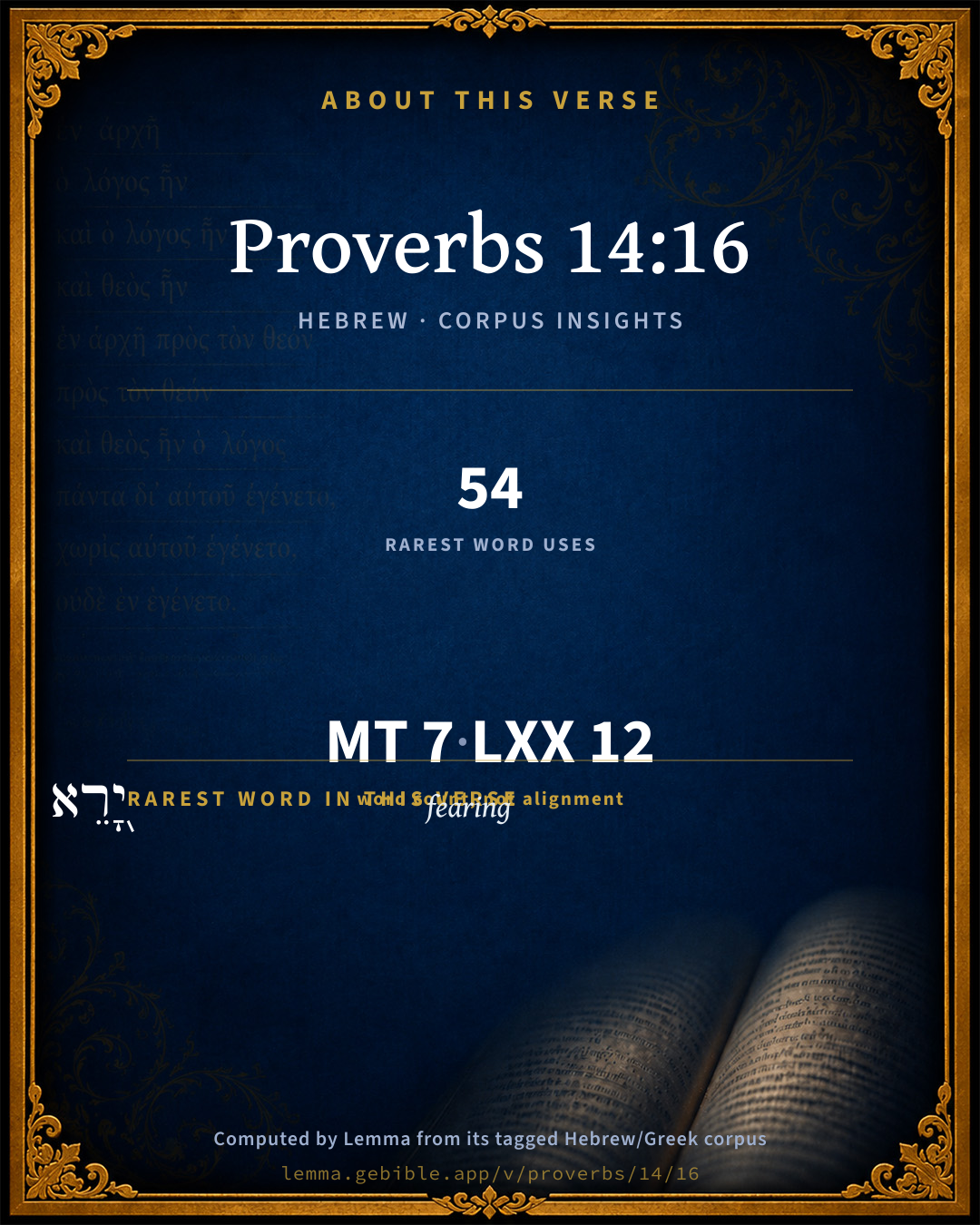
יָ֭רֵא fearing H3373 occurs in 54 verses of the Hebrew Bible. Also found in:

Grammatical profile

  • 4 verbs
  • 3 adjectives

Verb forms

  • יָ֭רֵא Qal · Participle Active
  • וְסָ֣ר Qal · Participle Active
  • מִתְעַבֵּ֥ר Hithpael · Participle Active
  • וּבוֹטֵֽחַ Qal · Participle Active

Hebrew & Septuagint length

In English translation the verse runs 14 words from the Hebrew and 20 from the Septuagint (LXX English) — the Septuagint runs noticeably longer here. See the side-by-side →

A rough comparison of the two English renderings, which tokenize alike — not a word-level alignment.

Word counts can differ between the Hebrew and the Greek without any difference in meaning — e.g. the Hebrew direct-object marker אֵת has no separate Greek word, and Greek often adds the article ὁ.

In the original languages it is 7 Hebrew tokens and 12 Greek tokens — but the two are counted differently (Hebrew bundles its prefixes and suffixes into one token; the Greek is in lemma form), so that isn’t a like-for-like length.

Cross-references

22

Topical passages linked to Proverbs 14:16 in the Treasury of Scripture Knowledge — connected by theme and wording, ordered by reader-vote popularity; previews shown in the World English Bible.

  • Proverbs 22:3 A prudent man sees danger, and hides himself; But the simple pass on, and suffer for it.
  • Proverbs 3:7 Don't be wise in your own eyes. Fear Yahweh, and depart from evil.
  • 1 Thessalonians 5:22 Abstain from every form of evil.
  • Genesis 42:18 Joseph said to them the third day, "Do this, and live, for I fear God.
  • Proverbs 29:9 If a wise man goes to court with a foolish man, The fool rages or scoffs, and there is no peace.
  • Genesis 33:9 Esau said, "I have enough, my brother; let that which you have be yours."
  • 1 Kings 20:10–11 Ben Hadad sent to him, and said, The gods do so to me, and more also, if the dust of Samaria shall suffice for handfuls for all the people who follow me.
  • Job 31:21–23 If I have lifted up my hand against the fatherless, Because I saw my help in the gate:
  • Proverbs 16:6 By mercy and truth iniquity is atoned for. By the fear of Yahweh men depart from evil.
  • Proverbs 16:17 The highway of the upright is to depart from evil. He who keeps his way preserves his soul.
  • Proverbs 28:14 Blessed is the man who always fears; But one who hardens his heart falls into trouble.
  • 1 Kings 19:2 Then Jezebel send a messenger to Elijah, saying, So let the gods do to me, and more also, if I don't make your life as the life of one of them by tomorrow about this time.
  • 1 Kings 20:18 He said, Whether they are come out for peace, take them alive, or whether they are come out for war, taken them alive.
  • Psalms 119:120 My flesh trembles for fear of you. I am afraid of your judgments.
  • Proverbs 7:22 He followed her immediately, As an ox goes to the slaughter, As a fool stepping into a noose.
  • Mark 6:17–19 For Herod himself had sent out and arrested John, and bound him in prison for the sake of Herodias, his brother Philip's wife, for he had married her.
  • Job 28:28 To man he said, 'Behold, the fear of the Lord, that is wisdom. To depart from evil is understanding.'"
  • Ecclesiastes 10:13 The beginning of the words of his mouth is foolishness; and the end of his talk is mischievous madness.
  • Mark 6:24–25 She went out, and said to her mother, "What shall I ask?" She said, "The head of John the Baptizer."
  • John 9:40 Those of the Pharisees who were with him heard these things, and said to him, "Are we also blind?"
  • Nehemiah 5:15 But the former governors who were before me were chargeable to the people, and took of them bread and wine, besides forty shekels of silver; yes, even their servants bore rule over the people: but I didn't do so, because of the fear of God.
  • Psalms 34:14 Depart from evil, and do good. Seek peace, and pursue it.

Cross-references courtesy of OpenBible.info (CC BY 4.0).

Hebrew and Greek witnesses Masoretic Hebrew ↔ Greek Septuagint

The same verse in the two great witnesses to the Old Testament, shown verse-for-verse.

Here the Septuagint runs noticeably longer than the Hebrew — LXX2012 (modern English Septuagint) 20 words vs World English Bible 14. A rough length comparison of the two English translations, not a word-level alignment — read both below.

These are two independent witnesses, not word-aligned to each other, and the Septuagint is shown in lemma (dictionary) form.

Hebrew Proverbs 14:16 Masoretic · Westminster Leningrad Codex

חָכָ֣ם יָ֭רֵא וְסָ֣ר מֵרָ֑ע וּ֝כְסִ֗יל מִתְעַבֵּ֥ר וּבוֹטֵֽחַ

A wise man fears, and shuns evil, But the fool is hotheaded and reckless.

World English Bible · Public Domain

Greek LXX Proverbs 14:16 Septuagint · lemma form

σοφός φοβέω ἐκκλίνω ἀπό κακός ὁ δέ ἄφρων ἑαυτοῦ πείθω μίγνυμι ἄνομος

A wise man fears, and departs from evil; but the fool trusts in himself, and joins himself with the transgressor.

LXX2012 (modern English Septuagint) · Public Domain

On this verse, The Pulpit Commentary discusses the Septuagint’s reading. Read the note in Commentary ↓

Hebrew: Westminster Leningrad Codex (CC BY 4.0). Greek: Septuagint (public domain); English from LXX2012 (modern English Septuagint) (Public Domain). How the Septuagint differs from the Hebrew →

Commentary

Notes on Proverbs 14:16 from classic Christian and Jewish commentators (each source and its license shown beneath its notes). The classic Christian expositions comment on the surrounding passage and are grouped to its opening verse, so a note may address several verses; the Jewish commentaries on the Tanakh (Rashi and others) are per-verse, so they appear only where the commentator wrote on this verse.

Lemma curates 59 commentaries, every one of them public domain or Creative Commons licensed, each selected and text-cleaned for this edition rather than reprinted as found. About our sources →

Trapp's Complete Commentary

John Trapp

Pro 14:16 A wise [man] feareth, and departeth from evil: but the fool rageth, and is confident.

Ver. 16. A wise man feareth and departeth from evil.] He trembleth at the judgments while they hang in the threatenings, meets God with entreaties of peace, and so redeems his own sorrows. Solo auditu contremisco, saith Jerome, speaking of that terrible text, Eze 16:42 : "I tremble at the very hearing of it." So Erasmus, repeating those words, "His blood will I require at thy hands"; {Eze 3:18} these, saith he, are fulmina, non verba - not words, but thunderbolts. A good child, if but threatened only, will amend his fault; yea, if he but hear others threatened. Daniel was more troubled than Nebuchadnezzar was. {Dan 4:19} Habakkuk, when in a vision he saw the judgments of God that were to come upon the Chaldeans, it made his very heart to ache and quake within him. {Pro 3:16}

But the fool rageth and is confident.] Some render it "rangeth and is confident," transit et confidit - so the Vulgate and the original will well enough bear it - he passeth on from sin to sin like a madman, and yet persuades himself that all shall do well. Such a desperate fool was Balaam, though the angel met him with a drawn sword, yet he would needs on; and what was the issue? He died by the sword of Israel, though he seemed a friend to Israel. Not to be warned is both a just presage, and desert, of ruin.

John Trapp, A Commentary or Exposition upon All the Books of the Old and New Testament (1647–1656) — public domain. Text from a community e-Sword module.

Joseph Benson's Commentary

Pro 14:16. A wise man feareth, and departeth from evil — He trembles at God’s judgments when they are either inflicted or threatened; and shuns sin, which is the procuring cause of all calamities; but the fool rages — Frets against God, or is enraged against his messengers who declare the threatening; or, as the Hebrew, מתעבר, should rather be translated here, transgresseth, or goeth on in sin constantly and resolutely; which is fitly opposed to departing from evil; as his being confident, in the next clause, that is, secure and insensible of danger, till God’s judgments overtake him, is opposed to fearing. Bishop Patrick’s interpretation is, “A wise man, being admonished of his error, and of his danger, is afraid of incurring the divine displeasure; and instantly starts back from that evil way into which he was entering, or wherein he was engaged: but a fool storms at those that would stop him in his course, and proceeds boldly and securely to his own ruin.”

Joseph Benson's Commentary on the Old and New Testaments (1811–1818) — public domain. Text from a community e-Sword module.

Matthew Henry's Commentary

Note, 1. Holy fear is an excellent guard upon every holy thing, and against every thing that is unholy. It is wisdom to depart from evil, from the evil of sin, and thereby from all other evil; and therefore it is wisdom to fear, that is, to be jealous over ourselves with a godly jealousy, to keep up a dread of God's wrath, to be afraid of coming near the borders of sin or dallying with the beginnings of it. A wise man, for fear of harm, keeps out of harm's way, and starts back in a fright when he finds himself entering into temptation. 2. Presumption is folly. He who, when he is warned of his danger, rages and is confident, furiously pushes on, cannot bear to be checked, bids defiance to the wrath and curse of God, and, fearless of danger, persists in his rebellion, makes bold with the occasions of sin, and plays upon the precipice, he is a fool, for he acts against his reason and his interest, and his ruin will quickly be the proof of his folly.

Matthew Henry's Commentary on the Whole Bible (1708–1710) — public domain (CC PDM 1.0). Text via the HelloAO Bible API.

Jamieson, Fausset & Brown

Robert Jamieson, A. R. Fausset & David Brown

(Compare Pro 3:7; Pro 28:14).

rageth--acts proudly and conceitedly.

Jamieson, Fausset & Brown — Commentary Critical and Explanatory on the Whole Bible (1871) — public domain (CC PDM 1.0). Text via the HelloAO Bible API.

Adam Clarke's Commentary

Verse 16. A wise man feareth] He can never trust in himself, though he be satisfied from himself. He knows that his suffiency is of GOD; and he has that fear that causes him to depart from evil, which is a guardian to the love he feels. Love renders him cautious; the other makes him confident. His caution leads him from sin; his confidence leads him to God.

Adam Clarke's Commentary on the Bible (1810–1826) — public domain. Text from a community e-Sword/MySword module.

Ellicott's Commentary for English Readers

(16) A wise man feareth.—(Comp. Pro_3:7.)

The fool rageth.—Gives way to passionate excitement, and “is confident” in his own wisdom; he has no “quietness and confidence” (Isa_30:15) in God.

A Bible Commentary for English Readers, edited by Charles John Ellicott (1878–1897) — public domain. Text from a community e-Sword module.

The Cambridge Bible for Schools and Colleges

gen. ed. J. J. S. Perowne

16. rageth] Or, beareth himself insolently, R.V. The rendering however, rageth, or loses his temper, is borne out by Psa_78:21; Psa_78:59, where both A.V. and R.V. render the same Heb. word, was wroth.

The Cambridge Bible for Schools and Colleges (gen. ed. J. J. S. Perowne; Cambridge University Press, 1878–1918) — public domain. Text from a community e-Sword module.

John Gill's Exposition

A wise man feareth, and departeth from evil,.... He fears God, and is careful not to offend him; wherefore he departs from sin, stands at a distance from it, abstains from all appearance of it; being influenced by the goodness and grace of God unto him, he fears the Lord and his goodness, and therefore avoids all occasions of sinning against him: his motive is not merely fear of punishment, as Jarchi, but a sense of goodness; and now, as it is through the influence of divine fear that men depart from evil; so to do this shows a good understanding, and that such a man is a wise man, Pro 16:6;

but the fool rageth, and is confident; he fears neither God nor men, he sets his mouth against both; he "rages" in heart, if not with his mouth, against God and his law, which forbid the practice of such sins he delights in; and against all good men, that admonish him of them, rebuke him for them, or dissuade him from them: and "is confident" that no evil shall befall him; he has no concern about a future state, and is fearless of hell and damnation, though just upon the precipice of ruin; yet, as the words may be rendered, "he goes on confidently", nothing can stop him; he pushes on, regardless of the laws of God or men, of the advices and counsels of his friends, or of what will be the issue of his desperate courses in another world.

John Gill's Exposition of the Whole Bible (1746–1763) — public domain (CC PDM 1.0). Text via the HelloAO Bible API.

Matthew Poole's English Annotations

Feareth; trembleth at God’s judgments, when they are either inflicted or threatened.

From evil; from sin, which is the procuring cause of all calamities.

Rageth; fretteth against God, or is enraged against his messengers who bring the threatening, or disquieteth himself in vain or, transgresseth, as this verb in its simple form and first conjugation commonly signifies; or, goeth on in sin constantly and resolutely, according to the emphasis which this conjugation commonly adds to the simple verb. And this is most fitly opposed to

departing from evil; as being

confident is opposed to fearing. Is confident; secure and insensible of his danger till God’s judgments overtake him.

Matthew Poole's English Annotations on the Holy Bible (1683–1685) — public domain. Text from a community e-Sword/MySword module.

Whedon's Commentary on the Bible

Daniel D. Whedon

16. The fool rageth, and is confident — Or, is haughty and confident, and so presses on to the evil which the wise man avoids. This is the meaning generally given to מתעבר, rageth, or is haughty; but I see no reason why the word here should not follow the primitive sense of the root, to pass over, on, or through, only adding the intensity which belongs to the form in which it is found, thus: The wise man fears and turns aside from evil; but the fool is confident and rushes upon it. He sees nothing to fear. This brings out the antithesis, which is only implied in our version. Comp. Pro_21:24; Pro_22:3.

Daniel D. Whedon (gen. ed.), Commentary on the Old and New Testaments (1874–1909) — public domain. Text from a community e-Sword module.

The Pulpit Commentary

A wise man feareth, and departeth from evil. (Pro_22:3) In Pro_3:7 we had, "Fear the Lord, and depart from evil;" but here the idea is different. A wise man fears the evil that lurks in everything, and examines and ponders actions by the standard of religion, and is thus saved from many evils which arise from hastiness and inadvertence. The fool rageth, and is confident. (Pro_21:24 Pro_28:26) The fool easily falls into a rage, and has no control over himself, and is confident in his own wisdom, in contrast to the wise man, who has trust in God, and is calm and thoughtful. (Isa_30:15) Revised Version, "beareth himself insolently, and is confident;" but, as Nowack remarks, the word (mithabber), where it occurs elsewhere, means, "to be excited," "to be in a passion", (comp. Pro_21:24 Pro_26:17 Psa_78:21, Psa_78:59, Psa_78:62) and this usual signification gives a good meaning here. Vulgate, transilit, "he overleaps" all laws and restrictions. The LXX, by transposition of the letters, reads mithareh, and translates mignutai ," The fool trusting to himself mixes himself up with sinners."

The Pulpit Commentary (1880–1919), ed. H.D.M. Spence-Jones & Joseph S. Exell — public domain. Text from a community e-Sword module.

John Wesley's Explanatory Notes

Feareth - Trembles at God's judgments when they are either inflicted or threatened. Rageth - Frets against God; or is enraged against his messengers. Confident - Secure and insensible of his danger.

John Wesley, Explanatory Notes Upon the Whole Bible (1754–1765) — public domain. Text via the GEBible commentary corpus.

Keil & Delitzsch

C. F. Keil & F. Delitzsch

16 The wise feareth and departeth from evil;

But the fool loseth his wits and is regardless.

Our editions have ירא with Munach, as if חכם ירא were a substantive with its adjective; but Cod. 1294 has חכם with Rebia, and thus it must be: חכם is the subject, and what follows is its complex predicate. Most interpreters translate 16b: the fool is over-confident (Zckler), or the fool rushes on (Hitzig), as also Luther: but a fool rushes wildly through, i.e., in a daring, presumptuous manner. But התעבּר denotes everywhere nothing else than to fall into extreme anger, to become heated beyond measure, Pro 26:17 (cf. Pro 20:2), Deu 3:26, etc. Thus 16a and 16b are fully contrasted. What is said of the wise will be judged after Job 1:1, cf. Psa 34:15; Psa 37:27 : the wise man has fear, viz., fear of God, or rather, since האלהים is not directly to be supplied, that careful, thoughtful, self-mistrusting reserve which flows from the reverential awe of God; the fool, on the contrary, can neither rule nor bridle his affections, and without any just occasion falls into passionate excitement. But on the other side he is self-confident, regardless, secure; while the wise man avoids the evil, i.e., carefully goes out of its way, and in N.T. phraseology "works out his own salvation with fear and trembling."

Keil & Delitzsch — Biblical Commentary on the Old Testament (1861–1891) — public domain (CC PDM 1.0). Text via the HelloAO Bible API. (Old Testament only.)

Bridges on Proverbs

Charles Bridges

Fear is sometimes thought to be an unmanly principle. But look at the terrible extent of the evil dreaded. Without — it is vanity and disappointment.†1 Within — it is the sting of guilt.†2 Upward — we see the frown of God.†3 Downward — everlasting burnings.†4 Surely then to depart from this evil,†5 yea — to fear it worse than death,†6 is true wisdom.

The fool however, stout and stubborn in his mind, never fears till he falls. The voice of God is unheard amid the uproar of passion, like a raving tempest. Bravely independent, he sits amid the threatenings of God as unalarmed, as Solomon amid his brazen lions; ’carried by his rash will, and blind passion, without apprehending the end and issue of things.’†7 His character is here drawn to life. He rageth, and is confident. Such a fool was Rehoboam, when his self-willed confidence rejected the counsel of wisdom and experience. (1Ki 12:13-15 .) Such a fool was the raging Assyrian, blindly confident in his own might, till the God whom he despised turned him back to his destruction. (2Ki 19:28-37 .) And will not the child of God bless his Father’s painful discipline, so needful to curb his raging will, and bring down his high confidence — "Thou hast chastised me, and I was chastised, as a bullock unaccustomed to the yoke: turn thou me, and I shall be turned; for thou art the LORD my God"? (Jer 31:18 .)

Footnotes:

†1 Rom 6:21.

†2 Pro 13:15. 1Co 15:56 .

†3 Joh 3:36.

†4 Psa 9:17. Mar 9:44 .

†5 Gen 39:9-10.

†6 Daniel 3:16-18; Dan 6:10 . Luk 12:5 .

†7 Diodati, 2Ch 25:15-20 .

Charles Bridges, An Exposition of the Book of Proverbs (1846) — public domain. Text from a community e-Sword module.

Kretzmann's Popular Commentary

Paul E. Kretzmann

v. 16. A wise man feareth and departeth from evil, dreading its power and preferring to keep his distance; but the fool rageth, in carnal presumption and insolence, and is confident, foolishly believing himself to be able to avoid the consequences of his sinful folly, rushing wildly into his own destruction.

Paul E. Kretzmann, Popular Commentary of the Bible (1921–1924) — public domain. Text from a community e-Sword module.

Rashi

Rabbi Shlomo Yitzchaki (Rashi)

A wise man fears retribution.

and turns away from evil From the evil.

but a fool passes vigorously He strengthens himself to pass vigorously.

and slips Heb. ובוטח, and slips and falls to the ground, as in (Jer. 12:5): “and in the peaceful you slip (בוטח),” and Jonathan renders: את מתבטח ונפיל, meaning “you slip and fall.” Others explain this as confidence. In his palace, he is confident, saying, “The evil will not befall me.”

Rashi on the Tanakh — English translations: “The Judaica Press complete Tanach with Rashi, translated by A. J. Rosenberg” (CC BY 4.0); “Pentateuch with Rashi's commentary by M. Rosenbaum and A.M. Silbermann, 1929-1934” (public domain); “The Metsudah Tanach series, Lakewood, N.J” (CC BY 4.0); and “The Book of Joshua, Metsudah Publications, 1997” (CC BY 4.0). Text via Sefaria.

Lesson kit

Teaching starters — assembled from the data on this page, not authored interpretation. Every prompt links to the verse data it draws on. Edit before teaching.

Proverbs, in the Wisdom, opens this verse with 7 words (7 distinct Hebrew lemmas). Its most distinctive word is yârêʼ (“fearing”). The Greek Septuagint runs longer here. A historical commentator’s framing appears above. Read the whole chapter for the surrounding context.

Discussion questions

  1. What does “fearing” (yârêʼ) contribute to the verse as a whole?
  2. How does Genesis 22:12, which shares the word «fearing», read alongside this verse?
  3. The Septuagint runs longer here than the Hebrew. What might account for the difference?
  4. These translations render this verse differently. What is at stake in choosing one wording over another?
  5. «יָ֭רֵא» is a Qal Participle Active verb. How does that grammatical form shape the action described?
  6. Compare how Trapp's Complete Commentary and Joseph Benson's Commentary read this verse. Where do they agree or differ?

Things to notice

Reading settings

Reading text

Shown beneath each verse's original-language words.

Old Testament
Old Testament edition

Read the OT as the Masoretic Hebrew (MT) or the Greek Septuagint (LXX).

English shown for the Greek Septuagint (in the Hebrew ↔ Greek comparison).

Comparing translations? Open the Compare panel on any verse page to stack up to four side by side.