
Jeremiah 41:10

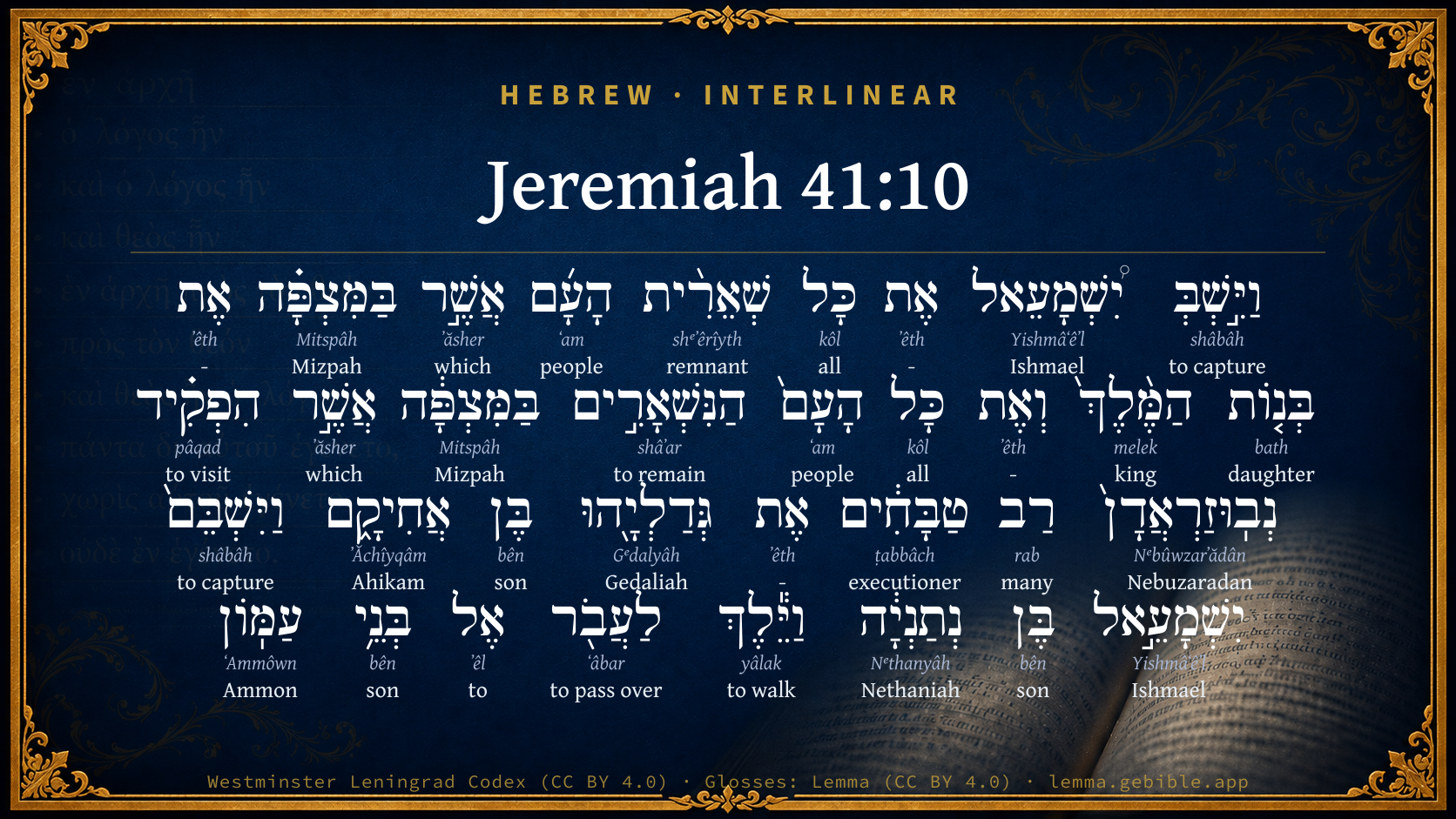
Hebrew (Westminster Leningrad Codex) Jeremiah 41:10 appears in the Hebrew Old Testament. The text above is from the Westminster Leningrad Codex. Each word links to its Strong’s number, a concise gloss, and parsing drawn from the Open Scriptures Hebrew Bible morphology. Click any word for its full Brown-Driver-Briggs (BDB) entry.
Download image
Cite this verse

Jeremiah 41:10 (World English Bible). Public Domain. Lemma interlinear Bible study tool, https://lemma.gebible.app/v/jeremiah/41/10.

Show BibTeX & RIS
BibTeX
RIS
English Translation
Then Ishmael carried away captive all the residue of the people who were in Mizpah, even the king's daughters, and all the people who remained in Mizpah, whom Nebuzaradan the captain of the guard had committed to Gedaliah the son of Ahikam; Ishmael the son of Nethaniah carried them away captive, and departed to go over to the children of Ammon.
World English Bible · Public Domain
Download a study sheet

One document with this verse’s original text, its word-by-word gloss line, the meaning frame, cross-references with their text, attributed commentary, and full source and license credits — printable, and it pastes into notes with its structure intact.

This verse Autodidact and up

Study sheet (.html) Plain text (.txt)

A passage Seminary Student

Up to 50 verses in one chapter. A passage sheet keeps up to 6 commentary sources and 12 cross-references per verse, in the order this page ranks them, and says so on the sheet whenever that leaves anything out. Ask for a single verse and you get the Autodidact verse sheet above.

Everything on this page stays free to read, with no account — the sheet is a download of what is already on screen, not access to it.

Want to remove ads? Support Godless Engineer
Compare translations 3

The same verse in 3 English versions, stacked beneath the original-language interlinear above. Click any original word for its lexicon entry.

Each is an independent rendering of the whole verse — the interlinear is not word-aligned to these translations.

Highlighted words mark where these versions differ — a whole-verse word diff, not a word-by-word alignment.

  • World English Bible Public Domain
    Then Ishmael carried away captive all the residue of the people who were in Mizpah, even the king's daughters, and all the people who remained in Mizpah, whom Nebuzaradan the captain of the guard had committed to Gedaliah the son of Ahikam; Ishmael the son of Nethaniah carried them away captive, and departed to go over to the children of Ammon.
  • King James Version Public Domain
    Then Ishmael carried away captive all the residue of the people that were in Mizpah, even the king's daughters, and all the people that remained in Mizpah, whom Nebuzaradan the captain of the guard had committed to Gedaliah the son of Ahikam: and Ishmael the son of Nethaniah carried them away captive, and departed to go over to the Ammonites.
  • unfoldingWord Literal Text CC BY-SA 4.0
    Next Ishmael captured all the other people who were in Mizpah, the king’s daughters and all the people who were left in Mizpah whom Nebuzaradan the chief guard had assigned to Gedaliah son of Ahikam. So Ishmael son of Nethaniah captured them and went to cross over to the people of Ammon.

unfoldingWord Literal Text — © unfoldingWord, licensed CC BY-SA 4.0. Word-aligned USFM3 via Door43 (git.door43.org/unfoldingWord/en_ult).

Versions to compare (up to 4)

3 of 4 selected

Show all 18 translations

Every available English version of this verse, each an independent rendering of the whole verse.

  • World English Bible Public Domain
    Then Ishmael carried away captive all the residue of the people who were in Mizpah, even the king's daughters, and all the people who remained in Mizpah, whom Nebuzaradan the captain of the guard had committed to Gedaliah the son of Ahikam; Ishmael the son of Nethaniah carried them away captive, and departed to go over to the children of Ammon.
  • Berean Standard Bible Public Domain
    Then Ishmael took captive all the remnant of the people of Mizpah—the daughters of the king along with all the others who remained in Mizpah—over whom Nebuzaradan captain of the guard had appointed Gedaliah son of Ahikam. Ishmael son of Nethaniah took them captive and set off to cross over to the Ammonites.
  • Majority Standard Bible Public Domain
    Then Ishmael took captive all the remnant of the people of Mizpah—the daughters of the king along with all the others who remained in Mizpah—over whom Nebuzaradan captain of the guard had appointed Gedaliah son of Ahikam. Ishmael son of Nethaniah took them captive and set off to cross over to the Ammonites.
  • King James Version Public Domain
    Then Ishmael carried away captive all the residue of the people that were in Mizpah, even the king's daughters, and all the people that remained in Mizpah, whom Nebuzaradan the captain of the guard had committed to Gedaliah the son of Ahikam: and Ishmael the son of Nethaniah carried them away captive, and departed to go over to the Ammonites.
  • American Standard Version (1901) Public Domain
    Then Ishmael carried away captive all the residue of the people that were in Mizpah, even the king's daughters, and all the people that remained in Mizpah, whom Nebuzaradan the captain of the guard had committed to Gedaliah the son of Ahikam; Ishmael the son of Nethaniah carried them away captive, and departed to go over to the children of Ammon.
  • Revised Version (1885) Public Domain
    Then Ishmael carried away captive all the residue of the people that were in Mizpah, even the king’s daughters, and all the people that remained in Mizpah, whom Nebuzaradan the captain of the guard had committed to Gedaliah the son of Ahikam: Ishmael the son of Nethaniah carried them away captive, and departed to go over to the children of Ammon.
  • Geneva Bible (1599) Public Domain
    Then Ishmael caryed away captiue all the residue of the people that were in Mizpah, euen the Kings daughters, and all the people that remained in Mizpah, whom Nebuzar-adan the chiefe steward had committed to Gedaliah the sonne of Ahikam, and Ishmael the sonne of Nethaniah caried them away captiue, and departed to goe ouer to the Ammonites.
  • Douay-Rheims (1899) Public Domain
    Then Ismahel carried away captive all the remnant of the people that were in Masphath: the king's daughters, and all the people that remained in Masphath: whom Nabuzardan the general of the army had committed to Godolias the son of Ahicam. And Ismahel the son of Nathanias took them, and he departed, to go over to the children of Ammon.
  • Young's Literal Translation Public Domain
    And Ishmael taketh captive all the remnant of the people who `are' in Mizpah, the daughters of the king, and all the people who are left in Mizpah, whom Nebuzar-Adan, chief of the executioners, hath committed `to' Gedaliah son of Ahikam, and Ishmael son of Nethaniah taketh them captive, and goeth to pass over unto the sons of Ammon.
  • Literal Standard Version CC BY-SA 4.0
    And Ishmael takes captive all the remnant of the people who [are] in Mizpah, the daughters of the king, and all the people who are left in Mizpah, whom Nebuzar-Adan, chief of the executioners, has committed [to] Gedaliah son of Ahikam, and Ishmael son of Nethaniah takes them captive, and goes to pass over to the sons of Ammon.
  • Unlocked Literal Bible CC BY-SA 4.0
    Next Ishmael captured all the other people who were in Mizpah, the king's daughters and all the people who were left in Mizpah whom Nebuzaradan the chief guard had assigned to Gedaliah son of Ahikam. So Ishmael son of Nethaniah captured them and went to cross over to the people of Ammon.
  • unfoldingWord Literal Text CC BY-SA 4.0
    Next Ishmael captured all the other people who were in Mizpah, the king’s daughters and all the people who were left in Mizpah whom Nebuzaradan the chief guard had assigned to Gedaliah son of Ahikam. So Ishmael son of Nethaniah captured them and went to cross over to the people of Ammon.
  • Darby Bible Public Domain
    And Ishmael carried away captive all the remnant of the people that were in Mizpah, the king's daughters, and all the people that remained in Mizpah, whom Nebuzar-adan the captain of the body-guard had committed to Gedaliah the son of Ahikam: Ishmael the son of Nethaniah carried them away captive, and departed to go over to the children of Ammon.
  • World Messianic Bible Public Domain
    Then Ishmael carried away captive all of the people who were left in Mizpah, even the king’s daughters, and all the people who remained in Mizpah, whom Nebuzaradan the captain of the guard had committed to Gedaliah the son of Ahikam. Ishmael the son of Nethaniah carried them away captive, and departed to go over to the children of Ammon.
  • Webster's Bible Public Domain
    Then Ishmael carried away captive all the residue of the people that were in Mizpah, even the king's daughters, and all the people that remained in Mizpah, whom Nebuzar-adan the captain of the guard had committed to Gedaliah the son of Ahikam: and Ishmael the son of Nethaniah carried them away captive, and departed to go over to the Ammonites.
  • Free Bible Version CC BY-SA 4.0
    Then Ishmael took all the people left in Mizpah prisoner, including the daughters of the king, as well as everyone else living there. These were the people that Nebuzaradan the commander of the guard had put under the care of Gedaliah. Ishmael took them prisoner and left to go to the Ammonites.
  • Bible in Basic English Public Domain
    Then Ishmael took away as prisoners all the rest of the people who were in Mizpah, the king's daughters and all the people still in Mizpah, whom Nebuzaradan, the captain of the armed men, had put under the care of Gedaliah, the son of Ahikam: Ishmael, the son of Nethaniah, took them away prisoners with the purpose of going over to the children of Ammon.
  • JPS Tanakh (1917) Public Domain
    Then Ishmael carried away captive all the residue of the people that were in Mizpah, even the king's daughters, and all the people that remained in Mizpah, whom Nebuzaradan the captain of the guard had committed to Gedaliah the son of Ahikam; Ishmael the son of Nethaniah carried them away captive, and departed to go over to the children of Ammon.

Literal Standard Version (2020), Covenant Press — licensed CC BY-SA 4.0. Text via the HelloAO Bible API (eBible.org). Unlocked Literal Bible (unfoldingWord) — licensed CC BY-SA 4.0. Text via the HelloAO Bible API (eBible.org). unfoldingWord Literal Text — © unfoldingWord, licensed CC BY-SA 4.0. Word-aligned USFM3 via Door43 (git.door43.org/unfoldingWord/en_ult). Free Bible Version, Dr. Jonathan Gallagher — licensed CC BY-SA 4.0. Text via the HelloAO Bible API (eBible.org).

Word by word

More ways to search: Search by grammar → Find every occurrence → Compare this word →

Practice this passage: Drill this verse → Learn its vocabulary →

נְבֽוּזַרְאֲדָן֙
Nᵉbûwzarʼădân
H5018
“Nebuzaradan”
Noun, Proper
Part of Speech
Noun
Type
Proper
Full BDB Definition

Origin: of foreign origin

TWOT: None

Nebuzaradan = "Nebo has given seed" - a general of Nebuchadnezzar's army at the capture of Jerusalem
  1. וַיִּ֣שְׁבְּ shâbâh H7617 “and · to capture” Conjunction + Verb, Qal, Sequential Imperfect, 3rd Person, Masculine, Singular
  2. יִ֠שְׁמָעֵאל Yishmâʻêʼl H3458 “Ishmael” Noun, Proper
  3. אֶת ʼêth H853 “-” Particle, Direct Object
  4. כָּל kôl H3605 “all of” Noun, Common, Masculine, Singular, Construct
  5. שְׁאֵרִ֨ית shᵉʼêrîyth H7611 “remnant of” Noun, Common, Feminine, Singular, Construct
  6. הָעָ֜ם ʻam H5971 “the · people” Particle, Definite Article + Noun, Common, Masculine, Singular, Absolute
  7. אֲשֶׁ֣ר ʼăsher H834 “which” Particle, Relative
  8. בַּמִּצְפָּ֗ה Mitspâh H4709 “in/at the · Mizpah” Preposition, Determined + Noun, Proper
  9. אֶת ʼêth H853 “-” Particle, Direct Object
  10. בְּנ֤וֹת bath H1323 “daughters of” Noun, Common, Feminine, Plural, Construct
  11. הַמֶּ֨לֶךְ֙ melek H4428 “the · king” Particle, Definite Article + Noun, Common, Masculine, Singular, Absolute
  12. וְאֶת ʼêth H853 “and · -” Conjunction + Particle, Direct Object
  13. כָּל kôl H3605 “all of” Noun, Common, Masculine, Singular, Construct
  14. הָעָם֙ ʻam H5971 “the · people” Particle, Definite Article + Noun, Common, Masculine, Singular, Absolute
  15. הַנִּשְׁאָרִ֣ים shâʼar H7604 “the · remaining” Particle, Definite Article + Verb, Niphal, Participle Active, Masculine, Plural, Absolute
  16. בַּמִּצְפָּ֔ה Mitspâh H4709 “in/at the · Mizpah” Preposition, Determined + Noun, Proper
  17. אֲשֶׁ֣ר ʼăsher H834 “which” Particle, Relative
  18. הִפְקִ֗יד pâqad H6485 “to visit” Verb, Hiphil, Perfect, 3rd Person, Masculine, Singular
  19. רַב rab H7227 “many of” Noun, Common, Masculine, Singular, Construct
  20. טַבָּחִ֔ים ṭabbâch H2876 “executioners” Noun, Common, Masculine, Plural, Absolute
  21. אֶת ʼêth H853 “-” Particle, Direct Object
  22. גְּדַלְיָ֖הוּ Gᵉdalyâh H1436 “Gedaliah” Noun, Proper
  23. בֶּן bên H1121 “son of” Noun, Common, Masculine, Singular, Construct
  24. אֲחִיקָ֑ם ʼĂchîyqâm H296 “Ahikam” Noun, Proper
  25. וַיִּשְׁבֵּם֙ shâbâh H7617 “and · to capture · them” Conjunction + Verb, Qal, Sequential Imperfect, 3rd Person, Masculine, Singular + Suffix, Personal, 3rd Person, Masculine, Plural
  26. יִשְׁמָעֵ֣אל Yishmâʻêʼl H3458 “Ishmael” Noun, Proper
  27. בֶּן bên H1121 “son of” Noun, Common, Masculine, Singular, Construct
  28. נְתַנְיָ֔ה Nᵉthanyâh H5418 “Nethaniah” Noun, Proper
  29. וַיֵּ֕לֶךְ yâlak H3212 “and · to walk” Conjunction + Verb, Qal, Sequential Imperfect, 3rd Person, Masculine, Singular
  30. לַעֲבֹ֖ר ʻâbar H5674 “to pass over” Preposition + Verb, Qal, Infinitive Construct
  31. אֶל ʼêl H413 “to” Preposition
  32. בְּנֵ֥י bên H1121 “sons of” Noun, Common, Masculine, Plural, Construct
  33. עַמּֽוֹן ʻAmmôwn H5983 “Ammon” Noun, Proper

About this verse

These counts appear in no published source. They are computed here, from the morphology-tagged text and Lemma’s own curated glosses. What Lemma adds →

34
words
23
distinct lemmas
Prophets
section

Notable vocabulary

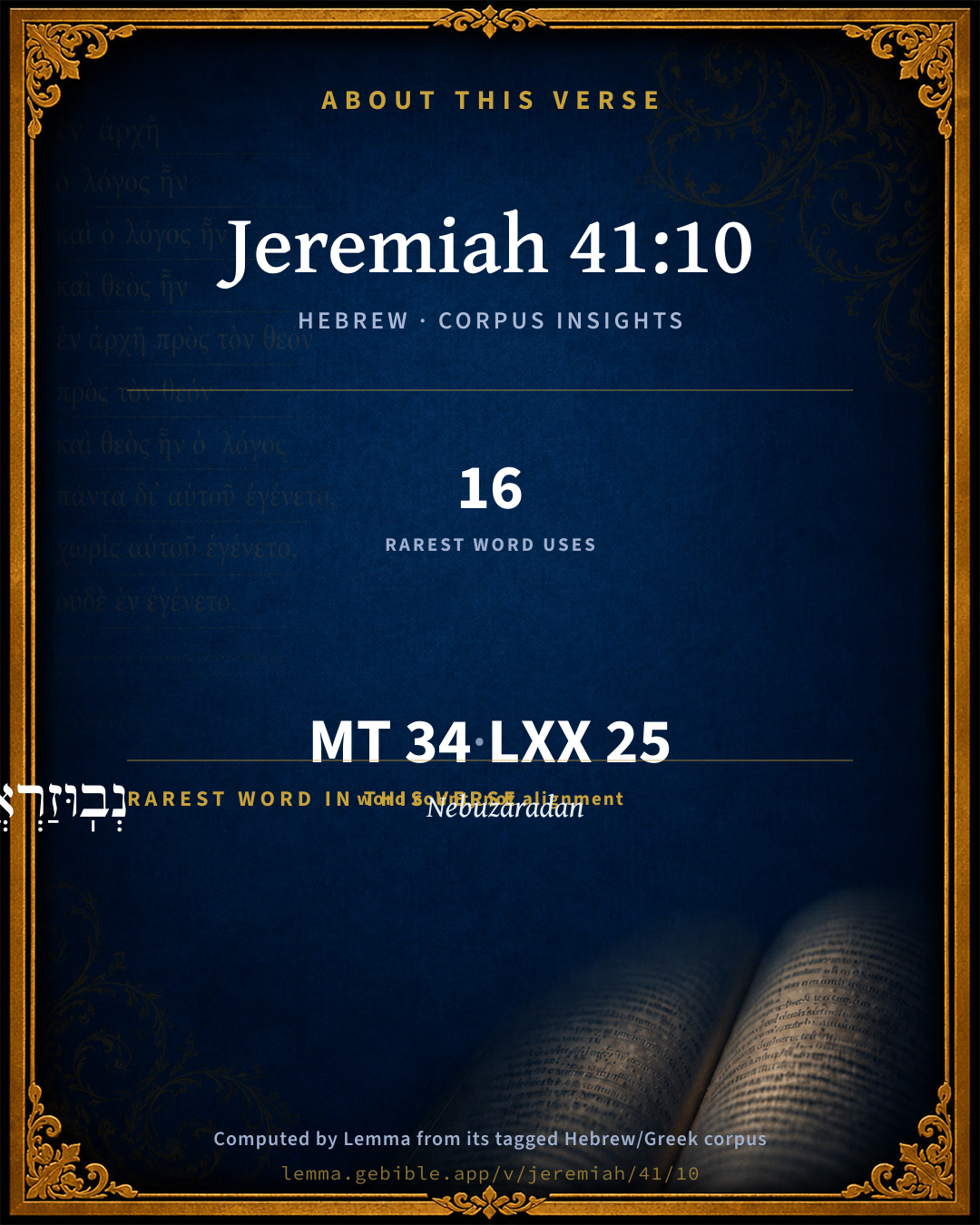
The rarest word here is נְבֽוּזַרְאֲדָן֙ Nebuzaradan H5018 — appearing just 16 times in the whole Hebrew Bible.

Shared distinctive vocabulary

נְבֽוּזַרְאֲדָן֙ Nebuzaradan H5018 occurs in 15 verses of the Hebrew Bible. Also found in:

Grammatical profile

  • 6 verbs
  • 21 nouns
  • 1 preposition
  • 6 particles

Verb forms

  • וַיִּ֣שְׁבְּ Qal · Sequential Imperfect
  • הַנִּשְׁאָרִ֣ים Niphal · Participle Active
  • הִפְקִ֗יד Hiphil · Perfect
  • וַיִּשְׁבֵּם֙ Qal · Sequential Imperfect
  • וַיֵּ֕לֶךְ Qal · Sequential Imperfect
  • לַעֲבֹ֖ר Qal · Infinitive Construct

Repetition

Words recur within this verse — often emphatic in Hebrew:

  • בֶּן son H1121 ×3
  • וַיִּ֣שְׁבְּ to capture H7617 ×2
  • יִ֠שְׁמָעֵאל Ishmael H3458 ×2
  • כָּל all H3605 ×2
  • הָעָ֜ם people H5971 ×2
  • בַּמִּצְפָּ֗ה Mizpah H4709 ×2
  • אֲשֶׁ֣ר which H834 ×2

Hebrew & Septuagint length

In the original languages it is 34 Hebrew tokens and 25 Greek tokens — but the two are counted differently (Hebrew bundles its prefixes and suffixes into one token; the Greek is in lemma form), so that isn’t a like-for-like length.

Cross-references

12

Topical passages linked to Jeremiah 41:10 in the Treasury of Scripture Knowledge — connected by theme and wording, ordered by reader-vote popularity; previews shown in the World English Bible.

  • Jeremiah 40:14 and said to him, Do you know that Baalis the king of the children of Ammon has sent Ishmael the son of Nethaniah to take your life? But Gedaliah the son of Ahikam didn't believe them.
  • Jeremiah 40:7 Now when all the captains of the forces who were in the fields, even they and their men, heard that the king of Babylon had made Gedaliah the son of Ahikam governor in the land, and had committed to him men, and women, and children, and of the poorest of the land, of those who were not carried away captive to Babylon;
  • Nehemiah 2:10 When Sanballat the Horonite, and Tobiah the servant, the Ammonite, heard of it, it grieved them exceedingly, because a man had come to seek the welfare of the children of Israel.
  • Nehemiah 2:19 But when Sanballat the Horonite, and Tobiah the servant, the Ammonite, and Geshem the Arabian, heard it, they ridiculed us, and despised us, and said, What is this thing that you do? will you rebel against the king?
  • Jeremiah 40:11–12 Likewise when all the Jews who were in Moab, and among the children of Ammon, and in Edom, and who were in all the countries, heard that the king of Babylon had left a remnant of Judah, and that he had set over them Gedaliah the son of Ahikam, the son of Shaphan;
  • Nehemiah 4:7–8 But it happened that when Sanballat, Tobiah, the Arabians, the Ammonites, and the Ashdodites heard that the repairing of the walls of Jerusalem went forward, [and] that the breaches began to be stopped, then they were very angry;
  • Nehemiah 6:17–18 Moreover in those days the nobles of Judah sent many letters to Tobiah, and [the letters] of Tobiah came to them.
  • Nehemiah 13:4–8 Now before this, Eliashib the priest, who was appointed over the chambers of the house of our God, being allied to Tobiah,
  • Jeremiah 22:30 Thus says Yahweh, Write you this man childless, a man who shall not prosper in his days; for no more shall a man of his seed prosper, sitting on the throne of David, and ruling in Judah.
  • Jeremiah 39:6 Then the king of Babylon killed the sons of Zedekiah in Riblah before his eyes: also the king of Babylon killed all the nobles of Judah.
  • Jeremiah 43:5–7 But Johanan the son of Kareah, and all the captains of the forces, took all the remnant of Judah, who were returned from all the nations where they had been driven, to sojourn in the land of Judah;
  • Jeremiah 44:12–14 I will take the remnant of Judah, that have set their faces to go into the land of Egypt to sojourn there, and they shall all be consumed; in the land of Egypt shall they fall; they shall be consumed by the sword and by the famine; they shall die, from the least even to the greatest, by the sword and by the famine; and they shall be an object of horror, [and] an astonishment, and a curse, and a reproach.

Cross-references courtesy of OpenBible.info (CC BY 4.0).

Hebrew and Greek witnesses Masoretic Hebrew ↔ Greek Septuagint

The same verse in the two great witnesses to the Old Testament, shown verse-for-verse.

These are two independent witnesses, not word-aligned to each other, and the Septuagint is shown in lemma (dictionary) form.

Hebrew Jeremiah 41:10 Masoretic · Westminster Leningrad Codex

וַיִּ֣שְׁבְּ יִ֠שְׁמָעֵאל אֶת כָּל שְׁאֵרִ֨ית הָעָ֜ם אֲשֶׁ֣ר בַּמִּצְפָּ֗ה אֶת בְּנ֤וֹת הַמֶּ֨לֶךְ֙ וְאֶת כָּל הָעָם֙ הַנִּשְׁאָרִ֣ים בַּמִּצְפָּ֔ה אֲשֶׁ֣ר הִפְקִ֗יד נְבֽוּזַרְאֲדָן֙ רַב טַבָּחִ֔ים אֶת גְּדַלְיָ֖הוּ בֶּן אֲחִיקָ֑ם וַיִּשְׁבֵּם֙ יִשְׁמָעֵ֣אל בֶּן נְתַנְיָ֔ה וַיֵּ֕לֶךְ לַעֲבֹ֖ר אֶל בְּנֵ֥י עַמּֽוֹן

Then Ishmael carried away captive all the residue of the people who were in Mizpah, even the king's daughters, and all the people who remained in Mizpah, whom Nebuzaradan the captain of the guard had committed to Gedaliah the son of Ahikam; Ishmael the son of Nethaniah carried them away captive, and departed to go over to the children of Ammon.

World English Bible · Public Domain

Greek LXX Structure differs

In the Septuagint, Jeremiah is about an eighth shorter than the Hebrew and arranges its material differently — the Oracles Against the Nations (Hebrew chapters 46–51) appear in the middle of the Greek book, after 25:13. Because the chapter and verse boundaries do not line up, a verse-for-verse comparison with the Hebrew is not shown.

A verse-for-verse comparison isn’t shown here because the chapters and verses don’t line up. Switch to the LXX edition with the MT / LXX toggle above to read the Greek directly.

Hebrew: Westminster Leningrad Codex (CC BY 4.0). Greek: Septuagint (public domain); English from a public-domain English Septuagint. How the Septuagint differs from the Hebrew →

Targum (Aramaic paraphrase)

1

The Targum is the ancient Jewish Aramaic paraphrase of the Hebrew Scriptures — an interpretive translation, not the Hebrew text itself. Onkelos (literal) and Pseudo-Jonathan (expansive) render the Torah, and Jonathan the Prophets. Coverage is partial: where no permissively-licensed English translation exists for a verse, only the Aramaic is shown. This is verse-level text, not a word-by-word alignment to the Hebrew.

  1. Targum Jonathan Prophets (Joshua–Malachi)
    וּשְׁבָא יִשְׁמָעֵאל יַת כָּל שְׁאָרָא דְעַמָא דִי בְמִצְפְּיָא יַת בְּנַת מַלְכָּא וְיַת כָּל עַמָא דְאִשְׁתָּאֲרוּ בְּמִצְפְּיָא דְמַנֵי נְבוּזַרְאֲדָן רַב קָטוֹלַיָא עַל גְדַלְיָהוּ בַּר אֲחִיקָם וּשְׁבָנוּן יִשְׁמָעֵאל בַּר נְתַנְיָהוּ וַאֲזַל לְמֶעְבַּר לְוַת בְּנֵי עַמוֹן:

    (no public-domain English translation for this verse)

    Targum Jonathan — Aramaic: “Mikraot Gedolot” (public domain). English: “Sefaria Community Translation” (CC0 1.0 (public-domain dedication)); “London "Chaldee Paraphrase," 1871” (public domain). Text via Sefaria.

Commentary

Notes on Jeremiah 41:10 from classic Christian and Jewish commentators (each source and its license shown beneath its notes). The classic Christian expositions comment on the surrounding passage and are grouped to its opening verse, so a note may address several verses; the Jewish commentaries on the Tanakh (Rashi and others) are per-verse, so they appear only where the commentator wrote on this verse.

Lemma curates 59 commentaries, every one of them public domain or Creative Commons licensed, each selected and text-cleaned for this edition rather than reprinted as found. About our sources →

Trapp's Complete Commentary

John Trapp

Jer 41:10 Then Ishmael carried away captive all the residue of the people that [were] in Mizpah, [even] the king’s daughters, and all the people that remained in Mizpah, whom Nebuzaradan the captain of the guard had committed to Gedaliah the son of Ahikam: and Ishmael the son of Nethaniah carried them away captive, and departed to go over to the Ammonites.

Ver. 10. Then Ishmael carried away captive.]

“ Auri sacra fames quid non mortalia cogit Pectora? ”

Even the king’s daughters.] His own kinswomen, whom the Babylonian had spared. It may be he meant to marry one of them, as our Richard III would have done his niece Elizabeth, and so to have reigned in her right.

And all the people that remained in Mizpah.] Who found less favour from a false brother than they had done from a professed enemy; so hath the Church ever done from heretics than from heathens.

John Trapp, A Commentary or Exposition upon All the Books of the Old and New Testament (1647–1656) — public domain. Text from a community e-Sword module.

Joseph Benson's Commentary

Jer 41:10-13. Ishmael carried away captive all the residue of the people — All that he did not slay: see note on Jer 41:3; and among the rest Zedekiah’s daughters, who had been left to the care of Gedaliah, when his sons were slain. These, it seems, being recovered by Johanan, were taken with him into Egypt, where they perished among the other Jews. And Ishmael departed to go over to the Ammonites — Probably intending to make a present of the captives he was taking with him, to Baalis king of Ammon, by whom he had been instigated to the murder of Gedaliah. But when Johanan, and all the captains heard, &c. — It would have been well if Johanan, when he gave information to Gedaliah of Ishmael’s treasonable design, had stayed with him; for he and his captains, and their forces, might have been a life-guard to him, and a terror to Ishmael, and so have prevented the mischief, without the effusion of blood. They took all the men, and went to fight with Ishmael — Upon receiving notice of the murders he had committed, and which way he had gone, they pursued him, and found him by the great waters that are in Gibeon — Called the pool of Gibeon, of which we read 2Sa 2:13. Now when all the people which were with Ishmael — Namely, the poor captives whom he was taking into the land of the Ammonites; saw Johanan, &c., they were glad — As they might well be, to see a probability of escaping out of the hands of the bloody man who had slain so many of their brethren: and they presently found an opportunity to wheel about, and come over to Johanan and his captains, Ishmael not attempting to detain them, but readily quitting his prey to save his life.

Joseph Benson's Commentary on the Old and New Testaments (1811–1818) — public domain. Text from a community e-Sword module.

Tyndale Open Study Notes

Tyndale Open Resources

41:10 Some of the king’s daughters somehow escaped being killed or taken into exile.

Tyndale Open Study Notes — © Tyndale Open Resources, licensed CC BY-SA 4.0. Text via the HelloAO Bible API.

Jamieson, Fausset & Brown

Robert Jamieson, A. R. Fausset & David Brown

the king's daughters-- (Jer 43:6). Zedekiah's. Ishmael must have got additional followers (whom the hope of gain attracted), besides those who originally set out with him (Jer 41:1), so as to have been able to carry off all the residue of the people. He probably meant to sell them as slaves to the Ammonites (see on Jer 40:14).

Jamieson, Fausset & Brown — Commentary Critical and Explanatory on the Whole Bible (1871) — public domain (CC PDM 1.0). Text via the HelloAO Bible API.

Adam Clarke's Commentary

Verse 10. Carried away captive] He took all these that he might sell them for slaves among the Ammonites.

Adam Clarke's Commentary on the Bible (1810–1826) — public domain. Text from a community e-Sword/MySword module.

John Calvin's Commentaries

It is not known whether Ishmael had this design at the beginning, or whether, when he saw that he had no power to stand his ground, he took the captives with him, that he might dwell with the king of Ammon. It is, however, probable that this was done according to a previous resolution, and that before he slew Gedaliah, it was determined that the remnant should be drawn away to that country. Perhaps the king of Ammon wished to send some of his own people to dwell in Judea; thus he hoped to become the ruler of Judea, and also hoped to pacify the king of Babylon by becoming his tributary. It was, however, a great thing to possess a land so fertile. However this may have been, there is no doubt but that the king of Ammon hoped for something great after the death of Gedaliah. And it is probable that for this reason the people were drawn away, to whom an habitation in Judea had been permitted.

The Prophet now tells us, that Ishmael took the remnant of the people captives. And it appears that in a short time he had a greater force than at the beginning; for he could not with a few men collect the people, for the number of those who had been left, as we have seen, was not inconsiderable: and they were dispersed through many towns; and Ishmael could not have prevailed on them by his command alone to remove to the land of Ammon. But after he had killed Gedaliah, his barbarity frightened them all, and no doubt many joined him; for an impious faction ever finds many followers when any hope is offered them. All then who were miserable among the people followed him as their leader; and thus he was able to lead away the whole people as captives.

But here again a question arises, that is, respecting the daughters of the king; for the poor and the obscure, who were of the lowest class, had alone been left; and the royal seed, as we have seen, had been carried away. But it is probable that some of the king’s daughters had escaped when the city was besieged; for Ishmael himself was of the royal seed, but he had escaped before the city was taken. Nebuchadnezzar then could not have had him as a captive. The same was the case with the daughters of the king, whom Zedekiah might have sent to some secure places. And Ge-daliah afterwards brought them together when he saw that it could be done without danger or hazard of exciting suspicion: he had indeed obtained this power, as we have before seen, from Nebuzaradan. Though then Gedaliah ruled over the poor and those of no repute, yet the daughters of the king, who had been removed to quieter places, afterwards dwelt with him; and so Ishmael, and John the son of Kareah, and other leaders of the army, came to him: the reason was the same.

But it is again repeated, and all the people that remained in Mizpah, whom Nebuzaradan had committed to Gedaliah, or, over whom he appointed Gedaliah, as we have before seen. But the repetition was not made without reason; for Jeremiah expressed again what was worthy of special notice, that the fury and violence of Ishmael were so great that he did not see that the mind of Nebuchadnezzar would be so exasperated as to become implacable; but his madness was so furious that he had no regard for himself nor for others.

He then says that he took away captive the people, and went that he might pass over to the children of Ammon Thus their condition was much worse than if they had been driven into exile; for the Ammonites were in no degree more kind than the Chaldeans; nay, they were exposed there, as we shall hereafter see, to greater reproaches; it would indeed have been better for them and more tolerable, had they been at once killed, than to have been thus removed to an exile the most miserable.

It hence appears that Ishmael was wholly devoid of all humane feelings, having been thus capable of the impiety of betraying the children of Abraham. For where there is ambition, it often happens that a lust for empire impels men to deeds of great enormity; but to draw away unhappy people to the Ammonites was certainly an act more than monstrous.

As to the people, we shall hereafter see that they deserved all their reproaches and miseries; and this calamity did not happen to them except through the righteous providence of God. For though they were freed, as we shall see, by the son of Kareah, yet they soon went into Egypt, notwithstanding the remonstrances of the Prophet, and his severe denunciations in case they removed there. Though then the base and monstrous cruelty of Ishmael is here set before us, let us yet know that the Jews deserved to be driven away into exile, and to be subjected to all kinds of miseries.

Oh, miserable sentence! when it is said, that there were slain seventy men in the hand of Gedaliah Some render “hand,” as I have noticed, “on account of Gedaliah;” and others, “in the place of Gedaliah.” But as this explanation seems forced, we may take hand for stroke or wound; and this seems the most suitable meaning, as hand is often so taken in Scripture. They were then slain in the wound of Gedaliah, that is, they were slain in like manner with him, as it were in addition to the wound he received. Let us now proceed, —

John Calvin's Commentaries (1540-1563) — public domain. Text from the Calvin Translation Society English edition (1840s-50s) via the Christian Classics Ethereal Library (ccel.org). Calvin's coverage is partial (roughly two-thirds of the Bible); uncommented books and verses are honest gaps, never fabricated. The 19th-century editor's footnotes and remarks are omitted so the notes are faithfully Calvin's own voice.

Ellicott's Commentary for English Readers

(10) Even the king’s daughters.—We find in Jer_39:6 that the sons of Zedekiah were slain at Riblah. The daughters (the word was probably used generally for all the princesses of the royal house) were spared, and consigned to the protection of Gedaliah. In taking possession of them, Ishmael was asserting, after the fashion of the East, his claim as the representative of the royal house. The Ammonites had been in alliance with Zedekiah (Jer_27:3), and Ishmael reckoned on finding a safe refuge with them. It would seem, indeed, from Jer_40:14, that he had been sent, or was believed to have been sent, by the king of the Ammonites for the very purpose of the murder of Gedaliah.

A Bible Commentary for English Readers, edited by Charles John Ellicott (1878–1897) — public domain. Text from a community e-Sword module.

The Cambridge Bible for Schools and Colleges

gen. ed. J. J. S. Perowne

10. the king’s daughters] not necessarily Zedekiah’s daughters, but female members of the royal house, not taken away as captive by Nebuchadnezzar.

The Cambridge Bible for Schools and Colleges (gen. ed. J. J. S. Perowne; Cambridge University Press, 1878–1918) — public domain. Text from a community e-Sword module.

John Gill's Exposition

Then Ishmael carried away captive all the residue of the people that were in Mizpah,.... All that were not slain by him, that remained after the slaughter he had made, chiefly the unarmed people; they being men of war who fell by his sword:

even the king's daughters; whether they were the daughters of Zedekiah, Jehoiakim, or Jehoiakim, says Kimchi, we know not; but it is most likely that they were the daughters of Zedekiah the last king, and who was just taken and carried captive; and so Josephus (n) expressly calls them; these the king of Babylon regarded not, because they could neither fight, nor claim the kingdom; only the sons of the king, whom he slew before his eyes; though it may be these were not his daughters by his lawful wife, but by his concubines, and so were not properly of the royal family, and less regarded:

and all the people that remained in Mizpah, whom Nebuzaradan the captain of the guard had committed to Gedaliah the son of Ahikam; that were not slain, or carried captive by the Chaldeans; but were left at Mizpah, under the care and government of Gedaliah:

and Ishmael the son of Nethaniah carried them away captive: so that those who escaped one captivity fell into another, and even by the hand of one of their own countrymen:

and departed to go over to the Ammonites; he went from Mizpah with these captives, in order to carry them to the king of Ammon, and make them his slaves; who had put him upon this enterprise out of hatred to the Jews, and to enrich himself with their spoils. Some render it, "to go over with the Ammonites" (o); which they suppose the ten men to be that came along with him and the princes, to commit the barbarities they did.

(n) Ut supra. (Antiqu. l. 10. c. 9. sect. 4.) (o) "cum filiis Ammon", Schmidt.

John Gill's Exposition of the Whole Bible (1746–1763) — public domain (CC PDM 1.0). Text via the HelloAO Bible API.

Haydock's Catholic Bible Commentary

King’s; Sedecias, (Calmet) or some of his predecessors, as all the women were taken, (chap. xxxviii. 22, 23.) unless those had escaped before. (Haydock)

George Leo Haydock (1774–1849), Haydock's Catholic Family Bible and Commentary, 1859 edition — public domain. Excludes Psalms (Douay-Rheims chapter numbering differs from Protestant) and Deuterocanonical books (Catholic canon only).

Matthew Poole's English Annotations

By this verse appeareth that all the Jews, Jer 41:3, must be understood in a restrained sense, concerning all those about Gedaliah. For he carried many away as prisoners, as also Zedekiah’s daughters, who either had concealed themselves at the taking of the city, or were left behind by the conquerors, as not like much to hurt them; and having done this, he knew there was no abiding for him long there, so he hasteneth away to the Ammonites, who (as we had it before) employed him in this murder.

Matthew Poole's English Annotations on the Holy Bible (1683–1685) — public domain. Text from a community e-Sword/MySword module.

Whedon's Commentary on the Bible

Daniel D. Whedon

10. King’s daughters — Not only those who were really such, but all the younger female members of the royal household.

Daniel D. Whedon (gen. ed.), Commentary on the Old and New Testaments (1874–1909) — public domain. Text from a community e-Sword module.

The Pulpit Commentary

The king"s daughters; rather, the royal princesses. (see on Jer_36:26)

The Pulpit Commentary (1880–1919), ed. H.D.M. Spence-Jones & Joseph S. Exell — public domain. Text from a community e-Sword module.

Keil & Delitzsch

C. F. Keil & F. Delitzsch

After executing these murderous deeds, Ishmael led away into captivity all the people that still remained in Mizpah, the king's daughters and all the people whom Nebuchadnezzar had committed to the care of Gedaliah, intending to go over with them to the Ammonites. As the object of ויּשׁבּ is very far removed through the intervention of a relative clause, the connection is resumed by ויּשׁבּם. "The king's daughters" are not only the daughters of Zedekiah, but female members generally of the royal house, princesses, analogous to בּן־מלך, king's son = prince, Jer 36:26; Jer 38:6.

Keil & Delitzsch — Biblical Commentary on the Old Testament (1861–1891) — public domain (CC PDM 1.0). Text via the HelloAO Bible API. (Old Testament only.)

unfoldingWord translationNotes

Door43 World Missions Community

Ishmael captured

Here Ishmael represents himself and his men. AT: "Ishmael and his men captured" (See: Synecdoche)

Nebuzaradan

See how you translated this man's name in Jeremiah 39:9. (See: How to Translate Names)

went to cross over to the people of Ammon

"traveled towards the land of the Ammonites"

translationWords

people group

Mizpah

chief

assign

Ammon

unfoldingWord translationNotes — © Distant Shores Media and the Door43 World Missions Community, licensed CC BY-SA 4.0. Source: git.door43.org/Door43/en_tn.

Lesson kit

Teaching starters — assembled from the data on this page, not authored interpretation. Every prompt links to the verse data it draws on. Edit before teaching.

Jeremiah, in the Prophets, opens this verse with 34 words (23 distinct Hebrew lemmas). Its most distinctive word is Nᵉbûwzarʼădân (“Nebuzaradan”). A historical commentator’s framing appears above. Read the whole chapter for the surrounding context.

Discussion questions

  1. How does “Nebuzaradan” (Nᵉbûwzarʼădân) shape what this verse is saying?
  2. How does 2 Kings 25:8, which shares the word «Nebuzaradan», read alongside this verse?
  3. What does the repetition of “son” (3× in this one verse) do in this verse?
  4. The translations on this page render this verse differently — a whole-verse word diff, not a word-by-word alignment. What might account for the different wordings?
  5. «וַיִּ֣שְׁבְּ» is a Qal Sequential Imperfect verb. How does that grammatical form shape the action described?
  6. Compare how Trapp's Complete Commentary and Joseph Benson's Commentary read this verse. Where do they agree or differ?

Things to notice

Reading settings

Reading text

Shown beneath each verse's original-language words.

Old Testament
Old Testament edition

Read the OT as the Masoretic Hebrew (MT) or the Greek Septuagint (LXX).

English shown for the Greek Septuagint (in the Hebrew ↔ Greek comparison).

Comparing translations? Open the Compare panel on any verse page to stack up to four side by side.