
Deuteronomy 2:29

Hebrew (Westminster Leningrad Codex) Deuteronomy 2:29 appears in the Hebrew Old Testament. The text above is from the Westminster Leningrad Codex. Each word links to its Strong’s number, a concise gloss, and parsing drawn from the Open Scriptures Hebrew Bible morphology. Click any word for its full Brown-Driver-Briggs (BDB) entry.
Download image
Cite this verse

Deuteronomy 2:29 (World English Bible). Public Domain. Lemma interlinear Bible study tool, https://lemma.gebible.app/v/deuteronomy/2/29.

Show BibTeX & RIS
BibTeX
RIS
English Translation
as the children of Esau who dwell in Seir, and the Moabites who dwell in Ar, did to me; until I shall pass over the Jordan into the land which Yahweh our God gives us.
World English Bible · Public Domain
Download a study sheet

One document with this verse’s original text, its word-by-word gloss line, the meaning frame, cross-references with their text, attributed commentary, and full source and license credits — printable, and it pastes into notes with its structure intact.

This verse Autodidact and up

Study sheet (.html) Plain text (.txt)

A passage Seminary Student

Up to 50 verses in one chapter. A passage sheet keeps up to 6 commentary sources and 12 cross-references per verse, in the order this page ranks them, and says so on the sheet whenever that leaves anything out. Ask for a single verse and you get the Autodidact verse sheet above.

Everything on this page stays free to read, with no account — the sheet is a download of what is already on screen, not access to it.

Want to remove ads? Support Godless Engineer
Compare translations 3

The same verse in 3 English versions, stacked beneath the original-language interlinear above. Click any original word for its lexicon entry.

Each is an independent rendering of the whole verse — the interlinear is not word-aligned to these translations.

Highlighted words mark where these versions differ — a whole-verse word diff, not a word-by-word alignment.

  • World English Bible Public Domain
    as the children of Esau who dwell in Seir, and the Moabites who dwell in Ar, did to me; until I shall pass over the Jordan into the land which Yahweh our God gives us.
  • King James Version Public Domain
    (As the children of Esau which dwell in Seir, and the Moabites which dwell in Ar, did unto me;) until I shall pass over Jordan into the land which the LORD our God giveth us.
  • unfoldingWord Literal Text CC BY-SA 4.0
    as the sons of Esau who live in Seir, and the Moabites who live in Ar, did for me, until I cross the Jordan into the land that Yahweh our God is giving to us.’

unfoldingWord Literal Text — © unfoldingWord, licensed CC BY-SA 4.0. Word-aligned USFM3 via Door43 (git.door43.org/unfoldingWord/en_ult).

Versions to compare (up to 4)

3 of 4 selected

Show all 18 translations

Every available English version of this verse, each an independent rendering of the whole verse.

  • World English Bible Public Domain
    as the children of Esau who dwell in Seir, and the Moabites who dwell in Ar, did to me; until I shall pass over the Jordan into the land which Yahweh our God gives us.
  • Berean Standard Bible Public Domain
    just as the descendants of Esau who live in Seir and the Moabites who live in Ar did for us, until we cross the Jordan into the land that the LORD our God is giving us.”
  • Majority Standard Bible Public Domain
    just as the descendants of Esau who live in Seir and the Moabites who live in Ar did for us, until we cross the Jordan into the land that the LORD our God is giving us.”
  • King James Version Public Domain
    (As the children of Esau which dwell in Seir, and the Moabites which dwell in Ar, did unto me;) until I shall pass over Jordan into the land which the LORD our God giveth us.
  • American Standard Version (1901) Public Domain
    as the children of Esau that dwell in Seir, and the Moabites that dwell in Ar, did unto me; until I shall pass over the Jordan into the land which Jehovah our God giveth us.
  • Revised Version (1885) Public Domain
    as the children of Esau which dwell in Seir, and the Moabites which dwell in Ar, did unto me; until I shall pass over Jordan into the land which the LORD our God giveth us.
  • Geneva Bible (1599) Public Domain
    (As the children of Esau which dwell in Seir, and the Moabites which dwell in Ar, did vnto me) vntill I be come ouer Iorden, into the land which the Lord our God giueth vs.
  • Douay-Rheims (1899) Public Domain
    As the children of Esau have done, that dwell in Seir, and the Moabites, that abide in Ar: until we come to the Jordan, and pass to the land which the Lord our God will give us.
  • Young's Literal Translation Public Domain
    as the sons of Esau who are dwelling in Seir, and the Moabites who are dwelling in Ar, have done to me -- till that I pass over the Jordan, unto the land which Jehovah our God is giving to us.
  • Literal Standard Version CC BY-SA 4.0
    as the sons of Esau who are dwelling in Seir and the Moabites who are dwelling in Ar have done for me, until I pass over the Jordan to the land which our God YHWH is giving to us.
  • Unlocked Literal Bible CC BY-SA 4.0
    as the descendants of Esau who live in Seir, and as the Moabites who live in Ar, did for me; until I pass over the Jordan into the land that Yahweh our God is giving us.'
  • unfoldingWord Literal Text CC BY-SA 4.0
    as the sons of Esau who live in Seir, and the Moabites who live in Ar, did for me, until I cross the Jordan into the land that Yahweh our God is giving to us.’
  • Darby Bible Public Domain
    -- as the children of Esau who dwell in Seir, and the Moabites who dwell in Ar, did to me, -- until I shall pass over the Jordan into the land which Jehovah our God giveth us.
  • World Messianic Bible Public Domain
    as the children of Esau who dwell in Seir, and the Moabites who dwell in Ar, did to me, until I pass over the Jordan into the land which the LORD our God gives us.”
  • Webster's Bible Public Domain
    (As the children of Esau who dwell in Seir, and the Moabites who dwell in Ar, did to me;) until I shall pass over Jordan into the land which the LORD our God giveth us.
  • Free Bible Version CC BY-SA 4.0
    just like the descendants of Esau living in Seir and the Moabites living in Ar allowed us, until we cross over the Jordan into the country that the Lord our God is giving to us.”
  • Bible in Basic English Public Domain
    As the children of Esau did for me in Seir and the Moabites in Ar; till I have gone over Jordan into the land which the Lord our God is giving us.
  • JPS Tanakh (1917) Public Domain
    as the children of Esau that dwell in Seir, and the Moabites that dwell in Ar, did unto me; until I shall pass over the Jordan into the land which the LORD our God giveth us.'

Literal Standard Version (2020), Covenant Press — licensed CC BY-SA 4.0. Text via the HelloAO Bible API (eBible.org). Unlocked Literal Bible (unfoldingWord) — licensed CC BY-SA 4.0. Text via the HelloAO Bible API (eBible.org). unfoldingWord Literal Text — © unfoldingWord, licensed CC BY-SA 4.0. Word-aligned USFM3 via Door43 (git.door43.org/unfoldingWord/en_ult). Free Bible Version, Dr. Jonathan Gallagher — licensed CC BY-SA 4.0. Text via the HelloAO Bible API (eBible.org).

Word by word

More ways to search: Search by grammar → Find every occurrence → Compare this word →

Practice this passage: Drill this verse → Learn its vocabulary →

בְּעָ֑ר
ʻÂr
H6144
“in/at · Ar”
Preposition + Noun, Proper
Part of Speech
Preposition + Noun
Type
Proper
Full BDB Definition

Origin: the same as H5892

TWOT: None

Ar = "a city" - a city of Moab located south of the Arnon river; perhaps the capital
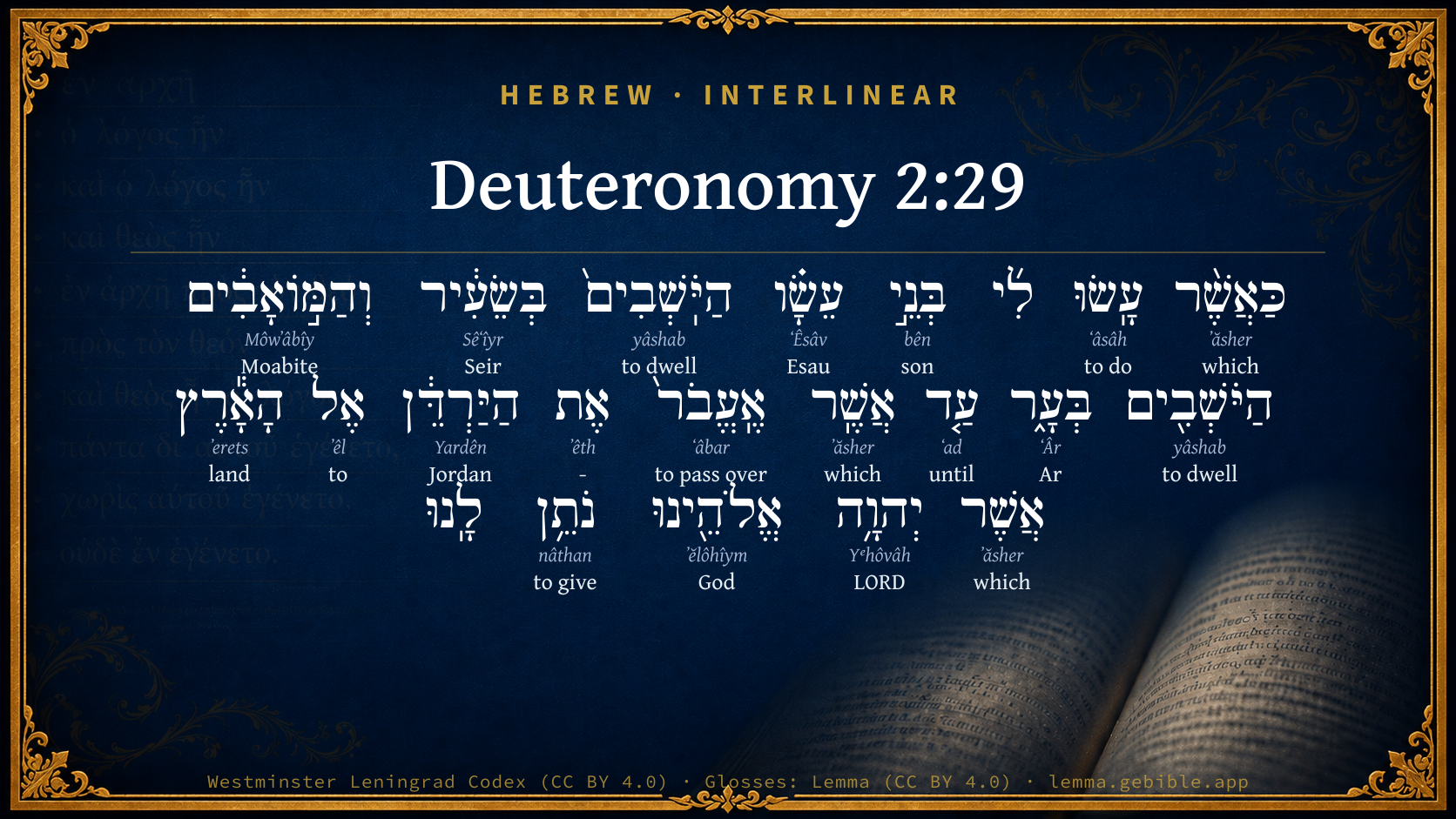
  1. כַּאֲשֶׁ֨ר ʼăsher H834 “like/as · which” Preposition + Particle, Relative
  2. עָֽשׂוּ ʻâsâh H6213 “to do” Verb, Qal, Perfect, 3rd Person, Common, Plural
  3. בְּנֵ֣י bên H1121 “sons of” Noun, Common, Masculine, Plural, Construct
  4. עֵשָׂ֗ו ʻÊsâv H6215 “Esau” Noun, Proper
  5. הַיֹּֽשְׁבִים֙ yâshab H3427 “the · dwelling” Particle, Definite Article + Verb, Qal, Participle Active, Masculine, Plural, Absolute
  6. בְּשֵׂעִ֔יר Sêʻîyr H8165 “in/at · Seir” Preposition + Noun, Proper
  7. וְהַמּ֣וֹאָבִ֔ים Môwʼâbîy H4125 “and · the · Moabites” Conjunction + Particle, Definite Article + Noun, Gentilic, Masculine, Plural, Absolute
  8. הַיֹּשְׁבִ֖ים yâshab H3427 “the · dwelling” Particle, Definite Article + Verb, Qal, Participle Active, Masculine, Plural, Absolute
  9. עַ֤ד ʻad H5704 “until” Preposition
  10. אֲשֶֽׁר ʼăsher H834 “which” Particle, Relative
  11. אֶֽעֱבֹר֙ ʻâbar H5674 “to pass over” Verb, Qal, Imperfect, 1st Person, Common, Singular
  12. אֶת ʼêth H853 “-” Particle, Direct Object
  13. הַיַּרְדֵּ֔ן Yardên H3383 “the · Jordan” Particle, Definite Article + Noun, Proper
  14. אֶל ʼêl H413 “to” Preposition
  15. הָאָ֕רֶץ ʼerets H776 “the · land” Particle, Definite Article + Noun, Common, Both, Singular, Absolute
  16. אֲשֶׁר ʼăsher H834 “which” Particle, Relative
  17. יְהוָ֥ה Yᵉhôvâh H3068 “LORD” Noun, Proper
  18. אֱלֹהֵ֖ינוּ ʼĕlôhîym H430 “God(s) · our” Noun, Common, Masculine, Plural, Construct + Suffix, Personal, 1st Person, Common, Plural
  19. נֹתֵ֥ן nâthan H5414 “giving” Verb, Qal, Participle Active, Masculine, Singular, Absolute

About this verse

These counts appear in no published source. They are computed here, from the morphology-tagged text and Lemma’s own curated glosses. What Lemma adds →

22
words
17
distinct lemmas
Pentateuch
section

Notable vocabulary

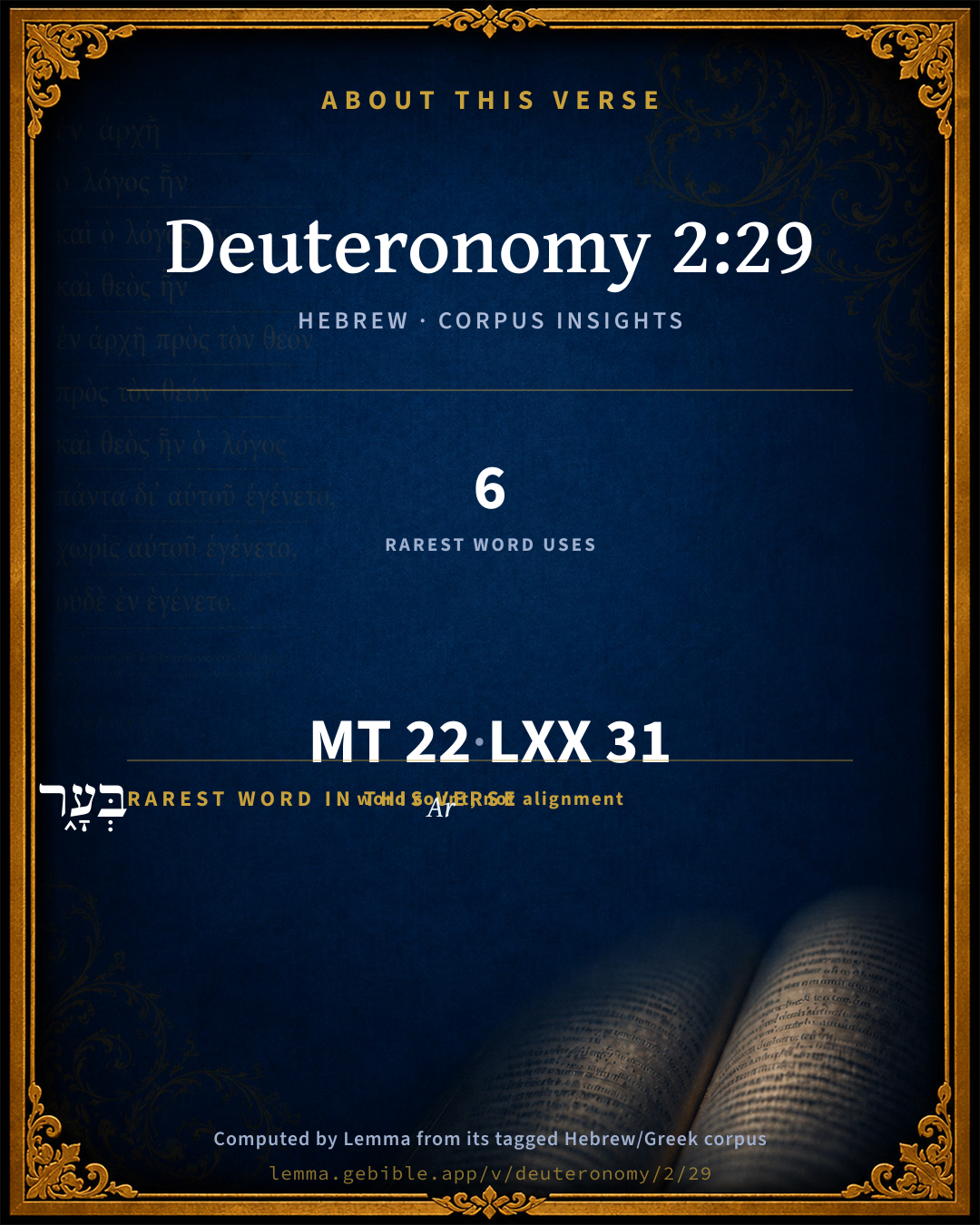
The rarest word here is בְּעָ֑ר Ar H6144 — appearing just 6 times in the whole Hebrew Bible.

Shared distinctive vocabulary

בְּעָ֑ר Ar H6144 occurs in 6 verses of the Hebrew Bible. Also found in:

Grammatical profile

  • 5 verbs
  • 9 nouns
  • 4 prepositions
  • 4 particles

Verb forms

  • עָֽשׂוּ Qal · Perfect
  • הַיֹּֽשְׁבִים֙ Qal · Participle Active
  • הַיֹּשְׁבִ֖ים Qal · Participle Active
  • אֶֽעֱבֹר֙ Qal · Imperfect
  • נֹתֵ֥ן Qal · Participle Active

Repetition

Words recur within this verse — often emphatic in Hebrew:

  • הַיֹּֽשְׁבִים֙ to dwell H3427 ×2
  • כַּאֲשֶׁ֨ר which H834 ×3

Hebrew & Septuagint length

In English translation the verse runs 35 words from the Hebrew and 35 from the Septuagint (LXX English) — the same length.

A rough comparison of the two English renderings, which tokenize alike — not a word-level alignment.

Word counts can differ between the Hebrew and the Greek without any difference in meaning — e.g. the Hebrew direct-object marker אֵת has no separate Greek word, and Greek often adds the article ὁ.

In the original languages it is 22 Hebrew tokens and 31 Greek tokens — but the two are counted differently (Hebrew bundles its prefixes and suffixes into one token; the Greek is in lemma form), so that isn’t a like-for-like length.

Cross-references

12

Topical passages linked to Deuteronomy 2:29 in the Treasury of Scripture Knowledge — connected by theme and wording, ordered by reader-vote popularity; previews shown in the World English Bible.

  • Numbers 20:18 Edom said to him, You shall not pass through me, lest I come out with the sword against you.
  • Deuteronomy 23:3–4 An Ammonite or a Moabite shall not enter into the assembly of Yahweh; even to the tenth generation shall none belonging to them enter into the assembly of Yahweh forever:
  • Judges 11:17–18 then Israel sent messengers to the king of Edom, saying, Please let me pass through your land; but the king of Edom didn't listen. In the same way, he sent to the king of Moab; but he would not: and Israel abode in Kadesh.
  • Exodus 20:12 "Honor your father and your mother, that your days may be long in the land which Yahweh your God gives you.
  • Deuteronomy 2:9 Yahweh said to me, Don't bother Moab, neither contend with them in battle; for I will not give you of his land for a possession; because I have given Ar to the children of Lot for a possession.
  • Deuteronomy 4:1 Now, Israel, listen to the statutes and to the ordinances, which I teach you, to do them; that you may live, and go in and possess the land which Yahweh, the God of your fathers, gives you.
  • Deuteronomy 4:21 Furthermore Yahweh was angry with me for your sakes, and swore that I should not go over the Jordan, and that I should not go in to that good land, which Yahweh your God gives you for an inheritance:
  • Deuteronomy 4:40 You shall keep his statutes, and his commandments, which I command you this day, that it may go well with you, and with your children after you, and that you may prolong your days in the land, which Yahweh your God gives you, forever.
  • Deuteronomy 5:16 "Honor your father and your mother, as Yahweh your God commanded you; that your days may be long, and that it may go well with you, in the land which Yahweh your God gives you.
  • Deuteronomy 9:6 Know therefore, that Yahweh your God doesn't give you this good land to possess it for your righteousness; for you are a stiff-necked people.
  • Deuteronomy 25:15 A perfect and just weight shall you have; a perfect and just measure shall you have: that your days may be long in the land which Yahweh your God gives you.
  • Joshua 1:11–15 Pass through the midst of the camp, and command the people, saying, Prepare food; for within three days you are to pass over this Jordan, to go in to possess the land, which Yahweh your God gives you to possess it.

Cross-references courtesy of OpenBible.info (CC BY 4.0).

Hebrew and Greek witnesses Masoretic Hebrew ↔ Greek Septuagint

The same verse in the two great witnesses to the Old Testament, shown verse-for-verse.

These are two independent witnesses, not word-aligned to each other, and the Septuagint is shown in lemma (dictionary) form.

Hebrew Deuteronomy 2:29 Masoretic · Westminster Leningrad Codex

כַּאֲשֶׁ֨ר עָֽשׂוּ לִ֜י בְּנֵ֣י עֵשָׂ֗ו הַיֹּֽשְׁבִים֙ בְּשֵׂעִ֔יר וְהַמּ֣וֹאָבִ֔ים הַיֹּשְׁבִ֖ים בְּעָ֑ר עַ֤ד אֲשֶֽׁר אֶֽעֱבֹר֙ אֶת הַיַּרְדֵּ֔ן אֶל הָאָ֕רֶץ אֲשֶׁר יְהוָ֥ה אֱלֹהֵ֖ינוּ נֹתֵ֥ן לָֽנוּ

as the children of Esau who dwell in Seir, and the Moabites who dwell in Ar, did to me; until I shall pass over the Jordan into the land which Yahweh our God gives us.

World English Bible · Public Domain

Greek LXX Deuteronomy 2:29 Septuagint · lemma form

καθώς ποιέω ἐγώ ὁ υἱός ησαυ ὁ καταοἰκέω ἐν σηιρ καί ὁ μωαβῖτης ὁ καταοἰκέω ἐν αροηρ ἕως παραἔρχομαι ὁ ἰορδάνης εἰς ὁ γῆ ὅς κύριος ὁ θεός ἐγώ δίδωμι ἐγώ

as the sons of Esau did to me, who lived in Seir, and the Moabites who lived in Aroer, until I shall have passed Jordan into the land which the Lord our God gives us.

LXX2012 (modern English Septuagint) · Public Domain

Hebrew: Westminster Leningrad Codex (CC BY 4.0). Greek: Septuagint (public domain); English from LXX2012 (modern English Septuagint) (Public Domain). How the Septuagint differs from the Hebrew →

Targum (Aramaic paraphrase)

2

The Targum is the ancient Jewish Aramaic paraphrase of the Hebrew Scriptures — an interpretive translation, not the Hebrew text itself. Onkelos (literal) and Pseudo-Jonathan (expansive) render the Torah, and Jonathan the Prophets. Coverage is partial: where no permissively-licensed English translation exists for a verse, only the Aramaic is shown. This is verse-level text, not a word-by-word alignment to the Hebrew.

  1. Targum Onkelos Torah (Genesis–Deuteronomy)
    כְּמָא דִי עֲבָדוּ לִי בְּנֵי עֵשָׂו דְיָתְבִין בְּשֵׂעִיר וּמוֹאָבָאֵי דְיָתְבִין בִּלְחָיָת עַד דְאֵעִבַר יָת יַרְדְנָא לְאַרְעָא דַיְיָ אֱלָהָנָא יָהֵב לָנָא

    (no public-domain English translation for this verse)

    Targum Onkelos — Aramaic: “Onkelos Genesis” (public domain); “Onkelos Exodus” (public domain); “Onkelos Leviticus” (public domain); “Onkelos Numbers” (public domain); “Onkelos Deuteronomy” (public domain). English: “Sefaria Community Translation” (CC0 1.0 (public-domain dedication)); “J.W. Etheridge. The Targums of Onkelos and Jonathan Ben Uzziel on the Pentateuch. London: Longmans, Green, 1862” (public domain). Text via Sefaria.

  2. Targum Pseudo-Jonathan Torah (Genesis–Deuteronomy)
    הֵיכְמָא דַּעֲבַד לִי בְּנוֹי דְעֵשָו דְּיַתְבִין בְּגַבְלָא וּמוֹאֲבָאֵי דְיַתְבִין בִּלְחָיַית עַד זְמַן דְּאַעִיבַר יַת יוֹרְדְּנָא לְאַרְעָא דַיְיָ אֱלָהָנָא יָהֵיב לָנָא

    as the Beni Esau, who dwell in Gebal, and the Moabaee, who dwell in Lechaiath have done to me, until the time that I pass over the Jordan into the land which the Lord our God giveth us.

    Targum Pseudo-Jonathan — Aramaic: “Targum Jonathan on Genesis” (public domain); “Targum Jonathan on Exodus” (public domain); “Targum Jonathan on Leviticus” (public domain); “Targum Jonathan on Numbers” (public domain); “Targum Jonathan on Deuteronomy” (public domain). English: “The Targum of Jonathan ben Uzziel, trans. J. W. Etheridge, London, 1862” (public domain). Text via Sefaria.

Commentary

Notes on Deuteronomy 2:29 from classic Christian and Jewish commentators (each source and its license shown beneath its notes). The classic Christian expositions comment on the surrounding passage and are grouped to its opening verse, so a note may address several verses; the Jewish commentaries on the Tanakh (Rashi and others) are per-verse, so they appear only where the commentator wrote on this verse.

Lemma curates 59 commentaries, every one of them public domain or Creative Commons licensed, each selected and text-cleaned for this edition rather than reprinted as found. About our sources →

Joseph Benson's Commentary

Deu 2:29-30. As the children of Esau did — They did permit them to pass quietly by the borders, though not through the heart of their land, and in their passage the people sold them meat and drink, being, it seems, more kind to them than their king would have had them; and therefore they here ascribe this favour not to the king, though they are now treating with a king, but to the people, the children of Esau. Hardened his spirit — That is, suffered it to be hardened.

Joseph Benson's Commentary on the Old and New Testaments (1811–1818) — public domain. Text from a community e-Sword module.

Geneva Bible (1599)

Geneva Bible translators

Because neither entreaty nor examples or others could move him, he could not complain of his just destruction.

Geneva Bible (1599) marginal notes — public domain. Text via Bolls.life.

Adam Clarke's Commentary

Verse 29. As the children of Esau which dwell in Seir] See Clarke on Nu 20:21.

Adam Clarke's Commentary on the Bible (1810–1826) — public domain. Text from a community e-Sword/MySword module.

Ellicott's Commentary for English Readers

(29) Until I shall pass over Jordan.—This was already determined.

A Bible Commentary for English Readers, edited by Charles John Ellicott (1878–1897) — public domain. Text from a community e-Sword module.

The Cambridge Bible for Schools and Colleges

gen. ed. J. J. S. Perowne

29. as the children of Esau … and the Moabites] In JE Num_20:18 ff. Esau refused Israel’s request made from Ḳadesh, but appears to have sold them bread and water when, later, Israel crossed the S. end of Mt Se‘ir, Deu_2:6. In Deu_23:5 [4] Mo’ab is blamed for not meeting Israel with bread and water on the way—but does that mean did not sell them these?

The Cambridge Bible for Schools and Colleges (gen. ed. J. J. S. Perowne; Cambridge University Press, 1878–1918) — public domain. Text from a community e-Sword module.

John Gill's Exposition

As the children of Esau which dwell in Seir, and the Moabites which dwell in Ar, did unto me,.... Which respects, as Jarchi observes, not the affair of passing through their land requested, for neither of them granted that, but buying food and drink; for though the Edomites at first seem not to have granted that, yet afterwards they did. The mountain of Seir, and the city Ar, are put for the whole countries of Edom and Moab:

until I shall pass over Jordan into the land which the Lord our God giveth us; this is observed to remove any suspicion or jealousy of their seizing his country, and taking possession of it, and dwelling in it; since they only proposed to pass through it on their journey to the land of Canaan, which lay on the other side Jordan, over which they must pass in order to possess it, which they had a right unto by the gift of God.

John Gill's Exposition of the Whole Bible (1746–1763) — public domain (CC PDM 1.0). Text via the HelloAO Bible API.

Haydock's Catholic Bible Commentary

As, &c. These nations had only permitted them to pass along their borders, and furnished them, through fear, (ver. 4,) with the necessaries of life. Sehon will not even grant so much.

George Leo Haydock (1774–1849), Haydock's Catholic Family Bible and Commentary, 1859 edition — public domain. Excludes Psalms (Douay-Rheims chapter numbering differs from Protestant) and Deuterocanonical books (Catholic canon only).

Matthew Poole's English Annotations

Object. The king of Edom, i.e. of the children of Esau, did not grant them passage, Num 20.

Answ. They did permit them to pass quietly by the borders, though not through the heart of their land; and in their passage the people sold them meat and drink, being, it seems, more kind to them than their king would have had them; and therefore they here ascribe this favour not to the king, though they are now treating with a king, but to the people,

the children of Esau.

Matthew Poole's English Annotations on the Holy Bible (1683–1685) — public domain. Text from a community e-Sword/MySword module.

The Pulpit Commentary

As the did unto me. This refers expressly to the fact that the Edomites and Moabites did not hinder the Israelites from passing through their country, though they were far from friendly, and dealt in an unbrotherly way with them, for which the Moabites were afterwards placed under a ban. (Deu_23:3)

The Pulpit Commentary (1880–1919), ed. H.D.M. Spence-Jones & Joseph S. Exell — public domain. Text from a community e-Sword module.

John Wesley's Explanatory Notes

As the children of Esau did - They did permit them to pass quietly by the borders, though not through the heart of their land, and in their passage the people sold them meat and drink, being it seems more kind to them than their king would have had them; and therefore they here ascribe this favour not to the king, though they are now treating with a king, but to the people, the children of Esau.

John Wesley, Explanatory Notes Upon the Whole Bible (1754–1765) — public domain. Text via the GEBible commentary corpus.

Rashi

Rabbi Shlomo Yitzchaki (Rashi)

כאשר עשו לי בגי עשו AS THE CHILDREN OF ESAU DID TO ME — This does not refer to passing through their land (רק אעברה ברגלי) for Edom refused this, (cf. Numbers 20:18) but to the matter of selling food and water (also mentioned in the preceding verse).

עד אשר אעבר את הירדן UNTIL I SHALL PASS OVER THE JORDAN — This is to be connected with "Let me pass through thy land” (v. 27).

Rashi on the Tanakh — English translations: “The Judaica Press complete Tanach with Rashi, translated by A. J. Rosenberg” (CC BY 4.0); “Pentateuch with Rashi's commentary by M. Rosenbaum and A.M. Silbermann, 1929-1934” (public domain); “The Metsudah Tanach series, Lakewood, N.J” (CC BY 4.0); and “The Book of Joshua, Metsudah Publications, 1997” (CC BY 4.0). Text via Sefaria.

Lesson kit

Teaching starters — assembled from the data on this page, not authored interpretation. Every prompt links to the verse data it draws on. Edit before teaching.

Deuteronomy, in the Pentateuch, opens this verse with 22 words (17 distinct Hebrew lemmas). Its most distinctive word is ʻÂr (“Ar”). A historical commentator’s framing appears above. Read the whole chapter for the surrounding context.

Discussion questions

  1. How does “Ar” (ʻÂr) shape what this verse is saying?
  2. Numbers 21:15 shares the word «Ar» with this verse. How do the two illuminate each other?
  3. “to dwell” occurs 2× in this one verse. What is the effect of the repetition?
  4. These translations render this verse differently. What is at stake in choosing one wording over another?
  5. The verb «עָֽשׂוּ» is Qal Perfect. How does its form color the action?
  6. Reading how Joseph Benson's Commentary and Geneva Bible (1599) read this verse, where do the two commentators agree and where do they part?

Things to notice

Reading settings

Reading text

Shown beneath each verse's original-language words.

Old Testament
Old Testament edition

Read the OT as the Masoretic Hebrew (MT) or the Greek Septuagint (LXX).

English shown for the Greek Septuagint (in the Hebrew ↔ Greek comparison).

Comparing translations? Open the Compare panel on any verse page to stack up to four side by side.