Lamentations 4:21

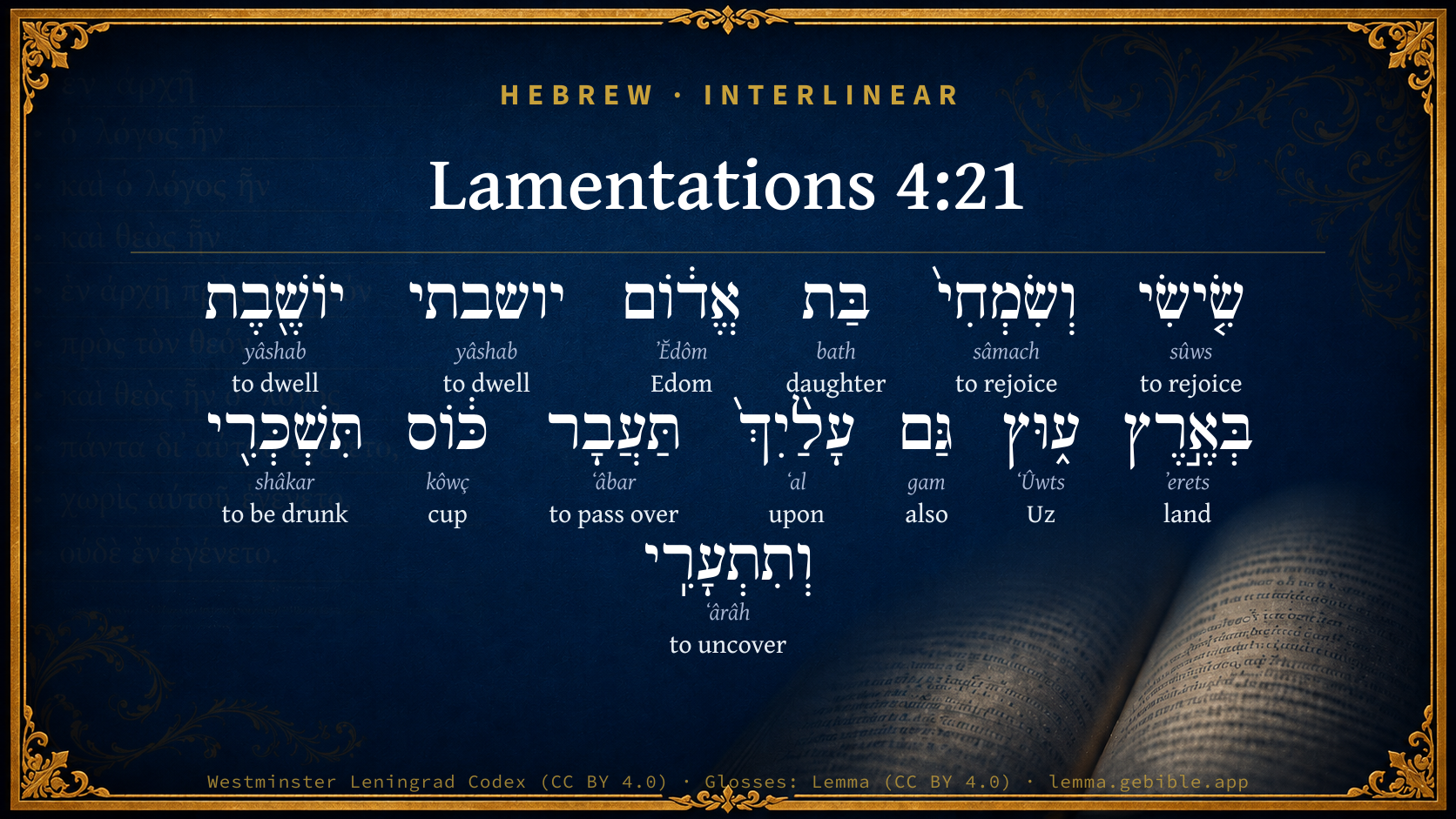
Hebrew (Westminster Leningrad Codex) Lamentations 4:21 appears in the Hebrew Old Testament. The text above is from the Westminster Leningrad Codex. Each word links to its Strong’s number, a concise gloss, and parsing drawn from the Open Scriptures Hebrew Bible morphology. Click any word for its full Brown-Driver-Briggs (BDB) entry.
Download image
Cite this verse

Lamentations 4:21 (World English Bible). Public Domain. Lemma interlinear Bible study tool, https://lemma.gebible.app/v/lamentations/4/21.

Show BibTeX & RIS
BibTeX
RIS
English Translation
Rejoice and be glad, daughter of Edom, that dwell in the land of Uz: The cup shall pass through to you also; you shall be drunken, and shall make yourself naked.
World English Bible · Public Domain
Download a study sheet

One document with this verse’s original text, its word-by-word gloss line, the meaning frame, cross-references with their text, attributed commentary, and full source and license credits — printable, and it pastes into notes with its structure intact.

This verse Autodidact and up

Study sheet (.html) Plain text (.txt)

A passage Seminary Student

Up to 50 verses in one chapter. A passage sheet keeps up to 6 commentary sources and 12 cross-references per verse, in the order this page ranks them, and says so on the sheet whenever that leaves anything out. Ask for a single verse and you get the Autodidact verse sheet above.

Everything on this page stays free to read, with no account — the sheet is a download of what is already on screen, not access to it.

Want to remove ads? Support Godless Engineer
Compare translations 3

The same verse in 3 English versions, stacked beneath the original-language interlinear above. Click any original word for its lexicon entry.

Each is an independent rendering of the whole verse — the interlinear is not word-aligned to these translations.

Highlighted words mark where these versions differ — a whole-verse word diff, not a word-by-word alignment.

  • World English Bible Public Domain
    Rejoice and be glad, daughter of Edom, that dwell in the land of Uz: The cup shall pass through to you also; you shall be drunken, and shall make yourself naked.
  • King James Version Public Domain
    Rejoice and be glad, O daughter of Edom, that dwellest in the land of Uz; the cup also shall pass through unto thee: thou shalt be drunken, and shalt make thyself naked.
  • unfoldingWord Literal Text CC BY-SA 4.0
    Rejoice and be glad, daughter of Edom, dweller in the land of Uz. Also to you the cup will pass; you will become drunk and will make yourself naked. TAW

unfoldingWord Literal Text — © unfoldingWord, licensed CC BY-SA 4.0. Word-aligned USFM3 via Door43 (git.door43.org/unfoldingWord/en_ult).

Versions to compare (up to 4)

3 of 4 selected

Show all 18 translations

Every available English version of this verse, each an independent rendering of the whole verse.

  • World English Bible Public Domain
    Rejoice and be glad, daughter of Edom, that dwell in the land of Uz: The cup shall pass through to you also; you shall be drunken, and shall make yourself naked.
  • Berean Standard Bible Public Domain
    So rejoice and be glad, O Daughter of Edom, you who dwell in the land of Uz. Yet the cup will pass to you as well; you will get drunk and expose yourself.
  • Majority Standard Bible Public Domain
    So rejoice and be glad, O Daughter of Edom, you who dwell in the land of Uz. Yet the cup will pass to you as well; you will get drunk and expose yourself.
  • King James Version Public Domain
    Rejoice and be glad, O daughter of Edom, that dwellest in the land of Uz; the cup also shall pass through unto thee: thou shalt be drunken, and shalt make thyself naked.
  • American Standard Version (1901) Public Domain
    Rejoice and be glad, O daughter of Edom, that dwellest in the land of Uz: The cup shall pass through unto thee also; thou shalt be drunken, and shalt make thyself naked.
  • Revised Version (1885) Public Domain
    Rejoice and be glad, O daughter of Edom, that dwellest in the land of Uz: the cup shall pass through unto thee also; thou shalt be drunken, and shalt make thyself naked.
  • Geneva Bible (1599) Public Domain
    Reioyce and be glad, O daughter Edom, that dwellest in the lande of Vz, the cuppe also shall passe through vnto thee: thou shalt be drunken and vomit.
  • Douay-Rheims (1899) Public Domain
    Sin. Rejoice, and be glad, O daughter of Edom, that dwellest in the land of Hus: to thee also shall the cup come, thou shalt be made drunk, and naked.
  • Young's Literal Translation Public Domain
    Joy and rejoice, O daughter of Edom, Dwelling in the land of Uz, Even unto thee pass over doth a cup, Thou art drunk, and makest thyself naked.
  • Literal Standard Version CC BY-SA 4.0
    Rejoice and be glad, O daughter of Edom, || Dwelling in the land of Uz, || Even to you a cup passes over, || You are drunk, and make yourself naked.
  • Unlocked Literal Bible CC BY-SA 4.0
    Rejoice and be glad, daughter of Edom, you who live in the land of Uz. But to you also the cup will be passed; you will be drunk and strip yourself naked.
  • unfoldingWord Literal Text CC BY-SA 4.0
    Rejoice and be glad, daughter of Edom, dweller in the land of Uz. Also to you the cup will pass; you will become drunk and will make yourself naked. TAW
  • Darby Bible Public Domain
    Rejoice and be glad, daughter of Edom, that dwellest in the land of Uz: the cup shall pass also unto thee; thou shalt be drunken, and make thyself naked.
  • World Messianic Bible Public Domain
    Rejoice and be glad, daughter of Edom, who dwells in the land of Uz. The cup will pass through to you also. You will be drunken, and will make yourself naked.
  • Webster's Bible Public Domain
    Rejoice and be glad, O daughter of Edom, that dwellest in the land of Uz; the cup also shall pass through to thee: thou shalt be drunken, and shalt make thyself naked.
  • Free Bible Version CC BY-SA 4.0
    Celebrate and be happy while you can, people of Edom, you who live in the land of Uz, because this cup will be passed to you too. You will get drunk and strip yourself naked.
  • Bible in Basic English Public Domain
    Have joy and be glad, O daughter of Edom, living in the land of Uz: the cup will be given to you in your turn, and you will be overcome with wine and your shame will be seen.
  • JPS Tanakh (1917) Public Domain
    Rejoice and be glad, O daughter of Edom, that dwellest in the land of Uz: the cup shall pass over unto thee also; thou shalt be drunken, and shalt make thyself naked.

Literal Standard Version (2020), Covenant Press — licensed CC BY-SA 4.0. Text via the HelloAO Bible API (eBible.org). Unlocked Literal Bible (unfoldingWord) — licensed CC BY-SA 4.0. Text via the HelloAO Bible API (eBible.org). unfoldingWord Literal Text — © unfoldingWord, licensed CC BY-SA 4.0. Word-aligned USFM3 via Door43 (git.door43.org/unfoldingWord/en_ult). Free Bible Version, Dr. Jonathan Gallagher — licensed CC BY-SA 4.0. Text via the HelloAO Bible API (eBible.org).

Word by word

More ways to search: Search by grammar → Find every occurrence → Compare this word →

Practice this passage: Drill this verse → Learn its vocabulary →

ע֑וּץ
ʻÛwts
H5780
“Uz”
Noun, Proper
Part of Speech
Noun
Type
Proper
Full BDB Definition

Origin: apparently from H5779

TWOT: None

Uz = "wooded" - son of Aram and grandson of Seth (noun proper masculine) - son of Nahor by Milcah (noun proper masculine) - an Edomite, son of Dishan and grandson of Seir (noun proper masculine) - the country of Job; probably east and southeast of Palestine somewhere in the Arabian desert (noun proper locative)
  1. שִׂ֤ישִׂי sûws H7797 “rejoice” Verb, Qal, Imperative, 2nd Person, Feminine, Singular
  2. וְשִׂמְחִי֙ sâmach H8055 “and · rejoice” Conjunction + Verb, Qal, Imperative, 2nd Person, Feminine, Singular
  3. בַּת bath H1323 “daughter of” Noun, Common, Feminine, Singular, Construct
  4. אֱד֔וֹם ʼĔdôm H123 “Edom” Noun, Proper
  5. יושבתי yâshab H3427 “dwelling” Verb, Qal, Participle Active, Feminine, Singular, Construct
  6. יוֹשֶׁ֖בֶת yâshab H3427 “dwelling” Verb, Qal, Participle Active, Feminine, Singular, Absolute
  7. בְּאֶ֣רֶץ ʼerets H776 “in/at · land of” Preposition + Noun, Common, Both, Singular, Construct
  8. גַּם gam H1571 “also” Particle, Accusative
  9. עָלַ֨יִךְ֙ ʻal H5921 “upon · you” Preposition + Suffix, Personal, 2nd Person, Feminine, Singular
  10. תַּעֲבָר ʻâbar H5674 “to pass over” Verb, Qal, Imperfect, 3rd Person, Feminine, Singular
  11. כּ֔וֹס kôwç H3563 “cup” Noun, Common, Feminine, Singular, Absolute
  12. תִּשְׁכְּרִ֖י shâkar H7937 “to be drunk” Verb, Qal, Imperfect, 2nd Person, Feminine, Singular
  13. וְתִתְעָרִֽי ʻârâh H6168 “and · to uncover” Conjunction + Verb, Hithpael, Imperfect, 2nd Person, Feminine, Singular

About this verse

These counts appear in no published source. They are computed here, from the morphology-tagged text and Lemma’s own curated glosses. What Lemma adds →

14
words
13
distinct lemmas
Prophets
section

Notable vocabulary

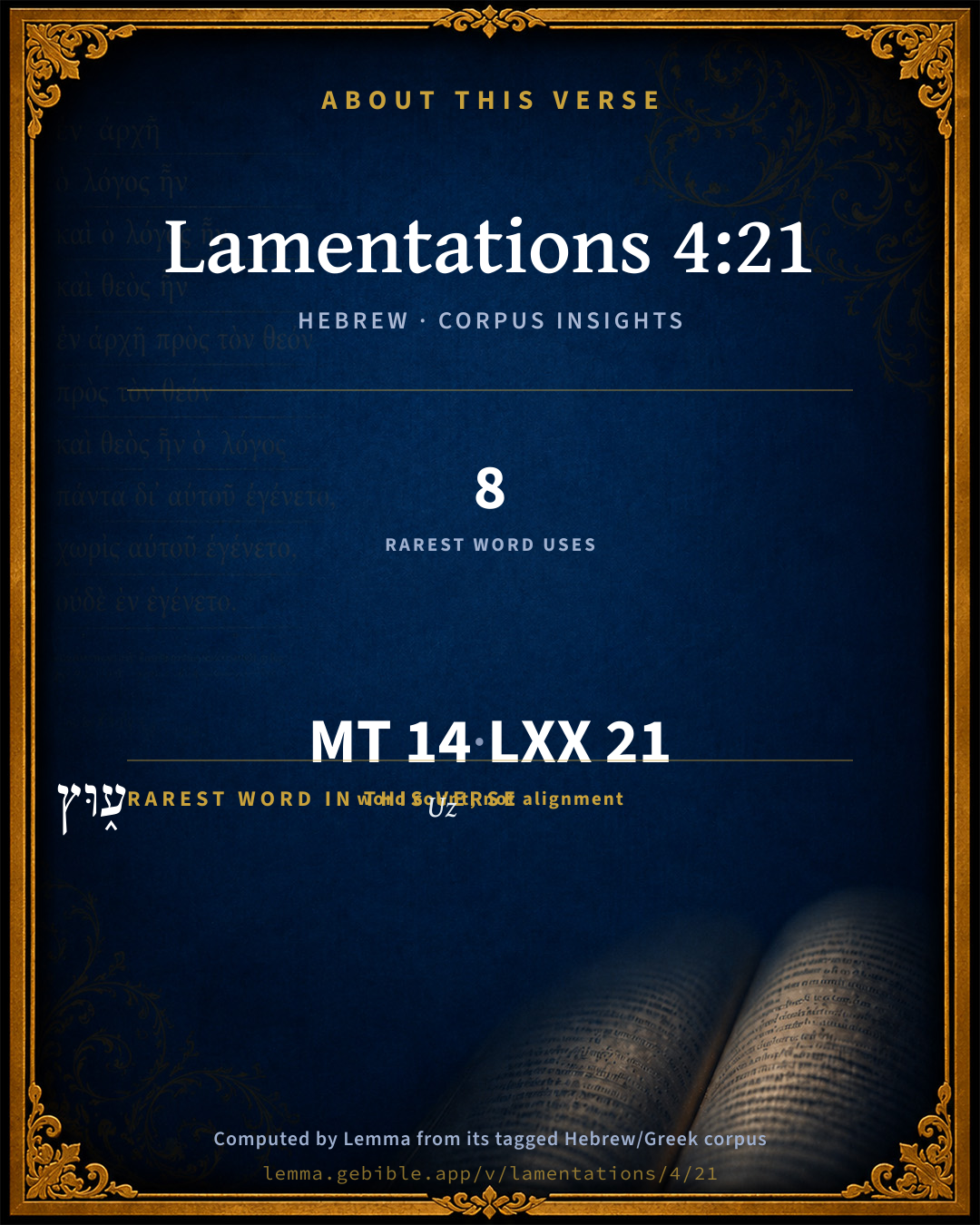
The rarest word here is ע֑וּץ Uz H5780 — appearing just 8 times in the whole Hebrew Bible.

Shared distinctive vocabulary

ע֑וּץ Uz H5780 occurs in 8 verses of the Hebrew Bible. Also found in:

Grammatical profile

  • 7 verbs
  • 5 nouns
  • 1 preposition
  • 1 particle

Verb forms

  • שִׂ֤ישִׂי Qal · Imperative
  • וְשִׂמְחִי֙ Qal · Imperative
  • יושבתי Qal · Participle Active
  • יוֹשֶׁ֖בֶת Qal · Participle Active
  • תַּעֲבָר Qal · Imperfect
  • תִּשְׁכְּרִ֖י Qal · Imperfect
  • וְתִתְעָרִֽי Hithpael · Imperfect

Repetition

A word recurs within this verse — often emphatic in Hebrew:

  • יושבתי to dwell H3427 ×2

Hebrew & Septuagint length

In English translation the verse runs 31 words from the Hebrew and 32 from the Septuagint (LXX English) — closely comparable.

A rough comparison of the two English renderings, which tokenize alike — not a word-level alignment.

Word counts can differ between the Hebrew and the Greek without any difference in meaning — e.g. the Hebrew direct-object marker אֵת has no separate Greek word, and Greek often adds the article ὁ.

In the original languages it is 14 Hebrew tokens and 21 Greek tokens — but the two are counted differently (Hebrew bundles its prefixes and suffixes into one token; the Greek is in lemma form), so that isn’t a like-for-like length.

Cross-references

22

Topical passages linked to Lamentations 4:21 in the Treasury of Scripture Knowledge — connected by theme and wording, ordered by reader-vote popularity; previews shown in the World English Bible.

  • Job 1:1 There was a man in the land of Uz, whose name was Job. That man was blameless and upright, and one who feared God, and turned away from evil.
  • Amos 1:11 Thus says Yahweh: "For three transgressions of Edom, yes, for four, I will not turn away its punishment; Because he pursued his brother with the sword, And cast off all pity, And his anger raged continually, And he kept his wrath forever;
  • Revelation 16:15 "Behold, I come like a thief. Blessed is he who watches, and keeps his clothes, so that he doesn't walk naked, and they see his shame."
  • Psalms 137:7 Remember, Yahweh, against the children of Edom, The day of Jerusalem; Who said, "Raze it! Raze it even to its foundation!"
  • Genesis 36:28 These are the children of Dishan: Uz and Aran.
  • 2 Chronicles 28:19 For Yahweh brought Judah low because of Ahaz king of Israel; for he had dealt wantonly in Judah, and trespassed severely against Yahweh.
  • Psalms 83:3–12 They conspire with cunning against your people. They plot against your cherished ones.
  • Ecclesiastes 11:9 Rejoice, young man, in your youth, And let your heart cheer you in the days of your youth, And walk in the ways of your heart, And in the sight of your eyes; But know that for all these things God will bring you into judgment.
  • Isaiah 34:1–17 Come near, you nations, to hear; and listen, you peoples: let the earth hear, and the fullness of it; the world, and all things that come forth from it.
  • Isaiah 63:1–6 Who is this who comes from Edom, with dyed garments from Bozrah? this who is glorious in his clothing, marching in the greatness of his strength? I who speak in righteousness, mighty to save.
  • Jeremiah 25:15–29 For thus says Yahweh, the God of Israel, to me: take this cup of the wine of wrath at my hand, and cause all the nations, to whom I send you, to drink it.
  • Jeremiah 49:12 For thus says Yahweh: Behold, they to whom it didn't pertain to drink of the cup shall assuredly drink; and are you he who shall altogether go unpunished? you shall not go unpunished, but you shall surely drink.
  • Ezekiel 25:6 For thus says the Lord Yahweh: Because you have clapped your hands, and stamped with the feet, and rejoiced with all the despite of your soul against the land of Israel;
  • Ezekiel 25:8 Thus says the Lord Yahweh: Because Moab and Seir say, Behold, the house of Judah is like all the nations;
  • Ezekiel 25:12–14 Thus says the Lord Yahweh: Because Edom has dealt against the house of Judah by taking vengeance, and has greatly offended, and revenged himself on them;
  • Ezekiel 26:2 Son of man, because Tyre has said against Jerusalem, Aha, she is broken: the gate of the peoples; she is turned to me; I shall be replenished, now that she is laid waste:
  • Ezekiel 35:3–9 and tell it, Thus says the Lord Yahweh: Behold, I am against you, Mount Seir, and I will stretch out my hand against you, and I will make you a desolation and an astonishment.
  • Ezekiel 35:11–15 therefore, as I live, says the Lord Yahweh, I will do according to your anger, and according to your envy which you have shown out of your hatred against them; and I will make myself known among them, when I shall judge you.
  • Obadiah 1:1 The vision of Obadiah. This is what the Lord Yahweh says about Edom. We have heard news from Yahweh, and an ambassador is sent among the nations, saying, "Arise, and let's rise up against her in battle.
  • Obadiah 1:10–16 For the violence done to your brother Jacob, shame will cover you, and you will be cut off forever.
  • Micah 1:11 Pass on, inhabitant of Shaphir, in nakedness and shame. The inhabitant of Zaanan won't come out. The wailing of Beth Ezel will take from you his protection.
  • Malachi 1:2–4 "I have loved you," says Yahweh. Yet you say, "How have you loved us?" "Wasn't Esau Jacob's brother?" says Yahweh, "Yet I loved Jacob;

Cross-references courtesy of OpenBible.info (CC BY 4.0).

Hebrew and Greek witnesses Masoretic Hebrew ↔ Greek Septuagint

The same verse in the two great witnesses to the Old Testament, shown verse-for-verse.

These are two independent witnesses, not word-aligned to each other, and the Septuagint is shown in lemma (dictionary) form.

Hebrew Lamentations 4:21 Masoretic · Westminster Leningrad Codex

שִׂ֤ישִׂי וְשִׂמְחִי֙ בַּת אֱד֔וֹם יושבתי יוֹשֶׁ֖בֶת בְּאֶ֣רֶץ ע֑וּץ גַּם עָלַ֨יִךְ֙ תַּעֲבָר כּ֔וֹס תִּשְׁכְּרִ֖י וְתִתְעָרִֽי

Rejoice and be glad, daughter of Edom, that dwell in the land of Uz: The cup shall pass through to you also; you shall be drunken, and shall make yourself naked.

World English Bible · Public Domain

Greek LXX Lamentations 4:21 Septuagint · lemma form

χαίρω καί εὐφραίνω θυγάτηρ ιδουμαία ὁ καταοἰκέω ἐπί γῆ καί γέ ἐπί σύ διαἔρχομαι ὁ ποτήριον κύριος καί μεθύω καί ἀποχέω

CHSEN. Rejoice and be glad, O daughter of Idumea, that dwell in the land: yet the cup of the Lord shall pass through to you: you shall be drunken, and pour forth.

LXX2012 (modern English Septuagint) · Public Domain

On this verse, The Expositor's Bible discusses the Septuagint’s reading. Read the note in Commentary ↓

Hebrew: Westminster Leningrad Codex (CC BY 4.0). Greek: Septuagint (public domain); English from LXX2012 (modern English Septuagint) (Public Domain). How the Septuagint differs from the Hebrew →

Commentary

Notes on Lamentations 4:21 from classic Christian and Jewish commentators (each source and its license shown beneath its notes). The classic Christian expositions comment on the surrounding passage and are grouped to its opening verse, so a note may address several verses; the Jewish commentaries on the Tanakh (Rashi and others) are per-verse, so they appear only where the commentator wrote on this verse.

Lemma curates 59 commentaries, every one of them public domain or Creative Commons licensed, each selected and text-cleaned for this edition rather than reprinted as found. About our sources →

Matthew Henry's Commentary

David's psalms of lamentation commonly conclude with some word of comfort, which is as life from the dead and light shining out of darkness; so does this lamentation here in this chapter. The people of God are now in great distress, their aspects all doleful, their prospects all frightful, and their ill-natured neighbours the Edomites insult over them and do all they can to exasperate their destroyers against them. Such was their violence against their brother Jacob (Oba 1:10), such their spleen at Jerusalem, of which they cried, Rase it, rase it, Psa 137:7. Now it is here foretold, for the encouragement of God's people,

I. That an end shall be put to Zion's troubles (Lam 4:22): The punishment of they iniquity is accomplished, O daughter of Zion! not the fulness of that punishment which it deserves, but of that which God has designed and determined to inflict, and which was necessary to answer the end, the glorifying of God's justice and the taking away of their sin. The captivity, which is the punishment of thy iniquity, is accomplished (Isa 40:2), and he will no longer keep thee in captivity; so it may be read, as well as, he will no more carry thee into captivity; he will turn again thy captivity and work a glorious release for thee. Note, The troubles of God's people shall be continued no longer than till they have done their work for which they were sent.

II. That an end shall be put to Edom's triumphs. It is spoken ironically (Lam 4:21): "Rejoice and be glad, O daughter of Edom! go on to insult over Zion in distress, till thou hast filled up the measure of thy iniquity. Do so; rejoice in thy own present exemption from the common fate of thy neighbours." This is like Solomon's upbraiding the young man with his ungoverned mirth (Ecc 11:9): "Rejoice, O young man! in thy youth; rejoice, if thou canst, when God comes to reckon with thee, and that he will do ere long. The cup of trembling, which it is now Jerusalem's turn to drink deeply of, shall pass through unto thee; it shall go round till it comes to be thy lot to pledge it." Note, This is a good reason why we should not insult over any who are in misery, because we ourselves also are in the body, and we know not how soon their case may be ours. But those who please themselves in the calamities of God's church must expect to have their doom, as aiders and abettors, with those that are instrumental in those calamities. The destruction of the Edomites was foretold by this prophet (Jer 49:7. etc.), and the people of God must encourage themselves against their present rudeness and insolence with the prospect of it. 1. It will be a shameful destruction: "The cup that shall pass unto thee shall intoxicate thee" (and that is shame enough to any man); "thou shalt be drunken, quite infatuated, and at thy wits' end, shalt stagger in all thy counsels and stumble in all thy enterprises, and then, as Noah when he was drunk, thou shalt make thyself naked and expose thyself to contempt." Note, Those who ridicule God's people will justly be left to themselves to do that, some time or other, by which they will be made ridiculous. 2. It will be a righteous destruction. God will herein visit thy iniquity and discover thy sins; he will punish them, and, to justify himself therein, he will discover them, and make it to appear that he has just cause thus to proceed against them. Nay, the punishment of the sin shall so exactly answer the sin that it shall itself plainly discover it. Sometimes God does so visit the iniquity that he that runs may read the sin in the punishment. But, sooner or later, sin will be visited and discovered, and all the hidden works of darkness brought to light.

Matthew Henry's Commentary on the Whole Bible (1708–1710) — public domain (CC PDM 1.0). Text via the HelloAO Bible API.

Trapp's Complete Commentary

John Trapp

Lam 4:21 Rejoice and be glad, O daughter of Edom, that dwellest in the land of Uz; the cup also shall pass through unto thee: thou shalt be drunken, and shalt make thyself naked.

Ver. 21. Rejoice and be glad.] This is spoken to Edom by a certain ironic and bitter concession - q.d., Do so if thou hast any mind to it; but thou shalt soon be made to change thy cheer. Thy flearing at us shall be soon turned into fearing for thyself, thy mirth into mourning.

That dwellest in the land of Uz.] Job’s country, called also Syria, saith R. Solomon, and haply from Seir. Evil is at next door by to those who rejoice at the evils of others.

The cup shall pass through unto thee.] The quaffing cup of God’s wrath. {Jer 25:18; Jer 25:29}

And shalt make thyself naked.] {a} To the scorn of all, as drunkards, who are void of shame and common honesty, baring those parts that nature would have covered. See Jer 49:10.

{a} Ut ebria et amotae mentis. as the intoxicated and the insane.

John Trapp, A Commentary or Exposition upon All the Books of the Old and New Testament (1647–1656) — public domain. Text from a community e-Sword module.

Joseph Benson's Commentary

Lam 4:21-22. Rejoice and be glad, O daughter of Edom — A sarcastical expression, as if the prophet had said, Rejoice while thou mayest, O Edom, over the calamities of the Jews; but thy joy shall not last long, for in a little time it shall come to thy turn to feel God’s afflicting hand; the cup of affliction shall pass unto thee: see Jer 49:7, &c. The punishment of thine iniquity is accomplished, O daughter of Zion, &c. — It was usual for the prophets, when they denounced God’s judgments against any heathen nation, at the same time to give gracious promises to Israel; thereby importing that God would never cast off the Jewish people utterly, as he did other nations, but would in due time extend his mercy toward them. He — Namely, God; will no more carry thee away — Or, rather, suffer thee to be carried; into captivity — “These and such like expressions, if they be understood in a strict, literal sense, must relate to the final restoration of the Jews.” — Lowth. He will discover thy sins — He will manifest how great thine iniquities have been, by the remarkable judgments wherewith he will punish thee.

Joseph Benson's Commentary on the Old and New Testaments (1811–1818) — public domain. Text from a community e-Sword module.

Whedon's Commentary on the Bible

Daniel D. Whedon

LIGHT AT EVENING, Lam_4:21-22.

21. Rejoice and be glad, O daughter of Edom — A manifestly ironical exclamation. He who tauntingly called out, “What of the night?” shall in the end realize that the “morning cometh” to Israel, and then it will be night to their foes, of which Edom was one of the chiefest.

Dwellest in the land of Uz — A hint as to the locality of Uz.

Daniel D. Whedon (gen. ed.), Commentary on the Old and New Testaments (1874–1909) — public domain. Text from a community e-Sword module.

The Preacher's Complete Homiletical Commentary

Joseph S. Exell (gen. ed.)

EXEGETICAL NOTES.—

(ש) Lam_4:21. The children of Edom had exulted over the destruction of Jerusalem, and urgently culled for its completeness. They said, Rase it, rate it, even to the foundations thereof (Psa_137:7). Now they are addressed in bitter irony, Rejoice and be glad, daughter of Edom, take a full measure of your malicious joy, but with all that your triumphing will be short; you cannot escape pungent woes, however extended your territory may be, that dwellest in the land of Uz, a district of country bordering on Edom’s land, and which seems to have been overrun by Edomites. To thee also shall the cup pass, the cup of the wine of the wrath of God which is mingled in His anger.

The strong feelings of indignation, which were almost hereditary among the Israelites, against the Edomites, may be partly accounted for from the idea that variance with one’s own kith and kin is often expressed by more bitter terms than variance with strangers, and partly by the consciousness which Israel had of its spiritual calling which the “profane” nature of Esau’s descendants tended to render inoperative.

(ת) Lam_4:22. No hint marks the transition from the grim scenes of calamity in which the Jews had been involved to this glimpse of light and renewal. The abruptness must be due to the conviction that, as Israel is the people with whom Jehovah has entered into covenant, all cannot be over with them, however they are pressed down by adversity. If they forsake Him, they will be chastised till they acknowledge and repent of their apostasy. Then He will have pity fur His name’s sake. Punishment will come to a termination; Ended is thine iniquity, daughter of Zion. The consequences following an evil procedure would, as it were, drain to the dregs the cup of wrath and grace would begin to appear. “A Messianic hope” is created, He will no more carry thee into captivity, by the Chaldeans, at any rate. This promise is dependent for its fulfilment upon the righteous state of Israel. Avoiding the sins which had brought the present term of punishment, they would not be subjected to such punishment again. The exiles who returned from Babylon were greatly purified and elevated by the trials which had been passed through, and if there had been due progress in spiritual things, as the prophet Malachi declares there was not, no further casting out of the land of promise would have taken place. But they crucified the Lord of glory. Their house is left unto them desolate, and they are scattered over the earth till they turn again to the Lord. The allotment to Edom is a contrast; He visits thine iniquities, daughter of Edom; He discovers thy sins. He sees they are persisted in, and shame and woe follow the exposure. “God covers sin when He forgives it (Psa_32:1-5). He discovers or reveals it when He punishes it” (Job_20:27). The safety of God’s people connotes the destruction of His enemies (Revelation 19, 20).

HOMILETICS

THE FATE OF THE MALEVOLENT

(Lam_4:21-22)

I. Their malicious joy over the unfortunate is brief. “Rejoice and be glad, O daughter of Edom” (Lam_4:21). Edom, though related to Judah, was her most relentless enemy. It was the enmity of inveterate envy. Judah had outdistanced Edom, and rose to superior greatness and power. This was the offence Edom could never forgive. She watched the downfall of Judah with a savage delight, and when the catastrophe came, which she did her best to accelerate, she gloated over it with a fiendish joy (Psa_137:7; Jer_49:7-22). The prophet now ironically calls upon Edom to take her fill of her unnatural merriment, for it would soon be silenced and changed into a song with a different tune. Having made common cause with the enemies of God’s people and become their aiders and abettors in oppression, Edom must share in the calamities that overwhelmed them. Edom is the type of the enemies of the Church in all ages, who, instigated with “envy, hatred, malice, and all uncharitableness,” exult in the misfortunes of God’s people. What a revelation is this of the possible wickedness of the human heart! Well might Vianny write, “The heart of the wicked swarms with sins like an anthill with ants. It is like a piece of bad meat—full of worms.” But the triumph of the morally bad is short.

II. They will be certainly punished for their wickedness.

1. It will be a punishment involving suffering and disgrace. “The cup also shall pass through unto thee: thou shalt be drunken, and shalt make thyself naked” (Lam_4:21). “Thou, too, shalt be drunk with the shame of ruin: thou, too, shalt expose thyself to contempt.”—Geikie. The wine-cup of the Divine wrath will by-and-bye be placed in the hands of His enemies, and they must drink it—drink it till they are infatuated with the intoxicating draught, and commit follies and sins that sink them into utter contempt. Now they know something of the bitterness of the suffering over which they had gloated when others were the victims.

2. It will be a righteous punishment. “He will visit thine iniquity, O daughter of Edom; He will discover thy sins” (Lam_4:22). To uncover and expose sins is equivalent to punishing them. Edom was punished not arbitrarily and from caprice, but because of her iniquity. The Divine chastisements are in harmony with the law of universal righteousness. God knows exactly the time and the measure of punishment. The cup of His wrath is not passed on to either individual or nation until it is full. The wicked cannot escape.

III. Their punishment will be intensified by the deliverance of the people whose miseries they ridiculed. “The punishment of thine iniquity is accomplished, O daughter of Zion: He will no more carry thee away into captivity” (Lam_4:22). Judah shall not be exiled again for the iniquity, the guilt of which is now expiated. It would be unjust to punish twice for the same offence. She has borne the punishment: it is finished; and she is now free—free to enter upon a course of obedience which will secure promised blessing. The tables are now turned. Judah is free: Edom is the sufferer; and it adds sharpness to the thorns that now distress her to know that her hated rival is delivered and is again in the ascendant. Envy gives the soul no rest, and deteriorates its capacity for nobler feelings.

“The cankering rust corrodes the brightest steel;

The moth frets out your garment, and the worm

Eats its slow way into the solid oak:

But Envy, of all evil things the worst,

The same to-day, to-morrow, and for ever,

Saps and consumes the heart in which it works.”—Cumberland.

We should be careful not to exult over the miseries of others, as we know not how soon we may be in the same plight, and the memory of our inhuman conduct will increase our own suffering.

LESSONS.—

1. Only the wilfully malicious can rejoice over the distresses of others.

2. Inveterate wickedness is sure to receive its just recompense.

3. Punishment is concerned only with the guilt already incurred.

GERM NOTES ON THE VERSES

Lam_4:21-22. Two kinds of joy. I. The joy of the envious. “Rejoice and be glad, O daughter of Edom” (Lam_4:21).

1. Is full of malice.

2. Is cruel.

3. Is unreal—the dry chuckle of the scornful. II. The joy of the free. “The punishment of thine iniquity is accomplished, O daughter of Zion” (Lam_4:22).

1. Indicates relief from suffering.

2. Despair has given place to hope.

3. Has the ring of grateful reality.

Punishment. I. Discovers and exposes sin. “He will visit thine iniquity, O daughter of Edom; He will discover thy sins” (Lam_4:22). II. Stupifies and degrades the victim with the contents of its mingled cup. “Thou shalt be drunken, and shalt make thyself naked” (Lam_4:21). III. Is sure to overtake the transgressor. “The cup also shall pass through unto thee” (Lam_4:21). IV. Does not cease till its mission is fulfilled. “The punishment of thine iniquity is accomplished, O daughter of Zion” (Lam_4:22).

Lam_4:22. A message from God to thee. I. Our first message is one of comfort.

1. A joyous fact. “The punishment of thine iniquity is accomplished.” Christ hath for His people borne all the punishment which they deserved.

2. To whom this message is sent. To the sinner conscious of his sin.

3. A precious promise. “I will no more carry thee away into captivity.” Thou art in captivity now, sorrowing on account of sin; but it is the last thou shalt ever have. In the world to come there is no captivity for thee. II. A burden of woe. “He will visit thine iniquity, O daughter of Edom.”

1. The daughter of Edom dwelt carelessly in the land of Uz, as if secure from danger.

2. Made merriment over the sorrows of others.

3. Cherished a vain hope, a self-sufficient confidence.

4. Was very proud. III. Why are there these different messages?

1. The reason of the message of mercy is sovereign.

2. Of the message of woe, Divine justice. IV. What claim have these messages on our faith? To be devoutly believed, because both messages are plainly revealed in the Word of God.—C. H. Spurgeon.

ILLUSTRATIONS.—Malice.

“For malice will with joy the lie receive,

Report, and what it wishes true, believe.”

—Yalden.

Reproof of malice. St. Augustine is said to have had these two lines inscribed on his table to remind his guests of his wishes—

“Whoever loves an absent friend to jeer,

May hence depart, no room is for him here.”

A malevolent tongue. The tongue of the slanderer is a devouring fire, which tarnishes everything it touches; which exercises its fury on the good grain equally as on the chaff, on the profane as well as on the sacred; which, wherever it passes, leaves only desolation and ruin; digs even into the bowels of the earth and fixes itself on things the most hidden; turns into vile ashes what only a moment before had appeared to us so precious and brilliant; acts with more violence and danger than ever in the time when it was apparently smothered up and almost extinct; which blackens what it cannot consume, and sometimes sparkles and delights before it destroys.—Massillon.

Wickedness. There have been men splendidly wicked whose endowments threw a brightness on their crimes, and whom scarce any villainy made perfectly detestable, because they never could be wholly divested of their excellences; but such have been in all ages the corrupters of the world, and their resemblance ought no more to be preserved than the art of murdering without pain.

—I have seen men who, I thought, ought to have a whole conversion for each one of their faculties. Their natures were so unmitigatedly wicked that it cost more for them to be decent than for other men to be saints.—Beecher.

Sin will find yon out. Men’s sins often find them out, though no visible sign or token may betray this fact to the world. All may outwardly stand fair; there may be no breach in the worldly prosperity; nay, this may be ampler, more strongly established than ever; while yet there may be that within which forbids to rejoice, which takes all the joy and gladness out of life—the memory of that sin which was nothing when committed, but which now darkens all—the deadly arrow poisoning the springs of life, which will not drop from the side, which no force, no art of man’s device can withdraw. To such Dr. Trench’s advice is, to turn the tables on our sins, to find them out, and to take them all to God to be condemned, pardoned, and subdued; “condemned by Thy righteous judgments, O Father; pardoned by the precious blood of Thy dear Son, and subdued by the mighty operation of the Holy Ghost.” This is the good, old-fashioned preaching of Apostles and preachers of the very oldest times.

The downward career of evil. In the Rabbinical books of the Jews they have a curious tradition about the growth of leprosy, that it began with the walls of a man’s house; then, if he did not repent, entered his garments, till at last the disease covered his whole body. And thus it is with the growth of sin. It begins with neglect of duty; it may be of prayer, or the warning voice of conscience is unheeded. Habits of sin are formed, till at last the soul that lets God alone is let alone by God.—Pilkington.

The Preacher's Complete Homiletical Commentary (gen. ed. Joseph S. Exell; Funk & Wagnalls, c. 1892) — public domain (pre-1929). A full-Bible homiletical/sermon-outline anthology covering 65 of 66 books (2 John is absent from the source module). Text from a community e-Sword module.

The Expositor's Bible

THE DEBT OF GUILT EXTINGUISHED

Lam_4:21-22

ONE after another the vain hopes of the Jews melt in mists of sorrow. But just as the last of these flickering lights is disappearing a gleam of consolation breaks out from another quarter, like the pale yellow streak that may sometimes be seen low on the western sky of a stormy day just before nightfall, indicating that the setting sun is behind the clouds, although its dying rays are too feeble to penetrate them. Hope is scarcely the word for so faint a sign of comfort as this melancholy fourth elegy affords in lifting the curtain of gloom for one brief moment: but the bare, negative relief which the prospect of an end to the accumulation of new calamities offers is a welcome change in itself, besides being a hint that the tide may be on the turn.

It is quite characteristic of our poets sombre tones that even in an attempt to touch on brighter ideas than usually occupy his thoughts, he should illustrate the improving prospects of Israel by setting them in contrast to a sardonic description of the fate of Edom. This neighbouring nation is addressed in the time of her elation over the fall of Jerusalem. The extension of her territory to the land of Uz in Arabia-Jobs country-is mentioned to show that she is in a position of exceptional prosperity. The poet mockingly encourages the jealous people to "rejoice and be glad" at the fate of their rival. The irony of his language is evident from the fact that he immediately proceeds to pronounce the doom of Edom. The cup of Gods wrath that Israel has been made to drink shall pass to her also; and she shall drink deeply of it till she is intoxicated and, like Noah, makes herself an object of shame. Thus will God visit the daughter of Edom with the punishment of her sins. The writer says that God will discover them. He does not mean by this phrase that God will find them out. They were never hidden from God; there are no discoveries for Him to make concerning any of us, because He knows all about us every moment of our lives. The phrase stands in opposition to the common Hebrew expression for the forgiveness of sins. When sins are forgiven they are said to be covered; therefore when they are said to be uncovered it is as though we were told that God does the reverse of forgiving them-strips them of every rag of apology, lays them bare. That is their condemnation. Nothing is more ugly than a naked sin.

The selection of this one neighbour of the Jews for special attention is accounted for by what contemporary prophets tell us concerning the behaviour of the Edomites when Jerusalem fell. They flew like vultures to a carcase. Ezekiel writes: "Thus saith the Lord God, Because that Edom hath dealt against the house of Judah by taking vengeance, and hath greatly offended, and revenged himself upon them; therefore thus saith the Lord God, I will stretch out Mine hand upon Edom, and will cut off man and beast from it, and I will make it desolate from Teman; even unto Dedan shall they fall by the sword. And I will lay My vengeance upon Edom by the hand of My people Israel, and they shall do in Edom according to Mine anger and according to My fury, and they shall know My vengeance, saith the Lord God." {Eze_25:12-14} Isaiah 34 is devoted to a vivid description of the coming punishment of Edom. This race of rough mountaineers had seldom been on friendly terms with their Hebrew neighbours. Nations, like individuals, do not always find it easy to avoid quarrels with those who are closest to them. Neither blood relationship nor commerce prevents the outbreak of hostilities in a situation that gives many occasions for mutual jealousy. For centuries France and England, which should be the best friends if proximity generated friendship, regarded one another as natural enemies. Germany is even a nearer neighbour to France than England is, and the frontiers of the two great nations are studded with forts. It does not appear that the extension of the means of communication among the different countries is likely to close the doors of the temple of Janus. The greatest problem of sociology is to discover the secret of living in crowded communities among a variety of conflicting interests without any injustice, or any friction arising from the juxtaposition of different classes. It is far easier to keep the peace among backwoodsmen who live fifty miles apart in lonely forests. Therefore it is not a surprising thing that there were bitter feuds between Israel and Edom. But at the time of the Babylonian invasion these had taken a peculiarly odious turn on the side of the southern people, one that was doubly offensive. The various tribes whom the huge Babylonian empire was swallowing up with insatiable greed should have forgotten their mutual differences in face of a common danger. Besides, it was a cowardly thing for Edom to follow the example of the Bedouin robbers, who hovered on the rear of the great armies of conquest like scavengers. To settle old debts by wreaking vengeance on a fallen rival in the hour of her humiliation was not the way to win the honours of war. Even to a calm student of history in later ages this longpast event shews an ugly aspect. How maddening must it have been to the victims! Accordingly we are not astonished to see that the doom of the Edomites is pronounced by Hebrew prophets with undisguised satisfaction. The proud inhabitants of the rock cities, the wonderful remains of which amaze the traveller in the present day, had earned the severe humiliation so exultingly described.

In all this it is very plain that the author of the Lamentations, like the Hebrew prophets generally, had an unhesitating belief in the supremacy of God over foreign nations that was quite as effective as His supremacy over Israel. On the other hand, iniquity is ascribed to Israel in exactly the same terms that are applied to foreign nations. Jehovah is not imagined to be a mere tribal divinity like the Moabite Chemosh; and the Jews are not held to be so much His favourites that the treatment measured out to them in punishment of sin is essentially different from that accorded to their neighbours.

To Israel, however, the doom of Edom is a sign of the return of mercy. It is not merely that the passion of revenge is thereby satisfied-a poor consolation, even if allowable. But in the overthrow of their most annoying tormentor the oppressed people are at once liberated from a very appreciable part of their troubles. At the same time they see in this event a clear sign that they are not selected for a solitary example of the vengeance of heaven against sin; that would have been indeed a hard destiny. But above all, this occurrence affords a reassuring sign that God who is thus punishing their enemies is ending the severe discipline of the Jews. In the very middle of the description of the coming doom of Edom we meet with an announcement of the conclusion of the long penance of Israel. This singular arrangement cannot be accidental; nor can it have been resorted to only to obtain the accentuation of contrast which we have seen is highly valued by the elegist. Since it is while contemplating the Divine treatment of the most spiteful of the enemies of Israel that we are led to see the termination of the chastisement of the Jews, we may infer that possibly the process in the mind of the poet took the same course. If so, the genesis of prophecy, which is usually hidden from view, here seems to come nearer the surface.

The language in which the improving prospect of the Jews is announced is somewhat obscure; but the drift of its meaning is not difficult to trace. The word rendered "punishment of iniquity" in our English versions-Revised as well as Authorised-at the beginning of the twenty-second verse, is one which in its original sense means simply "iniquity"; and in fact it is so translated further down in the same verse, where it occurs a second time, and where the parallel word "sins" seems to settle the meaning. But if it has this meaning when applied to Edom in the later part of the verse is it not reasonable to suppose that it must also have it when applied to the daughter of Zion in an immediately preceding clause? The Septuagint and Vulgate Versions give it as "iniquity" in both cases. And so does a suggestion in the margin of the Revised Version. But if we accept this rendering, which commends itself to us as verbally most correct, we cannot reconcile it with the evident intention of the writer. The promise that God will no more carry His people away into captivity, which follows as an echo of the opening thought of the verse, certainly points to a cessation of punishment. Then the very idea that the iniquity of the Jews is accomplished is quite out of place here. What could we take it to mean? To say that the Jews had sinned to the full, had carried out all their evil intentions, had put no restraint on their wickedness, is to give a verdict which should carry the heaviest condemnation; it would be absurd to bring this forward as an introduction to a promise of a reprieve. It would be less incongruous to suppose the phrase to mean, as is suggested in the margin of the Revised Version, that the sin has come to an end, has ceased. That might be taken as a ground for the punishment to be stayed also. But it would introduce a refinement of theology out of keeping with the extreme simplicity of the ideas of these elegies. Moreover, in another place, as we have seen already, the word "sins" seems to be used for the punishment of sins. {Lam_3:39} We have also met with the idea of the fufillment, literally the finishing, of Gods word of warning, with the necessary suggestion that there is to be no more infliction of the evil threatened. {Lam_2:17} Therefore, if it were not for the reappearance of the word in dispute where the primary meaning of it seems to be necessitated by the context, we should have no hesitation in taking it here in its secondary sense, as the punishment of iniquity. The German word schuld, with its double signification-debt and guilt has been suggested as a happy rendering of the Hebrew original in both places; and perhaps this is the best that can be proposed. The debt of the Jews is paid; that of the Edomites has yet to be exacted.

We are brought then to the conclusion that the elegist here announces the extinction of the Jews debt of guilt. Accordingly they are told that God will no more carry them away into captivity. This promise has occasioned much perplexity to people, concerned for the literal exactness of Scripture. Some have tried to get it applied to the time subsequent to the destruction of Jerusalem by the Romans, after which, it is said, the Jews were never again removed from their land. That is about the most extravagant instance of all the subterfuges to which literalists are driven when in a sore strait to save their theory. Certainly the Jews have not been exiled again-not since the last time. They could not be carried away from their land once more, for the simple reason that they have never been restored to it. Strictly speaking, it may be said indeed, something of the kind occurred on the suppression of the revolt under Bar-cochba in the second century of the Christian era. But all theories apart, it is contrary to the discovered facts of prophecy to ascribe to the inspired messengers of God the purpose of supplying exact predictions concerning the events of history in far-distant ages. Their immediate message was for their own day, although we have found that the lessons it contains are suitable for all times. What consolation would it be for the fugitives from the ravaging hosts of Nebuchadnezzar to know that six hundred years later an end would come to the successive acts of conquerors in driving the Jews from Jerusalem, even if they were not told that this would be because at that far-off time there would commence one long exile lasting for two thousand years? But if the words of the elegist are for immediate use as a consolation to his contemporaries, it is unreasonable to press their negative statement in an absolute sense, so as to make it serve as a prediction concerning all future ages. It is enough for these sufferers to learn that the last of the series of successive banishments of Jews from their land by the Babylonian government has at length taken place.

But with this information there comes a deeper truth. The debt is paid. Yet this only at the commencement of the Captivity. Two generations must live in exile before the restoration will be possible. There is no reference to that event, which did not take place till the Babylonian power had been utterly destroyed by Cyrus. Still the deliverance into exile following the terrible sufferings of the siege and the subsequent flight is taken as the final act in the drama of doom. The long years of the Captivity, though they constituted an invaluable period of discipline, did not bring any fresh kind of punishment at all comparable with the chastisements already inflicted.

Thus we are brought face to face with the question of the satisfaction of punishment. We have no right to look to a single line of a poem for a final settlement of the abstract problem itself. Whether, as St. Augustine maintained, every sin is of infinite guilt because it is an offence against an infinite Being; whether, therefore, it would take eternity to pay the debts contracted during one short life on earth, and other questions of the same character, cannot be answered one way or the other from the words before us. Still there are certain aspects of the problem of human guilt to which our attention is here drawn.

In the first place, we must make a distinction between the national punishment of national wickedness and the personal consequences of personal wrongdoing. The nation only exists on earth, and it can only be punished on earth. Then the nation outlasts generations of individual lives, and so remains on earth long enough for the harvest of its actions to be reaped. Thus national guilt may be wiped out while the separate accounts of individual men and women still remain unsettled. Next we must remember that the exaction of the uttermost farthing is not the supreme end of the Divine government of the world. To suggest any such idea is to assimilate this perfect government to that of corrupt Oriental monarchies, the chief object of which in dealing with their provinces seems to have been to drain them of tribute. The payment of the debt of guilt in punishment, though just and necessary, cannot be a matter of any satisfaction to God. Again, when, as in the case now before us, the punishment of sin is a chastisement for the reformation of the corrupt nation on whom it is inflicted, it may not be necessary to make it exactly equivalent to the guilt for which it is the remedy rather than the payment. Lastly, even when we think of the punishment as direct retribution, we cannot say what means God may provide for the satisfaction of the due claims of justice. The second Isaiah saw in the miseries inflicted upon the innocent at this very time, a vicarious suffering by the endurance of which pardon was extended to the guilty; {Isa_53:4-6} and from the days of the Apostles, Christians have recognised in his language on this subject the most striking prophecy the Bible contains concerning the atonement wrought by our Lord in His sufferings and death. When we put all these considerations together, and also call to our assistance the New Testament teachings about the character of God and the object of the work of Jesus Christ, we shall see that there are various possibilities lying behind the thought of the end of chastisement which no bare statement of the abstract relations of sin, guilt, and doom would indicate.

It may be objected that all such ideas as those just expressed tend to generate superficial views of sin. Possibly they may be employed so as to encourage this tendency. But if so, it will only be by misinterpreting and abusing them. Certainly the elegist does not belittle the rigour of the Divine chastisement. It must not be forgotten that the phrase which gives rise to these ideas concerning the debt of guilt occurs in the doleful Book of Lamentations, and at the close of an elegy that bewails the awful fate of Jerusalem in the strongest language. But in point of fact it is not the severity of the punishment, beyond a certain degree, but the certainty of it that most affects the mind when contemplating the prospect of doom. Not only does the imagination fail to grasp that which is immeasurably vast in the pictures presented to it, but even the reason rises in revolt and questions the possibility of such torments, or the conscience ventures to protest against what appears to be unjust. In any of these cases the effect of the menace is neutralised by its very extravagance.On the other hand, we have St. Pauls teaching about the goodness of God that leads us to repentance. {Rom_2:4} Thus we understand how it can be said that Christ-who is the most perfect revelation of Gods goodness-was raised up to give "repentance to Israel" as well as "remission of sins." {Act_5:31} It is at Calvary, not at Sanai, that sin looks most black. When a man sees his guilt in the light of his Saviours love he is in no mood to apologise for it or to minimise his ill desert. If he then contemplates the prospect of the full payment of the debt it is with a feeling of the impossibility of ever achieving so stupendous a task. The punishment from which he would revolt as an injustice if it were held over him in a threat now presents itself to him of its own accord as something quite right and reasonable. He cannot find words strong enough to characterise his guilt, as he lies at the foot of the cross in absolute self-abasement. There is no occasion to fear that such a man will become careless about sin if he is comforted by a vision of hope. This is just what he needs to enable him to rise up and accept the forgiveness in the strength of which he may begin the toilsome ascent towards a better life.

William Robertson Nicoll, ed., The Expositor's Bible (London: Hodder & Stoughton, 1887–1910) — public domain. 65 of 66 books (1 Corinthians is not separately keyed, as that volume carries no machine-parseable verse references); section-level commentary keyed to the opening verse. Introductory and overview sections not keyed to a specific passage are excluded.

Tyndale Open Study Notes

Tyndale Open Resources

4:21-22 The people of Edom were feeling secure and gloating over Jerusalem’s misfortune, but they, too, would experience punishment for their sins (see Obad 1; Jer 49:7-22).

4:21 Uz was an area east of the Jordan River that extended south to Edom. It was Job’s home (Job 1:1).

Tyndale Open Study Notes — © Tyndale Open Resources, licensed CC BY-SA 4.0. Text via the HelloAO Bible API.

Geneva Bible (1599)

Geneva Bible translators

This is spoken by derision.

Or, show thy nakedness.

Geneva Bible (1599) marginal notes — public domain. Text via Bolls.life.

Jamieson, Fausset & Brown

Robert Jamieson, A. R. Fausset & David Brown

Rejoice--at our calamities (Psa 137:7). This is a prophecy that Edom should exult over the fall of Jerusalem. At the same time it is implied, Edom's joy shall be short-lived. Ironically she is told, Rejoice while thou mayest (Ecc 11:9).

cup--for this image of the confounding effects of God's wrath, see Jer 13:12; Jer 25:15-16, Jer 25:21; as to Edom, Jer. 49:7-22.

Jamieson, Fausset & Brown — Commentary Critical and Explanatory on the Whole Bible (1871) — public domain (CC PDM 1.0). Text via the HelloAO Bible API.

Adam Clarke's Commentary

Verse 21. Rejoice and be glad, O daughter of Edom] A strong irony.

The cup also shall pass through unto thee] Thou who hast triumphed in our disasters shalt shortly have enough of thy own. They had joined themselves to the Chaldeans, (see Ps 137:7,) and therefore they should share in the desolations of Babylon.

Adam Clarke's Commentary on the Bible (1810–1826) — public domain. Text from a community e-Sword/MySword module.

John Calvin's Commentaries

The Prophet in this verse intimates that the Jews were exposed to the reproaches and taunts of all their enemies, but he immediately moderates their sorrow, by adding a consolation; and it was a sorrow that in itself must have been very bitter; for we know that nothing’ is harder to bear, in a state of misery, than the petulant insults of enemies; these wound us more than all other evils which we may suffer. The Prophet then intimates, that the Jews had been so reduced, that all the ungodly and malevolent were able, with impunity, to exult over them, and to taunt them with their troubles. This is done in the former clause but its it was a prophecy, or rather a denunciation, extremely bitter, he mitigates the atrocity of the evil, when he says that their enemies would have soon in their turn to undergo punishment.

Some explain the whole verse as spoken ironically, as though the Prophet had said tauntingly, — “Go now, ye Idumeans, and rejoice; but your joy shall be evanescent.” But I rather think that he refers to the very summit of extreme misery, because the Jews had been thus exposed to the taunts of their enemies; but he afterwards adds some alleviation, because all their enemies would at length be punished. There is, in Micah 7:8, a similar mode of speaking, though there is no mention made there of Edom; for there the Prophet speaks generally to all those who envied the people, and were their adversaries: he compares the people, according’ to what was usual, to a woman; and we know that in that sex there is much more jealousy than in men; and then, when there is a grudge, they fiercely urge their pleas, that they may have an occasion to speak evil of others. Therefore the Church, after having acknowledged that she had been deservedly chastised, adds, “Rejoice not over me, mine enemy.” But I have already fully explained the Prophet’s meaning, — that the Church calls all her enemies an enemy, or an inimical woman, as though there had been some quarrel or jealousy between women. Hence she says,

“Though I have fallen, yet rejoice thou not, my enemy; though I lie in darkness, yet the Lord will be my light — though then my enemy has rejoiced, yet my eyes shall see when she shall be trodden down.” (Micah 7:8, 10.)

The Prophet no doubt meant there to mitigate the sorrow of the godly, who saw that they were insolently taunted by all their neighbors. He then shews the necessity of a patient endurance for a time; for God would at length stretch out his hand, and render to enemies the reward of their barbarity.

But why in this place mention is made of Edom, rather than of other nations, is not evident. The Jews were, indeed, surrounded on every side with enemies, for they had as many enemies as neighbors. But the Idumeans, above others, had manifested hostility to the chosen people. And the indignity was the greater, because they had descended from the same father, for Isaac was their common father; and they derived their origin from two brothers, Esau and Jacob. As, then, the Idumeans were related to the Jews, their cruelty was less tolerable; for they thus forgot their own race, and raged against their brethren and relatives. Hence it is said in Psalm 137:7,

“Remember, O Lord, the children of Edom, who said, in the day of Jerusalem, Down with it, down with it, to the very foundation.”

The Prophet, then, after having imprecated God’s vengeance on all the ungodly, mentioned especially the Idumeans; and why? because they indulged their cruelty above all others; for they were standard-bearers, as it were, to enemies, and were like falls, by which the fire was more kindled; for this address was no doubt made to the Chaldeans,

“Make bare, make bare; spare not; let not a stone remain on a stone.” (Psalm 137:7.)

As, then, the Idumeans had behaved most cruelly towards their own relatives, the Prophet complains of them, and asks God to render to them what they deserved.

So now in this place our Prophet says, Be glad and rejoice, thou daughter of Edom, who dwellest in the land of Uz By this clause, as I have already said, Jeremiah intimates that the Jews were exposed to the taunts of their enemies, because the Idumeans could now insult them with security. But he immediately adds, also: here he begins a new subject, and this is intimated by the particle גם gam, To thee also shall pass the cup He employs a common metaphor; for adversity is denoted in Scripture by the word cup; for God, according to his will, gives to drink to each as much as he pleases. As when a master of a family distributes drink to his children and servants; so also God, in a manner, extends his cup to every one whom he chastises; nor does he allow any one either to reject the cup offered, or to throw away the wine, but he constrains him to drink and to exhaust to the very dregs as much as he gives to each to drink. Hence it is for this reason that the Prophet says now that the cup would pass over to the Idumeans; for we know that, shortly after, they were subdued by the Chaldeans, with whom they had before been united. But when they had by their perfidy fallen off from their treaty, they were in their turn punished. As, then, the agreement they had made with the Chaldeans did not continue, the Prophet says, that to them also the cup would pass over.

He adds, Thou shalt be inebriated and made naked God is wont thus to distinguish between his own children and aliens or the reprobate; for he indeed gives a bitter potion to his own children to drink, but it is as much as they are able to drink; but he altogether chokes others, because lie constrains them, as it has been already said, to drink to the very dregs. So, then, the Prophet now compares the extreme miseries which the Idumeans suffered to drunkenness; and to the same purpose are the words which follow, Thou shalt be made naked For he thus intimates, that they would be so confounded with the atrocity of their evils, as to have no care for decency, and to be dead to all shame: as a drunken man, who is overpowered by wine, disregards himself, and falls and exposes himself as Noah did; so also the Prophet says, that so great would be the calamities of Edom, that the people, exposed to every reproach, would afford occasion to all around them for taunts. As when a sot lies down in the mire, casts away his garments, and makes an exposure of himself, it is a spectacle both sad and shameful; so the Prophet says, that the Idumeans would be like the drunken, because they would lie down in their reproach. It follows, —

John Calvin's Commentaries (1540-1563) — public domain. Text from the Calvin Translation Society English edition (1840s-50s) via the Christian Classics Ethereal Library (ccel.org). Calvin's coverage is partial (roughly two-thirds of the Bible); uncommented books and verses are honest gaps, never fabricated. The 19th-century editor's footnotes and remarks are omitted so the notes are faithfully Calvin's own voice.

Ellicott's Commentary for English Readers

(21) O daughter of Edom.—The triumph of Edom in the downfall of Zion was, as in Psalms 137, the crowning sorrow of the mourner. But with this sorrow there is a vision of judgment, which is also a vision of hope; the prophet returning to his favourite image of the wine-cup (Jer_25:17). On the “Land of Uz” see Notes on Job_1:1, Jer_25:20.

Shalt make thyself naked.—See Note on Lam_1:8, and comp. Nah_3:5 for a bolder form of the same image.

A Bible Commentary for English Readers, edited by Charles John Ellicott (1878–1897) — public domain. Text from a community e-Sword module.

The Cambridge Bible for Schools and Colleges

gen. ed. J. J. S. Perowne

21. Rejoice and be glad] Enjoy thy shortlived triumph, while thou mayest.

that dwellest in the land of Uz] See on Jer_25:20.

The cup] For this, as a figure for Jehovah’s wrath, cp. Jer_25:15 ff.

thou shalt be drunken, etc.] a figurative way of saying, thou shalt be exposed in the eyes of the world to the contempt which attends upon disaster (cp. Lam_1:8 and Hab_2:15 f.).

21, 22. For the fierce vengeance which is to come on Edom cp. Jer_49:7-22; Psa_137:7; Isaiah 34 specially Lam_4:5-17; Eze_25:12 f., 35; Oba_1:10-15.

The Cambridge Bible for Schools and Colleges (gen. ed. J. J. S. Perowne; Cambridge University Press, 1878–1918) — public domain. Text from a community e-Sword module.

John Gill's Exposition

Rejoice and be glad, O daughter of Edom,.... The land of Idumea, and the inhabitants of it, who did indeed rejoice at the destruction of Jerusalem, Oba 1:12; and here, in an ironic manner, are bid to go on with their mirth, if they could, like the young man in Ecc 11:9, as Aben Ezra observes; for it would not last long, their note would soon be changed:

that dwellest in the land of Uz; not the country of Job, which had its name from Uz the son of Nahor, Job 1:1; but a country in Idumea, from whence the whole was so called, and that from Uz the son of Dishan, one of the sons of Seir: or else the sense is, that Edom or Idumea, and the inhabitants of it, dwelt upon the borders of Uz; and so agrees very well with the place of Job's residence, which was near the land of Edom. The Targum, according to R. Elias (o), is,

"rejoice, O wicked Rome;''

but, in the king of Spain's Bible, it is,

"rejoice and be glad, O Constantine (that is, Constantinople), the city of wicked Edom, which art built in the land of Armenia;''

and Jarchi says that Jeremiah prophesies concerning the destruction of the second temple, which the Romans destroyed; but in other copies, and according to Lyra, his words are, Jeremiah here prophesies concerning the destruction of the Roman empire, because that destroyed the temple; and it is usual with him, and other Rabbins, to interpret Edom of Rome;

the cup also shall pass through unto thee; the cup of God's wrath and vengeance; which, as it had come to the Jews, and was passing from one nation to another, in its turn would come to these Edomites; see Jer 25:15;

thou shall be drunken, and shall make thyself naked; be overcome by it; as persons with wine, or any strong drink, reel to and fro, and fall; and be utterly destroyed, lie helpless and without strength: "and be made naked" (p), as it may be rendered; stripped of their riches and wealth; or they should strip themselves of their clothes, and behave indecently, and expose those parts which ought to be covered, as drunken persons the sense is, they should be exposed, or expose themselves, to shame and contempt. The Septuagint version is, "and thou shalt be drunken, and pour out" (q); that is, vomit, as drunken men do; and so Jarchi and Abendana interpret the word of vomiting; and the Targum is,

"and thou shalt be emptied.''

(o) In Tishbi, p. 227. (p) "nudaberis", V. L. (q) , Sept. "et eris vomens", Pagninus, Vatablus.

John Gill's Exposition of the Whole Bible (1746–1763) — public domain (CC PDM 1.0). Text via the HelloAO Bible API.

Albert Barnes' Notes on the Bible

The prophet ends his elegy with the language of Messianic hope. The earthly king had fallen Lam 4:20; but Israel cannot really perish. First then Edom, the representative of the Church’s foes, is ironically told to rejoice. Rejoice she did at the capture of Jerusalem Jer. 49:7-22; but her punishment is quickly to follow.

Lam 4:22

The punishment of thine iniquity is accomplished - literally, Thy iniquity is ended. This is the result of Judah having borne her punishment. And as it is not just to punish twice for the same thing, therefore Jeremiah adds, “He will not send thee again into captivity;” not meaning that under all circumstances Judah would have immunity from exile; - for that would depend upon her future conduct: but that her present guilt being expiated, she would have nothing to fear on its account.

He will discover thy sins - See the margin. As Edom rejoices when the Church is chastised, so is the day of the Church’s triumph that also on which the wicked meet with retribution.

Albert Barnes' Notes on the Bible (1834–1885) — public domain. Text from a community e-Sword/MySword module.

Haydock's Catholic Bible Commentary

Rejoice. Edom had manifested her joy at the misfortunes of Juda. The prophet hints at this with a cutting irony, Psalm cxxxvi. 7., and Abdias 11. --- Come, as at a feast. Edom was visited five years after the Jews, chap. xlix. 7. --- Naked. Septuagint, "and shalt pour it out," (Haydock) or vomit. (Calmet) (Grotius)

George Leo Haydock (1774–1849), Haydock's Catholic Family Bible and Commentary, 1859 edition — public domain. Excludes Psalms (Douay-Rheims chapter numbering differs from Protestant) and Deuterocanonical books (Catholic canon only).

Matthew Poole's English Annotations

The Edomites were descended from Esau the elder brother of Jacob, and dwelled in a part of Arabia that obtained the name of Uz, probably from Uz the son of Dishan, who descended from Seir, Gen 36:20,28; they, out of their old hatred to the Jews, rejoiced at their ruin, as we learn from the prophecy of Obadiah, who upon this account was sent to prophesy against them: the prophet here ironically saith,

Rejoice, in the same sense as, Ecc 11:9, Solomon bids the young man rejoice. But their joy should be but for a little time, for God was dealing out the cup of his fury to more than the Jewish nation, and amongst others to the Edomites; and they should be filled. and intoxicated with it, and make themselves naked, as drunken men sometimes do in their debauches.

Matthew Poole's English Annotations on the Holy Bible (1683–1685) — public domain. Text from a community e-Sword/MySword module.

The Pulpit Commentary

Rejoice and be glad. An ironical address to Edom, who is bidden to enjoy her malicious triumph, but warned that it will be but short lived. How ungenerously the Edomites behaved at the fall of Jerusalem we are repeatedly told. (see on Jer_49:7) In the land of Uz. As to the situation of Uz, see on Jer_25:20. The cup; one of Jeremiah"s images. (see Jer_25:15)

The Pulpit Commentary (1880–1919), ed. H.D.M. Spence-Jones & Joseph S. Exell — public domain. Text from a community e-Sword module.

John Wesley's Explanatory Notes

Rejoice - The prophet speaks ironically, Rejoice; but thy joy shall be but for a little time. Drunken - Thou shalt be intoxicated with it, and make thyself naked as drunken men sometimes do.

John Wesley, Explanatory Notes Upon the Whole Bible (1754–1765) — public domain. Text via the GEBible commentary corpus.

Keil & Delitzsch

C. F. Keil & F. Delitzsch

However, it is not yet all over with Israel. Let the enemy triumph; the guilt of the daughter of Zion will come to an end, and then the guilt of the daughter of Edom will be punished. With this "Messianic hope," as Ewald rightly characterizes the contents of these verses, the lamentation resolves itself into joyous faith and hope regarding the future of Israel. There is no external sign to mark the transition from the depths of lamentation over the hopeless condition of Judah, to new and hopeful confidence, just as in the Psalms there is frequently a sudden change from the deepest lamentation to joyful confidence of final victory. But these transitions have their origin in the firm conviction that Israel has most assuredly been chosen as the nation with whom the Lord has made His covenant, which He cannot break. This truth has already been clearly and distinctly expressed in the threatenings and promises of the law, Lev 26 and Deut 28, and is reiterated by all the prophets. The Lord will assuredly visit His ever-rebellious people with the heaviest punishments, until they come to acknowledge their sin and repent of their apostasy; but He will afterwards again take pity on the penitent remnant, gather them from among the heathen, and fulfil all His promises to them. The words "exult and rejoice" are ironical, and signify: "Rejoice as much as you please; you will not, for all that, escape the punishment for your sins." "The daughter of Edom," i.e., the people of Edom, is named as the representative of the enemies of God's people, on account of their implacable hatred against Israel; see on Jer 49:7. From the designation, "dwelling in the land of Uz," it does not follow that the Edomite had at that time spread themselves widely over their original territory; for the land of Uz, according to Jer 25:20, lay on the confines of Idumea. As to the form יושׁבתּי, see on Jer 10:17. גּם עליך, "towards thee also (sc., as now to Judah) shall the cup pass." On this figure, cf. Jer 25:15. התערה, to make oneself naked, or to become naked in consequence of drunkenness (Gen 9:22), is a figurative expression indicative of the disgrace that will befall Edom; cf. Lam 1:8; Nah 3:5. תּם עונך, "Thy guilt is ended." The perfect is prophetic. The guilt is ended when it is atoned for; the punishment for it has reached its end, or grace begins. That this will take place in the Messianic times (as was pointed out long ago in the Chaldee paraphrase, et liberaberis per manum Messiae), is not indeed implied in the word תּם, but it is a necessary product of the Messianic hope of Israel; cf, for instance, Jer 50:20. To this it cannot be objected (with Gerlach), that it is inadmissible to transfer into the Messianic time also the punishment of Edom threatened in the second member: for, according to the prophetic mode of viewing things, the judgment on the heathen world falls, as a matter of course, in the Messianic age; and to refer the words to the chastisement of the Edomites by Nebuchadnezzar is against the context of both verses. "To reveal (discover) sins" means to punish them; for God uncovers the sins in order to punish them, quemadmodum Deus peccata tegere dicitur, cum eorum paenam remittit (Rosenmller); cf. Psa 32:1, Psa 32:5; Psa 85:3, etc.

Keil & Delitzsch — Biblical Commentary on the Old Testament (1861–1891) — public domain (CC PDM 1.0). Text via the HelloAO Bible API. (Old Testament only.)

unfoldingWord translationNotes

Door43 World Missions Community

Rejoice and be glad

"Rejoice" and "be glad" mean basically the same thing and emphasize the intensity of gladness. The writer uses these words to mock the people. He knew that the people of Edom would be glad that Jerusalem is being destroyed. AT: "Be very glad" (See: Doublet and Irony)

daughter of Edom

The people of the land of Edom are spoken of as if they were a woman. They were Israel's enemy. (See: Personification)

But to you also the cup will be passed

The cup is a metonym for the wine in it. The wine is a metaphor for punishment. AT: "But Yahweh will also punish you" (See: Metaphor and Metonymy)

Daughter of Zion

The people of Jerusalem are spoken of as if they were a woman. (See: Personification)\

your punishment will come to an end

"your punishment will end." The abstract noun punishment can be expressed with the verb "punish." AT: "Yahweh will stop punishing you" (See: Abstract Nouns)

he will not extend your exile

"Yahweh will not make your time in exile longer" or "Yahweh will not make you stay in exile longer"

he will uncover your sins

Here the sins not being known by others are spoken of as if they are under a cover. Removing the cover represents letting other people know about them. AT: "he will expose your sins" or "he will cause other people to know how you have sinned" (See: Metaphor)

translationWords

joy

Edom

drunk

punish

daughter of Zion

exile

sin

unfoldingWord translationNotes — © Distant Shores Media and the Door43 World Missions Community, licensed CC BY-SA 4.0. Source: git.door43.org/Door43/en_tn.

Rashi

Rabbi Shlomo Yitzchaki (Rashi)

Rejoice and be glad, O daughter of Edom Jeremiah prophesied about the destruction of the Second Temple, which the Romans would destroy.

Rejoice and be glad for the time being, but ultimately, the cup of retribution will pass also over you, and you will become drunk from it.

and vomit Heb. וְתִתְעָרִי, like (Gen. 24:20): “and she emptied (וַתְּעַר) her pitcher.”

Rashi on the Tanakh — English translations: “The Judaica Press complete Tanach with Rashi, translated by A. J. Rosenberg” (CC BY 4.0); “Pentateuch with Rashi's commentary by M. Rosenbaum and A.M. Silbermann, 1929-1934” (public domain); “The Metsudah Tanach series, Lakewood, N.J” (CC BY 4.0); and “The Book of Joshua, Metsudah Publications, 1997” (CC BY 4.0). Text via Sefaria.

Lesson kit

Teaching starters — assembled from the data on this page, not authored interpretation. Every prompt links to the verse data it draws on. Edit before teaching.

Lamentations, in the Prophets, opens this verse with 14 words (13 distinct Hebrew lemmas). Its most distinctive word is ʻÛwts (“Uz”). A historical commentator’s framing appears above. Read the whole chapter for the surrounding context.

Discussion questions

  1. The word ʻÛwts carries the sense “Uz.” How does it shape the verse?
  2. Genesis 10:23 shares the word «Uz» with this verse. How do the two illuminate each other?
  3. “to dwell” occurs 2× in this one verse. What is the effect of the repetition?
  4. These translations render this verse differently. What is at stake in choosing one wording over another?
  5. The verb «שִׂ֤ישִׂי» is Qal Imperative. How does its form color the action?
  6. Reading how Matthew Henry's Commentary and Trapp's Complete Commentary read this verse, where do the two commentators agree and where do they part?

Things to notice

Reading settings

Reading text

Shown beneath each verse's original-language words.

Old Testament
Old Testament edition

Read the OT as the Masoretic Hebrew (MT) or the Greek Septuagint (LXX).

English shown for the Greek Septuagint (in the Hebrew ↔ Greek comparison).

Comparing translations? Open the Compare panel on any verse page to stack up to four side by side.