
Isaiah 54:9

Hebrew (Westminster Leningrad Codex) Isaiah 54:9 appears in the Hebrew Old Testament. The text above is from the Westminster Leningrad Codex. Each word links to its Strong’s number, a concise gloss, and parsing drawn from the Open Scriptures Hebrew Bible morphology. Click any word for its full Brown-Driver-Briggs (BDB) entry.
Download image
Cite this verse

Isaiah 54:9 (World English Bible). Public Domain. Lemma interlinear Bible study tool, https://lemma.gebible.app/v/isaiah/54/9.

Show BibTeX & RIS
BibTeX
RIS
English Translation
For this is [as] the waters of Noah to me; for as I have sworn that the waters of Noah shall no more go over the earth, so have I sworn that I will not be angry with you, nor rebuke you.
World English Bible · Public Domain
Download a study sheet

One document with this verse’s original text, its word-by-word gloss line, the meaning frame, cross-references with their text, attributed commentary, and full source and license credits — printable, and it pastes into notes with its structure intact.

This verse Autodidact and up

Study sheet (.html) Plain text (.txt)

A passage Seminary Student

Up to 50 verses in one chapter. A passage sheet keeps up to 6 commentary sources and 12 cross-references per verse, in the order this page ranks them, and says so on the sheet whenever that leaves anything out. Ask for a single verse and you get the Autodidact verse sheet above.

Everything on this page stays free to read, with no account — the sheet is a download of what is already on screen, not access to it.

Want to remove ads? Support Godless Engineer
Compare translations 3

The same verse in 3 English versions, stacked beneath the original-language interlinear above. Click any original word for its lexicon entry.

Each is an independent rendering of the whole verse — the interlinear is not word-aligned to these translations.

Highlighted words mark where these versions differ — a whole-verse word diff, not a word-by-word alignment.

  • World English Bible Public Domain
    For this is [as] the waters of Noah to me; for as I have sworn that the waters of Noah shall no more go over the earth, so have I sworn that I will not be angry with you, nor rebuke you.
  • King James Version Public Domain
    For this is as the waters of Noah unto me: for as I have sworn that the waters of Noah should no more go over the earth; so have I sworn that I would not be wroth with thee, nor rebuke thee.
  • unfoldingWord Literal Text CC BY-SA 4.0
    “For this the waters of Noah to me, when I swore the waters of Noah would not pass over the earth again; thus I have sworn not to be angry with you and not to rebuke you.

unfoldingWord Literal Text — © unfoldingWord, licensed CC BY-SA 4.0. Word-aligned USFM3 via Door43 (git.door43.org/unfoldingWord/en_ult).

Versions to compare (up to 4)

3 of 4 selected

Show all 18 translations

Every available English version of this verse, each an independent rendering of the whole verse.

  • World English Bible Public Domain
    For this is [as] the waters of Noah to me; for as I have sworn that the waters of Noah shall no more go over the earth, so have I sworn that I will not be angry with you, nor rebuke you.
  • Berean Standard Bible Public Domain
    “For to Me this is like the days of Noah, when I swore that the waters of Noah would never again cover the earth. So I have sworn that I will not be angry with you or rebuke you.
  • Majority Standard Bible Public Domain
    “For to Me this is like the days of Noah, when I swore that the waters of Noah would never again cover the earth. So I have sworn that I will not be angry with you or rebuke you.
  • King James Version Public Domain
    For this is as the waters of Noah unto me: for as I have sworn that the waters of Noah should no more go over the earth; so have I sworn that I would not be wroth with thee, nor rebuke thee.
  • American Standard Version (1901) Public Domain
    For this is `as' the waters of Noah unto me; for as I have sworn that the waters of Noah shall no more go over the earth, so have I sworn that I will not be wroth with thee, nor rebuke thee.
  • Revised Version (1885) Public Domain
    For this is as the waters of Noah unto me: for as I have sworn that the waters of Noah should no more go over the earth, so have I sworn that I would not be wroth with thee, nor rebuke thee.
  • Geneva Bible (1599) Public Domain
    For this is vnto me as the waters of Noah: for as I haue sworne that the waters of Noah should no more goe ouer the earth, so haue I sworne that I would not be angrie with thee, nor rebuke thee.
  • Douay-Rheims (1899) Public Domain
    This thing is to me as in the days of Noe, to whom I swore, that I would no more bring in the waters of Noe upon the earth: so have I sworn not to be angry with thee, and not to rebuke thee.
  • Young's Literal Translation Public Domain
    For, the waters of Noah `is' this to Me, In that I have sworn -- the waters of Noah Do not pass again over the earth -- So I have sworn, Wrath is not upon thee, Nor rebuke against thee.
  • Literal Standard Version CC BY-SA 4.0
    For this [is as] the days of Noah to Me, || In that I have sworn that the waters of Noah || Do not pass over the earth again—So I have sworn, || Wrath is not on you, || Nor rebuke against you.
  • Unlocked Literal Bible CC BY-SA 4.0
    For this is like the waters of Noah to me: as I swore that the waters of Noah would never again pass over the earth, so have I sworn that I will not be angry with you or rebuke you.
  • unfoldingWord Literal Text CC BY-SA 4.0
    “For this the waters of Noah to me, when I swore the waters of Noah would not pass over the earth again; thus I have sworn not to be angry with you and not to rebuke you.
  • Darby Bible Public Domain
    For this is [as] the waters of Noah unto me, since I have sworn that the waters of Noah should no more go over the earth: so have I sworn that I will no more be wroth with thee, nor rebuke thee.
  • World Messianic Bible Public Domain
    “For this is like the waters of Noah to me; for as I have sworn that the waters of Noah will no more go over the earth, so I have sworn that I will not be angry with you, nor rebuke you.
  • Webster's Bible Public Domain
    For this is as the waters of Noah to me: for as I have sworn that the waters of Noah shall no more overflow the earth; so have I sworn that I will not be wroth with thee, nor rebuke thee.
  • Free Bible Version CC BY-SA 4.0
    To me this is just like Noah's time, when I promised with an oath that a flood would never cover the earth again. In the same way I promise with an oath that I won't be angry with you or tell you off.
  • Bible in Basic English Public Domain
    For this is like the days of Noah to me: for as I took an oath that the waters of Noah would never again go over the earth, so have I taken an oath that I will not again be angry with you, or say bitter words to you.
  • JPS Tanakh (1917) Public Domain
    For this is as the waters of Noah unto Me; for as I have sworn that the waters of Noah should no more go over the earth, so have I sworn that I would not be wroth with thee, nor rebuke thee.

Literal Standard Version (2020), Covenant Press — licensed CC BY-SA 4.0. Text via the HelloAO Bible API (eBible.org). Unlocked Literal Bible (unfoldingWord) — licensed CC BY-SA 4.0. Text via the HelloAO Bible API (eBible.org). unfoldingWord Literal Text — © unfoldingWord, licensed CC BY-SA 4.0. Word-aligned USFM3 via Door43 (git.door43.org/unfoldingWord/en_ult). Free Bible Version, Dr. Jonathan Gallagher — licensed CC BY-SA 4.0. Text via the HelloAO Bible API (eBible.org).

Word by word

More ways to search: Search by grammar → Find every occurrence → Compare this word →

Practice this passage: Drill this verse → Learn its vocabulary →

וּמִגְּעָר
gâʻar
H1605
“and · from · to rebuke”
Conjunction + Preposition + Verb, Qal, Infinitive Construct
Part of Speech
Conjunction + Preposition + Verb
Stem
Qal
Form
Infinitive Construct
Full BDB Definition

Origin: a primitive root

TWOT: 370

(Qal) to rebuke, reprove, corrupt
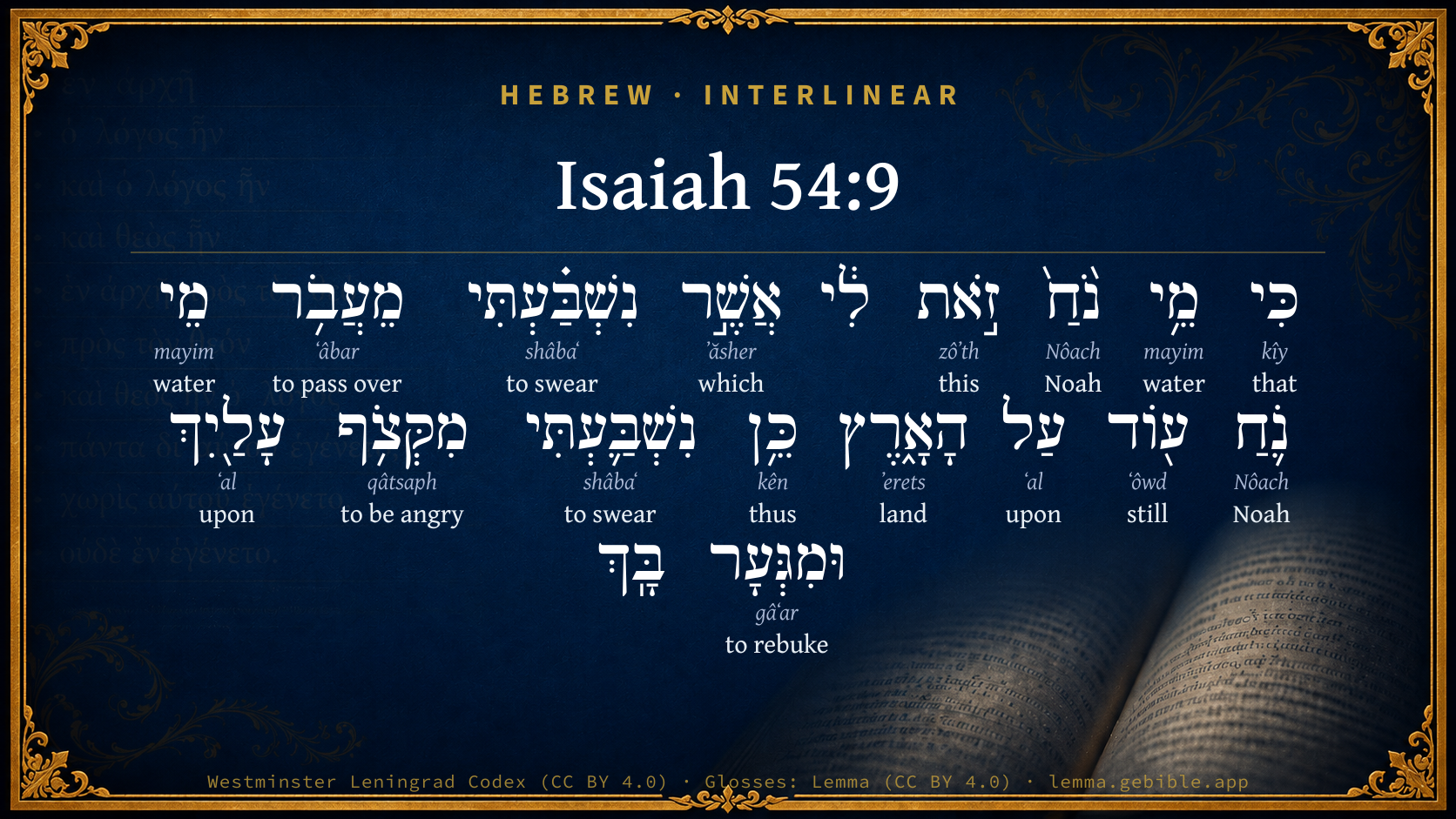
  1. כִּי kîy H3588 “that” Conjunction
  2. מֵ֥י mayim H4325 “water(s) of” Noun, Common, Masculine, Plural, Construct
  3. נֹ֨חַ֙ Nôach H5146 “Noah” Noun, Proper
  4. זֹ֣את zôʼth H2063 “this” Pronoun, Demonstrative, Feminine, Singular
  5. אֲשֶׁ֣ר ʼăsher H834 “which” Particle, Relative
  6. נִשְׁבַּ֗עְתִּי shâbaʻ H7650 “to swear” Verb, Niphal, Perfect, 1st Person, Common, Singular
  7. מֵעֲבֹ֥ר ʻâbar H5674 “from · to pass over” Preposition + Verb, Qal, Infinitive Construct
  8. מֵי mayim H4325 “water(s) of” Noun, Common, Masculine, Plural, Construct
  9. נֹ֛חַ Nôach H5146 “Noah” Noun, Proper
  10. ע֖וֹד ʻôwd H5750 “still” Adverb
  11. עַל ʻal H5921 “upon” Preposition
  12. הָאָ֑רֶץ ʼerets H776 “the · land” Particle, Definite Article + Noun, Common, Both, Singular, Absolute
  13. כֵּ֥ן kên H3651 “thus” Particle, Demonstrative
  14. נִשְׁבַּ֛עְתִּי shâbaʻ H7650 “to swear” Verb, Niphal, Perfect, 1st Person, Common, Singular
  15. מִקְּצֹ֥ף qâtsaph H7107 “from · to be angry” Preposition + Verb, Qal, Infinitive Construct
  16. עָלַ֖יִךְ ʻal H5921 “upon · you” Preposition + Suffix, Personal, 2nd Person, Feminine, Singular

About this verse

These counts appear in no published source. They are computed here, from the morphology-tagged text and Lemma’s own curated glosses. What Lemma adds →

19
words
13
distinct lemmas
Prophets
section

Notable vocabulary

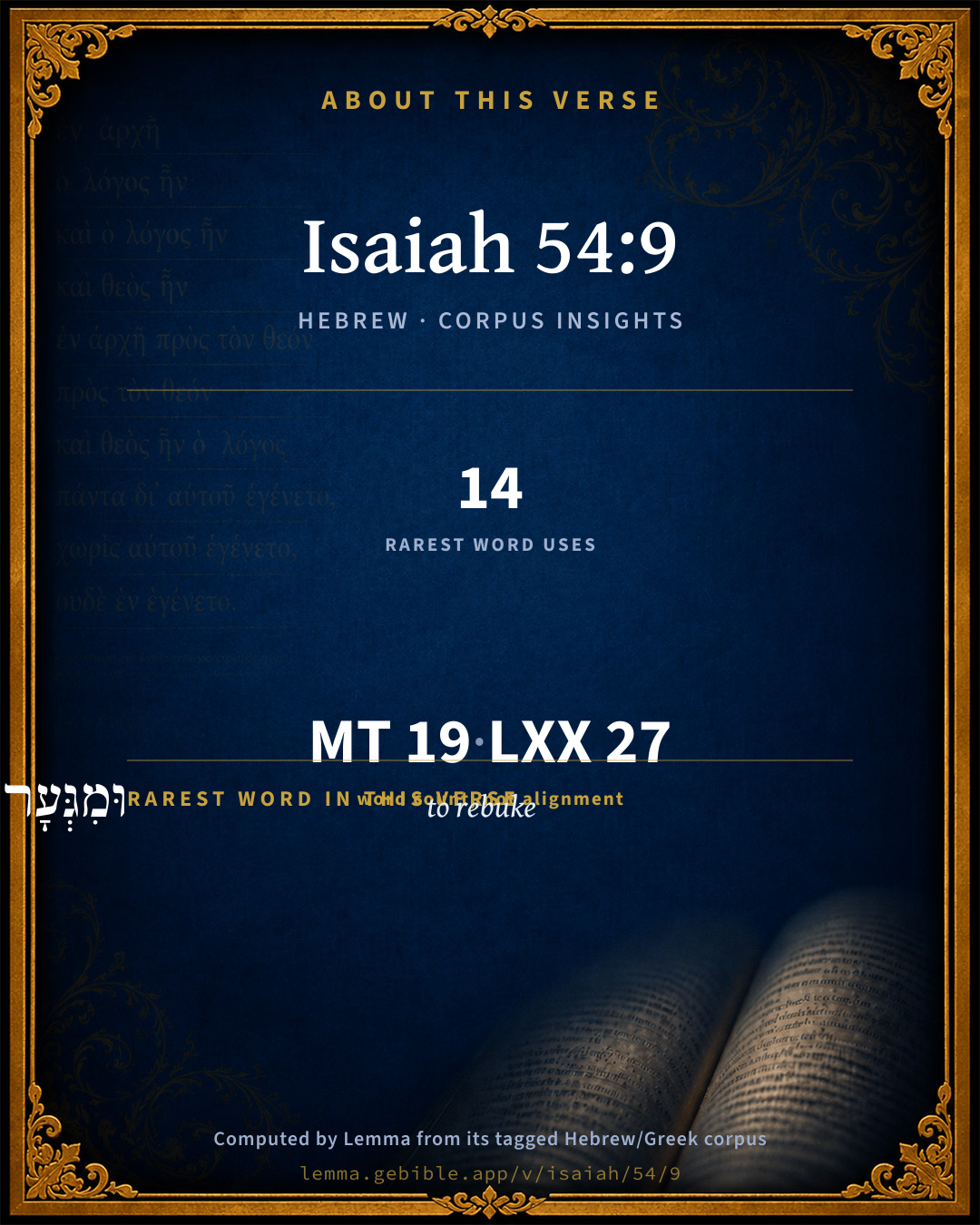
The rarest word here is וּמִגְּעָר to rebuke H1605 — appearing just 14 times in the whole Hebrew Bible.

Shared distinctive vocabulary

וּמִגְּעָר to rebuke H1605 occurs in 13 verses of the Hebrew Bible. Also found in:

Grammatical profile

  • 5 verbs
  • 5 nouns
  • 1 pronoun
  • 4 prepositions
  • 1 conjunction
  • 1 adverb
  • 2 particles

Verb forms

  • נִשְׁבַּ֗עְתִּי Niphal · Perfect
  • מֵעֲבֹ֥ר Qal · Infinitive Construct
  • נִשְׁבַּ֛עְתִּי Niphal · Perfect
  • מִקְּצֹ֥ף Qal · Infinitive Construct
  • וּמִגְּעָר Qal · Infinitive Construct

Repetition

Words recur within this verse — often emphatic in Hebrew:

  • מֵ֥י water H4325 ×2
  • נֹ֨חַ֙ Noah H5146 ×2
  • נִשְׁבַּ֗עְתִּי to swear H7650 ×2
  • עַל upon H5921 ×2

Hebrew & Septuagint length

In English translation the verse runs 42 words from the Hebrew and 37 from the Septuagint (LXX English) — closely comparable.

A rough comparison of the two English renderings, which tokenize alike — not a word-level alignment.

Word counts can differ between the Hebrew and the Greek without any difference in meaning — e.g. the Hebrew direct-object marker אֵת has no separate Greek word, and Greek often adds the article ὁ.

In the original languages it is 19 Hebrew tokens and 27 Greek tokens — but the two are counted differently (Hebrew bundles its prefixes and suffixes into one token; the Greek is in lemma form), so that isn’t a like-for-like length.

Cross-references

9

Topical passages linked to Isaiah 54:9 in the Treasury of Scripture Knowledge — connected by theme and wording, ordered by reader-vote popularity; previews shown in the World English Bible.

  • Isaiah 12:1 In that day you will say, "I will give thanks to you, Yahweh; for though you were angry with me, your anger has turned away and you comfort me.
  • Genesis 8:21 Yahweh smelled the sweet savor. Yahweh said in his heart, "I will not again curse the ground any more for man's sake, because the imagination of man's heart is evil from his youth; neither will I ever again strike everything living, as I have done.
  • Genesis 9:11–16 I will establish my covenant with you; neither will all flesh be cut off any more by the waters of the flood; neither will there any more be a flood to destroy the earth."
  • Hebrews 6:16–18 For men indeed swear by a greater one, and in every dispute of theirs the oath is final for confirmation.
  • Psalms 104:9 You have set a boundary that they may not pass over; That they don't turn again to cover the earth.
  • Isaiah 55:11 so shall my word be that goes forth out of my mouth: it shall not return to me void, but it shall accomplish that which I please, and it shall prosper in the thing whereto I sent it.
  • Jeremiah 31:35–36 Thus says Yahweh, who gives the sun for a light by day, and the ordinances of the moon and of the stars for a light by night, who stirs up the sea, so that the waves of it roar; Yahweh of hosts is his name:
  • Jeremiah 33:20–26 Thus says Yahweh: If you can break my covenant of the day, and my covenant of the night, so that there shall not be day and night in their season;
  • Ezekiel 39:20 You shall be filled at my table with horses and chariots, with mighty men, and with all men of war, says the Lord Yahweh.

Cross-references courtesy of OpenBible.info (CC BY 4.0).

Hebrew and Greek witnesses Masoretic Hebrew ↔ Greek Septuagint

The same verse in the two great witnesses to the Old Testament, shown verse-for-verse.

These are two independent witnesses, not word-aligned to each other, and the Septuagint is shown in lemma (dictionary) form.

Hebrew Isaiah 54:9 Masoretic · Westminster Leningrad Codex

כִּי מֵ֥י נֹ֨חַ֙ זֹ֣את לִ֔י אֲשֶׁ֣ר נִשְׁבַּ֗עְתִּי מֵעֲבֹ֥ר מֵי נֹ֛חַ ע֖וֹד עַל הָאָ֑רֶץ כֵּ֥ן נִשְׁבַּ֛עְתִּי מִקְּצֹ֥ף עָלַ֖יִךְ וּמִגְּעָר בָּֽךְ

For this is [as] the waters of Noah to me; for as I have sworn that the waters of Noah shall no more go over the earth, so have I sworn that I will not be angry with you, nor rebuke you.

World English Bible · Public Domain

Greek LXX Isaiah 54:9 Septuagint · lemma form

ἀπό ὁ ὕδωρ ὁ ἐπί νωε οὗτος ἐγώ εἰμί καθότι ὄμνυμι αὐτός ἐν ὁ χρόνος ἐκεῖνος ὁ γῆ μή θυμόω ἐπί σύ ἔτι μηδέ ἐν ἀποεἰλέω σύ

From the time of the water of Noe this is my purpose: as I swore to him at that time, saying of the earth, I will no more be angry with you, neither when you are threatened,

LXX2012 (modern English Septuagint) · Public Domain

On this verse, Keil & Delitzsch discusses the Septuagint’s reading. Read the note in Commentary ↓

Hebrew: Westminster Leningrad Codex (CC BY 4.0). Greek: Septuagint (public domain); English from LXX2012 (modern English Septuagint) (Public Domain). How the Septuagint differs from the Hebrew →

Targum (Aramaic paraphrase)

1

The Targum is the ancient Jewish Aramaic paraphrase of the Hebrew Scriptures — an interpretive translation, not the Hebrew text itself. Onkelos (literal) and Pseudo-Jonathan (expansive) render the Torah, and Jonathan the Prophets. Coverage is partial: where no permissively-licensed English translation exists for a verse, only the Aramaic is shown. This is verse-level text, not a word-by-word alignment to the Hebrew.

  1. Targum Jonathan Prophets (Joshua–Malachi)
    כְּיוֹמֵי נֹחַ דָא קֳדָמַי דְקַיְמֵית בְּמֵימְרִי דְלָא יֶעְדוּן מֵי טוּפָנָא דַהֲווֹ בְּיוֹמֵי נֹחַ עוֹד עַל אַרְעָא כֵּן קַיְמִית בְּמֵימְרִי דְלָא יֵחוֹל רוּגְזִי עֲלָךְ וְלָא אֶזוֹף בִּיךְ:

    This shall be before me as the days of Noah, when I swore by my WORD, that the waters of the deluge, which were in the days of Noah, shall no more pass over the earth; thus I swear by my WORD, that my anger shall not be hurled upon thee, neither will I reprove thee.

    Targum Jonathan — Aramaic: “Mikraot Gedolot” (public domain). English: “Sefaria Community Translation” (CC0 1.0 (public-domain dedication)); “London "Chaldee Paraphrase," 1871” (public domain). Text via Sefaria.

Commentary

Notes on Isaiah 54:9 from classic Christian and Jewish commentators (each source and its license shown beneath its notes). The classic Christian expositions comment on the surrounding passage and are grouped to its opening verse, so a note may address several verses; the Jewish commentaries on the Tanakh (Rashi and others) are per-verse, so they appear only where the commentator wrote on this verse.

Lemma curates 59 commentaries, every one of them public domain or Creative Commons licensed, each selected and text-cleaned for this edition rather than reprinted as found. About our sources →

Trapp's Complete Commentary

John Trapp

Isa 54:9 For this [is as] the waters of Noah unto me: for [as] I have sworn that the waters of Noah should no more go over the earth; so have I sworn that I would not be wroth with thee, nor rebuke thee.

Ver. 9. For this is as the waters of Noah.] Gen 9:9; Gen 9:11.

For as I have sworn,] i.e., I have said it. God’s word is as good as his oath. See the like, Exo 32:13 Gen 12:7.

So have I sworn.] And given thee the sacraments for thy confirmation, like as I gave him the rainbow.

John Trapp, A Commentary or Exposition upon All the Books of the Old and New Testament (1647–1656) — public domain. Text from a community e-Sword module.

The Biblical Illustrator

Joseph S. Exell

Isa_54:9

For this is as the waters of Noah unto Me

The Lord no more wroth with His people

I.

WHAT MEN HAVE MOST TO FEAR. All men who are unsaved ought, with fear and trembling, to dread the wrath of God--the wrath present, and the wrath to come. The text speaks of the Lords being wroth, as of an evil to be feared. Man has cause to be afraid of the rebuke of God--that stern rebuke of the Holy One which is the prelude to the lifting-up of His unsheathed sword, and the destruction of His adversaries.

1. Gods wrath is matter for fear, because to be in union with God is necessary to the happiness of the creature.

2. This wrath of God is to be feared all the more because there is no escaping from it. A man who is under the wrath of a monarch can escape to another kingdom; a man who has incurred the anger of the most mighty enemy can find, somewhere in this great world, a nook wherein he can conceal himself from his relentless pursuer. But he that has exposed himself to the wrath of God cannot save himself from the Almighty hand.

3. There is this also to be dreaded in the wrath of God, that there is no cure for it. Nothing can possibly give a man ease or safety when the rebuke of God has gone forth against him. He may be surrounded with temporal comforts, but his riches will only mock his inner poverty. Friends may utter words of cheer, but miserable comforters shall they all be. Instead of the mercies of this life becoming any comfort to him, when a man has the wrath of God resting upon him, it is written, I will curse all your blessings.

4. The rebuke of God, if we live and die impenitent, is one against which we cannot harden ourselves. We cannot gather strength to endure when God strikes at the heart and dries up the spirit.

5. Remember the overwhelming fact that the wrath of God does not end with death.

II. WHAT THE SAINTS NEED NEVER FEAR. Dreadful as it is, and more than sufficient to overwhelm the spirit with dismay, a fear of the wrath of God need never disturb the believers heart. God has sworn that He will never be wroth with His people. He does not say that He will never be so angry with their sins as to chasten them sharply; for anger with our sins is love to us. He does not say that He will not be so angry as to punish us; although there would be great mercy even in that; but He goes much further, and says that He will never be so wroth with His people as even to rebuke them. What! say you, then doth not God rebuke His people? Ah, verily, that He doth, and chasten them too! but those rebukes and those chastisements-are in love, and not in wrath. The text before us is to be read thus: I will not be wroth with thee so as to rebuke thee in indignation. There shall never be so much as a word of wrath from the lips of God, touching any one of His servants whose righteousness is of Him.

1. This, to make us sure of it, is first of all confirmed by an oath. We ought to believe Gods bare word: we are bound to accept His promise as certainty itself; but who will dare to doubt the oath of the Eternal?

2. As if further to illustrate the certainty of this, He is pleased to draw a parallel between His present covenant oath and that which He made in the days of Noah with the second great father of the human race.

(1) The covenant made with Noah was a covenant of pure grace. This covenant is paralleled by the covenant in your ease.

(2) The first covenant with Noah was made after a sacrifice. The same reason so works with God that He will not be wroth with you, nor rebuke you.

(3) That covenant which God made with Noah was openly propounded in the ears of the whole race. Noah and his sons heard it, and we have all heard it. Now, when a man makes a promise, if it is in private he is bound by it, and his honour is engaged thereto; but when his solemn promise becomes public, he stakes his character among men upon the fulfilment of his word. Now, since the Lord has made public this gracious word--I will not be wroth with thee, nor rebuke thee, does He not intend to do as He has said?

(4) God never has broken the covenant which He made with Noah. If the Lord be so faithful to one covenant, why should we imagine, even in our worst moments, that He will be unfaithful to His other word which He has spoken concerning our souls?

3. If this be the ease, that God will not be wroth with us, nor rebuke us, then the greatest fear that can ever fall upon us is gone, and it is time that all our lesser fears were gone with it. For instance, there is

(1) the fear of man. When we clearly understand that God is not wroth with us, we feel raised above the rage of mortals.

(2) So, too, we need not fear the devil. If God will not be wroth with me, nor rebuke me, why should I fear though all hells legions should march against, me? If God will never be wroth with us, nor rebuke us, we need not fear any of the chastisements which His may lay upon us. There is a vast difference between a blow that is given in anger and a pat that is given in love.

(4) How this alters the look of death. If death be a punishment to a believer, then death wears gloomy colours; but if death itself has changed its character, Show delightful is this!

(5) After death shall come the judgment, and in that last great day the Lord will not be wroth with His people; if the reading out of all His peoples sins before an assembled world must imply a rebuke, then it shall not be done, for He will not rebuke them. So then, what should we fear? What indeed? The Lord grant us to be afraid of being afraid!

Conclusion: If it be so, that God has sworn that He will not be wroth with us, then--

(1) Believe it.

(2) Rejoice.

(3) Be resigned.

(4) Impart. If you have learned this love in your own heart, then tell it out to others. (C. H. Spurgeon.)

The Biblical Illustrator, edited by Joseph S. Exell (c. 1880s–1900s) — public domain. Text from a community e-Sword module.

Joseph Benson's Commentary

Isa 54:9-10. For this is as the waters of Noah — This covenant of grace and peace made with thee shall be as certain and perpetual as that which I made with Noah, that there should never be another flood of waters to drown the world. So have I sworn that I would not be wroth with thee — Namely, so as I have been, or so as to forsake thee utterly. For the mountains shall depart, &c. — The mountains and hills shall sooner depart from their places than my kindness shall depart from thee. Nay, the time will come when all the mountains shall depart, and all the hills be removed, and even the whole earth, and all the works that are therein, shall be burned up, but then the covenant of peace between God and his church shall continue in the everlasting happiness of all the true and spiritual members of it. God will not cast off the Christian Church, as he cast off the Church of the Jews; the new covenant being established upon better and surer promises than the old; see Heb 8:6-7. Saith the Lord that hath mercy on thee — Who acts thus toward thee, not for thy merits, but through his own grace and mercy.

Joseph Benson's Commentary on the Old and New Testaments (1811–1818) — public domain. Text from a community e-Sword module.

Keil & Delitzsch

C. F. Keil & F. Delitzsch

The ground of this "everlasting kindness" is given in Isa 54:9 : "For it is now as at the waters of Noah, when I swore that the waters of Noah should not overflow the earth any more; so have I sworn not to be wroth with thee, and not to threaten thee." The commencement of this v. has been a fluctuating one from the earliest times. The Sept. reading is ממּי; that of the Targ., S., Jerome, Syriac, and Saad., כּימי; and even the Codd. read sometimes כּי־מי, sometimes כּימי (compare Mat 24:37, ὥσπερ αἱ ἡμέραι τοῦ Νῶε οὕτως κ.τ.λ - a passage which appears to derive its shape from the one before us, with the reading כימי, and which is expounded in Luk 17:26). If we read כימי, the word זאת must refer to the present, as the turning-point between wrath and mercy; but if we read כי־מי, זאת denotes the pouring out of wrath in connection with the captivity. Both readings are admissible; and as even the Septuagint, with its ἀπὸ τοῦ ὕδατος (from the water), gives an indirect support to the reading כּימי as one word, this may probably merit the preference, as the one best sustained. אשׁר is ubi, quum, as in Num 20:13; Psa 95:9, etc., although it might also be taken as the correlate of the kēn which follows, as in Jer 33:22 (cf., Isa 48:8); and in accordance with the accents, we prefer the former. The present turning-point resembles, in Jehovah's esteem, the days of Noah - those days in which He swore that a flood should not any more come upon the earth (min as in Isa 5:6 and many other passages): for so does He now confirm with an oath His fixed purpose that no such judgment of wrath as that which has just been endured shall ever fall upon Jerusalem again (גּער denotes threatening with a judicial word, which passes at once into effect, as in Isa 51:20). Hendewerk has the following quibbling remark here: "What the comparison with the flood is worth, we may gather from the alter history, which shows how soon the new Jerusalem and the renovated state succumbed to the judicial wrath of God again." To this we reply: (1.) That the prophecy refers to the converted Israel of the last days, whose Jerusalem will never be destroyed again. These last days appear to the prophet, according to the general character of all prophecy, as though linked on to the close of the captivity. For throughout all prophecy, along with the far-sightedness imparted by the Spirit, there was also a short-sightedness which the Spirit did not remove; that is to say, the directly divine element of insight into the future was associated with a human element of hope, which was nevertheless also indirectly divine, inasmuch as it subserved the divine plan of salvation; and this hope brought, as it were, the far distant future into the closest proximity with the troubled present. If, the, we keep this in mind, we shall see that it was quite in order for the prophet to behold the final future on the very edge of the present, and not to see the long and undulating way between. (2.) The Israel which has been plunged by the Romans into the present exile of a thousand years is that part of the nation (Rom 11:25), which has thrust away the eternal mercy and the unchangeable covenant of peace; but this rejection has simply postponed, and not prevented, the full realization of the salvation promised to Israel as a people. The covenant still exists, primarily indeed as an offer on the part of Jehovah, so that it rests with Israel whether it shall continued one-sided or not; but all that is wanted on the part of Israel is faith, to enable it to exchange the shifting soil of its present exile for the rocky foundation of that covenant of peace which has encircled the ages since the captivity (see Hag 2:9), as the covenant with Noah encircled those after the flood with the covenant sign of the rainbow in the cloud.

Keil & Delitzsch — Biblical Commentary on the Old Testament (1861–1891) — public domain (CC PDM 1.0). Text via the HelloAO Bible API. (Old Testament only.)

Tyndale Open Study Notes

Tyndale Open Resources

54:9 The Exile was similar in both drama and trauma to the flood in the time of Noah. In both instances, people sinned grievously against the Lord, but the Lord renewed his commitment to creation (after Noah’s flood) and to his people (after the Exile).

Tyndale Open Study Notes — © Tyndale Open Resources, licensed CC BY-SA 4.0. Text via the HelloAO Bible API.

Geneva Bible (1599)

Geneva Bible translators

As sure as the promise that I made to Noah, that the waters should no more overflow the earth.

Geneva Bible (1599) marginal notes — public domain. Text via Bolls.life.

Jamieson, Fausset & Brown

Robert Jamieson, A. R. Fausset & David Brown

I am about to do the same in this instance as in Noah's flood. As I swore then that it should not return (Gen 8:21; Gen 9:11), and I kept that promise, so I swear now to My people, and will perform My promise, that there shall be no return of the deluge of My wrath upon them. LOWTH, on insufficient authority, reads (the same will I do now as), "in the days of Noah."

Jamieson, Fausset & Brown — Commentary Critical and Explanatory on the Whole Bible (1871) — public domain (CC PDM 1.0). Text via the HelloAO Bible API.

Adam Clarke's Commentary

Verse 9. For this is as the waters of Noah unto me - "The same will I do now, as in the days of Noah"] כימי kimey, in one word, in a MS., and some editions; and so the Syriac, Chaldee, Vulgate, Symmachus, Theodotion, Abarbanel, Sal. ben Melec, and Kimchi acknowledge that their copies vary in this place.

It is certain that these two words ki mey, were written formerly as one. Taken as two כי מי ki mey, they signify for as the waters - when as one, כימי kimey, they signify as the days. This latter reading is found in about four of Kennicott's and De Rossi's MSS. In one of my own it appears to have been intended as one word: but he who added the points, which are by a much later hand than the MS. itself, has pointed the letters so as to make the two words which are commonly found in the text. For the waters, Symmachus, Theodotion, the Syriac, Vulgate, and Arabic have days. The former seems to make the best sense; and the ancient Versions, except the Septuagint, support it.

Adam Clarke's Commentary on the Bible (1810–1826) — public domain. Text from a community e-Sword/MySword module.

Ellicott's Commentary for English Readers

(9) This is as the waters of Noah.—Interesting (1) as showing the writer’s knowledge of the book of Genesis (see Isa_51:2); (2) as one of the few references to the Deluge, outside that book, in the Old Testament. Strictly speaking, Gen_9:11 speaks of a “covenant,” not an “oath,” but it would be idle to find a difficulty in the use of words which, as referring to a Divine act, are almost or altogether interchangeable. It is obvious that the words have found their fulfilment not in any earthly city but in the heavenly Jerusalem.

A Bible Commentary for English Readers, edited by Charles John Ellicott (1878–1897) — public domain. Text from a community e-Sword module.

The Cambridge Bible for Schools and Colleges

gen. ed. J. J. S. Perowne

9, 10. The permanence of the new covenant relation is illustrated first by the promise made to Noah, of which the rainbow is the perpetual token, and then by the steadfastness of the unchanging hills.

For this is as the waters of Noah unto me] Or, according to the reading of several MSS. and the ancient versions (though not the LXX.), As the days of Noah is this (i.e. the present juncture) to me (see R.V. marg.). The difference of reading is very slight, consisting merely in the conjunction of two words which the received text separates (כימי for כי מי). The second alternative is better.

for as I have sworn &c.] as I have sworn &c. (omitting “for”). Comp. Gen_8:21 f., Isa_9:11-17. The absence of any mention of an oath in the narrative is immaterial.

The Cambridge Bible for Schools and Colleges (gen. ed. J. J. S. Perowne; Cambridge University Press, 1878–1918) — public domain. Text from a community e-Sword module.

John Gill's Exposition

For this is as the waters of Noah unto me,.... Some copies, as Kimchi and Ben Melech observe, read these two words, , as one, thus, "as the days of Noah"; and this is followed by the Targum, Vulgate Latin, and Syriac versions; both readings may be kept, and joined in one, and the sense be, "for this is as the waters that were in the days of Noah unto me"; so Kimchi and Menachem join them. The meaning is, that God's dispensation towards his people, at the time the prophecy refers to, is like that of his to Noah and his family; and the love he bears to them is like that which he bore to him; and the covenant he has made with them is as that he made with him:

for as I have sworn that the waters of Noah should no more go over the earth; he gave his word for it, which is as firm as his oath; he made a covenant with Noah, and confirmed it by a rainbow, that the waters should no more go over the earth as they had, and that the world should be no more destroyed by a flood, Gen 9:9,

so have I sworn that I would not be wroth with thee, nor rebuke thee; for though the Lord's people are by nature children of wrath, as others, he has not appointed them to it, nor will he suffer it to fall upon them, but saves them from it through the righteousness of Christ, who has borne it for them; and though he rebukes by his Spirit, by his word and ministers, and by his providences, yet not in wrath, but in love; and of this he has given the strongest assurances; he has not only said it, but swore to it in covenant, Psa 89:3. The Jews (r) refer this prophecy to the times of the Messiah.

(r) T. Bab. Sanhedrin, fol. 99. 1.

John Gill's Exposition of the Whole Bible (1746–1763) — public domain (CC PDM 1.0). Text via the HelloAO Bible API.

Albert Barnes' Notes on the Bible

For this is as the waters of Noah unto me - As it was in the time of the flood of waters, so shall it be now. ‘I then solemnly promised that the waters should not again drown the earth, and I have kept that promise. I now promise with equal solemnity that I will bestow perpetual favor on my true people, and will shed upon them eternal and unchanging blessings.’ ‘The waters of Noah,’ here mean evidently the flood that came upon the world in his time, and from which he and his family were saved. Lowth, on the authority of one manuscript and of the Vulgate, Syriac, Symmachus, and Theodotion, reads this, ‘In the days of Noah? But the authority is not sufficient to change the Hebrew text, and the sense is as clear as if it were changed.

As I have sworn - Gen 8:21-22. God appeals to this not only because the oath and promise had been made, but because it had been kept.

That I would not be wroth - The idea seems here to be that no calamities should spread over the whole church, and sweep it away, as the waters swept over the world in the time of Noah, or as desolation swept over Jerusalem and the whole land of Canaan in the time of the exile at Babylon. There would be indeed persecutions and calamities, but the church would be safe amidst all these trials. The period would never arrive when God would forsake the church, and when he would leave it to perish. One has only to recollect how God has guarded the church, even during the most dangerous periods, to see how remarkably this has been fulfilled. His covenant has been as sure as that which was made with Noah, and it will be as secure and firm to the end of time.

Albert Barnes' Notes on the Bible (1834–1885) — public domain. Text from a community e-Sword/MySword module.

Haydock's Catholic Bible Commentary

Earth. Giving him the rainbow for a sign. My covenant with the Church is equally irrevocable: she is founded on a rock, Matthew xvi. 18. (Calmet) --- Christ will no more abandon her than he will drown the world. Some mountains shall be moved out of their place, but she shall not. (Worthington)

George Leo Haydock (1774–1849), Haydock's Catholic Family Bible and Commentary, 1859 edition — public domain. Excludes Psalms (Douay-Rheims chapter numbering differs from Protestant) and Deuterocanonical books (Catholic canon only).

Matthew Poole's English Annotations

This is as the waters of Noah unto me; this covenant of grace and peace made with thee shall be as certain and perpetual as that which I made with Noah, that there should never be another flood of waters to drown the world; of which see Gen 9:11.

Would not be wroth with thee, to wit, so as I have been, or so as to forsake thee utterly.

Matthew Poole's English Annotations on the Holy Bible (1683–1685) — public domain. Text from a community e-Sword/MySword module.

Whedon's Commentary on the Bible

Daniel D. Whedon

9, 10. As the waters of Noah unto me — And such perpetuity is as certain as the divine oath can make it; as certain as that the earth shall no more be deluged; the rainbow sign in the heavens being an eternal pledge thereto. Gen_8:21-22. This is here alluded to, not only because the oath and promise had been made, but because it also had been kept. Not be wroth, etc. — Because the everlasting Messianic covenant, made between Jehovah and his Church, secures that; though the Church may often be persecuted and disciplined, it shall never be swept away. Other things, as mountains and hills, shall be removed, but God’s kindness and covenant of peace — never. We are ever to keep in mind that the Church is the renovated spiritual Jerusalem. That shall stand, though of the walls of the literal city “there shall not be left one stone upon another.” Mat_24:2.

Daniel D. Whedon (gen. ed.), Commentary on the Old and New Testaments (1874–1909) — public domain. Text from a community e-Sword module.

The Pulpit Commentary

This is as the waters of Noah unto me. The existing calamity Israel submerged in the flood of Babylonian captivity-is as it were a repetition of the calamity of the Deluge in God"s eyes. Its object is to purify his Church, as the object of the Flood was to purify the world. A righteous household survived in the one case; a righteous remnant would go forth in the other. And as God bound himself in Noah"s time not to repeat the calamity of the Deluge, so now he binds himself not again to submerge his Church in a captivity like the Babylonian. It has been said that the promise was not kept, since the Jewish Church was, in A.D. 70, carried captive by the Romans. But the prophet views the Jewish Church as continued in the Christian, into which all its better and more spiritual members passed at the first preaching of the gospel; and the promise here made is thus parallel to that of our Lord, "Upon this rock I will build my Church; and the gates of hell shall not prevail against it". (Mat_16:18) Much as the Christian Church has suffered from the world, it has never been in like cases with the Jewish Church in Babylon, and, as God is faithful, never will be reduced to such extremity. As I have sworn; i.e. "pledged myself." It does not appear from Gen_8:20-22 or Gen_9:8-17 that God actually bound himself by oath. So have I sworn that I would not be wroth with thee, nor rebuke thee. That is to say, not to the same extent, not so as to visit her with the same punishment.

Lessons from Noah"s times.

In the ancient time God was wroth with mankind, when he "looked upon the earth, and, behold, it was corrupt; for all flesh had corrupted his way upon the earth." Then in Divine judgment he swept the earth clean with a flood of great waters. But in wrath he remembered mercy: a restoring-day came, and in that day God was pleased to enter into covenant with the race, and make solemn pledge and promise that never again should "all flesh be cut off by the waters of a flood, nor should there any more be a flood to destroy the earth." Isaiah saw a parallel to this in the Divine dealings with the idolatrous kingdom of Israel. It had become so utterly corrupt that ordinary forms of chastisement would not suffice; overwhelming judgments were demanded. The Divine wrath found expression in the destruction of the nation, and the bitterness of the Babylonish captivity. But mercy limited judgment; a restoring-time came, and brought with it new covenant assurances and promises: "My loving-kindness from thee shall not remove, neither shall the covenant of my peace totter, saith he that hath compassion on thee, Jehovah." In this we are to see exhibited in history earlier and later the methods of Divine dealing which may apply also to us.

I OUR SINS MAY AROUSE THE DIVINE INDIGNATION. Scripture impresses on us that in God is always responsive feeling towards sin. In this we may find foreshadowings of the fatherly relations of God toward us. He must never be thought of as merely concerned with wrong-doing because of its disturbing Divine order, as a king or a judge would be. Sin always bears a personal relation to God. It is disobedience, it is insult, it is unfaithfulness. He feels it as fathers feel the wrong-doing of their children.

II DIVINE WRATH MAY STILL FIND EXTREME JUDGMENTS. Such as are represented in the Flood or in the Captivity. Such as are suggested by the stern necessity fathers sometimes know; they must shut the home-door against hardened prodigal sons. In the spiritual life there are times when God must "cover himself with a cloud, that our prayer should not pass through.

III DIVINE MERCY ALWAYS WAITS TO PUT LIMIT ON THE JUDGMENT. That "mercy" makes the worst judgments to be but corrections. And that "mercy" watches for the moment when the correcting work is done, and restorings can be granted.

IV WHEN GOD RESTORES HE DOES IT WITH SUCH ABUNDANT COMFORTING AND ASSURANCE AS DISPELS ALL THE REMEMBRANCE OF THE JUDGMENT-TIME. illustrate from the tender language of the context. See also the warmth of parental feeling when the prodigal son came back home. R.T.

The Pulpit Commentary (1880–1919), ed. H.D.M. Spence-Jones & Joseph S. Exell — public domain. Text from a community e-Sword module.

John Wesley's Explanatory Notes

This - This covenant of grace and peace made with thee shall be as certain and perpetual as that which I made with Noah, that there should never be another flood to drown the world. Wrath - So as to forsake thee utterly.

John Wesley, Explanatory Notes Upon the Whole Bible (1754–1765) — public domain. Text via the GEBible commentary corpus.

J. A. Alexander on Isaiah

Joseph Addison Alexander

“For the waters of Noah is this to me; what I sware from the waters of Noah passing again over the earth (i.e., against their passing, or, that they should not pass), so I have sworn from being angry (that I will not be angry) against thee, and from rebuking (that I will not rebuke) thee.” The assurance of the preceding verse is now repeated in another form. ‘There can no more be another such effusion of my wrath than there can be another deluge’, here called the waters of Noah, just as we familiarly say "Noah’s flood.” The security in this case, as in that, is a divine oath or solemn covenant, like that recorded Gen 8:21, and Gen 9:11. Some convert a simile into a symbol, and endeavor to enumerate the points of similarity between the world and the deluge, the church and the ark. It is only upon this erroneous supposition that such passages as Psa 124:4-5, can be regarded as illustrative parallels. Such minute coincidences any reader is at liberty to search out for himself; but the text mentions only one point of comparison between the two events, namely, that neither can occur again. The Prophet does not say that God’s displeasure with the church is a flood which shall never be repeated, but that it shall never be repeated any more than the flood. There is no need of supplying any preposition before waters, since the meaning is that this is the same thing as the flood, or just such another case; in what respect is afterwards explained. ‘To me’ does not simply mean ‘in my view or opinion’, but expresses similarity of obligation; the oath was as binding in the one case as the other. ‘Rebuke’ must here be taken in the strong and pregnant sense which it has in Isa 17:13; Isa 50:2; Isa 51:20, and very generally throughout the Old Testament, as signifying not a merely verbal but a practical rebuke. That this is not a general promise of security, is plain from the fact that the church has always been subjected to vicissitudes and fluctuations. Nor is there any period in her history to which it can be properly applied in a specific sense, except the change of dispensations, which was made once for all and can never be repeated. That the church shall never be again brought under the restrictive institutions of the ceremonial law, is neither a matter of course nor a matter of indifference, but a glorious promise altogether worthy of the solemn oath by which it is attested here.

Joseph Addison Alexander, The Prophecies of Isaiah (1846–1847; New York: Scribner, 1870–1878) — public domain. Text from a community e-Sword module.

unfoldingWord translationNotes

Door43 World Missions Community

the waters of Noah

This refers to the flood that Yahweh caused during the time of Noah. (See: Assumed Knowledge and Implicit Information)

Though the mountains may fall and the hills be shaken, yet my steadfast love

Yahweh describes a hypothetical condition to explain what would happen even if those conditions were met. AT: "Even if the mountains fell and the hills shook, my steadfast love" (See: Hypothetical Situations)

the hills be shaken

This can be stated in active form. AT: "the hills may shake" (See: Active or Passive)

my steadfast love will not turn away from you

Yahweh continuing to love his people is spoken of as if his love would not turn away from the people. AT: "I will not stop loving you" (See: Metaphor)

nor will my covenant of peace be shaken

Yahweh not canceling his covenant with the people is spoken of as if his covenant were an object that would not be shaken. This can be stated in active form. AT: "and I will not cancel my covenant of peace" or "and I will surely give you peace as I promised in my covenant" (See: Metaphor and Active or Passive)

says Yahweh, who has mercy on you

Here Yahweh speaks about himself in the third person. It can be stated in first person. AT: "that is what I, Yahweh, who acts mercifully, say" (See: First, Second, or Third Person)

translationWords

water

Noah

oath

earth

anger

rebuke

covenant faithfulness

turn

peace

Yahweh

mercy

unfoldingWord translationNotes — © Distant Shores Media and the Door43 World Missions Community, licensed CC BY-SA 4.0. Source: git.door43.org/Door43/en_tn.

Rashi

Rabbi Shlomo Yitzchaki (Rashi)

For this is to Me [as] the waters of Noah [i.e.,] it is an oath in My hand, and He proceeds to explain His words, “as I swore that the waters of Noah shall never again pass over the earth, etc.”

Rashi on the Tanakh — English translations: “The Judaica Press complete Tanach with Rashi, translated by A. J. Rosenberg” (CC BY 4.0); “Pentateuch with Rashi's commentary by M. Rosenbaum and A.M. Silbermann, 1929-1934” (public domain); “The Metsudah Tanach series, Lakewood, N.J” (CC BY 4.0); and “The Book of Joshua, Metsudah Publications, 1997” (CC BY 4.0). Text via Sefaria.

Ibn Ezra

Rabbi Abraham ibn Ezra

The waters of Noah. The flood that was in the days of Noah.

This, namely, the punishment, which I decreed, and the comfort which I promised.

And as I have sworn, that the waters of Noah, that is, a flood like that in the days of Noah, should no more go over the earth. Comp. Neither will I again smite any more every thing living as I have done, (Gen. 8:21).

That I would not be wroth with thee, etc. This expression is used because Israel has been compared with a forsaken woman.

Ibn Ezra on the Tanakh — English translations: “Sefaria Community Translation” (CC0 1.0 (public-domain dedication)); “Yalkut, Sifsei Chachomim Chumash, Metsudah Publications, 2009” (CC BY 4.0); and “Commentary of Ibn Ezra on Isaiah - trans. by M. Friedlander, 1873” (public domain). Text via Sefaria.

Lesson kit

Teaching starters — assembled from the data on this page, not authored interpretation. Every prompt links to the verse data it draws on. Edit before teaching.

Isaiah, in the Prophets, opens this verse with 19 words (13 distinct Hebrew lemmas). Its most distinctive word is gâʻar (“to rebuke”). A historical commentator’s framing appears above. Read the whole chapter for the surrounding context.

Discussion questions

  1. The word gâʻar carries the sense “to rebuke.” How does it shape the verse?
  2. How does Genesis 37:10, which shares the word «to rebuke», read alongside this verse?
  3. What does the repetition of “water” (2× in this one verse) do in this verse?
  4. These translations render this verse differently; the difference is in the English rendering, not the original. What questions does that raise?
  5. «נִשְׁבַּ֗עְתִּי» is a Niphal Perfect verb. How does that grammatical form shape the action described?
  6. Compare how Trapp's Complete Commentary and The Biblical Illustrator read this verse. Where do they agree or differ?

Things to notice

Reading settings

Reading text

Shown beneath each verse's original-language words.

Old Testament
Old Testament edition

Read the OT as the Masoretic Hebrew (MT) or the Greek Septuagint (LXX).

English shown for the Greek Septuagint (in the Hebrew ↔ Greek comparison).

Comparing translations? Open the Compare panel on any verse page to stack up to four side by side.