
Deuteronomy 27:2

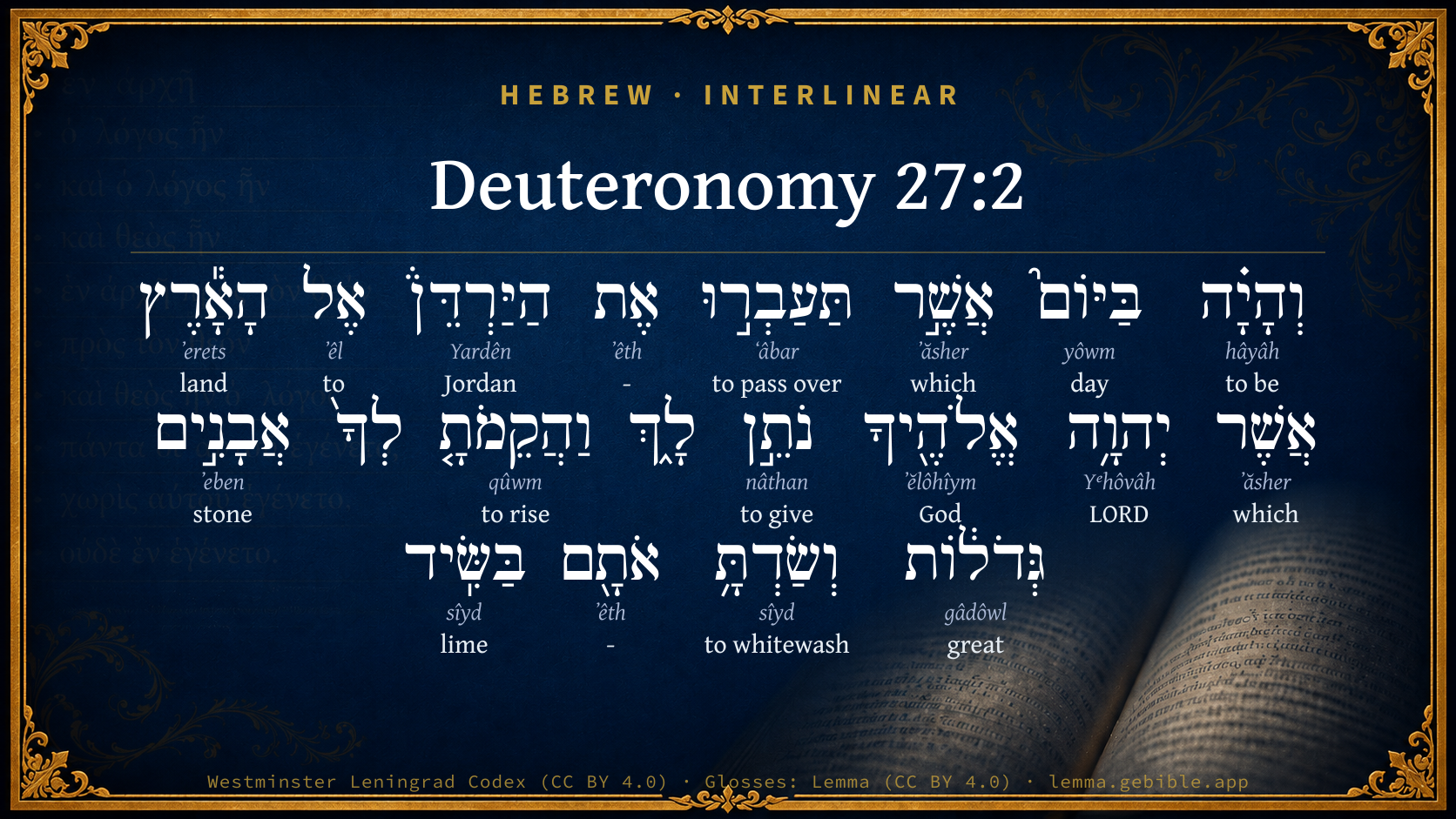
Hebrew (Westminster Leningrad Codex) Deuteronomy 27:2 appears in the Hebrew Old Testament. The text above is from the Westminster Leningrad Codex. Each word links to its Strong’s number, a concise gloss, and parsing drawn from the Open Scriptures Hebrew Bible morphology. Click any word for its full Brown-Driver-Briggs (BDB) entry.
Download image
Cite this verse

Deuteronomy 27:2 (World English Bible). Public Domain. Lemma interlinear Bible study tool, https://lemma.gebible.app/v/deuteronomy/27/2.

Show BibTeX & RIS
BibTeX
RIS
English Translation
It shall be on the day when you shall pass over the Jordan to the land which Yahweh your God gives you, that you shall set yourself up great stones, and plaster them with plaster:
World English Bible · Public Domain
Highlights
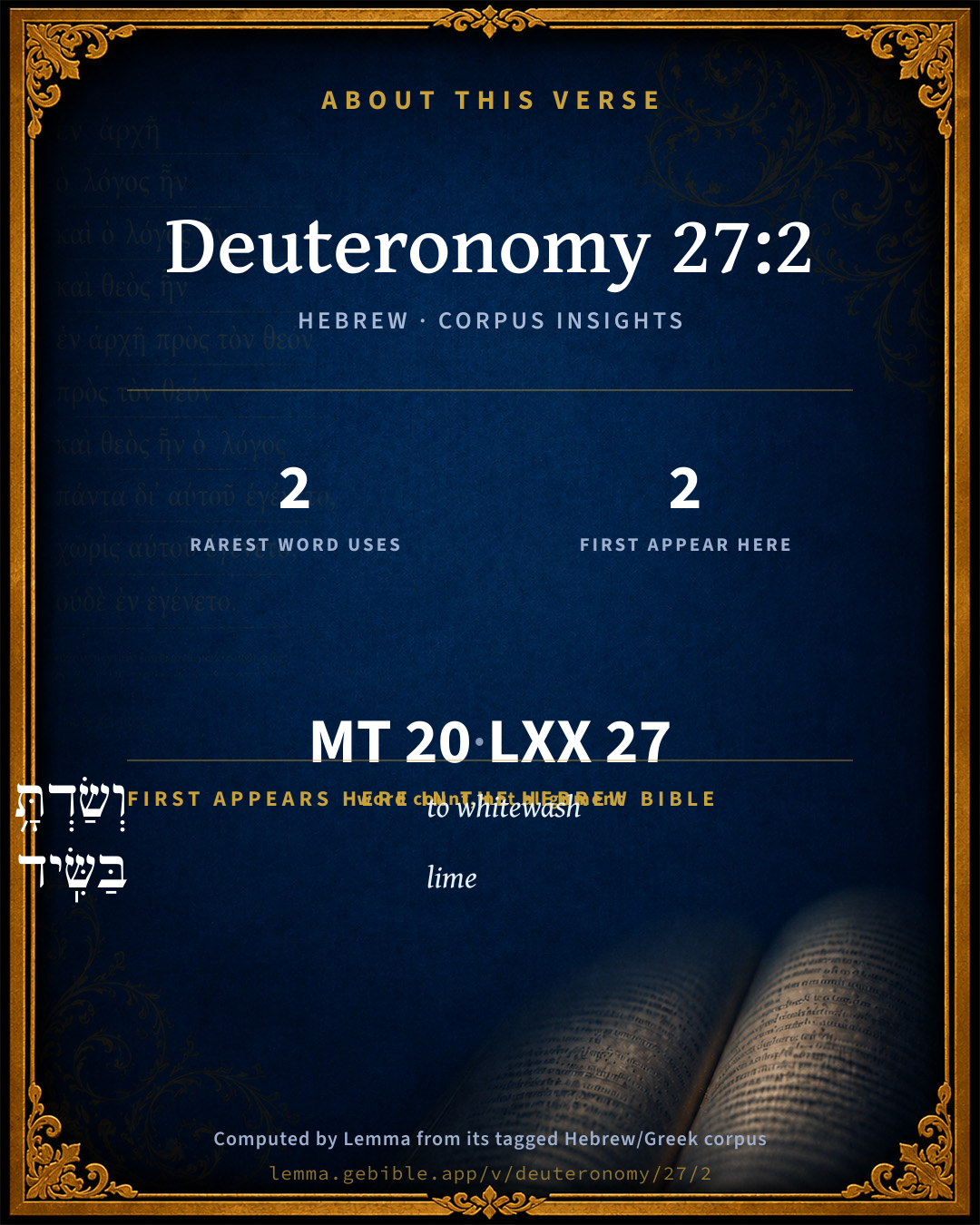
  • 2 first appearances in the Hebrew Bible
Full analysis ↓
Download a study sheet

One document with this verse’s original text, its word-by-word gloss line, the meaning frame, cross-references with their text, attributed commentary, and full source and license credits — printable, and it pastes into notes with its structure intact.

This verse Autodidact and up

Study sheet (.html) Plain text (.txt)

A passage Seminary Student

Up to 50 verses in one chapter. A passage sheet keeps up to 6 commentary sources and 12 cross-references per verse, in the order this page ranks them, and says so on the sheet whenever that leaves anything out. Ask for a single verse and you get the Autodidact verse sheet above.

Everything on this page stays free to read, with no account — the sheet is a download of what is already on screen, not access to it.

Want to remove ads? Support Godless Engineer
Compare translations 3

The same verse in 3 English versions, stacked beneath the original-language interlinear above. Click any original word for its lexicon entry.

Each is an independent rendering of the whole verse — the interlinear is not word-aligned to these translations.

Highlighted words mark where these versions differ — a whole-verse word diff, not a word-by-word alignment.

  • World English Bible Public Domain
    It shall be on the day when you shall pass over the Jordan to the land which Yahweh your God gives you, that you shall set yourself up great stones, and plaster them with plaster:
  • King James Version Public Domain
    And it shall be on the day when ye shall pass over Jordan unto the land which the LORD thy God giveth thee, that thou shalt set thee up great stones, and plaster them with plaster:
  • unfoldingWord Literal Text CC BY-SA 4.0
    And it will be, on the day when you cross the Jordan to the land that Yahweh your God is giving to you, then you shall erect for yourself large stones and plaster them with plaster.

unfoldingWord Literal Text — © unfoldingWord, licensed CC BY-SA 4.0. Word-aligned USFM3 via Door43 (git.door43.org/unfoldingWord/en_ult).

Versions to compare (up to 4)

3 of 4 selected

Show all 18 translations

Every available English version of this verse, each an independent rendering of the whole verse.

  • World English Bible Public Domain
    It shall be on the day when you shall pass over the Jordan to the land which Yahweh your God gives you, that you shall set yourself up great stones, and plaster them with plaster:
  • Berean Standard Bible Public Domain
    And on the day you cross the Jordan into the land that the LORD your God is giving you, set up large stones and coat them with plaster.
  • Majority Standard Bible Public Domain
    And on the day you cross the Jordan into the land that the LORD your God is giving you, set up large stones and coat them with plaster.
  • King James Version Public Domain
    And it shall be on the day when ye shall pass over Jordan unto the land which the LORD thy God giveth thee, that thou shalt set thee up great stones, and plaster them with plaster:
  • American Standard Version (1901) Public Domain
    And it shall be on the day when ye shall pass over the Jordan unto the land which Jehovah thy God giveth thee, that thou shalt set thee up great stones, and plaster them with plaster:
  • Revised Version (1885) Public Domain
    And it shall be on the day when ye shall pass over Jordan unto the land which the LORD thy God giveth thee, that thou shalt set thee up great stones, and plaister them with plaister:
  • Geneva Bible (1599) Public Domain
    And when ye shall passe ouer Iorden vnto the lande which the Lord thy God giueth thee, thou shalt set thee vp great stones, and playster them with plaister,
  • Douay-Rheims (1899) Public Domain
    And when you are passed over the Jordan into the land which the Lord thy God will give thee, thou shalt set up great stones, and shalt plaster them over with plaster,
  • Young's Literal Translation Public Domain
    and it hath been, in the day that ye pass over the Jordan unto the land which Jehovah thy God is giving to thee, that thou hast raised up for thee great stones, and plaistered them with plaister,
  • Literal Standard Version CC BY-SA 4.0
    and it has been, in the day that you pass over the Jordan to the land which your God YHWH is giving to you, that you have raised up great stones for yourself, and plastered them with plaster,
  • Unlocked Literal Bible CC BY-SA 4.0
    On the day when you will pass over the Jordan to the land that Yahweh your God is giving you, you must set up some large stones and plaster them with plaster.
  • unfoldingWord Literal Text CC BY-SA 4.0
    And it will be, on the day when you cross the Jordan to the land that Yahweh your God is giving to you, then you shall erect for yourself large stones and plaster them with plaster.
  • Darby Bible Public Domain
    And it shall be on the day when ye pass over the Jordan unto the land which Jehovah thy God giveth thee, that thou shalt set thee up great stones, and plaster them with plaster:
  • World Messianic Bible Public Domain
    It shall be on the day when you shall pass over the Jordan to the land which the LORD your God gives you, that you shall set yourself up great stones, and coat them with plaster.
  • Webster's Bible Public Domain
    And it shall be on the day when ye shall pass over Jordan to the land which the LORD thy God giveth thee, that thou shalt set thee up great stones, and plaster them with plaster:
  • Free Bible Version CC BY-SA 4.0
    The day you cross the Jordan into the country the Lord your God is giving you, set up some large stones and paint them with whitewash.
  • Bible in Basic English Public Domain
    And on the day when you go over Jordan into the land which the Lord your God is giving you, put up great stones, coating them with building-paste,
  • JPS Tanakh (1917) Public Domain
    And it shall be on the day when ye shall pass over the Jordan unto the land which the LORD thy God giveth thee, that thou shalt set thee up great stones, and plaster them with plaster.

Literal Standard Version (2020), Covenant Press — licensed CC BY-SA 4.0. Text via the HelloAO Bible API (eBible.org). Unlocked Literal Bible (unfoldingWord) — licensed CC BY-SA 4.0. Text via the HelloAO Bible API (eBible.org). unfoldingWord Literal Text — © unfoldingWord, licensed CC BY-SA 4.0. Word-aligned USFM3 via Door43 (git.door43.org/unfoldingWord/en_ult). Free Bible Version, Dr. Jonathan Gallagher — licensed CC BY-SA 4.0. Text via the HelloAO Bible API (eBible.org).

Word by word

More ways to search: Search by grammar → Find every occurrence → Compare this word →

Practice this passage: Drill this verse → Learn its vocabulary →

וְשַׂדְתָּ֥
sîyd
H7874
“and · to whitewash”
Conjunction + Verb, Qal, Sequential Perfect, 2nd Person, Masculine, Singular
Part of Speech
Conjunction + Verb
Stem
Qal
Form
Sequential Perfect
Person
2nd Person
Gender
Masculine
Number
Singular
Full BDB Definition

Origin: a primitive root probably meaning to boil up (compare H7736 )

TWOT: 2254

(Qal) to whitewash
  1. וְהָיָ֗ה hâyâh H1961 “and · to be” Conjunction + Verb, Qal, Sequential Perfect, 3rd Person, Masculine, Singular
  2. בַּיּוֹם֮ yôwm H3117 “in/at the · day” Preposition, Determined + Noun, Common, Masculine, Singular, Absolute
  3. אֲשֶׁ֣ר ʼăsher H834 “which” Particle, Relative
  4. תַּעַבְר֣וּ ʻâbar H5674 “to pass over” Verb, Qal, Imperfect, 2nd Person, Masculine, Plural
  5. אֶת ʼêth H853 “-” Particle, Direct Object
  6. הַיַּרְדֵּן֒ Yardên H3383 “the · Jordan” Particle, Definite Article + Noun, Proper
  7. אֶל ʼêl H413 “to” Preposition
  8. הָאָ֕רֶץ ʼerets H776 “the · land” Particle, Definite Article + Noun, Common, Both, Singular, Absolute
  9. אֲשֶׁר ʼăsher H834 “which” Particle, Relative
  10. יְהוָ֥ה Yᵉhôvâh H3068 “LORD” Noun, Proper
  11. אֱלֹהֶ֖יךָ ʼĕlôhîym H430 “God(s) · your” Noun, Common, Masculine, Plural, Construct + Suffix, Personal, 2nd Person, Masculine, Singular
  12. נֹתֵ֣ן nâthan H5414 “giving” Verb, Qal, Participle Active, Masculine, Singular, Absolute
  13. וַהֲקֵמֹתָ֤ qûwm H6965 “and · to rise” Conjunction + Verb, Hiphil, Sequential Perfect, 2nd Person, Masculine, Singular
  14. אֲבָנִ֣ים ʼeben H68 “stones” Noun, Common, Feminine, Plural, Absolute
  15. גְּדֹל֔וֹת gâdôwl H1419 “great” Adjective, Adjective, Feminine, Plural, Absolute
  16. אֹתָ֖ם ʼêth H853 “- · them” Particle, Direct Object + Suffix, Personal, 3rd Person, Masculine, Plural
  17. בַּשִּֽׂיד sîyd H7875 “in/at the · lime” Preposition, Determined + Noun, Common, Masculine, Singular, Absolute

About this verse

These counts appear in no published source. They are computed here, from the morphology-tagged text and Lemma’s own curated glosses. What Lemma adds →

20
words
16
distinct lemmas
Pentateuch
section

Notable vocabulary

The rarest word here is וְשַׂדְתָּ֥ to whitewash H7874 — appearing just 2 times in the whole Hebrew Bible.

First appearance in Scripture

These words make their first canonical appearance in the Hebrew Bible here:

  • וְשַׂדְתָּ֥ to whitewash H7874
  • בַּשִּֽׂיד lime H7875

Shared distinctive vocabulary

וְשַׂדְתָּ֥ to whitewash H7874 occurs in 2 verses of the Hebrew Bible. Also found in:

Grammatical profile

  • 5 verbs
  • 7 nouns
  • 1 adjective
  • 3 prepositions
  • 4 particles

Verb forms

  • וְהָיָ֗ה Qal · Sequential Perfect
  • תַּעַבְר֣וּ Qal · Imperfect
  • נֹתֵ֣ן Qal · Participle Active
  • וַהֲקֵמֹתָ֤ Hiphil · Sequential Perfect
  • וְשַׂדְתָּ֥ Qal · Sequential Perfect

Repetition

A word recurs within this verse — often emphatic in Hebrew:

  • אֲשֶׁ֣ר which H834 ×2

Hebrew & Septuagint length

In English translation the verse runs 35 words from the Hebrew and 40 from the Septuagint (LXX English) — closely comparable.

A rough comparison of the two English renderings, which tokenize alike — not a word-level alignment.

Word counts can differ between the Hebrew and the Greek without any difference in meaning — e.g. the Hebrew direct-object marker אֵת has no separate Greek word, and Greek often adds the article ὁ.

In the original languages it is 20 Hebrew tokens and 27 Greek tokens — but the two are counted differently (Hebrew bundles its prefixes and suffixes into one token; the Greek is in lemma form), so that isn’t a like-for-like length.

Cross-references

11

Topical passages linked to Deuteronomy 27:2 in the Treasury of Scripture Knowledge — connected by theme and wording, ordered by reader-vote popularity; previews shown in the World English Bible.

  • Joshua 4:1 It happened, when all the nation were clean passed over the Jordan, that Yahweh spoke to Joshua, saying,
  • Joshua 8:31 as Moses the servant of Yahweh commanded the children of Israel, as it is written in the book of the law of Moses, an altar of uncut stones, on which no man had lifted up any iron: and they offered thereon burnt offerings to Yahweh, and sacrificed peace-offerings.
  • Ezekiel 11:19 I will give them one heart, and I will put a new spirit within you; and I will take the stony heart out of their flesh, and will give them a heart of flesh;
  • Ezekiel 36:26 A new heart also will I give you, and a new spirit will I put within you; and I will take away the stony heart out of your flesh, and I will give you a heart of flesh.
  • Deuteronomy 6:1 Now this is the commandment, the statutes, and the ordinances, which Yahweh your God commanded to teach you, that you might do them in the land where you go over to possess it;
  • Deuteronomy 9:1 Hear, Israel: you are to pass over the Jordan this day, to go in to dispossess nations greater and mightier than yourself, cities great and fortified up to the sky,
  • Deuteronomy 11:31 For you are to pass over the Jordan to go in to possess the land which Yahweh your God gives you, and you shall possess it, and dwell therein.
  • Deuteronomy 26:1 It shall be, when you are come in to the land which Yahweh your God gives you for an inheritance, and possess it, and dwell therein,
  • Deuteronomy 27:3 and you shall write on them all the words of this law, when you are passed over; that you may go in to the land which Yahweh your God gives you, a land flowing with milk and honey, as Yahweh, the God of your fathers, has promised you.
  • Joshua 1:11 Pass through the midst of the camp, and command the people, saying, Prepare food; for within three days you are to pass over this Jordan, to go in to possess the land, which Yahweh your God gives you to possess it.
  • Joshua 4:5–24 and Joshua said to them, Pass over before the ark of Yahweh your God into the midst of the Jordan, and take up every man of you a stone on his shoulder, according to the number of the tribes of the children of Israel;

Cross-references courtesy of OpenBible.info (CC BY 4.0).

Hebrew and Greek witnesses Masoretic Hebrew ↔ Greek Septuagint

The same verse in the two great witnesses to the Old Testament, shown verse-for-verse.

These are two independent witnesses, not word-aligned to each other, and the Septuagint is shown in lemma (dictionary) form.

Hebrew Deuteronomy 27:2 Masoretic · Westminster Leningrad Codex

וְהָיָ֗ה בַּיּוֹם֮ אֲשֶׁ֣ר תַּעַבְר֣וּ אֶת הַיַּרְדֵּן֒ אֶל הָאָ֕רֶץ אֲשֶׁר יְהוָ֥ה אֱלֹהֶ֖יךָ נֹתֵ֣ן לָ֑ךְ וַהֲקֵמֹתָ֤ לְךָ֙ אֲבָנִ֣ים גְּדֹל֔וֹת וְשַׂדְתָּ֥ אֹתָ֖ם בַּשִּֽׂיד

It shall be on the day when you shall pass over the Jordan to the land which Yahweh your God gives you, that you shall set yourself up great stones, and plaster them with plaster:

World English Bible · Public Domain

Greek LXX Deuteronomy 27:2 Septuagint · lemma form

καί εἰμί ὅς ἄν ἡμέρα διαβαίνω ὁ ἰορδάνης εἰς ὁ γῆ ὅς κύριος ὁ θεός σύ δίδωμι σύ καί ἵστημι σεαυτοῦ λίθος μέγας καί κονιάω αὐτός κονία

And it shall come to pass in the day when you⌃ shall cross over Jordan into the land which the Lord your God gives you, that you shall set up for yourself great stones, and shall plaster them with plaster.

LXX2012 (modern English Septuagint) · Public Domain

On this verse, The Cambridge Bible for Schools and Colleges discusses the Septuagint’s reading. Read the note in Commentary ↓

Hebrew: Westminster Leningrad Codex (CC BY 4.0). Greek: Septuagint (public domain); English from LXX2012 (modern English Septuagint) (Public Domain). How the Septuagint differs from the Hebrew →

Targum (Aramaic paraphrase)

2

The Targum is the ancient Jewish Aramaic paraphrase of the Hebrew Scriptures — an interpretive translation, not the Hebrew text itself. Onkelos (literal) and Pseudo-Jonathan (expansive) render the Torah, and Jonathan the Prophets. Coverage is partial: where no permissively-licensed English translation exists for a verse, only the Aramaic is shown. This is verse-level text, not a word-by-word alignment to the Hebrew.

  1. Targum Onkelos Torah (Genesis–Deuteronomy)
    וִיהֵי בְּיוֹמָא דִי תַעְבְּרוּן יָת יַרְדְנָא לְאַרְעָא דַיְיָ אֱלָהָךְ יָהֵב לָךְ וּתְקִים לָךְ אַבְנִין רַבְרְבִין וּתְסוּד יָתְהוֹן בְּסִידָא

    (no public-domain English translation for this verse)

    Targum Onkelos — Aramaic: “Onkelos Genesis” (public domain); “Onkelos Exodus” (public domain); “Onkelos Leviticus” (public domain); “Onkelos Numbers” (public domain); “Onkelos Deuteronomy” (public domain). English: “Sefaria Community Translation” (CC0 1.0 (public-domain dedication)); “J.W. Etheridge. The Targums of Onkelos and Jonathan Ben Uzziel on the Pentateuch. London: Longmans, Green, 1862” (public domain). Text via Sefaria.

  2. Targum Pseudo-Jonathan Torah (Genesis–Deuteronomy)
    וִיהֵי בְּיוֹמָא דְתַעַבְרוּן יַת יוֹרְדְנָא לְאַרְעָא דַיְיָ אֱלָהָכוֹן יָהִיב לְכוֹן וּתְקוּמוּן לְכוֹן אַבְנִין רַבְרְבִין וּתְשׁוּעוּן יַתְהוֹן בְּגִירָא

    And it shall be on the day that you pass over the Jordana into the land which the Lord your God giveth you, that you shall erect for you great stones, and plaster them with lime;

    Targum Pseudo-Jonathan — Aramaic: “Targum Jonathan on Genesis” (public domain); “Targum Jonathan on Exodus” (public domain); “Targum Jonathan on Leviticus” (public domain); “Targum Jonathan on Numbers” (public domain); “Targum Jonathan on Deuteronomy” (public domain). English: “The Targum of Jonathan ben Uzziel, trans. J. W. Etheridge, London, 1862” (public domain). Text via Sefaria.

Commentary

Notes on Deuteronomy 27:2 from classic Christian and Jewish commentators (each source and its license shown beneath its notes). The classic Christian expositions comment on the surrounding passage and are grouped to its opening verse, so a note may address several verses; the Jewish commentaries on the Tanakh (Rashi and others) are per-verse, so they appear only where the commentator wrote on this verse.

Lemma curates 59 commentaries, every one of them public domain or Creative Commons licensed, each selected and text-cleaned for this edition rather than reprinted as found. About our sources →

Trapp's Complete Commentary

John Trapp

Deu 27:2 And it shall be on the day when ye shall pass over Jordan unto the land which the LORD thy God giveth thee, that thou shalt set thee up great stones, and plaister them with plaister:

Ver. 2. And plaster them with plaster.] That they might have it in white and black.

John Trapp, A Commentary or Exposition upon All the Books of the Old and New Testament (1647–1656) — public domain. Text from a community e-Sword module.

The Biblical Illustrator

Joseph S. Exell

Deu_27:2-3

That thou shalt set up great stones.

Memorial pillars

On the boundary line between European and Siberian Russia there is a square pillar of brick bearing on one side the coat-of-arms belonging to the province of Perm in Europe, and on the other side the coat-of-arms belonging to the province of Tobolsk in Asia. That pillar has more sorrowful associations than any other pillar in the world. For many years the exiles to Siberia had to pass it, and there bade a long farewell to home and country. Strong men wept; some pressed their faces to the loved soil they were leaving, some collected a little earth to take with them to their new abodes, and some passionately kissed the European side of the pillar. The plaister on the bricks was covered with inscriptions, plaintive and pathetic as the epitaphs in a graveyard. Moses thought of pillars which were to have not a mournful, but a joyful significance. The stones were afterwards set up by the people as memorials of Gods work on their behalf. The stones were to be a perpetual memorial of indebtedness to God for rescue from slavery and guidance to prosperity and honour. The disciples of Christ have experienced a change wonderful as that experienced by the Israelites. They have passed from bondage to liberty, from darkness to light, from moral debasement to spiritual glory. They are not to boast as if by their own endeavours they had wrought out the salvation in which they rejoice, but gratefully to confess that God has made them what they are. They are themselves to be monuments of Gods power such as all can see and understand. Something more is needed from them than activity in setting up great stones as abiding witnesses of the great revolution in their life. They are to stand before the world as witnesses of Gods saving, hallowing work in the human soul. The stones the Israelites were to set up were to be plaistered, and the law written on the plaister. There was a deep significance in the words thus inscribed. The people would be reminded by them that though they were out of the wilderness they had not ceased to be under the law. The horrors of Egyptian slavery would have been better for them than luxurious life in Canaan unrestricted by Divine precepts. The written stones were an attestation of Gods supremacy over them, and as a restraint from the moral laxity to which they would be tempted when at ease amid the limpid wells and orchards green and all the other charms of the land where Abraham fed his flock of yore. The disciples of Christ are to be as pillars inscribed with the law of the Lord. They do not bear the words of the ceremonial law, nor are they under direct obligation to bear those of the social law enacted in the wilderness. It is the moral law they bear as a sacred inscription on their life. Special prominence is to be given to the two great commandments, love to God and love to man, which, according to the teaching of Jesus, include the whole of the Decalogue. Faith in Christ does not mean freedom from the law as a rule of life. Truth, honesty, amiability are as much required in members of the Church as if those qualities were the sole condition of salvation: evangelical righteousness implies practical righteousness. (J. Marrat.)

The Biblical Illustrator, edited by Joseph S. Exell (c. 1880s–1900s) — public domain. Text from a community e-Sword module.

Joseph Benson's Commentary

Deu 27:2-3. On the day — Here it is evident the word day does not signify precisely the very same day they passed over, but some indefinite time after, namely, as soon as they were come to mount Ebal, (Deu 27:4,) after the taking of Jericho and Ai. See Jos 8:30. All the words of this law — Some have thought that he means the whole book of Deuteronomy. But they must have been immense stones to have contained this. It is more probable that only the ten commandments are intended, or perhaps, as Josephus’s opinion is, only the cursings which here follow, the last whereof seems to respect the whole law of Moses. Mount Ebal — The mount of cursing. Here the law was written, to signify that a curse was due to the violaters of it, and that no man could expect justification from it, all having violated it in one kind and degree or other. Here the sacrifices were to be offered, to show that there is no way to be delivered from this curse but by the blood of Christ, which all these sacrifices did typify, and by Christ’s being made a curse for us.

Joseph Benson's Commentary on the Old and New Testaments (1811–1818) — public domain. Text from a community e-Sword module.

Adam Clarke's Commentary

Verse 2. Thou shalt set thee up great stones] How many is not specified, possibly twelve, and possibly only a sufficient number to make a surface large enough to write the blessings and the curses on.

Plaster them with plaster] Perhaps the original ושדת אתם בשיד vesadta otham bassid should be translated, Thou shalt cement them with cement, because this was intended to be a durable monument. In similar cases it was customary to set up a single stone, or a heap, rudely put together, where no cement or mortar appears to have been used; and because this was common, it was necessary to give particular directions when the usual method was not to be followed. Some suppose that the writing was to be in relievo, and that the spaces between the letters were filled up by the mortar or cement. This is quite a possible case, as the Eastern inscriptions are frequently done in this way. There is now before me a large slab of basaltes, two feet long by sixteen inches wide, on which there is an inscription in Persian, Arabic, and Tamul; in the two former the letters are all raised, the surface of the stone being dug out, but the Tamul is indented. A kind of reddish paint had been smeared over the letters to make them more apparent. Two Arabic marbles in the University of Oxford have the inscriptions in relievo, like those on the slab of basalt in my possession. In the opinion of some even this case may cast light upon the subject in question.

Adam Clarke's Commentary on the Bible (1810–1826) — public domain. Text from a community e-Sword/MySword module.

The Cambridge Bible for Schools and Colleges

gen. ed. J. J. S. Perowne

2. on the day on which ye shall pass over Jordan] The Heb. idiom (cp. 2Sa_19:20, Est_9:1) implies the very day on which they were crossing, and not (vaguely) the time when they crossed; and this is confirmed by 3b which indicates that the stones were to be set up when Israel crossed Jordan but before they entered upon their occupation of the land, in order that thou mayest go in (similarly Dillm. and Dri.).

and plaister them with plaister] A whitewash of lime or chalk, as a background for the writing in black or another colour. The practice was Egyptian, and in Egypt the climate was not hostile to the result. But such writing would not survive the winters of Palestine, where not even inscriptions engraved in limestone, but only those in basalt have endured. It is possible therefore that we have here a very ancient fragment incorporated in D. Cp. E, Exo_24:4-7 where the writing of the words of the Lord by Moses is associated with the erection of twelve maṣṣebôth.

all the word; of this law] Heb. Tôrah (see on Deu_1:5, Deu_31:9, etc.). How much is comprised in this phrase we cannot say, for we are not sure of the exact size of the original code of D.

It was a widespread custom in antiquity to engrave laws upon stone pillars. The Code of Ḫammurabi is engraved on a pillar of black diorite in ‘about 49 columns, 4000 lines and 8000 words’ (Johns, Hastings’ D.B., Extra Vol.). The local tariff of Palmyra contains about 260 lines in Greek and 163 in Aramaic (Cooke, N. Semit. Inscr. 313 ff.). The regulations for sacrifices at Carthage (CIS. i. i. 166 ff.) were graven on stone. For Greece cp. Apollodorus in the Schol. to l. 447 of the Clouds of Aristophanes: οἱ ἀρχαῖοι λίθους ἱστάντες εἰώθεσαν τὰ δόξαντα ἐν αὐτοῖς ἀναγράφειν. These pillars were called στῆλαι and the phrase παραβῆναι τὰς στήλας (Polyb. xxvi. 1, 4) = to transgress the laws (Knobel).

when thou art passed over] LXX, ye are.

that thou mayest go in, etc.] Cp. Deu_4:40, Deu_6:3, Deu_7:1, etc. LXX B, etc., read that ye may go in, but most MSS have Sg.

The Cambridge Bible for Schools and Colleges (gen. ed. J. J. S. Perowne; Cambridge University Press, 1878–1918) — public domain. Text from a community e-Sword module.

John Gill's Exposition

And it shall be, on the day when you shall pass over Jordan,.... Not the precise day exactly, but about that time, a little after they passed that river, as soon as they conveniently could; for it was not till after Ai was destroyed that the following order was put in execution; indeed as soon as they passed over Jordan, they were ordered to take twelve stones, and did; but then they were set up in a different place, and for a different purpose; see Jos 4:3,

unto the land which the Lord thy God giveth thee, that thou shalt set thee up great stones; not in Jordan, as Jarchi, but on Mount Ebal, Deu 27:4; nor had the stones set up in Jordan any such inscription as what is here ordered to be set on these:

and plaster them with plaster: that so words might be written upon them, and be more conspicuous, and more easily read.

John Gill's Exposition of the Whole Bible (1746–1763) — public domain (CC PDM 1.0). Text via the HelloAO Bible API.

Albert Barnes' Notes on the Bible

The stones here named are not those of which the altar Deu 27:5 was to be built, but are to serve as a separate monument witnessing to the fact that the people took possession of the land by virtue of the Law inscribed on them and with an acknowledgment of its obligations.

Albert Barnes' Notes on the Bible (1834–1885) — public domain. Text from a community e-Sword/MySword module.

Haydock's Catholic Bible Commentary

Stones. The Latin translation of the Samaritan copy, defines the number to be two, (Exodus xx. 18,) and shews that the law, which was to be written upon them, was no other than the decalogue, to which the curses and blessings here recorded have a direct reference. When no number is specified, the dual is commonly understood. (Haydock) (Leviticus xii. 5, &c.) --- Two large stones would be sufficient to contain the words of the decalogue, and they would more strikingly represent the two tables written with the finger of God. They were probably first polished, and the letters raised upon them in relievo, as the Arabic marbles in the University of Oxford are done. The white plaster being then used to fill up the interstices between the letters of black marble, the words would appear very plainly. (Kennicott, Dis. 2.) --- Others think that a high and durable monument was raised both for an altar and for the inscription, though some would allow four others for this purpose. (Calmet) --- Plaster. The Hebrew does not specify all over; and Houbigant supposes, that the cement was only used to join the stones together. Neither do the Hebrew or Septuagint intimate that the plaster was laid on for the purpose of writing more easily.

George Leo Haydock (1774–1849), Haydock's Catholic Family Bible and Commentary, 1859 edition — public domain. Excludes Psalms (Douay-Rheims chapter numbering differs from Protestant) and Deuterocanonical books (Catholic canon only).

Matthew Poole's English Annotations

On that day, i.e. about that time, for it was not done till some days after their passing over.

Day is oft put for time, as hath been noted before.

Plaister them with plaister, for conveniency of writing upon them.

Matthew Poole's English Annotations on the Holy Bible (1683–1685) — public domain. Text from a community e-Sword/MySword module.

Whedon's Commentary on the Bible

Daniel D. Whedon

2. The day when ye shall pass over Jordan — Day is used here, as elsewhere, to denote the time when. After you have passed over Jordan, thou shalt set thee up great stones, etc. Some have inferred that the law was first engraved upon the stones and then the stones covered with some kind of cement.

Plaster them — The Hebrew word which our version renders plaster is so seldom met with that its meaning is not plain. In a dry climate, with little or no frost, the cement will remain intact for a long time. That on the so-called Pools of Solomon, which bear marks of great age, is in admirable preservation, as though only a few years old.

Daniel D. Whedon (gen. ed.), Commentary on the Old and New Testaments (1874–1909) — public domain. Text from a community e-Sword module.

The Pulpit Commentary

On the day when ye shall pass over Jordan; i.e. at the time; "day" is here used in a wide sense (cf. Gen_2:4; Num_3:1; 2Sa_22:1; Ecc_12:3; Isa_11:10, etc.) Thou shalt set thee up great stones, and plaster them with plaster, The stones, the number of which is not specified, were to be large, because much was to be inscribed upon them, and they were to be covered with a coating of lime or gypsum (dyci), in order to secure a smooth white surface on which the inscription might be clearly depicted. That the words were not, as Michaelis, Rosenm and others suppose, cut in the stone, and afterwards covered with plaster in order to preserve them, is plain from its being enjoined that they were to be written upon (l) the stones so prepared; and besides, as this was intended to be a proclamation of the Law, the main purpose of the erection would have been frustrated had the inscription been concealed by such a covering as that supposed. Among the ancient Egyptians the practice of depicting records on walls or monuments covered with a coating of plaster was common (see Hengstenberg, "Authentic des Pent.," 1:464, English translation, 1:433); from them, doubtless, it was borrowed by the Hebrews. It has been suggested by Kennicott that the writing was to be in relieve, and that the spaces between the letters were filled up by the mortar or cement. This is possible, but it is not such a process as this that the words of the text suggest. "A careful examination of Deu_27:4, Deu_27:8, and Jos 8:30-22, will lead to the opinion that the Law was written upon or in the plaster with which these pillars were coated. This could easily be done, and such writing was common in ancient times. I have seen specimens of it certainly more than two thousand years old, and still as distinct as when they were first inscribed on the plaster" (Thomson, "Land and the Book," it. p. 204).

The Pulpit Commentary (1880–1919), ed. H.D.M. Spence-Jones & Joseph S. Exell — public domain. Text from a community e-Sword module.

John Wesley's Explanatory Notes

On that day - About that time, for it was not done 'till some days after their passing over. 3. This law - The law properly so called, that is, the sum and substance of the precepts or laws of Moses, especially such as were moral, particularly the decalogue. Write it, that thou mayest go in - As the condition of thy entering into the land. For since Canaan is given only by promise, it must be held by obedience.

John Wesley, Explanatory Notes Upon the Whole Bible (1754–1765) — public domain. Text via the GEBible commentary corpus.

Rashi

Rabbi Shlomo Yitzchaki (Rashi)

והקמת לך THEN THOU SHALT RAISE THEE UP [GREAT STONES] — in the Jordan, and afterwards you shall take out from there others and build an altar of them on Mount Eval. Consequently you must say that there were three sets of stones: twelve in the Jordan, an equal number in Gilgal, and another twelve on Mount Ebal, as is stated in Treatise Sotah 35b.

Rashi on the Tanakh — English translations: “The Judaica Press complete Tanach with Rashi, translated by A. J. Rosenberg” (CC BY 4.0); “Pentateuch with Rashi's commentary by M. Rosenbaum and A.M. Silbermann, 1929-1934” (public domain); “The Metsudah Tanach series, Lakewood, N.J” (CC BY 4.0); and “The Book of Joshua, Metsudah Publications, 1997” (CC BY 4.0). Text via Sefaria.

Lesson kit

Teaching starters — assembled from the data on this page, not authored interpretation. Every prompt links to the verse data it draws on. Edit before teaching.

Deuteronomy, in the Pentateuch, opens this verse with 20 words (16 distinct Hebrew lemmas). Its most distinctive word is sîyd (“to whitewash”). A historical commentator’s framing appears above. Read the whole chapter for the surrounding context.

Discussion questions

  1. How does “to whitewash” (sîyd) shape what this verse is saying?
  2. 2 words here appear for the first time in Scripture. What is being introduced at this debut?
  3. Deuteronomy 27:4 shares the word «to whitewash» with this verse. How do the two illuminate each other?
  4. “which” occurs 2× in this one verse. What is the effect of the repetition?
  5. These translations render this verse differently; the difference is in the English rendering, not the original. What questions does that raise?
  6. The verb «וְהָיָ֗ה» is Qal Sequential Perfect. How does its form color the action?
  7. Reading how Trapp's Complete Commentary and The Biblical Illustrator read this verse, where do the two commentators agree and where do they part?

Things to notice

Reading settings

Reading text

Shown beneath each verse's original-language words.

Old Testament
Old Testament edition

Read the OT as the Masoretic Hebrew (MT) or the Greek Septuagint (LXX).

English shown for the Greek Septuagint (in the Hebrew ↔ Greek comparison).

Comparing translations? Open the Compare panel on any verse page to stack up to four side by side.