
2 Kings 2:8

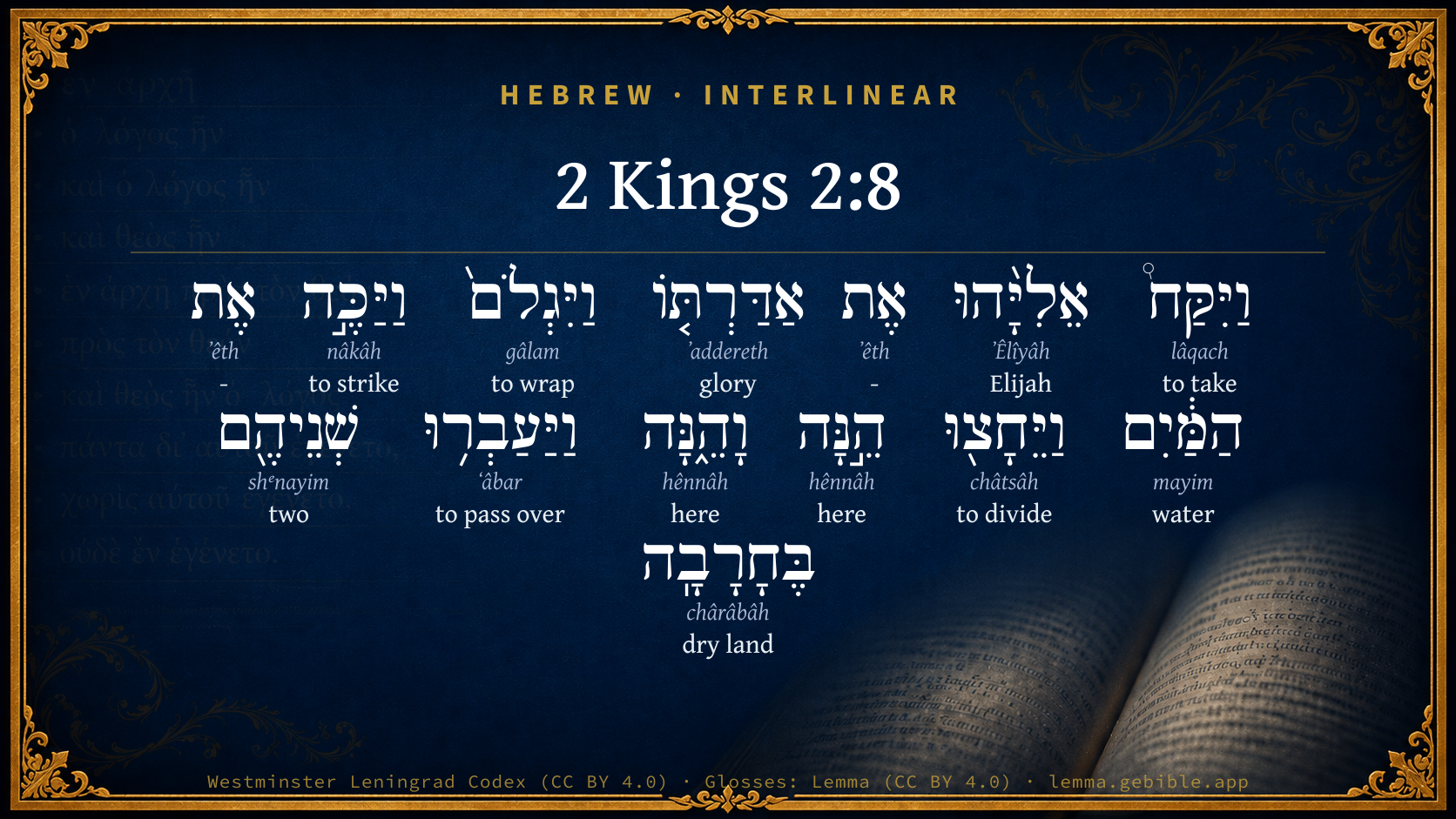
Hebrew (Westminster Leningrad Codex) 2 Kings 2:8 appears in the Hebrew Old Testament. The text above is from the Westminster Leningrad Codex. Each word links to its Strong’s number, a concise gloss, and parsing drawn from the Open Scriptures Hebrew Bible morphology. Click any word for its full Brown-Driver-Briggs (BDB) entry.
Download image
Cite this verse

2 Kings 2:8 (World English Bible). Public Domain. Lemma interlinear Bible study tool, https://lemma.gebible.app/v/2-kings/2/8.

Show BibTeX & RIS
BibTeX
RIS
English Translation
Elijah took his mantle, and wrapped it together, and struck the waters, and they were divided here and there, so that they two went over on dry ground.
World English Bible · Public Domain
Highlights
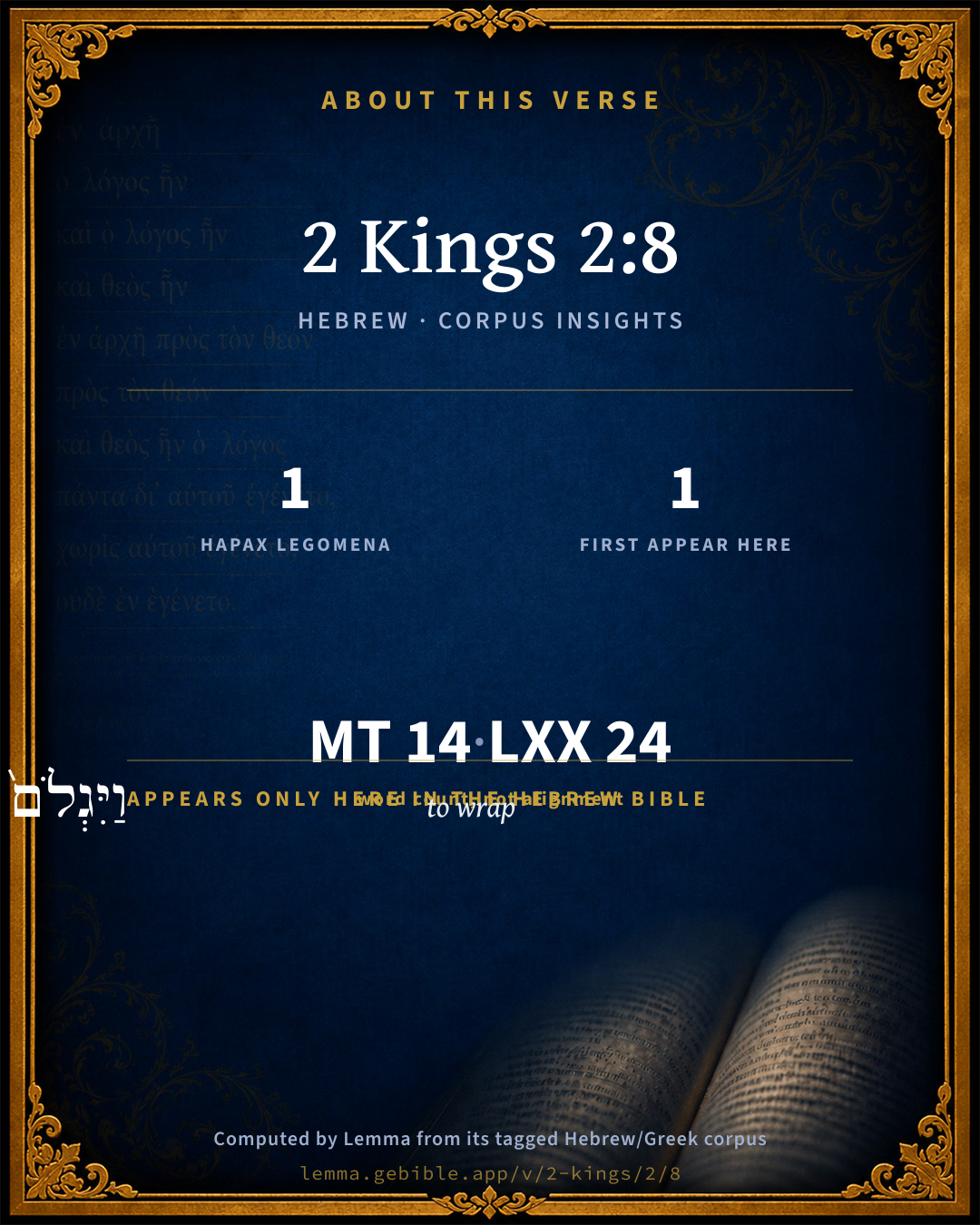
  • 1 hapax legomenon — only here in the Hebrew Bible
  • 1 first appearance in the Hebrew Bible
Full analysis ↓
Download a study sheet

One document with this verse’s original text, its word-by-word gloss line, the meaning frame, cross-references with their text, attributed commentary, and full source and license credits — printable, and it pastes into notes with its structure intact.

This verse Autodidact and up

Study sheet (.html) Plain text (.txt)

A passage Seminary Student

Up to 50 verses in one chapter. A passage sheet keeps up to 6 commentary sources and 12 cross-references per verse, in the order this page ranks them, and says so on the sheet whenever that leaves anything out. Ask for a single verse and you get the Autodidact verse sheet above.

Everything on this page stays free to read, with no account — the sheet is a download of what is already on screen, not access to it.

Want to remove ads? Support Godless Engineer
Compare translations 3

The same verse in 3 English versions, stacked beneath the original-language interlinear above. Click any original word for its lexicon entry.

Each is an independent rendering of the whole verse — the interlinear is not word-aligned to these translations.

Highlighted words mark where these versions differ — a whole-verse word diff, not a word-by-word alignment.

  • World English Bible Public Domain
    Elijah took his mantle, and wrapped it together, and struck the waters, and they were divided here and there, so that they two went over on dry ground.
  • King James Version Public Domain
    And Elijah took his mantle, and wrapped it together, and smote the waters, and they were divided hither and thither, so that they two went over on dry ground.
  • unfoldingWord Literal Text CC BY-SA 4.0
    And Elijah took his cloak and rolled up, and he struck the waters, and they were divided, here and here. And the two of them crossed over on dry ground.

unfoldingWord Literal Text — © unfoldingWord, licensed CC BY-SA 4.0. Word-aligned USFM3 via Door43 (git.door43.org/unfoldingWord/en_ult).

Versions to compare (up to 4)

3 of 4 selected

Show all 18 translations

Every available English version of this verse, each an independent rendering of the whole verse.

  • World English Bible Public Domain
    Elijah took his mantle, and wrapped it together, and struck the waters, and they were divided here and there, so that they two went over on dry ground.
  • Berean Standard Bible Public Domain
    And Elijah took his cloak, rolled it up, and struck the waters, which parted to the right and to the left, so that the two of them crossed over on dry ground.
  • Majority Standard Bible Public Domain
    And Elijah took his cloak, rolled it up, and struck the waters, which parted to the right and to the left, so that the two of them crossed over on dry ground.
  • King James Version Public Domain
    And Elijah took his mantle, and wrapped it together, and smote the waters, and they were divided hither and thither, so that they two went over on dry ground.
  • American Standard Version (1901) Public Domain
    And Elijah took his mantle, and wrapped it together, and smote the waters, and they were divided hither and thither, so that they two went over on dry ground.
  • Revised Version (1885) Public Domain
    And Elijah took his mantle, and wrapped it together, and smote me waters, and they were divided hither and thither, so that they two went over on dry ground.
  • Geneva Bible (1599) Public Domain
    Then Eliiah tooke his cloke, and wrapt it together, and smote the waters, and they were deuided hither and thither, and they twaine went ouer on the dry lande.
  • Douay-Rheims (1899) Public Domain
    And Elias took his mantle and folded it together, and struck the waters, and they were divided hither and thither, and they both passed over on dry ground.
  • Young's Literal Translation Public Domain
    And Elijah taketh his robe, and wrappeth `it' together, and smiteth the waters, and they are halved, hither and thither, and they pass over both of them on dry land.
  • Literal Standard Version CC BY-SA 4.0
    And Elijah takes his robe, and wraps [it] together, and strikes the waters, and they are halved, here and there, and both of them pass over on dry land.
  • Unlocked Literal Bible CC BY-SA 4.0
    Elijah took his cloak, rolled it up, and struck the water with it. The river divided on both sides so that the two of them walked over on dry ground.
  • unfoldingWord Literal Text CC BY-SA 4.0
    And Elijah took his cloak and rolled up, and he struck the waters, and they were divided, here and here. And the two of them crossed over on dry ground.
  • Darby Bible Public Domain
    And Elijah took his mantle, and wrapped it together, and smote the waters, and they were divided hither and thither; and they two went over on dry ground.
  • World Messianic Bible Public Domain
    Elijah took his mantle, and rolled it up, and struck the waters; and they were divided here and there, so that they both went over on dry ground.
  • Webster's Bible Public Domain
    And Elijah took his mantle, and wrapped it together, and smote the waters, and they were divided hither and thither, so that they two went over on dry ground.
  • Free Bible Version CC BY-SA 4.0
    Elijah took his cloak, rolled it up, and hit the water. It divided to the one side and to the other and both of them crossed over on dry ground.
  • Bible in Basic English Public Domain
    Then Elijah took off his robe, and, rolling it up, gave the water a blow with it, and the waters were parted, flowing back this way and that, so that they went over on dry land.
  • JPS Tanakh (1917) Public Domain
    And Elijah took his mantle, and wrapped it together, and smote the waters, and they were divided hither and thither, so that they two went over on dry ground.

Literal Standard Version (2020), Covenant Press — licensed CC BY-SA 4.0. Text via the HelloAO Bible API (eBible.org). Unlocked Literal Bible (unfoldingWord) — licensed CC BY-SA 4.0. Text via the HelloAO Bible API (eBible.org). unfoldingWord Literal Text — © unfoldingWord, licensed CC BY-SA 4.0. Word-aligned USFM3 via Door43 (git.door43.org/unfoldingWord/en_ult). Free Bible Version, Dr. Jonathan Gallagher — licensed CC BY-SA 4.0. Text via the HelloAO Bible API (eBible.org).

Word by word

More ways to search: Search by grammar → Find every occurrence → Compare this word →

Practice this passage: Drill this verse → Learn its vocabulary →

וַיִּגְלֹם֙
gâlam
H1563
“and · to wrap”
Conjunction + Verb, Qal, Sequential Imperfect, 3rd Person, Masculine, Singular
Part of Speech
Conjunction + Verb
Stem
Qal
Form
Sequential Imperfect
Person
3rd Person
Gender
Masculine
Number
Singular
Full BDB Definition

Origin: a primitive root

TWOT: 354

(Qal) to wrap up, fold, fold together
  1. וַיִּקַּח֩ lâqach H3947 “and · to take” Conjunction + Verb, Qal, Sequential Imperfect, 3rd Person, Masculine, Singular
  2. אֵלִיָּ֨הוּ ʼÊlîyâh H452 “Elijah” Noun, Proper
  3. אֶת ʼêth H853 “-” Particle, Direct Object
  4. אַדַּרְתּ֤וֹ ʼaddereth H155 “glory · his” Noun, Common, Feminine, Singular, Construct + Suffix, Personal, 3rd Person, Masculine, Singular
  5. וַיַּכֶּ֣ה nâkâh H5221 “and · to strike” Conjunction + Verb, Hiphil, Sequential Imperfect, 3rd Person, Masculine, Singular
  6. אֶת ʼêth H853 “-” Particle, Direct Object
  7. הַמַּ֔יִם mayim H4325 “the · water(s)” Particle, Definite Article + Noun, Common, Masculine, Plural, Absolute
  8. וַיֵּחָצ֖וּ châtsâh H2673 “and · to divide” Conjunction + Verb, Niphal, Sequential Imperfect, 3rd Person, Masculine, Plural
  9. הֵ֣נָּה hênnâh H2008 “here” Adverb
  10. וָהֵ֑נָּה hênnâh H2008 “and · here” Conjunction + Adverb
  11. וַיַּעַבְר֥וּ ʻâbar H5674 “and · to pass over” Conjunction + Verb, Qal, Sequential Imperfect, 3rd Person, Masculine, Plural
  12. שְׁנֵיהֶ֖ם shᵉnayim H8147 “two · their” Adjective, Cardinal number, Masculine, Dual, Construct + Suffix, Personal, 3rd Person, Masculine, Plural
  13. בֶּחָרָבָֽה chârâbâh H2724 “in/at the · dry land” Preposition, Determined + Noun, Common, Feminine, Singular, Absolute

About this verse

These counts appear in no published source. They are computed here, from the morphology-tagged text and Lemma’s own curated glosses. What Lemma adds →

14
words
12
distinct lemmas
Historical
section

Notable vocabulary

1 hapax legomenon — a word that appears only here in the entire Hebrew Bible:

  • וַיִּגְלֹם֙ to wrap H1563

First appearance in Scripture

This word makes its first canonical appearance in the Hebrew Bible here:

  • וַיִּגְלֹם֙ to wrap H1563

Shared distinctive vocabulary

בֶּחָרָבָֽה dry land H2724 occurs in 7 verses of the Hebrew Bible. Also found in:

Grammatical profile

  • 5 verbs
  • 4 nouns
  • 1 adjective
  • 2 adverbs
  • 2 particles

Verb forms

  • וַיִּקַּח֩ Qal · Sequential Imperfect
  • וַיִּגְלֹם֙ Qal · Sequential Imperfect
  • וַיַּכֶּ֣ה Hiphil · Sequential Imperfect
  • וַיֵּחָצ֖וּ Niphal · Sequential Imperfect
  • וַיַּעַבְר֥וּ Qal · Sequential Imperfect

Repetition

A word recurs within this verse — often emphatic in Hebrew:

  • הֵ֣נָּה here H2008 ×2

Hebrew & Septuagint length

In English translation the verse runs 28 words from the Hebrew and 33 from the Septuagint (LXX English) — closely comparable.

A rough comparison of the two English renderings, which tokenize alike — not a word-level alignment.

Word counts can differ between the Hebrew and the Greek without any difference in meaning — e.g. the Hebrew direct-object marker אֵת has no separate Greek word, and Greek often adds the article ὁ.

In the original languages it is 14 Hebrew tokens and 24 Greek tokens — but the two are counted differently (Hebrew bundles its prefixes and suffixes into one token; the Greek is in lemma form), so that isn’t a like-for-like length.

Cross-references

9

Topical passages linked to 2 Kings 2:8 in the Treasury of Scripture Knowledge — connected by theme and wording, ordered by reader-vote popularity; previews shown in the World English Bible.

  • 1 Kings 19:19 So he departed there, and found Elisha the son of Shaphat, who was plowing, with twelve yoke [of oxen] before him, and he with the twelfth: and Elijah passed over to him, and cast his mantle on him.
  • Exodus 14:21–22 Moses stretched out his hand over the sea, and Yahweh caused the sea to go back by a strong east wind all the night, and made the sea dry land, and the waters were divided.
  • Joshua 3:14–17 It happened, when the people removed from their tents, to pass over the Jordan, the priests who bore the ark of the covenant being before the people;
  • 2 Kings 2:14 He took the mantle of Elijah that fell from him, and struck the waters, and said, Where is Yahweh, the God of Elijah? and when he also had struck the waters, they were divided here and there; and Elisha went over.
  • 1 Kings 19:13 It was so, when Elijah heard it, that he wrapped his face in his mantle, and went out, and stood in the entrance of the cave. Behold, there came a voice to him, and said, What are you doing here, Elijah?
  • Psalms 114:5–7 What was it, you sea, that you fled? You Jordan, that you turned back?
  • Isaiah 11:15 Yahweh will utterly destroy the tongue of the Egyptian sea; and with his scorching wind will he wave his hand over the River, and will strike it into seven streams, and cause men to march over in sandals.
  • Hebrews 11:29 By faith, they passed through the Red sea as on dry land. When the Egyptians tried to do so, they were swallowed up.
  • Revelation 16:12 The sixth poured out his bowl on the great river, the Euphrates. Its water was dried up, that the way might be made ready for the kings that come from the sunrise.

Cross-references courtesy of OpenBible.info (CC BY 4.0).

Hebrew and Greek witnesses Masoretic Hebrew ↔ Greek Septuagint

The same verse in the two great witnesses to the Old Testament, shown verse-for-verse.

These are two independent witnesses, not word-aligned to each other, and the Septuagint is shown in lemma (dictionary) form.

Hebrew 2 Kings 2:8 Masoretic · Westminster Leningrad Codex

וַיִּקַּח֩ אֵלִיָּ֨הוּ אֶת אַדַּרְתּ֤וֹ וַיִּגְלֹם֙ וַיַּכֶּ֣ה אֶת הַמַּ֔יִם וַיֵּחָצ֖וּ הֵ֣נָּה וָהֵ֑נָּה וַיַּעַבְר֥וּ שְׁנֵיהֶ֖ם בֶּחָרָבָֽה

Elijah took his mantle, and wrapped it together, and struck the waters, and they were divided here and there, so that they two went over on dry ground.

World English Bible · Public Domain

Greek LXX 2 Kings 2:8 Septuagint · lemma form

καί λαμβάνω ηλιου ὁ μηλωτή αὐτός καί εἱλέω καί πατάσσω ὁ ὕδωρ καί διααἱρέω ὁ ὕδωρ ἔνθα καί ἔνθα καί διαβαίνω ἀμφότεροι ἐν ἔρημος

And Eliu took his mantle, and wrapped it together, and struck the water: and the water was divided on this side and on that side, and they both went over on dry ground.

LXX2012 (modern English Septuagint) · Public Domain

On this verse, Adam Clarke's Commentary discusses the Septuagint’s reading. Read the note in Commentary ↓

Hebrew: Westminster Leningrad Codex (CC BY 4.0). Greek: Septuagint (public domain); English from LXX2012 (modern English Septuagint) (Public Domain). How the Septuagint differs from the Hebrew →

Targum (Aramaic paraphrase)

1

The Targum is the ancient Jewish Aramaic paraphrase of the Hebrew Scriptures — an interpretive translation, not the Hebrew text itself. Onkelos (literal) and Pseudo-Jonathan (expansive) render the Torah, and Jonathan the Prophets. Coverage is partial: where no permissively-licensed English translation exists for a verse, only the Aramaic is shown. This is verse-level text, not a word-by-word alignment to the Hebrew.

  1. Targum Jonathan Prophets (Joshua–Malachi)
    וּנְסִיב אֵלִיָהוּ יַת שׁוֹשִׁיפֵיהּ וְאַחְזַר וּמְחָא יַת מַיָא וְאִתְפְּלִיגוּ לְכָא וּלְכָא וַעֲבָרוּ תַרְוֵיהוֹן בְּיַבֶּשְׁתָּא:

    (no public-domain English translation for this verse)

    Targum Jonathan — Aramaic: “Mikraot Gedolot” (public domain). English: “Sefaria Community Translation” (CC0 1.0 (public-domain dedication)); “London "Chaldee Paraphrase," 1871” (public domain). Text via Sefaria.

Commentary

Notes on 2 Kings 2:8 from classic Christian and Jewish commentators (each source and its license shown beneath its notes). The classic Christian expositions comment on the surrounding passage and are grouped to its opening verse, so a note may address several verses; the Jewish commentaries on the Tanakh (Rashi and others) are per-verse, so they appear only where the commentator wrote on this verse.

Lemma curates 59 commentaries, every one of them public domain or Creative Commons licensed, each selected and text-cleaned for this edition rather than reprinted as found. About our sources →

Trapp's Complete Commentary

John Trapp

2Ki 2:8 And Elijah took his mantle, and wrapped [it] together, and smote the waters, and they were divided hither and thither, so that they two went over on dry ground.

Ver. 8. And smote the waters, and they were divided.] Elijah was a great wonder worker: and this is reckoned by some, his seventh, by others his eleventh miracle.

John Trapp, A Commentary or Exposition upon All the Books of the Old and New Testament (1647–1656) — public domain. Text from a community e-Sword module.

Joseph Benson's Commentary

2Ki 2:8. And smote the waters — These waters of old yielded to the ark, now to the prophet’s mantle; which to those that wanted the ark, was an equivalent token of God’s presence. When God will take his children to himself, death is the Jordan which they must pass through. And they find a way through it, a safe and comfortable way. The death of Christ has divided those waters, that the ransomed of the Lord may pass over.

Joseph Benson's Commentary on the Old and New Testaments (1811–1818) — public domain. Text from a community e-Sword module.

Tyndale Open Study Notes

Tyndale Open Resources

2:8 Elijah folded his cloak together and struck the water with it: Such symbolic actions visually represented God’s power (see Exod 14:16, 21, 26-27; 17:8-13; 1 Kgs 11:30-31; Ezek 4; 5:1-4).

Tyndale Open Study Notes — © Tyndale Open Resources, licensed CC BY-SA 4.0. Text via the HelloAO Bible API.

Geneva Bible (1599)

Geneva Bible translators

To wit, of Jordan.

Geneva Bible (1599) marginal notes — public domain. Text via Bolls.life.

Jamieson, Fausset & Brown

Robert Jamieson, A. R. Fausset & David Brown

Elijah took his mantle, and wrapped it together, and smote the waters--Like the rod of Moses, it had the divinely operating power of the Spirit.

Jamieson, Fausset & Brown — Commentary Critical and Explanatory on the Whole Bible (1871) — public domain (CC PDM 1.0). Text via the HelloAO Bible API.

Adam Clarke's Commentary

Verse 8. Took his mantle] την μηλωτην αυτου, his sheep-skin, says the Septuagint. The skins of beasts, dressed with the hair on, were formerly worn by prophets and priests as the simple insignia of their office. As the civil authority was often lodged in the hands of such persons, particularly among the Jews, mantles of this kind were used by kings and high civil officers when they bore no sacred character. The custom continues to the present day; a lamb's skin hood or cloak is the badge which certain graduates in our universities wear; and the royal robes of kings and great officers of state are adorned with the skins of the animal called the ermine.

They were divided hither and thither] This was a most astonishing miracle, and could be performed only by the almighty power of God.

Adam Clarke's Commentary on the Bible (1810–1826) — public domain. Text from a community e-Sword/MySword module.

Ellicott's Commentary for English Readers

(8) His mantle.—The hairy ’addèreth, which characterised him as prophet. Zec_13:4, ’addèreth sç‘âr, “mantle of hair;” Syriac and Arabic, “head-dress” (wrongly).

Wrapped it together.—Rolled it up. Here only. (Comp. “my substance,” or “mass,” Psa_139:16; “blue mantles,” Eze_27:24, from the same root.) LXX., εἵλησεν; Vulg., “involvit;” Syriac, “rolled it up.”

Smote the waters.—A symbolical action like that of Moses smiting the rock, or stretching out his rod over the sea. (Comp. also the use of Elisha’s staff, 2Ki_4:29.) In all these cases the outward and visible sign is made the channel of the invisible and spiritual force of faith.

They were divided hither and thither.—Exo_14:16; Exo_14:21-22; Jos_4:22, seq.

So that.—And.

A Bible Commentary for English Readers, edited by Charles John Ellicott (1878–1897) — public domain. Text from a community e-Sword module.

The Cambridge Bible for Schools and Colleges

gen. ed. J. J. S. Perowne

8. And Elijah took his mantle] In 2Ki_1:8 the mantle was not mentioned, but the word here is the same as in Zec_13:4, so that there can be little doubt that the expression ‘hairy man’ above refers to the garment, and not to the head and beard.

and wrapt it together] Making thus a sort of roll or rod, and reminding us by his action of Moses, who smote with his rod the waters of the Nile (Exo_7:17; Exo_7:20) when they were to be turned into blood.

The Cambridge Bible for Schools and Colleges (gen. ed. J. J. S. Perowne; Cambridge University Press, 1878–1918) — public domain. Text from a community e-Sword module.

John Gill's Exposition

And it came to pass, when they were gone over,.... Had got on the other side Jordan:

that Elijah said unto Elisha, ask what I shall do for thee, before I be taken from thee; for, having followed him so closely, he now made no more a secret of his assumption, and having had full trial of his attachment to him, and affection for him:

and Elisha said, I pray thee, let a double portion of thy spirit be upon me; the two parts of the gifts of the spirit he had, that of prophecy, and that of doing miracles, as some think; or two parts out of three of what Elijah was possessed of; or rather double as much, and which he might desire, not from a spirit of vanity and ambition to be greater than his master, but from an eagerness to promote the glory of God, and the interest of religion, to reclaim the Israelites from their idolatry, and establish the true religion, which he might observe Elijah was not able to do with that measure of grace and gifts he had; or however this phrase denotes an abundance, a large portion or measure, as it everywhere does. Many, after Ben Gersom, have thought it refers to the double portion of the firstborn, and that Elisha does not mean a double portion with respect to Elijah, but with respect to the junior prophets, with whom he might be considered as a firstborn, and so desired a double or greater portion than they, and which may be most correct (m); and when he asked this, he did not suppose it was in Elijah's power to give him it, only that he would pray to God, at parting with him, that he would bestow it on him.

(m) See Weemse of the Moral Law, l. 2. c. 7. p. 41.

John Gill's Exposition of the Whole Bible (1746–1763) — public domain (CC PDM 1.0). Text via the HelloAO Bible API.

Albert Barnes' Notes on the Bible

They were divided ... - The attestation to the divine mission of Elijah furnished by this miracle would tend to place him upon a par in the thoughts of men with the two great leaders of the nation named in the marginal references.

Albert Barnes' Notes on the Bible (1834–1885) — public domain. Text from a community e-Sword/MySword module.

Haydock's Catholic Bible Commentary

Mantle. Septuagint Greek: meloten, "sheep skin," (Menochius) such as the prophets wore. The Syriac explains it of an ornament or bandage of the head; others, of a leathren mantle to keep off rain. Ad subitas nunquam scortea diset aquas. (Martial xiv.)

George Leo Haydock (1774–1849), Haydock's Catholic Family Bible and Commentary, 1859 edition — public domain. Excludes Psalms (Douay-Rheims chapter numbering differs from Protestant) and Deuterocanonical books (Catholic canon only).

Whedon's Commentary on the Bible

Daniel D. Whedon

8. His mantle — The shaggy garment that had been so long his prophetical badge.

Wrapped it together — Rolled it up in the form of a twisted cord, or a wonder-working rod.

Smote the waters — As if they were an enemy in his way. Elijah’s mantle was to him at Jordan what the rod of God was to Moses at the Red Sea; (Exo_14:16; Exo_14:21;) and many things in the lives of these two great prophets were strikingly parallel. Bishop Hall beautifully says: “There must be a fit parallel between these two great prophets who should meet Christ on Tabor. Both fasted forty days; both had visions of God in Horeb; both were sent to rebuke kings; both prepared miraculous tables; both opened heaven; both revenged idolatry; both quenched the thirst of Israel; both divided the waters; both of them are forewarned of their departure; the body of Moses is hid; the body of Elijah is translated.”

Daniel D. Whedon (gen. ed.), Commentary on the Old and New Testaments (1874–1909) — public domain. Text from a community e-Sword module.

The Pulpit Commentary

And Elijah took his mantle (the LXX have ton); the sheep-skin cape or capote, which covered his shoulders. And wrapped it together; rather, and rolled it up (eilhse, LXX); so that it resembled in some degree a rod or staff. And with this he smote the waters; consciously imitating the act of Moses when he "stretched out his hand over the Red Sea", (Exo_14:21) and divided its waters asunder.

And they were divided hither and thither, so that they two went over on dry ground. The parallelism with the miraculous acts of Moses and Joshua (Jos_3:13) is obvious, and allowed even by those who viewthe acts themselves as having no historical foundation (Ewald, "History of Israel," vol. 4. p. 111, note, Eng. trans.). It was intended that Israel should regard Elijah and Elisha as a second Moses and Joshua, and should therefore yield them a ready obedience. If miracles are impossible, cadit quaestio; exegesis of Scripture, and even reading of Scripture, may as well be put aside. But if they are possible, and have a place in the Divine economy, here was a worthy occasion for them. The powers of the world were arrayed against the cause of true religion and so against God; the cause was about to lose its great champion and assertor, Elijah; a weaker successor was about to take his place; without some manifest display of supernatural might the cause of religion would evidently have lost ground, perhaps have been ruined altogether. It pleased God, therefore, just at this time, to grant that signs and wonders of an extraordinary character should be done by the hands of his servants Elijah and Elisha, that a halo of mystic glory should encircle them, for the better sustentation of his own cause against his adversaries, for the exaltation and glorification of his faithful ones, and for the confusion and dismay of those who were opposed to them. Now, surely, if ever, was there a dignus vindice nodus, justifying a miraculous interposition.

The Pulpit Commentary (1880–1919), ed. H.D.M. Spence-Jones & Joseph S. Exell — public domain. Text from a community e-Sword module.

John Wesley's Explanatory Notes

Smote the waters - These waters of old yielded to the ark, now to the prophet's mantle; which to those that wanted the ark, was an equivalent token of God's presence. When God will take his children to himself, death is the Jordan, which they must pass through. And they find a way thro' it, a safe and comfortable way. The death of Christ has divided those waters, that the ransomed of the Lord may pass over.

John Wesley, Explanatory Notes Upon the Whole Bible (1754–1765) — public domain. Text via the GEBible commentary corpus.

Keil & Delitzsch

C. F. Keil & F. Delitzsch

When they reached the Jordan, Elijah took his prophet's cloak, rolled it up (גּלם, ἁπ. λεγ. convolvit), and smote the water with it; whereupon the water divided hither and thither, so that they both passed through on dry ground. The cloak, that outward sign of the prophet's office, became the vehicle of the Spirit's power which works unseen, and with which the prophet was inspired. The miracle itself is analogous to the miraculous dividing of the Red Sea by the stretching out of Moses' rod (Exo 14:16, Exo 14:21); but at the same time it is very peculiar, and quite in accordance with the prophetic character of Elijah, Moses, the leader of the people, performed his miracles with his shepherd's crook, Elijah the prophet divided the river with his prophet's mantle.

Keil & Delitzsch — Biblical Commentary on the Old Testament (1861–1891) — public domain (CC PDM 1.0). Text via the HelloAO Bible API. (Old Testament only.)

Rashi

Rabbi Shlomo Yitzchaki (Rashi)

And [he] rolled it up. He rolled it up in order that it would be easy to strike with it.

And [he] rolled it up. Not exactly rolling, but gathering together, which is called cueilir, in O.F.

Rashi on the Tanakh — English translations: “The Judaica Press complete Tanach with Rashi, translated by A. J. Rosenberg” (CC BY 4.0); “Pentateuch with Rashi's commentary by M. Rosenbaum and A.M. Silbermann, 1929-1934” (public domain); “The Metsudah Tanach series, Lakewood, N.J” (CC BY 4.0); and “The Book of Joshua, Metsudah Publications, 1997” (CC BY 4.0). Text via Sefaria.

Lesson kit

Teaching starters — assembled from the data on this page, not authored interpretation. Every prompt links to the verse data it draws on. Edit before teaching.

2 Kings, in the Historical, opens this verse with 14 words (12 distinct Hebrew lemmas). Its most distinctive word is gâlam (“to wrap”). A historical commentator’s framing appears above. Read the whole chapter for the surrounding context.

Discussion questions

  1. What does “to wrap” (gâlam) contribute to the verse as a whole?
  2. This verse holds 1 word here found nowhere else in the Hebrew Bible. What might the rare word draw attention to?
  3. The word “to wrap” first appears here in Scripture. What is being introduced at this debut?
  4. Genesis 7:22 shares the word «dry land» with this verse. How do the two illuminate each other?
  5. “here” occurs 2× in this one verse. What is the effect of the repetition?
  6. The translations on this page render this verse differently — a whole-verse word diff, not a word-by-word alignment. What might account for the different wordings?
  7. The verb «וַיִּקַּח֩» is Qal Sequential Imperfect. How does its form color the action?
  8. Reading how Trapp's Complete Commentary and Joseph Benson's Commentary read this verse, where do the two commentators agree and where do they part?

Things to notice

  • 1 word in this verse appears nowhere else in the Hebrew Bible.
  • 1 word makes its first canonical appearance in Scripture here.
  • This verse counts 14 Hebrew ↔ 24 Greek words.
  • These translations choose different wording for 14 words in this verse.
  • “here” occurs 2× in this single verse.

Reading settings

Reading text

Shown beneath each verse's original-language words.

Old Testament
Old Testament edition

Read the OT as the Masoretic Hebrew (MT) or the Greek Septuagint (LXX).

English shown for the Greek Septuagint (in the Hebrew ↔ Greek comparison).

Comparing translations? Open the Compare panel on any verse page to stack up to four side by side.