
Numbers 6:5

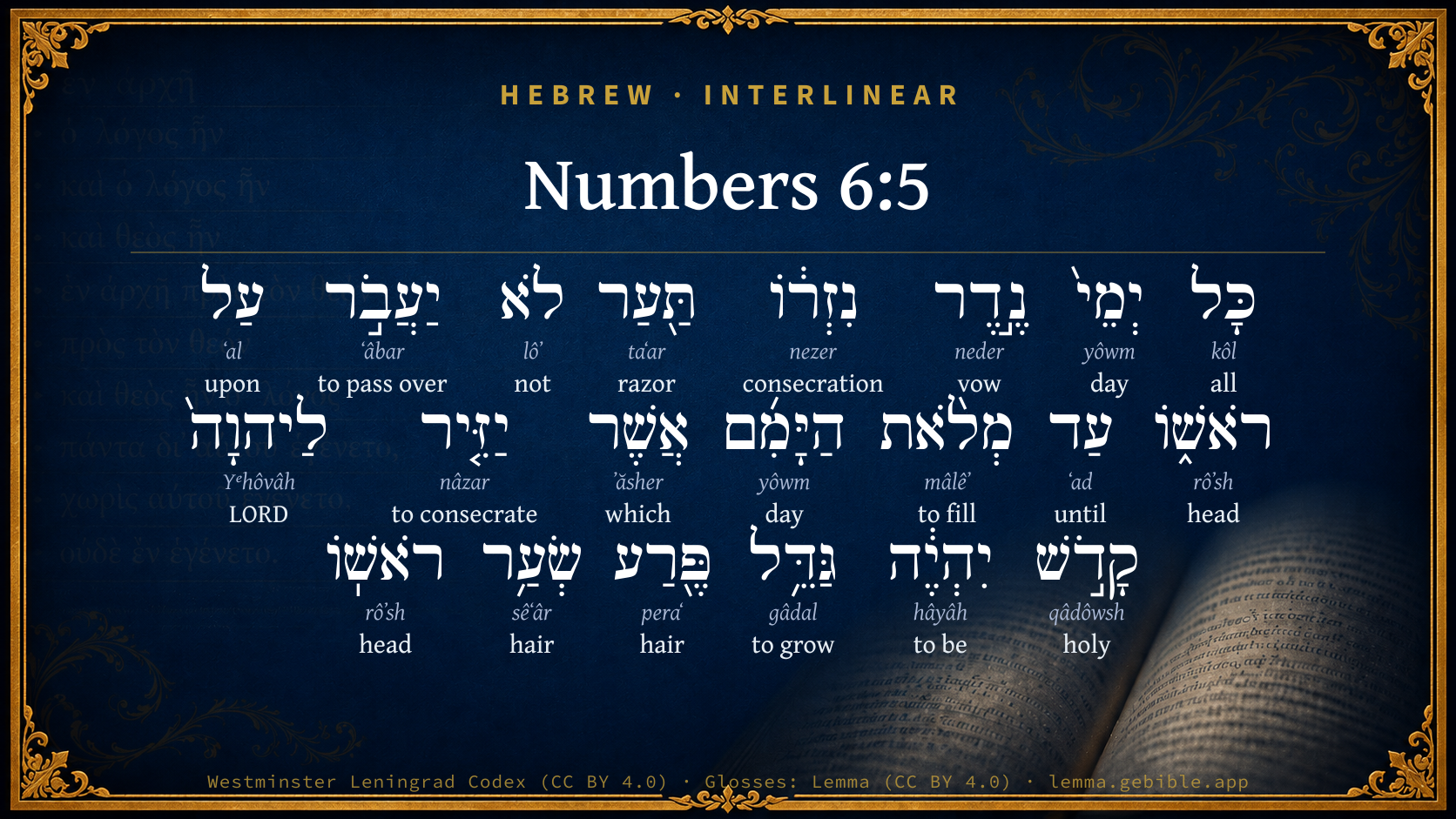
Hebrew (Westminster Leningrad Codex) Numbers 6:5 appears in the Hebrew Old Testament. The text above is from the Westminster Leningrad Codex. Each word links to its Strong’s number, a concise gloss, and parsing drawn from the Open Scriptures Hebrew Bible morphology. Click any word for its full Brown-Driver-Briggs (BDB) entry.
Download image
Cite this verse

Numbers 6:5 (World English Bible). Public Domain. Lemma interlinear Bible study tool, https://lemma.gebible.app/v/numbers/6/5.

Show BibTeX & RIS
BibTeX
RIS
English Translation
"All the days of his vow of separation there shall no razor come on his head, until the days are fulfilled, in which he separates himself to Yahweh. He shall be holy. He shall let the locks of the hair of his head grow long.
World English Bible · Public Domain
Highlights
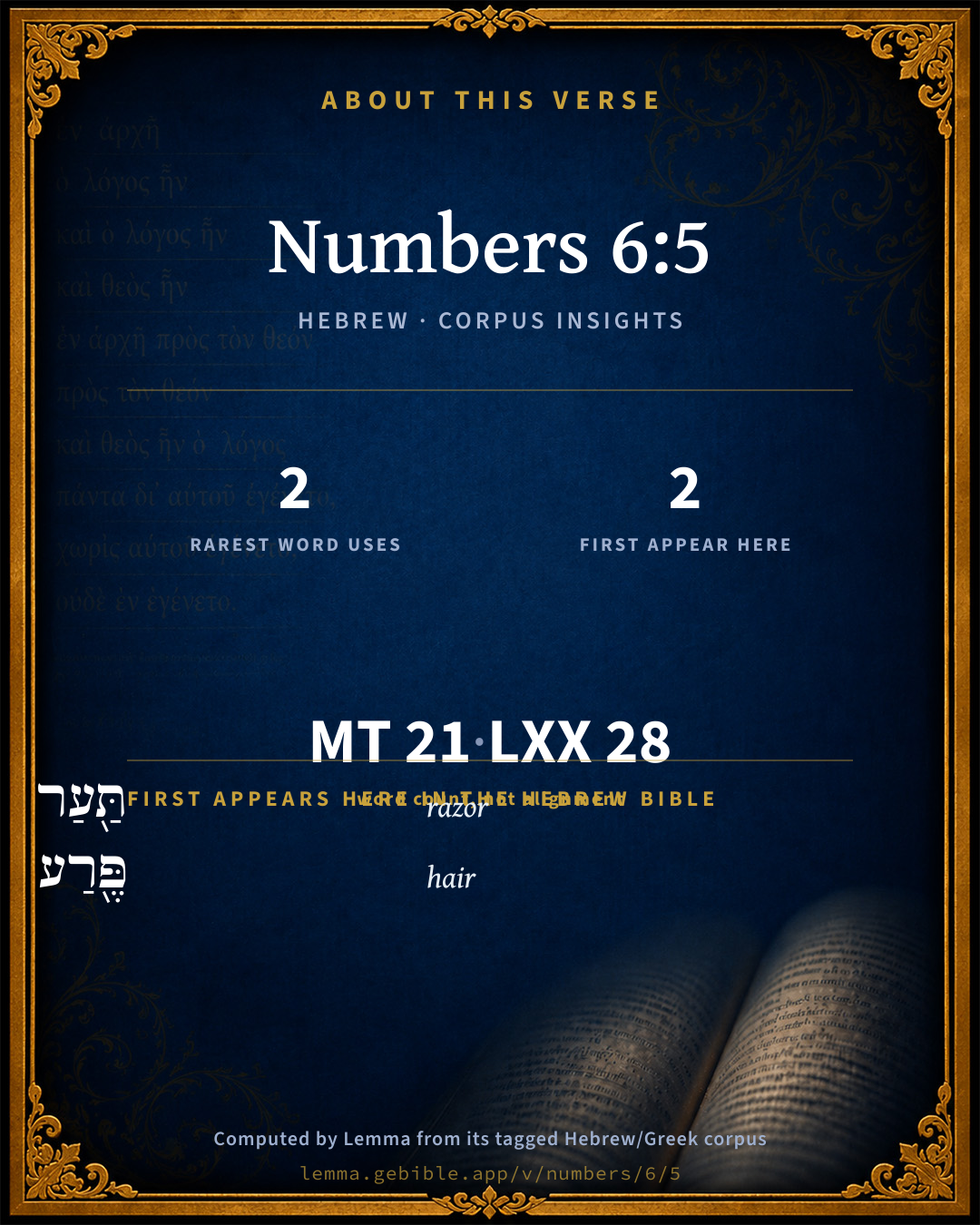
  • 2 first appearances in the Hebrew Bible
Full analysis ↓
Download a study sheet

One document with this verse’s original text, its word-by-word gloss line, the meaning frame, cross-references with their text, attributed commentary, and full source and license credits — printable, and it pastes into notes with its structure intact.

This verse Autodidact and up

Study sheet (.html) Plain text (.txt)

A passage Seminary Student

Up to 50 verses in one chapter. A passage sheet keeps up to 6 commentary sources and 12 cross-references per verse, in the order this page ranks them, and says so on the sheet whenever that leaves anything out. Ask for a single verse and you get the Autodidact verse sheet above.

Everything on this page stays free to read, with no account — the sheet is a download of what is already on screen, not access to it.

Want to remove ads? Support Godless Engineer
Compare translations 3

The same verse in 3 English versions, stacked beneath the original-language interlinear above. Click any original word for its lexicon entry.

Each is an independent rendering of the whole verse — the interlinear is not word-aligned to these translations.

Highlighted words mark where these versions differ — a whole-verse word diff, not a word-by-word alignment.

  • World English Bible Public Domain
    "All the days of his vow of separation there shall no razor come on his head, until the days are fulfilled, in which he separates himself to Yahweh. He shall be holy. He shall let the locks of the hair of his head grow long.
  • King James Version Public Domain
    All the days of the vow of his separation there shall no razor come upon his head: until the days be fulfilled, in the which he separateth himself unto the LORD, he shall be holy, and shall let the locks of the hair of his head grow.
  • unfoldingWord Literal Text CC BY-SA 4.0
    All the days of the vow of his separation, a razor shall not pass over upon his head. Until the fulfilling of the days that he made separate to Yahweh, he shall be holy and shall make great the locks of the hair of his head.

unfoldingWord Literal Text — © unfoldingWord, licensed CC BY-SA 4.0. Word-aligned USFM3 via Door43 (git.door43.org/unfoldingWord/en_ult).

Versions to compare (up to 4)

3 of 4 selected

Show all 18 translations

Every available English version of this verse, each an independent rendering of the whole verse.

  • World English Bible Public Domain
    "All the days of his vow of separation there shall no razor come on his head, until the days are fulfilled, in which he separates himself to Yahweh. He shall be holy. He shall let the locks of the hair of his head grow long.
  • Berean Standard Bible Public Domain
    For the entire period of his vow of separation, no razor shall pass over his head. He must be holy until the time of his separation to the LORD is complete; he must let the hair of his head grow long.
  • Majority Standard Bible Public Domain
    For the entire period of his vow of separation, no razor shall touch his head. He must be holy until the time of his separation to the LORD is complete; he must let the hair of his head grow long.
  • King James Version Public Domain
    All the days of the vow of his separation there shall no razor come upon his head: until the days be fulfilled, in the which he separateth himself unto the LORD, he shall be holy, and shall let the locks of the hair of his head grow.
  • American Standard Version (1901) Public Domain
    All the days of his vow of separation there shall no razor come upon his head: until the days be fulfilled, in which he separateth himself unto Jehovah, he shall be holy; he shall let the locks of the hair of his head grow long.
  • Revised Version (1885) Public Domain
    All the days of his vow of separation there shall no razor come upon his head: until the days be fulfilled, in the which he separateth himself unto the LORD, he shall be holy, he shall let the locks of the hair of his head grow long.
  • Geneva Bible (1599) Public Domain
    While hee is separate by his vowe, the rasor shall not come vpon his head, vntill the dayes be out, in the which he separateth him selfe vnto the Lord, he shalbe holy, and shall let the lockes of the heare of his head growe.
  • Douay-Rheims (1899) Public Domain
    All the time of his separation no razor shall pass over his head, until the day be fulfilled of his consecration to the Lord. He shall be holy, and shall let the hair of his head grow.
  • Young's Literal Translation Public Domain
    `All days of the vow of his separation a razor doth not pass over his head; till the fulness of the days which he doth separate to Jehovah he is holy; grown up hath the upper part of the hair of his head.
  • Literal Standard Version CC BY-SA 4.0
    All [the] days of the vow of his separation a razor does not pass over his head; he is holy until the fullness of the days [in] which he separates himself to YHWH; the upper part of the hair of his head has grown up.
  • Unlocked Literal Bible CC BY-SA 4.0
    During all the time of his vow of separation, no razor is to be used on his head until the days of his separation to Yahweh are fulfilled. He must be set apart to Yahweh. He must let the hair grow long on his head.
  • unfoldingWord Literal Text CC BY-SA 4.0
    All the days of the vow of his separation, a razor shall not pass over upon his head. Until the fulfilling of the days that he made separate to Yahweh, he shall be holy and shall make great the locks of the hair of his head.
  • Darby Bible Public Domain
    All the days of the vow of his separation there shall no razor come upon his head; until the days be fulfilled, that he hath consecrated himself to Jehovah, he shall be holy; he shall let the locks of the hair of his head grow.
  • World Messianic Bible Public Domain
    “‘All the days of his vow of separation no razor shall come on his head, until the days are fulfilled in which he separates himself to the LORD. He shall be holy. He shall let the locks of the hair of his head grow long.
  • Webster's Bible Public Domain
    All the days of the vow of his separation there shall no razor come upon his head: until the days shall be fulfilled, in which he separateth himself to the LORD, he shall be holy, and shall let the locks of the hair of his head grow.
  • Free Bible Version CC BY-SA 4.0
    They must not use a razor on their heads during the whole time of this promise of dedication. They must remain holy until their time of dedication to the Lord is finished. They must let their hair grow long.
  • Bible in Basic English Public Domain
    All the time he is under his oath let no blade come near his head; till the days while he is separate are ended he is holy and his hair may not be cut.
  • JPS Tanakh (1917) Public Domain
    All the days of his vow of Naziriteship there shall no razor come upon his head; until the days be fulfilled, in which he consecrateth himself unto the LORD, he shall be holy, he shall let the locks of the hair of his head grow long.

Literal Standard Version (2020), Covenant Press — licensed CC BY-SA 4.0. Text via the HelloAO Bible API (eBible.org). Unlocked Literal Bible (unfoldingWord) — licensed CC BY-SA 4.0. Text via the HelloAO Bible API (eBible.org). unfoldingWord Literal Text — © unfoldingWord, licensed CC BY-SA 4.0. Word-aligned USFM3 via Door43 (git.door43.org/unfoldingWord/en_ult). Free Bible Version, Dr. Jonathan Gallagher — licensed CC BY-SA 4.0. Text via the HelloAO Bible API (eBible.org).

Word by word

More ways to search: Search by grammar → Find every occurrence → Compare this word →

Practice this passage: Drill this verse → Learn its vocabulary →

פֶּ֖רַע
peraʻ
H6545
“hair of”
Noun, Common, Masculine, Singular, Construct
Part of Speech
Noun
Type
Common
Gender
Masculine
Number
Singular
State
Construct
Full BDB Definition

Origin: from H6544

TWOT: 1823a , 1822a

hair, long hair (of head), locks - leader
  1. כָּל kôl H3605 “all of” Noun, Common, Masculine, Singular, Construct
  2. יְמֵי֙ yôwm H3117 “days of” Noun, Common, Masculine, Plural, Construct
  3. נֶ֣דֶר neder H5088 “vow of” Noun, Common, Masculine, Singular, Construct
  4. נִזְר֔וֹ nezer H5145 “consecration · his” Noun, Common, Masculine, Singular, Construct + Suffix, Personal, 3rd Person, Masculine, Singular
  5. תַּ֖עַר taʻar H8593 “razor” Noun, Common, Both, Singular, Absolute
  6. לֹא lôʼ H3808 “not” Particle, Negative
  7. יַעֲבֹ֣ר ʻâbar H5674 “to pass over” Verb, Qal, Imperfect, 3rd Person, Masculine, Singular
  8. עַל ʻal H5921 “upon” Preposition
  9. רֹאשׁ֑וֹ rôʼsh H7218 “head · his” Noun, Common, Masculine, Singular, Construct + Suffix, Personal, 3rd Person, Masculine, Singular
  10. עַד ʻad H5704 “until” Preposition
  11. מְלֹ֨את mâlêʼ H4390 “to fill” Verb, Qal, Infinitive Construct
  12. הַיָּמִ֜ם yôwm H3117 “the · days” Particle, Definite Article + Noun, Common, Masculine, Plural, Absolute
  13. אֲשֶׁר ʼăsher H834 “which” Particle, Relative
  14. יַזִּ֤יר nâzar H5144 “to consecrate” Verb, Hiphil, Imperfect, 3rd Person, Masculine, Singular
  15. לַיהוָה֙ Yᵉhôvâh H3068 “to/for · LORD” Preposition + Noun, Proper
  16. קָדֹ֣שׁ qâdôwsh H6918 “holy” Adjective, Adjective, Masculine, Singular, Absolute
  17. יִהְיֶ֔ה hâyâh H1961 “to be” Verb, Qal, Imperfect, 3rd Person, Masculine, Singular
  18. גַּדֵּ֥ל gâdal H1431 “to grow” Verb, Piel, Infinitive Construct
  19. שְׂעַ֥ר sêʻâr H8181 “hair of” Noun, Common, Masculine, Singular, Construct
  20. רֹאשֽׁוֹ rôʼsh H7218 “head · his” Noun, Common, Masculine, Singular, Construct + Suffix, Personal, 3rd Person, Masculine, Singular

About this verse

These counts appear in no published source. They are computed here, from the morphology-tagged text and Lemma’s own curated glosses. What Lemma adds →

21
words
19
distinct lemmas
Pentateuch
section

Notable vocabulary

The rarest word here is פֶּ֖רַע hair H6545 — appearing just 2 times in the whole Hebrew Bible.

First appearance in Scripture

These words make their first canonical appearance in the Hebrew Bible here:

  • תַּ֖עַר razor H8593
  • פֶּ֖רַע hair H6545

Shared distinctive vocabulary

פֶּ֖רַע hair H6545 occurs in 2 verses of the Hebrew Bible. Also found in:

Grammatical profile

  • 5 verbs
  • 11 nouns
  • 1 adjective
  • 2 prepositions
  • 2 particles

Verb forms

  • יַעֲבֹ֣ר Qal · Imperfect
  • מְלֹ֨את Qal · Infinitive Construct
  • יַזִּ֤יר Hiphil · Imperfect
  • יִהְיֶ֔ה Qal · Imperfect
  • גַּדֵּ֥ל Piel · Infinitive Construct

Repetition

Words recur within this verse — often emphatic in Hebrew:

  • יְמֵי֙ day H3117 ×2
  • רֹאשׁ֑וֹ head H7218 ×2

Hebrew & Septuagint length

In English translation the verse runs 45 words from the Hebrew and 35 from the Septuagint (LXX English) — closely comparable.

A rough comparison of the two English renderings, which tokenize alike — not a word-level alignment.

Word counts can differ between the Hebrew and the Greek without any difference in meaning — e.g. the Hebrew direct-object marker אֵת has no separate Greek word, and Greek often adds the article ὁ.

In the original languages it is 21 Hebrew tokens and 28 Greek tokens — but the two are counted differently (Hebrew bundles its prefixes and suffixes into one token; the Greek is in lemma form), so that isn’t a like-for-like length.

Cross-references

6

Topical passages linked to Numbers 6:5 in the Treasury of Scripture Knowledge — connected by theme and wording, ordered by reader-vote popularity; previews shown in the World English Bible.

  • 1 Samuel 1:11 She vowed a vow, and said, Yahweh of hosts, if you will indeed look on the affliction of your handmaid, and remember me, and not forget your handmaid, but will give to your handmaid a man-child, then I will give him to Yahweh all the days of his life, and there shall no razor come on his head.
  • Judges 13:5 for, behold, you shall conceive, and bear a son; and no razor shall come on his head; for the child shall be a Nazirite to God from the womb: and he shall begin to save Israel out of the hand of the Philistines.
  • Judges 16:17 He told her all his heart, and said to her, "No razor has ever come on my head; for I have been a Nazirite to God from my mother's womb. If I am shaved, then my strength will go from me, and I will become weak, and be like any other man."
  • Judges 16:19 She made him sleep on her knees; and she called for a man, and shaved off the seven locks of his head; and she began to afflict him, and his strength went from him.
  • Lamentations 4:7–8 Her nobles were purer than snow, they were whiter than milk; They were more ruddy in body than rubies, their polishing was as of sapphire.
  • 1 Corinthians 11:10–15 For this cause the woman ought to have authority on her head, because of the angels.

Cross-references courtesy of OpenBible.info (CC BY 4.0).

Hebrew and Greek witnesses Masoretic Hebrew ↔ Greek Septuagint

The same verse in the two great witnesses to the Old Testament, shown verse-for-verse.

These are two independent witnesses, not word-aligned to each other, and the Septuagint is shown in lemma (dictionary) form.

Hebrew Numbers 6:5 Masoretic · Westminster Leningrad Codex

כָּל יְמֵי֙ נֶ֣דֶר נִזְר֔וֹ תַּ֖עַר לֹא יַעֲבֹ֣ר עַל רֹאשׁ֑וֹ עַד מְלֹ֨את הַיָּמִ֜ם אֲשֶׁר יַזִּ֤יר לַיהוָה֙ קָדֹ֣שׁ יִהְיֶ֔ה גַּדֵּ֥ל פֶּ֖רַע שְׂעַ֥ר רֹאשֽׁוֹ

"All the days of his vow of separation there shall no razor come on his head, until the days are fulfilled, in which he separates himself to Yahweh. He shall be holy. He shall let the locks of the hair of his head grow long.

World English Bible · Public Domain

Greek LXX Numbers 6:5 Septuagint · lemma form

πᾶς ὁ ἡμέρα ὁ εὐχή ὁ ἁγνισμός ξυρόν οὐ ἐπιἔρχομαι ἐπί ὁ κεφαλή αὐτός ἕως ἄν πληρόω ὁ ἡμέρα ὅσος εὔχομαι κύριος ἅγιος εἰμί τρέφω κόμη θρίξ κεφαλή

all the days of his separation:—a razor shall not come upon his head, until the days be fulfilled which he vowed to the Lord: he shall be holy, cherishing the long hair of the head,

LXX2012 (modern English Septuagint) · Public Domain

Hebrew: Westminster Leningrad Codex (CC BY 4.0). Greek: Septuagint (public domain); English from LXX2012 (modern English Septuagint) (Public Domain). How the Septuagint differs from the Hebrew →

Targum (Aramaic paraphrase)

2

The Targum is the ancient Jewish Aramaic paraphrase of the Hebrew Scriptures — an interpretive translation, not the Hebrew text itself. Onkelos (literal) and Pseudo-Jonathan (expansive) render the Torah, and Jonathan the Prophets. Coverage is partial: where no permissively-licensed English translation exists for a verse, only the Aramaic is shown. This is verse-level text, not a word-by-word alignment to the Hebrew.

  1. Targum Onkelos Torah (Genesis–Deuteronomy)
    כָּל יוֹמֵי נְדַר נִזְרֵהּ מַסְפַּר לָא יֶעְבַּר עַל רֵישֵׁהּ עַד מִשְׁלַם יוֹמַיָא דְיַנְזֵר קֳדָם יְיָ קַדִישׁ יְהֵי מַרְבֵּי פֵרוּעַ שְׂעַר רֵישֵׁהּ

    (no public-domain English translation for this verse)

    Targum Onkelos — Aramaic: “Onkelos Genesis” (public domain); “Onkelos Exodus” (public domain); “Onkelos Leviticus” (public domain); “Onkelos Numbers” (public domain); “Onkelos Deuteronomy” (public domain). English: “Sefaria Community Translation” (CC0 1.0 (public-domain dedication)); “J.W. Etheridge. The Targums of Onkelos and Jonathan Ben Uzziel on the Pentateuch. London: Longmans, Green, 1862” (public domain). Text via Sefaria.

  2. Targum Pseudo-Jonathan Torah (Genesis–Deuteronomy)
    כָּל יוֹמֵי נְדַר נִזְרֵיהּ גְלָב לָא יְעִבַּר עַל רֵישֵׁיהּ עַד זְמַן מִשְׁלַם יוֹמַיָא דְיִפְרֵשׁ לִשְׁמָא דַיְיָ קַדִישׁ יְהֵי מַרְבֶּה פֵּרוּעַ שְעַר רֵישֵׁיהּ

    All the days of his nazir-vow the razor shall not pass upon his head until the time when the days of his separation to the Name of the Lord be fulfilled; he shall be consecrate, letting the hair of his head grow.

    Targum Pseudo-Jonathan — Aramaic: “Targum Jonathan on Genesis” (public domain); “Targum Jonathan on Exodus” (public domain); “Targum Jonathan on Leviticus” (public domain); “Targum Jonathan on Numbers” (public domain); “Targum Jonathan on Deuteronomy” (public domain). English: “The Targum of Jonathan ben Uzziel, trans. J. W. Etheridge, London, 1862” (public domain). Text via Sefaria.

Commentary

Notes on Numbers 6:5 from classic Christian and Jewish commentators (each source and its license shown beneath its notes). The classic Christian expositions comment on the surrounding passage and are grouped to its opening verse, so a note may address several verses; the Jewish commentaries on the Tanakh (Rashi and others) are per-verse, so they appear only where the commentator wrote on this verse.

Lemma curates 59 commentaries, every one of them public domain or Creative Commons licensed, each selected and text-cleaned for this edition rather than reprinted as found. About our sources →

Trapp's Complete Commentary

John Trapp

Num 6:5 All the days of the vow of his separation there shall no razor come upon his head: until the days be fulfilled, in the which he separateth [himself] unto the LORD, he shall be holy, [and] shall let the locks of the hair of his head grow.

Ver. 5. There shall no razor.] In opposition to heathens, votaries who nourished their hair to offer to their gods. The popish priests also cut and shave their hair, that they may still look neat and effeminate; which God allowed not in his Nazarites. {Amo 2:11}

John Trapp, A Commentary or Exposition upon All the Books of the Old and New Testament (1647–1656) — public domain. Text from a community e-Sword module.

Joseph Benson's Commentary

Num 6:5. No razor shall come upon his head — Nor scissors, or other instrument, to cut off any part of his hair. This is the second rule he was to observe, and appointed, partly as a sign of his mortification to worldly delights and outward beauty; partly as a testimony of that purity which he professed, because the cutting off the hair was a sign of uncleanness, as appears from Num 6:9; partly that by the length of his hair he might be constantly put in mind of his vow. Holy — That is, wholly consecrated to God and his service, whereby is shown that inward holiness was the great thing which God required and valued in these, and consequently in other rites and ceremonies.

Joseph Benson's Commentary on the Old and New Testaments (1811–1818) — public domain. Text from a community e-Sword module.

Tyndale Open Study Notes

Tyndale Open Resources

6:5 Hair had special symbolic significance (cp. Lev 19:27); religious persons often left their hair uncut or shaved it off entirely (Num 8:5-7). The Israelites were not expected to leave their hair entirely uncut, but the Nazirites were.

Tyndale Open Study Notes — © Tyndale Open Resources, licensed CC BY-SA 4.0. Text via the HelloAO Bible API.

Adam Clarke's Commentary

Verse 5. There shall no razor come upon his head] The vow of the Nazarite consisted in the following particulars: -

1. He consecrated himself in a very especial and extraordinary manner to God.

2. This was to continue for a certain season, probably never less than a whole year, that he might have a full growth of hair to burn in the fire which is under the sacrifice of the peace-offering, Nu 6:18.

3. During the time of his separation, or nazarate, he drank no wine nor strong drink; nor used any vinegar formed from any inebriating liquor, nor ate the flesh or dried grapes, nor tasted even the kernels or husks of any thing that had grown upon the vine.

4. He never shaved his head, but let his hair grow, as the proof of his being in this separated state, and under vows of peculiar austerity.

5. He never touched any dead body, nor did any of the last offices, even to his nearest kin; but was considered as the priests, who were wholly taken up with the service of God, and regarded nothing else.

6. All the days of his separation he was holy, Nu 6:8.

During the whole time he was to be incessantly employed in religious acts.

Adam Clarke's Commentary on the Bible (1810–1826) — public domain. Text from a community e-Sword/MySword module.

Ellicott's Commentary for English Readers

(5) There shall no razor come upon his head.—The hair was to be suffered to grow in all its luxuriance during the days of the Nazirite vow. The meaning may be illustrated by reference to Lev_25:4-5; Lev_25:11, where it is prescribed that in the seventh year the vine was not to be pruned, and that the grapes of “the undressed vine” (literally, the grapes of the Nazirite) should not be gathered.

A Bible Commentary for English Readers, edited by Charles John Ellicott (1878–1897) — public domain. Text from a community e-Sword module.

The Cambridge Bible for Schools and Colleges

gen. ed. J. J. S. Perowne

5. Second regulation. The hair to be left uncut. This is found in every reference to the Nazirites, both in early and late times. Long hair was the visible mark of consecration.

The Cambridge Bible for Schools and Colleges (gen. ed. J. J. S. Perowne; Cambridge University Press, 1878–1918) — public domain. Text from a community e-Sword module.

John Gill's Exposition

All the days of the vow of his separation,.... Be the time he has vowed to be a Nazarite a week, a, month, or more, even a thousand days, but not less than thirty, as Ben Gersom observes:

there shall no razor come upon his head; he might not shave his beard, nor cut off his locks, and shave his head, nor cut short his locks with a pair of scissors, nor any with anything by which the hair may be removed, as Ben Gersom; nor pluck off his hair with his hands, as Maimonides says (x); but let it grow as long as it would during the time of his separation, which is expressed in the latter part of the verse:

until the days be fulfilled, in the which he separateth himself unto the Lord; to his service, to which he wholly addicted himself as long as his vow continued:

he shall be holy; separate from other men, and their practices and customs, and spend his time in holy exercises, in a religious way, and abstain from what might be a temptation to sin, or in the least hinder him in his acts of devotion:

and shall let the locks of his hair grow; two reasons Fagius gives of this part of the law, the one is, because of the mystery of it; letting the hair grow signified an increase of virtue or grace, as Samson's strength was increased and became very great while his hair was not cut; and so spiritual Nazarites, while they are in the way of their duty, grow in grace, and in knowledge of God and Christ, and all divine things, and grow stronger and stronger in the Lord, and in the power of his might; and Ainsworth hints at the same thing, and also supposes it might be an emblem of the subjection of the saints to Christ, as the letting the hair grow was a sign of the woman's subjection to man: the other is, that it was appointed to take the Israelites off of the errors and superstitious they had imbibed in Egypt, by ordering them to perform those rites and ceremonies to the honour of the true God, which they had used in the service of demons; and for this he cites a passage out of Cyrill; but it does not appear, by any good authority, that such a custom obtained among the Egyptians, or any other Gentiles so early; and what were used among them in later times took their rise from hence, and were imitations of this law; though there seems to be no great likeness between this law of Nazariteship and the customs of the Heathens, who used to consecrate their hair to their deities, Apollo, Hercules, Bacchus, Minerva, and Diana: what seems best to agree is what Lucian says (y), who observes, that young men consecrate their beards, and let their hair grow, consecrated from their birth, which they afterwards cut and lay up in vessels in the temple, some of gold, others of silver.

(x) Hilchot Nezirut, c. 5. sect. 11. (y) De Dea Syria.

John Gill's Exposition of the Whole Bible (1746–1763) — public domain (CC PDM 1.0). Text via the HelloAO Bible API.

Haydock's Catholic Bible Commentary

Grow. At the commencement, and at the end of the Nazariteship, the hair was cut; though perhaps a sort of crown was left at the top of the head, as the 7th verse may be rendered, "the crown of his God," &c. (Calmet) --- The Nazarite is under the same regulations with the high priest, with respect to any corpse, ver. 6. (Maimonides; More, p. 3.; Leviticus xxi. 11.) Both were consecrated to God in the most perfect manner. (Menochius) --- When the hair of Samson was cut off, he immediately lost his supernatural strength, Judges xvi.

George Leo Haydock (1774–1849), Haydock's Catholic Family Bible and Commentary, 1859 edition — public domain. Excludes Psalms (Douay-Rheims chapter numbering differs from Protestant) and Deuterocanonical books (Catholic canon only).

Matthew Poole's English Annotations

No razor, nor scissors, or other instrument to cut off any part of his hair. This was appointed, partly, as a sign of his mortification to worldly delights, and vain affectation of outward beauty, which is promoted by the polling or cutting off the hair; partly, as a testimony of that purity which hereby he professed, because the cutting off the hair was a sign of uncleanness, as appears from Num 6:9, and Lev 14:8,9; partly, that by the notorious length of his hair he might be constantly minded of his vow, and the exquisite holiness it required, and that others might thereby be admonished and stirred up to the imitation of his holy example; and partly, that he might reserve his hair entirely for God, to whom it was to be offered, Num 6:18.

He shall be holy, i.e. wholly consecrated to God and his service, whereby lie shows that inward and substantial holiness was the great thing which God required and valued in these, and consequently in other rites and ceremonies.

Matthew Poole's English Annotations on the Holy Bible (1683–1685) — public domain. Text from a community e-Sword/MySword module.

Whedon's Commentary on the Bible

Daniel D. Whedon

5. No razor come upon his head — The unshorn head was not a symbol of holiness among the Hebrews, as Bahr suggests, but simply an ornament in which the whole strength and fulness of life were set forth in honour of Jehovah as a sign of the perfect consecration of all his energies to his service. It was not a sign of perfect liberty, still less of dependence upon some other power, nor of abasement, nor abstinence, nor of renunciation of the world.

Until the days be fulfilled — The law prescribed no period.

Daniel D. Whedon (gen. ed.), Commentary on the Old and New Testaments (1874–1909) — public domain. Text from a community e-Sword module.

The Pulpit Commentary

There shall no razor come upon his head. The meaning of this law is best understood from the case of Samson, whose strength was in his hair, and departed from him when his hair was cut. No doubt that strength was a more or less supernatural gift, and it went and came with his hair according to some supernatural law; but it is clear that the connection was not merely arbitrary, but was founded on some generally received idea. To the Jew, differing in this from the shaven Egyptian and the short-haired Greek, the hair represented the virile powers of the adult, growing with its growth, and failing again with its decay. To use a simple analogy from nature, the uncropped locks of the Nazirite were like the mane of the male lion, a symbol of the fullness of his proper strength and life. (cf. 2Sa_14:25, 2Sa_14:26, and, for the disgrace of baldness, 2Ki_2:23) In later ages Western and Greek feeling on the subject prevailed over Eastern and Jewish, and a "Hebrew of the Hebrews" was able to argue that "even nature itself" teaches us "that if a man have long hair it is a shame unto him". (1Co_11:14) No doubt "nature itself" taught the Greek of Corinth that lesson; but no doubt also "nature itself" taught the Jew of Palestine exactly the opposite lesson; and the Apostle himself did not quite discard the earlier sentiment, for he too made a Nazirite vow, and suffered his hair to grow while it lasted. (Act_21:24) The meaning, therefore, of the law was that the whole fullness of the man"s vitality was to be dedicated without any diminution to the Lord, as typified by the free growth of his hair. It has been conjectured that it was allowed to the Nazirite to "poll" (keirasyai ) his hair during his vow, although not to "shave" it (xurasyai ); and in this way the statement is explained that St. Paul "polled his head" (keiramenov thn , Act_18:18, compared with Act_21:24) in Cenchraea, because he had a vow. It is, however, quite evident that any permission to cut the hair is inconsistent with the whole intention of the commandment; for if a man might "poll his head" when he pleased, he would not be distinguished from other men. If it was allowed in the Apostle"s time, it is only another instance of the way in Which the commandments of God were made of none effect by the traditions of men.

The Pulpit Commentary (1880–1919), ed. H.D.M. Spence-Jones & Joseph S. Exell — public domain. Text from a community e-Sword module.

John Wesley's Explanatory Notes

No razor - Nor scissors, or other instrument to cut off any part of his hair. This was appointed, partly as a sign of his mortification to worldly delights and outward beauty; partly as a testimony of that purity which hereby he professed, because the cutting off the hair was a sign of uncleanness, as appears from ver. 9, partly that by the length of his hair he might be constantly minded of his vow; and partly that he might reserve his hair entirely for God, to whom it was to be offered. Holy - That is, wholly consecrated to God and his service, whereby he shews that inward holiness was the great thing which God required and valued in these, and consequently in other rites and ceremonies.

John Wesley, Explanatory Notes Upon the Whole Bible (1754–1765) — public domain. Text via the GEBible commentary corpus.

unfoldingWord translationNotes

Door43 World Missions Community

vow of separation

This is an idiom. Here "separation" means "dedication" AT: "vow of dedication" (See: Idiom)

no razor is to be used on his head

This can be stated in active form. AT: "no one is to use a razor on his head" (See: Active or Passive)

the days of his separation to Yahweh

The word "separation" is an abstract noun that can be expressed as a verb. Here "separation" is an idiom that means "dedication." AT: "the days that he has separated himself to Yahweh" or "the days that he has dedicated himself to Yahweh" (See: Abstract Nouns and Idiom)

to Yahweh are fulfilled

This can be stated in active form. AT: "to Yahweh are complete" (See: Active or Passive)

He must be set apart to Yahweh

This can be stated in active form. AT: "He must set himself apart to Yahweh" (See: Active or Passive)

translationWords

vow

fulfill

set apart

unfoldingWord translationNotes — © Distant Shores Media and the Door43 World Missions Community, licensed CC BY-SA 4.0. Source: git.door43.org/Door43/en_tn.

Rashi

Rabbi Shlomo Yitzchaki (Rashi)

קדש יהיה means HOLY SHALL IT (not “he”) BE viz., his hair shall be holy. inasmuch as he must let grow freely the hair of his head (lit., so as to let grow the over-growth, פרע, of the hair of his head) (Sifrei Bamidbar 25; Taanit 4a).

פרע — The word פרע is punctuated (as to its first syllable) with Patach-Katan (Segol) because it is in construct state to שער ראשו and the meaning is: the פרע, the wild growth of שער ראשו — The meaning of the word פרע is over-growth of the hair; similar is (Leviticus 21:10) “He shall not let his hair grow wild (יפרע)”. Growth of the hair of less than thirty days’ duration does not come under the term פרע (Sifrei Bamidbar 25; Sanhedrin 22b).

Rashi on the Tanakh — English translations: “The Judaica Press complete Tanach with Rashi, translated by A. J. Rosenberg” (CC BY 4.0); “Pentateuch with Rashi's commentary by M. Rosenbaum and A.M. Silbermann, 1929-1934” (public domain); “The Metsudah Tanach series, Lakewood, N.J” (CC BY 4.0); and “The Book of Joshua, Metsudah Publications, 1997” (CC BY 4.0). Text via Sefaria.

Lesson kit

Teaching starters — assembled from the data on this page, not authored interpretation. Every prompt links to the verse data it draws on. Edit before teaching.

Numbers, in the Pentateuch, opens this verse with 21 words (19 distinct Hebrew lemmas). Its most distinctive word is peraʻ (“hair”). A historical commentator’s framing appears above. Read the whole chapter for the surrounding context.

Discussion questions

  1. The word peraʻ carries the sense “hair.” How does it shape the verse?
  2. 2 words make their first appearance in Scripture here. What does this debut establish?
  3. How does Ezekiel 44:20, which shares the word «hair», read alongside this verse?
  4. What does the repetition of “day” (2× in this one verse) do in this verse?
  5. These translations render this verse differently; the difference is in the English rendering, not the original. What questions does that raise?
  6. «יַעֲבֹ֣ר» is a Qal Imperfect verb. How does that grammatical form shape the action described?
  7. Compare how Trapp's Complete Commentary and Joseph Benson's Commentary read this verse. Where do they agree or differ?

Things to notice

Reading settings

Reading text

Shown beneath each verse's original-language words.

Old Testament
Old Testament edition

Read the OT as the Masoretic Hebrew (MT) or the Greek Septuagint (LXX).

English shown for the Greek Septuagint (in the Hebrew ↔ Greek comparison).

Comparing translations? Open the Compare panel on any verse page to stack up to four side by side.