

Micah 1:11

Hebrew (Westminster Leningrad Codex) Micah 1:11 appears in the Hebrew Old Testament. The text above is from the Westminster Leningrad Codex. Each word links to its Strong’s number, a concise gloss, and parsing drawn from the Open Scriptures Hebrew Bible morphology. Click any word for its full Brown-Driver-Briggs (BDB) entry.
Download image
Cite this verse

Micah 1:11 (World English Bible). Public Domain. Lemma interlinear Bible study tool, https://lemma.gebible.app/v/micah/1/11.

Show BibTeX & RIS
BibTeX
RIS
English Translation
Pass on, inhabitant of Shaphir, in nakedness and shame. The inhabitant of Zaanan won't come out. The wailing of Beth Ezel will take from you his protection.
World English Bible · Public Domain
Highlights
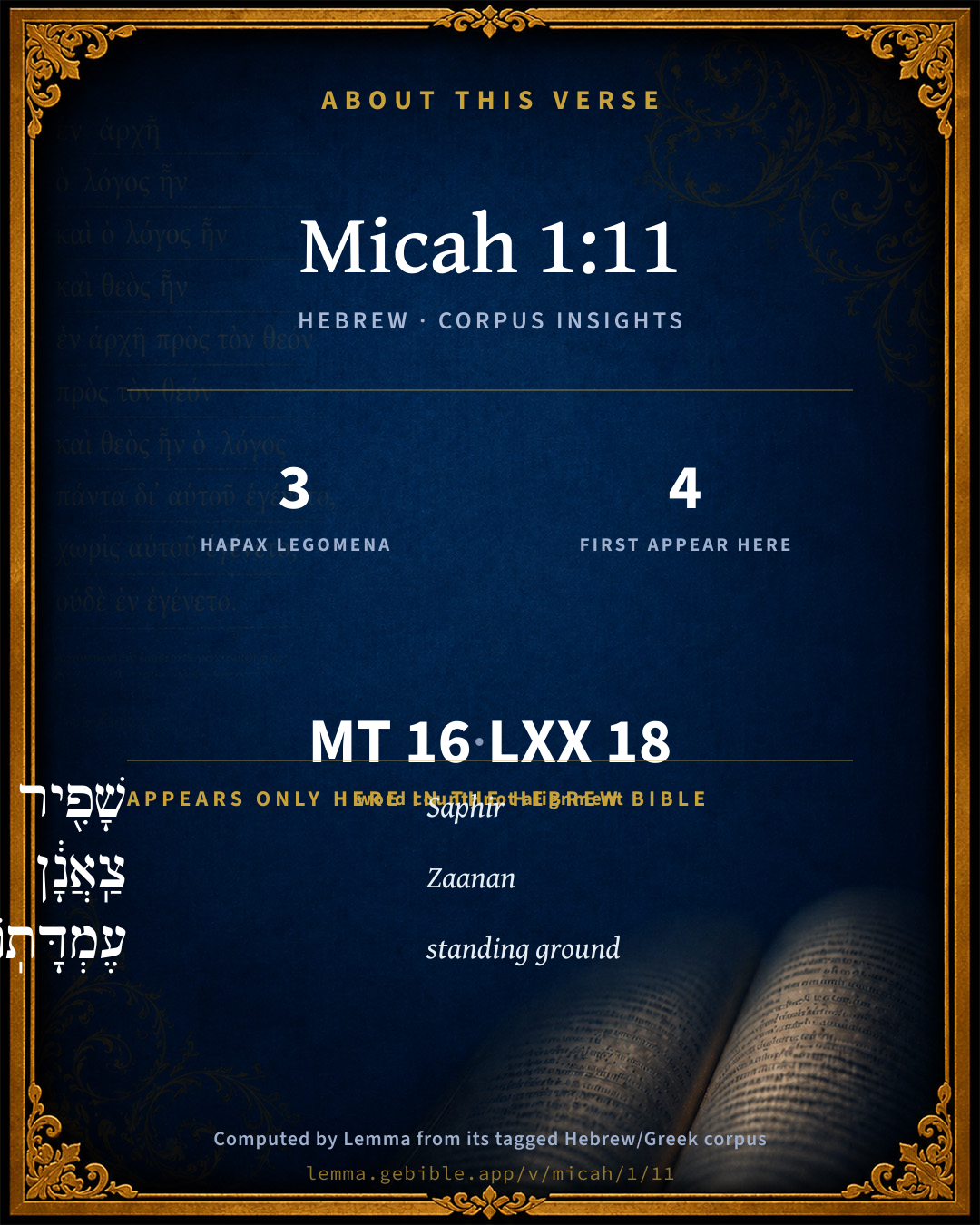
  • 3 hapax legomena — only here in the Hebrew Bible
  • 4 first appearances in the Hebrew Bible
Full analysis ↓
Download a study sheet

One document with this verse’s original text, its word-by-word gloss line, the meaning frame, cross-references with their text, attributed commentary, and full source and license credits — printable, and it pastes into notes with its structure intact.

This verse Autodidact and up

Study sheet (.html) Plain text (.txt)

A passage Seminary Student

Up to 50 verses in one chapter. A passage sheet keeps up to 6 commentary sources and 12 cross-references per verse, in the order this page ranks them, and says so on the sheet whenever that leaves anything out. Ask for a single verse and you get the Autodidact verse sheet above.

Everything on this page stays free to read, with no account — the sheet is a download of what is already on screen, not access to it.

Want to remove ads? Support Godless Engineer
Compare translations 3

The same verse in 3 English versions, stacked beneath the original-language interlinear above. Click any original word for its lexicon entry.

Each is an independent rendering of the whole verse — the interlinear is not word-aligned to these translations.

Highlighted words mark where these versions differ — a whole-verse word diff, not a word-by-word alignment.

  • World English Bible Public Domain
    Pass on, inhabitant of Shaphir, in nakedness and shame. The inhabitant of Zaanan won't come out. The wailing of Beth Ezel will take from you his protection.
  • King James Version Public Domain
    Pass ye away, thou inhabitant of Saphir, having thy shame naked: the inhabitant of Zaanan came not forth in the mourning of Bethezel; he shall receive of you his standing.
  • unfoldingWord Literal Text CC BY-SA 4.0
    Pass on your way, dweller of Shaphir, nakedness of shame. The dweller of Zaanan has not gone out; the mourning of Beth Ezel will take from you its standing place.

unfoldingWord Literal Text — © unfoldingWord, licensed CC BY-SA 4.0. Word-aligned USFM3 via Door43 (git.door43.org/unfoldingWord/en_ult).

Versions to compare (up to 4)

3 of 4 selected

Show all 18 translations

Every available English version of this verse, each an independent rendering of the whole verse.

  • World English Bible Public Domain
    Pass on, inhabitant of Shaphir, in nakedness and shame. The inhabitant of Zaanan won't come out. The wailing of Beth Ezel will take from you his protection.
  • Berean Standard Bible Public Domain
    Depart in shameful nakedness, O dwellers of Shaphir. The dwellers of Zaanan will not come out. Beth-ezel is in mourning; its support is taken from you.
  • Majority Standard Bible Public Domain
    Depart in shameful nakedness, O dwellers of Shaphir. The dwellers of Zaanan will not come out. Beth-ezel is in mourning; its support is taken from you.
  • King James Version Public Domain
    Pass ye away, thou inhabitant of Saphir, having thy shame naked: the inhabitant of Zaanan came not forth in the mourning of Bethezel; he shall receive of you his standing.
  • American Standard Version (1901) Public Domain
    Pass away, O inhabitant of Shaphir, in nakedness and shame: the inhabitant of Zaanan is not come forth; the wailing of Beth-ezel shall take from you the stay thereof.
  • Revised Version (1885) Public Domain
    Pass ye away, O inhabitant of Shaphir, in nakedness and shame: the inhabitant of Zaanan is not come forth; the wailing of Beth-ezel shall take from you the stay thereof.
  • Geneva Bible (1599) Public Domain
    Thou that dwellest at Shaphir, go together naked with shame: she that dwelleth at Zaanan, shall not come forth in ye mourning of Beth-ezel: the enemie shall receiue of you for his standing.
  • Douay-Rheims (1899) Public Domain
    And pass away, O thou that dwellest in the Beautiful place, covered with thy shame: she went not forth that dwelleth in the confines: the House adjoining shall receive mourning from you, which stood by herself.
  • Young's Literal Translation Public Domain
    Pass over for thee, O inhabitant of Shaphir, Naked one of shame. Not gone out hath the inhabitant of Zaanan, The lamentation of Beth-Ezel doth take from you its standing.
  • Literal Standard Version CC BY-SA 4.0
    Pass over for you, O inhabitant of Shaphir, || Naked one of shame. The inhabitant of Zaanan has not gone out, || The lamentation of Beth-Ezel takes from you its standing.
  • Unlocked Literal Bible CC BY-SA 4.0
    Pass by, inhabitants of Shaphir, in nakedness and shame. The inhabitants of Zaanan do not come out. Beth Ezel mourns, for their protection is taken away.
  • unfoldingWord Literal Text CC BY-SA 4.0
    Pass on your way, dweller of Shaphir, nakedness of shame. The dweller of Zaanan has not gone out; the mourning of Beth Ezel will take from you its standing place.
  • Darby Bible Public Domain
    Pass away, inhabitress of Shaphir, in nakedness [and] shame. The inhabitress of Zaanan is not come forth for the lamentation of Beth-ezel: he will take from you its shelter.
  • World Messianic Bible Public Domain
    Pass on, inhabitant of Shaphir, in nakedness and shame. The inhabitant of Zaanan won’t come out. The wailing of Beth Ezel will take from you his protection.
  • Webster's Bible Public Domain
    Pass ye away, thou inhabitant of Saphir, having thy shame exposed: the inhabitant of Zaanan came not forth in the mourning of Beth-ezel; he shall receive from you his standing.
  • Free Bible Version CC BY-SA 4.0
    Leave, people of Shaphir, naked and ashamed. People of Zanaan don't come out. People of Beth Ezel mourn, for you have lost your support.
  • Bible in Basic English Public Domain
    Be uncovered and go away, you who are living in Shaphir: the one living in Zaanan has not come out of her town; Beth-ezel is taken away from its base, even from its resting-place.
  • JPS Tanakh (1917) Public Domain
    Pass ye away, O inhabitant of Saphir, in nakedness and shame; the inhabitant of Zaanan is not come forth; the wailing of Beth-ezel shall take from you the standing-place thereof.

Literal Standard Version (2020), Covenant Press — licensed CC BY-SA 4.0. Text via the HelloAO Bible API (eBible.org). Unlocked Literal Bible (unfoldingWord) — licensed CC BY-SA 4.0. Text via the HelloAO Bible API (eBible.org). unfoldingWord Literal Text — © unfoldingWord, licensed CC BY-SA 4.0. Word-aligned USFM3 via Door43 (git.door43.org/unfoldingWord/en_ult). Free Bible Version, Dr. Jonathan Gallagher — licensed CC BY-SA 4.0. Text via the HelloAO Bible API (eBible.org).

Word by word

More ways to search: Search by grammar → Find every occurrence → Compare this word →

Practice this passage: Drill this verse → Learn its vocabulary →

שָׁפִ֖יר
Shâphîyr
H8208
“Saphir”
Noun, Proper
Part of Speech
Noun
Type
Proper
Full BDB Definition

Origin: from H8231

TWOT: None

Saphir = "fair" - a place in Judah; site unknown
  1. עִבְרִ֥י ʻâbar H5674 “pass over” Verb, Qal, Imperative, 2nd Person, Feminine, Singular
  2. יוֹשֶׁ֥בֶת yâshab H3427 “dwelling” Verb, Qal, Participle Active, Feminine, Singular, Construct
  3. עֶרְיָה ʻeryâh H6181 “nakedness” Noun, Common, Feminine, Singular, Absolute
  4. בֹ֑שֶׁת bôsheth H1322 “shame” Noun, Common, Feminine, Singular, Absolute
  5. לֹ֤א lôʼ H3808 “not” Particle, Negative
  6. יָֽצְאָה֙ yâtsâʼ H3318 “to go out” Verb, Qal, Perfect, 3rd Person, Feminine, Singular
  7. יוֹשֶׁ֣בֶת yâshab H3427 “dwelling” Verb, Qal, Participle Active, Feminine, Singular, Construct
  8. צַֽאֲנָ֔ן Tsaʼănân H6630 “Zaanan” Noun, Proper
  9. מִסְפַּד֙ çâphad H5594 “wailing of” Noun, Common, Masculine, Singular, Construct
  10. בֵּ֣ית Bêyth hâʼêtsel H1018 “Beth-ezel of” Noun, Common, Masculine, Singular, Construct
  11. הָאֵ֔צֶל Bêyth hâʼêtsel H1018 “Beth-ezel” Noun, Proper
  12. יִקַּ֥ח lâqach H3947 “to take” Verb, Qal, Imperfect, 3rd Person, Masculine, Singular
  13. מִכֶּ֖ם min H4480 “from · you” Preposition + Suffix, Personal, 2nd Person, Masculine, Plural
  14. עֶמְדָּתֽוֹ ʻemdâh H5979 “standing ground · his” Noun, Common, Feminine, Singular, Construct + Suffix, Personal, 3rd Person, Masculine, Singular

About this verse

These counts appear in no published source. They are computed here, from the morphology-tagged text and Lemma’s own curated glosses. What Lemma adds →

16
words
13
distinct lemmas
Prophets
section

Notable vocabulary

3 hapax legomena — words that appear only here in the entire Hebrew Bible:

  • שָׁפִ֖יר Saphir H8208
  • צַֽאֲנָ֔ן Zaanan H6630
  • עֶמְדָּתֽוֹ standing ground H5979

First appearance in Scripture

These words make their first canonical appearance in the Hebrew Bible here:

  • שָׁפִ֖יר Saphir H8208
  • צַֽאֲנָ֔ן Zaanan H6630
  • בֵּ֣ית Beth-ezel H1018
  • עֶמְדָּתֽוֹ standing ground H5979

Grammatical profile

  • 5 verbs
  • 8 nouns
  • 2 prepositions
  • 1 particle

Verb forms

  • עִבְרִ֥י Qal · Imperative
  • יוֹשֶׁ֥בֶת Qal · Participle Active
  • יָֽצְאָה֙ Qal · Perfect
  • יוֹשֶׁ֣בֶת Qal · Participle Active
  • יִקַּ֥ח Qal · Imperfect

Repetition

Words recur within this verse — often emphatic in Hebrew:

  • יוֹשֶׁ֥בֶת to dwell H3427 ×2
  • בֵּ֣ית Beth-ezel H1018 ×2

Hebrew & Septuagint length

In English translation the verse runs 27 words from the Hebrew and 28 from the Septuagint (LXX English) — closely comparable.

A rough comparison of the two English renderings, which tokenize alike — not a word-level alignment.

Word counts can differ between the Hebrew and the Greek without any difference in meaning — e.g. the Hebrew direct-object marker אֵת has no separate Greek word, and Greek often adds the article ὁ.

In the original languages it is 16 Hebrew tokens and 18 Greek tokens — but the two are counted differently (Hebrew bundles its prefixes and suffixes into one token; the Greek is in lemma form), so that isn’t a like-for-like length.

Cross-references

10

Topical passages linked to Micah 1:11 in the Treasury of Scripture Knowledge — connected by theme and wording, ordered by reader-vote popularity; previews shown in the World English Bible.

  • Isaiah 20:4 so shall the king of Assyria lead away the captives of Egypt, and the exiles of Ethiopia, young and old, naked and barefoot, and with buttocks uncovered, to the shame of Egypt.
  • Isaiah 16:2 For it shall be that, as wandering birds, as a scattered nest, so shall the daughters of Moab be at the fords of the Arnon.
  • Isaiah 47:2–3 Take the millstones, and grind meal; remove your veil, strip off the train, uncover the leg, pass through the rivers.
  • Jeremiah 13:22 If you say in your heart, Why are these things come on me? for the greatness of your iniquity are your skirts uncovered, and your heels suffer violence.
  • Jeremiah 48:6 Flee, save your lives, and be like the heath in the wilderness.
  • Jeremiah 48:9 Give wings to Moab, that she may fly and get her away: and her cities shall become a desolation, without any to dwell therein.
  • Ezekiel 16:37 therefore see, I will gather all your lovers, with whom you have taken pleasure, and all those who you have loved, with all those who you have hated; I will even gather them against you on every side, and will uncover your nakedness to them, that they may see all your nakedness.
  • Ezekiel 23:29 and they shall deal with you in hatred, and shall take away all your labor, and shall leave you naked and bare; and the nakedness of your prostitution shall be uncovered, both your lewdness and your prostitution.
  • Micah 1:8 For this I will lament and wail; I will go stripped and naked; I will howl like the jackals, And moan like the daughters of owls.
  • Nahum 3:5 "Behold, I am against you," says Yahweh of Hosts, "and I will lift your skirts over your face. I will show the nations your nakedness, and the kingdoms your shame.

Cross-references courtesy of OpenBible.info (CC BY 4.0).

Hebrew and Greek witnesses Masoretic Hebrew ↔ Greek Septuagint

The same verse in the two great witnesses to the Old Testament, shown verse-for-verse.

These are two independent witnesses, not word-aligned to each other, and the Septuagint is shown in lemma (dictionary) form.

Hebrew Micah 1:11 Masoretic · Westminster Leningrad Codex

עִבְרִ֥י לָכֶ֛ם יוֹשֶׁ֥בֶת שָׁפִ֖יר עֶרְיָה בֹ֑שֶׁת לֹ֤א יָֽצְאָה֙ יוֹשֶׁ֣בֶת צַֽאֲנָ֔ן מִסְפַּד֙ בֵּ֣ית הָאֵ֔צֶל יִקַּ֥ח מִכֶּ֖ם עֶמְדָּתֽוֹ

Pass on, inhabitant of Shaphir, in nakedness and shame. The inhabitant of Zaanan won't come out. The wailing of Beth Ezel will take from you his protection.

World English Bible · Public Domain

Greek LXX Micah 1:11 Septuagint · lemma form

καταοἰκέω καλῶς ὁ πόλις αὐτός οὐ ἐκἔρχομαι καταοἰκέω σεννααν κόπτω οἶκος ἔχω αὐτός λαμβάνω ἐκ σύ πληγή ὀδύνη

The inhabitant of Sennaar, fairly inhabiting her cities, came not forth to mourn for the house next to her: she shall receive of you the stroke of grief.

LXX2012 (modern English Septuagint) · Public Domain

On this verse, Keil & Delitzsch discusses the Septuagint’s reading. Read the note in Commentary ↓

Hebrew: Westminster Leningrad Codex (CC BY 4.0). Greek: Septuagint (public domain); English from LXX2012 (modern English Septuagint) (Public Domain). How the Septuagint differs from the Hebrew →

Targum (Aramaic paraphrase)

1

The Targum is the ancient Jewish Aramaic paraphrase of the Hebrew Scriptures — an interpretive translation, not the Hebrew text itself. Onkelos (literal) and Pseudo-Jonathan (expansive) render the Torah, and Jonathan the Prophets. Coverage is partial: where no permissively-licensed English translation exists for a verse, only the Aramaic is shown. This is verse-level text, not a word-by-word alignment to the Hebrew.

  1. Targum Jonathan Prophets (Joshua–Malachi)
    עֲבָרוּ לְכוֹן דְיַתְבִין בְּשָׁפִיר גְלָן עֶרְיָא עַרְטִילָאִין בָחֲתִין לָא יִפְקוּן מְשֵׁיזְבִין יַתְבֵי צַאֲנָן עֱבִידוּ לְכוֹן מִסְפַּד בְּמֶרֶר עַל קְטִילֵי גִבָּרֵיכוֹן בֵּית צוּלָאֵי בָּתֵּי חֶמְדַתְכוֹן דַהֲוֵיתוּן אַנְסִין וּמְקַרְבִין דֵין לִסְטַר דֵין בְּכֵן יִתְנְסֵיב מִנְכוֹן שְׁפַר אַרְעֲכוֹן:

    (no public-domain English translation for this verse)

    Targum Jonathan — Aramaic: “Mikraot Gedolot” (public domain). English: “Sefaria Community Translation” (CC0 1.0 (public-domain dedication)); “London "Chaldee Paraphrase," 1871” (public domain). Text via Sefaria.

Commentary

Notes on Micah 1:11 from classic Christian and Jewish commentators (each source and its license shown beneath its notes). The classic Christian expositions comment on the surrounding passage and are grouped to its opening verse, so a note may address several verses; the Jewish commentaries on the Tanakh (Rashi and others) are per-verse, so they appear only where the commentator wrote on this verse.

Lemma curates 59 commentaries, every one of them public domain or Creative Commons licensed, each selected and text-cleaned for this edition rather than reprinted as found. About our sources →

Trapp's Complete Commentary

John Trapp

Mic 1:11 Pass ye away, thou inhabitant of Saphir, having thy shame naked: the inhabitant of Zaanan came not forth in the mourning of Bethezel; he shall receive of you his standing.

Ver. 11. Pass ye away, thou inhabitant of Saphir] Or, thou that dwellest fairly, as it were in a city set with sapphires, see Isa 54:11, such as was Susa in Persia, and Antioch in Syria, a city so sweet and specious that Mahomet never dared come into it, lest he should be there detained by the pleasure of the place. Saphir here (say some) may allude to Samaria, that instead of her fairness shall be exposed to ignominy and nakedness: they shall be carried away, "young and old, naked and barefoot, even with their buttocks uncovered, to the shame of Samaria," Isa 20:4. So the Pope’s champions dealt by the Waldenses in France, those ancient Protestants. One great city of theirs they took, and put to the sword sixty thousand. To another they gave quarter for life; but so as that both the men and the women should depart stark naked, and show all, partibus illis quae honeste nominari non possunt, sanctorum illorum cruciatorum oculis expositis.

The inhabitant of Zaanan] Loci pecorosi, saith Junius, the country of flocks. Some make it to allude to Zion. Others say it signifieth an outlet; and make it to be as a gate to the kingdom of Judah. These came not forth of their gate in the mourning of Bethezel, or of the place together, to condole with them, as having their hands full at home, and matter enough of mourning for their own misery.

He shall receive of you his standing] The enemy shall stand and stay among you till he hath subdued you, and made a clear conquest; he shall not give you over till he have done the deed.

John Trapp, A Commentary or Exposition upon All the Books of the Old and New Testament (1647–1656) — public domain. Text from a community e-Sword module.

Keil & Delitzsch

C. F. Keil & F. Delitzsch

The penetration of the judgment into Judah is now clearly depicted by an individualizing enumeration of a number of cities which will be smitten by it. Mic 1:10. "Go not to Gath to declare it; weeping, weep not. At Beth-Leafra (dust-home) I have strewed dust upon myself. Mic 1:11. Pass thou away, O inhabitress of Shafir (beautiful city), stripped in shame. The inhabitress of Zaanan (departure) has not departed; the lamentation of Beth-Hazel (near-house) takes from you the standing near it. Mic 1:12. For the inhabitress of Maroth (bitterness) writhes for good; for evil has come down from Jehovah to the gate of Jerusalem." The description commences with words borrowed from David's elegy on the death of Saul and Jonathan (Sa2 1:20), "Publish it not in Gath," in which there is a play upon the words in begath and taggı̄dū. The Philistines are not to hear of the distress of Judah, lest they should rejoice over it. There is also a play upon words in בּכו אל־תּבכּוּ. The sentence belongs to what precedes, and supplies the fuller definition, that they are not to proclaim the calamity in Gath with weeping, i.e., not to weep over it there.

(Note: On the ground of the Septuagint rendering, καὶ οἱ Ἐνακεὶμ μὴ ἀνοικοδομεῖτε, most of the modern expositors follow Reland (Palaest. ill. p. 534ff.) in the opinion that בּכו is the name of a city, a contraction of בּעכּו, "and weep not at Acco." There is no force in the objection brought against this by Caspari (Mich. p. 110), namely, that in that case the inhabitants of both kingdoms must have stood out before the prophet's mind in hemistich a, which, though not rendered actually impossible by Mic 1:9, and the expression על־זאת in Mic 1:8, is hardly reconcilable with the fact that from Mic 1:11 onwards Judah only stands out before his mind, and that in Mic 1:8-10 the distress of his people, in the stricter sense (i.e., of Judah), is obviously the pre-eminent object of his mourning. For Acco would not be taken into consideration as a city of the kingdom of Israel, but as a city inhabited by heathen, since, according to Jdg 1:31, the Canaanites were not driven out of Acco, and it cannot be shown from any passage of the Old Testament that this city ever came into the actual possession of the Israelites. It is evidently a more important objection to the supposed contraction, that not a single analogous case can be pointed out. The forms נשׁקה for נשׁקעה (Amo 8:8) and בּלה for בּעלה (Jos 19:3 and Jos 15:29) are of a different kind; and the blending of the preposition ב with the noun עכּו, by dropping the ע, so as to form one word, is altogether unparalleled. The Septuagint translation furnishes no sufficient authority for such an assumption. All that we can infer from the fact that Eusebius has adopted the reading Ἐναχείμ in his Onom. (ed. Lars. p. 188), observing at the same time that this name occurs in Micah, whilst Aq. and Symm. have ἐν κλαυθμῶ (in fletu) instead, is that these Greek fathers regarded the Ἐναχείμ of the lxx as the name of a place; but this does not in the smallest degree prove the correctness of the lxx rendering. Nor does the position of בּכו before אל furnish any tenable ground for maintaining that this word cannot be the inf. abs. of בּכה, but must contain the name of a place. The assertion of Hitzig, that "if the word were regarded as an inf. abs., neither the inf. itself nor אל for לא would be admissible in a negative sentence (Jer 22:10)," has no grammatical foundation. It is by no means a necessary consequence, that because אל cannot be connected with the inf. abs. (Ewald, 350, a), therefore the inf. abs. could not be written before a finite verb with אל for the sake of emphasis.)

After this reminiscence of the mourning of David for Saul, which expresses the greatness of the grief, and is all the more significant, because in the approaching catastrophe Judah is also to lose its king (cf. Mic 4:9), so that David is to experience the fate of Saul (Hengstenberg), Micah mentions places in which Judah will mourn, or, at any rate, experience something very painful. From Mic 1:10 to Mic 1:15 he mentions ten places, whose names, with a very slight alteration, were adapted for jeux de mots, with which to depict what would happen to them or take place within them. The number ten (the stamp of completeness, pointing to the fact that the judgment would be a complete one, spreading over the whole kingdom) is divided into twice five by the statement, which is repeated in Mic 1:12, that the calamity would come to the fate of Jerusalem; five places being mentioned before Jerusalem (Mic 1:10-12), and five after (Mic 1:13-15). This division makes Hengstenberg's conjecture a very natural one, viz., that the five places mentioned before Jerusalem are to be sought for to the north of Jerusalem, and the others to the south or south-west, and that in this way Micah indicates that the judgment will proceed from the north to the south. On the other hand, Caspari's opinion, that the prophet simply enumerates certain places in the neighbourhood of Moresheth, his own home, rests upon no firm foundation.

בּית לעפרה is probably the Ophrah of Benjamin (עפרה, Jos 18:23), which was situated, according to Eusebius, not far from Bethel (see comm. on Josh. l.c.). It is pointed with pathach here for the sake of the paronomasia with עפר. The chethib התפּלּשׁתּי is the correct reading, the keri התפּלּשׁי being merely an emendation springing out of a misunderstanding of the true meaning. התפּלּשׁ does not mean to revolve, but to bestrew one's self. Bestrewing with dust or ashes was a sign of deep mourning (Jer 6:26; Sa2 13:19). The prophet speaks in the name of the people of what the people will do. The inhabitants of Shafir are to go stripped into captivity. עבר, to pass by, here in the sense of moving forwards. The plural לכם is to be accounted for from the fact that yōshebheth is the population. Shâphı̄r, i.e., beautiful city, is not the same as the Shâmı̄r in Jos 15:48, for this was situated in the south-west of the mountains of Judah; nor the same as the Shâmı̄r in the mountains of Ephraim (Jdg 10:1), which did not belong to the kingdom of Judah; but is a place to the north of Jerusalem, of which nothing further is known. The statement in the Onomast. s.v. Σαφείρ ἐν γῆ ὀρεινῆ between Eleutheropolis and Askalon - is probably intended to apply to the Shâmı̄r of Joshua; but this is evidently erroneous, as the country between Eleutheropolis and Askalon did not belong to the mountains of Judah, but to the Shephelah. עריה־בשׁת, a combination like ענוה־צדק in Psa 45:5, equivalent to stripping which is shame, shame-nakedness = ignominious stripping. עריה is an accusative defining the manner in which they would go out. The next two clauses are difficult to explain. צאנן, a play upon words with יצאה, is traceable to this verb, so far as its meaning is concerned. The primary meaning of the name is uncertain; the more modern commentators combine it with צאן, in the sense of rich in flocks. The situation of Zaanan is quite unknown. The supposed identity with Zenân see at Jos 15:37) must be given up, as Zenân was in the plain, and Zaanan was most probably to the north of Jerusalem. The meaning of the clause can hardly be any other than this, that the population of Zaanan had not gone out of their city to this war from fear of the enemy, but, on the contrary, had fallen back behind their walls (Ros., Casp., Hitzig). בּית האצל is most likely the same as אצל in Zac 14:5, a place in the neighbourhood of Jerusalem, to the east of the Mount of Olives, as Beth is frequently omitted in the names of places (see Ges. Thes. p. 193). Etsel signifies side, and as an adverb or preposition, "by the side of." This meaning comes into consideration there. The thought of the words mispad bēth, etc., might be: "The lamentation of Beth-Haezel will take away its standing (the standing by the side of it, 'etslō) from you (Judaeans), i.e., will not allow you to tarry there as fugitives (cf. Jer 48:45). The distress into which the enemy staying there has plunged Beth-Haezel, will make it impossible for you to stop there" (Hitzig, Caspari). But the next clause, which is connected by כּי, does not suit this explanation (Mic 1:12). The only way in which this clause can be made to follow suitably as an explanation is by taking the words thus: "The lamentation of Beth-Haezel will take its standing (the stopping of the calamity or judgment) from you, i.e., stop near it, as we should expect from its name; for (Mic 1:12) Maroth, which stands further off, will feel pain," etc. With this view, which Caspari also suggests, Hengstenberg (on Zac 14:5) agrees in the main, except that he refers the suffix in עמדּתו to מספּד, and renders the words thus: "The lamentation of Beth-Haezel will take its stopping away from you, i.e., the calamity will not stop at Beth-Haezel (at the near house), i.e., stop near it, as we should expect from its name; for (Mic 1:12) Maroth, which stands further off, will feel pain," etc. With this view, which Caspari also suggests, Hengstenberg (on Zac 14:5) agrees in the main, except that he refers the suffix in עמדתו to מספּד, and renders the words thus: "The lamentation of Beth-Haezel will take its stopping away from you, i.e., will not allow you the stopping of the lamentation." Grammatically considered, this connection is the more natural one; but there is this objection, that it cannot be shown that עמד is used in the sense of the stopping or ceasing of a lamentation, whereas the supposition that the suffix refers to the calamity simply by constructio ad sensum has all the less difficulty, inasmuch as the calamity has already been hinted at in the verb נגע in Mic 1:9, and in Mic 1:10 also it forms the object to be supplied in thought. Maroth (lit., something bitter, bitternesses) is quite unknown; it is simply evident, from the explanatory clause כּי ירד וגו, that it was situated in the immediate neighbourhood of Jerusalem. The inhabitants of Maroth writhe (châlâh, from chūl, to writhe with pain, like a woman in child-birth), because they are also smitten with the calamity, when it comes down to the gate of Jerusalem. לטוב, "on account of the good," which they have lost, or are about to lose.

Keil & Delitzsch — Biblical Commentary on the Old Testament (1861–1891) — public domain (CC PDM 1.0). Text via the HelloAO Bible API. (Old Testament only.)

Tyndale Open Study Notes

Tyndale Open Resources

1:11 Exile was the ultimate, most devastating curse (Deut 4:29; 28:37, 48; Jer 25:7-11).

Tyndale Open Study Notes — © Tyndale Open Resources, licensed CC BY-SA 4.0. Text via the HelloAO Bible API.

Geneva Bible (1599)

Geneva Bible translators

These were cities whereby the enemy should pass as he came to Judah.

He shall not depart before he hath overcome you, and so you shall pay for his tarrying.

Geneva Bible (1599) marginal notes — public domain. Text via Bolls.life.

Jamieson, Fausset & Brown

Robert Jamieson, A. R. Fausset & David Brown

Pass ye away--that is, Thou shall go into captivity.

inhabitant of Saphir--a village amidst the hills of Judah, between Eleutheropolis and Ascalon, called so, from the Hebrew word for "beauty." Though thy name be "beauty," which heretofore was thy characteristic, thou shalt have thy "shame" made "naked." This city shall be dismantled of its walls, which are the garments, as it were, of cities; its citizens also shall be hurried into captivity, with persons exposed (Isa 47:3; Eze 16:37; Hos 2:10).

the inhabitant of Zaanan came not forth--Its inhabitants did not come forth to console the people of Beth-ezel in their mourning, because the calamity was universal; none was exempt from it (compare Jer 6:25). "Zaanan" is the same as Zenan, in Judah (Jos 15:37), meaning the "place of flocks." The form of the name used is made like the Hebrew for "came forth." Though in name seeming to imply that thou dost come forth, thou "camest not forth."

Beth-ezel--perhaps Azal (Zac 14:5), near Jerusalem. It means a "house on the side," or "near." Though so near, as its name implies, to Zaanan, Beth-ezel received no succor or sympathy from Zaanan.

he shall receive of you his standing--"he," that is, the foe; "his standing," that is, his sustenance [PISCATOR]. Or, "he shall be caused a delay by you, Zaanan." He shall be brought to a stand for a time in besieging you; hence it is said just before, "Zaanan came not forth," that is, shut herself up within her walls to withstand a siege. But it was only for a time. She, too, fell like Beth-ezel before her [VATABLUS]. MAURER construes thus: "The inhabitant of Zaanan came not forth; the mourning of Beth-ezel takes away from you her shelter." Though Beth-ezel be at your side (that is, near), according to her name, yet as she also mourns under the oppression of the foe, she cannot give you shelter, or be at your side as a helper (as her name might lead you to expect), if you come forth and be intercepted by him from returning to Zaanan.

Jamieson, Fausset & Brown — Commentary Critical and Explanatory on the Whole Bible (1871) — public domain (CC PDM 1.0). Text via the HelloAO Bible API.

Adam Clarke's Commentary

Verse 11. Inhabitant of Saphir] Sapher, Sepphoris, or Sephora, was the strongest place in Galilee. - Calmet. It was a city in the tribe of Judah, between Eleutheropolis and Ascalon. - Houbigant.

Zaanan] Another city in the tribe of Judah, Jos 15:13.

Beth-ezel] A place near Jerusalem, Zec 14:5. Some think that Jerusalem itself is intended by this word.

Adam Clarke's Commentary on the Bible (1810–1826) — public domain. Text from a community e-Sword/MySword module.

John Calvin's Commentaries

The Prophet here addresses the cities which were on the borders of the kingdom of Israel, and through which the enemy would pass in entering the kingdom of Judah. He therefore bids the inhabitants of the city Saphir to pass over, and says, that the city would be ashamed or in a shameful manner naked. The word שפיר, shaphir, means splendid. He then says, “Thou art now beautiful, but the Lord will discover thy shame, so that thy nakedness shall be a shame to all, and the greatest disgrace to thyself.” There is a correspondence in the words, though not an alliteration. Hence the Prophet says, that though the city was called splendid, it would yet be deformed, so that no one would deign to look on it, at least without feeling shame. There is the same correspondence in the word Zaanan; for צעה, tsoe, means to transfer, as צען, tson, is to migrate. Hence the Prophet says, Go forth shall not the inhabitant of Zaanan for the mourning of Beth-Aezel; that is, he will remain quiet at home: this he will do contrary to what will be natural; for whence is the name of the city? even from removing, for it was a place of much traffic. But he will remain, he says, at home: though he may see his neighbors dragged into exile, he will not dare to move from his place.

He now adds, Take will the enemy from you his station. The verb עמד, omad, means to stand; nor is there a doubt but that when the Prophet says, He will take from you his standing, he speaks of the standing or station of the enemy: but interpreters however vary here. Some understand, that when the enemy had continued long in the land, they would not depart before they possessed the supreme power; as though he said, “Ye will think that your enemy can be wearied out with delay and tediousness, when not able soon to conquer your cities: this, he says, will not be the case; for he will resolutely persevere, and his expectation will not disappoint him; for he will receive the reward of his station, that is, of his delay.” But some say, He will receive his station from you. They explain the verb לקח, lakech, metaphorically, as meaning to receive instruction from hand to hand; as though the Prophet had said, Some, that is, your neighbors, will learn their own position from you. What does this mean? Zaanan will not go forth on account of the mourning of its neighboring city Aezel: others will afterwards follow this example. How so? For Zaanan will be, as it were, the teacher to other cities; as it will not dare to show any sign of grief for its neighbors, being not able to succor them; so also, when it shall be taken in its turn into exile, that is, its citizens and inhabitants, its neighbors will remain quiet, as though the condition of the miserable city was no object of their care. They shall then learn from you their standing; that is, Ye will remain quiet and still, when your neighbors will be destroyed; the same thing will afterwards happen to you. But as this bears but little on the main subjects we may take either of these views. It afterwards follows —

John Calvin's Commentaries (1540-1563) — public domain. Text from the Calvin Translation Society English edition (1840s-50s) via the Christian Classics Ethereal Library (ccel.org). Calvin's coverage is partial (roughly two-thirds of the Bible); uncommented books and verses are honest gaps, never fabricated. The 19th-century editor's footnotes and remarks are omitted so the notes are faithfully Calvin's own voice.

Ellicott's Commentary for English Readers

(11) Saphir . . . Zaanan.—The sites of these cities, like that of Aphrah, are a matter of conjecture. They were probably south-west of Jerusalem, the prophet following the march of the invading army.

The inhabitant of Zaanan came not forth—i.e., they remained in their city through fear of the enemy.

In the mourning of Beth-ezel.—Rather, the wailing of Beth-ezel shall take from you his standing—i.e., no support will be found in the inhabitants of Beth-ezel.

A Bible Commentary for English Readers, edited by Charles John Ellicott (1878–1897) — public domain. Text from a community e-Sword module.

The Cambridge Bible for Schools and Colleges

gen. ed. J. J. S. Perowne

11. inhabitant] The word in the Hebrew is feminine, the population of the city being (as often, e.g. Isa_1:8) personified as a virgin.

Saphir] as if Fair town (a play on the name).

Zaanan] The Zenan of Jos_15:37.

came not forth, &c.] Rather, is not come forth; the mourning of Beth-ezel taketh from you its standing-ground. Zaanan would willingly take to flight, but the sound of the mourning at Beth-ezel (which might mean ‘the house, or place, at one’s side’) fills them with despair. An ‘Azal,’ or rather Azel, is mentioned in Jerusalem in Zec_14:5 (see however on ‘Aphrah,’ Mic_1:10).

The Cambridge Bible for Schools and Colleges (gen. ed. J. J. S. Perowne; Cambridge University Press, 1878–1918) — public domain. Text from a community e-Sword module.

John Gill's Exposition

Pass ye away, thou inhabitant of Saphir,.... A village, according to Eusebius (l), between Eleutheropolis and Ashkelon; perhaps the same with Sephoron; it is mentioned among the cities of Judah, in the Greek version of Jos 15:48. Calmet (m) conjectures the prophet intends the city of Sephoris or Sephora in Galilee. Hillerus (n): takes it to be the same with Parah, mentioned with Ophrah, in Jos 18:23; so called from its ornament, neatness, beauty, and elegance, as both words signify, to which the prophet alludes: now everyone of the inhabitants of this place are called upon to prepare to go into captivity to Babylon; which would certainly be their case, though they dwelled in fine buildings, neat houses, and streets well paved. In the margin it is, "thou that dwellest fairly" (o); which some understand of Samaria; others of Judea; and particularly Jerusalem, beautifully situated, yet should go into captivity:

having thy shame naked; their city dismantled, their houses plundered, and they stripped of their garments, and the shame of their nakedness discovered; which must be the more distressing to beautiful persons, that have dressed neatly, and lived in handsome well built houses, and elegantly furnished, and now all the reverse;

the inhabitant of Zaanan came not forth in the mourning of Bethezel; or house of Azel, where the posterity of Azel, of the tribe of Benjamin, dwelt. Hillerus (p) suspects it to be the same with Mozah, Jos 18:26; so called from Moza, the great grandfather of Azel, Ch1 8:37. Capellus takes it to be the same with Azal in Zac 14:5. This place being taken and plundered by the enemy occasioned great mourning among the inhabitants: and it seems to have been taken first, before Zaanan; perhaps the same with Zenan, Jos 15:37; and is here read "Sennan" by Aquila; the inhabitants of which did not "come forth", in which there is an allusion to its name (q), either to help them in their distress, or to condole them; they being in fear of the enemy themselves, and in arms in their own defence, expecting it would be their turn next, and that they should share the same fate with them. Some think that under the name of Bethezel is meant Bethel; and of Zaanan, Zion; and that the sense is, that when Bethel, Samaria, and the ten tribes, were in distress, they of Zion and Judea did not come to give them any relief; and when they were carried captive did not mourn with them, were not affected with their case, nor troubled themselves about them;

he shall receive of him his standing: either the enemy, as R. Joseph Kimchi, shall receive of the inhabitants of Zaanan his standing; that is, he shall make them dearly pay for stopping him, for making him stand and stay so long before their city before he could take it; for all his loss of time, men, and money, in besieging it; by demolishing their city, plundering their houses, and carrying them captive; who remained he put to death by the sword. Aben Ezra interprets the word "receive" of doctrine or learning, as in Pro 4:2; and renders it, "he shall learn"; either Bethezel, or rather Zaanan, shall learn, by the case of Bethezel, and other neighbouring places, what would be his own case, whether he should stand or fall.

(l) Ad vocem (m) Dictionary, in the word "Saphir". (n) Onomast. Sacr. p. 925. (o) "habitans pulchre", Montanus; "habiatrix elegantis loci", Junius & Tremellius, Piscator. (p) Ibid. p. 516, 951. (q) from Vid. V. L. vers.

John Gill's Exposition of the Whole Bible (1746–1763) — public domain (CC PDM 1.0). Text via the HelloAO Bible API.

Albert Barnes' Notes on the Bible

Pass ye away - (literally, Pass thou (fem.) away to or for yourselves), disregarded by God and despised by man) pass the bounds of your land into captivity.

Thou inhabitant of Shaphir, having thy shame naked - better, in nakedness, and shame. Shaphir (fair) was a village in Judah, between Eleutheropolis and Ashkelon (Onomasticon). There are still, in the Shephelah, two villages called Sawafir . It, once fair, should now go forth in the disgrace and dishonor with which captives were led away.

The inhabitants of Zaanan came not forth - Zaanan (abounding in flocks) was probably the same as Zenan of Judah, which lay in the Shephelah . It, which formerly went forth in pastoral gladness with the multitude of its flocks, shall now shrink into itself for fear.

The mourning of Beth-Ezel - (literally, house of root, firmly rooted) shall take from you its standings It too cannot help itself, much less be a stay to others. They who have been accustomed to go forth in fullness, shall not go forth then, and they who abide, strong though they be, shall not furnish an abiding place. Neither in going out nor in remaining, shall anything be secure then.

Albert Barnes' Notes on the Bible (1834–1885) — public domain. Text from a community e-Sword/MySword module.

Haydock's Catholic Bible Commentary

Place. In Samaria. In the Hebrew, the beautiful place is expressed by the word Shaphir, which some take for the proper name of a city. (Challoner) --- It is thought that St. Jerome has given the sense of several proper names, (Calmet) or this has been done since in the Vulgate by some other. In the edition of his works, (A.D. 1533) we read, "The dwelling of Saphir passes from you: she hath not come out who inhabits Sennan. The house of Asel shall receive," &c. (Haydock) --- Saphir or Diocesarea was a strong place (Josephus, Jewish Wars ii. 37.) of Galilee, where Saanan was also situated, Judges iv. 11. Haetsel may denote "the vicinity." (Calmet) --- People shall not attempt to comfort their neighbours, being themselves under the greatest alarms. (Haydock) --- Forth. That is, they that dwelt in the confines came not forth, but kept themselves within, for fear. --- Adjoining, viz., Judea and Jerusalem, neighbours to Samaria, and partners in her sins, shall share also in her mourning and calamity: though they had pretended to stand by themselves, trusting in their strength. (Challoner) --- All the inhabitants shall be led into captivity naked. (Haydock)

George Leo Haydock (1774–1849), Haydock's Catholic Family Bible and Commentary, 1859 edition — public domain. Excludes Psalms (Douay-Rheims chapter numbering differs from Protestant) and Deuterocanonical books (Catholic canon only).

Matthew Poole's English Annotations

Pass ye away: the imperative is here put for the future, and the prophet does here foretell and threaten what shall befall this people, they shall go before the enemy into captivity. Saphir denotes either the beautiful and pleasant habitation, and so may be applied to any pleasant seat, such as were many in Judea; such were Samaria and Jerusalem, which perhaps are here intended. Or else it is the proper name of some particular town or city: who read Eusebius will meet with such a village in the mountains between Ashkelon and Hebron, or (as later it is called) Eleutheropolis.

Having thy shame naked; stripped by thy conquering enemy, so that thou shalt not have so much left as shall cover thy nakedness; with shame shalt thou be thus led into captivity, and change all thy beauty into shameful nakedness.

Zaanan; a place rich in pastures and sheep, say some; others take it for the proper name of a particular place in the tribe of Judah; it is likely at this time it might be some considerable garrison full of people and soldiers.

Came not forth; neither sent out succours to relieve their neighbouring besieged town Bethezel, but stood on their own guard, nor yet durst send out any to condole the captive state of their neighbours.

Bethezel; a strong town taken and wasted by the Assyrians, the people carried captive under the eye of the inhabitants of Zaanan, who mean time dare not stir or make many signs of sorrow.

He; the invading enemy, say some, others say it is the inhabitant of Zaanan.

Shall receive of you his standing: who refer this to the enemy make this the sense, viz. That the enemy should make his stay among them till he had conquered, spoiled, and captivated them; or, that he should by severe dealing make them pay dear for their obstinacy in defending their town against his forces, that he should strip them of all to recompense his expenses of treasure, time, and blood in taking them. But they that refer this to Zaanan and its inhabitants make this the sense, That they should take their measures, and judge what the enemy would do against them by that which he had done against Beth-ezel their neighbour.

Matthew Poole's English Annotations on the Holy Bible (1683–1685) — public domain. Text from a community e-Sword/MySword module.

Whedon's Commentary on the Bible

Daniel D. Whedon

11. The text of this verse is very obscure, which may be due in part to the attempt to secure paronomasia even at the cost of clearness, and in part to corruption of the text. The presence of several grammatical peculiarities and difficulties make it highly probable that the text has suffered in transmission. Various emendations have been proposed, but all are more or less unsatisfactory. The comments here are based upon the assumption that, essentially at least, the text is correct.

Pass ye away — Into exile.

Saphir — R.V., “Shaphir”; meaning “Beauty-town.” It has been identified with Shamir (Jdg_10:1) in Mount Ephraim; but the town must be looked for farther south, near the border of Philistia. The Shamir in the hill country of Judah (Jos_15:48) would be more suitable. Robinson identified Shaphir with one of the mud villages, called es-Suafir, about three and one half miles southeast of Ashdod; the same place seems to be mentioned by Jerome and Eusebius, and may be the place meant by Micah, but the identification must still be regarded as doubtful.

Having thy shame naked — R.V., “in nakedness and shame”; with shame uncovered. If the text is correct, it implies a warning to the inhabitants of Shaphir that they will be driven into exile and subjected to shameful treatment.

Zaanan — Meaning, perhaps, “March-town.” It is not yet identified; perhaps it is identical with Zenan (Jos_15:37).

Came not forth — R.V., “is not come forth.” The inhabitants of Zaanan are so terrified that they do not dare leave their city to fight or to flee. Their terror increases as they learn of the fate of the neighboring towns.

Beth-ezel — May be the same as Azel (Zec_14:5; see there). The meaning of the name is “The house by the side of,” and the city is named here on account of this meaning. Being in the neighborhood, it should become a place of refuge to the fugitives; but in this crisis the city belies its name, for it fails to give support.

He shall receive of you his standing — R.V., “shall take (better, takes) from you the stay thereof.” An obscure expression, which has received manifold interpretations. The most satisfactory, though not free from difficulties, is that which makes the sentence to mean that the presence of the enemy in Beth-ezel will make it impossible for any fugitive from Zaanan to take refuge there; therefore, the inhabitants of the latter city, when they hear of the distress of the neighboring town, will hesitate to leave their own.

Daniel D. Whedon (gen. ed.), Commentary on the Old and New Testaments (1874–1909) — public domain. Text from a community e-Sword module.

The Pulpit Commentary

Pass ye away. Leave your house. Thou inhabitant of Saphir. The Hebrew is "inhabitress," the population being personified as a virgin. (comp. 2Ki_19:21 Isa_47:1) "Saphir" means "Fair city." It is placed by Eusebius ("Onomast.") between Ascalon and Eleutheropolis: it is now identified with some ruins named Suafir, five miles southeast of Ashdod. Having thy shame naked; " in nakedness and shame" (Pusey); Vulgate, confusa ignominia. The prophet contrasts the shame of their treatment with the meaning of their city"s name," Go, Fair town, into foul dishonour." Septuagint, katoikousa kalwv taleiv authv , "fairly inhabiting her cities." St. Jerome, in despair of explaining these Greek renderings, says here, "Multum Hebraicum a LXX interpretatione discordat, et tantis tam mea quam illorum translatio difficultatibus involuta est, ut si quando indiguimus Spiritus Dei (semper autem in exponendis Scripturis sanctis illius indigemus adventu), nunc vel maxime eum adesse cupiamus." Zaanan is supposed to be the same as Zenan, mentioned in Jos_15:37. The meaning of the name is doubtful. It is taken to signify "abounding in flocks" or "going out." Came not forth; or, is not come forth. The paronomasia seems to lie rather in sound than sense, and is variously explained, "The inhabitants of Flock town went not forth with their flocks." "The dwellers of Forthcoming came not forth," i.e. to flee, or to fight, or to aid their brethren; or did not escape destruction. Vulgate, Non est egressa quae habitat in exitu; Septuagint, Ouk exhle katoikousa Sennaar , "She who dwelt at Sennaar came not forth." In the mourning, etc. These words are best joined with the following clause, thus: The mourning of Beth-ezel taketh from you its standing; i.e. refuge or shelter. Beth-ezel is explained, "House at one"s side." "Neighbour town;" so the prophet would say, "Neighbour town is no neighbour to you," affords you no help. But various other explanations are given. e.g. "Lamentation makes its sure abode at Beth-ezel from your calamity." This may, perhaps, be supported by the rendering of the LXX, Lhqetai ex umwn plhghnhv , "She shall receive of you the stroke of anguish." Dr. Cheyne connects the whole verse with one idea, "Zaanan would willingly take to flight, but the sound of the mourning at Beth-ezel (which might mean, "the house, or place, at one"s side") fills them with despair." Taking Beth-ezel to mean "House of root," others would interpret, on account of the public sorrow, "The "house of root" affords no firm home for you." Others, again," The lamentation of "The near House" will not stop near it, but pass on to other places." Beth-ezel is probably the Azal of Zec_14:5, the beth being dropped, as is often the case. It was in the neighbourhood of Jerusalem. (see note on Zec 1)

Vers. 11-16. Sorrow following in the train of evil.

I THIS TRUTH IS SET FORTH IN THESE VERSES IN POETICAL LANGUAGE. The prophet does not mention the land of Judah, but he singles out a number of places in the country, and addresses them by name, employing phraseology calculated to produce a strong impression concerning the grief and sadness that should overspread the nation. We may fittingly compare with this a similar passage in the book of Micah"s contemporary, Isaiah. (Isa_10:28-32) In both passages these distinguished seers described, in terms of pathetic sadness, the sorrows which should come upon the land in consequence of the nation"s guilt. The trials thus predicted did not, however, come in all their intensity so speedily, for the nation, under the influence of Hezekiah, bowed itself low in penitence, and proceeded to reform the prevailing evils. The Assyrian army was, in consequence, divinely checked in its onward march; the destroying angel accomplished his work of terrible destruction in the camp of the Assyrians, and a respite was granted to Judah. (Isa_37:36)

II THIS TRUTH, THUS ILLUSTRATED, ADMITS OF THE WIDEST APPLICATION. Sorrow ever follows in the course of evil. A life of obedience to God"s revealed will is the only way in which happiness, real and lasting, may be secured. The rabbins say that "when Adam had tasted the forbidden fruit, his head ached." The highest authority has declared that "the way of transgressors is hard," and that "whatsoever a man soweth that shall he also reap". (Gal_6:7) An old writer has compared a life of worldliness to one on the stream, and following the river"s course. He passes through very lovely scenery. There are the sweet meadows, green woods, the fertile pastures, magnificent buildings, strong forts, famous cities, but at last he comes to the salt sea. So the stream of worldliness may yield you many a passing delight, but the end to which it conducts is truly desolate (Thomas Adams). Have we not served sin long enough? All time is too long that is given to that service. It is enough. The time past shall suffice us in which to have wrought the will of the evil one. We cast ourselves at thy feet, O Lord; deliver us from the power and dominion, the shame and sorrow, of sin; and help us to live the manly and godly life!

The Pulpit Commentary (1880–1919), ed. H.D.M. Spence-Jones & Joseph S. Exell — public domain. Text from a community e-Sword module.

John Wesley's Explanatory Notes

Pass ye away - The imperative is here put for the future; they shalt go into captivity. Saphir - Probably Samaria and Jerusalem. Naked - Stript by the conquering enemy. Zaanan - It is thought, this was a considerable garrison full of people and soldiers. Came not forth - To help their neighbouring town Beth-ezel. Beth-ezel - A strong town taken by the Assyrians. His standing - The enemy shall encamp among you, shall stand on your ground, so that you will have no opportunity of coming out to help your neighbours.

John Wesley, Explanatory Notes Upon the Whole Bible (1754–1765) — public domain. Text via the GEBible commentary corpus.

unfoldingWord translationNotes

Door43 World Missions Community

General Information:

The meanings of the names of the villages is important to Micah here. You may want to include the meanings of the names of the places in a footnote.

Shaphir

The name of this city sounds like one meaning "beautiful." It contrasts with "nakedness and shame." (See: How to Translate Names)

in nakedness and shame

This idiom makes explicit that the people will be totally naked. AT: "totally naked and ashamed" (See: Idiom)

Zaanan

The name of this city means "go out." They are too afraid to go out and help.

Beth Ezel

The name of this city means "house of taking away."

for their protection is taken away

This can be translated in active form. AT: "for I have taken away everything that might protect them" (See: Active or Passive)

Maroth

The name of this city means "bitterness."

disaster has come down from Yahweh

The abstract noun "disaster" is spoken of here as a solid object rolling down a hill. It can be translated as a verb. AT: "Yahweh has caused bad things to happen" (See: Abstract Nouns and Metaphor)

translationWords

shame

Yahweh

gate

Jerusalem

unfoldingWord translationNotes — © Distant Shores Media and the Door43 World Missions Community, licensed CC BY-SA 4.0. Source: git.door43.org/Door43/en_tn.

Rashi

Rabbi Shlomo Yitzchaki (Rashi)

Pass along your way Heb. עִבְרִי לָכֶם. He commences with an expression in the feminine singular, as used in addressing the people of the city, as it is said: “the inhabitant of Shafir” addressing them all in the name of one people. And then he says, “לָכֶם, along your way” as used in addressing many people, for he was speaking to the public.

the inhabitant of Shafir—Shafir is the name of the city.

with your private parts exposed—Private parts would be exposed, appropriate to a city called “Shafir,” the name of the aborted fetus that comes out of the woman’s womb.

the inhabitants of Zaanan did not go forth—The fugitives of the inhabitants of Zaanan shall not go forth. -[from Jonathan]

the lamentation caused by drawing the houses one to the other shall take its stand from you—The lamentation you caused those who were robbed, whom you robbed of their inheritance in order to draw one house to the other, one field to the other, will take its stand from you - the stand of the houses that you built and erected on their inheritance. by drawing the houses from one the other ajoustement in Old French [which means, adding or joining].

Rashi on the Tanakh — English translations: “The Judaica Press complete Tanach with Rashi, translated by A. J. Rosenberg” (CC BY 4.0); “Pentateuch with Rashi's commentary by M. Rosenbaum and A.M. Silbermann, 1929-1934” (public domain); “The Metsudah Tanach series, Lakewood, N.J” (CC BY 4.0); and “The Book of Joshua, Metsudah Publications, 1997” (CC BY 4.0). Text via Sefaria.

Lesson kit

Teaching starters — assembled from the data on this page, not authored interpretation. Every prompt links to the verse data it draws on. Edit before teaching.

Micah, in the Prophets, opens this verse with 16 words (13 distinct Hebrew lemmas). Its most distinctive word is Shâphîyr (“Saphir”). A historical commentator’s framing appears above. Read the whole chapter for the surrounding context.

Discussion questions

  1. The word Shâphîyr carries the sense “Saphir.” How does it shape the verse?
  2. 3 words here appear nowhere else in the Hebrew Bible. Why might the author reach for such rare wording?
  3. 4 words make their first appearance in Scripture here. What does this debut establish?
  4. How does Isaiah 20:4, which shares this passage’s theme, read alongside this verse?
  5. What does the repetition of “to dwell” (2× in this one verse) do in this verse?
  6. The translations on this page render this verse differently — a whole-verse word diff, not a word-by-word alignment. What might account for the different wordings?
  7. «עִבְרִ֥י» is a Qal Imperative verb. How does that grammatical form shape the action described?
  8. Compare how Trapp's Complete Commentary and Keil & Delitzsch read this verse. Where do they agree or differ?

Things to notice

  • 3 words in this verse appear nowhere else in the Hebrew Bible.
  • 4 words make their first canonical appearance in Scripture here.
  • This verse counts 16 Hebrew ↔ 18 Greek words.
  • These translations choose different wording for 28 words in this verse.
  • “to dwell” occurs 2× in this single verse.

Reading settings

Reading text

Shown beneath each verse's original-language words.

Old Testament
Old Testament edition

Read the OT as the Masoretic Hebrew (MT) or the Greek Septuagint (LXX).

English shown for the Greek Septuagint (in the Hebrew ↔ Greek comparison).

Comparing translations? Open the Compare panel on any verse page to stack up to four side by side.