Genesis 31:21

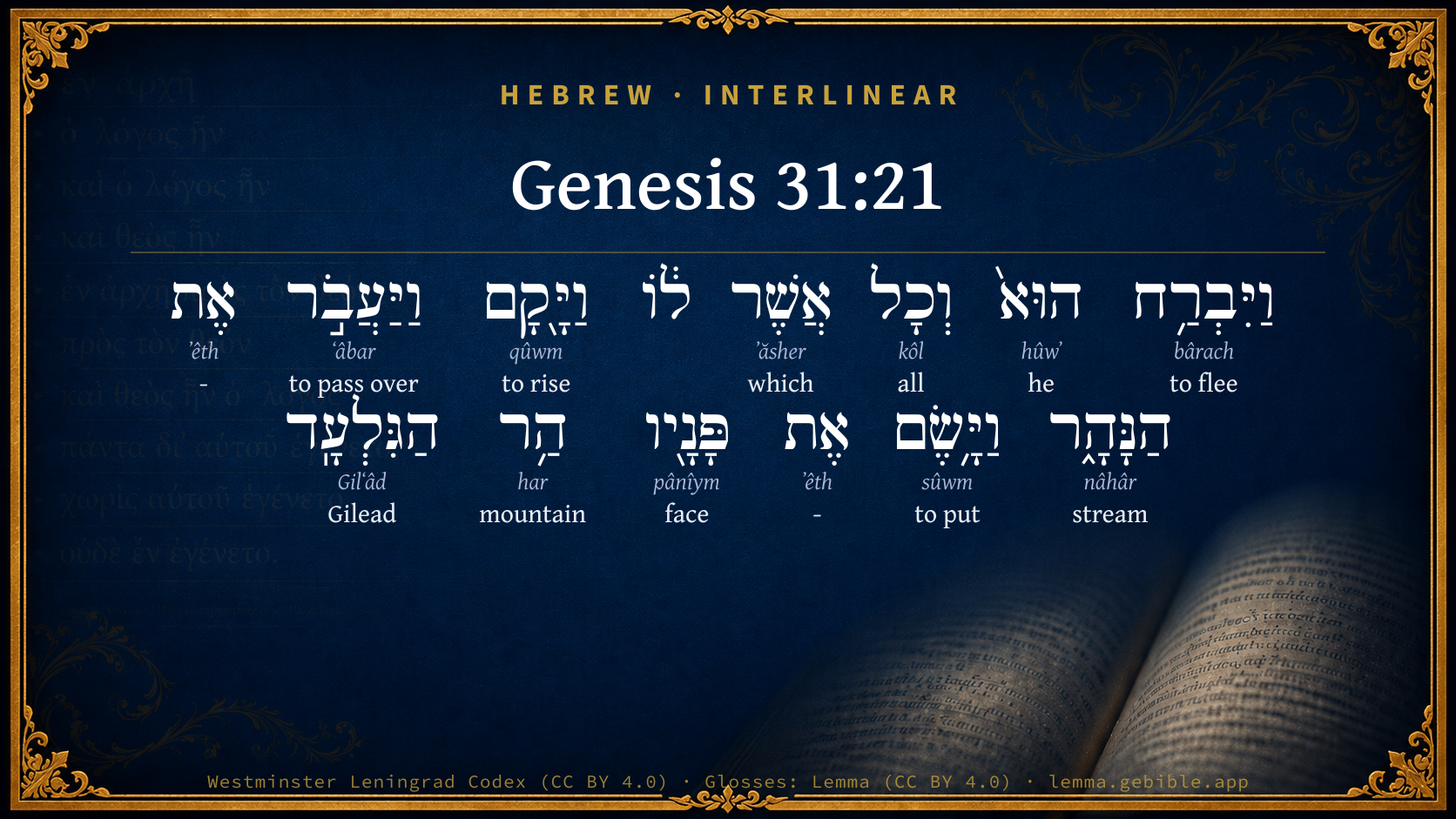
Hebrew (Westminster Leningrad Codex) Genesis 31:21 appears in the Hebrew Old Testament. The text above is from the Westminster Leningrad Codex. Each word links to its Strong’s number, a concise gloss, and parsing drawn from the Open Scriptures Hebrew Bible morphology. Click any word for its full Brown-Driver-Briggs (BDB) entry.
Download image
Cite this verse

Genesis 31:21 (World English Bible). Public Domain. Lemma interlinear Bible study tool, https://lemma.gebible.app/v/genesis/31/21.

Show BibTeX & RIS
BibTeX
RIS
English Translation
So he fled with all that he had. He rose up, passed over the River, and set his face toward the mountain of Gilead.
World English Bible · Public Domain
Highlights
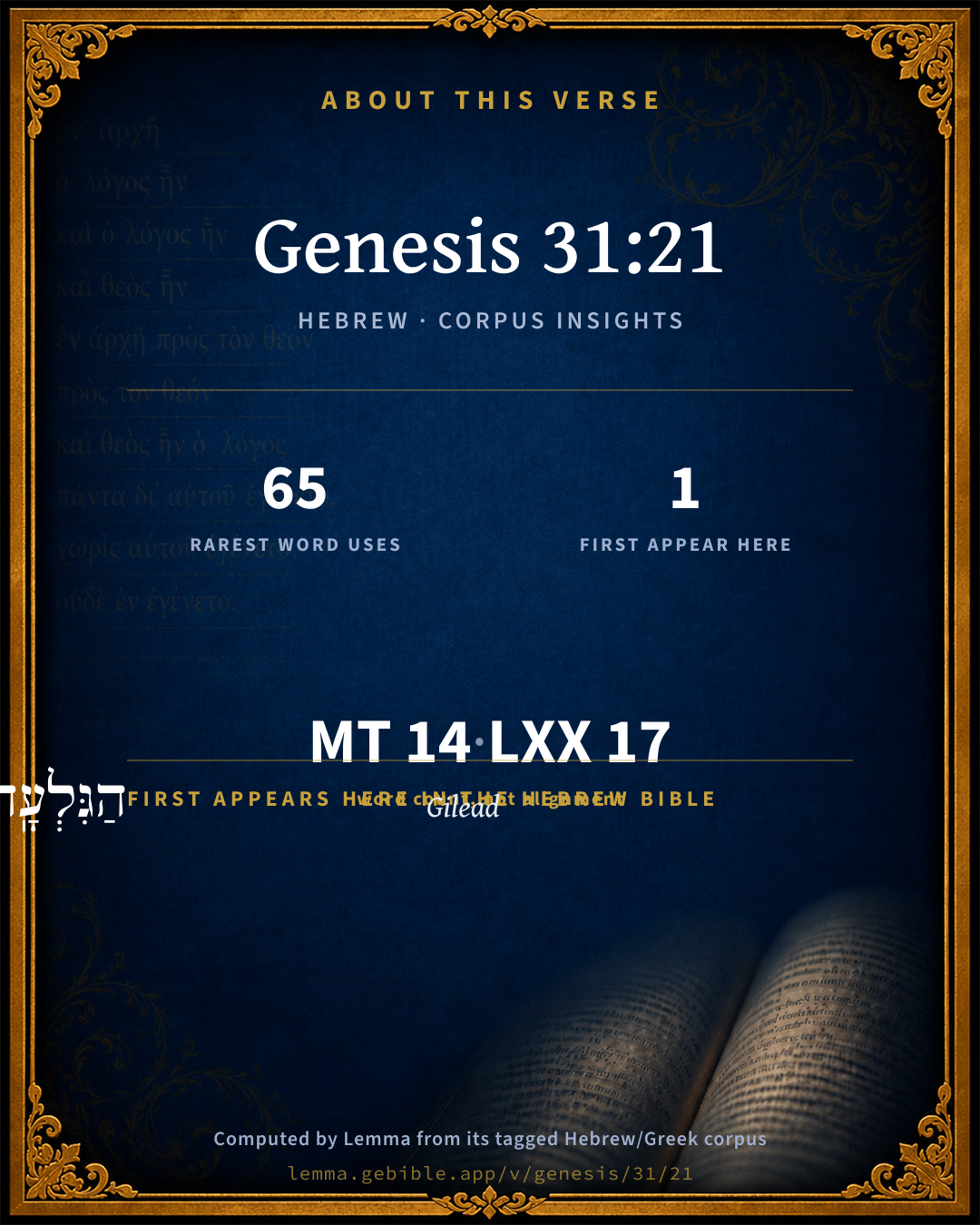
  • 1 first appearance in the Hebrew Bible
Full analysis ↓
Download a study sheet

One document with this verse’s original text, its word-by-word gloss line, the meaning frame, cross-references with their text, attributed commentary, and full source and license credits — printable, and it pastes into notes with its structure intact.

This verse Autodidact and up

Study sheet (.html) Plain text (.txt)

A passage Seminary Student

Up to 50 verses in one chapter. A passage sheet keeps up to 6 commentary sources and 12 cross-references per verse, in the order this page ranks them, and says so on the sheet whenever that leaves anything out. Ask for a single verse and you get the Autodidact verse sheet above.

Everything on this page stays free to read, with no account — the sheet is a download of what is already on screen, not access to it.

Want to remove ads? Support Godless Engineer
Compare translations 3

The same verse in 3 English versions, stacked beneath the original-language interlinear above. Click any original word for its lexicon entry.

Each is an independent rendering of the whole verse — the interlinear is not word-aligned to these translations.

Highlighted words mark where these versions differ — a whole-verse word diff, not a word-by-word alignment.

  • World English Bible Public Domain
    So he fled with all that he had. He rose up, passed over the River, and set his face toward the mountain of Gilead.
  • King James Version Public Domain
    So he fled with all that he had; and he rose up, and passed over the river, and set his face toward the mount Gilead.
  • unfoldingWord Literal Text CC BY-SA 4.0
    And he fled and all that to him. And he got up and crossed the River and set his face the mountain of Gilead. Laban Pursues Jacob and His Family 31:22-42

unfoldingWord Literal Text — © unfoldingWord, licensed CC BY-SA 4.0. Word-aligned USFM3 via Door43 (git.door43.org/unfoldingWord/en_ult).

Versions to compare (up to 4)

3 of 4 selected

Show all 18 translations

Every available English version of this verse, each an independent rendering of the whole verse.

  • World English Bible Public Domain
    So he fled with all that he had. He rose up, passed over the River, and set his face toward the mountain of Gilead.
  • Berean Standard Bible Public Domain
    So he fled with all his possessions, crossed the Euphrates, and headed for the hill country of Gilead.
  • Majority Standard Bible Public Domain
    So he fled with all his possessions, crossed the Euphrates, and headed for the hill country of Gilead.
  • King James Version Public Domain
    So he fled with all that he had; and he rose up, and passed over the river, and set his face toward the mount Gilead.
  • American Standard Version (1901) Public Domain
    So he fled with all that he had; and he rose up, and passed over the River, and set his face toward the mountain of Gilead.
  • Revised Version (1885) Public Domain
    So he fled with all that he had; and he rose up, and passed over the River, and set his face toward the mountain of Gilead.
  • Geneva Bible (1599) Public Domain
    So fled he with all that he had, and he rose vp, and passed the riuer, and set his face towarde mount Gilead.
  • Douay-Rheims (1899) Public Domain
    And when he was gone, together with all that belonged to him, and having passed the river, was going on towards mount Galaad,
  • Young's Literal Translation Public Domain
    and he fleeth, he and all that he hath, and riseth, and passeth over the River, and setteth his face `toward' the mount of Gilead.
  • Literal Standard Version CC BY-SA 4.0
    and he flees, he and all that he has, and rises, and passes over the River, and sets his face [toward] the Mount of Gilead.
  • Unlocked Literal Bible CC BY-SA 4.0
    So he fled with all that he had and quickly passed over the River, and headed toward the hill country of Gilead.
  • unfoldingWord Literal Text CC BY-SA 4.0
    And he fled and all that to him. And he got up and crossed the River and set his face the mountain of Gilead. Laban Pursues Jacob and His Family 31:22-42
  • Darby Bible Public Domain
    And he fled with all that he had; and he rose up and passed over the river, and set his face [toward] mount Gilead.
  • World Messianic Bible Public Domain
    So he fled with all that he had. He rose up, passed over the River, and set his face toward the mountain of Gilead.
  • Webster's Bible Public Domain
    So he fled with all that he had; and he arose, and passed over the river, and set his face towards the mount Gilead.
  • Free Bible Version CC BY-SA 4.0
    So Jacob left in a hurry with everything he had, crossed the Euphrates River, and headed towards the hill country of Gilead.
  • Bible in Basic English Public Domain
    So he went away with all he had, and went across the River in the direction of the hill-country of Gilead.
  • JPS Tanakh (1917) Public Domain
    So he fled with all that he had; and he rose up, and passed over the River, and set his face toward the mountain of Gilead.

Literal Standard Version (2020), Covenant Press — licensed CC BY-SA 4.0. Text via the HelloAO Bible API (eBible.org). Unlocked Literal Bible (unfoldingWord) — licensed CC BY-SA 4.0. Text via the HelloAO Bible API (eBible.org). unfoldingWord Literal Text — © unfoldingWord, licensed CC BY-SA 4.0. Word-aligned USFM3 via Door43 (git.door43.org/unfoldingWord/en_ult). Free Bible Version, Dr. Jonathan Gallagher — licensed CC BY-SA 4.0. Text via the HelloAO Bible API (eBible.org).

Word by word

More ways to search: Search by grammar → Find every occurrence → Compare this word →

Practice this passage: Drill this verse → Learn its vocabulary →

וַיִּבְרַ֥ח
bârach
H1272
“and · to flee”
Conjunction + Verb, Qal, Sequential Imperfect, 3rd Person, Masculine, Singular
Part of Speech
Conjunction + Verb
Stem
Qal
Form
Sequential Imperfect
Person
3rd Person
Gender
Masculine
Number
Singular
Full BDB Definition

Origin: a primitive root

TWOT: 284

to go through, flee, run away, chase, drive away, put to flight, reach, shoot (extend), hurry away - (Qal) - to go, pass through - to flee - to hasten, come quickly - (Hiphil) - to pass through - to cause to flee, put to flight - to drive away
  1. הוּא֙ hûwʼ H1931 “he” Pronoun, Personal, 3rd Person, Masculine, Singular
  2. וְכָל kôl H3605 “and · all of” Conjunction + Noun, Common, Masculine, Singular, Construct
  3. אֲשֶׁר ʼăsher H834 “which” Particle, Relative
  4. וַיָּ֖קָם qûwm H6965 “and · to rise” Conjunction + Verb, Qal, Sequential Imperfect, 3rd Person, Masculine, Singular
  5. וַיַּעֲבֹ֣ר ʻâbar H5674 “and · to pass over” Conjunction + Verb, Qal, Sequential Imperfect, 3rd Person, Masculine, Singular
  6. אֶת ʼêth H853 “-” Particle, Direct Object
  7. הַנָּהָ֑ר nâhâr H5104 “the · stream” Particle, Definite Article + Noun, Common, Masculine, Singular, Absolute
  8. וַיָּ֥שֶׂם sûwm H7760 “and · to put” Conjunction + Verb, Qal, Sequential Imperfect, 3rd Person, Masculine, Singular
  9. אֶת ʼêth H853 “-” Particle, Direct Object
  10. פָּנָ֖יו pânîym H6440 “face(s) · his” Noun, Common, Both, Plural, Construct + Suffix, Personal, 3rd Person, Masculine, Singular
  11. הַ֥ר har H2022 “mountain of” Noun, Common, Masculine, Singular, Construct
  12. הַגִּלְעָֽד Gilʻâd H1568 “the · Gilead” Particle, Definite Article + Noun, Proper

About this verse

These counts appear in no published source. They are computed here, from the morphology-tagged text and Lemma’s own curated glosses. What Lemma adds →

14
words
12
distinct lemmas
Pentateuch
section

First appearance in Scripture

This word makes its first canonical appearance in the Hebrew Bible here:

  • הַגִּלְעָֽד Gilead H1568

Grammatical profile

  • 4 verbs
  • 5 nouns
  • 1 pronoun
  • 1 preposition
  • 3 particles

Verb forms

  • וַיִּבְרַ֥ח Qal · Sequential Imperfect
  • וַיָּ֖קָם Qal · Sequential Imperfect
  • וַיַּעֲבֹ֣ר Qal · Sequential Imperfect
  • וַיָּ֥שֶׂם Qal · Sequential Imperfect

Hebrew & Septuagint length

In English translation the verse runs 24 words from the Hebrew and 21 from the Septuagint (LXX English) — closely comparable.

A rough comparison of the two English renderings, which tokenize alike — not a word-level alignment.

Word counts can differ between the Hebrew and the Greek without any difference in meaning — e.g. the Hebrew direct-object marker אֵת has no separate Greek word, and Greek often adds the article ὁ.

In the original languages it is 14 Hebrew tokens and 17 Greek tokens — but the two are counted differently (Hebrew bundles its prefixes and suffixes into one token; the Greek is in lemma form), so that isn’t a like-for-like length.

Cross-references

15

Topical passages linked to Genesis 31:21 in the Treasury of Scripture Knowledge — connected by theme and wording, ordered by reader-vote popularity; previews shown in the World English Bible.

  • 2 Kings 12:17 Then Hazael king of Syria went up, and fought against Gath, and took it; and Hazael set his face to go up to Jerusalem.
  • Genesis 2:14 The name of the third river is Hiddekel: this is the one which flows in front of Assyria. The fourth river is the Euphrates.
  • Genesis 15:18 In that day Yahweh made a covenant with Abram, saying, "To your seed have I given this land, from the river of Egypt to the great river, the river Euphrates:
  • Genesis 31:23 He took his relatives with him, and pursued after him seven days' journey. He overtook him in the mountain of Gilead.
  • Genesis 37:25 They sat down to eat bread, and they lifted up their eyes and looked, and saw a caravan of Ishmaelites was coming from Gilead, with their camels bearing spices and balm and myrrh, going to carry it down to Egypt.
  • Genesis 46:28 He sent Judah before him to Joseph, to show the way before him to Goshen, and they came into the land of Goshen.
  • Numbers 24:1 When Balaam saw that it pleased Yahweh to bless Israel, he didn't go, as at the other times, to meet with enchantments, but he set his face toward the wilderness.
  • Numbers 32:1 Now the children of Reuben and the children of Gad had a very great multitude of cattle: and when they saw the land of Jazer, and the land of Gilead, that behold, the place was a place for cattle;
  • Deuteronomy 3:12 This land we took in possession at that time: from Aroer, which is by the valley of the Arnon, and half the hill-country of Gilead, and the cities of it, gave I to the Reubenites and to the Gadites:
  • Joshua 13:8–9 With him the Reubenites and the Gadites received their inheritance, which Moses gave them, beyond the Jordan eastward, even as Moses the servant of Yahweh gave them:
  • Joshua 24:2–3 Joshua said to all the people, Thus says Yahweh, the God of Israel, Your fathers lived of old time beyond the River, even Terah, the father of Abraham, and the father of Nahor: and they served other gods.
  • Judges 10:18 The people, the princes of Gilead, said one to another, What man is he who will begin to fight against the children of Ammon? he shall be head over all the inhabitants of Gilead.
  • 1 Kings 17:1 Elijah the Tishbite, who was of the foreigners of Gilead, said to Ahab, As Yahweh, the God of Israel, lives, before whom I stand, there shall not be dew nor rain these years, but according to my word.
  • Jeremiah 50:5 They shall inquire concerning Zion with their faces turned toward it, [saying], Come you, and join yourselves to Yahweh in an everlasting covenant that shall not be forgotten.
  • Luke 9:51–53 It came to pass, when the days were near that he should be taken up, he intently set his face to go to Jerusalem,

Cross-references courtesy of OpenBible.info (CC BY 4.0).

Hebrew and Greek witnesses Masoretic Hebrew ↔ Greek Septuagint

The same verse in the two great witnesses to the Old Testament, shown verse-for-verse.

These are two independent witnesses, not word-aligned to each other, and the Septuagint is shown in lemma (dictionary) form.

Hebrew Genesis 31:21 Masoretic · Westminster Leningrad Codex

וַיִּבְרַ֥ח הוּא֙ וְכָל אֲשֶׁר ל֔וֹ וַיָּ֖קָם וַיַּעֲבֹ֣ר אֶת הַנָּהָ֑ר וַיָּ֥שֶׂם אֶת פָּנָ֖יו הַ֥ר הַגִּלְעָֽד

So he fled with all that he had. He rose up, passed over the River, and set his face toward the mountain of Gilead.

World English Bible · Public Domain

Greek LXX Genesis 31:21 Septuagint · lemma form

καί ἀποδιδράσκω αὐτός καί πᾶς ὁ αὐτός καί διαβαίνω ὁ ποταμός καί ὁρμάω εἰς ὁ ὄρος γαλαάδ

And he departed himself and all that belonged to him, and passed over the river, and went into the mountain Galaad.

LXX2012 (modern English Septuagint) · Public Domain

Hebrew: Westminster Leningrad Codex (CC BY 4.0). Greek: Septuagint (public domain); English from LXX2012 (modern English Septuagint) (Public Domain). How the Septuagint differs from the Hebrew →

Targum (Aramaic paraphrase)

2

The Targum is the ancient Jewish Aramaic paraphrase of the Hebrew Scriptures — an interpretive translation, not the Hebrew text itself. Onkelos (literal) and Pseudo-Jonathan (expansive) render the Torah, and Jonathan the Prophets. Coverage is partial: where no permissively-licensed English translation exists for a verse, only the Aramaic is shown. This is verse-level text, not a word-by-word alignment to the Hebrew.

  1. Targum Onkelos Torah (Genesis–Deuteronomy)
    וַאֲזַלּ הוּא וְכָל דִּי לֵהּ וְקָם וַעֲבַר יָת פְּרָת וְשַׁוִּי יָת אַפּוֹהִי לְטוּרָא דְגִלְעָד

    (no public-domain English translation for this verse)

    Targum Onkelos — Aramaic: “Onkelos Genesis” (public domain); “Onkelos Exodus” (public domain); “Onkelos Leviticus” (public domain); “Onkelos Numbers” (public domain); “Onkelos Deuteronomy” (public domain). English: “Sefaria Community Translation” (CC0 1.0 (public-domain dedication)); “J.W. Etheridge. The Targums of Onkelos and Jonathan Ben Uzziel on the Pentateuch. London: Longmans, Green, 1862” (public domain). Text via Sefaria.

  2. Targum Pseudo-Jonathan Torah (Genesis–Deuteronomy)
    וְאָזַל הוּא עִם כָּל דִילֵיהּ וְקָם וַעֲבַר יַת פְּרָת וְשַׁוִי יַת אַנְפּוֹי לְמֵיסוֹק לְטַוְורָא דְגִלְעָד אֲרוּם חָמָא בְּרוּחַ קוּדְשָא דְתַמָן עָתִיד לְמֶהֱוֵי שֵׁיזְבוּתָא לִבְנוֹי בְּיוֹמֵי דְיִפְתָּח דְמִן גִלְעָד

    And he went, he with all that he had. And he arose and crossed the Pherat, and set his face to ascend toward the mountain of Gilead; because he saw by the Holy Spirit that from thence would be deliverance for his sons, in the days of Jephtach, who was of Gilead.

    Targum Pseudo-Jonathan — Aramaic: “Targum Jonathan on Genesis” (public domain); “Targum Jonathan on Exodus” (public domain); “Targum Jonathan on Leviticus” (public domain); “Targum Jonathan on Numbers” (public domain); “Targum Jonathan on Deuteronomy” (public domain). English: “The Targum of Jonathan ben Uzziel, trans. J. W. Etheridge, London, 1862” (public domain). Text via Sefaria.

Commentary

Notes on Genesis 31:21 from classic Christian and Jewish commentators (each source and its license shown beneath its notes). The classic Christian expositions comment on the surrounding passage and are grouped to its opening verse, so a note may address several verses; the Jewish commentaries on the Tanakh (Rashi and others) are per-verse, so they appear only where the commentator wrote on this verse.

Lemma curates 59 commentaries, every one of them public domain or Creative Commons licensed, each selected and text-cleaned for this edition rather than reprinted as found. About our sources →

Trapp's Complete Commentary

John Trapp

Gen 31:21 So he fled with all that he had; and he rose up, and passed over the river, and set his face [toward] the mount Gilead.

Ver. 21. He passed over the river.] Euphrates; and so declined the ordinary way, that Laban might not overtake him; which yet he did. So God would have it, that he might have the greater glory of Jacob’s deliverance.

John Trapp, A Commentary or Exposition upon All the Books of the Old and New Testament (1647–1656) — public domain. Text from a community e-Sword module.

Tyndale Open Study Notes

Tyndale Open Resources

31:21 The journey took the family from Haran southwest to the land of Gilead, just east of the Jordan River in the north of today’s kingdom of Jordan.

Tyndale Open Study Notes — © Tyndale Open Resources, licensed CC BY-SA 4.0. Text via the HelloAO Bible API.

Geneva Bible (1599)

Geneva Bible translators

Or, Euphrates.

Geneva Bible (1599) marginal notes — public domain. Text via Bolls.life.

Adam Clarke's Commentary

Verse 21. Passed over the river] The Euphrates, as the Targum properly notices. But how could he pass such a river with his flocks, c.? This difficulty does not seem to have struck critics in general. The rabbins felt it, and assert that God wrought a miracle for Jacob on this occasion, and that he passed over dry shod. As we know not in what other way he could pass, it is prudent to refer it to the power of God, which accompanied him through the whole of his journey. There might, however, have been fords well known to both Jacob and Laban, by which they might readily pass.

The mount Gilead.] What the ancient name of this mountain was, we know not but it is likely that it had not the name of Gilead till after the transaction mentioned Ge 31:47. The mountains of Gilead were eastward of the country possessed by the tribes of Reuben and Gad; and extended from Mount Hermon to the mountains of Moab.-Calmet. It is joined to Mount Libanus, and includes the mountainous region called in the New Testament Trachonitis. - Dodd.

Adam Clarke's Commentary on the Bible (1810–1826) — public domain. Text from a community e-Sword/MySword module.

Ellicott's Commentary for English Readers

(21) The river.—The Euphrates.

Mount Gilead.—Gilead, the region of rock, was the mountainous frontier between the Aramean and Canaanite races. The form of the word is so remote from ordinary Hebrew that we have in it, probably, a very old appellation of this region; and Jacob apparently plays upon it in his name Galeed (Gen_31:47).

A Bible Commentary for English Readers, edited by Charles John Ellicott (1878–1897) — public domain. Text from a community e-Sword module.

The Cambridge Bible for Schools and Colleges

gen. ed. J. J. S. Perowne

21. the River] i.e. the Euphrates. See note on Gen_15:18. Cf. Psa_72:8, “from the River unto the ends of the earth.” “Haran” (Gen_24:4) was Laban’s home.

toward the mountain of Gilead] i.e. towards the hill-country on the east side of Jordan. The name “Gilead” is here used in its widest application.

The Cambridge Bible for Schools and Colleges (gen. ed. J. J. S. Perowne; Cambridge University Press, 1878–1918) — public domain. Text from a community e-Sword module.

John Gill's Exposition

And it was told Laban on the third day, that Jacob was fled. Three days after Jacob was gone he had the report of it, by some means or another; by some of his neighbours, or servants left at home, and sooner he could not well have it, since the flock he went to shear was three days' distance from Jacob's, Gen 30:36.

.

Genesis 31:23

gen 31:23

gen 31:23

gen 31:23And he took his brethren with him,.... Some of his relations, the descendants of his father's brethren, the sons of Nahor, of whom there were seven, besides Bethuel; and who all perhaps lived in Haran the city of Nahor, see Gen 22:20; or some of his neighbours and acquaintance whom he might call to:

and pursued after him seven days' journey; which must be reckoned, not from Jacob's departure from Haran, but from Laban's; for Laban being three days' journey from thence, whither he had to return, after he received the news of Jacob being gone; Jacob must have travelled six days before Laban set out with his brethren from Haran; so that this was, as Ben Gerson conjectures, the thirteenth day of Jacob's travel; for Laban not having cattle to drive as Jacob, could travel as fast again as he, and do that in seven days which took up Jacob thirteen:

and they overtook him in the mount Gilead; said to be three hundred and eighty miles from Haran (e).

(e) Bunting's Travels, p. 72.

John Gill's Exposition of the Whole Bible (1746–1763) — public domain (CC PDM 1.0). Text via the HelloAO Bible API.

Haydock's Catholic Bible Commentary

The river Euphrates. --- Galaad, as it was called afterwards, ver. 48. (Menochius)

George Leo Haydock (1774–1849), Haydock's Catholic Family Bible and Commentary, 1859 edition — public domain. Excludes Psalms (Douay-Rheims chapter numbering differs from Protestant) and Deuterocanonical books (Catholic canon only).

Matthew Poole's English Annotations

The river Euphrates, which lay between Mesopotamia and Chaldea, Gen 15:18, which for its largeness and famousness is oft called the river emphatically, as Exo 23:31; Jos 24:2,3, &c.

And set his face, i.e. resolutely directed his course. See Jer 50:5; Luk 9:51,53.

Mount Gilead, a very high and long mountain beyond Jordan, adjoining to the mountain of Lebanon, at the foot of which there was a large and fruitful country, which from the mountain received the name of Gilead, Deu 34:1; Jer 8:22; 22:6. This mountain is here called Gilead by anticipation, as appears from Gen 31:48.

Matthew Poole's English Annotations on the Holy Bible (1683–1685) — public domain. Text from a community e-Sword/MySword module.

Whedon's Commentary on the Bible

Daniel D. Whedon

21. The river — Euphrates, near which he probably abode at that time. Mount Gilead — So called by anticipation here. Comp. Gen_31:47-48.

Daniel D. Whedon (gen. ed.), Commentary on the Old and New Testaments (1874–1909) — public domain. Text from a community e-Sword module.

The Pulpit Commentary

So (literally, and) he fled with (literally, and) all that he had; and he rose up, and passed over the river, i.e. the Euphrates, which was called by preeminence the river (cf. 1Ki_4:21; Ezr_4:10, Ezr_4:16) and set his face toward the mount Gilead. dlGi, according to Gesenius, "the hard, stony region," from an unused quadrilateral root, signifying to be hard, though, according to the historian (by a slight change in the punctuation), "The hill, or heap of witness," from the transaction recorded in verses 45-47, which name it here proleptically receives, was not the mountain-range to the south of the Jahbok, now styled Jebel Jilad (Gesenius), Jebel-as-Salt (Robinson), Jebel-osha (Tristram), since Jacob had not yet crossed the river, but that upon its northern hank, called Jebel Ajlun, and situated near Mahanaim (Delitzsch, Keil, Kalisch, Porter).

The Pulpit Commentary (1880–1919), ed. H.D.M. Spence-Jones & Joseph S. Exell — public domain. Text from a community e-Sword module.

Radak

Rabbi David Kimhi (Radak)

ויברח...את הנהר, the river Euphrates.

Radak on the Tanakh — English translations: “Sefaria Community Translation” (CC0 1.0 (public-domain dedication)); “Eliyahu Munk, HaChut Hameshulash” (CC BY 4.0); “Rabbi Mike Feuer, Jerusalem Anthology” (CC BY 4.0); and “R. David Kimhi on the first book of Psalms, Translated by R.G. Finch, London, 1919” (public domain). Text via Sefaria.

Lesson kit

Teaching starters — assembled from the data on this page, not authored interpretation. Every prompt links to the verse data it draws on. Edit before teaching.

Genesis, in the Pentateuch, opens this verse with 14 words (12 distinct Hebrew lemmas). Its most distinctive word is bârach (“to flee”). A historical commentator’s framing appears above. Read the whole chapter for the surrounding context.

Discussion questions

  1. What does “to flee” (bârach) contribute to the verse as a whole?
  2. This is the first place “Gilead” appears in Scripture (first appears here). What does its debut here establish?
  3. How does 2 Kings 12:17, which shares this passage’s theme, read alongside this verse?
  4. The translations on this page render this verse differently — a whole-verse word diff, not a word-by-word alignment. What might account for the different wordings?
  5. «וַיִּבְרַ֥ח» is a Qal Sequential Imperfect verb. How does that grammatical form shape the action described?
  6. Compare how Trapp's Complete Commentary and Tyndale Open Study Notes read this verse. Where do they agree or differ?

Things to notice

Reading settings

Reading text

Shown beneath each verse's original-language words.

Old Testament
Old Testament edition

Read the OT as the Masoretic Hebrew (MT) or the Greek Septuagint (LXX).

English shown for the Greek Septuagint (in the Hebrew ↔ Greek comparison).

Comparing translations? Open the Compare panel on any verse page to stack up to four side by side.