Exodus 13:12

Hebrew (Westminster Leningrad Codex) Exodus 13:12 appears in the Hebrew Old Testament. The text above is from the Westminster Leningrad Codex. Each word links to its Strong’s number, a concise gloss, and parsing drawn from the Open Scriptures Hebrew Bible morphology. Click any word for its full Brown-Driver-Briggs (BDB) entry.
Download image
Cite this verse

Exodus 13:12 (World English Bible). Public Domain. Lemma interlinear Bible study tool, https://lemma.gebible.app/v/exodus/13/12.

Show BibTeX & RIS
BibTeX
RIS
English Translation
that you shall set apart to Yahweh all that opens the womb, and every firstborn which you have that comes from an animal. The males shall be Yahweh's.
World English Bible · Public Domain
Highlights Full analysis ↓
Download a study sheet

One document with this verse’s original text, its word-by-word gloss line, the meaning frame, cross-references with their text, attributed commentary, and full source and license credits — printable, and it pastes into notes with its structure intact.

This verse Autodidact and up

Study sheet (.html) Plain text (.txt)

A passage Seminary Student

Up to 50 verses in one chapter. A passage sheet keeps up to 6 commentary sources and 12 cross-references per verse, in the order this page ranks them, and says so on the sheet whenever that leaves anything out. Ask for a single verse and you get the Autodidact verse sheet above.

Everything on this page stays free to read, with no account — the sheet is a download of what is already on screen, not access to it.

Want to remove ads? Support Godless Engineer
Compare translations 3

The same verse in 3 English versions, stacked beneath the original-language interlinear above. Click any original word for its lexicon entry.

Each is an independent rendering of the whole verse — the interlinear is not word-aligned to these translations.

Highlighted words mark where these versions differ — a whole-verse word diff, not a word-by-word alignment.

  • World English Bible Public Domain
    that you shall set apart to Yahweh all that opens the womb, and every firstborn which you have that comes from an animal. The males shall be Yahweh's.
  • King James Version Public Domain
    That thou shalt set apart unto the LORD all that openeth the matrix, and every firstling that cometh of a beast which thou hast; the males shall be the LORD's.
  • unfoldingWord Literal Text CC BY-SA 4.0
    then cause to pass over to Yahweh all the openers of the womb, and all the openers of the litter of beasts that are yours. The males are for Yahweh.

unfoldingWord Literal Text — © unfoldingWord, licensed CC BY-SA 4.0. Word-aligned USFM3 via Door43 (git.door43.org/unfoldingWord/en_ult).

Versions to compare (up to 4)

3 of 4 selected

Show all 18 translations

Every available English version of this verse, each an independent rendering of the whole verse.

  • World English Bible Public Domain
    that you shall set apart to Yahweh all that opens the womb, and every firstborn which you have that comes from an animal. The males shall be Yahweh's.
  • Berean Standard Bible Public Domain
    you are to present to the LORD the firstborn male of every womb. All the firstborn males of your livestock belong to the LORD.
  • Majority Standard Bible Public Domain
    you are to present to the LORD the firstborn male of every womb. All the firstborn males of your livestock belong to the LORD.
  • King James Version Public Domain
    That thou shalt set apart unto the LORD all that openeth the matrix, and every firstling that cometh of a beast which thou hast; the males shall be the LORD's.
  • American Standard Version (1901) Public Domain
    that thou shalt set apart unto Jehovah all that openeth the womb, and every firstling which thou hast that cometh of a beast; the males shall be Jehovah's.
  • Revised Version (1885) Public Domain
    that thou shalt set apart unto the LORD all that openeth the womb, and every firstling which thou hast that cometh of a beast; the males shall be the LORD’S.
  • Geneva Bible (1599) Public Domain
    Then thou shalt set apart vnto the Lord all that first openeth the wombe: also euery thing that first doeth open the wombe, and commeth forth of thy beast: the males shalbe the Lordes.
  • Douay-Rheims (1899) Public Domain
    Thou shalt set apart all that openeth the womb for the Lord, and all that is first brought forth of thy cattle: whatsoever thou shalt have of the male sex, thou shalt consecrate to the Lord.
  • Young's Literal Translation Public Domain
    that thou hast caused every one opening a womb to pass over to Jehovah, and every firstling -- the increase of beasts which thou hast: the males `are' Jehovah's.
  • Literal Standard Version CC BY-SA 4.0
    that you have caused everyone opening a womb to pass over to YHWH, and every firstling—the increase of beasts which you have: the males [are] YHWH’s.
  • Unlocked Literal Bible CC BY-SA 4.0
    you must set apart to Yahweh the first offspring of every womb. All the firstborn offspring of your animals that are males, will belong to Yahweh.
  • unfoldingWord Literal Text CC BY-SA 4.0
    then cause to pass over to Yahweh all the openers of the womb, and all the openers of the litter of beasts that are yours. The males are for Yahweh.
  • Darby Bible Public Domain
    that thou shalt offer unto Jehovah all that breaketh open the womb, and every firstling that cometh of cattle which is thine: the males [shall be] Jehovah's.
  • World Messianic Bible Public Domain
    that you shall set apart to the LORD all that opens the womb, and every firstborn that comes from an animal which you have. The males shall be the LORD’s.
  • Webster's Bible Public Domain
    That thou shall set apart to the LORD all that openeth the matrix; and every firstling that cometh of a beast which thou hast, the males shall be the LORD'S.
  • Free Bible Version CC BY-SA 4.0
    you are to present to the Lord all firstborn males, human or animal. The firstborn males of your livestock all belong to the Lord.
  • Bible in Basic English Public Domain
    You are to put on one side for the Lord every mother's first male child, the first-fruit of her body, and the first young one of every beast; every male is holy to the Lord.
  • JPS Tanakh (1917) Public Domain
    that thou shalt set apart unto the LORD all that openeth the womb; every firstling that is a male, which thou hast coming of a beast, shall be the LORD'S.

Literal Standard Version (2020), Covenant Press — licensed CC BY-SA 4.0. Text via the HelloAO Bible API (eBible.org). Unlocked Literal Bible (unfoldingWord) — licensed CC BY-SA 4.0. Text via the HelloAO Bible API (eBible.org). unfoldingWord Literal Text — © unfoldingWord, licensed CC BY-SA 4.0. Word-aligned USFM3 via Door43 (git.door43.org/unfoldingWord/en_ult). Free Bible Version, Dr. Jonathan Gallagher — licensed CC BY-SA 4.0. Text via the HelloAO Bible API (eBible.org).

Word by word

More ways to search: Search by grammar → Find every occurrence → Compare this word →

Practice this passage: Drill this verse → Learn its vocabulary →

שֶׁ֣גֶר
sheger
H7698
“offspring of”
Noun, Common, Masculine, Singular, Construct
Part of Speech
Noun
Type
Common
Gender
Masculine
Number
Singular
State
Construct
Full BDB Definition

Origin: from an unused root probably meaning to eject

TWOT: 2329a

offspring, young or offspring of beasts
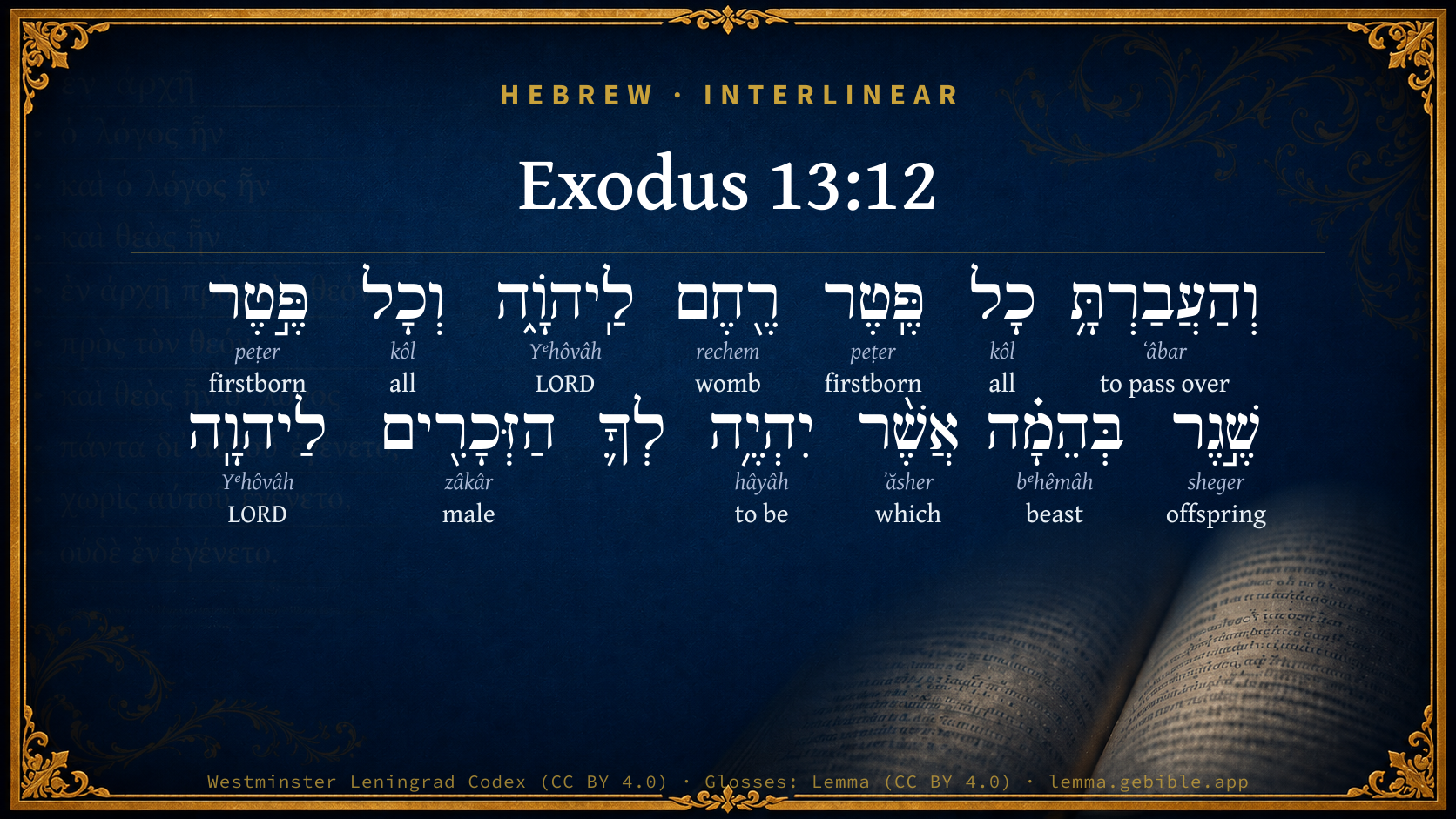
  1. וְהַעֲבַרְתָּ֥ ʻâbar H5674 “and · to pass over” Conjunction + Verb, Hiphil, Sequential Perfect, 2nd Person, Masculine, Singular
  2. כָל kôl H3605 “all of” Noun, Common, Masculine, Singular, Construct
  3. פֶּֽטֶר peṭer H6363 “firstborn of” Noun, Common, Masculine, Singular, Construct
  4. רֶ֖חֶם rechem H7358 “womb” Noun, Common, Masculine, Singular, Absolute
  5. לַֽיהֹוָ֑ה Yᵉhôvâh H3068 “to/for · LORD” Preposition + Noun, Proper
  6. וְכָל kôl H3605 “and · all of” Conjunction + Noun, Common, Masculine, Singular, Construct
  7. פֶּ֣טֶר peṭer H6363 “firstborn of” Noun, Common, Masculine, Singular, Construct
  8. בְּהֵמָ֗ה bᵉhêmâh H929 “beast” Noun, Common, Feminine, Singular, Absolute
  9. אֲשֶׁ֨ר ʼăsher H834 “which” Particle, Relative
  10. יִהְיֶ֥ה hâyâh H1961 “to be” Verb, Qal, Imperfect, 3rd Person, Masculine, Singular
  11. הַזְּכָרִ֖ים zâkâr H2145 “the · males” Particle, Definite Article + Noun, Common, Masculine, Plural, Absolute
  12. לַיהוָֽה Yᵉhôvâh H3068 “to/for · LORD” Preposition + Noun, Proper

About this verse

These counts appear in no published source. They are computed here, from the morphology-tagged text and Lemma’s own curated glosses. What Lemma adds →

14
words
10
distinct lemmas
Pentateuch
section

Notable vocabulary

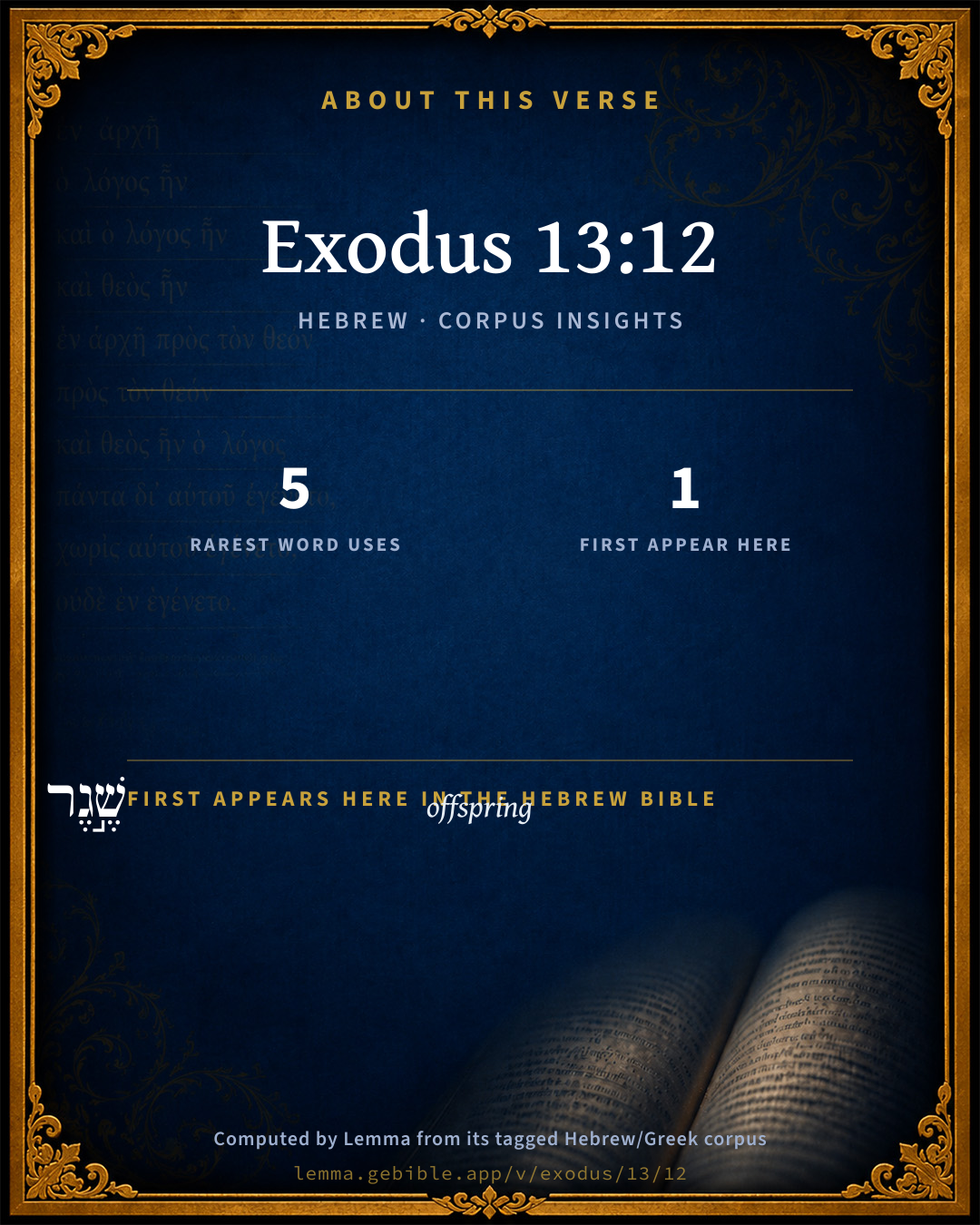
The rarest word here is שֶׁ֣גֶר offspring H7698 — appearing just 5 times in the whole Hebrew Bible.

First appearance in Scripture

This word makes its first canonical appearance in the Hebrew Bible here:

  • שֶׁ֣גֶר offspring H7698

Shared distinctive vocabulary

שֶׁ֣גֶר offspring H7698 occurs in 5 verses of the Hebrew Bible. Also found in:

Grammatical profile

  • 2 verbs
  • 10 nouns
  • 1 preposition
  • 1 particle

Verb forms

  • וְהַעֲבַרְתָּ֥ Hiphil · Sequential Perfect
  • יִהְיֶ֥ה Qal · Imperfect

Repetition

Words recur within this verse — often emphatic in Hebrew:

  • כָל all H3605 ×2
  • פֶּֽטֶר firstborn H6363 ×2
  • לַֽיהֹוָ֑ה LORD H3068 ×2

Hebrew & Septuagint length

In English translation the verse runs 28 words from the Hebrew and 43 from the Septuagint (LXX English) — the Septuagint runs noticeably longer here. See the side-by-side →

A rough comparison of the two English renderings, which tokenize alike — not a word-level alignment.

Word counts can differ between the Hebrew and the Greek without any difference in meaning — e.g. the Hebrew direct-object marker אֵת has no separate Greek word, and Greek often adds the article ὁ.

Cross-references

10

Topical passages linked to Exodus 13:12 in the Treasury of Scripture Knowledge — connected by theme and wording, ordered by reader-vote popularity; previews shown in the World English Bible.

  • Numbers 18:15 Everything that opens the womb, of all flesh which they offer to Yahweh, both of man and animal shall be yours: nevertheless the firstborn of man shall you surely redeem, and the firstborn of unclean animals shall you redeem.
  • Exodus 34:19 All that opens the womb is mine; and all your cattle that is male, the firstborn of cow and sheep.
  • Leviticus 27:26 "'Only the firstborn among animals, which is made a firstborn to Yahweh, no man may dedicate it; whether an ox or sheep, it is Yahweh's.
  • Ezekiel 44:30 The first of all the first fruits of every thing, and every offering of everything, of all your offerings, shall be for the priest: you shall also give to the priests the first of your dough, to cause a blessing to rest on your house.
  • Exodus 13:2 "Sanctify to me all of the firstborn, whatever opens the womb among the children of Israel, both of man and of animal. It is mine."
  • Exodus 22:29 "You shall not delay to offer from your harvest and from the outflow of your presses. "You shall give the firstborn of your sons to me.
  • Deuteronomy 15:19 All the firstborn males that are born of your herd and of your flock you shall sanctify to Yahweh your God: you shall do no work with the firstborn of your herd, nor shear the firstborn of your flock.
  • Numbers 3:12 "Behold, I have taken the Levites from among the children of Israel instead of all the firstborn who open the womb among the children of Israel; and the Levites shall be mine:
  • Numbers 8:17 For all the firstborn among the children of Israel are mine, both man and animal. On the day that I struck all the firstborn in the land of Egypt, I sanctified them for myself.
  • Luke 2:23 (as it is written in the law of the Lord, "Every male who opens the womb shall be called holy to the Lord"),

Cross-references courtesy of OpenBible.info (CC BY 4.0).

Hebrew and Greek witnesses Masoretic Hebrew ↔ Greek Septuagint

The same verse in the two great witnesses to the Old Testament, shown verse-for-verse.

Here the Septuagint runs noticeably longer than the Hebrew — LXX2012 (modern English Septuagint) 43 words vs World English Bible 28. A rough length comparison of the two English translations, not a word-level alignment — read both below.

These are two independent witnesses, not word-aligned to each other, and the Septuagint is shown in lemma (dictionary) form.

Hebrew Exodus 13:12 Masoretic · Westminster Leningrad Codex

וְהַעֲבַרְתָּ֥ כָל פֶּֽטֶר רֶ֖חֶם לַֽיהֹוָ֑ה וְכָל פֶּ֣טֶר שֶׁ֣גֶר בְּהֵמָ֗ה אֲשֶׁ֨ר יִהְיֶ֥ה לְךָ֛ הַזְּכָרִ֖ים לַיהוָֽה

that you shall set apart to Yahweh all that opens the womb, and every firstborn which you have that comes from an animal. The males shall be Yahweh's.

World English Bible · Public Domain

Greek LXX Exodus 13:12 Septuagint · lemma form

καί ἀποαἱρέω πᾶς δια ἀναοἴγω μήτρα ὁ ἀρσενικός ὁ κύριος πᾶς δια ἀναοἴγω μήτρα ἐκ ὁ βουκόλιον ἤ ἐν ὁ κτῆνος σύ ὅσος ἐάν γίγνομαι σύ ὁ ἀρσενικός ἁγιάζω ὁ κύριος

that you shall set apart every offspring opening the womb, the males to the Lord, every one that opens the womb out of the herds or among your cattle, as many as you shall have: you shall sanctify the males to the Lord.

LXX2012 (modern English Septuagint) · Public Domain

Hebrew: Westminster Leningrad Codex (CC BY 4.0). Greek: Septuagint (public domain); English from LXX2012 (modern English Septuagint) (Public Domain). How the Septuagint differs from the Hebrew →

Targum (Aramaic paraphrase)

2

The Targum is the ancient Jewish Aramaic paraphrase of the Hebrew Scriptures — an interpretive translation, not the Hebrew text itself. Onkelos (literal) and Pseudo-Jonathan (expansive) render the Torah, and Jonathan the Prophets. Coverage is partial: where no permissively-licensed English translation exists for a verse, only the Aramaic is shown. This is verse-level text, not a word-by-word alignment to the Hebrew.

  1. Targum Onkelos Torah (Genesis–Deuteronomy)
    וְתַעְבַּר כָּל פָּתַח וַלְדָא קֳדָם יְיָ וְכָל פָּתַח וְלַד בְּעִירָא דִי יְהֵי לָךְ דִכְרִין תַּקְדֵשׁ קֳדָם יְיָ:

    (no public-domain English translation for this verse)

    Targum Onkelos — Aramaic: “Onkelos Genesis” (public domain); “Onkelos Exodus” (public domain); “Onkelos Leviticus” (public domain); “Onkelos Numbers” (public domain); “Onkelos Deuteronomy” (public domain). English: “Sefaria Community Translation” (CC0 1.0 (public-domain dedication)); “J.W. Etheridge. The Targums of Onkelos and Jonathan Ben Uzziel on the Pentateuch. London: Longmans, Green, 1862” (public domain). Text via Sefaria.

  2. Targum Pseudo-Jonathan Torah (Genesis–Deuteronomy)
    וְתַפְרֵשׁ כָּל פְּתַח וַולְדָא קֳדָם יְיָ וְכָל פְּתַח וַולְדָא בְּעִירָא דְּמֵשַׁגְרָא אִמֵּיהּ דִּיהוֹן לִיךְ דִּכְרִין תַּקְדֵּישׁ קֳדָם יְיָ

    thou shalt set apart before the Lord every one that openeth the womb; and every animal that its dam beareth and that openeth the womb if it be to thee a male thou shalt sanctify before the Lord.

    Targum Pseudo-Jonathan — Aramaic: “Targum Jonathan on Genesis” (public domain); “Targum Jonathan on Exodus” (public domain); “Targum Jonathan on Leviticus” (public domain); “Targum Jonathan on Numbers” (public domain); “Targum Jonathan on Deuteronomy” (public domain). English: “The Targum of Jonathan ben Uzziel, trans. J. W. Etheridge, London, 1862” (public domain). Text via Sefaria.

Commentary

Notes on Exodus 13:12 from classic Christian and Jewish commentators (each source and its license shown beneath its notes). The classic Christian expositions comment on the surrounding passage and are grouped to its opening verse, so a note may address several verses; the Jewish commentaries on the Tanakh (Rashi and others) are per-verse, so they appear only where the commentator wrote on this verse.

Lemma curates 59 commentaries, every one of them public domain or Creative Commons licensed, each selected and text-cleaned for this edition rather than reprinted as found. About our sources →

Trapp's Complete Commentary

John Trapp

Exo 13:12 That thou shalt set apart unto the LORD all that openeth the matrix, and every firstling that cometh of a beast which thou hast; the males [shall be] the LORD’S.

Ver. 12. The males shall be the Lord’s.] This God did, that with the firstborn son, commonly best beloved, he might draw all the love to himself.

John Trapp, A Commentary or Exposition upon All the Books of the Old and New Testament (1647–1656) — public domain. Text from a community e-Sword module.

Joseph Benson's Commentary

Exo 13:12. Every firstling of a beast shall be the Lord’s — That is, every firstling male of a clean beast, as of the cow, sheep, or goat kind, was to be offered in sacrifice; and the blood being sprinkled, and the fat burned on the altar, the flesh of them was to be given to the priests, Num 18:17-18.

Joseph Benson's Commentary on the Old and New Testaments (1811–1818) — public domain. Text from a community e-Sword module.

Jamieson, Fausset & Brown

Robert Jamieson, A. R. Fausset & David Brown

FIRSTLINGS OF BEASTS. (Exo 13:11-16)

every firstling, &c.--the injunction respecting the consecration of the first-born, as here repeated, with some additional circumstances. The firstlings of clean beasts, such as lambs, kids, and calves, if males, were to be devoted to God and employed in sacrifice. Those unclean beasts, as the ass's colt, being unfit for sacrifice, were to be redeemed (Num 18:15).

Jamieson, Fausset & Brown — Commentary Critical and Explanatory on the Whole Bible (1871) — public domain (CC PDM 1.0). Text via the HelloAO Bible API.

Ellicott's Commentary for English Readers

(12) Thou shalt set apart—i.e., separate off from the rest of the flock or herd, that it might not be mixed up with those which were not “sanctified.”

A Bible Commentary for English Readers, edited by Charles John Ellicott (1878–1897) — public domain. Text from a community e-Sword module.

The Cambridge Bible for Schools and Colleges

gen. ed. J. J. S. Perowne

12. thou shalt cause to pass over unto Jehovah] The word is not the ordinary Heb. for ‘set apart’; and its use here is remarkable. In Num_27:7 f. (P), cf. 2Sa_3:10, it is indeed used in the simple sense of transferring or making over (an inheritance): but it is also the word regularly used of causing to pass over children in fire to Molech (2Ki_16:3, Eze_20:31 al.), and with ‘to Molech’ alone, Lev_18:21 (H), Jer_32:35, cf. Eze_16:21; Eze_23:37 (‘to them,’ i.e. to the idols), an esp. Exo_20:25-26 (the same expression as here) ‘in that they caused to pass over (viz. in the fire) all that first openeth the womb.’ It may be (cf., p. 409) that this heathen practice determined the use of the same verb here: Jehovah claimed the firstborn; and the Israelite was to cause his firstborn to pass over to Him: the child was not, however, retained by Him, or offered to Him as a sacrifice, but was to be ‘redeemed’ by its father (v. 13).

and every firstling, &c.] lit. and all that first openeth [the womb], (even) the casting (שגר) of beasts, that thou shalt have: shéger (the root is preserved in the Aram. shegar, to ‘cast’), denotes a newly born animal, Deu_7:13; Deu_28:4; Deu_28:18; Deu_28:51 †. The ‘beasts’ meant (as the parallel, Exo_34:19, states explicitly) are ox and sheep.

The Cambridge Bible for Schools and Colleges (gen. ed. J. J. S. Perowne; Cambridge University Press, 1878–1918) — public domain. Text from a community e-Sword module.

John Gill's Exposition

That thou shalt set apart unto the Lord all that openeth the matrix,.... Or "the womb", as in Exo 13:2, and this phrase, "set apart", explains the word "sanctify" there, and shows that it signifies the separating of such to the use and service of God, causing it to "pass", as the word (d) here used signifies, from a man's own power and use, to be the Lord's only:

and every firstling that cometh from a beast which thou hast; or "even every firstling" (e), explaining what is meant by what opens the matrix or womb, even every firstborn of a beast; though Jarchi interprets it of an abortion, what comes before its time, that this also should be set apart to the Lord; this must be understood of the firstlings of clean creatures, fit for food and sacrifice, such as the firstlings of cows, sheep, and goats, Num 18:17 as distinguished from unclean ones in the following verse:

the males shall be the Lord's; which explains what sort of firstborn of man and beast were to be set apart for his use, not females, though the first that opened the womb; but males.

(d) "et transire facies", Pagninus, Montanus, Fagius, Vatablus, Drusius, Cartwright; so Ainsworth. (e) "etiam quicunque vel quicquid aperuerit", Junius & Tremellius, Piscator, Ainsworth.

John Gill's Exposition of the Whole Bible (1746–1763) — public domain (CC PDM 1.0). Text via the HelloAO Bible API.

Matthew Poole's English Annotations

Thou shalt set apart, i. e. separate it from the rest, resign thy right in it to God. Heb.

Cause it to pass, not through the fire, as that verb is used, Deu 18:10; 2Ki 16:3; but under the rod, as it is used, and more fully expressed, Lev 27:32, which was the rite when any thing was separated and consecrated to God.

The males shall be the Lord’s, devoted to him, either to be sacrificed, if it was clean, or to be otherwise destroyed, if it was unclean, as it here follows.

Matthew Poole's English Annotations on the Holy Bible (1683–1685) — public domain. Text from a community e-Sword/MySword module.

The Pulpit Commentary

Set apart. The expression is especially appropriate to the case of first-born animals, which would have to be separated off from the rest of the flock, or of the herd, and "put aside" for Jehovah, so as not to be mixed up and confounded with the other lambs, kids, and calves. The males shall be the Lord"s. This limitation, implied in verse 2, is here brought prominently into notice.

The Pulpit Commentary (1880–1919), ed. H.D.M. Spence-Jones & Joseph S. Exell — public domain. Text from a community e-Sword module.

Rashi

Rabbi Shlomo Yitzchaki (Rashi)

והעברת This word והעברת is an expression for “setting apart”. Similarly it says, (Numbers 27:8) “And ye shall set his inheritance apart (והעברתם) for his daughter” (Mekhilta).

שגר בהמה DROPPED BY BEAST— a premature birth; and this is termed שגר because its mother casts it out (שגר) and expels it (שלחתו) from the womb before its due time (שגר is a synonym of שלח “to let go”). Scripture teaches you that although it is a premature birth it is nevertheless holy by reason of its being first born, in so far that it exempts from the law regarding the firstborn the young that comes (is born) after it (Mekhilta). It is true that an animal that is not a premature birth) is also called שגר, as (Deuteronomy 7:13) “the שגר of thy kine” (where it speaks of blessing this, and it is therefore evident that it cannot there denote a premature birth), but this שגר (i. e. its use here) is intended only to tell us something about a premature birth, because, you see, it has already written in this verse: “Every first offspring of the womb”! And if you say that also the firstborn of an unclean animal (and not a premature birth) is implied by שגר (and that this also must be hallowed) then I reply that Scripture comes and expressly states in another passage, (Deuteronomy 15:19) “[All the firstling males that are born] of thy herd and of thy flocks (thus only clean animals) [shalt thou sanctify etc.]”. Another meaning may be given in explanation of והעברת כל פטר רחם “thou shalt set apart every first born of the womb” — viz., that Scripture by the term פטר רחם is speaking of the firstborn of man (consequently the following words, שגר בהמה, need not denote an animal of premature birth, but an animal born in the natural course as it certainly means in Deuteronomy 7:13, and we thus avoid the necessity of here assigning to שגר a meaning different from that which it bears in the latter passage).

Rashi on the Tanakh — English translations: “The Judaica Press complete Tanach with Rashi, translated by A. J. Rosenberg” (CC BY 4.0); “Pentateuch with Rashi's commentary by M. Rosenbaum and A.M. Silbermann, 1929-1934” (public domain); “The Metsudah Tanach series, Lakewood, N.J” (CC BY 4.0); and “The Book of Joshua, Metsudah Publications, 1997” (CC BY 4.0). Text via Sefaria.

Ramban (Nachmanides)

Rabbi Moshe ben Nachman (Ramban / Nachmanides)

V’HA’AVARTA’ UNTO THE ETERNAL ALL THAT OPENETH THE WOMB. This is an expression of setting apart, i.e., that one is to remove the firstling from the flock and it is to be for the Eternal. Then He reverts and explains that this “setting apart” means that every first male offspring dropped by a beast, and every first offspring of an ass and every firstborn son of a man shall be the Eternal’s. But Rashi commented: “And thou shalt set apart unto the Eternal all that openeth the womb. Scripture is speaking of the firstborn of man.”

Ramban (Nachmanides) on the Tanakh — English translation: “Commentary on the Torah by Ramban (Nachmanides). Translated and annotated by Charles B. Chavel. New York, Shilo Pub. House, 1971-1976” (CC BY 4.0). Text via Sefaria.

Lesson kit

Teaching starters — assembled from the data on this page, not authored interpretation. Every prompt links to the verse data it draws on. Edit before teaching.

Exodus, in the Pentateuch, opens this verse with 14 words (10 distinct Hebrew lemmas). Its most distinctive word is sheger (“offspring”). The Greek Septuagint runs longer here. A historical commentator’s framing appears above. Read the whole chapter for the surrounding context.

Discussion questions

  1. What does “offspring” (sheger) contribute to the verse as a whole?
  2. This is the first place “offspring” appears in Scripture (first appears here). What does its debut here establish?
  3. How does Deuteronomy 7:13, which shares the word «offspring», read alongside this verse?
  4. What does the repetition of “all” (2× in this one verse) do in this verse?
  5. The Septuagint runs longer here than the Hebrew. What might account for the difference?
  6. These translations render this verse differently; the difference is in the English rendering, not the original. What questions does that raise?
  7. «וְהַעֲבַרְתָּ֥» is a Hiphil Sequential Perfect verb. How does that grammatical form shape the action described?
  8. Compare how Trapp's Complete Commentary and Joseph Benson's Commentary read this verse. Where do they agree or differ?

Things to notice

  • 1 word makes its first canonical appearance in Scripture here.
  • These translations choose different wording for 28 words in this verse.
  • “all” occurs 2× in this single verse.
  • 10 distinct Hebrew lemmas span 14 words in this verse.

Reading settings

Reading text

Shown beneath each verse's original-language words.

Old Testament
Old Testament edition

Read the OT as the Masoretic Hebrew (MT) or the Greek Septuagint (LXX).

English shown for the Greek Septuagint (in the Hebrew ↔ Greek comparison).

Comparing translations? Open the Compare panel on any verse page to stack up to four side by side.