2 Samuel 18:23

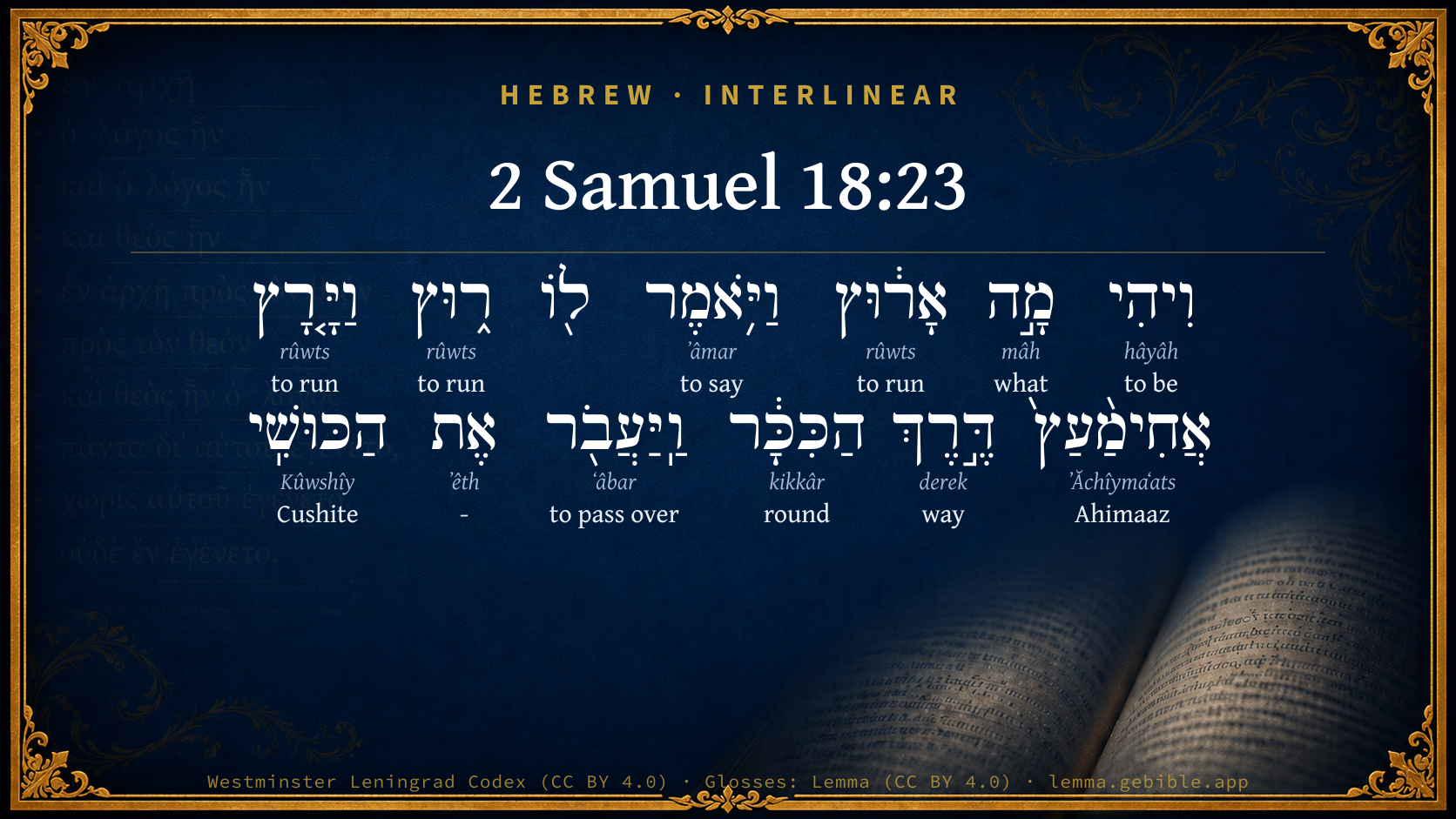
Hebrew (Westminster Leningrad Codex) 2 Samuel 18:23 appears in the Hebrew Old Testament. The text above is from the Westminster Leningrad Codex. Each word links to its Strong’s number, a concise gloss, and parsing drawn from the Open Scriptures Hebrew Bible morphology. Click any word for its full Brown-Driver-Briggs (BDB) entry.
Download image
Cite this verse

2 Samuel 18:23 (World English Bible). Public Domain. Lemma interlinear Bible study tool, https://lemma.gebible.app/v/2-samuel/18/23.

Show BibTeX & RIS
BibTeX
RIS
English Translation
But come what may, [said he], I will run. He said to him, Run. Then Ahimaaz ran by the way of the Plain, and outran the Cushite.
World English Bible · Public Domain
Download a study sheet

One document with this verse’s original text, its word-by-word gloss line, the meaning frame, cross-references with their text, attributed commentary, and full source and license credits — printable, and it pastes into notes with its structure intact.

This verse Autodidact and up

Study sheet (.html) Plain text (.txt)

A passage Seminary Student

Up to 50 verses in one chapter. A passage sheet keeps up to 6 commentary sources and 12 cross-references per verse, in the order this page ranks them, and says so on the sheet whenever that leaves anything out. Ask for a single verse and you get the Autodidact verse sheet above.

Everything on this page stays free to read, with no account — the sheet is a download of what is already on screen, not access to it.

Want to remove ads? Support Godless Engineer
Compare translations 3

The same verse in 3 English versions, stacked beneath the original-language interlinear above. Click any original word for its lexicon entry.

Each is an independent rendering of the whole verse — the interlinear is not word-aligned to these translations.

Highlighted words mark where these versions differ — a whole-verse word diff, not a word-by-word alignment.

  • World English Bible Public Domain
    But come what may, [said he], I will run. He said to him, Run. Then Ahimaaz ran by the way of the Plain, and outran the Cushite.
  • King James Version Public Domain
    But howsoever, said he, let me run. And he said unto him, Run. Then Ahimaaz ran by the way of the plain, and overran Cushy.
  • unfoldingWord Literal Text CC BY-SA 4.0
    “But whatever may be, let me run.” And he said to him, “Run.” And Ahimaaz ran the way of the plain, and he passed the Cushite.

unfoldingWord Literal Text — © unfoldingWord, licensed CC BY-SA 4.0. Word-aligned USFM3 via Door43 (git.door43.org/unfoldingWord/en_ult).

Versions to compare (up to 4)

3 of 4 selected

Show all 18 translations

Every available English version of this verse, each an independent rendering of the whole verse.

  • World English Bible Public Domain
    But come what may, [said he], I will run. He said to him, Run. Then Ahimaaz ran by the way of the Plain, and outran the Cushite.
  • Berean Standard Bible Public Domain
    “No matter what, I want to run!” he replied. “Then run!” Joab told him. So Ahimaaz ran by way of the plain and outran the Cushite.
  • Majority Standard Bible Public Domain
    “No matter what, I want to run!” he replied. “Then run!” Joab told him. So Ahimaaz ran by way of the plain and outran the Cushite.
  • King James Version Public Domain
    But howsoever, said he, let me run. And he said unto him, Run. Then Ahimaaz ran by the way of the plain, and overran Cushy.
  • American Standard Version (1901) Public Domain
    But come what may, `said he', I will run. And he said unto him, Run. Then Ahimaaz ran by the way of the Plain, and outran the Cushite.
  • Revised Version (1885) Public Domain
    But come what may, said he, I will run. And he said unto him, Run. Then Ahimaaz ran by the way of the Plain, and overran the Cushite.
  • Geneva Bible (1599) Public Domain
    Yet what if I runne? Then he saide vnto him, Runne. So Ahimaaz ranne by the way of the plaine, and ouerwent Cushi.
  • Douay-Rheims (1899) Public Domain
    He answered: But what if I run? And he said to him: Run. Then Achimaas running by a nearer way passed Chusai.
  • Young's Literal Translation Public Domain
    `And, whatever it be, `said he,' let me run.' And he saith to him, `Run;' and Ahimaaz runneth the way of the circuit, and passeth by the Cushite.
  • Literal Standard Version CC BY-SA 4.0
    “And whatever happens,” he said, “let me run.” And he says to him, “Run”; and Ahimaaz runs the way of the circuit, and passes by the Cushite.
  • Unlocked Literal Bible CC BY-SA 4.0
    “Whatever happens,” said Ahimaaz, “I will run.” So Joab answered him, “Run.” Then Ahimaaz ran by the way of the plain, and outran the Cushite.
  • unfoldingWord Literal Text CC BY-SA 4.0
    “But whatever may be, let me run.” And he said to him, “Run.” And Ahimaaz ran the way of the plain, and he passed the Cushite.
  • Darby Bible Public Domain
    -- But, come what may, let me run. And he said to him, Run. And Ahimaaz ran by the way of the plain, and outstripped the Cushite.
  • World Messianic Bible Public Domain
    “But come what may,” he said, “I will run.” He said to him, “Run!” Then Ahimaaz ran by the way of the Plain, and outran the Cushite.
  • Webster's Bible Public Domain
    But however, said he, let me run. And he said to him, Run. Then Ahimaaz ran by the way of the plain, and outran Cushi.
  • Free Bible Version CC BY-SA 4.0
    “Doesn't matter, I want to run anyway,” he said. “Fine, start running!” Joab told him. Ahimaaz took the route over flatter ground and overtook the Ethiopian.
  • Bible in Basic English Public Domain
    Whatever may come of it, he said, I will go. Then he said to him, Go. So Ahimaaz went running by the lowland road and overtook the Cushite.
  • JPS Tanakh (1917) Public Domain
    'But come what may, said he, I will run.' And he said unto him: 'Run.' Then Ahimaaz ran by the way of the Plain, and overran the Cushite.

Literal Standard Version (2020), Covenant Press — licensed CC BY-SA 4.0. Text via the HelloAO Bible API (eBible.org). Unlocked Literal Bible (unfoldingWord) — licensed CC BY-SA 4.0. Text via the HelloAO Bible API (eBible.org). unfoldingWord Literal Text — © unfoldingWord, licensed CC BY-SA 4.0. Word-aligned USFM3 via Door43 (git.door43.org/unfoldingWord/en_ult). Free Bible Version, Dr. Jonathan Gallagher — licensed CC BY-SA 4.0. Text via the HelloAO Bible API (eBible.org).

Word by word

More ways to search: Search by grammar → Find every occurrence → Compare this word →

Practice this passage: Drill this verse → Learn its vocabulary →

אֲחִימַ֨עַץ֙
ʼĂchîymaʻats
H290
“Ahimaaz”
Noun, Proper
Part of Speech
Noun
Type
Proper
Full BDB Definition

Origin: from H251 and the equivalent of H4619

TWOT: None

Ahimaaz = "my brother is anger (wrath)" - father-in-law of Saul - Zadok's son who aided David during Absalom's rebellion - a supply officer of Solomon
  1. וִיהִי hâyâh H1961 “and · to be” Conjunction + Verb, Qal, Jussive, 3rd Person, Masculine, Singular
  2. מָ֣ה mâh H4100 “what” Particle, Interrogative
  3. אָר֔וּץ rûwts H7323 “to run” Verb, Qal, Imperfect, 1st Person, Common, Singular
  4. וַיֹּ֥אמֶר ʼâmar H559 “and · to say” Conjunction + Verb, Qal, Sequential Imperfect, 3rd Person, Masculine, Singular
  5. ר֑וּץ rûwts H7323 “run” Verb, Qal, Imperative, 2nd Person, Masculine, Singular
  6. וַיָּ֤רָץ rûwts H7323 “and · to run” Conjunction + Verb, Qal, Sequential Imperfect, 3rd Person, Masculine, Singular
  7. דֶּ֣רֶךְ derek H1870 “way of” Noun, Common, Both, Singular, Construct
  8. הַכִּכָּ֔ר kikkâr H3603 “the · round” Particle, Definite Article + Noun, Common, Both, Singular, Absolute
  9. וַֽיַּעֲבֹ֖ר ʻâbar H5674 “and · to pass over” Conjunction + Verb, Qal, Sequential Imperfect, 3rd Person, Masculine, Singular
  10. אֶת ʼêth H853 “-” Particle, Direct Object
  11. הַכּוּשִֽׁי Kûwshîy H3569 “the · Cushite” Particle, Definite Article + Noun, Gentilic, Masculine, Singular, Absolute

About this verse

These counts appear in no published source. They are computed here, from the morphology-tagged text and Lemma’s own curated glosses. What Lemma adds →

13
words
10
distinct lemmas
Historical
section

Notable vocabulary

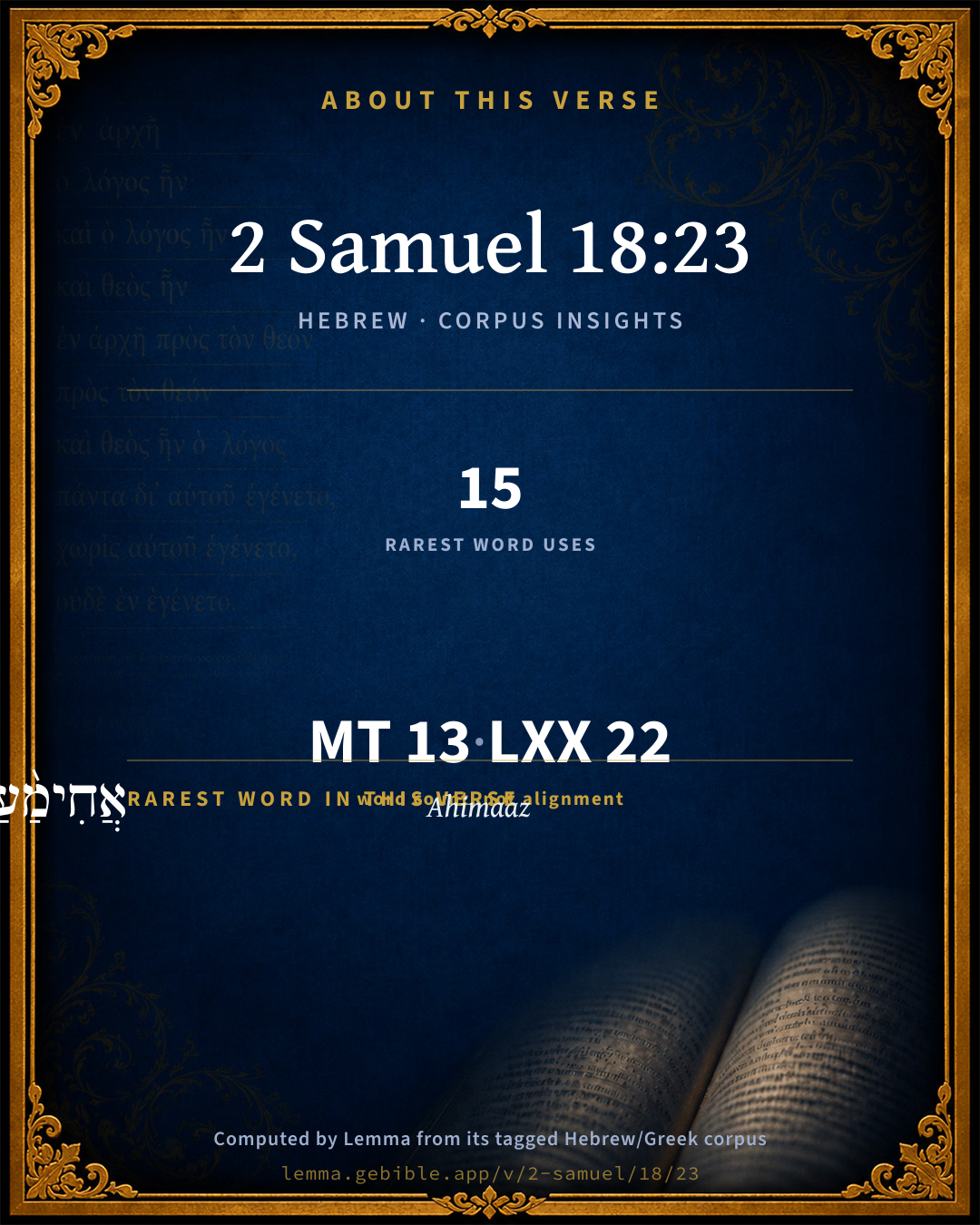
The rarest word here is אֲחִימַ֨עַץ֙ Ahimaaz H290 — appearing just 15 times in the whole Hebrew Bible.

Shared distinctive vocabulary

אֲחִימַ֨עַץ֙ Ahimaaz H290 occurs in 15 verses of the Hebrew Bible. Also found in:

Grammatical profile

  • 6 verbs
  • 4 nouns
  • 1 preposition
  • 2 particles

Verb forms

  • וִיהִי Qal · Jussive
  • אָר֔וּץ Qal · Imperfect
  • וַיֹּ֥אמֶר Qal · Sequential Imperfect
  • ר֑וּץ Qal · Imperative
  • וַיָּ֤רָץ Qal · Sequential Imperfect
  • וַֽיַּעֲבֹ֖ר Qal · Sequential Imperfect

Repetition

A word recurs within this verse — often emphatic in Hebrew:

  • אָר֔וּץ to run H7323 ×3

Hebrew & Septuagint length

In English translation the verse runs 27 words from the Hebrew and 25 from the Septuagint (LXX English) — closely comparable.

A rough comparison of the two English renderings, which tokenize alike — not a word-level alignment.

Word counts can differ between the Hebrew and the Greek without any difference in meaning — e.g. the Hebrew direct-object marker אֵת has no separate Greek word, and Greek often adds the article ὁ.

In the original languages it is 13 Hebrew tokens and 22 Greek tokens — but the two are counted differently (Hebrew bundles its prefixes and suffixes into one token; the Greek is in lemma form), so that isn’t a like-for-like length.

Cross-references

1

Topical passages linked to 2 Samuel 18:23 in the Treasury of Scripture Knowledge — connected by theme and wording, ordered by reader-vote popularity; previews shown in the World English Bible.

  • John 20:4 They both ran together. The other disciple outran Peter, and came to the tomb first.

Cross-references courtesy of OpenBible.info (CC BY 4.0).

Hebrew and Greek witnesses Masoretic Hebrew ↔ Greek Septuagint

The same verse in the two great witnesses to the Old Testament, shown verse-for-verse.

These are two independent witnesses, not word-aligned to each other, and the Septuagint is shown in lemma (dictionary) form.

Hebrew 2 Samuel 18:23 Masoretic · Westminster Leningrad Codex

וִיהִי מָ֣ה אָר֔וּץ וַיֹּ֥אמֶר ל֖וֹ ר֑וּץ וַיָּ֤רָץ אֲחִימַ֨עַץ֙ דֶּ֣רֶךְ הַכִּכָּ֔ר וַֽיַּעֲבֹ֖ר אֶת הַכּוּשִֽׁי

But come what may, [said he], I will run. He said to him, Run. Then Ahimaaz ran by the way of the Plain, and outran the Cushite.

World English Bible · Public Domain

Greek LXX 2 Samuel 18:23 Septuagint · lemma form

καί εἶπον τίς γάρ ἐάν τρέχω καί εἶπον αὐτός ιωαβ τρέχω καί τρέχω αχιμαας ὁδός ὁ ὁ κεχαρ καί ὑπερβαίνω ὁ χουσι

And he said, Why should I not run? and Joab said to him, Run. And Achimaas ran along the way of Kechar, and outran Chusi.

LXX2012 (modern English Septuagint) · Public Domain

On this verse, Jamieson, Fausset & Brown discusses the Septuagint’s reading. Read the note in Commentary ↓

Hebrew: Westminster Leningrad Codex (CC BY 4.0). Greek: Septuagint (public domain); English from LXX2012 (modern English Septuagint) (Public Domain). How the Septuagint differs from the Hebrew →

Targum (Aramaic paraphrase)

1

The Targum is the ancient Jewish Aramaic paraphrase of the Hebrew Scriptures — an interpretive translation, not the Hebrew text itself. Onkelos (literal) and Pseudo-Jonathan (expansive) render the Torah, and Jonathan the Prophets. Coverage is partial: where no permissively-licensed English translation exists for a verse, only the Aramaic is shown. This is verse-level text, not a word-by-word alignment to the Hebrew.

  1. Targum Jonathan Prophets (Joshua–Malachi)
    וִיהֵי מָא בִכְדֵין אֶרְהוּט וַאֲמַר לֵיהּ רְהוּט וּרְהַט אֲחִימַעַץ בְּאוֹרַח מֵישְׁרָא וּקְדִים יַת כּוּשִׁי:

    (no public-domain English translation for this verse)

    Targum Jonathan — Aramaic: “Mikraot Gedolot” (public domain). English: “Sefaria Community Translation” (CC0 1.0 (public-domain dedication)); “London "Chaldee Paraphrase," 1871” (public domain). Text via Sefaria.

Commentary

Notes on 2 Samuel 18:23 from classic Christian and Jewish commentators (each source and its license shown beneath its notes). The classic Christian expositions comment on the surrounding passage and are grouped to its opening verse, so a note may address several verses; the Jewish commentaries on the Tanakh (Rashi and others) are per-verse, so they appear only where the commentator wrote on this verse.

Lemma curates 59 commentaries, every one of them public domain or Creative Commons licensed, each selected and text-cleaned for this edition rather than reprinted as found. About our sources →

Trapp's Complete Commentary

John Trapp

2Sa 18:23 But howsoever, [said he], let me run. And he said unto him, Run. Then Ahimaaz ran by the way of the plain, and overran Cushi.

Ver. 23. Then Ahimaaz ran by the way of the plain.] Which was the nearest way, though farthest about.

John Trapp, A Commentary or Exposition upon All the Books of the Old and New Testament (1647–1656) — public domain. Text from a community e-Sword module.

Whedon's Commentary on the Bible

Daniel D. Whedon

AHITHOPHEL’S SUICIDE, 2Sa_18:23.

23. Arose, and gat him home — He was deeply chagrined and mortally offended. He saw, too, that by the neglect of his counsel Absalom’s cause was lost; and for himself, he had gone too far in treason ever to hope for reconciliation with David.

To his city — Giloh. See 2Sa_15:12.

Put his household in order — Or, as margin, gave charge concerning his house; settled up his worldly affairs.

Hanged himself — Like the betrayer of our Lord. Mat_27:5. There are several points of resemblance between Ahithophel and Judas Iscariot. The deep wounding of David’s spirit by the treason of Ahithophel probably occasioned the writing of the forty-first, fifty-fifth, sixty-ninth, and one hundred and ninth Psalms, from one of which (Psa_41:9) the Lord quoted a passage which he interpreted as a prophecy of Judas. Joh_13:18.

Buried in the sepulchre of his, father — “Not like an excommunicated outcast, but like a venerable patriarch.” — Stanley. According to Josephus he hung himself in the inmost room of his house, and his relatives took him down and honoured him with becoming funeral ceremonies. “Ahithophel is not, probably, the first man who hanged himself, but he bears the unenviable distinction of being the first whose hanging himself is recorded; and society would have little reason to complain, if all who have since sentenced themselves to this doom were as worthy of it as this father of self-suspenders. Bishop Hall quaintly remarks of him, that, though mad enough to hang himself, he was wise enough to set his house in order before he did it.” — Kitto.

23. Ran by the way of the plain — He seems to have understood the routes better than Cushi, and also to have been a swifter runner. What plain is here intended is not clear. If the Jordan valley is meant, then the wood of Ephraim must have been somewhere near the river. See note on 2Sa_18:6.

Daniel D. Whedon (gen. ed.), Commentary on the Old and New Testaments (1874–1909) — public domain. Text from a community e-Sword module.

Jamieson, Fausset & Brown

Robert Jamieson, A. R. Fausset & David Brown

by the way of the plain--or ciccar, "circle." This word is only used elsewhere in connection with the valley of the Jordan. It is possible that there may have been a place or region so called on the tablelands of Gilead, as the Septuagint seems to indicate. Or Mahanaim may have been so situated, with the regard to the battlefield, as to be more easily accessible by a descent to the plain of the Jordan, than over the hills themselves. Or the word may signify (as EWALD explains) a manner of quick running [STANLEY].

Jamieson, Fausset & Brown — Commentary Critical and Explanatory on the Whole Bible (1871) — public domain (CC PDM 1.0). Text via the HelloAO Bible API.

Ellicott's Commentary for English Readers

(23) By the way of the plain.—The word used here is generally applied to the valley of the Jordan and hence it has been argued that the battle could not have been fought on the eastern side of the river, since, in that case, Ahimaaz could not have reached Mahanaim by the Jordan valley except by a long and tedious detour. But the word simply means circuit, or surrounding country, and is used in Neh_12:28 for the country about Jerusalem. Here it means that Ahimaaz ran “by the way of the circuit,” i.e., in all probability, by a longer but smoother road than that taken by the Cushite, so that he was able to outrun him.

A Bible Commentary for English Readers, edited by Charles John Ellicott (1878–1897) — public domain. Text from a community e-Sword module.

The Cambridge Bible for Schools and Colleges

gen. ed. J. J. S. Perowne

23. by the way of the plain] “The plain” (Heb. kikkar) is the technical term for the floor of the valley through which the Jordan runs. In our ignorance of the exact position of the battlefield, we cannot trace the routes taken by the rival runners with certainty. But in all probability what is meant is that Ahimaaz struck down into the Jordan valley, and ran by a longer but easier route to Mahanaim, while the Cushite took the direct but more difficult route over the hills.

The Cambridge Bible for Schools and Colleges (gen. ed. J. J. S. Perowne; Cambridge University Press, 1878–1918) — public domain. Text from a community e-Sword module.

John Gill's Exposition

But howsoever (said he) let me run,.... Be it as it may, I beg I may have leave; and being so very importunate, it was granted:

and he said unto him, run; since he would take no denial:

then Ahimaaz ran by the way of the plain, and overran Cushi; who ran by the way of the mountains; which though the shorter way, that through the plain was easiest, and soonest run, though the longest.

John Gill's Exposition of the Whole Bible (1746–1763) — public domain (CC PDM 1.0). Text via the HelloAO Bible API.

Albert Barnes' Notes on the Bible

The plain - The floor of the valley through which the Jordan runs. The Cushite did not run by that road, but took the road over the hills, which may well have been the shorter but also the more difficult road. The two roads would probably meet a short distance from Mahanaim. These words, which have been thought to prove that the battle took place on the west of Jordan, are a clear proof that it took place on the east, because if the runners had had to cross the Jordan, they must both have come by the same road, which it is clear they did not.

Albert Barnes' Notes on the Bible (1834–1885) — public domain. Text from a community e-Sword/MySword module.

Matthew Poole's English Annotations

The way of the plain was the smoother and easier, though the longer way.

Matthew Poole's English Annotations on the Holy Bible (1683–1685) — public domain. Text from a community e-Sword/MySword module.

The Pulpit Commentary

Ahimaaz ran by the way of the plain; Hebrew, the kikkar, or Jordan valley. The battle, as we saw in ver. 6, was fought on the eastern side of the river, and Absalom"s army, in their flight, would endeavour to reach the fords of the Jordan; (comp. Jud_1:12:5) and probably Joab had pursued them for some distance before the man found in the thicket the body of the unfortunate Absalom. The large slaughter of twenty thousand men (ver. 7) proves that the defeated rebels were vigorously followed. In carrying the news the negro evidently went back by the route which the troops had followed; while Ahimaaz, using his more developed intellect, took a longer course to the west, but one that avoided the tangles and the deep defiles of the forest. Strictly, the Kikkar, as we have seen, was the name of the Jordan valley near Jericho; but it was probably applicable also to the same sort of formation further north. On approaching Mahanaim, Ahimaaz would strike inland, and the two routes would join one another; and one reason which made Ahimaaz go more to the west was that he did net wish the Cushite to know that he had a rival. He would thus go at a steady pace, picking his way through the forest, while Ahimaaz was using his utmost speed.

The Pulpit Commentary (1880–1919), ed. H.D.M. Spence-Jones & Joseph S. Exell — public domain. Text from a community e-Sword module.

Rashi

Rabbi Shlomo Yitzchaki (Rashi)

So what. In other words, so what if I get no reward?

And he passed. [Yonoson translates:] He arrived before the Kushite.

Rashi on the Tanakh — English translations: “The Judaica Press complete Tanach with Rashi, translated by A. J. Rosenberg” (CC BY 4.0); “Pentateuch with Rashi's commentary by M. Rosenbaum and A.M. Silbermann, 1929-1934” (public domain); “The Metsudah Tanach series, Lakewood, N.J” (CC BY 4.0); and “The Book of Joshua, Metsudah Publications, 1997” (CC BY 4.0). Text via Sefaria.

Lesson kit

Teaching starters — assembled from the data on this page, not authored interpretation. Every prompt links to the verse data it draws on. Edit before teaching.

2 Samuel, in the Historical, opens this verse with 13 words (10 distinct Hebrew lemmas). Its most distinctive word is ʼĂchîymaʻats (“Ahimaaz”). A historical commentator’s framing appears above. Read the whole chapter for the surrounding context.

Discussion questions

  1. What does “Ahimaaz” (ʼĂchîymaʻats) contribute to the verse as a whole?
  2. How does 1 Samuel 14:50, which shares the word «Ahimaaz», read alongside this verse?
  3. What does the repetition of “to run” (3× in this one verse) do in this verse?
  4. The translations on this page render this verse differently — a whole-verse word diff, not a word-by-word alignment. What might account for the different wordings?
  5. «וִיהִי» is a Qal Jussive verb. How does that grammatical form shape the action described?
  6. Compare how Trapp's Complete Commentary and Whedon's Commentary on the Bible read this verse. Where do they agree or differ?

Things to notice

Reading settings

Reading text

Shown beneath each verse's original-language words.

Old Testament
Old Testament edition

Read the OT as the Masoretic Hebrew (MT) or the Greek Septuagint (LXX).

English shown for the Greek Septuagint (in the Hebrew ↔ Greek comparison).

Comparing translations? Open the Compare panel on any verse page to stack up to four side by side.