Isaiah 29:5

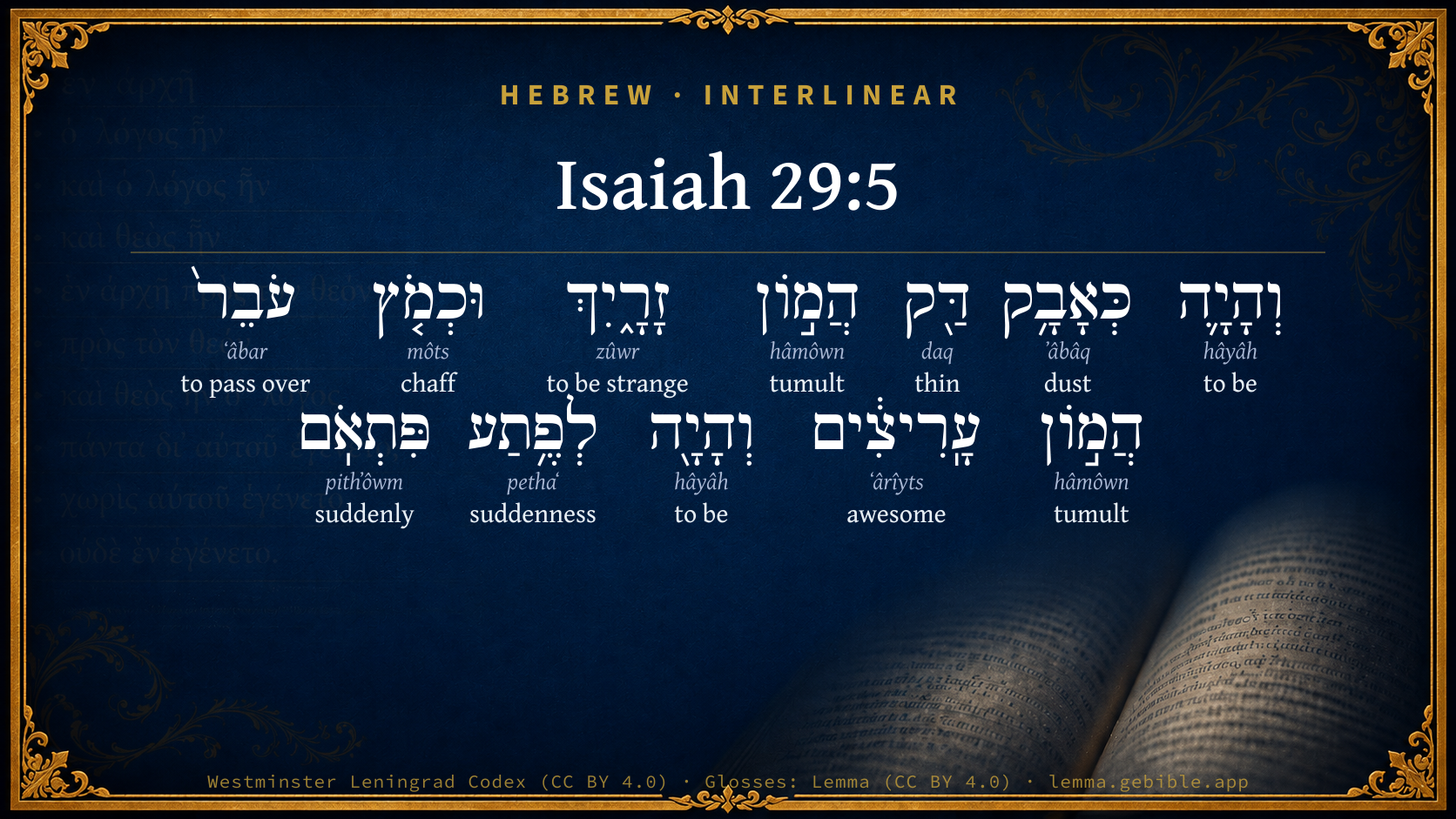
Hebrew (Westminster Leningrad Codex) Isaiah 29:5 appears in the Hebrew Old Testament. The text above is from the Westminster Leningrad Codex. Each word links to its Strong’s number, a concise gloss, and parsing drawn from the Open Scriptures Hebrew Bible morphology. Click any word for its full Brown-Driver-Briggs (BDB) entry.
Download image
Cite this verse

Isaiah 29:5 (World English Bible). Public Domain. Lemma interlinear Bible study tool, https://lemma.gebible.app/v/isaiah/29/5.

Show BibTeX & RIS
BibTeX
RIS
English Translation
But the multitude of your foes shall be like small dust, and the multitude of the awesome ones as chaff that passes away: yes, it shall be in an instant suddenly.
World English Bible · Public Domain
Download a study sheet

One document with this verse’s original text, its word-by-word gloss line, the meaning frame, cross-references with their text, attributed commentary, and full source and license credits — printable, and it pastes into notes with its structure intact.

This verse Autodidact and up

Study sheet (.html) Plain text (.txt)

A passage Seminary Student

Up to 50 verses in one chapter. A passage sheet keeps up to 6 commentary sources and 12 cross-references per verse, in the order this page ranks them, and says so on the sheet whenever that leaves anything out. Ask for a single verse and you get the Autodidact verse sheet above.

Everything on this page stays free to read, with no account — the sheet is a download of what is already on screen, not access to it.

Want to remove ads? Support Godless Engineer
Compare translations 3

The same verse in 3 English versions, stacked beneath the original-language interlinear above. Click any original word for its lexicon entry.

Each is an independent rendering of the whole verse — the interlinear is not word-aligned to these translations.

Highlighted words mark where these versions differ — a whole-verse word diff, not a word-by-word alignment.

  • World English Bible Public Domain
    But the multitude of your foes shall be like small dust, and the multitude of the awesome ones as chaff that passes away: yes, it shall be in an instant suddenly.
  • King James Version Public Domain
    Moreover the multitude of thy strangers shall be like small dust, and the multitude of the terrible ones shall be as chaff that passeth away: yea, it shall be at an instant suddenly.
  • unfoldingWord Literal Text CC BY-SA 4.0
    But the multitude of your strangers will be like fine dust, and the multitude of the terrible, like passing chaff. And it will happen in an instant, suddenly.

unfoldingWord Literal Text — © unfoldingWord, licensed CC BY-SA 4.0. Word-aligned USFM3 via Door43 (git.door43.org/unfoldingWord/en_ult).

Versions to compare (up to 4)

3 of 4 selected

Show all 18 translations

Every available English version of this verse, each an independent rendering of the whole verse.

  • World English Bible Public Domain
    But the multitude of your foes shall be like small dust, and the multitude of the awesome ones as chaff that passes away: yes, it shall be in an instant suddenly.
  • Berean Standard Bible Public Domain
    But your many foes will be like fine dust, the multitude of the ruthless like blowing chaff. Then suddenly, in an instant,
  • Majority Standard Bible Public Domain
    But your many foes will be like fine dust, the multitude of the ruthless like blowing chaff. Then suddenly, in an instant,
  • King James Version Public Domain
    Moreover the multitude of thy strangers shall be like small dust, and the multitude of the terrible ones shall be as chaff that passeth away: yea, it shall be at an instant suddenly.
  • American Standard Version (1901) Public Domain
    But the multitude of thy foes shall be like small dust, and the multitude of the terrible ones as chaff that passeth away: yea, it shall be in an instant suddenly.
  • Revised Version (1885) Public Domain
    But the multitude of thy foes shall be like small dust, and the multitude of the terrible ones as chaff that passeth away: yea, it shall be at an instant suddenly.
  • Geneva Bible (1599) Public Domain
    Moreouer, the multitude of thy strangers shalbe like small dust, and the multitude of strong men shalbe as chaffe that passeth away, and it shall be in a moment, euen suddenly.
  • Douay-Rheims (1899) Public Domain
    And the multitude of them that fan thee, shall be like small dust: and as ashes passing away, the multitude of them that have prevailed against thee.
  • Young's Literal Translation Public Domain
    And as small dust hath been The multitude of those scattering thee, And as chaff passing on the multitude of the terrible, And it hath been at an instant -- suddenly.
  • Literal Standard Version CC BY-SA 4.0
    And as small dust has been || The multitude of those scattering you, || And as chaff passing on the multitude of the terrible, || And it has been in an instant—suddenly.
  • Unlocked Literal Bible CC BY-SA 4.0
    The great number of your invaders will become like fine dust, and the multitude of the ruthless ones as chaff that passes away. It will happen suddenly, in an instant.
  • unfoldingWord Literal Text CC BY-SA 4.0
    But the multitude of your strangers will be like fine dust, and the multitude of the terrible, like passing chaff. And it will happen in an instant, suddenly.
  • Darby Bible Public Domain
    And the multitude of thine enemies shall be like small dust, and the multitude of the terrible ones as chaff that passeth away; and it shall be in an instant, suddenly.
  • World Messianic Bible Public Domain
    But the multitude of your foes will be like fine dust, and the multitude of the ruthless ones like chaff that blows away. Yes, it will be in an instant, suddenly.
  • Webster's Bible Public Domain
    Moreover, the multitude of thy strangers shall be like small dust, and the multitude of the terrible ones shall be as chaff that passeth away: yes, it shall be at an instant suddenly.
  • Free Bible Version CC BY-SA 4.0
    But then all your enemies will become like fine dust; all your cruel oppressors like chaff that's blown away. Then suddenly, in no time at all,
  • Bible in Basic English Public Domain
    And the army of your attackers will be like small dust, and all the cruel ones like dry stems gone before the wind; suddenly it will come about.
  • JPS Tanakh (1917) Public Domain
    But the multitude of thy foes shall be like small dust, and the multitude of the terrible ones as chaff that passeth away; yea, it shall be at an instant suddenly —

Literal Standard Version (2020), Covenant Press — licensed CC BY-SA 4.0. Text via the HelloAO Bible API (eBible.org). Unlocked Literal Bible (unfoldingWord) — licensed CC BY-SA 4.0. Text via the HelloAO Bible API (eBible.org). unfoldingWord Literal Text — © unfoldingWord, licensed CC BY-SA 4.0. Word-aligned USFM3 via Door43 (git.door43.org/unfoldingWord/en_ult). Free Bible Version, Dr. Jonathan Gallagher — licensed CC BY-SA 4.0. Text via the HelloAO Bible API (eBible.org).

Word by word

More ways to search: Search by grammar → Find every occurrence → Compare this word →

Practice this passage: Drill this verse → Learn its vocabulary →

כְּאָבָ֥ק
ʼâbâq
H80
“like/as · dust”
Preposition + Noun, Common, Masculine, Singular, Absolute
Part of Speech
Preposition + Noun
Type
Common
Gender
Masculine
Number
Singular
State
Absolute
Full BDB Definition

Origin: from root of H79

TWOT: 11a

dust - on ground - clouds (figuratively)
  1. וְהָיָ֛ה hâyâh H1961 “and · to be” Conjunction + Verb, Qal, Sequential Perfect, 3rd Person, Masculine, Singular
  2. דַּ֖ק daq H1851 “thin” Adjective, Adjective, Masculine, Singular, Absolute
  3. הֲמ֣וֹן hâmôwn H1995 “tumult of” Noun, Common, Masculine, Singular, Construct
  4. זָרָ֑יִךְ zûwr H2114 “strange · your” Adjective, Adjective, Masculine, Plural, Construct + Suffix, Personal, 2nd Person, Feminine, Singular
  5. וּכְמֹ֤ץ môts H4671 “and · like/as · chaff” Conjunction + Preposition + Noun, Common, Masculine, Singular, Absolute
  6. עֹבֵר֙ ʻâbar H5674 “passing over” Verb, Qal, Participle Active, Masculine, Singular, Absolute
  7. הֲמ֣וֹן hâmôwn H1995 “tumult of” Noun, Common, Masculine, Singular, Construct
  8. עָֽרִיצִ֔ים ʻârîyts H6184 “awesome” Adjective, Adjective, Masculine, Plural, Absolute
  9. וְהָיָ֖ה hâyâh H1961 “and · to be” Conjunction + Verb, Qal, Sequential Perfect, 3rd Person, Masculine, Singular
  10. לְפֶ֥תַע pethaʻ H6621 “to/for · suddenness” Preposition + Noun, Common, Masculine, Singular, Absolute
  11. פִּתְאֹֽם pithʼôwm H6597 “suddenly” Adverb

About this verse

These counts appear in no published source. They are computed here, from the morphology-tagged text and Lemma’s own curated glosses. What Lemma adds →

12
words
10
distinct lemmas
Prophets
section

Notable vocabulary

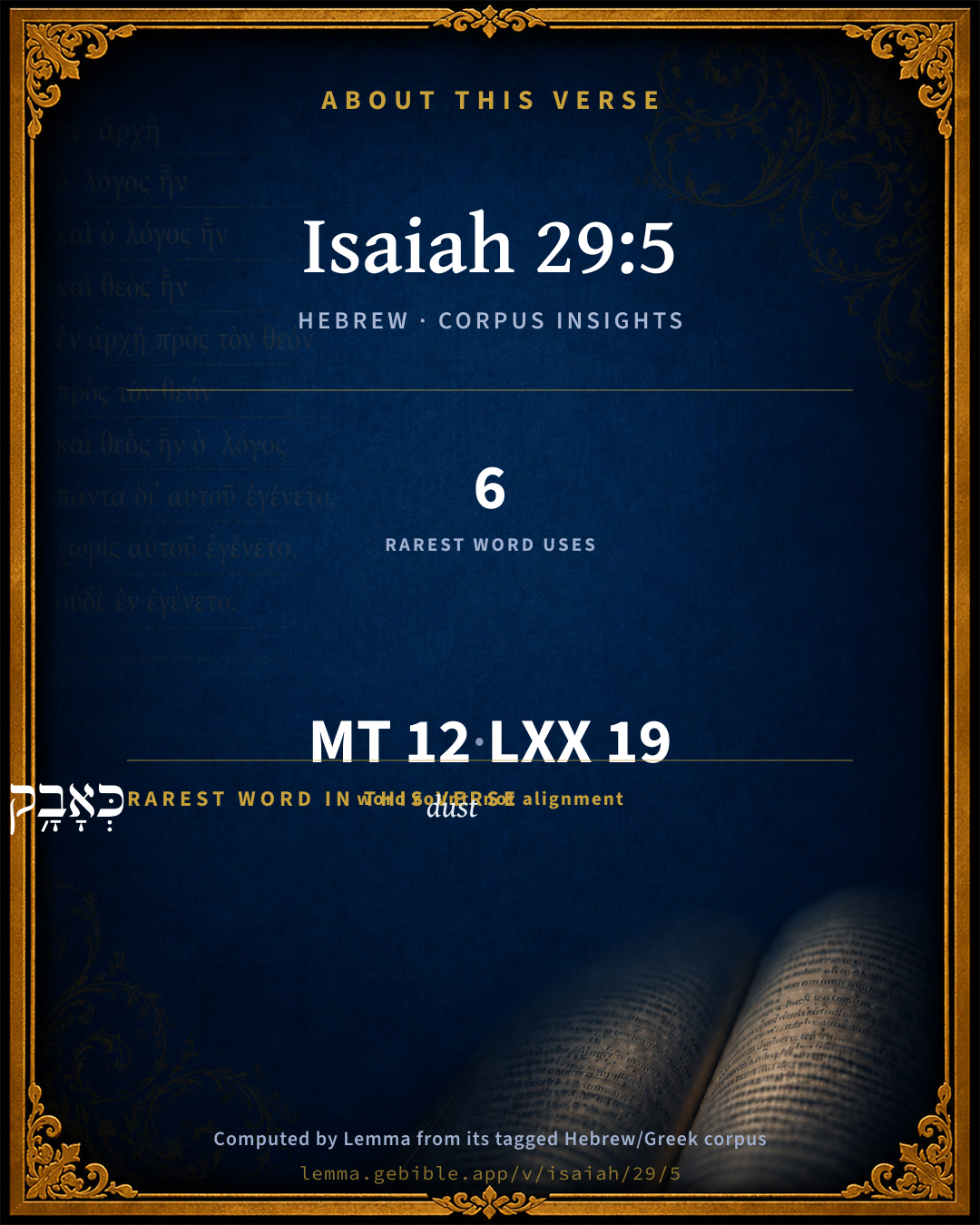
The rarest word here is כְּאָבָ֥ק dust H80 — appearing just 6 times in the whole Hebrew Bible.

Shared distinctive vocabulary

כְּאָבָ֥ק dust H80 occurs in 6 verses of the Hebrew Bible. Also found in:

Grammatical profile

  • 3 verbs
  • 5 nouns
  • 3 adjectives
  • 1 adverb

Verb forms

  • וְהָיָ֛ה Qal · Sequential Perfect
  • עֹבֵר֙ Qal · Participle Active
  • וְהָיָ֖ה Qal · Sequential Perfect

Repetition

Words recur within this verse — often emphatic in Hebrew:

  • וְהָיָ֛ה to be H1961 ×2
  • הֲמ֣וֹן tumult H1995 ×2

Hebrew & Septuagint length

In English translation the verse runs 31 words from the Hebrew and 32 from the Septuagint (LXX English) — closely comparable.

A rough comparison of the two English renderings, which tokenize alike — not a word-level alignment.

Word counts can differ between the Hebrew and the Greek without any difference in meaning — e.g. the Hebrew direct-object marker אֵת has no separate Greek word, and Greek often adds the article ὁ.

In the original languages it is 12 Hebrew tokens and 19 Greek tokens — but the two are counted differently (Hebrew bundles its prefixes and suffixes into one token; the Greek is in lemma form), so that isn’t a like-for-like length.

Cross-references

13

Topical passages linked to Isaiah 29:5 in the Treasury of Scripture Knowledge — connected by theme and wording, ordered by reader-vote popularity; previews shown in the World English Bible.

  • 1 Thessalonians 5:3 For when they are saying, "Peace and safety," then sudden destruction will come on them, like birth pains on a pregnant woman; and they will in no way escape.
  • Isaiah 30:13 therefore this iniquity shall be to you as a breach ready to fall, swelling out in a high wall, whose breaking comes suddenly in an instant.
  • Isaiah 37:36 The angel of Yahweh went forth, and struck in the camp of the Assyrians one hundred and eighty-five thousand; and when men arose early in the morning, behold, these were all dead bodies.
  • Isaiah 17:13–14 The nations shall rush like the rushing of many waters: but he shall rebuke them, and they shall flee far off, and shall be chased as the chaff of the mountains before the wind, and like the whirling dust before the storm.
  • Isaiah 31:3 Now the Egyptians are men, and not God; and their horses flesh, and not spirit: and when Yahweh shall stretch out his hand, both he who helps shall stumble, and he who is helped shall fall, and they all shall be consumed together.
  • Job 21:18 That they are as stubble before the wind, As chaff that the storm carries away?
  • Psalms 1:4 The wicked are not so, But are like the chaff which the wind drives away.
  • Psalms 35:5 Let them be as chaff before the wind, Yahweh's angel driving them on.
  • Psalms 46:5–6 God is in her midst. She shall not be moved. God will help her at dawn.
  • Psalms 76:5–6 Valiant men lie plundered, They have slept their last sleep. None of the men of war can lift their hands.
  • Isaiah 10:16–19 Therefore will the Lord, Yahweh of Hosts, send among his fat ones leanness; and under his glory there shall be kindled a burning like the burning of fire.
  • Isaiah 25:5 As the heat in a dry place will you bring down the noise of strangers; as the heat by the shade of a cloud, the song of the awesome ones shall be brought low.
  • Isaiah 31:8 The Assyrian shall fall by the sword, not of man; and the sword, not of men, shall devour him; and he shall flee from the sword, and his young men shall become subject to forced labor.

Cross-references courtesy of OpenBible.info (CC BY 4.0).

Hebrew and Greek witnesses Masoretic Hebrew ↔ Greek Septuagint

The same verse in the two great witnesses to the Old Testament, shown verse-for-verse.

These are two independent witnesses, not word-aligned to each other, and the Septuagint is shown in lemma (dictionary) form.

Hebrew Isaiah 29:5 Masoretic · Westminster Leningrad Codex

וְהָיָ֛ה כְּאָבָ֥ק דַּ֖ק הֲמ֣וֹן זָרָ֑יִךְ וּכְמֹ֤ץ עֹבֵר֙ הֲמ֣וֹן עָֽרִיצִ֔ים וְהָיָ֖ה לְפֶ֥תַע פִּתְאֹֽם

But the multitude of your foes shall be like small dust, and the multitude of the awesome ones as chaff that passes away: yes, it shall be in an instant suddenly.

World English Bible · Public Domain

Greek LXX Isaiah 29:5 Septuagint · lemma form

καί εἰμί ὡς κονιορτός ἀπό τροχός ὁ πλοῦτος ὁ ἀσεβής καί ὡς χνοῦς φέρω καί εἰμί ὡς στιγμή παραχρῆμα

But the wealth of the ungodly shall be as dust from a wheel, and the multitude of them that oppress you as flying chaff, and it shall be suddenly as a moment,

LXX2012 (modern English Septuagint) · Public Domain

On this verse, Adam Clarke's Commentary discusses the Septuagint’s reading. Read the note in Commentary ↓

Hebrew: Westminster Leningrad Codex (CC BY 4.0). Greek: Septuagint (public domain); English from LXX2012 (modern English Septuagint) (Public Domain). How the Septuagint differs from the Hebrew →

Targum (Aramaic paraphrase)

1

The Targum is the ancient Jewish Aramaic paraphrase of the Hebrew Scriptures — an interpretive translation, not the Hebrew text itself. Onkelos (literal) and Pseudo-Jonathan (expansive) render the Torah, and Jonathan the Prophets. Coverage is partial: where no permissively-licensed English translation exists for a verse, only the Aramaic is shown. This is verse-level text, not a word-by-word alignment to the Hebrew.

  1. Targum Jonathan Prophets (Joshua–Malachi)
    וִיהֵי כְּאָבָק דָקִיק הֲמוֹן מְבַדְרָיִךְ וּכְמוֹץ דְעָדִי אִתְרְגוּשָׁא תַּקִיפִין וִיהֵי בִּתְכֵּיף אִתְרְגוּשָׁא:

    Moreover the multitude of those scattering thee shall be like small dust, and the tumultuous assembly of the mighty as chaff that passeth away; and there shall be a tumult suddenly.

    Targum Jonathan — Aramaic: “Mikraot Gedolot” (public domain). English: “Sefaria Community Translation” (CC0 1.0 (public-domain dedication)); “London "Chaldee Paraphrase," 1871” (public domain). Text via Sefaria.

Commentary

Notes on Isaiah 29:5 from classic Christian and Jewish commentators (each source and its license shown beneath its notes). The classic Christian expositions comment on the surrounding passage and are grouped to its opening verse, so a note may address several verses; the Jewish commentaries on the Tanakh (Rashi and others) are per-verse, so they appear only where the commentator wrote on this verse.

Lemma curates 59 commentaries, every one of them public domain or Creative Commons licensed, each selected and text-cleaned for this edition rather than reprinted as found. About our sources →

Trapp's Complete Commentary

John Trapp

Isa 29:5 Moreover the multitude of thy strangers shall be like small dust, and the multitude of the terrible ones [shall be] as chaff that passeth away: yea, it shall be at an instant suddenly.

Ver. 5. Moreover, the multitude of thy strangers.] Thy foreign auxiliaries; these shall do thee no good, but be blown away as with a whirlwind.

It shall be at an instant, suddenly.] The last siege and sack of Jerusalem was so by a specialty, as is to be read in Josephus. And some interpreters understand this whole chapter of the times of the New Testament, because our Saviour and St Paul do cite some places herehence, and apply the same to those their times, not by way of accommodation only, but as the proper and true sense of the text. {as Mat 15:8-9 Rom 11:8 1Co 1:19}

John Trapp, A Commentary or Exposition upon All the Books of the Old and New Testament (1647–1656) — public domain. Text from a community e-Sword module.

Albert Barnes' Notes on the Bible

Moreover - These verses Isa 29:5, Isa 29:7-8 contain a beautiful description of the destruction of the army of Sennacherib. Though they had laid the plan of a regular siege; though the city, in itself, would not be able to hold out against them, and all was alarm and conscious imbecility within; yet in an instant the siege would be raised, and the advancing hosts of the Assyrians would all be gone.

The multitude of thy strangers - The multitude of the strangers that shall besiege thee; called ‘thy strangers,’ because they besieged, or oppressed thee. The word ‘strangers’ here, as elsewhere, means “foreigners” (see the note at Isa 1:7; compare Isa 2:6; Isa 5:17; Isa 14:1; Isa 25:2, Isa 25:5; Isa 29:5; Isa 60:10).

Shall be like small dust - Light, fine dust that is easily dissipated by the wind.

Of the terrible ones - Of the invading, besieging army, that is so much the object of dread.

As chaff that passeth away - (see the note at Isa 17:13). This image of chaff driven before the wind, to denote the sudden and entire discomfiture of enemies, is common in the Scriptures (see Job 21:18; Psa 1:4; Psa 35:5; Hos 13:13).

Yea, it shall be at an instant suddenly - The forces of Sennacherib were destroyed in a single night by the angel of the Lord (Isa 37:36; the note at Isa 10:12, Isa 10:28-34, note), and the siege of Jerusalem was of course immediately raised.

Albert Barnes' Notes on the Bible (1834–1885) — public domain. Text from a community e-Sword/MySword module.

Joseph Benson's Commentary

Isa 29:5-7. Moreover — Or, rather, But, the multitude of thy strangers — Of the strangers that encamp and fight against thee; shall be like small dust — Dispersed by the least breath of air; and the multitude of the terrible ones — Of the Assyrian army, terrible for courage and ferocity; shall be as the chaff that passeth away — Which is quickly carried away by the wind. Yea, at an instant, suddenly — This dissipation and destruction of thine enemies shall be as instantaneous as it is unexpected. Bishop Lowth, who considers these verses as containing “an admirable description of the destruction of Sennacherib’s army, with a beautiful variety of the most expressive and sublime images, adapted to show the greatness, the suddenness, and horror of the event,” gives us the following elegant and striking translation of them, which will give the reader a more just and enlarged view of their meaning, than any note wherewith we might attempt to explain it: But the multitude of the proud shall be like the small dust; And like the flitting chaff, the multitude of the terrible: Yea, the effect shall be momentary, in an instant. From Jehovah there shall be a sudden visitation, With thunder, and earthquake, and a mighty voice; With storm, and tempest, and flame of devouring fire. And like as a dream, a vision of the night, So shall it be with the multitude of all the nations, that fight against Ariel; And all their armies, and their towers, and those that distress her. The reader will observe, that this view of the passage has the sanction of the Vulgate version, and is approved by Prebendary Lowth, Vitringa, Dr. Waterland, Henry, and several others. Some, however, think that these verses should be connected with the preceding, and that the prophet continues in them to describe the judgment to be inflicted on Jerusalem.

Joseph Benson's Commentary on the Old and New Testaments (1811–1818) — public domain. Text from a community e-Sword module.

Keil & Delitzsch

C. F. Keil & F. Delitzsch

Thus far does the unfolding of the hoi reach. Now follows an unfolding of the words of promise, which stand at the end of Isa 29:1 : "And it proves itself to me as Ariel." Isa 29:5-8 : "And the multitude of thy foes will become like finely powdered dust, and the multitude of the tyrants like chaff flying away; and it will take place suddenly, very suddenly. From Jehovah of hosts there comes a visitation with crash of thunder and earthquake and great noise, whirlwind and tempest, and the blazing up of devouring fire. And the multitude of all the nations that gather together against Ariel, and all those who storm and distress Ariel and her stronghold, will be like a vision of the night in a dream. And it is just as a hungry man dreams, and behold he eats; and when he wakes up his soul is empty: and just as a thirsty man dreams, and behold he drinks; and when he wakes up, behold, he is faint, and his soul is parched with thirst: so will it be to the multitude of the nations which gather together against the mountain of Zion." The hostile army, described four times as hâmōn, a groaning multitude, is utterly annihilated through the terrible co-operation of the forces of nature which are let loose upon them (Isa 30:30, cf., Isa 17:13). "There comes a visitation:" tippâqēd might refer to Jerusalem in the sense of "it will be visited" in mercy, viz., by Jehovah acting thus upon its enemies. But it is better to take it in a neuter sense: "punishment is inflicted." The simile of the dream is applied in two different ways: (1.) They will dissolve into nothing, as if they had only the same apparent existence as a vision in a dream. (2.) Their plan for taking Jerusalem will be put to shame, and as utterly brought to nought as the eating or drinking of a dreamer, which turns out to be a delusion as soon as he awakes. Just as the prophet emphatically combines two substantives from the same verbal root in Isa 29:1, and two adverbs from the same verb in Isa 29:5; so does he place צבא and צבה together in Isa 29:7, the former with על relating to the crowding of an army for the purpose of a siege, the latter with an objective suffix (compare Psa 53:6) to the attack made by a crowded army. The metsōdâh of Ariel (i.e., the watch-tower, specula, from tsūd, to spy)

(Note: In Arabic, also, masâd signifies a lofty hill or mountain-top, from a secondary form of tsud; and massara, to lay the foundations of a fortified city (‛ı̄r mâtsōr, Psa 31:22), from tsūr.))

is the mountain of Zion mentioned afterwards in Isa 29:8. כּאשׁר, as if; comp. Zac 10:6; Job 10:19. אוכל והנּה without הוּא; the personal pronoun is frequently omitted, not only in the leading participial clause, as in this instance (compare Isa 26:3; Isa 40:19; Psa 22:29; Job 25:2; and Khler on Zac 9:12), but also with a minor participial clause, as in Psa 7:10; Psa 55:20, and Hab 2:10. The hungering and thirsting of the waking man are attributed to his nephesh (soul: cf., Isa 32:6; Isa 5:14; Pro 6:30), just because the soul is the cause of the physical life, and without it the action of the senses would be followed by no sensation or experience whatever. The hungry stomach is simply the object of feeling, and everything sensitive in the bodily organism is merely the medium of sensation or feeling; that which really feels is the soul. The soul no sooner passes out of the dreaming state into a waking condition, than it feels that its desires are as unsatisfied as ever. Just like such a dream will the army of the enemy, and that victory of which it is so certain before the battle is fought, fade away into nothing.

Keil & Delitzsch — Biblical Commentary on the Old Testament (1861–1891) — public domain (CC PDM 1.0). Text via the HelloAO Bible API. (Old Testament only.)

Geneva Bible (1599)

Geneva Bible translators

Thine hired soldiers in whom thou trustest, shall be destroyed as dust or chaff in a whirlwind.

Geneva Bible (1599) marginal notes — public domain. Text via Bolls.life.

Jamieson, Fausset & Brown

Robert Jamieson, A. R. Fausset & David Brown

Moreover--rather, "Yet"; yet in this extremity help shall come, and the enemy be scattered.

strangers--foreign enemies, invaders (Isa 25:2).

it shall be--namely, the destruction of the enemy.

at an instant--in a moment (Isa 30:23).

Jamieson, Fausset & Brown — Commentary Critical and Explanatory on the Whole Bible (1871) — public domain (CC PDM 1.0). Text via the HelloAO Bible API.

Adam Clarke's Commentary

Verse 5. The multitude of thy strangers - "The multitude of the proud"] For זריך zarayich, thy strangers, read זדים zedim, the proud, according to the Septuagint; parallel to and synonymous with עריצים aritsim, the terrible, in the next line: the ר resh was at first ד daleth in a MS. See Clarke on Isa 25:2.

The fifth, sixth, and seventh verses contain an admirable description of the destruction of Sennacherib's army, with a beautiful variety of the most expressive and sublime images: perhaps more adapted to show the greatness, the suddenness, and horror of the event, than the means and manner by which it was effected. Compare Isa 30:30-33.

Adam Clarke's Commentary on the Bible (1810–1826) — public domain. Text from a community e-Sword/MySword module.

Ellicott's Commentary for English Readers

(5) Moreover the multitude . . .—Better, But. The words interpret those of Isa_30:28. The tribulation should be great, but it should last but for a while. As in Isa_25:5, the “strangers”—i.e., the “enemies,” and the “terrible ones”—should be brought low. A sudden catastrophe, pointing, probably, to the destruction of Sennacherib’s army, should bring them low. They, too, should pass under the “threshing instrument” of God’s judgments, and be as chaff before the wind.

A Bible Commentary for English Readers, edited by Charles John Ellicott (1878–1897) — public domain. Text from a community e-Sword module.

The Cambridge Bible for Schools and Colleges

gen. ed. J. J. S. Perowne

5. thy strangers] the barbarians who assail thee.

the terrible ones] or the tyrants.

5–8. The discomfiture and dispersion of Zion’s enemies in the hour of their triumph.

The Cambridge Bible for Schools and Colleges (gen. ed. J. J. S. Perowne; Cambridge University Press, 1878–1918) — public domain. Text from a community e-Sword module.

John Gill's Exposition

Moreover, the multitude of thy strangers shall be like small dust,.... Or "of those that fan thee" (q), as the Vulgate Latin Version; and so the Targum,

"of those that scatter thee;''

or of thine enemies, as others; meaning the Romans, who were a strange people to them, who got the dominion over them, and scattered them abroad in the world: and the simile of "small dust", to which they are compared, is not used to express the weakness of them, but the greatness of their number, which was not to be counted, any more than the dust of the earth; see Num 23:10,

and the multitude of the terrible ones shall be as chaff that passeth away; designing the same numerous army of the Romans as before, who were terrible to the Jews: nor does this metaphor signify any imbecility in them, and much less the ruin of them, but their swiftness in executing the judgments of God upon his people, who moved as quick as chaff, or any such light thing, before a mighty wind:

yea, it shall be at an instant suddenly; either the numerous army should be suddenly before Jerusalem, or the destruction of that city should be as it were in a moment; and though the siege of it lasted long, yet the last sack and ruin of it was suddenly, and in so short a time, that it might be said to be in an instant, in a moment, as it were. The Jewish writers interpret this of the sudden destruction of Sennacherib's army by the angel, Kg2 19:35 but the next words show that the destruction of Jerusalem is meant.

(q) "ventilantium te", V. L. "dispergentium te", Vatablus, so Targum; "hostium tuorum", Pagninus, Cocceius.

John Gill's Exposition of the Whole Bible (1746–1763) — public domain (CC PDM 1.0). Text via the HelloAO Bible API.

Haydock's Catholic Bible Commentary

Away. The numbers, and speedy downfall of the Assyrians, are described. (Haydock)

George Leo Haydock (1774–1849), Haydock's Catholic Family Bible and Commentary, 1859 edition — public domain. Excludes Psalms (Douay-Rheims chapter numbering differs from Protestant) and Deuterocanonical books (Catholic canon only).

Matthew Poole's English Annotations

Of thy strangers; either,

1. Of the strangers that encamp and fight against thee. Or,

2. Of the Egyptians, and other strangers, whom thou hast hired to assist thee, as indeed they did, when the Chaldeans came against them. This exposition seems to agree best, as with the phrase, thy strangers, so with the scope of the place, and with the whole context, especially the foregoing verses; which plainly shows that this is not a promise to Jerusalem, but a threatening against it.

Like small dust; quickly blown away with the least wind, by comparing this with the following clause.

Of the terrible ones; of thy great commanders and stoutest soldiers.

It shall be; this dissipation and destruction of thy strangers and terrible ones shall come to pass.

Matthew Poole's English Annotations on the Holy Bible (1683–1685) — public domain. Text from a community e-Sword/MySword module.

Whedon's Commentary on the Bible

Daniel D. Whedon

5-8. Now there is promise. At the close of Isa_29:2 it is stated that Jerusalem shall become God’s altar-fire-hearth — indeed, the burning place of wrath upon her enemies. These verses expand this meaning.

Thy strangers — Foreign invaders.

Small dust — Suddenly the fierce besiegers shall become as dust, or like chaff blown away.

Thou — The enemy.

Shall be visited — Physical agencies shall be employed for a sudden annihilating stroke. The distresses of “Ariel” will pass away as in a moment. The suddenness will make the events seem as a dream to both the besiegers and the besieged. The besieger believed the prize of Jerusalem’s wealth was his; as he was passing his hand to grasp it, it evaded his touch as a flash. The besieged awoke in like manner to find the distress of dreaded capture wholly gone, and himself a free man again. There is scarcely so vivid a picture, in so small a compass, in all literature. It is the experience of nightmare that is given.

Thus far extends the promise attached to the woe-text of Isa_29:1-4. As will soon be seen, however, the people of the city of God’s altar-hearth are still stupid and dull.

Daniel D. Whedon (gen. ed.), Commentary on the Old and New Testaments (1874–1909) — public domain. Text from a community e-Sword module.

The Pulpit Commentary

Vers. 5-8. THE WARNING FOLLOWED BY A PROMISE. It is ever God"s care to prevent men from being "swallowed up with overmuch sorrow". (2Co_2:7) As long as he is not about to "make a full, (Jer_4:27) he mingles promises with his threats, words of cheer with words of warning. So now the prophet is directed to attach to his four verses of denunciation (vers. 1-4) four others of encouragement, and to declare the utter discomfiture of the vast host of enemies which for a time has besieged and "distressed" Ariel.

Moreover; rather, but. The relation of vers. 5-8 to vers. 1-4 is that of contrast. The multitude of thy strangers; i.e. "of thy enemies". (Isa_25:5) In primitive societies every stranger is an enemy; and hence language the formation of primitive men often has one word for the two ideas. In Latin hostis is said to have originally meant "foreigner" (Cic., "De Off"," 1:12). Shall be like small dust. Ground down, i.e. to an impalpable powder rendered utterly weak and powerless. The meaning is determined by the clause which follows, with which it must necessarily be in close accordance. As chaff that passeth away. "Chaff," in Scripture, is always a metaphor for weakness. (comp. Isa_5:24 Isa_17:13 Isa_33:11 Isa_41:15; and see also Psa_1:4 Psa_35:5 Job_21:18 Hos_13:3 Dan_2:35 Zep_2:2) It has no value; man"s object is to get rid of it: a light wind carries it away, and no one inquires whither. Yea, it shall be at an instant suddenly. Dr. Kay says it is "the collapse of Jerusalem" which is here intended. But most other commentators understand, with more reason, the collapse of her enemies (Cheyne, Delitzsch, Vance Smith, Knobel, etc.).

The Pulpit Commentary (1880–1919), ed. H.D.M. Spence-Jones & Joseph S. Exell — public domain. Text from a community e-Sword module.

John Wesley's Explanatory Notes

Strangers - Whom thou hast hired to assist thee, as indeed they did, when the Chaldeans came against them. Terrible ones - Thy great commanders, and stout soldiers. It - This destruction of thy strangers, and terrible ones shall come to pass.

John Wesley, Explanatory Notes Upon the Whole Bible (1754–1765) — public domain. Text via the GEBible commentary corpus.

J. A. Alexander on Isaiah

Joseph Addison Alexander

“They shall be like fine dust the multitude of thy strangers, and like passing chaff the multitude of the terrible ones, and it shall be in a moment suddenly.” It is now very commonly agreed, that this verse describes the sudden and complete dispersion of their enemies. The absence of ‘but’ at the beginning, or some other indication that the writer is about to pass from threats to promises, although it renders the connection more obscure, increases the effect of the description. The terms of this verse readily suggest the sudden fall of the Assyrian host, nor is there any reason for denying that the Prophet had a view to it in choosing his expressions. But that this is an explicit and specific prophecy of that event is much less probable, as well because the terms are in themselves appropriate to any case of sudden and complete dispersion, as because the context contains language wholly inappropriate to the slaughter of Sennacherib’s army. These considerations, although negative and inconclusive in themselves, tend strongly to confirm the supposition founded on the last part of the chapter, that the first contains a strong metaphorical description of the evils which Jerusalem should suffer at the hands of enemies, but without exclusive reference to any one siege, or to sieges in the literal sense at all. That the evils which the last part of the chapter brings to light are of a spiritual nature, and not confined to any single period, is a fact which seems to warrant the conclusion, or at least to raise a strong presumption, that the Ariel of this passage is Zion or Jerusalem, considered only as the local habitation of the church.

Joseph Addison Alexander, The Prophecies of Isaiah (1846–1847; New York: Scribner, 1870–1878) — public domain. Text from a community e-Sword module.

unfoldingWord translationNotes

Door43 World Missions Community

The great number of your invaders will become like fine dust, and the multitude of the ruthless ones as chaff that passes away

This emphasizes how weak and insignificant the invading army is before God. AT: "Yahweh will easily remove the horde of your invaders and the multitude of the ruthless ones"(See: Simile)

great number of your invaders

"many soldiers that will attack you"

the ruthless ones as chaff

The translator can supply the verb "will become." AT: "the soldiers who show you no mercy will become as chaff" (See: Ellipsis)

Yahweh of hosts will come to you

The word "you" refers to the people of Jerusalem. Possible meanings are 1) "Yahweh of hosts will come to help you" or 2) "Yahweh of hosts will come to punish you." (See: Forms of You)

translationWords

chaff

punish

Yahweh of hosts

devour

fire

unfoldingWord translationNotes — © Distant Shores Media and the Door43 World Missions Community, licensed CC BY-SA 4.0. Source: git.door43.org/Door43/en_tn.

Rashi

Rabbi Shlomo Yitzchaki (Rashi)

And the multitude of your foreigners shall be like fine dust The army of Sennacherib, which will be consumed by fire and will become dust.

and it shall be this thing.

a sudden happening (לְפֶתַע פִּתְאֹם) a sudden happening.

Rashi on the Tanakh — English translations: “The Judaica Press complete Tanach with Rashi, translated by A. J. Rosenberg” (CC BY 4.0); “Pentateuch with Rashi's commentary by M. Rosenbaum and A.M. Silbermann, 1929-1934” (public domain); “The Metsudah Tanach series, Lakewood, N.J” (CC BY 4.0); and “The Book of Joshua, Metsudah Publications, 1997” (CC BY 4.0). Text via Sefaria.

Ibn Ezra

Rabbi Abraham ibn Ezra

כאבק דק Like small dust. Some word must be supplied, because of אבק being in the construct state.

The multitude of thy strangers. The army of the Assyrians. Yet it shall be at an instant, suddenly. All this, mentioned before, shall take place suddenly.

Ibn Ezra on the Tanakh — English translations: “Sefaria Community Translation” (CC0 1.0 (public-domain dedication)); “Yalkut, Sifsei Chachomim Chumash, Metsudah Publications, 2009” (CC BY 4.0); and “Commentary of Ibn Ezra on Isaiah - trans. by M. Friedlander, 1873” (public domain). Text via Sefaria.

Lesson kit

Teaching starters — assembled from the data on this page, not authored interpretation. Every prompt links to the verse data it draws on. Edit before teaching.

Isaiah, in the Prophets, opens this verse with 12 words (10 distinct Hebrew lemmas). Its most distinctive word is ʼâbâq (“dust”). A historical commentator’s framing appears above. Read the whole chapter for the surrounding context.

Discussion questions

  1. What does “dust” (ʼâbâq) contribute to the verse as a whole?
  2. How does Exodus 9:9, which shares the word «dust», read alongside this verse?
  3. What does the repetition of “to be” (2× in this one verse) do in this verse?
  4. The translations on this page render this verse differently — a whole-verse word diff, not a word-by-word alignment. What might account for the different wordings?
  5. «וְהָיָ֛ה» is a Qal Sequential Perfect verb. How does that grammatical form shape the action described?
  6. Compare how Trapp's Complete Commentary and Albert Barnes' Notes on the Bible read this verse. Where do they agree or differ?

Things to notice

Reading settings

Reading text

Shown beneath each verse's original-language words.

Old Testament
Old Testament edition

Read the OT as the Masoretic Hebrew (MT) or the Greek Septuagint (LXX).

English shown for the Greek Septuagint (in the Hebrew ↔ Greek comparison).

Comparing translations? Open the Compare panel on any verse page to stack up to four side by side.