Psalms 81:7

Hebrew (Westminster Leningrad Codex) Psalms 81:7 appears in the Hebrew Old Testament. The text above is from the Westminster Leningrad Codex. Each word links to its Strong’s number, a concise gloss, and parsing drawn from the Open Scriptures Hebrew Bible morphology. Click any word for its full Brown-Driver-Briggs (BDB) entry.
Download image
Cite this verse

Psalms 81:7 (World English Bible). Public Domain. Lemma interlinear Bible study tool, https://lemma.gebible.app/v/psalms/81/7.

Show BibTeX & RIS
BibTeX
RIS
English Translation
You called in trouble, and I delivered you. I answered you in the secret place of thunder. I tested you at the waters of Meribah." Selah.
World English Bible · Public Domain
Download a study sheet

One document with this verse’s original text, its word-by-word gloss line, the meaning frame, cross-references with their text, attributed commentary, and full source and license credits — printable, and it pastes into notes with its structure intact.

This verse Autodidact and up

Study sheet (.html) Plain text (.txt)

A passage Seminary Student

Up to 50 verses in one chapter. A passage sheet keeps up to 6 commentary sources and 12 cross-references per verse, in the order this page ranks them, and says so on the sheet whenever that leaves anything out. Ask for a single verse and you get the Autodidact verse sheet above.

Everything on this page stays free to read, with no account — the sheet is a download of what is already on screen, not access to it.

Want to remove ads? Support Godless Engineer
Compare translations 3

The same verse in 3 English versions, stacked beneath the original-language interlinear above. Click any original word for its lexicon entry.

Each is an independent rendering of the whole verse — the interlinear is not word-aligned to these translations.

Highlighted words mark where these versions differ — a whole-verse word diff, not a word-by-word alignment.

  • World English Bible Public Domain
    You called in trouble, and I delivered you. I answered you in the secret place of thunder. I tested you at the waters of Meribah." Selah.
  • King James Version Public Domain
    Thou calledst in trouble, and I delivered thee; I answered thee in the secret place of thunder: I proved thee at the waters of Meribah. Selah.
  • unfoldingWord Literal Text CC BY-SA 4.0
    In distress you called, and I delivered you; I answered you from the secret place of thunder. I tested you at the waters of Meribah. Selah

unfoldingWord Literal Text — © unfoldingWord, licensed CC BY-SA 4.0. Word-aligned USFM3 via Door43 (git.door43.org/unfoldingWord/en_ult).

Versions to compare (up to 4)

3 of 4 selected

Show all 18 translations

Every available English version of this verse, each an independent rendering of the whole verse.

  • World English Bible Public Domain
    You called in trouble, and I delivered you. I answered you in the secret place of thunder. I tested you at the waters of Meribah." Selah.
  • Berean Standard Bible Public Domain
    You called out in distress, and I rescued you; I answered you from the cloud of thunder; I tested you at the waters of Meribah. Selah
  • Majority Standard Bible Public Domain
    You called out in distress, and I rescued you; I answered you from the cloud of thunder; I tested you at the waters of Meribah. Selah
  • King James Version Public Domain
    Thou calledst in trouble, and I delivered thee; I answered thee in the secret place of thunder: I proved thee at the waters of Meribah. Selah.
  • American Standard Version (1901) Public Domain
    Thou calledst in trouble, and I delivered thee; I answered thee in the secret place of thunder; I proved thee at the waters of Meribah. Selah
  • Revised Version (1885) Public Domain
    Thou calledst in trouble, and I answered thee in the secret place of thunder; I proved thee at the waters of Meribah. Selah
  • Geneva Bible (1599) Public Domain
    Thou calledst in affliction and I deliuered thee, and answered thee in the secret of the thunder: I prooued thee at the waters of Meribah. Selah.
  • Douay-Rheims (1899) Public Domain
    He removed his back from the burdens: his hands had served in baskets.
  • Young's Literal Translation Public Domain
    In distress thou hast called and I deliver thee, I answer thee in the secret place of thunder, I try thee by the waters of Meribah. Selah.
  • Literal Standard Version CC BY-SA 4.0
    In distress you have called and I deliver you, || I answer you in the secret place of thunder, || I try you by the waters of Meribah. Selah.
  • Unlocked Literal Bible CC BY-SA 4.0
    In your distress you called out, and I helped you; I answered you from a dark thundercloud. I tested you at the waters of Meribah. Selah
  • unfoldingWord Literal Text CC BY-SA 4.0
    In distress you called, and I delivered you; I answered you from the secret place of thunder. I tested you at the waters of Meribah. Selah
  • Darby Bible Public Domain
    Thou calledst in trouble, and I delivered thee; I answered thee in the secret place of thunder; I proved thee at the waters of Meribah. Selah.
  • World Messianic Bible Public Domain
    You called in trouble, and I delivered you. I answered you in the secret place of thunder. I tested you at the waters of Meribah.” Selah.
  • Webster's Bible Public Domain
    \\81:6\\I removed his shoulder from the burden: his hands were delivered from the pots.
  • Free Bible Version CC BY-SA 4.0
    In your suffering you cried out to me, and I saved you. I answered you from the thundercloud. I tested you at the waters of Meribah. Selah.
  • Bible in Basic English Public Domain
    You gave a cry in your trouble, and I made you free; I gave you an answer in the secret place of the thunder; I put you to the test at the waters of Meribah. (Selah.)
  • JPS Tanakh (1917) Public Domain
    (81-8) Thou didst call in trouble, and I rescued thee; I answered thee in the secret place of thunder; I proved thee at the waters of Meribah. Selah

Literal Standard Version (2020), Covenant Press — licensed CC BY-SA 4.0. Text via the HelloAO Bible API (eBible.org). Unlocked Literal Bible (unfoldingWord) — licensed CC BY-SA 4.0. Text via the HelloAO Bible API (eBible.org). unfoldingWord Literal Text — © unfoldingWord, licensed CC BY-SA 4.0. Word-aligned USFM3 via Door43 (git.door43.org/unfoldingWord/en_ult). Free Bible Version, Dr. Jonathan Gallagher — licensed CC BY-SA 4.0. Text via the HelloAO Bible API (eBible.org).

Word by word

More ways to search: Search by grammar → Find every occurrence → Compare this word →

Practice this passage: Drill this verse → Learn its vocabulary →

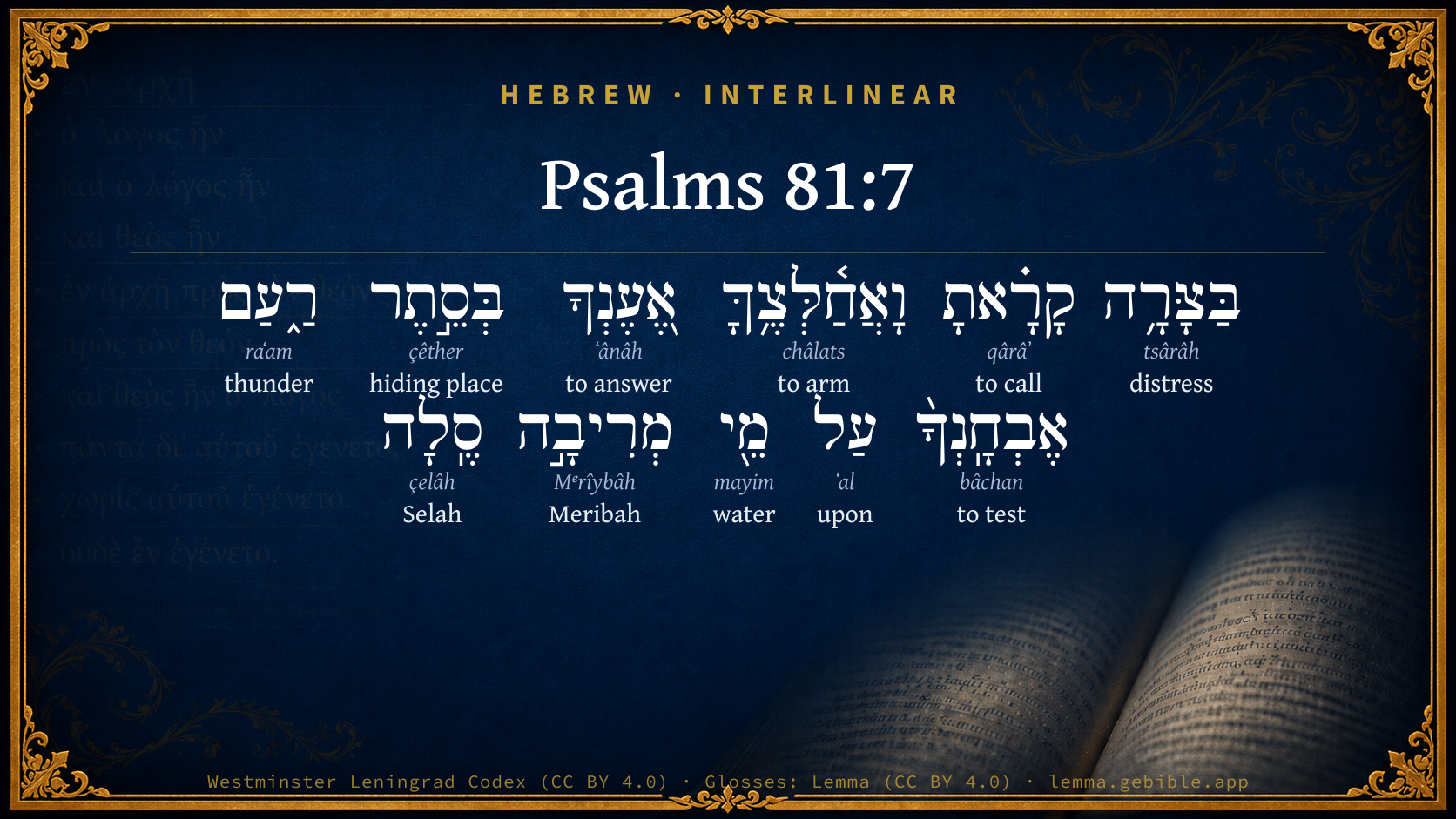
רַ֑עַם
raʻam
H7482
“thunder”
Noun, Common, Masculine, Singular, Absolute
Part of Speech
Noun
Type
Common
Gender
Masculine
Number
Singular
State
Absolute
Full BDB Definition

Origin: from H7481

TWOT: 2189a

thunder
  1. בַּצָּרָ֥ה tsârâh H6869 “in/at the · distress” Preposition, Determined + Noun, Common, Feminine, Singular, Absolute
  2. קָרָ֗אתָ qârâʼ H7121 “to call” Verb, Qal, Perfect, 2nd Person, Masculine, Singular
  3. וָאֲחַ֫לְּצֶ֥ךָּ châlats H2502 “and · to arm · you” Conjunction + Verb, Piel, Sequential Imperfect, 1st Person, Common, Singular + Suffix, Personal, 2nd Person, Masculine, Singular
  4. אֶ֭עֶנְךָ ʻânâh H6030 “to answer · you” Verb, Qal, Imperfect, 1st Person, Common, Singular + Suffix, Personal, 2nd Person, Masculine, Singular
  5. בְּסֵ֣תֶר çêther H5643 “in/at · hiding place of” Preposition + Noun, Common, Masculine, Singular, Construct
  6. אֶבְחָֽנְךָ֨ bâchan H974 “to test · you” Verb, Qal, Imperfect, 1st Person, Common, Singular + Suffix, Personal, 2nd Person, Masculine, Singular
  7. עַל ʻal H5921 “upon” Preposition
  8. מֵ֖י mayim H4325 “water(s) of” Noun, Common, Masculine, Plural, Construct
  9. מְרִיבָ֣ה Mᵉrîybâh H4809 “Meribah” Noun, Proper
  10. סֶֽלָה çelâh H5542 “Selah” Particle, Interjection

About this verse

These counts appear in no published source. They are computed here, from the morphology-tagged text and Lemma’s own curated glosses. What Lemma adds →

11
words
11
distinct lemmas
Wisdom
section

Notable vocabulary

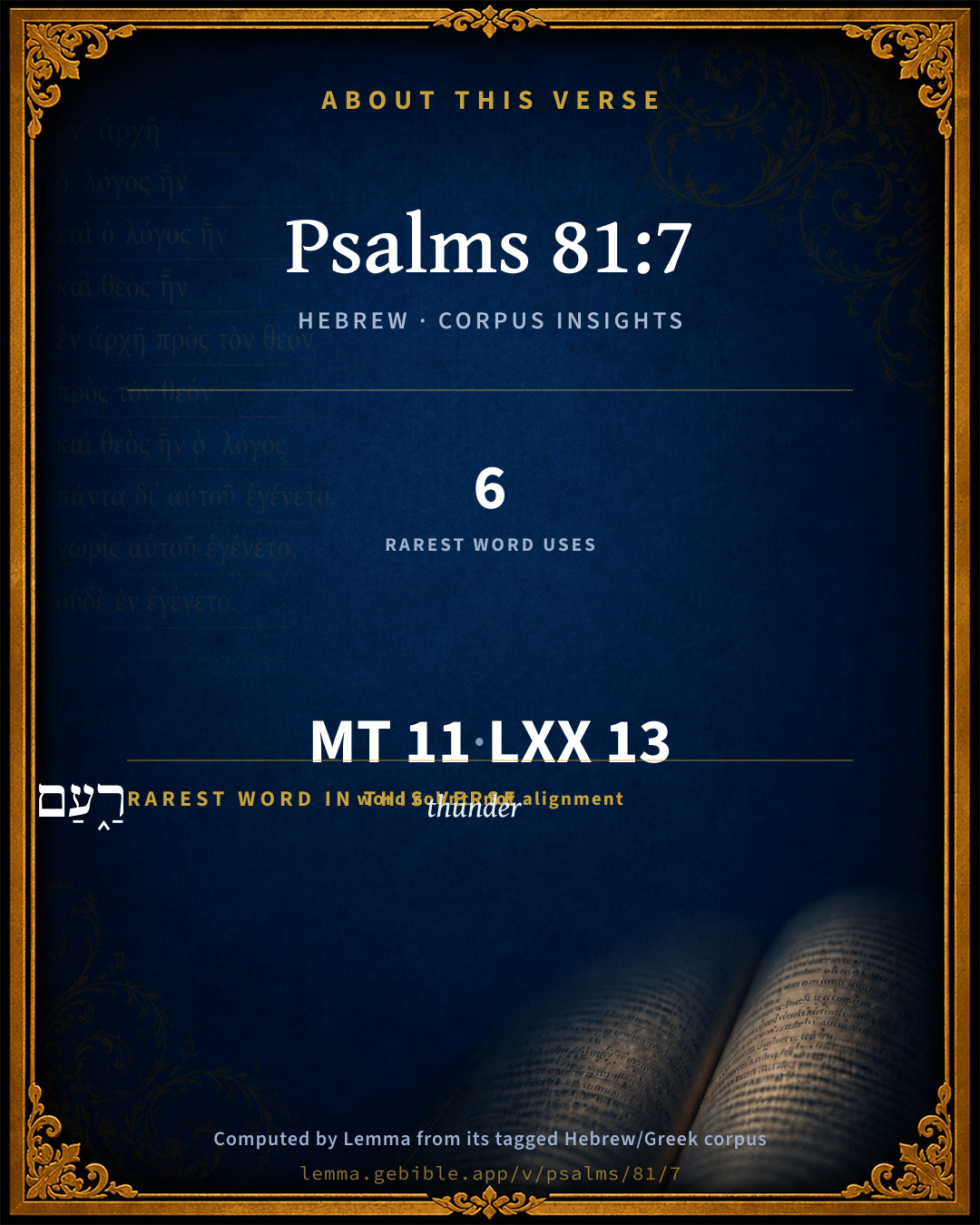
The rarest word here is רַ֑עַם thunder H7482 — appearing just 6 times in the whole Hebrew Bible.

Shared distinctive vocabulary

רַ֑עַם thunder H7482 occurs in 6 verses of the Hebrew Bible. Also found in:

Grammatical profile

  • 4 verbs
  • 5 nouns
  • 1 preposition
  • 1 particle

Verb forms

  • קָרָ֗אתָ Qal · Perfect
  • וָאֲחַ֫לְּצֶ֥ךָּ Piel · Sequential Imperfect
  • אֶ֭עֶנְךָ Qal · Imperfect
  • אֶבְחָֽנְךָ֨ Qal · Imperfect

Hebrew & Septuagint length

In English translation the verse runs 26 words from the Hebrew and 30 from the Septuagint (LXX English) — closely comparable.

A rough comparison of the two English renderings, which tokenize alike — not a word-level alignment.

Word counts can differ between the Hebrew and the Greek without any difference in meaning — e.g. the Hebrew direct-object marker אֵת has no separate Greek word, and Greek often adds the article ὁ.

In the original languages it is 11 Hebrew tokens and 13 Greek tokens — but the two are counted differently (Hebrew bundles its prefixes and suffixes into one token; the Greek is in lemma form), so that isn’t a like-for-like length.

Cross-references

12

Topical passages linked to Psalms 81:7 in the Treasury of Scripture Knowledge — connected by theme and wording, ordered by reader-vote popularity; previews shown in the World English Bible.

  • Exodus 19:19 When the sound of the trumpet grew louder and louder, Moses spoke, and God answered him by a voice.
  • Exodus 2:23 It happened in the course of those many days, that the king of Egypt died, and the children of Israel sighed because of the bondage, and they cried, and their cry came up to God because of the bondage.
  • Numbers 20:13 These are the waters of Meribah; because the children of Israel strove with Yahweh, and he was sanctified in them.
  • Psalms 50:15 Call on me in the day of trouble. I will deliver you, and you will honor me."
  • Exodus 14:10 When Pharaoh drew near, the children of Israel lifted up their eyes, and behold, the Egyptians were marching after them; and they were very afraid. The children of Israel cried out to Yahweh.
  • Exodus 14:30–31 Thus Yahweh saved Israel that day out of the hand of the Egyptians; and Israel saw the Egyptians dead on the seashore.
  • Psalms 91:14–15 "Because he has set his love on me, therefore I will deliver him. I will set him on high, because he has known my name.
  • Exodus 14:24 It happened in the morning watch, that Yahweh looked out on the host of the Egyptians through the pillar of fire and of cloud, and confused the Egyptian army.
  • Exodus 17:2–7 Therefore the people quarreled with Moses, and said, "Give us water to drink." Moses said to them, "Why do you quarrel with me? Why do you test Yahweh?"
  • Deuteronomy 33:8 Of Levi he said, Your Thummim and your Urim are with your godly one, Whom you did prove at Massah, With whom you did strive at the waters of Meribah;
  • Exodus 20:18–21 All the people perceived the thunderings, the lightnings, the sound of the trumpet, and the mountain smoking. When the people saw it, they trembled, and stayed at a distance.
  • Numbers 20:24 Aaron shall be gathered to his people; for he shall not enter into the land which I have given to the children of Israel, because you rebelled against my word at the waters of Meribah.

Cross-references courtesy of OpenBible.info (CC BY 4.0).

Hebrew and Greek witnesses Masoretic Hebrew ↔ Greek Septuagint

The same verse in the two great witnesses to the Old Testament, shown verse-for-verse.

You’re reading Greek Psalm 80 (Hebrew Psalm 81). The Septuagint counts the superscription, so verse numbers can differ from the Hebrew — chapter-level alignment, not verse-by-verse. Numbering follows Rahlfs.

These are two independent witnesses, not word-aligned to each other, and the Septuagint is shown in lemma (dictionary) form.

Hebrew Psalms 81:7 Masoretic · Westminster Leningrad Codex

בַּצָּרָ֥ה קָרָ֗אתָ וָאֲחַ֫לְּצֶ֥ךָּ אֶ֭עֶנְךָ בְּסֵ֣תֶר רַ֑עַם אֶבְחָֽנְךָ֨ עַל מֵ֖י מְרִיבָ֣ה סֶֽלָה

You called in trouble, and I delivered you. I answered you in the secret place of thunder. I tested you at the waters of Meribah." Selah.

World English Bible · Public Domain

Greek LXX Greek Psalm 80:7 Septuagint · lemma form

ἀποἵστημι ἀπό ἄρσις ὁ νῶτον αὐτός ὁ χείρ αὐτός ἐν ὁ κόφινος δουλεύω

You did call upon me in trouble, and I delivered you; I heard you in the secret place of the storm: I proved you at the water of Strife. Pause.

LXX2012 (modern English Septuagint) · Public Domain

Hebrew: Westminster Leningrad Codex (CC BY 4.0). Greek: Septuagint (public domain); English from LXX2012 (modern English Septuagint) (Public Domain). How the Septuagint differs from the Hebrew →

Commentary

Notes on Psalms 81:7 from classic Christian and Jewish commentators (each source and its license shown beneath its notes). The classic Christian expositions comment on the surrounding passage and are grouped to its opening verse, so a note may address several verses; the Jewish commentaries on the Tanakh (Rashi and others) are per-verse, so they appear only where the commentator wrote on this verse.

Lemma curates 59 commentaries, every one of them public domain or Creative Commons licensed, each selected and text-cleaned for this edition rather than reprinted as found. About our sources →

Trapp's Complete Commentary

John Trapp

Psa 81:7 Thou calledst in trouble, and I delivered thee; I answered thee in the secret place of thunder: I proved thee at the waters of Meribah. Selah.

Ver. 7. Thou calledst in trouble] Their trouble called, though themselves had been silent. I have seen, I have seen the afflictions of my people, &c., but they cried to the Lord at the Red Sea, Exo 14:10; Exo 14:15, and were delivered.

I answered thee in the secret place of thunder] i.e. In the pillar of cloud that stood between the two armies, and thundered against the Egyptians, Exo 14:24; confer Lam 3:44.

I proved thee at the waters of Meribah] When thou hadst but newly foot out of snare, and yet there and then thou showedst thyself. O thine ungratefulness, &c. This hath been thy manner from thy youth.

John Trapp, A Commentary or Exposition upon All the Books of the Old and New Testament (1647–1656) — public domain. Text from a community e-Sword module.

The Biblical Illustrator

Joseph S. Exell

Psa_81:7

I answered thee in the secret place of thunder.

Answers to prayer often come mysteriously

God has a thousand secret ways of granting our requests.

I. He may do it by a wave of air. A man is the subject of a painful disease, that seems progressing to the utter extinction of his life; for the sake of others depending on him, he implores his Maker to restore him. A fresh breeze from heaven is let into his chamber, it not only sweeps his foul room, but heaves his lungs with a new force, oxygenizes his blood, and quickens his pulses with a new vitality. Wave after wave continues to play around him until he is able to rise from his couch and go into the open fields. God has answered him from the secret place of thunder.

II. He may do it by the birth of a thought, The good man may be enfolded in darkness, wrapped in perplexities, so utterly embarrassed by his circumstances that he knows not what step to take next. He cries to Heaven for guidance; all worldly resources have failed. A new thought springs up in his mind, solves his problems, scatters his darkness, removes his embarrassments, reveals a path to enter, safe and sunny, full of promise. He pursues it, and all is right. His prayer is answered from the secret place of thunder.

III. He may do it by the visit of a friend. As he talks, the burden of sorrow falls from his heart, and he breathes once more the free air of hope. His prayer has been answered from the secret place of thunder.

IV. He may do it by a verse of scripture. (Homilist.)

The place of thunder

As there is a secret place of natural thunder, there is a secret place of moral thunder. In other words, the religious power that you see abroad in the Church and in the world has a hiding-place, and in many cases it is never discovered at all. I will use a similitude. Many years ago there was a large church. It was characterized by strange and unaccountable conversions. There were no great revivals, but individual cases of spiritual arrest and transformation. A young man sat in one of the front pews. He was a graduate of Yale, brilliant and dissolute. Everybody knew him and liked him for his geniality, but deplored his moral errantry. To please his parents he was every Sabbath morning in church. One day there was a ringing of the door-bell of the pastor of that church, and that young man, overwhelmed with repentance, implored prayer and advice, and passed into complete reformation of heart and life. All the neighbourhood was astonished, and asked, Why was this? His father and mother had said nothing to him about his souls welfare. In the course of two years, though there was no general awakening in that church, many such isolated cases of unexpected and unaccountable conversions took place. The very people whom no one thought would be affected by such considerations were converted. The pastor and the officers of the church were on the look-out for the solution of this religious phenomenon. Where is it, they said, and who is it, and what is it? At last the discovery was made and all was explained. A poor old Christian woman standing in the vestibule of the church one Sunday morning, trying to get her breath again before she went up-stairs to the gallery, heard the inquiry and told the secret. For years she had been in the habit of concentrating all her prayers for particular persons in that church. She would see some man or some woman present, and, though she might not know the persons name, she would pray for that person until he or she was converted to God. All her prayers were for that one person--just that one. She waited and waited for communion days to see when the candidates for membership stood up whether her prayers had been effectual. It turned out that these marvellous instances of conversion were the result of that old womans prayers as she sat in the gallery Sabbath by Sabbath, bent and wizened and poor and unnoticed. That was the secret place of the thunder. The day will come--God hasten it-when people wilt find out the velocity, the majesty, the multipotence of prayer. O ye who are wasting your breath and wasting your brains and wasting your nerves and wasting your lungs wishing for this good and that good for the Church and the world, why do you not go into the secret place of thunder? But, says some one, that is a beautiful theory, yet it does not work in my case, for I am in a cloud of trouble or a cloud of sickness or a cloud of persecution or a cloud of poverty or a cloud of bereavement or a cloud of perplexity. How glad I am that you told me that. That is exactly the place to which my text refers. It was from a cloud that God answered Israel--the cloud over the chasm cut through the Red Sea--the cloud that was light to the Israelites and darkness to the Egyptians. It was from a cloud, a tremendous cloud, that God made reply. It was a cloud that was the secret place of thunder. So you cannot get away from the consolation of my text by talking that way. Let all the people under a cloud hear it. I answered thee in the secret place of thunder. (T. De Witt Talmage.)

The Biblical Illustrator, edited by Joseph S. Exell (c. 1880s–1900s) — public domain. Text from a community e-Sword module.

J. A. Alexander on Psalms

Joseph Addison Alexander

8. (Psa 81:7) In distress thou hast called and I have delivered thee; I will (yet) answer thee in the secret place of thunder; I will try thee at the waters of Strife. The secret or hiding place of thunder is the dark cloud charged with tempest which overhung mount Sinai at the giving of the law (Exo 20:18). This is here anticipated or predicted, as well as the murmuring of the people at Meribah (Exodus 17, Numbers 20.) as a signal instance of their unbelief and disobedience. Thus understood, the verse continues the words of God himself, at the crisis of the exodus. According to the other exegeti-cal hypothesis already mentioned, there is here a sudden change of speaker, and the future verbs in this verse are to be explained as historical presents.

Joseph Addison Alexander, The Psalms Translated and Explained (1850) — public domain. Text from a community e-Sword module.

Geneva Bible (1599)

Geneva Bible translators

By a strange and wonderful fashion.

Or, contention, Exod. 17:7.

Geneva Bible (1599) marginal notes — public domain. Text via Bolls.life.

Adam Clarke's Commentary

Verse 7. Thou calledst in trouble] They had cried by reason of their burdens, and the cruelty of their task-masters; and God heard that cry, and delivered them. See Ex 3:7, c.

In the secret place of thunder] On Mount Sinai where God was heard, but not seen. They heard a voice, but they saw no shape.

At the waters of Meribah.] See this transaction, Ex 17:1, &c.

Adam Clarke's Commentary on the Bible (1810–1826) — public domain. Text from a community e-Sword/MySword module.

John Calvin's Commentaries

7 Thou didst cry in trouble, and I delivered thee. Here the same subject is prosecuted. By their crying when they were in distress, I understand the prayers which they then offered to God. It sometimes happens that those who are reduced to extremity bewail their calamities with confused crying; but as this afflicted people still had in them some remains of godliness, and as they had not forgotten the promise made to their fathers, I have no doubt that they directed their prayers to God. Even men without religion, who never think of calling upon God, when they are under the pressure of any great calamity, are moved by a secret instinct of nature to have recourse to Him. This renders it the more probable that the promise was, as it were, a schoolmaster to the Israelites, leading them to look to God. As no man sincerely calls upon Him but he who trusts in him for help; this crying ought the more effectually to have convinced them that it was their duty to ascribe to Him alone the deliverance which was offered them. By the secret place of thunder some, in my opinion, with too much refinement of interpretation, understand that God by thundering rendered the groanings of the people inaudible to the Egyptians, that by hearing them the Egyptians might not become the more exasperated. But the meaning simply is, that the people were heard in a secret and wonderful manner, while, at the same time, manifest tokens were given by which the Israelites might be satisfied that they were succoured by the Divine hand. God, it is true, was not seen by them face to face; but the thunder was an evident indication of his secret presence among them. To make them prize more highly this benefit, God upbraidingly tells them that they were unworthy of it, having given such a manifest proof at the waters of Meribah, that they were of a wicked and perverse disposition, Exodus 17:7. Your wickedness, as if he had said, having at that time so openly shown itself, surely it must from this be incontrovertible that my favor to you did not proceed from any regard to your good desert. This rebuke is not less applicable to us than to the Israelites; for God not only heard our groanings when we were afflicted under the tyranny of Satan, but before we were born appointed his only begotten Son to be the price of our redemption; and afterwards, when we were his enemies, he called us to be partakers of his grace, illuminating our minds by his gospel and his Holy Spirit; while we, notwithstanding, continue to indulge in murmuring, yea, even proudly rebel against Him.

John Calvin's Commentaries (1540-1563) — public domain. Text from the Calvin Translation Society English edition (1840s-50s) via the Christian Classics Ethereal Library (ccel.org). Calvin's coverage is partial (roughly two-thirds of the Bible); uncommented books and verses are honest gaps, never fabricated. The 19th-century editor's footnotes and remarks are omitted so the notes are faithfully Calvin's own voice.

Ellicott's Commentary for English Readers

(7) Thou calledst.—The recital of God’s past dealings with the people usual at the Feast of the Tabernacles (Deu_31:10-13; Neh_8:18) appears to follow here as if the feast were actually in progress and the crowd were listening to the psalmist.

I answered thee in the secret place of thunder.—Mr. Burgess is undoubtedly right in taking the verb as from ânan, “to cover,” instead of ânah, “to answer.” I sheltered thee in the thundercloud, with plain allusion to the “cloudy pillar.” The same verb is used in Psa_105:39, “He spread out the cloud for a covering.”

A Bible Commentary for English Readers, edited by Charles John Ellicott (1878–1897) — public domain. Text from a community e-Sword module.

The Cambridge Bible for Schools and Colleges

gen. ed. J. J. S. Perowne

7. From the divine decree for Israel’s liberation the transition to an address to Israel is easy. Israel of the present is regarded as one with Israel of the past.

Thou calledst &c.] For the phrase cp. Psa_50:15; and for the fact, Exo_2:23 ff.

in the secret place of thunder] In the covert of the thunder-cloud God conceals and reveals Himself (Psa_18:11; Psa_18:13; Psa_77:17 ff.). At the passage of the Red Sea, when Israel was sore afraid and cried out unto Jehovah, He “looked forth upon the host of the Egyptians through the pillar of fire and of cloud, and discomfited the host of the Egyptians” (Exo_14:10; Exo_14:24).

I proved thee at the waters of Meribah] Testing thy faith and obedience. The name Meribah or Strife was a reminder of repeated unbelief and ingratitude (Exo_17:7; Num_20:13; Psa_78:20); of the long ‘controversy’ (Mic_6:2) of a long-suffering God with an obstinate people. It is possible that the reference to this miracle in particular was suggested by the libations of water at the Feast of Tabernacles, which commemorated the supply of water in the wilderness.

The Cambridge Bible for Schools and Colleges (gen. ed. J. J. S. Perowne; Cambridge University Press, 1878–1918) — public domain. Text from a community e-Sword module.

John Gill's Exposition

Thou calledst in trouble, and I delivered thee,.... That is, when Israel were in trouble in Egypt, as the Targum adds, and they cried unto the Lord in their distress, he heard them, and answered them, and sent them a deliverer, and brought them out of all their troubles, Exo 3:7.

I answered thee in the secret place of thunder; by bringing the plague of thunder and lightnings upon the Egyptians, when the Israelites were hidden from them; a sense given by some, as Kimchi observes: or rather this was done when the Lord looked out of the pillar of cloud at the Red sea upon the Egyptian host, and troubled them; at which time the voice of his thunder was heard in heaven, Psa 77:16. Some think this has reference to the thunder at the giving of the law on Mount Sinai; but the sense before given is best:

I proved thee at the waters of Meribah; by withholding water from them to try them, and see whether they would behave patiently, and put their trust and confidence in the Lord, or not; see Exo 17:4.

Selah. See Gill on Psa 3:2.

John Gill's Exposition of the Whole Bible (1746–1763) — public domain (CC PDM 1.0). Text via the HelloAO Bible API.

Albert Barnes' Notes on the Bible

Thou calledst in trouble - The people of Israel. Exo 2:23; Exo 3:9; Exo 14:10.

And I delivered thee - I brought the people out of Egypt.

I answered thee in the secret place of thunder - That is, in the lonely, retired, solemn place where the thunder rolled; the solitudes where there was no voice but the voice of thunder, and where that seemed to come from the deep recesses of the mountain gorges. The allusion is doubtless to Sinai. Compare Exo 19:17-19. The meaning is, that he gave a response - a real reply - to their prayer - amid the solemn scenes of Sinai, when he gave them his law; when he recognized them as his people; when he entered into covenant with them.

I proved thee - I tried you; I tested your fidelity.

At the waters of Meribah - Margin, as in Hebrew, strife. This was at Mount Horeb. Exo 17:5-7. The trial - the proof - consisted in his bringing water from the rock, showing that he was God - that he was their God.

Albert Barnes' Notes on the Bible (1834–1885) — public domain. Text from a community e-Sword/MySword module.

Matthew Poole's English Annotations

Thou calledst in trouble; at the Red Sea, Exo 14:10-12.

In the secret place of thunder; from the dark and cloudy pillar, whence I thundered and fought against the Egyptians. See Exo 13:21; 14:19,24. Others refer this to the thunder at Sinai. But at that time they were

not in trouble, but in a safe and glorious condition.

Matthew Poole's English Annotations on the Holy Bible (1683–1685) — public domain. Text from a community e-Sword/MySword module.

The Treasury of David

Charles H. Spurgeon

Ver. 7. Thou calledst in trouble, and I delivered thee. God heard his people's cries in Egypt, and at the Red Sea: this ought to have bound them to him. Since God does not forsake us in our need, we ought never to forsake him at any time. When our hearts wander from God, our answered prayers cry "shame" upon us.

I answered thee in the secret place of thunder. Out of the cloud the Lord sent forth tempest upon the foes of his chosen. That cloud was his secret pavilion, within it he hung up his weapons of war, his javelins of lightning his trumpet of thunder; forth from that pavilion he came and overthrew the foe that his own elect might be secure.

I proved thee at the waters of Meribah. They had proved him and found him faithful, he afterwards proved them in return. Precious things are tested, therefore Israel's loyalty to her King was put to trial, and, alas, it failed lamentably. The God who was adored one day for his goodness was reviled the next, when the people for a moment felt the pangs of hunger and thirst. The story of Israel is only our own history in another shape. God has heard us, delivered us, liberated us, and too often our unbelief makes the wretched return of mistrust, murmuring, and rebellion. Great is our sin; great is the mercy of our God: let us reflect upon both, and pause a while.

Selah. Hurried reading is of little benefit; to sit down a while and meditate is very profitable.

Ver. 7. To answer in the secret place of thunder, refers us to the pillar of cloud and fire, the habitation of the awful Majesty of God, whence God glanced with angry eyes upon the Egyptians, filled them with consternation and overthrew them. Venema.

Ver. 7.

1. Answered prayers, bonds of gratitude.

2. Former testing times, warning memories.

3. The present a time for new answers as it is also for fresh tests.

Ver. 7. Waters of Meribah. The various test points of the believer's life.

Psalms 81:8*

Charles H. Spurgeon's The Treasury of David (1869–1885) — public domain. Psalms only. Text from a community e-Sword/MySword module.

Whedon's Commentary on the Bible

Daniel D. Whedon

7. Secret place of thunder—That is, the recesses of Sinai, at this time the mysterious seat of divinity. See the fundamental passage, Exo_19:19. In other theophanies the pavilion of God is located “in darkness,” “dark waters and thick clouds of the sky.” Psa_18:11; Psa_68:7-8. The unwonted terror of thunderstorms on Mount Sinai is attested by travellers, but at this time the “thunder” and earthquake were supernatural. God is represented as thus speaking from the clouds and the storm, to teach us that the answer of prayer is not from earth, but from Heaven; from the same great Power that rules the forces of created nature. The physical scenery and awful phenomena of Sinai were adapted to impress the people with the majesty and power of God.

Waters of Meribah—Both Meribah-Kadesh (Num_20:13) and Rephidim, called “Massah and Meribah, [temptation and strife,] because of the chiding of the children of Israel, and because they tempted the Lord, saying, Is the Lord among us or not?” Exo_17:7. See on Psa_78:15-16. This latter was the scene of the most signal temptation and miracle since the passage of the Red Sea. See on Psa_78:15-16; Psa_106:32. This last clause forms the link between the joyful retrospections of the previous section of the psalm and the admonitory address of God to his people which follows.

Daniel D. Whedon (gen. ed.), Commentary on the Old and New Testaments (1874–1909) — public domain. Text from a community e-Sword module.

The Pulpit Commentary

Thou calledst in trouble, and I delivered thee. (see Exo_2:23 Exo_3:7 Exo_14:10, etc.) I answered thee in the secret place of thunder. The pillar of the cloud seems to be meant. In this, and from this, God answered the cry of his people. (Exo_14:24) I proved thee at the waters of Meribah. (Exo_17:7) The "selah" after these words marks a pause, during which the people addressed might reflect on the manifold mercies which God had vouchsafed to them in Egypt, in the wilderness, and elsewhere.

"The secret place of thunder.

"Thunder covert;" literally "hiding place of thunder;" i.e. the dark thunderclouds, from behind which God spoke to the Israelites. Some writers find a reference to the pillar of cloud and fire, in which God appeared for the guiding of Israel"s journey. But there is no special reason for calling the pillar of cloud a "thundercloud." The poet is, in a very general way, reviewing the Divine dealings with Israel; and here the troubles connected with the time at Sinai are clearly referred to. The "hiding place of thunder" is surely the "thick darkness where God was" (Exo_20:21) when the Law was given from the "smoking mountain," amid "thunderings and lightnings." The writer of the Epistle to the Hebrews rhetorically contrasts the revelations from Sinai and from Zion. (Heb_12:18-24) His description of the revelation given from Sinai may help us to understand this poetical figure, "the secret place of thunder." "Ye are not come unto a mount that might be touched, and that burned with fire, nor unto blackness, and darkness, and tempest, and the sound of a trumpet, and the voice of words; which voice they that heard in, reared that the words should not be spoken to them any more." Thunder, then, may be taken, poetically, as the characteristic of the Old Testament dispensation. We must keep in mind two things:

(1) the intensity of the thunder noise in mountain districts; and

(2) the peculiar Eastern sentiments about thunder. In illustration of (1), Dr. Stewart gives the following experience of a thunderstorm at Mount Sinai. "Every ball; as it burst, with the roar of a cannon, seemed to awaken a series of distinct echoes on every side; ... they swept like a whirlwind among the higher mountains, becoming faint as some mighty peak intervened, and bursting with undiminished volume through some yawning cleft, till the very ground trembled with the concussion ...It seemed as if the mountains of the whole peninsula were answering one another in a chorus of the deepest bass. Ever and anon a flash of lightning dispelled the pitchy darkness, and lit up the mount as if it had been day; then, after the interval of a few seconds, came the peal of thunder, bursting like a shell, to scatter its echoes to the four quarters of the heavens, and overpowering for a moment the loud howlings of the wind." In illustration of (2), the fear produced by thunderings now may be shown, though superstitious ideas are checked by some measures of scientific knowledge. The fear of thunder is shared by the animals in the fields. Thunder, then, is the fitting illustration of the old dispensation; but unsuitable to the new dispensation. It fits the old because it impresses on man the sense of mystery; it gives man an idea of force; and it fills man"s mind with fear.

I THUNDER BRINGS A SENSE OF MYSTERY. In those days, how it comes was not known. Always, when it comes is not known. It was, and it still is, something over which men can only wonder. Show that this character is preserved in the God of the Old Testament. He hides himself. "Clouds and darkness are round about him." His voice is to man but as the inarticulate thunder. In some ages of the world, and in some Conditions of the race, mystery in God is the best education; it awakens the spiritual faculties in child ages, as it does in children.

II THUNDER GIVES MAN AN IDEA OF FORCE. When he hears it, man feels there is something wholly beyond his control. And force must be felt by the Israelites to lie behind law. He who gives the Law must be felt able to enforce its sanctions. Joubert tells us that the absolute rule of moral training is "force till right is ready." The thunderings and lightnings of Sinai impressed the force of the Divine authority.

III THUNDER FILLS MEN"S MINDS WITH FEAR. If fear is not the highest motive inspiring obedience, it is the necessary motive for many people, and the first motive for all. Fear is not lost, as the inspiration of obedience, in Christianity, it is only glorified in love. "Perfect love casteth out fear." Storm and tempest clear the atmosphere, and prepare for the warmth and quickening of the steady sunshine; and so the thunder of the Old Testament prepares for the life giving sunshine of the New. R.T.

The Pulpit Commentary (1880–1919), ed. H.D.M. Spence-Jones & Joseph S. Exell — public domain. Text from a community e-Sword module.

John Wesley's Explanatory Notes

Calledst - At the Red Sea. Secret place - From the dark and cloudy pillar, whence I thundered against the Egyptians.

John Wesley, Explanatory Notes Upon the Whole Bible (1754–1765) — public domain. Text via the GEBible commentary corpus.

Rashi

Rabbi Shlomo Yitzchaki (Rashi)

from the cauldron From slave labor to cook the pots in the manner of other slaves.

from the cauldron Heb. מדוד, a pot, as (I Sam. 2:14): “And he would thrust into the fire-pot or into the pot (הדוד).”

Rashi on the Tanakh — English translations: “The Judaica Press complete Tanach with Rashi, translated by A. J. Rosenberg” (CC BY 4.0); “Pentateuch with Rashi's commentary by M. Rosenbaum and A.M. Silbermann, 1929-1934” (public domain); “The Metsudah Tanach series, Lakewood, N.J” (CC BY 4.0); and “The Book of Joshua, Metsudah Publications, 1997” (CC BY 4.0). Text via Sefaria.

Lesson kit

Teaching starters — assembled from the data on this page, not authored interpretation. Every prompt links to the verse data it draws on. Edit before teaching.

Psalms, in the Wisdom, opens this verse with 11 words (11 distinct Hebrew lemmas). Its most distinctive word is raʻam (“thunder”). A historical commentator’s framing appears above. Read the whole chapter for the surrounding context.

Discussion questions

  1. The word raʻam carries the sense “thunder.” How does it shape the verse?
  2. Job 26:14 shares the word «thunder» with this verse. How do the two illuminate each other?
  3. The translations on this page render this verse differently — a whole-verse word diff, not a word-by-word alignment. What might account for the different wordings?
  4. The verb «קָרָ֗אתָ» is Qal Perfect. How does its form color the action?
  5. Reading how Trapp's Complete Commentary and The Biblical Illustrator read this verse, where do the two commentators agree and where do they part?

Things to notice

Reading settings

Reading text

Shown beneath each verse's original-language words.

Old Testament
Old Testament edition

Read the OT as the Masoretic Hebrew (MT) or the Greek Septuagint (LXX).

English shown for the Greek Septuagint (in the Hebrew ↔ Greek comparison).

Comparing translations? Open the Compare panel on any verse page to stack up to four side by side.