
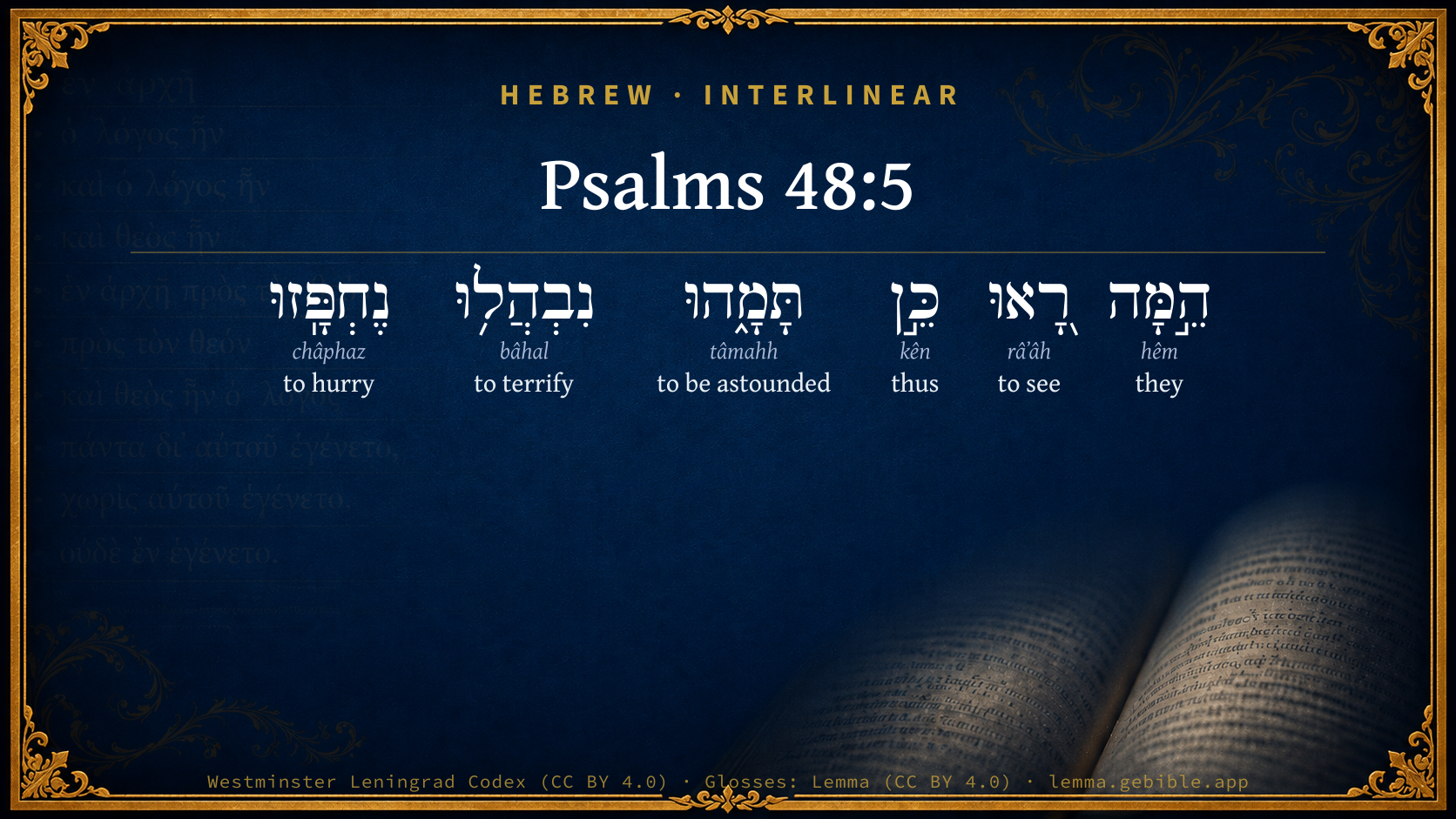
Psalms 48:5

Hebrew (Westminster Leningrad Codex) Psalms 48:5 appears in the Hebrew Old Testament. The text above is from the Westminster Leningrad Codex. Each word links to its Strong’s number, a concise gloss, and parsing drawn from the Open Scriptures Hebrew Bible morphology. Click any word for its full Brown-Driver-Briggs (BDB) entry.
Download image
Cite this verse

Psalms 48:5 (World English Bible). Public Domain. Lemma interlinear Bible study tool, https://lemma.gebible.app/v/psalms/48/5.

Show BibTeX & RIS
BibTeX
RIS
English Translation
They saw it, then they were amazed. They were dismayed, They hurried away.
World English Bible · Public Domain
Download a study sheet

One document with this verse’s original text, its word-by-word gloss line, the meaning frame, cross-references with their text, attributed commentary, and full source and license credits — printable, and it pastes into notes with its structure intact.

This verse Autodidact and up

Study sheet (.html) Plain text (.txt)

A passage Seminary Student

Up to 50 verses in one chapter. A passage sheet keeps up to 6 commentary sources and 12 cross-references per verse, in the order this page ranks them, and says so on the sheet whenever that leaves anything out. Ask for a single verse and you get the Autodidact verse sheet above.

Everything on this page stays free to read, with no account — the sheet is a download of what is already on screen, not access to it.

Want to remove ads? Support Godless Engineer
Compare translations 3

The same verse in 3 English versions, stacked beneath the original-language interlinear above. Click any original word for its lexicon entry.

Each is an independent rendering of the whole verse — the interlinear is not word-aligned to these translations.

Highlighted words mark where these versions differ — a whole-verse word diff, not a word-by-word alignment.

  • World English Bible Public Domain
    They saw it, then they were amazed. They were dismayed, They hurried away.
  • King James Version Public Domain
    They saw it, and so they marvelled; they were troubled, and hasted away.
  • unfoldingWord Literal Text CC BY-SA 4.0
    They, they saw, then they marveled. They were terrified, they hastened themselves away.

unfoldingWord Literal Text — © unfoldingWord, licensed CC BY-SA 4.0. Word-aligned USFM3 via Door43 (git.door43.org/unfoldingWord/en_ult).

Versions to compare (up to 4)

3 of 4 selected

Show all 18 translations

Every available English version of this verse, each an independent rendering of the whole verse.

  • World English Bible Public Domain
    They saw it, then they were amazed. They were dismayed, They hurried away.
  • Berean Standard Bible Public Domain
    They saw and were astounded; they fled in terror.
  • Majority Standard Bible Public Domain
    They saw and were astounded; they fled in terror.
  • King James Version Public Domain
    They saw it, and so they marvelled; they were troubled, and hasted away.
  • American Standard Version (1901) Public Domain
    They saw it, then were they amazed; They were dismayed, they hasted away.
  • Revised Version (1885) Public Domain
    They saw it, then were they amazed; they were dismayed, they hasted away.
  • Geneva Bible (1599) Public Domain
    When they sawe it, they marueiled: they were astonied, and suddenly driuen backe.
  • Douay-Rheims (1899) Public Domain
    For behold the kings of the earth assembled themselves: they gathered together.
  • Young's Literal Translation Public Domain
    They have seen -- so they have marvelled, They have been troubled, they were hastened away.
  • Literal Standard Version CC BY-SA 4.0
    They have seen—so they have marveled, || They have been troubled, they were hurried away.
  • Unlocked Literal Bible CC BY-SA 4.0
    They saw it, then they were amazed; they were dismayed, and they hurried away.
  • unfoldingWord Literal Text CC BY-SA 4.0
    They, they saw, then they marveled. They were terrified, they hastened themselves away.
  • Darby Bible Public Domain
    They saw, -- so they marvelled; they were troubled, they fled in consternation:
  • World Messianic Bible Public Domain
    They saw it, then they were amazed. They were dismayed. They hurried away.
  • Webster's Bible Public Domain
    \\48:4\\For lo, the kings were assembled, they passed by together.
  • Free Bible Version CC BY-SA 4.0
    As soon as they saw it they were astonished and ran away terrified.
  • Bible in Basic English Public Domain
    They saw it, and so were full of wonder; they were troubled, and went quickly away in fear.
  • JPS Tanakh (1917) Public Domain
    (48-6) They saw, straightway they were amazed; they were affrighted, they hasted away.

Literal Standard Version (2020), Covenant Press — licensed CC BY-SA 4.0. Text via the HelloAO Bible API (eBible.org). Unlocked Literal Bible (unfoldingWord) — licensed CC BY-SA 4.0. Text via the HelloAO Bible API (eBible.org). unfoldingWord Literal Text — © unfoldingWord, licensed CC BY-SA 4.0. Word-aligned USFM3 via Door43 (git.door43.org/unfoldingWord/en_ult). Free Bible Version, Dr. Jonathan Gallagher — licensed CC BY-SA 4.0. Text via the HelloAO Bible API (eBible.org).

Word by word

More ways to search: Search by grammar → Find every occurrence → Compare this word →

Practice this passage: Drill this verse → Learn its vocabulary →

About this verse

These counts appear in no published source. They are computed here, from the morphology-tagged text and Lemma’s own curated glosses. What Lemma adds →

6
words
6
distinct lemmas
Wisdom
section

Notable vocabulary

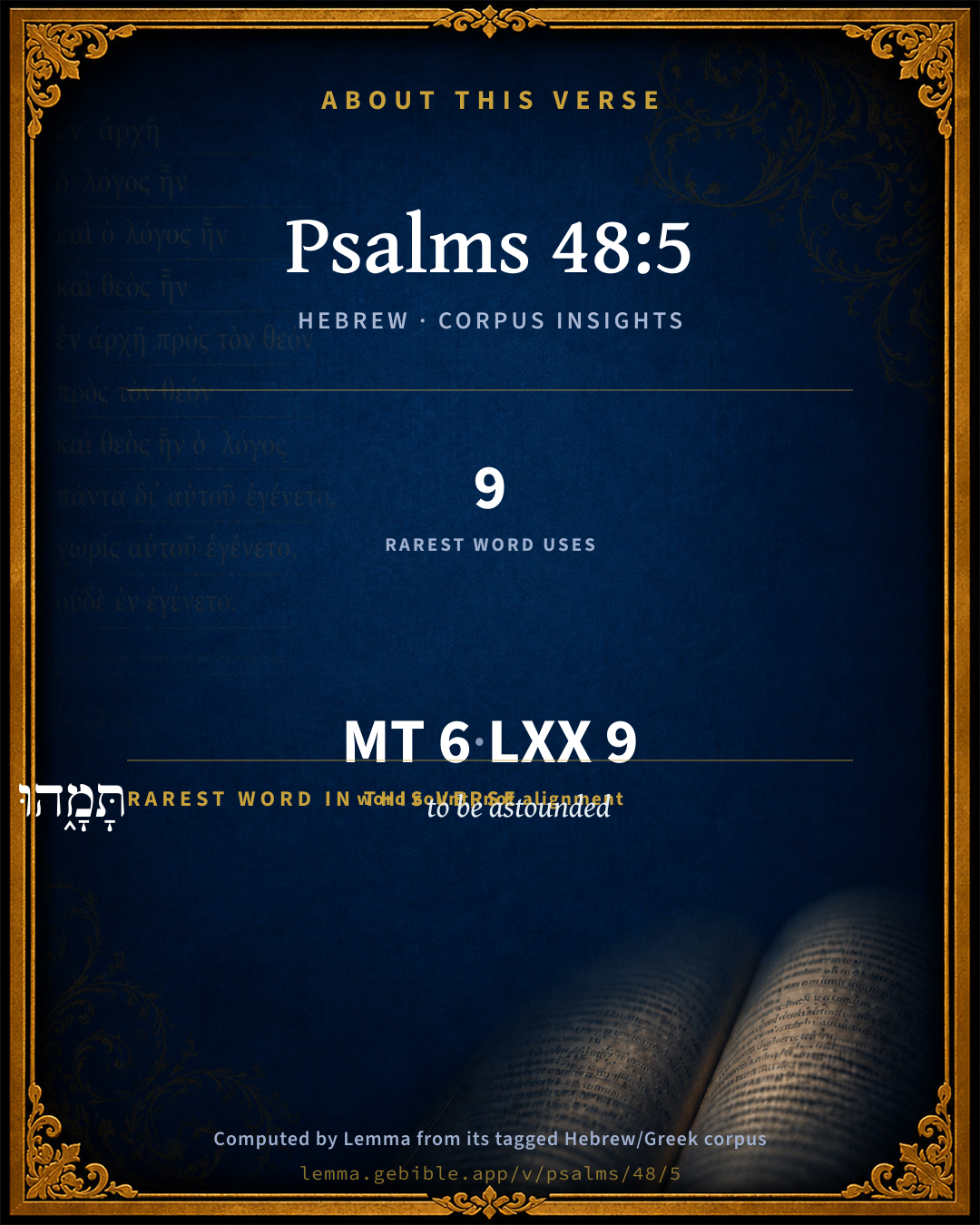
The rarest word here is תָּמָ֑הוּ to be astounded H8539 — appearing just 9 times in the whole Hebrew Bible.

Shared distinctive vocabulary

תָּמָ֑הוּ to be astounded H8539 occurs in 8 verses of the Hebrew Bible. Also found in:

Grammatical profile

  • 4 verbs
  • 1 pronoun
  • 1 particle

Verb forms

  • רָ֭אוּ Qal · Perfect
  • תָּמָ֑הוּ Qal · Perfect
  • נִבְהֲל֥וּ Niphal · Perfect
  • נֶחְפָּֽזוּ Niphal · Perfect

Hebrew & Septuagint length

In English translation the verse runs 13 words from the Hebrew and 12 from the Septuagint (LXX English) — closely comparable.

A rough comparison of the two English renderings, which tokenize alike — not a word-level alignment.

Word counts can differ between the Hebrew and the Greek without any difference in meaning — e.g. the Hebrew direct-object marker אֵת has no separate Greek word, and Greek often adds the article ὁ.

In the original languages it is 6 Hebrew tokens and 9 Greek tokens — but the two are counted differently (Hebrew bundles its prefixes and suffixes into one token; the Greek is in lemma form), so that isn’t a like-for-like length.

Cross-references

3

Topical passages linked to Psalms 48:5 in the Treasury of Scripture Knowledge — connected by theme and wording, ordered by reader-vote popularity; previews shown in the World English Bible.

  • Exodus 14:25 He took off their chariot wheels, and they drove them heavily; so that the Egyptians said, "Let's flee from the face of Israel, for Yahweh fights for them against the Egyptians!"
  • 2 Kings 7:6–7 For the Lord had made the host of the Syrians to hear a noise of chariots, and a noise of horses, even the noise of a great host: and they said one to another, Behold, the king of Israel has hired against us the kings of the Hittites, and the kings of the Egyptians, to come on us.
  • 2 Kings 19:35–37 It happened that night, that the angel of Yahweh went forth, and struck in the camp of the Assyrians one hundred eighty-five thousand: and when men arose early in the morning, behold, these were all dead bodies.

Cross-references courtesy of OpenBible.info (CC BY 4.0).

Hebrew and Greek witnesses Masoretic Hebrew ↔ Greek Septuagint

The same verse in the two great witnesses to the Old Testament, shown verse-for-verse.

You’re reading Greek Psalm 47 (Hebrew Psalm 48). The Septuagint counts the superscription, so verse numbers can differ from the Hebrew — chapter-level alignment, not verse-by-verse. Numbering follows Rahlfs.

These are two independent witnesses, not word-aligned to each other, and the Septuagint is shown in lemma (dictionary) form.

Hebrew Psalms 48:5 Masoretic · Westminster Leningrad Codex

הֵ֣מָּה רָ֭אוּ כֵּ֣ן תָּמָ֑הוּ נִבְהֲל֥וּ נֶחְפָּֽזוּ

They saw it, then they were amazed. They were dismayed, They hurried away.

World English Bible · Public Domain

Greek LXX Greek Psalm 47:5 Septuagint · lemma form

ὅτι ἰδού ὁ βασιλεύς συνἄγω ἔρχομαι ἐπί ὁ αὐτός

They saw, and so they wondered: they were troubled, they were moved.

LXX2012 (modern English Septuagint) · Public Domain

Hebrew: Westminster Leningrad Codex (CC BY 4.0). Greek: Septuagint (public domain); English from LXX2012 (modern English Septuagint) (Public Domain). How the Septuagint differs from the Hebrew →

Commentary

Notes on Psalms 48:5 from classic Christian and Jewish commentators (each source and its license shown beneath its notes). The classic Christian expositions comment on the surrounding passage and are grouped to its opening verse, so a note may address several verses; the Jewish commentaries on the Tanakh (Rashi and others) are per-verse, so they appear only where the commentator wrote on this verse.

Lemma curates 59 commentaries, every one of them public domain or Creative Commons licensed, each selected and text-cleaned for this edition rather than reprinted as found. About our sources →

Trapp's Complete Commentary

John Trapp

Psa 48:5 They saw [it, and] so they marvelled; they were troubled, [and] hasted away.

Ver. 5. They saw it, and so they marvelled] None of them could say, as Caesar, Veni, vidi, vici, I came, I saw, I conquored, but the contrary; they no sooner saw this heaven guarded city, but their hearts misgave them; and they were ready to say, as that duke of Saxony did, who intending to make war upon the bishop of Magdeburg, and understanding that he made no great preparation for defence of himself and his territories, but sought help from heaven by fasting and prayer, Insaniat alius, said he, God bless me from such a madness as to meddle with a man who confideth in God, and committeth himself wholly to his protection.

They were troubled and hasted away] Heb. They fled with a hasty or headlong flight, being smitten with a sudden terror, such as was that of the Egyptians, when their chariot-wheels were taken off; of the Philistines, when for haste they left their gods behind them, 2Sa 5:20-21; of the Syrians, 2Ki 7:6-7, when they left all and ran for their lives; of the Assyrians, when the angel had slain a hundred eighty-five thousand in their camp, &c.

John Trapp, A Commentary or Exposition upon All the Books of the Old and New Testament (1647–1656) — public domain. Text from a community e-Sword module.

The Treasury of David

Charles H. Spurgeon

Ver. 5. They saw it, and so they marvelled. They came, they saw, but they did not conquer. There was no veni, vidi, vici for them. No sooner did they perceive that the Lord was in the Holy City, than they took to their heels. Before the Lord came to blows with them, they were faint hearted, and beat a retreat. They were troubled and hasted away. The troublers were troubled. Their haste in coming was nothing to their hurry in going. Panic seized them, horses were not fleet enough; they would have borrowed the wings of the wind. They fled ignominiously, like children in a fright. Glory be to God, it shall be even thus with the foes of his church; when the Lord cometh to our help, our enemies shall be as nothing. Could they foresee their ignominious defeat, they would not advance to the attack.

Ver. 5-6. The potentates of the world saw the miracles of the apostles, the courage and constancy of the martyrs, and the daily increase of the church, notwithstanding all their persecutions; they beheld with astonishment the rapid progress of the faith through the Roman empire; they called upon their gods, but their gods could not help themselves; idolatry expired at the foot of the victorious cross. George Horne.

Ver. 5-6. See Psalms on "Ps 48:5" for further information.

Charles H. Spurgeon's The Treasury of David (1869–1885) — public domain. Psalms only. Text from a community e-Sword/MySword module.

J. A. Alexander on Psalms

Joseph Addison Alexander

6. (Psa 48:5). (As) they saw, so they wondered, were struck with terror, were put to flight. This verse explains what was meant by their passing in the on before it. The as, corresponding to so, which is expressed in Psa 48:9 (8), seems to be here omitted, as in Isa 55:9. As soon as they saw the holy city, or the tokens of divine protection. The last two verbs are passives. For the meaning of the first, see above, on Psa 2:5, and for that of the second, on Psa 31:23 (22). The whole verse is descriptive of a panic leading to a disorderly retreat or flight.

Joseph Addison Alexander, The Psalms Translated and Explained (1850) — public domain. Text from a community e-Sword module.

Geneva Bible (1599)

Geneva Bible translators

The enemies were afraid at the sight of the City.

Geneva Bible (1599) marginal notes — public domain. Text via Bolls.life.

Ellicott's Commentary for English Readers

(5) They saw.—A verse like Psa_46:6, vivid from the omission of the conjunctions, wrongly supplied by the Authorised Version. It has reminded commentators of Caesar’s Veni, vidi, vici.

They looked, even so were terrified, bewildered, panic-struck.

Hasted away.—Or, sprung up in alarm.

A Bible Commentary for English Readers, edited by Charles John Ellicott (1878–1897) — public domain. Text from a community e-Sword module.

The Cambridge Bible for Schools and Colleges

gen. ed. J. J. S. Perowne

5. They saw; forthwith they were amazed:

They were dismayed, they made haste to flee.

Caesar’s boast, Veni, vidi, vici, was reversed. They came to Zion, they saw it, they were smitten with panic terror. Cp. Isa_33:3.

The Cambridge Bible for Schools and Colleges (gen. ed. J. J. S. Perowne; Cambridge University Press, 1878–1918) — public domain. Text from a community e-Sword module.

John Gill's Exposition

Fear took hold upon them there,.... That is, either when they came up to the city, and passed by it, and saw what they did; or, as Kimchi observes, in the place where they thought to have made a great slaughter; that is, in Armageddon, Rev 16:16; so upon the slaughter of the seven thousand names of men, or men of name and renown, such as the kings here assembled, the remnant will be frightened, Rev 11:13;

and pain, as of a woman in travail; this figure is made use of elsewhere, when the destruction of Babylon and the coming of Christ are spoken of; see Isa 13:8.

John Gill's Exposition of the Whole Bible (1746–1763) — public domain (CC PDM 1.0). Text via the HelloAO Bible API.

Albert Barnes' Notes on the Bible

They saw it - That is, they looked on it; they contemplated it; they were struck with its beauty and strength, and fled.

And so they marveled - It surpassed their expectations of its strength, and they saw with wonder that any attempt to conquer it was hopeless.

They were troubled - They were filled with anxiety and confusion. They even began to have apprehensions about their own safety. They saw that their preparations had been made in vain, and that all hopes of success must be abandoned.

And hasted away - They fled in confusion. The idea in the whole verse is that of a “panic,” leading to a disorderly flight. This “may” have occurred in the time of Jehoshaphat, 2 Chr. 20, when the kings of Moab, Edom, and others, came up to attack Jerusalem, though the immediate cause of their overthrow was a conflict among themselves 2Ch 20:22-25. It may have been, however, that they approached the city, and were dismayed by its strength, so that they turned away before the internal conflict occurred which ended in their ruin. But it is not “necessary” to adjust these accounts one to another, or even to suppose that this was the event referred to in the psalm, though the general ideas in it accord well with all which occurred on that occasion.

Albert Barnes' Notes on the Bible (1834–1885) — public domain. Text from a community e-Sword/MySword module.

Matthew Poole's English Annotations

They saw it; they did only look upon it, but not come into it, nor shoot an arrow there, —nor cast a bank against it, as is said upon this or the like occasion, 2Ki 19:32.

So they marvelled, not so much at the structure or strength of the city, as at the wonderful works wrought by God on their behalf.

They were troubled and hasted away: see 2Ki 19:35.

Matthew Poole's English Annotations on the Holy Bible (1683–1685) — public domain. Text from a community e-Sword/MySword module.

The Pulpit Commentary

They saw it, and so they marvelled; they were troubled, and hasted away. The sight of the city, with its walls and towers (vers. 12, 13), was enough for them they recognized that the place was too strong to be attacked with any prospect of success; "marvelled," or "were amazed" (Cheyne), at its strength, and, being troubled in mind, hasted away. The unconnected verbs remind the commentators of Caesar"s famous despatch, "Vent, vidi, vici."

The Pulpit Commentary (1880–1919), ed. H.D.M. Spence-Jones & Joseph S. Exell — public domain. Text from a community e-Sword module.

John Wesley's Explanatory Notes

Saw it - They did only look upon it, but not come into it, nor shoot an arrow there - nor cast a bank against it, 2 Kings xix, 32. Marvelled - At the wonderful works wrought by God.

John Wesley, Explanatory Notes Upon the Whole Bible (1754–1765) — public domain. Text via the GEBible commentary corpus.

Rashi

Rabbi Shlomo Yitzchaki (Rashi)

the kings have assembled to wage war against it in the wars of Gog and Magog.

they have passed together to war.

Rashi on the Tanakh — English translations: “The Judaica Press complete Tanach with Rashi, translated by A. J. Rosenberg” (CC BY 4.0); “Pentateuch with Rashi's commentary by M. Rosenbaum and A.M. Silbermann, 1929-1934” (public domain); “The Metsudah Tanach series, Lakewood, N.J” (CC BY 4.0); and “The Book of Joshua, Metsudah Publications, 1997” (CC BY 4.0). Text via Sefaria.

Lesson kit

Teaching starters — assembled from the data on this page, not authored interpretation. Every prompt links to the verse data it draws on. Edit before teaching.

Psalms, in the Wisdom, opens this verse with 6 words (6 distinct Hebrew lemmas). Its most distinctive word is tâmahh (“to be astounded”). A historical commentator’s framing appears above. Read the whole chapter for the surrounding context.

Discussion questions

  1. What does “to be astounded” (tâmahh) contribute to the verse as a whole?
  2. How does Genesis 43:33, which shares the word «to be astounded», read alongside this verse?
  3. These translations render this verse differently; the difference is in the English rendering, not the original. What questions does that raise?
  4. «רָ֭אוּ» is a Qal Perfect verb. How does that grammatical form shape the action described?
  5. Compare how Trapp's Complete Commentary and The Treasury of David read this verse. Where do they agree or differ?

Things to notice

Reading settings

Reading text

Shown beneath each verse's original-language words.

Old Testament
Old Testament edition

Read the OT as the Masoretic Hebrew (MT) or the Greek Septuagint (LXX).

English shown for the Greek Septuagint (in the Hebrew ↔ Greek comparison).

Comparing translations? Open the Compare panel on any verse page to stack up to four side by side.