
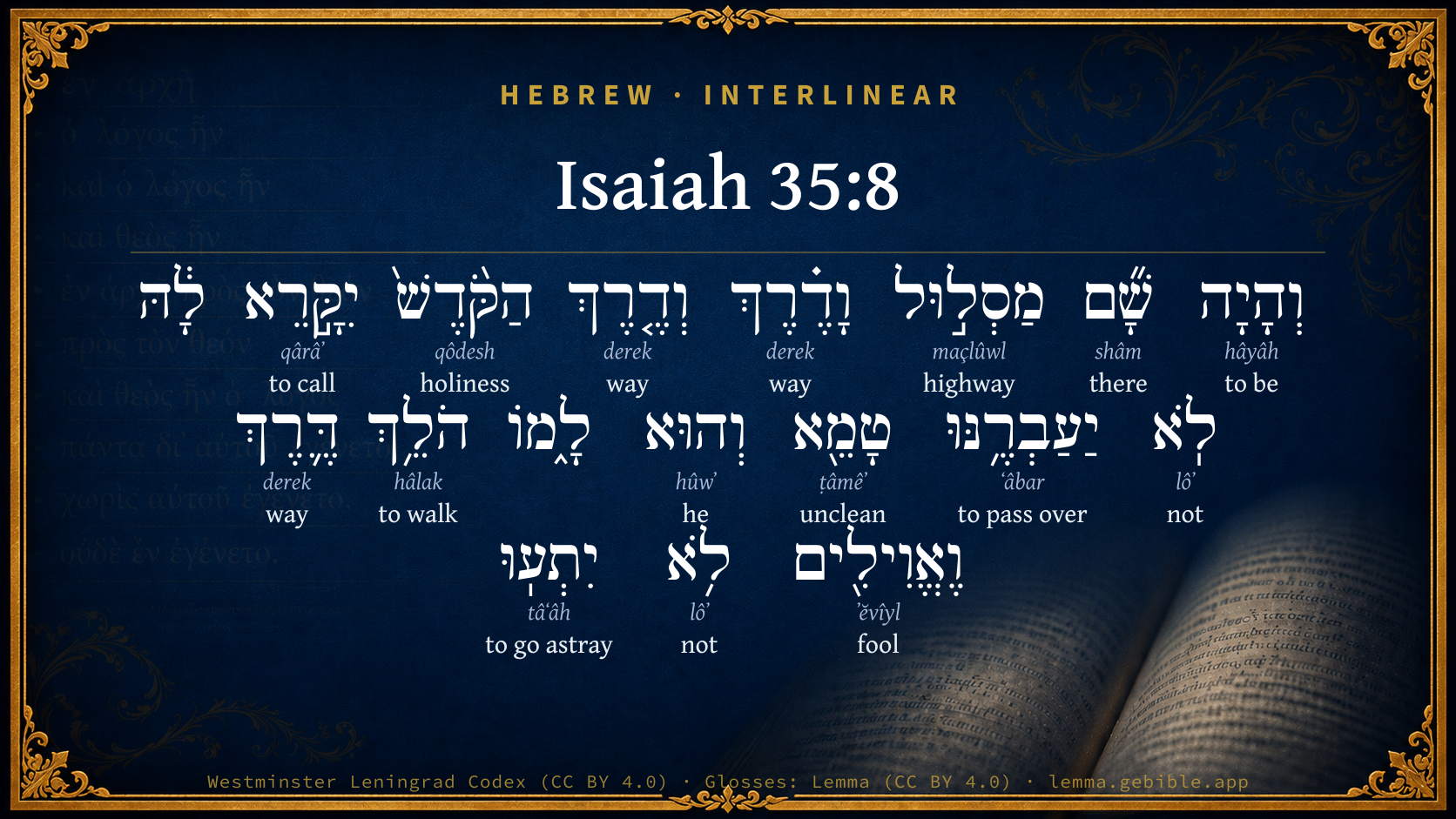
Isaiah 35:8

Hebrew (Westminster Leningrad Codex) Isaiah 35:8 appears in the Hebrew Old Testament. The text above is from the Westminster Leningrad Codex. Each word links to its Strong’s number, a concise gloss, and parsing drawn from the Open Scriptures Hebrew Bible morphology. Click any word for its full Brown-Driver-Briggs (BDB) entry.
Download image
Cite this verse

Isaiah 35:8 (World English Bible). Public Domain. Lemma interlinear Bible study tool, https://lemma.gebible.app/v/isaiah/35/8.

Show BibTeX & RIS
BibTeX
RIS
English Translation
A highway shall be there, and a way, and it shall be called The way of holiness. The unclean shall not pass over it, but is shall be for for him who walks in the Way. Wicked fools will not go there.
World English Bible · Public Domain
Highlights
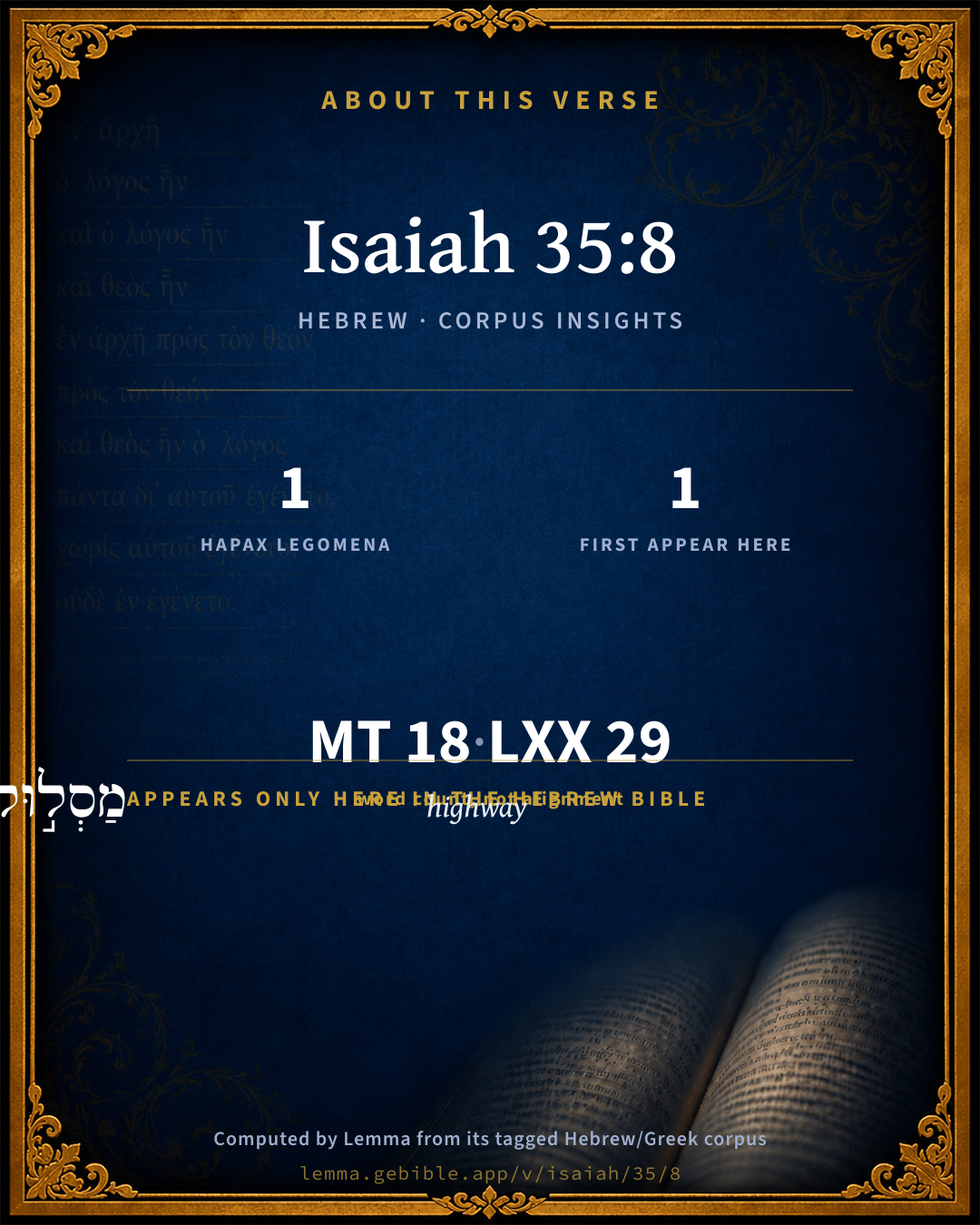
  • 1 hapax legomenon — only here in the Hebrew Bible
  • 1 first appearance in the Hebrew Bible
Full analysis ↓
Download a study sheet

One document with this verse’s original text, its word-by-word gloss line, the meaning frame, cross-references with their text, attributed commentary, and full source and license credits — printable, and it pastes into notes with its structure intact.

This verse Autodidact and up

Study sheet (.html) Plain text (.txt)

A passage Seminary Student

Up to 50 verses in one chapter. A passage sheet keeps up to 6 commentary sources and 12 cross-references per verse, in the order this page ranks them, and says so on the sheet whenever that leaves anything out. Ask for a single verse and you get the Autodidact verse sheet above.

Everything on this page stays free to read, with no account — the sheet is a download of what is already on screen, not access to it.

Want to remove ads? Support Godless Engineer
Compare translations 3

The same verse in 3 English versions, stacked beneath the original-language interlinear above. Click any original word for its lexicon entry.

Each is an independent rendering of the whole verse — the interlinear is not word-aligned to these translations.

Highlighted words mark where these versions differ — a whole-verse word diff, not a word-by-word alignment.

  • World English Bible Public Domain
    A highway shall be there, and a way, and it shall be called The way of holiness. The unclean shall not pass over it, but is shall be for for him who walks in the Way. Wicked fools will not go there.
  • King James Version Public Domain
    And an highway shall be there, and a way, and it shall be called The way of holiness; the unclean shall not pass over it; but it shall be for those: the wayfaring men, though fools, shall not err therein.
  • unfoldingWord Literal Text CC BY-SA 4.0
    And a highway and a way will be there, and one will call to it, “The Way of Holiness.” The unclean will not travel it, but it for them, the walker of the way, and fools will not wander.

unfoldingWord Literal Text — © unfoldingWord, licensed CC BY-SA 4.0. Word-aligned USFM3 via Door43 (git.door43.org/unfoldingWord/en_ult).

Versions to compare (up to 4)

3 of 4 selected

Show all 18 translations

Every available English version of this verse, each an independent rendering of the whole verse.

  • World English Bible Public Domain
    A highway shall be there, and a way, and it shall be called The way of holiness. The unclean shall not pass over it, but is shall be for for him who walks in the Way. Wicked fools will not go there.
  • Berean Standard Bible Public Domain
    And there will be a highway called the Way of Holiness. The unclean will not travel it—only those who walk in the Way—and fools will not stray onto it.
  • Majority Standard Bible Public Domain
    And there will be a highway called the Way of Holiness. The unclean will not travel it—only those who walk in the Way—and fools will not stray onto it.
  • King James Version Public Domain
    And an highway shall be there, and a way, and it shall be called The way of holiness; the unclean shall not pass over it; but it shall be for those: the wayfaring men, though fools, shall not err therein.
  • American Standard Version (1901) Public Domain
    And a highway shall be there, and a way, and it shall be called The way of holiness; the unclean shall not pass over it; but is shall be for `the redeemed': the wayfaring men, yea fools, shall not err `therein'.
  • Revised Version (1885) Public Domain
    And an highway shall be there, and a way, and it shall be called The way of holiness; the unclean shall not pass over it; but it shall be for those: the wayfaring men, yea fools, shall not err therein.
  • Geneva Bible (1599) Public Domain
    And there shalbe a path and a way, and the way shalbe called holy: the polluted shall not passe by it: for he shalbe with them, and walke in the way, and the fooles shall not erre.
  • Douay-Rheims (1899) Public Domain
    And a path and a way shall be there, and it shall be called the holy way: the unclean shall not pass over it, and this shall be unto you a straight way, so that fools shall not err therein.
  • Young's Literal Translation Public Domain
    And a highway hath been there, and a way, And the `way of holiness' is called to it, Not pass over it doth the unclean, And He Himself `is' by them, Whoso is going in the way -- even fools err not.
  • Literal Standard Version CC BY-SA 4.0
    And a highway has been there, and a way, || And it is called the “Way of Holiness.” The unclean do not pass over it, || And He Himself [is] by them, || Whoever is going in the way—even fools do not err.
  • Unlocked Literal Bible CC BY-SA 4.0
    A highway will be there called The Holy Way. The unclean will not travel it. But it will be for him who walks in it. No fool will go on it.
  • unfoldingWord Literal Text CC BY-SA 4.0
    And a highway and a way will be there, and one will call to it, “The Way of Holiness.” The unclean will not travel it, but it for them, the walker of the way, and fools will not wander.
  • Darby Bible Public Domain
    And a highway shall be there and a way, and it shall be called, The way of holiness: the unclean shall not pass through it; but it shall be for these. Those that go [this] way -- even fools, -- shall not err [therein].
  • World Messianic Bible Public Domain
    A highway will be there, a road, and it will be called “The Holy Way”. The unclean shall not pass over it, but it will be for those who walk in the Way. Wicked fools shall not go there.
  • Webster's Bible Public Domain
    And a highway shall be there, and a way, and it shall be called, The way of holiness; the unclean shall not pass over it; but it shall be for those: the way-faring men, though fools, shall not err therein.
  • Free Bible Version CC BY-SA 4.0
    There will be a highway there, a road called “The Way of Holiness.” Nobody bad will travel on it, only those who follow the Way. Fools will not go there.
  • Bible in Basic English Public Domain
    And a highway will be there; its name will be, The Holy Way; the unclean and the sinner may not go over it, and those who go on it will not be turned out of the way by the foolish.
  • JPS Tanakh (1917) Public Domain
    And a highway shall be there, and a way, and it shall be called The way of holiness; the unclean shall not pass over it; but it shall be for those; the wayfaring men, yea fools, shall not err therein.

Literal Standard Version (2020), Covenant Press — licensed CC BY-SA 4.0. Text via the HelloAO Bible API (eBible.org). Unlocked Literal Bible (unfoldingWord) — licensed CC BY-SA 4.0. Text via the HelloAO Bible API (eBible.org). unfoldingWord Literal Text — © unfoldingWord, licensed CC BY-SA 4.0. Word-aligned USFM3 via Door43 (git.door43.org/unfoldingWord/en_ult). Free Bible Version, Dr. Jonathan Gallagher — licensed CC BY-SA 4.0. Text via the HelloAO Bible API (eBible.org).

Word by word

More ways to search: Search by grammar → Find every occurrence → Compare this word →

Practice this passage: Drill this verse → Learn its vocabulary →

מַסְל֣וּל
maçlûwl
H4547
“highway”
Noun, Common, Masculine, Singular, Absolute
Part of Speech
Noun
Type
Common
Gender
Masculine
Number
Singular
State
Absolute
Full BDB Definition

Origin: from H5549

TWOT: 1506d

highway
  1. וְהָיָה hâyâh H1961 “and · to be” Conjunction + Verb, Qal, Sequential Perfect, 3rd Person, Masculine, Singular
  2. שָׁ֞ם shâm H8033 “there” Adverb
  3. וָדֶ֗רֶךְ derek H1870 “and · way” Conjunction + Noun, Common, Both, Singular, Absolute
  4. וְדֶ֤רֶךְ derek H1870 “and · way of” Conjunction + Noun, Common, Both, Singular, Construct
  5. הַקֹּ֨דֶשׁ֙ qôdesh H6944 “the · holiness” Particle, Definite Article + Noun, Common, Masculine, Singular, Absolute
  6. יִקָּ֣רֵא qârâʼ H7121 “to call” Verb, Niphal, Imperfect, 3rd Person, Masculine, Singular
  7. לֹֽא lôʼ H3808 “not” Particle, Negative
  8. יַעַבְרֶ֥נּוּ ʻâbar H5674 “to pass over · him” Verb, Qal, Imperfect, 3rd Person, Masculine, Singular + Suffix, Personal, 3rd Person, Masculine, Singular
  9. טָמֵ֖א ṭâmêʼ H2931 “unclean” Adjective, Adjective, Masculine, Singular, Absolute
  10. וְהוּא hûwʼ H1931 “and · he” Conjunction + Pronoun, Personal, 3rd Person, Masculine, Singular
  11. הֹלֵ֥ךְ hâlak H1980 “walking” Verb, Qal, Participle Active, Masculine, Singular, Construct
  12. דֶּ֛רֶךְ derek H1870 “way” Noun, Common, Both, Singular, Absolute
  13. וֶאֱוִילִ֖ים ʼĕvîyl H191 “and · fool” Conjunction + Adjective, Adjective, Masculine, Plural, Absolute
  14. לֹ֥א lôʼ H3808 “not” Particle, Negative
  15. יִתְעֽוּ tâʻâh H8582 “to go astray” Verb, Qal, Imperfect, 3rd Person, Masculine, Plural

About this verse

These counts appear in no published source. They are computed here, from the morphology-tagged text and Lemma’s own curated glosses. What Lemma adds →

18
words
13
distinct lemmas
Prophets
section

Notable vocabulary

1 hapax legomenon — a word that appears only here in the entire Hebrew Bible:

  • מַסְל֣וּל highway H4547

First appearance in Scripture

This word makes its first canonical appearance in the Hebrew Bible here:

  • מַסְל֣וּל highway H4547

Shared distinctive vocabulary

וֶאֱוִילִ֖ים fool H191 occurs in 26 verses of the Hebrew Bible. Also found in:

Grammatical profile

  • 5 verbs
  • 5 nouns
  • 2 adjectives
  • 1 pronoun
  • 2 prepositions
  • 1 adverb
  • 2 particles

Verb forms

  • וְהָיָה Qal · Sequential Perfect
  • יִקָּ֣רֵא Niphal · Imperfect
  • יַעַבְרֶ֥נּוּ Qal · Imperfect
  • הֹלֵ֥ךְ Qal · Participle Active
  • יִתְעֽוּ Qal · Imperfect

Repetition

Words recur within this verse — often emphatic in Hebrew:

  • וָדֶ֗רֶךְ way H1870 ×3
  • לֹֽא not H3808 ×2

Hebrew & Septuagint length

In English translation the verse runs 42 words from the Hebrew and 46 from the Septuagint (LXX English) — closely comparable.

A rough comparison of the two English renderings, which tokenize alike — not a word-level alignment.

Word counts can differ between the Hebrew and the Greek without any difference in meaning — e.g. the Hebrew direct-object marker אֵת has no separate Greek word, and Greek often adds the article ὁ.

In the original languages it is 18 Hebrew tokens and 29 Greek tokens — but the two are counted differently (Hebrew bundles its prefixes and suffixes into one token; the Greek is in lemma form), so that isn’t a like-for-like length.

Cross-references

43

Topical passages linked to Isaiah 35:8 in the Treasury of Scripture Knowledge — connected by theme and wording, ordered by reader-vote popularity; previews shown in the World English Bible.

  • Matthew 7:13–14 "Enter in by the narrow gate; for wide is the gate and broad is the way that leads to destruction, and many are those who enter in by it.
  • Isaiah 42:16 I will bring the blind by a way that they don't know; in paths that they don't know will I lead them; I will make darkness light before them, and crooked places straight. These things will I do, and I will not forsake them.
  • John 14:6 Jesus said to him, "I am the way, the truth, and the life. No one comes to the Father, except through me.
  • 1 Peter 1:14–15 as children of obedience, not conforming yourselves according to your former lusts as in your ignorance,
  • Revelation 21:27 There will in no way enter into it anything profane, or one who causes an abomination or a lie, but only those who are written in the Lamb's book of life.
  • Hebrews 10:20–23 by the way which he dedicated for us, a new and living way, through the veil, that is to say, his flesh;
  • 2 Timothy 1:9 who saved us and called us with a holy calling, not according to our works, but according to his own purpose and grace, which was given to us in Christ Jesus before times eternal,
  • 1 Peter 2:9–10 But you are a chosen race, a royal priesthood, a holy nation, a people for God's own possession, that you may show forth the excellencies of him who called you out of darkness into his marvelous light:
  • Jeremiah 31:21 Set up road signs, make guideposts; set your heart toward the highway, even the way by which you went: turn again, virgin of Israel, turn again to these your cities.
  • Titus 2:11–14 For the grace of God has appeared, bringing salvation to all men,
  • Hebrews 12:14 Follow after peace with all men, and the sanctification without which no man will see the Lord,
  • Isaiah 30:21 and your ears shall hear a word behind you, saying, This is the way, walk you in it; when you turn to the right hand, and when you turn to the left.
  • Ezekiel 44:9 Thus says the Lord Yahweh, No foreigner, uncircumcised in heart and uncircumcised in flesh, shall enter into my sanctuary, of any foreigners who are among the children of Israel.
  • Jeremiah 32:39–40 and I will give them one heart and one way, that they may fear me forever, for the good of them, and of their children after them:
  • 1 Thessalonians 4:7 For God called us not for uncleanness, but in sanctification.
  • Isaiah 60:21 Your people also shall be all righteous; they shall inherit the land forever, the branch of my planting, the work of my hands, that I may be glorified.
  • Psalms 25:8–9 Good and upright is Yahweh, Therefore he will instruct sinners in the way.
  • Proverbs 4:18 But the path of the righteous is like the dawning light, That shines more and more until the perfect day.
  • Ephesians 2:10 For we are his workmanship, created in Christ Jesus for good works, which God prepared before that we would walk in them.
  • Psalms 19:7 Yahweh's law is perfect, restoring the soul. Yahweh's testimony is sure, making wise the simple.
  • Psalms 23:4 Even though I walk through the valley of the shadow of death, I will fear no evil, for you are with me. Your rod and your staff, they comfort me.
  • Psalms 119:130 The entrance of your words gives light. It gives understanding to the simple.
  • Proverbs 8:20 I walk in the way of righteousness, In the midst of the paths of justice;
  • Isaiah 4:3 It will happen, that he who is left in Zion, and he who remains in Jerusalem, shall be called holy, even everyone who is written among the living in Jerusalem;
  • Isaiah 40:3–4 The voice of one who cries, Prepare you in the wilderness the way of Yahweh; make level in the desert a highway for our God.
  • Isaiah 49:10–12 They shall not hunger nor thirst; neither shall the heat nor sun strike them: for he who has mercy on them will lead them, even by springs of water will he guide them.
  • Isaiah 57:14 He will say, Cast up, cast up, prepare the way, take up the stumbling-block out of the way of my people.
  • Isaiah 62:10 Go through, go through the gates; prepare you the way of the people; cast up, cast up the highway; gather out the stones; lift up an ensign for the peoples.
  • Jeremiah 50:4–5 In those days, and in that time, says Yahweh, the children of Israel shall come, they and the children of Judah together; they shall go on their way weeping, and shall seek Yahweh their God.
  • Joel 3:17 "So you will know that I am Yahweh, your God, Dwelling in Zion, my holy mountain. Then Jerusalem will be holy, And no strangers will pass through her any more.
  • John 7:17 If anyone desires to do his will, he will know about the teaching, whether it is from God, or if I am speaking from myself.
  • Revelation 7:15–17 Therefore they are before the throne of God, they serve him day and night in his temple. He who sits on the throne will spread his tent over them.
  • Isaiah 11:16 There shall be a highway for the remnant of his people, who shall remain, from Assyria; like as there was for Israel in the day that he came up out of the land of Egypt.
  • Isaiah 19:23 In that day shall there be a highway out of Egypt to Assyria, and the Assyrian shall come into Egypt, and the Egyptian into Assyria; and the Egyptians shall worship with the Assyrians.
  • Isaiah 33:8 The highways lie waste, the wayfaring man ceases: [the enemy] has broken the covenant, he has despised the cities, he doesn't regard man.
  • Isaiah 52:1 Awake, awake, put on your strength, Zion; put on your beautiful garments, Jerusalem, the holy city: for henceforth there shall no more come into you the uncircumcised and the unclean.
  • Isaiah 52:11 Depart you, depart you, go you out from there, touch no unclean thing; go you out of the midst of her; cleanse yourselves, you who bear the vessels of Yahweh.
  • Ezekiel 43:12 This is the law of the house: on the top of the mountain the whole limit of it round about shall be most holy. Behold, this is the law of the house.
  • 2 Peter 3:13 But, according to his promise, we look for new heavens and a new earth, in which dwells righteousness.
  • 1 John 2:20 You have an anointing from the Holy One, and you know the truth.
  • Matthew 1:23 "Behold, the virgin shall be with child, And shall bring forth a son. They shall call his name Immanuel;" Which is, being interpreted, "God with us."
  • 1 John 2:27 As for you, the anointing which you received from him remains in you, and you don't need for anyone to teach you. But as his anointing teaches you concerning all things, and is true, and is no lie, and even as it taught you, you will remain in him.
  • Zechariah 14:20–21 In that day there will be on the bells of the horses, "HOLY TO YAHWEH;" and the pots in Yahweh's house will be like the bowls before the altar.

Cross-references courtesy of OpenBible.info (CC BY 4.0).

Hebrew and Greek witnesses Masoretic Hebrew ↔ Greek Septuagint

The same verse in the two great witnesses to the Old Testament, shown verse-for-verse.

These are two independent witnesses, not word-aligned to each other, and the Septuagint is shown in lemma (dictionary) form.

Hebrew Isaiah 35:8 Masoretic · Westminster Leningrad Codex

וְהָיָה שָׁ֞ם מַסְל֣וּל וָדֶ֗רֶךְ וְדֶ֤רֶךְ הַקֹּ֨דֶשׁ֙ יִקָּ֣רֵא לָ֔הּ לֹֽא יַעַבְרֶ֥נּוּ טָמֵ֖א וְהוּא לָ֑מוֹ הֹלֵ֥ךְ דֶּ֛רֶךְ וֶאֱוִילִ֖ים לֹ֥א יִתְעֽוּ

A highway shall be there, and a way, and it shall be called The way of holiness. The unclean shall not pass over it, but is shall be for for him who walks in the Way. Wicked fools will not go there.

World English Bible · Public Domain

Greek LXX Isaiah 35:8 Septuagint · lemma form

ἐκεῖ εἰμί ὁδός καθαρός καί ὁδός ἅγιος καλέω καί οὐ μή παραἔρχομαι ἐκεῖ ἀκάθαρτος οὐδέ εἰμί ἐκεῖ ὁδός ἀκάθαρτος ὁ δέ διασπείρω πορεύομαι ἐπί αὐτός καί οὐ μή πλανάω

There shall be there a pure way, and it shall be called a holy way; and there shall not pass by there any unclean person, neither shall there be there an unclean way; but the dispersed shall walk on it, and they shall not go astray.

LXX2012 (modern English Septuagint) · Public Domain

On this verse, Adam Clarke's Commentary discusses the Septuagint’s reading. Read the note in Commentary ↓

Hebrew: Westminster Leningrad Codex (CC BY 4.0). Greek: Septuagint (public domain); English from LXX2012 (modern English Septuagint) (Public Domain). How the Septuagint differs from the Hebrew →

Targum (Aramaic paraphrase)

1

The Targum is the ancient Jewish Aramaic paraphrase of the Hebrew Scriptures — an interpretive translation, not the Hebrew text itself. Onkelos (literal) and Pseudo-Jonathan (expansive) render the Torah, and Jonathan the Prophets. Coverage is partial: where no permissively-licensed English translation exists for a verse, only the Aramaic is shown. This is verse-level text, not a word-by-word alignment to the Hebrew.

  1. Targum Jonathan Prophets (Joshua–Malachi)
    וִיהֵי תַמָן כֵּבַשׁ אוֹרַח וְתִקוּן אוֹרְחָא דְקוּדְשָׁא יִתְקְרֵי לָהּ לָא יֶעְדוּן בֵּיהּ מְסָאֲבִין וְלָא יִפְסְקוּן עָדֵי אוֹרְחָא וּדְלָא אֲלִיפוּ לָא יִטְעוּן:

    And a trodden way shall be there, and a straight one; and it shall be called the way of holiness; the unclean shall not pass over it, and the wayfaring men shall not cease; the ignorant shall not err.

    Targum Jonathan — Aramaic: “Mikraot Gedolot” (public domain). English: “Sefaria Community Translation” (CC0 1.0 (public-domain dedication)); “London "Chaldee Paraphrase," 1871” (public domain). Text via Sefaria.

Commentary

Notes on Isaiah 35:8 from classic Christian and Jewish commentators (each source and its license shown beneath its notes). The classic Christian expositions comment on the surrounding passage and are grouped to its opening verse, so a note may address several verses; the Jewish commentaries on the Tanakh (Rashi and others) are per-verse, so they appear only where the commentator wrote on this verse.

Lemma curates 59 commentaries, every one of them public domain or Creative Commons licensed, each selected and text-cleaned for this edition rather than reprinted as found. About our sources →

Trapp's Complete Commentary

John Trapp

Isa 35:8 And an highway shall be there, and a way, and it shall be called The way of holiness; the unclean shall not pass over it; but it [shall be] for those: the wayfaring men, though fools, shall not err [therein].

Ver. 8. And an highway shall be there,] i.e., In the Church of Christ.

And a way.] εν δια δυοιν, The king’s highway to heaven, arcta et ampla; latet et lucet.

The way of holiness.] Or, The way of the sanctuary.

But it shall be for those.] Those beneficiaries of Christ mentioned in Isa 35:5-6; the ransomed of the Lord. {Isa 35:10}

The wayfaring men, though fools.] Simple Christians.

Shall not err.] Miss their way, or miscarry in it.

John Trapp, A Commentary or Exposition upon All the Books of the Old and New Testament (1647–1656) — public domain. Text from a community e-Sword module.

The Biblical Illustrator

Joseph S. Exell

Isa_35:8-10

And an highway shall be there

Highways

Highways are among the characteristic features of civilisation in a country, since they are the means of regular and easy communication between the opposite parts, and especially of all with the capital; but in times of foreign invasion they fall first into the power of the enemy, and are most completely deserted by the inhabitants (Jdg_5:6); and in Judaea, or any other country where wild beasts still exist, these keep aloof from the roads as long as they are kept open by traffic, but reappear in them if unfrequented, as in the story of the old prophet who met the lion on the way from Bethel.

And this highroad shall not only be so well marked and made that the most ignorant and inexperienced shall keep his way there without difficulty, but neither shall it be appropriated by the unclean heathens, nor stopped by any roaring lion,--any Sennacherib, or spiritual archetype of Sennacherib. It shall be called, for it shall really be, the holy way, the road set apart for the use of Jehovahs own chosen and consecrated people, whom He has redeemed and brought back from bondage; it shall be entirely for those. (Sir E. Strachey, Bart.)

The way to heaven

In describing the happiness of the Christian pilgrim, the prophet looks to the natural inconveniences of a wilderness, which are chiefly three--the want of water, the want of proper roads, and exposure to danger, particularly from beasts of prey; and he meets these with corresponding promises of abundance of water, an excellent highway, and complete protection.

I. THE NATURE AND PROPERTIES OF THIS WAY PREPARED FOR THE PEOPLE OF GOD, in their journey heavenward.

1. It is a way of Divine appointment, being like the kings highway, established by authority.

2. Like a highway, this path is designed for general use.

3. This way is denominated, The way of holiness, or, the separated way. Enter ye in at the strait gate, for wide is the gate, &c. The path of Christians is not merely a new path, among the many with which the broad way is filled. They have not changed one mode of sinning for another--they have chosen the way of holiness.

4. The prophet says, further, of the way to Zion, the unclean shall not pass over it. When the Israelites left Egypt, a mixed multitude went with them Exo_12:38). This mixed multitude a great snare to Israel.

5. This is a way remarkable for its plainness, and there is also the privilege of a guide (verse 8, marg.)

II. THE REFRESHMENT AND COMFORTS PROVIDED FOR CHRISTIANS BY THE WAY. And the parched ground shall become a pool, and the thirsty land springs of water, &c. Give a thirsty man what you may, if you do not give him what will assuage his thirst, you have not relieved him. There must be a suitableness in the object to his state, else it cannot profit him.

III. THE COMPLETE PROTECTION AFFORDED THEM. Is not the pilgrimage of Christians a journey of danger? But though the highway to Zion is through the habitation of the most ferocious of animals, yet those beasts of prey, though on the right hand and on the left, shall not enter on this highway. While the redeemed keep this way, they are safe: it is only when they leave it, that they are in danger. We have no example in Scripture of the Lord forsaking His people while they kept this way. The history of the people of Israel furnishes an illustration of this subject. Their males were required to go up to Jerusalem three times a year, to observe the great festivals of the law. Now, on such occasions, they had to leave their frontiers, their wives and children, and all their property, exposed to surrounding enemies. But God gave them a promise, that no man should desire their land, when they went up to appear before Him thrice in the year (Exo_34:24). Accordingly, though they were surrounded by the most hostile nations, not a man of them felt the least inclination to touch a thing that belonged to Israel, so long as the law of God was observed. But when Israel forsook the law of their God, and had recourse to the help of idols and of men for their security, then the restraint which had been put upon their enemies was removed, and their land became the prey of invaders. (David Russell.)

The road to the city

I. This road of the text is THE KINGS HIGHWAY. In the diligence you dash on over the Bernard Pass of the Alps, mile after mile, and there is not so much as a pebble to jar the wheels. You go over bridges which cross chasms that make you hold your breath; under projecting rock; along by dangerous precipices; through tunnels adrip with the meltings of the glaciers, and, perhaps for the first time, learn the majesty of a road built and supported by governmental authority. Well, my Lord the King decided to build a highway from earth to heaven. It should span all the chasms of human wretchedness; it should tunnel all the mountains of earthly difficulty; it should be wide enough and strong enough to hold fifty thousand millions of the human race, if so many of them should ever be born. It should be blasted out of the Rock of Ages, and cemented with the blood of the Cross, and be lifted amid the shouting of angels and the execration of devils. The King sent His Son to build that road. He put head and hand and heart to it, and after the road was completed, waved His blistered hand over the way, crying, It is finished.

II. This road spoken of is A CLEAN ROAD. Many a fine road has become miry and foul because it has not been properly cared for; but the unclean shall not walk on this one.

III. The road spoken of is A PLAIN ROAD. The wayfaring men, though fools, shall not err therein. That is, if a man is three-fourths an idiot, he can find this road just as well as if he were a philosopher. The pardon is plain. The peace is plain. Everything is plain.

IV. The road to heaven is A SAFE ROAD. No lion shall be there.

V. The road spoken of is A PLEASANT ROAD. God gives a bond of indemnity against all evil to every man that treads it. All things work together for good to those who love God. No weapon formed against them can prosper.

VI. THIS WAY ENDS IN GLORY. I do not care how fine a road you may put me on, I want to know where it comes out. The ransomed of the Lord shall return and come to Zion, &c. (T. De Witt Talmage, D. D.)

The way to heaven

I. THE WAY ITSELF. There is only one way that leads to heaven.

1. Jesus Christ is the way.

2. It is by faith that we enter into, and make progress in this way.

II. THE EXCELLENCY OF THIS WAY. Christ is divinely, infinitely excellent.

III. THE CHARACTER OF THOSE WHO ARE WALKING IN THIS WAY.

1. They are all, by nature, in the same circumstances with the rest of mankind.

2. From this situation they are redeemed by the obedience and death of the Son of God.

3. They are all holy persons.

4. They are constant, regular, and progressive in the way of holiness--they walk there.

5. They are all happy persons. They come to Zion with songs, &c. (W. S. Smart.)

The Kings highway

I. THE FEATURES OF THE WAY.

1. An open way though narrow.

2. A holy way though gladsome.

3. A safe way though simple.

II. ITS TRAVELLERS.

1. The Lord of the way Himself (see margin).

2. His ransomed ones. Good company, sympathetic, pilgrim songs and converse.

3. Angel-escort. Jacob. He shall give His angels charge . . . to keep thee in all thy ways.

III. ITS TERMINATION. Path of just brighter to completion of day. Heavenly Jerusalem Zions templed hill. Farewell to pilgrims staff and worn sandals. Welcome endless rest, wide open gates, greetings of the glorified, the bosom of God, and coronation of joy. (Homiletic Review.)

The way to Zion

Viewed as a description of the way of salvation through Christ, this prophecy calls upon us to consider--

I. THE TRAVELLERS of whom it speaks.

1. They were once journeying along a very different path. They are called the redeemed, and the term implies that they were once in bondage. This is the natural condition of us all.

2. But these travellers have been delivered from this state of bondage.

3. There are three ways of redeeming a captive--by exchange, by a forcible rescue, or by ransom. It is by the last of these that the people of God are here said to have been liberated.

II. THE WAY along which they are journeying.

III. THE HOME to which it is leading them. To return to Zion implies, in the first instance, to be admitted into the visible Church of God, and to a full participation of all its privileges. But it implies also much more. It directs our eyes upward to that holy hill on which the heavenly Jerusalem is built, the city of the living God. Of this unseen residence of the just, the earthly Zion was a type; and we may find it a profitable subject of meditation to trace--

(1) The resemblance;

(2) the contrast between them.

1. The hill of Zion was the peculiar residence of God. There His temple was erected, and there the mercy-seat, the visible symbol of His presence, stood. In heaven also Jehovah has a temple, and the way of holiness leads to it.

2. The Jews were taught to regard their sacred mountain as the source of all their blessings. When salvation was promised them, it was to come out of Zion; when they were to be strengthened and blessed, the Lord out of

Zion was to strengthen and bless them. Hence we find Daniel turning towards Jerusalem when he prayed in Babylon, and Jonah looked towards the holy temple of his God when he cried amidst the waves for deliverance. And what real happiness is there, which comes not from above?

3. Zion also was the place in which the people of the Lord assembled. And who can describe the blessedness which will flow from the fellowship of heaven?

4. The earthly Jerusalem was a splendid city; beautiful for situation, and the joy of the whole earth, was mount Zion; but even in the height of her greatness, when the glory of the Lord rested on her tabernacle, she afforded but a poor emblem of the heavenly city. At the time, however, to which the words of the prophet primarily relate, the contrast was peculiarly striking. The Zion to which the liberated Jews so joyfully returned, was a wilderness, and Jerusalem a desolation. And where is Jerusalem now? Where is its temple? The heavenly Zion, however, knows no destruction and fears no change. It is a city which hath foundations; an abiding city. (C. Bradley, M. A.)

The Kings highway

I. THE KINGS HIGHWAY IS A PLAINLY MARKED ROAD. In the Bible we have an accurate map of the country and all its roads. From first page to last, one name is conspicuous--Jesus Christ.

1. There is the great Patriarchal road; travelled by Adam; in bad repair in Noahs time; a broad way of promises to Abram, who travelled along it out of Ur; broader still to his children.

2. Then there is the great Mosaic road. Great pains taken to make it a good road; scores of workmen, called laws, upon it; hedges of immense height to keep people from the dangerous jungles of heathendom. Sign-posts everywhere. Most people murmured at it as rough or steep. But some, like Moses and Aaron, and Caleb and Joshua, saw Christ written up all along the way; upon their sacred buildings and altars; upon their religious teachers; even upon the garments of the people.

3. By and by the road widened into the great Prophetical road. David and Solomon, Isaiah and Jeremiah, and others, repaired the road. But after their time the road was sadly neglected. Few were found upon it. The fences were broken, and the people wandered in by-paths, until things became so bad that it seemed as though the road would be shut up altogether.

4. But suddenly (Mal_3:1) the King sent and put it into a thorough state of repair, so that it was like a new road, and it was called the new and living way; and though very rugged and narrow at times, it has always,, been kept open until this day.

II. THIS HIGHWAY IS THE WAY OF HOLINESS. It leads to God. They who travel along it bear His image. Dwelt in, and led by the Holy Ghost, they exercise themselves to have always a conscience void of offence, so that men can see that they walk holily, justly, and unblameably.

III. THIS HIGHWAY IS A SAFE WAY. The wayfaring men, though fools, shall not err therein.

IV. THIS HIGHWAY IS A WAY OF JOY. The ransomed of the Lord shall return, &c. The captives of Babylon, concerning whom this was primarily written, rejoiced because they had passed through the wilderness, and had survived the dangers of that journey; because they were re-instated in their former home, and the smile of God once more rested upon them. And we,--delivered from wrath, cleansed from sin, returned from banishment,restored to our proper home in the heart of God, dwelling in peace and safety as members of His household, the church,--have not we abundant cause for rejoicing? (W. J. Chapman, M. A.)

Holiness, under the old dispensation and under the new

We can hardly make a greater mistake in our theology than to suppose that the gospel dispensation has been designed by God in order to bring down the standard of the divine claims to the level of human infirmity: So far from this being the case the gospel dispensation has been inaugurated and designed specially in order that human infirmity may be raised to the level of the divine claims. The prophet was looking forward, as it would seem, to the glories of the Christian dispensation, and this was the characteristic of this new era that he contemplated with the most complete satisfaction: An highway shall be there, and a way, and it shall be called The way of holiness. But it may occur to some to ask, Had there been no knowledge of the way of holiness under previous dispensations? Does holiness of life belong only to the gospel age? I reply, Undoubtedly there were holy and humble men of heart before the Incarnation--men who lived in advance of their age. These were the bold pioneers of spiritual progress, who made their way through the pathless forest and the trackless wastes ere the Kings great highway was opened for our feet. It was with them as with the pioneers of civilisation in our own days. Hardy travellers have made their way right across the continent of Central Africa, exploring in almost all directions the vast and unknown region; but there is no highway across the continent of Africa: and those, therefore, who have crossed it, or attempted to do so, have had to face great and untold difficulties, and endure a vast amount of hardship and privation. By and by, if the world lasts long enough, and civilisation progresses, there may be a grand trunk road right across that continent, and by and by perhaps railways may be laid, and easy communication established, with that remote and barbarous region. It is even so with regard to the highway of holiness. Before the Christian dispensation earnest and devoted men attained to various degrees of holiness, but the Kings highway to holiness was not yet open. It was not yet revealed to the world what true and perfect holiness was, nor how we are to rise to it. Righteousness rather than holiness was set forth in the law. It needed the Incarnation of the Son of God to reveal it to man. And not until the Word of the Father was clothed in human form, and lived among His fellow-men in fashion as a man, did human eyes contemplate the true ideal of holiness, the standard and type of absolute perfection. In the life and conduct of Christ that standard was embodied and revealed; by the death and resurrection of Christ the spiritual power was secured to us by which it becomes possible for us to rise to the level of conduct so indicated. The highway of holiness was thus opened; and it now becomes possible for the wayfaring men, though fools, to walk therein. There are two thoughts, then, specially suggested to our minds in this connection.

1. In order to open the high way of holiness it was necessary that a perfect example should be given to mankind, so that men could understand what perfect holiness means; and that has been presented to us in the human life of Jesus.

2. Christ also imparts to us the secret of all true spiritual power by bringing us into close and blessed connection with God. The same power which rendered it possible for Jesus Christ as a man to be perfectly holy is thus brought within our reach by the Incarnation, and death and resurrection, of Jesus Christ. Thus we may say, not only have we the map and the chart of the highway of holiness placed in our hands, but also the highway itself opened up to us by the communication of a spiritual ability to tread therein. But if those advantages are real, they carry with them enhanced responsibilities. (W. Hay Aitken, M. A.)

The highway of holiness

Let us consider some of the characteristics of the life of holiness to which the prophet here calls our attention, and the conditions which are attached to the right of way.

I. It is the WAY OF THE PURIFIED. The unclean shall not pass over it. Until we are cleansed from our old sins we are not in a position to pass over the Kings highway of holiness. Some people who desire to live holy lives are no better than legalists. They cannot love much, because they have not had much forgiven them; thus they lose the true motive of a Christian life, while they are crippled in their efforts to attain to the proper standard of holiness, both by the weight of unforgiven sin and by absence of that spiritual power which flows to us through reconciliation. We must pass through the gate before we can pass along the way, and that gate is the Cross, where the blood of Jesus Christ cleanses from all sin. Nor is it difficult to find a mason for this necessity. Indeed, this passage gives us a sufficient reason if we are to accept the marginal rendering--For He shall be with them. It is quite true that Jesus Christ was the Friend of publicans and sinners; but He was their Friend because He saved them from their sins. And it is so now; those only who hate their sins, and who come to Christ to be delivered from their sins, can walk along the highway of holiness, because He is sojourning with those who sojourn there, and He cannot walk with the unclean. But having called attention to this statement as a reason for the necessity of cleansing, let us now dwell upon it as a characteristic of the way of holiness, and of the experience of those who pass along it.

II. The highway of holiness is THE PATH OF FELLOWSHIP WITH THE DIVINE. When Christ was here on earth He ever moved along this way, and He is still to be found there by those who pass along it. Indeed, so closely is His presence and our fellowship with Him connected with true spiritual holiness, that we can scarcely say whether the holiness is the fruit of the fellowship, or the fellowship the effect of the holiness. It is only while we walk in the light, as He is in the light, that we have fellowship with the Father and the Son through the Holy Spirit. These two elements in our experience act and react upon each other.

III. It is THE WAY OF RIGHT DIRECTION. Wayfaring men, though fools, shall not err therein. Here is a promise that may well comfort us in the perplexities of life. The reason why we make such great mistakes as we sometimes do is surely that we get off the Kings highway of holiness. We begin to pursue our own pleasure, or to gratify our ambition, or, we seek to please other people, and to avoid the cross. But when the wayfaring man is on the highway of holiness this promise will be fulfilled. He may seem to make mistakes, but God will overrule what appears to be a blunder to His own glory. There is yet another thought suggested by this clause which may serve to explain some of our errors. The prophet here speaks of those who are fools as being assured of right doctrines. May not one cause of mistakes sometimes be that we are not content to take the place of fools? We feel too much confidence in our own sound judgment and commonsense, and so we scarcely regard it necessary to inquire of the Lord. I do not mean to say that we ought not to use our natural faculties. They are a trust from God, and we are bound to use them. But we are warned not to lean to our own understanding, and he who gives us this advice would have been a much happier man and made much fewer practical mistakes if he had only taken it himself. But there is yet another reason why we sometimes err, suggested to us by this clause. And this other reason brings before our minds the fourth characteristic of the way of holiness.

IV. It is only THE WAY OF RIGHT DIRECTION TO THOSE WHO ARE WAYFARING MEN. Do we not sometimes err because we have so little of the wayfaring man about us? Living as we do in a luxurious age, how many of us surround ourselves with luxury, and lay ourselves out for self-indulgence! We are called to use the world as not abusing it; surely it is the abuse of the world when we allow it to take the place of heaven. There is a quaint old Latin proverb which tells us, The penniless travellers shall sing before the robbers. No wonder; for what can the robbers take from them? And many a Christian might sing defiance of all enemies--even of the great robber himself, if only we made over our all to its proper Owner, and regarded it as a sacred trust to be used for Him.

V. It is THE WAY OF SAFETY. No lion shall be there, &c. Is Satan, then, really to lose his power to do us harm? He may come to the hedge which fences in the highway from the rest of the world; he may growl and roar, and do his best to terrify you, but so long as your eye is single, and you are moving on the Kings great highway of holiness, the lion cannot lay a paw upon you or inflict a single wound.

VI. It is THE WAY OF JOY. VII. It is THE WAY THAT LEADS HOME. (W. HayAitken, M. A.)

The highway of the King of kings

I. Isaiah proclaims that this way shall be A HIGHWAY. Not a way confined, as the Old Testament way was, to one particular people. Not a way confined to any particular class of persons, rich in preference to poor, learned in preference to unlearned. Not a way confined to any particular sect, or any particular communion of persons. But a way open and public to all Then, woe to the man who presumes to set up a turnpike upon this highway. And yet this is what is done. Some would even have us believe that we cannot set our feet upon this way except through the help and invocation of saints and angels. Others tell us that we must have a priest at our elbow. Others say that we must belong to some particular sect of Christians. And others say that we must belong to some particular class of persons, such for instance as the learned. Such are the turnpikes, such are the barriers, which men presume to set up upon the highway of the King of kings.

II. Though it is clear that this way is accessible to all sects, classes, and conditions of men, yet THERE IS ONE EXCEPTION, and that one exception is not due to God, but to man himself. It shall be called the way of holiness: the unclean shall not pass over it; but it shall be for those, viz., for the holy.

III. Here is A SPECIAL INVITATION TO THE WAYFARING MEN--men who have not the advantage of learning, education, and accomplishments. It is the guidance of Gods Holy Spirit, without which even the best acquirements are nothing, which makes up to wayfaring men for the absence of all the advantages of learning, education, station, and leisure, which are the privileges of those who occupy the higher grades of life.

IV. On this Christmas Day WE CELEBRATE THE OPENING OF THAT WAY which Isaiah describes.

V. AT THE VERY END OF THIS GREAT VIADUCT IS HEAVEN. (E. Girdlestone, M. A.)

Simplicity of the religion of Jesus

It is impossible to transport ourselves back to a time when the New Testament was not, and when the civilisation which has come forth from the New Testament had not even been hinted at.

1. In that old time the choicest wisdom of the world did little else than puzzle itself over problems which are now known in their solution to the children in our schools. Whether man was anything more than an animal; whether with the death of his body a man did not cease to be, was an undecided question. But the mystery touching fife was almost as great as the mystery touching death. The best impulses of men to do that which was wise and good had no direction. A hundred teachers taught a hundred different ways of living. The interrogation of ages was: What is truth? Men sought it with a patience that would appal a modem disciple; sought it until they died, and died with the infinite sadness of knowing that all their seeking had been in vain--that they were no wiser than they were when they started their career of investigation.

2. The duty of all men that teach or can teach is to make things plain, simple, easily discerned by the popular perception, readily felt by the popular conscience, and easily appropriated by the popular emotion. It was largely because the language of Jesus was easily understood, and hence sympathetic, that the common people heard Him so gladly.

3. Well, the old prophet, looking along the fine of his craving, in which he represented the craving of humanity, the craving for light as to what death meant and of instruction in human duties, saw a happy day ahead. He saw a day when ignorance should give place to understanding, and the fear born of it, and the torment born of the fear, should harass men no more. He saw a day when the way of holiness should be so plain that the wayfaring man, though a fool, should not err therein; that is, when not only the wise should find it readily, but when those whose intellects were unassisted by education, and whose abilities to discern between right and wrong were not extraordinary, should easily distinguish between good and evil. When Christ was born, the sun arose; when Christ came up from the grave and brought life and immortality to light in His resurrection, the clock of ages struck the hour of mid-day, and the Sun of Righteousness stood full-orbed, armed on all sides with beams, in the spiritual zenith of the world.

4. If you desire to see the fulfilment of the old prophets prediction, look at your own age, and you behold it. In the fact that the Bible lies waiting perusal in your own homes, see and recognise that the day has come in which all that any man can long for in the way of knowledge as to his duty of life, in the way of the destiny of his soul after death, is realised.

5. The way to judge a system of instruction is not by listening to what men say about it, but by studying what the author of it said and did. If you wish to know what the system of salvation is, as included in the coming of the Christ, go to your New Testament record and ascertain from His own lips what it is.

6. Do not go expecting that His system is mysterious, for we often fail to see the simplicity of a thing, by having a previous impression that it is profoundly complex. This is the old blunder which both Jew and Greek made centuries ago. The ritualists of our day match the Jew, and the man of supreme culture types the aesthetic Greek. If you will go to the Master Himself, and not to His disciples, past or present, you will be struck as much by what is not in His system, as by what is in it.

7. One of the proofs of the fine wisdom of the Saviour is seen in His studiously keeping out of sight whatever would lead the minds of His followers in speculative directions. All questions of casuistry, such as the scribes and lawyers were continually tempting Him to discuss, He brushed aside as incompatible with the object of His mission. He came simply to establish divine connections with men, to teach the race virtues, and implant in their souls the germ of simple piety. (W. H. H. Murray.)

The holy road

I. THE WAY to the heavenly Zion, the dwelling-place of God. Zion of old was the place of the one altar of sacrifice and the one mercy-seat, where the Lord in manifest glory communed with His covenant people. Pilgrimage to the holy place was an important part of Israels religious fife. During the invasions of the land, and especially during the captivity, the solemn festivals were neglected, and there seemed to be no way up to the house of God. Then godly men sighed for the tabernacles of God. How much they longed for a highway by which they could march to Zion! We speak of another Jerusalem which is above.

1. There is a way to God and heaven. It is noteworthy that this road is one, a highway and a way. Many roads lead to ruin, but only one to salvation. Years at the University of Utrecht, several Christian students met together from various nations, and on one occasion it was agreed that four persons, representing Europe, Asia, Africa, and America, should describe the work of grace upon their hearts. The earnest brother from New England, and the friend from the Cape of Good Hope, and the missionary student from India, all found that their stories agreed with that of a young nobleman of Holland. Scenes and circumstances widely differed, but the joys and sorrows, the struggles and the victories of each, were the same, and one hope filled every heart. We differ in the pace with which we traverse the way, but the way itself is one. Jesus saith, I am the way. He is not only way, but end to all who put their trust in Him. This way is made through the wilderness: a highway shall be there--where the sand is always shifting, where if the traveller once loses his bearings he is doomed to certain death, with the vultures maw as his only sepulchre. A way is made for us through the deserts of sin, and the wildernesses of sorrow, over hills of doubt and mountains of fear. That way runs close at thy feet, poor wanderer! This way was cast up at great expense; for road-making over a long and rugged country is a costly business. Who could make a way over the mountains of our iniquities but Almighty God? It cost the great God the Jewel of heaven. This road has lasted now these thousands of years; it is still in good travelling condition, nor will it ever be closed till all the chosen wayfarers shall have reached the many mansions of the Fathers house. This way, being made by Divine power, is appointed by Divine authority to be the Kings highway. Whosoever travels by this road is under the protection of the King of kings. This highway has conducted already to God. It is said to be a highway and a way: it is not only a highway by appointment, but it is a way by use and traffic.

2. The name of this way. The way of faith is not contrary to holiness, but it is the way of holiness. If you are ever in a doubt about which is the right path, remember those words of the Saviour: Strait is the gate, and narrow is the way, and few there be that find it. Prefer strictness to laxity. Gods way is the way of holiness, for He has founded it upon holy truth. He is not unholy in the saving of any sinner. Those who follow that road do so by a holy trust. We must not believe that Christ will save us in our sins--that would be unholy faith; but we must look to Him to save us from our sins; for that is holy faith. It is also the way of holy living.

3. This way is a select way. The unclean shall not pass over it, but it shall be for those. Literally this may mean, The uncircumcised and the unclean. These were excluded from the house of the Lord, and here they are excluded from the sacred way of Israel: of this the spiritual meaning is that unless we are washed in the blood of Christ, and renewed in the spirit of our minds by the Holy Spirit, we are not in the way of God. It is a select way, for it is reserved for a select people it shall be for those. Who are they? Look backward, and you will read of memo who make the wilderness and the solitary place to be glad: of some whoso blind eyes were opened, whose deaf ears were unstopped. You read of the lame men who were made to leap as an hart, and of dumb men who began to sing.

This highway is reserved for those upon whom a miracle of grace has been performed. This way is for the ransomed. The redeemed of the Lord shall walk there. Another fact makes it very select. He shall be with them (marg.).

4. It is a plain way. The true Gospel is as plain as a pikestaff.

5. It is a safe way. No lion shall be there. There is one lion which those who make Jesus their way need never be afraid of: that is, the lion of unpardoned sin. Another lion also roars upon us, but cannot devour us, namely, temptation: you shall not be tempted above what you are able to bear. As for that grim lion of death of which some speak, it does not exist.

II. OUR DUTY IN CONNECTION WITH THIS WAY OF HOLINESS.

1. The first thing is carefully to discriminate between road and road. When you see a road which looks broad, smooth, pleasant, and well-bordered with flowers, say to yourself, There are many ways, but since only one of them leads to eternal life, I must be careful. I will pray, Lord, be my guide, even unto death. Do not believe that sincerity is enough; you need truth as well.

2. When you know the road, you should scrupulously keep in it, for many ways branch from it.

3. Are we in the way? Then let us be very earnest in telling other people of it. Travelling the other day by a country road the traveller wished to know the way to a certain spot. He inquired of one who sat by the roadside, but all the answer he got from him was a vacant stare, and a shake of the head. A little time after he found that the poor man was deaf and dumb. I am afraid there are many such Christians nowadays: they are spiritually deaf to the woes of others, and dumb as to giving them either instruction or encouragement. All they seem to do is to shake their wise heads, as if they knew a great deal more than they meant to tell. I asked a person, the other day, the road to a certain place, and in the politest possible manner he answered, I beg your pardon, but I am quite a stranger in these parts. That was a very sufficient reason for not directing me. He could not tell what he did not know. If any of you do not know the way, and are strangers in these parts, do not tell anybody; bat let this mournful reflection go home to your consciences: I cannot tell another the way to heaven because I am a stranger in these parts. God grant that we may never stretch the arm of our testimony beyond the sleeve of our experience!

4. If you are not in the road, may the Lord help you to get into it this morning. (C. H. Spurgeon.)

The Appian Way and the highway to heaven

You have heard of the Appian Way. It was three hundred and fifty miles long. It was twenty-four feet wide, and on either side the road was apath for foot passengers. It was made out of rocks cut in hexagonal shape and fitted together. What a road it must have been! Made of smooth, hard rock, three hundred and fifty miles long. No wonder that in the construction of it the treasures of a whole empire were exhausted. Because of invaders, and the elements, and Time--the old conqueror who tears up a road as he goes over it there is nothing left of that structure excepting a ruin. But I have to tell you of a road built before the Appian Way and yet it is as good as when first constructed. Millions of souls have gone over it. Millions more will come. (T. DeWitt Talmage, D. D.)

The pilgrim and his destination

Dean Alfords grave is shaded by an old yew tree in St. Martin s churchyard, and these words are recorded on the headstone: The Inn of a traveller on his way to Jerusalem. (J. N. Norton.)

The way of salvation plain

I remember the story of s Swedish king in years gone by who, when he was ill, was greatly concerned about his eternal state. There chanced to come to the palace an old farmer, known to his majesty for his piety; the king called him to his bedside, and said, Tell me, what is the faith that saves the soul? The peasant explained it out of his heart in plain language, much to the kings comfort. The king remained ill for months, and again fell into doubt and fear. Those about him urged him to send for the Archbishop of Upsala, as a learned prelate who could allay his fears. The bishop came to the royal couch, and gave his majesty a logical and theological definition of faith in most proper terms. When he was gone the king said, It was very learned, no doubt, and very ingenious, but there was no comfort in it for me; the peasants faith is the faith that can save my soul. (C. H. Spurgeon.)

Holiness can be understood by the unlettered

A minister was speaking to a disciple of Jesus, not much versed in the terminology of the schools, on the subject of entire holiness. At last she turned to him and said, I dont know what you mean in the way in which you speak of it, but if you mean constant readiness for heaven, Ive got that. She was a Christian woman, who habitually rested on Jesus for full salvation, and into whose heart there was poured the comfort of conscious readiness to do or suffer Gods will, as He might direct. (W. G. Pascoe.)

The highway of holiness

The highway of holiness is along the commonest road of life--along your very way. In wind and rain, no matter how it beats--it is only going hand in hand with Him. (M. G. Pearse.)

The Biblical Illustrator, edited by Joseph S. Exell (c. 1880s–1900s) — public domain. Text from a community e-Sword module.

Joseph Benson's Commentary

Isa 35:8. And a highway shall be there, and a way — The highway and the way are not to be taken for two different ways, but for one and the same way, even a cast-way, which is both raised ground, as the former Hebrew word מסלול signifies, and a way for persons to travel in, as the latter word here used means, both signifying a convenient, prepared, plain, and common road or path for travellers; namely, the way of truth and duty marked out by the gospel, which is the rule both of our faith and practice. “The knowledge of the truth and will of God,” says Mr. Scott, “when made very plain and clear to any people, is like casting up a highway through a country that was before impassable. The Gentile world was a desert, in this as well as in other respects; no highway to God, and heaven was to be there met with. But this advantage began to be vouchsafed to the nations when the gospel was sent to them,” and the way of duty was plainly marked out. And it shall be called, The way of holiness — Trodden by holy men, and filled with holy practices; the way of holy worship, and a holy conversation. The way of holiness is that course of religious duties in which men ought to walk and press forward, with an eye to the glory of God and their own felicity, in the enjoyment of him. It is “not a way of sufferance,” says Henry, “but an appointed way, a way into which we are directed by a divine authority, and in which we are protected by a divine warrant: it is the king’s, yea, the King of kings’ highway, in which we may be waylaid, but cannot be stopped. It is the good old way, (Jer 6:16,) the way of God’s commandments. The unclean shall not pass over it — Either to defile it, or to disturb those that walk in it. It is a way by itself, distinguished from the way of the world; for it is a way of separation from, and nonconformity to, this world.” The expression further means, that unclean persons shall, by a proper exercise of good discipline, be kept out of Christ’s church on earth, as they certainly shall not be admitted into his kingdom in heaven. But it shall be for those — Termed afterward the redeemed, who shall walk there, Isa 35:9. But Bishop Lowth and some interpreters think the clause may be better rendered, He, namely, God, shall be with them walking in the way; that is, he shall be their companion and guide in the way. Hence, though fools, they shall not err therein — The way shall be so plain and straight, that even the most foolish travellers cannot easily mistake it.

Joseph Benson's Commentary on the Old and New Testaments (1811–1818) — public domain. Text from a community e-Sword module.

The Preacher's Complete Homiletical Commentary

Joseph S. Exell (gen. ed.)

THE EXILES’ RETURN

Isa_35:8-10. And an highway shall be there, &c.

The chapter of which these words are a part testifies of Christ. The prophet, while foretelling in it the return of the Jews from their captivity in Babylon, is enabled to look forward to a more spiritual and much greater deliverance. With the eye of faith he sees the kingdom of the Messiah established in the earth, and beholds Him open a new and blessed road by which a multitude of the enslaved and perishing escape from their miseries and are led to His kingdom. This prophecy calls upon us to consider—

1. The travellers of whom it speaks;

2. The way along which they are journeying;

3. The home to which it is leading them.—Charles Bradley: Sermons, vol. ii. pp. 127, 128.

Whatever primary reference this prophecy might have to the return of the tribes from captivity, it is evident that all its interesting and beautiful descriptions can only be fully realised in the blessedness and glory of the Gospel dispensation. Consider it as spiritually referring to the Gospel way of salvation.

I. THE WAY ITSELF.

A religious course is often spoken of as a way (Pro_15:21; Jer_21:8; Mat_7:14). The way of which our text speaks is described—

1. As a highway. It is not a secluded private path, but a public highway opened by the authority of the King of kings; a way designed for the general accommodation of the human race, and leading to the metropolis of the universe.

2. It is a holy way.

3. It is a plain way. Not a way requiring extensive philosophical knowledge or deep metaphysical research to comprehend it. Ali the Gospel requirements and duties are plain.

4. It is a safe way [1255] Satan may try to allure us from it, but he cannot interrupt us while walking in it.

[1255] This is important in our own country, where there are no ferocious animals lying in wait to destroy; but it was peculiarly important in Judæa and the countries adjoining it. Many parts of these are said to have been infested with beasts of prey, which frequently rushed from their places of concealment upon the passing traveller, and rendered even the public roads exceedingly dangerous. Hence the prophet says of the way to heaven through Christ, that “no lion shall be there, nor any ravenous beast go up thereon; it shall not be found there.” Not that we are to conclude that the redeemed have no foes to combat, and no difficulties to surmount in their course. Like the Israelites returning from Babylon, they have to pass through an enemy’s country in their journey to Zion. But He who has redeemed them accompanies them in their pilgrimage; and though they are called to struggle and fight, He gives them the victory, and renders their path as safe as though there were no dangers near it, nor any to hurt and destroy.—Bradley.

II. THE CHARACTER OF ITS TRAVELLERS.

“The redeemed,” &c.

1. Once they were slaves. Slaves of sin and Satan.

2. They have been redeemed. By the precious blood of Jesus Christ. Redeemed to God; redeemed from sin, the power of Satan, and the wrath to come.

3. They are now the Lord’s freemen. Now sons, members of the Divine family; sharers of the Divine goodness and peace; and they bear a holy resemblance to their Elder Brother.

III. HOW THEY TRAVEL ALONG IT. “They shall return and come to Zion with songs.”

1. They sing the praises of their great Deliverer (Rev_1:5-6).

2. They sing on account of the deliverance itself.

3. They sing on account of the joys of their present experience.

4. They sing on account of their glorious prospects.

IV. THE BLESSEDNESS TO WHICH IT LEADS THEM.

1. They shall be crowned with joy.

2. They shall possess a perfect fulness of felicity.

3. Their felicity shall be uninterrupted and eternal.—Jabez Burns, D.D.: Four Hundred Sketches and Skeletons of Sermons, vol. ii. pp. 160–163.

THE ROAD TO THE CITY

Isa_35:8-10. And a highway shall be there, &c.

Human life is a journey—a journey to the grave. The Christian life is a journey—a journey to a better country. Abraham journeyed to the land of Canaan; Israel in the wilderness; their descendants on the return from Babylon (Ezr_8:31). If you would reach your destination, it is necessary to know and traverse the way.

I. It is a way easily known. Some are difficult to find. They are crossed and intersected so often, and so imperfectly supplied with guiding-posts, that mistakes are almost inevitable. This is a way in which “the wayfaring men, though fools, shall not err.” Serious mistake is almost impossible. You have a directory so clear that reference to it settles every question. God’s Word is the guide of life. He may read who runs. It is true there are difficulties in the Bible. But there are no difficulties in the ascertainment of the way of life. The road the child travels to his home is quite plain and easy, yet he may be ignorant of the means by which it was made, the materials of which it is constructed, the sources whence they were obtained, the engineering appliances by which they are bound together, the quarters from which the cost was defrayed. At present he has no information, or it is beyond his comprehension. Thus in the Bible there are many things difficult and beyond the present knowledge of the student. They diminish with advancing knowledge and thought. And even if they remain, they do not affect the matters on which certainty is necessary. The way of forgiveness through the Saviour’s death is written with the clearness of a sunbeam. The rule of life in its application to all circumstances is so clearly laid down that all cases in the court of conscience find an easy settlement; where there is a disposition to follow it, no practical difficulty exists. It is like the pillar of cloud and fire which infallibly guided the children of Israel in the wilderness.

II. It is a purified way. “The unclean shall not pass over it.” It is a holy way. The text fastens attention on those who traverse the road as giving it its character. They are holy persons in the company of holy persons. What is holiness? It is separation, setting apart, purity, always with reference to God.

1. Its meaning is not covered by morality. That term is ordinarily met by the performance of the duties that arise between man and man.

2. Nor is the meaning of the term “holy” covered by humanity. We hear much of what is called “the religion of humanity,” which means a benevolent desire for the well-being of mankind. Like morality, it is to be commended as far as it goes. It is, indeed, a step in advance of morality. It is a man’s worldly interest to practise its virtues. Humanity rises higher. It looks beyond self. In proportion as a man looks out from himself to the well-being of others, he is ennobled. Holiness includes them both, but they do not necessarily include holiness. They terminate in man, whereas holiness is in immediate relation to God. It is the separation of a man’s nature from all sin against God, and is consecration to Him. God brings a sinner under the power of His grace, and a saint emerges. The love of God in Christ, which pardons him, so influences his nature that he comes into sympathy with God, and desires to be like Him. He makes the divine will the rule of his life. He is born anew. He is holy in heart. His growing practical obedience to the Divine authority is his walk in the way of holiness. Those who have not experienced such a change cannot walk in it. They tire. Holiness of heart precedes holiness of life (H. E. I. 2813–2817).

III. It is a pleasant way. There are pilgrim songs. The walk through the country may be so pleasant that nothing is thought of its difficulty or its fatigue. The way of holiness is rendered pleasant by congenial companions, by Divine thoughts, by heavenly communings. There are difficulties. The way is sometimes steep; here and there are formidable obstructions. There are temptations to weariness and abandonment of the way. Yet the difficulties are not insurmountable. They disappear before the traveller’s sanctified determination. The ability of anything to give pleasure depends on our feeling in relation to it. Especially in things of a moral nature. The regenerated nature of a Christian makes every step of his progress a source of pleasure. Christians are the happiest of men, partly because happiness is not sought as their main end (H. E. I. 1080–1084, 4161–4163).

And it is safe as it is pleasant. All pleasant paths are not safe. Some pleasant ones are extremely perilous. The Lord of the way has cleared it of dangers. “He will keep the feet of His saints.” “No lion shall be there, nor any ravenous beast shall go up thereon.”

IV. It is a completed way. Some roads lead to nothing. They abruptly terminate, and you must retrace your steps. This is continued to the destination. “They shall come to Zion.” As the Jews reached the earthly Jerusalem we shall arrive in heaven. The holy city a fit termination of the holy way.

Are you in the way? Keep in it. Turn not aside. Advance toward your destination. Anticipate arrival.

Are you not in the way? Consider whither you are going. Renounce the world. Enter the road. Do not say it is hard. Do not say you cannot encounter the difficulties. God will help.—J. Rawlinson.

There are a thousand wrong roads, but only one right one.

1. The road of the text is the King’s highway. It spans all the chasms of human wretchedness; it tunnels all the mountains of earthly difficulty; it is wide and strong enough to hold all the millions of the human race. The King sent His Son to build the road. He put head, and hand, and heart to it, and after it was completed cried, “It is finished.”

2. It is spoken of as a clean road. “The unclean shall not pass over it” (Pro_14:12; Heb_12:14).

3. A plain road. “The way faring men, though fools, shall not err therein.” The pardon is plain. The peace is plain (1Ti_1:15). If you are saved, it will be as a little child (Mat_18:3).

4. A safe road. “No lion shall be there,” &c. His soul is safe. His reputation is safe (Psa_125:2).

5. A pleasant road. God gives a bond of indemnity against all evil to every man that treads it (Rom_8:28; Mat_6:26; Mat_6:28; Pro_3:33; 1Co_10:13). He enables him to be glad with a great joy (Psa_27:1; Rev_7:14; Rev_7:16-17; Exo_15:1).

6. What is its terminus? “The ransomed of the Lord shall come to Zion.” Zion was the King’s palace, a mountain fastness, impregnable. Heaven is the fastness of the universe. And Jesus is there!—T. De Wilt Talmage in 412, D.D.: Christian Age, vol. ix. pp. 3–5.

THE HAPPINESS OF HEAVEN

Isa_35:10. And the ransomed of the Lord shall return, &c.

“Zion,” literally speaking, was the proper name of the city where David dwelt (2Sa_5:7). But the name was also given to the ancient Jewish polity in church and state (Psa_102:13; Psa_102:16), to the Gospel Church, with all the spiritual blessings of the Christian dispensation (Isa_28:16; 1Pe_2:6-7); and also to the Church in glory, or the heavenly state of final and complete happiness with God and Christ for ever (Heb_12:22, &c.) We may therefore regard this text as revealing the general features of the happiness of heaven.

I. To whom does the hope of heaven belong? To “the ransomed of the Lord,” whom He has delivered from bondage and is bringing back from exile (H. E. I. 2730, 2829–2832).

II. How do those who attain to heaven come there? Triumphantly, “with songs and everlasting joy upon their heads.” This is said perhaps with allusion to the ovations of victorious chiefs, or to troops coming home from hard-fought fields and the privations even of a successful campaign, crowned with garlands and waving palms, singing some martial air, and approaching their homes and families with shouts of gratulation.

III. What do the redeemed realise when they reach heaven? “They shall obtain joy and gladness, and sorrow and sighing shall flee away.” In heaven—

1. There will be an en· tire cessation of every occasion of grief (H. E. I. 1629; P. D. 1753, 1767).

2. There will no longer be any possibility of falling. What a blessed peace will spring from this fact! In this world the sincerest believers, like pilots steering into port through narrow and winding channels beset with sunken rocks and hidden shoals, must work out daily their own salvation with fear and trembling (1Co_9:27). But in heaven the spirits of the just are “made perfect,” and, like God Himself, “cannot be tempted of evil.”

3. We shall meet again with our long-lost loved ones, never more to part (Rev_7:15-17; P. D. 2996–2998).

4. The companionship of saints and angels. The best and purest friendships here are often marred by the blots and blemishes of good men; but there will be no jarring in the exalted fellowships of heaven.

5. The possession of Christ and the beatific vision of God for ever (1Pe_1:8; Isa_33:7).—R. Bingham, M.A.: Sermons, pp. 128–149.

THE BANISHMENT OF SORROW

Isa_35:10. And the ransomed of the Lord shall return, &c.

I. “They shall obtain joy and gladness,” &c.—this is undoubtedly the distinctive and ineradicable hope of human nature. Is that hope a glorious, and perhaps in its effects a beneficent, delusion never to be realised? Or is it the earnest of a reality far greater than its highest imagination can conceive? The question receives contradictory answers from the two conflicting voices within the soul, as from time to time one or other gains a temporary predominance. But the Christian revelation allows no doubt on this matter for a moment, and yet it does not bid us shut our eyes to the darker phases of actual life. The picture drawn in this chapter deals with every sphere of human life. It begins with the outward: it tells how the “desert shall rejoice,” &c.; it turns, then, to the lower nature of man himself—“the eyes of the blind shall be opened,” &c.; lastly, it speaks to the spirit of man: the light of God shows a “highway through the desert of life” on which “the redeemed can walk” safely; and at the end there is a heavenly Zion of perfection, to which the “ransomed of the Lord shall come with songs,” &c.

II. When did the prophet look to see his vision fulfilled? He may well have thought first of the all but present deliverance from the gigantic power of Assyria by the redeeming arm of the Lord. Some such shadow of fulfilment there may have been, in the last gleam of unclouded prosperity which ever fell upon Judah, before its sun set in the great captivity: such shadows of fulfilment may have been felt in the history of man again and again. Isaiah unquestionably looked on to the kingdom of the Messiah as the one ideal of a perfect manifestation of God and a perfect exaltation of man. Such fulfilment Christ claimed for Himself; but it is in the actual manifestation of the kingdom of Christ on earth that the prophetic picture is realised in its fulness.

III. If the kingdom of Christ is what it proclaims itself to be, it must necessarily be, as on the Mount He proclaimed it, a kingdom of blessing. What are the two great sources of the sorrow which broods over life?

1. Over our bodily life, and the world of nature which subserves it, there is the blight of pain and suffering.

2. Spiritual evil—the blindness, weakness, sin of man himself. How does the Gospel profess to face and scatter both? By the revelation of the Cross it hallows doubly the law of suffering and death, by overruling it to good for ourselves, and by making it a condition and a means of helping the redemption of others. The Gospel deals still more decisively with the burden of sin: in this lies the essence of its redemption. “God is in Christ, reconciling the world to Himself.… We pray you, in Christ’s stead, be ye reconciled to God.” This is its first message; but it is not all: “Sin,” it goes on to say, “shall not have dominion over you.” “Ye are sanctified in Christ Jesus.”

IV. But is that promise actually realised? We answer boldly, Yes. It must be remembered that by the very nature of the case the kingdom of Christ is seen by us, as yet, only in the first stages of its conflict against the powers of evil. What it can offer, as yet, is a true but only imperfect earnest of the future. In all the three phases of this prophecy, Christ asserted its power to bless the whole world. He held the reins of the forces of Nature; lifted the burden of disease and resisted death; brought in the new life of His grace. He had joy, like no other joy, amid His continuous conflict with evil; and to those who were His, He gave peace in proportion as they entered into His spirit. The last conflict was but for a moment, the chill of dreariness before the dawn. “Then,” amidst some fear, and awe, and perplexity, “were the disciples glad when they saw the Lord.” It is, thank God! a matter of daily Christian experience, that, just in proportion as we are really Christ’s, the promise is realised again and again to us. There is joy in nature, and a deeper joy and peace in communion with God. Sometimes we feel that these things are the only reality in a fleeting and unsubstantial world around us. But this reality is yet imperfect; sorrow and sighing are rather kept at bay than driven away; but we have a sure and certain hope of a perfect future. Without the realisation of His peace in the present, without the sure and certain hope of the future, one hardly sees how man can care to live; one dares not think how he can die.—Canon Barry, D.D.: Christian Age, vol. xx. pp. 81–83.

The Preacher's Complete Homiletical Commentary (gen. ed. Joseph S. Exell; Funk & Wagnalls, c. 1892) — public domain (pre-1929). A full-Bible homiletical/sermon-outline anthology covering 65 of 66 books (2 John is absent from the source module). Text from a community e-Sword module.

MacLaren's Expositions of Holy Scripture

Alexander MacLaren

Isaiah

THE KING’S HIGHWAY

Isa 35:8 - Isa 35:9.

We can fancy what it is to be lost in a forest where a traveller may ride round in a circle, thinking he is advancing, till he dies. But it is as easy to be lost in a wilderness, where there is nothing to see, as in a wood where one can see nothing. And there is something even more ghastly in being lost below the broad heavens in the open face of day than ‘in the close covert of innumerous boughs.’ The monotonous swells of the sand-heaps, the weary expanse stretching right away to the horizon, no land-marks but the bleaching bones of former victims, the gigantic sameness, the useless light streaming down, and in the centre one tiny, black speck toiling vainly, rushing madly hither and thither-a lost man-till he desperately flings himself down and lets death bury him, that is the one picture suggested by the text. The other is of that same wilderness, but across it a mighty king has flung up a broad, lofty embankment, a highway raised above the sands, cutting across them so conspicuously that even an idiot could not help seeing it, so high above the land around that the lion’s spring falls far beneath it, and the supple tiger skulks baffled at its base. It is like one of those roads which the terrible energy of conquering Rome carried straight as an arrow from the milestone in the Forum over mountains, across rivers and deserts, morasses and forests, to flash along them the lightning of her legions, and over whose solid blocks we travel to-day in many a land.

The prophet has seen in his vision the blind and deaf cured, the capacities of human nature destroyed by sin restored. He has told us that this miraculous change has come from the opening of a spring of new life in the midst of man’s thirsty desert, and now he gets before us, in yet another image, another aspect of the glorious change which is to follow that coming of the Lord to save, which filled the farthest horizon of his vision. The desert shall have a plain path on which those diseased men who have been healed journey. Life shall no longer be trackless, but God will, by His coming, prepare paths that we should walk in them; and as He has given the lame man power to walk, so will he also provide the way by which His happy pilgrims will journey to their home.

I. The pathless wandering of godless lives.

The old, old comparison of life to a journey is very natural and very pathetic. It expresses life’s ceaseless change; every day carries us into a new scene, every day the bends of the road shut out some happy valley where we fain would have rested, every day brings new faces, new associations, new difficulties, and even if the same recur, yet it is with such changes that they are substantially new, and of each day’s march it is true, even when life is most monotonous, that ‘ye have not passed this way heretofore.’ It expresses life’s ceaseless effort and constant plodding. To-day’s march does not secure to-morrow’s rest, but, however footsore and weary, we have to move on, like some child dragged along by a careless nurse. It expresses the awful crumbling away of life beneath us. The road has an end, and each step takes us nearer to it. The numbers that face us on the milestones slowly and surely decrease; we pass the last and on we go, tramp, tramp, and we cannot stop till we reach the narrow chamber, cold and dark, where, at any rate, we have got the long march over.

But to many men, the journey of life is one which has no definite direction deliberately chosen, which has no all-inclusive aim, which has no steady progress. There may be much running hither and thither, but it is as aimless as the marchings of a fly upon a window, as busy and yet as uncertain as that of the ants who bustle about on an ant-hill.

Now that is the idea, which our text implies, of all the activity of a godless life, that it is not a steady advance to a chosen goal, but a rushing up and down in a trackless desert, with many immense exertions all thrown away. Then, in contrast, it puts this great thought: that God has come to us and made for us a path for our feet.

II. The highway that God casts up.

Of course that coming we take to be Christ’s coming, and we have just to consider the manner in which His coming fulfils this great promise, and has made in the trackless wilderness a way for us to walk in.

1. Christ gives us a Definite Aim for Life. I know, of course, that men may have this apart from Him, definite enough in all conscience. But such aims are unworthy of men’s whole capacities. Not one of them is fit to be made the exclusive, all-embracing purpose of a life, and, taken together, they are so multifarious that in their diversity they come to be equal to none. How many we have all had! Most of us are like men who zig-zag about, chasing after butterflies! Nor are any such aims certain to be reached during life, and they all are certain to be lost at death.

Godless men are enticed on like some dumb creature lured to slaughter-house by a bunch of fodder-once inside, down comes the pole-axe.

But Christ gives us a definite aim which is worthy of a man, which includes all others; which binds this life and the next into one.

2. Christ gives us distinct knowledge of whither we should go. It is not enough to give general directions; we need to know what our next step is to be. It is of no avail that we see the shining turrets far off on the hill, if all the valleys between are unknown and trackless. Well: we have Him to point us our course. He is the exemplar-the true ideal of human nature. Hour by hour His pattern fits to our lives. True, we shall often be in perplexity, but that perplexity will clear itself by patient thought, by holding our wills in suspense till He speaks, and by an honest wish to go right. There will no longer be doubt as to what is our law, though there may be as to the application of it. We are not to be guided by men’s maxims, nor by the standards and patterns round us, but by Him.

3. Christ gives means by which we can reach the aim. He does so by supplying a stimulus to our activity, in the motive of His love; by the removal of the hindrances arising from sin, through His redeeming work; by the gifts of new life from His Spirit.

‘The labour of the foolish wearieth every one of them, because he knoweth not how to go to the city.’ But he that follows Jesus treads the right way to the city of habitation.

4. Christ goes with us. The obscure words, ‘It shall be for those’ are by some rendered, ‘He shall be with them,’ and we may take them so, as referring to the presence with His happy pilgrims of the Lord Himself. Perhaps Isaiah may have been casting back a thought to the desert march, where the pillar led the host. But at all events we have the same companion to ‘talk with us by the way,’ and make ‘our hearts burn within us,’ as had the two disconsolate pedestrians on the road to Emmaus. It is Jesus who goes before us, whether He leads us to green pastures and waters of quietness or through valleys of the shadow of death, and we can be smitten by no evil, since He is with us.

III. The travellers upon God’s highway.

Two conditions are laid down in the text. One is negative-the unclean can find no footing there. It is ‘the way of holiness,’ not only because holiness is in some sense the goal to which it leads, but still more, because only holy feet can tread it, holy at least in the travellers’ aspiration and inward consecration, though still needing to be washed daily. One is positive-it is ‘the simple’ who shall not err therein. They who distrust themselves and their own skill to find or force a path through life’s jungle, and trust themselves to higher guidance, are they whose feet will be kept in the way.

No lion or ravenous beast can spring or creep up thereon. Simple keeping on Christ’s highway elevates us above temptations and evils of all sorts, whether nightly prowlers or daylight foes.

This generation is boasting or complaining that old landmarks are blotted out, ancient paths broken, footmarks obliterated, stars hid, and mist shrouding the desert. But Christ still guides, and His promise still holds good: ‘He that followeth Me shall not walk in the darkness, but shall have the light of life.’ The alternative for each ‘traveller between life and death’ is to tread in His footsteps or to ‘wander in the wilderness in a solitary way, hungry and thirsty,’ with fainting soul. Let us make the ancient prayer ours: ‘See if there be any wicked way in me, and lead me in the way everlasting.’

Alexander MacLaren, Expositions of Holy Scripture (1904–1910) — public domain. Text from a community e-Sword module.

Tyndale Open Study Notes

Tyndale Open Resources

35:8 The imagery of the great road recalls Israel’s crossing through the Red Sea (51:10). • Only holy and undefiled people will share the Highway of Holiness. God’s goal in salvation is that humans will share in his character and act as he does (see Eph 5:1-2; 1 Pet 2:21).

Tyndale Open Study Notes — © Tyndale Open Resources, licensed CC BY-SA 4.0. Text via the HelloAO Bible API.

Geneva Bible (1599)

Geneva Bible translators

It shall be for the Saints of God and not for the wicked.

God shall lead and guide them, alluding to the bringing forth of Egypt.

Geneva Bible (1599) marginal notes — public domain. Text via Bolls.life.

Jamieson, Fausset & Brown

Robert Jamieson, A. R. Fausset & David Brown

highway--such a causeway (raised way, from a Hebrew root, "to cast up") as was used for the march of armies; valleys being filled up, hills and other obstructions removed (Isa 62:10; compare Isa 40:3-4).

way of holiness--Hebraism for "the holy way." HORSLEY translates, "the way of the Holy One;" but the words that follow, and Isa 35:10, show it is the way leading the redeemed back to Jerusalem, both the literal and the heavenly (Isa 52:1; Joe 3:17; Rev 21:27); still Christ at His coming again shall be the Leader on the way, for which reason it is called, "The way of the Lord" (Isa 40:3; Mal 3:1).

it shall be for those: the wayfaring men--rather, "He (the Holy One) shall be with them, walking in the way" [HORSLEY].

though fools--rather, "And (even) fools," that is, the simple shall not go astray, namely, because "He shall be with them" (Mat 11:25; Co1 1:26-28).

Jamieson, Fausset & Brown — Commentary Critical and Explanatory on the Whole Bible (1871) — public domain (CC PDM 1.0). Text via the HelloAO Bible API.

Adam Clarke's Commentary

Verse 8. And a highway] The word ודרך vederech is by mistake added to the first member of the sentence from the beginning of the following member. Sixteen MSS. of Dr. Kennicott's, seven ancient, and two of De Rossi's have it but once; so likewise the Syriac, Septuagint, and Arabic.

Err therein.] A MS. of Dr. Kennicott's adds בו bo, in it, which seems necessary to the sense, and so the Vulgate, per eam, "by it." One of De Rossi's has שם sham, there.

But it shall be for those - "But he himself shall be with them, walking in the way."] That is, God; see Isa 35:4. "Who shall dwell among them, and set them an example that they should follow his steps." Our old English Version translated the place to this purpose, our last translators were misled by the authority of the Jews, who have absurdly made a division of the verses in the midst of the sentence, thereby destroying the construction and the sense.

Adam Clarke's Commentary on the Bible (1810–1826) — public domain. Text from a community e-Sword/MySword module.

Ellicott's Commentary for English Readers

(8) An highway shall be there.—The raised causeway, as distinct from the common paths. (See Jdg_5:6.) We are still in the region of parables, but the thought has a special interest as a transition, at the close of the first volume of Isaiah’s writings, to the opening of the second. The use of the road has been referred, by some interpreters, to the return of the exiles from Babylon. Rather is it the road by which the pilgrims of all nations shall journey to the mountain of the Lord’s house (Isa_2:1).

The way of holiness . . .—The name of the road confirms the interpretation just given. There was to be a true Via Sacra to the earthly temple, as the type of that eternal Temple, not made with hands, which also was in the prophet’s thoughts. Along that road there would be no barbarous invaders polluting the ground they trod, no Jews ceremonially or spiritually unclean. The picture of the heavenly Jerusalem (Rev_21:27) into which “there entereth nothing that defileth,” presents a like feature. It shall be for them, i.e. . . . It is appointed for those, for whosoever walketh therein (the Hebrew verb is in the singular). Then, in strict order, comes the final clause: Even the simple ones shall not lose their way. A curious parallel is found in Ecc_10:15, where “he knoweth not how to go to the city,” is one of the notes of the man who is void of understanding.

A Bible Commentary for English Readers, edited by Charles John Ellicott (1878–1897) — public domain. Text from a community e-Sword module.

The Cambridge Bible for Schools and Colleges

gen. ed. J. J. S. Perowne

8. The words and a way are superfluous, and may have originated through dittography.

but it shall be for those] Better (with an emendation of the text): but it shall be for his people. It is probable also that the next words should be joined to this clause,—“it shall be for His people when it walks in the way,” i.e. goes on pilgrimage. The verse as a whole suggests that the way is for the permanent use of pilgrims (cf. ch. Isa_19:23), not for the temporary purpose of the Return from Babylon (as in ch. Isa_43:19, &c.). Another proposed rendering is “and He Himself (Jehovah) walks in the way for them” (cf. ch. Isa_52:12). But this is less natural.

fools shall net err therein] If this clause be (as suggested) independent of the preceding, the meaning possibly is that fools shall not be there at all. The Hebr. word for “fool” (’ìvîl) connotes moral perversity, not merely the simplicity of inexperience (Job_5:3; Pro_1:7).

8–10. The highway in the desert. The image is founded on ch. Isa_40:3, Isa_43:19, Isa_49:11 (Isa_11:16).

The Cambridge Bible for Schools and Colleges (gen. ed. J. J. S. Perowne; Cambridge University Press, 1878–1918) — public domain. Text from a community e-Sword module.

John Gill's Exposition

And an highway shall be there, and a way,.... Not two ways, but one; the way shall be a highway, a way cast up, raised, and "elevated" (y); this is to be understood principally of Christ, the only way of life and salvation; and of the lesser paths of duty and ordinances: and the meaning is, that in those desert places, where Christ and his Gospel had not been preached, at least for many ages, here he should be made known, as the way, the truth, and the life; his Gospel preached, and his ordinances administered; and multitudes, both of Jews and Gentiles, should be directed and enabled to walk here. Christ is a highway to both; a way cast up by sovereign grace, which is raised above the mire and dirt of sin, and carries over it, and from it; a way visible and manifest, clearly pointed to and described in the everlasting Gospel; it is the King's highway, the highway of the King of kings, which he has ordered and appointed, and is common to all his subjects, high and low, rich and poor, stronger or weaker believers, all may walk in this way; it is an old beaten path, which saints in all ages, from the beginning of the world, have walked in; it is the good old way, the more excellent, the most excellent one; all obstructions and impediments are removed, cast in by sin, Satan, the law, and the world; nor is anyone to be stopped and molested in this way, and all in it shall come safe to their journey's end:

and it shall be called The way of holiness; or, "a holy way" (z); Christ is perfectly holy in nature and life, and the holiness of both is imputed to those that are in this way; all in this way are sanctified by the Spirit and grace of God; this way leads to perfect holiness in heaven, and none but holy persons walk here: salvation by Christ no ways discourages the practice of holiness, but is the greatest motive and incentive to it. Christ leads his people in paths of righteousness; in the paths of truth, of ordinances, and of worship, public and private, all which are holy; and in the path of Gospel conversation and godliness: this way is so holy, that

the unclean shall not pass over it; all men are unclean by nature; some are cleansed by the grace of God and blood of Christ; and though, as sanctified, they are not free from sin and the pollution of it, yet, as justified, they are "the undefiled in the way"; and none but such can pass over, or pass through this way to heaven, Rev 21:27,

but it shall be for those; for holy men, not for the unclean; for Israel only, as Kimchi, for such who are Israelites indeed; for those who are before mentioned, Isa 35:5 as Jarchi; it is for those to walk in who have been blind, but now see, and these are led in a way that they knew not before; for the deaf, who now hear the voice behind them, saying, this is the way; for the lame man, that leaps like a hart, to walk and run in; for the dumb, now made to sing, and go on in it rejoicing; it is for the redeemed to walk in, as in the following verse. This clause may be rendered, "and he shall be with them" (a); that is, God shall be with them; they shall have his company and gracious presence in the way; he will be with them, to guide and direct them, to supply all their wants, and furnish them with everything convenient for them; to support and strengthen them, on whom they may lean and stay themselves; to guard and protect them from all their enemies; and being with them they shall not miss their way, or fail of coming to the end. Hence it follows,

the wayfaring men, though fools, shall not err therein; or travellers; such the saints are, they are strangers, pilgrims, and sojourners here; they have no continuance here; they are like wayfaring men, that abide but for a night; they are bound for another country, a better, even a heavenly one, and at last shall arrive thither: now these, though they have been "fools" in their unregenerate state, with respect to spiritual things; or though they may not have that sharpness of wit, and quickness of natural parts, as some men have; and though they may not have that clear and distinct knowledge of Gospel truths as others, at least of some of them, yet shall not err as to the way of salvation; and though they may err or mistake in some things, yet not in the main, not fundamentally, nor finally; the way of salvation by Christ is so plain a way, that he that has any spiritual understanding of it shall not err in it.

(y) "semita strata", Montanus; "vel exaltata lapidibus", Vatablus. (z) "via sancta", V. L. Piscator. (a) "sed ipse illis ambulator vise" De Dieu; "ipse cum eis", Tigurine version.

John Gill's Exposition of the Whole Bible (1746–1763) — public domain (CC PDM 1.0). Text via the HelloAO Bible API.

Albert Barnes' Notes on the Bible

And an highway shall be there - (see the note at Isa 11:16). This is language which is derived from the return of the Jews from captivity. The idea is, that there would be easy and uninterrupted access to their own land. The more remote, though main idea in the mind of the prophet seems to have been, that the way of access to the blessings of the Messiah’s reign would be open and free to all (compare Isa 40:3-4).

And a way - It is not easy to mark the difference between the word “way” (דרך derek) and “a highway” (מסלוּל maselûl). Probably the latter refers more particularly to a raised way (from סלל salal, to cast up), and would be expressed by our word “causeway” or “turnpike.” It was such a way as was usually made for the march of armies by removing obstructions, filling valleys, etc. The word “way” (דרך derek) is a more general term, and denotes a path, or road of any kind.

And it shall be called the way of holiness - The reason why it should be so called is stated; - no impure person should travel it. The idea is, that all who should have access to the favor of God, or who should come into his kingdom, should be holy.

The unclean shall not pass over it - There shall be no idolater there; no one shall be admitted who is not a pure worshipper of Yahweh. Such is the design of the kingdom which is set up by the Messiah, and such the church of Christ should be (see Isa 40:3-4; Isa 49:11; Isa 62:10).

But it shall be for those - For those who are specified immediately, for the ransomed of the Lord. The Margin is, ‘For he shall be with them.’ Lowth reads it,

‘But he himself shall be with them, walking in the way.’

And this, it seems to me, is the more probable sense of the passage, indicating that they should not go alone or unprotected. It would be a holy way, because their God would be with them; it would be safe, because he would attend and defend them.

The wayfaring men - Hebrew, ‘He walking in the way.’ According to the translation proposed above, this refers to God, the Redeemer, who will be with his people, walking in the way with them.

Though fools - Hebrew, ‘And fools.’ That is, the simple, the unlearned, or those who are regarded as fools. It shall be a highway thrown up, so direct, and so unlike other paths, that there shall be no danger of mistaking it. The friends of God are often regarded as fools by the world. Many of them are of the humbler class of life, and are destitute of human learning, and of worldly wisdom. The sense here is, that the way of salvation shall be so plain, that no one, however ignorant and unlearned, need err in regard to it. In accordance with this, the Saviour said that the gospel was preached to the poor; and he himself always represented the way to life as such that the most simple and unlettered might find it.

Albert Barnes' Notes on the Bible (1834–1885) — public domain. Text from a community e-Sword/MySword module.

Haydock's Catholic Bible Commentary

Way, leading to Jerusalem. Idolaters, &c., shall not be there, chap. lii. 1. This was only verified (Calmet) in the Catholic Church, where, though some wicked may be found, the truth still prevails; and holiness can be obtained no where else. (Haydock) --- This Church is unspotted, Ephesians v. 27. (Calmet) --- Fools. The most simple may learn what is necessary for salvation, (Menochius) which will never be done by consulting Scripture alone. (Haydock)

George Leo Haydock (1774–1849), Haydock's Catholic Family Bible and Commentary, 1859 edition — public domain. Excludes Psalms (Douay-Rheims chapter numbering differs from Protestant) and Deuterocanonical books (Catholic canon only).

Matthew Poole's English Annotations

An highway shall be there, and a way: the highway and the way are not to be taken for two different ways, but for one and the same way, even a causey or cast-way, which is both raised ground, as the first Hebrew word signifies, and a way; both signifying a convenient, prepared, plain, and common road or path for travellers, such as the doctrine of the gospel is, which is frequently compared to a way, both in the Old and New Testament, as hath been often observed.

It shall be called the way of holiness; it shall be a holy way, trodden by holy men, and filled with holy practices. The people (walking in it) shall be all (i.e. a very great number of them, not so few as in the times of the law) righteous, as is declared and prophesied afterward, Isa 60:21.

The unclean shall not pass over it, either to disturb or defile it. Unclean persons shall, in a good measure, be kept or cast out of my church, by the strict exercise of good discipline, here, and hereafter not one unclean person shall enter into my kingdom.

It shall be for those; but this way shall be appropriated unto those persons above mentioned, the weak, and blind, and lame, whom God will heal and save, Isa 35:3-6. The pronoun relative is put without an antecedent, as it is in many other places. But this, and the following clause, is, and may well be, rendered otherwise, and he (to wit, God, who is oft designed by this pronoun, and is easily understood out of the context) shall be to or with them walking in the way, (their companion and guide in their way, which is a great felicity,) that fools may not err therein. The way-faring men, though fools, shall not err therein; the way shall be so plain and straight, that even the most foolish travellers (who are described by this character, that they know not the way to the city, Ecc 10:15) cannot easily mistake it.

Matthew Poole's English Annotations on the Holy Bible (1683–1685) — public domain. Text from a community e-Sword/MySword module.

Whedon's Commentary on the Bible

Daniel D. Whedon

8-10. And they shall be led home to Zion.

A highway shall be there, and a way — The one a cast up, well-prepared road, in distinction from the faint camel tracks of the desert, and the other a more general term characterizing the whole thoroughfare.

Way of holiness — No impure person, either of desert Bedouins or of the unreformed Israelites, shall travel over it. Such will have no desire to do so, for it is a holy way. Only the redeemed will be found thereon, travelling as pilgrims to the better land.

Wayfaring men — Any redeemed ones walking this road.

Though fools — Though ever so humble, ever so wanting in the world’s esteem, shall not go astray while on this blessed thoroughfare.

No lion… there — On this elevated pathway no beast of prey nor ravenous adversary can harass the joyous traveller. He, unlike the lone desert wanderer, is high and secure above this trouble. Lions abounded in the regions adjacent to Palestine, and the sacred writers often referred to them as objects of dread and alarm. The scene of these glorious times is yet in this world. The Church is militant: yet, under Messianic rule, triumphant. Redeemed ones ever walk in this highway “of holiness.” After dreary trials and captivities, they shall come out with shoutings, and return to the Lord’s courts in Zion with the joy of permanent victoriousness. This joy is in their aspect — upon their heads. It lights up the countenance. Possibly the allusion is to the anointing of the head in a time of joy, in contrast with ashes on the head in a time of mourning; or possibly, to the wearing of chaplets on the head in times of festivity.

Sorrow and sighing shall flee away — The enemies of God shall no more give trouble, they shall be scattered and destroyed; that is, evil shall diminish in power till, in the full coming of the Messiah, at the last days, it shall be no more felt. In this closing prophetic summary all the Gospel promises are included and summed up in that of complete redemption.

In the foregoing portions of prophecy the people of God were seen to be in danger respectively from Syrians, Egyptians, Assyrians, Moabites, Edomites, and Babylonians; and from each and all their deliverance was achieved, and their enemies destroyed as predicted. Now the conclusion is, that all God’s foes shall ultimately and forever be put to naught. The rule of Messiah shall be universal and eternal; and security and joy shall come upon God’s ransomed ones. A close most fitting to this prophetic series.

Daniel D. Whedon (gen. ed.), Commentary on the Old and New Testaments (1874–1909) — public domain. Text from a community e-Sword module.

The Pulpit Commentary

And a highway shall be there, and a way. (comp. Isa_30:21) There shall be a clear "way" marked out in which all shall be bound to walk a "strait and narrow way" doubtless, (Mat_7:14) but one not readily missed. The way shall be called The way of holiness. It shall be that path through the dangers and difficulties of life which holiness points out and requires. The unclean shall not pass over it. It is tempting to imagine that there is here a reference to the famous chinvat peretu of the Zoro-astrians the "bridge of the gatherer along which all souls had to pass in order to reach the abode of the blessed, but which the souls of the wicked never succeeded in passing ("Ancient Monarchies," vol. it. p. 339). The "bridge of the gatherer" is, however, in the other world, not in this world; but Isaiah"s "highway" is here. It is that right course of life, which "the unclean" do not follow, though they might do so if they chose, but which the righteous follow to their great gain and advantage. But it shall be for those; rather, as in the margin, but he shall be with them; God, i.e. shall be with those who seek to walk in the way, and not to err from it. He shall direct them, support them, sustain their footsteps. The wayfaring men; rather, they that walk in the way that make up their minds to try to walk in it. Though fools; i.e. however simple and unlearned they may be simplicissimi quidem" (Rosenm Shall not err therein; shall not wander from the way through mere simplicity. It shall be easy to find, difficult to miss.

Vers. 8, 9. The way to Zion.

The outward incidents of the Jewish people have a singularly dose correspondence with the inward experiences of human souls in Christian times. The captivity in Egypt and also that in Babylon find their analogue in the state of spiritual bondage which is the constant penalty of sin. The way back to Jerusalem stands for our homeward pilgrimage as we travel to the city of the blessed. As here described, there are several features in which the one answers strikingly and instructively to the other.

I THE HIGHWAY TO THE HEAVENLY CITY. In all his dealings with man God has been constructing a highway from bondage to spiritual freedom, from sin to holiness, from guilty selfishness to sacred service, from utter ruin to complete salvation, from earth to heaven. He was engaged in this beneficent, Divine procedure when he spake to us through the patriarchs, when he instituted the Law, when he gave to us his prophets. And he completed this "way" when he "sent forth his Son." Jesus Christ had so much to do with preparing for us the highway to the heavenly city that we appropriately speak of him, as indeed he spoke of himself, as actually being the Way itself. (Joh_14:6) He, the Truth, is the Way by which we have a knowledge of God and of his will. He, the Mediator, is the Way by which we ourselves come into close spiritual contact with God himself. He, the Propitiation, is the Way by which we ascend to forgiveness and reconciliation. He, the Life, is the Way by which we rise "into loving union with, and growing likeness to, and ultimate preparedness for, the Divine Father.

II THREE CHARACTERISTICS OF THE HEAVENWARD WAY.

1. Here is that which is paradoxical, but true withal; for this homeward way is characterized by breadth. It is the broad "highway," the open road, along which all travelers are free to pass. There is no such exclusiveness about it as is often found in the ways we construct. It is for all classes of society, for all nations and races of mankind, for men who have lived all kinds of human lives, for men of all tempers and dispositions; the "King"s highway" has ample room for them all.

2. But it is also, strangely though not inconsistently, characterized by narrowness. "And a way," i.e. a path, an elevated and narrow causeway along which only one or two can walk abreast. About this way of life there is a narrowness of its own. (see Mat_7:13, 14 Luk_13:24)

(1) Its gateway can only be entered by one at a time. Men do not enter into the kingdom of God in regiments or companies, but as separate and individual souls. (see Gal_6:5)

(2) No man can enter in swollen with pride, or carrying his vices with him, or wrapped round with selfishness. It is "the way of holiness," "the unclean shall not pass over it.

3. It is also characterized by directness. A man, "though a fool, shall not err therein." There is no serious difficulty here. Mysteries there are which are insoluble, but these can be left alone they will keep for a future time. But what the will of God is in Jesus Christ, how he would have us order our life, what manner of men we ought to be in order to please him, this is as clear and plain as it could be. The little child, the man who is little better than "a fool," need not miss his way in travelling to the heavenly city.

III THE IMMUNITY AND THE COMMUNION OF THE WAY.

1. Immunity. "No lion shall be there." Not that there is no adversary to be found in the way to Zion. The evil one himself, as a roaring lion, haunts the path of life. But there will be found no temptation which belongs peculiarly and especially to the heavenward way, as is the case with other paths. In the path of financial success is the lion of covetousness or avarice; in the path of fame is that of vanity; in the way of professional success is that of complacency, etc.; but in the way of holiness is no especial "lion" which frequents that road. It is morally and spiritually safe.

2. Communion. There is

(1) fellowship with the holy. "The redeemed shall walk there." And there is also and above all

(2) fellowship with God himself; with the Divine Friend of man. "He shall be with them" (marginal reading); he shall be with them he "Leader of faithful souls, and Guide of all who travel to the sky." C.

The Lord"s highway.

Under the figure of deliverance from Assyria and Babylon the times of Messiah are foreshadowed. From the previous verses we get suggestions of his miracles of healing, and assurances that he will supply grace to men like abundant fountains in thirsty places. The figure of a "way" was even used by Christ himself. He said, "I am the Way the way to the Father; the way of salvation; the way of holiness; the way to glory, "bringing many sons unto glory." Spiritualizing the way described in this text, we may note

I THE HIGHWAY OF SALVATION IS A RAISED WAY. A made way; one actually lifted up, leveled, prepared. This is the idea in the Hebrew word. We must distinguish between the ordinary Eastern path, a mere track in the sand or the soil, and the road carefully made for a royal progress, valleys raised, mountains leveled, stones removed. Such a road is Christ"s way of life and salvation for us. All hindrances are taken out of the way, and a plain path is laid before our feet. There are some points of view from which the way of life appears as a "strait gate" opening on to a narrow path. But from other points of view it is a broad, open road, which none can mistake. This may lead to consideration of the work of the Lord Jesus which was, as it were, the making of the way of life.

II THE HIGHWAY OF SALVATION IS A HOLY WAY. There is no possibility of our treading it with the uncleanness of willful sin, kept sin, upon us. Sinners may tread it, but they must be penitent sinners. And a penitent man, so far as heart and purpose are concerned, is a holy man. Imperfect saints may tread it, but only if their heart is set on holiness. Only if they are "clean every whir," but needing to "wash their feet.

III THE HIGHWAY OF SALVATION IS A SIMPLE WAY. "The wayfaring men, yea fools, shall not err therein." The difficulties we make; they are not really in the way. The way of salvation seems to wise people full of mystery, yet it is grasped by the wayfaring, the fool, the child. None need miss the way, for it is thoroughly well fitted with directions and guide-posts. We may blind ourselves, and refuse to see them. We may put obstacles in our own path. The one great obstacle takes many forms. What we really want is to keep our willfulness; to make a way of our own; to get God to save us on our own terms. There is the highway open right before us, and we persist in looking this way and that, if so be we may find any way but Christ"s way of penitence and faith. R.T.

The Pulpit Commentary (1880–1919), ed. H.D.M. Spence-Jones & Joseph S. Exell — public domain. Text from a community e-Sword module.

John Wesley's Explanatory Notes

A way - The high-way and the way are not to be taken for two different ways, but for one and the same way, even a causey, which is raised ground, and a way. Holiness - The people (walking in it) shall be all righteous. For those - But this way shall be appropriated to those persons above-mentioned; the weak, and blind, and lame, whom God will lead and save. Though fools - The way shall be so plain and strait, that even the most foolish travelers cannot easily mistake it.

John Wesley, Explanatory Notes Upon the Whole Bible (1754–1765) — public domain. Text via the GEBible commentary corpus.

Keil & Delitzsch

C. F. Keil & F. Delitzsch

In the midst of such miracles, by which all nature is glorified, the people of Jehovah are redeemed, and led home to Zion. "And a highway rises there, and a road, and it will be called the Holy Road; no unclean man will pass along it, as it is appointed for them: whoever walks the road, even simple ones do not go astray. There will be no lion there, and the most ravenous beast of prey will not approach it, will not be met with there; and redeemed ones walk. And the ransomed of Jehovah will return, and come to Zion with shouting, and everlasting joy upon their head: they lay hold of gladness and joy, and sorrow and sighing flee away." Not only unclean persons from among the heathen, but even unclean persons belonging to Israel itself, will never pass along that holy road; none but the church purified and sanctified through sufferings, and those connected with it. למו הוּא, to them, and to them alone, does this road belong, which Jehovah has made and secured, and which so readily strikes the eye, that even an idiot could not miss it; whilst it lies to high, that no beast of prey, however powerful (perı̄ts chayyōth, a superlative verbal noun: Ewald, 313, c), could possibly leap up to it: not one is ever encountered by the pilgrim there. The pilgrims are those whom Jehovah has redeemed and delivered, or set free from captivity and affliction (גּאל, לג, related to חל, solvere; פּדה, פד, scindere, abscindere). Everlasting joy soars above their head; they lay fast hold of delight and joy (compare on Isa 13:8), so that it never departs from them. On the other hand, sorrow and sighing flee away. The whole of Isa 35:10 is like a mosaic from Isa 51:11; Isa 61:7; Isa 51:3; and what is affirmed of the holy road, is also affirmed in Isa 52:1 of the holy city (compare Isa 62:12; Isa 63:4). A prelude of the fulfilment is seen in what Ezra speaks of with gratitude to God in Ezr 8:31. We have intentionally avoided crowding together the parallel passages from chapters 40-66. The whole chapter is, in every part, both in thought and language, a prelude of that book of consolation for the exiles in their captivity. Not only in its spiritual New Testament thoughts, but also in its ethereal language, soaring high as it does in majestic softness and light, the prophecy has now reached the highest point of its development.

Keil & Delitzsch — Biblical Commentary on the Old Testament (1861–1891) — public domain (CC PDM 1.0). Text via the HelloAO Bible API. (Old Testament only.)

J. A. Alexander on Isaiah

Joseph Addison Alexander

“And there shall be there a highway and a way; and there shall not pass through (or over) it an unclean (thing or person); and it shall be for them (alone).” Job (Job 12:24) speaks of a wilderness in which there is no way, and Jeremiah (Jer 18:15) of a way not cast up, to both which descriptions we have here a contrast. The comparison suggested is between a faint track in the sand and a solid artificial causeway. The desert shall cease not only to be barren but also to be pathless or impassable by reason of sand. The obvious meaning of the last clause is that the people of Jehovah shall themselves be holy. (Compare Isa 1:25; Isa 4:3). This is also the meaning of those Scriptures which exclude from Zion (or the sanctuary) the Canaanite (Zec 14:21), the uncircumcised (Eze 44:9), and the stranger. The pronoun ‘them’ has no expressed antecedent in the sentence, and has been variously applied; but the precise import of the original expression seems to be, that the highway shall belong exclusively to them for whose sake it was made, for whose use it was intended.

Joseph Addison Alexander, The Prophecies of Isaiah (1846–1847; New York: Scribner, 1870–1878) — public domain. Text from a community e-Sword module.

unfoldingWord translationNotes

Door43 World Missions Community

General Information:

These verses continue the description of the glorious future for God's people.

A highway will be there called The Holy Way

This can be stated in active form. AT: "A highway will be there that has the name The Holy Way" (See: Active or Passive)

highway

See how you translated this word in Isaiah 11:16.

The unclean

This refers to unclean people. A person who God considers spiritually unacceptable or defiled is spoken of as if the person were physically unclean. AT: "Those who are unclean" or "People who are not acceptable to God" (See: Nominal Adjectives and Metaphor)

him who walks in it

This is an idiom. Here "walking" refers to "living." This refers to the person who lives a holy life. The full meaning of this statement can be made clear. AT: "who lives in the holy way" or "who lives a holy life" (See: Idiom and Assumed Knowledge and Implicit Information)

they will not be found there

This can be stated in active form. AT: "no one will find them there" (See: Active or Passive)

the redeemed

This refers to people who God has redeemed. AT: "those who are redeemed" or "those who God has redeemed" (See: Nominal Adjectives)

translationWords

call

holy

clean

walk

fool

lions

redeem

unfoldingWord translationNotes — © Distant Shores Media and the Door43 World Missions Community, licensed CC BY-SA 4.0. Source: git.door43.org/Door43/en_tn.

Rashi

Rabbi Shlomo Yitzchaki (Rashi)

And there shall be a highway for the travelers.

no unclean one shall traverse it No unclean one shall traverse that road; i.e., it will no longer belong to the heathens ([mss.:] nations).

and it shall be for them And that is the road of those blind, deaf, lame, and mute mentioned above. They shall travel on this road, and even if they are fools, they shall not go astray, for I will straighten it for them.

Rashi on the Tanakh — English translations: “The Judaica Press complete Tanach with Rashi, translated by A. J. Rosenberg” (CC BY 4.0); “Pentateuch with Rashi's commentary by M. Rosenbaum and A.M. Silbermann, 1929-1934” (public domain); “The Metsudah Tanach series, Lakewood, N.J” (CC BY 4.0); and “The Book of Joshua, Metsudah Publications, 1997” (CC BY 4.0). Text via Sefaria.

Ibn Ezra

Rabbi Abraham ibn Ezra

And an highway shall be there, etc. Although the rivers shall swell, still there will be a pathway, etc. מסלול An highway.

The way of holiness. So called because of the return of the Israelites to Jerusalem.

The unclean shall not pass, etc. No heathen, that is unclean, will pass over it, although it is his own, out of fear: the redeemed alone shall walk on the highway; and furthermore, the wayfaring men, and fools, that are not acquainted with the way, shall not err therein, because it will be a highway.

Ibn Ezra on the Tanakh — English translations: “Sefaria Community Translation” (CC0 1.0 (public-domain dedication)); “Yalkut, Sifsei Chachomim Chumash, Metsudah Publications, 2009” (CC BY 4.0); and “Commentary of Ibn Ezra on Isaiah - trans. by M. Friedlander, 1873” (public domain). Text via Sefaria.

Lesson kit

Teaching starters — assembled from the data on this page, not authored interpretation. Every prompt links to the verse data it draws on. Edit before teaching.

Isaiah, in the Prophets, opens this verse with 18 words (13 distinct Hebrew lemmas). Its most distinctive word is maçlûwl (“highway”). A historical commentator’s framing appears above. Read the whole chapter for the surrounding context.

Discussion questions

  1. What does “highway” (maçlûwl) contribute to the verse as a whole?
  2. 1 word here appears nowhere else in the Hebrew Bible. Why might the author reach for such rare wording?
  3. This is the first place “highway” appears in Scripture (first appears here). What does its debut here establish?
  4. How does Job 5:2, which shares the word «fool», read alongside this verse?
  5. What does the repetition of “way” (3× in this one verse) do in this verse?
  6. These translations render this verse differently. What is at stake in choosing one wording over another?
  7. «וְהָיָה» is a Qal Sequential Perfect verb. How does that grammatical form shape the action described?
  8. Compare how Trapp's Complete Commentary and The Biblical Illustrator read this verse. Where do they agree or differ?

Things to notice

  • 1 word in this verse appears nowhere else in the Hebrew Bible.
  • 1 word makes its first canonical appearance in Scripture here.
  • This verse counts 18 Hebrew ↔ 29 Greek words.
  • These translations choose different wording for 20 words in this verse.
  • “way” occurs 3× in this single verse.

Reading settings

Reading text

Shown beneath each verse's original-language words.

Old Testament
Old Testament edition

Read the OT as the Masoretic Hebrew (MT) or the Greek Septuagint (LXX).

English shown for the Greek Septuagint (in the Hebrew ↔ Greek comparison).

Comparing translations? Open the Compare panel on any verse page to stack up to four side by side.