
Nahum 1:12

Hebrew (Westminster Leningrad Codex) Nahum 1:12 appears in the Hebrew Old Testament. The text above is from the Westminster Leningrad Codex. Each word links to its Strong’s number, a concise gloss, and parsing drawn from the Open Scriptures Hebrew Bible morphology. Click any word for its full Brown-Driver-Briggs (BDB) entry.
Download image
Cite this verse

Nahum 1:12 (World English Bible). Public Domain. Lemma interlinear Bible study tool, https://lemma.gebible.app/v/nahum/1/12.

Show BibTeX & RIS
BibTeX
RIS
English Translation
Thus says Yahweh: "Though they be in full strength, and likewise many, even so they will be cut down, and he shall pass away. Though I have afflicted you, I will afflict you no more.
World English Bible · Public Domain
Download a study sheet

One document with this verse’s original text, its word-by-word gloss line, the meaning frame, cross-references with their text, attributed commentary, and full source and license credits — printable, and it pastes into notes with its structure intact.

This verse Autodidact and up

Study sheet (.html) Plain text (.txt)

A passage Seminary Student

Up to 50 verses in one chapter. A passage sheet keeps up to 6 commentary sources and 12 cross-references per verse, in the order this page ranks them, and says so on the sheet whenever that leaves anything out. Ask for a single verse and you get the Autodidact verse sheet above.

Everything on this page stays free to read, with no account — the sheet is a download of what is already on screen, not access to it.

Want to remove ads? Support Godless Engineer
Compare translations 3

The same verse in 3 English versions, stacked beneath the original-language interlinear above. Click any original word for its lexicon entry.

Each is an independent rendering of the whole verse — the interlinear is not word-aligned to these translations.

Highlighted words mark where these versions differ — a whole-verse word diff, not a word-by-word alignment.

  • World English Bible Public Domain
    Thus says Yahweh: "Though they be in full strength, and likewise many, even so they will be cut down, and he shall pass away. Though I have afflicted you, I will afflict you no more.
  • King James Version Public Domain
    Thus saith the LORD; Though they be quiet, and likewise many, yet thus shall they be cut down, when he shall pass through. Though I have afflicted thee, I will afflict thee no more.
  • unfoldingWord Literal Text CC BY-SA 4.0
    Thus says Yahweh: “ if they are full and likewise numerous, also likewise they have been sheared, and he has passed away. Though I have afflicted you, I will afflict you no more.

unfoldingWord Literal Text — © unfoldingWord, licensed CC BY-SA 4.0. Word-aligned USFM3 via Door43 (git.door43.org/unfoldingWord/en_ult).

Versions to compare (up to 4)

3 of 4 selected

Show all 18 translations

Every available English version of this verse, each an independent rendering of the whole verse.

  • World English Bible Public Domain
    Thus says Yahweh: "Though they be in full strength, and likewise many, even so they will be cut down, and he shall pass away. Though I have afflicted you, I will afflict you no more.
  • Berean Standard Bible Public Domain
    This is what the LORD says: “Though they are allied and numerous, yet they will be cut down and pass away. Though I have afflicted you, O Judah, I will afflict you no longer.
  • Majority Standard Bible Public Domain
    This is what the LORD says: “Though they are allied and numerous, yet they will be cut down and pass away. Though I have afflicted you, O Judah, I will afflict you no longer.
  • King James Version Public Domain
    Thus saith the LORD; Though they be quiet, and likewise many, yet thus shall they be cut down, when he shall pass through. Though I have afflicted thee, I will afflict thee no more.
  • American Standard Version (1901) Public Domain
    Thus saith Jehovah: Though they be in full strength, and likewise many, even so shall they be cut down, and he shall pass away. Though I have afflicted thee, I will afflict thee no more.
  • Revised Version (1885) Public Domain
    Thus saith the LORD: Though they be in full strength, and likewise many, even so shall they be cut down, and he shall pass away. Though I have afflicted thee, I will afflict thee no more.
  • Geneva Bible (1599) Public Domain
    Thus saith the Lord, Though they be quiet, and also many, yet thus shall they be cut off when he shall passe by: though I haue afflicted thee, I will afflict thee no more.
  • Douay-Rheims (1899) Public Domain
    Thus saith the Lord: Though they were perfect: and many of them so, yet thus shall they be cut off, and he shall pass: I have afflicted thee, and I will afflict thee no more.
  • Young's Literal Translation Public Domain
    Thus said Jehovah: Though complete, and thus many, Yet thus they have been cut off, And he hath passed away. And I afflicted thee, I afflict thee no more.
  • Literal Standard Version CC BY-SA 4.0
    Thus said YHWH: “Though complete, and thus many, || Yet thus they have been cut off, || And he has passed away. Though I afflicted you, I afflict you no longer.
  • Unlocked Literal Bible CC BY-SA 4.0
    This is what Yahweh says, “Even if they are at their full strength and full numbers, they will nevertheless be sheared; their people will be no more. But you, Judah: Though I have afflicted you, I will afflict you no more.
  • unfoldingWord Literal Text CC BY-SA 4.0
    Thus says Yahweh: “ if they are full and likewise numerous, also likewise they have been sheared, and he has passed away. Though I have afflicted you, I will afflict you no more.
  • Darby Bible Public Domain
    Thus saith Jehovah: Though they be complete in number, and many as they be, even so shall they be cut down, and he shall pass away; and though I have afflicted thee, I will afflict thee no more.
  • World Messianic Bible Public Domain
    The LORD says: “Though they are in full strength and likewise many, even so they will be cut down and pass away. Though I have afflicted you, I will afflict you no more.
  • Webster's Bible Public Domain
    Thus saith the LORD; Though they are quiet, and likewise many, yet thus shall they be cut down, when he shall pass through. Though I have afflicted thee, I will afflict thee no more.
  • Free Bible Version CC BY-SA 4.0
    This is what the Lord says: Even though they are strong and numerous, they will be cut down and they will pass away. Though I have caused you trouble, I will not do so anymore.
  • Bible in Basic English Public Domain
    This is what the Lord has said: The days of my cause against you are ended; they are cut off and past. Though I have sent trouble on you, you will no longer be troubled.
  • JPS Tanakh (1917) Public Domain
    Thus saith the LORD: Though they be in full strength, and likewise many, even so shall they be cut down, and he shall pass away; and though I have afflicted thee, I will afflict thee no more.

Literal Standard Version (2020), Covenant Press — licensed CC BY-SA 4.0. Text via the HelloAO Bible API (eBible.org). Unlocked Literal Bible (unfoldingWord) — licensed CC BY-SA 4.0. Text via the HelloAO Bible API (eBible.org). unfoldingWord Literal Text — © unfoldingWord, licensed CC BY-SA 4.0. Word-aligned USFM3 via Door43 (git.door43.org/unfoldingWord/en_ult). Free Bible Version, Dr. Jonathan Gallagher — licensed CC BY-SA 4.0. Text via the HelloAO Bible API (eBible.org).

Word by word

More ways to search: Search by grammar → Find every occurrence → Compare this word →

Practice this passage: Drill this verse → Learn its vocabulary →

נָגֹ֖זּוּ
gazâz
H1494
“to shear”
Verb, Niphal, Perfect, 3rd Person, Common, Plural
Part of Speech
Verb
Stem
Niphal
Form
Perfect
Person
3rd Person
Gender
Common
Number
Plural
Full BDB Definition

Origin: a primitive root [akin to H1468 ]

TWOT: 336

to shear, mow - (Qal) - to shear - shearer (participle) - (Niphal) to be cut off, be destroyed
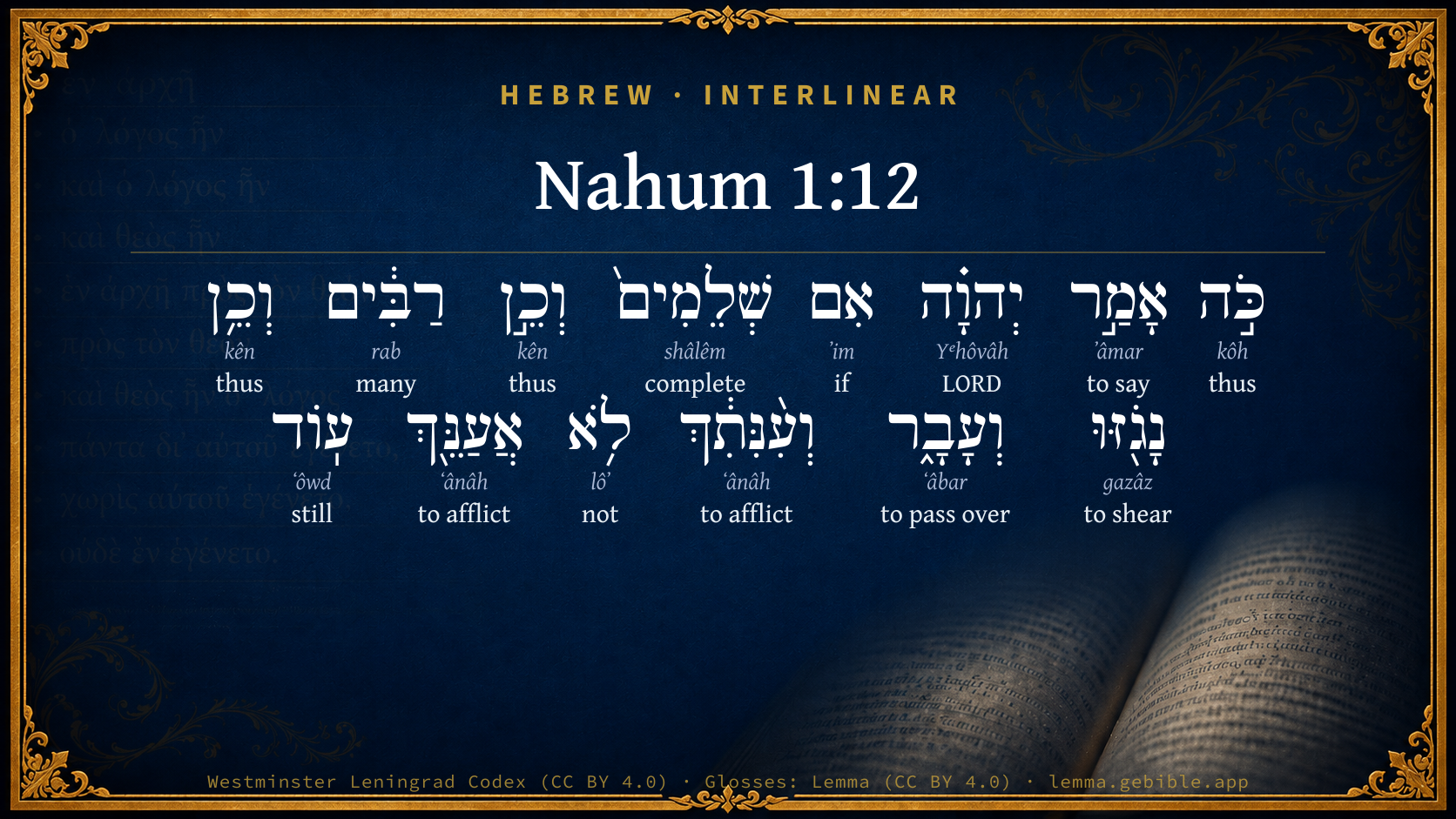
  1. כֹּ֣ה kôh H3541 “thus” Adverb
  2. אָמַ֣ר ʼâmar H559 “to say” Verb, Qal, Perfect, 3rd Person, Masculine, Singular
  3. יְהוָ֗ה Yᵉhôvâh H3068 “LORD” Noun, Proper
  4. אִם ʼim H518 “if” Conjunction
  5. שְׁלֵמִים֙ shâlêm H8003 “complete” Adjective, Adjective, Masculine, Plural, Absolute
  6. וְכֵ֣ן kên H3651 “and · thus” Conjunction + Particle, Demonstrative
  7. רַבִּ֔ים rab H7227 “many” Adjective, Adjective, Masculine, Plural, Absolute
  8. וְכֵ֥ן kên H3651 “and · thus” Conjunction + Particle, Demonstrative
  9. וְעָבָ֑ר ʻâbar H5674 “and · to pass over” Conjunction + Verb, Qal, Perfect, 3rd Person, Masculine, Singular
  10. וְעִ֨נִּתִ֔ךְ ʻânâh H6031 “and · to afflict · you” Conjunction + Verb, Piel, Perfect, 1st Person, Common, Singular + Suffix, Personal, 2nd Person, Feminine, Singular
  11. לֹ֥א lôʼ H3808 “not” Particle, Negative
  12. אֲעַנֵּ֖ךְ ʻânâh H6031 “to afflict · you” Verb, Piel, Imperfect, 1st Person, Common, Singular + Suffix, Personal, 2nd Person, Feminine, Singular
  13. עֽוֹד ʻôwd H5750 “still” Adverb

About this verse

These counts appear in no published source. They are computed here, from the morphology-tagged text and Lemma’s own curated glosses. What Lemma adds →

14
words
12
distinct lemmas
Prophets
section

Notable vocabulary

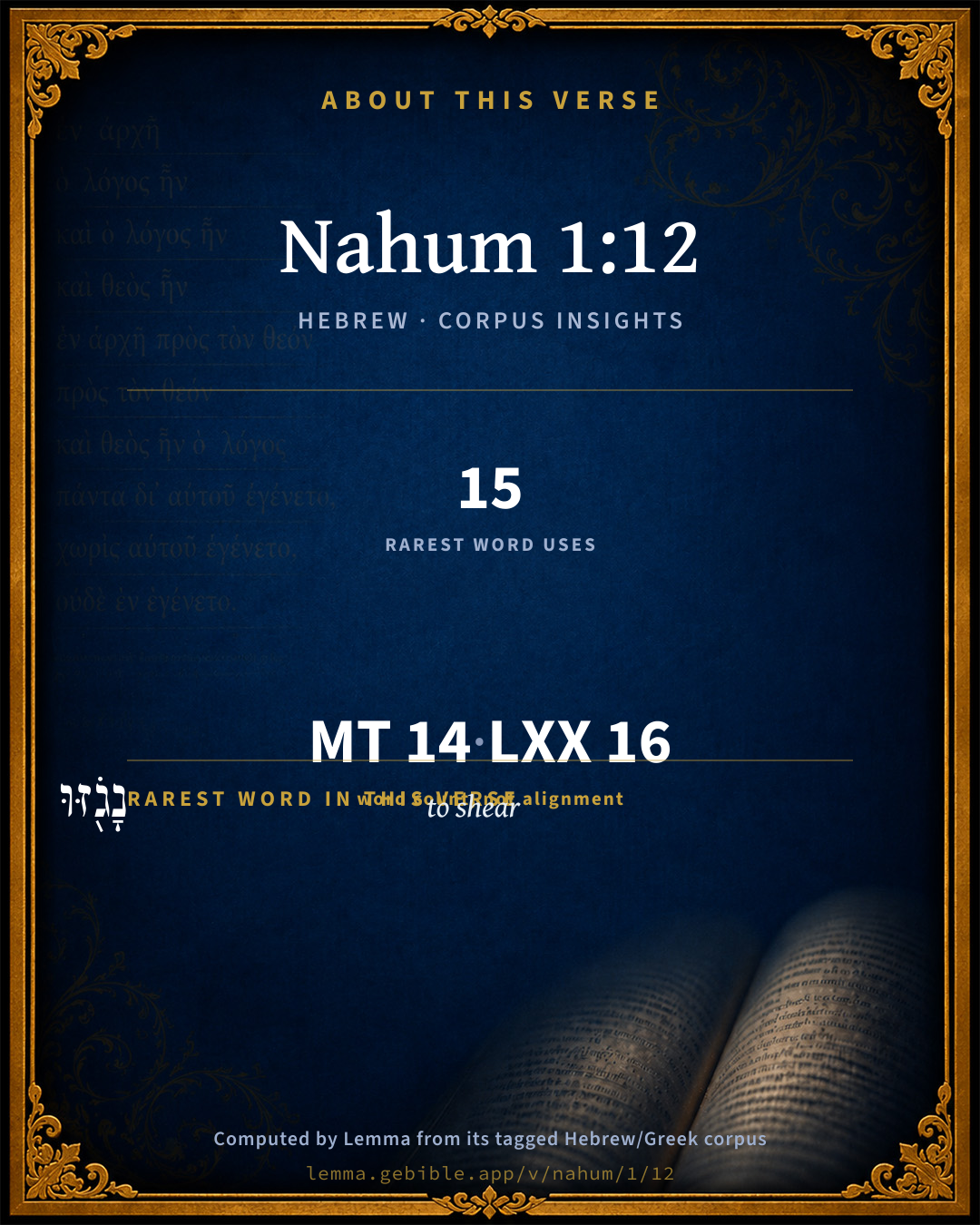
The rarest word here is נָגֹ֖זּוּ to shear H1494 — appearing just 15 times in the whole Hebrew Bible.

Shared distinctive vocabulary

נָגֹ֖זּוּ to shear H1494 occurs in 15 verses of the Hebrew Bible. Also found in:

Grammatical profile

  • 5 verbs
  • 1 noun
  • 2 adjectives
  • 1 conjunction
  • 2 adverbs
  • 3 particles

Verb forms

  • אָמַ֣ר Qal · Perfect
  • נָגֹ֖זּוּ Niphal · Perfect
  • וְעָבָ֑ר Qal · Perfect
  • וְעִ֨נִּתִ֔ךְ Piel · Perfect
  • אֲעַנֵּ֖ךְ Piel · Imperfect

Repetition

Words recur within this verse — often emphatic in Hebrew:

  • וְכֵ֣ן thus H3651 ×2
  • וְעִ֨נִּתִ֔ךְ to afflict H6031 ×2

Hebrew & Septuagint length

In English translation the verse runs 35 words from the Hebrew and 27 from the Septuagint (LXX English) — closely comparable.

A rough comparison of the two English renderings, which tokenize alike — not a word-level alignment.

Word counts can differ between the Hebrew and the Greek without any difference in meaning — e.g. the Hebrew direct-object marker אֵת has no separate Greek word, and Greek often adds the article ὁ.

In the original languages it is 14 Hebrew tokens and 16 Greek tokens — but the two are counted differently (Hebrew bundles its prefixes and suffixes into one token; the Greek is in lemma form), so that isn’t a like-for-like length.

Cross-references

19

Topical passages linked to Nahum 1:12 in the Treasury of Scripture Knowledge — connected by theme and wording, ordered by reader-vote popularity; previews shown in the World English Bible.

  • Isaiah 30:19 For the people shall dwell in Zion at Jerusalem; you shall weep no more; he will surely be gracious to you at the voice of your cry; when he shall hear, he will answer you.
  • Joel 2:19 Yahweh answered his people, "Behold, I will send you grain, new wine, and oil, And you will be satisfied with them; And I will no more make you a reproach among the nations.
  • Isaiah 7:20 In that day the Lord will shave with a razor that is hired in the parts beyond the River, even with the king of Assyria, the head and the hair of the feet; and it shall also consume the beard.
  • Isaiah 17:14 At evening, behold, terror; [and] before the morning they are no more. This is the portion of those who despoil us, and the lot of those who rob us.
  • Isaiah 31:8 The Assyrian shall fall by the sword, not of man; and the sword, not of men, shall devour him; and he shall flee from the sword, and his young men shall become subject to forced labor.
  • Isaiah 37:36 The angel of Yahweh went forth, and struck in the camp of the Assyrians one hundred and eighty-five thousand; and when men arose early in the morning, behold, these were all dead bodies.
  • Isaiah 8:8 and it shall sweep onward into Judah; it shall overflow and pass through; it shall reach even to the neck; and the stretching out of its wings shall fill the breadth of your land, Immanuel.
  • Isaiah 10:32–34 This very day shall he halt at Nob: he shakes his hand at the mountain of the daughter of Zion, the hill of Jerusalem.
  • Isaiah 14:24–27 Yahweh of Hosts has sworn, saying, Surely, as I have thought, so shall it happen; and as I have purposed, so shall it stand:
  • Isaiah 51:22 Thus says your Lord Yahweh, and your God who pleads the cause of his people, Behold, I have taken out of your hand the cup of staggering, even the bowl of the cup of my wrath; you shall no more drink it again:
  • Daniel 11:10 His sons shall war, and shall assemble a multitude of great forces, which shall come on, and overflow, and pass through; and they shall return and war, even to his fortress.
  • Nahum 1:15 Behold, on the mountains the feet of him who brings good news, who publishes peace! Keep your feasts, Judah! Perform your vows, for the wicked one will no more pass through you. He is utterly cut off.
  • Revelation 7:16 They will never be hungry, neither thirsty any more; neither will the sun beat on them, nor any heat;
  • Exodus 12:12 For I will go through the land of Egypt in that night, and will strike all the firstborn in the land of Egypt, both man and animal. Against all the gods of Egypt I will execute judgments: I am Yahweh.
  • 2 Kings 19:35 It happened that night, that the angel of Yahweh went forth, and struck in the camp of the Assyrians one hundred eighty-five thousand: and when men arose early in the morning, behold, these were all dead bodies.
  • 2 Kings 19:37 It happened, as he was worshipping in the house of Nisroch his god, that Adrammelech and Sharezer struck him with the sword: and they escaped into the land of Ararat. Esar Haddon his son reigned in his place.
  • Lamentations 3:31–32 For the Lord will not cast off forever.
  • Isaiah 30:28–33 and his breath is as an overflowing stream, that reaches even to the neck, to sift the nations with the sieve of destruction: and a bridle that causes to err [shall be] in the jaws of the peoples.
  • Isaiah 60:18–20 Violence shall no more be heard in your land, desolation nor destruction within your borders; but you shall call your walls Salvation, and your gates Praise.

Cross-references courtesy of OpenBible.info (CC BY 4.0).

Hebrew and Greek witnesses Masoretic Hebrew ↔ Greek Septuagint

The same verse in the two great witnesses to the Old Testament, shown verse-for-verse.

These are two independent witnesses, not word-aligned to each other, and the Septuagint is shown in lemma (dictionary) form.

Hebrew Nahum 1:12 Masoretic · Westminster Leningrad Codex

כֹּ֣ה אָמַ֣ר יְהוָ֗ה אִם שְׁלֵמִים֙ וְכֵ֣ן רַבִּ֔ים וְכֵ֥ן נָגֹ֖זּוּ וְעָבָ֑ר וְעִ֨נִּתִ֔ךְ לֹ֥א אֲעַנֵּ֖ךְ עֽוֹד

Thus says Yahweh: "Though they be in full strength, and likewise many, even so they will be cut down, and he shall pass away. Though I have afflicted you, I will afflict you no more.

World English Bible · Public Domain

Greek LXX Nahum 1:12 Septuagint · lemma form

ὅδε λέγω κύριος καταἄρχω ὕδωρ πολύς καί οὕτως διαστέλλω καί ὁ ἀκοή σύ οὐ ἐνἀκούω ἔτι

Thus says the Lord who rules over many waters, Even thus shall they be sent away, and the report of you shall not be heard any more.

LXX2012 (modern English Septuagint) · Public Domain

On this verse, Haydock's Catholic Bible Commentary discusses the Septuagint’s reading. Read the note in Commentary ↓

Hebrew: Westminster Leningrad Codex (CC BY 4.0). Greek: Septuagint (public domain); English from LXX2012 (modern English Septuagint) (Public Domain). How the Septuagint differs from the Hebrew →

Targum (Aramaic paraphrase)

1

The Targum is the ancient Jewish Aramaic paraphrase of the Hebrew Scriptures — an interpretive translation, not the Hebrew text itself. Onkelos (literal) and Pseudo-Jonathan (expansive) render the Torah, and Jonathan the Prophets. Coverage is partial: where no permissively-licensed English translation exists for a verse, only the Aramaic is shown. This is verse-level text, not a word-by-word alignment to the Hebrew.

  1. Targum Jonathan Prophets (Joshua–Malachi)
    כִּדְנַן אֲמַר יְיָ אִם יְהוֹן שְׁלֵימִין בְּעֵיצָה וְסַגִיאִין בְּאִתְמְנָיוּתָא עַמְמַיָא דְמִתְכַּנְשִׁין לַאֲעָקָא לִיךְ יְרוּשְׁלֵם וִיגוֹזוּן יַת דִגְלַת וְיֶעְבְּרוּן יַת פְּרָת וְיֵיתוּן לְעַנָיוּתָךְ וּדְשַׁעְבַּדְתִּיךְ לָא אַשַׁעְבְּדִנָךְ עוֹד:

    (no public-domain English translation for this verse)

    Targum Jonathan — Aramaic: “Mikraot Gedolot” (public domain). English: “Sefaria Community Translation” (CC0 1.0 (public-domain dedication)); “London "Chaldee Paraphrase," 1871” (public domain). Text via Sefaria.

Commentary

Notes on Nahum 1:12 from classic Christian and Jewish commentators (each source and its license shown beneath its notes). The classic Christian expositions comment on the surrounding passage and are grouped to its opening verse, so a note may address several verses; the Jewish commentaries on the Tanakh (Rashi and others) are per-verse, so they appear only where the commentator wrote on this verse.

Lemma curates 59 commentaries, every one of them public domain or Creative Commons licensed, each selected and text-cleaned for this edition rather than reprinted as found. About our sources →

Trapp's Complete Commentary

John Trapp

Nah 1:12 Thus saith the LORD; Though [they be] quiet, and likewise many, yet thus shall they be cut down, when he shall pass through. Though I have afflicted thee, I will afflict thee no more.

Ver. 12. Thus saith the Lord] To thee, O Jerusalem, and for thy comfort. The Lord will speak peace to his people; and ministers are charged to speak to their hearts, Isa 40:1.

Though they be quiet] Or still, well disciplined, as the Turkish army is, to the wonder of all that pass through it, Turcae perpetuum silentium tenent ut muti (Cuspin. de Caesar.) There was no falling out nor complaining in the Assyrian hosts; therefore, and by this means, did their king march on, pass through.

And likewise many] How great an army they were may be gathered from the many thousands of them that were slain by the angel, Isa 37:36. It is all one with God whether it be done against a nation or against a man only, Job 34:29; he stands not upon multitudes, who "taketh up the isles as a very little thing," Isa 40:15.

Yet thus shall they be cut down] Heb. shorn; with as little ado as one would shear a sheep, mow down a meadow, or shave off hair with a sharp razor. The prophet seemeth to allude to that text in Isaiah (with whom, as his contemporary, he hath many things common), Isa 7:20, and to threaten the Assyrian, that he shall be paid home in his own coin; and that as he had done to Israel so should it be done again to him. God loveth to retaliate.

When he shall pass through] Heb. And he passeth, or away he goeth, sc. to his own country, after the loss of his army, slain by the angel, so Jerome. Others, they shall be cut down, sc. by the hand of a mighty one, as Isa 10:34, or of an angel, when he, that is, Sennacherib, and every one of his army hath passed through, sc. the land without restraint or control, and now maketh account that he is master of all.

Though I have afflicted thee, yet I will afflict thee no more] sc. By these Ninevites; no, nor by any other enemies, unless there be a very great need, 1Pe 1:6. The Church hath ever had her halcyons, her interchanges of prosperity and adversity. God will not always chide, Psa 103:9, he delighteth in the prosperity of his servants, Psa 35:27, and wisheth, O that this people were wise, &c. "O that my people had hearkened," &c., Psa 81:13-15. There is another reading of the words, as may be seen in the margent. This is Junius. The Chaldee paraphraseth thus: Although the Ninevites enjoy great peace, and by peace are so multiplied that they are very numerous, yet shall they be shorn and cut down.

John Trapp, A Commentary or Exposition upon All the Books of the Old and New Testament (1647–1656) — public domain. Text from a community e-Sword module.

The Preacher's Complete Homiletical Commentary

Joseph S. Exell (gen. ed.)

CRITICAL NOTES.]

Nah_1:12-14.] Repeat the truths of Nah_1:9-11. Good to Judah, and evil to Assyria, predicted. Quiet] In tranquil security; or complete with unbroken ranks and number, with everything necessary for a successful siege. “The word may also be designed to convey the idea of mental completeness, i.e. in this connexion, security, martial courage” [Hend.]. Cut] Mown down like the harvest (2Ki_19:35; Isa_37:36-37). Give historical facts.

Nah_1:13. Yoke] The tribute to Assyria (cf. Isa_10:27; Jer_2:20).

Nah_1:14.] The name and power of Assyria to become extinct. Sown] The seed or race to be for ever destroyed, at destruction of Nineveh the dynasty would not be perpetuated. Gods] Every kind of images (Deu_27:15). (See Layard’s Nineveh and its Remains, on Idol, of Assyria.) House] The palace considered sacred. Make] i.e. the house of thy gods, thy grave. Sennacherib slain during worship (2Ki_19:37). Vile] Because when weighed according to moral standards worthless (Job_31:6), found light (Dan_5:27).

Nah_1:15.] This verse joined to ch. 2 in Heb. text, and nearly like (Isa_52:7). Here deliverance from Assyria, not Babylon. Tidings] Overthrow of Sennacherib. Mountains] No longer covered with hostile camps to prevent keeping feasts. Peace] and deliverance, i.e. great yearly feasts of thanksgiving. Wicked] Lit. Belial (Nah_1:11), marg. = Sennacherib. This is a wonderful type of Gospel events; salvation through Christ, victory over sin, death, and hell.

THE DESTRUCTION OF THE ENEMY, AND THE REDEMPTION OF GOD’S PEOPLE.—Nah_1:12-15

Here good is predicted to Judah, and evil to the enemy. One shall be purified and restored, the other utterly annihilated.

I. The destruction of the enemy. The Prophet notices their present condition, and contrasts it with future ruin.

1. They are unbroken in strength. “Though they be quiet.” If they be entire, sound and unharmed, perfect in warlike preparations, that will not avail them.

2. They are undiminished in number. “And likewise many.” Their numbers were unimpaired and great. Hezekiah thus exhorted the people: “Be strong and courageous, be not afraid nor dismayed for the King of Assyria, nor for all the multitude that is with him” (2Ch_32:7).

3. They are secure in tranquillity. “Quiet,” that is, without fear, and perfectly safe. They were free from attacks, and securely fortified, but not against God. They pictured an easy march and a splendid victory in the land, “When he shall pass through;” but the vast host was swept away in a single night. Notice their future.

1. Idolatry will be destroyed. “Out of the house of thy gods will I cut off the graven image.” Their gods in the temple, graven and molten, would not help them, nor be spared by the enemy. God has a controversy with all kinds of idols. The fate of a nation is often bound up with the fate of its God.

2. The dynasty would be extinguished. “No more of thy name be sown.” If not immediately, yet eventually the Assyrian line would cease. God commanded this, and it was certain to happen. Their splendid renown would fade away and their name be cut off. The race would be cut down without chance of springing again. “The face of the Lord is against them that do evil, to cut off the remembrance of them from the earth.”

3. The palace would be turned into a grave. “I will make (the house of thy gods) thy grave.” The temple was polluted by slaughter, and converted into a sepulchre (Isa_37:38; 2Ki_19:37). Men perish in the things in which they seek refuge. The Assyrian power was destroyed. God made a grave for its idols and its people. All were vile and light; found wanting when weighed in the balance (Dan_5:27). Whatever honour man set upon them, they were lightly esteemed by God. Wickedness in religious and political life brings contempt and ruin upon a nation. “The seed of evil-doers shall never be renowned.”

“God needs no indirect nor lawless course

To cut off those who have offended Him” [Shakespeare].

II. The redemption of God’s people. Deliverance from the enemy would be followed by restoration of worship and peace. All sorrow would end, and every cause of fear be overcome.

1. Deliverance would be enjoyed. The news would be proclaimed and welcomed throughout the kingdom. If to Sophocles the hands and feet of any one who went on errands of mercy were beautiful, how much more should the heralds of the gospel be received by all who hear them.

(1) Deliverance from affliction. “Though I have afflicted thee, I will afflict thee no more.” The bitter potion will not be repeated, unless there be real necessity. God doth not afflict willingly, and former trials should not hinder faith in present good.

(2) Deliverance from the enemy. Servitude no longer. (a) From the yoke of the enemy. A victorious army shall no longer tax and oppress. “Now will I break his yoke from off thee.” (b) From the fear of the enemy. He shall be completely subdued, and no trace of his steps left behind. He will be cut off in spirit, number, and existence. “The wicked shall no more pass through thee.”

2. Worship would be restored. Solemn feasts would be kept. The free use and thorough enjoyment of religious ordinances would be restored. Vows would be performed, and gratitude continually abound. The ransomed of the Lord would return to Zion with songs and everlasting joy upon their heads. It is our privilege to behold the feet of those who publish peace with God and salvation through Christ. If we believe we may keep our feasts in gladness, and anticipate the glory of that temple into which the wicked never enter.

HOMILETIC HINTS AND SUGGESTIONS

Nah_1:12. Cut down like grass in a field. The completeness of the destruction, and the ease with which it is done. Greatness and number nothing with God.

Nah_1:13. The affliction of the Church. “Yoke.” The method of deliverance. “Break his yoke.” The agent who works it. “I will break.” “By the strength of my hand I have done it” (Isa_10:13). The time in which it is done. “God, lest his own should despair, does not put them off altogether to a distant day, but saith now” [Pusey].

Nah_1:14. It is sufficient ground of assurance for the coming to pass of greatest things, that the Lord hath determined they should be; for, this is given as a sure ground of Assyria’s ruin, that the Lord hath given a commandment, or purposed their destruction, his purpose concluding as effectually the concurring of all means to bring it about, as if they were especially commanded. Name. “The Lord doth justly root out the memory of such persons or states, as make it their only work to get a name on earth, and to be eminent and terrible; for such is Assyria’s doom: no more of thy name shall be sown” [Hutcheson].

ILLUSTRATIONS TO CHAPTER 1

Nah_1:15. Peace, newly granted by the grace of God, was to be celebrated by a new consecration of the people. This has special reference to the king of Nineveh and Assyria, and the promise must have been very precious to contemporaries oppressed by Assyria. But to us the fundamental truth is far more important, that to the people of God a perfect deliverance is near at hand, and has already appeared in Christ, by which the Belial, from whom every wicked spirit proceeds, is for ever cast out [Lange].

“Come, and begin Thy reign

Of everlasting peace;

Come, take the kingdom to Thyself,

Great King of Righteousness” [Bonar]

The Preacher's Complete Homiletical Commentary (gen. ed. Joseph S. Exell; Funk & Wagnalls, c. 1892) — public domain (pre-1929). A full-Bible homiletical/sermon-outline anthology covering 65 of 66 books (2 John is absent from the source module). Text from a community e-Sword module.

Keil & Delitzsch

C. F. Keil & F. Delitzsch

The power of Nineveh will be destroyed, to break the yoke laid upon Judah. Nah 1:12. "Thus saith Jehovah, Though they be unconsumed, and therefore numerous, yet are they thus mowed down, and have passed away. I have bowed thee down, I will bow thee down no more. Nah 1:13. And now shall I break his yoke from off thee, and break thy fetters in pieces. Nah 1:14. And Jehovah hath given commandment concerning thee, no more of thy name will be sown: from the house of thy God I cut off graven image and molten work: I prepare thy grave; for thou art found light." To confirm the threat expressed in Nah 1:8-11, Nahum explains the divine purpose more fully. Jehovah hath spoken: the completeness and strength of her army will be of no help to Nineveh. It is mowed down, because Judah is to be delivered from its oppressor. The words שׁלמים to ועבר refer to the enemy, the warlike hosts of Nineveh, which are to be destroyed notwithstanding their great and full number. Shâlēm, integer, with strength undiminished, both outwardly and inwardly, i.e., both numerous and strong. וכן רבּים, and so, i.e., of such a nature, just because they are of full number, or numerous. וכן נגוזּוּ, and so, i.e., although of such a nature, they will nevertheless be mowed down. גּזז, taken from the mowing of the meadows, is a figure denoting complete destruction. ועבר is not impersonal, actum est, sc. de iis, but signifies it is away, or has vanished. The singular is used with special emphasis, the numerous army being all embraced in the unity of one man: "he paints the whole people as vanishing away, just as if one little man were carried off" (Strauss). With וענּתך the address turns to Judah. The words are not applicable to the Assyrians, to whom Abarbanel, Grotius, Ewald, and Hitzig refer this clause; for Asshur is not only bowed down or chastened, but utterly destroyed. ענּתך refers to the oppression which Judah had suffered from the Assyrians in the time of Ahaz and Hezekiah. This shall not be repeated, as has already been promised in Nah 1:9. For now will the Lord break the yoke which this enemy has laid upon Judah. ועתּה, but now, is attached adversatively to ענּתך. The suffix to מטהוּ refers to the enemy, which has its seat in Nineveh. For the figure of the yoke, cf. Lev 26:13; Jer 27:2; Jer 28:10; Eze 34:27, etc.; and for the fact itself, Isa 10:27. The words do not refer to the people of the ten tribes, who were pining like slaves in exile (Hitzig); for Nahum makes no allusion to them at all, but to Judah (cf. Nah 1:15), upon whom the Assyrians had laid the yoke of tribute from the time of Ahaz. This was first of all shaken off in the reign of Hezekiah, through the overthrow of Sennacherib; but it was not yet completely broken, so long as there was a possibility that Assyria might rise again with new power, as in fact it did in the reign of Manasseh, when Assyrian generals invaded Judah and carried off this king to Babylon (Ch2 33:11). It was only broken when the Assyrian power was overthrown through the conquest and destruction of Nineveh. This view, which is required by the futures 'eshbōr and 'ănattēq, is confirmed by Nah 1:14, for there the utter extermination of Assyria is clearly expressed. Vetsivvâh is not a perfect with Vav rel.; but the Vav is a simple copula: "and (= for) Jehovah has commanded." The perfect refers to the divine purpose, which has already been formed, even though its execution is still in the future. This purpose runs thus: "Of thy seed shall no more be sown, i.e., thou wilt have no more descendants" ("the people and name are to become extinct," Strauss; cf. Isa 14:20). It is not the king of Assyria who is here addressed, but the Assyrian power personified as a single man, as we may see from what follows, according to which the idols are to be rooted out along with the seed from the house of God, i.e., out of the idol temples (cf. Isa 37:38; Isa 44:13). Pesel and massēkhâh are combined, as in Deu 27:15, to denote every kind of idolatrous image. For the idolatry of Assyria, see Layard's Nineveh and its Remains, ii. p. 439ff. אשׂים קברך cannot mean, "I make the temple of thy god into a grave," although this meaning has already been expressed in the Chaldee and Syriac; and the Masoretic accentuation, which connects the words with what precedes, is also founded upon this view. If an object had to be supplied to אשׂים from the context, it must be pesel ūmassēkhâh; but there would be no sense in "I make thine idol into a grave." There is no other course left, therefore, than to take קברך as the nearest and only object to אשׂים, "I lay, i.e., prepare thy grave," כּי קלּות, because, when weighed according to thy moral worth (Job 31:6), thou hast been found light (cf. Dan 5:27). Hence the widespread opinion, that the murder of Sennacherib (Isa 37:38; Kg2 19:37) is predicted here, must be rejected as erroneous and irreconcilable with the words, and not even so far correct as that Nahum makes any allusion to that event. He simply announces the utter destruction of the Assyrian power, together with its idolatry, upon which that power rested. Jehovah has prepared a grave for the people and their idols, because they have been found light when weighed in the balances of righteousness.

Keil & Delitzsch — Biblical Commentary on the Old Testament (1861–1891) — public domain (CC PDM 1.0). Text via the HelloAO Bible API. (Old Testament only.)

Tyndale Open Study Notes

Tyndale Open Resources

1:12 The Assyrians’ allies were vassal or subordinate kingdoms, including once-powerful Egypt. Ironically, a coalition of former allies gradually brought down the great Neo-Assyrian Empire between 625 and 605 BC. • O my people refers to Judah, whom God had punished earlier when the Assyrian king Sennacherib (704–681 BC) launched a campaign (701 BC) against the western states of the Near East. While Sennacherib failed to take Jerusalem (2 Kgs 19:32-36), he boasted in his annals of carrying away Jerusalem’s tribute and an enormous amount of spoils from forty-six cities in Judah. Although Judah was now reduced to vassalage and faced the constant possibility of Assyrian aggression, Assyria did not defeat the southern kingdom. Babylon did so, however, in 586 BC. Sadly, neither Israel nor Judah heeded God’s repeated warnings that failure to repent would result in judgment (Hos 11:5; Joel 2:1-27).

Tyndale Open Study Notes — © Tyndale Open Resources, licensed CC BY-SA 4.0. Text via the HelloAO Bible API.

Rashi

Rabbi Shlomo Yitzchaki (Rashi)

Though they be at peace and likewise many Jonathan’s Targum is very appropriate to the verse: If they [the people of Nineveh] are at peace in their counsel, that they will all be of one accord; and likewise, if the people of Nineveh, your enemies, are many, O Jerusalem; and likewise, even if they have crossed the Tigris and passed over the Euphrates to besiege it, they will not succeed, for I have afflicted you; I will no longer afflict you. I have heard further (this rendering): If they are perfect—the people of Nineveh, in their greatness. and likewise—if they will be still greater and more honored. and so they shall be cut down and pass away—And so I will cut them down and take them away. This is like (Exod 1:12) “And the more they would afflict them, the more they would multiply.”

and I will no longer afflict you—I will afflict you this time with destruction and annihilation, and I will no longer be involved with you. Our Sages expounded upon this concerning the practice of charity in Tractate Gittin (7a), but it does not fit in with the context.

Rashi on the Tanakh — English translations: “The Judaica Press complete Tanach with Rashi, translated by A. J. Rosenberg” (CC BY 4.0); “Pentateuch with Rashi's commentary by M. Rosenbaum and A.M. Silbermann, 1929-1934” (public domain); “The Metsudah Tanach series, Lakewood, N.J” (CC BY 4.0); and “The Book of Joshua, Metsudah Publications, 1997” (CC BY 4.0). Text via Sefaria.

Geneva Bible (1599)

Geneva Bible translators

Though they think themselves in most safety, and of greatest strength, yet when God shall pass by, he will destroy them: notwithstanding he comforteth his Church, and promiseth to make an end of punishing them by the Assyrians.

Geneva Bible (1599) marginal notes — public domain. Text via Bolls.life.

Jamieson, Fausset & Brown

Robert Jamieson, A. R. Fausset & David Brown

The same truths repeated as in Nah 1:9-11, Jehovah here being the speaker. He addresses Judah, prophesying good to it, and evil to the Assyrian.

Though they be quiet--that is, without fear, and tranquilly secure. So Chaldee and CALVIN. Or, "entire," "complete"; "Though their power be unbroken [MAURER], and though they be so many, yet even so they shall be cut down" (literally, "shorn"; as hair shaved off closely by a razor, Isa 7:20). As the Assyrian was a razor shaving others, so shall he be shaven himself. Retribution in kind. In the height of their pride and power, they shall be clean cut off. The same Hebrew stands for "likewise" and "yet thus." So many as they are, so many shall they perish.

when he shall pass through--or, "and he shall pass away," namely, "the wicked counsellor" (Nah 1:11), Sennacherib. The change of number to the singular distinguishes him from his host. They shall be cut down, he shall pass away home (Kg2 19:35-36) [HENDERSON]. English Version is better, "they shall be cut down, "when" He (Jehovah) shall pass through," destroying by one stroke the Assyrian host. This gives the reason why they with all their numbers and power are to be so utterly cut off. Compare "pass through," that is, in destroying power (Eze 12:12, Eze 12:23; Isa 8:8; Dan 11:10).

Though I have afflicted thee--Judah, "I will afflict thee no more" (Isa 40:1-2; Isa 52:1-2). The contrast is between "they," the Assyrians, and "thee," Judah. Their punishment is fatal and final. Judah's was temporary and corrective.

Jamieson, Fausset & Brown — Commentary Critical and Explanatory on the Whole Bible (1871) — public domain (CC PDM 1.0). Text via the HelloAO Bible API.

Adam Clarke's Commentary

Verse 12. Though they be - many] Sennacherib invaded Judea with an army of nearly two hundred thousand men.

Thus shall they be cut down] The angel of the Lord (a suffocating wind) slew of them in one night one hundred and eighty-five thousand, 2Kg 19:35.

Adam Clarke's Commentary on the Bible (1810–1826) — public domain. Text from a community e-Sword/MySword module.

John Calvin's Commentaries

The Prophet pursues here the same subject; but expresses more clearly what might have been doubtful, — that whatever strength there might be in the Assyrians, it could not resist the coming of God’s vengeance. For thus saith Jehovah, Though they be quiet and also strong, etc. I cannot now finish this subject, but will only say this, — The Prophet intimates that though Nineveh promised to itself a tranquil state, because it was well fortified, and had a wide and large extent of empire, yet this thy peace, he says, or this thy confidence and security, shall not be an impediment, that the hand of God should not be extended to thee. Though, then, they be many or strong etc.; for we can render רבים, rebim, strong as well as many; but either would suit this place; for we understand the Prophet’s meaning to be, that all God’s enemies would be cut off, however secure they might be, while depending on their own strength and fortresses. The rest to-morrow.

John Calvin's Commentaries (1540-1563) — public domain. Text from the Calvin Translation Society English edition (1840s-50s) via the Christian Classics Ethereal Library (ccel.org). Calvin's coverage is partial (roughly two-thirds of the Bible); uncommented books and verses are honest gaps, never fabricated. The 19th-century editor's footnotes and remarks are omitted so the notes are faithfully Calvin's own voice.

Ellicott's Commentary for English Readers

(12) Thus saith the Lord.—Better, Thus saith Jehovah, Though they be of unimpaired strength and ever so numerous, yet just in that state shall they be cut down, and he [viz., the evil counsellor of Nah_1:11] shall pass away. Though I have afflicted thee [Jerusalem], I will afflict thee no more. Destruction comes upon the Assyrian army in the very hour of prosperity, while unscathed and complete in numbers (2Ki_19:32-33). Pass away: so in Psalms 48 (a composition generally thought to refer to this very catastrophe), “For lo, the kings were assembled: they passed away together.”

A Bible Commentary for English Readers, edited by Charles John Ellicott (1878–1897) — public domain. Text from a community e-Sword module.

The Cambridge Bible for Schools and Colleges

gen. ed. J. J. S. Perowne

12. The verse is very obscure. Sept. partly read differently and partly divided the letters otherwise, and did not find the word likewise in their text, rendering, Thus saith the Lord who ruleth over many waters; and Syr., Thus saith the Lord concerning the heads (rulers?) of many waters. The present text may be rendered with R.V., though they be in full strength and likewise many, even so shall they be cut down, and shall pass away. The word “cut down” as pointed is used elsewhere only of shearing sheep or the hair of the head, and even if the figure were that of thorns as Nah_1:10, seems inappropriate. If the figure were that of waters it would be still more unsuitable. The form might come however from the verb used in Psa_90:10 (R.V. for it is soon gone the we fly away), meaning “to hasten away.”

knen he shall pass through] better: and they shall pass away, plur. the rig.

Though I have afflicted thee] The natural rendering would be: and if (or, when) I shall afflict thee, I will afflict thee no more. This rendering would make the reference be to Nineveh, and the meaning be that the affliction would be once for all and final. For construction cf. Exo_4:14; Num_23:20. In A.V. reference is to Israel. See on Nah_1:9. If the words referred to Nineveh or Asshur the pronouns might be read as masc., cf. Nah_1:13-14.

13 seq. In Nah_1:13 Judah is addressed; in Nah_1:14 Asshur; again Nah_1:15 (Heb_2:1) Judah, and Nah_2:1 (Heb_2:2) Asshur; and once more Nah_1:2 Judah, and Nah_1:3 seq. Asshur. Such frequent interchange of persons is most unnatural. Nah_1:13 might be an interpolation or marginal note due to the assumption that Judah is addressed in the words in the end of the preceding verse. Ch. Nah_2:2 could hardly stand where it is, though it might follow ch. Nah_1:15.

his yoke] i.e. Asshur’s. The form only here, cf. Jer_27:2; Jer_28:10; Jer_28:12; Eze_34:27; Lev_26:13; Isa_58:6. With “burst thy bonds in sunder” cf. Psa_2:3, where the words are the same; also Jer_30:8.

The Cambridge Bible for Schools and Colleges (gen. ed. J. J. S. Perowne; Cambridge University Press, 1878–1918) — public domain. Text from a community e-Sword module.

John Gill's Exposition

Thus saith the Lord, though they be quiet, and likewise many,.... The Assyrian army under Sennacherib before Jerusalem, though they were quiet and secure and thought themselves out of all danger; not at all fearing that the besieged would sally out against them they being so numerous, and therefore betook themselves to sleep and rest:

yet thus shall they be cut down; or "shorn" (l); as the wool is shorn off the back of a sheep with sheers; or grass or corn is mowed with a scythe; or else as the hair of a man's head and beard are shaved with a razor; which sometimes was done, not only in a way of ignominy and contempt, as David's servants were served by Hanun, Sa2 10:4; but as a token of servitude; hence those words of the poet (m),

"after thou art a servant, dost thou let thy hair grow?''

upon which it is observed (n), that it belongs to freemen to let the hair grow; and so the philosopher says (o), to let the hair grow, or to nourish it, is commendable with a Lacedemonian, for it is a sign of liberty; for it is not for him who lets his hair grow to do any servile work; and it was usual with conquerors to shave the conquered, and such as were carried captives (p), which some think is referred to in Deu 32:42; and render the latter clause of that verse,

"and there shall be captivity, by reason of the head of nakedness of the enemy;''

that is, there should be captives whose heads should be made bare, or shaved by the enemy the conqueror (q); hence the king of Assyria, when a conqueror, is compared to a sharp razor, that should shave the head, and feet, and beard, even all sorts of people, Isa 7:20; but now he and his army should be shaved themselves; that is, conquered, slain, or taken captives, and become slaves, and treated with contempt; all which may be taken into the sense of this phrase, and serve to illustrate it:

when he shall pass through; when the angel should pass through the camp of the Assyrians, then were they cut down by him in great numbers, a hundred and fourscore and five thousand slain at once, Kg2 19:35;

though I have afflicted thee, I will afflict thee no more: or "any longer" (r); though the Lord had afflicted the people of the Jews by the Assyrian king, the rod of his anger, again and again, yet after this he would afflict them no more by him; for otherwise they were afflicted afterwards, yet not by the Assyrians, but by the Babylonians, Syrians, and Romans, Some understand this, as before, of the Ninevites and Assyrians, that should be utterly destroyed at once, and their affliction should not be a second time; see Nah 1:9; so Abarbinel: or, "I will not hear thee any more" (s); as he did formerly, when they repented at the preaching of Jonah.

(l) "tonsi", Junius & Tremellius, Piscator. (m) Aristophanes in Avibus, p. 584. (n) Scholia Graec. in ib. (o) Aristotel. Rhetor. l. 1. c. 9. (p) "Tonsa comas imo Barathri claudere recessu", Claudian in Ruffin. l. 1. prope finem. Vid. Barthium in ib. (q) Lydius de Re Militari, l. 6. c. 6. p. 237. (r) "non ultra", Pagninus, Montanus; "non amplius", Junius & Tremellius, Piscator, Cocceius. (s) "non exaudiam te amplius", Burkius.

John Gill's Exposition of the Whole Bible (1746–1763) — public domain (CC PDM 1.0). Text via the HelloAO Bible API.

Albert Barnes' Notes on the Bible

Though they be quiet and likewise many, yet thus shall they be cut down - Literally, “If they be entire,” i. e., sound unharmed, unimpaired in their numbers, unbroken in their strength, undiminished, perfect in all which belongs to war; “and thus many even thus shall they be mown down (or shorn), and he passeth away” . With might outwardly unscathed, “without hand” Dan 2:34, and “thus many,” i. e., many, accordingly, as being unweakened; as many as they shall be, “so shall they be mown down, and he,” their head and king, “shall pass away and perish” (compare Psa 48:4). Their numbers shall be, as their condition before, perfect; their destruction as their numbers, complete. It is wonderful how much God says in few words; and how it is here foretold that, with no previous loss, a mighty host secure and at ease, in consequence of their prosperity, all are at one blow mown down, like the dry grass before the scythe, are cut off and perish; and one, their king, “passeth away,” first by flight, and then by destruction. As they had shorn the glory of others Isa 7:20, so should they be shorn and cut down themselves.

Though I have afflicted thee, I will afflict thee no more - o. Unless by new guilt thou compel Me. God always relieves us from trouble, as it were with the words, “sin no more, lest a worse thing come unto thee” Joh 5:14. In the end, afflictions shall be turned into joy, and “God shall wipe away all tears from their eyes; and there shall be no more death, nor sorrow, nor crying, neither shall there be anymore paid” Rev 21:4.

Albert Barnes' Notes on the Bible (1834–1885) — public domain. Text from a community e-Sword/MySword module.

Haydock's Catholic Bible Commentary

Perfect. That is, however strong or numerous their forces may be, they shall be cut off, and their prince or leader shall pass away and disappear. (Challoner) --- If there were many just at Ninive, or among the Jews, (Calmet) a moderate chastisement would suffice. (Haydock) --- The latter have been afflicted; now their enemies shall suffer. Septuagint have read otherwise: (Calmet) "the Lord, reigning over the great waters; thus shall they be divided, and thou shalt be heard of no more." (Haydock)

George Leo Haydock (1774–1849), Haydock's Catholic Family Bible and Commentary, 1859 edition — public domain. Excludes Psalms (Douay-Rheims chapter numbering differs from Protestant) and Deuterocanonical books (Catholic canon only).

Matthew Poole's English Annotations

Thus saith the Lord: this addeth weight to his prediction, it comes under the great seal of Heaven.

Though they be quiet, and likewise many; or, If they would have been quiet and peaceable towards my people, Israel, they, i.e. the Assyrians, should have been many, &c.; but I think it is nearer to the intent of the place to retain our version. Though they, citizens of Nineveh, and people of Assyria, be quiet, be secure, and fear no danger, because of their strength and victories, and likewise many; as appears by the mighty army with which they besieged Jerusalem, in which one hundred and eighty-five thousand were cut off in one night.

Yet thus, irresistibly, suddenly, and universally, as is foretold Nah 1:10,

shall they be cut down: the prophet varieth his phrase, for, Nah 1:10, he speaks of it as done by fire, here he speaks of cutting down, intimating that it was the sword which should cut them off.

When he shall pass through; either God, the mighty and terrible One, passing over as a flood, as it is Nah 1:8; or else the angel of the Lord, as 2Ki 19:35.

Though I, the Lord, who am good to my people,

have afflicted thee, O Israel,

I will afflict thee no more; chastised by the Assyrian, the rod of mine anger, hast thou been, O my people, but I will no more use that rod; for they should soon cease to be a nation that ruleth, and be conquered and oppressed by others.

Matthew Poole's English Annotations on the Holy Bible (1683–1685) — public domain. Text from a community e-Sword/MySword module.

The Pulpit Commentary

Vers. 12-15. The destruction of Nineveh is emphatically announced, and Zion is depicted as rejoicing at the news of its ruin, and celebrating her feasts in safety.

Thus saith the lord. An expression used to introduce a solemn declaration. Though they (the Assyrians) be quiet. Shalem has this meaning elsewhere, as Gen_34:21; but this is unsuitable here, where it must be translated, "in full strength," "unimpaired," "complete," like the thorn hedge in ver. 10. Vulgate, Si perfecti fuerint. Though they be unbroken in strength, and likewise (on that account) many in number. Septuagint, Tade legei Kuriov katarcwn udatwn pollwn , "Thus saith the Lord, ruling over many waters." So the Syriac and Arabic. Jerome interprets "the waters" to mean the heavenly powers. (Psa_148:4) Yet thus (though such is their state) shall they be cut down. The verb is used of the mowing of a fold or the shearing of sheep, and implies complete destruction. When he shall pass through; better, and he shall pass away. The number is changed, but the same persons are meant, spoken of as one to show their insignificance and complete annihilation. Septuagint "Thus shall they be dispersed diastalhsoutai : dividentur, Jerome, and the report of thee shall no more be heard therein." The following clause is not translated. Though I have afflicted thee. The Lord addresses Judah, referring to the oppression of Judaea by the Assyriaus in the times of Ahaz and Hezekiah. (2Ki_16:18 2Ch_28:20) I will afflict thee no more; according to the promise in ver. 9. This is further confirmed in what follows.

The Pulpit Commentary (1880–1919), ed. H.D.M. Spence-Jones & Joseph S. Exell — public domain. Text from a community e-Sword module.

John Wesley's Explanatory Notes

They - The Assyrians. Quiet - Be secure, and fear no dangers. Yet thus - Irresistible, suddenly, and universally. He - The angel of the Lord. Thee - O Israel, I will no more use that rod.

John Wesley, Explanatory Notes Upon the Whole Bible (1754–1765) — public domain. Text via the GEBible commentary corpus.

unfoldingWord translationNotes

Door43 World Missions Community

General Information:

Yahweh speaks to the Israelites about Nineveh.

Even if they are at their full strength and full numbers

This refers to the Assyrians or to the people of Nineveh.

they will nevertheless be sheared

Yahweh speaks of destroying the people of Nineveh as if the were sheep that he will shear. This can be stated in active form. AT: "I will nevertheless shear them" or "I will nevertheless destroy them" (See: Metaphor and Active or Passive)

Now will I break that people's yoke from off you; I will break your chains

Yahweh speaks of freeing Judah from Assyrian oppression as if he were breaking the yoke and chains that the Assyrians had placed on them. AT: "Now I will free you from that people and they will no longer oppress you" (See: Metaphor)

translationWords

Yahweh

Judah

afflicted

yoke

unfoldingWord translationNotes — © Distant Shores Media and the Door43 World Missions Community, licensed CC BY-SA 4.0. Source: git.door43.org/Door43/en_tn.

Lesson kit

Teaching starters — assembled from the data on this page, not authored interpretation. Every prompt links to the verse data it draws on. Edit before teaching.

Nahum, in the Prophets, opens this verse with 14 words (12 distinct Hebrew lemmas). Its most distinctive word is gazâz (“to shear”). A historical commentator’s framing appears above. Read the whole chapter for the surrounding context.

Discussion questions

  1. The word gazâz carries the sense “to shear.” How does it shape the verse?
  2. How does Genesis 31:19, which shares the word «to shear», read alongside this verse?
  3. What does the repetition of “thus” (2× in this one verse) do in this verse?
  4. The translations on this page render this verse differently — a whole-verse word diff, not a word-by-word alignment. What might account for the different wordings?
  5. «אָמַ֣ר» is a Qal Perfect verb. How does that grammatical form shape the action described?
  6. Compare how Trapp's Complete Commentary and The Preacher's Complete Homiletical Commentary read this verse. Where do they agree or differ?

Things to notice

Reading settings

Reading text

Shown beneath each verse's original-language words.

Old Testament
Old Testament edition

Read the OT as the Masoretic Hebrew (MT) or the Greek Septuagint (LXX).

English shown for the Greek Septuagint (in the Hebrew ↔ Greek comparison).

Comparing translations? Open the Compare panel on any verse page to stack up to four side by side.