Ezekiel 48:14

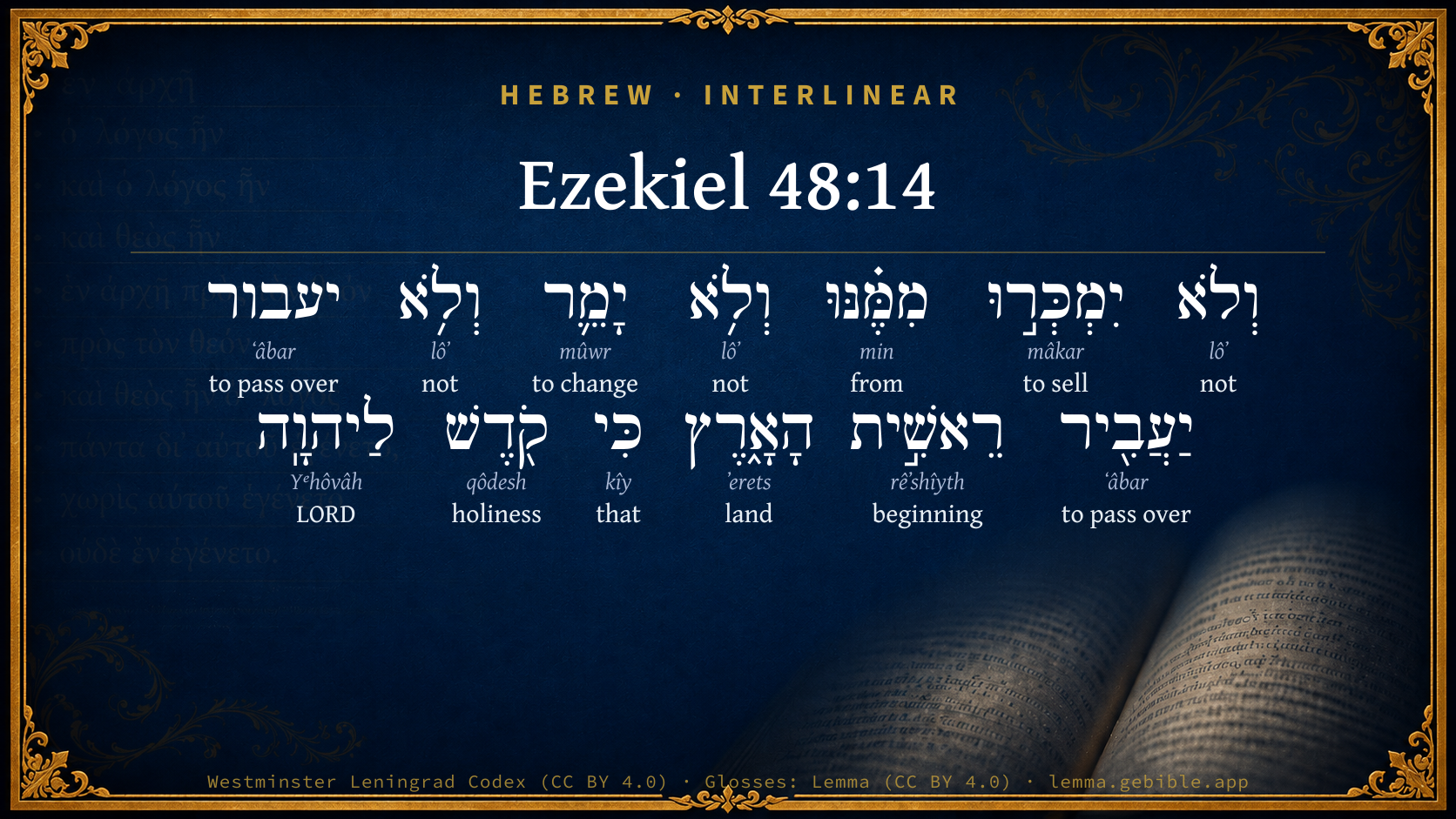
Hebrew (Westminster Leningrad Codex) Ezekiel 48:14 appears in the Hebrew Old Testament. The text above is from the Westminster Leningrad Codex. Each word links to its Strong’s number, a concise gloss, and parsing drawn from the Open Scriptures Hebrew Bible morphology. Click any word for its full Brown-Driver-Briggs (BDB) entry.
Download image
Cite this verse

Ezekiel 48:14 (World English Bible). Public Domain. Lemma interlinear Bible study tool, https://lemma.gebible.app/v/ezekiel/48/14.

Show BibTeX & RIS
BibTeX
RIS
English Translation
They shall sell none of it, nor exchange it, nor shall the first fruits of the land be alienated; for it is holy to Yahweh.
World English Bible · Public Domain
Download a study sheet

One document with this verse’s original text, its word-by-word gloss line, the meaning frame, cross-references with their text, attributed commentary, and full source and license credits — printable, and it pastes into notes with its structure intact.

This verse Autodidact and up

Study sheet (.html) Plain text (.txt)

A passage Seminary Student

Up to 50 verses in one chapter. A passage sheet keeps up to 6 commentary sources and 12 cross-references per verse, in the order this page ranks them, and says so on the sheet whenever that leaves anything out. Ask for a single verse and you get the Autodidact verse sheet above.

Everything on this page stays free to read, with no account — the sheet is a download of what is already on screen, not access to it.

Want to remove ads? Support Godless Engineer
Compare translations 3

The same verse in 3 English versions, stacked beneath the original-language interlinear above. Click any original word for its lexicon entry.

Each is an independent rendering of the whole verse — the interlinear is not word-aligned to these translations.

Highlighted words mark where these versions differ — a whole-verse word diff, not a word-by-word alignment.

  • World English Bible Public Domain
    They shall sell none of it, nor exchange it, nor shall the first fruits of the land be alienated; for it is holy to Yahweh.
  • King James Version Public Domain
    And they shall not sell of it, neither exchange, nor alienate the firstfruits of the land: for it is holy unto the LORD.
  • unfoldingWord Literal Text CC BY-SA 4.0
    They must not sell it or exchange it; none of this firstfruits of the land of Israel must ever be separated from these tracts, for it all is holy to Yahweh.

unfoldingWord Literal Text — © unfoldingWord, licensed CC BY-SA 4.0. Word-aligned USFM3 via Door43 (git.door43.org/unfoldingWord/en_ult).

Versions to compare (up to 4)

3 of 4 selected

Show all 18 translations

Every available English version of this verse, each an independent rendering of the whole verse.

  • World English Bible Public Domain
    They shall sell none of it, nor exchange it, nor shall the first fruits of the land be alienated; for it is holy to Yahweh.
  • Berean Standard Bible Public Domain
    They must not sell or exchange any of it, and they must not transfer this best part of the land, for it is holy to the LORD.
  • Majority Standard Bible Public Domain
    They must not sell or exchange any of it, and they must not transfer this best part of the land, for it is holy to the LORD.
  • King James Version Public Domain
    And they shall not sell of it, neither exchange, nor alienate the firstfruits of the land: for it is holy unto the LORD.
  • American Standard Version (1901) Public Domain
    And they shall sell none of it, nor exchange it, nor shall the first-fruits of the land be alienated; for it is holy unto Jehovah.
  • Revised Version (1885) Public Domain
    And they shall not sell of it, neither exchange it, nor shall the firstfruits of the land be alienated: for it is holy unto the LORD.
  • Geneva Bible (1599) Public Domain
    And they shall not sel of it, neither change it, nor abalienate the first fruites of the land: for it is holy vnto the Lord.
  • Douay-Rheims (1899) Public Domain
    And they shall not sell thereof, nor exchange, neither shall the firstfruits of the land be alienated, because they are sanctified to the Lord.
  • Young's Literal Translation Public Domain
    And they do not sell of it, nor exchange, nor cause to pass away the first-fruit of the land: for `it is' holy to Jehovah.
  • Literal Standard Version CC BY-SA 4.0
    And they do not sell of it, nor exchange, nor cause the first-fruit of the land to pass away: for [it is] holy to YHWH.
  • Unlocked Literal Bible CC BY-SA 4.0
    They must not sell it or exchange it; none of this firstfruits of the land of Israel must ever be separated from these tracts, for it all is holy to Yahweh.
  • unfoldingWord Literal Text CC BY-SA 4.0
    They must not sell it or exchange it; none of this firstfruits of the land of Israel must ever be separated from these tracts, for it all is holy to Yahweh.
  • Darby Bible Public Domain
    And they shall not sell of it, neither exchange, nor alienate the first-fruits of the land: for it is holy unto Jehovah.
  • World Messianic Bible Public Domain
    They shall sell none of it, nor exchange it, nor shall the first fruits of the land be alienated, for it is holy to the LORD.
  • Webster's Bible Public Domain
    And they shall not sell of it, neither exchange, nor alienate the first-fruits of the land: for it is holy to the LORD.
  • Free Bible Version CC BY-SA 4.0
    They are not permitted to sell exchange or transfer any of it, for it is the best part of the land, and is holy to the Lord.
  • Bible in Basic English Public Domain
    And they are not to let any of it go for a price, or give it in exchange; and the part of the land given to the Lord is not to go into other hands: for it is holy to the Lord.
  • JPS Tanakh (1917) Public Domain
    And they shall not sell of it, nor exchange, nor alienate the first portion of the land; for it is holy unto the LORD.

Literal Standard Version (2020), Covenant Press — licensed CC BY-SA 4.0. Text via the HelloAO Bible API (eBible.org). Unlocked Literal Bible (unfoldingWord) — licensed CC BY-SA 4.0. Text via the HelloAO Bible API (eBible.org). unfoldingWord Literal Text — © unfoldingWord, licensed CC BY-SA 4.0. Word-aligned USFM3 via Door43 (git.door43.org/unfoldingWord/en_ult). Free Bible Version, Dr. Jonathan Gallagher — licensed CC BY-SA 4.0. Text via the HelloAO Bible API (eBible.org).

Word by word

More ways to search: Search by grammar → Find every occurrence → Compare this word →

Practice this passage: Drill this verse → Learn its vocabulary →

יָמֵ֛ר
mûwr
H4171
“to change”
Verb, Hiphil, Jussive, 3rd Person, Masculine, Singular
Part of Speech
Verb
Stem
Hiphil
Form
Jussive
Person
3rd Person
Gender
Masculine
Number
Singular
Full BDB Definition

Origin: a primitive root

TWOT: 1164

to change, exchange - (Niphal) to be changed - (Hiphil) - to change, alter - to exchange
  1. וְלֹא lôʼ H3808 “and · not” Conjunction + Particle, Negative
  2. יִמְכְּר֣וּ mâkar H4376 “to sell” Verb, Qal, Imperfect, 3rd Person, Masculine, Plural
  3. מִמֶּ֗נּוּ min H4480 “from · us” Preposition + Suffix, Personal, 1st Person, Common, Plural
  4. וְלֹ֥א lôʼ H3808 “and · not” Conjunction + Particle, Negative
  5. וְלֹ֥א lôʼ H3808 “and · not” Conjunction + Particle, Negative
  6. יעבור ʻâbar H5674 “to pass over” Verb, Qal, Imperfect, 3rd Person, Masculine, Singular
  7. יַעֲבִ֖יר ʻâbar H5674 “to pass over” Verb, Hiphil, Imperfect, 3rd Person, Masculine, Singular
  8. רֵאשִׁ֣ית rêʼshîyth H7225 “beginning of” Noun, Common, Feminine, Singular, Construct
  9. הָאָ֑רֶץ ʼerets H776 “the · land” Particle, Definite Article + Noun, Common, Both, Singular, Absolute
  10. כִּי kîy H3588 “that” Conjunction
  11. קֹ֖דֶשׁ qôdesh H6944 “holiness” Noun, Common, Masculine, Singular, Absolute
  12. לַיהוָֽה Yᵉhôvâh H3068 “to/for · LORD” Preposition + Noun, Proper

About this verse

These counts appear in no published source. They are computed here, from the morphology-tagged text and Lemma’s own curated glosses. What Lemma adds →

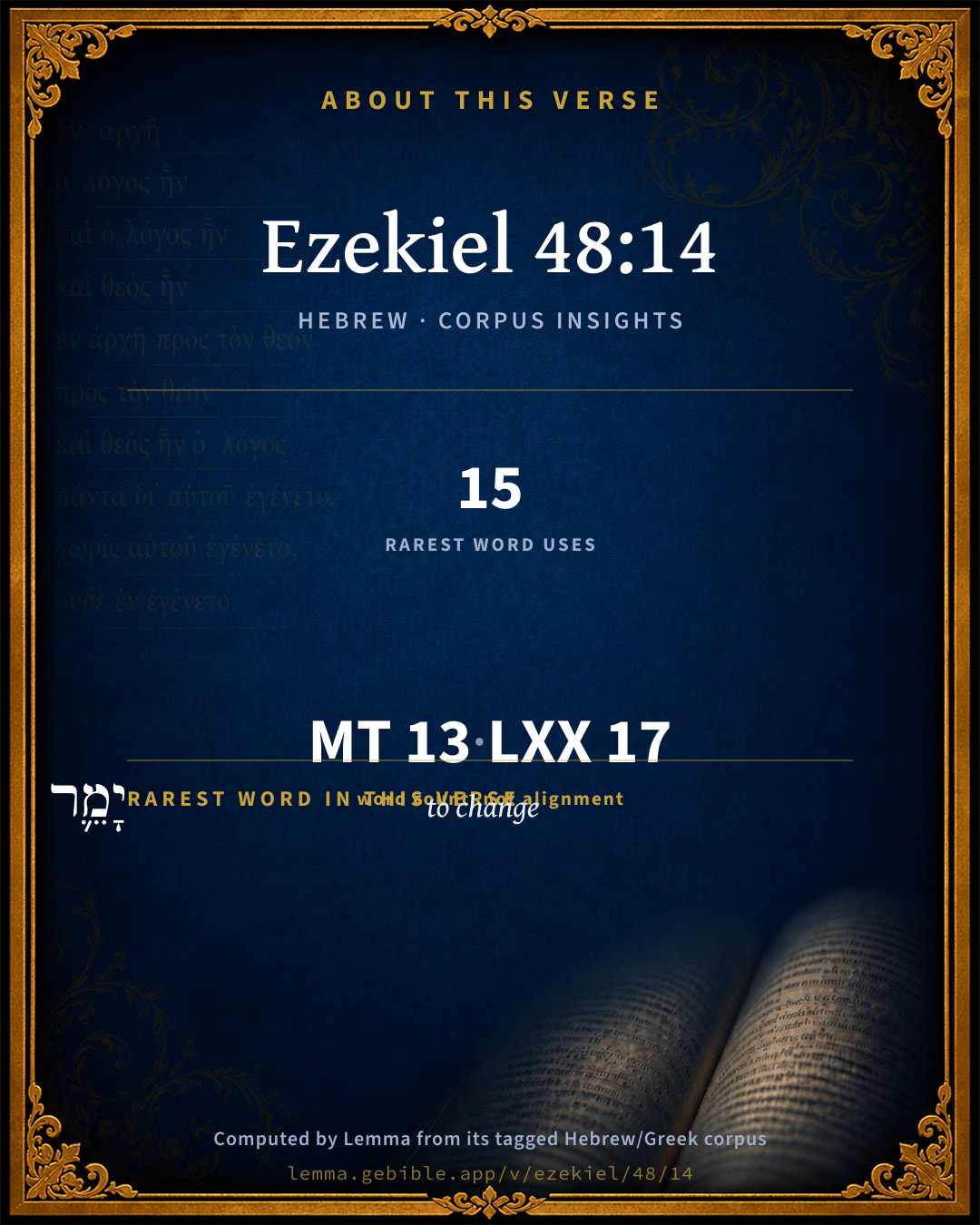
13
words
10
distinct lemmas
Prophets
section

Notable vocabulary

The rarest word here is יָמֵ֛ר to change H4171 — appearing just 15 times in the whole Hebrew Bible.

Shared distinctive vocabulary

יָמֵ֛ר to change H4171 occurs in 10 verses of the Hebrew Bible. Also found in:

Grammatical profile

  • 4 verbs
  • 4 nouns
  • 1 preposition
  • 1 conjunction
  • 3 particles

Verb forms

  • יִמְכְּר֣וּ Qal · Imperfect
  • יָמֵ֛ר Hiphil · Jussive
  • יעבור Qal · Imperfect
  • יַעֲבִ֖יר Hiphil · Imperfect

Repetition

Words recur within this verse — often emphatic in Hebrew:

  • יעבור to pass over H5674 ×2
  • וְלֹא not H3808 ×3

Hebrew & Septuagint length

In English translation the verse runs 25 words from the Hebrew and 30 from the Septuagint (LXX English) — closely comparable.

A rough comparison of the two English renderings, which tokenize alike — not a word-level alignment.

Word counts can differ between the Hebrew and the Greek without any difference in meaning — e.g. the Hebrew direct-object marker אֵת has no separate Greek word, and Greek often adds the article ὁ.

In the original languages it is 13 Hebrew tokens and 17 Greek tokens — but the two are counted differently (Hebrew bundles its prefixes and suffixes into one token; the Greek is in lemma form), so that isn’t a like-for-like length.

Cross-references

8

Topical passages linked to Ezekiel 48:14 in the Treasury of Scripture Knowledge — connected by theme and wording, ordered by reader-vote popularity; previews shown in the World English Bible.

  • Leviticus 27:28 "'Notwithstanding, no devoted thing, that a man shall devote to Yahweh of all that he has, whether of man or animal, or of the field of his possession, shall be sold or redeemed: every devoted thing is most holy to Yahweh.
  • Leviticus 27:9–10 "'If it is an animal, of which men offer an offering to Yahweh, all that any man gives of such to Yahweh becomes holy.
  • Exodus 22:29 "You shall not delay to offer from your harvest and from the outflow of your presses. "You shall give the firstborn of your sons to me.
  • Leviticus 23:20 The priest shall wave them with the bread of the first fruits for a wave offering before Yahweh, with the two lambs. They shall be holy to Yahweh for the priest.
  • Leviticus 25:34 But the field of the suburbs of their cities may not be sold; for it is their perpetual possession.
  • Leviticus 27:32–33 All the tithe of the herds or the flocks, whatever passes under the rod, the tenth shall be holy to Yahweh.
  • Ezekiel 48:12 It shall be to them an offering from the offering of the land, a thing most holy, by the border of the Levites.
  • Malachi 3:8–10 Will a man rob God? Yet you rob me! But you say, 'How have we robbed you?' In tithes and offerings.

Cross-references courtesy of OpenBible.info (CC BY 4.0).

Hebrew and Greek witnesses Masoretic Hebrew ↔ Greek Septuagint

The same verse in the two great witnesses to the Old Testament, shown verse-for-verse.

These are two independent witnesses, not word-aligned to each other, and the Septuagint is shown in lemma (dictionary) form.

Hebrew Ezekiel 48:14 Masoretic · Westminster Leningrad Codex

וְלֹא יִמְכְּר֣וּ מִמֶּ֗נּוּ וְלֹ֥א יָמֵ֛ר וְלֹ֥א יעבור יַעֲבִ֖יר רֵאשִׁ֣ית הָאָ֑רֶץ כִּי קֹ֖דֶשׁ לַיהוָֽה

They shall sell none of it, nor exchange it, nor shall the first fruits of the land be alienated; for it is holy to Yahweh.

World English Bible · Public Domain

Greek LXX Ezekiel 48:14 Septuagint · lemma form

οὐ πιπράσκω ἐκ αὐτός οὐδέ καταμετρέω οὐδέ ἀποαἱρέω ὁ πρωτογένημα ὁ γῆ ὅτι ἅγιος εἰμί ὁ κύριος

No part of it shall be sold, nor measured as for sale, neither shall the first fruits of the land be taken away: for they are holy to the Lord.

LXX2012 (modern English Septuagint) · Public Domain

Hebrew: Westminster Leningrad Codex (CC BY 4.0). Greek: Septuagint (public domain); English from LXX2012 (modern English Septuagint) (Public Domain). How the Septuagint differs from the Hebrew →

Targum (Aramaic paraphrase)

1

The Targum is the ancient Jewish Aramaic paraphrase of the Hebrew Scriptures — an interpretive translation, not the Hebrew text itself. Onkelos (literal) and Pseudo-Jonathan (expansive) render the Torah, and Jonathan the Prophets. Coverage is partial: where no permissively-licensed English translation exists for a verse, only the Aramaic is shown. This is verse-level text, not a word-by-word alignment to the Hebrew.

  1. Targum Jonathan Prophets (Joshua–Malachi)
    וְלָא יִזְבְּנוּן מִנֵיהּ וְלָא יַחֲלִיף וְלָא יַעֲבַר רֵישׁ אַרְעָא אֲרֵי קוּדְשָׁא קֳדָם יְיָ:

    (no public-domain English translation for this verse)

    Targum Jonathan — Aramaic: “Mikraot Gedolot” (public domain). English: “Sefaria Community Translation” (CC0 1.0 (public-domain dedication)); “London "Chaldee Paraphrase," 1871” (public domain). Text via Sefaria.

Commentary

Notes on Ezekiel 48:14 from classic Christian and Jewish commentators (each source and its license shown beneath its notes). The classic Christian expositions comment on the surrounding passage and are grouped to its opening verse, so a note may address several verses; the Jewish commentaries on the Tanakh (Rashi and others) are per-verse, so they appear only where the commentator wrote on this verse.

Lemma curates 59 commentaries, every one of them public domain or Creative Commons licensed, each selected and text-cleaned for this edition rather than reprinted as found. About our sources →

Trapp's Complete Commentary

John Trapp

Eze 48:14 And they shall not sell of it, neither exchange, nor alienate the firstfruits of the land: for [it is] holy unto the LORD.

Ver. 14. And they shall not sell of it.] This law is here occasionally, and by the way, inserted. It seemeth to hold forth, that lands given to the ministers of Christ under the New Testament may never be again taken away, or put to any other use, but to their maintenance for ever. See Mr Clark’s Mirror, chap. of Sacrilege.

The firstfruits of the land,] i.e., This part thus consecrated to God, as the firstfruits of the earth were.

John Trapp, A Commentary or Exposition upon All the Books of the Old and New Testament (1647–1656) — public domain. Text from a community e-Sword module.

Ellicott's Commentary for English Readers

(14) Shall not sell of it.—The Levites’ portion (Eze_48:13) was of the same size as that of the priests, instead of their having (as under the law) nearly three times as many cities, and the restriction of Lev_25:34 that they might not even temporarily alienate the fields attached to their cities, is here extended to their whole land on the express ground that it is “first-fruits.”

A Bible Commentary for English Readers, edited by Charles John Ellicott (1878–1897) — public domain. Text from a community e-Sword module.

The Cambridge Bible for Schools and Colleges

gen. ed. J. J. S. Perowne

14. Seems to apply to the united domain of priests and Levites.

the firstfruits] Possibly: this first-fruits or, best—the term being applied to the holy oblation in distinction from the rest of the land.

The Cambridge Bible for Schools and Colleges (gen. ed. J. J. S. Perowne; Cambridge University Press, 1878–1918) — public domain. Text from a community e-Sword module.

John Gill's Exposition

And the residue in length over against the oblation of the holy portion shall be ten thousand eastward, and ten thousand westward,.... What remained in length, which ran parallel with the holy portion of the land, after five thousand reeds were taken out for the city and suburbs, were twenty thousand; ten thousand to the east, and ten thousand to the west:

and it shall be over against the oblation of the holy portion; that is, that space as yet undisposed of, the twenty thousand reeds, ten on the east, and ten on the west of the city, were close to, and ran even with, the oblation of the holy portion assigned to the priests and Levites:

and the increase thereof; or what these twenty thousand reeds of land should produce, or could be made of them:

shall be for food for them that serve the city; not the Gibeonites given to be hewers of wood and drawers of water, as Jarchi interprets it; which sense is justly rejected by Kimchi; since, as he observes, the Gibeonites shall not dwell in Jerusalem the holy city, nor minister in time to come: but either civil magistrates, who serve the church of Christ, when they secure the peace of it, protect and defend it; as they will, especially in the latter day, when these officers will be peace, and these exactors righteousness do all things justly and equitably; and when kings shall be nursing fathers and queens nursing mothers to the church; and it is but right they shall be provided for suitably to their rank, dignity, and office, and tribute be given to whom tribute is due: or ministers of the word, who are the church's servants, and serve it in preaching the Gospel, and administering the ordinances of it; and go by various names, as husbandmen concerned in ploughing, sowing, reaping, and gathering in the harvest; as labourers in the vineyard, and employed in planting, watering, pruning, and propping the vines; and as stewards of the mysteries and manifold grace of God, to give to everyone in the city and family his portion of meat in due season; and as guides and governors, engaged in taking care of the good order and discipline of it; as watchmen, that go about it, or are set on the walls of it: and it is the will of God they should be comfortably provided for, and eat of the fruit of the field and vineyard they labour in; and of the milk of the flock they take care of; and reap carnal things where they have sowed spiritual, things: or else private believers, who serve the interest of Christ and one another by love; praying with and for one another; bearing one another's burdens, and building up each other on their most holy faith: and for whom "food", or "bread" (u), as in the original, both temporal and spiritual, is provided; both being to be had of the Lord, with whom there is enough, and to spare; Christ is the bread of life, and his word and ordinances are the provisions of Zion; which all that serve the city or church of God may partake of.

(u) "in panem", Pagninus, Montanus, Piscator.

John Gill's Exposition of the Whole Bible (1746–1763) — public domain (CC PDM 1.0). Text via the HelloAO Bible API.

Matthew Poole's English Annotations

It is most holy, and therefore no price should be offered for it, nor any price set upon it, nor may they pass away any on pretence of getting greater and more particularly serviceable to them and their employment, and so for convenience part with God’s inheritance; this is forbidden: this is holy, as the first-fruits were under the law, Lev 25:23,24; 1Ki 21:4.

Matthew Poole's English Annotations on the Holy Bible (1683–1685) — public domain. Text from a community e-Sword/MySword module.

The Pulpit Commentary

An inalienable possession.

The people were not permitted to sell their allotments, and especial provision was made to prevent the priests from parting with their share of the fruits of the land.

I THE CHRISTIAN INHERITANCE IS AN INALIENABLE POSSESSION.

1. No enemy can take it away. Christ secures it for his people, so that it is theirs forever. We may lose all earthly things in the shocks and changes of life, but the heavenly treasure abides. So long as we hold it truly, no moth nor rust can corrupt it, no thief can then break through and steal it.

2. The Christian has no right to part with it. He can deny Christ, renounce the gift of God, and abdicate his position as one of the kings and priests of God. But he has no right to act in this way. When once he is called into the kingdom it is with a view of never departing from it. Though left free from external constraints, the bands of conscience forbid his ever giving up his glorious heritage. The vows of Christian fidelity are irrevocable.

II IT IS A SIN TO ENDANGER THE CHRISTIAN INHERITANCE. AS Christians, we have a charge to keep. Our estate in the kingdom of heaven is entrusted to us. But we may be false to our trust in various ways.

1. By neglecting it. So long as our heritage is faithfully kept no enemy can enter or injure it. But if the hedge is broken down the wild boar from the wood may come through and root up the tender vines. (Psa_80:13) We need to watch over and carefully guard the privileges of the Christian life.

2. By renouncing it for worldly things. The priest might grow tired of his sacred office, and might prefer to have a farm of his own rather than be dependent on the sacrificial offerings of the people, while a lay Israelite, ambitious of the priesthood, might be glad to barter his estate for rank and office in the temple. This was forbidden. The Christian has no right to give up his allegiance to Christ and his inheritance in heavenly things for any earthly consideration. Having put his hand to the plough, he is never to look back.

III THE INALIENABILITY OF THE CHRISTIAN INHERITANCE RESULTS FROM ITS RELATIONS TO GOD. The portion of the priests was holy, not because they had it, but because it was primarily God"s share of the produce of the land. The Christian inheritance has special relations to God.

1. It is purchased by the death of Christ, the Son of God. A possession so acquired must have a profound sanctity attached to it. To throw away lightly a gift that was brought to us by means of the incarnation and crucifixion of our Lord is to despise God"s most wonderful condescension, to trample on the love of Christ in his most tremendous self-sacrifice. If he has died to make the inheritance ours, the least we can do is to prize it above all things.

2. It is still rightly owned by God. The priests enjoyed God"s portion of the produce. It was still God"s while they had it. Christ has called us into his kingdom to be his stewards. All we enjoy really belongs to him, and we shall have to give an account of our stewardship. If we destroy or alienate the vineyard with which we are now entrusted, we shall have no answer to give in the great day of reckoning.

The Pulpit Commentary (1880–1919), ed. H.D.M. Spence-Jones & Joseph S. Exell — public domain. Text from a community e-Sword module.

Rashi

Rabbi Shlomo Yitzchaki (Rashi)

or exchange And he shall not exchange it for any other land.

Rashi on the Tanakh — English translations: “The Judaica Press complete Tanach with Rashi, translated by A. J. Rosenberg” (CC BY 4.0); “Pentateuch with Rashi's commentary by M. Rosenbaum and A.M. Silbermann, 1929-1934” (public domain); “The Metsudah Tanach series, Lakewood, N.J” (CC BY 4.0); and “The Book of Joshua, Metsudah Publications, 1997” (CC BY 4.0). Text via Sefaria.

Lesson kit

Teaching starters — assembled from the data on this page, not authored interpretation. Every prompt links to the verse data it draws on. Edit before teaching.

Ezekiel, in the Prophets, opens this verse with 13 words (10 distinct Hebrew lemmas). Its most distinctive word is mûwr (“to change”). A historical commentator’s framing appears above. Read the whole chapter for the surrounding context.

Discussion questions

  1. How does “to change” (mûwr) shape what this verse is saying?
  2. Leviticus 27:10 shares the word «to change» with this verse. How do the two illuminate each other?
  3. “to pass over” occurs 2× in this one verse. What is the effect of the repetition?
  4. These translations render this verse differently. What is at stake in choosing one wording over another?
  5. The verb «יִמְכְּר֣וּ» is Qal Imperfect. How does its form color the action?
  6. Reading how Trapp's Complete Commentary and Ellicott's Commentary for English Readers read this verse, where do the two commentators agree and where do they part?

Things to notice

Reading settings

Reading text

Shown beneath each verse's original-language words.

Old Testament
Old Testament edition

Read the OT as the Masoretic Hebrew (MT) or the Greek Septuagint (LXX).

English shown for the Greek Septuagint (in the Hebrew ↔ Greek comparison).

Comparing translations? Open the Compare panel on any verse page to stack up to four side by side.