Deuteronomy 3:25

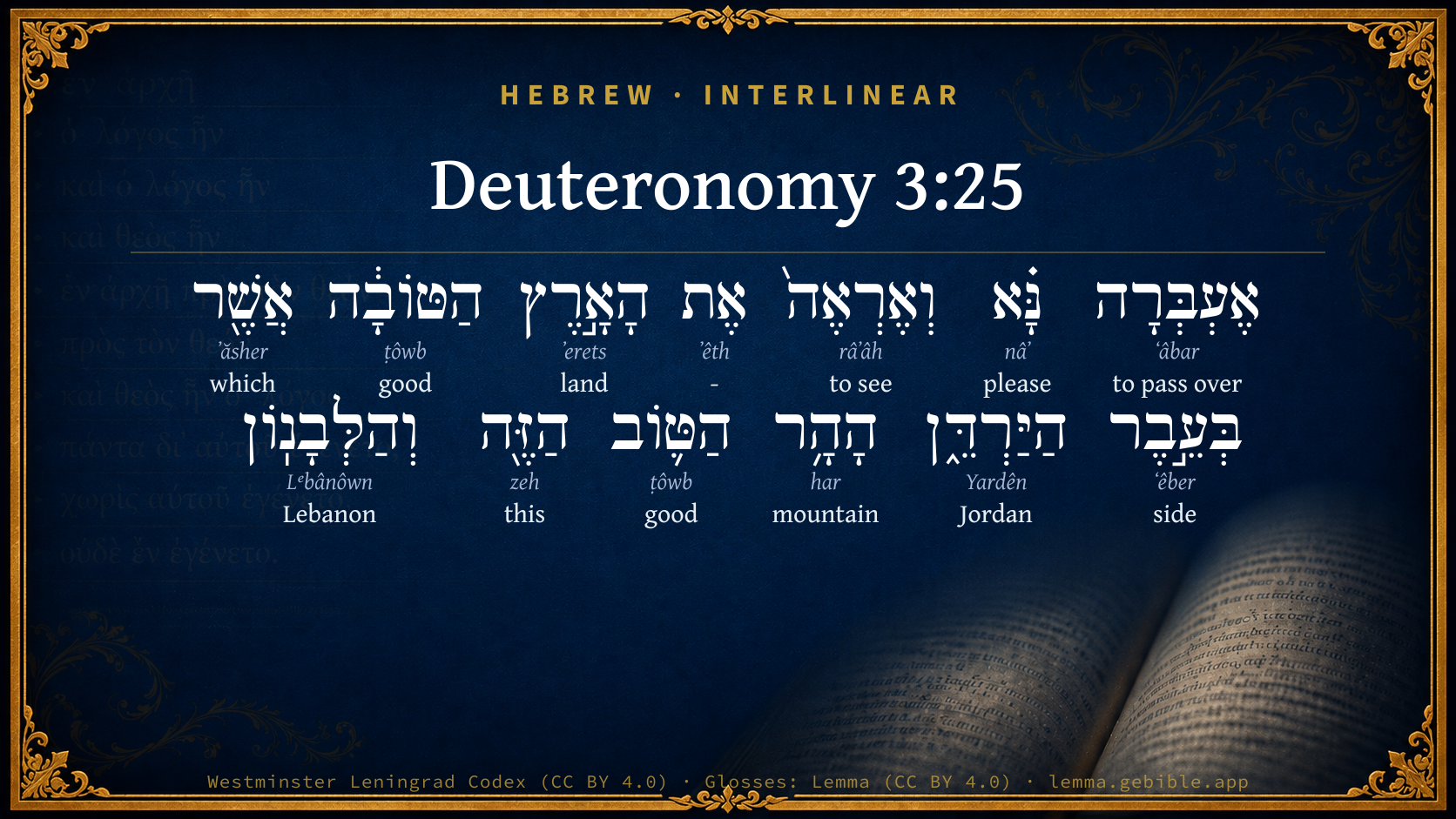
Hebrew (Westminster Leningrad Codex) Deuteronomy 3:25 appears in the Hebrew Old Testament. The text above is from the Westminster Leningrad Codex. Each word links to its Strong’s number, a concise gloss, and parsing drawn from the Open Scriptures Hebrew Bible morphology. Click any word for its full Brown-Driver-Briggs (BDB) entry.
Download image
Cite this verse

Deuteronomy 3:25 (World English Bible). Public Domain. Lemma interlinear Bible study tool, https://lemma.gebible.app/v/deuteronomy/3/25.

Show BibTeX & RIS
BibTeX
RIS
English Translation
Please let me go over and see the good land that is beyond the Jordan, that goodly mountain, and Lebanon.
World English Bible · Public Domain
Download a study sheet

One document with this verse’s original text, its word-by-word gloss line, the meaning frame, cross-references with their text, attributed commentary, and full source and license credits — printable, and it pastes into notes with its structure intact.

This verse Autodidact and up

Study sheet (.html) Plain text (.txt)

A passage Seminary Student

Up to 50 verses in one chapter. A passage sheet keeps up to 6 commentary sources and 12 cross-references per verse, in the order this page ranks them, and says so on the sheet whenever that leaves anything out. Ask for a single verse and you get the Autodidact verse sheet above.

Everything on this page stays free to read, with no account — the sheet is a download of what is already on screen, not access to it.

Want to remove ads? Support Godless Engineer
Compare translations 3

The same verse in 3 English versions, stacked beneath the original-language interlinear above. Click any original word for its lexicon entry.

Each is an independent rendering of the whole verse — the interlinear is not word-aligned to these translations.

Highlighted words mark where these versions differ — a whole-verse word diff, not a word-by-word alignment.

  • World English Bible Public Domain
    Please let me go over and see the good land that is beyond the Jordan, that goodly mountain, and Lebanon.
  • King James Version Public Domain
    I pray thee, let me go over, and see the good land that is beyond Jordan, that goodly mountain, and Lebanon.
  • unfoldingWord Literal Text CC BY-SA 4.0
    Let me cross, please, and see the good land that across the Jordan, that good hill, and Lebanon.’

unfoldingWord Literal Text — © unfoldingWord, licensed CC BY-SA 4.0. Word-aligned USFM3 via Door43 (git.door43.org/unfoldingWord/en_ult).

Versions to compare (up to 4)

3 of 4 selected

Show all 18 translations

Every available English version of this verse, each an independent rendering of the whole verse.

  • World English Bible Public Domain
    Please let me go over and see the good land that is beyond the Jordan, that goodly mountain, and Lebanon.
  • Berean Standard Bible Public Domain
    Please let me cross over and see the good land beyond the Jordan—that pleasant hill country as well as Lebanon!”
  • Majority Standard Bible Public Domain
    Please let me cross over and see the good land beyond the Jordan—that pleasant hill country as well as Lebanon!”
  • King James Version Public Domain
    I pray thee, let me go over, and see the good land that is beyond Jordan, that goodly mountain, and Lebanon.
  • American Standard Version (1901) Public Domain
    Let me go over, I pray thee, and see the good land that is beyond the Jordan, that goodly mountain, and Lebanon.
  • Revised Version (1885) Public Domain
    Let me go over, I pray thee, and see the good land that is beyond Jordan, that goodly mountain, and Lebanon.
  • Geneva Bible (1599) Public Domain
    I pray thee let me go ouer and see the good land that is beyond Iorden, that goodly mountaine, and Lebanon.
  • Douay-Rheims (1899) Public Domain
    I will pass over therefore, and will see this excellent land beyond the Jordan, and this goodly mountain, and Libanus.
  • Young's Literal Translation Public Domain
    Let me pass over, I pray Thee, and see the good land which `is' beyond the Jordan, this good hill-country, and Lebanon.
  • Literal Standard Version CC BY-SA 4.0
    Please let me pass over and see the good land which [is] beyond the Jordan, this good hill-country, and Lebanon.
  • Unlocked Literal Bible CC BY-SA 4.0
    Let me go over, I beg you, and see the good land that is beyond the Jordan, that good hill country, and also Lebanon.'
  • unfoldingWord Literal Text CC BY-SA 4.0
    Let me cross, please, and see the good land that across the Jordan, that good hill, and Lebanon.’
  • Darby Bible Public Domain
    Let me go over, I pray thee, and see the good land that is beyond the Jordan, that goodly mountain, and Lebanon.
  • World Messianic Bible Public Domain
    Please let me go over and see the good land that is beyond the Jordan, that fine mountain, and Lebanon.”
  • Webster's Bible Public Domain
    I pray thee, let me go over, and see the good land that is beyond Jordan, that goodly mountain, and Lebanon.
  • Free Bible Version CC BY-SA 4.0
    Please, let me cross over the Jordan and see the good land there, the beautiful hills, and the mountains of Lebanon!”
  • Bible in Basic English Public Domain
    Let me go over, O Lord, and see the good land on the other side of Jordan, and that fair mountain country, even Lebanon.
  • JPS Tanakh (1917) Public Domain
    Let me go over, I pray Thee, and see the good land that is beyond the Jordan, that goodly hill-country, and Lebanon.'

Literal Standard Version (2020), Covenant Press — licensed CC BY-SA 4.0. Text via the HelloAO Bible API (eBible.org). Unlocked Literal Bible (unfoldingWord) — licensed CC BY-SA 4.0. Text via the HelloAO Bible API (eBible.org). unfoldingWord Literal Text — © unfoldingWord, licensed CC BY-SA 4.0. Word-aligned USFM3 via Door43 (git.door43.org/unfoldingWord/en_ult). Free Bible Version, Dr. Jonathan Gallagher — licensed CC BY-SA 4.0. Text via the HelloAO Bible API (eBible.org).

Word by word

More ways to search: Search by grammar → Find every occurrence → Compare this word →

Practice this passage: Drill this verse → Learn its vocabulary →

וְהַלְּבָנֽוֹן
Lᵉbânôwn
H3844
“and · the · Lebanon”
Conjunction + Particle, Definite Article + Noun, Proper
Part of Speech
Conjunction + Particle + Noun
Type
Proper
Full BDB Definition

Origin: from H3835

TWOT: 1074e

Lebanon = "whiteness" - a wooded mountain range on the northern border of Israel
  1. אֶעְבְּרָה ʻâbar H5674 “to pass over” Verb, Qal, Cohortative, 1st Person, Common, Singular
  2. נָּ֗א nâʼ H4994 “please” Particle, Interjection
  3. וְאֶרְאֶה֙ râʼâh H7200 “and · to see” Conjunction + Verb, Qal, Cohortative, 1st Person, Common, Singular
  4. אֶת ʼêth H853 “-” Particle, Direct Object
  5. הָאָ֣רֶץ ʼerets H776 “the · land” Particle, Definite Article + Noun, Common, Both, Singular, Absolute
  6. הַטּוֹבָ֔ה ṭôwb H2896 “the · good” Particle, Definite Article + Adjective, Adjective, Feminine, Singular, Absolute
  7. אֲשֶׁ֖ר ʼăsher H834 “which” Particle, Relative
  8. בְּעֵ֣בֶר ʻêber H5676 “in/at · side of” Preposition + Noun, Common, Masculine, Singular, Construct
  9. הַיַּרְדֵּ֑ן Yardên H3383 “the · Jordan” Particle, Definite Article + Noun, Proper
  10. הָהָ֥ר har H2022 “the · mountain” Particle, Definite Article + Noun, Common, Masculine, Singular, Absolute
  11. הַטּ֛וֹב ṭôwb H2896 “the · good” Particle, Definite Article + Adjective, Adjective, Masculine, Singular, Absolute
  12. הַזֶּ֖ה zeh H2088 “the · this” Particle, Definite Article + Pronoun, Demonstrative, Masculine, Singular

About this verse

These counts appear in no published source. They are computed here, from the morphology-tagged text and Lemma’s own curated glosses. What Lemma adds →

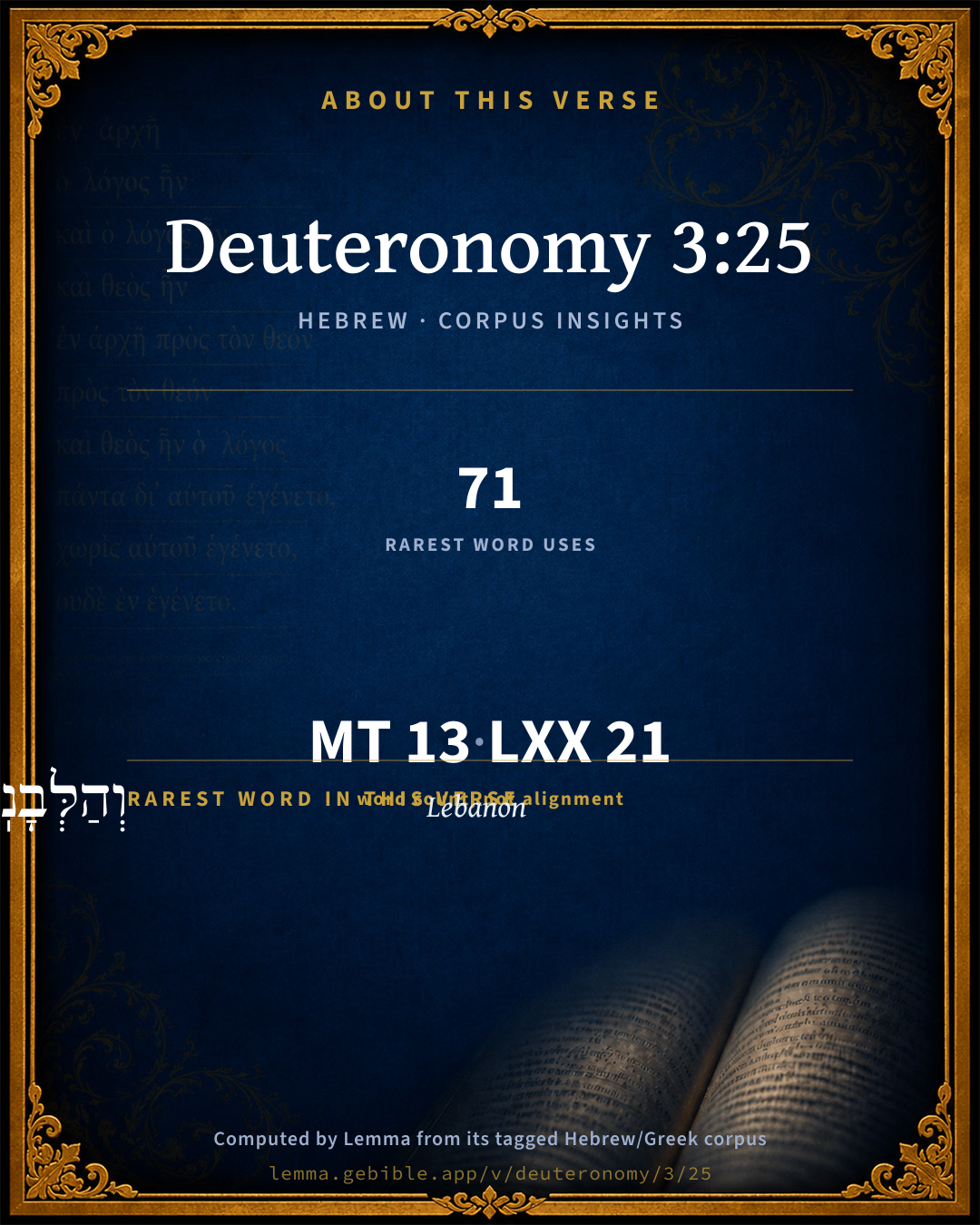
13
words
12
distinct lemmas
Pentateuch
section

Grammatical profile

  • 2 verbs
  • 5 nouns
  • 2 adjectives
  • 1 pronoun
  • 3 particles

Verb forms

  • אֶעְבְּרָה Qal · Cohortative
  • וְאֶרְאֶה֙ Qal · Cohortative

Repetition

A word recurs within this verse — often emphatic in Hebrew:

  • הַטּוֹבָ֔ה good H2896 ×2

Hebrew & Septuagint length

In English translation the verse runs 20 words from the Hebrew and 19 from the Septuagint (LXX English) — closely comparable.

A rough comparison of the two English renderings, which tokenize alike — not a word-level alignment.

Word counts can differ between the Hebrew and the Greek without any difference in meaning — e.g. the Hebrew direct-object marker אֵת has no separate Greek word, and Greek often adds the article ὁ.

In the original languages it is 13 Hebrew tokens and 21 Greek tokens — but the two are counted differently (Hebrew bundles its prefixes and suffixes into one token; the Greek is in lemma form), so that isn’t a like-for-like length.

Cross-references

4

Topical passages linked to Deuteronomy 3:25 in the Treasury of Scripture Knowledge — connected by theme and wording, ordered by reader-vote popularity; previews shown in the World English Bible.

  • Deuteronomy 4:21–22 Furthermore Yahweh was angry with me for your sakes, and swore that I should not go over the Jordan, and that I should not go in to that good land, which Yahweh your God gives you for an inheritance:
  • Exodus 3:8 I have come down to deliver them out of the hand of the Egyptians, and to bring them up out of that land to a good and large land, to a land flowing with milk and honey; to the place of the Canaanite, the Hittite, the Amorite, the Perizzite, the Hivite, and the Jebusite.
  • Deuteronomy 11:11–12 but the land, where you go over to possess it, is a land of hills and valleys, [and] drinks water of the rain of the sky,
  • Ezekiel 20:6 in that day I swore to them, to bring them forth out of the land of Egypt into a land that I had searched out for them, flowing with milk and honey, which is the glory of all lands.

Cross-references courtesy of OpenBible.info (CC BY 4.0).

Hebrew and Greek witnesses Masoretic Hebrew ↔ Greek Septuagint

The same verse in the two great witnesses to the Old Testament, shown verse-for-verse.

These are two independent witnesses, not word-aligned to each other, and the Septuagint is shown in lemma (dictionary) form.

Hebrew Deuteronomy 3:25 Masoretic · Westminster Leningrad Codex

אֶעְבְּרָה נָּ֗א וְאֶרְאֶה֙ אֶת הָאָ֣רֶץ הַטּוֹבָ֔ה אֲשֶׁ֖ר בְּעֵ֣בֶר הַיַּרְדֵּ֑ן הָהָ֥ר הַטּ֛וֹב הַזֶּ֖ה וְהַלְּבָנֽוֹן

Please let me go over and see the good land that is beyond the Jordan, that goodly mountain, and Lebanon.

World English Bible · Public Domain

Greek LXX Deuteronomy 3:25 Septuagint · lemma form

διαβαίνω οὖν ὁράω ὁ γῆ ὁ ἀγαθός οὗτος ὁ εἰμί πέραν ὁ ἰορδάνης ὁ ὄρος οὗτος ὁ ἀγαθός καί ὁ ἀντιλίβανος

I will therefore go over and see this good land that is beyond Jordan, this good mountain and Antilibanus.

LXX2012 (modern English Septuagint) · Public Domain

Hebrew: Westminster Leningrad Codex (CC BY 4.0). Greek: Septuagint (public domain); English from LXX2012 (modern English Septuagint) (Public Domain). How the Septuagint differs from the Hebrew →

Targum (Aramaic paraphrase)

2

The Targum is the ancient Jewish Aramaic paraphrase of the Hebrew Scriptures — an interpretive translation, not the Hebrew text itself. Onkelos (literal) and Pseudo-Jonathan (expansive) render the Torah, and Jonathan the Prophets. Coverage is partial: where no permissively-licensed English translation exists for a verse, only the Aramaic is shown. This is verse-level text, not a word-by-word alignment to the Hebrew.

  1. Targum Onkelos Torah (Genesis–Deuteronomy)
    אֵעִבַר כְּעַן וְאֶחֱזֵי יָת אַרְעָא טַבְתָא דִּי בְּעִבְרָא דְיַרְדְנָא טוּרָא טָּבָא הָדֵין וּבֵית מַקְדָשָׁא

    (no public-domain English translation for this verse)

    Targum Onkelos — Aramaic: “Onkelos Genesis” (public domain); “Onkelos Exodus” (public domain); “Onkelos Leviticus” (public domain); “Onkelos Numbers” (public domain); “Onkelos Deuteronomy” (public domain). English: “Sefaria Community Translation” (CC0 1.0 (public-domain dedication)); “J.W. Etheridge. The Targums of Onkelos and Jonathan Ben Uzziel on the Pentateuch. London: Longmans, Green, 1862” (public domain). Text via Sefaria.

  2. Targum Pseudo-Jonathan Torah (Genesis–Deuteronomy)
    אֱעִיבַר כְּדוֹן וְאֶחֱמֵי יַת אַרְעָא טַבְתָא דִבְעִיבְרָא דְיוֹרְדְּנָא טַוְורָא טָבָא דְנַן דְּבֵיהּ מִתְבַּנְיָא קַרְתָּא דִירוּשְׁלֵם וְטַוָור לִיבְנָן דְּבֵיהּ עָתִיד לְמִישְׁרֵי שְׁכִינְתָּא

    Let me, I pray, pass over and see the good land that is beyond Jordan, that goodly mountain on which is builded the city of Jerusalem, and Mount Lebanon, where the Shekinah will dwell.

    Targum Pseudo-Jonathan — Aramaic: “Targum Jonathan on Genesis” (public domain); “Targum Jonathan on Exodus” (public domain); “Targum Jonathan on Leviticus” (public domain); “Targum Jonathan on Numbers” (public domain); “Targum Jonathan on Deuteronomy” (public domain). English: “The Targum of Jonathan ben Uzziel, trans. J. W. Etheridge, London, 1862” (public domain). Text via Sefaria.

Commentary

Notes on Deuteronomy 3:25 from classic Christian and Jewish commentators (each source and its license shown beneath its notes). The classic Christian expositions comment on the surrounding passage and are grouped to its opening verse, so a note may address several verses; the Jewish commentaries on the Tanakh (Rashi and others) are per-verse, so they appear only where the commentator wrote on this verse.

Lemma curates 59 commentaries, every one of them public domain or Creative Commons licensed, each selected and text-cleaned for this edition rather than reprinted as found. About our sources →

Trapp's Complete Commentary

John Trapp

Deu 3:25 I pray thee, let me go over, and see the good land that [is] beyond Jordan, that goodly mountain, and Lebanon.

Ver. 25. The good land.] The "glory of all lands." {Eze 20:6}

Goodly mountain.] Moriah likely, whereon the temple afterwards stood.

John Trapp, A Commentary or Exposition upon All the Books of the Old and New Testament (1647–1656) — public domain. Text from a community e-Sword module.

Joseph Benson's Commentary

Deu 3:25. Let me go over — For he supposed God’s threatening might be conditional and reversible, as many others were. That goodly mountain — Which the Jews not improbably understood of that mountain on which the temple was to be built. This he seems to call that mountain, emphatically and eminently, that which was much in Moses’s thoughts, though not in his eye.

Joseph Benson's Commentary on the Old and New Testaments (1811–1818) — public domain. Text from a community e-Sword module.

Geneva Bible (1599)

Geneva Bible translators

He meaneth Zion, where the Temple should be built, and God honored.

Geneva Bible (1599) marginal notes — public domain. Text via Bolls.life.

Jamieson, Fausset & Brown

Robert Jamieson, A. R. Fausset & David Brown

I pray thee, let me go over, and see the good land that is beyond Jordan, that goodly mountain, and Lebanon--The natural and very earnest wish of Moses to be allowed to cross the Jordan was founded on the idea that the divine threatening might be conditional and revertible. "That goodly mountain" is supposed by Jewish writers to have pointed to the hill on which the temple was to be built (Deu 12:5; Exo 15:2). But biblical scholars now, generally, render the words--"that goodly mountain, even Lebanon," and consider it to be mentioned as typifying the beauty of Palestine, of which hills and mountains were so prominent a feature.

Jamieson, Fausset & Brown — Commentary Critical and Explanatory on the Whole Bible (1871) — public domain (CC PDM 1.0). Text via the HelloAO Bible API.

The Cambridge Bible for Schools and Colleges

gen. ed. J. J. S. Perowne

25. the good land] Deu_1:35.

that goodly mountain] To this day in Syria a whole range is called in the sing. mountain; and in fact from Nebo and the Ghôr below it all W. Palestine appears one compact mountain-mass.

and Lebanon] In clear weather Ḥermon, the summit of what is now particularised as Anti-Lebanon, is distinct from above Jericho and the opposite hills, as one looks up the Ghôr.

The Cambridge Bible for Schools and Colleges (gen. ed. J. J. S. Perowne; Cambridge University Press, 1878–1918) — public domain. Text from a community e-Sword module.

John Gill's Exposition

But the Lord was wroth with me for your sakes,.... Not at this time, and for this prayer of his, but on account of he and Aaron not sanctifying him at the waters of Meribah; or of some expressions of unbelief, and unadvised words, which dropped from his lips through their provocation of him; see Num 20:12.

and would not hear me; now, and grant the above request, having before declared that he and Aaron should not bring the people of Israel into the land he had given them; and Moses with all his entreaties could not prevail upon him to repeal the sentence:

and the Lord said unto me, let it suffice; that he had seen the conquest of the two kings, and the delivery of their kingdoms into the hands of Israel; and that he had brought the people through the wilderness to the borders of the land of Canaan, and that he should have a distant sight of the land, as after directed:

speak no more unto me of this matter; intimating it would be in vain, and to no purpose, to solicit such a favour, since it would never be granted; it was a determined point, and he would never recede from it.

John Gill's Exposition of the Whole Bible (1746–1763) — public domain (CC PDM 1.0). Text via the HelloAO Bible API.

Albert Barnes' Notes on the Bible

That goodly mountain - i. e., that mountainous district. The fiat districts of the East are generally scorched, destitute of water, and therefore sterile: the hilly ones, on the contrary, are of more tempered climate, and fertilized by the streams from the high grounds. Compare Deu 11:11.

The whole of this prayer of Moses is very characteristic. The longing to witness further manifestations of God’s goodness and glory, and the reluctance to leave unfinished an undertaking which he had been permitted to commence, are striking traits in his character: compare Exo 32:32 ff; Exo 33:12, Exo 33:18 ff; Num 14:12 ff.

Albert Barnes' Notes on the Bible (1834–1885) — public domain. Text from a community e-Sword/MySword module.

Haydock's Catholic Bible Commentary

I will. Moses flattered himself that God’s refusal to let him cross the Jordan, was only conditional; and therefore he begs, with all humility, for leave to enter Chanaan, at the head of the people. But, though God had pardoned his fault, he would not deprive Josue of the honour, which to fulfil the mystery, was reserved for him, Numbers xx. 12., and xxvi. 64. (Calmet) --- Moses might very lawfully desire to behold a place, consecrated by the abode of the Patriarchs, and to be honoured still more by the presence of the Messias, a happiness for which he had been labouring now forty years. (Du Hamel) --- And Libanus. Whether this and be an explanation of what mountain he meant, (Tirinus) is a matter of doubt. He unquestionably desired to see, and to put his people in possession of, all the country designed for their inheritance, in which various fruitful mountains appeared. That of Bethel was very high, and most delightful where Abraham and Jacob had dwelt. Moria and Sion, the future seat of the temple, might also attract his notice, and the mountains of Judea, as well as all the other lofty hills, which diversify the country for Idumea to Libanus. (Haydock) --- Egypt was a flat country. New and grander prospects now open to his view. Libanus is styled Antilibanus by the Septuatint, and by profane authors, as it lies, in effect, to the land of the Hebrews. Behind it Cœlostria extends, as far as Libanus. This mountain comprises four different hills, rising one above another, and taking in a circuit of 300 miles. The first of these hills, Antilibanus, is remarkable for its fertility in corn; the second has abundance of fine springs: but the third resembles an earthly paradise, being constantly adorned with fruits and flowers. Cedars grow chiefly upon the fourth, amidst the snows which lie there perpetually, notwithstanding the burning heats of the adjacent countries. Lebanon signifies both "whiteness and incense," for which it is very renowned. (Calmet) --- De la Roque thinks that it is higher than the Alps or Pyrenees. It stands in the form of a horse-shoe, extending from above Smyrna to Sidon, and thence towards Damascus, (Buffon) unless this be a part of Antilibanus, which runs north, from Damascus, in a parallel direction to Libanus, and includes the hollow Syria. (Haydock) --- Serarius makes these two mountains run eastward, almost from the Mediterranean sea, as Strabo (xvi.) and Ptolemy seem also to do. (Bonfrere)

George Leo Haydock (1774–1849), Haydock's Catholic Family Bible and Commentary, 1859 edition — public domain. Excludes Psalms (Douay-Rheims chapter numbering differs from Protestant) and Deuterocanonical books (Catholic canon only).

Matthew Poole's English Annotations

For he supposed God’s threatening might be conditional and reversible, as many others were.

That goodly mountain, or, that blessed mountain, which the Jews not improbably understand of that mountain on which the temple was to be built. For as Moses desired and determined to prepare an habitation for God, Exo 15:2, and knew very well that God would choose a certain place for his habitation, and to put his name there, Deu 12:5; so he also knew that it was the manner both of the true worshippers of God and of idolaters to worship their God in high places, and particularly that Abraham did worship God in the mount of Moriah, Gen 22:2, and therefore did either reasonably conjecture that God would choose some certain mountain for the place of his habitation, or possibly understood by revelation that in that very mount of Moriah, where Abraham performed that eminent and glorious act of worship, there also the children of Abraham should have their place of constant and settled worship. This he seems to call that mountain, emphatically and eminently, that which was much in Moses’s thoughts, though not in his eye, and the blessed (as the Hebrew tob oft signifies) or the goodly mountain. Or, the mountain may be here put for the mountainous countries, as that word is oft used, as Gen 36:9; Num 13:29; 23:7; Deu 1:7; Jos 10:6; 11:16,21, &c. And it is known that a great part of the glory and beauty and profit of this country lay in its hills or mountains. See Deu 11:11; 33:15. And

that goodly mountain may by an enallage of the number be put for those goodly mountains in Canaan, which were many. Thus also he proceeds gradually in this desire and description, and prays that he may see in general the good land that is beyond Jordan, and then particularly the goodly mountains of it, and especially that famous mount of Lebanon, which was so celebrated for its tall and large cedars, and other trees and excellent plants. See Psa 29:5; 104:16; Isa 2:13; 14:8.

Matthew Poole's English Annotations on the Holy Bible (1683–1685) — public domain. Text from a community e-Sword/MySword module.

Whedon's Commentary on the Bible

Daniel D. Whedon

THE APPOINTMENT OF JOSHUA AS THE SUCCESSOR OF MOSES, Deu_3:21-29. In Num_27:12-23, the death of Moses is foretold, and the appointment and consecration of Joshua related. Moses here reminds the people of this, and tells them that, notwithstanding his prayer that he might go over and see the goodly land, his request is not granted. This prayer of Moses is not mentioned in Numbers. It undoubtedly preceded the request for the appointment of a leader for the congregation.

25. That goodly mountain — Not one particular portion of the Promised Land is referred to, but the whole as a hilly region. As Moses stood on the plains of Moab the land across the Jordan would be to his vision mountainous throughout.

Daniel D. Whedon (gen. ed.), Commentary on the Old and New Testaments (1874–1909) — public domain. Text from a community e-Sword module.

The Pulpit Commentary

That goodly mountain; not any mountain specially, but the whole mountain elevation of Canaan, culminating in the distant Lebanon, as it appeared to the eye of Moses from the lower level of the "Arabah. This was "goodly," especially in contrast with the arid and sunburnt desert through which the Israelites had passed; the hills gave promise of streams that should cool the air and refresh and fertilize the land. (see Deu_8:7, etc.) Moses longed to go over if but to see this land, and to plant his foot on it; but his request was not granted.

The Pulpit Commentary (1880–1919), ed. H.D.M. Spence-Jones & Joseph S. Exell — public domain. Text from a community e-Sword module.

John Wesley's Explanatory Notes

Let me go over - For he supposed God's threatening might be conditional and reversible, as many others were. That goodly mountain -Which the Jews not improbably understood of that mountain on which the temple was to be built. This he seems to call that mountain, emphatically and eminently, that which was much in Moses's thoughts, though not in his eye.

John Wesley, Explanatory Notes Upon the Whole Bible (1754–1765) — public domain. Text via the GEBible commentary corpus.

Rashi

Rabbi Shlomo Yitzchaki (Rashi)

אעברה נא LET ME PASS OVER, I PRAY THEE — The term נא is a term of request (it does not here signify "now").

ההר הטוב הזה THAT GOODLY MOUNTAIN, i.e. Jerusalem (that was situated on hills) (Sifrei Bamidbar 134:5).

והלבנן AND LEBANON — this is a term for the Temple (Siphre).

Rashi on the Tanakh — English translations: “The Judaica Press complete Tanach with Rashi, translated by A. J. Rosenberg” (CC BY 4.0); “Pentateuch with Rashi's commentary by M. Rosenbaum and A.M. Silbermann, 1929-1934” (public domain); “The Metsudah Tanach series, Lakewood, N.J” (CC BY 4.0); and “The Book of Joshua, Metsudah Publications, 1997” (CC BY 4.0). Text via Sefaria.

Lesson kit

Teaching starters — assembled from the data on this page, not authored interpretation. Every prompt links to the verse data it draws on. Edit before teaching.

Deuteronomy, in the Pentateuch, opens this verse with 13 words (12 distinct Hebrew lemmas). Its most distinctive word is Lᵉbânôwn (“Lebanon”). A historical commentator’s framing appears above. Read the whole chapter for the surrounding context.

Discussion questions

  1. How does “Lebanon” (Lᵉbânôwn) shape what this verse is saying?
  2. How does Deuteronomy 4:21–22, which shares this passage’s theme, read alongside this verse?
  3. What does the repetition of “good” (2× in this one verse) do in this verse?
  4. The translations on this page render this verse differently — a whole-verse word diff, not a word-by-word alignment. What might account for the different wordings?
  5. «אֶעְבְּרָה» is a Qal Cohortative verb. How does that grammatical form shape the action described?
  6. Compare how Trapp's Complete Commentary and Joseph Benson's Commentary read this verse. Where do they agree or differ?

Things to notice

Reading settings

Reading text

Shown beneath each verse's original-language words.

Old Testament
Old Testament edition

Read the OT as the Masoretic Hebrew (MT) or the Greek Septuagint (LXX).

English shown for the Greek Septuagint (in the Hebrew ↔ Greek comparison).

Comparing translations? Open the Compare panel on any verse page to stack up to four side by side.