
Ezekiel 39:11

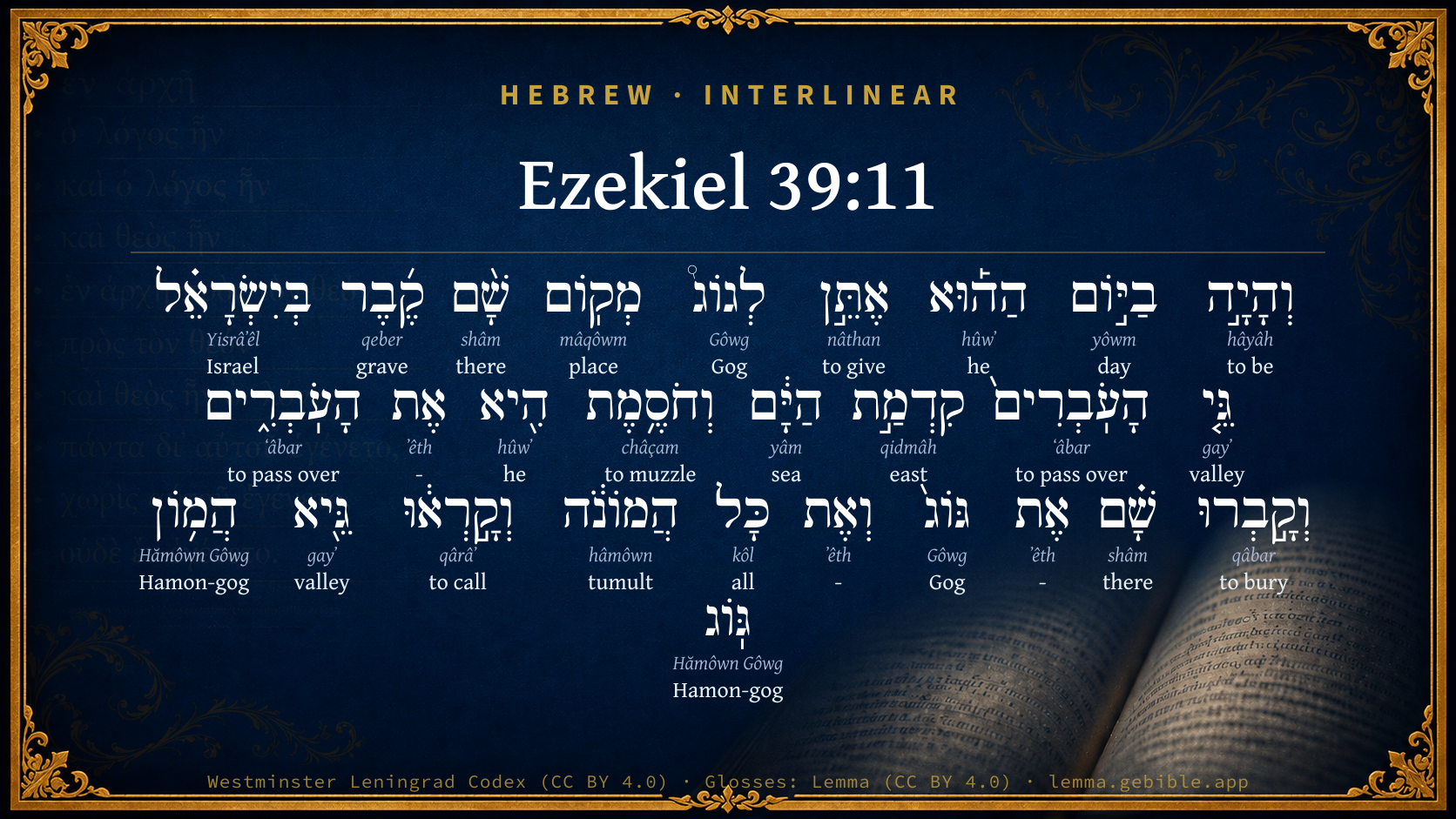
Hebrew (Westminster Leningrad Codex) Ezekiel 39:11 appears in the Hebrew Old Testament. The text above is from the Westminster Leningrad Codex. Each word links to its Strong’s number, a concise gloss, and parsing drawn from the Open Scriptures Hebrew Bible morphology. Click any word for its full Brown-Driver-Briggs (BDB) entry.
Download image
Cite this verse

Ezekiel 39:11 (World English Bible). Public Domain. Lemma interlinear Bible study tool, https://lemma.gebible.app/v/ezekiel/39/11.

Show BibTeX & RIS
BibTeX
RIS
English Translation
It shall happen in that day, that I will give to Gog a place for burial in Israel, the valley of those who pass through on the east of the sea; and it shall stop those who pass through: and there shall they bury Gog and all his multitude; and they shall call it The valley of Hamon Gog.
World English Bible · Public Domain
Highlights
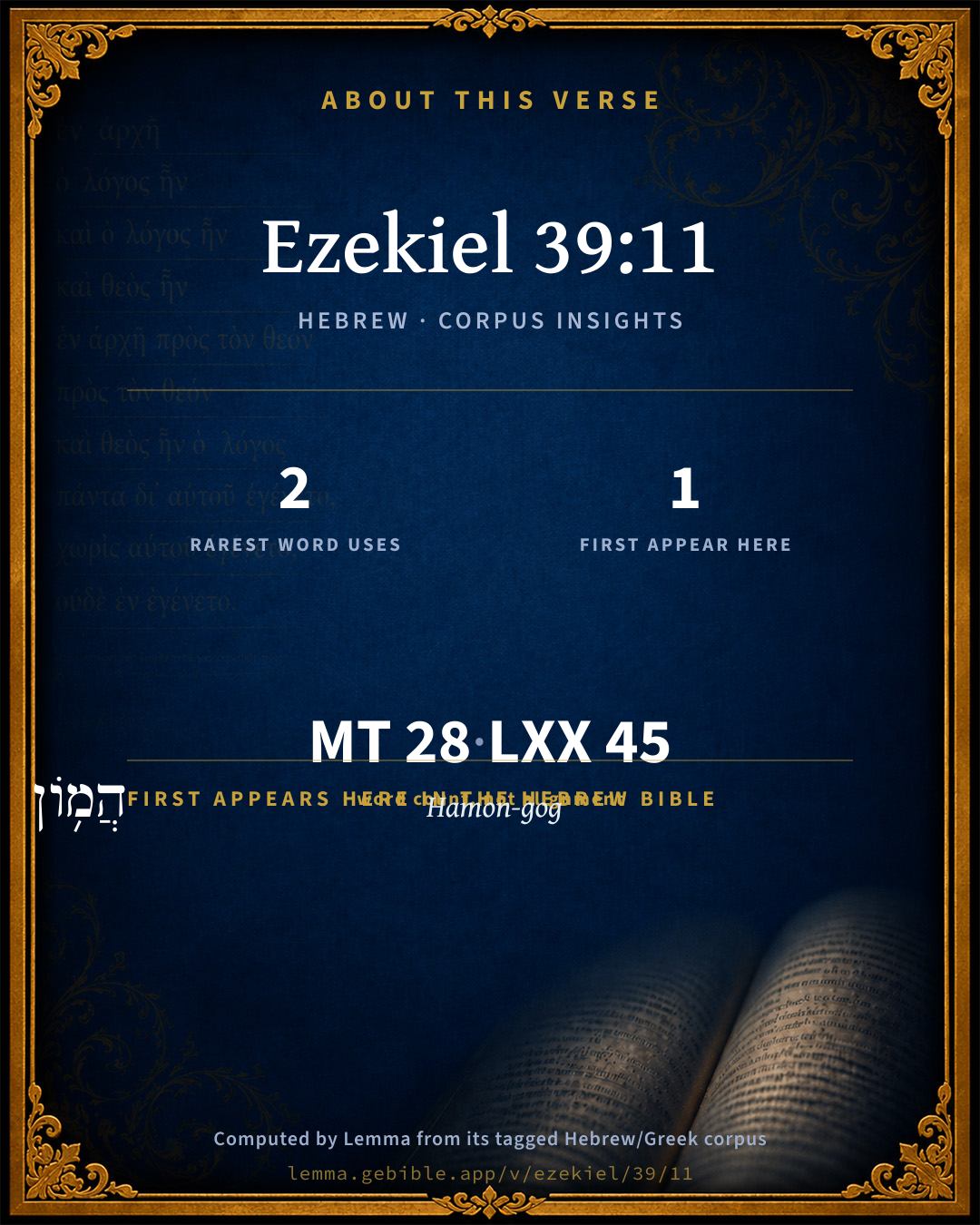
  • 1 first appearance in the Hebrew Bible
Full analysis ↓
Download a study sheet

One document with this verse’s original text, its word-by-word gloss line, the meaning frame, cross-references with their text, attributed commentary, and full source and license credits — printable, and it pastes into notes with its structure intact.

This verse Autodidact and up

Study sheet (.html) Plain text (.txt)

A passage Seminary Student

Up to 50 verses in one chapter. A passage sheet keeps up to 6 commentary sources and 12 cross-references per verse, in the order this page ranks them, and says so on the sheet whenever that leaves anything out. Ask for a single verse and you get the Autodidact verse sheet above.

Everything on this page stays free to read, with no account — the sheet is a download of what is already on screen, not access to it.

Want to remove ads? Support Godless Engineer
Compare translations 3

The same verse in 3 English versions, stacked beneath the original-language interlinear above. Click any original word for its lexicon entry.

Each is an independent rendering of the whole verse — the interlinear is not word-aligned to these translations.

Highlighted words mark where these versions differ — a whole-verse word diff, not a word-by-word alignment.

  • World English Bible Public Domain
    It shall happen in that day, that I will give to Gog a place for burial in Israel, the valley of those who pass through on the east of the sea; and it shall stop those who pass through: and there shall they bury Gog and all his multitude; and they shall call it The valley of Hamon Gog.
  • King James Version Public Domain
    And it shall come to pass in that day, that I will give unto Gog a place there of graves in Israel, the valley of the passengers on the east of the sea: and it shall stop the noses of the passengers: and there shall they bury Gog and all his multitude: and they shall call it The valley of Hamongog.
  • unfoldingWord Literal Text CC BY-SA 4.0
    Then it will happen on that day that I will make a place there for Gog—a grave in Israel, a valley for those who journey to the east of the sea. It will block those who wish to cross over. There they will bury Gog with all his multitudes. They will call it the Valley of Hamon Gog.

unfoldingWord Literal Text — © unfoldingWord, licensed CC BY-SA 4.0. Word-aligned USFM3 via Door43 (git.door43.org/unfoldingWord/en_ult).

Versions to compare (up to 4)

3 of 4 selected

Show all 18 translations

Every available English version of this verse, each an independent rendering of the whole verse.

  • World English Bible Public Domain
    It shall happen in that day, that I will give to Gog a place for burial in Israel, the valley of those who pass through on the east of the sea; and it shall stop those who pass through: and there shall they bury Gog and all his multitude; and they shall call it The valley of Hamon Gog.
  • Berean Standard Bible Public Domain
    And on that day I will give Gog a burial place in Israel, the Valley of the Travelers, east of the Sea. It will block those who travel through, because Gog and all his hordes will be buried there. So it will be called the Valley of Hamon-gog.
  • Majority Standard Bible Public Domain
    And on that day I will give Gog a burial place in Israel, the Valley of the Travelers, east of the Sea. It will block those who travel through, because Gog and all his hordes will be buried there. So it will be called the Valley of Hamon-gog.
  • King James Version Public Domain
    And it shall come to pass in that day, that I will give unto Gog a place there of graves in Israel, the valley of the passengers on the east of the sea: and it shall stop the noses of the passengers: and there shall they bury Gog and all his multitude: and they shall call it The valley of Hamongog.
  • American Standard Version (1901) Public Domain
    And it shall come to pass in that day, that I will give unto Gog a place for burial in Israel, the valley of them that pass through on the east of the sea; and it shall stop them that pass through: and there shall they bury Gog and all his multitude; and they shall call it The valley of Hamon-gog.
  • Revised Version (1885) Public Domain
    And it shall come to pass in that day, that I will give unto Gog a place for burial in Israel, the valley of them that pass through on the east of the sea: and it shall stop them that pass through: and there shall they bury Gog and all his multitude: and they shall call it The valley of Hamon-gog.
  • Geneva Bible (1599) Public Domain
    And at the same time will I giue vnto Gog a place there for burial in Israel, euen the valley whereby men go towarde the East part of the sea: and it shall cause them that passe by, to stoppe their noses, and there shall they bury Gog with all his multitude: and they shall call it the valley of Hamon-Gog.
  • Douay-Rheims (1899) Public Domain
    And it shall come to pass in that day, that I will give Gog a noted place for a sepulchre in Israel: the valley of the passengers on the east of the sea, which shall cause astonishment in them that pass by: and there shall they bury Cog, and all his multitude, and it shall be called the valley of the multitude of Cog.
  • Young's Literal Translation Public Domain
    And it hath come to pass, in that day, I give to Gog a place there -- a grave in Israel, the valley of those passing by, east of the sea, and it is stopping those passing by, and they have buried there Gog, and all his multitude, and have cried, O valley of the multitude of Gog!
  • Literal Standard Version CC BY-SA 4.0
    And it has come to pass in that day, I give a place to Gog there—a grave in Israel, the valley of those passing by, east of the sea, and it is stopping those passing by, and they have buried there Gog, and all his multitude, and have cried, O valley of the multitude of Gog!
  • Unlocked Literal Bible CC BY-SA 4.0
    Then it will happen on that day that I will make a place there for Gog—a grave in Israel, a valley for those who journey to the east of the sea. It will block those who wish to cross over. There they will bury Gog with all his multitudes. They will call it the Valley of Hamon Gog.
  • unfoldingWord Literal Text CC BY-SA 4.0
    Then it will happen on that day that I will make a place there for Gog—a grave in Israel, a valley for those who journey to the east of the sea. It will block those who wish to cross over. There they will bury Gog with all his multitudes. They will call it the Valley of Hamon Gog.
  • Darby Bible Public Domain
    And it shall come to pass in that day, [that] I will give unto Gog a place there for burial in Israel, the valley of the passers-by to the east of the sea; and it shall stop [the way] of the passers-by; and there shall they bury Gog and all the multitude; and they shall call it, Valley of Hamon-Gog.
  • World Messianic Bible Public Domain
    “‘“It will happen in that day, that I will give to Gog a place for burial in Israel, the valley of those who pass through on the east of the sea; and it will stop those who pass through. They will bury Gog and all his multitude there, and they will call it ‘The valley of Hamon Gog’.
  • Webster's Bible Public Domain
    And it shall come to pass in that day, that I will give to Gog a place there of graves in Israel, the valley of the passengers on the east of the sea: and it shall stop the noses of the passengers: and there shall they bury Gog and all his multitude: and they shall call it The valley of Hamon-gog.
  • Free Bible Version CC BY-SA 4.0
    At that time I will give Gog a place to be buried in Israel, the Travelers' Valley, east of the Sea. People won't be able to travel through because all his army will be buried there. So it will be called the Valley of Gog's Army.
  • Bible in Basic English Public Domain
    And it will come about in those days, that I will give to Gog a last resting-place there in Israel, in the valley of Abarim on the east of the sea: and those who go through will be stopped: and there Gog and all his people will be put to rest, and the place will be named, The valley of Hamon-gog.
  • JPS Tanakh (1917) Public Domain
    And it shall come to pass in that day, that I will give unto Gog a place fit for burial in Israel, the valley of them that pass through on the east of the sea; and it shall stop them that pass through; and there shall they bury Gog and all his multitude; and they shall call it the valley of Hamon-gog.

Literal Standard Version (2020), Covenant Press — licensed CC BY-SA 4.0. Text via the HelloAO Bible API (eBible.org). Unlocked Literal Bible (unfoldingWord) — licensed CC BY-SA 4.0. Text via the HelloAO Bible API (eBible.org). unfoldingWord Literal Text — © unfoldingWord, licensed CC BY-SA 4.0. Word-aligned USFM3 via Door43 (git.door43.org/unfoldingWord/en_ult). Free Bible Version, Dr. Jonathan Gallagher — licensed CC BY-SA 4.0. Text via the HelloAO Bible API (eBible.org).

Word by word

More ways to search: Search by grammar → Find every occurrence → Compare this word →

Practice this passage: Drill this verse → Learn its vocabulary →

וְחֹסֶ֥מֶת
châçam
H2629
“and · muzzling”
Conjunction + Verb, Qal, Participle Active, Feminine, Singular, Absolute
Part of Speech
Conjunction + Verb
Stem
Qal
Form
Participle Active
Gender
Feminine
Number
Singular
State
Absolute
Full BDB Definition

Origin: a primitive root

TWOT: 702

(Qal) to stop up, muzzle
  1. וְהָיָ֣ה hâyâh H1961 “and · to be” Conjunction + Verb, Qal, Sequential Perfect, 3rd Person, Masculine, Singular
  2. בַיּ֣וֹם yôwm H3117 “in/at the · day” Preposition, Determined + Noun, Common, Masculine, Singular, Absolute
  3. הַה֡וּא hûwʼ H1931 “the · he” Particle, Definite Article + Pronoun, Personal, 3rd Person, Masculine, Singular
  4. אֶתֵּ֣ן nâthan H5414 “to give” Verb, Qal, Imperfect, 1st Person, Common, Singular
  5. לְגוֹג֩ Gôwg H1463 “to/for · Gog” Preposition + Noun, Proper
  6. מְקֽוֹם mâqôwm H4725 “place of” Noun, Common, Masculine, Singular, Construct
  7. שָׁ֨ם shâm H8033 “there” Adverb
  8. קֶ֜בֶר qeber H6913 “grave” Noun, Common, Masculine, Singular, Absolute
  9. בְּיִשְׂרָאֵ֗ל Yisrâʼêl H3478 “in/at · Israel” Preposition + Noun, Proper
  10. גֵּ֤י gayʼ H1516 “valley of” Noun, Common, Both, Singular, Construct
  11. הָעֹֽבְרִים֙ ʻâbar H5674 “the · passing over” Particle, Definite Article + Verb, Qal, Participle Active, Masculine, Plural, Absolute
  12. קִדְמַ֣ת qidmâh H6926 “east of” Noun, Common, Feminine, Singular, Construct
  13. הַיָּ֔ם yâm H3220 “the · sea” Particle, Definite Article + Noun, Common, Masculine, Singular, Absolute
  14. הִ֖יא hûwʼ H1931 “he” Pronoun, Personal, 3rd Person, Feminine, Singular
  15. אֶת ʼêth H853 “-” Particle, Direct Object
  16. הָעֹֽבְרִ֑ים ʻâbar H5674 “the · passing over” Particle, Definite Article + Verb, Qal, Participle Active, Masculine, Plural, Absolute
  17. וְקָ֣בְרוּ qâbar H6912 “and · to bury” Conjunction + Verb, Qal, Sequential Perfect, 3rd Person, Common, Plural
  18. שָׁ֗ם shâm H8033 “there” Adverb
  19. אֶת ʼêth H853 “-” Particle, Direct Object
  20. גּוֹג֙ Gôwg H1463 “Gog” Noun, Proper
  21. וְאֶת ʼêth H853 “and · -” Conjunction + Particle, Direct Object
  22. כָּל kôl H3605 “all of” Noun, Common, Masculine, Singular, Construct
  23. הֲמוֹנֹ֔ה hâmôwn H1995 “tumult · his” Noun, Common, Masculine, Singular, Construct + Suffix, Personal, 3rd Person, Masculine, Singular
  24. וְקָ֣רְא֔וּ qârâʼ H7121 “and · to call” Conjunction + Verb, Qal, Sequential Perfect, 3rd Person, Common, Plural
  25. גֵּ֖יא gayʼ H1516 “valley of” Noun, Common, Both, Singular, Construct
  26. הֲמ֥וֹן Hămôwn Gôwg H1996 “Hamon-gog” Noun, Proper
  27. גּֽוֹג Hămôwn Gôwg H1996 “Hamon-gog” Noun, Proper

About this verse

These counts appear in no published source. They are computed here, from the morphology-tagged text and Lemma’s own curated glosses. What Lemma adds →

28
words
20
distinct lemmas
Prophets
section

Notable vocabulary

The rarest word here is וְחֹסֶ֥מֶת to muzzle H2629 — appearing just 2 times in the whole Hebrew Bible.

First appearance in Scripture

This word makes its first canonical appearance in the Hebrew Bible here:

  • הֲמ֥וֹן Hamon-gog H1996

Shared distinctive vocabulary

וְחֹסֶ֥מֶת to muzzle H2629 occurs in 2 verses of the Hebrew Bible. Also found in:

Grammatical profile

  • 7 verbs
  • 14 nouns
  • 2 pronouns
  • 2 adverbs
  • 3 particles

Verb forms

  • וְהָיָ֣ה Qal · Sequential Perfect
  • אֶתֵּ֣ן Qal · Imperfect
  • הָעֹֽבְרִים֙ Qal · Participle Active
  • וְחֹסֶ֥מֶת Qal · Participle Active
  • הָעֹֽבְרִ֑ים Qal · Participle Active
  • וְקָ֣בְרוּ Qal · Sequential Perfect
  • וְקָ֣רְא֔וּ Qal · Sequential Perfect

Repetition

Words recur within this verse — often emphatic in Hebrew:

  • לְגוֹג֩ Gog H1463 ×2
  • שָׁ֨ם there H8033 ×2
  • גֵּ֤י valley H1516 ×2
  • הָעֹֽבְרִים֙ to pass over H5674 ×2
  • הֲמ֥וֹן Hamon-gog H1996 ×2
  • הַה֡וּא he H1931 ×2

Hebrew & Septuagint length

In English translation the verse runs 59 words from the Hebrew and 63 from the Septuagint (LXX English) — closely comparable.

A rough comparison of the two English renderings, which tokenize alike — not a word-level alignment.

Word counts can differ between the Hebrew and the Greek without any difference in meaning — e.g. the Hebrew direct-object marker אֵת has no separate Greek word, and Greek often adds the article ὁ.

In the original languages it is 28 Hebrew tokens and 45 Greek tokens — but the two are counted differently (Hebrew bundles its prefixes and suffixes into one token; the Greek is in lemma form), so that isn’t a like-for-like length.

Cross-references

6

Topical passages linked to Ezekiel 39:11 in the Treasury of Scripture Knowledge — connected by theme and wording, ordered by reader-vote popularity; previews shown in the World English Bible.

  • Numbers 11:34 The name of that place was called Kibrothhattaavah, because there they buried the people who lusted.
  • Numbers 34:11 and the border shall go down from Shepham to Riblah, on the east side of Ain; and the border shall go down, and shall reach to the side of the sea of Chinnereth eastward;
  • Ezekiel 38:2 Son of man, set your face toward Gog, of the land of Magog, the prince of Rosh, Meshech, and Tubal, and prophesy against him,
  • Ezekiel 47:18 The east side, between Hauran and Damascus and Gilead, and the land of Israel, shall be the Jordan; from the [north] border to the east sea shall you measure. This is the east side.
  • Luke 5:1 Now it happened, while the multitude pressed on him and heard the word of God, that he was standing by the lake of Gennesaret.
  • John 6:1 After these things, Jesus went away to the other side of the sea of Galilee, which is also called the Sea of Tiberias.

Cross-references courtesy of OpenBible.info (CC BY 4.0).

Hebrew and Greek witnesses Masoretic Hebrew ↔ Greek Septuagint

The same verse in the two great witnesses to the Old Testament, shown verse-for-verse.

These are two independent witnesses, not word-aligned to each other, and the Septuagint is shown in lemma (dictionary) form.

Hebrew Ezekiel 39:11 Masoretic · Westminster Leningrad Codex

וְהָיָ֣ה בַיּ֣וֹם הַה֡וּא אֶתֵּ֣ן לְגוֹג֩ מְקֽוֹם שָׁ֨ם קֶ֜בֶר בְּיִשְׂרָאֵ֗ל גֵּ֤י הָעֹֽבְרִים֙ קִדְמַ֣ת הַיָּ֔ם וְחֹסֶ֥מֶת הִ֖יא אֶת הָעֹֽבְרִ֑ים וְקָ֣בְרוּ שָׁ֗ם אֶת גּוֹג֙ וְאֶת כָּל הֲמוֹנֹ֔ה וְקָ֣רְא֔וּ גֵּ֖יא הֲמ֥וֹן גּֽוֹג

It shall happen in that day, that I will give to Gog a place for burial in Israel, the valley of those who pass through on the east of the sea; and it shall stop those who pass through: and there shall they bury Gog and all his multitude; and they shall call it The valley of Hamon Gog.

World English Bible · Public Domain

Greek LXX Ezekiel 39:11 Septuagint · lemma form

καί εἰμί ἐν ὁ ἡμέρα ἐκεῖνος δίδωμι ὁ γωγ τόπος ὀνομαστός μνημεῖον ἐν ἰσραήλ ὁ πολυάνδριον ὁ ἐπιἔρχομαι πρός ὁ θάλασσα καί περιοἰκοδομέω ὁ περιστόμιον ὁ φάραγξ καί καταὀρύσσω ἐκεῖ ὁ γωγ καί πᾶς ὁ πλῆθος αὐτός καί καλέω ὁ γαι ὁ πολυάνδριον ὁ γωγ

And it shall come to pass that in that day I will give to Gog a place of renown, a tomb in Israel, the burial-place of them that approach the sea: and they shall build round about the outlet of the valley, and there they shall bury Gog and all his multitude: and the place shall then be called the burial-place of Gog.

LXX2012 (modern English Septuagint) · Public Domain

On this verse, The Cambridge Bible for Schools and Colleges discusses the Septuagint’s reading. Read the note in Commentary ↓

Hebrew: Westminster Leningrad Codex (CC BY 4.0). Greek: Septuagint (public domain); English from LXX2012 (modern English Septuagint) (Public Domain). How the Septuagint differs from the Hebrew →

Targum (Aramaic paraphrase)

1

The Targum is the ancient Jewish Aramaic paraphrase of the Hebrew Scriptures — an interpretive translation, not the Hebrew text itself. Onkelos (literal) and Pseudo-Jonathan (expansive) render the Torah, and Jonathan the Prophets. Coverage is partial: where no permissively-licensed English translation exists for a verse, only the Aramaic is shown. This is verse-level text, not a word-by-word alignment to the Hebrew.

  1. Targum Jonathan Prophets (Joshua–Malachi)
    וִיהֵי בְּעִדָנָא הַהוּא אֶתֵּן לְגוֹג אֲתַר כָּשַׁר לְבֵית קְבוּרָא בְּיִשְׂרָאֵל בְּחֵילְתָּא מְגִיזָתָא מַדְנַח יַם גִינוֹסַר וְסָמְכָא הִיא לִתְּרֵין טוּרַיָא וְיִקְבְּרוּן תַּמָן יַת גוֹג וְיַת כָּל אִתְרְגוּשְׁתֵּיהּ וְיִקְרוֹן חֵילַת אִתְרְגוּשַׁת גוֹג:

    (no public-domain English translation for this verse)

    Targum Jonathan — Aramaic: “Mikraot Gedolot” (public domain). English: “Sefaria Community Translation” (CC0 1.0 (public-domain dedication)); “London "Chaldee Paraphrase," 1871” (public domain). Text via Sefaria.

Commentary

Notes on Ezekiel 39:11 from classic Christian and Jewish commentators (each source and its license shown beneath its notes). The classic Christian expositions comment on the surrounding passage and are grouped to its opening verse, so a note may address several verses; the Jewish commentaries on the Tanakh (Rashi and others) are per-verse, so they appear only where the commentator wrote on this verse.

Lemma curates 59 commentaries, every one of them public domain or Creative Commons licensed, each selected and text-cleaned for this edition rather than reprinted as found. About our sources →

Trapp's Complete Commentary

John Trapp

Eze 39:11 And it shall come to pass in that day, [that] I will give unto Gog a place there of graves in Israel, the valley of the passengers on the east of the sea: and it shall stop the [noses] of the passengers: and there shall they bury Gog and all his multitude: and they shall call [it] The valley of Hamongog.

Ver. 11. I will give unto Gog a place there of graves.] That is all the portion or possession he gets in the Holy Land.

On the east of the sea.] The Dead Sea, or the lake of Sodom - a fit place for antichrist to be buried in: he shall at last be cast alive into a worse lake. {Rev 19:20}

And it shall stop the noses of passengers.] By reason of stench, or the mouths of passengers from speaking evil of God’s people.

And they shall call it.] For a lasting monument of God’s great mercy, in ridding the country of such pests.

John Trapp, A Commentary or Exposition upon All the Books of the Old and New Testament (1647–1656) — public domain. Text from a community e-Sword module.

Albert Barnes' Notes on the Bible

The prophet pictures to himself some imaginary valley (compare Zec 14:5) at the “east of the sea,” the Dead Sea, a place frightful in its physical character, and admonitory of past judgments. He calls it “the valley of the passengers” (or, passers-by), because they who there lie buried were but as a passing cloud. In Eze 39:11-15 there is a play upon words - there were “passengers” to be buried, “passengers” to walk over their graves, “passengers” to bury them; (or, a play upon the treble meaning of passing in (invading), passing by, and passing through.)

Stop the noses - The word thus rendered occurs only once more in Scripture Deu 25:4 where it is rendered muzzle. See Isa 34:3.

Hamon-gog - See the margin, compare Eze 39:16.

Albert Barnes' Notes on the Bible (1834–1885) — public domain. Text from a community e-Sword/MySword module.

Joseph Benson's Commentary

Eze 39:11-16. I will give unto Gog a place there of graves — Houbigant translates this passage, An illustrious place for sepulture, the valley of passengers opposite to the sea; through which the travellers shall pass, stopping their noses — According to the Chaldee, the scene here spoken of was the lake of Gennesareth. In the Hebrew language, all lakes are called by the name of seas. The same is called the eastern sea, (Eze 47:18,) to distinguish it from the Mediterranean, called the great sea westward, Jos 23:4. The valley near this sea is called the valley of the passengers, because it was the great road by which the merchants and traders from Syria, and other eastern countries, went into Egypt: see Gen 37:17; Gen 37:25. And seven months shall the house of Israel be burying of them — For a long time after the battle, the inhabitants shall be employed in burying the bones of the slain, that the land might not be polluted by them. Yea, all the people of the land shall bury them — See the note on the following verse. And it shall be to them a renown, &c. —

Or, The day that I shall be glorified shall be to them a day of renown, or a remarkable day of joy and gladness. And they shall sever out men, &c. — To cleanse the land thoroughly, men shall be set apart, and be constantly employed in picking up the bones of the slain that are scattered about, and burying them with the dead bodies of travellers who had happened to die on the roads; and they shall continue to do this, and be in daily search after the bones, for the space of seven months. The length of time assigned to this employment denotes the vast number of the slain, and the great care taken to cleanse the land from pollution. And when any seeth a man’s bone, then shall he set up a sign — A stone, or some other mark, that men may avoid passing over the bones, and that the persons appointed to bury them may take them from thence, and carry them to the proper burying- place. Also the name of the city shall be called Hamonah — Some render this verse, Also the name of the city, assigned to them who shall cleanse the land, shall be called Hamonah, that is, a multitude. The meaning seems to be, that the city where these appointed buriers should reside during the time they were employed in this office, and near which they should bury the dead, should afterward, in memory thereof, be called Hamonah; which, signifying a multitude, thereby denoted the greatness of the victory.

Joseph Benson's Commentary on the Old and New Testaments (1811–1818) — public domain. Text from a community e-Sword module.

Tyndale Open Study Notes

Tyndale Open Resources

39:11 The people would need to gather the plunder and bury the bodies of the slain soldiers. These corpses would otherwise defile the holy land, for contact with a corpse made a person ritually unclean. There were so many of these corpses that a vast graveyard would be required, big enough to fill an entire valley that would now be known as the Valley of Gog’s Hordes.

Tyndale Open Study Notes — © Tyndale Open Resources, licensed CC BY-SA 4.0. Text via the HelloAO Bible API.

Geneva Bible (1599)

Geneva Bible translators

Or, the multitude of Gog.

Which declareth that the enemies shall have an horrible fall.

For the stink of the carcasses.

Geneva Bible (1599) marginal notes — public domain. Text via Bolls.life.

Jamieson, Fausset & Brown

Robert Jamieson, A. R. Fausset & David Brown

place . . . of graves--Gog found only a grave where he had expected the spoils of conquest.

valley--So vast were to be the masses that nothing but a deep valley would suffice for their corpses.

the passengers on the east of the sea--those travelling on the high road, east of the Dead Sea, from Syria to Petra and Egypt. The publicity of the road would cause many to observe God's judgments, as the stench (as English Version translates) or the multitude of graves (as HENDERSON translates, "it shall stop the passengers") would arrest the attention of passers-by. Their grave would be close to that of their ancient prototypes, Sodom and Gomorrah in the Dead Sea, both alike being signal instances of God's judgments.

Jamieson, Fausset & Brown — Commentary Critical and Explanatory on the Whole Bible (1871) — public domain (CC PDM 1.0). Text via the HelloAO Bible API.

Adam Clarke's Commentary

Verse 11. The valley of the passengers on the east of the sea] That is, of Gennesareth, according to the Targum. The valley near this lake or sea is called the Valley of the Passengers, because it was a great road by which the merchants and traders from Syria and other eastern countries went into Egypt; see Ge 37:17; Ge 37:25. See Calmet here.

There shall they bury Gog and all his multitude] Some read, "There shall they bury Gog, that is, all his multitude." Not Gog, or Antiochus himself, for he was not in this battle; but his generals, captains, and soldiers, by whom he was represented. As to Hamon-gog, we know no valley of this name but here. But we may understand the words thus: the place where this great slaughter was, and where the multitudes of the slain were buried, might be better called Hamon-gog, the valley of the multitude of God, than the valley of passengers; for so great was the carnage there, that the way of the passengers shall be stopped by it. See the text.

Adam Clarke's Commentary on the Bible (1810–1826) — public domain. Text from a community e-Sword/MySword module.

Ellicott's Commentary for English Readers

(11) The valley of the passengers.—The name cannot be derived from the Scythians, as if they were spoken of “as a cloud passing over and gone,” because the same word is used again in this verse, and also in Eze_39:14-15, evidently in a different sense. It simply denotes some (probably imaginary) thoroughfare, which is to be blocked up by the buried bodies of the slain. No definite locality is assigned to it, except that it is “on the east of the sea,” meaning the Dead Sea. It was to be, therefore, on the extreme south-eastern outskirts of the land. This is another of the features of the description which indicate some other than a literal interpretation; for how should such a host, invading the land from the north for purposes of plunder, be found in that locality, and how could such vast numbers of dead bodies be transported thither?

Stop the noses.—The word “noses” is not in the original, and should be omitted. The meaning is simply that the bodies of the host shall so fill up the valley as to stop the way of travellers.

The valley of Hamon-gog.—It is better to translate the word Hamon, as in the margin: The valley of the multitude of Gog. So also in Eze_39:15.

A Bible Commentary for English Readers, edited by Charles John Ellicott (1878–1897) — public domain. Text from a community e-Sword module.

The Cambridge Bible for Schools and Colleges

gen. ed. J. J. S. Perowne

11. Gog’s burial—place shall be east of the Dead Sea.

a place there of graves] a place for a grave, lit. a place where a grave may be. For “there” LXX. reads name—a place of renown (name), a grave in Israel.

valley of the passengers] In Eze_39:14-15 the word is used of those appointed to go through the land in search of the scattered bones. The term cannot have that sense here. Ew. conjectured that it was a term applied to the hosts of Gog, the invaders, from their overflowing the country (Isa_8:8). The reading of Eze_39:14, however, which would be the strongest support of this view, is doubtful. The expression is probably a proper name; the “valley of the passers through” may have been so named as the usual route of communication between the east and west of the sea. Others by altering the points read “the (or, a) valley of Abarim” (Hitz. Corn.).

shall stop the noses] it shall stop them that pass through (or, the passengers). The valley shall be filled up with the graves of the innumerable hosts of Gog, so that the way of passers through shall be barred. A.V. has no probability. Neither LXX. nor Syr. read the words “those that pass through;” the former renders: and they shall build up the mouth of the valley round about.

Hamon-gog] i.e. Gog’s multitude.

The Cambridge Bible for Schools and Colleges (gen. ed. J. J. S. Perowne; Cambridge University Press, 1878–1918) — public domain. Text from a community e-Sword module.

John Gill's Exposition

And it shall come to pass in that day,.... When this destruction of the army of Gog shall be made:

that I will give unto Gog a place there of graves in Israel; or, "a place there, a grave in Israel" (b); he that thought to have subdued the whole land, and taken possession of it, shall have no more of it than just a place for a grave, to be buried in; a place fit for a grave, as the Targum; and where that will be is next observed: "the valley of the passengers on the east of the sea"; a valley through which travellers used to pass from Syria, Babylon, and other places, to Egypt and Arabia Felix, which lay east of the sea; not the Mediterranean sea, which lies west of Judea; but either the Dead sea, the sea of Sodom, a sulphurous lake, to which there may be an allusion, Rev 19:20 or the sea of Chinnereth, or Genesareth, as the Targum, Jarchi, and Kimchi; the same with the sea or lake of Tiberias and Galilee, mentioned in the New Testament; which sense is approved of by Gussetius (c); where was a passage from the land of Canaan to the east of the same sea. Calmet (d) thinks it stands for the great road at the foot of Mount Carmel, to go from Judea, Egypt, and the country of the Philistines, into Phoenicia, which road was to the east of the Mediterranean sea.

And it shall stop the noses of the passengers; or the passengers shall stop their noses, because of the ill smell of the carcasses (e); or their mouths, the mouths of blasphemers, who shall no more blaspheme the God of Israel, when they shall observe this monument of his power, in the destruction of his and his people's enemies. It may be rendered, "it shall stop the passengers (f); from passing that way, because of the multitude of the carcasses that shall fall there", and which is the reason of their being buried out of the way; this sense Jarchi takes notice of. The Targum is,

"and it is near to two mountains;''

as if this clause described the situation of the valley.

And there shall they bury Gog, and all his multitude; all his army, such of it as the fowls and beasts had not devoured, and the bones they had left; not his army only, but himself also, the Sultan or Grand Seignior of the Turks, the general of his mighty army: this was not true of Antiochus; he died not, nor was he buried in the land of Israel.

And they shall call it the valley of Hamon-gog: Hamon signifies a multitude; and this name will be imposed upon the place of Gog's sepulchre, because of the multitude slain and buried here, and to perpetuate the memory of it: there never was yet a place of this name in the land of Israel, which shows that this event is yet future. Calmet takes it to be the valley of Jezreel, in which he thinks the army of Cambyses was defeated, after the death of that prince; wrongly taking Cambyses and his army for Gog and Magog.

(b) "locum ibi sepulchrum", Starckius; "locum ubi sit sepulchrum", Cocceius. (c) Ebr. Comment. p. 585. (d) Dictionary in the word "Vale" (e) So R. Sol. Urbin. Ohel Moed, fol. 66. 2. (f) "et erit illa obturans transeuntes", Starckius; "et erit illa frenans transeuntes", Cocceius.

John Gill's Exposition of the Whole Bible (1746–1763) — public domain (CC PDM 1.0). Text via the HelloAO Bible API.

Haydock's Catholic Bible Commentary

East of the Mediterranean and of Carmel, the high road from Assyria to Egypt, (Genesis xxxvii. 2.; Calmet) where the Romans had a station at Legion. (Eusebius) --- Called, or shall be, Isaias vii. 14., and lx. 14. (Calmet) --- Valley. Septuagint, "Gai, the grave of Gog." Protestants, "the valley of Haman-Gog," ver. 16. (Haydock) --- Antichrist will not be burnt iwth material fire. But Catholics shall resist him zealously, and gain the victory. (Worthington)

George Leo Haydock (1774–1849), Haydock's Catholic Family Bible and Commentary, 1859 edition — public domain. Excludes Psalms (Douay-Rheims chapter numbering differs from Protestant) and Deuterocanonical books (Catholic canon only).

Matthew Poole's English Annotations

At that day; when God shall have destroyed this prince, and his formidable army.

Give unto Gog; and to many of those who were with him, for some were given to the birds and beasts to be devoured, Eze 39:4.

A place there of graves: beside many other reasons for burying these slaughtered multitudes, the humanity that religion is full of would guide the Jews to it, and God tells us that Gog shall have a grave in Israel. He came to take possession, and so he shall, but not as he purposed and hoped, but as God intended; Gog shall possess his house of darkness in that land which he invaded to make a prey of. He shall have one place there, a grave, as the Hebrew.

The valley of the passengers on the east of the sea: this valley hath here its name and situation; the name from the frequent travels of passengers through it from Egypt and Arabia Felix into the more northern parts, and from these again into Egypt and Arabia. By its situation it is on the east side of the Dead Sea, to distinguish it from the valley that is on this side Jordan westward, in which is Dothan. Now in this valley did the Jews discomfit the Ammonites, Moabites, Tyrians, and Sidonians, 1Ma 5. This might be a type, or firstfruits, and assurance of this great victory, but no more; for this was of a few against a few, and in this fight of some but few fell, &c.

It shall stop the noses; the stink of the putrefying carcasses should make travellers stop their noses, offended with the ill smells.

There shall they bury; partly in doing the office of humanity, though to dead enemies; and let their enemies live, who would not (for want of others) be so civil to them when dead; but chiefly to remove the nuisance of eye and nose, and to prevent diseases, that rise many times from such smells.

Gog: this prince, whoever it is, shall there fall, and be buried with

his multitude. They shall call it: this shall give name to the valley, which is to be called

The valley of Hamon-gog: which appellation I do not know to be given to any valley as yet, probably because this prophecy is not yet fully accomplished.

Matthew Poole's English Annotations on the Holy Bible (1683–1685) — public domain. Text from a community e-Sword/MySword module.

Whedon's Commentary on the Bible

Daniel D. Whedon

11. The R.V. reads, “And it shall come to pass in that day, that I will give unto Gog a place for burial in Israel, the valley of them that pass through on the cast of the sea: and it shall stop them that pass through.” Instead of “east of” the sea, Keil reads, “in front of.” Toy reads, “I will give Gog a place of renown, a grave in Israel.” Instead of “it shall stop them that pass through,” the copies from which the Greek and Syriac translations were taken read, “they shall stop [build up, wall in] the mouth of the valley.” The passage is extremely difficult, but the obvious meaning is that the number of the slain, or the impurity and uncleanness of the place (Driver), shall cause the traffic through this valley to cease. “Hamon-gog” merely means “the multitude of Gog,” and in no way assists in discovering the location of this valley. If, with Cornill, instead of “the valley of them that pass through,” we read, as we probably should, “the valley of Abarim” (compare Num_27:12; Num_33:47), we are led to the frontier mountain of Israel, over against Moab, with the great horrible sulphurous valley of the Dead Sea at its foot, through which ran the ancient road most traveled by invaders from the East. (See G.A. Smith, Historical Geography, pp. 13, 261-278.)

Daniel D. Whedon (gen. ed.), Commentary on the Old and New Testaments (1874–1909) — public domain. Text from a community e-Sword module.

The Pulpit Commentary

Verses 11-16 contain a second proof of the completeness of Gog"s destruction, viz. the length of time occupied in burying the slain and cleansing the land.

Gog, who should invade Israel in the hope of acquiring the entire mastery of her land, would obtain at Jehovah"s hands only a place there of graves, i.e. either, as Hitzig, Ewald, Keil, and Smend suggest, a place where a grave might be possible a place large enough to receive his slaughtered carcasses; or as Havernick proposes, "an altogether special grave as no other in Israel;" or as Schroder interprets, "a place where there is a grave for him and nothing else." Concerning both the designation and the site of this divinely provided sepulcher controversy has arisen.

(1) As to its site. The notion of Michaelis and Eiehhom, that the valley of the passengers on the east of the sea was in some way related to the mountains of Abarim mentioned in Num_27:12 and Deu_32:49, and that of Hitzig, that it signified "the valley of the opposite heights," as in 1Sa_17:3, and was to be sought for in the "very great valley" of Zec_14:4, may at once be dismissed the former as untenable, and the latter as far-fetched. The suggestion of Hengstenberg and Kliefoth, that by the burial-place of Gog was meant the valley of Megiddo, where Josiah fell in battle against Pharaoh-Necho, (2Ki_23:29) derives support from these considerations, that the very name of Megiddo points to battles, that in its vicinity are found such passes as are here described, and that its modern designation Lejun (Leqio), in all probability contains a reminiscence of the present passage. It is, however, open to the obvious objections that the place of Gog"s burial was not contiguous to the field of his overthrow, and that the clause locating it "on the east of the sea," by which on this hypothesis must be understood the Mediterranean, is rather descriptive of the entire land than of any particular spot therein. Hence the view of Havernick, Ewald, Keil, and Smoud, which finds the valley in the neighborhood of the Dead Sea, is to be preferred, though, even with agreement as to this, interpreters are not unanimous as to the spot intended. Ewald thinks of "the horrible, unwholesome valley over against the sea, i.e. (comp. Eze_47:8) the Dead Sea, that valley which covers the ancient overbearing ones (die Zerreisenden), the Sodomites, who resemble these;" Keil, translating kidmath as "in front of," holds by "the valley of the Jordan above the Dead Sea;" Havernick and Smend advocate "a place outside the Holy Land," though the clause, "a grave in Israel," seems against this. Dr. Currey, in the "Speaker"s Commentary," hints, net without reason, that the valley was "imaginary.

(2) As to its designation. That in the word "passengers" lies a paronomasia is apparent; but whether threefold or only twofold is uncertain.

In the present verse may signify either

(1) such travelers as were wont to pass through the valley (Keil), which is the obvious and natural interpretation; or

(2) the warriors of Gog (Ewald, Hitzig), who intended to pass through the land, but whose invasion had only proved a passing storm; or

(3) the commissioners who should be appointed to pass through the land in search of bones (ver. 15). The notion of Ewald, who derives from hr; b, and translates "haughty," "overbearing," meaning the Gogites, is countenanced by no ether expositor. If the first sense be taken, then the verse will read, "The valley of the passers through, and it (the valley, in consequence of having become the grave of Gog) stops (the way of) the passers through;" i.e. it becomes thereafter impassable for travelers (Rosenm Keil); or, it stops the noses, or breath, of such travelers by reason of its horrible stench (Ewald, Havernick). If the second meaning be selected, the valley must be understood to have afterwards received its name from the fact that Gog"s warriors lay entombed beneath its sod, and "the stopping of the passengers" to signify that whereas Gog purposed to overrun the land, his destructive career was there ignominiously arrested (Schroder). If the third rendering be preferred, then the valley will be held to have derived its designation, after the event, from the passing through it or through the land of the searchers, in which case the stepping of the passengers can only have alluded to the fact that, as the "buriers" proceeded with the work of interment, they were compelled to turn away their faces and stop their noses because of the noisome effluvium which arose from the corpses. The first interpretation is the best, though the first and second might be combined by making the first "passengers" stand for the travelers and the second for the invaders, whose career should there be stopped; and to this view a certain countenance is lent by the statements which follow, that there should Gog and all his multitude literally, all his noisy tumult be buried, and that the valley ever afterwards should bear the name of Hamon-gog, or, Gogs multitude.

The Pulpit Commentary (1880–1919), ed. H.D.M. Spence-Jones & Joseph S. Exell — public domain. Text from a community e-Sword module.

John Wesley's Explanatory Notes

Gog - And to many of those with him; but many were given to the birds and beasts to be devoured. Graves - Gog came to take possession; and so he shall, but not as he purposed and hoped. He shall possess his house of darkness in that land which he invaded. The valley of the passengers - So called from the frequent travels of passengers through it from Egypt and Arabia Felix, into the more northern parts, and from these again into Egypt and Arabia. The sea - The Dead Sea. Hamon Gog - That is, the multitude of Gog.

John Wesley, Explanatory Notes Upon the Whole Bible (1754–1765) — public domain. Text via the GEBible commentary corpus.

Scofield Reference Notes

C. I. Scofield

Gog

(See Scofield "Eze 38:2").

The Scofield Reference Bible (1917 edition), notes by C. I. Scofield — public domain. Text from a community e-Sword module.

unfoldingWord translationNotes

Door43 World Missions Community

Connecting Statement:

Yahweh begins to tell Ezekiel what will happen to Gog.

it will happen on that day that

This signals an important event. If your language has a way for doing this, you could use it here.

to the east of the sea

A few modern versions interpret the Hebrew expression here as "to the east toward the sea."

It will block

Possible meanings are 1) "The grave will block" or 2) "The dead army will block."

There they

"There the house of Israel"

They will call it

"People will call it"

Valley of Hamon Gog

"Valley of the Great Army of Gog"

translationWords

grave

unfoldingWord translationNotes — © Distant Shores Media and the Door43 World Missions Community, licensed CC BY-SA 4.0. Source: git.door43.org/Door43/en_tn.

Rashi

Rabbi Shlomo Yitzchaki (Rashi)

I will give Gog a place there as a grave A place where there will be a grave for them. Since he is of the seed of Japtheth, who covered his father’s nakedness, he therefore merited burial.

the valley of those who pass along The valley where people pass the Sea of Kinnereth to bring from there Genossar fruits regularly.

the east side of the sea Jonathan renders: on the east of the Sea of Gennasar.

and it will then stop those who pass along [Heb. וְחֹסֶמֶת.] It closes off those who pass, like (Deut. 25: 4): “You shall not muzzle (לֹא תַחְסוֹם).” Because of the many corpses that will fall there, travelers will be prevented from passing through. Therefore, they will pass by them and bury them. Menachem (p. 91) interprets it in his book (Machbereth) to mean that they will close their nose so as not to smell the odor of the corpses.

Rashi on the Tanakh — English translations: “The Judaica Press complete Tanach with Rashi, translated by A. J. Rosenberg” (CC BY 4.0); “Pentateuch with Rashi's commentary by M. Rosenbaum and A.M. Silbermann, 1929-1934” (public domain); “The Metsudah Tanach series, Lakewood, N.J” (CC BY 4.0); and “The Book of Joshua, Metsudah Publications, 1997” (CC BY 4.0). Text via Sefaria.

Lesson kit

Teaching starters — assembled from the data on this page, not authored interpretation. Every prompt links to the verse data it draws on. Edit before teaching.

Ezekiel, in the Prophets, opens this verse with 28 words (20 distinct Hebrew lemmas). Its most distinctive word is châçam (“to muzzle”). A historical commentator’s framing appears above. Read the whole chapter for the surrounding context.

Discussion questions

  1. The word châçam carries the sense “to muzzle.” How does it shape the verse?
  2. This is the first place “Hamon-gog” appears in Scripture (first appears here). What does its debut here establish?
  3. How does Deuteronomy 25:4, which shares the word «to muzzle», read alongside this verse?
  4. What does the repetition of “Gog” (2× in this one verse) do in this verse?
  5. These translations render this verse differently. What is at stake in choosing one wording over another?
  6. «וְהָיָ֣ה» is a Qal Sequential Perfect verb. How does that grammatical form shape the action described?
  7. Compare how Trapp's Complete Commentary and Albert Barnes' Notes on the Bible read this verse. Where do they agree or differ?

Things to notice

Reading settings

Reading text

Shown beneath each verse's original-language words.

Old Testament
Old Testament edition

Read the OT as the Masoretic Hebrew (MT) or the Greek Septuagint (LXX).

English shown for the Greek Septuagint (in the Hebrew ↔ Greek comparison).

Comparing translations? Open the Compare panel on any verse page to stack up to four side by side.